“Your kids wait in the car during dinner—the twins don’t like them,” my sister said at Mom’s birthday; Mom nodded; it was 30°F outside; I took my kids home; at 9 PM, Mom texted, “The heat stopped working—call your guy”; I replied, “My guy doesn’t like you”; then she remembered whose name was on the gas bill.
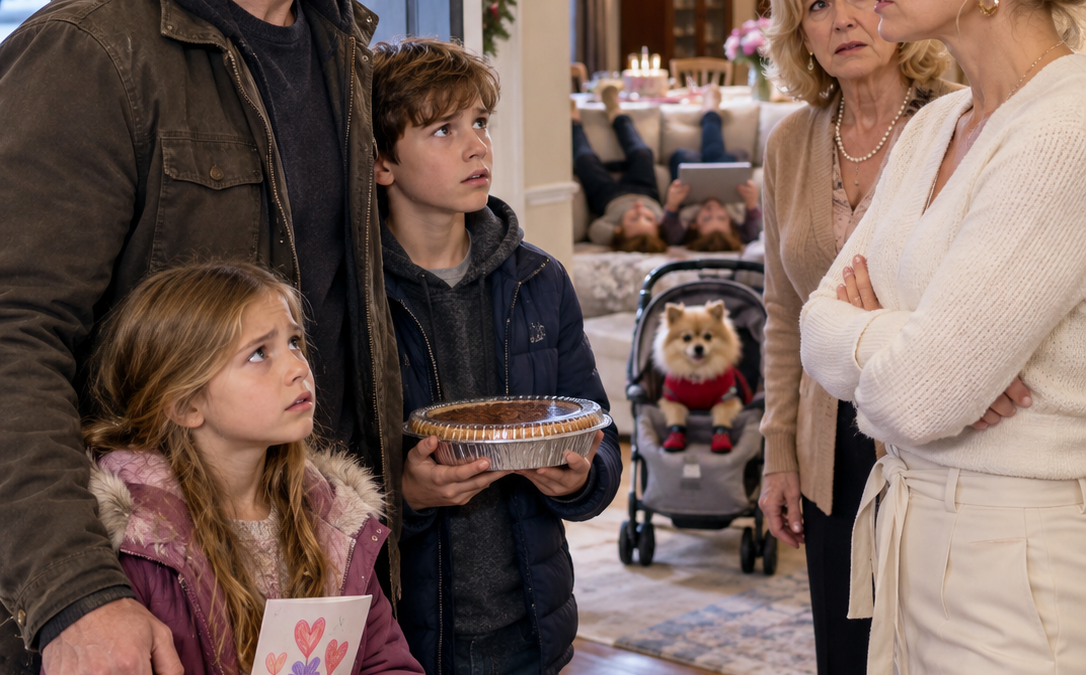
“Your kids can wait in the car during dinner. The twins don’t like them,” my sister Brooke said at Mom’s birthday.
Mom nodded.
That nod was what got me.
Not Brooke saying something ridiculous. Brooke had been saying ridiculous things with complete confidence since approximately 1998. But Mom agreeing with her while my twelve-year-old son, Owen, and nine-year-old daughter, Lucy, stood in the entryway holding her birthday gifts?
That was new.
I looked through the front window. It was 30 degrees outside. Then I looked back at my sister.
“You want my children to sit in my truck while the rest of us eat dinner?”
Brooke gave me the patient smile she normally used when explaining concepts like personal branding to people who had jobs.
“Rupert, please don’t make it sound cruel.”
“I repeated your sentence.”
“The truck has heat.”
“So does the house.”
Mom sighed. “Rupert.”
That tone. The same tone she’d used when I was fourteen and had supposedly embarrassed Brooke by telling her friends she slept with a stuffed rabbit named Mr. Bun Bun.
For the record, she did.
Brooke folded her arms. “The twins have been very clear that they don’t feel comfortable around Owen and Lucy.”
Her twins, Braxton and Brinley, were eight. At that exact moment, both were lying upside down on Mom’s couch, watching videos on an iPad while eating crackers directly over the cushions.
Owen looked at me. “What did we do?”
Brooke answered before I could.
“You can be a little intense.”
Owen blinked. “I said hi.”
Brooke nodded. “Exactly. Braxton felt pressured to respond.”
I stared at her.
Then Lucy asked, “What did I do?”
Brooke hesitated. “You ask a lot of questions.”
Lucy looked genuinely concerned. “I asked why your dog has a stroller.”
All of us turned toward the hallway.
Brooke’s six-pound Pomeranian, Cartier, was sitting inside a miniature gray stroller, wearing a red sweater and four tiny boots.
I looked back at Brooke. “I’m with Lucy on that one.”
“Cartier gets anxious on hardwood.”
“He’s a dog.”
“He’s sensitive.”
“So are my children, apparently. Yet only one of them has transportation inside the house.”
Mom rubbed her forehead. “It’s my birthday. Can we please not fight?”
“I’m not fighting.”
I picked up Lucy’s backpack.
“I’m leaving.”
Mom stared at me. “Rupert, seriously?”
Brooke threw her hands up. “Oh my God, you always do this.”
“Do what?”
“Turn everything into a principle.”
I looked at my children, then at the dining room where six chairs were set around a table, then at the driveway.
“No. Sometimes the principle arrives already assembled.”
Owen handed me the pecan pie I’d bought for Mom.
I handed it back.
“We’re taking that.”
Mom looked offended. “The pie, too?”
“Especially the pie.”
“Rupert, it hasn’t done anything wrong.”
Lucy gave Mom her handmade birthday card.
“Happy birthday, Grandma.”
That was the only moment Mom looked ashamed, for about two seconds.
Then Brooke said, “You’re upsetting her.”
I opened the front door.
“It’s 30 degrees outside. I’d hate for anybody to be uncomfortable.”
We left.
I took the kids to a diner ten minutes away. Owen ordered a cheeseburger. Lucy ordered pancakes with whipped cream and chocolate chips because apparently being rejected by family qualifies as breakfast.
I ate Mom’s birthday pie directly from the aluminum pan.
At 8:58, we got home.
At 9:06, my phone buzzed.
Mom.
The heat stopped working. Call your guy.
I stared at the message.
Then I started laughing.
Not chuckling. Not smiling. I laughed so hard I had to sit down.
Owen came into the kitchen. “What happened?”
I handed him the phone.
He read it. “Who’s your guy?”
“Usually me.”
That required explanation.
I do high-altitude repair work. Building exteriors, rooftop equipment, industrial signs, structural repairs, window systems—anything that breaks high enough above the ground that most people look at it and say, “There should be a different person for that.”
I’m usually that different person.
I don’t repair residential furnaces professionally, but after twenty-five years in construction and industrial maintenance, I know contractors in practically every trade. Which meant that, in my family, “Call Rupert” had gradually become the emergency response plan for everything.
Roof leaking? Call Rupert.
Garage door stuck? Rupert.
Gutter falling? Rupert.
Water heater making a noise? Rupert.
Wi-Fi slow? For some reason, also Rupert.
Two winters earlier, Mom’s furnace had needed major work. I’d found the contractor, negotiated the price, arranged everything, and even helped her set up the new gas service after she’d had credit problems.
Those credit problems had a name.
Brooke.
Mom had co-signed a loan for Brooke’s first business, Luxury Picnic Consulting.
I still don’t completely understand what Luxury Picnic Consulting was. As far as I could tell, Brooke charged people several hundred dollars to sit near sandwiches on decorative pillows.
The business lasted three months.
The debt lasted longer.
Because Mom couldn’t get favorable terms on the utility account at the time, I put the gas service in my name temporarily.
She said that was three years ago.
The account was still in my name.
The bill came out of my account automatically.
Mom reimbursed me.
Some months she forgot. Some months she remembered half. Some months she explained that Brooke was going through something.
Brooke had been going through something since college.
Mostly other people’s money.
I looked at Mom’s message again.
Call your guy.
I typed:
My guy doesn’t like you.
I sent it.
Owen made a sound somewhere between a cough and a laugh.
“Dad, what? That’s cold.”
“Apparently, so is Grandma’s house.”
My phone rang immediately.
Mom.
I answered. “Hello.”
“Rupert, this is not funny.”
“I disagree.”
“The furnace isn’t running.”
“Then call an HVAC company.”
“I don’t know who to call.”
“I sent you three numbers last winter.”
“I don’t have them.”
“They’re in your phone.”
“Where?”
“In our messages.”
“I have thousands of messages.”
“Search HVAC.”
There was silence.
Then Brooke’s voice appeared in the background.
“Give me the phone.”
Mom apparently obeyed.
“Rupert.”
“Brooke.”
“You need to come over.”
“No.”
“You haven’t even heard what I was going to say.”
“You were going to say I need to come over.”
Another silence.
“That’s not the point.”
“It was literally the sentence.”
“Declan Vale is coming tomorrow.”
I knew the name.
Everyone in our family knew the name because Brooke had mentioned him approximately every six minutes for the previous month.
Declan Vale was a lifestyle blogger with more than two million followers. Hotels, restaurants, luxury travel, celebrity events, expensive products.
Brooke had somehow arranged for him to stop by Mom’s house while he was in town.
She called it her breakthrough meeting.
Brooke was forty-one and had spent most of adulthood waiting for a breakthrough that did not involve starting at the beginning.
She refused to apply for jobs paying less than $100,000.
This was impressive because her highest previous salary had been $34,000.
Whenever I mentioned this mathematical issue, she accused me of having an employee mindset.
Brooke believed she belonged in executive-level positions.
Employers kept believing otherwise.
She’d been a wellness consultant, brand strategist, luxury experience curator, networking specialist, lifestyle entrepreneur, and briefly a creative director.
I once asked what she had creatively directed.
She said, “You wouldn’t understand.”
That answered it.
Her obsession with important people started after her husband Kyle’s sister, Monica, did Lady Gaga’s makeup once.
Once.
For one event.
The first time Brooke told the story, she said, “Monica did Lady Gaga’s makeup.”
Six months later, Monica had “worked with Gaga.”
A year later, “we have relationships in Gaga’s circle.”
By last Christmas, Brooke told a waiter, “Our family is connected to entertainment.”
Kyle worked at a flooring warehouse.
Mom was retired.
I hung off buildings for a living.
But apparently one eyeliner application had turned us into Hollywood royalty.
Now Declan Vale was actually coming to Mom’s house, and Brooke believed this was the moment he would recognize her natural talent and offer her some glamorous six-figure media position that did not currently exist.
She had bought a cream blazer specifically for the occasion.
“Rupert,” she said, “this could change my life.”
“What does that have to do with the furnace?”
“The house cannot be freezing when Declan arrives.”
“Agreed.”
“So come fix it.”
“I don’t fix furnaces.”
“You know people.”
“So do you. You’re connected to entertainment.”
“That’s completely different.”
“Call Lady Gaga.”
She hung up.
Mom called back.
“Rupert, please.”
“Mom, call an emergency HVAC company.”
“They charge just to come out.”
“Yes.”
“Two hundred forty-nine dollars.”
“Yes.”
“Before they even fix anything.”
“That’s generally how emergency service works.”
“This is ridiculous.”
I leaned against my kitchen counter.
“Mom, three hours ago you thought a heated truck was perfectly acceptable accommodation.”
“Don’t start.”
“I haven’t. Your furnace did.”
She exhaled.
“This is my house, Rupert.”
“Correct.”
“And I should be able to have heat in my own house.”
“Also correct.”
“So help me.”
“No.”
Silence.
Then she said, “You don’t get to punish me by deciding whether my house has heat.”
That sentence bothered me.
Not because she was wrong about needing heat, but because she still thought I was responsible for providing it.
I answered carefully.
“I’m not deciding whether you have heat. Your furnace broke. I didn’t touch it. I’m telling you to call a licensed HVAC company.”
“But you always handle these things.”
“I used to.”
“Why are you acting like this?”
“Because my children were told they weren’t welcome inside your house.”
“That has nothing to do with my furnace.”
“You’re right.”
I paused.
“And since it’s your house, I realized something else.”
“What?”
“The gas account.”
Silence.
A longer silence.
Then, “What about it?”
“It’s still in my name.”
Mom didn’t answer.
Brooke did.
“What?”
I could hear Mom whispering something. Then Brooke said, “Why is Mom’s gas in your name?”
“Because three years ago, her credit was damaged after she co-signed your luxury picnic loan.”
“That business had potential.”
“It had cushions.”
“It was experiential hospitality.”
“It was lunch on the ground.”
Mom interrupted.
“Rupert, are you threatening to shut off my gas?”
“No.”
I said it immediately.
“Absolutely not. I’m not shutting anything off, especially not in freezing weather.”
She went quiet.
“But on Monday, I’m calling the gas company and transferring responsibility for the account back to you. I’m also removing my automatic payment.”
Mom sounded stunned.
“You pay it automatically?”
“Yes.”
“I reimburse you.”
“Sometimes.”
“I always—”
“October.”
Silence.
“June.”
More silence.
“February,” Brooke muttered. “Why do you remember months?”
“Because banks invented statements.”
Mom sounded wounded.
“So now you’re keeping score.”
“No. I’m stopping.”
That was the difference.
I wasn’t asking for the missing money. I wasn’t shutting off her heat. I wasn’t even angry anymore.
I simply wasn’t going to maintain and subsidize a house where my children could be told to wait outside.
“Call the emergency company tonight,” I said.
Then I hung up.
At 8:12 the next morning, Mom called.
The HVAC technician had come. The furnace needed a control board. The part wouldn’t arrive until Monday.
The furnace had failed on its own.
Nothing dramatic. Nothing suspicious. Just an old component reaching the end of its life at the worst possible moment.
For Mom, inconvenient.
For Brooke, the collapse of Western civilization.
Declan was arriving at 4:00.
At 8:14, Brooke texted:
Bring your commercial heaters.
I owned four portable electric heaters I occasionally used on enclosed job sites.
I replied:
No.
She called immediately.
“Why?”
“Because they’re mine.”
“You’re not using them.”
“I’m also not using my extension ladder right now. Would you like that in the living room?”
“This is my career.”
“No, this is Mom’s furnace.”
“Same thing today.”
By noon, Brooke had apparently acquired six residential space heaters.
At 1:30, Kyle called me.
His voice was low.
“Rupert, what happened?”
“What?”
“She brought propane patio heaters inside.”
I stood up.
“Absolutely not.”
“I know.”
“Turn them off.”
“I did.”
“And?”
“She turned them back on.”
“Take the tanks outside.”
“She says they’re part of the aesthetic.”
“Carbon monoxide has a terrible aesthetic.”
“That’s what I said.”
I drove over.
Not to fix the furnace.
Not to save Brooke’s career.
I went to make sure my relatives didn’t accidentally kill themselves trying to impress a man from the internet.
Mom’s house was 52 degrees.
Mom was wearing a winter coat over her birthday dress. Kyle was carrying a propane cylinder toward the garage.
Cartier the Pomeranian was sitting inside his stroller, wrapped in a blanket.
And Brooke stood in the living room wearing her cream blazer over thermal underwear.
I stopped in the doorway.
She pointed at me.
“Don’t.”
“I didn’t say anything.”
“Your face did.”
I looked at the cream blazer, then at the thermal leggings, then at the high heels.
“You look like a TED Talk being held during an evacuation.”
Kyle turned away.
Brooke glared at him. “Don’t laugh.”
“I’m coughing.”
“You’re shaking.”
“It’s cold.”
Mom rushed over.
“Rupert, thank God. Can you at least look at the furnace?”
“The licensed technician already looked at it.”
“But maybe he missed something.”
“The control board is dead.”
“You haven’t even checked.”
“I don’t need to independently investigate electricity because Brooke has a blogger coming.”
Brooke appeared beside Mom.
“He is not a blogger. He is a major digital personality.”
“Does he generate heat?”
“No.”
“Then today, he’s a blogger.”
At 3:16, the doorbell rang.
Brooke froze.
She looked at the clock.
“He’s early.”
Mom ripped off her winter coat.
Kyle whispered, “That seems medically unnecessary.”
“Do I look cold?” Mom asked.
“Yes,” all three of us said.
Brooke hissed, “Nobody mention the furnace.”
She opened the door.
Declan Vale stood there in jeans, boots, and a thick black puffer jacket.
“Declan.”
Brooke’s voice became so sophisticated that for a second I thought another woman had entered the room.
“It’s incredible to finally connect in person.”
He stepped inside, stopped, looked around, then said, “Wow.”
Brooke smiled.
“You like it?”
“It’s freezing.”
Nobody spoke.
Mom finally said, “We like fresh air.”
Declan looked at the closed windows.
“All of it?”
Kyle bent over, pretending to adjust his shoe.
Brooke offered Declan champagne.
He accepted the glass.
She reached for his coat.
He held on to it.
“I’m going to keep this, of course.”
Brooke was smiling so hard I worried about her jaw.
Then Declan noticed Lucy’s handmade birthday card sitting on the side table.
He picked it up.
“Cute.”
Mom smiled. “My granddaughter made that.”
“She here?”
“No,” Brooke said quickly.
I said, “Not anymore.”
Brooke turned toward me slowly.
Declan looked between us.
“Family drama?”
“No,” Brooke said.
“Yes,” Kyle said.
She stared at her husband.
He lifted his champagne. “I’m cold and weak.”
Declan laughed.
“What happened?”
Mom said, “Just a misunderstanding.”
That annoyed me.
“A misunderstanding is when you show up at the wrong restaurant.”
Mom looked at me.
“Rupert.”
I continued.
“My kids were told to wait in my truck during dinner because Brooke’s twins didn’t want them here.”
Declan stopped smiling.
“Seriously?”
Brooke stepped forward.
“It was a boundary issue.”
“It was 30 degrees outside,” I said.
Declan looked around the freezing house, then at Brooke, then at me.
“That’s weirdly relevant now.”
Kyle made a noise into his glass.
Brooke ignored him and changed the subject.
“Declan, this is my brother Rupert. He works in maintenance.”
Declan looked at me.
“What kind?”
“High-altitude repairs.”
“What does that mean?”
“Building exteriors, rooftop equipment, industrial signs, structural work. Rope access sometimes.”
His eyebrows went up.
“You hang off buildings?”
“When necessary.”
Brooke waved one hand.
“It sounds more dramatic than it is.”
Declan stared at her.
“How high?”
“Highest job was a little over seven hundred feet.”
He looked back at Brooke.
“That sounds exactly as dramatic as it is.”
Kyle smiled.
Declan asked me several questions—harness systems, wind limits, anchor points, emergency procedures, how you replace exterior components when the sidewalk is seventy stories below you.
I answered.
Brooke stood beside us, becoming visibly more irritated every time Declan looked interested.
Finally, she interrupted.
“I actually wanted to discuss something exciting with you.”
Declan turned. “Sure.”
“I’ve been thinking about your brand.”
I watched Kyle close his eyes.
Brooke continued.
“You have a tremendous opportunity in elevated female luxury storytelling.”
Declan blinked.
“I do?”
“Absolutely.”
“What is elevated female luxury storytelling?”
Brooke paused.
I waited.
Kyle waited.
Mom waited.
Even Cartier seemed interested.
Brooke smiled.
“It’s about access to… culture.”
“What culture?”
“Premium culture.”
I looked at Kyle.
He whispered, “Don’t.”
Brooke continued.
“I already operate in adjacent circles.”
Declan nodded politely. “Like?”
“Well, my sister-in-law Monica has worked with Lady Gaga.”
I coughed.
Brooke shot me a look.
Declan seemed genuinely interested.
“Oh, cool. What does she do?”
“Celebrity makeup.”
“How long did she work with Gaga?”
Brooke hesitated.
“The relationship was project-based.”
“How many projects?”
Silence.
Kyle stared into his champagne.
Declan waited.
Finally, Brooke said, “One.”
“One event?”
“Yes.”
I nodded.
“Historic eyeliner.”
Kyle lost it.
He turned around and laughed into the curtains.
Declan started laughing, too.
Brooke stared at me.
“You think everything is funny?”
“No. Just the funny things.”
Then the power went out.
Everything died.
Lights. Music. Electric fireplace. Space heaters. The warming trays. A decorative lamp Brooke had positioned specifically because it made the charcuterie board look editorial.
Darkness.
Mom screamed.
Cartier barked.
Kyle yelled from near the curtains, “I didn’t do it.”
I pulled out my phone flashlight.
Brooke stood motionless.
“What happened?”
“How many electric heaters are running?”
Mom answered. “Six.”
“Six?”
“And the warming trays.”
“How many?”
“Three.”
I looked toward the breaker panel.
“You’ve turned Mom’s electrical system into a hostage situation.”
I reset the tripped main breaker and unplugged four heaters.
Declan was enjoying himself now.
“This is honestly the best visit I’ve had all week.”
Brooke misunderstood.
Her face brightened.
“Really?”
“Absolutely.”
“I knew you’d feel the energy.”
“The energy just shut off.”
Kyle walked into the kitchen.
I heard him laughing again.
Brooke finally cornered Declan beside the charcuterie board.
“So, about potentially working together…”
“I’m not hiring.”
“Not necessarily hiring. Collaborating?”
“I’m pretty booked.”
“For how long?”
He considered the question.
“Professionally or emotionally?”
I looked down.
I genuinely tried not to laugh.
I failed.
Declan stayed another twenty minutes.
Most of that time, he asked me about high-rise repair.
Before leaving, he handed me his card.
“If I ever do a piece on dangerous jobs, can I call you?”
“Sure.”
Behind him, Brooke looked like her soul had left her body.
Then he thanked Mom, shook Kyle’s hand, and left.
The front door closed.
Silence.
Brooke turned toward me.
“You ruined my life.”
I looked around.
“You still appear alive.”
“He came here for me.”
“Yes.”
“And left wanting to talk to you.”
“I didn’t ask him to.”
“That makes it worse.”
I frowned. “How?”
“You didn’t even care.”
“Correct.”
“And that made you interesting.”
Kyle slowly raised one finger.
“She does have a point there.”
Brooke turned on him.
“Whose side are you on?”
“I’m on the side with functioning electricity.”
Brooke sat down.
Then, unexpectedly, she started crying.
Not dramatic crying.
Real crying.
That changed the room.
“I just wanted something to finally work.”
Nobody joked.
Not even me.
Because underneath the VIP nonsense, the $100,000 minimum salary, the celebrity connections that existed mainly through eyeliner, Brooke was scared.
She was forty-one.
She had friends who had careers, houses, promotions, businesses.
She kept trying to skip directly to the part where everyone respected her because she was terrified of spending a few years being a beginner.
I sat across from her.
“Then start something and stay with it.”
She wiped her face.
“You make that sound easy.”
“It isn’t.”
“You already have a career.”
“I started mine carrying equipment for guys who barely remembered my name.”
She looked at me.
“I’m forty-one.”
“So?”
“I can’t start at the bottom.”
“Then stop calling it the bottom.”
She frowned.
“What?”
“It’s the beginning.”
For once, Mom didn’t interrupt.
Monday morning, I called the gas company.
I did exactly what I’d told Mom I would do.
I did not shut off the gas.
I did not cancel service.
I did not leave her without heat.
We transferred responsibility for the account into her name.
Then I removed my bank account from automatic payment.
Mom called afterward.
“So that’s it?”
“That’s it.”
“You’re really not paying it anymore?”
“No.”
She was quiet.
Then she said something I didn’t expect.
“I suppose you shouldn’t have been paying it before.”
“No.”
Another pause.
“I’m sorry about the children.”
That was better.
But not enough.
“Tell them.”
She did.
She apologized to Owen and Lucy that weekend.
A proper apology.
No “if you were hurt.”
No “everyone misunderstood.”
She told them she had been wrong to agree with Brooke and that they should never have been asked to sit outside.
Lucy forgave her immediately.
Owen took longer.
I let him.
Brooke eventually found a job with a regional event company.
Starting salary: $56,000.
She almost rejected it.
Mom told her to take it.
That may have been the most shocking event in the entire story.
Brooke lasted six months, then twelve, then got promoted.
The last time we talked about work, she was making $71,000.
She still wants six figures, but now she has a plan that involves experience rather than Lady Gaga’s eyelashes.
A year later, we celebrated Mom’s birthday at the same house.
It was 28 degrees outside.
The furnace worked perfectly.
More importantly, when Owen and Lucy walked in, Mom hugged them first.
Brooke was setting the table.
She looked at Owen.
“Bad news.”
He stopped.
“What?”
“The twins have requested separate seating.”
I stared at her.
She pointed toward the driveway.
“So Braxton and Brinley will be eating in the car.”
“Mom!” Brinley shouted.
Brooke laughed.
“I’m kidding.”
Even Owen laughed.
Then Lucy noticed Cartier.
He was wearing tiny waterproof boots indoors.
She looked at Brooke.
“Why is he wearing shoes in the house?”
Brooke opened her mouth, paused, then sighed.
“You know what, Lucy? I still don’t have a good answer.”
That might have been the biggest sign of growth.
I used to think being dependable meant always saying yes.
If family called, you came.
If something broke, you fixed it.
If someone needed money, time, tools, contacts, or labor, you found a way.
I thought that was love.
Now, I think love without boundaries eventually starts looking a lot like unpaid employment.
Mom’s furnace breaking wasn’t revenge.
I didn’t break it.
I didn’t turn it off.
I didn’t shut off her gas.
A control board failed because control boards fail.
What changed was simpler.
For the first time, I let a problem belonging to another adult remain that adult’s responsibility.
And when Mom reminded me that it was her house, she was absolutely right.
It was her house.
Which meant it could finally be her gas bill, too.
Because if my children aren’t welcome at your table, you probably shouldn’t expect their father to keep paying to heat the dining room.
What would you have done?
Brought the heaters over anyway, or let the VIP lifestyle discover the exciting world of personal responsibility?








