“She never served—if she says she did, she’s lying,” my brother told the court. He was suing me for stealing from my late mom’s trust. Then my lawyer handed the judge a sealed Navy envelope. The judge took off her glasses. “All rise.”
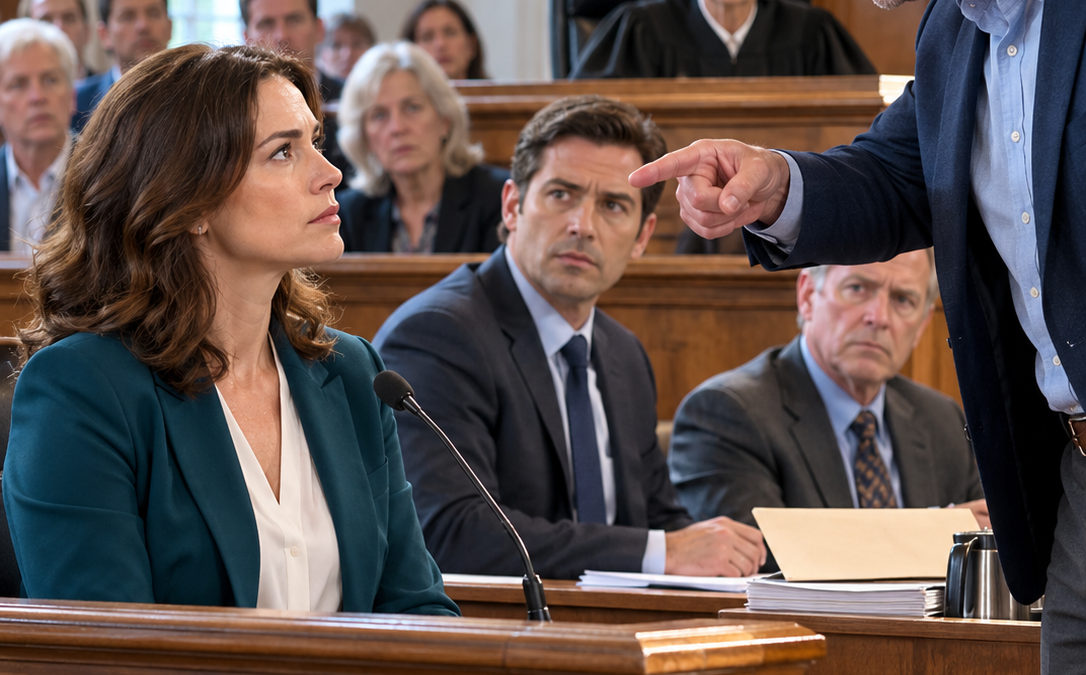
He said it the way he’d call out a tide, like it was just a fact the water had handed him that morning. My brother told the court that I had never spent a single day in the United States Navy, and that if I stood there and claimed otherwise, I was lying under oath to a judge and to everyone in Sable Cove who’d known me since I wore rubber boots two sizes too big.
Seven people I recognized sat in that gallery. The woman who ran the post office, a man who’d bought lobster off our wharf for thirty years, my old high school English teacher, gray now, her hands folded like she was waiting for a hymn. And down at the plaintiff’s table sat my brother, Wade Ducet, in a navy blazer he’d bought for our mother’s funeral and clearly decided was his courthouse suit now, because it made him look like a man you’d trust with money.
He was suing me for stealing from our dead mother’s trust. What he didn’t know, what his lawyer didn’t know, what none of them sitting there in their church clothes knew, was that inside my attorney’s folder, there was a single envelope, sealed, with a return address from the Department of the Navy. And before the morning was done, the judge would set down her glasses, look at me for a long moment, and say the words that pulled every person in that room to their feet.
The water in the little paper cup on the witness rail tasted like the pipes. I remember that. The way you remember stupid things when the floor is coming out from under you. I remember the fluorescent buzz and the smell of lemon cleaner that couldn’t quite cover the old varnish smell of the courtroom. And underneath all of it, the aftershave my brother had worn since he was nineteen. Cheap and sharp. Probably the same bottle, because Wade never in his life saw a reason to change a thing that already worked for him.
My name is Nora Ducet. I was forty-two years old the day I sat in that witness box and listened to my brother erase thirty years of my life with the flat confidence of a man who has never once doubted that his version of things is the true one. Wade was forty-seven, thick through the chest, his hands scarred from a lifetime of rope and traps and cold. A man used to being the one who decided what a day would mean. In our town, his word carried. He ran the co-op board. He sat on the harbor committee. He’d taken over the wharf after our father drowned off the Sable Ledges when I was sixteen. And somewhere in the years after that, he’d stopped being my brother and started being an institution.
Across the aisle, his lawyer was a man named Franklin Doyle, who did wills and property lines and boundary disputes for half the peninsula. He believed, the way men like him believe, in what you can pull out of a drawer. Deeds, bank statements, a trust document with a signature on it. Franklin Doyle had a folder fat with paper, and he thought that paper was going to bury me. And I understood why he thought that, because for most of my life, the things about me that mattered had never once been printed on a page anyone in that county could read.
My own lawyer, Owen Reyes, sat very still beside a folder that held almost nothing. That was the part that must have made Doyle so comfortable. We had nothing to show. That was the whole shape of the thing. For twenty-two years, I’d had nothing anyone here could see.
Let me tell you how a family decides who you are.
We grew up five miles out from the village, on a point of land my great-grandfather had bought back when it was worth nothing. A low gray house with a porch that had rotted soft on the harbor side from all the weather coming off the water. The kitchen always smelled like coffee and the particular sweetness of bait barrels you never fully aired out. My father, Emil, fished. My mother, Adele, kept the books, ran the house, and held the whole operation together the way a keel holds a boat, out of sight and taking every strain.
I was the middle child and the only one who ever asked questions. Wade was the oldest, and Wade fit. That’s the plainest way I can put it. He fit the shape my father wanted a son to take. Out on the water at fourteen, quick with the traps, easy with the men down at the co-op, loud in the right rooms. My father looked at Wade and saw himself continued. And there is no love a man like my father gives more freely than the love of seeing himself go on.
Then there was my little sister, June, five years behind me, who fit a different way. June knew how to make a room easy. She laughed half a second before the joke landed. She learned early that if you agreed with our father before he finished a sentence, he’d carry that warmth around with him all afternoon. June wasn’t false. I want to be fair to her. She just understood, in a way I never managed, that peace in that house was a thing you bought, and she was willing to pay for it.
And then there was me. I asked why. Not to be difficult. I want that on the record even now. I asked because the numbers didn’t add up, because the way we’d always done it wasn’t the same as the right way. Because I could see a better line and I didn’t understand why we weren’t taking it. In our house, a question was a form of disrespect. My father heard “Why?” and understood it as “Who do you think you are?”
I was thirteen the afternoon it fixed itself in me for good. I was at the kitchen table with the wharf ledger, the green one, matching the fuel receipts against what my father had written down, and the diesel didn’t reconcile. Not by a lot. Sixty dollars, seventy dollars across a couple of weeks. But it was wrong, and wrong was wrong.
“Dad,” I said, careful, keeping it soft. “The fuel’s off. It doesn’t match the slips.”
He didn’t look at the book. He looked at me. “It’s fine.”
“It’s off by about seventy.”
“It adds up,” he said, “because I’m the one who says it does.”
That was the end of it. That was, in a lot of ways, the end of a great many conversations before they ever got started. My mother was standing in the doorway to the mudroom with a dish towel in her hands, watching the way she watched a squall build out over the islands. Alert, patient, not stepping in unless she had to.
That night, she came and sat on the edge of my bed. “You weren’t wrong,” she said. “I know. Being right and being heard are two different things in this house.” She smiled, tired around the eyes. “You’ll learn which fights are worth the water you spill on them.”
That was my mother. She never fought my father head-on. She went around him. She kept copies of things he threw away. She wrote small notes in the margins of the ledgers, initialed and dated in that neat schoolteacher hand of hers. She remembered what everyone else let go of. And she watched me, though I didn’t understand until much later that she was measuring something in me. Not how obedient I was. Not how useful. How much weather I could take.
My father drowned that spring. I was sixteen. A February line squall in April’s clothing. A swamped boat, water cold enough to kill you in minutes that far out. They found the boat before they found him. After that, the wharf was Wade’s, and Wade, at twenty-one, wore it like a crown. My mother went quiet in a new way, and the house got smaller around all of us.
By eighteen, I knew two things all the way down. If I stayed, I’d spend my whole life being the disappointing version of myself that my brother and my father had already decided I was. And if I left, it would cost me the only place I’d ever called home.
I left.
There wasn’t a supper for it or a send-off. Wade drove me to the bus in Ellsworth because our mother asked him to, and he kept both hands on the wheel the whole way, like the truck might bolt.
“You really doing this?” he said when he put it in park, not quite a question.
“Yes.”
“Navy’s not going to fix whatever’s the matter with you.” He said it the way he said most things, like a weather report. “You know that.”
I didn’t answer him because there was no answer he’d have accepted.
“Don’t come back here broke looking for us to carry you,” he said. “We take care of our own out here. We don’t float people who won’t pull their own traps.”
“I won’t,” I said.
He nodded once, satisfied, like he’d confirmed a reading on a gauge. That was the last real conversation my brother and I had for the better part of my adult life.
My mother had hugged me at the door that morning before he’d come out, and she’d held on longer than usual. “Come home when you can,” she said into my shoulder. And then she pulled back and looked at me with those steady eyes and said, “Not everything you do is going to be understood. That doesn’t make it wrong.”
I thought she meant the Navy. It took me twenty years to understand she meant all of it.
Everything that came after boot camp burned off the parts of me that were for show and left the parts that worked under load. I found something there I’d never had at home. A place where being exact was a virtue instead of a threat. Where a question asked at the right time, in the right way, was called initiative and not insolence.
I was good at it. I was better at it than I’d let myself believe I could be good at anything. I went in as a sailor, and I came up through intelligence. And somewhere around my sixth year, the work I did stopped being the kind of thing you could describe at a table.
There was no ceremony to that, either. There rarely is for the things that actually change your life. There was a conversation in an office you needed two badges to enter, a folder slid across a desk, and a man who told me I was being reassigned.
“To what?” I asked.
“You’ll carry a cover designation,” he said. “On paper, you’ll be an analyst attached to a contracting office. Something dull enough that nobody follows it up. The actual work is why we brought you in here.”
I understood, sitting in that chair, that my life had just split into two channels. One I could talk about and one I couldn’t.
On paper, I became a mid-level analyst with a logistics group and a mailing address in a Northern Virginia office block that looked like ten thousand others. My pay matched a job that sounded stable and forgettable in the world nobody at home could see. I spent my days in rooms where the doors closed with a particular soft weight and the clocks were all set to the same second, and the work I did decided things that happened before anyone read about them, if they ever read about them at all.
You learn how to live in the seam between those two channels. You learn to answer a question without answering it. You learn to hand someone enough truth to satisfy their curiosity and never one inch past the line you don’t get to draw yourself.
The first time somebody took a marker to a memo I’d written and blacked out half of it, it wasn’t because I’d gotten anything wrong. It was because I’d gotten it too right to leave lying around.
When June called in those early years, she’d laugh and say, “So, what do you actually do all day? Wade says you sit in an office pushing paper around.”
And I could hear him behind her voice, filling up the room even from across it.
“Analysis,” I’d tell her. “Contracts. Same problems, different day.”
“That sounds like nothing,” she’d say, teasing.
And she wasn’t wrong that it sounded like nothing. Sounding like nothing was the entire design.
My mother never pushed. She didn’t need the details to know the direction. When I called her, she asked if I was warm enough, if I was eating, if the people around me were decent. And once, only once, on a bad line with a lot of ocean between us, she asked, “Are you where you’re supposed to be, Nora?”
“Yes,” I said.
“Then good,” she said. “Don’t let anybody make you smaller than that.”
The visits got rarer. Not because I stopped loving that gray house on the point, but because being there meant folding myself back into a shape I’d outgrown, and every year the fold got harder. Wade stopped asking me anything at all. And in a town where the only proof that counts is the proof people can see with their own two eyes, my brother built a story to fill the space I’d left.
Nora left. Nora doesn’t come back. Nora won’t say what she does. Nora must not be doing anything worth saying.
I made rank in that silence. I made it again. By the time my mother got sick, I was a captain. And there were rooms I walked into where people stood, and I’d drive up to Maine and stand in the co-op parking lot in my civilian coat and be, to everyone there, the daughter who’d run off and made nothing of herself.
The cancer took my mother over one long winter. I came home as often as the work would let me, which was never as often as Wade thought I owed. She never asked me what I did. She asked if I was safe. She asked if I was sleeping. And near the end, when the machines had gone quiet for a minute and it was just the two of us, she took my hand and said, “You know, I always knew.”
I asked her what she meant. She just squeezed my fingers, that schoolteacher grip, and said, “I kept everything, Nora. You remember that? I kept everything.”
I thought it was the medicine talking. It wasn’t.
She died in March, with the harbor still iced in along the edges.
At the reading of the trust, Wade sat at the head of the lawyer’s table like he’d sat at the head of everything since he was twenty-one. Hands folded, face arranged into something that could pass for grief if you didn’t know him.
Our mother had left the wharf and the house in a trust, with the three of us as beneficiaries and Wade as trustee, along with specific bequests and one line that named me to receive a set share in cash from an account our mother had built up quietly over the years. An account nobody but she and the bank had known the size of.
Wade didn’t look at me when the numbers were read. He looked at Franklin Doyle and said, “We’ll be reviewing all the distributions.”
Three months later, a sheriff’s deputy handed me papers on the wharf road.
Breach of fiduciary duty. Conversion.
Wade’s suit claimed that I had drained tens of thousands from our mother’s accounts over the years under the cover of helping her manage things from afar. That the cash account she’d left me was money I’d already siphoned and was now trying to launder into a legitimate inheritance. And that my entire adult story—the Navy, the deployments, the career I could never describe—was a fiction I’d invented to explain where I’d been and where money had gone.
In my brother’s telling, it made perfect sense. If he couldn’t see what I’d done with my life, then it didn’t exist. And if it didn’t exist, then the woman standing in front of him was exactly the failure he’d always needed me to be, and a thief besides.
There are jobs you can explain at supper and jobs you carry quietly to the grave. And I’d made my peace with mine a long time before that deputy found me on the wharf road. What I had not made my peace with was watching a courtroom decide I was a liar and a thief because the truth about me was filed somewhere none of them would ever be allowed to look.
So we come back to the courtroom, and to Wade in his funeral blazer, and to the fluorescent buzz.
It was a bench trial. There was no jury. Whatever you might expect from the movies, a dispute over a trust is a matter for a judge. And the judge was a woman named Whitfield, who had been on that bench for a long time and had the particular stillness of someone who has watched every kind of family tear itself apart across the same worn rail and is no longer surprised by any of it.
Franklin Doyle put on his case the way you’d expect. Bank records, a timeline, my mother’s ledgers—the green ones, with all those neat marginal notes—which Doyle read as evidence of a confused old woman being managed by a distant daughter, and which I recognized as my mother building, year over year, a record that would outlast her.
He put Wade on the stand, and Wade told the room in that flat, certain voice that I’d never been what I claimed. That there were no deployments. That a person who’d truly served would have something to show for it. A photograph, a discharge paper, a story that hung together. And that I had none of it because there was none of it to have.
Then Owen Reyes called me to the stand and asked me the questions we both knew were coming. And I answered them as far as I was allowed.
“Miss Ducet, did you serve in the United States Navy?”
“Yes.”
“For how long?”
“Twenty-two years.”
“In what capacity?”
“Not all of it is public,” I said.
I watched Franklin Doyle’s face do something small and pleased, like I’d handed him a gift. And he took it the second Reyes sat down.
He rose slowly, the way a man does when he thinks he’s already won.
“Not public,” he said, tasting it. “So your position is that the proof of your entire career simply can’t be seen because it’s too secret for this court to verify?”
“My position,” I said, “is that your not being able to see a thing has never once been the same as the thing not existing.”
That was when my brother stood up. The chair leg screamed on the courtroom floor.
Wade never shouted when he could do something better than shouting, which was project, the way he’d learned to make himself heard across a windy harbor and a full co-op meeting, and at every supper of my childhood. He didn’t yell. He aimed.
“She never served a single day in that Navy,” he said.
One thick finger leveled at me, steady as a gaff.
“Not one. She ran off from this family, left our mother to carry everything, and now she wants a court to believe she was off doing something so secret and so important that not one soul on God’s earth can prove it. If she says she served, she is lying. It’s a bald-faced lie, and everyone in this room who’s known her since she was a girl knows it.”
“Mr. Ducet,” Judge Whitfield said, “sit down.”
But he’d said it. He’d set it in front of the post office woman and the English teacher and the man who bought our lobster. Set it into the varnish and the lemon cleaner. And I sat in that box and looked at my brother. Really looked at the red threaded through the whites of his eyes, at the set of his jaw, at the thing hiding under the anger that I finally recognized as satisfaction.
He thought this made him righteous. He thought the truth was just whatever survived longest in his own mouth.
Owen Reyes stood.
“Your Honor,” he said, and his voice was very quiet after Wade’s. “The defense would like to submit a document that was not available to us during discovery. It arrived under seal from the Department of the Navy. There’s a public affairs officer from the department present in the gallery who can speak to its authenticity, and I’d ask that the court review it in chambers or on the bench as it sees fit.”
Franklin Doyle turned, frowning, already objecting. Wade blinked.
Down in the third row, a man I hadn’t placed until that second stood up in a service dress uniform. I knew the weight of it in my own shoulders. And June, who I hadn’t even been sure would come, lifted her head and looked at me for the first time all morning like she was seeing something she couldn’t name.
Judge Whitfield took the envelope. She read the outside of it. Then she opened it, and she read what was inside. And the room did that thing rooms do when everyone in them stops breathing at once.
She read it twice. I could tell because her eyes went back to the top of the page.
And then Judge Whitfield took off her reading glasses, folded them slowly, and set them down on the bench. She looked up. And she didn’t look at Wade, and she didn’t look at Doyle.
She looked at me.
“All rise,” she said.
And here is the thing I had never once let myself picture.
In twenty-two years of walking into that co-op parking lot as the daughter who’d made nothing of herself, Judge Whitfield stood up on her own bench in her own courtroom. She rose to her feet, and the bailiff rose, and the uniformed officer in the third row was already standing at attention.
And then the post office woman stood, uncertain, not knowing why, only knowing the whole room was tilting toward it. And the English teacher stood, and Franklin Doyle stood because he didn’t know what else to do.
And last of all, slow and confused, my brother stood up, too.
I stayed sitting for one more second because the letter wasn’t about me standing. It was a summary cleared for release of a career the court would never see the full shape of.
It confirmed twenty-two years of continuous service. It confirmed classified assignments, the details of which remained classified. And it confirmed my current rank, which the Navy had seen fit to state plainly in a sealed letter to a judge in a small Maine county, so that a man could not stand in a courtroom and call me a liar without the United States government correcting the record.
Rear Admiral, United States Navy.
I stood then, not for the rank. Titles matter in some rooms, and that was not one of them. I stood because my mother had told me not to let anyone make me smaller than what I was, and I had spent a great deal of my life keeping myself small so that other people could feel large.
And I was done.
Judge Whitfield sat back down and told everyone else to. What happened after that was procedure, and procedure is a mercy when your life has just cracked open in a public room.
Franklin Doyle asked for a recess. When we came back, the plaintiff withdrew the complaint.
Judge Whitfield had things to say about bringing a fraud action with no evidence beyond a family grievance, and about the ledgers, which she’d read more carefully than Doyle had hoped, and which showed my mother’s own hand recording every dollar of that cash account as savings she was building for the one child she’d decided the family had failed.
The court sanctioned my brother for the costs.
My mother, it turned out, had kept everything, exactly like she said.
I looked back once, and I found my brother had gone gray in the face, the funeral blazer suddenly too big for him. A man watching a story he’d told his whole life come apart in the space of two minutes.
He caught up to me in the hallway, which surprised me. The air out there was cooler, cleaner, like it hadn’t been shaped by anyone’s expectations. He said my name. It sounded different in his mouth than it had for thirty years, none of the old certainty in it.
“Nora.”
I stopped. I didn’t have to. I did.
“You said you pushed paper,” he said. “In an office. That’s what you always—”
“I know what I always said.”
“You were in the Navy?”
It came out of him like a boy’s question, stripped of everything he’d built on top of himself the whole time.
“Twenty-two years?”
“Yes.”
“You never told me.”
“You never once asked me anything,” I said, “that I’d have had to answer honestly to lie to you. You told me who I was. I stopped correcting you a long time ago.”
His jaw worked, hunting for the old line, the one that had anchored him his whole life. The one about pulling your own weight. About not carrying people. About how the world divided into those who could see a thing and those who were fooling themselves.
It didn’t come. There was nothing under it to stand on anymore.
“Admiral,” he said finally.
And the word sat wrong in his mouth. Not incorrect, just impossible, like a language he’d never learned. I didn’t answer to it, not because it was wrong, but because it wasn’t necessary. Not there. Not with him.
I turned and walked past June, who had come out into the hall and was standing with her hand over her mouth, and past the post office woman, and out through the courthouse doors into a cold blue morning that didn’t ask a single thing of me.
And for the first time in my whole life, my brother was standing behind me at the center of nothing at all.
The town corrected itself the way a shoreline does. Not all at once. Grain by grain, conversation by conversation, until one day you look and the edge of the thing isn’t where it used to be.
For a few weeks, Wade held the old line at the co-op. He told anyone who’d listen that the government had papered over the truth, that things weren’t what the court had made them look like. But the story didn’t take. It didn’t have to be argued down. It just stopped finding purchase.
Men who’d nodded along with my brother for twenty-five years started letting his sentences hang. The harbor committee stopped asking his opinion first. His usual stool at the diner stayed open, and the waitress still poured his coffee out of habit. Because habit is the last thing to go. But the easy back-and-forth that had propped him up his whole life got thin, and then it got quiet.
Respect in a small town is almost never taken away out loud. It’s just quietly withdrawn.
June called me six weeks after the hearing. I was standing in a corridor a thousand miles away with a phone pressed to my ear and the low, steady hum of the building around me. All those systems doing what they were built to do.
“Hi,” she said.
The same word she’d said to me ten thousand times growing up. It sounded different now.
“Hi.”
There was a long pause.
“I’ve been thinking about what you said in the hallway.”
“That narrows it down some.”
A small, startled laugh, almost a sob. “You always do that. Make it just sharp enough that I have to actually pay attention.”
“That wasn’t the plan.”
“I know. It just is.”
Another pause, longer.
“I wasn’t asking, Nora. All those years, I let Wade tell me who you were because it was easier than finding out. I’m sorry.”
I leaned back against the wall. The truth is, I believed her about halfway, which is how trust comes back when it comes back at all. Not whole and not fast. In pieces you count one at a time.
“I don’t need you to know what I did,” I told her. “You won’t get most of it anyway. That’s just the job.”
“I know. I don’t need that.”
Her breath came uneven down the line.
“I just need to know if there’s still something there between us.”
That was the real question. And it wasn’t about the past. It was about the future. I let the silence sit a moment, not to punish her, only to be accurate.
“There is,” I said. “But it’s not the same as it was.”
“I’m not asking for the same.”
“Good, because I don’t have the same to give you.”
She took that. I could hear her settle into it.
“We can start where we are,” she said.
“That’s the only place anybody ever starts.”
We talked for eleven minutes about nothing. About neutral ground. About her kids and the weather and what the winter had done to the wharf pilings. When it ended, I stood there a while longer than I needed to. Not because I was unsure, but because I was adjusting. The way you brace when the deck shifts under you and finds a new level.
Families don’t reset. They reconfigure.
Wade never called. He wrote once. The envelope was the kind of plain, lined paper he’d always used, folded with the same rough precision he brought to everything.
He didn’t apologize. That would have taken a language he’d never been given. He didn’t admit he’d been wrong, exactly, because being wrong wasn’t a thing the world had ever asked him to survive.
Three words in the middle of the page, in that hard, blunt hand.
I didn’t know.
I read it three times. Not for feeling. For meaning. It was true, and it was nowhere near enough. And both of those things were allowed to be so at once.
I folded it back up and put it in a drawer. I didn’t throw it away, and I didn’t frame it. I stored it, which felt about right.
The cash my mother left me, the account Wade had gone to court to say I’d stolen, I never touched for myself.
Seven months after the hearing, I used it to start something. A fund small by the standards of anywhere else, big enough to matter in a place like Sable Cove. Two years of tuition at a state school for a daughter of a fishing family going into public service of any kind. The Navy or the classroom or the county office. It didn’t matter which. Renewable once.
I named it after my mother.
Adele Ducet had spent her whole life keeping the records straight for people who never once thanked her for it, and I wanted her name on something that would still be doing that work long after all of us were gone.
The little ceremony was at the town library, because that’s the kind of town it is. June came and stood in the second row and didn’t say anything, and didn’t need to.
Wade wasn’t there. Not out of anger. Out of clarity. There are some rooms you just don’t share, and knowing which ones is its own kind of peace.
They put a small brass plate up by the library door. No rank on it. No titles. No service. Nothing about a sealed letter or a judge standing up. Just my mother’s name, and under it, mine.
That was all that needed to be there.
Back at my post, my office is what it has always been. A desk, a couple of screens, no decorations, no markers of anything that got confirmed in a Maine courtroom.
There’s a small matte pin I’ve worn for years. The kind of thing nobody looks at twice. The kind of thing that caught a judge’s eye across a courtroom once and rearranged an entire case without my having to say a word.
I still wear it the same way I always did. Not for anybody to see. For continuity.
There’s a freedom that comes when you stop needing to be understood by the people who once decided who you were. It isn’t loud, and it isn’t a victory lap. It’s just steady, the way the tide is steady.
For most of my life, my silence got read as absence, as running away, as proof that there was nothing there worth speaking of. In that courtroom, it finally got read as what it actually was, which was never a hole in me.
It was a boundary.
My brother spent thirty years mistaking what he couldn’t see for what wasn’t there. He filled the space I left with a story that made sense to him. And he told it so many times it hardened into fact in his mouth. And he carried that fact all the way into a court of law, expecting it to hold.
It didn’t hold. Not because I argued louder than he did. I never once outshouted my brother in my life. It didn’t hold because the truth finally showed up carrying an authority that didn’t need his permission to exist.
I didn’t win that day, whatever it looked like from the gallery. Winning means there was a contest, two people pulling against each other for the same rope. That’s not what happened in that room.
What happened was a correction. A record set straight. The distance between what was said about me and what was actually true finally closing in public, with the whole town watching.
If you’ve ever been made into a smaller version of yourself so somebody else could feel large, if you’ve ever been told that what you did with your life doesn’t count because nobody could see you doing it, if you’ve ever sat in a room and watched your own silence get used against you like a confession, then you already understand the thing I carried out of that courthouse into the cold blue morning.
Not every truth needs to be explained. Some of them only need to be confirmed.
And when they finally are, they don’t just change the room. They change who gets to tell the story from then on.