When I was five, every day I would chase after the older boy next door and call him “my future husband.” Seventeen years later, at a job interview, the CEO stared intently at me, then smiled and asked.
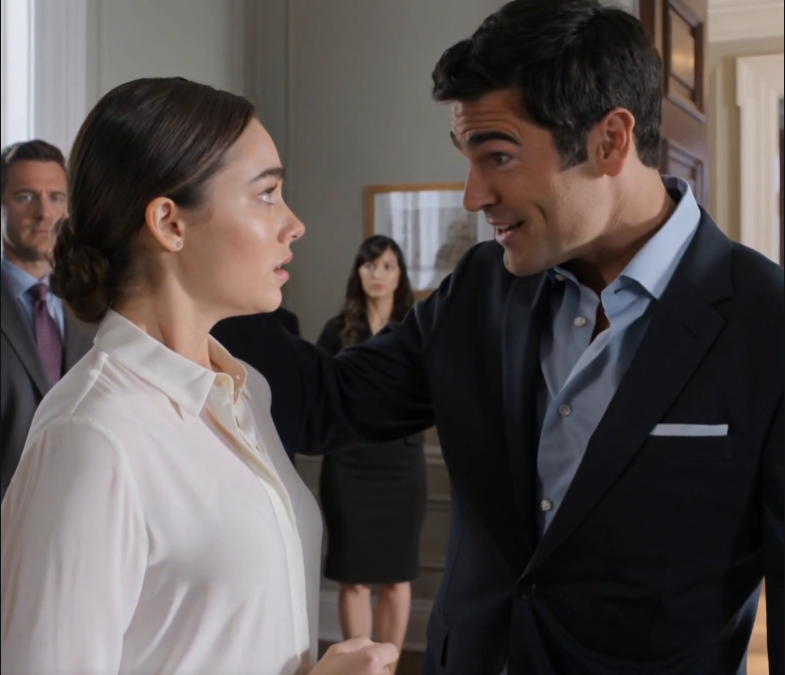
Kevin pushed open the car door and stepped onto the sidewalk. He wore a sharply tailored suit, and his hair was slicked back with enough pomade to make it shine under the summer sun. A woman in a tight red dress had one arm wrapped possessively around his waist. Her heavy makeup and expensive accessories were clearly intended to draw attention, and the dress clung to every curve of her body. She glanced at me from the corner of her eye, her lips curling into a condescending smirk.
Kevin removed his sunglasses and tipped his chin toward my shabby appearance.
“Well, well, Sarah. Looks like the job hunt is really taking a toll on you. I heard you’ve been bombing interviews left and right lately. Guess that fancy valedictorian diploma of yours is only good for being a coaster.”
Every word dripped with malicious satisfaction. I straightened my back, looked him directly in the eye, and answered evenly, “I’ll take care of my own life. I don’t need you worrying about me.”
I turned and started walking away, but Kevin hurried forward and blocked my path. From the inside pocket of his jacket, he produced a glittering, gold-embossed business card and shoved it toward my face.
“Don’t be so stubborn. When I generously offered to take care of you, all you had to do was listen to me and depend on me. But you wanted to play hard to get. Look at yourself now. How pathetic.”
He held the card closer, smiling as though he were doing me an extraordinary favor.
“For old times’ sake, I’ll give you an opportunity. Our company is hiring a receptionist. The base pay is three thousand dollars a month, and all you have to do is sit there and smile at guests. With that money, you’ll at least be able to pay the rent on that dump of an apartment you live in. Don’t be shy.”
The woman beside him burst into shrill laughter.
“My Kevin is just too kindhearted. That’s his problem. Personally, I’d be worried that a delusional woman like her would make a mess even if we hired her to clean the toilets.”
Blood rushed to my face. I reached out and slapped the business card from Kevin’s hand, sending it fluttering into a muddy puddle at the edge of the street. Then I fixed him with the coldest stare I could manage.
“Save your cheap pity for yourself. Even if I have to spend the rest of my life washing dirty dishes in a diner, I will never work under a disgusting human being like you. Your offer is just as ugly as your personality.”
I stepped on the fallen card, grinding it into the mud beneath my shoe, and walked away without looking back.
Behind me, Kevin erupted in furious shouting. He hurled threats and swore that he would make me regret humiliating him. But I refused to let a single word reach my heart. I had already wasted enough of my life on someone like him.
I was just about to board a bus when my phone vibrated again. Exhausted and still shaken by the encounter, I unlocked the screen. A new email appeared, its subject line standing out in bold red letters.
“Titan Group — Interview Invitation.”
For several seconds, I could only stare. I rubbed my eyes and read the words three times, afraid that the heat had finally made me hallucinate.
Titan Group was one of the largest and most powerful commercial real estate conglomerates in New York City. It was the dream employer of ambitious business graduates, a company whose name carried enormous weight throughout the industry. When I had submitted my résumé for a marketing specialist position, I had expected nothing. I had sent it only because a small, stubborn part of me refused to give up hope.
And now they were inviting me to interview.
My hands trembled so badly that I nearly dropped the phone. It felt as though a door I had long believed was permanently locked had suddenly opened a crack.
This might be my last chance. Whatever happened, I had to seize it.
The next morning, I woke at exactly 5:30 and began preparing the only business suit I owned. My white blouse had started to yellow with age, and the hem of my black skirt was slightly frayed. I had washed both pieces as carefully as possible, and now I pressed every crease with painstaking attention. I tied my hair neatly behind my head and applied a thin layer of soft pink lipstick to bring some color back to my tired face.
Titan Group’s headquarters stood at a prestigious intersection in Midtown Manhattan. The massive fifty-story tower rose above the surrounding buildings, its blue glass exterior reflecting the morning sunlight with an almost blinding brilliance.
Passing through the enormous revolving doors, I immediately felt a rush of cold air-conditioning against my skin. A shiver ran down my spine.
The first-floor lobby seemed endless. Polished marble floors gleamed like mirrors, and everything, from the high ceilings to the immaculate reception counters, spoke of money and authority. Following the instructions in my invitation, I entered the visitor elevator and pressed the button for the thirty-eighth floor.
When the doors opened, I found a long line of applicants waiting on luxurious leather sofas. For a moment, I felt as though I had stepped into another world.
Everyone seemed to be dressed in expensive designer clothes. Premium leather handbags rested beside their chairs, and the air carried the unmistakable scent of costly perfume. Small groups of applicants chatted comfortably, casually mentioning directors, vice presidents, and influential executives they supposedly knew.
Their conversations were filled with the names of powerful people and exclusive institutions. The atmosphere reeked of vanity and nepotism.
I quietly found an empty seat in the farthest corner of the waiting area, took my résumé from my bag, and reviewed it one final time.
About fifteen minutes later, a woman who appeared to be in her mid-forties emerged from the grand conference room. She wore a deep burgundy suit, heavy makeup, and sharply arched eyebrows. Her severe eyes swept over the applicants with an expression that suggested she had already found most of them disappointing.
The nameplate pinned to her chest read: Emily Sanders, HR Director.
“Those whose names are called, please enter the conference room. We will now begin the group interviews. Mr. Adams, Miss Baker, Mr. Clark…”
My name was among those she called.
We followed her into a spacious conference room dominated by an enormous circular table made from a single polished slab. Director Sanders took the head seat, folded her arms across her chest, and gestured impatiently for the introductions to begin.
One by one, the applicants stood and delivered polished speeches about studying abroad in Europe, their parents’ successful companies, and their participation in multimillion-dollar projects. They spoke with effortless confidence, as though impressive careers had already been guaranteed to them.
When my turn arrived, I straightened my shoulders and stood.
“My name is Sarah, and I’m applying for a position in the marketing department. I graduated as valedictorian from Columbia Business School, received a full scholarship for three consecutive years, and served as team leader on several market research projects during college.”
Before I could finish, Director Sanders slammed her ballpoint pen onto the table. The sharp clack cut through my introduction like a warning shot.
She looked me up and down, openly inspecting my inexpensive clothes.
“Did you just say you graduated as valedictorian from Columbia? Do you have any idea what Titan Group’s hiring policy is this year?”
Her voice grew louder until it echoed off the conference room walls.
“We only accept résumés from the top five graduates of your university. I personally reviewed the list of those five individuals, and I can tell you with absolute certainty that there was no one named Sarah on it.”
I frowned, caught completely off guard by the accusation.
“Director, I truly did graduate as valedictorian of my class. You’re welcome to verify my original documents. I brought a notarized copy of my degree certificate and my official academic transcripts.”
Director Sanders gave a mocking laugh. She snatched the folder from my hands, flipped through a few pages, and carelessly tossed it onto the table.
“Forging notarized documents is child’s play these days. Walk into some back alley, slip someone a few hundred dollars, and they’ll produce a stack of official-looking papers for you in no time.”
She leaned back in her chair, her eyes narrowing.
“Just walking into Titan Group wearing those cheap clothes is an insult to our company’s image. And now you have the audacity to commit fraud with a fake degree? Do you think we’re idiots?”
Mocking laughter spread around the table. Several applicants whispered to one another, pointing at my clothes and covering their mouths as they snickered.
The humiliation burned through me. I curled my hands into fists, pressing my nails against my palms, and forced myself to breathe slowly. Every hour I had spent studying, every shift I had worked while other students slept, every examination I had fought to pass seemed to be under attack.
I was not going to allow a stranger to erase four years of sacrifice with a few careless insults.
“Director Emily Sanders,” I said, my voice firm and controlled, “someone in a position of responsibility in human resources should not slander an applicant without evidence. If you have doubts about my qualifications, I demand that we turn on a computer right now and log into the university’s academic portal together.”
I held her gaze.
“My student ID is real. My transcripts are real. And I will not allow anyone to tarnish my honor or the effort I put into the last four years.”
My refusal to retreat made Director Sanders’s face flush with anger. She struck the desk with her palm, rose to her feet, and pointed directly at me.
“You want to prove something? You, a greenhorn, dare to raise your voice and teach me, the HR director of Titan Group, how to do my job?”
She gave a contemptuous snort.
“Fine. Do it. Let’s see what kind of expression you make when the truth comes out and you have to walk out of this room in disgrace.”
She instructed a subordinate who had been taking notes to connect a laptop to the large conference screen.
At that moment, a young male applicant seated beside me, who had remained silent until then, spoke up in an oily, flattering tone.
“Director Sanders, let’s just let her do what she says. Fraudsters are always smooth talkers. Put everything on the big screen so we can strip away her fake mask in front of everyone.”
The subordinate pushed the laptop toward me.
I stepped forward. My hands trembled slightly, but I typed with determination, entering the web address of Columbia’s academic portal. The loading symbol began to spin, and for a moment I felt a surge of relief. Once the records appeared, the truth would be right there for everyone to see.
But just as the login screen was about to load, a yellow exclamation mark appeared over the Wi-Fi icon in the lower-right corner.
The browser displayed a connection error.
I frowned and refreshed the page. Nothing happened. I tried again, only to receive the same warning.
“It looks like there’s a problem with the Wi-Fi connection,” I explained. “I’ll try reconnecting.”
Director Sanders’s lips curled into a triumphant smirk.
She strode forward and slammed the laptop shut with such force that the sound echoed through the room.
“Stop it. This cheap little performance is over. Titan Group’s internet runs on ultra-high-speed fiber optics, and it has never once failed at such a convenient moment. It seems even the internet is tired of playing along with your lies.”
She leaned toward me.
“You were only buying time to figure out an escape route, weren’t you?”
Then she turned to the other applicants and raised her voice.
“Look closely, everyone. Titan Group never accepts people who lack integrity. Sarah, gather up those worthless papers and get out of here immediately.”
She called toward the door.
“Security! Get up to the thirty-eighth floor and drag this woman out of the building!”
The laughter around me grew louder.
“No money, no connections, and she thinks she can sneak into a major corporation with a fake degree,” a young woman in an expensive designer dress remarked. “Talk about not knowing your place.”
The humiliation rose in my throat until I could barely breathe. I bit my lip hard enough to feel a sharp sting, struggling to keep the tears from spilling.
I had entered that room with nothing but my education, my honesty, and the hope of earning a fair opportunity. Now those same things were being trampled beneath the feet of people who believed wealth and influence gave them the right to decide another person’s worth.
There was nothing left I could say that they would willingly hear.
Swallowing my despair, I crouched down and gathered the résumé pages scattered across the table. I held the papers tightly against my chest and turned toward the door.
That was when the heavy mahogany doors were suddenly thrown open from the outside.
They crashed against the walls with a tremendous bang.
Every conversation stopped. Every head turned.
A tall, broad-shouldered man stepped into the conference room wearing a flawless, custom-tailored dark navy suit. His powerful build gave him an imposing presence, while his sharply defined jaw, straight nose, and deep black eyes made his face strikingly handsome.
But it was his gaze that commanded the room. Cold and penetrating, it seemed capable of cutting straight through anyone who dared meet it.
Several of Titan Group’s highest-ranking executives followed closely behind him, bowing slightly and deferring to his every movement. Their obvious respect made his position unmistakable.
The atmosphere changed instantly. Even the air seemed to grow colder.
Director Sanders, who had been radiating arrogance only moments earlier, transformed before my eyes. Her expression softened into a fawning smile, and she rushed forward, bending her head in an exaggerated bow.
“Oh, CEO Tyler! Good morning, sir. Are you personally inspecting the departments today? We were just conducting the final interviews for the marketing division.”
The man standing before us was none other than Tyler, the legendary head of Titan Group.
He was both CEO and chairman, a man whose decisions affected tens of thousands of employees and whose company held enormous influence over New York City’s commercial real estate market.
Tyler stood silently in the middle of the room, surveying the applicants with an expression so stern that several people visibly shrank back in their chairs.
Then his eyes found me.
I froze, still clutching my scattered résumé pages against my chest.
The instant our gazes met, my heart seemed to stop. Something changed in those dark eyes. The coldness vanished, replaced by a strange, unmistakable warmth.
One corner of his mouth lifted into a faint smile.
It was such a familiar smile that a shiver traveled down my spine, though I couldn’t immediately understand why.
Noticing that the CEO’s attention had remained on me for far longer than expected, Director Sanders quickly stepped between us.
“Mr. Tyler, please don’t concern yourself with that woman. She’s an extremely problematic applicant. She tried to deceive our company by presenting a forged valedictorian diploma from Columbia University, and I just exposed her. I was about to call security and have her removed. Please don’t let her waste your valuable time.”
Tyler did not even glance at her.
Instead, he extended his hand and spoke in a low voice that was gentle yet carried unmistakable authority.
“Give me her documents.”
Director Sanders flinched. Recovering quickly, she snatched the folder from my arms and presented it to him with both hands, as though offering something precious.
Tyler opened the folder and examined the first page. His dark eyebrows rose almost imperceptibly.
“Sarah. Date of birth…” he murmured, following the printed lines with his eyes. “Residential address: 2B, Old Alleyway, South Bronx.”
He closed the folder carefully.
The conference room fell so silent that I could hear the faint ticking of the clock on the wall.
Tyler took a slow step toward me. His tall frame blocked part of the overhead light, casting a shadow across my face. A faint scent of expensive cologne and cedarwood reached me as he approached.
My heart was beating so wildly that I thought it might burst through my ribs.
He stood close enough for me to see the individual lashes framing his dark eyes.
“The old alleyway in the South Bronx,” he repeated softly.
His voice had become strangely tender.
And suddenly, a fragment of memory from seventeen years earlier swept through my mind.
A narrow, muddy alley after a summer rain. Old houses with moss-covered slate roofs. A thin six-year-old boy crouching on a porch, carefully gathering marbles that had rolled across the ground. Behind him, a five-year-old girl with messy hair and a red lollipop followed him everywhere he went.
I could see the little girl tripping over a loose stone, scraping her knee, and bursting into tears. The boy had hurried over in a panic, helped her onto his back, and carried her down the muddy alley while trying to comfort her.
The little girl had clung tightly to his neck and called after him in her childish voice.
“You!”
I stared at the man standing before me.
His features had matured, becoming more sharply defined, but those eyes were exactly as I remembered them. So was the quiet steadiness in his expression.
It couldn’t be.
Tyler raised his right hand. His warm palm rested gently on the top of my head, ruffling the hair I had so carefully tied back that morning. The gesture was startlingly familiar, filled with an affection that seemed to have survived every passing year.
He lowered his head slightly and leaned closer. Although his voice was soft, every person in the silent conference room could hear his words.
“Do you remember me?”
For a moment, it felt as though time itself had stopped.
The applicants who had been laughing at me only minutes earlier stared with their mouths open. Their eyes widened in disbelief, as though they had witnessed something impossible.
Director Sanders stood rooted to the floor. Her hands trembled at her sides, and the color drained from her heavily made-up face.
The young man who had mocked me dropped his pen. It struck the marble floor with a small, sharp sound that seemed impossibly loud in the silence.
I couldn’t move.
The poor boy from the old Bronx alley, the boy who had disappeared without a single goodbye, was standing in front of me seventeen years later as the head of one of the most powerful business empires in New York.
Director Sanders staggered backward. Her stiletto heel caught the edge of an applicant’s clothing, and she nearly fell. She swallowed hard, forcing an unnatural smile onto her pale face.
“CEO Tyler, surely you’re joking. There’s no possible way you could know this fraudulent woman. There must be some enormous misunderstanding.”
Her voice shook, and she clenched her hands so tightly that her knuckles turned white.
Tyler straightened, the tenderness in his expression disappearing the moment he turned toward her.
He slipped both hands into his trouser pockets and walked slowly to the front of the table. His voice was quiet, but the cold authority behind it sent a visible chill through the room.
“I have never joked about personal matters, especially not inside my own company.”
He paused, allowing the words to settle.
“Sarah is my childhood friend. Her degree represents four years of genuine effort, sacrifice, and hard work. Yet despite being HR director, you failed to follow even the most basic procedures for verifying an applicant’s qualifications. Instead, you publicly accused her of fraud.”
His eyes narrowed.
“And how do you intend to explain the fact that the company’s internet connection suddenly failed at the exact moment she attempted to prove her credentials?”
Director Sanders was sweating visibly.
“M-Mr. CEO, the network issue must be a technical problem on the IT department’s side. I truly know nothing about it. I was only being strict with verification because I wanted to protect Titan Group’s reputation.”
Tyler gave a short, humorless laugh.
He lifted one hand.
A young employee wearing thick glasses and an IT department uniform immediately entered the conference room. He carried a laptop and several pieces of network-testing equipment.
“Report,” Tyler instructed.
The employee bowed slightly.
“Sir, our investigation found absolutely no technical defects in the wireless network system or the main server serving the thirty-eighth-floor conference room. However, when I inspected the network distribution box in the corner, I discovered that someone had deliberately disconnected the Ethernet cable, physically cutting off the connection to this area.”
He adjusted his glasses and continued.
“According to the system records, the disconnection occurred approximately ten minutes ago, exactly when the applicant attempted to access the university website.”
The report struck Director Sanders like a bolt of lightning.
She swayed on her feet, her already pale complexion turning an ashen gray.
Murmurs began spreading among the applicants. Those who had eagerly supported her accusations were now looking at her with growing suspicion and contempt.
I folded my arms across my chest, feeling some of the injustice that had weighed on me finally begin to lift.
The ugly scheme that had nearly destroyed my reputation was being exposed in front of everyone who had participated in humiliating me.
Director Sanders opened her mouth, desperately searching for another excuse.
But before she could speak, hurried footsteps sounded in the hallway.
The conference room doors swung open again.
A man in an expensive suit entered, carrying a designer briefcase and holding his chin high with exaggerated confidence. The moment he spotted Tyler, his face broke into a broad, eager smile.
“Cousin Tyler! Are you inspecting the lower departments today? I’ve just returned from successfully wrapping up negotiations with the construction materials suppliers. Everything went incredibly smoothly!”
That grating, sycophantic voice made my skin crawl.
The newcomer was Kevin.
The very same ex-boyfriend who had insulted me on the sidewalk.
He strode forward, completely oblivious to the oppressive atmosphere in the room, talking excitedly about his supposed achievements. Apparently, he worked for Titan Group and had some kind of family connection to Tyler.
As he pulled out a chair, his eyes swept across the room and landed on me.
He stopped abruptly.
“Sarah? What the hell are you doing here?”
His expression showed genuine shock, but it quickly hardened into familiar contempt.
“You acted so high and mighty when I offered you a receptionist job this morning. You threw my business card away, and now you’ve sneaked into Titan Group to beg for scraps?”
His eyes traveled disdainfully over my clothes.
“Look at that pathetic outfit. We’re not hiring toilet cleaners here, so get the hell out. How did you even get into this conference room?”
Then he turned toward Tyler with an ingratiating smile.
“Cousin Tyler, don’t waste your time on a woman like this. She’s my ex-girlfriend, but she’s like a leech. Stubborn, useless, and completely shameless. I’ll call security and get her out of your sight.”
As though eager to demonstrate his authority, Kevin rolled up his sleeves and marched toward me. He reached out to grab my shoulder.
But before his fingers touched my collar, another hand closed around his wrist.
Tyler stood between us.
His grip was so firm that Kevin’s face twisted in pain. With one decisive movement, Tyler twisted his arm away and released it, sending Kevin stumbling backward. Kevin nearly collapsed onto the floor.
“Who are you calling cousin?” Tyler asked.
His voice was dangerously cold.
Kevin stared at him, stunned.
“Just because my aunt became your stepmother, you think that gives your family the right to behave as though we’re blood relatives? Inside this company, there are superiors and subordinates. There are no family privileges.”
Tyler took a step forward.
“You just insulted my friend directly in front of me. Do you honestly believe Titan Group is your personal playground?”
Kevin’s face drained of color.
He opened his mouth, but Tyler had already turned toward the secretary recording the meeting minutes.
“Write down my instructions clearly. The construction materials project currently supervised by Deputy Director Kevin is canceled, effective immediately. Because of his professional incompetence and inappropriate behavior toward an applicant, he is stripped of all authority until further notice.”
Tyler’s voice remained perfectly steady.
“Call security. Have this man removed from the conference room immediately.”
Two large security guards appeared at the door. They seized Kevin by both arms and dragged him toward the hallway.
Kevin struggled and shouted, desperately calling for help, but no one intervened.
The heavy wooden doors slammed shut behind him, plunging the conference room into another stunned silence.
Director Sanders looked ready to collapse. Sweat poured down her face, threatening to ruin her carefully applied makeup.
Tyler surveyed the remaining applicants, who had retreated nervously into their chairs.
Then he cleared his throat.
“Titan Group operates according to principles of transparency and meritocracy. I do not allow personal feelings to interfere with business decisions.”
His gaze rested briefly on me.
“Yes, Sarah is my friend. But if she wants to work at this company, she must prove her abilities. If she cannot meet our professional standards, she will be rejected just like any other applicant.”
He approached the conference table and picked up a thick leather-bound file.
With a sharp movement, he placed it directly in front of me. The documents struck the polished surface with a heavy thud.
“This is the proposal for Sunrest Construction’s mixed-use commercial facility project. The total investment is one billion dollars.”
He tapped the cover.
“It’s a core project our marketing department has been struggling with for two months. Your task is to examine the key figures and produce a viable preliminary marketing strategy.”
He took out his smartphone and opened the stopwatch.
“You have exactly ten minutes. Begin.”
A wave of astonished murmurs swept through the conference room.
Several applicants shook their heads. One or two exchanged knowing smirks.
Asking a recent college graduate to understand a billion-dollar development project and formulate an effective strategy in ten minutes was nearly impossible. But I understood why Tyler had chosen such a brutal test. He intended to remove any possible suspicion that I was receiving special treatment because of our childhood connection.
I inhaled deeply, pushed aside every distracting emotion, and opened the file.
My fingers moved rapidly through the pages. Numbers, blueprints, competitor analyses, zoning descriptions, and demographic reports flashed before my eyes.
The speed-reading and analytical skills I had developed during three years in my university’s market research club seemed to awaken all at once.
I forced myself to focus on the essentials.
The project site was located in a suburb outside downtown New York, surrounded by several colleges and densely populated apartment complexes. Its competitors were planning high-end mixed-use shopping centers paired with luxury condominiums.
But the demographic data revealed a serious problem.
Most of the people living near the proposed development were students, young workers, and middle-income residents. Their purchasing power did not support the luxury retail model the competitors were pursuing.
If Titan Group simply copied that strategy, the company would risk investing a billion dollars into a commercial complex its surrounding community could not afford to use.
I kept reading, comparing the demographic figures with retail spending patterns and the projected leasing costs.
The clock ticked relentlessly. Sweat gathered along my hairline.
Then Tyler’s voice broke the silence.
“Time’s up.”
I closed the file slowly.
After collecting my thoughts, I lifted my head, briefly glanced at the executives seated beside Tyler, and began.
“The Sunrest Construction project possesses one undeniable advantage: its location. It’s surrounded by educational institutions and a large population of young residents.”
I stood and walked toward the whiteboard.
“My proposal is to develop a mixed-use destination that combines culture with commerce.”
Picking up a marker, I began sketching the layout.
“Instead of leasing the first and second floors to luxury retailers, we should create the largest mega-bookstore in the tri-state area. It would be connected to an art exhibition space and an area reserved for weekend cultural markets.”
I drew several sections across the board.
“The third and fourth floors would become an international street-food court, with prices tailored to college students’ budgets. The entire complex would have a modern urban aesthetic, designed to encourage young people to gather, spend time together, and take photographs for social media.”
I moved the marker toward the top of the drawing.
“The uppermost floor would contain a movie theater and a cutting-edge virtual reality theme park.”
Then I turned back to the panel.
“We are not selling luxury goods. We are selling cultural experiences.”
Several executives straightened in their chairs.
“Customers will come here to study, socialize, enjoy art, eat, and be entertained. Once the development becomes a place they genuinely want to visit, spending on the surrounding services will happen naturally.”
I referred to the demographic figures I had just reviewed.
“At present, New York has no directly competing development built around this exact combination of accessible culture and commercial activity. By leasing space to retailers, food vendors, and entertainment operators, we can build a stable, long-term cash-flow model.”
I continued explaining the target market, estimated visitor behavior, and positioning strategy. Whenever I cited a statistic from the documents, I gave the number accurately, down to the decimal point.
There was no reason to waste words. Every minute mattered.
When I finally placed the marker on the table, the room was silent.
For several seconds, no one moved.
Then a man in his fifties, seated to Tyler’s left, began applauding enthusiastically.
It was Director Carter, head of Titan Group’s marketing department.
“Fantastic. Absolutely fantastic!”
He leaned forward, his face bright with excitement.
“That is extremely sharp critical thinking. You’ve identified the exact blind spot our department has been debating for two months.”
He gestured toward the whiteboard.
“Your approach is creative, but more importantly, it’s realistic. You’ve understood the market and produced a strategy that aligns perfectly with our group’s capabilities. I am genuinely impressed.”
The other applicants stared at me in astonishment. Some looked embarrassed, while others appeared genuinely awed.
I remained standing beside the whiteboard, trying to steady my breathing. The knowledge I had spent years acquiring had finally been given the chance to speak for itself.
Tyler watched me with a faint smile.
This time, there was no mistaking the pride in his expression.
He tapped one finger lightly against the table.
“Everyone heard that presentation. Her professional abilities are beyond question.”
Then he looked directly at me.
“Sarah, report to the marketing department tomorrow. Your probationary period will be waived, and you will receive one hundred percent of your salary as a full-time employee from your first day.”
His expression softened slightly.
“Do you accept?”
For the first time that morning, I smiled without restraint.
“Thank you, Mr. CEO. I gladly accept.”
The following morning, at exactly eight o’clock, I stepped into the Titan Group employee elevator wearing a crisp new blouse and a suit I had bought with money borrowed from my best friend.
I held my head high, but beneath my composed appearance, excitement and nervousness fought for control of my stomach.
Unlike the suffocating atmosphere of the interview room the previous day, the actual workplace felt energetic and full of life. The marketing department occupied the entire thirty-sixth floor. Instead of narrow corridors and high cubicle walls, it featured an open-plan layout where desks flowed into one another, encouraging conversation and collaboration. Green plants filled the corners, and sunlight poured through enormous glass windows, giving the whole office a fresh, creative atmosphere.
After completing my onboarding paperwork at the reception desk, I was assigned a workstation beside a glass wall overlooking the city. I set my bag on the chair and was taking in the magnificent view when a woman with thick, wavy hair and bright orange lipstick rolled toward me in an office chair.
“Hey there, newbie! Congratulations on surviving HR Director Emily Sanders’s deadly hiring gauntlet.”
She laughed and extended her hand.
“I’m Susan. I handle event planning. Looks like we’re going to be deskmates from now on.”
Her friendly manner immediately eased some of my anxiety. I smiled and shook her hand.
“Hi, Susan. I’m Sarah. I’m a complete beginner with almost no practical experience, so I hope you’ll look out for me.”
Susan winked.
Then she rolled her chair closer, glanced around to make sure no one was listening, and lowered her voice.
“You know, you’ve been practically famous in this building since yesterday afternoon. Everyone’s talking about how you crushed that arrogant Deputy Director Kevin’s ego and even made Emily Sanders lose face in front of the CEO.”
She gave a quick, delighted laugh, but her expression soon turned serious.
“Still, you need to be careful.”
I frowned.
“Careful of what?”
Susan leaned closer.
“Director Sanders holds grudges like nobody’s business. She behaves like a tyrant because she thinks she’s untouchable. Apparently, she’s related to one of Titan Group’s major shareholders.”
Her voice dropped even lower.
“Even the CEO couldn’t fire her outright yesterday because he had to consider that shareholder’s position. He only stripped her of hiring authority for this recruitment round. She came into work this morning looking like the Grim Reaper. Trust me, she hates you.”
I felt a small chill.
Susan continued, “And there’s already a rumor going around that you have a special connection to the CEO. In this business, you never know when someone might decide to stab you in the back.”
I nodded, committing her warning to memory.
She had a point. I had been hired without a probationary period, and the decision had been announced personally by Tyler. Even though I had passed an exceptionally difficult professional test in front of several executives, there would inevitably be people who attributed my success to favoritism.
But I had no intention of becoming entangled in office politics.
I wanted to work hard, earn an honest living, and change the circumstances of my life. I had not fought my way through four years of college merely to waste my future worrying about gossip.
I turned on my computer, logged into Titan Group’s internal database, and began reading departmental reports.
I had barely settled into the work when Director Carter approached my desk and placed a thin folder in front of me.
“Sarah, your work on the Sunrest Construction project was excellent,” he said. “The strategy department is moving forward with the direction you proposed.”
A spark of pride warmed my chest.
“However,” he continued, “you’re still a new hire, and you need to demonstrate your ability on a practical project. This folder contains the planning documents for a budget café franchise owned by one of our subsidiaries.”
He tapped the file once.
“Read it carefully and submit a detailed marketing proposal within one week.”
With that, Director Carter turned and walked away.
Susan leaned over to glance at the title printed on the folder. The moment she saw it, she covered her mouth and gasped.
“Oh my God. He just handed you the biggest poisoned chalice in this entire department.”
I looked at her.
“That café project?” she whispered. “The budget is practically nothing, but the expectations are through the roof. Nobody’s wanted to touch it for three months.”
She shook her head.
“Be careful, Sarah. If you mess this one up, they’ll tear you apart.”
I smiled reassuringly and opened the folder.
Whatever kind of poisoned chalice Director Carter had placed in front of me, I was determined to turn it into something worthwhile.
For the rest of the day, I barely lifted my eyes from the computer. My fingers moved constantly across the keyboard as I studied the subsidiary’s business model, its target locations, and the financial limitations placed on the project.
I ate a premade sandwich from the lobby for lunch and continued working. By eight that evening, most of my colleagues had already gone home, but I was still examining the numbers.
Only when the office had grown almost completely silent did I finally pack my bag and leave.
I carried the documents back to my cramped apartment and spread them across my small desk. The lamp stayed on until two in the morning while I scrutinized every figure.
Susan had been right.
The problem was far more difficult than it initially appeared.
The subsidiary wanted to open several café locations simultaneously, targeting working-class neighborhoods throughout the city. However, the entire budget for both initial interior renovations and marketing was just three hundred thousand dollars.
With ten locations planned, that left only thirty thousand dollars per store.
In a city as expensive as New York, thirty thousand dollars barely seemed enough to launch a decent food cart, let alone renovate and promote a chain of cafés.
The conventional business model was impossible under those constraints.
I stared at the figures for a long time, turning the problem over in my mind. If the company couldn’t afford to compete with established coffee brands on expensive storefronts, designer interiors, and large advertising campaigns, then perhaps it shouldn’t try to compete on those terms at all.
The following morning, I informed Director Carter that I needed to conduct field research.
I exchanged my stiff office clothes for a T-shirt and jeans, pulled a worn baseball cap low over my forehead, and climbed onto my rattling secondhand scooter.
New York was suffering through a brutal heat wave, with temperatures approaching one hundred degrees Fahrenheit. The air shimmered above the streets, and hot wind whipped against my face as I traveled through the outer boroughs.
I visited aging public markets, old apartment complexes, and neighborhoods packed with small studio units where factory workers, delivery drivers, and college students lived.
I sat on stoops drinking inexpensive deli coffee. I talked to delivery drivers between jobs, chatted with women selling vegetables in the markets, and listened to residents describe their routines, preferences, and everyday frustrations.
I asked what made them choose one coffee shop over another, how much they were comfortable spending, and what they actually wanted from a neighborhood café.
For three days, I traveled from one working-class community to another under the punishing summer sun.
By the time I returned to the office, my skin had noticeably darkened. My clothes were dusty, my body ached, and my notebook was filled with page after page of observations.
But I had discovered something important.
Most of the people I interviewed weren’t searching for expensive espresso made on high-end machines or coffee served in beautiful cups printed with fashionable foreign lettering.
They wanted something much simpler.
A cool, spacious place where they could escape the heat after a long day. Strong, familiar drip coffee. Warm pretzels and inexpensive pastries. Somewhere they could sit with friends, rest their tired feet, and talk freely while classic soul or country music played softly in the background.
They weren’t looking for luxury.
They were looking for comfort, affordability, and a sense of belonging.
That realization became the foundation of my proposal.
I returned to Titan Group and spent the entire weekend locked inside a small conference room, typing almost without interruption.
By Monday morning, I had completed a thirty-page report built around a single concept: “Our Neighborhood Hangout Café.”
When I stood before Director Carter and the subsidiary’s management team, I could feel their skepticism. They had been struggling with this project for months, and now a young employee who had joined the company only a week earlier was proposing to solve it.
I connected my laptop to the projector and began.
“Executives, our greatest mistake would be trying to compete with the major coffee brands on their own terms.”
I displayed a map of the neighborhoods I had visited.
“We should not rent expensive commercial spaces on major avenues. Instead, we should establish our cafés in older, densely populated residential neighborhoods or on wide street corners with steady local foot traffic. The rent in those areas is only a fraction of what we would pay in premium commercial districts.”
I moved to the next slide.
“We don’t need elaborate interiors. Low wooden tables, large industrial fans, and cooling mist systems will provide the comfortable, nostalgic atmosphere our customers actually want.”
The screen displayed a simple design with a retro, welcoming aesthetic.
“Our primary products will be classic drip coffee, iced tea, and inexpensive pastries. Prices will remain between one dollar and fifty cents and two dollars and fifty cents.”
Several executives began taking notes.
“For promotion, we won’t waste money purchasing online articles or hiring celebrity models. Our strategy will focus on neighborhood word of mouth.”
I explained the promotional plan in detail.
“We will distribute discount coupons through community board leaders and neighborhood watch presidents during local meetings. On weekends, we’ll organize chess tournaments for senior residents and award modest prizes. Those activities will encourage people to visit regularly and introduce the cafés to their friends and neighbors.”
Then I projected the budget table.
“With these adjustments, thirty thousand dollars per location is more than enough to cover the initial renovations and marketing expenses. We can even preserve a reserve fund to support the first two months of operations.”
I walked the management team through each expense, from tables and equipment to staffing requirements and promotional materials. Every figure was supported by the field research and local estimates I had collected.
When I finished, the room was completely quiet.
The executives examined the numbers again. One after another, even the most demanding members of the management team began nodding.
Director Carter stood.
Then, to my astonishment, he started applauding.
“Truly incredible, Sarah.”
He continued clapping as he spoke.
“This is a plan perfectly aligned with reality. You’ve maximized an extremely limited budget while accurately understanding the psychology of our target customers.”
He turned toward the subsidiary’s executives.
“I approve this proposal immediately. The subsidiary will allocate the funds and begin construction this week.”
Then he looked back at me.
“And I will personally submit a recommendation to corporate management that you receive a special bonus for your outstanding work.”
The room erupted into applause.
My colleagues crowded around to congratulate me. Susan was so excited that she nearly jumped out of her shoes before pulling me into a fierce hug.
After years of struggling simply to survive, I finally felt genuine pride in my professional abilities. It wasn’t the pride of being praised for something I had inherited or received through someone else’s favor.
It was the quiet, overwhelming satisfaction of knowing that my own knowledge, judgment, and relentless effort had produced something valuable.
The first taste of success was sweeter than I could have imagined.
But I had no idea that this brilliant, rapidly unfolding success would become the spark that ignited a terrifying storm.
Somewhere beyond my sight, people consumed by jealousy were watching and waiting. Their resentment was growing sharper by the day, and they were preparing to strike at the very foundation of everything I had worked so hard to build.
On Wednesday afternoon, the thirty-sixth floor was unusually peaceful.
The sound of typing blended with soft instrumental music drifting from the ceiling speakers. I sat at my desk, carefully reviewing the list of coffee bean suppliers for the upcoming café openings.
Everything was proceeding according to plan.
Then the glass doors at the entrance of the marketing department were suddenly flung open.
They slammed against the walls with a harsh crash.
I looked up.
HR Director Emily Sanders stormed into the office, breathing heavily. Her stiletto heels struck the polished floor in rapid, angry steps.
Her bloodshot eyes swept across the room until they found my desk.
She marched straight toward me and slammed a thick stack of documents onto my keyboard. The impact shook the glass of water beside my monitor, sending water spilling across the desk.
“Sarah! Stand up right now!”
Her voice was so loud that nearly everyone on the floor turned to look.
I calmly pushed my chair back and rose. Taking a tissue from the box beside my computer, I began wiping up the spilled water.
“Director Sanders,” I said evenly, “why are you shouting during working hours? This is the marketing department. I’d appreciate it if you maintained basic professional courtesy.”
She gave a malicious laugh.
“Professional courtesy? A thief who steals someone else’s intellectual property thinks she has the right to demand professional courtesy?”
She planted her hands on her hips and raised her voice again.
“Everyone, come over here! Take a good look at the true face of our brilliant new employee.”
She pointed directly at me.
“This woman not only stole someone else’s ideas, but she also attempted to embezzle company money!”
The office erupted into murmurs.
People exchanged startled looks, whispering while casting curious and suspicious glances in my direction.
Susan rose from her chair, her face pale with worry, and gently tugged at my sleeve.
I gave her a reassuring look and reached for the documents Director Sanders had thrown onto my desk.
The first was a color-printed copy of my recently approved café proposal.
Beside it lay another document bearing the corporate logo of Northwood Corp., a well-known competitor.
I opened the second file.
As I turned the pages, my expression grew increasingly serious.
The written analysis, market charts, target demographic descriptions, and even the retro interior design concept were more than ninety percent identical to my proposal.
The only major difference was the budget.
Northwood’s version estimated costs at approximately three times the amount I had proposed.
I frowned, rapidly organizing the information in my mind.
Such a high level of similarity could not possibly be accidental.
“Director Sanders,” I asked directly, “where did you obtain this Northwood Corp. document?”
She smiled triumphantly.
“Ha! This is a project Northwood planned early last year but never executed. An acquaintance of mine who works in management there happened to show it to me.”
Her eyes gleamed with satisfaction.
“I never imagined a rookie like you would have the nerve to copy someone else’s intellectual property, change a few details, and present it as your own achievement.”
She leaned forward, speaking with increasing hostility.
“And you deliberately used cheap materials while claiming the full three hundred thousand dollars the company allocated, didn’t you? You planned to pocket the difference and defraud Titan Group!”
The accusations made my blood boil.
I gripped the papers so tightly that my knuckles turned white.
I knew exactly what she was trying to do. She had never forgiven the humiliation she suffered during my interview. Now she had found what she believed was the perfect opportunity to destroy my reputation and drive me out of Titan Group.
“I didn’t steal anyone’s ideas, and I didn’t inflate the budget,” I replied firmly. “Every figure I presented was based on field research and actual estimates from local contractors.”
I refused to look away.
“Don’t try to play innocent when the evidence is right here!” she snapped. “Northwood’s document has existed since last year, and you’ve only been at this company for a week. If this isn’t plagiarism, what is?”
She thrust a finger toward my face.
“Follow me. We’re going straight to the CEO’s office. I’m going to expose your true colors in front of management and CEO Tyler himself.”
Her voice rose with malicious excitement.
“Let’s see whether being his childhood friend will save you when he discovers you’ve committed corporate fraud.”
Director Sanders stepped toward me and attempted to seize my arm.
Her aggressive behavior pushed my anger to its limit.
I planted my feet firmly and pulled away, knocking her hand aside.
“There’s no need to drag me anywhere. If management needs to investigate these accusations, I’ll go to the CEO’s office willingly.”
I met her furious stare.
“I have nothing to hide, and therefore nothing to fear. The truth will come out.”
We stood facing each other in the middle of the silent office.
Then a deep, authoritative voice sounded from the entrance.
“No one is going anywhere, because I’m already here.”
Every head turned.
Tyler stood at the doorway beside Marketing Director Carter.
He wore a meticulously tailored dark gray shirt, its sleeves rolled to his elbows, revealing an expensive Swiss watch. His powerful presence filled the entrance, and his dark eyes swept over the disorder in the office.
His gaze settled on Director Sanders’s furious expression, then on the documents scattered across my desk.
The employees instinctively moved aside, opening a wide path for the two executives.
As they approached, the office grew so quiet that I could hear my own heartbeat.
Director Sanders immediately changed her expression. She snatched up both sets of documents and hurried toward Tyler with a mixture of wounded outrage and poorly concealed triumph.
“Mr. CEO! Director Carter! I have an extremely serious matter to report.”
She held up the papers.
“I’ve just discovered that our new employee, Sarah, plagiarized an entire commercial proposal. The café franchise strategy she presented yesterday was actually stolen from an earlier project developed by Northwood Corp.”
She opened the documents and pointed at the matching sections.
“From the interior design to the customer demographics, these two proposals are practically identical. Furthermore, Sarah inflated the budget to three hundred thousand dollars in an attempt to steal investment funds from our group.”
She handed the files to Tyler with both hands.
Her speech was so smooth and confident that it sounded as though she had rehearsed it repeatedly.
Director Carter frowned deeply. His eyes moved from the documents to me, his expression grave.
Tyler said nothing.
He accepted the Northwood file and turned through several pages at an almost leisurely pace.
Then a faint smile appeared at the corner of his mouth.
It was not a reassuring smile.
He closed the file and placed it on Director Carter’s nearby desk.
“Director Sanders,” he said calmly, “are you absolutely certain that Northwood Corp. drafted this project early last year?”
“Yes, sir. Absolutely certain,” she answered immediately. “My acquaintance, who works as a manager at that company, guaranteed its authenticity. Sarah is an indefensible intellectual property thief.”
She nodded emphatically, clearly believing victory was already hers.
Tyler walked toward my computer.
He tapped the keyboard to wake the monitor and looked at me.
“Sarah, please log into the university cloud storage account you used three years ago. Open the team assignment folder from your junior-year brand management course.”
There was no doubt in his expression.
He trusted me completely.
I immediately understood what he wanted.
I sat down and began typing. Within moments, my old university account opened on the screen.
I navigated through the archived folders until I found a compressed file titled “Our Neighborhood Hangout Café Proposal.”
I clicked it.
The original documents appeared.
Tyler pointed toward the file information displayed on the monitor.
“Everyone, look carefully at the creation date.”
He read it aloud.
“December twelfth. Three years ago.”
Several employees leaned forward.
“This was one of Sarah’s top-ranked college team projects, for which she received a perfect grade. The original file contains the same design concept, low-price positioning, demographic analysis, and neighborhood word-of-mouth marketing strategy.”
He gestured toward the supporting documents.
“All of it has been preserved in the university’s cloud storage system for three years.”
A collective gasp moved through the office.
The employees stared at the screen, where the date and archived project files stood as undeniable evidence.
Tyler turned slowly toward Director Sanders.
“Northwood Corp. was established only two years ago.”
His voice became dangerously cold.
“But Sarah’s original concept has existed for three.”
He paused long enough for everyone to understand the significance.
“It appears that your acquaintance at Northwood stole this employee’s university project, repackaged it as corporate intellectual property, and then failed to execute it.”
Director Sanders’s face turned white.
Tyler continued, “You brought that material into Titan Group without properly verifying its source and used it to publicly accuse one of our employees of theft.”
His eyes narrowed.
“How do you intend to explain such despicable behavior?”
Director Sanders stumbled backward.
“M-Mr. CEO, I didn’t know. I was deceived! I was only worried about the company, and there was also the question of the budget…”
Before she could finish, Director Carter slammed his hand onto my cost-estimation sheet.
“I’ve worked in this industry for twenty years,” he said sharply. “What qualifications do you have, as an HR director, to evaluate construction material prices?”
He pointed at the budget.
“Sarah’s estimates match current market prices down to the penny. Are you suggesting she inflated the numbers when she calculated thirty thousand dollars to establish one café?”
His anger intensified.
“If you believe that’s excessive, take thirty thousand dollars onto the street right now and try purchasing all the necessary tables, equipment, and materials yourself!”
Director Sanders fell silent.
The truth was now clear to everyone.
Her carefully constructed accusations had collapsed in a matter of minutes. All around us, employees watched her with expressions that ranged from disappointment to open contempt.
She lowered her head, sweating so heavily that streaks began to appear in her makeup.
Tyler stood before her and delivered his decision.
“Emily Sanders, you abused your authority to pursue a personal grudge. You abandoned professional judgment, publicly slandered a colleague, and damaged the working environment of Titan Group.”
His tone left no room for negotiation.
“I don’t care which shareholder you’re related to. Effective immediately, your employment is terminated.”
He looked toward the entrance.
“Security. Go to the HR department, supervise her while she collects her personal belongings, and escort her out of the building.”
Within fifteen minutes, security officers were standing on either side of Director Sanders.
The woman who had spent years intimidating junior employees and acting as though no one could challenge her was now forced to walk through the office under the contemptuous gazes of her own subordinates.
I watched her disappear through the glass doors.
The storm she had created out of jealousy had finally been broken by the truth.
For the first time since joining Titan Group, I felt I could breathe without constantly waiting for another attack from the HR department.
But Emily Sanders would not be the last person to try to destroy me.
A week after Emily Sanders’s disgraceful dismissal, the atmosphere in the marketing department had changed completely.
The tension that once hung over the thirty-sixth floor had finally lifted. People treated me with genuine respect, acknowledging both my professional achievements and the unwavering support I had received from senior management.
The budget café franchise project was advancing at remarkable speed. The first two locations had already begun interior construction, and I spent nearly every waking hour reviewing designs, negotiating with coffee bean suppliers, and coordinating with the subsidiary’s management team.
The work was demanding, but I welcomed it. Every completed task brought me closer to the life I had spent so many years struggling to build.
On Tuesday morning, the receptionist in the first-floor lobby called to inform me that a package of custom mug samples had arrived for the café project.
I stretched my stiff shoulders, saved the document I had been working on, and took the elevator downstairs.
The moment the doors opened, I sensed that something was wrong.
The usually quiet, elegant lobby was in chaos.
A crowd of employees and security guards had gathered near the reception desk, forming a loose circle around someone at its center. The sharp clatter of high heels echoed across the marble floor, accompanied by a woman’s shrill, furious shouting.
Curious, I approached the gathering.
Standing in the middle of the crowd was a young woman who appeared to be around my age. She wore a limited-edition, bright red designer dress with a dramatic slit up one thigh. An expensive crocodile-leather handbag hung from her arm, and oversized sunglasses rested above her heavily made-up eyes.
Diamonds glittered from her ears, fingers, and wrists. Her red lips were twisted with arrogance as she pointed accusingly at the security guards blocking her path.
“Move out of my way right now! You people get a little authority and suddenly think you can do whatever you want!”
She stamped one foot against the marble.
“Do you have any idea who I am?”
Her voice rose even higher.
“I’m Khloe, the precious daughter of Sunrest Construction’s chairman and the future fiancée of your CEO, Tyler! How dare a bunch of ordinary employees stop me from entering the building?”
She jabbed one long, red-painted fingernail toward the head of security.
“Call your CEO down here immediately!”
The security chief maintained a polite but firm expression.
“I apologize, Miss Khloe. Mr. Tyler is currently attending an important board of directors meeting on the top floor. Unless he gives us direct instructions, no one is permitted to interrupt.”
He gestured toward a nearby hallway.
“Would you please wait in the VIP lounge?”
“I don’t need a lounge! I need to see him right now and settle this matter once and for all!”
Khloe stamped her feet again, shaking with anger.
Then her gaze swept across the crowd.
It stopped on me.
For a moment, she seemed stunned. Then her eyes widened, and her expression transformed into naked fury.
I immediately realized that she must have seen photographs of me before.
Without warning, she shoved past the security guards and charged straight toward me.
“You’re that woman, Sarah, aren’t you?”
She stopped directly in front of me, breathing heavily.
I straightened my shoulders and answered calmly.
“Yes, I’m Sarah. Can I help you?”
Khloe let out a piercing laugh.
“Can you help me?”
She folded her arms and studied me with contempt from head to toe. My simple business suit looked painfully ordinary beside her expensive designer clothing.
“I came here to give a delusional woman like you a reality check.”
She raised her voice so everyone in the lobby could hear.
“Everyone, open your eyes and take a good look at this homewrecker!”
Several employees gasped.
Khloe pointed at my face.
“She thinks that because she’s got a pretty face, she can seduce the CEO and scheme her way into high society.”
Her voice trembled with resentment.
“Do you think I don’t know what’s been happening? Ever since you sneaked into this company, Tyler has been making excuses to avoid our family dinners.”
She stepped closer.
“You’re a country bumpkin with no money, no parents to support you, and nothing but a cramped little apartment. Yet you dare dream of stealing the man I’m going to marry?”
Her lips curled.
“Keep dreaming.”
The insults struck me like sharp needles.
She was using her family’s wealth and social standing to humiliate me in front of a crowd, just as Kevin and Emily Sanders had done before her.
Around us, the employees began whispering. Some looked at me with sympathy, while others watched with open suspicion.
I felt anger rising in my chest, but I forced myself to remain composed.
If I lost control, I would be giving Khloe exactly what she wanted.
“Miss Khloe,” I said, looking directly into her eyes, “shouldn’t you preserve a little of your own dignity?”
Her smile faltered.
“This is a workplace, not a public market where you can make a scene because of blind jealousy. I earned my position at Titan Group through my own qualifications, and every dollar of my salary comes from honest work.”
I held her gaze.
“CEO Tyler and I maintain a transparent, professional relationship. If you don’t have enough confidence in your own charm to keep the man you call your fiancé, that’s your problem.”
I spoke each word clearly.
“Don’t take your insecurities out on me.”
Khloe’s expression changed instantly.
Her cheeks flushed bright red, then turned pale. She seemed unable to believe that someone she considered socially inferior would dare answer her so directly in front of a crowd.
Her wounded pride overwhelmed whatever restraint she had left.
“Who do you think you are, talking back to me like that?”
She clenched her teeth.
“You arrogant little brat! I’m going to teach you some manners today and show you exactly where you belong in society!”
She raised her right arm.
The diamonds on her wrist caught the lobby lights in a sudden flash as her hand swung toward my face.
Then a man’s voice rang out from the back of the crowd.
“Slap her! Teach that woman a lesson she’ll never forget! The higher she climbs, the harder she’ll fall!”
I turned my head toward the voice.
My stomach tightened.
It was Kevin.
Ever since Tyler had removed him from the conference room and ended his employment at Titan Group, Kevin had been consumed by resentment. He had clearly never forgiven me for the disgrace he suffered.
Seeing him standing behind the crowd, encouraging Khloe’s attack, made everything suddenly clear.
He had been spreading rumors about me and had deliberately drawn Khloe into the confrontation. The two of them had joined forces, hoping to humiliate me and ruin my reputation.
I turned back just as Khloe’s hand descended.
I didn’t close my eyes.
Instead, I braced myself and started raising my arm to block the blow.
But before her fingernails could reach me, someone caught her wrist in midair.
An enormous hand closed around it with an iron grip.
Khloe cried out in pain.
I looked up and saw a broad back standing directly in front of me.
Tyler.
He had appeared so suddenly that I hadn’t even noticed him approaching. Now he stood between us like an immovable wall.
His face was darker than I had ever seen it. His usual icy composure had given way to unmistakable fury, and his black eyes burned with anger.
“What the hell are you doing in my company?”
His voice was low, but the force behind it silenced the lobby.
With one sharp movement, he released Khloe’s wrist and pushed her arm away.
She stumbled backward, nearly falling. Only the quick intervention of her personal bodyguards kept her upright.
Holding her reddened wrist, Khloe immediately forced tears into her eyes.
“Tyler! How could you treat me like this?”
She stared at him accusingly.
“I’m the woman you’re going to marry. I only came here to chase away the homewrecker who’s been clinging to you, and you actually raise your hand against me for the sake of some lowly employee?”
Tyler turned toward her.
Without a word, he removed a silk handkerchief from his breast pocket and carefully wiped the fingers that had touched her wrist. Then he tossed the handkerchief into a nearby trash can.
Khloe froze.
His deliberate gesture made his disgust unmistakable.
“The woman I’m going to marry?” Tyler repeated coldly.
He took a step toward her.
“Who told you I was marrying you? Don’t make such careless claims in public.”
Khloe retreated behind her bodyguards, but her expression remained defiant.
“Our families already settled the arrangement! Our fathers agreed that our marriage would unite the two business groups. You never objected before, so why are you backing out now?”
She raised her chin.
“Don’t even think about avoiding your responsibility!”
Tyler laughed.
It was a low, cold sound filled with contempt.
He slipped both hands into his pockets and spoke loudly enough for the entire lobby to hear.
“Let me make this perfectly clear to you and your money-obsessed family, once and for all.”
He looked directly at her.
“That so-called marriage arrangement was nothing more than a decision made over dinner by your greedy father and my irresponsible father.”
The murmurs in the lobby stopped.
“I own ninety percent of Titan Group’s shares. I have never signed a single engagement agreement, nor have I ever consented to marry you.”
His voice hardened.
“And I will never welcome a malicious, ignorant woman like you into my home.”
Khloe stared at him, her lips trembling.
“Stop using a title you don’t possess to threaten people in my company. You have no right.”
The lobby erupted into astonished whispers.
With a few sentences, Tyler had destroyed the illusion Khloe had been using to intimidate everyone around her.
Her face turned ashen.
She seemed unable to find a single word in response.
Tyler shifted his attention toward Kevin, who had begun trying to hide behind several security officers.
“And you.”
Kevin stiffened.
“You were fired for incompetence, and now you’re acting as someone else’s lapdog just to harass your ex-girlfriend.”
Tyler’s expression filled with contempt.
“Someone like you doesn’t even deserve to set foot inside this building.”
He turned toward the security team.
“Effective immediately, Khloe and Kevin are permanently blacklisted from all Titan Group properties. Neither of them is permitted to enter our premises again.”
His eyes swept over the officers.
“Any employee who knowingly allows them inside will be dismissed.”
“Understood, sir!” the security chief replied.
The guards immediately formed a barrier and began escorting Khloe and Kevin toward the revolving doors.
Khloe resisted, stamping her feet and glaring at me.
“Tyler, you’re going to regret humiliating me like this! Do you think Sunrest Construction will simply let this go?”
Then she pointed at me.
“And you! Just wait!”
Her voice shook with fury.
“Don’t ever dream of living a peaceful life in New York City again!”
With that final threat, she spun around and stormed out of the building, followed by her bodyguards and Kevin.
The gathered employees gradually dispersed, returning to their workstations while whispering about what they had just witnessed.
Only when the crowd had disappeared did the suffocating tension finally begin to ease.
Tyler turned to face me.
The terrifying coldness in his eyes vanished, replaced by a gentleness that made my throat tighten.
He removed his suit jacket and draped it carefully over my shoulders. Only then did I realize that I was trembling.
“Are you okay?” he asked softly.
His large, warm hand rested reassuringly on my shoulder.
“I’m sorry you had to go through something so terrible.”
I looked up at him, still struggling to calm my racing heart.
There were so many things I wanted to say, but the words remained trapped in my chest.
I had spent years teaching myself to face every humiliation alone. Yet now, standing beneath the enormous lights of Titan Group’s lobby with Tyler’s jacket around my shoulders, I felt a warmth and protection that I hadn’t experienced since childhood.
After that confrontation, I made an even firmer decision.
I would not allow the rumors surrounding Tyler and me to define my place in the company. The only way to silence them was to deliver results so undeniable that no one could attribute my success to favoritism.
I poured all my time and energy into work.
Days passed in a blur of market reports, financial spreadsheets, project meetings, and supplier negotiations.
By early July, I had nearly lost track of time.
One morning, Director Carter called me into his private office.
On his polished oak desk lay a thick stack of documents bearing the official seal of the New York City mayor’s office.
The moment I saw them, I sensed that this was no ordinary assignment.
Director Carter gestured for me to sit in the chair opposite him. His expression was unusually serious.
“Sarah, take a look at these documents.”
He pushed the file across the desk.
“This is the bidding package for the Cultural Innovation Park project. The total investment is five billion dollars.”
I looked up in surprise.
“New York City is inviting private companies to bid on the design and operation of the development,” he continued. “It’s a tremendous opportunity, but it’s also a project filled with risk.”
I opened the folder.
The proposed development covered hundreds of acres along the riverfront. According to the city’s requirements, the winning company would need to create a unique cultural landmark capable of attracting international tourists while providing educational value to the local community.
The facility also had to achieve a stable, self-sustaining revenue model within five years of opening.
It was an extraordinary undertaking.
I raised my eyes from the documents.
“Director, are you asking me to join the advisory team for this project?”
I couldn’t entirely hide my excitement.
Director Carter shook his head.
“Not join the team, Sarah.”
He leaned forward.
“I want to entrust the entire proposal to you, from developing the central concept to drafting the final bidding documents.”
For a moment, I thought I had misunderstood him.
He continued before I could speak.
“You possess innovative thinking that isn’t restricted by the outdated methods many traditional businessmen still rely on. But this competition will attract the biggest companies in the real estate industry.”
He looked at me with unmistakable expectation.
“You’ll be competing directly against professionals who have decades more experience than you.”
Then he asked, “Do you have the courage to accept this challenge?”
My heart began pounding.
A five-billion-dollar municipal development project was being placed in the hands of an employee who had joined Titan Group little more than a month earlier.
Director Carter and the company’s management were taking an enormous gamble.
If I failed, the consequences could be devastating.
But if I backed away simply because the opportunity was frightening, I might spend the rest of my life wondering whether I had thrown away the chance to do something extraordinary.
I took a long breath.
“I accept.”
Director Carter watched me silently.
“Thank you for believing in me,” I continued. “I’ll give this project everything I have. I promise to deliver the strongest proposal I can possibly create.”
From that day forward, the office became almost my entire world.
I spent every waking hour researching, calculating, sketching, and writing. Meals became an afterthought. Sleep felt like a luxury I could no longer afford.
I organized a field survey team to examine the riverfront property in detail, measuring and documenting every section of the proposed development area.
I searched through hundreds of history books, cultural archives, and old records, trying to discover an idea that would meet the city’s requirements while giving the park an identity no competitor could easily imitate.
For two full weeks, I slept no more than four hours a night, usually curled up on the sofa in the employee break room.
Gradually, the proposal began taking shape.
Its central theme was cultural heritage preservation.
I envisioned a recreation of a nineteenth-century American artisan village, built within the park grounds.
Visitors would be able to walk through the village and watch traditional craftspeople demonstrate blacksmithing, glassblowing, and quilting. The experience would be paired with commercial areas selling carefully designed souvenirs and locally inspired products.
Rather than offering tourists another ordinary shopping destination, the park would allow them to experience history through living demonstrations.
I believed that the combination of historical education, craftsmanship, cultural nostalgia, and commercial activity would appeal strongly to the judging panel.
By three o’clock one morning, I finally completed the last page of the hundred-page proposal.
I let out an exhausted cheer.
My eyes were bloodshot, my shoulders ached, and my entire body felt as though it might collapse at any moment.
But I was exhilarated.
I saved the completed documents, sent the files to Director Carter for final review, and collapsed forward onto my desk.
Within seconds, I was asleep.
Three days remained before the official bid presentation at City Hall.
The printing, binding, presentation slides, blueprints, and visual materials were all prepared.
For the first time in weeks, I allowed myself to relax.
Wearing a light blue dress, I sat at my desk with a cup of hot chamomile tea, waiting for the morning project meeting to begin.
Then the internal telephone rang.
The sharp, unexpected sound startled me.
I picked up the receiver.
“Hello?”
A stern male voice answered.
“Am I speaking with Sarah, the project manager responsible for Titan Group’s Cultural Innovation Park bid?”
“Yes, this is Sarah.”
“This is the New York City project management committee.”
I immediately straightened in my chair.
“Good morning, sir. Have there been any new instructions regarding the bid?”
The man’s voice became colder.
“Sarah, yesterday our automated review system analyzed the summary proposals submitted electronically by the participating companies.”
He paused.
“According to our anti-plagiarism software, Titan Group’s cultural heritage preservation proposal shows more than eighty percent similarity to a document submitted by another company six hours before yours.”
My fingers tightened around the receiver.
The man continued.
“Even the architectural drawings for the artisan village are identical. How do you explain this?”
For an instant, my mind went completely blank.
The teacup in my other hand shook so violently that hot tea spilled across my fingers.
I barely noticed the pain.
“I’m sorry,” I whispered. “What did you just say?”
“Eighty percent similarity,” the man repeated.
“That’s impossible!”
I stood so abruptly that my chair rolled backward.
“I wrote that proposal myself, word by word. I’ve been working on it day and night for two weeks. Titan Group has never authorized anyone to release those documents outside the company.”
My voice trembled.
The man on the telephone grew impatient.
“Please don’t make excuses. The other company’s documents were registered in our system before yours.”
He spoke with the finality of someone delivering a formal warning.
“Under the bidding rules, any later submission showing evidence of plagiarism may be disqualified immediately.”
I felt the blood drain from my face.
“Titan Group is now at risk of being removed from the bidding process on the grounds of intellectual property theft.”
He continued, “We expect an authorized company representative to appear at the committee headquarters this afternoon to clarify the situation.”
Then the call ended.
The receiver slipped from my trembling hand and struck the desk with a clatter.
A cold sensation crept down my spine.
Someone had betrayed us.
Just before the most important moment of the entire project, someone had stolen the work into which I had poured every ounce of my strength.
The situation was worse than a simple accusation. If Titan Group lost its qualification to participate in the bid, the consequences would extend far beyond my own career.
A five-billion-dollar opportunity could vanish because of a crime I hadn’t committed.
I grabbed my laptop and hurried toward the elevator.
Without stopping to catch my breath, I rode to the top floor and rushed toward Tyler’s executive office.
His secretary tried to stop me, but I was too frightened to wait.
I pushed the door open.
Tyler was seated behind his desk, examining a set of financial reports.
The moment he saw my pale face, he rose.
“Sarah? What’s wrong?”
He came toward me immediately.
“Why are you so upset?”
Still struggling for breath, I explained the telephone call in as much detail as I could.
I told him about the plagiarism report, the eighty-percent similarity score, the six-hour submission gap, and the warning that Titan Group might be disqualified.
By the time I finished, Tyler’s expression had darkened.
His jaw tightened, but he did not panic.
Nor did he blame me.
He simply returned to his desk, picked up the internal telephone, and called the director of IT systems management.
“Bring the company’s security and IT investigation teams to my office immediately.”
His voice was firm.
“Our systems may have been compromised.”
Within five minutes, the IT director and several technicians arrived.
They connected my laptop to Titan Group’s central computing systems and began examining its activity records.
Lines of code scrolled rapidly across black monitors. The technicians spoke quietly to one another, moving between screens as they traced access logs and network connections.
A suffocating silence settled over the executive office.
I sat rigidly in a chair, watching their every movement.
About twenty minutes later, the IT director looked up.
Sweat glistened on his forehead.
“Sir, we’ve identified the vulnerability.”
Tyler’s gaze sharpened.
“Explain.”
“Three days ago, Sarah’s computer was infected with sophisticated malware delivered through a spam email disguised as personal correspondence.”
The IT director turned his laptop toward us.
“The malicious software installed a backdoor, allowing an external attacker to access the storage drive containing the project data.”
He pointed at a section of the activity log.
“The attacker then copied the entire bidding proposal folder.”
My breath caught.
Someone had entered my computer without my knowledge and stolen two weeks of work.
Tyler’s expression remained cold.
“Have you identified the hacker’s IP address?”
“Yes, sir. The attacker used a VPN to conceal their location, but a small trace remained in the system logs.”
The director adjusted the screen.
“Using reverse-tracking methods, we traced the initial IP range and identified a registered internet connection associated with a rented office in Midtown Manhattan.”
He glanced toward Director Carter, who had joined us during the investigation.
“Furthermore, Director Carter contacted the project management committee and obtained the name of the company that submitted the matching proposal.”
Tyler waited.
“It’s Dream Culture Corp.”
The name struck me like a physical blow.
Dream Culture Corp.
I knew exactly who was behind it.
The company was part of the Sunrest Construction business network, a shell corporation Khloe had purchased three months earlier.
Suddenly, every piece of the puzzle seemed to fall into place.
Khloe had never abandoned her desire for revenge after being humiliated in Titan Group’s lobby.
She had used her money to hire someone capable of infiltrating my computer, stealing the entire proposal, and submitting it through her own company before Titan Group could complete its official submission.
Then she had relied on the bidding system to identify me as the plagiarist.
She hadn’t merely tried to damage my reputation.
She had attempted to destroy my career and rob Titan Group of a major business opportunity.
I sat motionless, overwhelmed by the cruelty of it.
Tyler folded his arms and turned toward the enormous windows overlooking Manhattan.
Outside, a violent summer rainstorm had begun. Water streamed down the glass, blurring the city skyline into a gray haze.
A flash of lightning tore across the sky, briefly illuminating his sharply defined profile.
Then he turned toward the IT director.
“Extract every available record of the malware infection, unauthorized access, and external data transfer. Preserve the evidence on a separate external hard drive.”
The director nodded.
“I’ll personally deliver the evidence to the mayor’s office and defend Titan Group’s eligibility to participate in the bid.”
Tyler’s voice carried absolute resolve.
“We are the victims of corporate espionage. They cannot simply disqualify us because someone stole our intellectual property and submitted it first.”
The IT team immediately resumed working.
I felt a small measure of relief, but Director Carter’s expression remained deeply troubled.
He sighed and stepped forward.
“Mr. Tyler, even if we prove that Titan Group was the victim and preserve our eligibility, we still have a serious problem.”
Tyler looked at him.
“Go on.”
“Sarah’s artisan village concept has already been leaked, and another company registered it first.”
Director Carter gestured toward the project documents.
“If we present the same idea, the judges won’t view it as original or innovative anymore. They’ll see two companies fighting over a concept that has already been exposed.”
His face grew grim.
“Even if we’re allowed to remain in the competition, our chances of winning with the original proposal are practically zero.”
The words pierced me.
He was right.
Two weeks of relentless effort had been reduced to something that could no longer give Titan Group the competitive advantage it needed.
Tyler listened without interrupting.
Then he nodded.
He crossed the office and stopped in front of the chair where I sat, staring down at my red, exhausted eyes.
“Sarah.”
I looked up.
“Those people used despicable methods to steal your work and force you to surrender. But you cannot fall here.”
His voice was steady.
“I can clear your name. I can protect the company’s right to compete. But I cannot stand at that podium and deliver your presentation for you.”
He held my gaze.
“Consider the original idea dead. Abandon those two weeks of work without regret.”
A lump formed in my throat.
“Create something entirely new. Something so much better than what they stole that their copied proposal becomes meaningless by comparison.”
He leaned forward slightly.
“Can you do that?”
I stared into his eyes.
His expression held no pity, only absolute confidence in my abilities.
Somehow, that trust gave me strength.
I swallowed the bitterness in my chest and straightened my back.
“How much time do I have to submit a replacement proposal?”
My voice was steadier now.
Tyler glanced at his watch.
“According to the revised document submission deadline, you have exactly forty-eight hours from this moment.”
Forty-eight hours.
To replace a hundred-page proposal that had taken two weeks to develop.
It was nearly impossible.
But I had already survived far too much to surrender now.
“I’ll do it.”
I stood and reached for my laptop.
“I’ll turn this entire situation upside down. I’ll show them what happens when they push someone to the edge and expect her to stay down.”
Tyler watched me, a faint expression of pride returning to his face.
I left his office and returned to the thirty-sixth floor, where the greatest professional challenge of my life was waiting.
Back in the marketing department, I went straight to Susan’s desk.
“Susan, I need you to do me a favor.”
She looked up, immediately noticing the determination on my face.
“Anything. What do you need?”
“Buy me a case of energy drinks and ten cans of black coffee. I’m going to be here for a while.”
Susan stared at me for a moment, then nodded.
I entered a glass-walled conference room, closed the doors, and locked them from the inside. Then I pulled down the blinds, shutting out the rest of the office.
For the next forty-eight hours, there would be no distractions.
I opened my laptop and stared at the empty document on the screen.
The original concept of preserving tangible cultural heritage had taken me two exhausting weeks to develop. But now, with the entire idea compromised, I had to abandon it.
I began reconsidering the city’s objectives from an entirely different perspective.
The world was changing rapidly. In an age dominated by digital technology, simply displaying antiques or allowing tourists to watch traditional craftsmen work might no longer be enough to sustain visitor interest.
What if we stopped treating cultural heritage as something people could only observe?
What if visitors could step directly into history?
That question changed everything.
I scrapped the old framework and began developing a new concept centered on interactive cultural experiences.
Instead of building a physical nineteenth-century village with enormous construction and maintenance expenses, Titan Group could establish a massive interactive digital museum.
Visitors would wear state-of-the-art virtual reality headsets and travel backward through time.
They could witness famous historical events, participate in simulated battles, stand among crowds during great parades, and interact with historically significant figures recreated through three-dimensional holograms and artificial intelligence.
The experience would combine historical education with the excitement of modern entertainment.
I began sketching an enormous digital exhibition complex, mapping out visitor routes, interactive zones, ticketing systems, and the required technology.
But the museum would be only one part of the development.
Around it, I envisioned a vibrant district of food stalls and live-music venues that would remain open twenty-four hours a day, seven days a week.
The culinary offerings would combine traditional American dishes with international street food. Music venues would showcase a fusion of old and contemporary styles, creating a place where cultural heritage and modern urban life could coexist.
The entire development would become a cultural destination that never slept.
I worked without interruption.
Hours slipped past as I built financial models, calculated construction costs, compared potential revenue sources, and revised the proposed layouts.
I searched for ways to reduce the immense expenses associated with maintaining a large physical heritage village and replace them with a more adaptable digital infrastructure.
Each new section of the proposal had to support the next.
The experience needed to attract tourists, deliver educational value, provide opportunities for local businesses, and generate enough revenue to meet the city’s financial requirements.
The forty-eight hours felt like a race against death.
My fingertips became swollen from typing. My eyes burned with exhaustion, and my shoulders grew so stiff that even small movements were painful.
I barely noticed.
Every time I felt myself slowing down, I remembered Khloe’s triumphant expression in Titan Group’s lobby and the cold voice of the committee official accusing me of plagiarism.
I refused to let their scheme become the final chapter of my career.
At some point during the second day, I heard a faint sound near the door.
When I looked down, I saw that someone had slipped a neatly packed steak dinner into the room, accompanied by a small handwritten note.
The handwriting was strong and unmistakably familiar.
“Eat while you work. I always believe in you.”
I stared at those words for a long moment.
Tyler.
He knew I needed to fight this battle myself, and he had respected that decision. But he had found a quiet way to remind me that I wasn’t completely alone.
I ate the dinner, feeling some of my exhausted strength return, and went straight back to work.
At the forty-seventh hour, I finally completed the last presentation slide.
The finished proposal contained a comprehensive financial plan that significantly reduced construction expenses while maximizing revenue from technology-based entertainment, cultural tourism, food services, and commercial leasing.
The projected return on investment was far stronger than the original plan.
I reviewed the figures one final time, corrected the remaining formatting errors, and saved the complete presentation onto three separate external hard drives.
Only then did I allow myself to breathe.
I leaned back in my chair, closed my burning eyes, and released a long sigh.
The work was finished.
A moment later, exhaustion overwhelmed me, and I collapsed forward onto the cool surface of the desk.
The grand auditorium at New York City Hall glowed beneath magnificent crystal chandeliers.
The atmosphere was solemn and tense. Some of the most powerful figures in New York’s real estate industry occupied the audience, their expressions betraying a mixture of ambition, confidence, and anxiety.
At the front of the hall sat a panel of nine distinguished government experts specializing in architecture, culture, and economics.
They would determine which company deserved the five-billion-dollar development contract.
I wore a sleek light gray suit that Tyler had personally arranged for me earlier that morning. A little makeup concealed the dark circles beneath my eyes, though nothing could completely hide the exhaustion of the previous two days.
Tyler sat beside me, calm and composed. He watched the proceedings with the quiet confidence of a commander surveying a battlefield.
Across the aisle sat Khloe.
She wore an extravagant red haute couture dress and had arranged herself in her chair with her arms and legs crossed, as arrogant as ever.
Whenever our eyes met, she smirked or made a small, provocative gesture.
She seemed utterly convinced that Titan Group had nothing left to present.
After all, she had stolen the concept our team had spent weeks developing. From her perspective, the best we could do was appear at the competition with an empty presentation and suffer public humiliation.
I looked away and rested my hands on my laptop.
She had no idea what I had prepared.
The official presentations began.
One company after another approached the podium, displaying elaborate architectural drawings and explaining the financial advantages of its proposed development.
Most of the concepts were variations on the same basic idea: enormous shopping complexes with a handful of traditional craft stores included to satisfy the city’s cultural requirements.
Their designs were expensive and polished, but they seemed to lack any genuine understanding of what a cultural landmark should mean.
Several judges shook their heads as the presentations continued.
Then the master of ceremonies announced Dream Culture Corp.
Khloe rose confidently and walked toward the podium.
She connected her presentation and began speaking with practiced fluency.
As the slides appeared on the enormous screen, I felt a familiar ache in my chest.
There it was.
My original cultural heritage proposal.
The nineteenth-century artisan village. The blacksmithing demonstrations. The glassblowing studios. The quilting workshops. The premium souvenir shops.
Even the demographic analysis and architectural drawings were exactly as I had prepared them.
Khloe presented the material smoothly, reading the words I had spent countless sleepless nights writing.
It was painful to watch another person take credit for my work.
But I remained still.
The stolen concept was no longer the future of Titan Group’s proposal.
It was the past.
Several older members of the judging panel nodded approvingly as Khloe explained the nostalgic appeal of the artisan village.
When she finished, the audience applauded enthusiastically.
Khloe bowed, smiling with unmistakable satisfaction.
As she walked past my row, she cast me a triumphant glance.
It was the expression of someone who believed she had successfully stolen a victory.
Then the master of ceremonies raised his microphone.
“Our final presenter today is Titan Real Estate Group. Please approach the podium.”
I stood.
For a moment, the weight of the entire competition seemed to settle on my shoulders.
Tyler reached out and gave my back a gentle, reassuring pat.
I looked at him.
He smiled.
That was enough.
Holding my laptop, I walked toward the podium and connected it to the enormous projection system.
I took a breath and opened the first slide.
The auditorium erupted in gasps.
A magnificent digital eagle appeared to soar across the presentation space, its enormous wings spreading as a vivid holographic display filled the screen.
Then the image shifted.
A historical figure emerged in extraordinary three-dimensional detail, appearing almost alive beneath the auditorium lights.
The judges leaned forward.
I stood behind the podium and began speaking in a clear, steady voice.
“Respected judges, if all we do is construct imitation historical houses and display a handful of traditional crafts, we are essentially locking culture inside a glass case and allowing it to grow old.”
The room fell silent.
“Titan Group proposes an entirely different vision.”
I advanced to the next slide.
“Our project is called Living Culture. Its foundation is the integration of three essential elements: cultural heritage, cutting-edge technology, and interactive community experiences.”
Images of the digital museum began appearing on the screen.
“Our objective is not merely to allow visitors to look at history. We want them to experience it.”
I introduced the concept of the virtual reality exhibition complex, showing detailed plans for its interior and interactive technology.
“Visitors will be able to put on VR headsets and step directly into recreations of significant historical events. They can experience the atmosphere of past centuries, witness major moments in American history, and interact with digitally reconstructed historical figures.”
I explained how holographic displays and artificial intelligence would provide an immersive educational experience while keeping the physical environment flexible enough to accommodate future exhibitions.
Then I presented comparative data from successful entertainment and digital exhibition models in Japan and South Korea.
“The consumers of tomorrow are members of a younger generation,” I continued. “They don’t want to remain passive spectators. They want to participate, interact, and feel that they are part of the experience.”
I gestured toward the visualizations.
“Advanced lighting, virtual reality, and interactive technology will transform this riverfront property into a giant time machine.”
Several judges began writing notes rapidly.
I continued.
“Outside the museum, we propose a twenty-four-hour cultural food and entertainment district, combining traditional cuisine, modern street food, and live performances that connect historical and contemporary musical styles.”
The screen filled with vibrant architectural renderings of open-air food markets and performance spaces.
“This will not be a development that closes its doors when the museum exhibitions end. It will remain a living cultural destination throughout the day and night.”
Then I moved to the financial projections.
“The reduction in physical reconstruction and long-term maintenance expenses, combined with revenue from digital entertainment, ticketing, commercial leasing, and food services, produces a far stronger financial model.”
I displayed the projected cash flow.
“According to our analysis, the investment can be recovered within three and a half years, significantly outperforming the city’s five-year target.”
For fifteen minutes, I presented the concept, financial strategy, and operational model with every ounce of conviction I possessed.
I explained the opportunities for education, tourism, and local community participation. I described how the flexible technological infrastructure could support continuously changing exhibitions without requiring the construction of entirely new physical attractions.
The judges watched intently.
No one whispered. No one looked away.
Every eye seemed fixed on the images and figures moving across the enormous screen.
By the time I reached the final slide, I knew that something extraordinary had happened.
The new proposal had completely changed the atmosphere of the competition.
I bowed my head.
“Thank you for your consideration.”
For approximately five seconds, the auditorium was silent.
Then applause broke out.
It grew louder, spreading across the hall until people began standing.
A thunderous standing ovation filled the auditorium.
Several members of the judging panel rose from their seats, openly praising the innovation and feasibility of the proposal.
I stood at the podium, stunned by the response.
Then I looked toward the audience.
Tyler was smiling.
His dark eyes shone with unmistakable pride.
Across the aisle, Khloe sat rigidly in her chair.
Her face had turned white. She gripped the armrests so tightly that her knuckles appeared almost blue.
The arrogance had disappeared from her expression.
She was beginning to understand that the stolen proposal she had been so proud of was no longer capable of defeating us.
She had taken two weeks of my work.
But she hadn’t taken my mind, my creativity, or my determination.
Three days later, the official results were announced through the news media.
Titan Group had won the Cultural Innovation Park contract.
All nine members of the expert judging panel had given the proposal exceptionally high scores, producing a unanimous victory.
But the victory was not limited to the bidding competition.
The technical evidence Tyler had submitted to the relevant city authorities had led to an investigation into the unauthorized intrusion of Titan Group’s computer systems.
Dream Culture Corp.’s role in the stolen proposal was exposed.
Its business license was revoked, and the company was permanently barred from participating in New York City’s public bidding processes.
It was also blacklisted amid allegations of corporate espionage and serious intellectual property violations.
The scandal became a lasting stain on Khloe’s once-powerful family.
The very scheme she had devised to humiliate me had instead destroyed the credibility of the company she had used to carry it out.
When the news spread through Titan Group’s internal network that afternoon, the marketing department erupted in celebration.
Employees cheered, laughed, and embraced one another as though an enormous festival had broken out on the thirty-sixth floor.
Susan arrived at my desk carrying a huge basket of red roses.
She placed them carefully beside my monitor, then pulled me into another enthusiastic hug.
The whispers suggesting that I had climbed the corporate ladder only because of my connection to Tyler had finally faded.
My colleagues now looked at me with genuine respect.
They had seen my work, my effort, and the results I was capable of delivering.
Late that afternoon, my smartphone lit up with a new message.
It was from Tyler.
“Get dressed up. I’ve reserved a restaurant at a top-tier hotel downtown for tonight. We need to celebrate this victory. And there’s something very important I want to tell you.”
I read the message twice.
A warm blush spread across my cheeks.
Something very important.
The words were simple, yet they made my heart flutter in a way I couldn’t explain.
Ever since our reunion in the interview room, Tyler had maintained an appropriate distance from me in the workplace. He knew how quickly rumors could spread and how badly they could damage the reputation of a young employee.
But despite that careful distance, I had always been aware of his quiet concern.
His encouragement when I doubted myself. The food he had secretly left outside my conference room. The way he trusted my judgment even when everyone else was prepared to question it.
I had felt him watching over me from a distance, never demanding recognition for the support he gave.
That evening, the restaurant he had chosen was located on the top floor of a five-star landmark hotel in downtown Manhattan.
It was one of those exclusive places where a single meal could cost as much as an ordinary office worker earned in an entire month.
The interior was decorated in a lavish European style. Crystal chandeliers glowed warmly above elegant tables, and the sound of a live violin drifted through the room.
Tyler had reserved the entire VIP balcony, which overlooked the glittering Manhattan skyline.
When I arrived, I found him standing beside a beautifully arranged table.
He wore a black silk shirt with the top two buttons undone. Without his usual business suit, he appeared slightly more relaxed, although his broad shoulders and powerful presence remained unmistakable.
He smiled when he saw me.
Then he stepped forward and pulled out a red velvet chair.
“Please, sit.”
The table was already set with an extravagant dinner: Wagyu steak decorated with delicate flakes of gold, rare truffles, and a bottle of twenty-year-old French wine.
Tyler poured the wine and raised his glass.
I lifted mine.
The crystal glasses touched with a light, pleasant chime.
“Congratulations,” he said softly, “to the woman who brought an extraordinary victory to Titan Group.”
His eyes held mine.
“This is a truly spectacular beginning.”
I smiled and took a sip of the rich, bittersweet wine.
“Thank you for believing in me until the very end.”
I lowered my glass.
“If your security team hadn’t helped protect the project and allowed me to work without worrying about another attack, I never would have been able to rewrite the proposal with a clear mind.”
Tyler’s expression softened.
As we began eating the tender steak, our conversation gradually drifted away from business.
We talked about the muddy alleyways of our childhood, the games we had played, and the small memories that had somehow remained vivid despite seventeen years of separation.
For a while, I forgot about the exhausting competition, the rumors, and the people who had tried to hurt me.
There was only the warmth of the candlelight, the music drifting through the air, and the man sitting across from me.
The atmosphere felt peaceful and almost impossibly romantic.
Then a violent crash shattered everything.
The glass doors separating our private dining area from the outer restaurant burst open after a powerful kick.
I turned sharply.
Khloe stormed into the room.
Kevin followed close behind her.
Both looked completely different from the confident, expensively dressed people who had once looked down on me.
Khloe’s dress was wrinkled, her hair disheveled, and her eyes bloodshot. The carefully maintained elegance she had displayed in Titan Group’s lobby was gone.
Kevin’s face was pale and haggard, his expression twisted with anxiety.
Khloe’s corporate assets had been frozen amid the ongoing investigation, and the details of the Dream Culture Corp. scandal had been spreading through the media since that morning.
She looked like someone who had spent the entire day watching her world collapse.
“Tyler!”
She pointed a shaking finger at him.
“This is all because of that vulgar woman!”
Her voice cracked with rage.
“You pushed me to the edge! You used me, abandoned me, and then set a trap to destroy my family!”
Kevin hurried forward beside her.
“Cousin Tyler, please!”
His voice trembled.
“For the sake of our family ties, let us off just this once. I listened to that woman’s sweet talk and made a stupid decision because I was desperate.”
He clasped his hands.
“Please, I’m begging you.”
Startled by their sudden appearance, I dropped my fork onto the plate.
The metal struck the porcelain with a sharp clink.
Our beautiful dinner had been completely ruined.
I stared at the two intruders, my heart pounding.
But Tyler did not appear surprised.
He remained seated, holding his glass of wine with perfect composure.
He swirled the dark liquid slowly and watched them with a faint, dangerous smile.
Then he spoke.
“You’re fifteen minutes later than I expected.”
Khloe stopped.
Her eyes widened.
“What?”
Tyler set down his wineglass.
“You knew we were coming here?” she demanded.
Without answering immediately, he reached into the inner pocket of his jacket and removed a small electronic device.
He tossed it onto the glass tabletop.
The metal object bounced twice before coming to rest.
Khloe stared at it.
Tyler’s eyes narrowed.
“Khloe, did you honestly believe your cheap little tricks could fool Titan Group’s security system?”
He pointed toward the device.
“I’m referring to the tracking device you had someone secretly attach beneath my car last week.”
Khloe’s face changed.
“I discovered it almost immediately,” Tyler continued. “But I deliberately left it in place.”
He leaned back.
“I wanted you to know exactly where I was tonight.”
A cold smile appeared on his lips.
“I used that little device to bring you here. This is the final net, and you’ve walked straight into it.”
Khloe’s legs seemed to weaken.
She stared at him, her expression shifting rapidly from shock to fear.
Before she could recover, Tyler picked up his smartphone.
He touched the screen.
A recorded audio file began playing through the phone’s speaker.
Khloe’s own high-pitched voice filled the private dining room.
“If you plant this malware on Sarah’s computer and extract the data, I’ll wire you an additional ten thousand dollars as a bonus. Make sure the job is clean. I don’t want any traces left behind.”
The recording ended.
Silence followed.
Khloe looked as though the ground had disappeared beneath her feet.
She stumbled backward and shook her head repeatedly.
“No. No! That’s fake!”
Her voice rose in panic.
“Where did you get that recording? I never said those things! You’re trying to frame me!”
Tyler stood.
His imposing presence seemed to fill the entire room.
“I’ve already submitted your bank transaction records and that audio recording to the authorities.”
He stepped toward her.
“The police are waiting in the first-floor lobby right now.”
Khloe’s lips trembled.
But Tyler wasn’t finished.
“Do you know what the biggest news story of the day is?”
He placed both hands on the edge of the table and leaned forward slightly.
“My grandfather, whom you believed was retired and living comfortably in Florida, is actually the head of a special audit committee.”
Khloe stared at him without blinking.
“He personally cooperated with federal investigators to expose the fraudulent public construction projects carried out by Sunrest Construction.”
Tyler’s voice became colder.
“Your father bribed officials to obtain bridge and road construction contracts. Then he diverted money from those projects, reduced the quality of construction materials, and allowed substandard work to be performed.”
He paused.
“The evidence has already been collected. At this very moment, an emergency arrest warrant is being delivered to your father’s residence.”
Khloe covered her mouth.
Tyler continued relentlessly.
“You and your family should prepare to face the legal consequences of everything you’ve done.”
For several seconds, Khloe remained motionless.
Then her legs gave way.
She collapsed onto the plush carpet, her expensive dress spreading around her.
The wealthy, powerful family whose status she had used to humiliate everyone she considered beneath her was falling apart.
She began sobbing loudly, clutching at her hair as though she could somehow force the situation to reverse itself.
Tyler turned away from her.
His gaze settled on Kevin.
Kevin had been standing near the door, trembling so violently that he could barely keep his balance.
When Tyler looked at him, he instinctively turned to flee.
But two bodyguards in black suits had already moved into position, blocking the exit.
Kevin stopped short.
Tyler reached toward a nearby desk and picked up a thick file.
He threw it at Kevin.
The folder struck his upper body, scattering sheets of densely printed documents across the carpet.
“Did you really believe I removed you from Titan Group simply because you insulted Sarah?”
Kevin stood frozen.
Tyler gestured toward the papers.
“You’ve been leaking Titan Group’s commercial secrets to competitors in exchange for illegal payments.”
He took a step forward.
“During your two years as deputy director, you colluded with construction material suppliers, forged invoices, and embezzled ten million dollars in company funds.”
Kevin’s face drained completely of color.
“The account records, false receipts, and evidence of your illegal payments are all contained in those documents.”
His voice was merciless.
“Every transaction has been traced.”
Kevin crumpled to the floor.
His arms and legs seemed to have lost their strength.
He crawled toward Tyler and clutched desperately at the fabric of his trousers.
“Tyler! Please save me!”
Tears and mucus streaked his face.
“I know I’ve done terrible things. I’ve committed unforgivable sins.”
He looked up pleadingly.
“But isn’t our aunt your stepmother? Doesn’t that mean something?”
He tightened his grip.
“For the sake of that family connection, please forgive me just this once. I’ll sell my house. I’ll return every dollar to the company.”
His voice broke.
“Please, just don’t send me to prison!”
Tyler sharply pulled his leg free, pushing Kevin away.
“There is no mercy that places family connections above the law.”
He looked down at him.
“You will answer for your crimes in court.”
At that moment, four uniformed police officers entered the room.
Their presence silenced Kevin’s frantic pleading.
The officers approached Khloe and Kevin, informed them of their rights, and took them into custody.
Khloe struggled and screamed. Kevin continued begging, desperately calling Tyler’s name as the officers escorted them toward the exit.
But Tyler did not move.
He watched silently as the two people who had repeatedly plotted against us disappeared through the doorway.
Their cries echoed down the hallway, growing fainter until they were swallowed by the quiet of the hotel.
For a long moment, I remained seated, staring at the documents scattered across the carpet.
Everything had happened so quickly.
The people who had tried to destroy my career, steal my work, and ruin my future were now facing the consequences of their own actions.
Their wealth had once seemed like an impenetrable shield.
But no amount of money or influence could erase the evidence of what they had done.
Every scheme they had devised to push someone else down had eventually become part of the trap that destroyed them.
When the commotion was finally over, Tyler turned to me.
The coldness in his expression faded.
“Come on,” he said gently. “I’ll take you home.”
After everything had been settled, Tyler dismissed his driver and took the wheel himself.
Outside, an unseasonal summer downpour swept across New York City. Rain lashed against the windshield, and powerful gusts of wind sent sheets of water swirling across the streets. The windshield wipers moved at their highest speed, yet they could barely keep the glass clear.
Inside the car, the atmosphere was warm and quiet.
The heater filled the cabin with a gentle warmth, and the familiar scent of cedarwood from Tyler’s clothes gave me an unexpected sense of comfort.
I rested my head against the window, watching the streetlights blur into long, trembling reflections through the rain.
My heart was still beating too quickly.
Everything that had happened at the restaurant felt almost unreal. The audio recording, the revelation about Khloe’s family, Kevin’s financial crimes, and the sight of police officers leading them away had unfolded so rapidly that I hadn’t had time to absorb any of it.
I had spent weeks fighting one crisis after another.
Now, for the first time, there was nothing left to fight.
Tyler glanced toward me.
Then he slowed the car and pulled over beneath a large sycamore tree beside the street.
He switched off the engine.
Without its steady hum, the sound of rain became more distinct. Droplets pattered against the car roof and the awnings of nearby shops, while water rushed along the gutters.
Tyler turned toward me.
His eyes were gentle, but there was something unusually serious in his expression.
“Sarah, all those problems have finally been resolved,” he said. “No one will be using those dirty tricks to torment you anymore.”
He paused.
“But there’s one question I’ve been carrying in my heart ever since the day we found each other again.”
I slowly turned to face him.
“Why do you always try to build an invisible wall between us?” he asked. “What are you afraid of?”
His voice was so sincere that it seemed to reach directly into the most carefully guarded part of my heart.
For months, I had forced myself to remain strong. I had built a hard shell around my emotions because I believed it was the only way to survive in a world where people were constantly searching for weaknesses they could exploit.
But sitting beside Tyler in that quiet car, surrounded by the sound of rain, I suddenly felt that shell beginning to crack.
My nose stung.
Before I could stop them, tears spilled down my cheeks.
I lowered my head, struggling to speak through the sobs gathering in my throat.
“I was afraid,” I whispered.
Tyler remained silent, allowing me to continue.
“I was terrified of the difference between our social positions.”
My voice trembled.
“You’re the CEO of a massive company. You have tens of thousands of employees, incredible wealth, and a position that most people can only dream about.”
I looked down at my hands.
“But I’m just a poor woman living in a cramped studio apartment with a leaking ceiling.”
The tears fell faster.
“I was afraid that people would point at me and call me a gold digger. That they’d think I was clinging to a billionaire because I wanted to become rich.”
I tried to wipe my face, but the tears kept coming.
“I was afraid everyone would believe that I only got where I am because of you.”
My voice broke.
“Most of all, I was terrified that I wasn’t worthy of standing beside you.”
For a long moment, Tyler said nothing.
Then he released a quiet sigh.
He reached toward me and gently wiped the tears from my cheeks with the sleeve of his shirt.
His hands were large and warm as he gathered my trembling fingers between his palms.
“Sarah,” he said softly, “do you really think I was born with a silver spoon in my mouth?”
I lifted my eyes.
He gave a faint, sorrowful smile.
“You’ve misunderstood something very important about me.”
His expression grew distant.
“My biological father was a cruel, abusive man who spent nearly every day drowning himself in alcohol.”
I stared at him.
“Back in that old alleyway in the Bronx, behind the iron door of our house, my mother and I lived through things no child should ever have to experience.”
He spoke slowly, as though the memories were still painful to touch.
“Every day, there was shouting. Every day, there were insults and violence. My mother tried to protect me, but there was only so much she could endure.”
My throat tightened.
“Eventually, she couldn’t take it anymore. She left that house with me, carrying nothing but our divorce papers and the clothes we owned.”
Tyler looked down briefly.
“My father didn’t give us a single cent.”
The rain continued striking the windshield.
“We moved into a crumbling shack on the outskirts of the city. My mother collected scrap metal and washed dishes in diners just to put food on the table.”
He paused.
“There were times when I watched her come home so exhausted that she could barely stand. Yet she still smiled at me because she didn’t want me to worry.”
I looked at him in astonishment.
I remembered the thin boy from the Bronx alley, the one who wore muddy clothes and always seemed to have scraped knees.
But I had never imagined the suffering hidden behind the door of his childhood home.
Tyler tightened his hold on my hands.
“It wasn’t until I turned fifteen that my grandfather in Florida finally came looking for his daughter. He took us in and gave us a place to live.”
He looked directly into my eyes.
“But don’t think my life suddenly became easy after that.”
His voice carried a quiet determination.
“To reach the position I hold today, I had to work harder than you can imagine.”
While attending one of the most demanding business schools, he had taken part-time jobs washing dishes and cleaning diners. He often worked until two in the morning, then returned to his studies with barely enough energy to stay awake.
“There were countless nights when I thought I couldn’t continue,” he admitted. “I’d be exhausted from work, buried under assignments, and wondering whether everything I was doing would ever be enough.”
He gave a small smile.
“But whenever I felt that way, I remembered something.”
I watched him silently.
“A little five-year-old girl with messy hair who followed me everywhere in that old alley.”
My breath caught.
Tyler’s eyes softened.
“She used to chase after me every day, calling out, ‘You!'”
For an instant, I could almost hear the childish voice echoing between the old houses.
“She didn’t care that I was poor. She didn’t care that my clothes were old or that I lived in a miserable little house.”
He looked at me with an affection so deep that I could barely hold his gaze.
“To her, I was simply someone she wanted to be with.”
His voice grew quieter.
“That memory stayed with me through every difficult year.”
He smiled sadly.
“When I graduated last year and returned to New York to take over my grandfather’s company, the first thing I did was start looking for you.”
I stared at him.
“You looked for me?”
“Everywhere I could.”
He nodded.
“But your family had moved away from the old neighborhood. Nobody seemed to know where you had gone. Finding you felt like searching for a needle in a haystack.”
He gently brushed another tear from my cheek.
“Then one day, after I’d almost given up hope, you walked into that interview room.”
The memory returned to me in vivid detail.
The enormous conference table. The laughter of the applicants. Emily Sanders’s accusations. The moment Tyler had stepped through the door and looked at me.
I remembered how the coldness in his eyes had vanished when he recognized my face.
At the time, I had thought it was a miracle.
Now I realized that he had been searching for me long before that morning.
“Sarah,” Tyler continued, “money and fame are empty shells to me.”
He lifted my hands slightly.
“What matters most is the unconditional sincerity you gave me when I was just a poor boy who had almost nothing.”
His voice trembled with emotion.
“I’ve carried that memory in my heart for years.”
He leaned closer.
“Please don’t let this fear of being unworthy tear us apart.”
I couldn’t hold back any longer.
The tears I had struggled to suppress poured down my face.
I threw myself into his arms and held him tightly, burying my face against his broad chest.
Tyler wrapped his arms around me.
For a long time, neither of us spoke.
I could feel the steady beat of his heart beneath my cheek, and somehow it seemed to fall into rhythm with my own.
All the loneliness, fear, and insecurity I had carried for so many years began to fade.
I had believed the distance between us was measured in money, social standing, and professional success.
But Tyler had lived through the same poverty, the same exhaustion, and the same desperate desire to build a better future.
He understood the life I had fought to escape because he had once lived it himself.
When I finally lifted my face, he was still watching me.
I nodded through my tears.
It was my answer.
I wanted to stand beside him, not as a woman seeking protection from a powerful man, but as someone who loved him and was willing to face the future together.
Outside, the rain continued pouring down in silver sheets.
But inside the small car, beneath the sheltering branches of the sycamore tree, a love that had survived seventeen years of separation and the harsh storms of life had finally begun to bloom.
Time passed quickly after that night.
Six months later, my life had entered a brilliant new chapter.
The Cultural Innovation Park project held its official groundbreaking ceremony beneath the warm early-summer sun.
It was an enormous event attended by high-ranking New York City officials, major investors, business leaders, and reporters from prominent media outlets.
The project that had nearly been destroyed by corporate espionage was finally becoming a reality.
Standing near the stage, I looked across the construction site and felt a surge of emotion.
The enormous stretch of riverfront land before me was no longer just a collection of measurements, financial projections, and computer-generated images.
It was the future location of a development I had helped create.
I had written the opening speech myself, carefully explaining the project’s vision and its importance to cultural education, tourism, and the surrounding community.
When I delivered it, the audience responded with enthusiastic applause.
Reporters gathered around me afterward, their camera flashes flickering almost continuously.
Standing beside Titan Group’s senior executives, I answered questions confidently about the project’s technological features, economic prospects, and long-term development strategy.
For once, I didn’t feel intimidated by the expensive suits or the powerful people surrounding me.
I belonged there.
Through my own knowledge, judgment, and tireless work, I had earned my place.
The colleagues who had once doubted my qualifications now respected my decisions. Experienced employees listened when I spoke, trusted my professional judgment, and followed the strategic direction I provided.
The prejudices that had once seemed impossible to overcome had gradually fallen away.
Three days after the groundbreaking ceremony, the chairman of the board personally presented me with an official promotion letter.
I held the document in my hands, scarcely believing what I was reading.
After competing against numerous experienced candidates, I had been selected as Titan Group’s new vice president of marketing.
The role placed me in charge of brand development and public relations for the corporation’s major projects.
It was an extraordinary rise for someone who had joined the company as a new graduate with almost no professional experience.
But I knew exactly how much work had gone into reaching that moment.
The sleepless nights. The endless research. The humiliations I had endured. The proposals I had written and rewritten. The risks I had taken when everyone expected me to fail.
Each had brought me closer to the position I now held.
That evening, after receiving the promotion letter, Tyler came to pick me up.
He told me he had prepared something special.
I assumed we might be visiting another luxurious restaurant in Manhattan, but instead he drove toward the suburbs.
The city lights gradually disappeared behind us, replaced by quiet roads, dark trees, and scattered homes.
Eventually, we arrived at a small lakeside garden.
Hydrangeas bloomed in clusters around a charming glass greenhouse nestled beside the water.
The evening air was cool and peaceful. Crickets chirped among the flowers, and the moon cast a silver reflection across the still surface of the lake.
I stepped out of the car and looked around in surprise.
“Tyler, what is this place?”
He smiled.
“Come inside.”
The greenhouse had been prepared for a private dinner.
Soft candlelight flickered against the glass walls, illuminating a simple wooden table.
There were no crystal chandeliers, elaborate floral displays, or expensive decorations.
Instead, two bowls of hearty chicken stew sat beside a plate of warm, fluffy biscuits.
The familiar smell filled the room.
I stopped.
It was the kind of meal Tyler’s mother had cooked for us when we were children.
I remembered sitting beside him in that old neighborhood, both of us reaching for the last biscuit and arguing over who deserved it.
The memory brought an immediate smile to my face.
“You remembered?”
Tyler laughed softly.
“Of course.”
We sat down and shared the meal.
The stew was rich and comforting, and the biscuits tasted like something from a childhood I had almost forgotten.
As we ate, we talked about the old days, laughing at memories that once seemed so ordinary but had somehow become precious over time.
The quiet simplicity of the dinner meant more to me than any extravagant banquet could have.
It reminded me that beneath Tyler’s wealth and position, he was still the boy I had known in that muddy alley.
After dinner, he reached across the table and took my hand.
“Come with me.”
He led me out of the greenhouse and toward a wooden bench on the porch overlooking the lake.
A chilly night breeze swept through the garden.
I shivered instinctively.
Tyler drew me closer, wrapping one arm around my shoulders and pulling me gently against his chest.
For a while, we sat in comfortable silence, watching moonlight shimmer across the water.
Then he spoke.
“Sarah, do you remember something you used to say when you were five years old?”
His voice was low and warm beside my ear.
I looked up at him.
“What?”
He smiled.
“That promise you used to make every day.”
Suddenly, I remembered.
Heat rushed to my cheeks.
I laughed softly, embarrassed by the innocence of my younger self.
“Of course I remember.”
I looked down.
“I used to insist that when I grew up, I was going to become your wife. I said it so often that even the neighbors started teasing me.”
I shook my head with a smile.
“But I didn’t care.”
Tyler watched me for a moment, his expression becoming unexpectedly emotional.
Then he reached into his jacket pocket.
He withdrew a small, deep red velvet box.
My heart gave a sudden, powerful thump.
For a moment, I couldn’t breathe.
Tyler opened the lid.
Inside was not a dazzling diamond ring, nor an elaborate piece of jewelry like the ones displayed in expensive boutiques.
Resting on the soft velvet cushion was a small silver ring.
Its design was old-fashioned, and its surface had darkened with age. The metal was slightly tarnished, bearing the marks of many passing years.
I stared at it in confusion.
Tyler carefully lifted the ring between his fingers.
His eyes held a depth of emotion I had never seen before.
“I bought this at a little corner store in our old neighborhood when I was ten years old.”
I looked up sharply.
He smiled.
“I collected scrap metal for three months to save enough money.”
His voice grew softer.
“I planned to give it to you before my mother and I moved away. But on the day we left, you’d gone to visit your grandmother in the countryside.”
He looked down at the ring.
“I didn’t get the chance to say goodbye.”
My throat tightened.
“So I carried it with me.”
He turned the tarnished silver band gently between his fingers.
“I kept it in my pocket all the way to Florida.”
I could barely see him through the tears gathering in my eyes.
“Whenever I felt overwhelmed in that unfamiliar place, whenever studying or working became so exhausting that I wanted to give up, I would take this ring out and look at it.”
He smiled faintly.
“And I’d promise myself that one day, I would succeed. That I would come back to New York and find you.”
I covered my mouth with one hand.
He had kept the ring all those years.
A small, inexpensive piece of silver that most people would never have noticed.
Yet he had carried it through poverty, separation, education, exhaustion, and the long struggle to build a new life.
“This ring has been waiting for you for seventeen years,” he whispered.
Tears spilled down my cheeks.
No diamond, no matter how large or expensive, could have carried the history contained in that tiny silver band.
Every scratch and darkened mark seemed to represent a year of longing, determination, and an unbroken promise.
I thought about the little boy who had spent three months collecting scrap metal to buy a ring for his childhood friend.
I thought about the young man who had worked late into the night, clinging to the memory of a girl who used to follow him through a muddy alley.
And I thought about the powerful CEO who, despite having the wealth to buy almost anything, had chosen to offer me the one thing he had treasured when he had nothing.
Tyler stood.
Then, beneath the clear moonlight, he lowered himself onto one knee in the soft grass.
I stared at him, overwhelmed.
He held the small silver ring carefully in his hand and looked up at me.
“Sarah,” he began, his voice steady but filled with feeling, “thank you for appearing in my life when my childhood was at its most difficult.”
He smiled gently.
“Thank you for giving me something beautiful to remember during all those years when everything else seemed so hard.”
I was crying openly now.
“Thank you for waiting for me, and for bravely overcoming every storm we’ve faced since finding each other again.”
He raised the ring slightly.
“Will you be my wife?”
My lips trembled.
“Will you let me love you, protect you, and care for you for the rest of my life?”
For several seconds, I was unable to speak.
The words I wanted to say were lost in the overwhelming emotion filling my chest.
I could only nod.
Again and again, I nodded through my tears.
Then I extended my left hand.
Tyler smiled, his eyes shining.
He gently held my fingers and slipped the little silver ring onto my ring finger.
It fit perfectly.
I stared at it, scarcely believing that a ring purchased so many years earlier could rest so naturally on my hand, almost as though it had been made for that exact moment.
Tyler rose and pulled me into his arms.
I wrapped my arms around his neck, and beneath the moonlight, we kissed.
It was a kiss filled with seventeen years of separation, loneliness, hope, and longing.
All the tears we had shed, all the hardships we had survived, and all the promises that had remained unspoken seemed to come together in that one moment.
The journey that had begun in a muddy alleyway had finally brought us back to each other.
We had started as two poor children with almost nothing to our names.
Life had separated us, tested us, and forced us to endure difficulties neither of us could have imagined.
Yet through education, relentless effort, courage, and perseverance, we had both built futures that once seemed impossibly distant.
And now, after all those years, we stood together at the beginning of something new.
I looked down at the old silver ring, then up at the man holding me.
For the first time in my life, I wasn’t afraid of what the future might bring.
My career had become something I could be proud of, and the boy who had once carried me home after I scraped my knee had returned to stand beside me.
The long detour of our lives had finally come full circle.
Ahead of us lay a future filled with hope, love, and the possibility of happiness we had once been too young to understand.
Our seventeen-year journey had reached its beautiful conclusion, leaving behind a story of endurance, sincerity, and the extraordinary strength of a promise made in childhood.
Looking back on everything I experienced, I understood that the most important things in life could never be measured by wealth or status alone.
When I first arrived in New York, I believed that graduating at the top of my class would be enough to open the doors of the professional world. I quickly discovered how cruel society could be toward someone without money, influence, or powerful connections.
I was rejected repeatedly, humiliated during interviews, and accused of dishonesty by people who believed their positions placed them above accountability.
But I also learned that lacking wealth or social standing did not mean I had to remain trapped by those circumstances forever.
Education, persistence, integrity, and the determination to keep improving myself became the tools with which I changed my life.
Every obstacle forced me to discover another strength.
Every unjust accusation reminded me how important it was to preserve evidence, defend my work, and refuse to surrender my dignity.
The people who tried to destroy me believed that their money and influence made them untouchable. They were willing to lie, steal, manipulate, and hurt others to protect their own pride.
Yet their greed and arrogance eventually turned against them.
Emily Sanders lost her position because she abused her authority. Kevin’s dishonesty and financial crimes destroyed the influence he had once used to intimidate others. Khloe’s attempts to steal my work and manipulate the bidding process brought devastating consequences upon the business empire she had considered invincible.
They had devoted so much energy to pushing someone else down that they failed to recognize the traps they were creating for themselves.
I learned that the consequences of dishonesty may not always arrive immediately, but harmful actions can eventually return to destroy the very people who commit them.
At the same time, Tyler taught me something just as important.
The value of a person does not come from a bank account, a family name, or the position printed on a business card.
True worth comes from character, courage, and the willingness to treat others with sincerity.
The little silver ring he placed on my finger was worth almost nothing in a jewelry store.
But to me, it was priceless.
It represented the devotion of a boy who had once been poor, the perseverance of a young man who refused to give up, and the loyalty of someone whose heart had remained unchanged through years of hardship.
Our story had taught me that poverty need not become a permanent chain, and that even the harshest experiences cannot extinguish a person who continues to work with determination and integrity.
The greatest rewards in life are rarely handed to us simply because we desire them. They are often earned through sacrifice, resilience, and the courage to keep going when the road seems impossible.
And just as a diamond becomes brilliant only after enduring extraordinary pressure, people can discover their greatest strength by surviving life’s most difficult trials.
So whatever hardships life may bring, I hope we never lose the courage to stand on our own feet, the sincerity to treat others with kindness, or the determination to become better than our circumstances.
Because sometimes the brightest future begins with nothing more than a small promise, a generous heart, and the refusal to give up.
Thank you for accompanying Sarah and Tyler through this seventeen-year journey of struggle, reunion, justice, and love. May the story’s warmth and hope remain with you, and may peace and happiness always find their way into your life.








