Two pilots squared up as I crossed the deck. “Wrong side of the foul line, princess.” One grabbed my arm. I put him flat on his back. His wingman lunged and landed on top of him. Three seconds, both down. Nobody on the deck moved.”You’re whatever I say you are up here,” the lieutenant said. “Move, or I move you.”
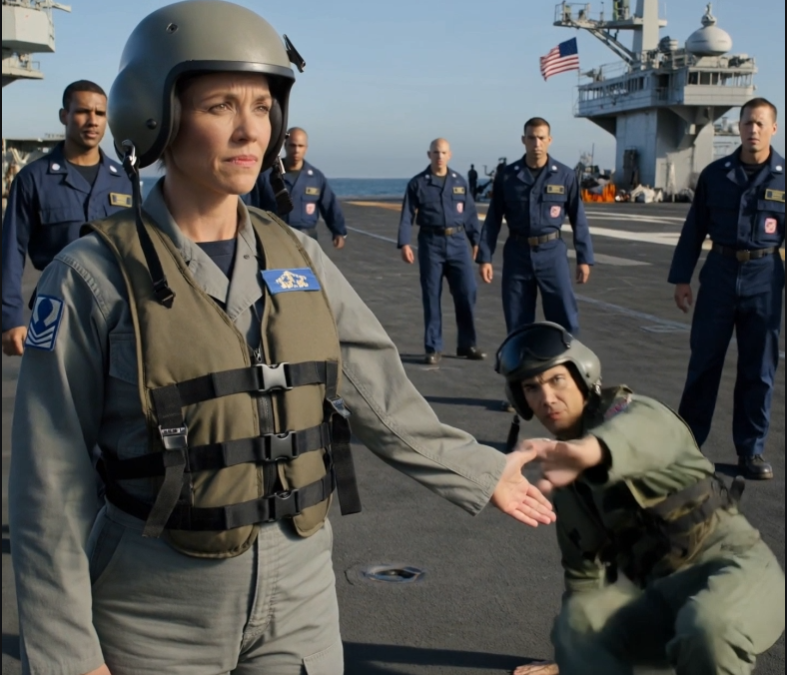
The wind on a flight deck does not care who you are. It comes across the bow at thirty knots of ship speed, plus whatever the weather adds, and it presses on everyone the same. The admiral, the airmen, and the woman nobody has met yet.
I was the woman nobody had met yet.
I had been aboard for eleven minutes, and I was crossing the deck with my chin down and my hands loose when two lieutenants decided that eleven minutes was ten too many.
I had a borrowed float coat zipped to the throat and a cranial with no markings on it because I had wanted to walk the deck once before I owned it. The way you walk through a house before you buy it, quietly, touching nothing, learning where the floor creaks. Nobody up there knew my name. Nobody was supposed to. I had timed my arrival for the back half of a launch cycle so the deck would be busy and I would be small, one more float coat in a river of float coats moving aft between the jet blast deflectors.
The taller one stepped into my lane first. He had a good face and a bad morning in it, and he put a flat hand toward my chest, not touching me, just claiming the air between us.
“Wrong side of the foul line, princess,” he said. “Deck’s not a tour.”
I stopped. I kept my boots square and my weight even, the way you learn to stand when you have spent years being the smallest person in a fight. The second one drifted around to my flank, grinning the way a man grins when he thinks the situation is already over and he only came for the laugh.
“Island’s that way,” the tall one went on, tipping his head toward the tower without looking away from me. “Tourists watch from the island. You want a picture, you get it from behind the glass with the rest of the visitors.”
“I’m not a visitor,” I said.
I said it level. I have said harder things in worse weather. But level was the wrong key for a man who had already decided the song, and he heard it as back talk. He reached out and flicked the sleeve of my float coat twice, a small, ugly gesture, the kind you use on a child or a stray. And that flick told me more about him than his file ever would.
“You’re whatever I say you are up here,” he said. “Move, or I move you.”
There is a version of me that talks him down. She’s forty-four years old, and she has a ready room full of tools for exactly this: patience, rank, and the long game. She is the version I have spent two decades building on purpose.
She did not show up.
He put his hand on my arm, closed his fingers, and turned his shoulder to steer me back toward the catwalk like a piece of gear that had drifted out of place. And the version of me that answered was the one from before all the tools. She is nineteen. She stands harbor watch at two in the morning. She learned in a place where you did not get a second sentence.
I did not decide to do it. Twenty years of muscle decided for me, and I spent the next twenty seconds wishing I had been slower.
I took the hand that was holding my arm. I turned it, stepped through, and put him flat on his back on the nonskid. Controlled. No strike. Just leverage and the deck. His wingman was already moving, lunging the way men lunge when their friend goes down and their brain has not caught up. I used the little that he gave me and folded him over the first one so that he landed across his own lieutenant’s chest.
Three seconds. Both of them down.
Neither of them hurt, unless you count the part of a man that gets hurt worst, which is the part that was sure.
The jets kept turning. The wind kept coming across the bow. But near us, in a circle maybe forty feet wide, the deck went still. It was the particular stillness of people who have just watched something they will be talking about at chow for a week and are not yet sure whether to laugh.
I put my hand out to the tall one. I am not proud of those three seconds, but I was raised to offer the hand afterward. He did not take it. He stared up at me from the nonskid with the wind flattening his hair.
Behind him, above us, over the ship’s general announcing system, a voice that had been in the middle of a routine call stopped. Just stopped midword, the way a room stops when someone in it sees something the rest have not.
Nobody on the deck moved.
Let me pull back, because the woman on her feet in the middle of that circle and the two men on the deck at her boots are the whole problem. And it will help to know who was actually standing there.
Three hours earlier, I had been strapped into the back of a transport, turning circles in the gray, watching the ship grow from a smudge to a shape to a runway that had no business floating. My orders were folded in a cargo pocket against my thigh. I had read them so many times that the creases had gone soft.
Commander, United States Navy. Report to the ship. Relieve as Air Officer.
The air officer on a carrier is the person who runs the flight deck and the airspace right above it. Every launch, every recovery, every aircraft that turns a wheel up there for the length of a cruise on the ship. They do not call that person the air officer. They call the person the Air Boss, or just the Boss, and the whole deck answers to the Boss the way a body answers to a spine without deciding to.
I was three hours from taking that watch, and I had wanted to arrive the way I try to do everything hard: quietly and early, so that when the loud part came, I would already know where the exits were.
I had wanted to learn the deck before it learned me.
That plan lasted about ninety feet.
So there I was, eleven minutes aboard, standing over two of the pilots I had crossed an ocean to lead. And the first thing my new deck knew about its new boss was that she could put a man down without spilling her coffee.
That is not the introduction you write for yourself. It is not the reputation you want walking point ahead of you into a job that is nine-tenths trust.
I had come aboard the way the incoming Air Boss usually does not, on a routine logistics flight rather than with any fanfare. And I had asked the aircrewman on the transit not to radio ahead that I was aboard. He had given me a look, the look enlisted people give officers who are making their lives complicated for reasons of their own. He had done it anyway because I asked, and because there was nothing improper in it, only unusual.
I had told myself it was humility.
Standing over two lieutenants on the nonskid, I understood it had also been a little bit of pride. The specific pride of a person who wants to be discovered rather than announced, who wants the deck to find out on its own that the quiet one in the plain float coat was the one running the show.
Pride is patient like that. It hides inside your virtues and waits. And mine had arranged for me to be exactly anonymous enough on that deck to get my sleeve flicked.
The man who reached us first was a senior chief, an aviation boatswain’s mate, a handler, which is the rating that moves aircraft around the deck and, more than anyone, owns the choreography of the place.
He was built like a piling, and he moved through the turning aircraft the way a fish moves through a reef without looking, because his body had memorized every hazard on that deck years ago. His float coat was yellow, going tan at the shoulders from salt and sun. His name, I would learn in a minute, was Bragg.
He did not run. Handlers do not run on a flight deck because running on a flight deck is how you end up under something. He arrived fast without running, which is its own skill. He took in the two men on the nonskid and the woman standing over them, and he did the thing that told me everything I needed to know about him.
He did not look at the lieutenants first. He looked at how I was standing.
Handlers read bodies the way sailors read weather, and something in the way I had my boots set and my hands open made his eyes narrow. Not in suspicion, but in recognition of a category, the way you clock a fellow tradesman in a crowd.
“On your feet, gentlemen,” he said without heat. Then he turned to me, and only then. “Ma’am, are you injured?”
“No, Senior Chief,” I said. “Nobody’s hurt.”
The two lieutenants got up. The tall one, whose name I did not yet have, would not look at me. The wingman was checking his own elbow and glancing at the growing ring of faces, understanding for the first time that there had been an audience, that whatever this was, it was now a story, and that he was on the wrong side of it.
I bent and picked up the wingman’s cranial, which had come off in the fold. I held it out to him, and he took it, because there is no version of a man who refuses his own helmet.
That was the only lecture I gave. No words, just a woman waiting for the deck to finish its cycle, holding out a boy’s helmet in a thirty-knot wind, learning the name of the deck that was about to be hers by breaking it.
The thing you have to understand about my hands is that they were the first part of me anyone ever respected.
And I have spent the rest of my life trying to make them the last.
I came into the Navy at eighteen from a river town in Ohio where the water was brown and the work was gone. The recruiter did not sell me a jet or a horizon. He sold me a way out and a rating I had never heard of: Master-at-Arms, which is the Navy’s police. The people who stand the gates and the quarterdecks and the brig hatches. The people who are the first hard surface a bad night runs into.
I was small, and I was fast, and I was angry in the quiet way that does not show up on a form. And the rating fit me like a glove I did not know I had been looking for.
There was a Master Chief named Acriman who ran the security department on my first base, a man built like a filing cabinet with a gray flattop and hands that had clearly settled a great many arguments before I was born. He watched me handle a drunk on the pier my second month, a big man twice my weight who was swinging at a shipmate. He watched me put the big man down clean and fast and safe.
He did not congratulate me. He waited until the reports were done and the pier was quiet. Then he found me by the water and said the sentence that has been sitting in my chest for twenty-six years.
“You’ve got fast hands,” he said. “That’s the least interesting thing about you, and it’s the thing that’s going to get you in the most trouble, because people are going to keep handing you reasons to use them. Keep your hands down until the day only your hands will do. Most days are not that day.”
I was nineteen, and I did not understand him. I thought he was telling me to be careful, and I was young enough to hear careful as an insult.
It took me years to understand that he was not talking about caution at all. He was talking about power. He had watched me discover that I could end a physical argument almost before it started. And he knew, the way old men who have been in a hundred fights know, that the discovery is a trap.
Once you know you can win the fast way, every slow way starts to look like weakness. And you spend the fast currency on arguments that a patient person would have won for free and kept the change.
He was trying to make me rich in the only account that matters in a long career, which is the account of fights you did not have to have.
For a while, I did keep my hands down, and I watched it work. I watched drunks talk themselves back down the brow because I gave them a door instead of a wall. I watched a whole watch section learn that the small woman at the quarterdeck did not need to prove anything, and that the not needing was itself a kind of authority that the men who flexed never quite got their hands on.
I was good at it. I could have taught it. In a sense, I have been teaching it my whole life, to every division and every wardroom and every nervous nugget who ever flew for me.
Two years later, I did not keep my hands down.
A sailor came off the brow at two in the morning, so drunk he could not find his own feet. When a young watchstander tried to help him, he swung, and I put him on the concrete before I had finished the sentence in my head about whether I should.
I was right. Every witness said I was right. The man had thrown the first punch, and I had ended it before it landed on the kid.
And I still stood at captain’s mast three weeks later while a commander read the words excessive force off a page, because being right and standing at mast are not opposites. They live in the same house.
Acriman came to the mast. He did not have to. He stood in the back in his dress uniform, and afterward, on the same stretch of water where he had told me about my hands, he told me the second half of the lesson.
“You were right,” he said. “Being right at mast is still standing at mast. The Navy doesn’t give you a medal for the fight you win. It gives you a career for the fights you make unnecessary. You want to go somewhere in this outfit, you learn the difference between being able to end something and needing to.”
I carried that sentence through a commissioning program, through flight school, through three deployments and a squadron command and an instructor tour teaching the best fighter pilots in the fleet how to think faster than their own fear.
I taught Acriman’s rule to every division I ever had.
Keep your hands down until the day only your hands will do.
I believed it. I built a whole career on the space between able and needing.
The Mustang path, the road from the enlisted ranks up into the officer corps, teaches you underestimation the way a cold climate teaches you about coats. You do not read about it. You wear it every day.
I walked into wardrooms full of officers who had been officers since they were twenty-two, who had never stood a midwatch at a gate or scrubbed a bilge. And I watched them decide in two seconds that a prior-enlisted aviator ten years older than the rest of the ensigns was a curiosity at best and a mistake at worst.
I got called the wrong name at receptions. I got handed coats to hold and drinks to fetch by men who assumed the older woman in the room was somebody’s staff. I learned that the fastest way to lose those little arguments was to win them loudly, and the surest way to win the war was to let each small, wrong assumption walk right up to the edge of a cliff it had built for itself.
Being underestimated became, over the years, less a wound than weather I dressed for.
But weather gets into your bones. That is the part they do not tell you.
You can be good at being underestimated for twenty years and still have it wearing a groove in you the whole time. A groove that fills with something hot and fast and certain every single time a door closes in your face. And one day, the groove is deep enough that the hot, fast, certain thing gets to your hands before the twenty years of discipline get to your head.
And on the foul line, eleven minutes aboard, forty-four years old, with more rank on my collar than Acriman ever wore, I had put two men on the deck in three seconds because one of them flicked my sleeve and called me princess.
The wound was not that they had underestimated me. People underestimate me for a living. It is, if I am honest, a tool I have used, the way a small fighter uses a taller one’s certainty against him.
The wound was older and closer to the bone.
It was that being underestimated makes the easy answer feel like justice. It dresses your worst reflex in the clothes of fairness. It hands you a reason, and the reason is always waiting. And I had just learned that after all these years, the reason still worked on me in under three seconds.
I would spend the rest of that day deciding whether I owed two lieutenants an apology or a standard.
It turned out to be both, and the order mattered.
The senior chief keyed the radio clipped to his float coat and turned halfway away from us into the wind, the way you do to hear. I watched the back of his neck while he talked to the tower, and I watched the exact moment the conversation changed him.
He had reported it plainly at first. An incident at the foul line. Starboard side. Two aviators and a passenger. No injuries. Deck safe.
Routine. Almost.
The kind of thing a handler passes up to primary flight control a dozen times a cruise so the Boss knows what is happening on the Boss’s deck.
Then the tower said something back, and Bragg’s shoulders squared. He turned a few degrees more into the wind and asked me without quite looking at me.
“Ma’am, the tower’s asking. What’s your name?”
“Kesler,” I said.
He passed it up. And then he went still in the particular way a professional goes still when a small fact rearranges a large picture.
Up in the tower, behind the green glass that overhangs the deck, a captain named Grantham was standing his last watches as the Air Boss of that ship. He was forty-nine, and he was tired in the good way, the way a man is tired at the end of a cruise he ran well. He had the plan of the day and the airplane and the arrival message all on the same clipboard, because that is how it works. The incoming Boss is a line item on the schedule like everything else.
He had read the name that morning.
Commander A. Kesler reporting. Relieving as Air Officer.
He had been half expecting a formal walk up, a knock, a salute, a handshake, the changing of the watch done the way it is done, with ceremony and a folder and two signatures.
Instead, his handler had just told him that a passenger named Kesler had put two of the air wing lieutenants on the deck at the foul line.
And Grantham, who had run that flight deck for eighteen months and could read a situation through green glass at two hundred feet, understood the whole thing in about the time it took me to understand it.
Which is to say, faster than the two men still brushing salt off their flight suits.
His voice came over the general announcing system a moment later, even and unhurried, the voice of a man who has never once in his career let the deck hear him rushed.
“Flight deck personnel, make a hole and pass the incoming Air Officer to primary flight control.”
The word that did the work was officer. But the word that landed was the one the deck uses, and it did not come over the 5MC.
It came from Bragg, quietly, to the two lieutenants. Almost kindly, the way you tell a man the thing he is about to wish he had known.
“That’s the Boss,” he said. “You squared up on the Boss.”
I have thought a great deal since about the two seconds after that sentence.
The tall lieutenant, Buckley, I would learn, did not go pale or stammer. He did something worse and more human. He looked at me, and then he looked at his own hand, the one that had flicked my sleeve, as if it belonged to someone else, as if it had acted without him.
And I recognized the look, because it is the exact look I had worn on the foul line about my own hands. I have worn it before, at eighteen and at twenty and at forty-four.
The look of a person meeting the gap between what they meant and what they did.
Everyone around those two men on the deck had already stopped seeing me as a stray that bit them. The two men themselves were the last to turn, because they had the most to lose in the turning.
I did not feel triumphant. I want to be honest about that, because the story would be cleaner if I had, and it would be a lie.
What I felt, watching the word travel across the deck and rearrange every posture it touched, was tired and a little sick. And aware, the way you are aware of a stone in your boot, that I had just started the most important command of my life by winning a fight I should have talked my way out of.
The climb to the tower is a ladder and a half up the island, steel treads worn silver in the middle. I made it with a lieutenant on either side of me because Bragg had detailed them to walk me up, which was either mercy or theater. I could not tell.
The two of them were now escorting the woman they had tried to remove. And everyone we passed made a hole.
That was when I felt the second pull, and it was worse than the first, because the first had been fast and animal, and the second was slow and human and dressed up as justice again.
The deck wanted a reckoning.
Not the deck as a place. The deck as a crowd, the hundreds of eyes that had seen or heard by now. A crowd that has watched two officers put hands on a stranger and get dropped for it wants the story to end the way stories end, with the two men getting what is coming.
I could feel the appetite for it in every made hole, in every carefully blank face. They were not blank because they did not care. They were blank because they were waiting to see what kind of Boss ended a man.
A young sailor said the quiet part. She was a blue shirt, an airman, maybe twenty, chocks and chains, the lowest and most essential job on the deck. As I passed, she leaned in under the wind. She was fast and loyal and certain.
“Everybody saw it, ma’am. They had it coming.”
She meant it as a gift. She was offering me the crowd. She was telling me the deck was already on my side and would cheer whatever I did to the two men who had disrespected me.
And that is the most dangerous thing a leader is ever handed: a crowd that has preapproved your cruelty.
I have watched that gift ruin better officers than me. A crowd behind you feels like judgment vindicated, and it is only appetite. It does not love you. It loves the story. And the story it wants is the simple one, the one where the disrespected woman brings down the hammer and everyone gets to feel the clean, animal satisfaction of a score settled in public.
The crowd will hand you that hammer and cheer while you swing it. And then weeks later, when the two young men you destroyed are gone and the deck is short two pilots and the wardroom has quietly filed you under vindictive, the same crowd will not remember handing you anything.
Appetite never remembers what it asked for. It only remembers whether you fed it, and it despises, in the long run, the leaders who did.
So I climbed the ladder past Ivers and her loyal, dangerous certainty, and I let the appetite of the deck press on me the whole way up. I made myself feel it clearly so that I would not mistake it for my own judgment.
My judgment and the crowd’s appetite happened to be pointed at the same two men. That is exactly when you have to be most careful, because it is the moment when doing the wrong thing feels the most like doing the right one.
I did not answer her. I filed her face away. Ivers, it said on her float coat. And I filed the lesson she did not know she was teaching me, which is that the appetite of the people who are on your side is a trap dressed as support.
Up in primary flight control, behind the green glass, the light was strange and gray, and the whole deck lay out below like a diagram of itself.
Grantham was there, and he had the report half-written already because he was a good Boss, and a good Boss protects his deck and his relief. The fastest way to protect both was to nail the two lieutenants to the wall before I even took the watch, so that the ugliness belonged to the outgoing Boss and the incoming Boss started clean.
“Two lieutenants put hands on a senior officer on my flight deck,” he said, sliding the clipboard toward me. “I can have this at the captain’s desk before you relieve me. You can have their wings by noon. You would be within your rights, and frankly, you would be doing me a favor, because I’d like to hand you a deck with that already handled.”
Then the hatch opened, and the captain of the ship came in, because word travels up a chain even faster than it travels across a deck.
The commanding officer of a carrier is a four-striped force of nature, named, in this case, Rutherford. And he was not angry, which was worse.
He was decisive.
He had a ship to run and a problem in front of him with an obvious solution. He was a man who liked obvious solutions delivered fast.
“Boss,” he said to me, and I noticed he used the title before I had earned it, which was its own kind of message. “I don’t care what the wardroom thinks of it. You can have both those officers grounded and their wings under review by the end of the launch. Say the word and it’s done. Nobody puts hands on the Air Boss on my ship.”
Three people in that tower, all senior, all correct, all offering me the same clean, fast, justified end.
The word everyone wanted was right there. It was the word I had spent twenty-six years learning not to say fast.
I looked out through the green glass at the deck, at the diagram of the thing that was about to be mine. And I made the decision the way I have learned to make the ones that matter: without spectacle, in the flat interior voice that does not raise itself even when everything around it does.
I picked up Grantham’s clipboard. I read the half-written report, the clean prose that would have ended two careers by lunch, and I handed it back to him unsigned.
“I’m not going to sign a page about my own fists,” I said.
Grantham looked at me. He was a smart man, and he heard the whole thing in the sentence, but he made me say it anyway because he wanted to know I knew what I was turning down.
“You are within your rights,” he said again.
“I know exactly what I’m within,” I said. “That’s the problem. If those two are going to answer for their hands, they’re not going to answer to the person whose hands answered back.”
I watched him as I continued.
“Whatever I do to them in the next hour, the whole ship reads it as a woman getting even. And then the lesson isn’t about the foul line. The lesson is, don’t cross the Boss. And that’s a smaller lesson than the one I want on this deck.”
Rutherford folded his arms. He was not used to a slow answer to a fast problem, and I could see him deciding whether I was principled or soft, which is a decision people have been making about me my whole career and usually getting wrong.
“Every officer on this ship is going to know by tonight that two lieutenants put hands on you and kept their wings,” he said. “You don’t think that sends a message that you can put hands on the Air Boss and skate?”
“It sends exactly that message if I stay quiet, sir,” I said. “It sends a very different message if I stand them up in front of the deck for sixty days, learning the job of every person they thought they were better than.”
I let the words settle before I went on.
“Grounding them is loud, and it’s over by lunch, and nobody learns anything except to be afraid of me. Standing them up is quiet, and it lasts a cruise, and everybody who watches it learns the thing I actually want them to learn, which is that this deck doesn’t run on rank. It runs on respect. And respect is a thing you pay to the person whose name you don’t know yet.”
Rutherford was quiet for a moment. Below us, a jet came off the bow and turned into the gray and was gone.
“You have thought about this a great deal for a woman who’s been aboard nineteen minutes,” he said.
“I have thought about this for twenty-six years, sir,” I said. “I just did it badly nineteen minutes ago, and I’d like the next twenty-six not to look like the last three seconds.”
“So you let it go.”
He said it as a test, not a conclusion.
“No, sir,” I said. “I’m not letting anything go. I’m taking the watch first. The deck doesn’t care about my feelings, and it’s midcycle. And the most important thing that happens today is not what happens to two lieutenants. It’s that thirty-some aircraft get back aboard safely.”
I could feel the weight of the decision settling into place as I explained it.
“So I’ll take the watch. I’ll run the recovery, and then I’ll take those two men into my ready room, on the record, cold, with the report I write myself and sign myself. And I’ll hold them to a standard, not to a grudge. No wings by noon. Standards by dark.”
Grantham almost smiled. Rutherford did not, but something in his shoulders changed, the way a man’s shoulders change when he decides to let a subordinate be right in a way he would not have chosen.
“It’s your deck,” he said, which was the closest a captain like that comes to yes.
I reached for the Air Boss’s chair. It is an ordinary chair, a raised seat with a good view, in a bank of radios and the microphone that owns the deck. I had sat in a hundred like it, in simulators and as an understudy and in my own head for years.
I put my hand on the back of it, and I felt the whole weight of the thing come up through my palm.
The decision was made. It had been quiet, and it had been total. Now it only remained to prove it in the one language the deck respects, which is not words.
There is a small ceremony for taking the watch, and we did it right there in the tower with the deck turning below us, because a watch is not a feeling. It is a legal fact, and the fact has to be handed from one person to another cleanly or it does not count.
“I relieve you, sir,” I said.
“I stand relieved,” Grantham said.
He stepped back from the microphone and the radios and the view, and the deck was mine.
I have relieved the watch a thousand times in twenty-six years. I have done it on quarterdecks at two in the morning, in ready rooms before dawn, and in combat information centers with the ship at general quarters.
I had never done it in a borrowed float coat, with two lieutenants’ bootprints still on my conscience, in front of a captain who was not yet sure about me, with a deck full of people waiting to find out whether the fast hands had a slow enough head to sit in that chair.
So I did the only thing that ever settles that question.
I went to work.
The weather was coming down. It had been gray when I flew in, and now it was closing, the ceiling dropping toward the water and the visibility going soft.
A carrier recovery in bad weather is the most demanding routine thing in the world. Thirty aircraft with fixed fuel and no shoulder to pull over onto, coming home to a moving runway the length of a few city blocks that is also pitching in a swell.
The Boss runs it. Not the pilots. Not the captain. The Boss.
The Boss owns the deck and the pattern and the tempo. And the Boss’s voice is the one thing everyone in that machine can hear, so the Boss’s voice has to be the calmest thing in the sky.
I keyed the microphone and made my first call as the Air Boss. I made it flat and slow and a little bored, because bored is a gift you give a nervous deck.
“On the flight deck, this is the Air Boss. We’re going to bring them all home the boring way. Stand by to respot for recovery.”
Bragg’s handlers began to move the aircraft, clearing the landing area. The deck reorganized itself under my voice, and I felt it take. I felt the tempo settle onto the beat I was setting, and there is no feeling in the world quite like a flight deck deciding to trust you.
It is not applause. It is better. It is a thousand small motions falling into your rhythm.
A carrier recovery looks like chaos from the outside, and it is the opposite of chaos. It is a piece of music with no room for a wrong note. Aircraft come down the pattern in a stack, each one bleeding altitude and fuel on a schedule. The deck has to be clean, the wires have to be set, and the tension on the arresting gear has to be dialed for the exact weight of the exact aircraft on final.
All of it has to happen in the seconds between one jet catching a wire and the next one rolling into the groove.
The Boss sits above it and holds the tempo.
And the whole trick of the job, the thing they cannot teach you in any school and you only learn by doing it badly a few times where it is safe, is that your voice sets the heartbeat of the deck.
If your voice speeds up, three hundred people speed up. And a fast deck drops things and clips things and gets people hurt. So you learn to slow your own pulse on purpose, to talk the way a good doctor talks in a bad room. And the deck borrows your calm because it has nowhere else to get any.
I brought the first six aboard clean, one after another, the boring way. Each trap loosened something in the tower that had been wound tight since the foul line. I could hear it in the controllers’ voices.
They had a Boss.
Whatever else had happened on the deck that morning, the chair had a professional in it. And a deck can forgive almost anything of a Boss who can run the recovery.
Then the problem came, the way problems always come in the middle of the routine.
A young pilot, a nugget on one of his first cruises, was in the pattern low on fuel and getting lower. The weather had pushed his first two passes long, and now the arithmetic was getting thin, the fuel and the ceiling and the pitching deck all closing toward the same bad number.
The controllers were tightening. I could hear the pattern getting brittle, the pilot’s transmissions climbing half a step in pitch. And a scared pilot flies scared. A scared pilot on his last few thousand pounds of fuel is how you lose an aircraft and a boy on a Tuesday.
I looked at the fuel state and the deck and the weather, and I did the thing I had done once before on a black night in 2017, when I was the airborne mission commander and talked a nugget aboard on his last drop of gas by giving him the one thing he did not have, which was somebody who sounded certain.
I keyed the microphone and dropped my voice another half step into the register I keep for exactly this. The register that says the person talking has seen this a hundred times and is a little bored by it.
And I talked to the boy in the sky.
“Two-zero-four, Boss. Listen to my voice. You have gas for this. I wouldn’t lie to you, today of all days. The deck is clear. The deck is ready. The wind is fair. You’re going to fly the ball all the way down, and you’re not going to think about anything else. Paddles has you. I have you. Fly the ball.”
The landing signal officer took him at the back of the pass, and the boy flew the ball. I watched the aircraft come out of the gray at the bottom, wings level, on speed, and catch the third wire and slam to a stop in the arrested-landing way that always looks like a crash and never is.
And the deck exhaled.
Nobody clapped. On a good deck, no one ever claps, because clapping means you thought it might go the other way, and the Boss’s whole job is to make everyone believe it could only ever go this way.
But Bragg looked up at the glass once and gave me a quarter of a nod. And a quarter of a nod from a senior chief handler is worth more than a medal from almost anyone else.
The nugget was not the only test the weather handed me that hour.
Two aircraft later, another pilot came in high and fast, floated the wires, and boltered, which is when the hook skips every wire and the jet has to slam to full power and get airborne again off the angled deck.
A bolter is normal and safe, and also the exact moment a nervous deck holds its breath, because for one second an airplane that was landing is now taking off with not much runway left.
I kept my voice flat and sent him around. I told him he had done nothing wrong, that the deck had moved on him, that we had all the fuel and all the night we needed. I brought him around the pattern and back down, and this time he flew it into the wire.
I told him in the same bored voice, “Better do it that way when it counts.”
A deck learns as much from how you handle the ordinary bolter as from how you handle the emergency, because the emergency is rare and the ordinary imperfection is constant. A Boss who stays flat over the small stuff has already told the deck how the big stuff will sound.
By the time I recovered the last aircraft, the weather had won the argument with the daylight. The deck was lit and slick, and I had been in the chair long enough that the two lieutenants at the back of the tower had stopped being defendants and started being students.
I had not planned that either. I had only planned to do the job in front of them.
I had brought Buckley and Holloway up to the tower for the recovery, not to be yelled at, but to watch. I had told Bragg to put them at the back of primary flight control, where they could see the whole thing, the fuel states and the weather and the deck in my hands and my voice.
I had done it on purpose, because I did not have a single word to say to those two men that would be as loud as letting them watch me do the job.
And when the nugget on his last gas came out of the gray and caught the wire, I saw Buckley understand in his body what he had squared up to at the foul line.
It was his own division’s jet. It was one of his people I had brought home.
I did not have to say a word to them. The deck said it in the only language the deck respects.
I recovered the rest of them in the next forty minutes, one at a time, the boring way. When the last aircraft was chained down and the landing area was cold, I gave the deck back its normal tempo and climbed down out of the tower with my legs telling me how long I had been standing.
The fallout, when it came, came the way real fallout does. Not in a single scene, but in a spreading, in the way the story moved through the ship and settled into a new arrangement of who respected whom.
I took Buckley and Holloway into my ready room an hour after the recovery, on the record, with Bragg standing witness and a yeoman taking notes. The report I would write myself lay blank on the desk in front of me.
They came in at attention, and they stayed at attention. The tall one, Buckley, had the look of a man who had been rehearsing an apology for an hour and did not know if he would be allowed to give it.
I did not mention my rank. I did not mention the foul line as a fight. I did not say one word about the three seconds in which I had put them on the deck, because those three seconds were mine to answer for, not theirs, and I was not going to let my worst reflex become the subject of their correction.
“You didn’t put hands on a tourist,” I said. “You put hands on a shipmate. That she turned out to be me is the least of your problems. And if the only reason you’re standing there sweating is that it turned out to be me, then you haven’t learned the thing yet.”
They stood very still as I continued.
“The thing is this. You looked at a person you didn’t know on your deck, and in two seconds you decided she was no one. And you decided that being no one meant she could be moved with a hand. That is the failure. Not the rank. The hand.”
Buckley broke attention the way disciplined men break it, which is barely, just enough to speak.
“Why not just end us, ma’am?” he said, his voice low and steady. “You could. Everyone would understand it. You’d be within your rights.”
There was that phrase again.
Within your rights.
It had been offered to me three times in one morning by three good officers, and here it was a fourth time from the man it would have destroyed, almost asking for it. Because being destroyed is simple, and being corrected is hard.
“Because ending you is exactly what everyone expects of me,” I said. “It’s what the deck wants. It’s what the captain offered. And it’s what you’re half asking for right now, because it would be over.”
I looked at him and saw that he was listening, not just waiting for a sentence.
“And I’m done, at forty-four years old, being the thing people expect on a first look. You decided who I was in two seconds. I’m not going to decide who you are in two seconds back. That would just be the two of us making the same mistake. Taking turns.”
I kept their wings.
I want to be clear that this was not softness, because I have watched softness ruin more young officers than severity ever did. I did not keep their wings to be liked. I kept them because grounding two competent pilots would have cost the air wing more than it cost the two of them, and because the standard I actually wanted on that deck was harder to serve than a grounding and would take longer to pay.
So I gave them the standard instead.
For the next sixty days, they would stand deck safety watches under Senior Chief Bragg on their own time, learning the foul line from the nonskid up. They would learn the name and the job of every person who crossed their path until they could teach the foul line to a new sailor without using their hands or their rank to do it.
At the end of the sixty days, each of them would write me one page. Not an apology. I had enough apologies. A page on the difference between authority and the appearance of authority.
And they would find out that the second page was much harder to write than the first.
Holloway, the younger one, spoke for the first time then, and he did it well, which raised him in my estimation more than any amount of silent standing would have.
“Ma’am, permission to say one thing,” he said.
When I nodded, he went on.
“I was going to tell myself for the rest of my life that I lunged because my lieutenant went down and I was defending him. That isn’t why I lunged. I lunged because you’d made me look small in front of the deck, and I wanted it back.”
He held my eyes.
“I would like that on the record with the rest of it, because I don’t want to be the version of me that gets to keep the excuse.”
I looked at that boy for a moment, and I thought the Navy was going to be all right if it kept making a few like him.
“It’s on the record, Mr. Holloway,” I said. “Hold on to that. The day you stop being able to catch yourself in a flattering lie is the day you become dangerous with a set of wings.”
Bragg, standing witness by the bulkhead with his arms folded, said nothing. But when the two of them had gone, he uncrossed his arms and said the only sentence he offered me all day that was not about the deck.
“My last three bosses would’ve taken the wings,” he said. “I’ve been doing this twenty-nine years, ma’am. I’ll run through the skin of my hands for the one who didn’t.”
Then he put his cover on and went back to his deck, and I understood that whatever I had lost on the foul line in three seconds, I had earned back somewhere harder to reach.
Rutherford caught me in the passageway afterward. He did not say I had been right, because captains like that do not. But he said, “The deck is yours, Boss.”
This time the title had weight under it, and coming from him, that was the whole speech.
Grantham found me later with the last of the turnover, the binders and the keys and the small human handoffs that no checklist covers. At the very end, off the record, closing his cruise, he said the thing I have kept.
“I’ve watched three officers take this deck,” he said. “The deck has never stood that quiet for a new Boss. Not because you dropped two lieutenants. Anybody can drop somebody. Because you didn’t spend it.”
He paused, then finished.
“You had the whole ship handing you a hammer all morning, and you put it down and picked up the harder tool. The deck noticed. Decks always notice.”
That night, I sat in the tower alone with the deck ranged and quiet below me, the aircraft chained down in neat rows, the ceiling still low over the water, and I let myself feel the shape of the day.
I had gotten the chair. I had taken the watch and run a hard recovery and brought a scared boy home on the last of his gas. And I had held two men to a standard instead of nailing them to a wall.
By every external measure, it had been a good first day. Maybe better than good. The kind of first day that becomes a story people tell about a Boss for the rest of a cruise.
And I had also learned, at forty-four years old, that when a door is closed in my face, I still reach for my hands first.
Twenty-six years of building the slow head, and it took one flick of my sleeve and one word to skip past all of it in under three seconds. I did not get to pretend otherwise.
The whole deck had watched me fail my own rule. The rule I had taught to a hundred sailors. The rule Acriman had given me by the water when I was nineteen and sure that fast hands were the best thing about me.
There is a kind of person who would have let the good outcome erase the bad reflex. The recovery went well. The men were corrected fairly. The deck respects me now.
All true. And all of it a way of not looking at those three seconds.
But I have never been able to let an outcome launder a reflex, because the reflex does not care about the outcome. It waits. It is patient. It will be there the next time a door closes in my face.
And there is always a next door.
So I did the thing I had been owing for years.
I found paper, actual paper, and wrote to Acriman, who is sixty-eight now and retired to a place with a porch. I wrote the letter I had been not writing for a decade because I did not want to write it until I had something true to say.
I did not write to him about the wings on my collar or the chair I had taken or the deck I now ran. He would have been glad of all of it, and it was not the point.
Master Chief,
You told me once by the water to keep my hands down until the day only my hands would do, and you told me most days are not that day.
Today, a lieutenant flicked my sleeve and called me a name and put a hand on my arm. And my hands went first. Before my head, before my rank, before everything you and the last twenty-six years put into me.
I put two men on the deck in three seconds, and then I stood there being the Air Boss with their bootprints on my conscience.
I want to tell you I have finally learned the difference between being able and needing to.
I have not.
I have only learned today, at forty-four, that I still have to choose it every single time. That it never becomes automatic. That the fast hands are still the first thing that answers, and the slow head has to run to catch up.
I think you knew that when you told me. I think that was the whole lesson.
And it took me twenty-six years to hear the part you left quiet, which is that keeping your hands down is not a thing you learn once. It is a thing you do again every day until they bury you.
I’m still learning the difference between being right and being whole.
Thank you for not letting me confuse them.
Your MA, now their Boss.
I sealed it and set it in the outgoing tray, and I sat with the quiet deck a while longer.
I thought about the two lieutenants asleep somewhere below me in their racks, and about the fact that they would spend sixty days learning a lesson that I had just proven, at forty-four, I was still learning myself.
There is a temptation when you correct someone to stand above the thing you are correcting, to pretend you are the finished version handing down wisdom to the unfinished.
I could not stand there.
I had failed the exact test I was about to hold them to. And I had failed it first and worse, because I had every year and every stripe and every hour of training that they did not. And my hands had still gone before my head.
The only honest place to lead them from was beside them, as one more person who reaches for the wrong tool when a door slams and who has decided anyway, again tonight, to keep reaching for the right one until the reaching becomes the truer reflex.
Acriman would have liked that the lesson had cost me something. He never trusted a lesson that came free. He used to say that the ones you pay for are the only ones you keep, and I had paid for this one in front of three hundred witnesses on my first morning aboard, which is about as expensive as a lesson gets.
Being right and being whole are not the same instrument.
I had spent a career flying the first one. I was, that night, at the start of a cruise and the start of a command, finally learning to fly the second.
The rest of it came slowly, the way anything real comes, over the weeks of a long cruise, in the small daily proofs that outlast any single dramatic morning.
Buckley stood his sixty days of deck safety watches, and he did not stand them sullenly, which surprised me.
Somewhere around the fourth week, I came out onto the deck during a launch and heard him correcting a brand-new pilot at the foul line. A nugget who had wandered into a hazard area the way nuggets do.
I stopped and listened, because a person shows you who they have become by what they do when they think the lesson is over.
“Wrong side of the line,” Buckley told the kid.
My whole chest went tight because those were nearly the words he had used on me. But he did not stop there.
“And you say sir or ma’am to everyone up here. And you learn their name and their job before you learn their rank, because you have no idea who anyone is yet. And up here, the person you don’t recognize is exactly the person you can’t afford to be wrong about.”
He did not know I was behind him.
That is the only version of that sentence that counts. The one a man says when he thinks no one who matters is listening.
I walked on, and I did not let him see me, because the correction was not mine to receive.
Holloway turned out to have a gift for the handling side, and Bragg, who does not hand out compliments, told me the boy had a good eye for the deck. He asked, in the roundabout way senior chiefs ask for things, whether I would mind if he took him under his wing for real.
I did not mind.
The two men who had tried to move me off my own deck became, over a cruise, two of the deck’s steadiest hands. And I would like to tell you I planned that, but I only planned the standard.
The men did the rest, which is the only way it ever works.
There was a night about two months into the cruise when the weather came up hard, worse than the day I reported aboard. A low, ragged ceiling, a heaving deck, and a whole event airborne with the divert field socked in behind them, which is the situation that keeps carrier captains awake for the rest of their lives.
I ran that recovery for three hours.
Somewhere in the middle of it, Buckley was one of the ones I had to bring down through the worst of it. I heard my own flat, bored, certain voice go up to him in the pattern, the voice I had used on the nugget my first day.
And I heard him take it and fly the ball and trap.
When he taxied clear, he keyed his radio for just a second, which you are not supposed to do, and said, “Thanks, Boss.”
Then he got off the net before I could tell him not to clutter my frequency.
It was the only time either of us ever spoke about the foul line, and neither of us mentioned the foul line at all.
When it was over and the last jet was chained and the deck was cold and streaming, I sat in the chair with my hands shaking the way they always shake after the adrenaline lets go.
I thought about the fact that the man whose life the deck had just trusted to my voice was a man I had put on the nonskid on my first morning aboard.
If I had taken his wings by noon that first day, the way the whole ship wanted me to, there would have been an empty cockpit in that pattern tonight, or a stranger in it, and I would never have known what I had spent.
The blue shirt, Ivers, the one who had offered me the crowd on the ladder, kept turning up in my orbit, the way sharp young sailors do when they have seen something they want and do not yet have the words for it.
One afternoon, in a lull, she worked up the nerve to ask me the question she had clearly been carrying for weeks.
“Ma’am,” she said, “how does a Master-at-Arms get to be the Air Boss?”
She had done her research. She knew where I had started, at the gates and the quarterdecks, at the bottom, in her neighborhood of the Navy.
She was really asking whether the distance between where she stood and where I sat could be walked by a person like her.
“Slowly,” I said. “And by learning when not to use my hands, which took me longer than it should have.”
I looked at her and continued.
“You saw the fast part on the foul line. The fast part is the least interesting thing about the job. Anybody can be fast. You get here the same way anybody gets anywhere hard. One watch you don’t quit at a time. And you keep your hands down until the day they’re the only thing that’ll do. And you learn to know that day when it comes, and you learn that almost no day is that day.”
She looked at me the way I must have looked at Acriman by the water a lifetime ago, like someone being handed a map to a country she had been told was closed to her.
And I saw her file the sentence away the way I had filed his.
That is how it moves, if it moves at all. From a man on a porch in Ohio to a woman in a tower at sea to a girl in a blue shirt with chains over her shoulder, one quiet handing down at a time.
Ivers put in for a commissioning program before the cruise was over.
She asked me for the recommendation, standing very straight in my ready room, clearly braced for me to tell her she was aiming too high from too low, because someone in her life had taught her to expect that.
I wrote the recommendation that night, and I did not write it kindly, because kindness is not what an honest recommendation is for.
I wrote that she had the one thing you cannot teach a leader, which is the instinct to read a room for who is being overlooked in it, and that the Navy would be a fool to leave her holding chains a day longer than it had to.
I do not know yet how her story ends.
She has a long way to walk, and most of the doors are still shut. But she has the map now, and she has seen with her own eyes that the distance from the bottom to the tower is a distance a person can actually cross, because she watched somebody cross it.
And sometimes that is the only thing a person needs to believe is possible.
The bond that broke at the foul line in three seconds took a whole cruise to reform. And it reformed into something better than what would have been there if those three seconds had never happened, which is a strange thing to be able to say and a true one.
The deck learned to trust its Boss, and the Boss learned again, for the ten-thousandth time, the difference between being able to end a thing and needing to.
Recognition arrived. It just arrived quietly, the way the recognition that lasts always does. And by the time it came, I had mostly stopped needing it to come loudly.
If you have made it this far with me, then I suspect you already know the pull I am talking about, because almost everyone does.
You have been waved off. You have been blocked at some line by someone who decided in two seconds, on no evidence but the look of you, that you were no one. That you did not belong. That you could be moved with a hand or a word or a laugh in front of people who mattered to you.
Maybe it was a job. Maybe it was a family. Maybe it was a room that went quiet in the wrong way when you walked into it.
And you know the thing that rose up in you when it happened. The fast, hot, certain thing that had a perfect answer ready, an answer that would have felt in the moment exactly like justice.
I want to tell you the truth I have after twenty-six years and one bad three seconds on a flight deck.
The easy answer is almost always your hands.
Not always fists. Sometimes it is the cutting sentence, the email you should not send, the scene you could make and win. The hands come in many shapes, and the easy answer is right there every time.
Patient. Waiting. Dressed up as fairness.
Because being underestimated makes cruelty feel earned.
The right answer is almost always your standard. And the standard is harder and slower, and it does not feel like justice in the moment.
It feels like swallowing something. It feels like letting them get away with it.
It is not.
It is the long game. And the long game is the only game that builds anything that lasts.
The person who meets contempt with a standard instead of a strike does not lose. They just win somewhere the crowd cannot see, on a timeline the crowd is too impatient to watch.
Two aviators squared up on a stranger at the foul line, and what shocked them was never really the one move. Anybody can be dropped.
What shocked them, what shocked the whole deck, and what I am still honestly a little shocked by myself, is that the stranger they tried to move turned out to be the one person on that deck who could have ended them where they stood and chose instead to make them better.
Keep your hands down until the day only your hands will do.
Learn to know that day, and learn, the way I am still learning, that almost no day is that day.
This is the last salute.
Take care of each other.
Ou








