True Story: The Bank Called: “Ma’am, Someone Is Trying to Cash Out Your Account and Take $29 Million.” But I Never Had Any Bank Accounts. When I Arrived—The Manager Said 3 Words: “Ma’am, the Sender Left a Message…”
The bank called me.
“Ma’am, someone is trying to cash out your account and take $29 million.”
But I had never had a bank account in my life. When I arrived, the manager leaned close and whispered three words. Then he told me something that made my blood run cold.
“Ma’am, the sender left a message.”
Good day, dear listeners. It’s Briella again. I’m glad you’re here with me. Please subscribe to my channel and like this video. And let me know in the comments which city you’re listening from. That way, I can see how far my story has traveled.
For twenty-six years, my life fit inside a coffee can. That’s not a figure of speech. I kept my rent money in a Maxwell House can on the top shelf of my kitchen in Toledo, Ohio, and my tips in a second one under the sink. My mother, Irene Doyle, had raised me that way. She’d lost everything once, she said, and she never trusted a bank again. I paid my bills with money orders from the Kroger on Monroe Street and cashed my paychecks at the check-cashing place next to the laundromat.
People laughed at me for it. I didn’t care. I was fifty-two years old, worked the morning shift at Lou’s Diner, and my son, Danny, was finishing his electrician’s apprenticeship. Nobody could take from me what I’d never put anywhere they could reach. At least, that was what I believed.
The first strange thing was a letter from a law firm in Columbus called Witam and Prior. It arrived in late August, thick and cream-colored, addressed to Ms. Margaret A. Doyle. Nobody had called me Margaret since my mother’s funeral. I figured it was a debt collector with nicer stationery, so I put it in the drawer with the coupons and forgot about it.
Then a man in a gray sedan started eating breakfast at Lou’s every Tuesday and Thursday for three weeks. Wheat toast, black coffee, a big tip. He never talked much, but once I caught him watching me refill the ketchup bottles the way you’d watch someone you were trying to remember. Rosa, who’d worked the counter with me for fifteen years, nudged me and said, “Maggie, either he’s in love or he’s a cop.”
He stopped coming before I could find out which.
Then came the phone calls. An unknown Columbus number, three times in one week. No voicemail. Why would anyone in Columbus want me? I didn’t know a soul there. On the fourth call, I picked up.
“Miss Doyle, my name is Alan Brener. I’m a senior trust officer with Lakeshore National Bank.”
He spoke carefully, like a man walking across ice.
“Ma’am, someone is trying to cash out your account and take twenty-nine million dollars.”
I actually laughed. I was standing in the diner’s back hallway with a dish towel over my shoulder, and I laughed right into the phone.
“Mister, I don’t have an account. I’ve never had a bank account in my life. You’ve got the wrong Margaret Doyle, or you’re a very creative scammer.”
“I understand why you’d think so,” he said, not offended at all. “Please don’t give me any information. Don’t confirm your Social Security number, your birthday, nothing. Hang up, look up our main number yourself, and ask for me. I’ll wait.”
That was not how scammers talked. Scammers wanted you to stay on the line. I hung up anyway.
That night, Danny came over with Chinese takeout, and I told him everything. He looked up Lakeshore National Bank on his phone. Real bank. Real headquarters on East Broad Street in Columbus. And on their wealth management page was a small photograph of a gray-haired man with tired eyes.
Alan Brener. Senior Trust Officer.
“Mom,” Danny said slowly, staring at the screen. “That’s the guy from the diner. The toast guy.”
My stomach turned over. Had a bank been watching me? And why?
I called the main number the next morning. A receptionist transferred me without hesitation, and Alan Brener picked up on the first ring.
“Thank you for calling back, Miss Doyle. I owe you an apology about the diner. I needed to be sure I had the right person before I made contact. I’d prefer not to discuss this by phone. Can you come to Columbus? It’s time-sensitive. I’ve placed a hold, but I can only keep it for so long.”
“A hold on what?”
“On a request to liquidate and transfer the entire trust. The paperwork was filed nine days ago.”
I took the next day off. Lou grumbled, but Lou always grumbled. Danny insisted on driving me down in his truck. Two and a half hours on I-75 and US-23, past cornfields already turning brown. The whole way, my mind circled the same questions. What trust? Whose money? And who on earth was trying to take something with my name on it?
The bank was the kind of building I’d only ever walked past. Marble floors, brass elevator doors, and a quiet that made your shoes sound loud. A receptionist led us to the fourth floor. Alan Brener was waiting outside a glass conference room.
He was the toast man, all right, wearing a suit this time. He shook Danny’s hand, then mine, and held on a second longer than necessary. Then he leaned close, speaking so softly that Danny couldn’t hear him.
“Read this first.”
He pressed a sealed envelope into my hands. My name was written on the front in shaky blue ink.
For Margaret.
“Ma’am,” he said quietly, “the sender of the money left a message. He made me promise you’d read it before anyone told you anything else.”
I turned the envelope over. On the back flap, written in the same unsteady hand, was a name I had heard exactly once in my life, from my mother on the night she died.
Richard Hail.
I sat down at the long conference table because my knees told me to. Danny sat beside me. Mr. Brener closed the blinds and stepped out to give us privacy. My hands were shaking so badly that Danny had to open the envelope for me.
Inside were two handwritten pages.
Margaret,
If you are reading this, I am dead, and I am sorry that this is how you learn my name from me instead of from your mother.
I am your father.
I met Irene in the summer of 1973, when I was a married man of twenty-six with a lumberyard and too much pride. When she told me she was pregnant, I offered her money to go away. She threw it back at me. She told me she would raise you without one cent from a coward.
She kept her word. I did not keep mine to anyone.
I watched from a distance. I know you never had a bank account because your mother never trusted anything that could be taken away. I am the reason she felt that way.
I sold my company in 2021. Twenty-nine million dollars of that sale belongs to you in a trust I set up that same year. It is not a gift. It is a debt.
My wife, Celeste, does not know the details, but she knows something exists. If she finds out, she will fight. Her daughter, Brooke, will help her.
Do not sign anything they hand you.
My lawyer, Harold Witam, has the original documents. Trust Alan Brener. Trust Linda Park, my assistant of thirty years.
I have no right to ask you for anything, but please do not let them take this. Not for the money. For Irene.
Richard.
I read it twice. Then I put my face in my hands. Danny rubbed my back and didn’t say anything, which is the kindest thing a son can do sometimes.
When Mr. Brener came back, he laid everything out plainly. Richard Hail had died of heart failure on August 2 at the age of seventy-nine. He had created a revocable trust in 2021, naming me as sole beneficiary and the bank as successor trustee. When he died, the trust became irrevocable.
Then, eleven days ago, an attorney representing Celeste Hail had submitted a document labeled First Amendment to the Richard J. Hail Revocable Trust. It was dated March 14 of that year, signed and notarized, and it made Celeste the sole beneficiary. Along with it came a request to liquidate everything and distribute the money to her.
“And there’s something else,” Mr. Brener added. “Two days before the amendment arrived, a woman called our service line claiming to be you. She asked about the account balance and requested an address change to a P.O. box in Dublin, Ohio. She didn’t know the security answers. That’s what made me pull the file.”
“So someone pretended to be me,” I said slowly, “to find out if I knew.”
“That’s my reading of it, yes.”
I started counting what I had lost, and it wasn’t money. It was a father who had sat in a car outside my high school graduation, if the stories Linda Park would later tell me were true. It was my mother scrubbing other people’s floors with her mouth shut tight. It was every night I’d lain awake doing math with my tips. Fifty-two years of a life that could have been different, and the man who could have changed it had chosen not to until it no longer cost him anything.
And now two strangers wanted to take even the apology.
I was scared, more scared than I’d ever been. What did a waitress from Toledo know about trusts and amendments and Columbus lawyers? People like Celeste Hail had country club memberships and attorneys on retainer. I had two coffee cans and a son with a truck.
“How long can you hold it?” I asked.
“The trust document gives the trustee reasonable discretion when there’s a dispute,” Mr. Brener said. “But if Mrs. Hail’s attorney goes to probate court and I have nothing from you, a judge may order distribution. You need a lawyer, Miss Doyle. Soon.”
“I can’t afford a lawyer who works in a building like this.”
“The trust can pay reasonable legal fees to defend its own validity. That’s standard. And I’d suggest someone who isn’t afraid of the Hail name.”
Danny was the one who said it on the drive home.
“Mom, you don’t have to win today. You just have to not quit.”
By the time we got off the highway in Toledo, I had a plan written on the back of a Wendy’s receipt. It wasn’t fancy. First, find my own lawyer, not one anyone handed me. Second, get the original trust from Harold Witam before anyone else did. Third, find out where Richard Hail really was on March 14. Fourth, find out who rented that P.O. box.
The next morning, I asked Rosa, whose niece worked as a paralegal, for a name. By noon, I had one. Ruth Okafor, a Columbus attorney who handled trust and estate litigation and had once sued a hospital chain on behalf of a janitor’s widow and won.
I called her from the diner’s back hallway, the same spot where I’d taken the bank’s call.
“Miss Okafor, my name is Maggie Doyle. I’m a waitress. I think my father left me twenty-nine million dollars, and I think his wife is trying to steal it with a forged paper.”
There was a pause. Then she said, “Miss Doyle, can you be in my office Thursday at nine?”
“Yes, ma’am,” I said.
And for the first time in my life, I meant to fight for something that was mine.
Ruth Okafor’s office was on the third floor of an old brick building in German Village, with a radiator that clanked and a framed photograph of her grandmother on the wall. She was about my age, with reading glasses on a beaded chain, and she read Richard’s letter without speaking.
Then she read the copy of the amendment Mr. Brener had given me.
“Look at the notary block,” she said, tapping it with a pen. “Denise M. Carver, Franklin County. We’re going to find Ms. Carver.”
That Thursday, we took the first official steps. I signed a sworn affidavit for the bank stating that I had never called them, never requested an address change, and never authorized anyone to act for me. Ruth sent a formal letter to Lakeshore National Bank as counsel for the beneficiary, demanding that the trustee refuse distribution pending court review.
Then we drove to the Columbus Division of Police, where I filed an identity fraud report about the phone call. The officer was polite and bored until I said the words twenty-nine million. Then he sat up and wrote more carefully.
Ruth also sent a letter to Harold Witam, Richard’s lawyer, requesting the original trust instrument and his file. He was eighty-one and semi-retired, but he called her back that same afternoon.
“Richard told me this day would come,” he said over the speakerphone. “I’ve been waiting for you, Miss Doyle.”
It didn’t take long for the other side to notice. Banks were required to notify interested parties when a distribution was contested, and Celeste’s attorney received Ruth’s letter within a week.
Four days later, my cell phone rang. Another Columbus number.
“Hi, is this Maggie? This is Brooke Langford.”
Her voice was bright and warm as a radio commercial.
“I’m Richard’s stepdaughter. I just found out about you, and I’m in shock. I had no idea he had another daughter. I’d love to meet you. Just us girls for lunch. Family should know each other, don’t you think?”
Family? Two weeks earlier, she’d probably been the woman on the bank service line pretending to be me.
“That’s kind of you,” I said. “My attorney will be in touch about scheduling anything.”
The warmth dropped out of her voice like a stone into a well.
“Your attorney. Wow. Okay. You know, Maggie, Richard was very sick the last year of his life. Things he wrote, things he promised… People shouldn’t take them too seriously.”
“Then you shouldn’t have anything to worry about,” I said, and hung up.
My heart was pounding so hard I had to sit down on an upturned milk crate.
Ruth’s investigator, a retired sheriff’s deputy named Carl Mendes, found Denise Carver within two days. She worked as a transaction coordinator at Langford Realty Group in Dublin, Ohio.
Brooke’s brokerage.
“Coincidence?” I asked Ruth.
“In my experience, there are fewer of those than people think,” she said.
The P.O. box took longer because it required a subpoena, and getting one meant filing in court. That was the moment I understood there would be no going back. Once we filed, my name and Richard Hail’s would be in public records. Reporters could read them. Everyone in Toledo who had ever wondered who my father was would know.
“Are you sure?” Ruth asked me, her pen hovering over the petition. “Once this is filed, it’s real.”
I thought about my mother throwing Richard’s money back in his face in 1973. She had chosen pride over comfort her whole life. I wasn’t going to choose fear over her.
“File it,” I said.
Ruth filed a petition in the Franklin County Probate Court asking the court to declare the original trust valid and the so-called amendment void. With the case open, she subpoenaed the post office records and Denise Carver’s notary journal.
The P.O. box records arrived first. Box 4417, Dublin Post Office, opened in July, three weeks before Richard died. The renter’s name and driver’s license were on the application.
Brooke E. Langford.
Then Harold Witam drove down from Upper Arlington with the original trust in a leather folder and something else.
Hospital paperwork.
On March 12, Richard had been admitted to the Cleveland Clinic after a mild stroke. He was discharged on March 20. On March 14, the date the amendment was supposedly signed and notarized in Columbus, he was lying in a hospital bed 140 miles away.
“He couldn’t have signed it in front of a notary in Columbus,” Harold said. “Not unless the notary drove to Cleveland, and that journal will tell us whether she did.”
Ruth held up the hospital record and looked at me over her glasses.
“Maggie,” she said, “this is no longer a family disagreement. This is evidence of forgery.”
I stared at the paper. A stranger’s hospital bracelet number, a date, a city. Such small things, and they were about to change everything.
Ruth moved fast. She filed a motion asking the probate court to formally freeze the trust assets until the case was decided, attaching the Cleveland Clinic records and the P.O. box application. Then, with my permission, she sent a copy of everything to the Franklin County Prosecutor’s Office with a letter titled Referral of Suspected Forgery and Attempted Theft by Deception.
“Once the prosecutor has it, it’s out of our hands,” she warned. “They decide whether to charge. You can’t call it back.”
“I don’t want to call it back,” I said.
Within forty-eight hours, Celeste’s attorney, a man named Grant Holloway, filed a response accusing me of opportunistic interference and claiming Richard had suffered documented cognitive decline. It was a strange argument, Ruth pointed out. If Richard’s mind was failing, then the amendment that gave everything to Celeste was just as suspect as the trust.
Then Celeste came to see me herself.
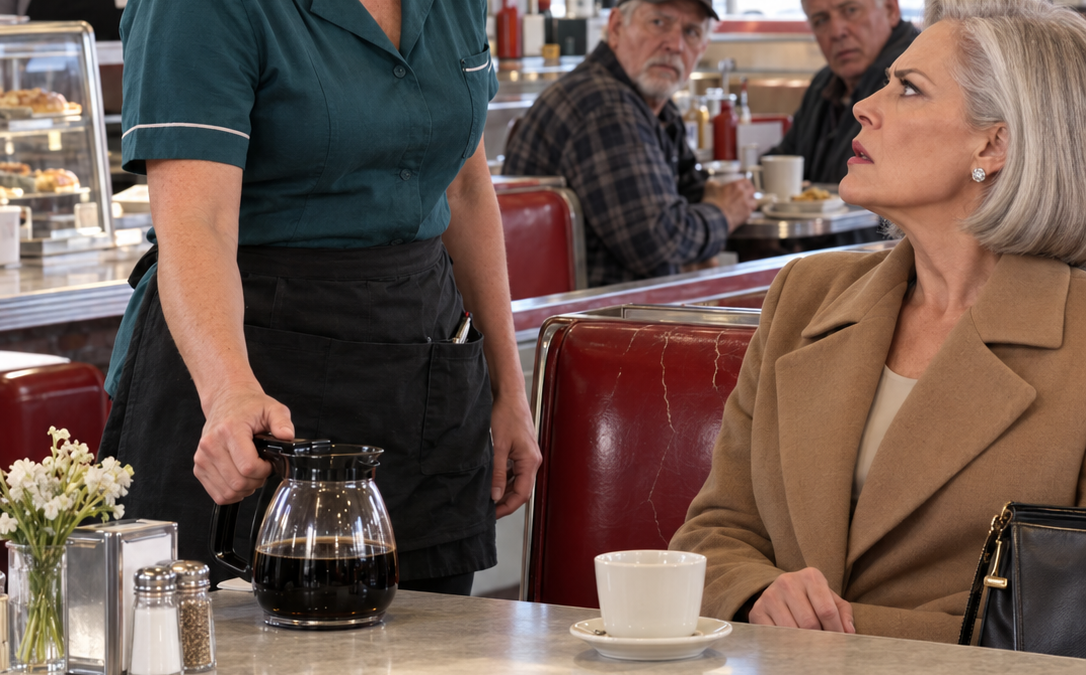
It was a Wednesday morning at Lou’s during the breakfast rush. A silver Mercedes parked across two spaces, and a slim woman in a camel coat walked in, looked at the cracked vinyl booths as though they might stain her, and sat in my section.
She was sixty-one, with a perfect silver bob and diamond studs. I knew who she was before she spoke.
“Coffee, please,” she said. “And five minutes of your time, Margaret.”
I poured the coffee. I did not sit.
“I’ll be direct,” Celeste said, stirring cream into coffee she didn’t drink. “My husband was confused at the end. He had guilt about your mother, and lawyers took advantage of it. You’ve been very quiet your whole life, living on cash, no accounts, no paper trail.”
She smiled.
“Twenty-six years of tips, Margaret. How much of that did you actually report to the IRS?”
The coffee pot suddenly felt heavy in my hand.
“Brooke has a friend who used to work for the Treasury,” she went on calmly. “Unreported income over decades, with interest and penalties. It adds up. And then there’s your mother, a young woman who tried to extort a married businessman in 1973 and took his money. That’s what the court file will say. That’s what Toledo will read.”
“My mother threw his money back at him,” I said.
“Can you prove that?” Celeste asked sweetly. “I can prove a check was written.”
My face burned. Rosa was watching from the counter, her jaw tight. Two regulars in the next booth had stopped eating. I set the coffee pot down carefully on the table.
“Mrs. Hail,” I said, loud enough for the booth behind her to hear, “you can call the IRS. You can call the newspapers. You can tell all of Ohio that my mother was a nobody who loved the wrong man. But you can’t explain how my father signed a paper in Columbus while he was in a hospital bed in Cleveland. And neither can your daughter.”
I looked at the untouched coffee.
“Your coffee is on the house. Please don’t come back.”
Her smile cracked at the corners. For one second, she looked her age. Then she stood, dropped a twenty on the table that she didn’t need to leave, and walked out without another word.
I made it to the back hallway before my legs gave out.
That afternoon, I called Ruth, and she connected me with a tax attorney, a soft-spoken man named Peter Linkfist. He listened to everything and then said something that took the weight off my chest.
“Miss Doyle, you’d be surprised how common this is among restaurant workers. We’ll file amended returns for the years still open, estimate the tips honestly, and pay what’s owed. Voluntary disclosure before the IRS contacts you is treated very differently than being caught. Whatever they report, you’ll have already fixed it.”
It would cost me money I didn’t have yet. The trust’s legal fee provision didn’t cover my personal taxes, so I would pay it from my savings over time. My coffee cans were finally going to meet the government. I almost laughed.
Ruth also took care of the threat against my mother. Harold Witam remembered the matter well. Richard had told him decades earlier that Irene returned his check uncashed. Banks in 1973 kept microfilm records, and Lakeshore National, which had absorbed Richard’s old bank, still had them.
The check was marked VOID — RETURNED TO DRAWER.
When Holloway received Ruth’s letter pointing out that any public claim of extortion would be defamatory and provably false, Celeste’s side went silent. No more calls. No more silver Mercedes.
They had retreated, but I knew it wasn’t over.
I was exhausted in a way I’d never felt, not even after double shifts. So I asked Lou for four days off, my first real vacation in nine years, and drove up to Marblehead on Lake Erie.
I rented a cheap cabin near the lighthouse and did nothing. I walked the rocks in the October wind, ate perch sandwiches, and slept ten hours a night. I read Richard’s letter one more time on the lighthouse steps, then folded it away.
What would my mother have done?
I already knew. She would have gone back to work and kept her chin up.
On the fourth morning, I watched the sun come up over the gray water, packed my bag, and drove home ready.
The temptation came wrapped in professional courtesy.
Two weeks after Lake Erie, Grant Holloway sent Ruth a settlement proposal, and Ruth invited me to her office to read it in person.
“I want you to see it with your own eyes,” she said. “It’s your decision, not mine.”
The offer was simple. Three million dollars, paid to me within thirty days. In exchange, I would sign a release stating that the trust was invalid, withdraw my petition, and, buried on page four, cooperate in withdrawing any criminal referrals and decline to provide testimony in related matters.
Three million dollars.
I sat very still for a woman who had once cried in a Kroger parking lot because her transmission cost eighteen hundred dollars.
It was an unimaginable number. I could pay off Danny’s student loans, buy a house with a yard, and never pour another cup of coffee for a man who snapped his fingers at me. And all I had to do was agree that my father’s last wish was a lie and stay quiet about a forgery.
“Can they even ask for that?” I said. “Me promising not to testify?”
“They can ask,” Ruth said dryly. “A court would never enforce it, and agreeing to obstruct a criminal case could get you in trouble. Which tells you how worried they are.”
There was a second piece.
Brooke had included a personal note printed on her real estate letterhead.
Maggie,
Mom and I would love for you to come to the house in Upper Arlington. Richard’s study is just as he left it. His books, his photos. You deserve to see where your father lived. Let’s end this as a family.
I’ll be honest. That part hurt more than the money because I did want to see his study. I wanted to know what books he’d read, whether he’d kept any picture of my mother, whether there was a single object in that house that proved he’d thought about us.
They knew exactly where to press.
I put the note face down.
“No,” I said. “Tell them no. No counteroffer.”
Ruth looked at me for a long moment.
“You’re very calm, Maggie.”
“I spent twenty-six years carrying four plates at once while people yelled at me,” I said. “Calm is just a job skill.”
She smiled at that, then grew serious.
“I have to tell you something. As your lawyer, litigation is never certain. If a judge decides Richard lacked capacity, we could lose everything, and you’d walk away with nothing instead of three million. I’m not saying take it. I’m saying make the choice knowing that.”
I thought about it for a full minute. The radiator clanked. Ruth’s grandmother looked down at me from her frame.
“If I take their money,” I said finally, “I’m agreeing that what they did was a negotiation instead of a crime. My mother never sold her silence. I’m not going to sell mine.”
Ruth wrote the rejection in two sentences.
After that, the Hail side went quiet again, but it was a different kind of quiet. Carl Mendes, Ruth’s investigator, noticed a private investigator’s car parked on my street in Toledo twice in one week. Someone requested my old court records from Lucas County, which showed nothing but a 1994 speeding ticket.
They weren’t attacking. They were watching, waiting for me to make a mistake.
And I’ll admit, the watching wore me down. I stopped sleeping well. I jumped when cars slowed outside the diner. I started checking my rearview mirror on the way home from work, memorizing license plates like a crazy woman.
One night, I sat in my kitchen staring at the two coffee cans and wondered if I was a fool to turn down three million dollars for a fight I might lose.
That was when the people around me caught me.
Danny moved his weekly dinners to twice a week and started fixing every loose outlet in my house just to have an excuse to be there. One night, he installed a motion light over my back door without asking.
“Grandma would have wanted you to see who’s coming,” he said.
Rosa covered two of my shifts so I could drive to Columbus for depositions, and she told every regular at Lou’s that if anyone came around asking questions about Maggie Doyle, they should say nothing and tip big.
Lou himself, who had never said a sentimental word in twenty-six years, gave me a key to the back door.
“In case you need somewhere quiet to make phone calls.”
And then Linda Park called.
She was sixty-eight, Richard’s assistant of thirty years. She’d gotten my number from Harold Witam and asked if she could drive up to Toledo.
We met at a little Polish bakery on Lagrange Street. She was small and precise, carrying a brown leather tote bag, and she cried before she even sat down.
“He talked about you,” she said. “Not often, but every year on your birthday, he’d ask me to check that you were all right. He drove past your high school once and sat in the parking lot for an hour. He never went in. I told him he was a coward. He agreed with me.”
She took a manila folder out of her tote. Inside were copies of Richard’s calendar from March. Every day of his Cleveland Clinic stay was blocked out in her handwriting.
Cleveland Clinic. Room 6214. No visitors except Celeste.
“Except Celeste?” I repeated.
“She visited him on the thirteenth and fifteenth,” Linda said. “I was there both days. And Maggie, I’ll testify to all of it. I don’t care who it upsets.”
I reached across the table and held her hand.
I’d had a mother who fought alone. I wasn’t going to have to.
They came on Sunday afternoon, December 6, five weeks before the hearing.
I was raking the last wet leaves off my little front lawn when the silver Mercedes pulled up to the curb. This time, Celeste and Brooke got out together. Brooke carried a small gift-wrapped box. Celeste carried a tin of cookies from an expensive bakery in Columbus.
They looked like two neighbors coming over for coffee.
“We came in peace,” Brooke said, holding up her hands with a laugh. “No lawyers, just us. Can we talk for ten minutes?”
Every instinct I had said no. Ruth had told me never to talk to them without her. But I wanted to hear what they’d say when no lawyer was in the room, and I knew that whatever they said, I would remember every word. Twenty-six years of taking orders by ear at a busy counter trains your memory.
So I let them into my kitchen, the same kitchen with the coffee cans on the shelf, and I did not offer them anything.
Brooke looked around at the yellow curtains and the chipped Formica, and I watched her try to hide what she thought of it. She almost managed.
She slid the box across the table.
“This was Richard’s. We thought you should have it.”
Inside was a gold watch, an old Hamilton with a worn leather band. On the back was an engraving.
RJH — 1971.
Two years before he met my mother.
I’ll admit, my throat closed up. I set it down very carefully.
“We’ve been thinking,” Celeste said gently. “This fight is hurting everyone. Richard wouldn’t have wanted strangers in a courtroom picking over his life. We’re willing to go up to five million, and Brooke and I will publicly acknowledge you as Richard’s daughter. You’d be part of the family Christmas in Upper Arlington. Your son could meet his cousins.”
Brooke’s two children.
She actually pulled out her phone and showed me a photograph of them in matching sweaters.
That was the moment I understood how carefully they had planned this visit.
“And the criminal referral?” I asked.
Celeste’s smile stayed, but something behind it shifted.
“That would need to go away, of course.”
“It isn’t mine to make go away. The prosecutor has it.”
“Prosecutors listen to victims,” Brooke said. “If the so-called victim says she was confused, that she misunderstood a phone call… cases die every day.”
So that was the real reason for the watch and the cookies.
They needed me to lie.
“No,” I said.
Celeste’s patience broke the way old ice breaks all at once. She leaned forward, her voice low and hard.
“Do you understand what happens at that hearing? Richard’s medical records will be read out loud. They’ll say he had memory problems. Your mother’s name will be in every Columbus paper. Your son’s employer will see that his grandfather was a man who paid off his mistress. Your little friends at that diner will hear every word. And when it’s over, even if you win, you’ll be a fifty-two-year-old waitress people whisper about.”
She stared straight at me.
“Is that what you want?”
“Mom,” Brooke said under her breath.
But Celeste wasn’t finished.
“I gave that man twenty-two years. I nursed him through two surgeries. I sat in that hospital in Cleveland while he cried about you. A daughter he never even met. And he gives you everything. You think you earned it? Pouring coffee?”
The kitchen was quiet except for the refrigerator humming.
“No,” I said evenly. “I didn’t earn it. Neither did you. He decided. That’s how a trust works.”
I held her gaze.
“And Mrs. Hail, you just told me you were in that hospital in Cleveland in March. Thank you.”
Celeste went white.
Brooke stood up so fast her chair scraped the linoleum.
“We’re leaving,” Brooke snapped. “Mom. Now.”
Celeste gathered her coat with trembling hands. At the door, she turned back, her face ugly with rage.
“You’ll regret this,” she said. “People like you always do.”
“Take your cookies,” I said. “And I’ll keep the watch. It was my father’s.”
The Mercedes pulled away so hard it left a black mark on the curb.
Then I locked the door, sat back down at my kitchen table, and shook for twenty minutes because she was right about some things.
The hearing would be public. People would talk. Danny’s foreman might read about it. Rosa might hear things about my mother that I couldn’t stop. What if the judge believed Richard’s mind was gone? What if I lost and the whole world saw me as a greedy nobody who’d grabbed at a dead man’s money?
I picked up the Hamilton watch and turned it over in my hand.
It was still ticking.
Someone had wound it before bringing it here, probably to make the gesture feel more sincere.
I called Ruth that night and told her everything Celeste had said, word for word, while it was fresh. Ruth was quiet for a moment, then sighed.
“I should scold you for letting them in,” she said, “but I’m not going to.”
She had me write it all down, sign and date it, and email her a photograph of the page before midnight.
“She admitted she was with him in Cleveland during the exact days the amendment was supposedly notarized in Columbus,” Ruth said. “And she tried to get a witness to recant to a prosecutor. That’s a serious mistake.”
I hung up and looked at the dark window, at the motion light Danny had installed glowing over the empty back steps.
The fear was still there, cold and heavy in my chest. But somewhere underneath it, something steadier had formed.
They had shown me their faces.
Now I knew exactly who I was fighting and exactly why I couldn’t stop.
The hearing was held on January 14 in courtroom 11B of the Franklin County Probate Court. It was a plain room with wood paneling, fluorescent lights, and maybe forty seats. Every one of them was filled.
A reporter from the Columbus Dispatch sat in the second row with a notepad. Danny sat right behind me in the only suit he owned. Rosa had taken the bus down from Toledo at five in the morning and sat beside him in her church coat.
That morning in the hallway, Ruth had straightened my collar like a mother sending a child to school.
“Don’t look at them,” she said. “Look at the judge. Answer only what you’re asked. And if you get angry, count to three before you speak.”
Judge Eleanor Marsh was in her sixties, with a sharp gaze that made even Grant Holloway sit up straight.
Across the aisle sat Celeste in a navy suit and pearls, and Brooke in black, both looking composed. They didn’t glance at me once.
Ruth started with the foundation.
Harold Witam testified that he had drafted the original trust in 2021, that Richard had executed it in his office in front of two witnesses, and that Richard had never once mentioned an amendment.
“Richard called me about everything,” Harold said. “He called me when he changed his car insurance. He did not call me about this.”
Then Alan Brener testified about the phone call from the woman claiming to be me.
Ruth played the bank’s recording.
A bright female voice trying to sound older, asking for an address change to P.O. Box 4417 in Dublin.
I watched Brooke’s shoulders rise half an inch.
Ruth introduced the post office application with Brooke’s driver’s license number on it. Holloway objected, then said Brooke had rented the box for business purposes.
“What business,” Ruth asked mildly, “requires a P.O. box opened three weeks before a man’s death and used once for his trust?”
Holloway had no answer.
Ruth simply nodded and moved on.
Then Linda Park took the stand with her leather tote bag and her calendar copies.
She testified that Richard was admitted to the Cleveland Clinic on March 12 and stayed through March 20, that on the fourteenth he spent the morning in an MRI and the afternoon asleep, and that he never left the building.
Ruth also introduced the hospital’s certified admission and discharge records, which matched Linda’s calendar to the hour.
“Was anyone else with him that week?” Ruth asked.
“Mrs. Hail. On the thirteenth and the fifteenth.”
Holloway stood for cross-examination and tried to suggest that Linda had a grudge.
“You were let go after Mr. Hail’s death, weren’t you?”
“I retired,” Linda said crisply. “He left me a pension. Mrs. Hail tried to cancel it. The bank wouldn’t let her.”
Someone in the gallery coughed to cover a laugh. The judge’s eyebrows rose.
Then Ruth called Denise Carver.
Denise was a nervous woman in her forties, gripping a tissue. She had been subpoenaed with her notary journal, and she had her own lawyer sitting behind her.
Ruth asked her to read the journal entries for March 14.
“There are none,” Denise said quietly.
“Did you notarize a document for Richard Hail on that date or any date?”
“No. I never met Mr. Hail.”
“Did anyone have access to your notary stamp?”
Denise’s eyes went to Brooke. Her chin trembled. Her lawyer leaned forward and whispered something, and Denise nodded.
“I keep my stamp in my desk at the office,” she said. “In April, Brooke asked to borrow it. She said she needed it for a closing and I could just sign later. I told her no. That’s not how it works. The next morning, the stamp was in my desk, but in the wrong drawer.”
The courtroom went completely silent.
“That’s a lie!”
Brooke was on her feet.
“Denise, you gave it to me! You said it was fine!”
Holloway grabbed her arm.
“Miss Langford, sit down.”
“Counsel, control your client,” Judge Marsh said sharply.
But Brooke had already done the damage. She had just admitted in open court that she’d had the stamp.
Ruth didn’t raise her voice.
“Your Honor, the amendment is dated March 14. Miss Carver’s stamp left her desk in April. Mr. Hail was in Cleveland in March. That document was not signed by him, not notarized by her, and it was backdated.”
Then Holloway made his last mistake.
He called Celeste to testify that Richard had signed the amendment at home in Columbus in March.
Ruth stood for cross-examination.
She held up my signed, dated statement.
“Mrs. Hail, on December 6, in Miss Doyle’s kitchen, did you say, and I quote, ‘I sat in that hospital in Cleveland while he cried about you’?”
Celeste’s lips parted.
“I… I don’t recall exactly.”
“Were you in Cleveland with your husband from March 12 through March 20?”
“Part of the time. I went home some days.”
“Then how did your husband sign a document at home in Columbus on the fourteenth while he was a patient in Cleveland?”
Celeste looked at Holloway.
Holloway looked at his legal pad.
Brooke stared at the table.
“Maybe it was a different day,” Celeste said finally, her voice cracking. “Brooke handled the paperwork. I just… I just signed what…”
“Mom!” Brooke hissed.
Celeste stopped, but it was too late.
Every person in courtroom 11B had heard it. The Dispatch reporter was writing so fast her pen scratched against the paper.
I sat with my hands folded on the table, perfectly still. I didn’t look at them, just as Ruth had told me.
I felt no triumph yet, only a cold, clear certainty, like the lake at Marblehead at dawn.
The truth had been sitting there the whole time. It had only needed someone stubborn enough to drag it into the light.
Judge Marsh didn’t make us wait for a written opinion.
After a forty-minute recess, she returned to the bench and read her ruling aloud.
“The court finds by clear and convincing evidence that the document titled First Amendment to the Richard J. Hail Revocable Trust was not executed by Richard J. Hail. The notarization is fraudulent. The amendment is void and of no legal effect.”
She continued.
“The original trust dated June 2021 is valid in its entirety. The successor trustee, Lakeshore National Bank, is directed to administer the trust for the sole benefit of Margaret A. Doyle according to its terms.”
Danny squeezed my shoulder so hard it hurt.
Behind me, Rosa whispered, “Thank you, Jesus.”
The judge wasn’t finished.
“Further, the court finds that the respondents’ defense of this action was conducted in bad faith. Pursuant to Ohio law, the court awards the trust its full attorney’s fees and costs, to be paid personally by Celeste Hail and Brooke Langford, jointly and severally. A transcript of these proceedings will be forwarded to the Franklin County Prosecutor.”
Celeste made a small sound, like the breath had been knocked out of her.
Brooke sat completely still, staring at the wall.
Grant Holloway was already packing his briefcase with the speed of a man who wanted to be anywhere else.
I left the courtroom and walked down the hallway, through a crowd of people I didn’t know, and out onto the courthouse steps into the January cold.
The Dispatch reporter asked if I wanted to make a statement.
“My mother’s name was Irene Doyle,” I said. “She never took a dime from anyone. Please spell it right.”
She did.
The next morning, the story ran on the front page of the Metro section, and by noon, someone at Lou’s had taped it to the pie case.
Regulars I’d served for twenty years came up to the counter just to shake my hand. One old retired trucker named Walt left a hundred-dollar tip under his saucer with a note.
For Irene.
That should have been the end.
It wasn’t.
It was the beginning of their fall.
Three weeks later, a Franklin County grand jury indicted both of them.
Brooke was charged with forgery, tampering with records, identity fraud for the call to the bank, and attempted theft by deception.
Celeste was charged with forgery, attempted theft by deception, and attempting to intimidate a witness.
My written statement from the kitchen became Exhibit 14.
Their attorneys called Ruth twice, offering deals, restitution, apologies, and agreements to drop everything if I would ask the prosecutor for leniency.
Every time, I gave the same answer through Ruth.
“The prosecutor makes those decisions. I’ll tell the truth if I’m called. That’s all.”
No compromise.
They had offered me money to lie, and now they were offering me apologies to lie. My answer was the same either way.
Brooke broke first.
Faced with Denise Carver’s testimony, the P.O. box application, and the bank recording, she accepted a plea in April.
She pleaded guilty to forgery and identity fraud, both felonies, and agreed to testify against her mother.
Her statement was devastating.
Celeste had found a copy of the trust summary in Richard’s desk in June, when he was weakening. Celeste drafted the amendment language herself. Brooke typed it, took the notary stamp, forged Richard’s signature from his old letters, and picked March 14 because her mother said he was home that week.
Celeste had gotten her own husband’s hospital dates wrong.
Celeste went to trial in August.
I testified on the second morning.
Her new lawyer, a sharp woman from Cincinnati, spent twenty minutes trying to paint me as a gold digger who had manipulated a dying man I’d never met.
I let her finish, counted to three the way Ruth had taught me, and said, “Ma’am, I didn’t know his name until after he was dead. It’s hard to manipulate a stranger.”
Two jurors looked down to hide their faces.
She lost in two days.
The jury took less than three hours.
Judge Raymond Ostrouski sentenced her to eighteen months in the Ohio Reformatory for Women in Marysville, followed by three years of supervision, and ordered her to pay restitution covering every dollar of legal costs and the bank’s investigation expenses.
Brooke received five years of community control, two hundred hours of community service, and a felony record.
The Ohio Division of Real Estate revoked her license within a month.
Langford Realty Group, the brokerage with her name on the door, dissolved after three agents quit and two clients sued over transactions Denise had to reexamine.
Denise Carver, who had told the truth, was not charged.
I sent her a handwritten thank-you note.
She sent one back.
There was one more consequence, quieter but just as final.
Richard’s will had left Celeste the house in Upper Arlington and a lifetime income from a separate account. But the will contained a clause, standard in Harold Witam’s drafting, stating that any beneficiary convicted of a felony against the estate or its beneficiaries forfeited their share.
Celeste’s conviction triggered it.
The house went to the estate’s residuary beneficiary, the Columbus Foundation, for Richard’s old scholarship fund.
The fund was for children of construction workers.
When Harold told me, he smiled for the first time since I’d met him.
“Richard was a coward about a lot of things,” he said, “but he understood his wife.”
I didn’t feel joy when Celeste was led out of the courtroom in handcuffs. I want to be honest about that.
I felt something quieter, the feeling of a door finally closing on a draft that had been blowing through my life for fifty-two years.
That night, back in Toledo, I took Richard’s Hamilton watch out of the drawer and wound it. Then I set it on the windowsill next to my mother’s old photograph.
“We won, Mom,” I said. “And we didn’t have to lie once.”
The first thing I did with my new life was something that made Danny laugh until he cried.
On a Tuesday morning in September, I walked into a branch of Lakeshore National Bank in Toledo and opened my very first bank account.
Alan Brener drove up from Columbus just to be there. He said he wouldn’t have missed it.
“Name?” the young banker asked.
“Margaret Irene Doyle,” I said.
I’d never used my middle name before. It felt right.
When she handed me my first debit card, I held it up to the light like it was a lottery ticket.
Alan shook my hand, and this time there was no whispering.
“Your father would have liked to see this,” he said. “He’d have hated that he wasn’t here, but he’d have liked it.”
I didn’t go crazy with the money.
The trust paid out according to Richard’s terms: a large initial distribution, followed by steady income, with the bank still managing the principal.
Ruth helped me find a fee-only financial advisor, a patient woman named Sandra Kim, who explained index funds to me three times without once making me feel stupid.
On the third explanation, I finally understood, and she clapped her hands like I’d won a spelling bee.
I paid off Danny’s student loans first.
Then I bought him the small brick house he’d been renting on Heather Downs Boulevard, and he cried harder than I did.
He finished his apprenticeship that fall and passed his journeyman’s exam on the first try.
In March, he started his own small electrical contracting business.
Doyle & Son Electric.
I told him I wasn’t the son.
He said the son was him, and the name was for his grandmother.
I paid every penny of my back taxes through Peter Linkfist.
When the IRS sent the final letter confirming that my accounts were settled, I framed it.
Rosa thought that was hilarious.
I didn’t quit Lou’s right away.
People expected me to, but I loved those mornings. The first pot of coffee at five-thirty, the grill hissing, the same old men arguing about the Mud Hens.
What changed was that when Lou announced he wanted to retire, I bought the diner.
I kept the name.
I raised everyone’s wages, added health insurance for the staff, and made Rosa the manager.
On her first day, she cried in the walk-in cooler, then came out and fired a supplier who had been shorting us on eggs for three years.
The regulars still call me Maggie.
Nobody calls me Margaret except the bank.
Then I did the thing I’m proudest of.
With Ruth’s help, I set aside two million dollars to create the Irene Doyle Fund, administered through the Toledo Community Foundation.
It gives grants to single mothers working in service jobs. Emergency car repairs. Childcare. A security deposit on an apartment. Eighteen hundred dollars for a transmission, so no woman has to cry in a Kroger parking lot the way I did.
The first year, it helped forty-one families.
One of them was a young waitress from a truck stop near Perrysburg. She was twenty-three, with a baby and a car that wouldn’t start.
She wrote me a thank-you card in purple ink.
I keep it on the refrigerator, right next to my mother’s photograph.
Ruth stayed in my life, too.
She refused to let me pay her a bonus beyond her fees, so I made a donation in her grandmother’s name to a legal aid clinic in Columbus.
She called me and pretended to be angry for about ten seconds.
Linda Park and I became real friends.
Every few months, she drives up from Columbus, and we eat pierogi at the Polish bakery on Lagrange Street while she tells me stories about Richard.
Not all of them are kind.
I don’t want them to be.
I want the whole man, coward and all, because that’s the only way I can forgive him.
And I did.
Mostly.
On the first anniversary of his death, Danny and I drove to Green Lawn Cemetery in Columbus.
I stood at Richard’s grave and said, “You should have come into the diner.”
Then I set down a cup of black coffee from Lou’s and left.
As for Celeste and Brooke, I never went looking for news about them.
It found me anyway, the way bad news always finds people in small worlds.
Celeste served fourteen months in Marysville before being released to supervision.
The house in Upper Arlington was gone. The country club revoked her membership while she was still awaiting sentencing. The board said her conduct violated the standards of the club.
The friends who used to fill her dinner parties stopped returning her calls, one by one.
Linda told me not a single one visited her in Marysville.
Her restitution and legal judgments ate through her savings, and when she got out, she moved into a one-bedroom apartment in Grove City.
Ruth heard she’d taken a part-time job doing intake at a dry cleaner.
I don’t say that to mock her.
Honest work is honest work.
But I can’t pretend I didn’t notice the irony that she ended up serving the public.
Brooke’s fall was quieter, but deeper.
With a felony forgery conviction, no real estate brokerage would hire her, and no licensing board would touch her.
Her husband filed for divorce six months after her plea and got primary custody of their two children.
The last thing Ruth heard, Brooke was working night shifts at a distribution warehouse, paying restitution in monthly installments.
She sent me one letter.
It said, I’m sorry.
Nothing else.
I didn’t answer it.
I’m not sure I ever will.
They had wanted everything.
In the end, they lost everything they’d had before they started.
Their home, their reputation, their careers, their family, and their freedom.
And all of it came from one decision to steal from someone they thought was too small to fight back.
I still keep one Maxwell House can on my kitchen shelf.
It’s empty now.
I keep it to remember.
For fifty-two years, I believed the safest life was one where nobody could take anything from me.
I was wrong.
They can always try.
What protects you isn’t hiding.
It’s the truth written down and the courage to say it out loud.
People who think you’re small will count on your silence.
Don’t give it to them.
So tell me honestly, what would you have done? Would you have taken the three million dollars and walked away?
Leave your answer in the comments. I read every one.
Subscribe if this story stayed with you.
Thank you for listening.








