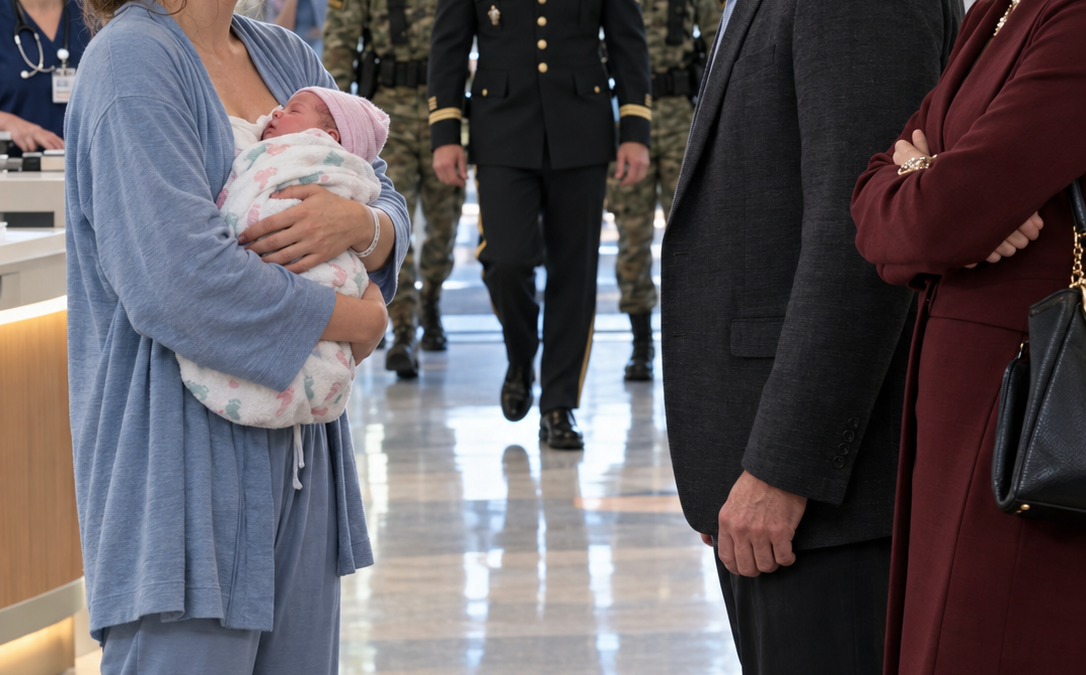
Three days after my husband died, I gave birth alone. At discharge, Dad handed me my bags. “Take the baby and go. You’re not coming home.” Mom added: “A widow and her baby aren’t our responsibility.” I said nothing. I made one call. Twenty minutes later, my husband’s commanding officer walked in with two military police officers. Dad went pale.
My name is Karen Nelson, and I was twenty-nine the morning my family told me what a widow was worth.
I was standing in a hospital lobby in Killeen, Texas, still bleeding from childbirth, our three-day-old daughter in my arms, when my father set two bags at my feet.
“Take the baby and go,” he said. “You’re not coming home.”
My mother did not look at the child. “A widow and her baby aren’t our responsibility.”
My husband had been killed six days earlier. I had delivered our daughter alone. I had no phone, no keys, and no ride. They had arranged it that way.
I did not argue. I borrowed a nurse’s phone and made one call. Twenty minutes later, my husband’s commanding officer walked through the sliding doors with two military police officers behind him. My father’s face went the color of the wall. They had been certain no one was coming. What they had done to be that certain, and what that call set in motion, is why I never handed them my life again.
Welcome back to Hidden Shadows, where ordinary women face impossible families and answer with quiet strength instead of noise. If a story has ever made you feel a little less alone, you’re in the right place. Pull up a chair, drop a comment, and subscribe. This one begins with two bags in a hospital lobby, and it does not end where my parents thought it would.
To understand that lobby, you have to understand a man who left notes on a refrigerator.
Tyler wrote one every morning before a shift. Yellow sticky notes, the cheap kind from the commissary, always in the same spot above the handle so I’d see them when I reached for the creamer. He never signed his name, just a T. He had started the week we moved into the house on post, and after a while, I stopped peeling them off. The fridge had a whole season of them, some faded, some curling at the corners from the afternoon sun that came through the kitchen door.
Chili in the crockpot. Don’t let it burn. Love you. T.
Your mom called the house line. I didn’t pick up. T.
Pick a name. I’m serious. T.
He was thirty-one, nine years in the Army, all of it as a military police officer, the last four at Fort Cavazos. He had grown up in Tulsa with a grandmother who raised him after his parents died. When she passed in 2020, he came back from her funeral, sat down at our kitchen table, and said very quietly that I was his whole family now. He wasn’t a talker. He was a note writer.
I was twenty-nine and taught pre-K at a child development center just off post. Twenty four-year-olds, five days a week. I’d gone on maternity leave at the end of February, which meant I had a lot of time to stand in front of that refrigerator.
The note on the third of March said, Late shift. Don’t wait up. Box in the garage. Don’t peek. T.
I stuck it up with the others and made a point of not going into the garage. I assumed it was a crib. He’d been talking about building one himself for months, and I’d been telling him to just buy one. This was exactly the kind of thing he’d do to win the argument.
I should tell you where I come from, because it matters.
My parents live in Dayton, Ohio, in the same brick house I grew up in. My father, Gordon, ran a carpet-cleaning business for twenty years until it folded two years ago. My mother, Diane, has been the administrative assistant at their church for as long as I can remember, which means she knows everyone’s business, and everyone thinks she’s wonderful. My older brother, Brent, is the one they talk about at church. I was the one who was easy.
I left Dayton at twenty-one for a teaching job in Texas. My mother called that leaving home. She still does. When Tyler and I married in the fall of 2021, the card she sent was addressed to Karen. Not Karen and Tyler. Just Karen.
I told myself it was a slip. Tyler read it, set it on the counter, and never mentioned it. That was how he handled my family. He didn’t fight them. He just didn’t let them in very far.
My mother has always held things for me. My birth certificate until I was twenty-five. My car title. My decisions. When I was a teenager, she opened my mail. I learned to call it care. It took a death and a daughter to teach me a different word.
The knock came at 11:30 that Tuesday night.
I was thirty-eight weeks pregnant and still up, wiping the counter because he’d told me not to wait, and I always did. Two men in uniform stood at the door. One was an officer I didn’t recognize. The other was a chaplain. I knew what that combination meant before either of them opened his mouth, and I remember thinking, absurdly, that I was still holding the roll of paper towels.
Tyler’s patrol vehicle had been struck on a road inside the installation at 9:40 that evening. The other driver was a civilian contractor coming off a late shift. He was drunk. Tyler had been on duty. He had died before the ambulance reached him.
That was the whole story, and they told it to me kindly and plainly. Then the officer asked if there was someone they could call. I said a name before I thought about it.
Jenna. Not Mom. Jenna.
Jenna Caldwell’s husband was in Tyler’s company, and she had been my friend since the week we’d arrived on post. She was thirty-two, had two kids under five, and her husband was away at a training rotation in Louisiana. She showed up in fifteen minutes with both children asleep in the back of her car, carried them in one at a time, laid them on my couch under a blanket, and sat with me on the kitchen floor until the sun came up.
At one point, she got up, took the paper towels out of my hand, and put them back on the counter. I hadn’t noticed I was still holding them.
At seven in the morning, I called my mother. She cried. She really did. And then, in the same breath, she started organizing.
“We’re driving down. Don’t sign anything. Don’t let anyone from the Army into that house until we get there.”
“Mom, they’ve already been here. They have to be. That’s how it works.”
“Those people will fill your head with paperwork. Family handles family.”
Jenna was listening on the speaker. She looked at me for one second, then got up and made coffee without saying anything. I would understand that look much later.
My father took the phone. “I’m going to set up a fundraising page tonight,” he said, “so people know the family is taking care of you.”
I thanked him. I meant it.
On Wednesday, a sergeant first class named Owen Marsh came to the house. He was my casualty assistance officer, which is a job I didn’t know existed until it was standing in my living room. He was thirty-eight, calm, and carried a binder. He explained in about four minutes what the next few weeks would involve.
Someone from the unit would help with the funeral. Tyler’s personal effects would come to me. There were benefits. There was a process. And I didn’t need to understand any of it that day.
He sat on the floor so he’d be lower than me on the couch. I noticed that. I was a teacher. I noticed how people got down to your level.
That afternoon, Tyler’s battalion commander called. Lieutenant Colonel Patrick Riley had been Tyler’s company commander back in 2019, when Tyler was still a specialist. His voice caught once on the phone, then didn’t again.
“Karen, I’m not going to tell you it gets easier this week. I’m going to tell you my number doesn’t change.”
I was looking at the fridge while he said it. His number was on a sticky note Tyler had put up five years earlier, our first month on post.
CO emergencies.
I had read it a thousand times without meaning to.
Before Marsh left, he said something I filed away. “If you don’t answer my calls the next few days, I’m still going to call. That’s my job.”
I nodded. I was thirty-eight weeks pregnant, and my husband was dead. I would have nodded at anything.
Labor started Thursday night, around eleven. Early, but not dangerously early. The doctor later told me stress does that. Jenna drove me to the hospital in Killeen and stayed until one in the morning, when she had to go home to her kids. There was no one to leave them with. I told her to go. She didn’t want to. I told her again.
Our daughter was born at 5:05 on Friday morning.
The nurse’s name was Ruth Aur. She was in her fifties and had hands like a carpenter and a voice she didn’t raise. There was a doctor I’d never met. There was a sign on the wall across from the bed that said, Hand hygiene saves lives. And I read it, I would guess, forty times, because reading it meant I wasn’t thinking about the other person who was supposed to be in that room.
I won’t describe the pain. I’ll tell you that when it was over, Ruth put my daughter on my chest and said, “You did that by yourself, honey. Nobody gets to take that from you.”
We named her Nora. Tyler had picked it. She had his chin. I’d wondered for months whose chin she’d have, and there it was, and he wasn’t there to see it.
I bled more than they liked afterward. The doctor said I’d stay at least three days. I remember the number.
My parents arrived at 6:40 that evening. They had driven, not flown, traveling hundreds of miles over two days with a night in Little Rock because my father said it was easier to bring things. My mother came into the room, picked up Nora before she asked how I was, and said, “There. Now she’s with family.”
My father stood at the foot of the bed talking about the fundraising page. It was already near thirty thousand dollars. People were so generous. He said half of Dayton had shared it. He said it like he’d built something.
I was moved. I’m telling you that honestly. I lay in that bed and thought, They came.
From my window on the second floor, I could see their van in the lot. It was full of plastic storage bins stacked to the windows. I assumed they were my parents’ things. The bins looked empty, but I didn’t think about why.
My father asked for the keys to our house on post so they could sleep close by. I called the visitor center from my room and sponsored them for a pass. Then I handed him the keys on Tyler’s carabiner. I remember him weighing them in his palm.
That night, my phone would not stop. Relatives, coworkers, Tyler’s unit, people I hadn’t heard from in years. I was so tired I couldn’t focus on the screen. Every time it lit up, I flinched.
“Give it to me,” my mother said. “I’ll answer for you. You rest.”
I told her the passcode.
“Who’s Riley?” she asked, scrolling. “Who’s Jenna?”
I told her. She nodded and put the phone in her purse. I heard the zipper close.
“You rest,” she said. “I’ll handle everyone.”
I slept for four hours.
My mother was me.
Saturday, nobody came. No flowers from the unit. No text from Jenna, though I couldn’t have seen one anyway. No visit from anyone in Tyler’s platoon, who had been at my house every single day since Tuesday with food I didn’t eat.
“I told them you needed quiet,” my mother said. “They respected that.”
Around noon, my father stepped into the hallway to take a call, and he left the door open a few inches. I heard him say, “Yes, ma’am. She’s doing as well as can be expected. We’ll have her home by the weekend, God willing.”
I assumed he meant the hospital. I assumed a lot of things that weekend. When he came back in, he said it was someone from church checking on us.
I asked for my phone Saturday night. My mother said it was charging at the house. She had forgotten it. She’d bring it tomorrow. I said okay. I didn’t ask why she needed to charge it at my house when there was an outlet next to my bed. I was still the kind of daughter who didn’t ask.
I heard her in the hallway later, talking to the front desk.
“No visitors. Family only. She’s very fragile.”
On Sunday, she made her offer.
“Come home to Ohio. Stay in your old room. Have the service at our church. So many people there love Tyler.”
Pastor Hail had already said he’d do it. She’d already talked to the funeral home in Dayton. She’d gotten a quote.
They had met Tyler three times. Once at the wedding, once at Christmas, and once when they had passed through on a road trip and stayed a night.
I said no. Gently. I said his people were here, and I wanted to bury him where his people were.
“His people,” my mother repeated, like she was testing the weight of the words.
She didn’t speak to me for the rest of the evening. My father tried to smooth it over.
“Your mother’s tired, honey. We all are.”
But she sat by the door with her purse on her lap and looked at the baby and not at me. She and my father went back to my house instead of staying at the hospital, and I lay there feeling like I’d been ungrateful.
That was the feeling I knew best. It was almost comfortable.
Monday morning, they came to the lobby with two bags already packed. The bags were old gym duffels of my brother’s. His name was still on them in marker. My father set them at my feet.
And you already know what he said.
I asked for my phone. I asked for my keys, house and car. My car was still in my driveway. Jenna had driven me in.
“They’re in the van,” my mother said. “We packed up the house for you. If you change your mind, we’ll be in the parking lot for ten minutes. Then we’re on the road, with or without you.”
“Ten minutes, Karen,” my father said. He looked at his watch when he said it.
I want to be precise about what I felt. I did not feel like crying. I felt something drop and lock, like a deadbolt.
I turned around and walked back to the nurse’s station.
“Ruth, could I borrow your phone?”
I dialed the number from memory. Two rings.
“Riley.”
“Sir, this is Karen Nelson. I’m being discharged. I don’t have a phone or keys, and my parents just told me I’m not coming home.”
A pause. Then a chair scraping. Then his voice, away from the phone.
“Bishop, Puit, with me. Now.”
He came back on the line. “Where are you standing?”
“The lobby.”
“Don’t move. Twenty minutes.”
Ruth took her phone back and then, without a word, walked around the desk and stood between me and the lobby doors. She was not a large woman. She didn’t say anything. She just stood there with her arms folded, and I stood behind her with my daughter, and we waited.
Ten minutes passed. The van didn’t leave. My parents sat in the parking lot and waited for me to break.
At 11:25, the sliding doors opened, and three people in uniform came through. Lieutenant Colonel Riley, and behind him, Sergeant Cole Bishop and Specialist Amanda Puit, both still in duty uniform with their MP brassards on. They’d come straight from a shift. They looked like people who’d run to a car.
My father had walked back in to check on me. He was halfway across the lobby when he saw them. I have never seen a face empty that fast.
Riley looked at him. “Mr. Whitaker, we’ve spoken by text.”
My father didn’t answer. His mouth was open a little.
Riley turned to me. “Mrs. Nelson, your house is on the installation. It’s yours for as long as you need it. We’re taking you home.”
Amanda Puit hugged me so hard I gasped, then let go fast because she remembered I’d just given birth. She was twenty-four and the youngest in Tyler’s squad, and she was crying and trying not to. Cole Bishop, who was twenty-eight and did not cry in public, picked up both bags without asking and looked at the names on them.
My mother appeared in the doorway. She looked at the two MPs and said, “Karen said she didn’t want you here.”
Puit reached into her pocket and took out her phone.
“Ma’am,” she said, looking at me, not my mother. “Did you send this?”
The message had come from my number at 10:20 on Saturday morning.
I don’t want anyone from the Army at the hospital. Please respect my privacy. My parents are handling everything. God bless.
I read it twice. I did not remember writing it. I looked at my mother. My mother looked at the baby.
I have never in my life ended a text with God bless. My mother ends every one that way.
My father put his hand in his coat pocket and took out my phone and my keys on Tyler’s carabiner. Not from the van. From his pocket. He’d had them on him the whole time, every minute I’d been asked to wait in that parking lot. My life had been six inches from his hand.
He handed them to Riley, not to me. Riley took them, looked at them, and passed them to me without a word.
Then he said, “Let’s go.”
And we went.
Riley drove. Bishop rode in front. Puit sat in the back with me and Nora and didn’t say much, which was the right thing.
“We came Saturday,” Bishop said after a while, not turning around. “Two o’clock. Flowers and a card from the squad. The desk said family only. We figured you’d asked.”
“We got the text first,” Puit said. “We came anyway. Cole thought maybe it was a mistake.”
“I didn’t think it was a mistake,” Bishop said. “I hoped it was.”
At the gate, the guard glanced at Riley and waved us through. I opened my phone and went to the sent folder. Four messages: Riley, Sergeant Marsh, Jenna, and the group chat for Tyler’s squad. All at 10:20 Saturday morning. All the same wording, more or less.
The one to Jenna said, Please don’t come by. Karen’s parents are here now.
Karen’s parents.
I read it three times before I understood what was wrong with it. I don’t call myself Karen when I’m talking to Jenna.
Riley’s reply was in the thread, too.
Understood. We’re here whenever you’re ready. Please let us know about arrangements.
He’d thought I meant it. He’d respected it. He’d gone back to his office and sat with it for two days.
“Did I…” I started. “I was on so much medication. Is it possible I…”
Riley didn’t answer for me. He kept his eyes on the road.
“Find out where you were at 10:20,” he said. “That’s all.”
I called the hospital and asked for Ruth. She remembered.
At 10:20 on Saturday morning, I was taking my first shower after delivery. She’d walked me into the bathroom and held me up for almost twenty minutes because I kept getting lightheaded.
“I had one hand on your back and one on the rail,” she said. “You weren’t holding anything, sweetheart. Not even yourself.”
My phone had been in my mother’s purse. My mother had been in the chair by the door.
I still had a bruise on my elbow from that rail. I looked at it while she talked. I’d expected relief. It wasn’t relief. It was heavier. It’s one thing to wonder if you did something. It’s another to know for certain who did.
We pulled into my driveway. My car was there exactly where I’d left it. I opened the garage first because I couldn’t face the front door yet.
The box was still in the corner.
Don’t peek.
But the tape on it was wrong. Tyler used the clear kind. This was brown packing tape, wrapped twice. Somebody had opened it and closed it again.
The unassembled crib was there in its carton. The bags of baby clothes from Jenna’s friends were there, the car seat still in its plastic. Everything for Nora had been left behind.
Inside the house, the bedroom closet was half empty. My side.
The folder with our marriage certificate, our passports, and my prenatal records was gone from the drawer. Tyler’s footlocker, the one that lived under the bed with his grandmother’s photos and his first MP badge and every letter he’d ever kept, was gone. There was a clean rectangle in the dust where it had been.
The refrigerator notes were still there. Every one. They hadn’t touched those. I suppose they hadn’t seen the point.
Bishop stood in the bedroom doorway and asked if I wanted to report it.
“Not yet,” I said. “They’re my parents.”
I heard myself say it, and I disliked the sound.
Sergeant Marsh came by that afternoon. He’d called my number eleven times over the weekend. He’d gotten the same text as everyone else, and then he’d called anyway because that was his job, and nobody had picked up. He didn’t lecture me about it.
He sat at my kitchen table with his binder and told me one thing I needed to hear.
“Nobody can act on your behalf in this process. Not your father, not anyone. I only talk to you.”
He tapped the binder.
“I wanted you to know that before anybody tells you otherwise.”
I didn’t know yet that somebody would, but I filed it next to the other thing he’d said.
Jenna came over an hour later with her kids and a casserole, put both down, and hugged me for a long time. I told her about the closet.
“They didn’t steal it,” I said. “They packed it. There’s a difference.”
“Is there?”
My phone buzzed. My mother, from somewhere on the highway.
Call us when you’ve calmed down, honey. Your things are safe with us. God bless.
The next morning, Jenna opened her laptop on my kitchen table and pulled up the fundraising page.
Support for SSG Tyler Nelson’s Widow and Newborn.
The cover photo was me asleep in the hospital bed, Nora on my chest, my IV line still in. My mother had taken it Friday night while I slept.
The total was $61,500. Two hundred and fourteen donors.
I scrolled the list. Most of the names were from the battalion: wives, sergeants, a couple of officers, then a long run of names from my parents’ church. I recognized my third-grade Sunday school teacher.
Organizer: Gordon Whitaker.
The most recent update had gone up Monday at 8:50 in the morning, more than two hours before my father set the bags at my feet.
Karen is coming home to Ohio with us. Thank you all.
Jenna scrolled down the donor list and stopped on a name.
Brent Whitaker. $500.
My brother had donated to my father’s page.
That afternoon, the company commander’s wife came by with a meal-train dinner in a foil pan. She was kind. She held Nora and told me about her own first month with a newborn. And then, at the door, she said carefully, “Your dad’s page is doing so well. Has any of that reached you yet? A few of the girls were asking.”
I told her the truth.
“Not yet.”
She nodded. There was something in her face that hadn’t been there when she came in. Not suspicion of me, exactly. Uncertainty about whose version was true.
She’d read the page. The page said I was going to Ohio. I was standing in my kitchen in Texas. Those two things didn’t fit, and she was too polite to say so.
That was the first time I understood the story was already out ahead of me.
That night, Jenna made dinner at my house. Her kids lay on the rug next to Nora’s bassinet, and her older one kept putting a stuffed rabbit on Nora’s blanket and taking it back.
Jenna told me about Saturday. The text had come in at 10:20. She hadn’t believed it, so she’d brought a pot of chicken soup to the hospital at two in the afternoon anyway. The front desk had turned her away. Family only, per the family’s request. She’d sat in her car in the lot and cried, then driven home.
“I thought you didn’t want me anymore,” she said.
I apologized. She stopped me.
“You didn’t do it. But you have to decide who you believe.”
She pointed at the pot on my stove. It was the same soup. She’d frozen it and brought it back.
“I showed up. They sent me away in your name. That’s the whole story, Karen. That’s it.”
I called my brother. It was the first time in eight months. The last time had been Christmas, and it had been about our parents, and it had ended badly.
Brent is thirty-three, divorced, an HVAC technician in Columbus. He picked up on a job site. I could hear an air compressor behind him and somebody yelling about a ladder.
He’d heard the version my parents were telling. I’d been pulled in by some Army people and a friend. I’d shut the family out. I’d been saying strange things because of the medication.
“Mom said you told them to stay away.”
“Mom said a lot of things from my phone.”
I didn’t argue. I sent him three photos. The 10:20 text, the 8:50 update, and the rectangle in the dust under my bed.
He was quiet long enough that I thought the call had dropped. The compressor cut off.
“Is the van still in their garage?”
“I don’t know.”
“I do.”
A pause.
“I’m going to Dayton tomorrow.”
He drove the seventy miles the next day and told them he was visiting. He sent me pictures from the garage. The van hadn’t been unloaded. Tyler’s footlocker was there with a strap around it, the document folder on top, my clothes in the plastic bins. The same bins I’d seen from the hospital window, no longer empty.
Then he went upstairs and sent one more photo.
My old bedroom was a nursery. A crib, a changing table, new curtains with clouds on them.
He asked my mother when she’d done it.
“February,” she said.
Before Tyler died. Before anyone had asked me anything.
That was why everything for Nora had been left in Texas. In my mother’s mind, the baby already had a room downstairs.
He found her at the kitchen table printing the donor list. She was writing thank-you cards to Tyler’s unit. In my name.
Karen and Nora are so grateful for your kindness.
He watched her sign one.
It’s all here, Brent texted. Give me a day.
Then he told them, “I’m taking the footlocker and the papers to her.”
Dad said, “Suit yourself,” and didn’t look at him. Mom went upstairs and shut the door.
Brent still didn’t know how to bring up the money with our father. He told me he was sorry. He’d figure it out.
The battalion held its memorial ceremony that Thursday, nine days after Tyler died. The boots, the rifle, the helmet, the dog tags. It was in the same headquarters building where Tyler had walked in every morning for four years.
Nora was six days old and asleep in a wrap against my chest. Jenna sat on one side of me. The two chairs on my other side were empty.
Sergeant Marsh had sent my parents the invitation on Tuesday, by email and by text. No reply.
The first sergeant called the roll.
“Staff Sergeant Nelson.”
Silence.
“Staff Sergeant Tyler Nelson.”
Silence.
“Staff Sergeant Tyler J. Nelson.”
When the bugle started, Nora startled, and I put my hand over her ear.
I don’t remember much else. I remember two hundred people standing at the same moment and the sound that made.
Afterward, Amanda Puit caught me by the door and spoke low.
“The company commander’s wife asked me again if the fundraiser money got to you yet. I didn’t know what to tell her.”
“What did you say?”
“I said I’d ask.”
Brent flew into Austin on Friday with the footlocker as checked luggage and the document folder in his backpack. He rented a car and drove to Killeen. He didn’t hug me when he came in. He set the footlocker on the table, undid the strap, and opened it.
Tyler’s grandmother in a church hat. The badge. The letters, still rubber-banded. All of it.
“I didn’t take the money,” Brent said. “I didn’t know how. Dad keeps saying it’s family money.”
The footlocker still had a label on the lid in my mother’s handwriting.
Whitaker. Ohio.
“I’ve spent thirty-three years being the one they don’t have to worry about,” Brent said. “I think that just means I’m the one they never checked on.”
He peeled the label off, crumpled it, and put it in his pocket.
“It was never theirs.”
We buried Tyler on Saturday at the State Veterans Cemetery in Killeen. It was cool and bright. The honor guard folded the flag and put it in my hands, and the sergeant who did it knelt and said the words, and I don’t remember them.
Bishop and Puit were in the detail. My brother stood behind me, the only Whitaker present.
I didn’t give a eulogy. I read the last sticky note.
Late shift. Don’t wait up.
And then I said, “I waited up. I’m still waiting up. That’s not a complaint. That’s what love looks like when it doesn’t get to finish.”
I counted the folds of the flag so I wouldn’t cry. Thirteen.
I made it to ten.
That night, my father posted an update.
Karen has chosen not to include family in Tyler’s services. It’s a painful time, and we ask for your prayers. We will honor Tyler our way, and the funds will be held for the baby’s future.
Thirty comments from Dayton in the first hour.
Praying for you both.
So sorry.
God is good.
Three comments from the battalion.
With respect, sir, over half of us are from the battalion. When does Karen get access?
Deleted within the hour. Jenna had already screenshotted it.
The following week, Brent called to tell me what was going around his old church. My mother had been telling people I’d had an episode after the birth, that the Army had gotten to me, that my friend Jenna was not a good influence. A woman I’d babysat for at fifteen had messaged Brent to ask if I was getting help.
I understood something then that I hadn’t quite understood before.
This was not a fight about money. It was a fight about who got to tell the story. And my parents had a church, a page, and my own phone number.
I went out to the garage and looked at the box with the brown tape. I wasn’t ready. I turned off the light.
The rest of March went by on a schedule. Feedings every two hours, prescriptions, appointments with Sergeant Marsh about survivor benefits. There was a process. It took time, and he walked me through each form so I didn’t have to think.
He never once asked about my parents. He’d seen the text. He didn’t need to.
Nora had her first checkup at the clinic on post. The intake form asked for an emergency contact. I held the pen over the line for a moment. Then I wrote Jenna’s name and number.
It was the first form in my life where my mother’s name didn’t go there. The receptionist didn’t notice. I did.
My parents called four times. I didn’t pick up. My mother left a voicemail.
“We forgive you, Karen. Come home when you’re ready. God bless.”
I laughed for the first time in three weeks. It wasn’t a good laugh. Jenna, who was there, looked up from the baby.
I didn’t delete the message. I saved it. I noticed myself doing that.
Toward the end of the month, Cole Bishop came over on a Thursday to put the crib together. He was bad at small talk and good with an Allen wrench. He’d brought his own tools because he didn’t trust the ones in the box. When he finished, he stood back and pushed on the rail to make sure it didn’t wobble.
Then he asked if I wanted the box from the garage brought in.
He set it on the living room floor. I cut the brown tape.
Inside was a nightlight shaped like a moon, the kind you assemble yourself, which Tyler had clearly done because one seam was glued crooked. A newborn onesie printed at some shop off post.
Nelson reporting for duty.
And an envelope.
Nora, open whenever you get here.
Dated February 27.
If I’m not there, your mom is enough. She always was. Don’t let anyone tell either of you different.
Dad.
He’d never signed anything Dad before. Nine years of T.
Bishop waited until I could see again.
He didn’t touch my shoulder or say anything about God’s plan. He just waited. Then he pointed at the tape.
“Somebody opened this before you.”
“I know,” I said. “And she still told me I had no one.”
If someone in your family has ever spoken for you without asking, tell me in the comments. I’m starting to think it’s not as rare as I believed. And stay with me, because at that point, I still hadn’t decided what to do with what I had found.
Brent called that same week. He’d been thinking for two weeks about the screenshots and about the nursery and about a thing he’d never told me.
When I was nineteen, my first serious boyfriend broke up with me by text. Out of nowhere, on a Tuesday. I’d blamed myself for a decade.
Brent, who was twenty-three then and still living at home, had overheard my mother in the kitchen telling my father she’d handled it so I could focus on school. She’d had my phone that week because I’d been on it too much.
“You didn’t get dumped, Karen. You got managed. I heard her say it. I said nothing. I’m sorry.”
I was holding Nora with one arm. I set her down in the crib very slowly because I didn’t trust my hands.
Ten years. One fake text. I’d rewritten my whole idea of myself around a message my mother typed.
I stood over the crib for a while. My daughter was asleep in a bed a sergeant had assembled because her father couldn’t, under a crooked moon her father had glued, in a house her grandparents had told her didn’t exist.
And I understood that this wasn’t an incident. It was how my mother loved.
She would do it to Nora. She’d already picked out the curtains.
I would not hand it down.
I took a sticky note from Tyler’s stack and wrote three words.
Phone. Page. Card.
I put it on the fridge next to Late shift. It was the first note on that refrigerator in my handwriting. It didn’t curl at the corners.
Then I called Sergeant Marsh and asked one question.
“Was the battalion doing anything else for Tyler?”
“There’s a plaque dedication and a posthumous award presentation on April seventeenth,” he said. “The battalion invites next of kin. That’s you.”
“Next of kin.”
I said it back to myself. I was starting to understand the words.
My parents found out about the ceremony the way they found out about most things. Someone told them.
A donor from the battalion messaged my father in early April, asking politely about the money, and mentioned the date in passing. That Friday, my father posted an update.
We will be attending the ceremony at Fort Cavazos on April 17th to present the first $15,000 to Karen and Nora in person. We hope this brings the family back together.
The Dayton comments came in a wave.
So glad you’re reconciling.
What a beautiful gesture.
Prayers for healing.
Then my mother called, and this time I answered.
“Your father is doing this for you in front of everyone. If you refuse it there, honey, people will see who you’ve become.”
She called me honey four times in two minutes. I counted.
“And we’re bringing Pastor Hail. He wants to pray with you.”
They were bringing their own audience.
I sat up that night feeding Nora and turned it over. If I took the check, they’d won. They’d have handed me money in front of Tyler’s whole battalion, and the story would be that the family took care of her. If I refused it, I was the ungrateful daughter who threw kindness back in her parents’ faces in front of two hundred people.
Either way, they’d written the ending. They’d written both of them.
I played my mother’s voicemail. I read Tyler’s card again. The moon nightlight was on across the room, crooked seam and all.
Then I saw it.
Both endings were theirs. I didn’t have to pick one. I could bring the truth and let the room decide what it meant.
That was something my parents had never once allowed. A room deciding for itself.
I called Jenna.
“Do you still have the screenshots of the deleted comments?”
“All of them.”
I got three things ready, and I did it the way I’d plan a parent-teacher conference. Nothing dramatic. Facts in order. The kind of preparation where you know the worst question you might get, and you already have the answer in a folder.
I printed the four messages from 10:20, with the date and time. I printed the 8:50 update from the morning of my discharge and the one that said our way, with Jenna’s screenshot of the deleted comment.
And I took Tyler’s card, which I would not show anyone. It came with me for me.
Ruth came by the house on a Tuesday after her shift. I hadn’t asked her to come in person. She’d insisted. She sat at my kitchen table, held Nora for a while, and then wrote half a page by hand about that Saturday morning. The shower, the rail, my phone in a purse across the room. She signed it and dated it.
“I’ve been doing this twenty-six years,” she said. “I’ve seen a lot of mothers get handled by their families in that building. Most of them don’t get to say anything about it. You get to.”
No lawyer. No forms. Just a nurse who’d been there.
And I asked Amanda Puit for one thing.
“If my mother says I told everyone to stay away, read the message. Word for word. Don’t add anything.”
“Word for word,” Puit said. “Including the God bless.”
The three pages went into a blue plastic folder. It used to hold my prenatal records. My parents had taken the records. They’d left the folder.
Brent texted, I’m flying in. Where do you want me to stand?
Next to me. Not next to them.
I didn’t hire anyone. I printed three pages and asked two people to tell the truth.
If you want more stories where the quiet version wins, subscribe. The ceremony was two days away.
I asked to see Colonel Riley the Wednesday before. I wanted to know exactly what he could and couldn’t do because I’d stopped assuming things about people in authority. My parents had been my authority for twenty-nine years.
He was direct. He couldn’t tell my parents to do anything. He couldn’t touch the money. He couldn’t handle anyone. If someone asked him about the text he’d received from my number, he’d tell the truth. And no one was going to speak on behalf of the family at his battalion ceremony without the next of kin being asked first.
“I’ll be there as his commander,” he said. “I’ll tell the truth if it’s asked. What happens after that is yours, Karen. That’s how it should be.”
There was a company photo from 2019 on his desk. Tyler was in the back row, a head taller than everyone, not smiling because he never smiled in official photos.
“He was a good MP,” Riley said. “He’d have been a better first sergeant.”
The night before the ceremony, my mother called one more time. I let it ring twice and then picked up because I wanted to know what the last move looked like.
Her voice was different. Softer. Tired.
“Your father’s blood pressure has been terrible since March. The doctor’s worried. I’m not telling you that to guilt you, Karen. I’m telling you because tomorrow could go one of two ways, and I’d like it to go the way where my husband doesn’t have a stroke in front of two hundred strangers.”
She waited.
It was a good pause. She’d taught me that pause.
“I’ll see you tomorrow, Mom,” I said, and hung up.
Brent got in late that night. He’d driven from the airport with the windows down, he said, because he’d needed the noise. We sat at the kitchen table with Nora asleep between us in her bassinet.
“He’s going to stand up there like it’s his,” Brent said. “You know that.”
“I know.”
“And she’s going to take the baby.”
“I know that, too.”
He looked at the fridge for a long time. He’d never seen the notes before.
“He really did that every day?”
“Every day.”
Brent didn’t say anything else. He got up and read every one of them, standing there in his socks. Then he went to the couch.
Two days had become one.
I’d bought a black dress that fit a body six weeks past delivery. I practiced one sentence in the bathroom mirror. Just one. I didn’t practice anything else because I knew that if I scripted it, I’d sound like my mother.
The battalion headquarters was full by ten. More than two hundred people. Soldiers in dress uniform, spouses, kids in stiff clothes, the family readiness group with their coffee urns along the back wall. The plaque was under a cloth by the entrance. Riley stood near the side of the room, not on the stage.
My parents had come early. They were in the front row with a man in a gray suit and a clerical collar. My mother stood up as I came in, held out her arms, and took Nora from me before I could say anything.
In front of everyone, a grandmother.
I let her because I’d decided beforehand that I would, and because it would have taken a scene to stop her.
My father had an envelope in his hand. He’d dressed up. He looked pleased with the turnout, as if it were his.
Brent came in five minutes later and sat down on my other side without looking at our parents. My mother saw him, and her mouth thinned. Jenna sat behind me with her hand on my shoulder.
The ceremony itself was what it should have been. The plaque with Tyler’s name went up on the wall by the entrance, unveiled by two soldiers from his squad. Colonel Riley presented the posthumous award, and I accepted it. I said thank you to the battalion in two sentences, and my voice held.
Then the master of ceremonies said the family had asked for a moment, and my father stood up first.
He walked to the podium like he’d been waiting for it. He adjusted the microphone.
“On behalf of the family, we want to thank this community. Your generosity raised over sixty thousand dollars for our daughter and granddaughter.”
He held up the envelope.
“Today, we’d like to present the first fifteen thousand to Karen and Nora in person, and we’d like to ask her to come home.”
My mother stood behind him, holding my daughter, turned toward the room like a photograph.
Applause started. Then, in the middle rows, it faltered. A few people weren’t clapping. A sergeant’s wife with her arms crossed. A staff sergeant looking at the floor.
I knew who they were. They were the people whose comments had been deleted.
I didn’t go to the podium. I stood where I was in the front row, with the blue folder against my leg, and I spoke at the volume I use with twenty four-year-olds.
“I want to be accurate, because Tyler was…”
I let that sit.
“I haven’t received any of that money. I wasn’t asked before the page was opened. I wasn’t asked before it was announced that I was moving to Ohio. I’m not moving to Ohio.”
The room went very still. Someone’s coffee cup clicked against a saucer and then stopped.
My father’s smile stayed on.
“We’ve been holding it for the baby. Everyone knows that. Karen’s been through a lot, and she’s had some people around her…”
He didn’t finish that sentence. He looked at the middle rows and decided not to.
My mother stepped forward with Nora on her shoulder.
“Karen asked all of you not to come to the hospital,” she said to the room in her church voice. “She sent messages. We were only respecting her wishes. We’ve been respecting her wishes this whole time.”
I waited. I let her finish. I had learned from her exactly how long a pause could be.
Amanda Puit stood up three rows back. Nobody had invited her to. Colonel Riley, at the side of the room, didn’t move.
“Ma’am,” Puit said, “I’d like to read the message I received from Mrs. Nelson’s phone on Saturday, March seventh, at 10:20 in the morning.”
She read it. Every word. The privacy. The parents handling everything.
She paused before the last two words, and then she read them, too.
“God bless.”
Somebody in the back said, “Huh?” out loud.
Just that.
I opened the folder. I didn’t make a speech about it. I held up the page.
“Four messages. Same minute. Colonel Riley got one. Sergeant Marsh got one. Jenna Caldwell got one. His squad got one.”
I turned to the second sheet.
“And this is from the nurse who was holding me up in the shower at 10:20 that morning because I couldn’t stand on my own. My phone was in my mother’s purse.”
The company commander’s wife, the one who’d brought the foil pan, the one who’d asked twice about the money, turned around in her seat and looked at Riley.
“Sir, did you get that message?”
“I did,” Riley said. “I replied that we’d wait until she was ready. We waited two days.”
He said nothing else. He didn’t need to.
I didn’t look at my mother. Jenna did.
Jenna hadn’t planned to say anything. She stood up anyway. She was still holding a paper cup of coffee, and she didn’t put it down.
“Diane.”
Just the name first.
“Why did you text me from Karen’s phone?”
Two seconds. In a room that size, two seconds is a long time.
I watched my mother look for the version of this where she was still the one deciding.
“I did it for her own good.”
She said it to Jenna, but the room heard it.
That was the moment, if you want one. Not the papers. That sentence. Two hundred people understood at once that the three days of silence had come from the woman holding my baby.
A wife two rows back put her hand over her mouth. Pastor Hail, in the front row, took off his glasses.
My mother turned to him.
“Pastor, tell them. Tell them what kind of family we are.”
He looked at her for a long moment. He was a man who’d known her for twenty years.
“Diane,” he said quietly. “I think they can see.”
My father tried to pull it back the only way he knew.
“That money is family money,” he said, and his voice climbed. “We’ve been keeping it safe because if we hand it all over, she’ll turn around and give it right back to these people.”
He gestured at the middle rows with the envelope.
He meant the sergeants’ wives, the platoon, the people who’d put in fifty dollars, a hundred dollars on the night Tyler died, from the same paychecks that had paid for my husband’s flowers.
A woman in the fourth row said, not loudly, “We are these people, sir.”
Pastor Hail looked at the floor. He didn’t pray.
Nobody touched the envelope on the podium after that. My father set it down and then seemed not to know what to do with his hands.
He looked at me, and his voice dropped the way it used to when I was a child and he wanted to end something.
“Karen, honey, let’s talk about this privately.”
“You announced it on the page,” I said. “You made it public. I’m just answering where you asked.”
I walked to my mother and held out my arms. She gave me Nora. She couldn’t do anything else, not with that many eyes on her.
I settled my daughter into the wrap the way Jenna had taught me. I tucked the fabric and checked her airway, and while I did it, I said the sentence I’d practiced.
“You don’t get to tell my husband’s people what I want. You had my phone for three days. You don’t get my voice again.”
Then the rest, which I hadn’t practiced, but which came out even.
“The page gets transferred to my name by next Friday, so the people in this room can see where their money went. And you don’t introduce yourselves as Nora’s grandparents to anyone who buried my husband. Not here. Not ever.”
My mother found her voice. It was thinner than usual.
“You’re going to walk out on us in front of all these people?”
I looked at her for the first time that morning.
“Take the baby and go,” I said. “That’s what you said. I’m doing it.”
I didn’t use the main doors. I walked to the wall by the entrance and put two fingers on the new plaque, on his name. Then I went out the side door.
Brent came with me. Jenna came with me, still holding her coffee.
Cole Bishop and Amanda Puit stayed where they were, which happened to be between my parents and the exit. They didn’t say a word. They just stood there at parade rest, the way Tyler would have.
Behind me, I heard Colonel Riley tell the master of ceremonies to continue the program. He never said one word to my father. He didn’t have to.
The side door closed quietly. It didn’t slam.
In the parking lot, it was bright and ordinary. A soldier was walking a dog. Brent looked at his phone.
“Dad just texted me. Tell your sister we’ll transfer it Monday.”
“Don’t answer,” I said. “He can tell me himself.”
He did, the following Friday.
Not because I’d made him, but because more than fifty donors had messaged him in the week after the ceremony, and because the platform has a button that lets donors report a campaign, and my father had two hundred people who now knew exactly what that button was for.
The email was two lines.
Transferred.
Your mother is very hurt. Dad.
I read it a few times. It was the closest thing to an apology he was capable of writing, and it wasn’t one. I put it in the folder with the rest.
I used the first of the money to pay the balance on the funeral and to open a savings account for Nora. There had been a sticky note about that in the footlocker from the year before, tucked in with the letters.
Savings for the kid. Don’t touch. T.
I hadn’t known he’d started thinking about it that early. He’d always been ahead of me.
Sergeant Marsh closed out his binder at my kitchen table the last week of April. The benefits were in process. The paperwork was done. He’d be a phone call away, but he wouldn’t be coming by anymore.
Before he left, he said, “For what it’s worth, I still have the text. I keep everything. If you ever need it, it’s there.”
I told him I hoped I wouldn’t. He said that was the right answer.
Dayton, according to Brent, did what small communities do. Nobody confronted my mother. The women’s group at church simply gave the fundraising duties to somebody else. Somebody asked her about the thank-you cards she’d sent to Tyler’s unit in my name, and she said it had been a misunderstanding. The subject didn’t come up again in her hearing.
Brent sent me a photo of the prayer request board in the church lobby. My name had been taken down. So had Tyler’s.
Pastor Hail called me once. He was brief.
“I came down there to pray for reconciliation,” he said. “I saw something else. I won’t ask you to forgive them. That’s not mine to ask. I’ll just say I saw it, and I’ll say so if anyone asks me.”
My parents didn’t lose their house. They didn’t lose their friends. They lost the version of the story where they were the heroes, and they lost the assumption that they could walk into my life without knocking.
That was the whole consequence.
It was enough.
Brent asked if he could stay a couple of weeks. He was between jobs and, I think, between families.
“Couch,” I said. “I’ve got a crib, but no guest bed.”
At the beginning of May, my mother left one more voicemail. Her voice was soft, the way it always is. She’d only ever wanted to protect me. I’d understand when Nora was older.
“Family is forever. God bless.”
I listened to the whole thing. I didn’t delete it. I didn’t call back.
I made a new folder on my phone and named it Nora, for later. I put the voicemail in it next to a photo of Tyler’s card.
Someday, my daughter can have both. Her grandmother’s voice and the truth. She can decide for herself.
That’s the one thing nobody in my family ever let me do.
My thumb stopped over the callback button for a second. Then it moved on. I called someone else.
Nora was ten weeks old on the Saturday in the middle of May when I first drove myself off post.
By then, I’d signed the paperwork to stay in the house for the full year the Army allows. Sergeant Marsh had brought the forms. I’d signed them at the kitchen table. That was the whole event.
Bishop had finished the crib weeks earlier, and Tyler’s crooked moon hung over it. Brent was still on my couch, working remotely and losing arguments with Nora at three in the morning.
“She’s got your lungs,” he said one night over her screaming.
“She’s got his chin.”
“The lungs are all Whitaker. Sorry.”
The person I’d called after my mother’s voicemail was Jenna, to ask if she wanted to come for dinner. She said she’d come if I picked her up because her car was in the shop.
So that afternoon, I put Nora in her car seat and packed her things into one of Brent’s old gym bags. One of the two from the lobby, his name still on it.
And I drove to the gate.
The guard asked for my ID. I gave him mine. My dependent ID, my name, my face. He looked at it and at me and said, “Have a good one, ma’am.”
And the arm went up.
I’m telling you that because two months earlier, I’d stood in a hospital lobby and believed I had no home to go to. The house had been there the whole time. The only people who ever told me I wasn’t coming home were the two who had never lived in it.
I didn’t come home because they let me. I came home because it was mine.
Tyler had been trying to tell me that for five years, one note at a time.
When we got back, I stood at the refrigerator with Nora on my hip.
Late shift. Don’t wait up.
Curling now, faded at the edge.
Phone. Page. Card.
I peeled that one off. That job was finished.
The card was under the magnet where I’d put it in March.
Your mom is enough.
I took a fresh sticky note from his stack and wrote one for tomorrow. I stuck it above the handle where I’d see it when I reached for the creamer.
Early shift tomorrow. Nora, we’re home. Mom.
I’d never signed anything Mom before. It felt like the right place to start.
If you’ve ever had to bury someone without the people who were supposed to stand next to you, I hope you had a Jenna. Tell me about yours in the comments. Share this with the one who showed up.








