The night I fell 22 feet off a roof, the only one who sat with me was a nurse I’d never met. 19 days in the ICU. Not one visitor. When I finally came home, Mom said, “Why didn’t you let us know?” I told her, “I did. 23 calls.” Mom checked her phone. My sister went white. 2 years later…
I’m Ross. Three years ago, I fell 22 feet off the roof of a warehouse in Columbus, Ohio. The only person who sat with me that first night was a nurse I had never met. Her name was Bernie.
She held my hand through the bed rail until the sun came up, and she did her charting left-handed so she wouldn’t have to let go. I spent 19 days in intensive care. Not one person from my family came through that door. Not my mom, not my sister, not my brother-in-law. Nobody.
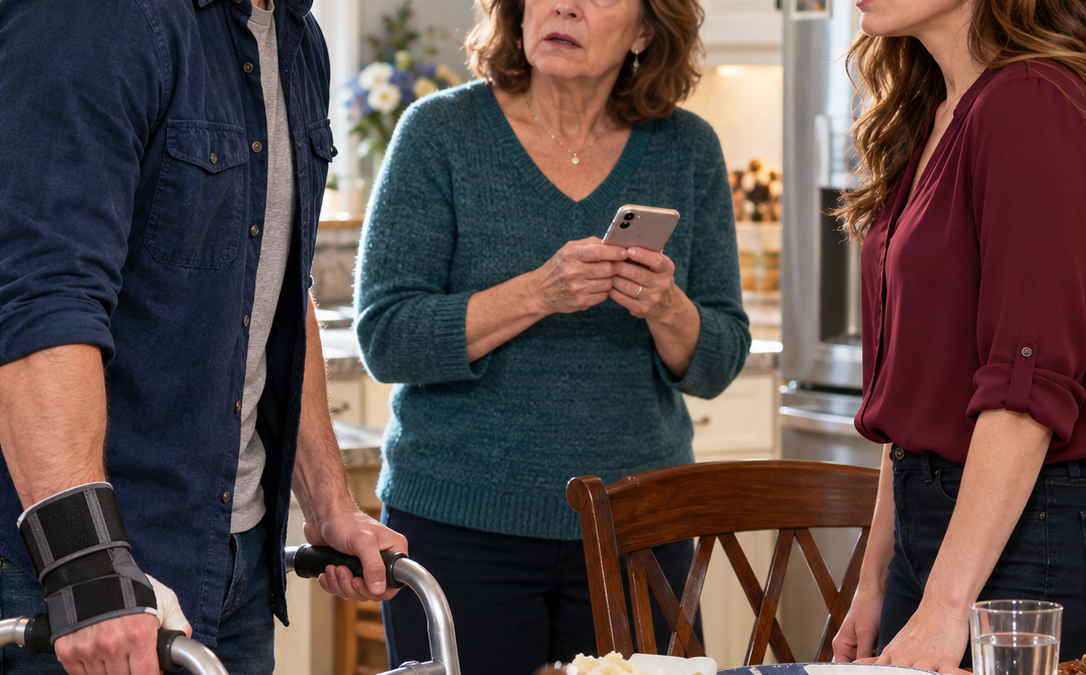
When I finally got home, I went straight to my mom’s house in Huntington, Indiana. It was a Sunday, so my sister Natalie was there, and there was pot roast on the table. My mom looked up, saw the walker, the brace, and the way I was standing, and the first thing she said was, “Ross, why didn’t you let us know?”
“I did, Mom. Twenty-three calls.”
She picked her phone up off the counter and scrolled. Then she scrolled again. Nothing. Not one call from a number she didn’t know. Across the table, my sister had gone white.
I’ll get to all of it, but you should know where this ends up. Two years after that Sunday, Natalie tried to get my mom to sell the house I grew up in and move into her basement. I didn’t argue with anybody. I put my mom in my truck and drove her two and a half hours to a hospital cafeteria in Columbus so she could meet the nurse who held my hand.
Let me back up.
I was 27 when I fell. I’d been doing commercial heating and air for about six years by then, working out of Fort Wayne for a company called Barlo Mechanical. Rooftop units, mostly. The big gray boxes you see on top of grocery stores, warehouses, and schools. I liked it. I liked being up there early, before the tar got soft, when you could see the whole town waking up.
My family is small. My dad, Daryl, died three years before all this. Heart attack in the driveway while shoveling snow, the kind of thing every doctor warns you about and nobody listens to. He was 61. He drove a parts truck for 30 years and never missed a day. When he died, he left my mom the house, a paid-off Buick, and a life insurance policy for $120,000.
My mom, Kim, is the kind of person who keeps the twist ties from bread bags in a drawer. She didn’t touch that insurance money. She put it in a savings account and said the same thing every Christmas for three years.
“That’s your dad’s money. Half each when you buy a house. That’s what he’d want.”
She said it so often that my sister and I used to mouth the words along with her.
My sister Natalie is four years older than me. She lives ten minutes from Mom, married to a guy named Joey who sells farm equipment and laughs at everything half a second late, like he’s waiting to see if it’s safe. They have two kids.
When Dad died, Natalie was the one close by, and she stepped in. I’ll give her that. She drove Mom to appointments. She set up Mom’s online banking. She set up her phone, her email, her streaming, all of it, and she kept the passwords in a little notebook in her purse. If Mom’s phone did anything strange, Mom called Natalie, and Natalie fixed it.
That spring, Mom had a stent put in. It was a scare, but it went fine. She was back to her garden in three weeks. Still, after that, Natalie started saying things like, “We can’t stress Mom out,” and, “Mom doesn’t need to hear about that.”
At the time, I thought it was sweet.
One more thing, and it matters. Years earlier, when I first started at Barlo, the office lady handed me an emergency contact form. Mom didn’t drive at night back then, and her old flip phone was always dead. So I put down Natalie.
I never thought about it again.
The Columbus job was a two-week job at a distribution warehouse off the interstate. Fourteen rooftop units were being swapped out, and Barlo sent four of us. We stayed at a hotel with a waffle maker that only made half a waffle.
On September 9th, at about four in the afternoon, I was walking backward with one end of a refrigerant line set. The parapet on that corner of the roof had been cut down for a crane lift the week before. Somebody had marked it with orange tape.
The tape had blown off.
I don’t remember the fall. I remember the tape being there in the morning. That’s it.
What I know about the rest, I know from my crew, from Bernie, and from my medical records, which I’ll get to.
I landed on a stack of pallets, which is probably the only reason I’m here. I broke my pelvis, a bunch of ribs, and my left wrist. One of the ribs punctured a lung, and there was bleeding inside that they had to go in and stop.
By that night, I was in the trauma intensive care unit at a hospital on the north side of Columbus, with a breathing tube in, sedated, and about as close to the edge as you can get and still be talking about it three years later.
My boss, Stu Barlo, didn’t have my mom’s number. He had the form. So the hospital called Natalie.
I was on the breathing tube for five days. I don’t remember any of them. But the first night, Bernie was my nurse, and she told me later that she sat with me because she’d looked at my chart, saw I was 27 and alone and two and a half hours from anywhere that sounded like home, and she didn’t like it.
“You kept trying to reach for the tube,” she said. “So I gave you something else to hold.”
Bernie Rule was 61, about five feet tall, with reading glasses on a beaded chain and a voice like a school bus driver who has seen everything and isn’t impressed by any of it. She’d been an intensive care nurse for 34 years. She worked nights because, in her words, “The doctors are asleep and the patients are honest.”
On the sixth morning, they took the tube out. My throat felt like I’d swallowed a sander. The first thing I saw clearly was a whiteboard on the wall across from the bed. It had the date, my nurse’s name, and a smiley face somebody had drawn with a green marker.
The second thing I saw was that nobody was in the chair.
I asked for my phone. One of the day nurses brought me my belongings bag. My phone was in there in about four pieces.
So that night, when Bernie came on shift, I asked her if I could use the room phone to call my mom.
“You can call the moon if you want, honey,” she said. “Dial nine first.”
I called my mom’s cell. It didn’t ring. It just went straight to voicemail, the robot voice telling me the person I was calling was not available.
I figured it was off. Mom turned her phone off at night half the time to save the battery, which was a thing she believed in the way some people believe in ghosts.
So I called Natalie. She picked up on the second ring.
“Ross! Oh my gosh. Ross, you’re awake!”
“I’m awake.”
“Oh, thank God. They told me you were critical. I’ve been sick about it.”
“Where’s Mom? Her phone’s going straight to voicemail.”
There was a little pause. Not a long one. Just enough.
“Mom knows. She knows, Ross. She’s just, you know, with her heart. The doctor doesn’t want her driving that far. And her phone’s been acting up. I keep telling her to get a new one. I’ll take her this week.”
“Can you put her on tomorrow?”
“I’ll try. She’s been so upset. I don’t want to set her off.”
“Natalie, I’d like to talk to my mom.”
“I know. I know. I’ll make it happen, and I’ll come down this weekend. Joey can take the kids. Okay? Love you, Rossy.”
She hadn’t called me Rossy since I was eleven.
I called Mom again before I fell asleep. Straight to voicemail. I left a message.
“Mom, it’s me. I’m okay. I’m in Columbus. Call the hospital and ask for my room. I love you.”
Bernie was charting at the little computer by the door. When I hung up, she got up, walked over to the whiteboard, and made a small mark in the corner with the green marker. One line.
“What’s that?” I said.
“That’s how many times you’ve called your mother,” she said. “Somebody ought to keep count.”
I thought she was joking. She wasn’t.
Over the next two weeks, that tally grew. Two. Five. Eight. I called in the mornings, at supper, and at night when Bernie was on. Every single time, straight to voicemail. Sometimes I left a message, sometimes I didn’t. Bernie made a mark every time.
The day-shift nurses started noticing. One of them, a young guy named Theo, asked me if I wanted the social worker to try reaching my family. I said my sister was handling it. He gave me a look like he’d heard that one before.
Natalie I could reach. That was the strange part. She picked up most of the time, and she always had something. Mom was resting. The doctor said no long drives. Natalie herself was coming Saturday.
Then Saturday came, and one of the kids had a fever. The next Saturday, Joey had a work thing with a combine dealer in Fort Wayne. Then the next Saturday, it rained, and she said, “You know I don’t drive on the interstate in the rain, Ross.”
Which was true, actually. But it was also the third Saturday.
On the seventh day, after my ninth or tenth call, Bernie asked for my mom’s number. I gave it to her. She called it from her own cell phone, standing right there by the bed, so she could leave a message as the nurse, which she said gets people moving.
It didn’t ring for her either. Straight to the robot.
Bernie looked at her phone for a second. Then she looked at me over the top of those glasses. She didn’t say anything. She just went back and made another mark on the whiteboard, which was funny because it wasn’t my call.
But I didn’t argue.
On the twelfth day, Natalie called me. That only happened once, so I remember it. She sounded cheerful, chatty. She asked how the food was. She said Mom’s phone was still acting up and they were going to the store to get a new one soon. She said the kids drew me pictures.
“Mom says she loves you and to just focus on getting better, okay? Don’t worry about anything up here. Everything’s handled.”
I asked her to put Mom on.
She said Mom was in the shower.
It was two o’clock in the afternoon.
I was moved out of intensive care on day nineteen. Four more days on a regular floor, learning to get in and out of a bed with a walker and a pelvis that felt like it had been put back together by a committee.
On my last night in the unit, Bernie came in at the start of her shift and stood in front of the whiteboard for a while.
“Twenty-three,” she said.
“Twenty-three,” I said.
She took her phone out and took a picture of it. Then she pulled up the chair, the chair that had been empty for nineteen days except when she was in it, and sat down next to me.
“Can I tell you something, Ross? And you can tell me to mind my business.”
“Go ahead.”
“I’ve been doing this a long time. I’ve had patients whose families didn’t come because they lived in another country. I’ve had patients whose families didn’t come because the patient had burned every bridge there was. I’ve had patients whose families didn’t come because there wasn’t any family. You’re not any of those.”
“No.”
“So when you go home,” she said, “you pay attention. That’s all. Pay attention.”
My boss, Stu, drove down to get me on day twenty-three. He apologized about the tape for about the fifteenth time, and I told him for about the fifteenth time it wasn’t his fault.
Workers’ comp was covering the hospital and most of my pay. Stu had made sure of that from day one. He was a good boss. He called me every other day I was in there. He was the only one from home who did.
Stu asked where I wanted to go. I said Huntington.
It was a Sunday.
So that’s how I ended up in my mom’s kitchen with a walker, a wrist brace, and a backpack full of hospital paperwork, watching her scroll through a phone with nothing on it.
I want to tell you what happened right after Natalie went white, because it’s the part I didn’t understand until much later.
She recovered fast. Faster than you’d think.
She stood up, came around the table, and hugged me carefully, like I was made of glass. Then she turned to Mom.
“Mom, he told me not to worry you. Remember? I told you he had a fall at work. He said it was a sprain. He made me promise not to scare you with your heart.”
My mom looked at me.
“A sprain? I called your cell three times, honey. You never called back. Natalie said you were busy fighting with the insurance.”
“Natalie,” I said, “I was on a breathing tube.”
“Well, I didn’t know that,” Natalie said. “Nobody told me that.”
“You said they told you I was critical. You said it on the phone.”
“I said it was serious. I didn’t say critical. Ross, you were on a lot of medication. You probably don’t remember half of what you said.”
That was the thing about Natalie. She always had the next sentence ready. She’d had it ready since we were kids. When I was nine and she was thirteen and Dad’s good tape measure ended up in the creek, she had a story about a raccoon ready before he even asked.
My mom held up her phone.
“Honey, there’s nothing here. If you’d called, it would be here.”
“I called from the hospital phone. I called you twenty-three times. It went straight to voicemail every time. I left messages.”
Mom tapped her voicemail. She showed me a message from her pharmacy, a message from the church about the fall rummage sale.
Nothing from me.
Joey, who’d been very quietly eating pot roast the whole time, said, “Huh?” and went back to eating.
I stood there with my hands on that walker and looked at the three of them, and I understood for the first time that my mom actually didn’t know. She wasn’t faking it. She was hurt and confused, and she was looking at me like maybe I was the one who’d gotten it wrong.
Maybe the medication. Maybe I’d dialed the wrong number twenty-three times.
The phone said I hadn’t called. Natalie said I’d said it was a sprain. And I was the one who’d been on all that medication.
“Sit down, honey,” Mom said. “Let me get you a plate.”
I didn’t sit down.
“I’m going to go home now, Mom.”
Stu was still in the driveway because I’d asked him to wait. Because some part of me already knew.
“Ross, come on,” Natalie said. “Don’t be like that. Let’s eat.”
On the way out, I noticed a set of house keys on the counter by the door, on a brand-new keychain shaped like a little house. The tag on it said, “Welcome Home, Natalie and Joey,” with a realtor’s name on the back.
“You guys bought a house?”
“We closed while you were—” Natalie said, and then she stopped. “Last month. We closed last month.”
“Congratulations,” I said. “How’d you swing the down payment?”
Joey laughed half a second late.
“We saved,” Natalie said.
My mom looked down at her plate.
I didn’t think anything of that look at the time.
I should have.
For the next five weeks, I did physical therapy in Fort Wayne and watched a lot of television about people restoring old trucks. Mom called a few times. The calls were short and careful, like she was talking to a neighbor she didn’t know well. She asked if I was eating. She said Natalie told her I was doing great.
She never brought up the twenty-three calls, and I didn’t either, because I didn’t want her to tell me again that the phone said I hadn’t called.
But Bernie’s voice kept sitting in the back of my head.
Pay attention.
In early November, Mom called and said, “Ross, my phone’s doing something funny. The screen keeps telling me my storage is full, and Natalie’s out of town at Joey’s sales meeting. Could you look at it when you’re up here?”
I had just been cleared to drive. I was up there the next afternoon. Mom went outside to cover her mums against the frost, and I sat at her kitchen table with her phone.
The storage thing took two minutes.
Then I opened her settings and went to the list of blocked numbers.
There were two numbers on it.
The first one was a Columbus number. I didn’t recognize it until I looked it up on my own phone. It was the main line of the hospital. Every call out of my room had shown up as that number.
The second one was a cell phone number with an Ohio area code.
Then I opened her voicemail.
On an iPhone, if you scroll all the way to the bottom of the voicemail list, there’s a little folder most people never see. It says “Blocked Messages.”
Voicemails from blocked numbers don’t ring the phone. They don’t show up in your calls. They don’t show up in your regular voicemail list. They just go quietly into that folder and sit there.
There were seventeen voicemails in it.
All from the hospital line.
All from me.
I pressed play on the first one, and I heard my own voice from the night the tube came out.
“Mom, it’s me. I’m okay. I’m in Columbus. Call the hospital and ask for my room. I love you.”
I listened to every one.
By the fourteenth one, I wasn’t saying I was okay anymore. I was just saying, “Hi, Mom. It’s me again.”
The date on the first one was September 14th. That was the sixth day. That was my first call.
There was nothing in the folder before it. No hospital billing office, no social worker, nobody calling to upset my mother. Which meant the hospital line had been blocked before a single call came in from it.
Somebody had blocked it the moment they knew where I was.
Mom came back inside with dirt on her knees. She saw my face and said, “What’s wrong?”
I didn’t play them for her right then. I’ll be honest about that. I wanted to, but I knew exactly what would happen. She’d call Natalie, and Natalie would have the next sentence ready, and I’d be the one standing there looking like the problem.
So I said, “Nothing. Storage is fixed.”
I took screenshots of the blocked list and the folder with the dates on them, texted them to myself, and drove home.
Then I called Natalie and asked her to meet me at Mom’s on Sunday.
She knew. I could hear it.
“What’s this about?”
“Just be there.”
That Sunday, I put Mom’s phone on the kitchen table, opened the folder, and played the first voicemail out loud.
Mom put her hand over her mouth. I let it play all the way through. Then I played the second one. Then I stopped because I didn’t want to do that to her seventeen times.
“Did you block the hospital on Mom’s phone?” I asked.
Natalie looked at the phone, then at Mom, and then she cried. Real tears. I’ll give her that, too.
“Yes,” she said. “Yes. Okay, I did. I’m sorry, Mom. You just had your stent. The doctor said no stress. And they called me and said it was bad. And all I could think was, if Mom drives two and a half hours on the interstate in a panic and has another heart attack, then I lose both of you. So I blocked it. I was going to tell you as soon as he was out of the woods, and then he was out of the woods, and it had gone on so long, and I didn’t know how.”
“And the sprain?” I asked.
“I panicked, Ross. I panicked. I’m not perfect.”
“There’s nothing in that folder before my first call,” I said. “Nobody was calling to upset her. You blocked it the same night they called you, before I could talk.”
“Because I knew you would call her! Because you’d want her there, and you’d tell her everything, and she’d get in the car. Ross, you’d have done the same thing.”
“No,” I said. “I wouldn’t have.”
And my mom, my mom reached across the table and took Natalie’s hand.
“She was scared, Ross,” Mom said. “She was scared for me. It was a bad choice, but she was scared.”
I sat there for a minute. Joey wasn’t there that day. It was just the three of us, the way it had been after Dad died. I watched my mother pick her side, and it was the same side it was always going to be, because Natalie was ten minutes away and I was a voice on the phone.
“Okay,” I said, and stood up. “I’m going to go.”
“Ross, please,” Natalie said. “Let’s start over. Come for Thanksgiving. Come see the new house. I’ll make the sweet potato thing.”
“No,” I said. “Just no.”
I drove back to Fort Wayne.
And that’s where most people would say I went quiet.
I did go quiet for a long time. But I want to be clear about what that means, because I know how it sounds. I didn’t sit in my apartment feeling sorry for myself.
I went back to work in January, light duty first, then back on roofs by April. I wore a harness and tied off on every single job, and I made every guy on my crew do the same. If they complained, I told them I’d show them the pins in my pelvis on the X-ray.
I didn’t go to Thanksgiving. I didn’t go to Christmas.
Natalie sent a card with the kids’ school pictures and “We miss you” written inside in that big, loopy handwriting of hers. I put it in a drawer.
Mom called about every other week. The calls stayed short. She never mentioned the voicemails again, and I didn’t either.
And I paid attention, like Bernie said.
The thing I couldn’t get past was the timing.
Natalie’s story was that she panicked about Mom’s heart. Fine. People panic. But panicking is something you do fast and badly. It’s not keeping it up for nineteen days. It’s not telling your brother three Saturdays in a row that you’re coming. It’s not calling him on day twelve, cheerful, to tell him everything’s handled up here.
Panic doesn’t plan.
Whatever Natalie had done, she’d kept doing it on purpose every day for almost three weeks.
So that winter, I did something I’d never thought I’d do.
I requested my own medical records.
It’s your file. You fill out a form, pay a copy fee, and a few weeks later, you get a thick envelope with every note every doctor and nurse wrote about you. Most of it was numbers I had to look up, but the nursing notes were in plain English.
On the first night, at 2111, which is 9:11 at night, Bernie had written this:
“Sister Natalie reached by phone at emergency contact number provided by employer. Informed of patient condition. Intubated, sedated, critical but stable. Family visit encouraged. Sister states she will inform mother and is unable to come in tonight. Declined chaplain call to mother.”
Declined chaplain call to mother.
The hospital had offered to have a chaplain call my mom.
Natalie said no.
Critical. Intubated.
She’d been told those exact words by Bernie at 9:11 that first night. And then she’d told Mom it was a sprain, and she’d told me to my face that nobody had told her it was that bad.
I read that note probably fifty times.
Then I put the whole envelope in the fire safe in my closet, along with a printout of the screenshots from Mom’s phone.
In February, I called the hospital, asked for the intensive care unit, and asked if Bernie Rule was working.
She was.
She came on the line and said, “This is Bernie,” in that school bus voice.
“Bernie, it’s Ross. Twenty-three.”
She knew exactly who I was.
I told her about the kitchen table, the blocked numbers, the folder, and the chart note. She was quiet for a bit.
Then she said, “The second number on that list. Read it to me.”
I read it to her.
It was her cell phone.
“I called your mother from that phone,” she said. “Day seven. I remember because I was so mad I didn’t leave a message, and I always leave a message.”
“So my sister blocked you, too.”
“Your sister blocked the nurse, Ross,” she said. “In thirty-four years, nobody’s ever blocked the nurse.”
Before I hung up, I asked her something I’d been working up to.
“If it ever came to it, would you tell my mom what you told my sister that night? In person?”
“Honey,” she said, “I’ve got two more winters, and then I’m retiring to my sister’s place in Kentucky to grow tomatoes and ignore my phone. But until then, you bring your mother up here anytime you want, and I will tell her every word.”
That was the plan, more or less. It wasn’t much of one yet. I just didn’t know what I was waiting for.
I’d find out.
Two years went by.
I got promoted to lead tech. I trained two apprentices, and neither of them fell off anything. I kept my phone on and charged every night. Always.
Natalie tried every few months. A birthday text. “Thinking of you, Rossy.” A long email around Easter about how she’d been seeing a counselor and understood now that she’d let fear make her decisions.
It was a very good email. It used the word “accountability” four times.
It didn’t say one thing about why she’d kept lying to me for nineteen days.
I didn’t answer it.
Then, in September, almost two years to the day after I fell, my mom called on a Wednesday night.
That alone was unusual. She called on Sunday afternoons, always after church and before supper.
“Ross,” she said, “I need to ask you something, and I want you to just tell me what you think. Don’t get upset.”
“Okay.”
“Joey got laid off in July. The dealership closed the Wabash store. He’s been looking, but there isn’t much.”
“I’m sorry to hear that.”
“And they’ve got the house payment and the kids, and Natalie’s only part-time at the dentist. And Natalie had an idea. She thinks I should sell this house and move in with them. They’ve got that finished basement. She says I’d have my own bathroom and my own entrance, and I wouldn’t be alone out here anymore. And the money from the house would help them get through. And she says it’d be good for my heart not having to keep up the yard.”
I didn’t say anything for a second.
The house I grew up in.
The house Dad had shoveled the driveway of on the last morning he was alive.
“What do you think about it, Mom?”
“I don’t know. I love this house, but Natalie’s been so good to me, and they’re in a bind. She’s already got a realtor coming to walk through on Saturday, just to see what it’s worth.”
She’s got a realtor coming Saturday, just to look.
“Mom,” I said, “can I ask you something?”
“Sure, honey.”
“The money from the house. Where does it go?”
“Well, it’d be mine, honey. I’d just help them with their payments for a while until Joey finds something. It’s not like I’d be giving it away. It’s not like last time.”
I stopped.
“Last time?”
There was a long pause on the line, the kind where you can hear the person realize they’ve said something they can’t take back.
“With your dad’s money,” she said quietly. “For their down payment. But you said, honey, you told Natalie you didn’t want it.”
I was standing in my kitchen. I remember putting my hand flat on the counter.
“Mom, when did I say that?”
“When you were in the hospital. Natalie talked to you. You said keep it. You didn’t want a dime from me. I was hurt, honestly, Ross, I was. But I thought, well, he’s always been so independent. He never wanted help from anybody. And Natalie needed it for the house. So I signed it all over. The whole account. She said you’d want her to have it since you weren’t buying anything anytime soon.”
“Mom, I never said that. I never once talked to Natalie about Dad’s money. Not in the hospital. Not ever.”
“She showed me your text.”
“I didn’t have a phone, Mom. My phone was in four pieces in a plastic bag.”
Silence.
“She didn’t show me your text,” Mom said slowly. “She sent me one. She said you’d said it. I’ve got it here. Hold on.”
She found it and read it to me.
It was from Natalie, dated September 19th, two years earlier.
Day eleven.
“Talked to Ross today. He says, ‘Keep it. He doesn’t want a dime from you.’ His words. Says he’s fine and to stop worrying.”
Day eleven.
I talked to Natalie on day twelve, and all she’d said on day twelve was that Mom’s phone was acting up and everything was handled up here.
Everything was handled up here.
“Mom,” I said, “do you still have the paperwork from when you gave Natalie the money?”
“Of course I do. I keep everything.”
She does.
She keeps the twist ties.
I drove up the next night after work. Mom had the file box out on the kitchen table, the green metal one with Dad’s handwriting on the label.
In a folder marked “Natalie House,” there was a gift letter.
When you give somebody money for a down payment, the bank makes the person giving it sign a letter saying it’s a gift, not a loan, and that they don’t expect it back.
It was for $120,000.
All of it.
Both halves.
Signed by my mother, witnessed by a loan officer.
Dated September 20th.
Day twelve.
The day Natalie called me, cheerful, and asked how the hospital food was.
There was a sticky note on the front of the folder in Natalie’s loopy handwriting.
“Mom, sign where the yellow tabs are. Don’t worry about reading it all. It’s just bank stuff. Love you.”
I sat there and looked at that sticky note for a long time.
And it all lined up.
It had never been about Mom’s heart.
Mom’s heart was the excuse.
The closing on Natalie’s house had been set for the end of September, and Natalie couldn’t afford it on half. She needed Mom to sign over my half, too.
And Mom never would have. Not in a million years.
If Mom had known I was lying in a hospital bed in Columbus on a breathing tube, Mom would have been in the car that first night. Mom would have been in that empty chair.
And the first thing she’d have done, the very first thing, was make sure my half of Dad’s money was sitting there waiting for me, for whatever I needed when I got out.
The sprain. The panic. The tears at the kitchen table. The counselor and the four accountabilities.
All of it was there to cover $60,000 of my dad’s money.
And now Joey was out of work, and the house that money bought was in trouble, and Natalie had a realtor coming Saturday to sell my mom’s house, too.
Mom was watching me read.
“Ross,” she said, “tell me what’s going on.”
“I will, Mom. I promise. But not here. Can you take tomorrow off from the church office?”
“Why?”
“Because I want you to meet somebody.”
I called the hospital that night from my truck in Mom’s driveway.
Bernie was on. When I told her what I’d found, she was quiet for a long time.
“Tomorrow’s my last shift,” she said. “You know that? Thirty-six years. Tomorrow night’s the last one.”
“I didn’t know that.”
“Well, I didn’t know you were going to call. Seems like we both got lucky. Bring her to the cafeteria at six. I’ll come down before my shift. And Ross?”
“Yeah?”
“Bring the note.”
Before I left Mom’s driveway, I made one more call, to the lender in Fort Wayne who’d preapproved me for a house back in the spring.
I asked her about something called a gift of equity.
She said, “Oh, sure. Families do it all the time.”
Friday, I picked Mom up at noon. We drove two and a half hours east on the same interstate Natalie wouldn’t drive in the rain.
Mom was quiet most of the way. Somewhere around Lima, she said, “Is this about the hospital?”
“Yes.”
“Are you going to be angry with me?”
“No, Mom. I was never angry with you. I was angry that you didn’t know, and I couldn’t make you know.”
She held her purse in her lap with both hands the whole drive.
The hospital cafeteria was in the basement, the way they always are, with a pie case where one of the pies is always lemon meringue.
At 5:55, a short woman in navy scrubs with reading glasses on a beaded chain came walking across the room carrying two cups of coffee.
My mom stood up before I told her who it was.
“You’re Kim,” Bernie said.
“I’m Kim.”
Bernie set down the coffee and hugged her. My mom was not a hugger with strangers.
She hugged her back.
We sat down.
Bernie didn’t waste any time. She never did.
“Kim, I was your son’s nurse the night he came in,” she said. “He was on a ventilator. He was critical. We didn’t know if he’d make it to morning. At 9:11 that night, I called the emergency contact number his employer gave us. Your daughter answered. I told her exactly what I just told you. Intubated, sedated, critical. I told her family should come. I offered to have our chaplain call you so you wouldn’t hear it from a stranger in the middle of the night. She said no. She said she’d tell you herself. And she said she couldn’t come in that night.”
My mom said nothing.
I slid the copy of the chart note across the table with Bernie’s words circled in pen.
Mom read it with her finger, the way she reads the Bible at church.
“She told me it was a sprain,” my mom said finally. “She said he fell at work and sprained something, and he made her promise not to scare me.”
“Ma’am,” Bernie said, “there was nothing sprained about that boy. I called you myself on day seven,” she went on. “From my cell phone. It went straight to voicemail. I found out later from Ross that I was blocked.”
Mom closed her eyes.
Then I took the gift letter out of the folder and set it next to the chart note. Then I set down Natalie’s text, the screenshot from Mom’s own phone dated day eleven.
Then the sticky note with the yellow tabs.
“Mom,” I said, “on day eleven, Natalie told you I said I didn’t want Dad’s money. I was in that unit talking to nobody but Bernie and a whiteboard. On day twelve, you signed the letter. On day fifteen, she closed on her house. She didn’t block the hospital because of your heart. She blocked the hospital so you wouldn’t come down here and find out I was hurt before you signed.”
Bernie took her phone out, found something, and turned it around.
It was the picture she’d taken of my whiteboard on my last night in intensive care.
My name. The date. The green smiley face.
And in the corner, twenty-three little lines grouped in fives, with three left over.
“He called you every one of those times,” Bernie said. “I counted. Somebody had to.”
My mom put her hand over her mouth and cried.
Not loud. Just steady, like rain on a roof.
Bernie held one of her hands across the table.
I held the other one.
It was the first time in two years I’d held my mother’s hand.
After a while, Mom wiped her face with a cafeteria napkin, folded it into a perfect square the way she does, and said, “What do I do, Ross?”
“First thing,” I said, “you don’t sell your house on Saturday.”
“No,” she said. “No, I won’t.”
“Second thing, and this is just an idea. You can say no.”
I told her about the gift of equity.
Here’s how it works.
When a family member sells a house to another family member for less than it’s worth, the difference counts toward the buyer’s down payment.
Mom’s house was worth about $190,000.
If she sold it to me and gave me $60,000 of it as a gift of equity, that $60,000 was my half of Dad’s money.
Finally, on paper, through a bank, with nobody’s sticky notes on it.
“And then what?” Mom asked. “Where would I go?”
“Nowhere,” I said. “You stay. It’s your house. You live there as long as you want. You just won’t own it anymore, which means nobody can talk you into selling it. Not a realtor, not Natalie, not anybody.”
“And you’d pay the mortgage on it?”
“I was going to buy a house anyway, Mom. I’d rather it be that one.”
Bernie laughed.
The first time I’d ever heard her laugh.
“Well, now that’s not a sprain either.”
My mom looked at the papers for a long time. Then she said, “Your dad would have liked that.”
“Yeah,” I said. “I think so.”
We walked Bernie to the elevator at a quarter to seven. She had a shift to work, her last one.
Before the doors closed, she pointed at me.
“Keep that phone charged,” she said.
“Every night.”
The realtor came Saturday at ten.
Her name was Cindy. She drove a white SUV with her own face on the door, and she was very confused when my mother met her on the porch and said, “I’m so sorry you drove out. The house isn’t for sale. My son’s buying it.”
Natalie pulled into the driveway about ninety seconds later. She’d been planning to meet Cindy there.
She got out of her van with a clipboard.
I was sitting on the porch steps.
“What are you doing here?” she said.
“Visiting my mom.”
Cindy said something polite and backed her SUV out of the driveway as fast as a person can do that while still waving.
“Mom,” Natalie said, “what’s going on? What did he tell you?”
“Come inside, Natalie,” Mom said. “Sit down.”
Natalie came inside.
She didn’t sit down.
Mom had the green file box open on the table, with the chart note on top and the gift letter next to it. There was the sticky note with the yellow tabs, and her own phone with Natalie’s text from day eleven on the screen.
Natalie looked at the table, and I watched her look for the next sentence.
I’d been watching her do that my whole life.
It was the first time I’d ever seen her not find one.
“I went to Columbus yesterday,” Mom said. “I met his nurse. Her name is Bernie. She told me what she told you at 9:11 that first night.”
“Mom, she doesn’t know. She’s just a nurse. She doesn’t know what was going on with us.”
“She called me, Natalie. She called me on day seven. You blocked her. And on day eleven, you told me Ross said he didn’t want his father’s money. And on day twelve, I signed every yellow tab you put on that letter. And I didn’t read it because you told me not to worry about reading it.”
“We needed it. You don’t understand, Mom. The bank was going to pull the loan. We had to have it by the closing. And Ross was fine. He came out fine. He’s got a better job than Joey ever had. What was he going to do with it? Buy another truck?”
That was it.
That was the real sentence, the one under all the others.
“He was on a breathing tube,” my mother said. “And you knew it.”
Natalie sat down then.
“I’m not selling my house,” Mom said. “Ross is buying it with his half of your father’s money, which I am giving him the only way I have left to give it. I’m going to keep living here. And I’m not going to help with your payments, Natalie. You already got your help. Two of them.”
“Mom, if you don’t help us, we’ll lose the house.”
“Then you’ll sell it,” Mom said. “People do it all the time. Joey’s family can help. Or you can call your brother. I hear he answers.”
I didn’t say anything.
I didn’t have to.
I just sat there on the arm of Dad’s old recliner.
I’d like to say I felt sorry for her. I didn’t. I felt like a guy who’d been holding his breath under a tarp for two years and finally got to stand up.
Natalie left without the clipboard.
The house closing was in November.
Mom read every page out loud at the closing table before she signed it, to the visible pain of the title lady who had another closing at three.
When it was done, my mom handed me the keys to the house I grew up in. Then she held her hand out, and I handed them right back.
“I’ll need a spare,” I said.
“You’ll get one when you call on Sunday,” she said.
Natalie and Joey listed their house in January.
It sold in March for a little less than they paid, and almost everything they had left after the bank went to the credit cards they’d been running up since July.
They moved into a rental in Wabash, near Joey’s parents.
Joey got a job at a seed company in the spring.
Joey came by my apartment once on his own and stood in the hallway with his hands in his jacket pockets.
“I didn’t know,” he said, “about the money or the calls.”
I believed him.
He said Natalie wasn’t doing great.
I said, “She knows where I am.”
She hasn’t called.
I didn’t expect her to.
I think the only thing harder for Natalie than admitting what she did would be hearing me pick up.
Mom changed the emergency contact on her phone, her doctor’s forms, her pharmacy, and even the church directory.
It’s me now.
All of it.
She made me watch her do every one.
And then she made me show her where the blocked list is on her phone and the folder at the bottom of her voicemail.
She checks it every Sunday night, like she’s checking the locks.
It’s always empty.
The last thing.
Bernie retired to her sister’s place in Kentucky, like she said she would.
Tomatoes and an unanswered phone.
But in June, she drove up for a weekend to see an old nursing school friend in Fort Wayne. She called me and asked if the offer of a Sunday supper was still good.
Mom made pot roast.
Of course she did.
Bernie sat at the kitchen table where all of this started and told night-shift stories until my mom laughed so hard she had to put down her fork.
After supper, they did the dishes together, and I dried. Bernie kept handing me plates before I’d finished the last one, the way nurses do.
On the side of Mom’s fridge, there’s a little whiteboard.
Mom bought it at the dollar store after the closing. She uses it for her pills, her appointments, and the date of the next Sunday supper.
Before she left, Bernie picked up the green marker hanging from the string, and in the bottom corner, she drew one small line.
“What’s that for?” Mom asked.
“That’s how many times he’s come home,” Bernie said. “Somebody ought to keep count.”
There are nineteen lines on it now.
Mom adds one every Sunday.
She’s never once let me hold the marker.








