The new VP made me polish his shoes in front of everyone—I did it. The next day, the group chairman showed up at my house with his son on his knees.
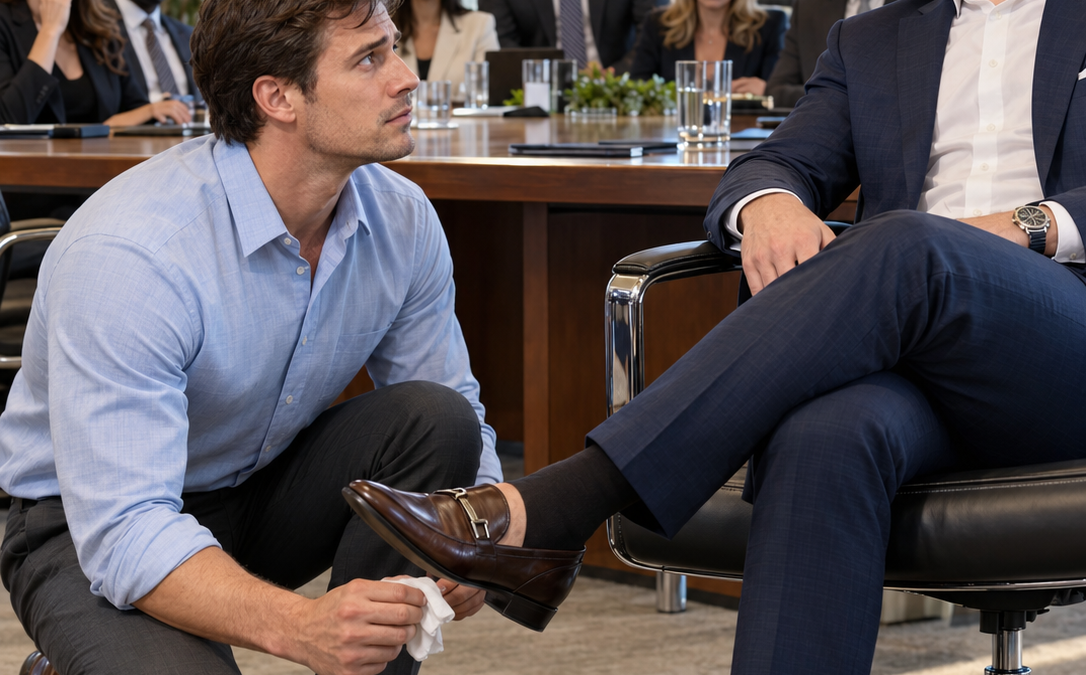
The new VP made me shine his shoes in front of the entire company. I did it perfectly and respectfully. Everyone thought I was spineless. They didn’t know I was wiping away the last bit of power his father and he had left in the group. The next morning, his chairman father brought him to my old apartment door and knelt there trembling.
Chapter One: Servant to the VP
The first thing Tyler Whitmore asked me to do as vice president was shine his shoes.
Not metaphorically. Not in some harmless executive joke that everyone could laugh off later. He put one Italian loafer into the aisle of the main conference room, leaned back in the chair that had belonged to three better managers before him, and looked at me in front of forty-two people.
“Daniel,” he said, glancing at the dust on the toe. “Take care of that for me for one second.”
Nobody moved.
The screen behind him still showed the title slide from his welcome meeting.
One Team. One Standard. One Future.
I almost laughed. Instead, I stood.
My direct manager, Ben Lawson, went pale.
“Tyler, facilities can get a cloth. We don’t need—”
“I didn’t ask facilities.”
Tyler’s eyes never left mine.
“I asked Daniel.”
The room got so quiet I could hear the conference table’s power strip humming under my hand.
Tyler was thirty-one, newly appointed vice president of strategic operations at Whitmore Logistics Industrial, the company his grandfather had built from one diesel repair shop into a private industrial group with nine thousand employees across six states.
Tyler had been with us for eleven months. Before that, he had bounced through private equity, an MBA program, and a two-year strategy fellowship at a firm his father invested in. Now his father, Robert Whitmore, was chairman and chief executive of WLI, and Tyler had arrived at our Dallas headquarters with a new title, a new corner office, and the serene confidence of a man who had never once wondered what happened if people stopped cleaning up after him.
I reached into my pocket and pulled out a folded tissue. I carried them because Texas cedar season treated my sinuses like a personal enemy.
Then I crouched.
A few people looked away. Somebody near the back whispered, “Jesus.”
Tyler smiled.
I wiped the dust from the toe of his shoe in slow, even strokes. Then I checked the edge of the sole and cleaned a faint gray mark near the welt. I did it carefully enough that a professional valet would have approved.
When I finished, I stood and dropped the tissue into the trash can by the wall.
“Anything else?” I asked.
Tyler examined the shoe, then gave a little nod.
“Good attitude,” he said. “That matters around here. People get too attached to titles. Sometimes you have to show you’re willing to do whatever the business needs.”
A few nervous laughs died almost as soon as they started. He looked around the room as if he had just delivered a lesson in leadership.
Then he said, “Actually, Daniel, since you’re good with details, why don’t you make sure my office is ready every morning? Desk, shelves, shoes if needed. I like things exact.”
Ben’s jaw tightened.
“Understood,” I said.
That was the moment half the building decided I had no spine.
By lunch, the story had traveled from strategy to accounting, from accounting to procurement, and probably from procurement to the warehouse in Fort Worth.
I knew because Miles Chin, a younger project lead I had trained three years earlier, found me in the break room and shut the door behind him.
“What the hell was that?” he demanded.
I stirred powdered creamer into a cup of bad coffee.
“A meeting.”
“You know what I mean.”
“I do.”
“You should report him.”
“I might.”
Miles stared at me.
“Might?”
I took a sip. It tasted like warm cardboard.
He lowered his voice.
“Daniel, everybody saw it. Ben saw it. HR had two people in the room. He treated you like a servant.”
“I noticed.”
“So why did you do it?”
Because sixteen years earlier, Tyler’s grandfather had paid for the certification course that got me out of a warehouse night shift.
Because twelve years earlier, Samuel Whitmore had walked a plant floor with me until two in the morning after a conveyor control failure, even though he was already worth hundreds of millions of dollars and I was a twenty-three-year-old technician with grease on my sleeves.
Because seven years earlier, when Samuel was dying, he had asked me to promise him something no sane person would have wanted.
Because there was a fireproof envelope in a safe-deposit box downtown containing my name, Samuel’s signature, a board resolution, and authority Tyler did not know existed.
I said none of that.
Instead, I shrugged.
“My dad’s physical therapy isn’t cheap. I’m not getting fired over a shoe.”
Miles looked disappointed in me.
That helped.
The more ordinary my reason sounded, the safer the real one stayed.
My father had suffered a stroke eighteen months earlier. That part was true. He could walk short distances now, but only with a cane and somebody close enough to catch him if his right leg buckled.
My mother had become his driver, scheduler, cook, insurance negotiator, medication manager, and unofficial physical therapist. I covered whatever Medicare and the supplemental plan did not.
People at work knew enough to assume I was trapped.
Tyler clearly had.
That afternoon, he called me into his office.
He was on the phone when I entered, speaking in the softer voice he reserved for his father.
“Yeah, Dad. First day is fine. A little too much old-company thinking in this group, but I’ll fix it. They’ve gotten comfortable.”
He noticed me and smiled.
“No, I’ve already figured out who can be trained.”
He ended the call.
His office had been redecorated over the weekend. The old framed photographs of WLI plants were gone, replaced by abstract metal art and a large black-and-white photograph of Manhattan.
Tyler had never lived in New York, but apparently he wanted people to think he might have.
He pointed to a cabinet near the credenza.
“There’s shoe cream in there. Horsehair brush, too. I don’t want anything harsh on the leather.”
“Okay.”
“And the desk needs to be cleared before I arrive. No fingerprints. No random papers. My coffee should be here by 8:15. Black. Pour-over. Medium roast. Not the machine downstairs.”
I nodded.
His smile broadened.
“See, this is what I mean. Some people fight every little instruction because they need to prove they matter. You’re smarter than that.”
I almost told him he had no idea.
Instead, I asked, “Anything else?”
He handed me a folder.
“Summarize these market reports. Ten pages max. Tomorrow morning.”
There were six reports inside. Combined length: 480 pages.
“I’ll have it ready.”
When I reached the door, he stopped me.
“Daniel.”
I turned.
“Don’t take this morning personally. I push people. The good ones understand.”
I looked at him for a moment.
“Understood.”
I closed the door behind me.
Then I went to the stairwell, walked down two flights, and called Arthur Bell.
Arthur was seventy-two, a former plant president and one of the three independent directors Samuel Whitmore had trusted most. He had known me since I was twenty-four. In the last seven years, I had called him directly only twice.
He answered on the third ring.
“Daniel?”
“Arthur.”
A pause.
His voice changed.
“Is it time?”
“Not yet.”
He exhaled.
“Then why are you calling?”
“Robert put Tyler in strategic operations.”
“I know.”
“Today Tyler told me to shine his shoes in front of the department.”
Silence.
Not shock. Arthur had spent fifty years in industry. Very little shocked him anymore.
Finally, he said, “Was anyone else present?”
“Forty-two people.”
“HR?”
“Yes.”
“Written complaint?”
“Not yet.”
“Good.”
I smiled despite myself.
“Good?”
“You know what I mean. Document before you move. Samuel did not give you that authority so you could settle a personal score.”
“I know.”
“Do you?”
The stairwell smelled like concrete dust and lemon cleaner. I looked through the narrow window in the door at the bright hallway outside.
“Yes.”
Arthur’s voice softened slightly.
“Then watch the business. Not your pride. If this is one spoiled kid being cruel to one employee, HR can handle it. If it is evidence of the governance problem Sam feared, that’s different.”
“I understand.”
“Robert has been consolidating too much authority. Related-party vendor concerns are already on the audit committee’s radar. Two directors are unhappy about the Memphis automation project, but suspicion isn’t a case.”
“What would be a pattern?”
“Misuse of corporate resources, retaliation, control failures, decisions that put the company at material risk. Something the independent directors can defend to lenders, minority shareholders, employees, and a judge if it comes to that.”
I leaned against the wall.
“And the trust is still exactly where Sam left it?”
“Exactly.”
The words landed with the same weight they always did.
Seven years earlier, before Samuel Whitmore died, he had reorganized a portion of his ownership into the Whitmore Stewardship Trust.
It held eleven percent of WLI’s voting shares.
Not enough to control the company, but enough to matter in a close shareholder fight.
The trust agreement named a professional trustee for ordinary matters and created one unusual position: independent steward.
Me.
A companion board resolution gave the independent steward the right, upon certifying a defined material stewardship failure, to direct the trust’s voting block for governance matters, request a special meeting of the governance committee, and submit evidence directly to the full board without management interference.
It did not make me king.
It did not let me fire anyone.
It gave me a door that management could not lock.
Samuel had made Arthur and outside counsel aware of my identity. Robert knew the trust contained a springing governance mechanism, but Samuel had deliberately kept the identity of the steward confidential unless activated.
His reason had been simple.
“If they know who holds the fire alarm,” he had told me from a hospital bed, “they’ll spend their time watching the alarm instead of watching the fire.”
I had hated the metaphor then.
I hated how right it felt now.
Arthur continued.
“Don’t use company systems for your personal evidence archive. Don’t take files you aren’t entitled to. Don’t bait Tyler into anything. Preserve what comes to you in the normal course of work. If you need legal guidance, call Naomi Pierce at Prescott Hale. She still represents the trust, not management.”
“I remember.”
“And Daniel?”
“Yeah?”
“If Tyler makes you shine his shoes again, you are allowed to say no.”
I laughed once.
“I know.”
“Then why didn’t you?”
I looked down at my hands.
“Because I wanted to know what he would do if he thought I never would.”
Arthur was quiet for a long moment.
“That,” he said, “sounds more like Sam than I’m comfortable admitting.”
We hung up.
I returned to my desk and worked until 9:30.
The office emptied around me. At seven, Tyler left without saying goodbye. At 7:10, his assistant messaged me that the leather on one shoe looked dry and asked me to condition it before morning.
I saved the message. Not to my personal cloud. Not to a thumb drive.
I forwarded it, along with a factual memo of the morning meeting, to the secure portal Prescott Hale maintained for the stewardship trust.
No adjectives. No revenge language.
Date, time, witnesses, exact instruction, my response.
Then I went home.
My parents lived in the same two-bedroom apartment in Oak Cliff where I had grown up. The building was old enough that the hallway carpet had been replaced in sections, creating three different shades of brown between the elevator and their door.
I stopped there first.
Dad was asleep in his recliner with a baseball game playing too softly to hear. Mom sat at the kitchen table sorting insurance statements into little piles.
“You ate?” she asked.
“Not yet.”
She stood immediately.
“I made meatloaf.”
“Mom, sit. I can heat it.”
She studied my face.
“Bad day?”
“New boss.”
“Oh.”
That was all she said, but the word carried thirty-five years of experience with bosses.
I heated a plate and sat with her.
Dad woke halfway through and asked how work was.
His speech was better when he was rested, though certain consonants still caught in his throat.
“Fine,” I said.
He pointed his fork at me.
“Fine means bad.”
Mom smiled.
I looked at both of them and thought about Samuel’s envelope, Arthur’s warning, Tyler’s shoe, and the fact that I was sitting at the same scarred kitchen table where I had filled out my first community college application.
“Just an adjustment,” I said.
Dad nodded slowly.
“Don’t let anybody make you small.”
My fork stopped halfway to my mouth.
He had no idea what had happened that morning.
“Trying not to,” I said.
The next day, I arrived at work at 7:40.
Tyler’s office was empty. I cleaned the desk because he had instructed me to. I wiped the shelves. I set his coffee where he wanted it.
Then I opened the shoe cabinet.
Two pairs of loafers waited inside.
I polished both until they reflected the ceiling lights.
At 8:16, Tyler walked in, took one look around, and smiled.
“Now that,” he said, “is how you make yourself useful.”
I stepped aside.
“Glad it meets the standard.”
He never noticed the email waiting in his inbox from corporate finance.
I did.
I had been copied because the expense request touched one of my projects.
Subject: Clarification Required — Executive Residence Technology Package.
The amount was $86,740.
The listed business purpose was Regional Client Demonstration Environment.
The ship-to address was Tyler Whitmore’s new house in Preston Hollow.
I read it twice.
Then I forwarded nothing, downloaded nothing, and touched no files I was not authorized to see.
I simply made a note in the trust portal.
Date. Amount. Document visible in ordinary course of duties. Potential related-party/personal-benefit question.
For the first time since Tyler had put his shoe in front of me, I felt something colder than anger.
I felt certainty.
The shoe was never going to be the case.
The shoe was only the first breadcrumb.
Chapter Two: The Stewardship Trust
By the end of Tyler Whitmore’s first week, everyone had learned the new rules.
There were the written rules, of course. Expense approvals, vendor onboarding, project gates, information security controls—the dull, necessary machinery that kept a nine-thousand-person company from turning into a family checkbook with forklifts.
Then there were Tyler’s rules.
His coffee had to be on his desk by 8:15, but not earlier than 8:10 because he claimed coffee died if it sat too long. His office temperature had to be sixty-nine degrees. His printer tray had to contain heavyweight paper, even though ninety percent of his documents were digital. If the sunlight hit his monitor after three in the afternoon, somebody had to lower the blinds.
That somebody became me.
At first, coworkers were angry for me. Then they became embarrassed for me. By Friday, most of them had learned not to look up when Tyler called across the floor.
“Daniel, shoes.”
Or, “Daniel, car service.”
Or, “Daniel, I need that restaurant moved to 7:30. Tell them I want the private room, not the side room.”
The strangest part was how quickly humiliation became background noise. People can adapt to almost anything if the payroll system keeps running.
Ben tried twice to intervene. The second time, Tyler closed his office door and kept him inside for nearly forty minutes. When Ben came out, his face was gray.
He stopped by my desk that evening.
“I’m sorry,” he said.
“For what?”
“For not being able to stop this.”
“You don’t need to apologize.”
“I do. I’m your manager on the org chart.”
He gave me a tired look.
“Tyler says the department needs cultural discipline. He says you’re the example.”
“I figured.”
Ben leaned one hand against the partition.
“He also said Robert wants him to identify people who are too comfortable. I don’t know if that’s true.”
“Probably partly true.”
“You’re taking this too calmly.”
“I’m taking notes.”
Ben studied me for a second. I thought he might ask what I meant, but he didn’t.
“Be careful,” he said.
That weekend, I drove to Oak Cliff to take Dad to therapy. The clinic was in a strip center between a tax office and a taqueria. Dad hated the parallel bars and hated the therapist telling him to slow down even more.
“I can walk,” he muttered.
“You can fall, too,” Mom said.
He glared at her. The therapist laughed.
Afterward, we went back to their apartment. Dad fell asleep in the recliner, exhausted. Mom made grilled cheese and tomato soup, the same lunch she had made when I was ten and homesick from school.
She set my bowl down and looked at me.
“You’re losing weight.”
“I’m not.”
“You are.”
“Maybe your portions got bigger.”
She ignored that.
“Miles called.”
I stopped eating.
“He what?”
“He wanted your father’s old physical therapist’s number. Said a friend needed it.”
That was a terrible lie. Miles had the number already.
Mom folded her arms.
“What’s happening at work?”
“New executive.”
“What kind?”
“The kind who thinks being important and making other people feel unimportant are the same thing.”
Dad opened one eye from the recliner.
“Idiot,” he said.
Mom glanced at him.
“Go back to sleep.”
“I’m awake.”
I smiled despite myself.
Mom sat across from me.
“Can you leave?”
“Yes.”
“Then why don’t you?”
That was harder.
There were things my parents did not know about Samuel Whitmore. They knew he had helped me early in my career. They knew he had paid for my controls certification after I fixed a routing problem at the old Irving distribution center. They knew he sometimes called me directly and once sent Dad a Christmas ham so large Mom had given half of it to the neighbors.
They did not know about Samuel’s final year.
Cancer had reduced him from a broad-shouldered man who walked plants faster than people half his age into somebody who needed help sitting up in bed. It did not reduce his attention to detail.
Three weeks before he died, he summoned me to his home with Arthur Bell and a lawyer named Naomi Pierce present.
“Robert thinks the company is inherited property,” Samuel had said. “It isn’t. It’s a responsibility.”
I had tried to interrupt. He raised one hand.
“Let me finish before I run out of breath and patience.”
Even dying, he had been difficult.
The company’s family ownership was complicated. Samuel still controlled a meaningful voting block, but his estate plan split economic benefits among children, grandchildren, charitable interests, and a stewardship trust. He had created that trust because he believed family wealth and corporate control should not always travel together.
“Blood gets you a seat at Thanksgiving,” he had told me. “It does not qualify you to run a company.”
The trust held eleven percent of voting rights. More important, the board had adopted a resolution recognizing an independent steward who could bypass management and directly petition the governance committee when there was credible evidence of serious misuse, self-dealing, or succession risk.
Samuel named me.
I told him no.
He ignored me.
“I didn’t ask because you want power,” he said. “I asked because you don’t.”
“That is not a qualification.”
“It’s rarer than an MBA.”
I looked at Arthur for help. Arthur stared at the floor.
Naomi Pierce slid the documents toward me.
I did not sign that day. I came back the next morning.
Samuel smiled when he saw me.
“Knew you’d make the wrong decision.”
I signed.
He died nineteen days later.
For seven years, I did nothing with the authority except review the annual stewardship packet prepared by outside counsel and occasionally answer questions from Arthur.
Robert Whitmore made decisions I disliked. He pushed out two respected plant presidents. He put too much capital into a warehouse automation program that failed. He increasingly surrounded himself with people who agreed before he finished speaking.
But bad management was not automatically misconduct. A founder’s private doubts did not give me the right to overthrow his son because I thought I could do better.
So I waited.
Now Mom was asking why I didn’t leave.
“Because I need to finish something,” I said.
She watched me for a long time. Then she nodded.
“Finish it clean.”
That was all.
Monday morning, Tyler upgraded me from office servant to personal errand runner.
He called me in at 10:15 and slid a manila folder across the desk. Inside was a list for his new house.
Confirm smart-home installer. Meet furniture delivery. Approve landscape lighting samples. Pick up wine refrigerator warranty documents. Coordinate security gate programming.
I looked at him. He mistook my silence for hesitation.
“I know it’s personal,” he said. “Do it after hours if you’re worried about time coding.”
“Why me?”
“Because you’re reliable.”
There it was. The little gift of praise abusers sometimes give when they want a favor to feel like an honor.
“My project deadlines don’t move,” I said.
“Then manage your time better.”
He leaned back.
“Daniel, this is how executive trust works. You want exposure to senior leadership? You make senior leadership’s life easier.”
I held the folder.
“Send the instructions by email.”
His eyebrows lifted.
“What?”
“So I don’t miss anything.”
He smiled.
“Of course, detail guy.”
Five minutes later, the instructions arrived in writing.
I saved them through the normal records system and forwarded the thread to the trust portal.
That evening, I went to Tyler’s house in Preston Hollow because a security contractor needed an authorized person on-site.
The place was enormous. White limestone, black steel windows, heated pool, four-car garage. It looked less like a home than a hotel designed for people who disliked other guests.
A delivery truck from a high-end furniture company was parked out front. The driver handed me a manifest.
Dining table: $18,400.
Custom shelving: $22,900.
Sectional: $31,600.
Desk and credenza: $14,200.
I recognized the vendor name.
It was the same vendor on the $86,740 regional client demonstration environment expense request.
I photographed nothing. I did not need to.
The shipping document would be retained by the vendor, and the company expense request was already in finance. I signed only the delivery acknowledgment as recipient on behalf of the homeowner, not as a WLI representative.
At 9:30, Tyler texted.
Everything good?
I answered.
Delivery complete. Vendor noted one damaged chair. They will replace it Friday.
He replied with a thumbs-up.
Then another message appeared.
Make sure finance releases payment tomorrow. Charge it to regional demo center. Dad knows.
I read the sentence twice.
The founder’s grandson had just instructed a company employee to help disguise personal furniture as a corporate business expense.
I did not answer immediately.
Instead, I called Naomi Pierce.
She picked up with, “Tell me you’re not calling from a company phone.”
“I’m not.”
“Good. What happened?”
I described the text.
“Do not alter it, forward it outside approved legal channels, or respond substantively until we preserve it. Screenshot only if your device is company-managed and preservation policy allows. Is it?”
“Yes.”
“Then don’t. The message exists on the enterprise platform. We can issue a preservation notice if you trigger the process.”
“I’m not triggering yet.”
“Why?”
“Because Tyler claims Robert knows.”
Naomi was quiet.
“You want to know whether that is bluff or governance?”
“Exactly.”
“Be careful. There is a line between observing misconduct and letting preventable harm occur.”
“I won’t approve payment.”
“Good.”
The next morning, Tyler asked before I had taken off my coat.
“Did you talk to finance?”
“Not yet.”
His expression hardened.
“Why not?”
“I need the business purpose code and approving executive.”
“I just told you. Regional demo center.”
“The delivery address is your residence.”
“So?”
“So finance will ask.”
Tyler stared at me like I had suddenly started speaking another language.
Then he smiled without warmth.
“Rules are written by people, Daniel. They aren’t commandments.”
“I agree.”
“Good. Then tell finance I approved it.”
“You can’t approve your own personal expense.”
For the first time since he arrived, the room changed.
Not dramatically. He did not shout. His face simply lost the relaxed expression he wore when he believed everyone around him was harmless.
“My father is CEO,” he said.
“I know.”
“He is aware of the house. He is aware of the expense.”
“Then an approval from him will solve the issue.”
Tyler leaned forward.
“You’re getting brave.”
“No, I’m getting specific.”
A long silence followed. Then he laughed.
“You know what? Fine. I’ll handle it.”
I nodded.
He pointed at the floor beside his desk.
“Before you go, those brown loafers need conditioner.”
I looked at the shoes, then at him, and crouched again.
Not because I was afraid.
Because now I knew the distinction Arthur had asked me to find. This was no longer one arrogant son humiliating one employee. The personal and corporate lines were already being blurred.
The only question left was how far up the family tree the blur went.
Two hours later, finance controller Maria Alvarez copied me on an email to Tyler.
Tyler, we cannot process invoice 88417 as regional demonstration equipment. Vendor documentation and ship-to information indicate residential furniture for your private address. Please provide an approved reimbursement agreement or personal payment method. No corporate funds will be released absent review by Legal and the audit committee delegate.
Tyler replied from his phone.
Maria, Robert has already cleared this. Stop overcomplicating it. Daniel Hart can confirm this installation supports executive/client hosting. Process today.
My name sat there in black letters.
I typed a response.
I cannot confirm that. I was present only for residential delivery coordination at Tyler’s instruction. I have no information establishing a corporate business purpose.
I read it once.
Then I clicked Send.
Three minutes later, Tyler’s office door opened so hard it struck the wall.
“Hart!”
Every head in the department lifted.
“Office. Now.”
I stood.
Miles looked at me this time. I did not give him a reassuring smile.
I walked into Tyler’s office and closed the door behind me.
He was holding his phone in one hand.
“What the hell do you think you’re doing?”
“Answering finance accurately.”
“You made me look like a thief.”
“I described what I did.”
“You work for me.”
“I work for Whitmore Logistics Industrial.”
His face tightened.
Then he came around the desk until he was close enough that I could smell mint gum.
“You need this job,” he said quietly. “Your father is sick. Everybody knows. Don’t make the mistake of confusing patience with security.”
The threat was soft enough that nobody outside could hear it.
I met his eyes.
“Is that a direction related to my employment?”
He blinked.
“What?”
“If it is, send it to me in writing.”
For the first time, Tyler Whitmore looked uncertain. Only for a second.
Then he stepped back.
“Get out.”
I did.
At my desk, a new message was waiting from Arthur Bell.
Naomi briefed me. Governance committee meets Wednesday. Do not assume the problem is only Tyler.
I looked through the glass wall at Tyler pacing in his office.
I had spent years wondering what Samuel meant by material stewardship failure.
I was beginning to understand.
Chapter Three: Retaliation
Retaliation arrived wearing an HR logo.
At nine the next morning, I received a calendar invitation titled Performance Alignment Discussion.
Attendees: Tyler Whitmore, Melissa Grant from Human Resources, Ben Lawson, and me.
The meeting started at ten.
Melissa had a legal pad open in front of her. She looked uncomfortable before anyone spoke, which told me she had read whatever Tyler submitted.
Tyler sat with his arms folded.
“Daniel has developed an attitude problem,” he began.
Melissa glanced at him.
“Can you be more specific?”
“He resists direction. Challenges decisions in front of staff. Undermines authority. Yesterday, he publicly contradicted an executive instruction in an email thread with finance.”
“I answered a factual question,” I said.
Tyler ignored me.
“He also has trouble adapting to leadership changes. I think he has become territorial because he has been in this group a long time.”
Ben shifted in his chair.
“Tyler, Daniel’s performance reviews for the last six years are all exceeds or strong performer.”
“I’m not talking about technical output.”
“That’s most of his job.”
“I’m talking about culture.”
There it was again.
Culture had become Tyler’s favorite word for obedience.
Melissa asked me to respond.
I kept it simple.
“I have completed every assigned business task within policy. I declined to characterize residential furniture delivered to Tyler’s home as a company demonstration expense because I had no basis to do so. I’m happy to follow lawful and documented instructions.”
Tyler gave a short laugh.
“See that wording? Lawful. Documented. He talks like he’s building a lawsuit.”
Melissa wrote something down.
I said, “You asked for specifics.”
The meeting ended with no discipline. Melissa said HR would monitor the relationship and reminded everyone about anti-retaliation expectations.
Tyler smiled through that part.
At 11:20, my access to the Horizon project folder disappeared.
At 11:31, my approval rights in the vendor portal were removed.
At 11:40, Tyler sent the department a new reporting structure, putting my project responsibilities under Miles Chin, who had five years less experience than I did.
Miles appeared beside my desk two minutes later.
“I didn’t ask for this.”
“I know.”
“I’m going to refuse.”
“No.”
He stared at me.
“Daniel.”
“Take the role.”
“You want me to help him push you out?”
“I want the work protected.”
“That’s insane.”
“No. If you refuse, he’ll put somebody weaker there. Take it. Run the project correctly, and don’t do anything off the books.”
Miles lowered his voice.
“What are you doing?”
“Working.”
I looked at him. He was angry enough that his ears had turned red.
“Miles, I’m asking you to trust me for a little longer.”
He searched my face.
“Fine,” he said at last. “But I hate this.”
“So do I.”
That afternoon, we had a progress review on the Gulf Coast distribution optimization program, a seventy-million-dollar network redesign involving three warehouses, two rail transfer points, and a major retail customer.
I had led the technical modeling for eight months.
Tyler had been briefed twice. He had not read either briefing.
I knew because he opened the meeting by announcing a decision that contradicted the customer’s signed operating constraints.
“We’re going to consolidate outbound routing through Houston,” he said, pointing at the map. “One control point. Cleaner. More efficient.”
The customer representative, Karen Holt, frowned.
“That won’t work for our storm continuity requirement.”
Tyler smiled at her.
“We’ve run the numbers.”
I had run the numbers.
“No,” I said.
Every head turned.
Tyler’s smile vanished.
I continued before he could stop me.
“Our agreed design uses Houston and San Antonio as redundant control points. If we consolidate, a major Gulf weather event can isolate the control node and violate the twelve-hour recovery requirement in Section 4.2 of the service agreement.”
Karen nodded immediately.
“That’s exactly right.”
Tyler looked at the screen.
“Then change the recovery plan.”
Karen stared at him.
“The recovery requirement is ours, not yours.”
A silence followed.
Tyler recovered fast.
“What I mean is, there may be a way to meet the same outcome through alternative capacity. Daniel, put options together.”
“I already did. They’re in the risk appendix from last Tuesday.”
His eyes hardened.
Karen said, “Can you resend that to me?”
“Absolutely,” Tyler interrupted. “All client communication comes through my office now.”
Karen looked from him to me.
“That seems unnecessary.”
“I prefer centralized accountability.”
The meeting limped forward for another thirty minutes.
Afterward, Karen caught me in the hallway.
“Is everything okay over there?”
“I can’t discuss internal reporting changes.”
“I didn’t ask about reporting changes.”
I looked at her.
She lowered her voice.
“I’ve worked with you for four years. You don’t normally have to correct your own executive in front of us.”
“I’ll make sure the project requirements remain clear.”
“That wasn’t my question either.”
I gave her a small smile.
“It’s the answer I can give.”
She nodded slowly.
“Fair enough.”
That evening, the secure trust portal showed a message from Naomi Pierce requesting a call. I joined from my personal laptop at home. Arthur was on, too.
Naomi did most of the talking.
“The governance committee has enough to open a preliminary review,” she said. “Not enough to activate the stewardship mechanism yet.”
“What are they reviewing?”
“Executive expense controls, related-party approvals, retaliation concerns, and certain appointments made by Robert over the last eighteen months.”
“Tyler?”
“Tyler is part of it.”
Arthur cut in.
“Daniel, there are two things you don’t know.”
“I’m listening.”
“First, the furniture request wasn’t isolated. Audit found prior charges tied to Tyler’s residence routed through a company vendor account. Landscaping design, AV equipment, and a security upgrade. Some were rejected. Some were paid.”
I leaned back.
“How much?”
“Still being reconciled. At least $190,000 potentially personal.”
“And Robert?”
“Second thing,” Arthur said. “Finance has emails suggesting Robert’s chief of staff told people not to nickel-and-dime the family over executive expenses.”
I closed my eyes.
Samuel’s face appeared in memory with painful clarity.
Blood gets you a seat at Thanksgiving. It does not qualify you to run a company.
Naomi said, “Do not jump ahead. We need context. There may be legitimate reimbursable security expenses for senior officers. There may be taxable benefits. The problem is classification and approval. Let audit do its job.”
“I will.”
Arthur said, “There’s more pressure coming. Robert is pushing Tyler as part of the succession story for lenders. Next month’s North American Industrial Leadership Forum in Chicago is important. Tyler is speaking on a panel about digital supply chains.”
I almost laughed.
“Tyler?”
“Yes.”
“He couldn’t explain redundant routing to a customer this afternoon.”
“Which is why this matters.”
Naomi’s tone sharpened.
“Careful. Incompetence is not fraud. We are not building a morality play. We are assessing whether governance has failed.”
“I know.”
“You keep saying that because I keep reminding you.”
“That is how lawyers show affection.”
Arthur chuckled.
For the first time in days, I relaxed.
The next morning, Tyler called me in and tossed a printed itinerary onto his desk.
“You’re coming to Chicago.”
“When?”
“Two weeks.”
“I’m not on the delegation list.”
“You are now.”
He tapped the paper.
“I need somebody who knows the operational details. My presentation team is useless.”
I said nothing.
He leaned back.
“And before you get excited, you’re not speaking. You’re there to handle logistics, prep, notes, whatever I need.”
“Understood.”
“Good. Get my flights switched to first class. Four Seasons. Lake-view suite. Dinner reservations at places that don’t put executives next to tourists. And I need the panel deck rewritten. What I got from communications looks like a middle school project.”
I picked up the itinerary.
His eyes dropped to my shoes.
“Also, your shoes are terrible.”
I looked down at my brown leather Oxfords. They were seven years old and resoled twice, but polished.
“They’re fine.”
“If you’re traveling with me, buy better ones.”
“Will the company reimburse them?”
Tyler laughed.
“Don’t be cheap.”
I almost admired the consistency.
Over the next week, I prepared the Chicago material.
Unlike Tyler, I actually liked the subject.
WLI’s network had real strengths: dense regional freight lanes, long-term industrial contracts, experienced plant teams, and a data platform we had spent years integrating.
The weakness was not the business.
It was leadership increasingly treating operations as a stage set for executive ambition.
I built Tyler a clean presentation with defensible numbers, realistic case studies, and clear limitations.
He changed the title to Dominating the Intelligent Supply Chain.
Then he added a slide claiming WLI would deploy autonomous predictive logistics across eighty percent of the network within twenty-four months.
That was fiction.
I sent him a comment.
Current approved roadmap targets decision-support automation, not autonomous network control. Recommend revising claim.
He rejected the comment.
I sent a second note.
The 80% figure is not supported by the current capital plan or implementation schedule.
Rejected.
Finally, he messaged me directly.
Stop thinking like an engineer. Vision is supposed to be ahead of reality.
I responded.
Understood. I recommend labeling it as a strategic aspiration, not a committed deployment target.
No answer.
Later that day, Maria Alvarez from finance stopped me near the elevators.
“Can I ask you something off the record?” she said.
“Probably not.”
She gave a humorless smile.
“Right answer. Let me try again. If outside counsel contacts you about Tyler’s expenses, will you cooperate?”
“Yes.”
Her shoulders dropped slightly.
“Good.”
“Maria, are you okay?”
She glanced down the hallway before answering.
“I’ve spent twenty-two years telling people no when the answer is no. Lately, I’m being told no is disloyal.”
“I’m sorry.”
“Don’t be. Just don’t let them turn this into one angry employee versus one executive.”
“I won’t.”
She nodded. Then she surprised me.
“Sam Whitmore once backed me in a meeting when a plant president tried to bury a safety cost. He said, ‘A company that punishes the person who protects the rule eventually pays someone to investigate why the rule failed.'”
I smiled.
“That sounds like him.”
Maria looked at me more carefully.
“You knew him well, didn’t you?”
“Well enough.”
She walked away.
That night, I found a message waiting in the trust portal from Naomi.
Governance committee has issued preservation notices. No management notification to you required. Do not discuss review internally. Also, Leonard Shaw will be at Chicago forum.
I knew the name.
Everybody in our industry did.
Leonard Shaw had built Shaw Capital into one of the largest private industrial investment firms in the country. Thirty years earlier, when Samuel Whitmore’s second warehouse nearly failed, Leonard had provided emergency financing that kept the company alive.
They had remained close friends until Samuel died.
Samuel had mentioned him in the letter he left me.
If the day comes when people call the stewardship trust a dead man’s eccentricity, Leonard can tell them it wasn’t. He argued with me about every damn page.
I had never met Leonard.
Naomi’s message continued.
Arthur believes you should meet him privately. Not for permission, but for continuity and credibility if the mechanism is activated.
I sat at my kitchen table for a long time.
Chicago was supposed to be Tyler’s debut as the future of Whitmore Logistics Industrial. He wanted me there to carry his bags and polish the performance.
For the first time, I wondered whether Samuel had been right about something else.
Sometimes the most dangerous place to stand is behind a man who believes the spotlight belongs to him.
Chapter Four: Public Failure
Tyler treated the Chicago trip like a coronation.
He arrived at DFW wearing a navy cashmere jacket, white sneakers that probably cost more than my monthly car payment, and sunglasses even though we were inside Terminal D before sunrise.
I had one carry-on. He had three bags and asked why the car service had not provided proper luggage handling at the security line.
He sent me to buy coffee at the gate. He sent me back because the coffee was too cold.
On the plane, he sat in first class while I sat in economy with a laptop on my knees, revising the panel briefing he had ignored until midnight.
I did not mind the seat. For the first time in two weeks, he was twenty rows away from me.
Chicago in October was colder than Dallas had been when we left. The wind off the lake cut through my suit jacket as soon as we stepped outside O’Hare.
Tyler hated the weather immediately.
“Why do people live here?” he asked the driver.
The driver looked at him in the mirror and said, “Mostly to annoy people from Texas.”
I looked out the window so Tyler would not see me smile.
The North American Industrial Leadership Forum occupied three floors of a downtown hotel and convention center. Thousands of attendees moved between sessions with badges swinging from their necks: executives, consultants, manufacturers, software vendors, investors, and reporters.
WLI had sponsored the opening reception, which meant Tyler’s name appeared on signs large enough to satisfy him.
He spent the first afternoon shaking hands.
I spent it fixing facts.
His communications team had sent over talking points for an interview with an industry publication. Tyler had changed three numbers himself. One was merely exaggerated. One was outdated. One was impossible.
I corrected them and handed the page back.
He looked irritated.
“You always do this.”
“Do what?”
“Make everything sound smaller.”
“I make it accurate.”
“Accuracy is table stakes. Leadership is narrative.”
“Then tell a true story.”
His eyes narrowed.
“You’re getting mouthy again.”
I met his gaze.
“No. We’re at an external event. False operational claims create different problems than internal slides.”
He held my eyes for a moment, then tossed the page onto the table.
“Fine. Use your boring numbers.”
That evening, while Tyler attended a private sponsor dinner, I went to the hotel’s second-floor library lounge.
Leonard Shaw was already there.
He was seventy-six, thinner than he looked in photographs, with white hair and a charcoal suit that fit perfectly without calling attention to itself.
He stood when I approached.
“Daniel Hart.”
“Yes, sir.”
“Don’t sir me unless you plan to ask for a loan.”
His handshake was dry and firm.
We sat in a corner away from the bar. Naomi had arranged the meeting. I brought no company documents, only Samuel’s personal letter to me and a certified copy of the stewardship trust’s appointment page that Naomi had prepared.
Leonard read the letter slowly.
Halfway through, his mouth tightened.
At the end, he removed his glasses and rubbed the bridge of his nose.
“Sam never did know how to leave other people homework.”
“That sounds familiar.”
Leonard looked up.
“How bad is it?”
“I don’t know yet.”
“That’s not a politician’s answer. Good.”
I summarized what I had personally observed: Tyler’s treatment of staff, private errands, the residential expense request, the retaliation after I refused to validate it, and the operational decisions made without reading the underlying material.
Then I stopped.
“What about Robert?” Leonard asked.
“The committee is reviewing that. I won’t speculate.”
He nodded once.
“Better answer.”
I asked, “Did Samuel talk to you about me?”
“Too much.”
That caught me off guard.
A slight smile crossed Leonard’s face.
“He worried you’d spend your whole life being useful to people who mistook quiet for weakness.”
I said nothing.
“He also worried Robert would confuse ownership with entitlement. Sam loved his son. That made him less objective, not more.”
“Did you agree with the trust?”
“I argued against it for six months.”
“Why?”
“Because dead founders should not govern living companies from the grave.”
That was exactly the concern that had bothered me for years.
Leonard continued.
“But Sam eventually convinced me of one thing. He wasn’t creating a ghost CEO. He was creating a circuit breaker. You cannot run the company. You cannot replace the board. You can force independent review and direct the trust vote when specific triggers are met. That is a limited power, which is why I stopped objecting.”
“I’ve never used it.”
“I know. Arthur tells me enough to know the building hasn’t burned down.”
He slid Samuel’s letter back to me.
“If you activate it, do it because the evidence requires it, not because Tyler made you polish a shoe.”
“I know.”
Leonard leaned back.
“Does it still hurt?”
I looked at him.
“The shoe,” he said.
I thought about the conference room. Forty-two people. Tyler’s foot in the aisle. Miles staring at the table.
“Yes.”
“Good.”
I frowned.
“Pain is not disqualifying,” Leonard said. “Pretending you have none is. Know where your anger is. Then don’t let it drive.”
We talked for another twenty minutes.
When I stood to leave, he said, “If the trust’s authority becomes public, I will confirm what I know. No theatrics, no press conference, just facts.”
“That’s all I need.”
“Then I hope you never need it.”
So did I.
The next morning, Tyler’s panel began at 10:30.
The room held maybe six hundred people. The topic was Digital Transformation Without Operational Disruption.
Tyler shared the stage with a railroad COO, the head of supply chain for a national retailer, and a manufacturing technology executive who had spent twenty years running plants before moving into software.
For the first fifteen minutes, Tyler did fine.
He delivered the lines I had written. He described WLI’s network. He talked about resilience, data visibility, and phased automation.
Then the moderator went off script.
“Tyler, you’ve talked about an eighty-percent autonomous network within two years. What does autonomous mean in your operating model?”
I stopped breathing for half a second.
We had removed that claim from the official deck. Tyler had apparently repeated it during a media interview.
He smiled.
“It means we take people out of repetitive decisions and let the system optimize in real time.”
The manufacturing executive beside him asked, “At what decision layer?”
Tyler hesitated.
“Across the network.”
“That’s broad. Dispatch, slotting, carrier selection, inventory positioning, labor scheduling?”
“All of it. Eventually.”
The executive’s expression stayed polite.
“What are you using for exception authority when the model’s confidence drops below threshold?”
Tyler looked toward the audience for one terrible second.
His eyes found me.
I had prepared a note on that exact issue.
He had not read it.
“We have safeguards,” he said.
“What kind?”
“Human oversight.”
The railroad COO smiled slightly.
“So autonomous until a human is needed.”
A few people laughed.
Tyler’s neck reddened.
The moderator moved on, but the damage had started.
A consultant asked about the Gulf Coast redesign. Tyler gave the centralized Houston answer he had proposed in front of Karen Holt.
Another attendee raised the storm continuity problem.
Tyler corrected himself mid-sentence.
By the end of the panel, he was speaking faster and using more adjectives.
That is rarely a good sign.
When he came offstage, he shoved the briefing folder into my chest.
“Why wasn’t I prepared for that?”
“You were.”
“The exception authority question wasn’t in here.”
“Page eleven.”
He flipped pages.
It was on page eleven.
His jaw moved.
“You should have highlighted it.”
“It is highlighted.”
The line was yellow.
He stared at it, then at me.
“This is not the time to be smart.”
Before I could answer, his phone rang.
He saw the name and walked away.
I did not hear the conversation, but I watched his posture change. Shoulders back at first, then rigid, then slightly bent.
When he returned, he had lost color.
“We’re leaving after lunch.”
“You have the executive roundtable at three.”
“Cancel it.”
“What happened?”
“Nothing you need to worry about.”
He walked three steps, stopped, and turned.
“Actually, where were you last night?”
“At dinner.”
“With who?”
“Personal meeting.”
“You work for me on this trip.”
“Not twenty-four hours a day.”
His eyes sharpened.
“Who did you meet?”
I said nothing.
His phone buzzed again.
This time he read the message in front of me.
I watched his face.
“What?” I asked.
He locked the screen.
“Finance is freezing executive expense exceptions pending review.”
“That seems like their job.”
“You knew?”
“I knew finance had concerns.”
“No. You knew this was coming.”
“I didn’t.”
He stepped closer.
“Daniel, if you are doing something behind my back—”
“Doing what?”
He stopped.
That was the problem.
He did not know.
For the first time, his uncertainty was larger than his contempt.
At noon, I received a secure message from Naomi.
Governance committee has found sufficient basis to expand review. They are requesting your formal certification interview tomorrow at 8:00 a.m. Dallas time. Do not discuss.
I read it and put my phone away.
Tyler spent lunch calling his father. I went outside and walked one block along the river.
The wind was hard and cold. Tour boats moved below between buildings that made everything look smaller than it was.
When I returned to the hotel, Leonard Shaw was crossing the lobby with two people from his firm.
He saw me and stopped.
“Daniel.”
Tyler was standing ten feet away.
His head snapped around.
Leonard crossed the distance and shook my hand.
“Good meeting last night,” he said. “I’m glad Sam chose someone patient.”
Tyler stared at us.
Not because Leonard knew my name.
Because he had heard his grandfather’s.
Leonard gave Tyler a polite nod.
“Mr. Whitmore.”
Then he walked on.
Tyler waited until Leonard was out of earshot.
“What did he mean?”
I adjusted the strap on my laptop bag.
“You should ask your father.”
His face went still.
“Ask him what?”
“Whether he remembers the Whitmore Stewardship Trust.”
For the first time since I had met him, Tyler Whitmore had no answer.
We did not fly home together.
At 1:30, he received another call, packed without help, and took an earlier flight.
I stayed because the governance committee asked me to.
At six that evening, a formal notice went to seven senior executives, including Tyler and Robert.
Independent review initiated. Document preservation required. No retaliation permitted. No expense records, communications, access logs, or approval histories to be altered or destroyed.
Tyler texted me one sentence.
What did you do?
I stared at the screen for a while, then answered with the truth.
I told finance I would not call your furniture a business expense. Nothing else.
His reply came almost immediately.
You’re going to regret this.
I forwarded the message to Naomi.
Not because it frightened me.
Because now it belonged in the record.
Chapter Five: The Governance Trigger
The governance committee interview lasted three hours and twenty-six minutes.
Naomi Pierce conducted most of it by video from Dallas. Arthur Bell was present, along with two independent directors I knew only from annual town halls and one forensic accountant from an outside firm.
Nobody asked how I felt about shining Tyler’s shoes.
That was a good sign.
They asked what he had instructed me to do, when he had instructed it, who had been present, what records existed, and whether I had ever encouraged him to make a questionable request.
They asked about the furniture invoice. They asked about the messages. They asked about the residential deliveries, the HR meeting, the removal of my project access, and Tyler’s attempt to make me validate the house as a client demonstration site.
Then they asked about the business.
That part took longer.
I walked them through the Gulf Coast routing issue, the Horizon program, the delays caused by executive overrides, and the widening gap between what WLI publicly claimed about digital transformation and what operations had actually approved.
I was careful not to turn every bad decision into corruption.
“Was the Houston consolidation proposal improper?” one director asked.
“No. It was a bad idea, not misconduct.”
“Was Tyler qualified to make it?”
“That’s a board and management question.”
“What is your professional opinion?”
“My professional opinion is that he had not read the operating constraints when he announced it.”
The forensic accountant asked, “Do you believe Robert Whitmore directed Tyler’s residential costs to the company?”
“I don’t know.”
“Tyler told you his father had approved it?”
“Yes.”
“Do you believe Tyler?”
“I don’t know.”
Arthur glanced at me with something close to approval.
When the factual interview ended, Naomi asked everyone except the directors and Arthur to step out of the call.
Then she said, “Daniel, we need your stewardship certification.”
I had imagined that moment for years.
In my imagination, it had always felt dramatic.
It did not.
It felt like signing a hospital consent form.
The trust language required me to certify that I had a good-faith basis to believe a material stewardship failure might exist and that direct independent review was necessary to protect the corporation and its stakeholders.
Not that anyone was guilty.
Not that anyone should be removed.
Only that the normal chain of command could no longer be trusted to investigate itself.
I read the certification twice.
Then I signed electronically.
Naomi said, “That activates the trust’s governance provisions. The trustee will follow your direction on qualifying shareholder votes until the board resolves the matter or the mechanism expires under the trust terms.”
Arthur added, “And your identity will be disclosed to Robert and the board today.”
There it was.
Seven years of anonymity ended in one sentence.
I closed the laptop and sat in the hotel room for several minutes without moving.
Then I called my mother.
“Are you home?” I asked.
“Where else would I be at eight in the morning?”
“Dad awake?”
“He’s arguing with the weatherman.”
“Put me on speaker.”
She did.
I told them more than I had ever told them before.
Not everything. Not legal details. But enough.
I told them Samuel had asked me years ago to serve as an independent safeguard for part of the company’s governance. I told them that safeguard had stayed dormant. I told them recent events had forced me to activate it.
Dad was silent for so long that I thought the call had dropped.
Finally, he said slowly, “That why you stayed?”
“Yes.”
“And shoe?”
I closed my eyes.
“Miles told you.”
Mom said, “He told me enough.”
Dad’s breathing got louder through the speaker.
“Should’ve hit him.”
Mom snapped, “No, he should not have hit him.”
Dad said, “Maybe little.”
I laughed for the first time in two days.
Then Dad became serious.
“You do right thing. Not angry thing.”
“I’m trying.”
“Good.”
I flew home that afternoon.
By the time I landed, Robert Whitmore knew.
His first call came while I was waiting for my bag.
I let it ring out.
The second came before I reached the parking garage.
I answered.
“Daniel.”
Robert’s voice was controlled. I had heard him speak to lenders, governors, union representatives, and angry customers in exactly that tone.
“Robert.”
“Where are you?”
“Airport.”
“We need to talk.”
“I’m available tomorrow with counsel present.”
“You and I have known each other too long for lawyers.”
“Actually, we haven’t.”
A pause.
That was true.
Robert and I had worked in the same company for years, but our relationship was mostly secondhand through Samuel. Robert knew I had been one of his father’s younger protégés. He did not know how far the trust had gone.
“How long?” he asked.
“How long what?”
“How long have you been the steward?”
“Since your father appointed me.”
“Seven years?”
“Yes.”
“And you never told me.”
“It was confidential by design.”
“My father designed plenty of things when he was sick.”
I stopped walking.
“Careful.”
The word came out before I could soften it.
Robert went quiet.
Then he said, “You think because you have an old document and eleven percent of a voting trust, you can threaten my family?”
“No.”
“Then what do you think you’re doing?”
“Requesting independent review under an authority your father created and the board recognized.”
“This is because of Tyler.”
“This is because the governance committee found enough evidence to review Tyler and the control environment around him.”
“He made you shine a shoe, and you decided to destroy him.”
“If this were only about a shoe, HR could deal with it.”
Robert exhaled hard.
“My son is immature. I know that.”
“Then why is he a vice president?”
That landed.
His voice changed.
“You are way outside your lane.”
“Maybe.”
“I can fix the expense issue. Tyler reimburses the company. He apologizes. We move him to a different role. You step back from this trust mechanism, and everyone keeps their dignity.”
There it was.
The first offer.
“Independent review has already begun.”
“You can withdraw your certification.”
“I can’t erase what audit has found.”
“Daniel, think about what you’re doing. Nine thousand employees, lenders, customers, families. You pull a succession fight into the open, and people get hurt.”
“That is why it’s going through the board instead of social media.”
He had no response to that.
Finally, he said, “Tomorrow. 7:30. My office, with Naomi Pierce.”
I said, “My office.”
“I heard you.”
I hung up.
The next morning, Naomi joined by video while I sat across from Robert at a conference table beside his office.
Tyler was there, too.
He looked terrible.
No designer confidence. No polished contempt. His eyes were bloodshot, and he had not shaved cleanly.
When I entered, he stood.
“Daniel, I think this has gotten completely out of hand.”
I sat down.
Robert remained standing at the window.
Naomi appeared on the screen and immediately said, “For the record, Daniel is here in his capacity as an employee witness and independent steward. This is not a settlement conference, and no one should pressure him to alter testimony or destroy records.”
Robert looked at the screen.
“Naomi, I know what obstruction is.”
“Excellent. Saves time.”
Tyler rubbed his face.
Then he looked at me.
“The furniture was stupid.”
I waited.
“I’ll pay it personally.”
“You should.”
“And the shoe thing…”
He stopped.
Robert turned from the window.
“Apologize.”
Tyler’s jaw tightened.
“Dad.”
“Apologize.”
Tyler looked at me.
“I shouldn’t have done it.”
That was not an apology.
Exactly.
But it was closer than I expected.
I said, “You shouldn’t have.”
His face flushed.
Robert sat at last.
“Good. Now we’re acting like adults. Tyler reimburses the questionable expenses. He takes leave. Daniel withdraws the stewardship certification, and governance continues a normal review without triggering shareholder provisions.”
Naomi said, “No.”
Robert stared at the screen.
“I was speaking to Daniel.”
“So was I.”
I said, “The certification stands.”
Tyler leaned forward.
“Why? What do you want?”
The question sounded almost desperate.
“Nothing from you.”
“Everybody wants something.”
“I want the board to do its job.”
Robert laughed once, without humor.
“You think boards are sacred. Boards are politics in expensive chairs.”
“Then your father wasted a lot of time building one.”
His eyes flashed.
He opened a folder and slid a paper toward me.
It was a proposed separation agreement.
Six months’ salary. Full medical coverage for eighteen months. A consulting retainer worth another $200,000. Mutual non-disparagement. My resignation from WLI. My resignation as independent steward.
I looked up.
“You cannot buy the trust role from me.”
“We can compensate you for stepping down.”
“Same sentence with better tailoring.”
Naomi said, “Robert, the trust instrument specifies the steward’s resignation process and successor appointment. WLI is not a party with authority to purchase it.”
Robert’s hand flattened on the table.
“Then name your price for the employment matter.”
“There isn’t one.”
Tyler muttered, “Of course there is.”
I turned to him.
“You still think this is about me, don’t you?”
“No.”
I had wondered if saying that would feel noble.
It did not.
Part of it was about me.
The shoe mattered. The threats mattered. Being treated like an object mattered.
But the only reason I had any business using Samuel’s mechanism was that the evidence had moved far beyond me.
“I’m angry at you,” I said. “I’m not pretending otherwise. But my anger doesn’t decide whether you keep your job. The board does. The evidence does.”
Tyler looked away.
The meeting ended forty minutes later with nothing resolved.
That afternoon, the governance committee delivered its preliminary findings to the full board. I did not receive the report, only a notice of the next step.
Special Board Meeting — Thursday, 9:00 a.m.
Purpose: Executive conduct, governance controls, succession oversight, and related-party transactions.
The stewardship trust’s eleven-percent voting block would be represented, although that did not give me a board vote.
Ben Lawson came to my desk.
The office had changed since my identity became known.
People were too polite. Conversations stopped when I walked past. Somebody from procurement called me Mr. Hart even though she had called me Daniel for eight years.
I hated it.
Ben closed the little meeting room door behind him.
“So it’s true?”
“Some of it.”
“You’ve had this role for years?”
“Yes.”
He sat slowly.
“And you let Tyler make you shine his shoes.”
“I didn’t let him. He chose to ask. I chose not to stop him.”
Ben rubbed both hands over his face.
“I don’t know whether that’s incredibly disciplined or completely insane.”
“Neither do I.”
He looked up.
“What happens Thursday?”
“The board meets.”
“And after?”
“I go to work Friday.”
Ben smiled weakly.
“You really think it’s that simple?”
No.
It wasn’t.
At 6:10, as I was leaving, Naomi called.
“The forensic review found something else.”
“What?”
“Tyler’s residential expenses are the small part.”
I stopped beside the elevator.
“There are vendor payments to a consulting LLC owned by one of his former business school classmates. About $1.4 million over eighteen months. Procurement bypasses. Vague deliverables. Several approvals traced to Robert’s chief of staff.”
“Did Robert approve them?”
“Unknown. The board will ask.”
“Anything illegal?”
“Don’t use that word yet. The evidence supports conflict-of-interest and control concerns. Outside counsel will determine more.”
The elevator doors opened.
I did not move.
Naomi said, “Daniel, this is the part where you remember the process protects everyone, including people you dislike.”
“I remember.”
“Good. Go home.”
I did not go to my apartment.
I went to my parents’ place.
Dad was practicing standing from a chair without using his hands. He made it on the third try.
Mom clapped.
I clapped, too.
He looked at me, breathing hard, and grinned.
“Still got it.”
“Apparently.”
For an hour, nobody mentioned WLI.
That hour mattered more than I expected.
When I left, Mom walked me to the door.
“Thursday?” she asked.
“Thursday.”
She touched my arm.
“Finish it clean.”
“I will.”
At seven the next morning, before the board meeting, someone knocked on my parents’ apartment door.
Mom called me immediately.
“There are two men outside.”
“Who?”
She looked through the peephole.
Then she whispered, “I think one is your boss.”
“Which one?”
“The older one.”
I closed my eyes.
Robert Whitmore had come to Oak Cliff, and Tyler was standing beside him.
Chapter Six: A Desperate Plea
I reached my parents’ apartment twenty minutes after Mom called.
Robert and Tyler were still there. They had not knocked again.
Robert stood beside the faded welcome mat in a dark overcoat that looked absurdly expensive against the chipped beige hallway walls. Tyler stood three feet behind him, hands in his pockets, staring at the carpet.
Neither had brought an assistant.
Neither had brought a lawyer.
That worried me more than if they had arrived with both.
Mom opened the door before I could stop her.
“Daniel’s here,” she said.
Robert turned.
He looked ten years older than he had the day before.
“Can we talk?”
“Not here.”
He glanced past me into the apartment.
My father sat in his wheelchair by the dining table. He had insisted on using the chair that morning because therapy had worn him out the day before. His right hand rested stiffly on the armrest.
Robert saw him, and his expression changed.
Maybe he remembered Samuel visiting plant workers’ homes after accidents. Maybe he remembered that companies look different from a conference room than they do from the kitchen table of someone who depends on the paycheck.
Or maybe he was simply tired.
“Five minutes,” Robert said.
Mom looked at me.
I nodded.
They came inside.
Our dining table seated four comfortably. There were five of us, so Tyler stood.
Nobody offered coffee.
Robert took the chair across from Dad.
For a few seconds, he seemed unable to begin.
Finally, he said, “Mr. Hart, I’m Robert Whitmore.”
Dad looked at him.
“I know.”
His speech was slow, but the words were clear.
Robert nodded.
“I’m sorry to come this early.”
Dad pointed weakly toward Tyler.
“He shoe man.”
The room went completely still.
Tyler’s face went red.
I looked at Mom. She suddenly found the kitchen counter fascinating.
Robert closed his eyes for half a second.
“Yes,” he said. “That’s my son.”
Dad looked at Tyler.
“Bad manners.”
Tyler swallowed.
“Yes, sir.”
It was the first time I had ever heard him call anybody sir without calculation.
Robert turned back to me.
“I’m not here to argue evidence.”
“Then why are you here?”
“Because the board meets in less than two hours. Because this company is my father’s life’s work. Because whatever you think of me, I have spent thirty years there, too.”
“That still doesn’t explain why you’re in my parents’ apartment.”
His jaw tightened.
“I want you to narrow the certification.”
“No.”
“Daniel, listen to me.”
“I did yesterday.”
“Tyler resigns today. Effective immediately. I will support the governance committee review. I will also step down as CEO after an orderly transition, sixty or ninety days. But if the board humiliates the family publicly, lenders will panic. Customers will wonder whether control has collapsed. Competitors will use it.”
“That decision belongs to the board.”
“You are directing eleven percent of the voting trust on qualifying shareholder matters.”
“Today’s board decisions are still board decisions.”
“You can influence them.”
“So can you.”
Robert stared at me.
Then he did something I had never seen him do.
He looked scared.
Not angry. Not insulted.
Scared.
“My father knew this would happen,” he said quietly.
“What?”
“He knew I would fail him somehow.”
Dad shifted in the wheelchair.
I said, “Samuel feared a governance failure. That isn’t the same thing as wanting you to fail.”
Robert laughed bitterly.
“You always did defend him.”
“He defended a lot of people.”
Robert looked down at his hands.
“I thought the trust was theater. Something he created because he couldn’t let go. I knew there was a steward, but outside counsel would never identify you. I assumed it was some retired judge or former CEO.”
Tyler finally spoke.
“I didn’t know any of this.”
“No,” Robert said without looking at him. “You didn’t know much of anything you should have.”
Tyler flinched.
Robert’s voice rose for the first time.
“I gave you a vice president title because you told me you were ready. I cleared obstacles. I defended you to the board. And your first month in that role, you turned a senior employee into your valet and tried to put your furniture through the company.”
“It wasn’t—”
“Stop. One word.”
Tyler stopped.
Robert stood.
He looked at his son.
“Apologize properly.”
Tyler’s hands came out of his pockets.
“I already apologized.”
“No. You admitted it was a mistake because you were scared. Apologize to the man.”
Tyler looked at me, then at my father, then at the floor.
“I’m sorry,” he said. “For the shoes. For the errands. For threatening your job. For trying to make you back the expense. I treated you like you were beneath me because I thought you couldn’t do anything about it.”
He swallowed.
“That was wrong.”
I believed he meant at least part of it.
That did not erase anything.
“Thank you for saying it,” I replied.
Robert looked at me.
“Is there anything I can do?”
“Cooperate with the board.”
“I mean before that.”
“No.”
His face tightened again.
Then he said, “If pride is what you need, I don’t have much left.”
Before I understood what he meant, he lowered himself.
One knee touched the old carpet.
Mom gasped.
Tyler said, “Dad.”
Robert ignored him.
“If getting on my knees in this hallway is what it takes for you to believe I understand how serious this is, fine.”
He put the other knee down.
It was not graceful.
He was sixty-two and clearly had bad knees. His hands trembled as he steadied himself against the edge of the chair.
The image was so absurdly close to the kind of revenge fantasy I might have imagined after Tyler humiliated me that I felt no satisfaction at all.
Only discomfort.
“Get up,” I said.
Robert looked at me.
“Please protect the company. I am trying to protect it from the scandal, too.”
“That depends on what the investigation finds. Not on whether you kneel in my parents’ living room.”
Dad tapped the arm of his wheelchair.
“Stand up,” he said.
Robert looked at him.
Dad continued, carefully forming each word.
“A man kneels to pray. Not negotiate.”
For a second, nobody moved.
Then Robert stood.
He seemed smaller afterward.
Not because he had been on the floor.
Because he finally looked like a man rather than an institution.
They left three minutes later.
At the door, Tyler turned back.
“I am sorry, Daniel.”
I nodded once, then closed the door.
Mom stared at me.
“What kind of company do you work for?”
Dad answered before I could.
“Not for long.”
The special board meeting began at nine.
WLI had eleven directors. Robert chaired the board but could not prevent a properly called special meeting under the bylaws.
Arthur Bell chaired the governance committee and, after the preliminary findings, requested that independent counsel run the session.
Naomi was present for the trust. WLI’s own outside counsel sat on the other side of the table.
I attended for two reasons: as a witness and as independent steward.
I was not a director.
That distinction mattered.
Robert arrived last.
Tyler did not attend. His employment status was one of the agenda items, and counsel had advised that he be interviewed separately.
The first hour was almost painfully procedural.
Counsel reviewed the committee’s mandate. The forensic accountant summarized preserved records. HR presented witness statements regarding Tyler’s treatment of staff.
Finance presented expense exceptions and approval chains.
The numbers were worse than I knew.
Two hundred thirty-eight thousand dollars in residential and personal expenses had been submitted through company channels over eighteen months. About $91,000 had actually been paid before Maria Alvarez began rejecting items.
Some were potentially legitimate executive security costs, but many had no documented business purpose.
The $1.4 million consulting relationship was more serious.
The vendor, Northline Advisory, was owned by Tyler’s MBA classmate. The contract had been awarded without competitive review under an executive strategic exception.
Deliverables existed, but several reports appeared to recycle internal WLI work.
Robert’s chief of staff had approved the exception.
Robert said he knew Northline had been engaged but did not know Tyler’s relationship with the owner.
One independent director asked, “Did you ask?”
“No.”
“Why not?”
“I trusted my team.”
The director looked down at the papers.
“That appears to be the central issue.”
Then HR discussed retaliation.
My access changes after the finance email. The performance alignment meeting. Statements from Ben, Miles, Maria, the administrative employee Tyler had accused over the necklace, and six others.
The shoe incident was mentioned in one paragraph.
One paragraph.
That surprised me.
For weeks, it had felt enormous.
On paper, surrounded by governance failures and seven-figure contracts, it looked almost small.
But it was not irrelevant.
It showed how Tyler understood power.
Next came business judgment.
Nobody proposed removing Robert because his son had embarrassed himself on a conference panel.
Instead, the committee reviewed succession oversight, repeated management exceptions, the failed Memphis automation investment, executive appointments without formal benchmarking, and Robert’s decision to combine CEO and chair powers after Samuel’s death.
Bad decisions are not automatically breaches of duty.
But patterns matter.
So do controls.
At 11:40, Naomi asked me to explain the trust mechanism.
I did.
I told them Samuel had never empowered me to run WLI. The trust gave me a defined path to force independent review and direct its eleven-percent block in certain shareholder votes.
It did not give me a crown.
One director asked, “What outcome do you want?”
“An outcome you can defend if I didn’t exist.”
He leaned back.
“That’s inconveniently reasonable.”
“I’ve had good legal coaching.”
Naomi did not smile, but Arthur did.
The board recessed for forty minutes.
When we returned, I was asked to wait outside for the final deliberation.
I sat in the same hallway where I had spent years walking past executive offices without anybody noticing me.
Miles texted.
Whatever happens, Horizon is stable. Karen signed off on dual-control routing. Thought you’d want to know.
I answered.
I did. Thank you.
At 1:15, the doors opened.
Arthur came out first.
“Come in.”
Robert sat at the far end of the table.
He looked exhausted.
Independent counsel read the resolutions.
Tyler Whitmore would be terminated for cause, subject to final documentation, based on abuse of authority, policy violations, undisclosed conflict of interest, and retaliation.
The Northline matter would be referred for further legal review. No criminal conclusion was being made.
Robert Whitmore would step down immediately as board chair and take administrative leave as CEO pending completion of the broader investigation and an executive transition plan.
The board appointed the current COO, Elena Ramirez, interim CEO.
Arthur Bell became interim non-executive chair.
The board also created a governance renewal committee to review succession policy, related-party transactions, executive expenses, whistleblower protections, and separation of chair and CEO roles.
Votes were nine to two on Tyler, eight to three on Robert’s leave and removal as chair.
No mob.
No cheering.
No cameras.
Just votes recorded in minutes.
Robert listened without interruption.
When counsel finished, he looked at me.
“My father got what he wanted.”
I shook my head.
“No.”
His eyebrows moved.
“He wanted you to succeed.”
That hurt him more than anything else said that day.
I saw it.
He looked away.
Arthur asked whether I would accept an interim management role.
“No.”
Three directors looked surprised.
Arthur did not.
“Why?” one asked.
“Because if the lesson from this week is that the person with the hidden lever gets to become boss, then we learned the wrong lesson.”
I looked around the table.
“Elena knows the business. Let her run it. I’ll cooperate with the committee. I’ll continue my actual job until we decide what comes next.”
The independent director who had questioned Robert earlier nodded slowly.
“Sam chose well.”
I did not know what to say to that, so I said nothing.
At 3:15, WLI sent an internal announcement.
Leadership Transition. Independent review ongoing. Tyler Whitmore no longer employed by the company. Robert Whitmore on leave and no longer board chair. Elena Ramirez interim CEO. Arthur Bell interim chair.
The announcement did not mention shoes.
It did not mention my parents’ apartment.
It did not mention that Robert had been on his knees two hours earlier.
It did not need to.
By four, the entire company knew something had changed.
I returned to my desk.
The first thing I saw was Tyler’s office through the glass.
His shoes were still in the cabinet.
Facilities had not packed them yet.
Miles came over and stood beside me.
“So,” he said. “What happens to those?”
I looked at the polished brown loafers.
“Not my job.”
Then I sat down and answered forty-three project emails.
Chapter Seven: Moving Forward
For the first week after the board meeting, people treated me like I had become dangerous.
Doors opened faster. Emails started with Daniel, hope you’re doing well instead of Need this by end of day. Executives who had walked past me for years suddenly remembered my name.
One vice president I had met twice invited me to lunch and spent forty minutes explaining how strongly he had always believed in Samuel Whitmore’s stewardship philosophy.
I declined the second lunch.
Power changes the weather around you.
The hardest part is remembering that the weather is not your personality.
Elena Ramirez made that easier.
On her third day as interim CEO, she called me into the executive conference room.
No entourage. No lawyer.
Just Elena with a yellow legal pad and two coffees.
“I’m told you take yours black.”
“I do.”
She pushed one cup toward me.
“Good. Saves me from learning oat milk ratios.”
Elena had run WLI’s operating companies for six years. She had started in procurement, moved through plant management, then logistics.
She knew what a late railcar did to a production schedule and could explain contribution margin without a slide deck.
Samuel had liked her.
Tyler had called her too operational.
That told me plenty.
“What do you need?” I asked.
“A list.”
“Of what?”
“Everything people stopped telling senior management because it was safer not to.”
I almost smiled.
“That may be a long list.”
“I blocked ninety minutes.”
We used all of it.
I talked about approval bottlenecks, executive overrides, managers afraid to deliver bad news, project teams forced to make presentation numbers look cleaner than operating reality, and experienced employees leaving because promotions increasingly depended on proximity rather than performance.
I did not give her names unless names were necessary.
At the end, Elena tapped her pen on the pad.
“Why didn’t you tell Robert any of this before?”
“Some of it was told. Not by me alone. And he had reasons for every exception.”
“Everybody does.”
She closed the pad.
“I want you on the governance renewal committee.”
“That sounds like punishment.”
“It probably is.”
“I already have a job.”
“You still have it. This is temporary.”
I hesitated.
She said, “Daniel, I don’t need a secret king. I need somebody who knows where the floorboards squeak.”
That line convinced me.
For four months, I split my time between strategic operations and the committee.
The changes were less dramatic than the board meeting and more important.
Executive personal expenses moved to a separate review process with automatic audit committee visibility above a threshold.
Related-party vendors required written disclosure and independent approval.
No executive could place a family member into a vice president role without outside benchmarking, succession documentation, and independent director review.
HR added a channel that bypassed business leadership for retaliation complaints involving senior executives.
Project teams gained the right to document unresolved risks in final decision records without having the language edited out by sponsors.
Those were boring reforms.
I became very fond of boring reforms.
The broader investigation took longer.
Tyler repaid the personal expenses the company had covered and entered a civil settlement that resolved certain compensation and reimbursement claims.
The outside review concluded that the Northline Advisory engagement had serious conflict-of-interest and procurement failures.
WLI terminated the contract and recovered part of the fees through settlement.
Outside counsel did not find evidence sufficient to conclude Robert had personally taken money from the arrangement.
They did find that he had tolerated exceptions for family, bypassed controls, and repeatedly failed to disclose or manage obvious conflicts around Tyler.
Robert resigned as CEO permanently before the final report was issued.
He kept an economic interest in the family company, but the board separated ownership from operating authority.
He also resigned his board seat six months later.
Tyler disappeared from industry events.
Once, somebody sent me a screenshot of his new LinkedIn profile. He was advising a small investment firm in Florida.
I closed the message without replying.
Revenge gets boring when you no longer need it.
The shoe story did not disappear as quickly.
It became company folklore.
People exaggerated it almost immediately.
In one version, Tyler made me polish ten pairs while he watched. In another, I secretly owned half the company. In a third, Samuel had adopted me.
Miles enjoyed reporting the newest variations.
“My favorite,” he told me one Friday, “is that you were an undercover federal investigator.”
“That explains why I spent eight years fixing warehouse software. Deep cover.”
“Very deep.”
He laughed.
Then he became serious.
“You know people felt bad, right?”
“About what?”
“Watching.”
I knew.
“I don’t blame them.”
“Some blame themselves.”
I thought about the conference room. Forty-two people. A few shocked faces, a few embarrassed ones. Nobody standing up after Ben tried.
“If I had been watching,” I said, “I don’t know what I would have done either.”
Miles frowned.
“You would have said something.”
“Maybe. It’s easy to be brave after the danger has a name.”
He nodded slowly.
That became another reform, though not one we could put in a policy manual.
Managers started interrupting smaller abuses earlier.
People spoke more plainly in meetings, not because everyone suddenly became courageous, but because they had seen what happened when disrespect was allowed to become a management system.
My father improved, too.
By spring, he could walk from the apartment door to the elevator with a cane.
The first time he did it without touching the wall, Mom cried so hard he got annoyed.
“Stop crying,” he told her.
“You almost fell, didn’t you?”
“Almost did. Almost not fall.”
I laughed until my stomach hurt.
I offered to move them to a newer apartment with an elevator that did not groan every time it stopped.
Dad refused.
“This home.”
So we renovated instead.
Grab bars. Wider bathroom door. Better lighting. A lower threshold at the balcony.
The old dining table stayed.
So did the worn welcome mat where Robert Whitmore had knelt.
Mom wanted to throw it away.
Dad said no.
“History.”
I told him that was ridiculous.
He kept it anyway.
Seven months after the board meeting, WLI completed a formal CEO search.
Elena got the job not because she was interim, but because the board interviewed external candidates, benchmarked the role, and chose her after a process that would have made Tyler miserable.
Arthur remained non-executive chair through the transition.
At the same meeting, the board asked me to join as a director representing the stewardship trust’s governance interests.
I said yes, but only after Naomi made me read the conflicts policy twice.
Two weeks later, Elena offered me another role.
Senior Vice President of Network Strategy and Systems.
I laughed when she said it.
“What?” she asked.
“Tyler once told me if I handled his house errands well, he might make me a project manager.”
Elena stared at me.
“Please tell me you’re joking.”
“I wish.”
She rubbed her forehead.
“I’m going to pretend I never heard that because I already have enough reasons to drink.”
I accepted the job after negotiating one condition.
My role in the stewardship trust would remain legally separate, with conflicts handled by independent counsel and recusal rules.
I had spent too much time watching blurred lines destroy people. I was not going to create a cleaner-looking version of the same problem.
The salary was more than I had ever made.
The office was larger than I needed.
On my first morning, facilities had placed a brand-new executive chair behind the desk and a little brass nameplate near the door.
Daniel Hart
Senior Vice President, Network Strategy and Systems
I looked at it for a while.
Then I moved the nameplate inside the office.
Miles saw me do it.
“Too fancy?”
“Too easy to believe.”
He understood.
The real test came two months later.
We were preparing for an operations review when a young analyst named Sophie rushed into the conference room carrying three binders and a coffee tray.
She clipped the edge of a chair.
Coffee splashed across the floor.
A few drops landed on my right shoe.
Sophie went white.
“Oh my God, Mr. Hart. I’m so sorry.”
Before I could react, she grabbed a stack of napkins, crouched, and reached toward my shoe.
The room went silent.
For one strange second, time folded over itself.
Tyler’s loafer in the aisle.
Forty-two people watching.
The tissue in my hand.
His smile.
I stepped back.
“No.”
Sophie froze.
I took the napkins from her and wiped my own shoe.
“It’s coffee,” I said. “Not a chain of command.”
Somebody laughed nervously.
I looked around the room.
“No one in this company is paid to prove another person is important. If I ever forget that, remind me.”
Elena, sitting at the other end of the table, raised her coffee.
“I’ll put it in the minutes.”
The tension broke.
Sophie cleaned the spill. I helped move the binders.
The meeting started five minutes late.
Nothing historic happened.
That was the point.
Later that afternoon, I received a letter at my office.
No corporate return address.
Handwritten.
Robert Whitmore.
I almost left it unopened.
Then I read it.
It was three pages.
He did not ask for his job back.
He did not blame me.
He wrote about Samuel, about growing up as the founder’s son, about spending decades believing that preserving his father’s company meant preserving family control.
Near the end, one sentence stopped me.
I mistook inheritance for stewardship. And by the time I understood the difference, I had taught my son the same mistake.
I folded the letter.
There was no reason to answer.
Then I thought of my father saying, A man kneels to pray, not negotiate.
I took a blank card from the desk and wrote four words.
Take care of yourself.
I mailed it.
Not forgiveness.
Not friendship.
Just an end to the fight.
On the one-year anniversary of Tyler’s first day, I visited the old operations floor.
The corner office had become a shared project room. Nobody wanted the executive suite, so Elena had ordered the wall removed and turned the space into a workshop with whiteboards on three sides.
The shoe cabinet was gone.
Ben had retired two months earlier. At his farewell lunch, he told me he was going to spend his remaining years refusing every meeting invitation he could.
Miles now ran the Gulf Coast program.
Maria Alvarez had been promoted to vice president of corporate finance controls, which made her laugh because she said the title sounded like professional person who says no.
Sophie, the analyst who spilled coffee on me, was presenting a network model when I walked in.
She did not stop because an executive entered.
That made me happier than any standing ovation could have.
After work, I drove to my parents’ apartment.
Dad was on the balcony with a cup of decaf coffee, which he hated but drank because his cardiologist told him to.
Mom was making chili.
I sat across from him.
He looked at my shoes.
“Clean.”
I laughed.
“Very funny.”
He smiled.
Then he asked, “Worth it?”
I knew exactly what he meant.
The humiliation. The waiting. The board fight. The months of cleanup.
I thought before answering.
“I don’t know if suffering is ever worth it just because something good comes later.”
Dad nodded.
“But I’m glad I didn’t become like them.”
He lifted his cup.
“That answer.”
We sat quietly while evening settled over Oak Cliff.
The building across the street switched on its hallway lights one floor at a time. Somewhere below, a kid bounced a basketball against concrete.
Mom opened the balcony door and told us dinner was ready.
I stood and helped Dad up.
He waved me off after the first step.
“Got it.”
I stayed close anyway.
A year earlier, Tyler Whitmore had stretched out a shoe and assumed a quiet employee would always be beneath him.
He was wrong about one important thing.
I had not been waiting for the chance to stand above him.
I had been waiting for the company to remember that no one should have to kneel.
If you’ve ever watched a workplace confuse authority with dignity, tell me what happened in the comments. And if you enjoy stories about quiet competence, hidden leverage, and people who finally draw the line without becoming the thing they hated, subscribe and stay with the channel.
There are more stories ahead.








