“Sweetie, use your sister’s card! She’s got $90,000 saved for the kids’ college!” Mom said, pulling my card from my purse. My sister drove straight to a bridal boutique and picked a $14,000 gown, a tiara, and crystal heels. The clerk ran the card—and kept it. “Ma’am… where did you get this?”
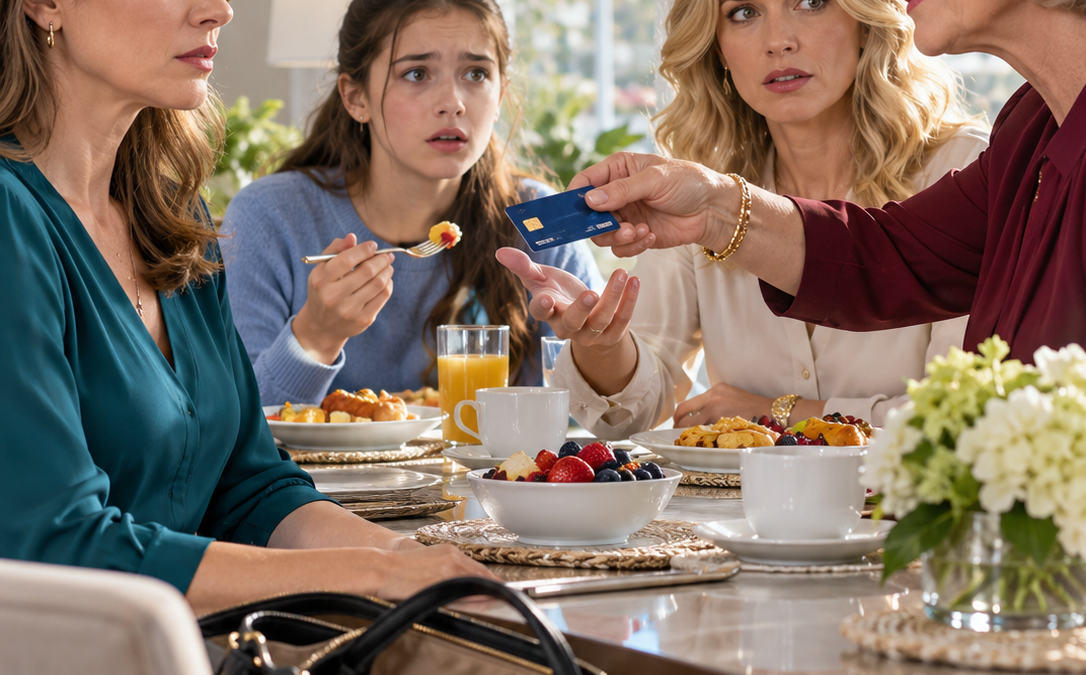
“Sweetie, use your sister’s card. She’s got $90,000 saved for the kids’ college.”
Mom pulled my card from my purse and handed it across the brunch table to my sister. My fourteen-year-old niece watched it change hands, her fork stopping halfway to her mouth. The woman taking it had left her with me when she was two years old. Mom looked at the girl and smiled. My throat tightened, but I stayed quiet. Haley had already heard enough without having to listen to us argue over what her future was worth.
My sister went straight to a bridal boutique and picked out a $14,000 gown, a tiara, and crystal heels. But when the clerk ran the card, the machine beeped and instructed her to keep it.
“Ma’am, where did you get this?”
If a parent has ever handed something that was yours to the child they favored, tell me in the comments and where you’re listening from. The clerk’s question had an answer, and I was the only one at that brunch table who knew it.
I’m Melissa Grady. I’m thirty-eight, and I work the night shift as charge nurse in the emergency room in Dover, Delaware. My husband, Dan Grady, paves roads for the state. Our son, Noah, is eleven. And Haley Pettit, the girl at that table, has been ours since she was two years old. On paper, she’s ours in every other way, too.
In Dover, where half of Kent County has stood at my mother’s DMV window and the other half sits two pews behind her at Wesley Methodist on State Street, a daughter marrying into Smyrna chicken money isn’t just a wedding. It’s the whole family changing what people call them.
That spring, my sister Courtney Pettit was marrying Evan Schaefer.
Sundays in our house start with batter. I mix it the night before after a shift, so it’s ready when I’m not. Haley flips the pancakes. Noah counts every single one out loud.
“Nineteen. Twenty.”
There’s a blue plate with a chip in the rim that nobody but Haley uses.
On Thursdays at four, Dan drives her to the fence at the Dover High field, and they watch the field hockey team run drills from the parking lot. He started doing that in October, after he found out she’d been walking there by herself. He hasn’t missed a Thursday since.
That spring, she had a flyer for summer hockey camp folded into quarters in her binder. She didn’t know I’d seen it, and she never asked.
Haley knows Courtney is her mother. I’ve told her on every birthday since she was old enough to understand the words. What she also knows is that Evan’s family doesn’t.
In their house, Haley is Melissa’s girl. And the person who built that sentence and kept it standing for twelve years is my mother, Diane Pettit.
Two college accounts sit under those kids’ names. Ninety thousand dollars, give or take, between them. Twelve years of overtime.
No card touches those accounts. Not mine. Not anyone’s.
That Sunday, we were due at my mother’s condo for what she was calling dress day. Courtney’s future mother-in-law, Lorraine Schaefer, would be there.
I found my keys. I found my purse.
There was an old card in the front pocket of my purse that morning, the one I’d meant to cut up Wednesday.
My mother’s condo smelled like coffee and the vanilla candle she lights whenever company comes over. Lorraine sat across from me with her purse in her lap. Courtney reached over and straightened the collar of Haley’s shirt without looking, the way you do something you’ve done a hundred times before.
“I hear you’re standing up with your aunt, sweetheart,” Lorraine said.
“Yes, ma’am,” Haley told her over her eggs.
Mom talked about the gown. Lorraine said something about the florist, and Haley laughed. Her Sunday laugh, the big one that fills our kitchen when Noah starts counting pancakes too fast.
Mom’s eyes went to her.
Then she reached behind my chair, opened my purse, and went through it as though it belonged to her. Her hand came out holding my card.
She passed it across the table to Courtney and said that sentence about Haley’s college money. Then she looked at Haley and smiled.
I’ll tell you now what I knew, so you don’t mistake my silence for weakness.
That card was dead.
And anything I said at that table would have been said over the head of a fourteen-year-old who had just heard what her grandmother thought she was worth.
So I said nothing.
My throat closed around the words. My eggs went cold. The chair beneath me had one short leg, and it rocked whenever I shifted my weight. Haley’s fork stopped, then started again.
“Mom,” Courtney said, and then didn’t finish.
“We’ll just go look,” Lorraine said, already reaching for her keys.
Haley leaned toward me.
“Did Grandma just—”
“Yes,” I said. “Eat.”
Courtney’s hand went to her jacket pocket twice on the way to the car, checking that the card was still there.
I wasn’t in that boutique in Wilmington. What I know about what happened there, I know from two phone calls: the bank’s that afternoon and Lorraine’s the following evening.
The clerk ran the card. The machine instructed her to keep it. She took it into the back, returned without it, and asked my sister where she’d gotten it.
“It’s my sister’s,” Courtney said.
“I’m going to have to keep it, ma’am,” the clerk told her.
And Lorraine Schaefer stood between a tiara and a pair of crystal heels and heard every word.
That afternoon, my phone rang with the bank’s number on the screen.
A card I had reported lost in February had just been presented at a store. The man explained that the merchant had retained it. He wanted to know whether I had given the card to anyone.
“No,” I said.
That was true. I hadn’t given it to anyone. It had been taken.
He asked whether I wanted to file a police report.
I didn’t.
Nothing had been charged, and Courtney was still my sister.
Courtney called six times from the parking lot. The one voicemail she left came out in a single breath.
“Tell them it’s fine. Just call and tell them it’s fine.”
I let the phone ring.
Fine would have been the first lie I told in all of this, and I wasn’t going to start there.
Mom called once the dishes were done.
“The bank made a mistake. You’ll call them tomorrow and clear it up.”
“The card was lost in February, Mom. I reported it then.”
Silence.
I could practically hear her rearranging the facts in her head.
“Then it’s a misunderstanding.”
Lorraine’s call came the next evening. She apologized for standing in a store while my card was taken, which wasn’t hers to apologize for.
Then she said, “We don’t do secrets in this family, so I’ll ask you straight. Did you give Courtney that card?”
“I didn’t give it to anyone,” I said.
She was quiet for a second.
“All right. Thank you for telling me the truth.”
I hung up and thought about my card sitting in the back room of a boutique with my name on it, and about what my sister had called it.
Then I thought about the first word I’d given the bank.
No.
It was the truest word I’d said all day.
I told Haley what had happened that Sunday night at the kitchen table, with the dishes still in the sink. I didn’t soften it. I’ve watched too many families in my emergency room soften things until nobody knows what actually happened.
“Grandma said your college money,” I told her. “Your mom took the card to buy the dress. Nobody spoke up. The card stopped working in February. That’s the only reason it didn’t work.”
She nodded.
Haley nods that way when she’s filing something away to look at later.
Then she asked, “Did I laugh too loud at brunch?”
I had to put my hand flat on the table.
“You laughed exactly right,” I said.
From the stairs came Noah’s voice.
“Haley laughs loud at pancakes, too.”
He’d been listening the way eleven-year-olds listen, with his whole top half hanging over the railing.
Haley almost smiled. It didn’t get all the way there, but it started.
She got up to put her school things away. When she pulled her binder out of her bag to find a worksheet, something slipped loose from the back.
The camp flyer, folded into quarters, slid onto the floor.
She pushed it back into the binder without looking at me.
On Monday, I was ten minutes late picking Haley up from middle school because I’d slept through my alarm.
She wasn’t waiting at the curb.
She was sitting in the front seat of my mother’s car with a dress spread across her lap.
Blue, the color of the bay in August.
When she climbed into my car, she held it as though it might wake up.
“Grandma says Mom wants me to stand next to her,” she told me. “She said at the wedding, and Mrs. Schaefer wants me to, too. And there’s a tiara for the junior bridesmaid, and I have to get it hemmed.”
She looked happy.
Happy in the cautious way of someone who expects to be told no.
I didn’t tell her no. Not in the car.
At home, I hung the dress on her closet door. She lay on her bed looking at it until I turned out the light.
After dinner, my mother called.
She didn’t mention the bank. She’d already rewritten Sunday.
“You embarrassed your sister in front of Lorraine Schaefer,” she said. “So you’ll cover half the dress. Sisters do that. That makes it right.”
“No,” I said.
“Then I’ll handle the dress.”
I heard her breathe in.
“But the girl stands next to her mother,” my mother said. “And that part I’m not pulling.”
The next day, I drove to the spa in Camden where Courtney works and found her on her lunch break out back by the dumpsters, eating a salad.
It was the first time in twelve years I’d gone directly to my sister without going through our mother.
I didn’t bring up the card. I didn’t bring up the bank.
“If Haley stands next to you,” I said, “she stands there as your daughter. You tell Lorraine first.”
Courtney looked across the parking lot.
“After the wedding, Mel. I mean, after, when I’m family. I’ll tell them everything.”
“Then there’s no dress,” I said. “Mine or anybody’s.”
She started to argue, and I raised my hand, not to stop her, but to offer her something.
“Sundays. Nine o’clock. My kitchen. No dress, no wedding, no Mom. You and her, with your real names.”
She was quiet long enough for me to hear the dumpster lid banging in the wind.
Then she said, “Okay.”
And she meant it.
I know what my sister’s okay sounds like when it’s for show. This one wasn’t.
She picked at her salad.
“At least the money helped,” she said. “All these years.”
She said it like a comfort she’d been carrying around in her pocket.
I didn’t ask what she meant. I had one thing to get done that day, and I’d gotten it.
She didn’t tell our mother about our conversation. I knew that because, by the end of the week, nobody had called to yell at me.
Driving back to the hospital, I let myself look at something I don’t usually examine too closely.
I have kept the peace in my family for twenty years by not saying things.
It’s a skill. I’m good at it.
But this time, I was being quiet about something different. I was staying quiet so my sister could get to my kitchen without being talked out of it in the car.
Still, one thing followed me down Route 13 and refused to stay in the back of my mind.
At least the money helped.
She’d said all these years, and I didn’t know what money she meant.
Sunday at nine, my sister stood in my kitchen doorway like a delivery driver waiting for someone to sign for a package.
Haley had already set the blue plate at the empty chair.
Nobody but Haley had ever eaten from that plate.
Courtney didn’t know that.
I did.
Dan pointed toward the chair.
“Sit. You’re blocking the syrup.”
Haley stood at the stove with the spatula. She flipped a pancake, and Noah called out the count.
“Twenty. Twenty-one. Twenty-two.”
Courtney watched her daughter turn pancakes the way you’d watch somebody speak a language you’d never heard before.
“I didn’t know you could flip like that,” she said.
“It’s just wrist,” Haley answered, going red all the way to her ears.
After we ate, Haley brought the camp flyer to the table. She unfolded it, slid it toward Courtney, then pulled it back toward herself before anyone could read it.
“Just looking,” she said.
Later, after Courtney had gone, Haley tried on the blue dress in the kitchen because the light was better there.
Dan held the pins while she folded the hem up to the length she wanted.
A man who lays highways for a living stood in our kitchen holding a mouthful of straight pins, saying nothing, his hands steady as a table.
There was a pocket sewn into the lining.
I found a receipt inside it while checking the seams.
A children’s boutique up in Newark. January.
Courtney’s name on it.
Her own money.
Size fourteen, girls.
She had bought that dress for her daughter two months before the card incident.
Before our mother had anything to work with, Courtney had wanted Haley standing beside her. Before there was any way to make it happen, she’d already bought the dress.
At bedtime, I sat on the end of Haley’s bed and told her about the receipt.
“Your mom wanted you there,” I said. “From before the card. Before any of this.”
I watched her take that in.
Then I gave her the rest of it, because she’s fourteen, not four.
Wanting is one thing. Mothering is another.
And we’d watch for the second one, one Sunday at a time.
Courtney let it slip, though not on purpose.
Our mother asked where she’d been Sunday morning, and my sister has always been a bad liar before coffee.
Mom didn’t call me.
She moved the field.
A text went to Haley instead.
Dress day at Grandma’s condo. Saturday. All the bridesmaids. Mrs. Schaefer stopping by to see. Bring your dress.
I thought about it for one night.
If I went, I’d be walking straight into the room I’d promised myself I’d stay out of. If I didn’t, a fourteen-year-old girl would be standing in that room with two adults who had reasons to make her say things.
I went.
Not because I’d changed my mind about the room, but because Haley would be in it.
Lorraine called the day before, friendlier than she’d been previously, the way people become friendly when they’ve decided you’re not the problem.
She told me why her family doesn’t keep secrets.
Her first husband had a child in Salisbury she hadn’t known about for ten years. She found out at a funeral.
“I told your mother the same thing over coffee,” she said. “I’m not telling either of you for sympathy. I’m telling you so you know what I can’t live with.”
I thanked her.
I didn’t tell her anything.
It wasn’t mine to tell.
Later that day, Haley put on the dress in her room and came looking for me barefoot, with the hem pinned.
“Should I say I’m your daughter if they ask?”
I didn’t write her a line.
I’ve seen what happens to children who get handed lines.
“You say what’s true,” I told her. “If it gets hard, I’m there.”
On Saturday, Dan drove.
My mother’s condo is in one of those brick buildings off Route 8 with the flags out front.
He parked at the curb, turned off the engine, and didn’t reach for his door.
“I’ll be in the truck,” he said.
Which is the longest promise Dan knows how to make.
Lorraine was already sitting on the sofa when we came in, her coat still on. The bridesmaids’ dresses were draped across the backs of the dining chairs like people who had fainted.
Haley went into the bedroom and came out wearing her blue dress.
My mother clapped twice.
Courtney’s face did something I couldn’t read.
Lorraine smiled at Haley.
“And you’re Melissa’s?”
Before Haley could open her mouth, I answered.
“Haley’s been ours for twelve years.”
True.
Not one word more than true.
Lorraine turned toward my sister.
“You seem fond of her.”
“My niece,” Courtney said.
Two words.
Haley stood in the dress her mother had bought her and heard that same mother call her something else.
Her hands dropped to the pinned hem and held on.
I didn’t let her stand there another second.
“Haley,” I said, “come help me with the car.”
She came.
I rested a hand on her shoulder, not her hand.
She’s fourteen.
We walked past the fainted dresses and down the stairs. Nobody stopped us, because nobody could think of a reason that would sound right if spoken aloud.
Dan saw Haley’s face through the windshield and reached across the seat to push open the passenger door.
I crouched beside the open truck door.
“You never have to stay in a room where they call you something you’re not,” I told her. “I’ll get you out every time.”
“I didn’t say anything wrong.”
“You didn’t say anything. That’s the point.”
Dan reached over and turned the radio on low, which is what he does instead of hugging people in parking lots.
Haley put her feet on the dashboard, something he lets her do exactly nowhere else.
Then I went back inside with my hands empty and one sentence ready.
I walked past the dresses into my mother’s kitchen, and Courtney followed because she knew I’d wait there until she did.
I’d thought about giving her a deadline while climbing the stairs. Then I decided a deadline was the sort of thing my mother would do.
“Next time she’s asked,” I said, “I won’t answer for her, and I won’t let her answer with a lie. She says her own name, or she walks out with me. Either way, people will see. I’m not giving you a deadline. Whoever asks next is.”
“You’re forcing me,” my sister said.
“I’m not lying,” I answered. “There’s a difference.”
My mother appeared in the kitchen doorway and flicked her hand at us.
The little wave she uses to send waiters away.
Behind her, in the living room, Lorraine was watching me through the doorway.
Not unkindly. Just taking something in and putting it somewhere.
I collected Haley’s school shoes from beneath the dining table. Courtney picked up the hanger the blue dress had come on and held it out to me as though it were the reason I’d returned.
On the drive home, I understood what I’d just paid.
I’d allowed Lorraine to start wondering. Not by telling her anything, but by telling her nothing in a way a woman like Lorraine could hear.
And she’d heard it.
Lorraine had looked at me one second longer than a polite woman needed to.
“You’re confusing the girl,” my mother told Courtney that week.
I know because Courtney told me later, and because my sister went quiet afterward.
No text. No call.
“Sundays are with me,” Mom had said. “Until the wedding, at least.”
On Sunday, the batter was waiting in the refrigerator.
Haley stood at the front window by eight-thirty with her hair brushed and her shoes on.
Noah made a stack of pancakes himself, even though there was nobody to count for. The stack went cold on the plate.
“Zero,” he said eventually, to no one.
At ten, Haley left the window.
She didn’t say anything about it.
Instead, she turned on the hot water and washed every dish in the sink, the breakfast dishes and the ones left from the night before.
She dried them.
She wiped the counter in long strokes, then the stove, then the front of the refrigerator.
She put the cold stack of pancakes in the microwave and took it out again without turning it on.
Dan stood in the kitchen doorway with his coffee.
He didn’t come in.
He didn’t go out.
A man who moves tons of asphalt for a living stood trapped between two rooms by a sponge.
I watched my niece’s hands working, and I knew what I was looking at.
A child making herself useful so she’d get to keep her place.
I’d seen that child before.
In 2014, after my sister left, I stood at my mother’s sink and washed dishes for an hour so Mom would see that I could handle it.
So she’d see I was the one who could handle things.
Nobody came for that Sunday either.
The last thing Haley picked up was the blue plate, which hadn’t been used.
“I’ll keep it clean so Mom sees it next week,” she said.
Then she dried the blue plate, too.
I sat down on the floor beside the dishwasher, where she was kneeling to put the pans away.
I didn’t take the pan from her.
“Your mom chose not to come today,” I said. “That’s hers. That’s not yours. You don’t clean a kitchen so somebody will come.”
“I laughed too loud at the dress thing,” she said. “Saturday.”
I heard what she was saying.
“You laughed? That’s all you did.”
She put the pan away and lined its handle up with the other handles.
Then she wiped the handle she’d just touched.
And then she asked me the question that had been hiding underneath all her other questions.
“If she never comes back, do I still get to be hers?”
I made myself answer the part I could answer.
“You’re hers. Whether she gets to be yours is on her.”
Dan came in carrying three forks.
He took the cold stack of pancakes to the counter, and the three of us ate standing up.
No plates, because the stove was clean and nobody wanted to be the one to dirty it.
Noah came in, leaned against the counter, and took the last pancake.
We ate them cold, right there, and nobody wiped down the counter afterward.
I gave up my Sunday shifts for the rest of the spring.
The shifts that paid more.
I told the scheduler it was a family thing, which is the only sentence a scheduler accepts without asking a follow-up question.
Whatever Sundays turned into, I was going to be awake for every one of them.
Dan kept Thursday at four.
The truck. The fence.
He didn’t bring up Sunday, and neither did Haley.
They stood in the parking lot and watched the Dover High girls run drills in the cold, sticks knocking together and a coach blowing short blasts on a whistle.
“Those girls don’t look like they’re scared of anything,” Haley said into her scarf.
“Nope,” Dan answered.
That was the whole conversation.
He reported it to me later the way he reports the weather.
He also told me she’d stood there past five, after the drills had ended, until the field lights came on.
A text arrived, not from Courtney but through our mother, in our mother’s spelling.
Court is slammed with dress stuff. Next Sunday for sure.
I read it twice and didn’t answer.
In bed, Dan asked what I was going to do.
I told him the only thing I’d managed to work out.
“I’m not going to be the wall between them,” I said. “And I’m not going to be the floor she stands on to leave.”
He thought about that.
“Which one’s harder?”
“The second.”
The wedding was a month away.
Mom called with instructions instead of a question.
“After church Sunday, the lawn behind the fellowship hall. Lorraine will be there. Bring the girl.”
I said we’d come.
Haley wanted to see her mother, and I had a rule now. The rule only worked if I was in the room.
Dan turned off his lamp.
He had one more thing to say.
“Thursday’s Thursday.”
And that was the whole sermon.
The lawn behind Wesley Methodist is where Dover does its real business after the service.
Mom had Lorraine by the elbow before the last hymn was finished. Courtney stood at our mother’s shoulder.
Haley and Noah were twenty feet away by the azaleas.
Close enough.
I stayed close enough, too.
Lorraine asked her question gently. She’d been carrying it since the condo.
“Haley is Melissa’s, yes? Only she has Courtney’s hands.”
My mother didn’t blink.
I watched her build the answer on the spot, using the same voice she’d used at the DMV window for people who came in with sad stories.
The girl’s mother was family, she explained. A cousin’s daughter down in Salisbury. The resemblance ran right through the family.
“She passed when the baby was two.”
A small shake of the head.
“Melissa gets emotional about it. We don’t bring it up.”
She had taken the one story Lorraine had told us about herself and used it as a key.
Over by the azaleas, Haley had gone still, the way children go still when they’ve heard something they weren’t supposed to hear.
Then my mother turned toward her granddaughter and raised her voice so the words would carry.
“Grandma loving you, sweetheart, that depends on you being good at the wedding.”
I don’t argue on church lawns.
I put a hand on each child and walked us toward the car.
Courtney stayed beside our mother, looking down at the grass.
The next night, she would be the one standing at my door.
When I got home from dropping Noah at practice, Haley’s bedroom door was closed.
I knocked and went in anyway, because some doors are shut so you’ll come in.
She was sitting on her bed with her shoes still on.
“You let her say my mom’s dead,” she said, not loudly. “You could have told them. You were right there.”
I sat on the edge of her bed.
I didn’t tell her about rules or rooms or Lorraine.
“It’s not mine to say,” I told her. “It’s yours and it’s your mother’s. If you want to say it, I’ll stand next to you while you do. But if I say it for you, you become the thing they found out. I won’t make you the secret.”
She stared at the ceiling.
“I already am,” she said.
I didn’t try to fix that with a sentence.
There wasn’t one.
I got off the bed and sat on the floor with my back against her dresser. I let the truth of what she’d said sit there in the room with us, because it was true.
After a while, I said the other thing, the thing my mother had said on the lawn, because it needed answering before Haley went to sleep.
“Grown-ups break things, and grown-ups fix them. Nobody borrows you for the fixing, and nobody makes love into a condition for you. Not Grandma, not your mom, not me.”
“Then what do I do?”
“You go to school. You go to the fence on Thursday. The rest is ours.”
She didn’t say okay.
She took off her shoes, which was its own answer.
Later, I heard Noah’s feet moving along the hallway carpet.
There was the soft sound of something being set down outside her door, then his footsteps going away again.
A pancake, cold, wrapped in a paper towel.
He didn’t knock.
The house was so quiet I could hear the refrigerator decide to start running.
“I already am,” she’d said.
And I’d sat on her floor and stayed.
The next night, at eleven, somebody knocked on my kitchen door.
Not the front door. The kitchen door, the one family uses.
Courtney stood there without a coat.
Her car was in the driveway with its lights still on.
“Mom told them I’m dead,” my sister said. “She told Lorraine that Haley’s mother is dead.”
I went outside, turned off her headlights, brought her in, and sat her at the kitchen table.
I didn’t decide anything for her.
I didn’t tell her it would all be right, and I didn’t give her a date.
“I’m not going to tell anyone,” I said. “I’m not going to lie to anyone. Haley’s the same. Add those two things together and see what you get.”
“If I tell them, I lose everything.”
“You lose what you built out of lying. What’s left is what’s real. I don’t know how big that is, but I know it’ll stand.”
She lowered her forehead onto the table.
I went to the hall closet and took out the green blanket with the pulled thread.
I’d handed it to her in 2014, the night she left, because she was shaking and I didn’t have anything else to give her.
She’d left it on the porch chair.
I never threw it away.
I never knew why.
I put it over her on the couch.
In the morning, Haley came downstairs in her socks, ready for school, and stopped on the bottom step.
Her mother was sitting at the kitchen table on a Tuesday.
“Hi,” Courtney said.
“Hi,” Haley answered.
Courtney got up, took the milk from the refrigerator, poured a glass, and set it at Haley’s place.
A small thing.
The kind of small thing a mother does without thinking, except Courtney was thinking about every inch of it.
Haley drank the milk.
My sister had slept under the blanket I’d handed her the night she left in 2014. The blanket I’d never thrown away.
On Sunday, Courtney arrived at nine with her hair still wet.
Haley handed her the spatula without a word.
My sister made her first pancake in my kitchen and burned it black on one side.
“Burned ones don’t count,” Noah announced. “That’s the rule.”
“Since when?” Courtney asked.
“Since now.”
Courtney laughed, then looked as though she wasn’t sure she was allowed to.
Dan slid the syrup toward her without saying anything.
In our house, that is permission.
Haley slid the burned pancake onto her own plate without comment and ate it, black side and all.
That is a thing I will remember when I’ve forgotten the rest.
After we ate, Courtney asked Haley to come out onto the porch.
I let the screen door bang shut and stayed at the sink, where I could hear them without being seen listening.
“I’m going to tell Evan,” my sister said. “I don’t know when yet. I have to figure out how, but I’m not letting anybody say your mother’s dead again. Not ever. That’s done.”
Haley didn’t thank her.
She looked at Courtney for a long time, the way she looks at a math problem when she suspects there’s a trick hidden in it.
She didn’t say Mom.
She has never once called Courtney that to her face, and she wasn’t going to start on a porch because of a sentence that still had a hole in it.
Courtney’s hands worked at the hem of her shirt.
She was waiting for the girl to say thank you, or Mom, or anything at all.
The girl didn’t.
I dried the same glass twice at the sink.
I had a name for what my sister had just done.
A promise without a day attached to it.
And I’d heard those before, from the same family, in the same voice.
“Tell Grandma first,” Haley said.
She said it in front of me.
Courtney nodded without moving.
On Monday, the Schaefers’ wedding planner called my cell from a number I didn’t recognize, her voice bright as a bell.
She was confirming the spellings for the place cards because I was listed as the contact for the Grady party.
Table twelve. The kids’ table.
“Haley Grady, niece of the bride,” she read. “G-R-A-D-Y.”
My mother had sent her that list.
Haley’s last name is Pettit.
It has been since the day she was born, and my mother knows perfectly well how to spell it.
“Spell it however you like,” I said. “My family won’t be there under that name.”
The planner said, “Oh.”
Then she told me she’d pass that along.
So we were out.
Dan, Noah, and me.
I’d just taken my family out of my sister’s wedding over a card with a child’s name on it, and I’d do it again before the planner finished saying oh.
At supper, I told Haley.
I told her the part that belonged to her.
“Whether you go is yours,” I said. “If you go, you go with your name, and I’ll be standing outside the door the whole night. If you don’t go, this house still has a Saturday.”
“Can I decide later?”
“Yes.”
From the hallway, Noah said, “We’re not going.”
Dan didn’t look up from the paper.
“We’re going wherever she goes.”
The planner said she’d pass the message along.
By Sunday, half of State Street had heard it.
I know because by the time Dan took Haley to the fence that week, my mother had already made her calls.
At the fence, Dan told me, Haley asked him a question she’d never asked before.
“Is summer busy for you?”
At first, he thought she meant work.
Then he realized she didn’t.
He looked at the girls on the field and the camp banner zip-tied to the far fence, and he put it together.
“Never on Thursdays,” he said.
Sunday, Courtney came at nine again.
Her second Sunday in a row.
She sat and ate and said about one sentence, and the sentence was fine.
After breakfast, we went to church.
I’ve been going to that building since I was baptized in it.
My mother had done her work.
Every woman over sixty on that lawn had heard that Melissa was boycotting her sister’s wedding.
Over money.
Over a card.
The woman who’d taught me my Sunday school verses saw me at the door and turned to study a bulletin board that had nothing on it.
Somebody’s aunt put a hand on Haley’s arm and said, “Poor Diane.”
As though Haley would agree.
Our pew, the one our family has used since my grandmother’s time, had room on either side of us that nobody filled.
The sermon was about honoring your father and mother.
I’m not making that up.
I sat through it.
I didn’t argue in church.
I sang the hymns. Every verse of every one.
Dan kept his hand flat on the pew between us for the entire service.
He didn’t touch me.
His hand was simply there, like a stake you’d drive beside something that might lean.
At home, the kitchen was quiet.
Haley’s phone was lying on the counter where she charges it.
The screen lit up.
A text from my mother.
Haley read it.
She didn’t react, which is how I knew something was wrong.
She set the phone faceup on the counter, carefully, the way you’d set down something you didn’t want to be holding anymore.
“I don’t want to answer it,” she said.
Then she went upstairs.
I looked at the screen she’d left facing me.
Grandma will lose you, and that’s your aunt’s fault.
I read it twice and put the phone down.
“Then don’t,” I told her when she came back. “You don’t owe her an answer. Grown-ups fix what grown-ups break. That’s not a job a fourteen-year-old gets assigned.”
She looked at the screen for a while.
Then she turned off notifications for my mother’s number herself.
She didn’t block it.
That was hers to decide, and she’d decided.
“Okay,” she said.
I didn’t call my mother.
Dan asked whether I was going to, and I told him calling her would only be handing her a stage.
He nodded like a man who’d seen plenty of stages.
The following Sunday, my sister came for the third week straight.
Nine o’clock exactly, as though she’d been parked around the corner waiting for the clock to reach the hour.
Haley let her flip three pancakes.
One burned.
“Doesn’t count,” Noah said.
Courtney laughed.
Haley looked at her mother laughing in her kitchen, then looked away quickly, the way you’d look away from something too bright.
My sister was coming.
She hadn’t told anybody anything yet, but she was coming.
That morning she’d walked in carrying a box of pancake mix under her arm, the kind in the yellow box.
“We have mix,” Dan said.
“I know,” she answered.
Then she set her box beside ours anyway.
That night, with the kids inside, my sister and I sat on the porch in the two chairs that don’t match.
I told her something I’d never told her before.
“In 2014, after you left, Mom said you’d be sending three hundred dollars a month for Haley.”
Courtney turned toward me.
“Nothing ever came,” I said. “Not one month.”
The one time I’d asked our mother about it, she’d said, “I gave you a daughter. You want money, too?”
And I hadn’t asked again.
“Twelve years, Court. I never asked again.”
Courtney stood so quickly her chair shifted beneath her.
“She told me she sent it?”
Her voice went thin.
“I gave her three hundred the first two years. Every month. In cash, because she said you didn’t want to deal with me directly.”
I didn’t move.
“Then she said she’d handle it from her end, and I’d pay her back when I was on my feet. I owed her, Mel. I owe her. I thought I was paying. I thought that was the one thing I was doing right.”
I sat very still.
Across the street, somebody’s sprinkler ticked around in its steady circle.
Our mother had told my sister she was paying for a daughter she never saw.
Our mother had told me my sister didn’t care enough to send a dime.
Twelve years in both directions.
Every time I’d looked at Courtney, I’d thought, She doesn’t even send money.
Every time she’d looked at me, she’d thought, At least the money helps.
“That’s what you meant,” I said. “At the spa.”
She sat back down.
Neither of us cried.
We’re not that kind of family, which may be how things got this far.
“I’m asking her next week,” Courtney said. “In front of you.”
“Ask her for you,” I told her. “Not for me.”
She’d been paying into nothing for twelve years.
I’d been waiting on nothing for twelve.
And we sat there with it.
I spent twelve years believing the wrong story about my own sister. If a parent ever told two different versions of you to two different people, tell me in the comments.
The following week, my mother brought her answer to my kitchen.
During the last week before the wedding, Mom called Courtney every night to tell her to come home and get ready, as though my sister were nine years old and it was the first day of school.
Courtney was sleeping at the condo.
But she kept Sunday.
She stopped by the ER that week to bring me coffee on my break, something she’d never done in her life.
That’s how I properly met Courtney’s fiancé in the hospital parking lot when he came to pick her up.
Evan was tall, with a farmer’s handshake and a way of looking directly at the person he was speaking to.
“Lorraine says you’re good people,” he told me.
“We try,” I said.
On Wednesday, my sister did something she’d never done before.
She told our mother no.
Not about the dress.
About the words.
Haley would not be rehearsing “Aunt Court” for the rehearsal dinner.
Courtney told me afterward on the phone, half proud and half frightened.
“And Mom just said, ‘Leave it to me.'”
“Leave what to her?”
“I don’t know. She said it like she was being nice.”
I didn’t like that.
I didn’t say so.
At home, Noah had folded a tiara out of printer paper and tape.
Haley wore it while she did her homework, and nobody mentioned the real one sitting in a store in Wilmington.
Dan and I did the math at the sink.
What we’d paid so far.
Sundays. Our pew. My mother, for all practical purposes.
“Still cheaper than the other thing,” Dan said.
Then he put the last pot away.
Haley came downstairs in her paper tiara.
“If I go Saturday,” she asked, “will you really stand outside the whole night?”
“Yes,” I said.
I kept thinking about that morning, before the conversation on the porch, when she’d flipped pancakes as though she were angry at the batter.
Noah had counted thirty that morning, a record, and nobody had mentioned that the wedding was six days away.
On Thursday at four, Dan’s truck was in the parking lot by the field, just as it had been every Thursday since October.
The Dover High girls were running a passing drill, their sticks knocking together while the coach blew short whistles.
Haley stood at the fence with her fingers hooked through the chain links.
She said the first thing she’d ever said to Dan about the wedding.
“If I don’t go, is Saturday still a day?”
Dan watched a girl miss a pass and chase it down.
“Saturday’s pancakes,” he said.
Haley nodded as though that settled something.
I had the night off for once.
I was home with my shoes off when Courtney’s text arrived.
Mom wants to come by tonight. I’m coming with her. I want to see what she’s planning.
I wrote back.
My house. My rules.
A thumbs-up came from my sister.
In our family, that was a signed contract.
I didn’t tell Haley what was coming.
I told her who.
“Grandma’s coming by at seven. Your mom, too.”
“Okay,” she said.
Then she went upstairs to change out of her practice clothes, something she never does for anybody.
Dan put the kettle on, which is what he does when he wants to keep his hands busy.
Noah set the table for five without being asked, then stood looking at the plates and counting.
He took one plate away.
Haley came downstairs and sat in her chair by the window.
She put both hands flat on the table, the way I do when I’m getting ready for a patient I’ve been warned about.
I turned on the porch light.
I checked the clock.
I don’t usually check clocks at home.
At work, I live by them. At home, I’ve always let time go.
That evening, I checked twice.
At seven, two cars pulled into our driveway.
The second was my mother’s.
She came in carrying the blue dress on a hanger like a flag.
It had gone to the condo that week with the rest of the wedding things.
Courtney followed her inside, her keys still in her hand.
Mom draped the dress over a kitchen chair.
Then she took something out of her purse.
A white index card.
She laid it on the table in front of Haley.
Her handwriting.
I’d recognize it from every birthday card I’d received in my life.
Hi, I’m Haley, Melissa’s daughter. Aunt Court is my favorite.
“Read it for Grandma, sweetheart,” she said. “Just once so it’s easy tomorrow.”
Haley opened her mouth.
“No,” I said before she could make a sound. “Not that sentence. Not in this house. Not anywhere.”
My mother’s voice went flat as a counter.
“Then she doesn’t come.”
Haley looked at the card.
She looked at Dan, who had set down the kettle.
She looked at Noah standing in the doorway.
Then she looked at me.
She was in her own kitchen, at her own table, with every person who’d ever held her up standing around her.
“Then I’m not coming,” Haley said.
My mother turned toward Courtney the way you’d hand off a tray.
“Say something to your sister.”
Courtney picked the card up from my table.
She read it to herself twice.
Then she tore it in half.
She placed the two pieces side by side in front of our mother, so the sentence couldn’t be read anymore.
“She comes with her name,” my sister said. “Or I don’t come.”
“You’ll lose Evan.”
“Then I lose him.”
Courtney hadn’t told him yet.
She didn’t know what he’d say.
She said it anyway, in my kitchen, with her daughter watching her say it.
Then she turned toward Haley.
Her voice was different.
Not the voice she used at the spa.
Not the voice she used to apologize.
“You don’t say that sentence,” she told her. “Not for me. Not for her.”
Then she turned back to our mother.
“And you told Lorraine I was dead, with Haley right there by the azaleas. You don’t get to say that again. And the three hundred? We’re going to talk about the three hundred.”
“You both got what you needed,” my mother said. “I got what I was owed.”
Her hand came up and flicked.
That little wave.
Nobody moved for it.
Courtney picked up her keys.
“I’m going to Smyrna,” she told me.
Dan was already at the door.
He opened it for her and held it.
When my mother moved toward the same doorway, he let the door swing gently shut and went back to the kettle.
My mother picked up the dress from the chair.
She stood in my kitchen holding a dress nobody would wear.
And nobody took it from her.
She left the dress on the chair after all.
I don’t know whether she forgot it or decided to leave it.
She went down my front steps alone.
Deep in the night, my phone lit up on the nightstand.
Courtney.
“I told him,” she said. “Everything.”
“He didn’t say anything. He said he needed to walk.”
“Where is he walking?”
That was all she had.
So that was all I had.
I didn’t know how this would end.
I want to say that plainly, because people who tell these stories always seem to know what’s coming.
I didn’t.
I hung up and went downstairs.
I sat at the kitchen table in the dark.
A house makes a particular kind of sound when everyone inside it is asleep.
The refrigerator.
The furnace clicking on.
The kettle Dan had put on and never poured, ticking softly as it cooled.
The blue dress was still hanging over the chair across from me, a shape in the darkness.
Dan came downstairs without turning on the lights.
He sat beside me.
He didn’t ask anything.
He put his hand on the table near mine.
Sixteen years married, and that is still the whole of what he says at that hour.
It’s enough.
Then I heard movement on the stairs.
Haley came down in her sleep shirt and sat on the third step, the place she’d used to sit when she was little and couldn’t sleep.
She’d heard the phone.
She’d probably heard everything through the floor.
“Did she really tear it?” she asked.
“She did.”
A long breath came from the stairs.
“Okay.”
She went back up.
I listened until I heard her bedroom door.
Then I stood, took the blue dress from the chair, carried it upstairs, and hung it in her closet beside her school clothes.
Nobody had to tell me to do it.
I didn’t sleep.
At six, my phone lit up with Evan’s name.
Not Courtney’s.
Evan, calling at six in the morning, sounded like a man who’d walked a long way.
“I’m calling the rehearsal off,” he said. “I’m keeping the dinner. Just family at the house. I’d like Haley there.”
A pause.
“As Courtney’s daughter, if she wants to come.”
He didn’t say anything about Saturday.
I noticed that he didn’t.
I didn’t ask.
I carried his words upstairs exactly as he’d spoken them, adding nothing, and set them in front of Haley like a plate.
She thought about it for the length of a glass of orange juice.
“I’ll go,” she said. “But not in the dress. Not for this one.”
She wore her own clothes.
Her good jeans and the top she’d bought with babysitting money.
Dan put on the shirt he wears to funerals and weddings because it’s the only one he owns with a collar.
“Shoes,” he said to Noah, who was standing there in socks.
We drove out to Bowers Beach that evening with the windows down and the bay smelling of salt and mud.
The Schaefers’ house sits up on pilings with a deck wrapped around three sides.
I’d never been there before.
I walked up the steps, feeling the wide boards beneath my feet, solid and dry.
And I noticed something.
I wasn’t bracing.
For the first time on that family’s ground, I wasn’t bracing.
Lorraine met us at the top of the stairs.
She didn’t look at me first.
She looked at Haley.
“I’m glad you came,” she told her.
Inside, a long table had been set for too few people.
There were a lot of chairs pushed back against the wall where a rehearsal dinner would have been.
Courtney was already seated.
She had cried, and she was finished crying, and her hands were folded in front of her like a student’s.
My mother sat at the far end in her good blue suit, as though nothing had happened the night before.
Because in her version, nothing had.
Evan stood at the head of the table.
He didn’t pick up his glass.
Courtney stood before he could speak.
“Haley is my daughter,” she said.
The room stopped.
Nobody reached for a glass.
“My sister raised her because I didn’t. I lied to every one of you. I asked my sister to lie with me. She wouldn’t.”
Then she sat down.
Her hands lay flat on the table.
Evan looked at her, then at the table.
“There’s no wedding tomorrow,” he said.
“I’m not calling it off. I’m putting it off. I’ll marry Courtney when Haley is used to being called her daughter. Not tonight. Not tomorrow.”
My mother started to speak.
“We can—”
“Diane.”
Lorraine Schaefer said her name the way you set down a glass.
“The cousin in Salisbury. Who was she?”
Diane Pettit, who had run a DMV window for most of her adult life, opened her mouth.
Nothing came out.
Haley sat beside me.
She didn’t have to say a thing.
Courtney reached across the table and touched her sleeve.
“You don’t have to say anything,” she told her. “That’s mine.”
My mother’s hand rose to wave the matter away.
For once, the air didn’t move.
Sunday morning, Haley set the blue plate at her own place before anybody else was awake.
Her place.
Her plate.
She didn’t make a thing of it.
Courtney arrived at nine.
Evan didn’t.
Not yet.
Half an hour later, my mother’s car pulled into the driveway.
She came into my kitchen without knocking and without apologizing, which, with her, are practically the same thing.
She had a plan.
She always has a plan.
It’s what people mistake for strength.
“Here’s what we do,” she said. “I’ll tell Lorraine I made up the Salisbury story to protect the girl’s privacy. Adoption records. People understand that. I’ll say Courtney came forward because I told her to. We move the wedding to August. Until then, the girl stays out of the Schaefers’ pictures, just until it settles.”
She looked at Courtney first.
Courtney had always been the first to fold.
“No,” Courtney said.
My mother looked at Haley.
Haley had always been good.
“No,” Haley said.
Then she looked at me.
I didn’t say anything.
I slid a folder across the table.
Twelve years of bank statements.
A page for every month.
Not one deposit from our mother on any of them.
A charge nurse charts everything.
“Melissa,” my mother said. “Say something.”
I had.
It was in the folder.
Dan went to the door, opened it, and stood beside it.
The way he’d stood in the truck.
The way he’d stood in the kitchen doorway with his coffee.
Not pushing.
Just there.
My mother looked at the folder.
Then at the four of us.
Then at the open door.
She walked through it, down the steps, across the yard, and to her car.
Nobody followed her.
Nobody had to.
Behind me, Noah called out, “Twenty-six,” counting pancakes as though it were any other Sunday.
My mother’s plan hadn’t been taken away from her.
It had simply run out of people.
That afternoon, Courtney asked me for the landlord’s number for the apartment above the bakery on Loockerman Street.
June moved quickly, and it moved on time.
Courtney signed a lease for the one-bedroom apartment over the bakery and carried her own boxes up the back stairs.
Real rent, for the first time in her life.
She went to the pastor at Wesley and told him the whole thing in his office.
The Salisbury story included.
She told the woman who owned the spa, the woman Lorraine had introduced her to.
She told every person who had been handed our mother’s story.
One at a time.
With her own mouth.
The gown went back to the store in Wilmington.
The deposit my mother had put down to handle the dress stayed there in the store’s account under her name.
The middle school held eighth-grade promotion in the gym, with the bleachers pulled out.
Courtney came.
She sat where Haley told her to sit, four rows back.
Not with us.
Not far away.
When the teacher collecting names at the door asked, “And you are?” my sister answered, “Haley’s mother.”
Haley, standing in line in her cap, didn’t turn around.
But her ears went red all the way to the tips.
There had never been a debt to our mother.
Courtney stopped carrying one.
Soon afterward, an envelope appeared on my kitchen counter.
Three hundred dollars in cash.
A sticky note in my sister’s handwriting was attached to it.
Nothing on the note but the month.
The next morning, I took the money to the bank and deposited it in Haley’s account myself.
At Wesley, my mother still sat with the retired ladies.
But those ladies had now heard who Haley’s mother was from two different people who’d attended the promotion ceremony.
They had questions for Diane about that cousin in Salisbury.
She didn’t have an answer.
And the question followed her up and down the pew.
Courtney didn’t come every Sunday anymore.
She came on the Sundays when she was invited.
Nine o’clock every time.
Never nine-oh-five.
Dan came home that Friday carrying a long box from the sporting goods store on Route 13.
He set it on the kitchen table and stepped back as though it might go off.
Haley opened it.
Inside was a field hockey stick.
Composite.
The good kind.
Her name was burned into the grip.
Taped inside the lid were a receipt for summer camp, paid in full, and a flyer folded into quarters.
The flyer she’d thought was still in her binder.
“I didn’t ask,” she said.
“You don’t have to,” Dan answered. “I saw you at that fence thirty-five Thursdays.”
I’d planned to let him have the moment.
I didn’t manage it.
“You’re not here because you’re good,” I said.
My voice didn’t hold steady on the word good.
It just didn’t.
“You’re here because you’re ours. You can laugh as loud as you want in every room of this house.”
Haley cried.
Not the quiet kind she’d taught herself.
The other kind.
The kind that takes over your whole face.
Noah handed her a paper towel.
“One,” he said.
She laughed through her tears.
“Two,” he announced.
Relief.
That’s what it was.
Plain for all of us.
And it looked like a child sitting at the kitchen table with a hockey stick across her lap and pancake batter still on the stove.
Nothing about the wedding had been decided.
The blue dress was still hanging in Haley’s closet.
None of that touched the thing we’d just settled at the table.
She had a place here that she’d never had to earn.
She cried the way children cry when nobody is asking them to stop.
In July, Haley said, “I don’t want to see Mom this week.”
So Courtney didn’t come.
She didn’t text.
She didn’t send a cake up the back stairs or a message through Noah.
Sunday came and went without her, and nobody said her name.
The next week, Haley said, “She can come.”
And Courtney came.
That’s the whole test, if you want to know what it is.
Not the showing up.
The not showing up when you’re told not to.
In August, Haley made the junior varsity team at Dover High on her first try.
The first scrimmage was on a Saturday.
The night before, she told me, “Mom can come. And Evan, if he wants.”
She told them exactly where to sit.
At the end of the bleachers by the equipment shed.
They sat there.
Evan brought nothing and said nothing.
At the end of the scrimmage, he walked over to the fence.
“I’m Evan,” he told Haley. “I’m the guy who’s waiting.”
“Okay,” Haley said.
Then she went to get on the bus.
Courtney and Evan picked a date in the spring.
That was theirs to pick, and they picked it.
Haley sent my mother a birthday card.
That was hers to send.
She sent one card.
Nothing inside but her name.
My mother called me once that fall.
She wanted to talk about repairing things.
“Repair them with Courtney,” I said. “Not through me.”
I’d learned the very thing I was supposed to have been teaching.
You can love somebody and still put your hand up.
The child had taught me that beside a sink with a sponge.
Once the season started, I watched from the far side of the field.
Dan brought his folding chair out of the truck bed and sat with his arms crossed the same way they’d been crossed all winter.
He stood in the same parking lot he’d stood in every Thursday.
Except now, the girl on the field was ours.
October tenth fell on a Saturday.
Haley turned fifteen with a home game.
She played center mid.
We stood at the same fence.
Dan with his arms folded.
Noah holding a scoreboard he’d made from a pizza box and a marker.
Me in the clothes I’d worn through an entire night shift.
At the far end of the bleachers, the end she’d pointed out, Courtney and Evan sat with their hands in their laps.
On time.
No flowers.
She’d said no flowers.
Haley looked up at them once during the first half.
She didn’t wave.
She went straight back to the ball.
At halftime, she jogged over to our fence with her hair stuck to her forehead.
Dan handed her water through the chain links.
I had something I’d been carrying since March, and I said it there, through that same fence.
“I stayed quiet at that brunch because I thought quiet kept the peace,” I told her. “It didn’t. It just kept you small. I’m not doing that again.”
She drank.
Then she wiped her mouth with the back of her hand.
“I know,” she said. “You went back in there for me.”
Then she ran back onto the field.
After the game, Haley asked for pancakes at home instead of going to a restaurant.
And then she asked for something else.
The something else came out at our kitchen table that afternoon, once the stove was going.
Sunday pancakes on a Saturday, because it was her birthday and that was her call.
The blue plate sat at her place, its chipped rim turned toward the window.
Haley flipped.
Noah counted.
Courtney stood in the doorway with a cake from the bakery beneath her apartment.
She’d been invited, and she came inside when Haley nodded.
Evan had stayed in the car.
“He says next time,” Courtney said. “If that’s okay.”
“Okay,” Haley answered.
She flipped another pancake.
“Twenty-nine,” Noah said. “That’s a new record.”
It wasn’t.
He knew it wasn’t.
He said it anyway.
Haley put down the spatula and turned toward all of us at the table.
At first, she didn’t look up.
“There’s a club trip to Philadelphia in November,” she said. “I signed up already. It’s two hundred dollars.”
Then she raised her eyes.
“Can I?”
Not, Is that too much?
Not, I can pay it back from babysitting.
Just the question a child asks her parents.
“Yes,” Dan said.
“Yes,” I said.
She didn’t thank us three times.
She said it once and went back to the stove.
The blue dress is still in her closet.
There’s a date in the spring that belongs to my sister and the man who waited.
And the dress doesn’t have to answer to it yet.
Maybe Haley will wear it.
Maybe she won’t.
The thing that mattered was settled at this table in June, long before the dress ever had to decide anything.
I ate everything on my plate.
I was full for the first time in months, and I knew it as it happened.
The house was loud.
Then all of us went quiet at the same time, chewing, and the quiet was something we were doing together.
My feet were flat on my own kitchen floor.
If someone once made you feel that you had to be useful, or quiet, or smaller just to keep your seat at a family table, tell me about it in the comments.
I read every one, usually at that same table.
And if this story earned a place with you, liking and subscribing helps it find the next family that needs it.
A child doesn’t have to earn a place at the table.
The table is what you set before she asks.
The blue plate is in my hands.
I’m rinsing it.
And Noah is already counting the next one.








