“Stop being a leech and get a real job!” Dad yelled in my own kitchen while my sister snickered, “She’s always been a burden.” I’d taken them in six years earlier when he lost everything, so I closed my laptop and said, “You have 30 days to move out, Dad.” He laughed—until the doorbell rang at 8 the next morning…
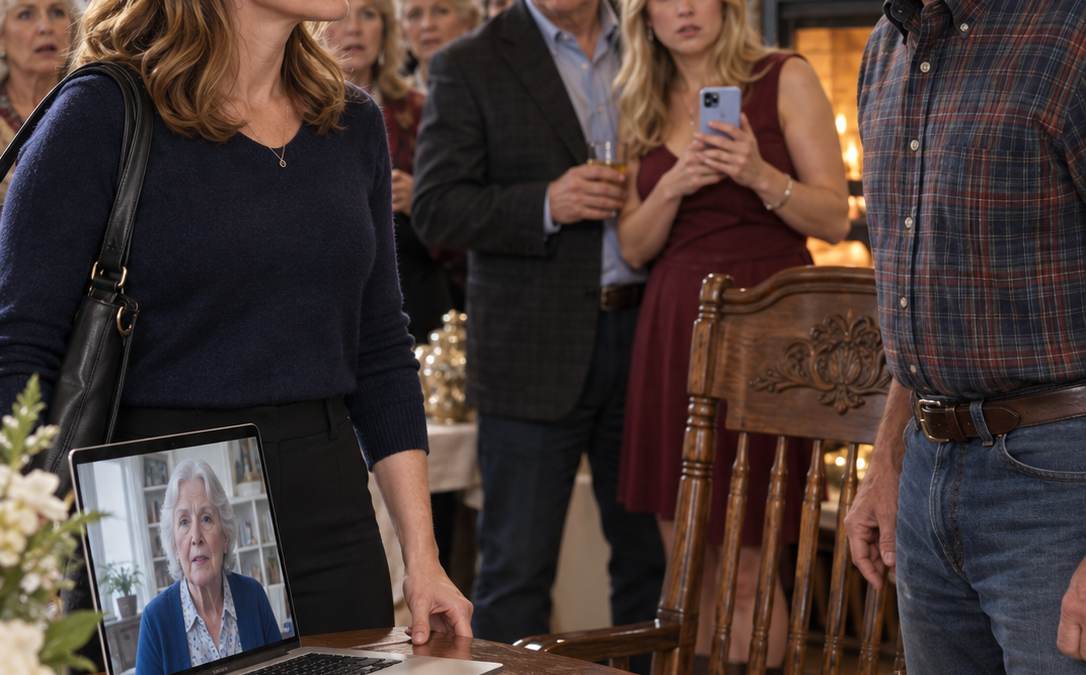
My name’s Hannah Ericson. I’m 39. I was working on my laptop at my own kitchen table when my father yelled, “Stop being a leech and get a real job.”
He wanted my work off his table.
My sister snickered behind her phone. “She’s always been a burden.”
I’d taken them both in six years earlier, when my father lost everything. The work he was dismissing paid the mortgage, the fuel, and the groceries for all three of us. I could have listed every bill.
Instead, I closed my laptop.
It made a small sound.
“You have 30 days to move out, Dad.”
He laughed until he had to sit down.
I let him.
Tell me where you’re listening from tonight, and I’ll tell you why I let my father laugh.
The chair he dropped into was the one at the head of the table, my grandfather’s, and he laughed in it until he had to wipe his eyes with the heel of his hand.
From that kitchen window, you can see our colony barn against Pioneer Peak. And in Palmer, people still ask which tract your family drew in 1935 before they ask what you do for a living.
My father, Gordon Ericson—Gord to everyone in the valley—has never once had to answer the second question.
“Thirty days,” he said when he had his breath back. “I’ve got a man coming Thursday to look at this kitchen, and you’re telling me 30 days?”
“Thirty days, Dad.”
That was all I said. I said it once.
He turned to my sister, Jenna, as if I had left the room.
“You hear her? In my mother’s house. At my table.”
He slapped the wood flat-handed the way you slap the side of a truck that’s loaded and ready to go.
“There isn’t a soul in this valley who’d carry my bags out that door. Not one.”
“She’ll have it on a spreadsheet by morning,” Jenna said. She was already looking at her phone. “She gets like this.”
My father told her, “She’ll be fine by breakfast.”
I rinsed my cup. Only mine. I dried it, put it away, and carried the laptop upstairs under my arm.
His laughing followed me up the stairs like a dog that knows the house.
In my room, I opened the laptop again. There was an email still on the screen, one I had typed that afternoon and not sent.
I read it through once.
Then I deleted it.
For six years before that night, every time my father laughed at me, I gave ground. I lowered my voice, or I found something that needed doing in another room. He had every reason to believe the laugh would work again.
It always had.
I set one alarm for 7:30, and I slept better than I had in six years.
The alarm never had much to do. I was dressed and standing in the upstairs hall, listening to my father move around my kitchen, when the doorbell rang at 8:00.
It was still full dark, the way it is here in deep winter, and six below zero.
He went to answer it himself in his robe, carrying coffee from my pot. The way a man answers his own door.
I think he expected one of his friends had come to take him to breakfast.
Two men stood on the porch in moving-company jackets. The older one held a clipboard.
“Morning. Ericson move. Pickup March 6th. It’s prepaid.”
My father looked at the clipboard.
Then he looked past the man’s shoulder at the truck idling in the dark with the company’s name on its side.
“There’s some mistake,” he said.
“We just walk through today and tag what’s going. Which rooms are Mr. Ericson’s, sir?”
I came down the last three stairs and stepped past my father. I had an envelope in my hand, and I put it in his right there on the threshold, with the cold coming in around our ankles.
Then I answered the foreman.
“Upstairs. The two rooms on the left and the office.”
“Yes, ma’am.”
They wiped their boots and went up.
My father stopped laughing somewhere between the word prepaid and the date.
He stood in the mudroom holding that envelope for a long while before he opened it.
While he does, I owe you an explanation for the two movers, because I had not lost my temper the night before.
I had only stopped.
Two weeks earlier, I came home from town and found a stranger in my kitchen with a tape measure, writing down the length of my counters.
My father was leaning in the doorway with his arms folded.
“Just getting numbers,” he said. “Don’t get wound up.”
I didn’t get wound up.
I drove back into Palmer that afternoon to the law office that had drawn up my grandmother’s papers when she sold me the house.
The lawyer there now is Paige Novak. She listened for ten minutes and asked me one question.
“You want it fast, or you want it clean?”
“Clean.”
So Paige drew up a 30-day notice, and I hired a moving company and paid them in advance.
Then, for two weeks, I did nothing.
The notice stayed in my bag.
I cooked his supper.
On the last afternoon, I had an email typed to the movers canceling all of it.
That was the email on my screen when he called me a leech. I closed the laptop on it.
And upstairs, I deleted it.
That is the whole secret.
I was one click away from backing down again.
In the mudroom, my father read the notice twice. He did not shout. His face went still and cold instead, the way a pond skins over, and he took out his phone and called his brother.
My uncle Ray.
I called Paige from the porch. She gave me the rule for the next 30 days.
“From today, everything in writing. And you don’t argue in that kitchen.”
Through the door, I could hear my father. He kept his voice low. Short words, no speeches.
He canceled the man who was coming Thursday.
The last thing I heard him say into the phone was, “And nobody tells the Harlands.”
Before the Harlands, there is the house.
And the house starts at that same kitchen table in June of 2017, with a pen in my grandmother’s hand.
Alma Ericson was my father’s mother. She was 81 that summer, and she had decided something.
“I’m selling it, not giving it,” she said. “There’s a difference, and one day you’ll need it.”
She had the number written on the back of a seed envelope.
$310,000.
The appraiser’s figure.
“Not a penny under,” she said. “So nobody can say I gave it to you.”
The money was for her own care. She meant to grow old in her own rooms, with a nurse she paid for herself, and not in anybody’s spare bedroom.
“Grandma, Dad’s going to—”
“Your father’s had what he’s getting.”
She kept the pen.
She didn’t explain, and I didn’t ask.
Twice that month, her neighbor from the next tract over, Lois Bergstrom, drove her into Palmer to the lawyer’s office.
And both times, my grandmother told me to stay home.
So I borrowed from the bank and bought the house I had grown up visiting.
I moved in. I set my desk in her sewing room under the window and went on doing what I do.
I’m a title examiner.
Before a house is sold, somebody has to read every deed ever recorded on it and say whether the seller truly owns what he’s selling.
I’m that somebody, and I do it from a laptop.
My grandmother liked to stand in the sewing-room doorway with her coffee and watch. Once, she said she knew what it took to make a house pay for itself. She mentioned the years she’d had boarders upstairs, and then she changed the subject.
My father called my work typing.
My grandmother died two springs later, in her own bed, with the nurse she had hired.
But there was an afternoon before that when I had three county records open at once and she had been watching for an hour.
She tapped my laptop lid twice, like knocking on a door, and said, “That is a real job.”
The deed had been in my name for almost three years, and the sewing room had been my office just as long, when my father’s pickup came up the drive the winter after she died.
The bank had taken his excavating company that winter. It took the 35 acres around this house, the last of the family’s fields, and it took his own house in town.
What he had left fit in the bed of that truck, with my sister riding beside him.
“Just till breakup, Hannie,” he said on the porch.
Breakup is what we call the thaw up here, when the river ice goes out.
I thought he meant April.
Jenna walked past me.
“What’s the Wi-Fi password?”
“It’s on the fridge.”
I made supper that first night.
When I carried it in, my father had already sat down at the head of the table in my grandfather’s chair.
My grandfather died before I could walk.
My grandmother dusted that chair every week and never sat anyone in it.
I stood there with the dish in my hands.
Then I pulled out the side chair and sat.
I believed that being useful was something people kept a record of. That somewhere, it was being written down in my favor.
Nobody had sat in that chair for 32 years, and I am the one who let him.
Breakup came six times, and he was still in that chair.
I read files for a living.
This is how that one reads.
The fuel. The groceries. The insurance on my father’s truck. The mortgage on rooms I no longer had the use of.
Set against what I would have spent alone, it came to about $1,150 a month.
Over 72 months, that is $82,800.
My father had Social Security by then.
It went to his truck and to what he called expenses.
My sister worked summers at a lodge and winters not at all and paid nothing.
A year in, he needed the sewing room.
“A man needs an office,” he said. “You can do that typing anywhere.”
So my desk went to the kitchen table, and his recliner went under my grandmother’s window.
I carried the monitor down myself.
That same year, he put his own name on my heating-fuel account as the person to call.
I found out when I phoned about a delivery.
“Mr. Ericson said to route the calls to him,” the dispatcher told me.
He had told them a company likes to have a man to talk to.
I let that stand too.
In six years, I never once said no, and I can’t bill that part to anyone else.
There is one more line in this file, and I’ll ask you to hold on to it.
When I bought the house, I read its whole history, the way I would for a stranger.
In 1991, there was a mortgage on it in my grandmother’s name.
In 2002, it was paid off and released.
An old loan. Long settled.
I skimmed past it.
The family thinned out in those years. I still worked the sign-in table every winter at the supper for the old colony families, the ones whose grandparents drew land here.
But nobody saved me a seat at the Ericson table anymore.
The Christmas card stopped in 2021.
And I told myself the valley was just getting older.
So that is whose name was on the fuel account and whose desk was in the kitchen the week I handed my father 30 days.
He didn’t yell again.
What he did the first morning was walk to the thermostat in the hall and turn it to 78.
Then he left it there.
Seventy-eight degrees in a farmhouse in February, on oil I was buying.
The heat came up through the old floor registers until the kitchen windows ran.
He took my grandfather’s chair and talked loudly to Jenna across my work.
What they would do with this kitchen. Where they would put the new stove.
“She’ll come around,” he told her. “She always does.”
Jenna propped her phone against the sugar bowl and filmed me working.
I turned the thermostat down once.
Within the hour, it was back at 78, so I stopped touching it.
I bought a small notebook instead, and every morning I wrote down the number on the dial, the date, and the time.
I did not turn it to 90 to spite him.
I wrote things down.
It is what I know how to do.
I didn’t answer either of them.
On the third night, Jenna was putting the milk away.
She said it to the refrigerator, not to me.
“Wait till everybody hears what you did to Grandma.”
I found out what she meant on Saturday, in the frozen aisle of the grocery store in Palmer, with my hand on a bag of peas.
“Hannah. Oh, hon.”
It was my father’s cousin, Marcy Lond.
She had her coat buttoned to the chin, and she put her hand on my sleeve and left it there.
“I just want you to know,” Marcy said. “Whatever happened with Alma’s signature, family forgives.”
The glass door of the freezer was fogging where I held it open.
I let it close.
“Say that again, Marcy. Slowly.”
“Now, I’m not judging. Gord’s been so good about it. All these years, he never wanted it to get around.”
“Wanted what to get around?”
Her hand tightened on my sleeve.
Then she told me.
And she got quieter with every sentence, the way a person does when she hears herself walking somewhere she can’t walk back from.
For six years, my father had been telling the family that his mother wasn’t right in her mind when she signed that house over to me.
That I did that kind of paperwork for a living, so I knew how to get it done.
That I got the place for half what it was worth.
And that he—Gord—was letting me stay on in the house quietly so the Ericsons wouldn’t have a scandal.
“I thought you knew we all knew,” Marcy whispered.
“Who is all?”
“Well… Ray. The cousins. The old families, mostly.”
She looked at the peas in my hand.
“Oh, Hannah. You didn’t know.”
I asked her why now.
Why my father would need it settled now, after six years of keeping it quiet.
So she told me the rest.
My sister had gotten engaged at New Year’s to a Wasilla boy named Cody Harland, whose people were builders.
My father had promised the young couple the house as their wedding present.
And the Harlands were coming to see it on the 28th.
Marcy patted my arm.
She meant it kindly.
I believe that even now.
Then she said the part she thought I knew.
“Just give it back before the Harlands come to see it.”
I left the cart where it stood and walked out to my truck and sat in it with the engine off.
My breath went onto the windshield and stayed there.
I examine chains of title.
A chain is every owner a piece of land has ever had, each one handing it to the next.
When a chain doesn’t make sense, it is because a link is missing.
And when you find the link, everything on either side of it reads clean.
Marcy had handed me the link.
The Christmas cards.
The seat nobody saved me at the Ericson table.
The stranger with the tape measure taking numbers in my kitchen.
The man who was coming Thursday and who got canceled the same morning I served my father notice.
“Nobody tells the Harlands.”
And: “Get a real job.”
He had not been insulting my work.
He needed me out of the house in the daytime so another family’s carpenters could come and go.
In my father’s version, there was a leech living off the Ericson place.
It was me.
The windshield had gone white.
I didn’t wipe it.
I had two things now that I had not had that morning.
I knew the lie, word for word.
And I knew exactly who had been told.
He hadn’t laughed because he thought I was bluffing.
He’d laughed because he thought the valley had already ruled.
I met the whole list the next afternoon.
They came straight from church, 11 of them in four trucks, and not one of them rang my doorbell.
My uncle Ray opened the front door himself and held it for the others, the way you do at a house that belongs to your brother.
They sat down in my dining room.
My father was already at the head of the table.
His eyes were wet, and he let everyone see them.
He said almost nothing.
There was a paper at my place with a pen laid across it.
I read it standing up, the way I would read a stranger’s file.
It was a one-page form my sister had printed off the internet, the kind that signs a house away.
My name was typed on the line for the person giving.
My father’s was on the line for the person getting.
Jenna had her phone up.
She was filming my face.
“Nobody’s calling you a thief, Hannah,” Ray said.
He is a heavy, slow man, and he sounded fair.
He believed he was being fair.
“We’re saying make it right.”
“I just want my mother’s house to stay Ericson,” my father said.
His voice broke in the middle of it.
Marcy looked down at the tablecloth.
She had not told him about the freezer aisle.
I slid the paper back across the table with one finger.
The pen rolled off it.
“I won’t discuss my grandmother in a room,” I said. “I’ll answer you on paper.”
Ray shook his head.
“Paper’s how we got here.”
Nobody raised a voice.
Eleven people who had known me since I was born sat in my own dining room being patient with me.
One of my aunts had brought a coffee cake and set it on my sideboard.
I didn’t sit down.
I didn’t ask them to leave.
I stood at my place until they understood I was finished.
Then the chairs began to scrape.
Jenna lowered her phone, smiled at me, and said, “Paper? Wait till your boss gets his.”
My boss got his on Monday.
I knew before he called, because when I opened my laptop at the kitchen table, the company system would not let me in.
Two words on the screen.
ACCOUNT SUSPENDED.
My manager phoned a few minutes later from Anchorage.
A letter had come, he said, from a family member.
It claimed I had taken the house I lived in from an elderly woman who was no longer in her right mind.
“It’s not that I believe it,” he said. “It’s that I can’t leave it unanswered.”
I understood him.
A title company sells one thing, and that is certainty about who owns what.
It cannot keep an examiner with a fraud accusation sitting on her own deed.
I was on leave until the compliance people met on Friday.
If I couldn’t answer the letter by then, I was finished.
In my trade, there is a name for this.
A cloud on title.
It means a shadow over who really owns a thing, and nobody will touch the property until it is cleared.
The cloud was on my name now.
My father came through with his coffee.
He glanced at the screen.
“Day off?”
I didn’t answer him.
I shut the laptop and slid it into its bag.
For the first time in 16 years, the laptop was just a thing I carried.
I carried it into Paige’s office the next morning and set the bag on the floor by my chair, zipped shut.
Paige had a copy of my sister’s letter by then.
She read it once and turned it face down on her desk.
“He doesn’t need to win,” Paige said. “Understand that. There’s no court in this. He needs your name next to the word fraud. That’s all he needs, and only until Friday.”
“Then I’ll answer it tonight. I have the deed. I have the loan papers. I have the bank’s appraisal. I can put a file together by—”
“No.”
She unscrewed the lid of her travel mug and looked at me over it.
“You’re the party. You don’t get to be the witness. Anything you say about yourself, they have to set aside. What your company needs is other people. Who drove her to this office?”
“Lois Bergstrom.”
“Good. Lois is alive.”
Paige wrote that down.
She asked who my grandmother’s doctor had been, and I told her.
She asked who else had been in the room when the papers were signed.
That was when I looked at the chair.
It stood against the wall of Paige’s office, an old oak armchair with a green cushion.
My grandmother had sat in that chair twice the summer she sold, with the door closed.
I knew how long because Lois once told me how long she waited in the truck.
I did not know one word of what was said.
My grandmother never told me, and it never crossed my mind that it was mine to ask.
“I wasn’t in the room,” I said. “She wouldn’t let me come.”
Paige stopped writing.
“Twice?”
“Twice.”
She put her pen down.
And for the first time that morning, she almost smiled.
The lawyer who had sat alone with my grandmother both times was her own father, Walter Novak.
He had retired and left Paige the practice.
Paige reached for her coat.
“My father kept Alma’s file, and he told me never to shred it.”
The file was a banker’s box on Walter’s dining table, three blocks from the office, with the lid still taped.
On the end, in black marker:
ERICSON, ALMA, 2017.
Walter is 81, tall and slow, with a courtly way of standing until a woman sits.
He cut the tape with a pocketknife.
He took things out one at a time and laid them in a row, the way I lay out a search.
An appraisal by a man my grandmother had hired herself.
A letter from her doctor, signed the same week, saying she was of sound mind.
Walter’s own notes from two meetings, with the same line at the top of each.
Mrs. Bergstrom drove. Granddaughter not present.
Paige wrote steadily beside me.
“She came in,” Walter said, “and before she had her coat off, she told me, ‘My son will say I was soft in the head. Fix it so he can’t.’”
The last thing in the box was a disc.
He had an old television on a cart.
It took a minute to warm.
Then the picture cleared, and my grandmother was sitting in the oak chair with the green cushion, in her good blue cardigan, looking straight at me.
“My name is Alma Ericson,” she said. “It’s Tuesday, June 6th, 2017.”
She said the price.
She said who was buying and why.
Then she said, “Nobody’s making me.”
She sounded a little put out, the way she did when someone checked her arithmetic.
It was her kitchen voice.
I had not heard it in seven years.
The room smelled of Walter’s coffee and of the dust that had come up out of the box. The afternoon light lay across the table, and she went on talking, plain and unhurried, about a decision she had made with her eyes open.
My hand was flat on the lid of the box.
I found I could not lift it.
“That’s her,” I said.
It came out with no voice under it.
Walter let her finish her sentence.
Then he pressed a button, and the picture stopped.
“There’s more after that,” Walter said. “But it isn’t for lawyers, and it isn’t for today.”
I did not ask him for the rest.
I had enough to carry.
Paige sent the company everything in that box the next day, with a copy of the disc.
On Friday at noon, exactly, my manager called.
“Your access is restored as of noon,” he said.
He sounded like himself again.
“It’s the cleanest family transfer I’ve seen.”
I was relieved.
I’ll say it as plainly as that.
It was like setting down a full bucket I had carried so far I’d stopped feeling my arm.
I opened the laptop at the kitchen table and typed my password.
The screen I had looked at every working day for 16 years came up the way it always had.
My father was standing at the counter.
He had listened to the whole call.
I waited for the shouting.
Shouting would have meant he had lost something.
He didn’t shout.
He looked at the screen, then at my sister, and spoke to her in a low, easy voice.
He sounded almost proud.
“See that? That’s what she’s good at.”
Jenna smiled into her phone.
It took me a moment to hear what he had done.
My grandmother’s file had cleared my name, and he had just made the file the charge.
Of course her paper is clean.
Look who made it.
My father watched me log back in, nodded slowly, and said, “Paper. Well, paper’s what you do.”
By Saturday, that sentence had left my kitchen.
Saturday was the winter supper for the old colony families in the church hall.
I had worked the sign-in table at that supper nine years running.
This year, the woman who organizes it left me a voicemail.
“Maybe sit this one out, hon, till it’s settled.”
So I wasn’t there.
Marcy sent me the clip that night.
I watched it in my truck, in my own driveway, with the engine off.
My father was standing at the head table in his good shirt.
He told the old story about his grandfather drawing our tract in 1935.
Then he stopped.
He put his hand flat on the tablecloth.
“My own daughter has served me papers to put me out of my mother’s house,” he said.
His voice broke.
He let the hall sit in it.
“But that house is staying Ericson.”
Somebody off camera said, “Amen, Gord.”
My sister had posted it in the private group the colony families keep, where the Harlands would never see it.
Above it, she had written one line about what happens to an old woman’s house when someone in the family does paperwork for a living.
My thumb had gone numb on the cold glass.
I kept watching.
I watched it four times.
By Tuesday, 41 people had liked the story of what I did to my grandmother.
Forty-one.
And the kitchen table was no longer a place I could work.
That week, I caught Jenna standing behind my chair, taking a picture of my screen.
Two days later, an envelope from Paige’s office reached me already slit open, with my father’s coffee ring on it.
So the originals went into Paige’s safe.
And that same morning, I put the laptop in its bag and walked across the field to Lois’s back door.
Lois is 77.
She has farmed the tract next to ours since before I was born, and she drove my grandmother to the Novak office both times.
Lois let me in and did not ask a single question.
She set a plate of lemon bars on the table and went back to her seed order.
I told her anyway.
All of it.
Lois heard me out.
She had never been told the story.
Not in six years.
My father was careful around Lois.
He knew she would ask him which day and what time and who else was there.
“Folks here don’t read,” Lois said. “They listen. Your paper’s fine. It needs a witness with a pulse.”
“Would you say what you saw out loud in front of people?”
Lois got up without answering and went to the pantry door.
A stack of old wall calendars hung there on a nail.
She lifted them off until she found the year, turned it to June, and laid it in front of me.
Two squares, a week apart, in ballpoint.
Alma—lawyer.
“Alma said somebody would ask one day,” Lois said. “I kept the calendar.”
Neither of us said anything kind.
It wasn’t that sort of kitchen.
I sat with my hand on a nine-year-old calendar and tried to ask for one more thing.
I am not good at asking.
I said I needed somewhere to work a few hours a day where nobody read over my shoulder.
“I’ve got a table and no opinions,” Lois said.
She moved her seed catalogs to make room.
I walked home across the field every evening that week with Lois’s phrase in my pocket.
A witness with a pulse.
And one of those evenings, I walked into a house that smelled like my grandmother’s moose stew.
My father was at the stove.
He had her recipe card propped against the salt.
“Sit down, Hannie,” he said. “You’ve been working.”
He had not called me Hannie since the night he moved in.
He filled my bowl first.
He asked about my day and waited for the answer.
Jenna set the table without being told.
Nobody touched the thermostat.
The next evening, he was standing in the kitchen doorway when I came in, with one hand on the frame.
“Come look at this.”
There are pencil marks on that doorframe.
My grandmother made them with a ruler laid flat on each child’s head.
Gord, 1966.
Ray, just above it.
Hannah, 1996.
Jenna, the same year, a good foot lower.
“Your grandma measured you right here,” my father said. “You cried because she measured Jenna first. I remember.”
Then he looked at me.
“You going to put me out past my own name on the wall?”
He said it quietly.
He wasn’t laughing now.
“Give me till breakup. That’s all.”
My body answered before I did.
My shoulders came down.
My hands wanted his empty bowl, to rinse it, to do one small thing for him.
The truth is plain enough.
This was the voice I had waited six years to hear.
And he knew exactly where I kept the waiting.
I didn’t say yes.
I didn’t say no.
I said good night.
Upstairs, I took the yellow legal pad out of my bag and uncapped a pen.
Paige would need it in writing, signed, and I could drive it into town in the morning.
I sat on the edge of the bed with the pad on my knees for a long time.
The furnace ticked down in the kitchen.
He was whistling.
I wrote Extended to May 6th on the legal pad and left the pen lying across it.
I never signed it.
What stopped me came up through the floor.
It was Friday before light.
The registers in that house are the old kind, iron grates set into the floorboards, and they carry more than heat.
Lying in bed, I could hear the kitchen as if I were standing in it.
The coffee maker.
A chair.
Then my father’s voice on the phone, warm and wide awake.
He was laughing.
It was the good laugh, the one he keeps for men he wants something from.
“Bring your crew Monday, Dennis. She’s coming around. Give me till breakup and the whole place is the kids’.”
He meant the Monday after the 28th, after the Harlands came for the engagement party.
A crew in my grandmother’s kitchen with pry bars.
I lay still and let the warm air come up over my face.
Air I was paying for, carrying that voice.
I felt clear.
It was like stepping outside on the coldest morning of the year, when the air is so clean it hurts and you can count the trees on the mountain.
The stew had a deadline.
So did the pencil marks.
And so did he.
He needed more time from me for one reason.
He needed that kitchen torn out before I could stop it.
I didn’t go downstairs.
There was nothing down there I needed to say.
I tore the page off the pad and folded it until it was too small to read.
Stay with me and subscribe while you’re here, because that folded scrap was the last thing my father almost got from me.
I put the folded scrap in my coat pocket, along with a name I didn’t know yet—Dennis—and a day I did.
Then I went to work on the one house I had never examined properly.
Mine.
When the doors opened, I was at the counter of the recording office in Palmer, where every deed in this valley is kept.
“Certified,” the clerk said. “All of them? Somebody selling?”
“No. Somebody’s keeping.”
I asked for the whole chain on our tract, stamped and sealed.
My grandfather’s name.
Then my grandmother’s alone after he died.
Then the 2017 deed from Alma Ericson to me.
Then nothing.
No later paper of any kind.
The clerk pressed the raised seal into each page, and I ran my thumb over it the way you check a coin.
Paige added one page, a sworn statement from her father about the two meetings.
I had written a cover note of four sentences.
Paige crossed out two of them and an adjective.
What was left was this:
You were told a story about this house. Here is the record.
Paige asked if a copy of the disc should go in too.
I said no.
Paper had cleared my name once.
I trusted paper.
Eleven sets.
One for every person who had sat in my dining room.
I took them to Lois’s table to address, and she pulled the stack away from me.
“Give me those,” Lois said. “They’ll open mine.”
So the envelopes went out in her handwriting by certified mail, the kind you have to sign for at the door.
I proofed every set before it was sealed.
That is habit.
You read the whole chain, even the links that don’t matter anymore.
And somewhere around the ninth set, I was reading the old mortgage from 1991, the one that was paid off, the one I had skimmed when I bought the place.
My grandmother’s signature was on it.
I knew her hand.
I had her recipe cards.
I had 30 years of birthday checks.
On the 1991 line, the capital A in Alma leaned the wrong way.
And I told myself it was the pen.
The first answer came by telephone.
I read it twice.
Marcy said she was crying.
“The doctor’s letter. The lawyer. Hannah, why didn’t you ever say?”
“Nobody asked me.”
She cried harder at that.
I let her.
That was one.
Two of the envelopes came back the same afternoon.
The carrier handed them to me at the box, still sealed.
Across the front of each, in red, the post office had stamped a single word.
REFUSED.
My uncle Ray had signed for his.
The green card came back with his name on it.
He did not call.
The other seven did what the valley does.
Nothing I could hear.
At supper, my father cut his meat and spoke to my sister.
He didn’t look at me.
He knew about the envelopes by then.
“Told you,” he said to Jenna. “Paper’s what she does.”
Jenna laughed.
Eleven sets, sealed and certified.
And they had moved one person.
One out of 11.
He hadn’t had to answer a single page.
He only had to remind them who had made the pages.
Lois had told me at her table.
Folks here don’t read.
They listen.
I had sent the valley something to read.
The next morning, there was a truck in my driveway with HARLAND & SON painted on the door.
The man who got out of it was about 65, in a canvas coat, and he didn’t come to the door.
He walked the outside of my house.
He looked at the foundation, then the eaves.
He had a little notebook, and he wrote in it without taking off his gloves.
It was well below zero, and his breath went straight up.
I learned later why he was there at that hour.
My father had told him to come midmorning, when I was always at Lois’s table.
But Dennis Harland was the father of the groom and a builder.
And builders come early.
I went out in my coat.
“Morning, ma’am.”
He touched his cap.
He took me for the daughter who was staying there.
“My crew’s here Monday at seven. I’d appreciate the counters cleared.”
“Cleared for what?”
“The kitchen. We’re taking it down to the studs. It’s our wedding present to the kids.”
Our breath stood between us in the cold.
“This house is in my name, Mr. Harland.”
He didn’t bristle.
He nodded slowly, like a man who had been warned about the weather.
“Gord said you’d tell me that.”
I could have gone inside and come back with a certified deed.
I thought about 11 envelopes and about what my father had said over his supper.
Paper from my hand was only what I do.
But I watched Dennis close his notebook, and I knew one thing about him already.
A man who writes down his numbers before he lifts a hammer does not send a crew into a house on anybody’s say-so.
Not mine.
Not my father’s either.
The front door opened.
My father came out on the porch in his shirtsleeves, smiling with all his teeth.
“Dennis, you’re early.”
“She says it’s her name on the deed, Gord.”
“After the party, Dennis. It’s all in order.”
Dennis looked at him a moment longer than was friendly.
Then he walked back to his truck, and I walked with him as far as its door.
I told him, “Don’t take my word for it. Ask my father for the deed before your crew comes Monday.”
Dennis did.
I heard my father put him off twice that week on the phone, using the good laugh.
“After the party. After the party.”
The party was Saturday.
Sixty people came into my house.
The Harlands.
My relatives.
The old colony families in their good sweaters.
My sister had carried my work things out of the kitchen that morning and shut them in the hall closet.
My father had dragged my grandfather’s chair into the front room and set it by the fireplace, where a man could stand beside it.
Nobody was passing the food, so I picked up a tray.
My father introduced me to no one.
I kept my bag on my shoulder the whole evening.
There were two things in it.
A single sheet of paper with a raised seal.
And my laptop.
Lois sat in the straight chair by the front door.
She had not taken off her coat.
A woman from the Harland side—pearls, a kind face—turned and set an empty glass on my tray.
“Are you with the caterer, hon?”
“No, ma’am. I live here.”
She laughed politely.
The way you laugh when the help makes a joke.
Across the room, Marcy saw it happen and looked down into her cup.
My father tapped a spoon against his glass, and 60 people turned toward my grandfather’s chair.
The spoon stopped.
“1935,” my father said. “My grandfather drew this tract. Four generations of Ericsons under this roof.”
He put his hand on the back of the chair.
“Tonight, I’m giving this house to Jenna and Cody.”
They clapped.
Sixty people.
Jenna took Cody’s arm.
Dennis did not clap.
He raised his glass.
“Then let’s see that deed, Gord, and my boys start Monday.”
A few people laughed.
Dennis didn’t.
My father smiled at the whole room.
“It’s been mine since my mother passed. Paper’s just paper.”
That is what Gordon Ericson said.
In my house.
To 60 witnesses.
I set down the tray.
I opened my bag.
I took out one page.
I crossed the room.
People moved their feet for me.
I laid the page on the table in front of Dennis.
“Certified a week ago. Nothing’s been recorded since.”
He put on his glasses.
Nobody spoke.
The fire ticked.
Somewhere behind me, a fork touched a plate.
He read it once to himself.
His finger went down the page.
It stopped at the bottom.
He looked up at my father.
Then he looked at me.
Dennis read the last line out loud, the way you read a price tag.
“Grantee: Hannah Ericson, a single woman.”
For the length of one breath, nobody in that room looked at my father.
Then he laughed.
A small, sad laugh.
He shook his head at the page the way you shake it at a child’s drawing.
“That’s the paper my mother signed when she didn’t know what day it was,” he said gently. “Ask anyone here.”
And they nodded.
I watched it go around the room, cousin to cousin.
A slow agreeing.
It was the story they had been told for six years.
He only had to point at it.
I didn’t answer him.
I took my laptop out of the bag, set it on the sideboard, and opened it.
I turned the screen to the room.
I pressed one key.
And I stepped back against the wall.
My grandmother was in the oak chair in her blue cardigan.
The speakers on that machine are small.
Sixty people leaned toward them.
“It’s Tuesday, June 6th, 2017,” she said. “I know what day it is, Gordon.”
Somebody set a glass down.
In the long quiet of that front room, with the fire going and the wind working at the storm windows, my grandmother’s kitchen voice gave the price and the buyer and her reasons, in order.
The way she used to read me a recipe.
“Nobody’s making me,” she said.
Forty seconds.
I left the picture where it stopped, with her looking out.
By the door, a chair creaked.
Lois Bergstrom stood up in her coat.
“I drove her,” Lois said. “Both times.”
Dennis folded his glasses.
“Nobody from my crew touches this house,” he said. “You had my man measure a kitchen that isn’t yours, Gord.”
My uncle Ray took off his cap and held it.
Cody looked at Jenna.
Jenna looked at my father.
Then the coats began coming off the hooks two by two, with the careful good nights people use at a funeral.
My father did not shout.
He walked through them to the kitchen doorway and ran his palm down the frame over the pencil marks.
The way you’d pat a horse you had decided to put down.
I closed the laptop.
It made its small sound.
My father looked around the room slowly, like a man pricing what he was about to lose.
I thought that was the end of it.
It was the end of the paper.
It was not the end of my father.
The morning after the party, my uncle Ray was standing at the pasture fence when I went out for the mail.
He had his cap in his hand.
He would not come up onto the porch.
I walked down to him.
We stood with the top rail between us.
He had an envelope under his arm addressed in Lois’s handwriting.
It was open now.
He had signed for it a week ago and left it on his workbench.
After the party, he had gone home and read every page, standing up in his shop.
“I told you to do the right thing,” Ray said.
He was looking at the rail.
“I’d like that back.”
“You can have it back.”
He nodded and turned the cap around once in his hands.
He is not a man who says the other word.
I didn’t need him to.
He told me, in his slow way, what he had believed and why.
He hadn’t been around much the summer Ma sold.
Gord had phoned him.
Gord had always been the one who phoned.
“He’s my brother,” Ray said. “He can have the room over the shop. That’s all he can have.”
“That’s between you and him.”
“It is.”
The wind came across the field, and neither of us did anything about it.
We didn’t shake hands.
Ericsons don’t hug, and we weren’t going to start at a fence.
I thought he was finished, but he took the pages out of the envelope, found the one he wanted, and held it flat against the rail so it wouldn’t blow.
It was the chain.
The whole list of who had owned the place and what had been borrowed against it.
“What’s this one?”
“That’s a mortgage on the house. It was paid off years ago. It doesn’t affect anything.”
Ray shook his head.
Not at the law.
At the idea.
He tapped the 1991 line with one thick finger.
“Ma never borrowed a dime in her life.”
I carried that line back into the house with me and didn’t know where to put it down.
My sister was on the stairs that evening, halfway up, with a liquor-store box in her arms.
Shoes, mostly.
She had been crying earlier.
She wasn’t now.
Cody had postponed.
That was his word.
And nobody at the Harlands’ was picking up the phone.
“Jenna.”
She stopped with her back half to me.
For one second, her face was something I recognized.
She was eight years old again, and our mother’s car was going down the drive for the last time.
Then it closed.
“You can stay till the sixth, same as Dad,” I said. “After that, I’ll help you with a deposit on a place of your own.”
“Wow.”
She shifted the box on her hip.
“A deposit? Saint Hannah?”
“Not here. Keep it.”
She went up three more steps.
I offered it, and I meant every dollar of it.
I would have written that check.
I would not have written a second one.
And I would not have let her unpack.
She did not turn around from the stairs.
“You think you won?” Jenna said. “Dad says you won’t have anything left to win.”
Above us, while she said it, I could hear him.
Tape coming off a roll.
One long tearing sound.
Then the flat of his hand smoothing it down.
By the next morning, there were boxes on the landing, squared and stacked, each one lettered in block capitals.
BOOKS.
TOOLS.
WINTER.
My father packs the way he used to load a trailer.
I had something to tell him.
Paige had said it flatly on the phone.
“Don’t spend the last night alone in that house with them.”
So I stood in his doorway and told him Thursday night I would be at Lois’s.
I would be back Friday at eight with the movers.
He took that in.
He nodded.
“No sense making it ugly.”
“No.”
He thanked me for hiring the movers.
He said it was more than he had expected.
He did not call me Hannie.
He did not call me anything else.
Thirty-nine years I had wanted that man.
The reasonable one.
The one who looks up when you speak.
He arrived with four days left, and I took him for dignity.
He tore another length of tape.
For six years, I had paid that fuel company’s bills, and he had taken its phone calls.
“I’ll see to the fuel truck,” he said. “Last thing I do for the place.”
And I thanked him.
The truck was due midweek.
It didn’t come.
I noticed.
I’ll give myself that much.
I stood at the kitchen window and looked at a driveway with no tire tracks in the new snow, and I thought, He said he would see to it.
And I let it go.
That one is mine.
Thursday was day 29, and the coldest air of the winter came down the valley with it.
The radio said 14 below.
Late in the afternoon, I walked across the field to Lois’s with an overnight bag.
From her kitchen window, I could see my own house.
There was smoke at the stack.
In the yard, my father and my sister were carrying Jenna’s boxes out to his pickup, one at a time, not hurrying, like two people leaving decently.
Lois watched with me.
“He’s loading awful quiet for Gord,” Lois said.
“He said he’d see to the fuel.”
Lois didn’t answer that.
There was a sheet of paper on her refrigerator under a magnet shaped like a cabbage.
Her grandson works at the equipment yard out on the highway, and the yard was hiring.
OPERATORS WANTED.
I read it twice.
Then I asked her if I could have it.
“My grandson’s yard needs operators,” Lois said. “Take it. He won’t thank you.”
I folded it into my coat pocket, where the other folded paper had been.
Then Lois dragged her chair to the window, sat down facing my house, and picked up her knitting.
She didn’t say why.
Now I have to tell you something my father didn’t know.
The winter my grandmother spent two weeks in the hospital, she made me put a low-temperature alarm in that house.
It is a gray plastic box about the size of a paperback.
If the rooms fall too cold, it sends a message to two telephones.
Mine.
And Lois’s.
The man who installed it hung it in the boiler room on the wall behind the shelves of canned goods, because that was where the wire reached.
Alma’s gray box had hung by the boiler for eight years.
And my father never once looked behind those shelves.
It went off a little before midnight.
Two telephones at once.
Mine on the arm of Lois’s couch.
Hers on the windowsill.
I had been lying there in my clothes.
I read the screen.
One line and a number.
The temperature inside my house.
The number was already wrong.
And while I was reading it, it dropped again.
Lois was at the window.
She had not gone to bed.
“His truck went out hours ago,” she said.
“I thought he was running boxes to Ray’s.”
“So did I.”
I got my boots on.
My fingers were stupid with the laces.
It was 14 below out there.
And I know that house the way I know my own hands.
The water line that climbs the north wall to the upstairs bath.
The pipes under the kitchen sink against the outside wall.
Every hour of that cold was a pipe.
“The main’s under the stairs,” I said. “Red handle.”
“Go. I’m calling my grandson.”
She had the phone to her ear already.
With her other hand, she lifted the binoculars off the sill, the ones she keeps for moose in the garden.
I had my coat on.
I had her door open.
The cold came in like something with weight.
Lois did not lower the glasses.
“Hannah.”
I stopped.
“Your yard light’s on, and your windows are open. Every one of them. There’s no smoke from your stack.”
I ran the field with my coat open.
Every window in my house stood wide to the night.
The curtains my grandmother sewed were blowing out over the sills, stiff with frost.
The front door wasn’t locked.
Inside, it was as cold as the yard and so quiet I could hear snow hiss across the kitchen floor.
I went under the stairs on my knees, found the red handle, and shut the water off.
Then there were headlights.
Lois’s grandson came first.
Behind him came three more trucks.
Old colony names.
Men and women in coveralls pulled on over pajamas.
Two of those families had sent my envelope back unopened.
They did not mention it.
Neither did I.
They shut the windows room by room.
They dragged in the big heaters farmers use in a calving barn, and the house began to roar.
Lois’s grandson came up from the boiler room, wiping his hands.
“Switch was off, ma’am. Somebody shut it. And your tank’s about dry.”
One line had split in the upstairs bath.
That was all.
I called the fuel company’s night number to beg a delivery.
The dispatcher went quiet while she read.
“Ma’am, that delivery was canceled Monday by phone.”
She read me the note exactly.
Caller stated: I’m the owner.
“They record them all,” she said.
Toward morning, Lois’s grandson poured diesel into my tank from his own red cans.
The furnace caught.
The first warm air came up through the register against my ankles.
I was grateful.
There is no better word.
It was like a hand laid on the back of my neck.
A state trooper stood in my kitchen, writing down what each person had seen.
When he came to me, I took the small notebook out of my coat and gave it to him.
A month of mornings in my own hand.
And the same number on every line.
The last line was that Thursday at 7:30.
78°.
Whatever happened to my house had happened after I walked across the field.
He copied it into his report.
And he kept the notebook.
One of the old men stopped beside me on his way out for another heater.
He didn’t look at me.
“Alma would have skinned us if we let this place go.”
I thanked every one of them by name.
I got through all the names but Lois’s.
On hers, my voice went.
She pretended to be busy with her gloves.
The people he swore wouldn’t carry his bags were carrying heaters into my house.
Ten minutes to eight.
Daylight coming.
A pickup turned in at the road.
My father’s.
My sister beside him.
He had come early.
He had come to close the windows.
He stopped at the bottom of the drive.
He could get no farther.
The yard was full of trucks.
He got out anyway.
He looked up.
Smoke at the stack.
He looked at the windows.
Shut.
Every one.
He looked at the porch.
A trooper was standing on it.
My father found his voice.
The old one.
The big one.
“What in God’s name did she do?”
Nobody answered him.
Not Lois.
Not her grandson.
Not the men by the heaters.
The trooper came down two steps.
“Mr. Ericson, you’ll wait out here.”
My father stood in the snow.
Then came a diesel engine out on the road and the slow beep of it backing.
The moving truck came up my drive in reverse.
The same foreman climbed down with the same clipboard.
I was inside.
I had shut the front door to hold the heat.
My hand was on the knob.
He spoke to Lois on the porch.
“Morning, ma’am. Ericson move. She’s expecting us.”
He checked his watch.
The foreman stepped around my father, climbed the porch, and rang the bell at 8:00 exactly.
I opened my own front door.
The movers went past me and up the stairs with their blankets.
And they began to bring my father down.
That is how it looked.
Books came down.
Tools came down.
Winter.
Then the recliner from under my grandmother’s window, on its side, with two men walking it.
Out on the road, my uncle Ray’s truck sat idling, waiting to lead them to the room over his shop.
My father stood at the foot of my porch steps and tried his voices on me.
He went through three of them in about a minute.
First, the owner.
“You can’t keep me off my mother’s porch.”
The trooper didn’t move.
Neither did I.
Then, softer, the father.
“Hannie.”
Then he turned his back on me and opened his arms to the yard, to the old families, the people who had said amen to his story.
“You all see this?”
They saw it.
They went on coiling extension cords.
Somebody shut a tailgate.
Nobody looked back at him.
The rest is only what happened.
He was charged for what he did to that house, and a judge ordered him to stay off my property until it was settled.
The Harlands called the wedding off for good.
Jenna’s post about my grandmother came down from the colony group, and not one of the 41 would admit to having liked it.
My sister sat in the cab of his truck through all of it with her hood up and did not get out.
“Get in the truck, Gord,” Ray called from the road.
My father didn’t move yet.
He was looking up at me, waiting for the speech.
He had it coming.
And he knew the figures as well as I did.
$82,800.
Six years.
The chair.
I didn’t give him one line of it.
I came down one step.
Only one.
I was still above him.
I took the folded paper out of my coat pocket, the one from Lois’s refrigerator, and opened it so he could see the picture of the machine.
I held out the flyer.
“They need someone who knows excavators,” I said. “And it’s a real job, Dad.”
I shut the door on that cold.
By dark, the house was quiet in a way I had not heard in six years.
Paige came by after supper and would not sit.
She set an envelope on the kitchen table, addressed in my grandmother’s hand, with the original disc inside.
Six words on the front.
After he’s out of my kitchen.
“My father says it’s time,” Paige said.
Then she let herself out.
I opened the laptop on the table where my grandmother used to roll pie crust.
The furnace ran under the floor.
I pressed the key.
My grandmother was still in the oak chair, hands folded.
“Hannah,” she said. “This part is yours. In 1991, your father signed my name at a bank to borrow against this house. A friend of his stamped it.”
She had paid it back herself.
Eleven years.
A little every month.
That was why there had been boarders upstairs.
She told no one.
Not even Ray.
“A mother doesn’t send her boy to jail,” she said. “That was my mistake, and I’m not leaving it to you.”
The capital A that leaned the wrong way.
I put my hand flat on the table, on the place where her elbow had worn the finish pale, and I kept it there.
Then she told me about the year before she sold.
He had come to her wanting the house signed over.
She had said no.
And he had stood in this kitchen and called his own mother a burden.
I understood it then.
It was like a lamp coming on in a room I had lived in for years.
The word was never about me.
It is what he calls whoever is carrying him.
My sister only said it for him that night.
She learned it at his table.
I did not forgive him.
I stopped needing him to take it back.
I would drive a copy to Ray soon enough.
That night, it was only the two of us.
“Don’t you carry him,” she said. “I did it 26 years, and it never made him lighter.”
“Okay, Grandma,” I said.
It took me two tries.
“One day he’ll call you a burden in your own kitchen,” she said.
“He called me one in mine.”
Then she reached forward and turned the camera off herself.
The kitchen stayed quiet a long time.
The river ice went out.
And in late May, a flatbed from the equipment yard stopped at the road, and my father climbed down from the driver’s seat.
He had stood in front of a judge and admitted what he did, and the order keeping him away had run out.
He still phoned Paige first to ask if he could come.
He walked up the drive and climbed the porch.
Then my father did something I had not seen him do in six years.
He rang my doorbell.
He wanted his father’s toolbox.
I carried it out to him.
Then I brought two cups of coffee, and we sat on the top step with the toolbox between us.
“They’ve got me on the 320,” he said.
The big excavator.
His hands were dirty in the creases.
“Good.”
We drank.
“Could I see the kitchen? Just a minute.”
“No.”
He nodded.
He didn’t ask twice.
He carried the toolbox down to the truck himself.
I carried the two cups inside.
It is the middle of August now.
My desk is back in the sewing room.
My grandfather’s chair is back at the head of the table.
I dust it every week like she did.
And nobody sits in it.
Not him.
Not me.
Two Saturdays a month, Paige and I sit at the senior center and read house papers.
Free for anyone over 70 who wants to know what is truly in their name.
A house belongs to whoever keeps it warm, not to whoever is loudest in its kitchen.
If someone you were carrying ever called you the burden, tell me in the comments what you finally stopped paying for.
I read them here at this kitchen table.
And if this story kept you company tonight, a like and a subscribe will carry it to the next person who needs to hear it.
Tonight, I close my laptop.
And I slide the bolt.
It makes a small sound.








