“She’s just my wife!” My husband mocked me: “What do you know about combat?” Then he saw the “Phantom” insignia on my chest… He froze. The general suddenly stood up: “Ma’am… please forgive me.”
I turned back toward the mirror. There had been a time when comments like that hurt. Eventually, they just became background noise.
Daniel had never served in the military. That wasn’t a problem by itself. Plenty of military marriages work because the civilian spouse respects what they don’t personally understand.
Daniel used to respect it.
When we first met, he thought my career was fascinating. He asked about my training, my deployments, and what it was like to lead people under pressure. I answered what I could. There were things I couldn’t discuss. There always would be.
At first, he understood. Then, slowly, the questions stopped and the jokes started.
“Must be nice getting thanked for wearing a uniform.”
“You military people love making everything sound classified.”
“Was that really combat, or were you just sitting in a command center?”
I learned to let most of it pass. Marriage teaches you that not every battle is worth fighting. What I didn’t understand then was that sometimes avoiding a battle only gives resentment room to grow.
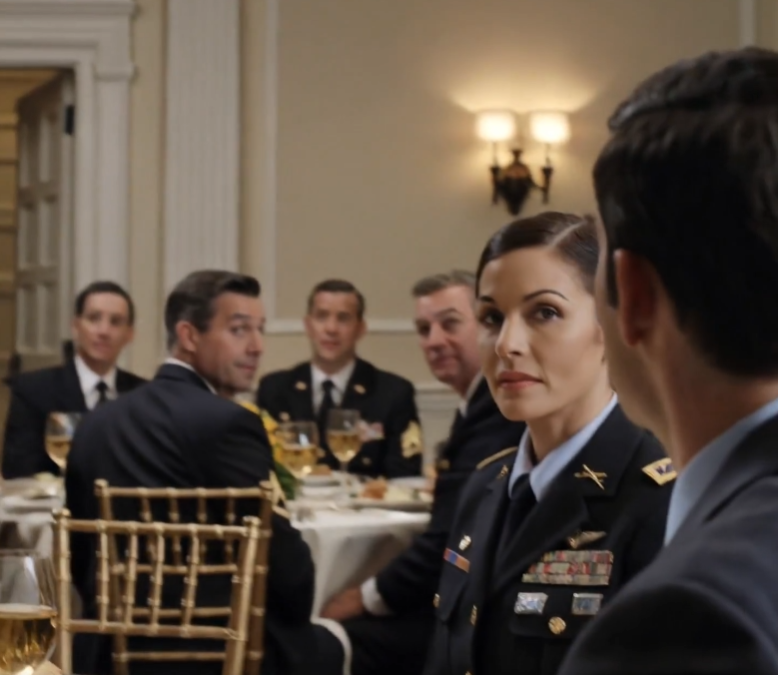
That evening, we drove onto the installation just after six. The October air was cool, and the sun was already dropping behind the trees. The dinner was being held in a formal hall used for military ceremonies and receptions. Officers, retired service members, spouses, and several senior leaders were gathering inside.
Daniel adjusted his jacket as we walked through the entrance.
“Remember,” he said, “try not to make everything about the Army.”
I looked at him. “I wasn’t planning to.”
“Good.”
Inside, people greeted one another. I shook hands with old friends and acquaintances while Daniel stayed close beside me.
Then we reached the receiving line.
A senior general stood near the entrance, greeting guests. I knew him, not socially, but professionally. He had been in the chain of command during an important period of my career.
When he saw me, his expression changed for half a second. But before he could say anything, Daniel stepped forward.
“This is my wife,” he said.
The general smiled politely. “Good to meet you, ma’am.”
Daniel laughed. “She’ll probably tell you she’s important.”
I looked at him.
He continued, “She just loves wearing the uniform.”
The general’s smile disappeared.
I could have corrected him. Instead, I simply said, “Good evening, sir.”
We moved into the dining room.
For the first half hour, everything was polite. Then the conversation turned toward military service. One retired officer mentioned a deployment from years earlier, and someone asked me a question about leadership.
Before I could answer, Daniel interrupted.
“Oh, she wasn’t really doing the exciting stuff.”
A few people looked at him.
He grinned. “She was basically an office soldier.”
I felt my jaw tighten. I put my fork down.
“Daniel.”
“What?”
“That’s enough.”
He leaned toward me. “I’m joking.”
Then, louder, he said, “Seriously, what does she know about combat?”
The table went silent.
He pointed toward my uniform. “You see all these ribbons and badges? People assume they mean something.”
My face felt warm, but my voice stayed calm.
“I never claimed anything.”
Daniel shook his head. “That’s exactly what I mean. You act like you’re some kind of war hero.”
I looked across the table.
The general was staring at my chest. Not at my ribbons, but at one particular insignia.
The insignia Daniel had never once asked me about.
The general’s expression changed. He slowly put down his glass. Then he stood.
“Ma’am.”
Everyone turned.
The general looked at me with an expression I hadn’t seen in years. Recognition, respect, and something close to regret.
Daniel followed his gaze to my uniform. His eyes stopped on the small insignia, and his face went pale.
“Phantom,” he whispered.
I didn’t answer.
The general straightened his jacket. Then, in front of everyone, he said, “Ma’am, please forgive me for a moment.”
Nobody moved.
I could hear the soft hum of the air conditioner above us and the faint clink of silverware from another table.
Daniel looked from the general to me. His confidence was gone. And for the first time that evening, he seemed to realize that there were entire chapters of my life he had never bothered to read.
For several seconds after the general apologized, I couldn’t move. Not because I was afraid, but because I was remembering.
The insignia on my chest had never meant what Daniel thought it meant. It wasn’t a decoration. It wasn’t something I wore to impress people, and it certainly wasn’t something I had ever expected him to understand without asking.
The general slowly sat back down.
“Please,” he said to me. “We should talk later.”
I nodded. “Of course, sir.”
Daniel finally found his voice.
“What exactly is Phantom?”
The general looked at him. Then he looked at me.
I answered before he could.
“It’s part of my past.”
Daniel swallowed. “That doesn’t answer the question.”
“No,” I said. “It doesn’t.”
He stared at me. For once, he didn’t have a joke ready.
Dinner continued, but nobody at our table seemed interested in eating. The conversation became polite and careful. People talked about the weather, upcoming ceremonies, retirement plans, and football.
Daniel barely spoke.
I knew what was happening inside his head. He was trying to reconstruct twenty years of my life from the pieces I had allowed him to see, and there weren’t many pieces.
When we first met, I had already been serving for several years. I was twenty-eight, living in Virginia at the time, and working long hours. Daniel had been introduced to me by a mutual friend.
On our second date, he asked what I did.
I told him, “Military.”
He said, “Yes, but what do you do?”
I gave him the honest answer I could give.
“Operations.”
He smiled. “That sounds mysterious.”
“It isn’t.”
He laughed. “You’re going to have to teach me.”
I thought he was genuinely interested.
For a while, he was. He used to ask about my training. He wanted to see photographs. He once told his friends that dating a woman in uniform made him feel like he had stepped into a movie.
I remember laughing when he said that.
I told him real military life wasn’t anything like a movie. There were long stretches of boredom. There was paperwork and inspections. There were early mornings, bad coffee, equipment problems, and endless meetings.
And then there were moments nobody wanted to talk about afterward.
Daniel didn’t understand those moments.
Neither did I at first.
You don’t learn how to carry difficult experiences in one day. You learn slowly. You learn by going back to work the next morning. You learn by putting on your uniform even when part of you wants to stay in bed.
You learn to answer questions with “I’m fine,” because sometimes that’s the only answer you are allowed to give.
Daniel eventually stopped asking.
I don’t remember exactly when. Maybe it happened after our first deployment-related separation. Maybe it happened when his own career became more demanding. Or maybe it happened so gradually that neither of us noticed.
But somewhere along the way, my service became an inconvenience to him.
He began making little comments. If I had to attend a military function, he’d say, “Another Army party.”
If I came home exhausted, he’d say, “You knew what you signed up for.”
If I mentioned a former colleague who had died, he’d become uncomfortable and change the subject.
I never demanded that he understand everything. I only wanted him to respect what he didn’t understand.
That night, he hadn’t.
After dinner, we stepped outside. The parking lot was quiet. The air smelled like damp leaves and cold pavement.
Daniel stopped beside our car.
“What aren’t you telling me?”
I looked at him. “About what?”
“Phantom.”
I took a breath. “There are things I can’t discuss.”
“Can’t?”
“That’s right.”
He looked frustrated. “After all these years, you’re telling me there are things about your military career you can’t tell your own husband?”
“There are things I can’t tell anyone.”
He looked away. “That sounds convenient.”
That sentence hurt more than the insults at dinner.
I had expected anger. I hadn’t expected disbelief.
“You think I’m hiding something from you because I don’t trust you.”
“I don’t know what to think.”
I opened the car door.
“You could have asked me years ago.”
“I did.”
“No,” I said quietly. “You asked what my job was. You stopped asking what it cost.”
He went silent.
I got into the passenger seat.
On the drive home, neither of us spoke. The highway lights passed across the windshield in steady intervals. I watched them and thought about the first time I had been given the name Phantom.
It wasn’t glamorous.
There had been no dramatic ceremony, no music, no applause. Just a briefing room, a stack of folders, and a senior officer telling us that certain assignments required people who could remain calm when everyone else was losing their heads.
I had been one of those people.
Over the years, the name followed me. It became associated with a small group of personnel trusted with sensitive operational work.
I never wore it like a crown. If anything, I tried to forget it whenever I came home, because home was supposed to be different.
At home, I wasn’t an officer. I was a wife.
I cooked dinner. I paid bills. I worried about the mortgage. I reminded Daniel about dentist appointments. I bought groceries at Harris Teeter. I sat beside him on the couch while he watched baseball.
Those ordinary things mattered to me.
They still do.
Maybe that’s why I never told him everything. I didn’t want my marriage to become another briefing room.
When we reached home, Daniel parked in the driveway. He didn’t get out immediately.
Finally, he said, “The general knew you.”
“Yes.”
“How?”
“He was there.”
“Where?”
I looked at him.
“Daniel, you’re asking questions now because someone important recognized me.”
He frowned. “That isn’t fair.”
“Isn’t it?”
He looked down at his hands.
I could see the embarrassment on his face, but beneath it, there was something else.
Fear.
He was beginning to understand that my past wasn’t a story I had exaggerated. It was something much heavier.
“What did you do?” he whispered.
I opened my door.
“Things I’m proud of.”
Then I paused.
“And things I still think about.”
I went inside. Daniel followed.
Neither of us slept much that night.
Around two in the morning, I woke up and found him standing in the hallway. He was holding an old photograph, one I hadn’t seen in years.
It showed me standing with several other soldiers. We were younger, much younger.
Daniel stared at the photograph. Then he turned it over.
There was a handwritten date on the back.
His eyes widened.
He looked at me.
“You were there?”
I nodded.
“Where?”
I didn’t answer.
He looked again at the photograph, then at me.
And for the first time in our marriage, Daniel wasn’t looking at my uniform.
He was looking at the woman underneath it.
Daniel was still holding the photograph when I walked into the hallway. He looked at me like he was waiting for a confession.
“What happened there?” he asked.
I glanced at the photograph. There were six of us in it. I recognized every face. Four were still alive. Two were not.
I reached for the picture, but Daniel held on to it.
“Just tell me,” he said.
“I can’t tell you everything.”
His jaw tightened. “Of course.”
I ignored the sarcasm.
“But I can tell you this.”
I pointed at the photograph.
“We were sent to support a team that had been cut off from its normal communications.”
Daniel looked at the faces.
“What year?”
I gave him the year.
He did the math silently.
“That was before we met.”
“Yes.”
“So why didn’t you tell me?”
“Because there wasn’t anything useful I could tell you.”
“That doesn’t make sense.”
“It does if you’ve lived through it.”
He sat down on the bottom stair. I remained standing.
There are memories you can describe, and there are memories that change shape when you put them into words.
That night, I decided Daniel deserved some of the truth.
Not classified information. Not operational details.
Just the human part.
“We lost communication with a small group during a mission,” I said.
Daniel looked up.
“What kind of mission?”
“A dangerous one.”
“Were you in combat?”
I paused.
“Yes.”
He looked genuinely stunned.
I had never lied to him. But I had never said that word either.
Combat.
It carried too much weight.
“We were supposed to maintain contact and coordinate support,” I continued. “Then the situation changed.”
“How?”
“I can’t tell you exactly.”
He rubbed his forehead.
“Were you in charge?”
“I was responsible for decisions.”
His eyes met mine. “That means yes.”
“It means I had responsibilities.”
He looked back at the photograph.
“And those people?”
“They were my responsibility, too.”
I sat across from him.
“There was a point when we had to make a choice. We could pull back, or we could stay long enough to get people out.”
“What did you choose?”
“I stayed.”
Daniel’s expression changed.
“You could have died.”
“So could everyone.”
He stared at me.
For once, there was no argument, no joke, no dismissive comment. Just silence.
Then he asked something I wasn’t prepared for.
“Were you scared?”
I smiled sadly.
“Of course.”
That seemed to surprise him.
“Then how did you do it?”
“Being brave doesn’t mean you’re not afraid.”
I looked down at the photograph.
“It means you decide something else matters more.”
Daniel didn’t respond.
I continued.
“That’s what military service taught me. Not how to stop being afraid, but how to keep moving when fear is there.”
He looked at the photograph again.
“Who are the two people?”
I took a slow breath.
“Two soldiers who didn’t make it home.”
Daniel lowered his eyes.
“I’m sorry.”
Those were the first sincere words he’d said all night.
“Thank you.”
He handed the photograph back. I put it inside the drawer beside my desk.
Then Daniel said, “The general knew about this.”
“Yes.”
“He called you ma’am. Like…” He stopped. “Like you were important.”
I looked at him.
“That’s what bothered you?”
He shook his head. “No.”
“What bothered you?”
He took a long time to answer.
“I realized I don’t know you.”
The honesty of it caught me off guard.
“You know me.”
“No. I know my version of you.”
That sentence stayed with me because it was true.
Daniel had created a version of me that was convenient. His wife. His partner. The woman who cooked dinner. The woman who helped with bills. The woman who wore a uniform but supposedly never did anything particularly difficult.
He had never asked what existed underneath that version.
The next morning, I went to work as usual.
The Army did not care about my marital problems.
At five-thirty, my alarm went off. I made coffee, put on my duty uniform, and drove onto the installation while the sky was still gray.
Everything looked normal.
Soldiers walked toward buildings carrying coffee cups. Cars moved through the gates. A maintenance crew was already working.
I passed a young lieutenant who looked exhausted.
He gave me a quick salute. I returned it.
For a moment, I remembered being his age. I remembered thinking I knew what courage was.
I didn’t.
You learn it later.
That afternoon, I received a call from the general. He asked me to meet him.
When I arrived, he closed the office door.
“I owe you an apology,” he said.
I frowned. “For what?”
“For recognizing you too late last night.”
I smiled. “You have no reason to apologize.”
“I should have recognized the insignia immediately.”
“It was a dinner, sir.”
He sat back. Then he said something that surprised me.
“Your husband embarrassed himself.”
I didn’t answer.
“He also embarrassed you.”
“I know.”
“You don’t have to defend him.”
“I wasn’t going to.”
The general studied me.
“You’re still protecting him.”
I looked away.
“Old habits.”
He understood.
After a moment, he said, “There are things he should know.”
“Yes. But there are things he cannot know.”
“I understand.”
He nodded. Then he told me something I had almost forgotten.
Years earlier, during the same period as my Phantom assignment, there had been a security concern involving a civilian contractor.
The contractor was connected to one of Daniel’s clients.
At the time, I had recognized the connection. I had also recognized the danger.
Daniel had no idea.
The general looked at me.
“You kept your husband completely separate from it.”
“I did what I was supposed to do.”
“You also protected him from information that could have destroyed his career.”
I shook my head.
“I didn’t protect him. I protected the integrity of the investigation.”
The general gave me a knowing look.
“You can call it whatever you want.”
I didn’t argue.
When I returned home that evening, Daniel was waiting at the kitchen table. There were papers spread out in front of him.
“What are those?” I asked.
“Old business records.”
I stopped.
He looked up.
“I found something.”
My stomach tightened.
“What?”
He pushed one document toward me.
It contained the name of a company connected to the investigation years earlier.
Daniel’s face had gone pale.
“Why was your unit involved with this?”
I looked at the document, then at him, and suddenly I understood.
The past I had spent years keeping outside our marriage had finally found its way through the front door.
Daniel whispered, “You knew.”
I didn’t answer.
He stood.
“You knew what was happening with my company.”
“I knew there was an investigation.”
“And you never told me?”
“I couldn’t.”
“Why?”
I looked directly into his eyes.
“Because if I had told you, I would have been putting both of us at risk.”
He stared at me.
Then his voice dropped.
“Were you protecting me?”
I paused.
“Yes.”
His expression broke. Not dramatically, just enough for me to see the realization settle into him.
The woman he had called an office soldier. The woman he had mocked in front of a general had spent years protecting him from a world he didn’t even know existed.
And for the first time, Daniel looked ashamed.
Daniel stayed at the kitchen table long after I had gone upstairs.
I could hear the refrigerator humming in the quiet house.
For once, he wasn’t following me from room to room trying to explain himself. He wasn’t angry. He wasn’t making excuses.
He was thinking.
That was enough for one night.
The next morning, I found him sitting on the back porch with two cups of coffee.
He pushed one toward me.
“I didn’t know how you took the things I said.”
I sat down and looked at the coffee.
“You said a lot of things.”
“I know.”
He rubbed his hands together.
“I thought you were trying to make me feel small.”
I looked at him.
“Why would I do that?”
“Because people respect you.”
I almost laughed.
Not because it was funny, but because it was so painfully simple.
“Daniel, I never needed you to compete with me.”
He stared at the yard.
“I know that now.”
I wasn’t ready to tell him that everything was fine.
It wasn’t.
An apology doesn’t erase years. Respect doesn’t return because somebody finally realizes what they lost.
So I said something I had been holding inside for years.
“You don’t get to discover my value because somebody else recognized it.”
He looked up.
“What do you mean?”
“You saw the general stand up. You saw everyone become quiet. You saw the insignia. Suddenly, I became important to you.”
“That isn’t fair.”
“It is.”
I kept my voice calm.
“If nobody had recognized me that night, would you have apologized?”
He didn’t answer.
I nodded.
“That is what I thought.”
He looked down.
“I don’t know exactly.”
That morning, I made a decision.
I wasn’t going to punish Daniel. I wasn’t going to humiliate him in front of his family. I wasn’t going to tell everyone what I knew about his business or the protection I had quietly provided years earlier.
That would have been easy, and it would have made me no better than the person he had been becoming.
Instead, I was going to stop protecting him from the consequences of his own behavior.
That was the revenge I never planned.
I simply stopped covering for him.
A few days later, his sister Melissa called. She had heard about the dinner.
Of course she had.
Family news travels faster than military intelligence.
“I heard there was some kind of scene,” she said.
“There wasn’t a scene.”
“Daniel says you made him look terrible.”
I closed my eyes.
“He made himself look terrible.”
“He says you embarrassed him.”
“He embarrassed himself when he mocked me.”
Melissa sighed.
“He was joking.”
I had heard that sentence for years.
I finally answered differently.
“Then his jokes aren’t funny.”
There was a pause.
“You know how men are.”
“Yes,” I said. “I know exactly how men are.”
She became defensive.
“You’re taking this too seriously.”
“No. I’m taking myself seriously.”
She didn’t know what to say.
Neither did I.
After we hung up, I sat at the kitchen table for several minutes. My hands were shaking slightly, not from anger, but from the realization that I had finally stopped making myself smaller to keep everyone else comfortable.
A week later, Daniel’s mother invited us to Sunday dinner.
I almost didn’t go, but I decided I would.
Not because I wanted another confrontation, but because I wanted to see what happened when I stopped avoiding one.
His parents lived about twenty minutes away in a brick ranch house surrounded by old oak trees. We sat around the dining table while his mother served roast chicken, mashed potatoes, green beans, and rolls.
For ten minutes, everything was normal.
Then his father cleared his throat.
“I heard you had quite a night at that military dinner.”
I looked at Daniel.
He didn’t look at me.
His mother smiled nervously.
“Your husband was just trying to make people laugh.”
I put my fork down.
“He called me an office soldier.”
Daniel’s mother waved her hand.
“Oh, men say things.”
I looked at her.
“Do they?”
She stopped.
I continued calmly.
“He told people I didn’t know anything about combat.”
Daniel’s father shifted in his chair.
“And then,” I said, “he saw something on my uniform that he had never bothered to ask me about.”
Nobody spoke.
Daniel finally said, “Mom, Dad, I was wrong.”
His mother looked surprised.
I was surprised, too.
He continued.
“I wasn’t joking.”
He looked at me.
“I was embarrassed.”
His father asked, “About what?”
Daniel swallowed.
“That she was more accomplished than I was.”
The room went silent.
He had finally said it.
Not to me.
To his parents.
And that mattered.
His mother looked at him.
“You were jealous of your wife?”
“Yes.”
He lowered his eyes.
“I was.”
I didn’t feel triumphant.
I felt sad, because I knew jealousy could turn love into competition if you let it.
On the drive home, Daniel didn’t speak.
When we reached the house, he sat in the driveway with the engine off.
Then he said, “I need to ask you something.”
“Okay.”
“Are you ashamed of me?”
I turned toward him.
“No.”
“After everything?”
I said, “No.”
“Why?”
“Because I know who you are.”
He looked confused.
“And I know who I am.”
I reached for the door handle.
“You don’t have to become smaller because I’m strong.”
He stared at me.
“And I don’t have to become smaller so you can feel strong.”
That was the boundary.
Simple. Clear.
It changed our marriage more than any argument ever had.
Over the next few weeks, Daniel began asking questions.
Real questions.
Not questions designed to challenge me. Questions designed to understand me.
“What was your first deployment like?”
“What did you miss most?”
“Did you ever want to quit?”
“Did you lose friends?”
Sometimes I answered. Sometimes I said, “I can’t talk about that.”
And this time, he didn’t push.
He simply said, “Okay.”
One evening, he found an old photograph in the desk drawer. It was the same group picture from years earlier.
He turned it over.
On the back were six names. Two had small stars beside them.
He understood what they meant.
He looked at me.
“Do you still think about them every year?”
“What do you remember?”
I looked at the photograph.
“Their jokes.”
He smiled faintly.
“Not the mission?”
“No.”
I touched one of the names.
“I remember who they were before the worst day of their lives.”
Daniel sat beside me for a long time.
Neither of us spoke.
Then he said, “I think I’ve been looking at your uniform instead of looking at you.”
I turned toward him.
“That might be the first thing you’ve said that I believe.”
He nodded.
“I know.”
And that was when I understood something.
Revenge wasn’t always about making someone hurt the way they hurt you.
Sometimes revenge was simply refusing to remain the version of yourself they had created.
Three months passed after that dinner.
Nothing changed overnight.
That was probably the most important part.
Daniel didn’t wake up the next morning as a completely different man. I didn’t suddenly forget twenty years of small insults. We didn’t hug in the kitchen, promise to start over, and pretend the problem had disappeared.
Real life doesn’t work that way.
Change is usually quieter.
It shows up in little decisions.
Daniel stopped making jokes about my uniform. He stopped calling my work paper-pushing. When someone asked about my service, he let me answer for myself.
And when I couldn’t answer because something was confidential, he simply said, “There are things she can’t discuss.”
That sentence meant more to me than he probably realized.
One Saturday morning, I came downstairs and found him watching an old video from one of my military ceremonies.
He looked over.
“I didn’t know you had this.”
“Neither did I.”
He smiled.
“You’re serious in every picture.”
“I was working.”
“You ever smile?”
“Sometimes.”
He laughed.
It was the first time the joke didn’t feel like a weapon.
Then he asked, “Can I come to the ceremony next month?”
I looked at him.
“What ceremony?”
“The ceremony. The one you mentioned.”
“You want to come?”
“If that’s okay.”
I nodded.
“It is.”
The ceremony was held on a clear spring morning. The installation was already busy when we arrived. Families walked toward the reviewing area carrying folding chairs and small American flags. Children wore miniature uniforms.
Retired soldiers stood together in groups, comparing stories that had probably grown more entertaining with every passing year.
Daniel stayed beside me.
He didn’t try to lead me. He didn’t introduce himself first.
He simply walked beside me.
That mattered.
Near the entrance, the same general from the dinner approached us.
Daniel straightened immediately.
“Sir.”
The general nodded.
“Good morning.”
Then he looked at me.
“I’m glad you’re here.”
“Thank you, sir.”
His eyes moved toward Daniel.
“And I’m glad you came, too.”
Daniel nodded.
“I wouldn’t have missed it.”
The general smiled.
“Good answer.”
I almost laughed.
During the ceremony, I sat with several other officers while Daniel stood with the families.
The band played. The colors were presented. Everyone rose for the national anthem.
I watched the flag moving gently in the morning wind.
I had seen that flag in places where the air smelled like dust and diesel. I had seen it folded beside coffins. I had seen young soldiers touch it before leaving for places they hoped never to return to.
And I had learned never to take it for granted.
After the formal portion, the general took the microphone.
He spoke about military families.
Not missions. Not classified operations.
Families.
He talked about the people who waited at home, the spouses who handled bills while someone was deployed, the parents who didn’t sleep when the phone rang late at night, and the children who learned to count months instead of weeks.
Then he said something that made me look at Daniel.
“Sometimes,” the general said, “the people closest to us know the least about what we carry.”
The crowd became quiet.
He continued.
“Not because we don’t trust them. Sometimes because there are things we cannot explain. Sometimes because we don’t want the people we love to carry our burdens, too.”
Daniel looked down.
I knew he was listening.
Then the general called my name.
I stood.
He asked me to come forward.
I walked toward the stage.
For a moment, I felt twenty years younger, then twenty years older.
The general shook my hand.
He didn’t reveal anything classified.
He simply said, “You served with discipline, courage, and loyalty. More importantly, you remembered the people behind the mission.”
I nodded.
“Thank you, sir.”
Then he turned toward the audience.
“Some accomplishments don’t come with public explanations. That doesn’t make them less meaningful.”
I looked toward Daniel.
He was standing at the back.
His eyes were wet.
He didn’t hide it.
After the ceremony, we walked toward the parking lot.
For several minutes, neither of us said anything.
Finally, Daniel stopped.
“Can I tell you something?”
“Sure.”
“I used to think that if people respected you, somehow that meant they respected me less.”
I listened.
“I was wrong.”
He looked at the ground.
“I spent years trying to make your accomplishments sound ordinary because I was afraid mine didn’t measure up.”
I took a slow breath.
“That wasn’t fair.”
“I know.”
He looked at me.
“I don’t want to do that anymore.”
We continued walking.
After a few steps, he asked, “Can we start over?”
I stopped.
That question would have meant everything to me a year earlier.
Now, it meant something different.
“Starting over doesn’t mean pretending nothing happened.”
“I know.”
“It means doing things differently.”
“I can do that.”
“You’ll have to.”
“I will.”
I studied his face.
“What happens when you feel insecure again?”
He thought about it.
“I tell you. And if I don’t understand something, I ask. And if you can’t tell me, I respect that.”
I nodded.
“That’s a start.”
He smiled.
“A start?”
“A real one.”
We got into the car.
On the drive home, Daniel didn’t turn on the radio. He asked me about the ceremony. He asked about the soldiers he had met. He asked about the two names on the photograph.
I told him what I could.
He listened.
That night, after dinner, I found him standing in front of the framed photograph on my desk.
He had placed it there himself.
The six of us were still young, still smiling, still believing we had plenty of time.
Daniel touched the frame.
“I wish I’d asked about them sooner.”
“So do I.”
He turned toward me.
“Do you regret not telling me more?”
I thought about that.
“No.”
“Why?”
“Because I didn’t owe anyone every detail of my life.”
He nodded.
“But I wish you had known me better.”
His expression changed.
“I wish that, too.”
I walked over and stood beside him.
For a while, we looked at the photograph together.
Then he said quietly, “I used to introduce you as my wife like that was supposed to make you smaller.”
I said nothing.
He continued.
“Now I understand it should have been the greatest introduction of my life.”
I smiled.
“Don’t make it dramatic.”
He laughed.
“Sorry.”
“Good.”
He took my hand.
I let him.
It wasn’t forgiveness for everything.
Not yet.
It was something more realistic.
A decision to see whether trust could be rebuilt.
Some wounds don’t disappear. They become reminders.
And sometimes that’s what healing really is.
Not forgetting what happened, but learning how to live differently because it happened.
The next morning, I put on my uniform again.
Daniel stood in the doorway.
He didn’t joke. He didn’t ask why I needed all those ribbons.
He simply said, “You look beautiful.”
I looked at him.
“Thank you.”
Then he added, “And terrifying.”
I laughed.
“There you are.”
He smiled.
For the first time, the laughter between us felt safe.
And I realized something I should have understood years earlier.
I didn’t need my husband to admire my rank.
I needed him to respect the woman who had earned the right to wear it.
The first few months after that ceremony were not perfect.
I want to say they were. I want to tell you Daniel changed, I forgave him, and somehow everything became easy.
But that wouldn’t be honest.
Marriage doesn’t repair itself because one person finally says the right thing.
Trust is rebuilt in ordinary moments, sometimes painfully ordinary ones.
Daniel still had bad days.
So did I.
There were evenings when something he said reminded me of the years when he had made jokes about my service, and I would go quiet.
He learned not to tell me, “You’re overreacting.”
Instead, he’d ask, “Did I hit something?”
Sometimes I would say yes.
Sometimes I’d say no.
Either way, he listened.
That was new.
He also started asking questions.
Not the kind of questions that demanded secrets, but the kind that showed he actually wanted to understand me.
One evening, we were sitting on the back porch after dinner. The sun was going down behind the trees, and I could hear a lawnmower somewhere across the neighborhood.
Daniel looked at me.
“What was the hardest part?”
I knew what he meant.
“My deployments?”
He nodded.
I thought for a moment.
“Coming home.”
He looked surprised.
“Really?”
“People think the hard part is leaving. Sometimes it is. But when you come home, everybody expects you to become the person you were before you left.”
“And you couldn’t?”
“Not completely.”
He was quiet.
Then he asked, “Did you ever think about quitting?”
“Yes.”
That surprised him even more.
“Really?”
“Of course.”
“Why didn’t you?”
I looked out across the yard.
“Because I still believed the work mattered.”
He nodded slowly.
“I think I understand.”
“You don’t have to understand everything.”
“I know.”
That answer made me smile.
Later that summer, Daniel came with me to a small military family gathering.
It wasn’t glamorous.
There were paper plates, folding tables, children running through the grass, and somebody arguing with a grill that refused to cooperate.
Daniel met people I had served with. Some knew pieces of my past. Others knew much more than he did.
But nobody treated him like an outsider.
One of the older soldiers shook his hand and said, “So, you’re the husband?”
Daniel laughed.
“Apparently.”
The man looked at me.
“She ever tell you about the time she nearly got us lost?”
Daniel’s eyes widened.
“You got lost?”
I pointed at the soldier.
“Don’t you dare.”
Everyone laughed.
Daniel laughed hardest.
For once, he wasn’t embarrassed that I had stories he didn’t know.
He was curious about them.
That night, on the drive home, he said, “You have a whole life I never really saw.”
I looked out the window.
“So do you.”
He shook his head.
“No. I knew your job. I didn’t know you.”
That sentence stayed with me because that had been the real problem.
He had known my title. He had known my uniform. He had known that other people respected me.
But he hadn’t known what those things had cost.
And honestly, I had made the same mistake with him.
I had assumed his insecurity was simply arrogance.
Sometimes it was.
But sometimes it was fear.
Fear that he wasn’t enough. Fear that people would compare us. Fear that standing beside a strong woman somehow made him smaller.
None of that excused what he had done.
But understanding it helped me stop carrying anger that no longer served me.
One evening, nearly a year after the military dinner, we were getting ready for another ceremony.
I stood in front of the mirror, adjusting my uniform.
Daniel walked in.
He stopped behind me.
For a moment, neither of us spoke.
Then he said, “Can I tell you something?”
“Sure.”
“I’m sorry.”
I looked at him through the mirror.
“For what?”
He took a breath.
“For making you smaller because I was afraid people would think I was small.”
I turned around.
He continued.
“I thought if I made your service sound ordinary, I’d feel ordinary next to you.”
I didn’t interrupt.
“I was wrong.”
“Yes,” I said quietly.
He nodded.
“I know.”
There was no argument. No excuse.
Just an apology.
I walked toward him.
He reached for my hand.
This time, I didn’t hesitate.
I held it.
Not because everything was forgotten.
It wasn’t.
Some things should never be forgotten. They remind us what we are capable of becoming when we stop paying attention to the people we love.
But forgiveness doesn’t always mean erasing the past.
Sometimes it means refusing to let the past control the future.
Daniel looked at my uniform.
Then he looked at me.
“I don’t want to be proud of the uniform.”
I smiled.
“What do you want to be proud of?”
He squeezed my hand.
“The woman wearing it.”
That was the moment I finally understood that he had learned the lesson.
Not because a general had stood up. Not because an insignia had shocked him. Not because other people had suddenly recognized my value.
He had learned it because he had finally stopped measuring my worth against his own.
And I had learned something, too.
For years, I thought revenge meant proving someone wrong, making them regret what they had done, showing them the person they had underestimated.
But sometimes the deepest revenge is quieter.
You stop shrinking. You stop explaining yourself to people committed to misunderstanding you. You stop apologizing for the strength you worked your whole life to build.
And you let people decide whether they can stand beside the real you.
I still wear my uniform with pride.
I still remember the six people in that old photograph.
Four came home.
Two didn’t.
I still think about them every year.
I remember their jokes, their bad habits, the little things that made them human before anyone called them heroes.
And I remember what their lives taught me.
Service isn’t always visible. Sacrifice doesn’t always come with a medal. And love doesn’t mean knowing every secret.
Sometimes love means respecting the silence around the things someone cannot explain.
That night, before we left for the ceremony, Daniel opened the front door for me.
He smiled.
“Ready?”
I looked at him.
“Always.”
He laughed, and we walked out together.
Not as a general’s wife. Not as a soldier’s husband. Not as two people competing to prove who mattered more.
Just two people who had finally learned that love isn’t about standing in someone’s shadow.
It’s about making room for both people to stand in the light.
My husband once thought I was just his wife.
He eventually learned that a person doesn’t become smaller simply because someone refuses to see how much they carry.
And maybe that’s the lesson I want to leave with you.
If someone has ever underestimated you, don’t spend your whole life trying to convince them of your worth.
Keep becoming the person you know you are.
The right people won’t need a general to stand up before they finally see you.
And if this story reminded you of someone who had to find their strength after being underestimated, share it with them.
If it meant something to you, stay with me for more stories about ordinary people who discover that their quietest strength can sometimes change everything.
Thank you for listening.








