“She had one job—being a wife. And she lost him.” My dad laughed. I said nothing. Then a Navy veteran stood up: “Gus… that’s Lieutenant Colonel Nora Halvorsen.” “Your daughter outranks every man in this room.”
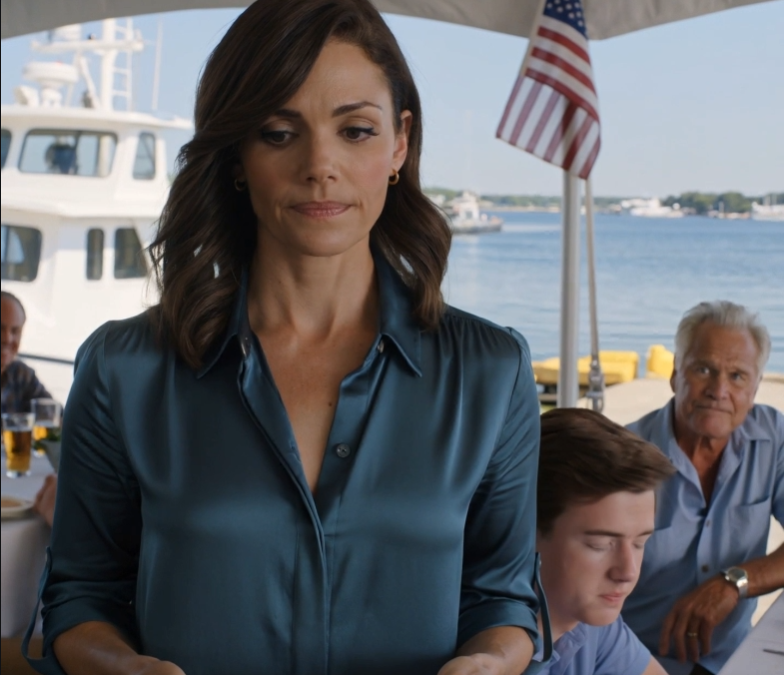
My father raised his glass in front of ninety people and said of me, “She had one job in this life—being somebody’s wife—and she lost him.”
Then he laughed. And because he laughed, other people did, too.
I was standing at the end of the folding table with a paper plate in my hand. Salmon, red potatoes, a roll I hadn’t touched. Somebody’s kid was running a toy truck along the edge of a tent pole, and the halyards were slapping out on the water. I could smell diesel, cut grass, and the sugar of a sheet cake with the yard’s name piped across it in blue. I set the plate down. I did not set it down hard.
“Gus,” Priscilla said from his left. Just his name.
“What?” my father said. “It’s a party.”
The man who would stand up two hours later had spent nineteen years in the Navy, and he had driven four hours up the coast that afternoon carrying an envelope he had been trying to deliver for fourteen months.
Fourteen months earlier, on a Thursday in July, I had been standing in my kitchen in Virginia Beach with a cup of coffee going cold in my hand when two officers came up my walk. I already knew. That’s the part nobody believes. At about eleven the day before, the phone traffic in my own building had changed shape, the way a room changes when someone in it has decided not to look at you. I had gone home at 1700, sat down in the kitchen, and not turned on any lights.
They knocked. I opened the door before the second knock.
A lieutenant commander I had never met stood on my step with his cover under his arm and his ears red from the heat.
“Ma’am, I’m required to say this the way it’s written,” he said. “I’m going to say it anyway, and then I’m going to say it like a person. You can stop me whenever you want.”
The Secretary of the Navy had asked him to express his deep regret. My husband, Senior Chief Wesley Kilbride, had died on July 16.
“Okay,” I said.
That was the whole of it. I said okay and stepped back so they could come in out of the sun. I remember rinsing the cold coffee down the drain because I couldn’t think of anything else to do with my hands. I remember one of them asking twice if there was somebody I wanted called, and me saying no both times.
Wes and I had been married eleven years. He was forty-four. He had a laugh you could hear through a closed door, and he never in his life signed a piece of paper without taking a photograph of it first.
Three weeks after the funeral, I drove north to Bell Harbor, Maine, which is where I was born and where my father has run a boatyard on the same four acres of mud and granite since my grandfather started it in 1961.
The office smells like kerosene and old coffee. Over the shop door, there is a sign that says HALVERSON MARINE WORKS, and under it, smaller, AND SON.
My father did not ask me how I was. He slid a letter across the desk with two fingers.
“They’re calling it,” he said. “Ninety days and they take the yard, the shop, the rail, the whole point. I’ve been to three banks. Nobody’s lending on a boatyard that lost money four years running. And don’t tell me about restructuring, Nora. I’ve had my fill of men in fleece vests explaining my own dock to me.”
The number at the bottom of the letter was $294,000.
“I’ll cover it,” I said.
He looked at the window instead of at me. Out on the rail, there was a lobster boat up on the cradle with her bottom half scraped.
He said family didn’t need paper. He said his father had never signed a note in his life, and neither had he.
I wired $310,000 from the credit union in Wisconsin nine days later. That was the death gratuity and most of the insurance, which is money the Navy gives you for a man, and I gave it to my father for a piece of ground, and nobody wrote anything down.
The certified letter came the following June.
Dot Pelletier has carried mail out to the point for twenty-two years, and she does not hand you a certified letter without an opinion about it. She stood at the bottom of my steps holding the clipboard out.
“You want to sign for this outside or inside?” she said. “I’ll say this and then I’ll shut up. I carried one of these to Marian Fogg in March, and she was out of her house by August. I’ve been at this long enough to know the return address on a bad morning.”
“Outside’s fine,” I said.
The envelope was from a firm in Portland.
NOTICE TO QUIT. THIRTY DAYS.
The premises were described as a seasonal dwelling situated on Lot Four, Halverson Point, currently occupied under a month-to-month tenancy at will.
I read it standing up. Then I sat down on the step and read it again, because the seasonal dwelling situated on Lot Four was the cottage Wes had rebuilt with his own hands over six summers of leave, and the month-to-month tenant was me.
I drove to the yard the next morning. My father was in the office with a roll of drawings weighted flat by a coffee can of bolts, and he did not roll them up when I came in.
“You knew this was coming,” he said.
“No.”
“Cobb’s people need clean title on the whole point or there’s no deal. And there’s a deal, Nora. There’s a real one, and it closes in November.”
He put his hand flat on the drawings like he was holding down a sale.
“That cottage sits on yard land. Your husband put a roof on a building that wasn’t his, and I let him, and I was glad of it, and it’s still not his. I’m not throwing you in the road. I’ll find you something in town.”
“And the three hundred and ten thousand?”
“That was a gift to your family.”
He could say that sentence and have it sound reasonable to himself. And the reason took thirty years to build.
My mother died in February of my senior year. Cancer. Eleven weeks from the diagnosis to the end, fast enough that the ground never really closed over it.
My father stopped talking that spring. Not metaphorically. He would come in at seven, eat, and go down to the shop and turn the lights on and stand there.
I sat at the kitchen table in April with a folder from the recruiter’s office and slid it toward him next to the sugar bowl.
“There’s a scholarship attached,” I said. “They pay for school, and then I owe them years. I have to have somebody sign the school part.”
He read it for a long time. Then he took the pen out of his shirt pocket, signed the bottom of the second page, and pushed it back.
“Your brother’s staying,” he said. “Somebody had to.”
That was all.
He didn’t say don’t go. He didn’t say good. He signed it and went down to the shop, and in August I got on a bus.
The thing I have never been able to make anybody understand is that I would have stayed if he had said one word. One. I have had twenty-three years to decide whether that’s true, and I still don’t know.
Teddy stayed.
Teddy was three years older, and he was better with people than I have ever been. He ran the yard’s service side from the time he was twenty-two, and when he was twenty-seven, a fuel line let go in a bilge he was standing in.
I was at a school in Alabama. They found me forty hours later. By the time I got a seat out of Montgomery and through Boston and up the coast in a rented Corolla, they had buried him.
Because in February in Bell Harbor, you take the ground when the ground is open.
My father was in the office when I got there, still in his suit. He held out a key ring with a brass tag on it. I put my hand out, and he dropped it in.
“Four days,” he said.
“There were two connections and weather in Boston,” I said. “I have the boarding passes in my bag if you want them.”
“I’m not asking for your papers, Nora.”
He never asked for them again, either. Not once, not about anything. And that turned out to matter more than I understood at the time.
Because a man who never asks what you do is a man who gets to decide what you are.
Teddy left a boy. Wyatt was three. His mother remarried a man from Rockland and moved inland, and by the time Wyatt was sixteen, he was down on the point every summer sweeping the shop for my father.
Now he is nineteen and sands hulls there full-time. He is the only person in that family who has ever asked me a question about my job and waited for the answer.
He came out to the cottage the second week of July with two lobsters in a paper sack and a story about a customer’s outboard. While he was talking, I was aware of my phone facedown on the counter, the way you’re aware of a burn on your arm.
There is one saved voicemail on it. It came in on the eleventh of July, five days before Wes died, and it is fifty-one seconds long. I have never played it.
Wyatt saw me look at the phone.
“Aunt Nora, did you ever—”
The phone rang in my hand. My father’s name.
Wyatt stopped talking, looked at the sack, and started taking the elastics off the lobsters’ claws one at a time. By the time I hung up, he was talking about the outboard again.
“Did I ever what?” I asked.
“Nothing. It was nothing.”
I told him I’d listen to it in the spring.
That was a lie, and I told it easily. And if you want to know what I am actually like, it’s that.
That night, I typed a message to my father. Four sentences about what my job actually was, with a photograph of the promotion attached. My hand was up, and Wes was off to the side of the frame, laughing at something outside it.
I read the message over twice. Then I deleted it, took the photograph out of the drafts folder, and washed a cup that was already clean.
Fay Trudeau practices out of a converted dentist’s office in Wiscasset, with the chair still bolted down in the back room. She spread three printouts across the desk in a row and turned them so I could read them right side up.
“Three things,” she said. “One, your money. Three hundred and ten thousand, wired the ninth of September. Memo line blank. And I want you to hear me say that memo line blank is the single most expensive decision anyone in your family made that year.
“Two, the purchase and sale. Cobb Harbor Holdings, $2.6 million for the point, contingent on clear title, closing the fourteenth of November. And three, this.”
The third printout was a quitclaim deed recorded in the county registry, dated March 12, three years earlier, conveying any interest in Lot Four from Norah J. Halverson to Halverson Marine Works, Inc., notarized by Priscilla Fen, who has done my father’s books since 1998.
“That’s my signature,” I said.
“You’re certain?”
“I’ve been signing that way since I was nineteen. That’s mine.”
Fay took her glasses off.
“Then here’s your situation. Your father says the money was a gift, and there’s nothing on paper to say otherwise. Your father says the cottage lot is the company’s, and there is something on paper to say exactly that. And you just told me the something is your own hand. I can make noise. I can’t make it not true.”
I asked her what March 12, three years ago, was.
She said that was the question, and I should go find out what I was doing that day. I said I would. Then I drove home the long way and did not go find out, because Wes had been alive on March 12 three years ago, and I did not want to open that spring up and go walking around inside it.
Bell Harbor is nine hundred people in the winter. By the last week of July, I could feel it in the hardware store.
Alden Gove came down the fastener aisle with a bag of carriage bolts and stood too close, the way men do when they’re about to be kind at you.
“I’ll say my piece and then I’m done,” he said. “Your father buried a wife and a son on that ground. He’s seventy-one, and his hands shake in the morning, and this sale is the only rest he’s ever going to get. Whatever’s between you, let it go until November. It’ll keep.”
Wyatt was at the end of the aisle holding a gallon of thinner.
I said, “Did you know he had me sign a deed?”
Wyatt said the register was open, walked up front, and paid. He was in the truck before I got there.
By the door, there was a stack of blue flyers.
SIXTY YEARS OF HALVERSON MARINE WORKS.
SATURDAY THE SIXTH. SUPPER AT SIX.
ALL WELCOME.
With special thanks to our guest from the Damariscotta Marine Trades Academy.
I wasn’t going to go. I had put the flyer in the recycling, and I had decided.
Wyatt called me on Thursday.
“He wants you there,” he said. “He won’t say it like that. What he said was, ‘It looks a certain way if you’re not.’ And then he went and got the good chairs down from the loft himself, which he hasn’t done since Grandpappy died.”
I didn’t say anything.
“Aunt Nora, I’m asking. Not him. Me. I sanded that hull for five weeks, and I’d like one person there who’s on my side of it. We’re asking for two hours. You can leave when the cake comes out.”
I said I’d come.
He hung up too fast, the way people do when they’ve gotten something and don’t want to spend it. I stood in the kitchen a while with the phone in my hand and the one saved message on it that I still had not played.
The sixtieth anniversary celebration started at four o’clock on September 6, a Saturday, with a white tent on the gravel between the shop and the rail, two hundred folding chairs, and a boat under a blue tarp on the cradle.
They had put the tent up so the open side faced the water. There were pot lights strung along the shop wall, a table of clams under foil, and a keg in a stock tank. Men I had known since I was seven were standing around in their good shirts with their thumbs in their pockets.
Priscilla Fen had a clipboard and a roll of raffle tickets and a look on her face that was not a party look. She caught my elbow by the cake table.
“I’m glad you came,” she said. “That’s all I’m going to say to you tonight, so I’m going to say it properly. I’ve kept your father’s books for twenty-seven years, and I’ve watched him do three things this summer I’d have talked him out of if he was a man who could be talked to. I’m glad you came.”
“That’s a strange kind of glad, Pris.”
“It’s the kind I’ve got.”
She tore off two raffle tickets, put them in my hand, and went to see about the tables.
Alan Cobb was there in a quarter-zip with a leather folder under his arm, being shown the rail by my father, who had his sleeves rolled up and was talking with his hands the way he does when he’s selling.
I went into the shop at five to find a paper towel for a kid who had gotten barbecue sauce down his shirt. The two of them were standing at the far end by the bandsaw with the drawings out on the bench, and neither of them heard the door because the compressor was cycling.
“The only thing my people keep flagging is that structure at the end,” Cobb said. “The one with the new roof. Title says company land, fine, but somebody’s living in it, and my lender’s going to want to know who and on what.”
“Seasonal rental,” my father said. “Always has been. The yard’s put people in it since my father’s time. Welders, a caretaker one winter, a fella who ran the crane. There’s a tenant in it now, month to month. No lease, and she’ll be out well before you close. That’s not a title problem. That’s a phone call.”
“Family?”
“Everybody in this town’s family.”
I stood in the doorway with a roll of blue shop towels in my hand, and I understood that I had just been described to a stranger, accurately according to the paperwork, and that not one word of it was true.
My father had said it in the ordinary voice of a man giving out a delivery date.
I took the towels out to the kid.
That’s the whole of what I did about it.
They ate at six. My father stood up at ten past with a beer in his hand and thanked the crew and the town and his father in heaven. He got a laugh with a story about a launch in 1974.
And then he got to me.
“My daughter came all the way up from Virginia,” he said. “Nora, stand up so they can see you.”
I didn’t stand.
“She was married to a Navy fella. Big guy, good hands. Passed away last year, and she’s been out on the point since. And folks keep asking me what she does now.”
He turned his hand toward me.
“She had one job in this life, being somebody’s wife, and she lost him. Lost him like a set of keys, and now she wants the house.”
Ninety people.
Some of them laughed. Some of them looked at the tablecloth. A man at the next table said, “Ah, Gus,” in the tone you use on a dog that has gotten into something.
My father put his free hand up like he was accepting an award.
“I’m allowed,” he said. “I’m sixty years in, and it’s my tent.”
Somewhere behind me, a chair leg scraped across the plywood. I saw Wyatt sit back down with his ears going red and his hands flat on his knees. He did not say anything, and I watched him not say it.
“Okay,” I said.
That was my whole answer. One word, said in a normal voice. My father heard it, took it for agreement, and sat down pleased with himself.
Alan Cobb leaned over the corner of the table toward me while the plates were being cleared. He had the folder open and a pen out, and he was being polite about it.
“Gus says you’re in Virginia,” he said. “What line of work? Government?”
“She types,” my father said. “Somewhere down there. Whole building of them.”
Cobb laughed the way you laugh at a client’s joke, made a note, and closed the folder halfway.
Wyatt got to me before I made it out of the tent. He had a folding chair in each hand, and he set them both down.
“You want me to say something?” he asked. “I’ll say something. I’ll say it right now. I don’t care whose tent it is.”
“Sit down and eat your supper, Wyatt.”
“Aunt Nora—”
“Wyatt, sit down.”
He stood there holding on to the back of a chair with both hands. Nineteen years old, deciding. Then somebody called him about the coffee urn, and he went.
I want you to remember that he offered, because he did. And I told him not to. I have thought about that more times than is useful.
I went and stood at the rail.
There was a green light out on the ledge, and the tide was running hard against the pilings. You could hear it working underneath the planks. I put both hands on the top rail behind me.
The tent noise came back up the way it does. Plates and chairs, a woman laughing at something. At the tables, ninety people agreeing without saying anything that we were all going to move along now.
Then a chair went back and stayed back.
The man who stood up was fifty-two years old, in a blue Oxford shirt with the collar unbuttoned. He had been sitting at the end of table four all night, eating clams and talking to the harbormaster about zoning.
“Gus,” he said, “before the cake, can I take one minute?”
My father said, “Take two.”
And there was that party sound, that agreeable noise a room makes when it thinks something nice is about to happen.
He didn’t raise his voice. He spoke like a man in a small room, and ninety people leaned in to hear him.
“My name is Ray Delgado. I run the trades academy over in Damariscotta. I came up here to say thank you for the shop tour and to talk about apprenticeships, and I’m going to do that in a minute.”
He paused.
“First, I have to fix something.”
He looked at the water and then at my father.
“Nineteen years I was in the Navy. Six years ago, I was on the ground in a bad place with four other men and no way out that we could see. The people who came for us do a job called personnel recovery. And the officer running that mission is the one on the radio who decides who goes and when and what it’s worth.”
He turned toward the rail.
“That officer is standing at your rail. That’s Lieutenant Colonel Norah Halverson, United States Air Force. Twenty-three years.”
Nobody applauded.
It wasn’t that kind of quiet.
“I have three kids,” Ray said. “The oldest starts community college in Bangor next week. They have a father because a woman none of you have ever asked a question sat in a room and said go.”
My father had not moved. His hand was still around the beer, and his thumb was moving on the label, back and forth.
Ray reached inside his jacket and took out an envelope.
It was white, and it had gone soft at the corners the way paper does when it’s been carried.
“There’s a second thing, and then I’ll sit down,” he said. “Wes Kilbride and I came up together. Two years before he died, he gave me this and told me if anything happened, don’t mail it. Hand it to Gus Halverson with my own hands. I’ve had it fourteen months. I’ve driven up this coast twice and turned around twice because there’s no good day for it.”
He held the envelope out.
“There’s no good day for it. It’s yours.”
My father took it.
He is a man with hands like fence posts, and I watched him try to get his thumb under the flap and not manage it. He tried again. The paper shook enough that the woman next to him looked away.
“You want me to?” Ray asked.
“No.”
My father got it open. He read maybe six lines and then stopped and stood there.
“Wes wrote me a copy of the middle part,” Ray said, “because he wanted somebody to be able to say it out loud if you couldn’t.”
He looked down at the paper in his hand.
“He wrote, ‘Your daughter outranks every man who will be in that room, and she will never once tell you so, and I’ve spent eleven years watching her wait for you to ask.’”
Ray let the words settle.
“And Gus, you are running out of daylight.”
My father folded the letter along the crease it already had. He put it in his shirt pocket.
He sat down.
I did not turn around at the rail for a long time.
There was a green light on the ledge, and the tide was running out. Behind me, a party was trying to decide what it was now.
I want to say I felt something enormous.
What I actually felt was tired and cold across the shoulders, and aware that I had left my sweater in the truck.
Alan Cobb closed his folder all the way. He shook my father’s hand at the edge of the tent, said something about Tuesday, and got in his car. The tent went on without him.
Priscilla found me at the cake table while the crew was folding chairs. She had the raffle drum under one arm, and she set it down on the plywood between us like she needed both hands free for what she was about to do.
“Twenty-seven years,” she said. “I’ve stamped near a thousand things for that man, and I have never once had a night like this one. I’ve been standing over there doing arithmetic in my head since that fella said Air Force, and I don’t care for the answer I’m getting.”
She pushed a paper plate of cake toward me and didn’t let go of it.
“You take that home. And Nora, if anybody ever asks you what I said to you tonight, you tell them I said take the cake.”
“Pris, what did you stamp on March twelfth?”
She looked out at the tent poles. Her mouth moved, and nothing came out of it.
Then Alden Gove called her name about the raffle drum. She picked it up and went, and she did not say good night or look at me again.
I stood there holding a plate of cake with my own name in blue icing three feet away, spelled out under sixty years of a family business. My father’s chair at the head table was empty, and his beer was still on it, with the label picked half off.
Merle Bishop found me in the gravel by the trucks twenty minutes later.
Merle has done my father’s legal work since the eighties. He had a plate of cake in one hand, and he set it on the hood of somebody’s F-150 before he spoke.
“That was a hell of a thing,” he said. “I mean it. I sat there and I got some grit in my eye, and I’m not embarrassed about it.”
He took his glasses off and put them back on.
“Now I have to say the other part, because you’ll hear it Monday from somebody less fond of you. A letter from a dead man is not a deed. Colonel doesn’t beat a recorded instrument. You signed a quitclaim on March twelfth. It went on the books the nineteenth, and every man in that tent could weep into his beer, and it would still be on the books Tuesday morning.”
He looked at me.
“Nobody forged your hand, Nora. You’ve looked at it. You told your own lawyer it’s yours.”
“It is mine,” I said.
“Then that’s where we are.”
He picked his cake back up.
“I’m sorry. I’ve known you since you were in a car seat, and I’m still going to be across the table.”
He was right.
That’s the thing I need you to sit with.
He was completely right.
The closing was still on November fourteenth, and my husband’s name had just been read out to ninety people, and it had not moved one line of the county registry.
Ray Delgado was still there at nine o’clock, leaning on the tailgate of my truck with his jacket over his arm. He asked if I’d eaten. I said no, and he said neither had he, really.
He took a folded sheet out of his shirt pocket and held it out.
“That’s my copy of the middle part. His handwriting, not mine. I wrote it out on the plane home the week he gave it to me because I was afraid of losing the original in a move. And it’s yours now. I’d like to be done carrying paper for that man.”
I unfolded it under the dome light.
Small block capitals, all of them leaning the same way. A draftsman’s hand for a man who couldn’t draw.
“He was the most organized human being I ever served with,” Ray said. “You know what he did with paperwork? Every page, every time. Phone camera, laid flat before the pen ever touched it. Mortgage, rental cars, some kid’s permission slip. He used to say paper walks.”
I stood there in the gravel with my keys in one hand and a folded sheet in the other. I didn’t say anything for long enough that Ray asked if I was all right.
Wes photographed everything he ever signed. He backed it up, and he never deleted anything.
And on March 12, three years ago, he had been home on leave. My father had brought a stack of yard forms out to the cottage for both of us to sign because the insurance underwriter needed them by Friday.
I drove home, and I did not go inside. I went under the cottage.
Wes kept a Pelican case under the workbench in the crawl space, inside a dry bag, with a hand-lettered strip of tape on the lid that said BORING.
Inside were two external drives, his passport, and the deed to a truck he had sold in 2011.
By ten the next morning, the tide was out, and the mud smelled like the inside of a penny. I had the case out and open on the gravel when Wyatt came around the corner of the house with a coffee for me and stopped.
“You need a hand?”
“I need a laptop in about four hours.”
He crouched down and looked at the drives. He did not touch them.
Then he said, “He made me carry them out here. That day. Grandpa. There was a box of forms, and I put it in the truck, and I carried it up your steps, and I was sixteen, and he said—”
The horn went off down at the yard. Two short blasts.
That was how my father had called people to the shop since before I was born.
Wyatt stood up so fast he knocked the coffee over.
“I have to go,” he said.
The photographs were in a folder called YARD PAPERS 12 MAR, three years old. Thirty-one images, taken between 9:04 and 9:19 in the morning.
Wes had laid each page on our kitchen table and photographed it square from above, with the window light coming in from the left. In four of the frames, you could see the edge of his thumb.
Page one, a certificate of insurance. Pages two through six, an underwriter’s questionnaire about the rail and the travel lift. Page seven, a slip lease for a mooring in the inner harbor, one page with a signature block at the bottom. Pages eight through eleven, a vendor agreement. And the last frame, taken at 9:19, showed the whole stack squared up on the table with a pen lying across it.
Fay put her elbows on either side of my laptop and made me walk her through it twice.
“So here’s what happened,” she said. “And I’m going to say it in plain words because you’ll have to say it in plain words to a judge.”
She turned the laptop toward me.
“A quitclaim deed is two pieces of paper stapled together. The first page says what land is being given away. The second page is where you sign and where the notary writes down that you appeared in front of her. Your signature page is real. Your father’s people kept it, and they attached it to a different first page, and that’s what went to the registry.”
She tapped the screen.
“On March twelfth, you signed a mooring lease. You have eleven photographs of what was actually in that stack, with the time on them, taken by a man who’s been dead for fourteen months, and there is no deed in it.”
“Priscilla notarized it.”
“Priscilla notarized something on March twelfth. That’s the part she can’t walk back, and it’s the part that ends her.”
Fay closed my laptop gently.
“Nora, look at me. You didn’t sign a deed. You’ve spent five months believing you signed away your husband’s house, and you didn’t.”
“Okay,” I said.
I said it in exactly the voice I had said it in the tent, and Fay heard it and let it go.
The registry of deeds is in Wiscasset, in a brick building with a radiator that knocks. A woman named Adese Okafor from the state notary commission drove up from Augusta on a Thursday and put my photographs next to the recorded instrument on a light table. She looked at them for eleven minutes without saying anything.
“Same signature page,” she said finally. “Same fold, same staple holes. And there are two staple holes. I want you to hear the word I’m going to write down, because people go soft on this one. This isn’t a mix-up, and it isn’t a filing error.”
She looked at me over the papers.
“Yesterday your father had a debt he thought he was owed. This morning he has a fraudulent conveyance. And those are not the same animal.”
It went the way those things go, which is to say slowly and through offices, and without anybody shouting.
Fay filed to void the deed on September 22. Cobb Harbor Holdings terminated the purchase and sale eight days later, citing a title defect, and their letter ran to one paragraph.
The state suspended Priscilla Fen’s notary commission in November and revoked it in March. She closed her books and moved to her sister’s in Bangor.
The district attorney looked at my father for four months and declined to prosecute. Fay explained why in a way I understood and still don’t like. He was seventy-one. The loss had been reversed. The notary took the paperwork charge, and there is only so much appetite for prosecuting an old man over a lot line in a county with two prosecutors.
The yard was not sold. The bank note came back into the world where it had been all along.
On the first Saturday in November, they came for the boat under the blue tarp, and my father launched it himself with a crew of three because Wyatt was at the cottage that afternoon.
I drove past at four o’clock. My father was standing on the empty cradle with his back to the road, looking at the water where a boat had been.
Wyatt came out to the cottage on the second Saturday in November with a flat cardboard box under his arm, the kind copier paper comes in, soft at the corners. He put it on the kitchen table and didn’t sit down.
“That’s the box,” he said. “It’s been in the loft over the paint locker since that day. I put it there because he told me to put it somewhere, and I couldn’t make myself throw it out. And I’m going to tell you the whole thing, and then you can do whatever you want with me.”
“Sit down, Wyatt.”
“No.”
He had his hands in his jacket.
“I was sixteen. He drove me out here with a box of forms, and he said, ‘When they’re done signing, bring the whole thing back. Don’t leave the extras.’ And there were extras. There was a page in there I saw twice, once before and once after, and it didn’t look the same both times. And I was sixteen, and it was my grandfather, and I decided I hadn’t seen it.”
He took a breath that went wrong halfway through.
“Then last summer he stood up in front of the whole town and said you lost your husband like a set of keys. And I sat there with my hands on my knees, Aunt Nora.”
He looked down at the box.
“That’s not a thing that happened to me. That’s a thing I did.”
I opened it.
Inside was a curl of eleven staples, a mooring lease with a blank signature line, and a page of the underwriter’s questionnaire with a coffee ring on it.
We took the coffee out to the dock because Wyatt couldn’t be in the kitchen anymore. It was slack tide and cold, and the ledge light was going in the last of the daylight.
“Are you going to say something?” he asked after a while.
“You were sixteen.”
“That’s not an answer.”
“That’s a fact. They’re not always different things.”
I put my cup down on the plank between us.
“Here’s what I’ve got, and it’s not the good version. You were a kid, and you kept a box for three years because some part of you knew it wasn’t over. And that box is the reason those staple holes got explained instead of argued about.”
I looked at him.
“And you sat in a chair in a tent and didn’t stand up for me. I saw you not do it, and I’m not going to tell you I didn’t.”
He was crying by then, not making any noise about it, wiping his face with the heel of his hand the way his father used to.
“Why does he do it?” Wyatt asked. “I keep going at it, and I can’t get anywhere. He’s not stupid. He liked Wes. He talks about Teddy every day of his life.”
“I don’t know.”
“You have to know. You’re his kid.”
“I’ve had forty-one years, and I don’t know. I’m his daughter, and that’s the honest end of it.”
I picked my cup back up.
“Come sand something tomorrow. Don’t sit in the house all day thinking.”
I went to the yard office on the Tuesday before Thanksgiving.
My father was at the desk with the ledger open. The letter in its envelope was under the corner of it, still there, still soft three months on.
“Did you know what page seven was?” I asked.
He turned a page in the ledger.
“I saved this yard. Your grandfather’s yard, and your brother’s, and that boy’s after him. I did what men have done for a hundred years to keep ground in a family. And I’ll answer for the paperwork. But I will not stand here and be told I stole from my own daughter, because every dollar you sent went into that rail, and it’s still there. You can go look at it.”
“That isn’t what I asked.”
He didn’t look up.
I stood there for maybe five seconds. Then I let myself out and pulled the door shut behind me.
The last thing I heard was the ledger page going over.
That was nine months ago.
The corrective deed was recorded on December 4, and Lot Four is mine outright. I put my retirement packet in at twenty-three years and four months, which is past the gate, which means there is a pension.
I’d had that packet in a drawer for two years. Nobody in Maine put it there.
In May, I sat on the new sill on the north side of the cottage with the door open. Wyatt was on a ladder doing the trim, and I took my phone out and played the voicemail.
Fifty-one seconds.
Wes was in a hallway somewhere, with men talking behind him, telling me about a bird that had gotten into the building and would not be caught. At the end, he said he’d call Sunday.
He sounded exactly like himself.
Wyatt came down two rungs.
“Was that him?”
“That was him.”
“Play it again.”
“Not today.”
I put the phone faceup on the sill instead of facedown, which is a smaller thing than it sounds like and took me eleven months.
“Hand me the small brush,” I said.
I see my father at the yard twice a month.
Ray’s academy sends four apprentices now, first-year kids who need hours on real hulls. My father takes them, and he is good at it.
That was never the question.
He was scraping a skeg in July when I came by for zinc anodes. He straightened up and wiped his hands on the rag in his back pocket.
“Two boxes came in,” he said. “Take the whole two. I ordered heavy. The price went up eleven percent in April, and it’ll go again.”
“I only need one.”
“Take the two.”
That is the entire conversation.
He has never said one word to me about the tent or the envelope or March twelfth. And I have stopped waiting for it.
The stopping did not happen on a particular day. It just turned out one morning to have already happened.
My father said I lost my husband like a set of keys.
The strange part is that he was reaching for something true and came up an inch short, because keys are a thing you can lose, and a person isn’t.
Things go missing.
People get carried by whoever is still standing, for as long as they’re able.
I’ve said all of it now, and I’d rather not be the only one talking. If you stayed with me this far, tell me what’s still sitting with you. The tent, the envelope, or the box in the loft.
Let me know where in the world you’re listening from tonight. And if this one got in under your ribs, subscribe, because next week I’m telling you about a woman who came home for a funeral and found her name crossed out of the family Bible.








