“Rangers eat first. Cooks and coffee girls eat what’s left.” He shoved me out of the line. I caught the rail. His whole table howled. “Aw, did I hurt her feelings?” Then a voice cracked across the hall like a rifle shot. “Sergeant.” Three generals were standing. The oldest one was already moving, and he wasn’t walking. “That coffee girl outranks every Ranger in this hall.”
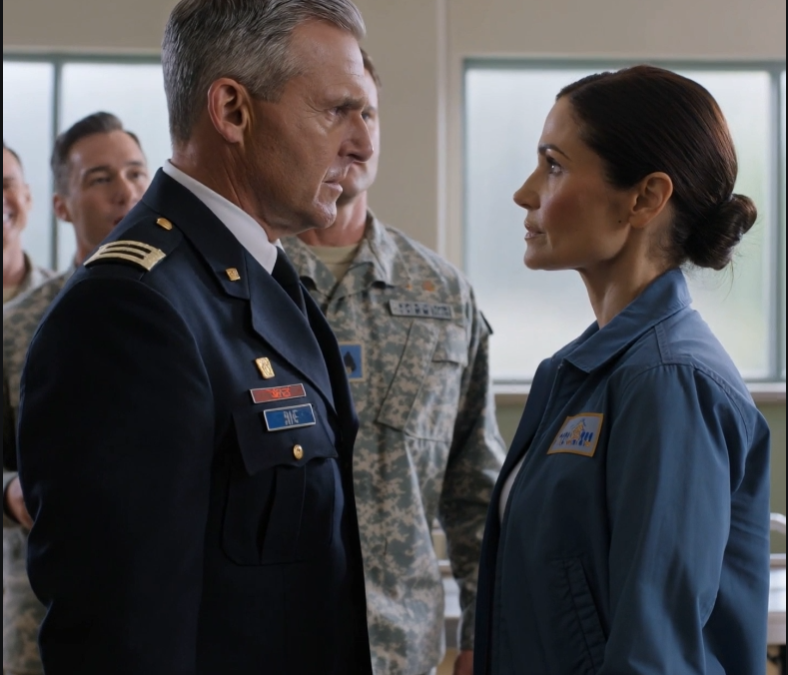
The tray rail in that dining facility was stainless steel, polished by forty years of forearms. I remember exactly how it felt when I caught it, because catching it was the only thing I did fast in those ten seconds. Everything else I did slowly. That is the part people never believe.
The man who shoved me was a staff sergeant with a Ranger scroll on his shoulder and a tray in his hands. He had cut into the serving line with three of his soldiers, the way some men walk through doors, as if the architecture owed them something. I was standing at the rail in jeans and a field jacket, holding a cup of coffee beside an empty tray. I had moved exactly as fast as the line moved, which was not fast at all, because four hundred people were being fed in that hall, and a head table was being served on the far side beneath the flags.
He looked at me the way you look at furniture that has been put in the wrong place.
“Rangers eat first,” he said. “Cooks and coffee girls eat what’s left.”
I did not move quickly enough for his schedule. So he put his shoulder and his free hand into the space between us, and then into me. I went sideways off the rail hard enough that my hip caught the steel, my tray skated three feet down the line, and my coffee jumped its lid. I caught the rail. I kept the coffee. Twenty-two years of holding heavy machines steady in bad air will leave you with hands that do not spill things.
His table howled. Not all four hundred people, just his table, a dozen men in the middle of their meal. The laughter had that particular weather of a closed unit mocking an outsider, the sound bouncing off the long windows.
“Aw,” he said, pitching his voice so they could hear. “Did I hurt her feelings?”
I straightened my jacket, picked up my tray, and set it back on the rail in front of me, exactly where it had been. I did not look at him. There is a kind of stillness you learn in certain cockpits at certain altitudes, a stillness that is not patience and is not fear. I had been learning it since this man was in middle school. I had been shoved before, harder and by better men.
What I noticed first was not a voice. It was the sound of the hall changing.
A dining facility at lunch makes a noise like weather. Hundreds of forks and trays and conversations average out into a gray roar. Somewhere behind me, that roar developed a hole. The hole spread. Chairs scraped at the far end of the room, three of them almost together, the sound carrying because the silence arrived ahead of it.
Then came the voice. One word, and it crossed that hall the way a rifle shot crosses a valley.
“Sergeant.”
The staff sergeant turned toward the head table, his tray still in his hands. I turned, too, because everyone turns toward a sound like that. Three general officers were standing at the head table. All three. The two-star was up first, I would learn later, though from where I stood, they seemed to rise together the way a formation does.
The oldest of them, a lean three-star with silver hair and a Ranger tab older than half the room, had already stepped around the end of the table. He was coming across the floor toward us at a pace that was technically a walk, only because generals do not run indoors.
Four hundred soldiers stopped chewing. The staff sergeant’s tray began, very slightly, to tilt.
I stood at the rail with my cold coffee and my empty tray, in my jeans and my road jacket, and watched fifteen years arrive all at once from the one direction I had never expected them to come.
Three days before that lunch, I was two states away, driving a pickup truck old enough that nobody at any gate ever looked at it twice. That was not an accident. Very little about how I moved through the world was an accident by then. The truck was ten years old, the color of dust, and in the back seat was a garment bag folded once around a dress uniform I wore maybe twice a year.
In the glove box, beneath the registration and a tire gauge, was a set of orders. Those orders said that in three weeks I would take command of a brigade. They had my name on them and my rank, and if you had shown them to anyone in that chow hall before lunch, including the staff sergeant, I believe they would have read them twice.
I had spent twenty-two years in the Army, most of them in a corner of Army aviation that does not advertise. We did not wear our unit on our jackets. We did not tell stories at barbecues. When people at weddings asked what I did, I said I flew helicopters for the government. When they asked which kind, I said the loud kind, laughed, and changed the subject. They remembered me as pleasant and a little boring, which was the goal.
Low, quiet, and off everyone’s scope. I had learned to travel the way I had learned to fly.
There were exactly two things I unpacked at every billet before I unpacked anything else. The first was a brass challenge coin, worn smooth at the edges, with a rotor blade stamped on one face. The brass had gone dark everywhere except where my thumb went. The second was nothing anyone could see. It was a list of six names, and I kept it where I kept it.
At lights-out, in whatever room I was in, I said those names once each in my head, always in the same order, the way other people pray. Five of the six names belonged to men I had carried out of bad places over two decades. Men who had lived. I kept those five to remind myself that the work was real.
The sixth name was Danny.
I will get to Danny.
The symposium that brought me to that post was the kind of thing the Army does well and enjoys too much. Three days of leadership panels and slide decks in a fieldhouse, attended by every commander and command sergeant major in the community. It was hosted that year by a Ranger battalion because their post had the newest fieldhouse. My name was on the attendance roster because incoming brigade commanders were asked to come.
I had called the action officer two weeks out, a major with a polite phone voice, and made one request.
“Put me in the back row,” I told him. “I do my best work there.”
He laughed because he thought I was being modest. I was being accurate. The back row is where you see everything. The back row is where I had spent my whole career, and I do not mean that as a complaint. Some people are built for the front of the room. I had spent twenty-two years learning that the room only works because of what happens behind it, above it, in the dark at altitude, on the nights nobody films.
I drove in on a Saturday because I like roads better than airports and because the drive gave me two days alone with farmland and the radio. Somewhere in the second state, I stopped for gas, and a woman at the next pump looked at my truck bed, looked at my boots, and asked if I hauled horses.
“Used to haul something like that,” I said.
She nodded, satisfied, and that was the whole conversation.
I should tell you what the work actually was, the part I can tell, because otherwise the quiet sounds like mystery. It was never mystery. It was labor.
I spent my twenties learning to put sixty thousand pounds of helicopter into spaces with no margin, at night, in weather that grounds sensible people. I spent my thirties teaching other pilots to do it, and my forties signing for the units that do it.
The community I served in selects for a particular temperament, and it is not the temperament the movies think. It is not swagger. It is the opposite of swagger. It is people who triple-check things that have never once failed, who speak on the radio in voices you could set a metronome by, who believe all the way down that the mission is the star, the crew is the crew, and nobody in the aircraft is the main character.
You live like that for two decades, and it gets into everything. You stop reaching for credit the way you stop reaching for the controls when the other pilot is flying. Somebody else briefs the mission you planned, and you sit in the third row taking notes on your own plan. It does not even sting anymore, and you tell yourself that is professionalism.
Mostly, it is. I still believe mostly it is.
But I will tell you the test, because I learned it the hard way, and you may as well have it for free. Professional quiet serves the mission. The other kind serves everyone else’s comfort. They look identical from the outside. They even look identical from the inside for years, until some plain envelope or some stranger’s shove comes along and shows you which one you have actually been practicing.
That is who came through the front gate at dawn on the day of the symposium. A forty-four-year-old woman in a dusty truck, waved through by a private who barely bent down to the window. A colonel’s eagle in a glove box. A garment bag folded once. A brass coin in a jacket pocket, riding where it always rode.
And in a desk drawer two states behind me, in a house with nobody in it, was a letter from the Army that had taken fifteen years to arrive.
In 2011, I was a captain, twenty-nine years old, flying heavy assault helicopters for a special operations aviation unit whose name I spent a decade and a half not saying out loud. I can say some of it now. That is what the letter in the drawer was about.
Bear with me.
That August, there was a valley in eastern Afghanistan, a long granite bowl with one good entrance and no good exits. On a moonless night, a Ranger element went into it after a target, and the valley closed behind them like a hand.
By 0200 hours, they had wounded men they could not move, and an enemy on three ridgelines walking fire down onto their position. The ground force commander, a lieutenant colonel whose voice I knew from the radio and whose face I had never seen, was calling for extraction in the tone professionals use when they are telling you the truth slowly so they do not tell it fast.
Two aircraft went in. I was pilot in command of the lead, call sign Archangel 26.
My crew chief was a staff sergeant named Tobias Quinn, who had hands like a cabinetmaker and never once raised his voice in an aircraft. My flight engineer was a sergeant named Danny Wallace, twenty-seven years old, from a town in Ohio that I have since visited twice. He held the record in our company for the worst impressions of every officer he had ever met, including me.
His impression of me was a flat voice saying the words, “Copy. Continuing,” in response to increasingly catastrophic information, and I want it understood that the impression was fair.
The second aircraft, Chalk Two, was flown by a major named Miles Crane, six years senior to me, smooth on the controls and smoother off them, the kind of pilot who briefed beautifully.
On the first run into the valley, both aircraft went in together, and the valley lit up.
Chalk Two took a burst through the aft pylon before the wheels were down, lost hydraulics in one system, and waved off with metal in two of its crew. Crane pulled out of the bowl and turned back for the forward base.
I want to be precise here because, for fifteen years, I had to listen to people be imprecise about it in both directions. Turning back was the correct decision for that aircraft in that condition. Nobody who was there ever said otherwise.
What happened to the night afterward was not about what Crane did in the valley. It was about what he allowed the world to believe later, in rooms with carpet.
We put down in the bowl alone and loaded the first lift of wounded while the door gunners worked and the airframe took rounds the way a tin roof takes hail. Quinn called the load. We flew out through the entrance notch with tracers crossing above the rotor system and delivered nine men to the surgical team.
Then I did the arithmetic on fuel and weight, and I told my crew we were going back.
“Copy,” Danny said. “Continuing.”
He grinned at me in the green light because he had been doing that impression for two years, and it had finally come true.
I want to put you inside the next twenty minutes as far as I am allowed to.
The forward base pad at night is its own weather system, rotor wash and grit and men running bent over. While the medics pulled the first nine off the ramp, I sat at the controls doing fuel math with a thumb that would not stop tapping the cyclic, which is the only nervous habit I have ever had and the only place it shows.
The tower asked my intentions. I heard myself state them.
There was a pause on the radio, the length of a senior man somewhere deciding whether to make my decision for me. Then the net cleared, and we lifted.
The second run was worse because the valley had our number now. They had moved guns to the entrance notch, and we came in low over the south wall instead, a line I had eyeballed on the first climb out and filed away because a part of every pilot’s mind is always shopping for the next way in.
On the ground, the lieutenant colonel’s perimeter had shrunk by thirty meters, and his voice had not changed at all. And I will tell you, of every man I have ever heard on a radio, that voice in that valley is the one I would teach.
We took the second lift out through smoke so thick the rotor system drummed it into shapes. It was on that second lift that the other passengers came aboard, the ones I am still careful about.
They carried equipment cases, and they did not speak. One of them sat on the floor with his back against the gun mount and watched Danny work the ramp for the entire flight. At the pad, going off the tail, he stopped, slapped the airframe twice with a flat hand, and pointed one finger at Danny like a man marking something he intended to remember.
Danny gave him a thumbs-up and went back to his chains.
That, as it turned out, was the moment the whole night changed owners. Those cases and those silent men were the reason the file went dark, and the rescue went dark with them. A sergeant from Ohio went dark, too, folded into a program he had never heard of on the strength of a finger pointed at him by a man whose name does not exist.
The third run, the last one, is the one whose ending I have already told you. We went back twice more after that first lift. Twenty-two Rangers came out of that valley alive on my aircraft over three lifts.
On the last climb out, with the cockpit glass starred on my side and a piece of something hot sitting above my left eyebrow, the ramp took a long burst while the last men were coming aboard. Danny Wallace stood on that ramp, in the doorway of all that fire, and pulled the last Ranger in by the drag handle. He held the ramp and called it clear.
“Ramp’s clear,” Quinn relayed, because Danny’s microphone was already gone, though we did not know why yet. “Last man’s aboard. Go, go, go.”
We were seven minutes from the surgical team when Quinn’s voice changed.
I have spent fifteen years grateful and ashamed that I had an aircraft to fly during those seven minutes, because flying it was all that was asked of me. The men in the back were asked for so much more.
Danny Wallace died on the pad with the rotors still turning above him.
Twenty-two men lived.
The lieutenant colonel from the radio walked off my ramp on his own legs with another man’s blood down his front. He stopped in the rotor wash and looked up at the cockpit on the side of the aircraft for three full seconds. Then they took him to the debrief, and I never saw his face again for fifteen years.
He never saw mine.
Here is the part I could not say until this year. There was something else on that objective, and something else on my aircraft that night on the second lift.
A sensitive element with sensitive equipment and sensitive passengers. I am still careful by reflex.
The careful version is this: The rescue itself was a clean, loud, brave, ordinary piece of soldiering, and it had the bad luck to happen in the middle of a program so dark that everything it touched went dark with it. By the time the sun came up, the whole night had been pulled into a special access program, and the rescue had been pulled in with it, the way a clean shirt goes down with the laundry.
My battalion commander then was a lieutenant colonel named Adele Fontaine, the best officer I have ever worked for. She called me into a plywood office that smelled of burned coffee and told me the shape of my future with her hands flat on the desk, because she refused to soften things by fidgeting.
“The rescue happened,” she said. “You didn’t. I’m sorry, Captain. That’s the shape of it.”
The citation went through closed channels.
In 2012, in a conference room with eleven chairs and no windows, a man whose name I cannot use even now hung the Distinguished Service Cross around the neck of my dress uniform. Then a warrant officer took it off again, logged it, and put it in a case. The case went into the kind of safe that does not get moved when units move.
I was thirty years old.
My mother died believing my career had stalled in staff jobs. I gave a eulogy that protected the program. I want you to sit with that sentence the way I have had to.
And then there was the ceremony I was allowed to attend.
That same year, on a parade field in the sun, Major Miles Crane received the Silver Star. The citation was a masterpiece of the genre, and I mean that without sarcasm. Whoever wrote it threaded a needle because every sentence in it was true. Aircraft commander during a night extraction under heavy fire. Battle damage, casualties aboard. Sound judgment under conditions of extreme risk.
All true.
The needle it threaded was that a reader, any reader, every reader, came away believing the rescue was his. I stood in the back row in a uniform with nothing on it that mattered and watched him take the medal with exactly the right expression: modest and burdened.
At the reception afterward, I heard him say the sentence I would hear him repeat for fifteen years at promotions and panels and podiums, the sentence that was his entire genius in eleven words.
“That night asked everything of the crews, and the crews answered.”
He never lied.
I want to be fair, because fairness is the only thing I have ever been able to afford. Miles Crane never once, in my hearing or anyone else’s, claimed he flew those last two lifts. He just never corrected a single human being who assumed it. And the Army is an assuming institution, and the assumption was promoted with him year over year like a staff officer who does all his work.
The lieutenant colonel from the valley floor became a colonel and then a general. Somewhere in there, he gave a speech about the worst night of his life in an auditorium, and the speech ended up on the internet. A friend sent me the clip with no comment because there was no comment to make.
Onstage, he said he owed his life and the lives of twenty-one of his men to a voice on the radio and a call sign on the side of an aircraft, and that he had never been allowed to learn the name behind it.
“Wherever Archangel 26 is,” he said to an auditorium, to a camera, to nobody, to me, eleven years after the valley, “I hope she knows.”
He said she. The radio had given him that much.
I watched the clip once at one in the morning, closed the laptop, and went to work the next day, low and quiet and off everyone’s scope. If you had asked me, I would have told you in a flat voice, “Copy. Continuing.”
The letter came in April of this year, in a plain envelope with a government frank. It sat in my office inbox for two days between a parking memo and a dental reminder, which is the Army’s way of telling you that miracles ride coach.
Programs have clocks. Most people never think about it, and there is no reason they should. But classification is not a tomb. It is a lease, and leases run out. Somewhere in a building full of patient civilians, there is an office whose entire job is to walk down the shelves of the nation’s secrets with a calendar in hand.
Fifteen years is one of the standard calendars.
The letter was four paragraphs. It informed me, with regret for any inconvenience, that following a scheduled declassification review, portions of a 2011 operational file had been approved for public release; that the released portions included after-action summaries and award citations; and that, as a named party, I was being notified as a courtesy.
There was a control number. There was a website. There was a signature block belonging to someone whose entire career happens at a desk I will never see, and to whom I owe more than I owe most of the people who have pinned things on me.
My name was in a public record attached to that night for the first time in fifteen years.
I read the letter twice. Then I put it in a drawer and closed the drawer, and I am still not able to fully explain the closing of that drawer. Fifteen years I had wanted that piece of paper. Now it sat in my desk like a bird I no longer knew how to feed.
Quinn called me the same night, which is how I learned the file was already loose in the world.
Tobias Quinn, retired sergeant first class, two replaced knees, a porch in Tennessee, the steadiest hands I ever flew with. He had been crying, had stopped, and had started again when I picked up.
“They printed our names, ma’am,” he said. “It’s on a .gov site. Anybody can read it. Danny’s, too.”
He took a long breath.
“First time the Army ever spelled Wallace right.”
We stayed on the phone for an hour and said maybe two hundred words between us. That was always our ratio.
The symposium invitation had come the month before, routine, a tasking more than an invitation. Major General Adele Fontaine, who had long ago traded the plywood office for two stars, wanted her incoming brigade commanders in the room.
I pulled up the agenda to plan my travel, and that was when I saw the speakers list. Between a panel on talent management and a fireside chat, there was a name.
Brigadier General Miles Crane.
The topic of his leadership talk was Decision Under Fire.
I sat looking at that title for a while. I would like to tell you I laughed. I did not do anything at all, which, after twenty-two years, is my versatile response to almost everything.
Then I signed the attendance block and booked no flights because I had already decided to drive.
The file was out. The ground had moved. I had not moved with it yet, but the thing about ground is that it does not require your participation.
Miles Crane called me two weeks before the symposium.
I had not heard his voice on a phone in ten years, and it arrived exactly as I remembered it. Warm, unhurried, the voice of a man who has never once been interrupted.
“Camille. Long time.”
He spent ninety seconds on my brigade selection, congratulating me with what I will concede was real professional respect, because the terrible thing about Miles was that none of it was fake.
Then he got to the freight.
“Listen, the release caught us all off guard. My office is getting questions. A couple of the association newsletters, one reporter. Nothing serious yet.”
A pause shaped exactly like sympathy.
“I think the dignified thing for the families, for Wallace’s family especially, is to let the record live in the archive. It speaks for itself now. No interviews, no theater.”
Then, softly, came the sentence he had been driving toward since hello.
“You’ve never been one for theater, Camille. It’s what I’ve always admired about you.”
There it was.
Fifteen years of my silence handed back to me as my virtue, my discipline repurposed as his shelter. He had found the one frame in which my staying small was a favor I would be doing for a dead man’s mother.
I told him I had no interviews planned, which was true. He said it was good talking to me, which may also have been true. We hung up, and I sat in my kitchen while the refrigerator hummed.
That evening, I walked the post where I was stationed, out along the airfield fence. It is a thing I do in the way other people walk to clear their heads, except my head does not clear. It just gets quieter company.
Out by the fence, with the smell of jet fuel coming over the wire, I let myself stand in the memory I usually walk past.
Danny Wallace’s funeral. Ohio. October 2011.
A white church at the edge of a corn town. A folded flag. An honor guard from a unit Danny had never served in because his own unit could not be named on a program. Half his company was there anyway, in dress uniforms with thin ribbon racks that lied by omission.
We all told the same outline of the same story in the same words because we had been briefed in the parking lot. The briefing was lawful and necessary, and I have hated it quietly for fifteen years.
His mother, a small woman who had taught third grade for thirty years, held my hands in both of hers at the reception and asked me the only question she had.
“Were you with him? Can you tell me how it was?”
I answered her inside the lines of a cover story. I said true things, carefully selected, professionally arranged.
“He did not suffer long. He was holding the door for his brothers. Everyone came home because of him.”
All true, every word, and arranged so that the shape of the night could not be seen.
She thanked me and hugged me, and I flew home with the unspent truth sitting in my chest like cargo that had missed its flight.
That was the wound, if you want it named. Not the closed room, not the safe with my medal in it, not Crane on his parade field. The wound was nodding along. Fifteen years of being a co-signer on a silence I had never chosen, smiling at receptions while my own night was told around me by men who were not there for the end of it.
Quiet had been my discipline. Somewhere along the way, it had become my disguise. And the difference between those two things is the difference between wearing armor and hiding in it.
Two days later, a printed symposium packet arrived. Inside it, unsigned and unexplained, my copy of the agenda had one line of handwriting in the margin next to the seating notes. Small, upright script I knew from a thousand orders.
Back row’s fine. AF.
Adele Fontaine had countersigned the classification order in 2011 with her hands flat on the desk. She had also, I understood from those four words, spent fifteen years not forgetting it.
She was not telling me where to sit. She was telling me she knew exactly who would be in the building and that, wherever I sat, somebody in that room finally knew what they were looking at.
I read the line twice and put the packet in the truck.
The night before I drove, I took the case down from the closet shelf. It had been moved by classified courier four times in fifteen years, every time I changed stations. The absurdity of that was not lost on me: a medal with its own security detail and an owner who could not wear it to dinner.
The release had changed that, too. A second letter from the awards branch had confirmed it in the bloodless prose of the personnel system. The decoration was now publicly acknowledged and authorized for wear.
I opened the case on the kitchen table.
The Distinguished Service Cross. An eagle on a cross. It sits heavy for its size, and I had held it exactly three times. Once in the room with eleven chairs. Once when a courier made me verify a serial number. And now, in a kitchen at forty-four, with the refrigerator humming.
I closed the case and left it on the shelf.
If that surprises you, I understand. But the symposium was not my assumption of command. Showing up to a leadership conference with the cross on my chest would have been an argument, an opening statement, theater of my own.
Crane was right about exactly one thing. I have never been one for theater. The difference, which he will never understand, is the reason.
Theater is for changing what people see. I no longer cared what people saw. I had one debt left to pay, and it was not to the audience. It was to a sergeant from Ohio, and it could not be paid with a medal.
Anyway, I called Quinn from the road the next morning and told him about Crane’s phone call, because Quinn is the only living person who was inside that aircraft and inside all fifteen years of the silence, both.
He was quiet for a moment. Then he said the only impatient thing I ever heard him say.
“You going down there to finally be seen, ma’am? Tell me that’s it. Even a little.”
“No,” I said.
I had had two states of farmland to make sure of the answer.
“I’m not going there to be seen, Toby. I’m going so I stop hiding. Those are different.”
“Huh,” he said.
Then, after a mile, he added, “Danny would say, ‘Take the medal.'”
“Danny would take the medal,” I said. “Wear it to the chow hall and ask the salad bar to salute him.”
Quinn laughed for a long time, the wet kind of laughing. We hung up, and I drove the rest of the way with the radio off.
I came through the front gate at dawn on Saturday, the day before the symposium opened. A private waved the dusty truck through without bending to the window.
I drew a room in the visiting officers’ quarters from a desk clerk who called me “ma’am” in the civilian way, the way that means nothing. I slept nine hours, and in the morning I put on jeans, a clean shirt, and the road jacket because in-processing and billeting paperwork are not uniform events, and my report date was not until Monday.
I want that on the record plainly because of everything that came after.
I was not in disguise.
I was a colonel on a Sunday in civilian clothes, with a billet folder in her truck, planning to sign forms, find the fieldhouse, and eat one quiet lunch.
The opening lunch was being served in the battalion dining facility, the schedule said. All symposium attendees welcome.
I do my best work in the back row. I figured I would do the same in a chow line.
The dining facility had been polished for the occasion, the way the Army polishes things, which is to say completely and slightly past the point of sense. Somebody had buffed the tray rail.
There were tablecloths at one end of the hall, beneath the flags of every unit on the post. At the long head table sat the senior visitors, bright with stars even at a distance, being served by soldiers in serving whites who moved like it was an inspection, because it was.
I did not study the head table when I came in. I registered it the way you register weather, scanned for exits the way twenty-two years makes you scan, took a tray, and joined the serving line with everybody else, between a young specialist and a contractor with a lanyard.
The hall was loud and warm and smelled like every dining facility since the beginning of the world. Steam and gravy and floor wax. And I had missed it, honestly, the way you miss ordinary rooms where nobody knows you.
I had a cup of coffee in one hand before I even reached the hot line because old habits know where the urns are.
The staff sergeant came in at full conversation, four soldiers in tow, all of them in regimental physical training gear with their unit ball caps, fresh off some Sunday detail. He was broad and sun-reddened and wore his authority the way young, strong men wear it, right out on the surface where it can get scratched.
They came up the line from behind, and he stepped into the gap in front of me as if the gap had been reserved. His men folded in after him.
The specialist behind me went very still, the way juniors do when physics is about to happen.
I said nothing because a chow line is not a hill, let alone one to die on. But I did not step back either, because my tray was on the rail and my feet were where my feet were.
He noticed the not stepping back. They always notice the not stepping back.
He turned and took inventory of me.
Jeans. Road jacket. Forty-four years old. Coffee.
No badge he recognized. No rank he could see. A woman in his chow hall on symposium Sunday, and his arithmetic came up with the only answer young certainty allows.
“Rangers eat first,” he said, loud enough to feed his table the line. “Cooks and coffee girls eat what’s left.”
“Good to know,” I said mildly, and stayed exactly where I was.
That was the wrong answer for his audience. Or the right one.
He put his shoulder and his free hand into me. Hard. A real shove, the kind that is dressed as casual but comes up from the hips, and I went off the rail sideways.
My hip rang against the steel. The tray skated. The coffee jumped but did not fall because some part of my hands has never once been off duty.
His table howled.
“Aw,” he said to the laughter, gesturing at me with his tray like a tour guide. “Did I hurt her feelings?”
I straightened my jacket, set my tray back on the rail, and stood still in the small, bright center of all that laughter, the way I have stood still inside louder things that were actually trying to kill me.
I felt the old cold settle over me. The working cold, the altitude where everything slows down and the hands take over.
Inside that cold, I had a thought that almost made me smile, which would have confused everyone.
The thought was, Copy. Continuing.
The hall’s roar developed a hole.
The hole spread outward from the head table like rings on a pond, conversations dying in widening circles as people followed other people’s eyes.
I heard the chairs, three of them scraping back almost together.
I learned afterward, from a dozen retellings, the order of what I could not see.
Major General Adele Fontaine, fifty-eight years old, two stars, had been mid-sentence with the host battalion commander when the shove happened in the corner of her eye. She was on her feet before her own glass stopped rocking because she had recognized the woman by the rail the moment it happened, the way you recognize people you have wronged.
Beside her sat the three-star, the symposium’s senior visitor, a lean, silver-haired lieutenant general with a Ranger tab, a master parachutist badge, and a Distinguished Service Cross ribbon of his own.
He came up out of his chair, following Fontaine’s eyes, asking her one word.
“Who?”
Fontaine, who had countersigned the order that erased me and had spent fifteen years filing it where she filed her regrets, said my name into the falling quiet, loudly enough that the name itself started outward through the room like a current.
Crane, the third general at that table, rose last and slowest. I am told his face was already arranged when he came up, pleasant, burdened, correct.
Some men rise for the occasion. Miles Crane rose for the optics one last time, because the optics were all that had ever been his.
But the voice that crossed the hall belonged to the three-star.
“Sergeant!”
It hit the room like a rifle shot in a valley, one word with thirty-five years of close air under it.
The staff sergeant turned toward the head table with his tray still in his hands, and every Ranger in the hall came to some version of attention without being told, the way a body flinches before the mind catches up.
Lieutenant General Harlon Voss came around the end of the head table and crossed that dining facility at a pace that was a walk only by the letter of the law.
Fifty-seven years old, silver to the temples, lean as fence wire. As he came, the silence went total.
Four hundred people stood or froze half-standing, forks down. The only sounds in the building were his footfalls and the kitchen’s far-off steam.
The staff sergeant had gone to attention by then, locked, eyes front, gray climbing his neck. He believed, I could see him believing it, that he was about to be destroyed for shoving a civilian in front of the head table.
He was preparing for that.
He had no idea, none, that the truth coming across the tile toward him was so much larger and so much older than his ten seconds of bad manners.
Voss did not stop in front of him.
He stopped in front of me.
Up close, his eyes were pale gray, and they were doing something I have only seen eyes do a few times, a kind of frantic arithmetic. Fifteen years of a voice being fitted, feature by feature, onto a face.
When he spoke, it was to the staff sergeant, but his eyes never left mine. His voice was pitched for the whole hall because some sentences are orders, even when they are aimed at no one.
“That coffee girl outranks every Ranger in this hall.”
Nobody moved.
I watched the sentence land on the staff sergeant like rotor wash.
“Sergeant,” Voss went on, conversational now, terrible now. “In April, the Army declassified a file. I have read it nine times. I can quote it. Colonel Camille Drayton. Captain then. Pilot in command, Archangel 26.”
His jaw worked once.
“On the worst night of my life, this woman flew into a valley that two governments had given up on. Three times. Alone, after her wing aircraft was shot off her, she carried out twenty-two of my Rangers.”
His voice did not rise. It came down, which was worse.
“I was the twenty-second man, Sergeant. She carried me.”
The staff sergeant’s tray was no longer tilting because a private had quietly taken it from his hands, which is its own kind of mercy.
Then Harlon Voss, lieutenant general, Ranger, fifty-seven years old, came to attention in front of a woman in jeans and a road jacket and saluted me in a dining facility on a Sunday, in front of four hundred people.
He held the salute.
“Archangel 26,” he said, only for me now, his hand at his brow, his voice finally just a man’s. “Fifteen years I’ve owed you my name to your face. Harlon Voss. Valley floor, north end.”
His eyes were shining, and his hand did not shake.
“I kept saying, ‘I hope she knows.’ Well, I am asking now. Do you know?”
The whole hall was on its feet by then. Nobody had ordered it. It went up row by row, table by table, a long, rolling rustle of four hundred chairs, cooks at the serving line standing straight with their tongs still in their hands.
At the head table, far away, Adele Fontaine stood with her fingertips pressed white against the tablecloth and her chin absolutely level. Miles Crane stood beside her, wearing the expression of a man at his own audit.
I returned the salute.
Some part of my hands has never once been off duty.
While our hands were still raised, Adele Fontaine arrived at the edge of my vision, having crossed the hall at the dignified speed of a two-star who refuses to be seen hurrying.
What she did was small, and I will keep it always.
She did not salute, and she did not speak. She picked my tray up from the rail where it sat askew, set it back in front of me, square the way you dress a line, and stood beside me at the rail, facing the room.
A battalion commander again for ten seconds, putting herself where she had not been able to stand fifteen years ago.
I understood every word of it.
There were none.
“I know now, sir,” I said.
And because the silence had been mine for fifteen years, and this next sentence was the only thing I had ever truly wanted to do with its ending, I said the rest loudly enough for the cooks to hear it.
“But you should know the ramp held because of Sergeant Danny Wallace, flight engineer, Archangel 26. He stood in the door of all of it and pulled your last man aboard, and he did not come home. I just flew the aircraft.”
The name went through the hall and found the wall and stayed there.
Voss closed his eyes for one second, the way you do at a graveside.
“Then we will say his name here, too,” he said.
My coffee, when I finally lifted it, had gone completely cold. I drank it anyway.
It was, and I am being precise, the best cup of coffee of my entire career.
They tried to walk me to the head table. I asked instead for ten more minutes in the serving line because I had come for lunch, and the line had reformed.
Voss laughed like a man whose ribs hurt and said the United States Army had waited fifteen years and could wait through the salad bar.
He posted himself beside me in the line, three stars in service dress next to a road jacket, talking quietly about the valley’s north end. We moved down the rail together at exactly the speed the line moved, which is, I have come to believe, the speed of everything that actually matters.
The staff sergeant found me that afternoon.
Staff Sergeant Bryce Rener, twenty-nine, eight years in, ball cap in his hands, marched up to me outside the fieldhouse with his battalion command sergeant major standing off at a distance the CSM had chosen carefully. Close enough to witness, far enough that the apology had to stand on its own legs.
He did not perform it. I will give him that for the rest of my life.
He stood at attention, looked me in the eye, and said, “No excuse, ma’am. None.”
“No,” I agreed. “None.”
He took that standing, too.
And because he had not added a single decoration to it, not one but, I gave him the only thing I had decided he could usefully carry.
“Sergeant Rener, the problem was never who I turned out to be. Understand that, and we’re done here. You shoved a stranger because the room let you, and the room let you because you’ve been winning the wrong game in it for eight years.”
“Yes, ma’am.”
To the command sergeant major afterward, I said one sentence and left proportion where it belongs, in his chain of command.
“He shoved a stranger, Sergeant Major. Whoever she turned out to be, start there.”
I am told they started there. I never asked where they finished.
The rest of that Sunday had a strange ringing quality, like the hour after an engine shuts down. Word moved across the post at the speed word moves, which is faster than aircraft.
By the dinner meal, the story had already grown. There was a version where I had put Rener on the floor, which I had not, and a version where I was an undercover inspector general, which I dearly loved. There was even a version surprisingly close to the truth, which is rare and should be encouraged.
Young soldiers found reasons to walk past me.
Two cooks from the serving line, both specialists, came to my table at dinner. They stood there gathering courage until the taller one finally spoke.
“Ma’am, we eat what’s left every day. No disrespect to anybody.”
I laughed harder than I had laughed in a year and told them the coffee girls had always been my people.
I meant it.
The symposium opened the next morning. There was an agenda printed in three colors.
The agenda did not survive contact.
Lieutenant General Harlon Voss was the opening speaker, slated for thirty minutes on large-scale operations. He walked to the lectern, set his slides aside without apology, and put a single sheet of paper down in front of him.
I knew the font from forty feet away because government prose has a face like a relative in April.
He said, “This citation was declassified. It has never once been read aloud in public. By the authority vested in me by nobody, that ends this morning.”
He read my citation to the community.
All of it.
The bowl. The three lifts. The wing aircraft lost off the formation. The cockpit glass. The ramp.
He read Danny Wallace’s posthumous citation after it, and he read it more slowly. When he reached the words held the ramp, the fieldhouse, nine hundred chairs, made no sound whatsoever.
He named Tobias Quinn, crew chief, and the door gunners.
Then he looked up and found me in the back row, aisle seat, and did not make the room turn around, which I will always credit him for.
He only said, “The Army keeps its secrets for good reasons, but it kept this one from itself. Gentlemen, ladies, the cost of a culture that assumes who its heroes are is sitting in this room, and it has been sitting in our back rows for fifteen years.”
The next speaker on the agenda after the morning break was Brigadier General Miles Crane.
Decision Under Fire.
He gave it.
I will say this for Miles. He stood up in the worst room of his life and delivered all forty of his slides in a steady voice. It was a competent talk, and nobody heard one word of it.
The community is not stupid. The citation had hit the fieldhouse two hours earlier, and every officer in those chairs had spent the break doing the same arithmetic on his Silver Star that I had watched a parade field not do in 2012.
Nothing in his citation was false. The room simply reread it in real time, at scale, and the assumption that had carried him for fifteen years stood up from its seat beside him and walked out.
Assumptions do not come back.
He found me in the corridor at the lunch break, beside the trophy cases. Credit where due, he came alone.
“Camille.”
The warm voice had a hairline crack in it now, right across the middle.
“I want you to know I never claimed your night. Not once. Not anywhere. You will not find one sentence.”
“I know,” I said. “I’ve looked.”
I let that settle between us.
“Fifteen years, Miles. You never claimed it. You just never refused it.”
He stood with that.
Then, because the manager in him could not help itself even at the bottom, he said, “Is there anything you need from me going forward?”
“That’s the cleanest confession I’ve ever heard,” I said. “And no, there’s nothing I need from you going forward, and nothing going backward either. We’re fully settled.”
I offered my hand. He took it, and we shook once, the way you close an account.
I declined dinner, and that was the last private conversation we will ever have.
Two days later, his office announced, citing schedule, that he was withdrawing from the symposium’s closing panel. I am told the request was his own. I believe it.
Optics were always his instrument, and he could finally hear them.
I want to be careful with this part because stories like mine get told as if the ending erases the middle, and the middle does not erase. The middle is fifteen years long, and I live there.
That evening, I skipped the symposium icebreaker and walked the host post’s airfield fence at sunset because every post has a fence, and my feet know the way.
I called Quinn.
He had watched a video of the citation reading by then. Some captain had filmed it on a phone, and it was already moving through the community the way the shove video would have moved if anyone had filmed that instead.
There is a sermon in that, but I was too tired to write it.
“His mom called me,” Quinn said instead of hello.
“Mrs. Wallace?”
“She read Danny’s citation to me over the phone. The whole thing out loud.”
A long pause, Tennessee humming in it.
“Fifteen years, ma’am. That woman thought she knew how her boy died in outline. She read it to me like it was news from him.”
We talked about Danny in the open air, by name, at volume, for the first time in our lives. It turns out we both did impressions of him doing impressions.
It turns out grief you finally say out loud weighs less coming up than it did going down, but it scrapes more.
Here is the inventory, and I will keep it short because self-pity is a fuel that burns dirty.
The boards.
Twice early in my career, I was passed over for jobs I wanted badly by good officers making sound decisions off a file that read thin in exactly the years that were the thickest of my life.
I have since sat on boards myself. I do not blame the men who read my file. I blame no one, which I have learned is not the same as saying no harm was done.
The friendships.
You cannot grow people close to you when half your life is a locked room. You learn a smooth, pleasant, bulletproof small talk. You become known as private, and then one day you are forty-four and your truck is the thing on post that knows you best.
And Mrs. Wallace’s hands in Ohio in October, holding mine while I answered her question inside the lines. Every word true, and the shape of the night hidden, and her thanking me.
Of everything the silence cost, I will be paying that one off the longest, because she deserved the truth from a person in a kitchen fifteen years before she got it from a website.
That night, in the visiting officers’ quarters, on government stationery I found in the desk because some traditions hold, I wrote her a letter.
Longhand. Eleven pages.
The whole night, all of it. Every minute of her son. The impression he did of me. The grin in the green light. The ramp. The seven minutes. The pad.
I signed it with my name and my call sign, and I sealed it before I could soften it because I knew if I read it over, I would start protecting her again.
Protecting people had been my way of hiding from them for fifteen years.
I mailed it in the morning.
The cost stays the cost. But it stops compounding the day you finally tell the truth at full length.
Three weeks later, on a parade field two states away, I took command of my brigade.
I wore the Army service uniform out of the garment bag that had ridden behind my seat, and on it, for the first time in any public place on this earth, was the Distinguished Service Cross.
The awards branch letter had said authorized for wear. I have read drier sentences, but not many that changed more.
Tobias Quinn sat in the front row in a gray jacket that did not fit him because he had bought it in a hurry. I had called him myself and told him that if he was not there, I would send an aircraft, and he knows me well enough to know it was only mostly a joke.
He sat where families sit.
He is what I have, and I am what he has, and the program that owns half our memories can keep the memories. It cannot have the row of chairs.
Major General Adele Fontaine presided.
We had spoken exactly once about 2011 the week before. Fifteen minutes in her office, door open, both of us too old for theater.
She did not apologize the way people do on television.
“I signed it, Camille,” she said. “I’d sign it again tomorrow. The program was sound, and it cost you what it cost you. Both of those are true, and I have carried the second one.”
That was the entire conversation, and it was enough because it was exact.
The apology she actually owed me, she paid on the parade field in public, inside the official act, with the microphone on.
“Some debts the Army pays late,” she told the formation, the families, the flags. “It pays them in full today.”
Before the ceremony, in the small room behind the reviewing stand where commanders wait, Fontaine handed me coffee in a paper cup. We stood at the window watching the formation assemble, and she told me one thing I had never known.
In 2012, the year of the closed room, she had submitted a formal request to have the rescue carved out of the program and acknowledged separately. It was denied at a level she described only by pointing her cup at the ceiling.
She submitted it again in 2016, and again in 2020, each time on her own letterhead, each time denied.
She had never told me because, she said, “Hope on a schedule is crueler than none.”
The declassification review that finally freed the file was routine, a calendar running out. But there was a memorandum in it, she said, an old one arguing the case. The review officers had read it, and it had mattered.
I asked her if the memorandum had her signature on it.
She looked at the formation through the window and drank her coffee.
That was the third thing she never needed to say out loud.
The ceremony itself I remember in pieces, the way you remember weddings.
Heat shimmer on the parade field. The chaplain mispronouncing nobody’s name, a small miracle. My new command sergeant major, a quiet mountain of a man, marching the colors toward me with the brigade behind him at parade rest.
Three thousand soldiers whose names I did not know yet, and would.
I had made exactly one request of the staff for the reception afterward. It confused the protocol officer badly, and I made it an order gently.
The dining facility crew that catered it ate first. Before the generals, before the families, before me.
Nobody in that brigade asked why, because by then everyone in the Army had heard the story.
But I would have done it if the chow hall had never happened, because twenty-two years in the back rows of rooms teaches you exactly who keeps the rooms running.
The colors came across. I took the staff in both hands, and the weight of a brigade settled into my arms.
From the front row, Quinn watched me with his cabinetmaker’s hands folded.
And somewhere in Ohio, a third-grade teacher had an eleven-page letter in her recipe drawer.
The back row, for once in twenty-two years, was not where I was sitting.
A week after that, an envelope arrived with a handwritten three-star return address. Inside was a single sheet of paper and a square of worn cloth.
The cloth was a unit patch faded to the color of the valley itself.
The note said, “We carried this on the objective. Twenty-one men have one. The twenty-second belongs to you. You flew. We lived.”
H. H. V.
And from Ohio came a photograph.
A sergeant, twenty-five years old, grinning on the ramp of a helicopter in the sun, with a note on the back in a schoolteacher’s perfect cursive.
“He would have loved who he worked for. I am glad to finally know it was you.”
The coin sits on my desk now, in my brigade headquarters, where anyone can see it. The photograph sits beside it.
At lights-out, I still say six names.
The list does not get shorter, but I no longer carry it alone.
And that, it turns out, was the whole difference all along.
I want to say one last thing, and I want to say it straight to you.
Maybe nobody ever shoved you out of a chow line. But if you are still listening to me this far in, I would bet there is work you did in the dark that someone else got daylight for. A record somewhere that reads thin in exactly the years you bled. A room you have stood in the back of for so long that the back of the room started to feel like your name.
Hear me on this.
The work was real.
It was real the whole time. It did not become real the day they read it out loud, and it would have stayed real if they never had.
Records get corrected late or never. Your worth does not wait on either one. The truth does not need an audience to be true, and neither do you.
But I will tell you what I learned at a tray rail, holding a cold cup of coffee.
There is a difference between being quiet and being hidden, and you are allowed to know which one you are doing.
Quiet is a strength.
Hiding is a tax, and you do not owe that tax to anyone. Not to an institution, not to a smooth man with a warm voice, not even to your own discipline.
If you have carried something like that, carried it for years for people who will never know your name, then you are in the best company I know.
I hope someone rises to their feet for you. And if no one ever does, rise for yourself gently, the way you would for a stranger who deserved it, because you are at least that.
Thank you for listening to my story.
If it found you somewhere quiet, tell me yours in the comments because I read them, and I believe you. And if you want more stories like mine, stay close.
The back row is always open, and there is room.








