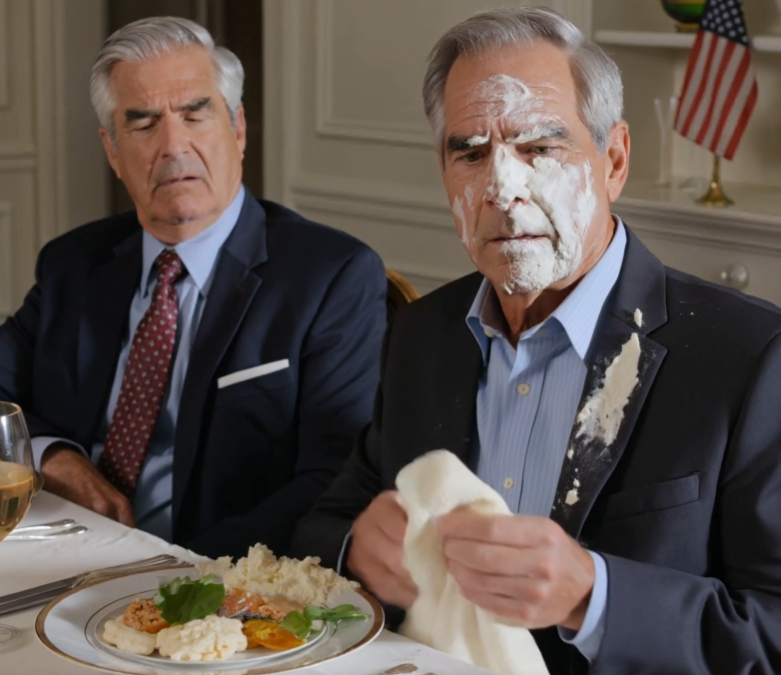
On Thanksgiving, I brought a homemade cake to my daughter’s house. My son-in-law called me a “freeloader old man,” shoved my face into the cake, and yelled, “This cheap cake is just like you.” My daughter filmed it. I walked away. Next morning, I did one thing that made them pay.
On Thanksgiving morning, I woke up at 4:00 a.m. to bake a cake for my family.
But when I brought it to the table, my son-in-law curled his lip, called me a freeloading old man, and mocked it as a cheap cake. My daughter didn’t stop him. She pulled out her phone and recorded him shoving my head into the cake.
I quietly wiped my face, set my napkin down, stood up, and walked away. I didn’t cry. I didn’t say a word, because I knew what happened next wouldn’t need my words.
This is Silent Dad Revenge, stories about fathers who said nothing, then said everything. Leave a comment below with your city or country. It means more than you know. Hit subscribe. You won’t want to miss what comes next.
Note that this story blends fiction with purpose. Any similarity to names or places is coincidental, but the wisdom inside it was built for you.
I was already standing at the flour-dusted counter of my shop, Greg’s Sugar Corner, when 4:07 blinked across the clock above the oven. The shop was dark except for the warm amber glow above the prep station, and outside, Harllo Avenue was still and cold, the kind of cold that settles into Georgia in late November and stays like an uninvited guest.
I didn’t mind the early hour. I never had.
I reached for the apron hanging on the hook beside the refrigerator, the one with the faded sunflower embroidered on the left pocket, its threads worn thin from twenty-three years of washing. Margaret had sewn that sunflower herself the Christmas after we opened the shop. She had pressed the finished apron into my hands and said, “Now you look like a real baker, Greg.”
I laughed and told her I already was one. She said that was beside the point.
I tied the apron strings, slowly smoothed the front panel the way I always did, and turned to the counter. Today was Thanksgiving, and today I was making her recipe.
The vanilla sponge batter came together the way it always did. My hands remembered what my mind had long stopped needing to think about. Three cups of flour, a pinch of salt, the real vanilla extract I ordered from a small farm in Madagascar because Margaret had insisted there was no substitute.
The kitchen filled with a warmth that had nothing to do with the oven temperature. It smelled like every good morning I had ever known.
I was pressing the second layer into the pan when a knock tapped against the front glass. Pastor David Holloway stood on the other side of the door, bundled in his old wool coat, his breath fogging in the cold air. David lived three houses down from my old place on Cedarwood Lane and had walked this stretch of Harllo Avenue every morning for fifteen years.
I waved him in.
“You’re up early, even for you,” he said, stomping his boots on the mat. His cheeks were red from the cold, and his eyes crinkled at the corners when he smiled.
“Margaret’s recipe.”
“What gave it away?” I asked.
“The vanilla.” He inhaled deeply. “That woman could perfume a whole city block.”
I smiled, the kind that starts at the corners of your mouth and works its way up slowly.
“I’m bringing it to Haley’s dinner tonight.”
David’s expression shifted just slightly, not enough for most people to catch. But I had known this man for twenty years, and I caught it.
“That’s kind of you, Greg,” he said carefully.
“She’s my daughter,” I replied, turning back to the batter. “It’s not kindness. It’s just what fathers do.”
David stayed for one cup of coffee and left with a foil-wrapped muffin I pressed into his hand. At the door, he paused and turned back.
“You call me tonight if you need anything. Doesn’t matter what time.”
I looked at him. “I’ll be fine, David.”
“I know you will.” He pulled his coat tighter. “Call me anyway.”
By eight, the cake was cooled, frosted, and boxed. I had piped small white flowers along the border, the same ones Margaret used to make, the ones Haley had pointed at as a little girl and called “the pretty ones.”
I set the box carefully on the passenger seat of my truck, placed a folded dish towel beneath it so it wouldn’t slide, and drove the eleven minutes to 14 Maple Ridge Drive.
The house appeared at the end of the cul-de-sac the way it always did. Large, well-kept, the kind of home that photographed well for Christmas cards.
I had bought it in 1998 with money saved over eighteen years, signed every document myself, and handed Haley the keys on her wedding day, not as a gift, but as a loan of love.
“Until you two get settled,” I had said.
That had been four years ago. The subject of getting settled had not come up since.
I rang the bell. Haley opened the door in a silk blouse that probably cost more than my weekly grocery run. She looked at the white box in my hands, then at me, and her expression arranged itself into something polite.
“Baked again, Dad?”
The words landed lightly, but I felt the weight beneath them. The slight tilt of her chin. The way she said again, the way other people say still.
“Vanilla sponge,” I said. “Your mother’s.”
“Right.” She stepped back from the door. “You can put it in the kitchen.”
She was already walking away when I stepped inside.
I stood for a moment in the entryway, holding the cake box with both hands. The house was warm and smelled like the catered appetizers Evan had probably ordered from that downtown place on Meridian Street. Ivory candles lined the hallway table. A floral arrangement sat in a crystal vase I had never seen before.
I carried the cake to the kitchen and set it on the far end of the counter, away from the catering trays. I opened the box once to check the frosting, pristine and undisturbed, and closed it again.
I heard Evan’s voice from the living room, smooth and practiced, talking about commercial property values with the particular enthusiasm of a man auditioning for an audience.
I straightened my collar, took a breath that reached all the way down, and walked toward the sound.
The living room had been rearranged for the occasion. The everyday furniture had been pushed toward the walls, replaced by a long rented table draped in ivory linen and flanked by chairs that did not match the house but looked expensive enough that no one would say so.
Tall candles burned at even intervals. A string quartet played softly from a Bluetooth speaker near the fireplace. Not real musicians, just a playlist Evan had probably labeled Classy Thanksgiving and felt proud of.
Seven guests sat around the table. I recognized two of them as neighbors from the far end of the cul-de-sac. The others were Evan’s colleagues, the kind of men who laughed half a second after their boss laughed and checked their watches when they thought no one was looking.
At the head of the table sat Russell Bennett.
I had seen his photograph in the Cedarwood Hills Gazette. Silver-haired, broad-shouldered, the kind of face that belonged on the cover of a regional business magazine.
Russell Bennett was the president of First Cedarwood Community Bank.
And from the way Evan was leaning toward him, voice lowered, shoulders forward, hands moving in that particular way that meant he was selling something, I understood immediately why tonight’s dinner needed ivory linen and catered appetizers.
Evan was performing. Russell was the audience.
“The Meridian Street corridor alone is going to see a forty percent value increase over the next eighteen months,” Evan was saying, his finger tracing an invisible map on the tablecloth. “I’ve already got two anchor tenants lined up once the bank comes in as a financing partner.”
He stopped when he noticed me in the doorway.
The shift in his expression was small but total, the way a lamp flickers before it steadies itself. Then the smile came back, wider than before, the kind that showed too many teeth.
“There he is,” Evan said, leaning back in his chair. “The baker.”
A few heads turned.
I walked to the kitchen, lifted the cake box carefully, and carried it out with both hands steady. I set it on the side table near the window, opened the lid, and turned to the room.
“I made Margaret’s vanilla sponge,” I said. “For after dinner.”
Haley, seated halfway down the table, pressed her lips together and looked down at her plate.
Russell Bennett looked up from his wineglass.
“That smells wonderful,” he said.
I could tell the difference between a polite compliment and a real one. He meant it.
“Thank you, Mr. Bennett,” I said.
Evan set his fork down with a small click.
“Russell, don’t encourage him.”
He said it lightly, like it was a joke, but his eyes were flat.
“My father-in-law thinks homemade is the same as good.”
Soft laughter came from the colleagues.
Russell did not laugh.
I moved to my seat at the far end of the table, the chair closest to the kitchen, the one nobody else wanted. I unfolded my napkin and reached for the water glass.
The dinner stretched on.
Evan talked about the Meridian Street project, the bank partnership, and a golf trip to Hilton Head he was planning for the new year. His colleagues echoed and amplified everything he said. Haley refilled wineglasses and smiled at the right moments.
I ate quietly, answered when spoken to, and watched.
I watched the way Evan’s hand shook slightly when Russell asked a direct question about projected revenue. I watched the way Haley’s smile tightened every time Evan glanced at her, like a signal she had learned to respond to without thinking.
I watched Russell Bennett, who ate slowly, asked precise questions, and gave nothing away.
I had spent thirty years reading rooms. This one told me everything I needed to know.
When the main course was cleared, I stood and brought the cake to the table. I set it in the center, lit the single candle I had placed on top, and stepped back.
“It’s a little informal,” I said. “But Margaret always said Thanksgiving deserved something homemade.”
Russell leaned forward to look at the frosted flowers along the border.
“She sounds like she was a wise woman.”
“She was,” I said.
Evan pushed his chair back and stood.
His jaw was set in a way I recognized, the look that appeared when something was happening that he had not planned and could not control.
“Okay, enough of the sentiment,” he said, his voice cutting across the table.
He looked at my cake the way someone looks at an object placed in the wrong room.
“What is this supposed to be, Greg? You brought a homemade cake to a dinner party?”
“Evan,” Haley started.
“No, seriously.”
He stepped around his chair, moving toward the side table.
“We have guests, and you bring in this? What do you even call this? A farmers’ market reject?”
I kept my hands flat on the table.
“It’s your wife’s mother’s recipe,” I said evenly. “I made it for the family.”
“Family?”
He said the word like it tasted wrong.
He picked up the cake box lid and dropped it. The sound made two of his colleagues flinch.
“Let me tell you something about family, old man. Family contributes. Family pulls its weight. You walk around this house like you built it, like you earned your spot at this table. But what exactly have you contributed lately? What does a sixty-five-year-old baker bring to the table besides flour on his shirt?”
The room went very still.
I heard my own heartbeat.
Russell Bennett set his wineglass down.
“Evan.” His voice was low and even. “That’s enough.”
Evan turned to look at him, and for just a moment, the mask slipped. Fear crossed his face before confidence slammed back down over it.
He turned back to me and leaned in close.
“You want to play the humble father routine? Fine. But not at my table.”
He placed one hand on the back of my chair.
Then he placed the other on the back of my neck and pushed.
My face hit the cake.
The frosting was cool against my cheek. The candle went out.
Someone gasped. Someone else made a sound that might have been a laugh before thinking better of it.
Out of the corner of my eye, I saw Haley lift her phone.
I raised my head slowly.
Frosting clung to my eyebrow, my chin, and the collar of my good shirt. My heart was hammering so hard I could feel it in my back teeth, but my hands, when I pressed them to the tablecloth, did not shake.
I was not going to shake.
I reached for my cloth napkin, wiped my face, wiped my collar, folded the napkin once, and set it beside my plate.
Then I stood up.
Russell Bennett was already on his feet.
He did not speak to Evan. He did not look at Haley.
He picked up his jacket from the back of his chair, nodded once at me, an expression that carried more weight than any sentence I had ever heard, and walked out of the dining room.
I tucked my chair in, straightened my back until it ached, and followed him out.
Greg’s Sugar Corner was the only place I had ever felt completely like myself.
Not the house on Cedarwood Lane, where Margaret and I had raised Haley. Not the church pew, three rows from the left, where I sat every Sunday. Not even the driver’s seat of my old truck, though that came close.
It was here, behind this counter, under these amber lights, surrounded by the smell of vanilla and brown butter and powdered sugar, that I knew exactly who I was and what I had built.
I unlocked the front door at seven, stepped inside, and stood in the dark for a long moment before reaching for the light switch.
The fluorescent overheads flickered on.
I walked behind the counter, pulled my stool from beneath the register, and sat down.
I was still wearing my good shirt.
The frosting had dried along the collar into a stiff white line, and there was a faint smear of blue buttercream above my left eyebrow that I had missed when I wiped my face at the dinner table.
I caught my own reflection in the stainless steel panel behind the espresso machine, and for the first time since I had walked out of 14 Maple Ridge Drive, the full weight of the evening landed on me all at once.
My chin trembled. My eyes burned, hot and fast.
I pressed the back of my hand against my mouth and breathed through my nose until the wave passed.
I was not going to fall apart in my own shop.
I pushed myself off the stool, filled the kettle, and set it on the back burner.
My hands moved through the familiar motions. A mug, a tea bag, honey from the jar Margaret had painted a small bee on twelve years ago.
By the time the water boiled, I had gotten most of myself back.
I was on my second cup when I heard a key in the front lock.
Elaine pushed the door open with her shoulder the way she always did and walked in carrying a paper bag from the All Night Diner two blocks over.
My sister was sixty-four years old, wore her silver hair in a braid over one shoulder, and had never once in her life waited to be invited somewhere she decided she needed to be.
“I brought pie,” she announced, setting the bag on the counter. “Real pie from people who make it in a kitchen that isn’t trying to prove anything.”
I looked at her and felt something in my chest crack open.
Just slightly. Not break, just open, the way a window opens to let air in.
“How did you know I was here?” I asked.
“Because you’ve been coming here when the world gets too loud since 1987.”
She unwrapped two slices of pecan pie and slid one across the counter toward me.
“And because Pastor Holloway called me at 7:15 and said, and I quote, ‘Elaine, your brother needs his sister tonight.'”
I wrapped both hands around my mug.
“I’m fine.”
“You have frosting above your eye, Greg.”
I reached up and wiped it away with my thumb. My jaw tightened.
“He did it in front of Russell Bennett,” I said. “In front of everyone at that table. Pushed my face into the cake like I was… like I was nothing.”
Elaine set her fork down.
Her eyes went sharp and still, the way they always did when she was deciding something.
“And Haley?” she asked.
I looked down at my mug.
My throat felt like something had closed around it.
“She filmed it,” I said.
The words landed between us like something dropped from a height.
Elaine exhaled slowly through her nose. Not a sigh, more like a controlled release of something that wanted to be much louder.
“Gregory Alan Whitman,” she said, her voice low and steady. “How long have you been letting this happen?”
“I kept thinking she would…”
I stopped, then started again.
“Haley was a good kid, Elaine. You remember what she was like? She used to sit right there on that stool and eat the broken cookies off the cooling rack.”
“I remember,” Elaine said. “I also remember what Margaret told you the week before she passed.”
My throat tightened until it ached.
I nodded once, slowly.
Margaret had taken my hand from her hospital bed and said, “Don’t let loving her cost you yourself, Greg. She’s grown. She makes her choices. You make yours.”
I had promised her that.
And then grief had made me soft in places I should have stayed firm.
Elaine’s phone buzzed on the counter.
She glanced down, and her expression shifted.
“Haley posted the video,” she said.
My stomach dropped.
“Already?”
“Twenty minutes ago. It’s got four hundred views.”
Elaine was already dialing.
“I’m calling Natalie.”
Natalie Prescott answered on the second ring, her voice precise and alert despite the hour.
I had known Natalie for eleven years. She had been Margaret’s attorney first, then mine. She had a mind like a steel filing cabinet. Everything sorted, nothing lost.
“I already saw it,” Natalie said before Elaine finished explaining. “I’m downloading the original right now before it gets taken down or edited. Elaine, is Gregory with you?”
“He’s right here.”
“Good.”
A pause. The sound of keyboard clicks.
“Gregory, listen to me carefully. What happened tonight at that dinner table constitutes elder abuse under Georgia Code Section 16-5-102. You are sixty-five years old. The act was recorded on video with witnesses present, including the bank president. That recording is now evidence.”
I straightened on my stool.
“I don’t want to make this into something dramatic, Natalie.”
“It already is something,” she said firmly. “The question is whether we shape it or let Evan shape it for us.”
Another pause.
“I need you to go to your lockbox first thing tomorrow morning and check your savings passbook. Do not touch anything else in that box. Just look and call me immediately.”
I frowned.
“Why the passbook?”
“Because six months ago, you asked me to watch Evan’s financial behavior, and what I’ve been watching worries me.”
Her voice dropped half a register.
“I should have pushed harder sooner. That’s on me. But tomorrow morning, lockbox first. Can you do that?”
“Yes,” I said.
“Good.”
The keyboard clicks stopped.
“Try to sleep. Tomorrow we start doing this right.”
The call ended.
Elaine reached across the counter and covered my hand with hers, her grip strong and warm and certain.
“She’s the best lawyer in Cedarwood Hills,” Elaine said.
“I know,” I said.
“And I’ve been waiting four years to make that phone call.”
Despite everything, the frosting on my collar, the ache behind my eyes, the hollow place where my daughter used to live in my chest, I felt something shift.
Not hope exactly. Something quieter than hope and more durable.
I picked up my fork and took a bite of the pecan pie.
“It’s good,” I said.
Elaine smiled.
“Told you.”
I did not sleep.
I had tried, stretched out on the narrow cot in the back office of my shop, the one I kept for early baking mornings and late inventory nights, but my mind would not settle.
I lay on my back, staring at the water stain on the ceiling tile, listening to the refrigeration units hum and thinking about a lockbox I had not opened in six weeks.
At 6:15, I gave up.
I made coffee, drank it standing at the counter, and watched the sky outside the front window go from black to gray to the pale, washed-out blue of a Georgia morning after a hard night.
At seven sharp, I called Natalie.
“I’m already on my way,” she said before I finished my first sentence.
She arrived twenty minutes later in a charcoal wool coat, reading glasses pushed up on her forehead, a leather satchel over one shoulder.
Natalie moved through every room like she owned it, not with arrogance, but with the particular certainty of a woman who had spent thirty years knowing exactly what she was doing and why.
“Show me the lockbox,” she said, setting her satchel on the counter.
The lockbox was a heavy steel unit bolted to the floor of the back office closet, the kind that required both a key and a four-digit code.
I had bought it eleven years ago after the shop was broken into and a register was stolen.
I kept three things inside: the deed to Greg’s Sugar Corner, my personal savings passbook, and a folded letter from Margaret that I had not been able to bring myself to read more than twice.
I unlocked the box and lifted the lid.
The deed was there.
Margaret’s letter was there.
The savings passbook was gone.
My hand went to the edge of the box and gripped it. The metal was cold against my palm.
I stood bent over the open lockbox for a long moment, my breathing deliberate and controlled, the way a man breathes when he is deciding whether to let something destroy him.
“It’s not here,” I said.
Natalie leaned in, looked, and straightened.
Her expression did not change, but her jaw set in a way I recognized as the thing she did instead of cursing.
“The box wasn’t forced,” she said. “No scratches on the lock plate, no damage to the hinge.”
She looked at me.
“Who has the combination?”
I pressed my lips together.
“Two years ago, Evan asked me for the combination,” I said. “Said it was in case I had a medical emergency and couldn’t get to the shop. He said he wanted to be prepared.”
I exhaled through my nose.
“I wrote it down for him. I never asked for it back.”
Natalie closed her eyes for exactly two seconds.
Then she opened them and reached into her satchel for her phone.
“I’m calling Sandra Cole,” she said. “She’s a loan officer at First Cedarwood Community Bank. She’s been a customer here for nine years, and she owes me a favor from a property dispute in 2019. If Evan used that passbook as collateral for anything, Sandra will find the trail.”
Sandra answered on the third ring, her voice warm but immediately alert when she heard Natalie’s name.
“Nat, what do you need?”
“I need you to run a quiet check on any loan applications or collateral submissions tied to the account number on Gregory Whitman’s personal savings passbook. The account is at your branch. I need to know if anything was filed in the last six months under his name or Social Security number without his authorization.”
A pause.
Keyboard clicks.
I stood at the counter with my coffee going cold in my hand, my heart beating in a slow, dreadful rhythm.
“Natalie,” Sandra said, and her voice had changed. “There’s a collateral submission here dated… hold on… November fourth. A savings passbook in the name of Gregory Alan Whitman, submitted as partial security for a business loan application filed by Evan James Caldwell.”
I set the coffee mug down before I dropped it.
“The signature on the authorization form,” Natalie said carefully. “Does it match the signature on file for Gregory Whitman?”
More clicking. A longer pause.
“No,” Sandra said. “It doesn’t. Not even close. The signature on file from his account opening in 2008 is a completely different hand.”
Natalie looked at me.
I looked back at her.
What had just been confirmed was large enough that it needed a second to take up its full space in the room.
Then my voice came out rough and quiet and entirely steady.
“He forged my signature.”
“Yes,” Natalie said. “Under Georgia Code Section 16-9-1, that’s felony forgery. Combined with the unauthorized use of your financial account, we’re looking at financial fraud charges that carry up to ten years.”
She pulled a legal pad from her satchel and uncapped her pen.
“Sandra, I need you to flag that application internally and preserve every document associated with it. Do not process anything further on that loan until you hear from me.”
“Already done,” Sandra said.
Then, quieter, “Natalie, is Gregory okay?”
Natalie looked at me.
I had both hands flat on the counter now, my head bowed slightly, my shoulders carrying something that had just gotten considerably heavier.
“He will be,” she said.
The call ended.
Natalie set the phone face down on the counter and waited.
I raised my head.
My eyes were dry but burning at the corners, the way eyes get when the tears decide to stay inside instead.
“He sat at my Thanksgiving table,” I said. “He pushed my face into a cake I made with my own hands, and the whole time, the whole time, he was already carrying my savings in his briefcase.”
My voice cracked on the last word, just once.
Then it steadied.
Natalie put her pen down.
“Gregory, I need to ask you something, and I need you to answer honestly. Are you ready to do what comes next? All of it, however long it takes?”
I looked at the empty lockbox, then at the deed to my shop, still sitting inside it, still mine, still intact, still exactly where I’d put it.
“Tell me what to do,” I said. “And I’ll do it.”
Natalie picked up her pen.
“Then let’s start,” she said.
Pause here for just a moment. I now know what was taken from me, but I don’t yet know how far Evan is willing to go, and what comes next will make your jaw drop.
Type “still here” in the comments. I read every one, and right now I need to know you’re still with me.
Quick note: This story carries fictional elements added to bring the message to life. If that’s not something you’d like to continue with, feel free to step away here and know you’re always welcome back.
The week after Thanksgiving moved slowly, the way bad weather moves. Not dramatic, just persistent.
Evan had not apologized. I had not expected him to.
What I had not expected was the silence that replaced the cruelty. Evan moved through the house with a careful, almost cheerful composure, as though Thanksgiving had been a minor miscommunication, already filed away and forgotten.
He greeted me in the hallway with a nod. He complimented Haley’s cooking at dinner. He held doors open.
It was the most frightening version of Evan I had ever seen.
On a Tuesday morning, eight days after Thanksgiving, he appeared in the doorway of the small guest room I used when I stayed overnight at the house.
He was dressed for the office: a crisp gray suit, silver cufflinks, the kind of careful presentation that costs more than it looks.
“Dad,” he said. “Got a few minutes?”
I looked up from my coffee.
Evan had not called me Dad in two years.
“Sure,” I said.
The living room had been tidied since Thanksgiving. The rented table was gone, the ivory linens returned, and the crystal vase had been replaced by a smaller ceramic one Haley had bought at a craft fair.
Evan gestured toward the armchair by the window and waited until I sat before settling onto the sofa across from me.
He set a manila folder on the coffee table between us and folded his hands on top of it.
“I’ve been thinking,” he began, his voice measured and reasonable, “about the family dynamic. About what’s sustainable going forward.”
I wrapped both hands around my mug.
“Go on.”
“You’re sixty-five. You’re running a small bakery on a street that’s about to get very competitive. You’re living between that shop and our home, and frankly…”
He paused, as though searching for the kindest word.
“It’s not a stable situation for any of us.”
“I see,” I said.
Evan slid the manila folder across the coffee table.
“This is an independence acknowledgment. It’s a document that formalizes your commitment to self-sufficiency. No financial reliance on this household going forward. Clean boundaries. I had my attorney draft it.”
I opened the folder.
I read slowly, the top page first, then the second.
My eyes moved down to the fine print at the bottom of page two.
My chest tightened like a fist closing.
Business Transfer Agreement.
Greg’s Sugar Corner. 207 Harllo Avenue, Cedarwood Hills, Georgia.
Full transfer of ownership and commercial title upon signature.
My hands did not shake, but my jaw ached from the effort of keeping my expression neutral.
“This transfers my shop,” I said.
Evan leaned forward, elbows on his knees.
“It’s a formality. The shop isn’t performing the way it used to. We both know that. This arrangement protects you legally while giving the family the flexibility to consolidate assets. It’s practical, Dad. That’s all it is.”
“Practical,” I repeated.
“If you don’t sign,” he said, his voice dropping just slightly, losing its warmth like a coat coming off, “I’ll have to ask my attorney to review your residency arrangement here. This house is a significant asset. I can’t carry dead weight indefinitely.”
The back door opened.
Elaine walked in from the kitchen, tying her scarf loosely around her neck, a reusable grocery bag over one arm.
My sister smiled at Evan with the particular sweetness of a woman who had decided exactly what she thought of him and kept it entirely to herself.
“Oh, sorry. Am I interrupting? I was just dropping off some things for Greg. I can sit in the kitchen if you boys need privacy.”
“Stay,” I said.
Evan glanced at Elaine, registered her the way people register furniture, and turned back to me.
What he did not know was that in her left coat pocket, Elaine’s phone was already recording every word.
Georgia was a one-party consent state. She was the one party. She did not need his permission. She did not need anyone’s permission.
“Look,” Evan said, his composure cracking just enough to let the pressure underneath show through. “I have a financing meeting in three weeks that could change everything for this family. Everything. But I need liquidity now. The shop, the passbook. These are assets sitting idle while real opportunity is burning.”
I looked at him steadily.
“The passbook that went missing from my lockbox?”
His expression flickered.
“That’s being handled.”
“By whom?”
“By me.”
He straightened.
“I’m handling it the same way I handle everything in this family while you bake cookies and reminisce about Margaret.”
The sound of Margaret’s name in his mouth hit me like a hand pressed flat against a bruise.
My eyes burned. My throat locked.
I breathed through it, one long breath in, one measured breath out, and set the folder back on the coffee table.
“I need to speak with my attorney,” I said.
Evan laughed, short, sharp, dismissive.
“Your attorney? Greg, come on. You’re a baker.”
I stood.
I buttoned the middle button of my cardigan the way I always did when I was preparing to leave a room with my dignity intact.
I looked at Evan for a long moment, not with anger, not with hurt, but with the particular clarity of a man who was finally finished waiting.
“Evan,” I said quietly, “do you actually know whose name is on the deed to this house?”
He blinked.
“Mine, obviously.”
I nodded once, slowly, as though filing the answer away somewhere useful.
“I’ll be in touch,” I said.
I walked to the front door, picked up my jacket from the hook, and stepped outside into the cold December air without looking back.
Behind me, I knew Elaine was still sitting in that room, watching Evan gather his folder with shaking hands, keeping her face perfectly, mercifully still.
And in her pocket, every word he had just said was preserved forever.
I was not in the room when Elaine made the call, but she told me everything afterward, word for word, the way she always did when something mattered enough to get right.
The moment Evan’s car pulled out of the driveway, she walked to the front window and watched until the taillights disappeared around the bend.
Then she sat down on the sofa, put her face in her hands, and let out a sound she had been holding back for the better part of an hour. Low and ragged and furious, the kind of sound that had nowhere else to go.
“Four years,” she said into her palms. “Four years I watched that man eat your food, sleep under your roof, spend your money, and talk to you like you were something he’d stepped in.”
She dropped her hands and reached for her phone.
Her fingers were trembling, not from fear, but from the particular anger of a woman who had waited a very long time to act and was finally, finally done waiting.
Natalie answered before the second ring.
“I have the recording,” Elaine said. “All of it. He admitted to the passbook. He admitted to the transfer scheme. He said the words out loud, Natalie, because he genuinely believed neither of us mattered enough to be dangerous.”
There was a pause on the line, the brief, weighted pause of a woman recalibrating everything she was about to do.
“Send it to me encrypted,” Natalie said. “Right now. Then go be with Gregory.”
What happened next, I learned piece by piece over the following days.
Natalie’s office on the third floor of the Cedarwood Professional Building had floor-to-ceiling windows that looked out over the old courthouse square.
She rarely noticed the view.
She was noticing it that evening, staring out at the December sky going gray above the oak trees, because she needed thirty seconds to feel the full size of what she was holding before she turned it into strategy.
Then she turned away from the window and picked up her phone.
Detective Ray Okapor of the Cedarwood Hills Police Department’s Elder Crimes Unit answered on the first ring.
He was forty-five, methodical, and had spent eleven years working financial exploitation cases against older adults. He had the particular patience of a man who understood that the most important cases rarely moved fast.
“Natalie,” he said. “What do you have?”
“Enough,” she said. “Video evidence of physical elder abuse. Georgia Code Section 16-5-102. Victim is sixty-five. Audio recording of the perpetrator explicitly admitting to unauthorized use of a savings account and attempted property fraud through a coercive document signing. Bank records confirming a forged signature on a collateral submission. All of it documented. All of it preserved.”
She heard Okapor pull his chair closer to his desk.
“I can have a warrant application drafted by end of day,” he said. “Judge Harmon owes me a timely review. We could have signed paperwork by Thursday.”
“I need it before Friday morning,” Natalie said. “There’s a bank meeting scheduled. I want the arrest to happen there.”
A beat of silence.
“You want to do this in the bank?”
“I want him to walk in thinking he’s won,” Natalie said. “And I want him to walk out in handcuffs.”
“Yes.” Okapor exhaled slowly. “Get me everything tonight. I’ll make Thursday work.”
The second call Natalie made was to Russell Bennett.
Russell picked up on the third ring.
When Natalie finished laying out what she had, he was quiet for a long moment. The quiet of a man doing math in his head, adding up what he had witnessed at my Thanksgiving table against what he was hearing now.
“Sandra flagged the SAR two days ago,” he said finally.
Suspicious Activity Reports were federal requirements. When a bank officer identified potential fraud on an account, they were legally obligated to file.
Sandra Cole had filed hers forty-eight hours after Natalie’s first call.
“I’ve been waiting to hear from you,” Russell said.
“I need you in the room on Friday,” Natalie said. “As the bank president. When Gregory walks in, I need Evan to understand all at once that there is no version of this he talks his way out of.”
Russell’s voice was steady and certain.
“I’ll be there.”
That evening, I sat at the counter of my shop with the deed to Greg’s Sugar Corner spread open in front of me.
Not because I needed to check it, but because I needed to see my own name in print.
Gregory Alan Whitman.
Black ink on white paper, notarized and filed, and entirely, incontestably mine.
Natalie called at nine.
“It’s done,” she said. “Warrant on Thursday. Bank meeting Friday at 9:00. Detective Okapor will be in position.”
She paused.
“I also filed the three-day notice to vacate this afternoon, delivered by process server to 14 Maple Ridge Drive. Under Georgia law, since you hold clear title to the property, the notice is valid and enforceable immediately upon the three days expiring.”
I looked down at the deed.
“Haley will have received it.”
“Yes,” Natalie said.
I sat with that for a moment.
My daughter had received a legal notice to leave a house she believed was hers, delivered by a stranger in a county vehicle on a Tuesday afternoon in December.
“Is this the right thing?” I asked.
Not to Natalie exactly. More to the room, to the amber light and the smell of sugar and the photograph of Margaret on the wall.
“It’s the honest thing,” Natalie said. “And with you, Greg, I’ve found those are usually the same.”
I folded the deed, carefully creased it along the original lines, and slid it back into the lockbox.
Then I picked up the letter from Margaret, the one I had not been able to bring myself to read more than twice, and held it without opening it.
Just held it.
The paper was soft from handling. It smelled faintly of the lavender soap she had always kept on the bathroom shelf.
“Okay,” I said.
To her, to the room, to whatever came next.
“Friday.”
I want to tell you what happened on Friday morning from Evan’s side first.
I pieced together what happened that morning from what Russell observed, what Sandra later described, and what Haley eventually told Natalie after the paperwork was done and the silence between us had finally settled into something honest.
Some of what follows, I can only imagine. But after four years of watching this man, I knew exactly how his mind worked on a morning like that.
I think you need to see it the way he saw it, so you understand exactly what kind of man walked into that bank believing the day belonged to him.
Evan Caldwell woke up at 6:15 on Friday morning feeling, for the first time in four months, like himself again.
Not the version of himself that had been fielding calls from creditors and staring at cash-flow projections until two in the morning. Not the version that had smiled through dinners and charity events and golf outings while quietly drowning in debt that had no visible bottom.
The version he had been when he first opened Caldwell Property Group at thirty-one, when the phones rang constantly and the deals closed fast and he genuinely believed the city would reshape itself around his ambitions.
He showered, shaved with the good razor, and stood in front of the closet for a full three minutes before selecting the charcoal suit, the one Haley had picked out for his first bank meeting two years ago, back when things were still manageable.
He knotted his tie twice before he got it right, buffed his shoes with the cloth from the dresser drawer, and checked his reflection one final time.
“There you are,” he said to the mirror.
Downstairs, Haley was in the kitchen.
She had made coffee and set a mug on the counter for him without being asked, which she had not done in weeks.
She looked tired, shadows under her eyes, a tightness around her mouth that had been there since the notice arrived three days ago.
The one from some property management office she had never heard of, telling her the house she had lived in for four years was subject to a vacate order.
She had shown it to Evan in a panic.
He had told her it was a clerical error, that he would handle it, that she should not worry.
He had not handled it.
He had added it to the list of things he was going to fix after today.
“How do I look?” he asked.
Haley turned from the counter.
She looked at him for a moment, at the suit, the tie, the carefully arranged hair, and something crossed her face that he could not quite read.
“Like you always do,” she said.
He took that as a compliment and picked up his coffee.
The drive to First Cedarwood Community Bank took eleven minutes.
Evan used them to rehearse.
He knew the numbers by heart: the loan amount, the repayment schedule, the projected revenue figures he had adjusted upward, just enough to look optimistic without triggering skepticism.
He had my savings passbook in his inside jacket pocket.
He had the transfer agreement for my shop in his briefcase.
He had a revised business plan printed on heavy-stock paper because Russell Bennett was the kind of man who noticed paper quality.
He pulled into the parking deck at 8:47, sat in the car for two minutes to let the energy settle, and walked through the main entrance of First Cedarwood Community Bank.
At 8:51, Sandra Cole was at the front desk.
She looked up when he pushed through the glass door, and her smile was professional and warm, exactly what he expected.
“Mr. Caldwell,” she said. “Good morning. Mr. Bennett is expecting you. I’ll take you up.”
“Thank you, Sandra,” he said, the way he said thank you to people whose names he remembered because it made them feel valued and useful.
The elevator opened on the third floor.
Sandra led him down a carpeted hallway past two closed conference rooms and stopped at the last door on the right.
Through the narrow glass panel beside the door, Evan could see a long table, bottled water at each seat, and the Cedarwood Hills skyline through the window beyond.
“Mr. Bennett will be just a moment,” Sandra said. “Can I get you anything?”
“I’m fine,” Evan said. “Thank you.”
She nodded and walked back toward the elevator.
Evan watched her go, then pushed open the conference room door and stepped inside.
He set his briefcase on the table and laid out his documents in the order he had planned: business plan on top, loan application beneath, my passbook and the transfer agreement in a separate folder to the right.
He straightened the stack twice.
He pulled out his chair, decided against sitting, and stood instead at the far end of the table, where the light from the window would fall across him at the best angle.
He checked his phone.
One message from Haley.
Be careful.
He typed back.
Watch us come home different people tonight.
The door opened.
Russell Bennett walked in, dark suit, silver hair, the unhurried confidence of a man who had never once needed a room to like him.
He extended his hand, and Evan shook it with both firmness and warmth, the handshake he had practiced.
“Russell,” Evan said. “Thank you for making the time.”
“Of course,” Russell said.
He set a folder of his own on the table but did not open it.
He looked at Evan’s arranged documents, then at Evan, with an expression that was perfectly, professionally neutral.
“Before we begin,” Russell said, pulling out his chair slowly, “we’re going to wait for one more person.”
Evan’s smile held.
“Oh, I wasn’t aware we had…”
“He’s on his way up now,” Russell said.
And then Russell looked toward the door.
The particular quality of his expression, steady and certain, carrying the weight of something already decided, made the air in the room change in a way Evan could not name but felt immediately in the back of his throat.
He turned toward the door.
It opened.
Before I show you what was waiting on the other side of that door, tell me in the comments: Did you see this coming from the beginning, or did I completely surprise you?
Type “saw it” or “shocked.” I want to know where you stand, because the man who walked through that door was not the same man Evan pushed into a cake on Thanksgiving night.
Not even close.
I did not rush.
I had learned a long time ago that the men who entered rooms too quickly were usually the ones who had not earned the right to be there.
I stepped through the conference room door at my own pace, measured, unhurried, and let the room absorb me before I said a word.
I was wearing the navy suit I had bought for Margaret’s funeral and never found another occasion worthy of it.
Until today.
My silver tie was knotted cleanly at my throat, and in the left breast pocket, folded along its original creases, was her letter.
I did not look at Evan immediately.
I looked at Russell Bennett, who rose from his chair the moment I crossed the threshold.
Not a polite half-stand. A full rise, the kind a man offers when he genuinely respects who has just walked in.
Russell extended his hand, and I took it.
“Gregory,” he said. “Thank you for coming.”
“Thank you for the room,” I said.
Only then did I turn.
Evan had gone the color of old paper.
His mouth was open in the shape of a word that had not made it out yet.
His eyes moved from my face to the suit, to the pocket square, to the easy way I pulled out the chair across from him and sat down.
And with every detail they landed on, something in his expression collapsed a little further, like a building losing its supports one floor at a time.
I had waited four years for this moment.
I had not imagined it would feel so quiet.
“What?” Evan started. “What is this?”
Russell settled back into his chair, his voice the same even, unhurried tone it had been all morning.
“Evan, I’d like to formally introduce Gregory Alan Whitman. He is the sole deed holder of the commercial properties along the Harllo District, including the building in which Caldwell Property Group maintains its offices. He is also the legal title holder of the residential property at 14 Maple Ridge Drive.”
The color that had drained from Evan’s face did not come back.
“That’s…”
His voice cracked down the middle.
He pressed his hand flat on the table and leaned forward.
“That is not possible. I have lived in that house for four years. I have paid utilities. I have…”
“Made verbal claims,” Natalie said.
The side door opened, and she walked in, leather satchel over one shoulder, an accordion file thick with documents under her arm.
She set everything on the table without ceremony and opened the file to the first tab.
“Verbal claims of ownership carry no legal weight against a recorded deed.”
She continued pulling documents and laying them across the table one at a time.
“This is the title record for 14 Maple Ridge Drive, filed with the Cedarwood County Recorder’s Office in 1998. Gregory Alan Whitman, sole owner.”
She placed a second document beside it.
“This is the collateral submission you filed with First Cedarwood Community Bank on November fourth, bearing a signature that does not match the verified signature on Gregory Whitman’s account dating back to 2008.”
A third document.
“And this is a certified transcript of a recorded conversation in which you explicitly described your intention to obtain Greg’s Sugar Corner through a fraudulent transfer document.”
She looked directly at Evan.
“Four years of occupancy with the owner’s permission establishes no legal claim to property under Georgia law.”
Evan’s hand was shaking visibly against the tabletop.
His jaw worked without producing sound.
“You recorded me,” he said finally, his voice thin and airless. “Elaine. That was Elaine.”
“Georgia is a one-party consent state,” Natalie said simply. “The recording is entirely admissible.”
The main door opened one more time.
Detective Ray Okapor walked in wearing a charcoal jacket, his badge clipped to his belt, a folded warrant in his right hand.
He was broad-shouldered and unhurried, with the kind of face that had seen enough to stop being surprised by any of it.
He set the warrant on the table in front of Evan and let him read the header.
Evan read it. His lips moved slightly.
Then he looked up, and for the first time in the four years I had known him, he looked genuinely, completely afraid.
“Evan James Caldwell,” Detective Okapor said, his voice level and clear. “You are under arrest for larceny by taking, felony forgery, financial fraud, and elder abuse under Georgia state law. You have the right to remain silent. Anything you say can and will be used against you in a court of law. You have the right to an attorney.”
“I know my rights,” Evan said, his voice cracking on the last word.
“Then exercise them,” Okapor said.
The handcuffs were on before Evan finished his next breath.
I watched it happen from across the table.
I did not feel the surge of satisfaction I had half expected.
What I felt was quieter than that.
A slow, deep exhale, the kind that comes after you have been holding your breath for so long you have forgotten what it felt like not to.
My shoulders dropped an inch.
The tightness I had carried since Thanksgiving, since long before Thanksgiving, if I was being honest with myself, began to loosen its grip.
I reached into my breast pocket and touched Margaret’s letter through the fabric.
“Greg,” Russell said quietly from across the table. “You all right?”
I looked down at my own hands.
The baker’s hands.
The ones with flour ground into the knuckles and a small burn scar on the right thumb from a rack pull gone wrong twenty years ago.
The hands that had made the cake.
The same hands that had wiped frosting from my face at that dinner table and set a folded napkin beside my plate.
They were steady.
They had always been steady.
“I will be,” I said.
Sandra Cole appeared in the doorway as Okapor guided Evan toward the hall.
Her eyes were bright with the particular emotion of someone who had done a small but necessary thing and felt the full weight of it.
She looked at me and pressed her hand briefly to her collarbone, a gesture that needed no translation.
I nodded once.
“Thank you, Sandra,” I said. “For all of it.”
Three weeks after the arrest, I opened Greg’s Sugar Corner on a Saturday morning without setting an alarm.
I had simply woken up at 4:53, the way I always do when something in my body decides the night is finished, and found myself standing at the prep counter with the lights on and flour on my hands before I had fully decided to be there.
Outside, Harllo Avenue was quiet under a thin December frost.
The shop windows had fogged at the corners from the oven heat, and the smell of browning butter and warm vanilla moved through every room like something alive.
My phone was on the counter beside the register.
It rang at 7:12.
The screen read Haley.
My chest pulled tight, not with anger, not anymore, but with the particular ache of a father who loves his daughter completely and cannot save her from herself.
I wiped my hands on my apron and answered.
“Dad, please.”
Her voice broke on the single syllable.
She had been holding it together until this exact moment.
“Haley…”
“I don’t have anywhere to go.”
She was crying now, not delicately, but fully, the kind of crying that comes from the stomach.
“I didn’t know about the savings account. I swear I didn’t know what he was doing. I believed him, Dad. I believed everything he told me.”
I turned to face the window.
Harllo Avenue was beginning to lighten, the frost catching the early gray and throwing it back silver.
My eyes burned at the corners, and I let them.
“I know you didn’t know about the account,” I said. “That’s not what I keep coming back to, Haley.”
She went very quiet.
“Thanksgiving,” I said. “I was standing in that kitchen doorway. I watched you pick up that phone, sweetheart. I watched you point it at me. I kept waiting for you to put it down.”
A sound came through the phone that was not quite a word.
Something between a sob and my name.
“You didn’t put it down,” I said.
“Dad, I’m so sorry.”
“I know you are. But sorry lives in the same place the hurt does, and right now I can’t hold both of them at the same time.”
I told her Natalie would be in touch about the property, that she would have time to make arrangements, that I was not putting her on the street, but I could not give her the house back.
“I love you, Dad,” she whispered.
“I love you, too,” I said. “That part doesn’t change.”
I ended the call.
I stood with both hands braced against the counter, my head bowed, my shoulders shaking once, just once, before I steadied myself.
Then I untied the apron.
Margaret’s apron, worn soft from decades of mornings just like this one.
I folded it carefully along its original creases, the way she had taught me.
“You fold something you intend to keep.”
I laid it in the deep drawer beneath the register and closed the drawer.
From the hook beside the refrigerator, I lifted the new apron, still white, still unworn.
I put it on, tied the strings, and smoothed the front panel with both hands.
Then I pulled Margaret’s letter from my shirt pocket.
The one I had carried for three weeks without opening.
I unfolded it slowly at the counter, in the amber light, with the smell of vanilla in the air.
Her handwriting was small and even and entirely hers.
Greg,
If you’re reading this, it means you finally decided you were worth fighting for.
I always knew you were.
Make something good today. Make it for people who deserve it.
I love you,
M.
My vision blurred.
I laughed, a short, wet, helpless sound, and pressed the letter flat against my chest.
“Okay, Margaret,” I said. “Okay.”
By noon, the shop was full.
Elaine was on her stool. Natalie sat with her reading glasses and an untouched slice of cake. Russell Bennett was in the chair by the window, turning his face into the afternoon sun.
Pastor Holloway was at the corner table with his tea.
I set a fresh cake on the counter.
White frosting. Clean edges. No occasion.
Russell cut the first slice, took a bite, and looked up.
“Greg,” he said, “this is the best thing I have ever eaten.”
I smiled.
The kind that starts slowly and means it.
“My wife’s recipe,” I said. “She always said the best cake is the one you make for people who deserve it.”
Pastor Holloway raised his coffee cup.
“To Margaret.”
“To Margaret,” Elaine said, her voice catching just slightly at the end.
I picked up my own cup.
Through the fogged front window, Harllo Avenue moved past in its ordinary way.
My street. My block. Mine.
You know, I had built this.
Not loudly. Not in a way that required anyone else’s acknowledgment to be real.
It had always been enough.
It always would be.
Gregory once told me something I carry with me every day.
“The Lord doesn’t ask you to be loud. He asks you to be honest and patient enough to let the truth do its own work.”
That stayed with me longer than any wound ever did.
I spent years being the quiet one, the one who baked cakes for people who laughed at them, the one who handed over keys and combinations in trust and got humiliation in return.
This is my revenge dad story.
Not the loud kind. Not the dramatic kind.
The kind where family justice walks in wearing a navy suit and lets the paperwork do the talking.
But here is what I want you to hear.
Don’t be like me.
Don’t wait four years.
Don’t let kindness become a door that only swings one way.
Every revenge dad moment you’ve ever seen on this channel carries the same message: Family justice doesn’t require shouting. It requires patience, preparation, and the courage to finally choose yourself.
I was a revenge dad who almost waited too long.
Don’t make my mistake.
Family justice is always worth fighting for.
Quietly. Legally. Completely.
If this story moved something in you, leave a comment below. I read every single one.
Share it with someone who needs it today, and subscribe so you never miss what comes next.
Thank you for staying with me until the very end.
A gentle note: Some stories ahead contain fictional elements created purely for reflection and inspiration. If that’s not the right fit for you right now, we understand completely. Feel free to step away.








