On my birthday, my sister’s son tossed his drink on my outfit and said, “Now you look as cheap as you really are.” My mom took his side. I just smiled. That night, I canceled my sister’s credit card. But at 8:40 a.m., her son woke up to find his Porsche… gone. And then…
Because I knew them better than they knew themselves.
I knew that if my older sister, Jessica, ever found out exactly how much money I was making, her constant requests for temporary emergency loans would quickly transform into demands for a permanent payroll.
Jessica and her husband, David, were the kind of people who cared infinitely more about the appearance of wealth than the reality of financial stability. They were obsessed with the neighborhood pecking order. If the neighbors installed a new swimming pool, David suddenly needed a massive outdoor kitchen, even though his credit cards were completely maxed out. If someone at Jessica’s country club bought a new designer handbag, Jessica would magically discover a reason she desperately needed an identical one, despite the fact that they were constantly dodging calls from collection agencies.
I wanted to help them survive, but I never wanted to fund their delusions of grandeur. I wanted to make sure my nephew had food on the table, but I didn’t want to buy him a life he hadn’t earned.
Unfortunately, my absolute silence regarding my own success only made them disrespect me more.
To them, I was just boring, single, pathetic Matthew, a guy grinding away at some mediocre desk job, pushing papers for a boss who probably hated him. I was useful only when the electricity was about to be shut off or when David’s truck needed a new transmission.
Looking back, the disrespect wasn’t a sudden explosion. It didn’t happen overnight. It was a slow, agonizing drip, a steady erosion of my personal boundaries that I allowed to happen out of a misplaced sense of duty.
I let them treat me like a second-class citizen in my own family because I was blinded by a promise. A promise I’d made to a dying man in a room that smelled like bleach and finality, long before I’d ever had the chance to figure out who I really was.
And that promise became the architect of my own miserable prison.
The fundamental shift in my family’s dynamic, the moment the heavy yoke was placed firmly across my shoulders, happened right after my father’s funeral.
I was in my early twenties.
I remember standing beside a fresh grave in the freezing, pouring rain. The gray American sky felt unbearably heavy, as though it were pressing down on all of us. My mother was completely falling apart, leaning against one of the cemetery tent poles for support.
My older sister, Jessica, wasn’t comforting her.
Instead, Jessica stood ten feet away, loudly arguing with her husband, David, about who was going to pay for the post-funeral reception at the local diner.
Dad hadn’t left behind a massive inheritance. There was no secret trust fund, no hidden real estate empire. He’d worked hard his entire life in a steel mill, and the modest life insurance policy he left behind barely covered the exorbitant medical bills from his final months and the cost of the burial itself. My mother inherited a paid-off house, but she had no real income.
Three days before he passed, in that sterile, humming hospital room, Dad asked everyone to leave.
He gripped my hand with a surprising, desperate strength. His breathing was shallow and ragged, and I leaned in close to hear him over the steady beeping of the heart monitor.
“Keep them together, Matthew,” he rasped, his eyes burning into mine with an intensity that haunts me to this day. “Your mother is fragile. Jessica is reckless. David is weak. You’re the strong one, Matt. You’ve always been the anchor. Promise me. Don’t let this family fall apart.”
I was twenty-two years old. I was terrified.
But I squeezed his hand and made the promise.
“I’ve got them, Dad. I promise.”
That single whispered sentence became my lifelong prison sentence.
I took it upon myself to be the glue holding a shattered vase together. But over the years, as I built my career and watched my bank accounts grow, I learned a very harsh, very painful psychological reality.
When you constantly act as the safety net for people who absolutely refuse to learn how to walk the tightrope, they eventually stop trying to find their balance. They just jump wildly and carelessly, fully expecting you to be there at the bottom to catch them.
And my sister Jessica loved nothing more than to jump.
Jessica and David’s marriage was a constant theater of chaos. They were perpetually on the brink of financial disaster and, quite frankly, often on the brink of divorce from the sheer stress of their own bad decisions.
But they never once downsized their lifestyle. They never created a budget. They never skipped a vacation.
Because they had me.
Whenever the water reached their chins, I was the one pulling them into the life raft. I quietly paid their overdue property taxes. I covered the mortgage when David was mysteriously between jobs for eight agonizing months. I paid for the roof repairs.
I did it all silently, transferring funds directly to the vendors so they wouldn’t have to face the humiliation of handling the cash.
I never asked for a thank-you.
I never received one.
But my quiet generosity cultivated a monster.
That monster was my nephew, Carter.
Carter was Jessica and David’s golden child. From the day he was born, he was treated like absolute royalty. He was the center of their chaotic universe. Because they felt inadequate about their own failures, they projected all their desperate need for status onto him.
He was never told no. He was never held accountable for his actions.
If he failed a math test in middle school, Jessica marched into the principal’s office and blamed the teacher’s curriculum. If he broke a neighbor’s expensive landscaping light with a baseball, David simply threw cash at the neighbor and told them to stop being so sensitive about a kid having fun.
By the time Carter turned nineteen and enrolled in a local community college, he had become a walking, talking nightmare of pure, unfiltered American entitlement.
The biggest, most catastrophic mistake I ever made in my entire life was getting involved with Carter’s car.
It started about two years ago.
Jessica called me on a Tuesday night. I’d just gotten home from a grueling fourteen-hour day at the office, dealing with a massive corporate buyout. I was exhausted.
She was sobbing hysterically through the phone, her breath hitching dramatically between words.
She claimed Carter was severely depressed. She said he was being mercilessly bullied at college because he had to take the public bus, and that he desperately needed a reliable car to get to his new part-time job and build a future for himself.
She used every emotional manipulation tactic in the book.
She even brought up his nonexistent college fund, crying and claiming that she and David had drained his education savings just to keep food on the table during the pandemic.
It was a lie.
There had never been a college fund.
But she knew exactly how to trigger my guilt regarding my father’s dying wish.
“Matthew, please, you have to help us,” she begged, her voice cracking perfectly over the phone. “We just need a co-signer. It’s a very sensible used Honda Civic. We’ve done the math. We’ll make the monthly payments. I swear to God, on Dad’s grave. I just need you to put your good name on the paperwork so he can get approved for the loan. Please, Matt.”
I knew David’s credit score was an absolute joke. I knew Jessica’s was even worse, dragged down by unpaid department-store credit cards.
But the guilt gnawed at my stomach.
I agreed to meet them at the auto dealership the next day during my lunch break.
When I arrived at the address she’d texted me, I immediately knew something was wrong.
It wasn’t a used-car lot.
It was a high-end European luxury auto dealership.
I walked through the double glass doors, and there was no sensible used Honda anywhere in sight.
Standing in the middle of the pristine, polished showroom floor, gleaming beneath the bright overhead lights, was a slightly used, jet-black Porsche Macan.
It was beautiful, aggressive, and incredibly expensive.
Carter was leaning against the hood, taking selfies with his phone, completely ignoring the salesman hovering nearby.
Jessica rushed over the second she saw me, her eyes wide with a perfectly rehearsed expression of fake innocence.
“Matthew! Oh, I’m so glad you’re here. Listen, the dealer gave us an absolutely incredible financing deal on this one. It’s practically a steal. It’s an investment, really. Carter needs to project an image of success for his upcoming business internships. A Honda just doesn’t send the right message in the corporate world.”
My jaw tightened so hard my teeth ached.
I pulled her aside, away from the salesman.
“Jessica, are you out of your mind? You cannot afford the insurance on a Porsche, let alone the monthly payments and the premium gas it requires.”
“We can. We absolutely can,” she lied, her voice taking on a desperate, high-pitched quality. “David just landed a massive new contractor client. The money is going to be flowing in next month. Please, Matthew. Just look at him. Look how happy he is. Don’t ruin this for him.”
I looked over at Carter.
He didn’t even glance my way. He was too busy texting his friends about his new ride.
A wave of profound disgust washed over me.
But then, standing in that showroom, my financial brain kicked in. I had a very cold, very rational, and highly protective thought.
If I simply co-signed a loan for these people, they would inevitably default within three months. The bank would come after me, and my flawless credit score would take a massive, unnecessary hit.
But I had the cash.
I had more than enough liquid cash sitting in a high-yield savings account, doing nothing.
I ignored Jessica, walked directly up to the finance manager, and pulled him into a private glass-walled office.
I didn’t finance the vehicle. I didn’t sign a loan agreement.
I bought the Porsche outright, paying the full amount with a cashier’s check arranged through my bank.
But I made a very specific, legally binding stipulation.
I made absolutely certain that the title, state registration, and comprehensive insurance policy were strictly and entirely in the name of Matthew Davis.
Me.
When I walked out of the office, I tossed the heavy key fob to Carter.
He barely caught it, finally looking up from his phone.
“Listen to me very carefully, Carter,” I said, my voice low and hard. “You miss one single insurance payment to me, or your mother misses one monthly installment to my bank account, and the car goes away. Instantly.”
He smirked, spinning the keys around his finger.
“Yeah, yeah, whatever, Uncle Matt. Thanks for the wheels.”
He didn’t even shake my hand.
Jessica hugged me so hard I could barely breathe, tears of joy streaming down her face and ruining her makeup.
“You are an absolute lifesaver, Matthew. I promise we’ll transfer the first payment to your account next Friday.”
They never transferred a single dime.
Not the next Friday. Not the next month. Not ever.
For two entire years, I paid the sky-high insurance premiums. I paid the annual state registration fees.
I had essentially bought my deeply entitled nephew a luxury sports car so he could play the role of a rich kid around his college campus, while my sister and brother-in-law paraded around their neighborhood telling everyone who would listen how hard they’d worked and sacrificed to buy their son a Porsche as a reward for his achievements.
I let them have their grand illusion.
I swallowed my pride.
But I kept the original notarized vehicle title locked inside a heavy, fireproof safe in my home office.
I owned that car.
I owned every single bolt, leather seat, and tire.
That was mistake number one.
Mistake number two, the one that truly broke the camel’s back, was the emergency credit card.
About a year after the Porsche incident, the economy took a slight dip. David’s hours at his contracting job were severely cut.
Jessica came to my house unannounced on a Sunday morning.
She sat at my kitchen table, physically trembling, twisting a paper napkin into tiny shreds. She looked me in the eye and swore they couldn’t afford groceries. She said they were eating cheap ramen noodles every night and that Carter was losing weight from the stress.
It was a complete, calculated fabrication.
But she knew exactly which emotional buttons to push to activate the fixer in me.
I couldn’t stand the thought of my family going hungry, even if it was their own fault.
I didn’t want to hand her a stack of cash because I knew David would immediately take it and spend it on his expensive golf club memberships or cheap beer.
So I took out a secondary heavy-metal credit card linked directly to my personal reserve checking account. It had a substantial, almost limitless spending ceiling.
“Look at me, Jessica,” I said, sliding the cold metal card across the granite countertop. “This is for absolute emergencies only. I mean groceries to keep you alive, gas to get David to work, pharmacy runs if someone gets sick. If the furnace breaks down in the winter and you need heat, that’s an emergency. Do not use this for anything else. I’m trusting you, and I’ll monitor the statements every single month.”
“I promise, Matthew,” she wept, clutching the card to her chest like a holy relic. “You’re an angel sent from Dad. I don’t know what we would do without you. You’re the best brother in the world.”
For the first few months, she actually behaved.
I saw a hundred dollars at the local supermarket here, forty dollars at the gas station there. Nothing crazy.
Because I was busy securing a massive corporate merger for my firm, working grueling weekends, and traveling across the country, I gradually relaxed my vigilance.
I stopped checking that specific account’s individual line-item statements, trusting my automated accounting software to flag anything catastrophic.
I didn’t realize she’d slowly, methodically begun pushing the boundaries.
It started small.
A two-hundred-dollar charge at a high-end hair salon. Then five hundred dollars at a designer clothing boutique.
Then she started using it for Carter.
She used my hard-earned money to book first-class flights to Miami for Carter and his new, high-maintenance girlfriend, Chloe, for spring break.
She was using my salary to fund a luxury lifestyle they had absolutely no business living, treating my emergency lifeline like her own personal, limitless black card.
I discovered the horrific truth exactly three days before my thirty-second birthday.
My personal banker, Gabriel, a sharp guy who managed my high-tier accounts, called me on my private line for a routine quarterly account review.
He cleared his throat nervously.
“Mr. Davis, everything looks incredibly strong, but I wanted to personally flag the high volume of luxury retail and travel transactions on the secondary card ending in 4402. It doesn’t quite match your usual spending profile.”
I pulled up the detailed, itemized statement on my dual monitors.
My blood ran cold.
I felt a physical sickness settle in my stomach.
In the span of just six months, Jessica had racked up nearly fifteen thousand dollars in completely frivolous, arrogant charges.
Designer shoes. Expensive steakhouse dinners. VIP concert tickets. Spa days.
I sat in my office chair, staring at the glowing screen for a full hour.
I didn’t feel angry at first.
I felt profoundly, deeply stupid.
I had enabled this by trying to honor my father and save my family. I had turned them into bloodsucking parasites.
I picked up my phone to call Jessica, my thumb hovering aggressively over her contact name.
But then I stopped.
A cold realization washed over me.
Yelling at her wouldn’t accomplish anything.
She would cry. She would deflect blame onto David. She would play the ultimate victim, and my mother would inevitably call me in tears, begging me to be the bigger person and let it go.
No. A simple, loud argument wasn’t going to fix a decade of systematic disrespect and financial abuse.
I needed to amputate the rot completely.
And I decided right then and there, in the quiet of my office, that my upcoming birthday dinner was going to be the final, ultimate test.
I would give them one last evening to treat me like a respected human being.
If they failed, I was done playing the victim.
I was going to become the architect of their reality check.
I hosted the birthday dinner at my house.
Honestly, I didn’t want to do it. I would have much rather spent the evening alone with a good book and a glass of scotch, but my mother had insisted.
“It’s a family tradition, Matthew. We have to celebrate you. Family is everything,” she’d lectured me over the phone.
I spent the entire Saturday cleaning my house from top to bottom, preparing a very expensive dry-aged prime rib roast, and meticulously setting the dining room table with the good silver.
For the first time in years, I decided to actually treat myself to something nice.
I went to a high-end bespoke tailor downtown and bought a custom-fitted dark charcoal outfit, a crisp cream shirt with a subtle sheen paired with perfectly tailored trousers.
It wasn’t loud or flashy, but the fabric was exquisite and the fit was flawless.
When I looked in the full-length mirror in my bedroom, I didn’t see the tired, overworked, underappreciated family doormat.
I saw the man I actually was: successful, driven, and in control.
The guests arrived promptly at six o’clock.
It was a relatively small group: my mother, Jessica, David, Carter, my aunt Clara, and a longtime family friend named Dylan, who had known my father.
The moment they walked through my heavy oak front door, the entire atmosphere in my home shifted.
It became immediately toxic, heavy, and exhausting.
Nobody brought a gift.
Not a bottle of wine. Not even a cheap greeting card from the pharmacy.
Aunt Clara, a deeply bitter woman who thrived on manufacturing family drama and tearing others down to make herself feel taller, immediately started criticizing my house before she’d even taken off her coat.
She ran a finger along the entryway table, checking for dust.
“It’s so quiet and sterile in here, Matthew,” she announced loudly enough for everyone in the hallway to hear. “Don’t you get unbearably lonely? You really need to find a wife to warm this place up. Although, with your boring desk job and that mediocre salary, I suppose it’s hard to meet exciting, successful women.”
I forced a tight, polite smile as I took her coat.
“I like the quiet, Aunt Clara. It gives me time to think.”
We sat down for dinner.
The prime rib roast I’d spent hours carefully preparing and monitoring was barely acknowledged.
Jessica immediately complained that the roasted potatoes were far too salty for her diet.
David spent the entire meal aggressively chewing his food while talking loudly about a twenty-foot boat he was planning to buy, a boat I knew for an absolute fact he couldn’t afford without coming to me for another massive bailout loan.
But Carter was by far the worst part of the evening.
He sat at the far end of the table, slouched deep in his chair, wearing a designer graphic hoodie that I recognized from the brand as something that had been purchased with my emergency credit card.
He didn’t say a single word to me.
Not happy birthday. Not hello.
He had his latest iPhone propped up against his crystal water glass and was actively FaceTiming his girlfriend, Chloe, right in the middle of dinner.
He was loudly, obnoxiously bragging about the Porsche.
“Yeah, babe, I’m going to take it to the shop and get the rims completely blacked out next week,” Carter said, shoving a massive piece of prime rib into his mouth and chewing with his mouth open. “The guys at the dealership said it’ll look sick. Totally custom. I might just trade it in for the newer, faster model next year, though. My dad said if I keep my grades up and crush this semester, we can look at some serious upgrades.”
My fork paused halfway to my mouth.
I slowly lowered it and looked directly at David across the table.
David suddenly found his cloth napkin incredibly interesting. He refused to meet my gaze, intensely wiping his mouth.
He was actually sitting there, eating the food I’d bought in the house I’d paid for, letting his teenage son believe he was the powerful patriarch providing that luxury car.
Dylan, our family friend, looked incredibly uncomfortable.
He kept shifting in his seat, glancing nervously at me and then at Carter, clearly sensing the profound disrespect radiating through the room.
“Carter,” Dylan said gently, trying to be the voice of reason, “maybe it would be respectful to put the phone away during your uncle’s birthday dinner. You can call Chloe later.”
Carter rolled his eyes in a dramatic, exaggerated motion.
“Chill out, Dylan. God, it’s just a casual family dinner. It’s not like Uncle Matt has anything important or interesting to say anyway. He’s just going to talk about spreadsheets.”
“Carter, that is enough,” I said.
My voice wasn’t a shout.
It was low, even, and dangerously calm. The kind of calm that comes right before a hurricane makes landfall.
Carter stopped chewing.
He slowly turned his head and looked at me.
He really looked at me for the first time all night.
His eyes moved over my new outfit, scanning the custom tailoring, the crisp collar, and the expensive fabric.
A nasty, incredibly arrogant smirk spread slowly across his young face.
He picked up his heavy crystal glass.
It was filled to the brim with a dark, staining cherry punch that my mother had specifically requested I make for the evening.
“You know what’s really funny, Uncle Matt?” Carter said, leaning forward, his voice dripping with condescension. “You try so incredibly hard. You buy these fake nice clothes to look like you’re somebody important, to look like you have money. But everyone at this table knows the truth. You’re just a sad, single guy pushing papers in a cubicle.”
“Carter,” Jessica warned, but her tone was entirely halfhearted, lacking any real parental authority.
Before anyone could even take a breath to react, Carter casually, deliberately flicked his wrist.
He didn’t trip.
He didn’t stumble.
His hand didn’t slip.
He intentionally, maliciously tossed the entire contents of his heavy glass directly across the table at me.
The dark red, sugary liquid hit my chest dead center. It splashed violently up onto my collar, soaking through the expensive cream fabric instantly.
The cold, sticky wetness seeped through to my skin.
Ice cubes clattered against my plate and bounced onto the hardwood floor.
The dining room went completely, paralyzingly silent.
The only sound was the faint drip, drip, drip of cherry punch falling from the edge of the mahogany table onto the rug.
Carter sat back in his chair, holding the empty glass, looking incredibly pleased with himself.
He looked me straight in the eye, that arrogant smirk permanently etched onto his face.
“Now you look as cheap as you really are,” he sneered.
I didn’t move a muscle.
I sat perfectly still, processing the sheer, unadulterated audacity of what had just happened in my own home.
I waited for the explosion.
I waited for David to stand up, grab his son by the collar, and drag him out of my house.
I waited for Jessica to scream at him for ruining my birthday.
I waited for my mother to demand an immediate, groveling apology.
Nothing.
David just cleared his throat awkwardly and looked down at his half-eaten potato.
Jessica covered her mouth with her hands, her eyes wide, but she didn’t utter a single syllable of reprimand.
Then my mother broke the silence.
She let out a nervous, fluttering little laugh.
“Oh, Matthew, please don’t make that angry face. It’s just a little prank. He’s just a teenager playing around. He’s under a lot of stress with his classes. Don’t overreact and ruin a perfectly good evening for everyone.”
A prank.
My own mother had just sat there and watched my nineteen-year-old nephew humiliate me, ruin my expensive property, and verbally assault me to my face.
And she’d labeled it a prank to protect him.
I looked over at Dylan.
His mouth was slightly open in pure shock.
He was the only person in the room who recognized the absolute insanity and toxicity of the situation.
Right then, in that exact freezing second, the invisible chains I’d worn since my father’s funeral shattered into a million pieces.
The promise I’d made to my dying father dissolved into the cold, sticky mess clinging to my chest.
I realized with crystal clarity that trying to keep this family together was actively destroying my soul.
My money, my immense patience, my protective silence—it wasn’t helping them grow.
It was weaponizing their worst traits.
It was enabling a lifestyle of cruelty.
I didn’t yell.
I didn’t flip the table.
I didn’t throw my plate against the wall.
I didn’t even demand an apology, because an apology from these people meant absolutely nothing.
I simply smiled.
It wasn’t a warm, forgiving smile.
It was the cold, detached smile of a predator just before the steel jaws of a trap snap shut.
I stood up slowly, purposefully, calmly wiping a single drop of red punch off my chin with a white linen napkin.
“Excuse me for a moment,” I said quietly, my voice echoing slightly in the tense room. “I need to change my shirt.”
I walked upstairs to my master bedroom.
I stripped off the ruined, expensive clothes and threw them directly into the trash can. I didn’t even try to rinse out the stain.
I put on a pair of comfortable, faded blue jeans and a plain black T-shirt.
Then I went into my master bathroom, splashed freezing cold water on my face, and gripped the edges of the sink.
Looking at myself in the mirror, I expected to feel rage.
But instead, a bizarre, overwhelming sense of peace washed over my entire body.
The chronic anxiety, the bitter resentment, the heavy, suffocating burden of being the family ATM—it was all completely gone.
Evaporated.
Replaced by a cold, surgical, terrifying precision.
When I walked back downstairs, the tension in the dining room was thick enough to cut with a steak knife.
They were all watching the stairs, expecting me to come down screaming. They were bracing themselves to tell me I was being too sensitive, ready to gaslight me into accepting the abuse.
Instead, I walked to my chair, sat back down, poured myself a fresh glass of iced water, and looked directly at David.
“So, David,” I said, my voice perfectly pleasant and conversational, “tell me more about the engine specs on this boat you’re looking at.”
Jessica blinked rapidly, utterly confused by my lack of reaction.
Carter looked visibly disappointed that he hadn’t gotten a rise out of me, his smirk fading into a pout.
My mother beamed, clapping her hands together, clearly relieved that her good, compliant boy was keeping the peace and taking the abuse like a champion.
They ate the rest of the dessert.
They drank my expensive coffee.
They laughed.
They left my house around nine o’clock, completely, blissfully oblivious to the fact that they’d just sealed their own spectacular downfall.
I locked the heavy oak front door behind them.
I didn’t bother cleaning the dining room table.
I walked straight down the hall into my home office and booted up my high-powered laptop.
The room was pitch-black, illuminated only by the harsh blue glow of the dual monitors.
It was time for surgery.
Step one.
I logged securely into my private banking portal and navigated through the menus to the secondary emergency credit card account.
I looked at the current balance.
It was sitting at just over five thousand dollars for the current billing cycle alone.
I didn’t just freeze the card.
A freeze could be undone.
I didn’t pause it.
I clicked through the administrative override settings, bypassed the warning prompts, and permanently canceled the card.
I flagged the account as officially closed by the primary account holder.
The limitless financial lifeline that Jessica had ruthlessly abused for over a year was severed instantly, evaporating into the digital ether.
Step two.
I opened the bottom drawer of my heavy mahogany desk and pulled out a reinforced steel lockbox.
I keyed in the code.
Inside, resting on black velvet, was the original spare smart key fob for the Porsche Macan.
I picked up my smartphone and opened the proprietary vehicle management app provided by the dealership.
Because I was the legal, registered owner of the vehicle, I had full, unrestricted telemetry and security access.
I checked the live GPS tracking.
The car was parked exactly where I knew it would be, sitting proudly in the middle of Jessica’s suburban driveway, exactly twelve miles away.
I dialed a number I hadn’t used in a few years.
It rang twice before a deep, gruff voice answered.
“Luke, it’s Matthew.”
Luke was a guy I’d grown up with in our old working-class neighborhood.
He now owned and operated a high-end, highly secure exotic-car towing and storage facility on the industrial side of the city.
He dealt with repossessions for the ultrawealthy.
He didn’t ask stupid questions.
He just did his job, and he did it with absolute, airtight discretion.
“Hey, man, it’s late. What do you need?” Luke asked, the sound of a garage door opening somewhere in the background.
“I need a stealth flatbed pickup tonight. Right now, actually,” I said, my voice steady. “It’s a 2023 Porsche Macan. I have the spare keys. I have the title in my hand. It’s my vehicle. I need it pulled smoothly from a residential driveway and stored in your most secure, climate-controlled indoor bay. Nobody sees it. Nobody touches it. Nobody breathes on it until I say so.”
“Send the address,” Luke said simply. “I’ll be there in forty minutes.”
At two in the morning, I drove my unassuming sedan out to Jessica’s neighborhood.
The suburban streets were dead quiet, bathed in the sickly orange glow of the streetlights.
I parked a full block away, killed my engine, and walked silently toward her driveway.
There it was.
The pride and joy of Carter’s pathetic, entitled existence.
I used the spare smart fob to quietly unlock the doors.
The lights flashed once.
I slipped into the driver’s seat.
The interior smelled overwhelmingly of cheap designer cologne and unearned arrogance.
I didn’t start the engine.
The roar of the exhaust would have woken the entire house.
Instead, I waited in the darkness, gripping the leather steering wheel until Luke’s massive matte-black stealth flatbed rolled silently down the street, its headlights completely off.
Within five minutes, moving with practiced, military precision, we had the Porsche hooked up, shifted into neutral, and smoothly winched onto the bed of the truck.
It was completely silent.
Flawless.
As the tow truck pulled away into the night, disappearing around the corner, I stood alone on the cold sidewalk, looking at the large, empty space in the concrete driveway.
A cold, profound, deeply satisfying peace settled into my chest.
Tomorrow morning, their grand illusions were going to shatter into dust.
I was sitting at my kitchen table the next morning, drinking a cup of strong black coffee and watching the sun come up.
The clock on the microwave read exactly 8:42 a.m.
Suddenly, my cell phone started vibrating relentlessly against the wooden table.
The caller ID flashed Jessica’s name.
I took a sip of coffee and let it ring.
It stopped, went to voicemail, then immediately started ringing again.
This time it was my mother calling.
Then David.
The panic was officially setting in.
I finally answered on the fifth try, clearing my throat to make my voice sound groggy, confused, and just awake.
“Hello?”
“Matthew! Matthew, you have to get over here right now!”
Jessica was screaming so loudly that the audio distorted through my phone speaker.
“Carter’s car is gone! Someone stole it! It was right in the driveway last night, and now it’s gone. It’s completely gone!”
“Stolen?” I injected the perfect amount of fake, sleepy concern into my voice. “Jess, slow down. Are you sure he didn’t go out last night and park it somewhere else?”
“Of course I’m sure! He was asleep in his bed! He’s having a full-blown panic attack on the lawn. Matthew, we called the police. They’re on their way right now. You need to come here. David is losing his mind and doesn’t know what to do!”
“All right, calm down. I’ll be there as soon as I can,” I said before hanging up.
I took my time getting dressed.
I finished my entire cup of coffee.
I washed the mug.
I drove the exact speed limit all the way across town to their house.
When I finally pulled up to the curb, the scene playing out on their front lawn was absolute, glorious chaos.
Carter was pacing back and forth across the grass, violently pulling at his hair, looking as though his entire universe had just collapsed in on itself.
He wasn’t wearing his smug, arrogant smirk anymore.
He looked like a terrified, helpless child.
Jessica was hovering over him, crying hysterically and wringing her hands.
David stood near the edge of the driveway, helplessly looking up and down the empty street, as though hoping the car would magically materialize out of thin air.
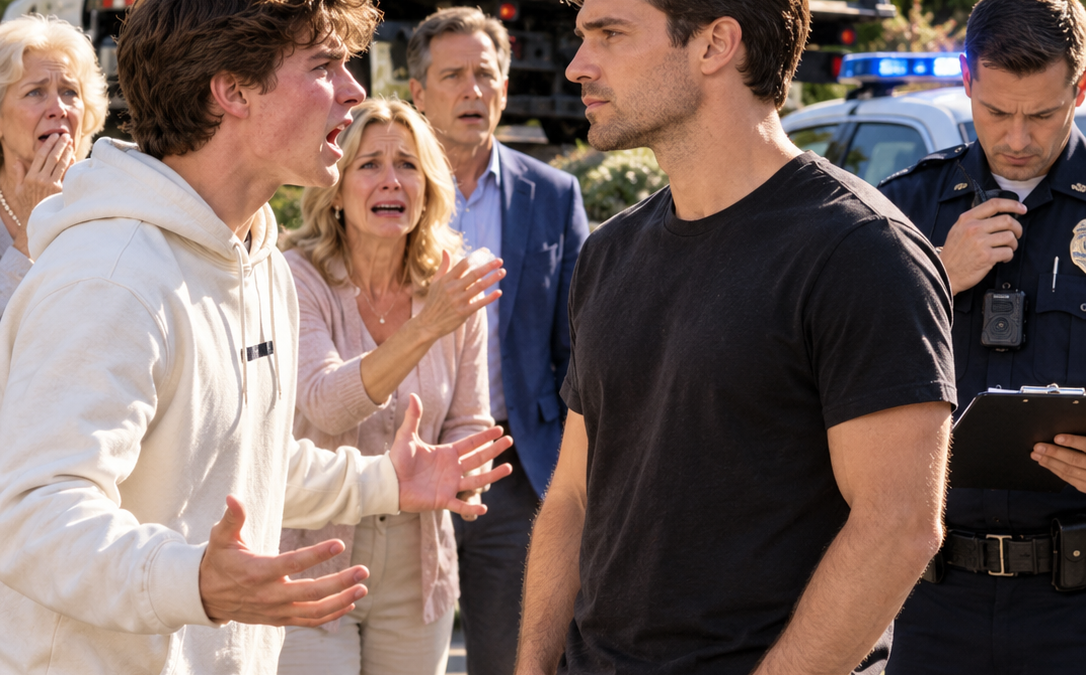
Parked at an angle in front of the house, its light bar flashing silently, was a black-and-white police cruiser.
Officer Ryan, a seasoned gray-haired cop with a visibly tired expression, stood beside the trunk holding a metal clipboard, trying to extract a coherent statement from a hyperventilating Jessica.
I parked my car, turned off the engine, and walked slowly up the driveway, my hands casually tucked into my pockets.
“Matthew!” Jessica shrieked, running toward me and grabbing my arm with a vise-like grip. “Thank God you’re here. The police are asking all these questions. They need to put out an APB or a helicopter or whatever it’s called. Carter is supposed to pick up Chloe and her parents for brunch at the club in an hour. He’ll be ruined!”
I gently but firmly peeled her desperate fingers off my jacket sleeve and walked over to the police officer.
“Good morning, Officer. I’m Matthew, the uncle of the boy over there. What seems to be the situation this morning?”
Officer Ryan sighed heavily, clearly annoyed by the suburban drama.
“Well, sir, they’re officially reporting a stolen vehicle, a late-model black Porsche Macan. I was just asking the young man for the license plate number and the vehicle registration details so I can run it through the national database.”
“It’s my car!” Carter yelled from across the lawn, his voice cracking loudly. “Some lowlife ghetto scumbag stole my beautiful car! You need to go out there, find them, and arrest them right now!”
Officer Ryan gave Carter a long, slow look of profound, professional distaste.
He keyed the radio microphone on his shoulder.
“Dispatch, Unit Four. I need a ten-twenty-eight plate run. Stand by for the alphanumeric.”
He looked back at Jessica, his pen poised over his clipboard.
“Ma’am, do you have the plate number?”
Jessica, trembling, rattled off the incredibly obnoxious vanity plate Carter had begged for.
We stood in complete silence on the dewy grass for about sixty agonizing seconds.
Then the radio on the officer’s shoulder crackled to life with a burst of static.
“Unit Four, Dispatch. We have a hit on that plate. Registered to a 2023 Porsche Macan. History is clean. No outstanding warrants, no liens.”
“Copy that, Dispatch,” Officer Ryan said. “Who is the registered legal owner on file?”
“Registered owner is listed as Matthew Davis. Address on file is…”
The dispatcher’s voice echoed across the lawn, clearly reading out my exact home address.
The silence that fell over the front yard was thicker, heavier, and far more devastating than the silence at the dinner table the night before.
Jessica froze, her mouth hanging open.
Carter stopped his frantic pacing in midstep.
David slowly turned his head to look at me, his eyes wide with sudden, terrifying realization.
Officer Ryan lowered his metal clipboard.
He looked down at his notes, processed the information, and then looked directly at me.
“Sir, your name is Matthew Davis?”
“Yes, Officer, it is,” I said, my voice smooth and perfectly calm.
Officer Ryan turned his attention back to Jessica.
His professional demeanor instantly shifted from patient public servant to highly irritated law enforcement officer.
“Ma’am, you called 911 and reported a stolen vehicle. But according to the state database and the Department of Motor Vehicles, this vehicle belongs legally and entirely to this gentleman standing right here. Not your son. Not your husband. Did he give you explicit written permission to report his personal property as stolen?”
“No,” Jessica stammered, all the color rapidly draining from her face until she looked sickly pale. “No, Officer, you don’t understand the situation. He just… he co-signed the paperwork to help us out. It’s Carter’s car. It’s my son’s car.”
“That is absolutely not how the law works in this state, ma’am,” Officer Ryan said bluntly, his voice hard. “The name on the physical title identifies the sole legal owner of the property. If Mr. Davis didn’t report it stolen, it is not a stolen vehicle. This is a domestic civil matter. It has nothing to do with the police.”
He looked back at me.
“Sir, do you happen to know where your vehicle is currently located?”
I turned my head and looked directly into Carter’s eyes.
They were wide with a chaotic mixture of profound confusion and dawning, absolute horror.
“I do, Officer,” I said clearly. “The vehicle is perfectly safe. It’s secured in a private, locked garage facility. I personally had it moved late last night.”
Carter completely snapped.
“You took it! You took my car! Give me the keys right now, you jealous piece of—”
Carter lunged forward, his fists clenched, but David finally found his paternal reflexes.
He grabbed his son hard by the shoulders, physically dragging him backward.
Officer Ryan immediately stepped between us, his hand dropping casually but purposefully to rest near his heavy-duty belt.
“All right, that’s enough, kid. Calm down right now before I put you in cuffs. It is not your car. You have absolutely no legal right to it, and if you touch him, you’re going to jail for assault.”
The officer closed his metal clipboard with a loud snap and looked at Jessica with disgust.
“Ma’am, filing a false police report is a serious crime. Since there seems to be a massive family misunderstanding here, I’m going to let this slide with a warning. But if you ever waste my department’s valuable time again over a luxury car you do not own, I’ll write you a citation, and I’ll arrest whoever gets out of line. Have a good day.”
Officer Ryan turned, got into his cruiser, and drove away, leaving a devastating, suffocating silence in his wake.
Jessica stared at me, her mouth opening and closing rapidly like a fish suffocating on dry land.
“Matthew, what did you do? Why did you take Carter’s car in the middle of the night?”
“I didn’t take Carter’s car, Jessica,” I said, my voice eerily, terrifyingly calm. “I took my car. And since Carter clearly made it known last night that he thinks I’m just a cheap, sad paper pusher, I figured he certainly wouldn’t want to be seen driving a vehicle funded by my pathetic, mediocre salary.”
“It was a joke!” Jessica screamed, tears of genuine, terrifying panic streaming down her face. “He was just messing around last night. You know how teenagers are. You cannot do this, Matthew! Chloe’s parents are expecting him to drive her to the country club today. He’ll be a laughingstock!”
“Then he’d better start walking,” I said, turning on my heel toward my sedan.
“Matthew, wait!”
David finally spoke up, his voice weak, pathetic, and pleading.
“Come on, man. Let’s go inside. Let’s talk about this over a beer. Don’t do this to the boy. We’ll make him apologize.”
“There’s absolutely nothing to talk about, David,” I said, opening my car door. “You wanted to play pretend. You wanted to act rich on my dime. Game’s over.”
I drove away, leaving them standing helplessly on the lawn.
But I knew the pain had only just begun.
Taking the car was just the physical, visible blow.
The invisible, devastating financial strike was about to hit them where it truly hurt.
Around one o’clock that afternoon, I was sitting in my home office reviewing some complex quarterly legal documents for work when my phone buzzed.
It was a text message from my cousin Samuel.
Samuel was an absolute snake in the grass, a sleazy real estate agent who hadn’t successfully sold a house in two years.
He survived by gossiping and mooching off the extended family.
He always acted like he was my best friend, but I knew for a fact that he constantly talked trash about me behind my back with Jessica.
The text read:
“Hey man, crazy morning over at Jess’s house. Hear you took the car back. Good for you, man. They’ve been using you for years. By the way, Jess is literally losing her mind. Just tried to buy $400 worth of groceries for a party, and her card got declined at the register. Epic fail. LMAO.”
I stared at the glowing screen.
Samuel thought he was bonding with me. He thought he was cleverly aligning himself with the winning team.
But he was actually giving me a beautiful, real-time play-by-play of the total collapse of their lives.
Jessica had gone to the high-end, ridiculously expensive organic supermarket she frequented to keep up appearances.
She’d arrogantly filled her cart with prime cuts of organic meat, imported French cheeses, and expensive wines.
When the cashier swiped her heavy metal emergency card, the terminal must have flashed bright red.
Declined.
Account closed.
I could picture the scene perfectly.
The long line of wealthy suburbanites standing impatiently behind her, whispering. The cashier looking at her with thinly veiled pity and annoyance. Jessica frantically pulling out her phone, sweating, desperately trying to log into an online banking portal she no longer had access to.
It was the ultimate public humiliation for a woman whose entire existence revolved around fake appearances.
Exactly five minutes after Samuel’s text, my phone rang.
It was Jessica.
I stared at the screen and declined the call.
She called again immediately.
Declined.
Then came the frantic, desperate barrage of text messages.
“Matthew, the card isn’t working at all. The bank made a huge mistake. Please call them and fix it. I’m literally stranded at the register with a cart full of food.”
“Matthew, answer your phone right now! This isn’t funny anymore. How could you do this to us? We need food to survive. You’re starving your own family over a stupid joke!”
I picked up my phone, my thumb flying across the keyboard, and typed out a single, precise, devastating reply.
“The card was expressly for life-or-death emergencies. Buying $400 worth of luxury groceries and wine while your son drives a $60,000 sports car you cannot afford is not an emergency. The account is permanently closed by the bank at my request. I suggest you consult a lawyer if you don’t like it, but we both know you can’t afford one. Stop contacting me about money.”
I hit send.
I watched the delivery receipt appear.
Then I put my phone on silent, tossed it onto the couch, and went back to my spreadsheets.
But a parasite doesn’t just quietly die when you brutally cut off its main food supply.
It thrashes.
It looks desperately for a new host.
Later that afternoon, Samuel called me again.
I decided to answer, just to see what kind of pathetic game he was trying to play.
“Hey, Matt,” Samuel said, his voice slick, greasy, and conspiratorial. “Man, things are getting incredibly ugly over there. Jess just called me crying hysterically. She asked if she could borrow a thousand bucks to float them until David gets paid next month. Can you believe the absolute nerve of that woman?”
“What did you tell her, Samuel?” I asked calmly, leaning back in my chair.
“I told her no. Obviously, I’m totally broke right now anyway.”
He laughed, a nervous, high-pitched sound.
“But listen, bro. She’s talking crazy right now. She’s saying she’s going to get a lawyer to sue you. Saying she has squatter’s rights on the car or some legal nonsense. You’d better watch your back.”
“A lawyer?”
I let out a genuine, hard laugh that echoed through my quiet office.
“She couldn’t afford her groceries this afternoon, Samuel. She certainly can’t afford a retainer for a lawyer.”
“Yeah, true, true,” Samuel agreed far too quickly, desperate to agree with me. “Look, man, I’m just looking out for you. We’re family. Got to stick together, right? Protect each other. Hey, actually, since you’re saving all that cash now by cutting them off, I’ve got this incredible investment property downtown. Needs a quick flip. If you spot me five grand by tomorrow, I can double it for you in a month. Guaranteed.”
There it was.
He wasn’t calling to support me.
He wasn’t my ally.
He was calling because he smelled fresh blood in the water, and he wanted to be the very first leech to attach himself and siphon off the funds that were no longer flowing to Jessica.
“Samuel,” I said, my voice dropping an octave and turning to ice, “I know you texted Jessica this morning, telling her I was being totally unreasonable and that you felt bad for Carter. I know exactly how you operate. You try to play both sides of the fence. Listen to me very carefully. If you ever ask me for a single dime again, I’ll block your number permanently, and I’ll make sure the rest of the family knows exactly why. Do you understand me?”
Dead, terrifying silence filled the other end of the line.
I could hear him swallow hard.
“Yeah, yeah, got it, Matt. Just… just joking around, man. My bad.”
He hung up incredibly quickly.
The walls were rapidly closing in on them.
They were running out of money.
They were running out of fake allies.
And they were finally running out of lies.
The silent storm I’d quietly unleashed in the middle of the night was now a Category Five hurricane, violently tearing the roof off the fake, pathetic life they’d built on my back.
But I knew deep down that the worst was yet to come.
Because people like Jessica and Carter don’t just surrender gracefully and learn their lesson.
When cornered like rats, they attack.
And they were about to bring the fight directly to my front door.
By the fifth day after the Porsche vanished from Jessica’s driveway, the tension in their household had reached a boiling point.
The reality of their financial collapse was no longer a looming threat.
It was a daily, suffocating reality.
Without my emergency credit card to float their luxury grocery runs and random shopping sprees, they were forced to actually look at their bank account.
And the numbers did not lie.
Carter was losing his mind.
He’d missed his fancy country club brunch with his girlfriend, Chloe.
According to the venomous texts I received from him, Chloe’s wealthy parents had made several passive-aggressive comments about him showing up in his mother’s beat-up minivan.
The humiliation was eating him alive.
He blamed Jessica.
Jessica blamed David.
And all three of them naturally blamed me.
I knew they wouldn’t just sit quietly and accept their new reality.
People who have spent their entire lives living off the sweat of others don’t know how to reflect.
They only know how to attack.
I was expecting a confrontation, but I didn’t expect them to be foolish enough to bring the circus to my place of business.
It was a Wednesday morning.
I was in the middle of a major quarterly review.
Now, you have to remember, my family had absolutely no idea what I actually did for a living.
Because I drove a normal car and lived in a normal house, they assumed my job was just as mediocre as they thought I was.
Aunt Clara had convinced them years ago that I was some low-level clerk, pushing papers in a dreary cubicle, making a pathetic salary that barely covered my bills.
I never corrected them.
Letting them believe I was financially average was my only defense mechanism.
My office was located in a sleek, fifty-story glass tower in the financial district downtown.
Our firm managed high-net-worth portfolios. The lobby was lined with imported Italian marble, and security was incredibly tight.
You didn’t just walk into our offices.
Around eleven o’clock, my desk phone rang.
It was Sarah, our head receptionist on the executive floor.
Her voice was unusually tight.
“Mr. Davis, I apologize for the interruption. There’s a situation at the front desk. Three individuals are here demanding to see you. A woman claiming to be your sister, an older woman who says she’s your mother, and a young man. They’re being quite loud. Building security is on standby. Should I have them escorted out?”
I closed my eyes and took a deep breath.
They had actually done it.
They’d driven downtown to ambush me, hoping to embarrass me in front of my boss and force me to hand over the car keys to save face.
“No, Sarah,” I said smoothly. “Don’t call security just yet. Send them up to Conference Room B. I’ll handle it.”
Conference Room B was our flagship meeting space.
It featured a massive polished mahogany table, leather chairs, and floor-to-ceiling windows offering a panoramic view of the city skyline.
It was designed to intimidate and impress millionaires.
It was the perfect stage.
I gathered a very specific manila folder from my desk drawer and walked down the quiet, carpeted hallway.
As I approached the glass doors of the conference room, I could hear Jessica’s shrill voice echoing off the walls.
“I can’t believe he works in a place like this,” she was saying. “He probably just sorts the mail. We need to find his manager. If we threaten to expose him for stealing Carter’s car, they’ll fire him. He’ll have to give it back.”
I pushed the heavy glass door open and stepped inside.
Jessica, my mother, and Carter spun around.
They looked completely out of place.
Jessica was wearing a wrinkled blouse, looking exhausted and frantic. My mother looked nervous, clutching her purse with white knuckles. Carter was wearing the same designer hoodie he’d worn at my birthday dinner, but his arrogant smirk had been replaced by a look of sheer, unadulterated rage.
“Matthew!” Jessica shrieked, marching toward me. “You are completely out of your mind! You’ve ruined Carter’s life! We’ve been calling you for days. You’re going to walk out to that parking garage right now and give my son his keys back, or I’m calling the police and telling them you stole it!”
“You already tried calling the police, Jessica,” I said, walking slowly to the head of the mahogany table.
I didn’t sit down.
I stood tall, looking at them.
“Officer Ryan explained the law to you very clearly. You cannot steal your own property.”
“It is not your property!” Carter yelled, slamming his hands down on the expensive table. “You bought it for me! You promised it to me! You’re just a jealous loser who can’t stand seeing someone else succeed!”
Before I could respond, the door to the conference room opened again.
It was Elijah.
Elijah was the founding partner of our firm, a man in his late sixties, impeccably dressed, with a commanding presence that demanded instant respect in any room he entered.
He was also my mentor.
He’d seen the commotion at the front desk and, knowing my usually quiet demeanor, had come to check on me.
“Matthew,” Elijah said, his deep voice instantly silencing Jessica and Carter.
He looked at my family with polite but cold curiosity.
“Is everything all right in here? Sarah mentioned there was a disturbance. Do we need Legal involved?”
Jessica puffed out her chest.
Seeing an older man in a tailored suit, she immediately assumed he was my supervisor.
“Yes, actually. Are you his boss? You need to know what kind of person you have working for you. This man is a thief! He stole my son’s car and canceled the credit card he gave us to help feed my family. He’s starving his own mother and nephew. You should fire him immediately!”
Elijah looked at Jessica for a long, silent moment.
Then he looked at me, a slight, knowing smile touching the corners of his mouth.
“Fire him?” Elijah chuckled, a rich, dry sound. “Ma’am, I couldn’t fire Matthew even if I wanted to. He’s our senior executive director. He’s a senior partner in this firm. He manages portfolios worth more than the entire gross domestic product of small island nations. In fact, he practically runs this floor.”
Elijah turned to me.
“Handle your business, Matthew. Let me know if you need building security to escort them out.”
He nodded respectfully to me and walked out, closing the heavy glass door behind him.
The silence that hit the room was absolute.
It was the kind of silence that rings in your ears.
Jessica stared at the closed door, her face completely drained of color.
Carter’s jaw physically dropped.
My mother took a shaky step backward, her eyes darting around the luxurious boardroom, finally registering the reality of where she was standing.
The illusion was dead.
The pathetic, mediocre paper pusher they thought they could bully simply did not exist.
I was the one holding all the cards.
And I always had been.
I tossed the thick manila folder onto the center of the mahogany table.
It landed with a heavy, satisfying thud.
“Go ahead, Jessica,” I said, my voice cutting through the silence like a razor. “Open it.”
She approached the table as though it were rigged to explode.
With trembling fingers, she opened the cover.
Inside were the indisputable facts of their parasitic existence.
“On the left,” I said, pointing to the documents, “is the original notarized title and registration for the 2023 Porsche Macan. As you can clearly see, my name is the only name on that document. Not Carter’s. Not David’s. Mine. I bought it in cash. I paid the insurance. I paid the taxes.”
I looked directly at Carter.
He was shrinking back against the glass wall, looking smaller and more pathetic than I’d ever seen him.
“That outfit you wore to my house, the one you wore while you called me cheap and threw a drink in my face…”
I took a step toward him.
“I pulled the statements. That hoodie was purchased on my secondary credit card. The shoes on your feet were bought with my money. You’ve never worked a hard day in your life. You’re a nineteen-year-old child playing dress-up with my salary.”
Carter opened his mouth to speak, but nothing came out.
The bravado was completely gone, crushed beneath the weight of undeniable reality.
I turned my attention back to my sister.
“On the right side of that folder, Jessica, are the itemized statements from the emergency credit card. The card I gave you so you wouldn’t go hungry. There are thousands of dollars in charges for day spas, designer handbags, and first-class plane tickets. You lied to my face. You used my father’s memory to manipulate me into funding a lifestyle you haven’t earned and can’t afford. And when David mentioned his new boat at dinner, you both sat there and let everyone believe you were successful, knowing full well you were planning to come begging to me to finance it.”
“Matthew, please!”
My mother suddenly cried out, stepping forward and reaching for my arm.
Tears streamed down her wrinkled cheeks.
“Please stop this. This is your family, your flesh and blood. You’re tearing us apart over money. Your father would be so disappointed in you for treating your sister this way.”
I looked at my mother.
The woman who had watched me be humiliated and called it a prank.
The woman who had enabled Jessica’s toxic behavior for decades.
“No, Mom,” I said, pulling my arm away gently but firmly. “I’m not tearing this family apart. I’m the only reason this family hasn’t been living on the street for the past five years. I kept the promise I made to Dad. I kept you all afloat. But I’m done being the anchor that you drag through the mud.”
I looked from one stunned face to another.
“You wanted to know what I look like when I’m cheap? You’re looking at it. The free ride is permanently over.”
I walked over to the desk console and pressed the intercom button.
“Sarah, please have building security come up to Conference Room B to escort my guests to the lobby. We’re finished here.”
Jessica collapsed into one of the leather chairs, sobbing into her hands.
Carter stood frozen, staring blankly out the window at the city below, realizing that his entire identity as the wealthy, cool kid on campus had just been incinerated.
My mother simply wept softly, realizing that her golden child and her favorite grandson had finally pushed the quiet provider too far.
As the security guards walked into the room, polite but firm, guiding my broken family toward the elevators, I stood alone in the boardroom.
I didn’t feel a shred of guilt.
I felt a massive, suffocating weight lift off my chest.
I could finally breathe.
This was the moment that changed everything.
The moment I finally took back control of my life.
Thank you so much for your patience and for staying with me until now. You’ve been amazing. Please give this video a like and comment “1” below to let me know you’ve made it this far. Not only does this help more people find this story, but it also lets me know that my experiences truly mean something to someone. Your support is my greatest motivation to keep sharing the rest of this journey.
The immediate aftermath of the boardroom confrontation was a deafening, terrifying silence from their end.
For the first time in ten years, my phone didn’t ring with demands, emergencies, or manufactured crises.
The realization that I was utterly serious, combined with the shock of seeing my actual life and status, had finally broken their delusion.
But I knew I couldn’t just leave things hanging.
The Porsche was still sitting in Luke’s secure garage.
And as much as it represented my ultimate leverage, it was also a depreciating asset and a constant reminder of my own foolishness.
A week after the ambush at my office, I called a luxury auto broker.
I didn’t drive the car back to Jessica’s house.
I didn’t hand the keys over to Carter with a stern warning.
I didn’t want the car, and I certainly wasn’t going to let them have it.
I sold the Porsche.
Because it was in pristine condition and the market for used luxury vehicles was high, I recovered almost the entire purchase price.
But I didn’t just put that money back into my own savings account.
Despite everything, despite the incredible disrespect and the years of being used, I was not a vindictive monster.
I still cared about Carter’s actual future, even if I despised his current personality.
I knew that without my constant financial bailouts, Jessica and David would never be able to afford to send him to a decent university.
They’d lied about having a college fund for him.
So I took the entire sum from the sale of the Porsche and contacted my legal team.
I had my lawyer draft the paperwork to create an irrevocable, ironclad educational trust.
I put the money into a legitimate college fund, but I attached extreme, unbreakable stipulations.
The money could only be used for tuition, university housing, and required textbooks.
It could never be paid out in cash.
Neither Jessica nor David nor Carter could access a single dime directly.
The trust would pay the educational institutions directly.
If Carter decided to drop out and try to start a foolish business or buy another flashy car, the money would remain locked away until he was thirty-five.
I was giving him the gift of an education, the tools to build his own real wealth.
But I was completely removing his ability to use my money for status.
I sent the legally binding trust documents to Jessica’s house via certified mail.
I didn’t include a note.
The legal paperwork spoke for itself.
Two days after the certified mail was delivered, I received a surprise visitor at my house.
It was late on a Friday evening, and rain was pouring outside.
The doorbell rang, and when I looked through the peephole, I saw David standing on my porch.
He looked terrible.
He was soaked to the bone, his shoulders slumped, and the usual false bravado he carried himself with was completely gone.
I opened the door but didn’t invite him inside.
We stood on the threshold, the cold rain blowing onto the porch.
“Matthew,” David said, his voice barely above a whisper.
He couldn’t meet my eyes.
He stared at the welcome mat.
“Can I talk to you for a minute?”
“Make it quick, David,” I said, leaning against the doorframe.
He rubbed his face with rough, calloused hands.
“I just… I wanted to say I’m sorry. For everything. For the dinner, for the car, for letting Jessica treat you the way she did. I saw the trust documents for Carter’s college fund. You didn’t have to do that after how he treated you. You’re a better man than I am, Matt. A much better man.”
It was the most honest thing he’d ever said to me in his entire life.
But an apology doesn’t pay the bills, and it doesn’t erase a decade of weakness.
“Why are you really here, David?” I asked. “Jessica sent you to ask for a loan, didn’t she?”
David swallowed hard, looking deeply ashamed.
“Things are really bad, man. Jessica is talking about a divorce because the stress of having no money is tearing us apart. The mortgage is past due. They’re threatening foreclosure. The threat of a custody battle over Carter’s younger sister is being thrown around. It’s a nightmare. We just need ten thousand to catch up. I swear on my life, I’ll pay you back. I’ll get a second job. I’ll work nights.”
I looked at this broken man, a man who had allowed his wife and son to walk all over him and everyone else because he was too afraid to set boundaries.
“No, David,” I said firmly.
The word hung in the cold, wet air.
He looked up at me, desperation in his eyes.
“Matt, please. We’re going to lose the house.”
“Then you lose the house,” I told him, my voice completely devoid of pity. “You sell it. You downsize. You move into an apartment you can actually afford. You get that second job. And you start acting like the head of your household instead of a bystander in your own life.”
I held his gaze.
“I’m not writing you a check. If Jessica wants a divorce because you can’t fund her fantasy life anymore, then let her get a lawyer. That’s your mess to clean up, not mine.”
David stood there for a long moment.
He didn’t argue.
He didn’t yell.
He simply nodded slowly, accepting the brutal reality of the situation.
Then he turned and walked back out into the pouring rain, climbed into his beat-up truck, and drove away.
It was harsh.
It was a brutal form of tough love.
But it was the only way to stop the bleeding.
The last loose end was Aunt Clara.
She had been the primary instigator, the whisperer in the shadows who had constantly fed Jessica’s ego and undermined my position in the family.
The day after David’s visit, I picked up my phone and called her.
She answered on the first ring, her voice dripping with fake concern.
“Matthew! Oh, I’ve been so worried about you. The family is in an absolute uproar. Jessica is a mess. What on earth possessed you to act so cruelly toward your own sister?”
“Aunt Clara,” I interrupted, cutting through her theatrical nonsense. “I’m calling to tell you that you’re no longer welcome in my home. You will not call my personal cell phone, and you will not contact me at my office. For years, you’ve sat back and thrown gasoline on every fire in this family because you have nothing better to do with your miserable life. You’re a toxic, bitter woman, and I’m officially cutting you out.”
“Excuse me?” she gasped, highly offended. “You cannot speak to your elder this way! I am your family!”
“Family is a title you earn through respect, Clara, not a free pass for abuse. Have a nice life.”
I hung up the phone and immediately blocked her number.
I blocked Jessica.
I blocked David.
I blocked Carter.
I created a fortress of silence around myself.
And for the first time in my adult life, I felt truly, wonderfully safe.
Six months passed.
Half a year of absolute, glorious tranquility.
The immediate result of setting those massive, concrete boundaries was a profound shift in my own mental and physical health.
Without the constant low-level anxiety of wondering what disaster Jessica was going to drag me into next, I thrived.
I slept eight hours a night.
I focused intensely on my career.
Three months after the incident in the boardroom, Elijah called me into his office and offered me a massive promotion to managing partner.
It came with an equity stake in the firm and a salary increase that secured my financial future for the rest of my life.
I had finally stopped pouring my energy into a leaking bucket and started investing it in myself.
But I wasn’t completely blind to what was happening on the other side of town.
Through my mother, whom I still spoke to on occasion, I heard the updates.
The collapse of their fake empire had been brutal but necessary.
David actually followed through.
He didn’t get the boat.
Instead, he swallowed his pride, took a second job working night shifts at a logistics warehouse, and started slowly digging them out of the massive hole they’d created.
Jessica was forced to get a job working reception at a local dental clinic.
It was a massive blow to her enormous ego, having to serve coffee and answer phones for people she used to look down on at the country club.
But it was the reality check she desperately needed.
The most profound change, however, was in Carter.
Without the Porsche, without my credit card to buy designer clothes, and without the illusion of immense wealth to hide behind, his life shattered.
Chloe, his status-obsessed girlfriend, dumped him less than a week after he lost the car.
His fair-weather friends at college slowly drifted away when he could no longer pick up the check at expensive restaurants.
To my genuine surprise, Carter didn’t completely fold.
Faced with the reality that his college fund was strictly controlled by an ironclad trust and that he had zero spending money, he was forced to enter the real world.
He got a job.
He didn’t get a glamorous internship at a downtown firm.
He got a job working the drive-through window at a local fast-food burger franchise.
One evening, driving home from a late meeting, I intentionally took a detour past that specific restaurant.
I pulled into the parking lot and parked in the shadows near the back.
I watched through the glowing glass windows of the kitchen.
There was Carter.
The golden boy.
He was wearing a cheap polyester uniform shirt, an ugly visor, and a headset.
He was sweating, wiping down a greasy stainless-steel counter while a manager yelled at him to hurry up with a massive order of fries.
He looked exhausted.
He looked humbled.
He looked, for the very first time in his entire life, like a man learning the actual value of a dollar.
It was hard to watch, seeing my own blood sweating over a deep fryer.
But I knew it was the most valuable education he would ever receive.
Far more valuable than the college tuition I was paying for.
The real test of our new dynamic came in late November, right before the Thanksgiving holiday.
I received a handwritten letter in the mail.
It wasn’t a text or a demanding phone call.
It was a carefully written letter from Jessica.
She didn’t ask for money.
She didn’t mention the past.
She simply invited me to their house for Thanksgiving dinner.
She wrote, “We know we have a lot to prove, but the table isn’t the same without you. We would be honored if you came.”
I thought about it for a long time.
Holding on to anger is like drinking poison and expecting the other person to die.
I had won the war.
The boundaries were set in stone.
I decided to go, if only to see the results of the storm I’d created.
When I pulled up to their house on Thanksgiving Day, there were no luxury cars in the driveway.
The landscaping was slightly overgrown because they could no longer afford the expensive gardening service.
It looked like a normal, middle-class American home.
I knocked on the door.
Jessica answered.
She looked older and tired, and her hair wasn’t perfectly blown out at a salon.
But there was a strange, quiet dignity about her that I hadn’t seen since we were children.
“Matthew,” she said softly, stepping aside to let me in. “Thank you for coming.”
The house smelled like roasted turkey and actual home cooking, not the expensive catered food she usually tried to pass off as her own.
The television was on in the living room, showing the football game.
David was sitting in an armchair wearing a faded flannel shirt.
He stood up immediately, walked over, and shook my hand firmly.
It was the handshake of a man who was working hard for his keep.
“Good to see you, Matt,” David said, his voice steady.
Then Carter walked out of the kitchen.
He was holding a stack of plates.
He stopped when he saw me.
He didn’t have a smirk.
He didn’t look at his phone.
He walked over to me, set the plates down on the dining table, and stood up straight.
“Uncle Matt,” Carter said, his voice stripped of that arrogant teenage drawl.
He reached into the pocket of his jeans and pulled out a small, awkwardly wrapped box.
He handed it to me.
“I… I bought this for you with my own paycheck from the restaurant.”
I looked at the cheap wrapping paper.
I carefully tore it open.
Inside was a simple, heavy ceramic coffee mug.
It had a cheesy joke about spreadsheets printed on the side.
It probably cost fifteen dollars.
But holding it in my hands, it felt heavier and more valuable than any luxury item they’d ever demanded from me.
“I’m sorry,” Carter said, looking me directly in the eye.
It was incredibly difficult for him.
I could see the shame burning in his cheeks.
“I’m really sorry for what I did on your birthday. I was an arrogant jerk. I didn’t understand how hard you worked for what you have. Working the fryer… it sucks. It’s really hard. I get it now.”
I looked at the kid.
He smelled faintly of old fry grease and humility.
“Thank you, Carter,” I said, my voice softening just a fraction. “I appreciate the gift, and I accept your apology.”
The dinner was not a joyous, loud, perfect family gathering.
It was quiet.
It was careful.
It was awkward.
Everyone was walking on eggshells, intensely aware of the new power dynamic in the room.
There were no arrogant boasts about imaginary wealth.
There were no passive-aggressive insults disguised as jokes.
There was just a family, broken and slowly trying to piece themselves back together with glue they had to buy themselves.
After dinner, as I was putting on my coat to leave, Jessica walked me to the door.
She wrapped her arms around herself, looking out into the cold November night.
“I know things will never be the way they were, Matthew,” Jessica said quietly. “And honestly, I know that’s a good thing. Aunt Clara tried to call me last week, trying to talk badly about you. I hung up on her. I see exactly what she was doing all those years.”
Jessica looked up at me, tears welling in her eyes.
“I’m sorry I used Dad’s memory against you. You were the only one actually keeping his promise.”
I nodded slowly.
“I forgive you, Jessica. But you understand the bank is closed, right? Forever.”
She gave a small, genuine smile.
“I know, Matt. We’re figuring it out. We really are.”
I drove home that night with the heater blasting in my car, watching the city lights pass by.
The ceramic coffee mug Carter had given me sat in the passenger seat.
Later that evening, sitting in my quiet, peaceful house, I poured myself a glass of scotch and reflected on the chaos of the past year.
It’s a terrifying thing to realize that the people you love are actively destroying you.
It goes against every instinct, every societal expectation, to turn your back on your own family when they’re struggling.
But I learned the hardest, most vital lesson of my entire life.
There is a massive, fundamental difference between helping someone and enabling them.
Helping someone is giving them a ladder to climb out of a hole.
Enabling them is climbing down into the hole with them, handing them a shovel, and paying them to keep digging.
For ten years, out of a misguided sense of loyalty to my father, I handed Jessica and Carter the shovels.
I shielded them from the consequences of their own actions.
I allowed them to live in a fantasy world built entirely on my stress, my hard work, and my silent suffering.
It took a ruined shirt, a glass of cherry punch, and a moment of profound public humiliation for me to finally wake up.
Sometimes love isn’t soft.
Sometimes love isn’t paying the rent or buying the groceries or co-signing the loan.
Sometimes the most loving thing you can possibly do for a person is to let them hit rock bottom.
You have to let them feel the cold, hard concrete of reality.
You have to let them lose the car, face the collection calls, and smell the fry grease on their own clothes.
Because until they feel the pain of their own failures, they will never, ever respect the value of your success.
My relationship with my family is not perfectly healed.
I don’t know if it ever will be.
We don’t spend every weekend together.
We don’t share deep emotional secrets.
But there is a new foundation beneath us now.
And it’s built on absolute, unshakable respect.
They know my boundaries are made of steel.
They know I’m no longer a victim.
I’m a man who owns his life, his money, and his peace of mind.
And for the first time in a decade, when I look in the mirror, I finally respect the man looking back at me.
Thank you for sticking around and listening to my story. I know it was a heavy one, but it’s a journey I had to share. I hope this resonated with you in some way, especially if you’ve ever felt like you were carrying the weight of the world for people who didn’t appreciate it.
Have you ever found yourself in a similar situation? Have you ever had to cut off someone you love just to save yourself? Let me know your experiences down in the comments.
And for those of you who are truly part of the one-percent club, the amazing people who stayed with me through every twist and turn until the very last second, do me a huge favor and comment the letter W below.
W stands for winner.
It’s our secret sign, letting me know that you’re part of that incredible group who doesn’t just skim the surface but stays for the whole truth.
If you found value in this story, please hit that like button, and don’t forget to follow so we can keep sharing these journeys together.
Take care of yourselves.
Set your boundaries.








