On Father’s Day, my mom said: “The Army turned you into a heartless machine.” I stood up and said: “Then live as if you never had a daughter.” I drove off in my own SUV. 15 minutes later she texted: “Bring the car back or I’m calling the cops.” I smiled coldly and replied: “Go ahead.” 45 minutes later, three squad cars surrounded the house…
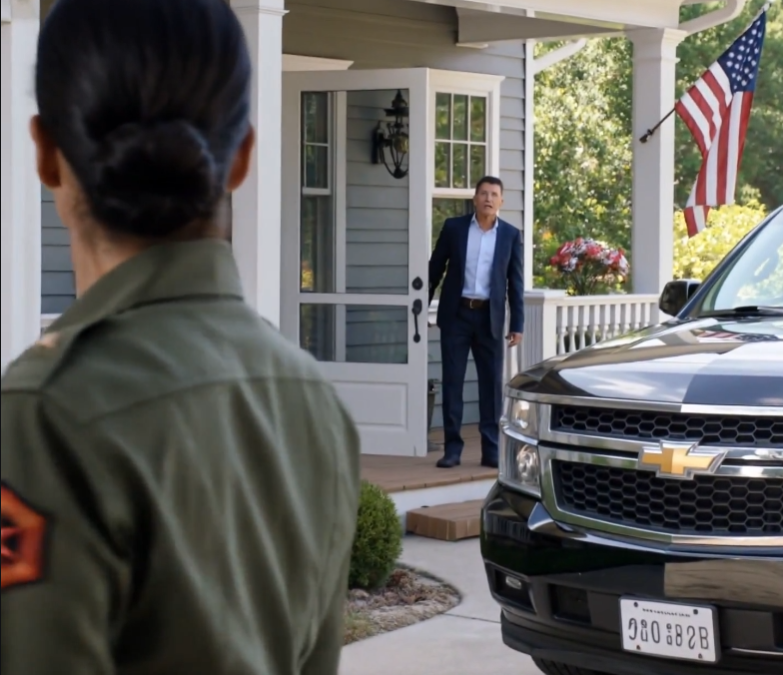
I turned my phone facedown on the passenger seat and merged onto I-24, heading east, heading nowhere, heading anywhere that wasn’t the house I had bought with thirteen months of deployment pay while my brother was busy telling his friends he owned it.
Twenty minutes out, my mother sent a single line.
“Return the vehicle or I am calling the police.”
I picked up the phone at a red light and looked at her message for a long moment. Then I typed two words.
“Go ahead.”
I set the phone back down.
What I expected was nothing. I expected her to bluff the way she had always bluffed.
What I did not expect, what I was genuinely not prepared for, was to hear from the duty sergeant at Fort Campbell forty minutes later that my own brother had filed a stolen-vehicle report with the Montgomery County Sheriff’s Office.
The person who called it in had my address and was demanding a felony warrant. If that warrant went through before I could document ownership, my security clearance would be flagged, my promotion packet would stall, and fifteen years of service would be held hostage by a man who thought hazard pay was an allowance.
But here’s the part nobody saw coming, least of all Philip.
The person in handcuffs that night was not me.
Before I get to that, I need to go back, because none of this was an accident. None of it happened in a vacuum. Fifteen years of a pattern can look like bad luck when you’re in the middle of it, the way a flood looks like rain until the water is at your throat.
I want you to understand how I got to that driveway. Because if you’re watching this and you know someone like me, or if you are someone like me, I need you to see the whole shape of it.
I enlisted at nineteen out of Hopkinsville, Kentucky. My father, Earl—not the Earl on this channel’s band list, a different Earl—was a man who repaired heavy equipment for the county until a scaffolding accident took him when I was sixteen.
He had one thing he used to say. He would stand in the kitchen in his work boots before a long shift and tell me, “Audra, the only thing nobody can take from you is what you earned yourself.”
I had that sentence burned into the inside of my sternum when I raised my right hand. I carried it through basic training, through AIT, through three combat tours.
My mother’s name is Francis. She is seventy-one years old, sharp as a letter opener when she wants something, soft as flannel when she wants you to believe she is fragile.
I do not tell this story to paint her as a villain, because that would be too simple. I tell it because she is a woman who decided very early that Philip needed protecting and I needed deploying, and she never once questioned whether those two things should be equal.
Philip is four years older than me. He was going to be an architect. Then he was going to run a property management company. Then he was going to launch a food truck. After that, it was a landscaping business, a car-detailing service, and an online resale operation.
What it actually was, every single time, was my money going into one end of a dream and coming out the other as nothing.
When I was in Kandahar for my second rotation, he spent $14,000 of my money on a commercial-grade espresso machine and a lease deposit for a coffee shop that opened for eleven days before he lost interest and abandoned the keys.
My mother called me after that one.
I was sitting in a communications tent on a forward operating base when she called and said that Philip was going through a difficult time and that the family needed a little extra that month.
I sent $3,000.
I was making roughly $52,000 a year at the time, plus combat pay. I sent it because I was afraid of what it meant if I didn’t.
I was afraid that the thin thread of belonging I felt to that house in Clarksville would snap if I let it. I was afraid that being thousands of miles away in a place that was trying to kill me, with nothing to come home to, was worse than being used.
I told myself that as long as I kept sending the money, the door would still be open when I landed.
What I didn’t understand then, what took me twelve more years to understand, was that I wasn’t buying an open door. I was paying rent on a role.
My role was the provider. Philip’s role was the one who needed providing for. My mother had cast us both before either of us was old enough to audition, and I had been playing my part so faithfully, for so long, that I couldn’t see the stage.
Tamson figured it out before I did.
She married Philip six years ago in a ceremony at my house. She called it their house in the vows. I remember that. I remember standing in the yard in my dress blues, watching her say “our home” and feeling something heavy settle in my gut.
And I smiled anyway, because I wanted my mother to be happy.
Tamson was a smart woman who had married a man she thought was on the way up. She believed him because he wore the clothes she believed in, drove the car she believed in, and lived in the house she believed in, all of it courtesy of a sister overseas.
Once she understood the architecture of the arrangement, she did not leave it. She expanded it.
She started referring to my house as the family estate. She started asking me, through my mother, about updating the kitchen. She told extended family members at a Fourth of July cookout that she and Philip were considering adding a sunroom.
I heard about the sunroom secondhand from my cousin Bridget, who called me laughing about it, not understanding that I was not laughing. I was standing outside the PX at Schofield Barracks in Hawaii, pressing my thumbnail into my palm to keep my voice level.
I didn’t say anything then either.
I’m going to stop pretending that makes me noble, because it doesn’t. It makes me a woman who was afraid.
Not of them. I had been under actual fire. I was not afraid of Tamson and her sunroom.
I was afraid of the specific hollow feeling of being unloved by your own mother in the specific way that cannot be fixed by anything in the world except the mother deciding to fix it.
And I kept believing, past all reason, that if I was just a little more helpful, a little more generous, a little more patient, she would look at me the way I needed her to look at me, just once.
She looked at me across that Father’s Day table instead.
The machine.
She called me the stranger.
I drove east on I-24 for a long time after that. I passed the exit for the base twice before I finally took it. The guard at the gate snapped a salute when I rolled down the window and showed my ID.
There is something about that moment I will not forget. A twenty-three-year-old specialist standing at parade rest, looking at me with the particular clear respect that military service creates.
The kind that has nothing to do with blood or sentiment or whether you remember to call on birthdays. It is earned. It is given because it was earned. Nobody handed it to anyone.
I sat in my vehicle on base for forty minutes before I turned the engine off.
The call came at 11:47 p.m. from an unknown local number. I was on my bunk in my temporary quarters, staring at the ceiling with my boots still on.
I answered on the second ring.
“Is this Audrey Callaway?”
A man’s voice. Flat, bureaucratic, precise.
“Ma’am, this is Sergeant Whitaker with the Montgomery County Sheriff’s Office. We’ve received a report of a stolen vehicle, a 2022 Chevrolet Tahoe, registered to a Philip Callaway. The reporting party is requesting we issue a warrant for your detention.”
I sat up and put both feet on the floor. I breathed in for four counts and out for four, the way I had been breathing under pressure for fifteen years.
“Sergeant Whitaker,” I said, “I am Sergeant Major Audrey Callaway, United States Army. The vehicle in question is registered in my name. I am the sole titleholder, the sole insured party, and the sole individual who has made a single payment toward that vehicle. I have the title, the registration, the insurance documents, and the bill of sale on my encrypted drive. I will email them to your department’s official address within the next five minutes. When you read them, you will see that the individual who filed this report has committed the felony offense of filing a false police report.”
There was a pause.
“Ma’am, can you spell your name for me?”
I spelled it.
I sent the documents. Four files, each one cleaner and more conclusive than the last. Each one bearing only my name in the relevant fields. Each one representing a piece of a deployment that Philip had never served, money Philip had never earned, a sacrifice Philip had never even acknowledged.
The warrant died before morning.
By the time the sun came up over the flight line, Philip was the one with an open investigation attached to his name.
I didn’t sleep. I sat at the small desk in my quarters with my laptop open and my hands flat on the table, and I thought about my father, who died when I was sixteen with calloused hands and a good name and nothing else.
The man who had told me that the only thing no one could take from me was what I earned myself.
I thought about how long I had spent handing over everything I earned to people who took it without looking up from their phones.
At 6:15 a.m., I walked into the office of Lieutenant Colonel Jerome Fisk, the JAG attorney who had been advising me on personal legal matters since I was a staff sergeant with a complicated power-of-attorney situation and a family in Clarksville that had a habit of treating legal documents like suggestions.
He was already at his desk. He had a cup of coffee, a yellow legal pad, and a look on his face that told me he had already seen my name on something that morning.
“Sit down, Callaway,” he said.
I sat.
He turned his computer monitor around. It was a credit report. It was not pretty.
“DoD Financial Review flagged your accounts at three,” he said. “Your supplemental cards have $38,000 in charges from the past eleven months. Restaurant bills in the hundreds of dollars. A furniture showroom in Nashville. Golf club membership dues. Tamson’s spa receipts. I pulled this to stop them from putting a hold on your clearance.”
I looked at the numbers.
I had given my mother that card three years ago for household expenses, groceries, and utilities. She had given it to Philip and Tamson as though it were a gift.
“How long has this been going on?” Fisk asked.
“Longer than this report shows,” I said.
He looked at me for a moment. He was sixty-two years old, and he had two daughters who were both doing perfectly fine in the civilian world. He had the kind of patience that comes from watching people make the same mistakes for thirty years without losing his fundamental belief that they could stop.
“Audra,” he said, and he only used my first name when he wanted me to hear something past the rank. “Why do you allow this?”
I looked at the corner of his desk.
There was a small framed photograph there. A man in his forties, dressed in civilian clothes, standing with two teenagers at the Grand Canyon.
It was the kind of ordinary family photograph I had never had. I had deployments instead of vacations. I had combat pay instead of a college fund. I had wire transfers instead of a mother who showed up.
“Because she’s the only mother I have,” I said. “And I keep thinking that if I stop, I stop being her daughter entirely.”
Fisk put down his pen. He folded his hands on the desk.
“You stopped being her daughter at that table yesterday,” he said. “She told you so herself. What you’re still trying to be is her banker.”
He let that settle between us for a moment.
“And the bank,” he said, “is closed.”
Something moved in me when he said it. A physical thing, like pressure releasing from a joint that had been locked for years.
“Close it,” I said. “Help me close all of it.”
We spent three hours in that office.
I called my bank’s priority line and canceled every supplemental card on my account. My mother’s, Philip’s, and the shared household card Tamson used as her personal expense account.
I listened to the operator read back the card numbers, and I confirmed them one by one. I felt each confirmation like a door clicking shut in a house I was finally done paying rent on.
I pulled up my SGLI policy, the $400,000 life insurance coverage the government provides to service members, and looked at the beneficiaries.
Francis Callaway and Philip Callaway.
Fifty percent each.
If I died in service, they collected. If I took a round in some country whose name they couldn’t place on a map, they cashed out.
I changed it.
Both names came off the document. The Disabled American Veterans organization went on instead.
Then came the house.
Fisk had a civilian real estate attorney on retainer for situations like mine, and that attorney had a paralegal who could draft a thirty-day notice to quit in the time it took me to drink a second cup of coffee.
The house was mine. The deed had only one name on it, and that name had been there since I signed the closing documents in 2017 while deployed, signing remotely through a notarized power of attorney.
Philip had never paid a mortgage payment, a property tax bill, or a utility invoice.
He had simply moved in when I offered him a place to stay temporarily after his first business failed in 2019. He had not moved out since. Somehow, in the intervening years, he had constructed an entire identity around the fiction that the house was his.
I signed the notice to quit with a steady hand.
The paralegal sent it to the process server before lunch.
By four o’clock that afternoon, Philip’s supplemental card had been declined at a grocery store in Clarksville, a gas station on Fort Campbell Boulevard, and a dry cleaner on Dover Street.
My mother’s card had been declined at the Publix on Tiny Town Road. Tamson’s had been declined at a salon in the Governor’s Square area, where she spent $280 every three weeks on something she described as maintenance.
I knew all of this because Tamson called me seven times in a two-hour window, escalating each time. I watched the calls come in from my office window, and I did not answer a single one.
The real theater came the next morning.
At 9:00 a.m., my base duty officer radioed my office to report three civilians at the main gate requesting entry and making a disturbance.
My mother. Philip. Tamson.
They had rented a car—or Tamson had rented a car on her own credit, which was apparently the first time she had used her own credit for anything in three years.
They had driven to Fort Campbell in the middle of a Tuesday morning to demand what they considered their rights.
I took my time walking to the gate.
I dressed the way I always dressed on duty. Army combat uniform, rank on my collar, boots laced tight, and the posture I had been building for fifteen years.
When I came through the inner gate and saw them standing on the civilian side of the checkpoint, the contrast was something I would carry with me for the rest of my life.
My mother wore a blazer she’d had for twenty years, her face tight with a fury that couldn’t quite cover the fear underneath.
Philip wore a collared shirt that still had creases from the dry-cleaning bag, ironed by a shop that had declined his card the day before.
Tamson stood in oversized sunglasses, her jaw working, her hands opening and closing at her sides.
I stopped fifteen feet away.
I did not close the distance.
Philip went first. He always went first when he was scared, because filling the air with noise felt safer to him than silence.
“What did you do to our accounts? What is this notice? You can’t evict us from our own home. Mom, tell her!”
I held up one hand. Just one hand, palm out, the universal gesture for stop.
He stopped.
I reached into my uniform jacket pocket and took out a manila envelope. I handed it to the MP standing to my left, who walked it across to the checkpoint desk.
Philip had to walk over and pick it up himself, which was its own small justice.
Inside was the eviction notice, legally served now, along with a copy of the vehicle title from 2022 and a copy of the police report from the night he called the sheriff’s office.
The police report included the case number and the notation that the reporting party was now under investigation for filing a false report.
Everything in one clean package.
Thirty days. The law. His name on none of the things he claimed.
Tamson was the one who opened the envelope. She was always the more operationally efficient of the two.
She scanned the documents, and I watched the color leave her face in a single wave, from the forehead down, like a shade being drawn.
“You sold the house,” she said.
“I donated it,” I said. “To a transitional housing nonprofit for veterans. Closing is in sixty days. The thirty-day notice gives you thirty days to be gone before the charity takes possession.”
“You can’t do that,” Philip said.
But his voice had a different quality now. Thinner, like it was coming from farther away.
“It was my house,” I said. “I can do whatever I want with it.”
My mother had been standing slightly behind both of them, and now she stepped forward.
I braced myself for the performance I had been watching my entire life, the particular theatrical grief she deployed when she wanted to reassign guilt.
And she started it.
Her voice broke on the first syllable of my name. Her hand reached for my sleeve. Her eyes filled.
“Audra, I am your mother. I carried you. I gave you everything I had. How can you do this? How can you put your own family on the street like we’re nothing to you?”
I looked at her.
I looked at her for a long moment without saying anything, the way I had trained myself to look at hard things directly and without flinching.
“You told me at your dinner table, in front of thirty-eight people, that the Army turned me into a machine,” I said. “I want you to understand something, Mom. Machines don’t get hurt. I got hurt every single time. I just stopped telling you about it because you weren’t interested.”
She closed her mouth.
“Philip has thirty days,” I said. “You have your pension. I will help you find an apartment within your means, and I will pay the first month’s deposit, one time, as a goodbye. That’s what I’m offering. That’s all I’m offering.”
She looked at me like I was something she had never seen before.
Maybe I was.
I had spent fifteen years trying to be whatever she needed me to be, and this was the first time I was just being myself. And myself was apparently unrecognizable.
I turned to the MP.
“We’re done here. Please escort them back to the civilian parking area.”
I walked back through the gate without looking back, both feet on the ground, moving at the same measured pace I used when I needed my soldiers to see that the situation was under control.
It was.
In the days that followed, the phone rang with calls from relatives I hadn’t spoken to since my father’s funeral. Aunts and cousins who had never once sent a package to an APO address or asked how I was sleeping were suddenly deeply concerned with the injustice being done to Francis and Philip.
I listened to each of them for approximately thirty seconds. Then I asked them all the same question.
“Are you offering to take them in?”
Every single one of them found a reason to end the call.
Philip was served with a summons regarding the false police report on a Wednesday morning.
His lawyer, a guy he’d found online and couldn’t actually pay, called me asking if I’d be willing to drop the investigation in exchange for Philip vacating the house early.
I told the lawyer that my only interest was in having the house vacated by the date specified in the notice to quit, and that the criminal matter was between his client and the Montgomery County Sheriff’s Office.
I had no standing to drop an investigation I hadn’t initiated, which was true.
The sheriff’s office doesn’t work for me. They work for the law that Philip had tripped over.
He moved out on day twenty-six.
I know because the property manager I had hired confirmed it by text at 7:14 in the morning. He sent the message with a photograph of an empty living room.
The carpet still had the indentations from the furniture I had bought in 2017.
There was a forgotten umbrella by the front door, the kind with a broken spoke, the kind that gets left behind when you leave a place you never owned.
My mother found a one-bedroom apartment in Clarksville on Craft Street, about two miles from where she’d been living.
I paid the deposit as I said I would.
I drove her boxes in a rented cargo van on a Saturday morning in August. We did not speak much, but we worked steadily.
At the end of it, she made two cups of tea from a box she’d packed herself, in mugs I did not recognize, and handed me one.
We sat on the floor of her new living room because the furniture wasn’t arranged yet, and that was the closest thing to a conversation we were able to have.
She did not apologize.
I did not expect her to.
Apology was not part of her vocabulary, and at this point in my life, I had stopped needing it.
What I needed was for things to be honest. For the arrangement we had to accurately reflect what we actually were to each other.
Two women who shared blood and a complicated history and not much else, at least for now.
At least until something had time to grow in the space where the money used to be.
Philip got a job.
This is the part people find hardest to believe, because they have heard the story of the eternal golden child who never lifts a finger, and they have already written his ending.
But Philip got a job because he had to.
He started at a distribution warehouse in Smyrna, working overnight shifts loading trucks.
He complained about it to anyone who would listen for about a month.
Then he stopped complaining.
And the complaining stopped because complaining required energy that he was now spending on twelve-hour shifts.
There was something clarifying about that, I think. About having no one left to listen to you complain because you had burned all of those bridges yourself.
He called me four months in.
It was a Sunday evening, and I was at my kitchen table in my off-base apartment, eating leftover chicken and rice and watching the sun go down through a window I had paid for with no one else’s help.
“I’m not calling to ask for anything,” he said right at the start, like he knew that was the only way I would stay on the line.
“Okay,” I said.
“I just wanted to tell you that I got a promotion. Shift lead.”
There was a pause.
“I know that’s not—I know it doesn’t fix anything. I just thought you should know.”
I didn’t say congratulations immediately.
I sat with it for a moment.
I thought about my father in his work boots. I thought about what it costs a man to make a call like that, to offer something small and honest to someone he has wronged enormously, knowing it might not be received.
“I’m glad,” I said. “I mean it.”
He exhaled.
We talked for seven minutes about nothing in particular. The warehouse, the weather, a truck that had broken down on I-24.
It was the most ordinary conversation we had ever had.
And it was the best conversation we had ever had, because it did not have money in it anywhere. Not as a subject and not as an undercurrent.
For the first time in thirty years, we were just two people talking.
Tamson left him in October.
I heard about this thirdhand. She moved to Nashville and found a job in marketing and, from what I understand, an apartment of her own, which she seems to be managing.
I wish her well.
I mean that honestly.
She was a woman who built her life on a structure I was financing, and when the financing stopped, she did what she needed to do.
That is not cruelty. That is just a person making a choice.
The same choice I finally made.
I made Sergeant Major last November.
The ceremony was on a Tuesday morning on post. Dress uniform, the whole thing.
My mother came.
She drove herself in a ten-year-old Toyota she had bought with her own money, the first car she had owned outright in years.
She sat in the third row and watched them pin the rank on my collar.
When it was over, she walked up to me.
She did not say she was proud of me. Not in so many words.
But she took my face in both of her hands the way she used to when I was very small, before the pattern set in, before the roles calcified, before money became the language we used instead of love.
She held my face. She looked at me.
“You look like your father,” she said.
That was enough.
That was, in fact, everything.
I have thought a lot about what my father said.
“The only thing no one can take from you is what you earned yourself.”
He was talking about dignity, I think, not money.
He was talking about the thing you build inside yourself through hard work and honesty and showing up for your life.
It cannot be taken, but it can be given away.
I gave it away for fifteen years at a discounted rate to people who spent it without looking up.
And the only way I got it back was to stop.
Just stop.
Refuse to send another wire transfer to the bottomless account of someone else’s need.
The hardest thing I ever did was not a combat tour.
The hardest thing I ever did was stand at my own gate and say nothing that could be unsaid, then walk away from the only mother I had, not knowing if she would ever speak to me again.
She did.
That is not guaranteed for everyone who reads this.
I know that some of you are going to do the hard thing, and it will not end in a parking lot at Fort Campbell with an old woman holding your face.
Some of you are going to lose the relationship entirely, and you are going to have to find a way to live inside that loss with your dignity intact.
That is the hardest version of this story.
I am not going to pretend it doesn’t exist.
But I will tell you what I know for certain, the thing I would tell my nineteen-year-old self standing in a recruiting office in Hopkinsville with stars in my eyes and a desperate need to be loved.
You cannot buy your way into being valued.
You cannot wire-transfer yourself into being seen.
Every dollar you send to someone who does not respect you is a dollar you are spending to stay invisible.
And you, the one doing the work, taking the risk, bleeding for the budget, you deserve to be seen.
Put the checkbook down.
Pick yourself up.
That’s the whole lesson.








