My twin sister returned from the military with the rank of major general. Seeing my whole body covered in bruises, she asked me what had happened. I told her that my own husband had beaten me. She then proposed that we switch identities to teach him a lesson of a lifetime…
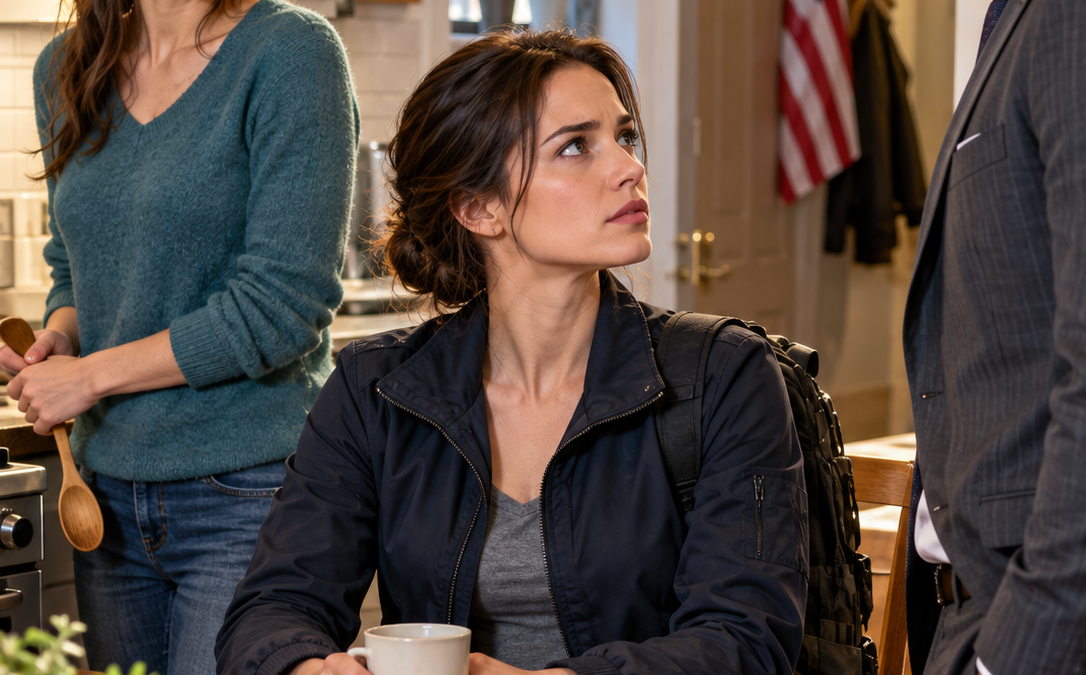
I looked at my reflection and did not recognize it.
Not because it was dark. The bathroom bulb was working perfectly, its warm yellow light spilling over the tiles, touching the shelf lined with lotions, and settling across the mirror. But the woman looking back at me had the eyes of someone who had long ago stopped expecting anything good.
My left cheekbone was dark purple, the bruise fading into a sickly yellow near my temple. My bottom lip was slightly split, the blood already dried and crusted over. The bruising extended beneath the collar of my nightgown, too.
I touched my cheek with two fingers. The pain was familiar, almost ordinary, like a blister caused by shoes that were too tight. Unpleasant, certainly, but already a part of me.
That was what frightened me most. Not the pain itself, but the fact that I had grown accustomed to it.
There was silence beyond the bathroom wall. David was sleeping. He always slept well afterward.
I turned off the faucet, which I had left running simply for the noise, hoping it would drown out my thoughts, his footsteps, or whatever else I could not bear to hear. Then I stepped back into the hallway. Fragments of a shattered plate lay scattered across the floor near the living room entrance. I did not bother picking them up. I stepped over the pieces and walked into the kitchen.
The coffee maker. A mug. A scoop of grounds. Everything where it belonged.
Outside the window was Chicago, seen from the fifth floor of an aging apartment building. The courtyard below lay under the damp darkness of fall. A streetlamp swayed in the wind, casting restless shadows across the pavement. The playground swings were empty and wet. Not a single elderly neighbor occupied the benches where they usually gathered every evening to gossip about everything and everyone.
It was almost three in the morning. Only the streetlamp and the wind remained.
I held the mug in both hands and stared through the glass, wondering how I had gotten here.
Not how I had walked from the bathroom to the kitchen. I remembered that perfectly well. I meant how I had reached this point in my life. This night. This shattered plate on the floor. This face in the mirror that I no longer recognized.
The truth was that I knew the answer. I simply did not always want to look at it.
Five years earlier, I had attended a corporate party hosted by a real estate development firm. I had gone almost by accident. A friend had urged me to get out of the house for once, to go somewhere and meet people.
There was a man standing at the bar. Six feet two inches tall, wearing an expensive suit, with the confident gaze of someone who knew he was worth more than anyone else in the room.
He looked at me. Specifically at me. Not in my general direction, not casually across the crowd, but directly into my eyes.
Then he smiled.
David Carter knew how to smile. Looking back, I think that was his greatest talent.
It was an open, effortless smile, complete with dimples. The kind of smile you trusted instantly and unconditionally because you assumed people with something to hide could not possibly smile like that.
He brought me a drink and asked what I did for a living. When I answered, he listened attentively. Truly attentively. He leaned forward slightly, as though every word mattered.
I talked about numbers, spreadsheets, and the endless boredom of financial planning. I told him how I had once dreamed of becoming a journalist. Completely insignificant things, the sort of details people tell strangers at parties without expecting them to remember.
But David listened.
Then he said, “You have an unusual way of looking at people.”
I did not understand what he meant.
“Most people look at you, and you can tell they’re already thinking about what they’re going to say next,” he explained. “You look at people differently. Like you’re actually seeing them.”
It was a very good line. I remembered it for a long time.
A month later, we were dating. Three months after that, he told me he wanted to spend the rest of his life with me.
I called Victoria.
My twin sister was somewhere in the Middle East at the time, and the connection kept dropping every other word. She congratulated me, of course, but there was something in her voice, a hesitation I could not quite interpret through the static.
She flew in for three days for the wedding.
She wore a crisp white button-down shirt and dark dress pants. She did not wear her dress uniform, although she certainly could have. She stayed close to me throughout the ceremony and danced the first dance with me because our father had died ten years earlier, and there was no one else to fill that place.
David watched her with a mixture of interest and mild caution. It was the expression people wore when they encountered someone who looked exactly like a person they already knew and could not quite adjust to the resemblance.
The night before Victoria left, we sat alone in the kitchen. David had gone out late with his buddies.
Out of nowhere, she said, “Something’s wrong with him.”
I looked at her.
“I can’t explain it,” she continued. “I just feel it.”
I laughed and told her she had forgotten how to take a break from her job. She spent so much time looking for threats that she had started seeing them everywhere.
Victoria did not take offense. She finished her tea and went to bed.
The next day, she flew out.
I would remember that conversation many times in the years that followed.
The first year of my marriage to David was genuinely good, although it was not perfect. His temper had been obvious from the beginning. He could raise his voice at an employee over the phone or slam his coffee mug onto the table when something angered him. But afterward, he would calm down, and everything would return to normal.
I told myself he was simply a man with a strong personality.
Business was stressful. People lost their tempers. It was normal.
In the second year, the outbursts began.
That was exactly what he called them.
“I had an outburst. I’m sorry. The job is eating me alive.”
His voice grew louder more frequently. The things he threw began landing closer to me.
Once, he smashed a mug against the wall right beside my head.
Not at me, I told myself. Beside me.
It was only a mug. Nothing had happened. Everything was fine.
The first time he actually struck me was during our third year of marriage.
I spent a long time sitting on the bathroom floor, crying into a towel so he would not hear me.
Later, he came in quietly, carrying flowers. His face was full of guilt, and his hands were trembling. He began to cry, too. Then he dropped to his knees.
“I don’t know what came over me. Never again. I swear.”
I believed him.
Or perhaps I wanted to believe him.
Believing someone and wanting to believe someone are two very different things. At the time, I did not understand the difference.
After that, everything escalated almost imperceptibly. Gradually, like water eroding a shoreline. Not through a single violent storm, but through a steady current that never stopped.
First, he took control of the finances.
“I’m better at handling money. Trust me.”
Then he began monitoring my phone.
“Who’s calling you? Who is this woman? Why are you still talking to your old coworkers?”
After that came my friends.
“They’re turning you against me. I can see it. Every time you see them, you come home acting differently.”
Eventually, I stopped seeing my friends.
Working remotely, which had once seemed like a convenience, became a trap. There was no reason to leave the apartment. Nowhere to go. No one to see.
I sat at home, cooked dinner, and waited for the sound of his footsteps on the stairs.
For three years, I told Victoria nothing.
I convinced myself I was protecting her.
She was fighting in a war. She faced real problems, real danger, real blood. Compared with the things she endured, my bruises hardly seemed worth mentioning.
That was another part of what David had done to me.
He had convinced me that I was insignificant. That my problems were imaginary. That, compared with the larger world, my pain was trivial.
I finished my coffee. It had gone cold.
Five hours earlier, everything had begun the way it usually did.
I had been making soup, a simple chicken noodle soup with carrots and celery. The radio was playing something quiet and jazzy in the background while I chopped parsley.
Outside, darkness was settling over Chicago. October evenings came early. By three o’clock, the shadows were already long, and by six, the city was completely dark.
I had not turned on the living room lights. For some reason, the twilight felt more familiar, more peaceful, less revealing.
David was supposed to be home at seven.
I deliberately avoided looking directly at the clock. Instead, I caught glimpses of it from the corner of my eye whenever I passed, although I was checking it constantly.
6:42.
6:51.
6:58.
When the hands crossed seven, something in my stomach tightened.
Not dramatically. Just enough for me to feel it.
At 7:22, the heavy lobby door slammed downstairs. I could hear it all the way up on the fifth floor. The building was old, and sound traveled through it mercilessly.
Then came the hum of the elevator.
Then footsteps on the landing.
I knew David’s footsteps. I had learned every variation over five years.
There were his ordinary footsteps, steady and unhurried, with a faint squeak from the sole of his right shoe. There were his good footsteps, the ones I heard when a deal had gone through or something at work had pleased him. Those were lighter, almost buoyant.
And then there were the other footsteps.
A little heavier than usual. A little slower.
Always followed by a pause before the door opened.
That pause was what I feared most.
That evening, there was a pause.
I turned down the burner beneath the soup and wiped my hands on a dish towel. Then I put the knife back into its drawer.
That was a rule I had established for myself long ago.
Quietly. Just in case.
The key turned in the lock.
David walked in without saying a word. He took off his jacket, tossed it toward the coat rack, and missed the hook. The jacket landed on the floor.
He did not pick it up.
He walked into the living room and switched on the light. I heard him sink into his armchair. He did not turn on the television.
“Is the soup ready?” he called.
His voice was flat.
That meant nothing. A flat voice could become anything.
“Almost,” I answered. “Another ten minutes.”
Silence.
I set the table, neither rushing nor deliberately slowing down. Over the years, I had learned the precise rhythm required to avoid attracting his attention.
Do not fuss. Do not drag your feet.
I set out the bowls and bread, ladled soup into his bowl, and called him to dinner.
He came into the kitchen, sat down, picked up his spoon, and took a taste.
“Too salty.”
I said nothing.
The soup was fine. I had tasted it myself.
“I said it’s too salty,” he repeated, staring into the bowl. “Do you even taste this stuff when you cook?”
“I did taste it,” I replied calmly. “I think it’s fine.”
That was my mistake.
Not what I had said. The way I had said it.
My voice had been too steady.
David could tell when I was making a conscious effort to keep my voice level, and that made him even angrier.
He did not want composure from me. He wanted fear. Immediate fear, at the very first sign of his displeasure.
Usually, once he saw that fear, he would calm down.
But that night, he had no intention of calming down.
“‘I think it’s fine,'” he repeated mockingly. “Do you hear yourself? I’m telling you what’s wrong with it, and you’re arguing.”
“I’m not arguing.”
“You’re arguing right now. Just like always. I come home exhausted, and you start in on me.”
I lowered my eyes to my bowl.
I did not eat. I simply stared at the soup.
I will not describe what happened next in detail.
Not because I cannot remember it. I remember everything, down to the smallest detail. I remember how the plate fell. I remember the sound of the chair overturning.
But some things do not need to be described in full.
It is enough to know that they happened.
That they happened again.
For what felt like the countless time.
The next morning, David got up at seven thirty, showered, and dressed for work in an expensive gray pinstriped suit.
He walked into the kitchen and found me sitting at the table.
“Is the coffee ready?” he asked, as if nothing had happened the night before.
“It’s ready.”
He poured himself a cup and drank it standing up. Then he glanced at his watch.
“Maybe we’ll go to a restaurant tonight. We haven’t been out in a while.”
I did not answer.
He put his mug in the sink, slipped on his overcoat, and picked up his keys.
The door slammed behind him.
I sat there listening to his footsteps fading away.
His light, businesslike morning footsteps.
A man going to work. A man making plans to take his wife to dinner. A man freshly shaved, impeccably dressed, and perfectly presentable to the world.
I reached for my phone.
Five missed calls.
All from Victoria, sometime during the night.
She called at unpredictable hours. Sometimes at three in the morning, sometimes at six. Wherever she happened to be stationed, time seemed to operate according to different rules.
I typed a message.
Everything is fine. I’ll call you later.
Then I put the phone down.
I’ll call you later meant never.
It meant I could not talk to her because I would start crying. And if I started crying, I would have to explain. And I did not want to explain because she would say something that would make everything collapse.
At the time, I felt as though there was nothing left to collapse.
I stepped onto the balcony.
The October morning was gray and damp, carrying the smell of rotting leaves and something sharp in the wind. Either the first snow was approaching, or it was simply the air blowing in from Lake Michigan, which always managed to smell like winter long before winter arrived.
Down in the courtyard, the older neighbors had already taken their usual places on the bench. They wore heavy coats and scarves and carried canvas shopping bags.
One of the women lifted her head, looked up at me, and then glanced away.
Mrs. Gable from the fourth floor.
She heard everything.
She always heard everything.
The walls were thin, and her apartment was directly beneath ours. We greeted each other politely whenever we crossed paths in the lobby.
But never, not once, had she said anything.
I went back inside and closed the balcony door.
I worked remotely until lunchtime. Spreadsheets, estimates, delivery receipts. The real estate company existed for me mostly as an abstraction, a collection of emails, numbers, and occasional phone calls. There were almost no actual people in my working day.
David had once called that arrangement convenient.
“You don’t have to commute anywhere. You can sit at home and do your job.”
He had presented it as concern for my well-being.
I understood the truth much later.
At two o’clock that afternoon, the doorbell rang.
I was not expecting anyone.
David would not be back until around seven, and our regular delivery driver only came on Wednesdays.
I walked to the door.
“Who is it?”
“Open up,” a voice answered from the other side.
I opened the door.
Victoria stood in the hallway.
An olive-drab tactical backpack hung from one shoulder. She was dressed in civilian clothes: jeans, a dark jacket, and flat-soled boots. Her hair was cropped short, and her cheekbones and forehead carried the deep, even tan of someone who had spent the summer in places that were most certainly not vacation destinations.
She looked exhausted.
Not the kind of exhaustion that disappeared after a good night’s sleep, but something deeper, something that had settled into the line of her shoulders and the way she planted her feet.
For the first second, we simply stared at each other.
Then her eyes moved to my left cheekbone.
The bruise was still dark purple, fading into yellow.
I had not had time to say a word, apply concealer, pull my scarf higher, or prepare an excuse.
She simply stood there looking at me.
I had never seen that expression on her face before.
She remained silent for several seconds, but those seconds seemed to stretch far longer than they should have.
Then she stepped across the threshold, dropped her backpack against the wall, and closed the door behind her.
“Do you have tea?” she asked.
“Yes.”
“Good.”
She walked straight into the kitchen as though she lived there, although she most certainly did not. Her last visit had been more than a year earlier, when she had stopped by for only a few hours while passing through Chicago.
“Put the kettle on.”
I put the kettle on.
Victoria sat on a stool facing the window, rested her elbows on the table, and looked down into the courtyard at the familiar benches and empty swing set.
She said nothing about my bruised face.
Nothing about the calls I had not answered.
“You came without warning,” I finally said.
“I bought the ticket last night.”
She turned toward me.
“I’m on leave.”
“Your first leave in two years?”
“Fourteen days.”
“And you came straight here?”
“Where else?”
The kettle whistled.
I poured hot water into two mugs, slid one across the table, and sat opposite her.
We sat in silence, but it was a normal kind of silence. Our twin silence. The kind that exists between people who have grown from the same roots, who do not need to fill every quiet moment with words.
Then she asked, “How long?”
Two words.
She was looking into her mug rather than at me.
I wanted to ask what she meant. I wanted to stand up, leave the kitchen, and pretend I had misunderstood.
That had always been my strategy, a reliable plan I had tested countless times.
Instead, I heard myself answer.
“About three years.”
Victoria nodded slowly.
She lifted her mug, took a sip, and set it back down.
“Tell me.”
I did not tell her everything immediately.
At first, I told her nothing at all.
I stared at the tabletop and insisted that everything was perfectly fine.
“I just fell. I’m clumsy. You know that.”
Victoria listened.
She did not interrupt. She did not argue. She simply waited.
Victoria knew how to wait. I had known that about her all my life. She could wait with a patience that seemed almost infinite, until the person sitting across from her finally understood there was nowhere left to hide.
Eventually, I started talking about David in general.
His work. His development projects. The kinds of clients he dealt with. Neutral things. Safe things.
Victoria listened.
Then, without intending to, I heard myself say, “He gets tired sometimes, and he loses his temper. But you know how it is. The job, the stress. He always regrets it afterward.”
Victoria did not respond.
She looked at my cheek.
Then her eyes dropped to my hands.
I quickly moved them beneath the table.
There were marks there, too. Marks that clothing could not always conceal.
“Paige,” she said quietly.
There was no pity in her voice. No accusation. No judgment.
Just my name.
And for some reason, that was enough.
I began to cry.
Not the loud, desperate, uncontrolled crying I had done alone in the bathroom. The tears simply began falling, and I made no effort to stop them.
I sat there crying silently.
Victoria did not rush forward to hug me. She did not tell me everything would be all right.
She simply sat beside me.
And somehow, that felt exactly right.
Then I began to tell her.
Not everything at once. I spoke in fragments, jumping from the previous year to the beginning of our marriage, then forward again to the day before yesterday.
Victoria did not demand clarification or insist on a chronological timeline.
She listened for the essential facts.
What he had done. How he had done it. Under what circumstances. What happened beforehand. What followed afterward.
At one point, she stood up and walked onto the balcony.
She remained there for approximately five minutes.
Through the glass, I watched her standing with her back to me, both hands shoved deep into her pockets, looking down into the courtyard.
When she returned, she poured herself more tea.
It had already gone cold.
She did not explain why she had needed to step outside.
I knew.
She had gone out there to manage whatever was rising inside her.
Victoria possessed a particular ability to step away, contain what she was feeling, and return with complete control over herself.
Commanders learned to do that. Otherwise, they could not function.
But I had known her since birth, and I could tell that maintaining that control was costing her an enormous amount of effort.
We sat together until nightfall.
David texted at eight.
I did not answer his call. Instead, I sent him a message.
I have a headache. Not tonight.
He replied with one word.
Okay.
He did not ask how I was feeling.
He did not tell me to get well soon.
Victoria picked up my phone and opened the message thread without asking permission.
She simply took it and began reading.
I did not stop her.
For the first time in a very long while, I did not care.
Let her read it. Let her see.
She scrolled for a long time, her face expressionless.
Then she put the phone down.
“Where does he keep the money?”
“He handles all the finances himself. I have a debit card. He transfers whatever he thinks I need.”
She nodded.
“Whose name is the apartment in?”
“His. We didn’t arrange it any other way. He said it would be easier for taxes and paperwork.”
“Understood.”
She rubbed her forehead with one palm.
“The car?”
“His.”
“What exactly belongs to you?”
I thought about it.
“My laptop. My clothes. My books.”
Victoria said nothing.
But something in her face changed, almost imperceptibly.
It was not anger. It was something quieter, more deliberate.
The expression of someone who had already made a decision but had not yet spoken it aloud.
Late that night, when exhaustion finally settled over us and our conversation began to fade, Victoria stood and walked slowly through the apartment.
She moved deliberately, studying the rooms with the concentration of someone who knew how to read a space.
In the entryway, she stopped beside the closet and examined its broken handle.
The handle had been hanging from a single screw for months.
“How long has that been broken?”
“Six months, probably.”
She said nothing and continued walking.
In the bedroom, she noticed David’s expensive Swiss watch on the nightstand. He always left it there when he went to sleep, beside his phone, which was plugged into the charger.
His side of the bed. His pillow. His glass of water.
Everything arranged for his comfort.
My side was at the very edge of the mattress, as though I occupied the space of a guest rather than the woman who lived there.
Victoria looked at all of it.
I watched her memorizing everything.
In the living room, she examined the bar. Several bottles of expensive liquor stood in neat rows, including an open bottle of bourbon that was nearly half empty.
She offered no commentary.
We returned to the kitchen, where I made fresh tea.
Victoria opened her backpack and removed something wrapped carefully in cloth.
It was an old photograph in a small frame.
She placed it on the table between us.
I recognized it immediately.
We were about eight years old in the picture, standing on either side of our father.
He was wearing his military uniform, the insignia of a colonel visible on his chest. His expression was serious, but his eyes were laughing as he held us by our shoulders.
Fort Liberty, North Carolina.
Summer.
The parade field and trees were visible behind him.
I was wearing a white dress. Victoria wore an identical one. Our mother had liked dressing us alike when we were little.
“Where did you get this?” I asked.
“I carry it on every deployment.”
Victoria looked down at the photograph.
“What did he tell us?”
I knew exactly what she meant.
“If anyone ever raises a hand to you,” I began.
“You’re not obligated to tolerate it,” Victoria finished.
She touched the edge of the frame.
“He told both of us that. Both of us, Penny.”
“I know.”
“But you forgot.”
It was not a reproach. Merely a statement of fact.
“I didn’t forget,” I whispered. “I just stopped believing it was true. That I had the right.”
I looked down at the table.
“When something goes on long enough, you start thinking it must be your own fault. Like if you’d just been better, calmer, smarter, none of it would be happening.”
Victoria listened.
“And then you get used to the pain,” I continued. “That’s the worst part. Not when it hurts, but when it stops feeling unusual. When it just becomes part of your life.”
A long silence followed.
“Is he coming back soon?” Victoria asked.
“Usually around seven. Sometimes later.”
“Where is he tonight?”
“I don’t know. I didn’t ask.”
Victoria nodded, wrapped the photograph in its cloth, and returned it to her bag.
Then she carried her mug to the sink.
“I’m going to stay with you for a few days.”
“He won’t be happy.”
She turned around.
“I’m going to stay with you for a few days.”
There was no question in her tone.
I nodded.
She made herself a bed on the living room sofa. I offered her the bedroom, but she refused without explanation.
She lay down and closed her eyes.
Within minutes, she was asleep.
I could hear her steady breathing from the hallway. It was a military habit, the ability to sleep almost anywhere, quickly and deeply.
I lay in the bedroom staring at the ceiling.
Outside, the wind dragged fallen leaves across the asphalt. Somewhere in the distance, an elevated train rumbled through the city.
Chicago continued its enormous, indifferent nighttime existence.
I thought about what I had told Victoria.
Three years.
For three years, I had been putting knives away in a drawer whenever I heard my husband’s footsteps approaching.
For three years, I had been texting Everything is fine to a sister who was fighting in mountains and enduring things I did not even know enough to imagine, and who somehow still managed to worry about me.
For three years, I had explained bruises by blaming cabinet doors and doorframes.
But for the first time in three years, I had not needed to explain anything.
I closed my eyes.
The following morning, the sky was barely beginning to lighten. The bedroom window was a dull rectangle of gray.
I woke to noises coming from the living room.
For several seconds, I lay there disoriented. Something was moving rhythmically, quietly, but unmistakably.
I got up and walked into the hallway.
Victoria was exercising.
It was five thirty in the morning, and the living room was still in semidarkness. She wore a T-shirt and sweatpants.
This was not an ordinary morning workout.
She moved through planks and push-ups, followed by sharp, precise strikes whose names I did not know.
Either she did not hear me or she heard me and chose not to react.
I stood watching her for several seconds.
We were twins.
The same face. The same height. Identical hands.
Yet we moved through the world in completely different ways.
Victoria occupied the room fully, without apology, without any instinctive desire to make herself smaller.
She moved like someone who had never learned to shrink away.
I suddenly wondered whether we were truly alike at all.
Physically, of course. No one could deny that.
But in every other way?
Victoria noticed me and stopped. Her breathing remained steady.
“Did I wake you?”
“No. I get up early.”
“Coffee?”
“I’ll make it.”
We sat in the kitchen again.
Only now it was morning, and the courtyard outside was waking up. Someone was walking a dog. Someone else was taking out the trash. Children with school backpacks emerged from the building across the street.
“Tell me about him in detail,” Victoria said.
She held her mug in one hand and looked down at the table.
“Not like yesterday. Different details.”
“What kind of details?”
“How he’s wired. What matters to him. What he’s afraid of.”
I looked up.
She was watching me evenly.
There was something new in her expression, something I had not seen the day before.
Yesterday, she had been listening as my sister.
Now she was listening like someone who had already made a tactical decision and was gathering intelligence.
“Victoria,” I said carefully, “what are you planning?”
She remained silent for a moment.
Then she answered, “First, tell me everything about him. Every single detail.”
I studied her face.
My face, and yet not mine.
Her straight back. Her calloused hands. The steady gaze of a woman accustomed to making decisions and accepting the consequences.
Outside, the streetlamp swayed in the wind. Fallen leaves skittered across the wet pavement.
Mrs. Gable from the fourth floor had already claimed her usual bench. Wrapped in her heavy coat, with her canvas tote beside her, she stared into the distance.
I lifted my mug, took a sip of coffee, and began to speak.
The next morning, David came home around ten thirty.
I heard the lobby door, then the elevator, then his footsteps.
Ordinary footsteps this time. Not the frightening ones.
Good footsteps.
I was standing by the stove holding a wooden spoon, and I froze.
Victoria sat at the kitchen table with a mug of coffee, reading something on her phone. She did not look at me. She merely shifted her elbow slightly to clear some space on the table.
David opened the front door and stepped inside.
I heard him take off his jacket. Then he noticed the unfamiliar tactical backpack leaning against the hallway wall.
“Who’s here?” he called from the entryway.
“My sister,” I answered.
There was a pause.
Then he appeared in the kitchen doorway.
Victoria lifted her head.
They stared at each other for several seconds.
It must have been a strange experience for him, seeing his wife’s face sitting at the kitchen table while his wife stood simultaneously beside the stove.
Victoria and I were identical twins in the most literal sense. The same cheekbones, the same eye shape, the same nose.
But something about the way Victoria sat, her back straight, her eyes level, making no effort to hide herself, was profoundly different.
David sensed it.
I could see that he did not understand exactly what he was noticing, but he noticed.
“Victoria,” he said. “When did you get in?”
“Yesterday.”
Her voice was calm and neutral.
“Staying long?”
“I’m on leave.”
He nodded and glanced at me.
I looked down into the pot.
Then he walked into the living room and turned on the television.
Victoria set down her mug and looked at me.
She said nothing.
But I knew she had seen my hands. She had noticed how tightly I was gripping the wooden spoon.
She noticed everything.
Lunch passed in almost complete silence.
David ate while staring at his phone, occasionally mentioning something trivial about traffic or a client who was delaying a signature.
Victoria gave short, neutral responses.
I barely spoke.
David was accustomed to that.
After lunch, he left for a construction site.
The door clicked shut behind him.
I think that was the first time I truly exhaled all morning.
“He didn’t realize,” I said.
“Not yet,” Victoria answered.
She stood, carried her plate to the sink, and turned on the faucet. She washed the dishes silently, quickly, with the same precise efficiency she applied to everything.
Then she dried her hands and turned toward me.
“Keep talking.”
So I kept talking.
We talked throughout the afternoon.
Victoria asked questions. Specific, precise questions, without any unnecessary explanation.
What did David do in the mornings? What time did he usually leave for work? When he drank, did he begin early in the evening or wait until later? Did he call before coming home?
Did he have friends who visited the apartment?
Did he go to the gym?
She already knew he had boxed in the past, but she wanted to know whether he still trained.
“No,” I answered. “He stopped a couple of years ago.”
“Why?”
I thought about it.
“I don’t know. He just stopped going. Said he didn’t have time.”
“Did he like being a boxer?”
“What do you mean?”
“Did he talk about it? Especially when he wanted to impress someone or when he was angry?”
I thought for a moment, then remembered.
“Sometimes he holds his hands up like he’s demonstrating something. He says, ‘I used to box. You know what I’m capable of?'”
“Every time?”
“No. Not every time.”
Victoria nodded and wrote something in a small, rigid military notebook.
I had noticed her taking notes since the beginning of our conversation. At first, I assumed it was simply a habit.
Now I saw that she had already filled several pages.
“What does he value above everything else?” she asked.
“In what sense?”
“Reputation. Money. Respect. Which matters most?”
I considered the question.
It was a good one. I had never articulated the answer to myself, but strangely enough, it came almost immediately.
“Reputation,” I said.
Victoria lifted her head.
“It’s incredibly important to him what people think of him. At work, among his friends, in his professional circles. He could lose money and convince himself he’ll make more. But if someone found out something ugly about him, something that damaged his image, that would be the worst thing imaginable.”
Victoria looked at me as though I had just revealed something important without realizing it.
“Good,” she said quietly.
Then she wrote another note.
The following morning, she woke me at eight.
“Get dressed. We’re going out.”
“Where?”
“Outside.”
I did not argue.
We stepped into a gray October morning.
The courtyard was nearly empty except for an elderly man walking his dog near the far corner. The air smelled of damp soil and the first bite of frost. The temperature must have dropped below freezing overnight.
Victoria stopped in the middle of the playground, between the rusted swings and an old pull-up bar.
“Stand like this,” she instructed. “Feet a little wider than shoulder-width apart. Don’t tense up. Just stand your ground.”
I copied her stance.
“Now watch. I’m going to put my hand on your shoulder. Not aggressively. Just place it there.”
She demonstrated.
“What do you do?”
“Nothing. I’m just standing here.”
“No. Look.”
She repeated the motion.
“When someone puts a hand on your shoulder, even without threatening you, your body reacts automatically. You either tense up or lean away.”
I watched her.
“Both reactions communicate fear,” she continued. “You always lean away, Paige. It’s obvious.”
“I know.”
“I’m not criticizing you. I’m telling you what we need to change.”
We trained for approximately an hour.
Victoria did not teach me how to fight.
She taught me how to stand, how to hold my shoulders, where to direct my eyes, and how to breathe when someone raised their voice.
“Don’t hold your breath,” she told me. “It gives you away immediately.”
She demonstrated again.
“When you stop breathing, you’re transmitting a signal. He reads that signal. He knows he has you locked in. Don’t give it to him. Breathe evenly, even if you’re terrified. Especially if you’re terrified.”
It was easy to say and incredibly difficult to do.
But Victoria explained that breathing under pressure was a physical skill like any other.
It could be trained.
By the time we returned to the apartment, the muscles in my back were aching.
I did not understand why until I realized how much effort it had taken to stand with my spine straight and my shoulders relaxed.
For years, my body had memorized a different posture.
I had spent so much time making myself smaller, more invisible, less likely to attract attention, that my muscles had adapted to the effort.
“The body remembers everything,” Victoria said. “It remembers fear, too. But it can be retrained.”
I stared at her.
We were standing in the entryway, still wearing our jackets. She was removing her boots exactly as I did, left foot first.
And suddenly I thought about our childhood.
We had grown up together. Learned the same things. Read the same books. Survived the same childhood fevers.
But somewhere around eighteen, our paths had separated.
Now she knew how to stand her ground beneath a hostile gaze.
I did not.
“Victoria,” I said, “tell me what you’re planning.”
She straightened and looked at me.
“You don’t actually want to know.”
“Why would you say that?”
“Because if I tell you, you’ll have to make a choice. As long as you don’t know, you can put off deciding a little longer.”
She was right.
I said nothing.
“That’s why I want you to do one thing first,” she continued. “Call a lawyer. Not tomorrow. Not later. Today.”
“A lawyer?”
“I’ll find you a number. Someone who specializes in family law. Just call and ask how the process works. No obligations. You’re gathering information.”
“And what will that accomplish?”
“Information,” she said. “Information is everything.”
I nodded.
The lawyer’s name was Laura Sterling.
Victoria found her through some of her contacts.
She was a formidable professional who handled cases quickly, efficiently, and without unnecessary sentiment.
I called her that afternoon.
We spoke for twenty minutes.
Laura Sterling was calm, direct, and precise. She explained what was required for the division of marital assets when property was registered solely in one spouse’s name. She told me how incidents of domestic violence could be officially documented, what evidence might be admissible in court, what could be proven, and what could not.
She also outlined the potential timeline.
I wrote everything down.
When the call ended, I sat looking at my notes.
“Well?” Victoria asked.
“The apartment,” I said. “Laura says if it was purchased during the marriage, having only his name on the deed doesn’t automatically make it his separate property. It can still be marital property. She says I may be entitled to half.”
“She’s right.”
“But I need concrete evidence of the abuse if we’re going to establish what happened and use it in the legal process. Otherwise, David can contest everything, drag the case through court, and hire expensive attorneys.”
“There will be evidence,” Victoria said.
She did not hesitate.
“I promise you that.”
That evening, David was still at work when Victoria called me into the bedroom.
She was sitting at my vanity.
My makeup was arranged across the surface in front of her. Most of it had not been touched in a long time, but it was still there.
“Come here,” she said.
I approached.
“Sit down.”
I sat.
“Show me exactly how you do your makeup.”
I looked at her.
“What for?”
“Paige.”
I showed her.
Victoria watched with intense concentration, not the casual curiosity of someone watching a makeup tutorial, but the attention of someone studying a target.
When I finished, she asked me to bring several pieces of clothing I normally wore around the apartment.
I gathered a few items from the closet.
She examined them and selected one.
“Now go into the kitchen. I’ll call you.”
I left the bedroom, made myself tea, and stood looking out the window.
Approximately twenty minutes passed.
“Come in,” Victoria called.
I returned to the bedroom.
And froze in the doorway.
It was one of the strangest sensations I had ever experienced.
I was looking at myself from the outside.
Victoria sat at my vanity, wearing my clothes and my makeup.
The foundation matched perfectly. She had applied it exactly the way I did.
Her hair was shorter than mine, but she had styled it to imitate my usual appearance.
She was looking into the mirror rather than at me.
“Something’s missing,” she said.
I approached cautiously.
“The eyes are wrong.”
“What do you mean?”
“You look down when you’re unsure of yourself. You do it constantly. Right here, around the corners of your eyes.”
She pointed toward her reflection.
“And you pull your eyebrows together slightly when you’re expecting a blow. You don’t even realize you’re doing it.”
I stared at her.
“You notice all that?”
“That’s my job.”
She turned toward me.
“I observe people. How they stand. How they look at things. Where they carry tension.”
I moved closer and stood beside her.
We looked into the mirror together.
Two identical thirty-two-year-old women.
The same face.
And yet we were completely different.
“Because you’re not afraid,” I said quietly.
Victoria looked at my reflection for a long time.
“I am afraid,” she finally answered.
“Just of different things.”
I did not ask what those things were.
I knew she would not tell me anyway.
The following day, David left early for the construction site.
He called at seven in the morning to warn me that he would be home late. He had an important meeting with a contractor, followed by dinner with his business partners.
He expected to return around eleven.
Later that morning, Victoria sat at the kitchen table with her notebook, listening to me discuss David for what must have been the hundredth time.
She no longer asked general questions.
Everything had become very specific.
“When he comes home after dinner with his partners, what kind of mood is he usually in?”
“Depends.”
“Does he drink at those dinners?”
“Yes. Not always heavily, but he drinks.”
“Is he more aggressive afterward?”
I considered it.
“Not at first. At first, he’s usually relaxed. Satisfied. But later, if something doesn’t go exactly the way he wants, then yes.”
“What qualifies as something not going his way?”
“If I don’t react correctly. If I say the wrong thing. If he thinks I’m not happy enough to see him.”
Victoria made another note.
“Does he ever stop himself?”
“What do you mean?”
“Has he ever raised his hand to hit you, then stopped before making contact?”
I remembered an incident from long ago, near the beginning.
He had lifted his hand, then lowered it and walked into another room.
At the time, I had interpreted it as restraint.
Later, I realized he simply had not wanted to leave visible marks before a major meeting.
“Once,” I said. “But that was because—”
“Understood,” Victoria interrupted.
She wrote something down.
“It means he’s capable of controlling himself when doing so serves his interests.”
I stared at her notebook.
“Victoria, stop writing. Tell me what you’re going to do.”
She closed the notebook, set down her pen, and looked directly at me.
“I’m going to switch places with you.”
For several seconds, I could not speak.
“What?”
“For one evening, I’m going to be you.”
I stared at her.
“He’s known me for five years. He won’t confuse us.”
“From a distance, and for the first few minutes, he won’t notice.”
“He’ll realize eventually.”
“Yes,” she agreed. “He will.”
“Then what’s the point?”
“I don’t need a long time. I only need enough.”
“Enough time for what?”
She did not answer immediately.
Instead, she rose from the table and walked to the window.
Outside, the October afternoon was gray and motionless. Someone in the courtyard was raking wet leaves into uneven piles.
“Have you ever seen what happens to someone when they suddenly realize they have no cards left to play?” Victoria asked without turning around.
I remained silent.
“When someone walks into a situation expecting their usual rules to apply, only to discover that the rules have changed? That their tactics don’t work anymore? That they aren’t in the position of power they believed they occupied?”
“He’s dangerous,” I warned. “He used to box.”
“I know.”
“He’s big, Victoria. He’s strong.”
She turned around.
“He boxed at a recreational gym,” she said flatly. “I’ve fought in actual combat zones. Those are two entirely different things, Paige.”
She let the statement settle between us.
“You’re not going to convince me to stand down,” she added. “So don’t waste your time trying. You’ll be more useful if you help me.”
I looked at her for a long moment.
At that face.
My face.
Identical, and yet somehow belonging to someone from an entirely different world.
“Help you how?”
“Show me exactly how you walk.”
It was bizarre.
I spent the next hour pacing around my own apartment while my twin sister studied me as though I were a character she had been hired to portray.
But that was exactly what she was doing.
She watched how I moved, where I placed my feet, how I carried my hands. Then she asked me to repeat certain movements and copied them herself.
“You shorten your stride when you enter a room where he’s sitting,” she observed. “And you hesitate at the threshold. Do you notice that?”
I shook my head.
“It’s a threat assessment. Your body does it automatically.”
She demonstrated.
“I’m going to enter the same way, but with slight adjustments. He won’t consciously notice the difference.”
Then she began practicing my voice.
She sat opposite me, repeating familiar phrases in my intonation and rhythm.
I corrected her.
“No, I don’t sound like that. You’re talking too fast. When I’m nervous, I actually get quieter, not louder.”
She repeated the phrase.
This time, it was perfect.
She absorbed each correction almost immediately.
At some point, I began to cry.
Victoria stopped.
“What is it?”
I stared at her.
“You just became me.”
She waited.
“The voice. The gestures. Everything. I looked at you, and I saw myself. And I realized how deeply all of this has become part of me.”
I wiped my face.
“I don’t carry myself this way because I want to. I don’t speak this way because it’s my personality. I didn’t choose to take those short, hesitant steps when I enter a room. I didn’t choose to lower my voice whenever I’m scared.”
My throat tightened.
“It’s him. He did all of this. He made me like this.”
I could not finish.
Victoria stayed quiet.
Then she stood, crossed the room, and placed one hand on my shoulder.
She did not hug me.
It was simply the solid, grounding weight of her hand.
“That’s why I’m here,” she said.
At three that afternoon, David called.
I was in the bathroom.
Victoria was sitting in the kitchen with my phone nearby.
She reached it before I did.
I hurried out of the bathroom and stopped in the kitchen doorway.
Victoria looked at me and lifted her chin slightly.
A silent instruction.
Be quiet.
“Yeah,” she said into the phone.
Her voice was mine.
“Okay.”
A pause.
“No, I didn’t go anywhere. I’m home.”
Another pause.
“All right. Call me when you’re leaving.”
She ended the call and looked at me.
“He was checking whether you were home. Dinner with his partners is running late. He says he’ll be back around midnight.”
For several seconds, I could hardly breathe.
“You did it,” I whispered. “You actually fooled him.”
“It was a short conversation. A longer one would be more difficult.”
“But you did it.”
Victoria nodded and set the phone on the table.
“That gives me four days before he starts suspecting anything.”
“I thought you only needed one evening.”
“Correct. One evening.”
She looked at me.
“I need you to stay at a friend’s place tonight.”
“I don’t have friends anymore. He—”
“You have friends,” she interrupted. “You just stopped talking to them.”
I looked away.
“Call Natalie.”
My head came up.
“You remember Natalie?”
“You talked about her three years ago. You told me she was your best friend. And you told me you had a falling-out over David.”
Victoria stood and filled the kettle.
“Call her. You don’t have to tell her everything. Just tell her you need a favor. People who were once close to you usually show up when it matters.”
I watched her move around the kitchen.
Her straight posture. Her short dark hair. Her calloused hands pulling mugs from the cabinet with practiced efficiency.
A brigadier general commanding a special forces brigade, now operating out of a kitchen in a fifth-floor Chicago apartment.
“Are you afraid?” I asked.
“I already explained that to you.”
“No. I mean being alone with him for an entire evening. Aren’t you afraid?”
Victoria placed the mugs on the table.
She looked at me for a long moment, assessing exactly how much of the truth she wanted to reveal.
“I command a special forces brigade,” she finally said. “I make operational decisions that determine whether people live or die. I’m terrified of making a mistake that gets someone killed.”
She paused.
“Your husband isn’t something I’m afraid of.”
She poured boiling water into the mugs.
“But that doesn’t mean I’ll be careless. I’m never careless.”
For the next two days, we practiced.
Victoria trained herself to become me.
She studied my habits as though she were preparing to assume an identity in an operation that allowed no mistakes.
She corrected herself constantly and asked for clarification whenever something was uncertain.
Did I look at David while he ate, or did I keep my eyes lowered?
Did I clear the plates immediately after dinner, or wait until he finished using his phone?
Did he ever kiss me when he came home?
“Sometimes?” she asked.
“Never.”
“Never?”
“Not for a long time.”
She wrote it down.
One evening, David was home watching television in the living room while Victoria and I sat quietly in the kitchen.
She mimicked my gestures, my voice, my inflections.
I watched and offered whispered corrections.
At one point, she made a small, almost insignificant movement with her hand.
And I suddenly recognized myself.
Not an imitation. Not a caricature.
Exactly myself.
The sight made my skin crawl.
“How do you do that?” I whispered.
“Repetition.”
She copied another gesture.
“In my line of work, you sometimes have to operate as someone else. Not often, but it happens.”
“Isn’t that espionage?”
“It’s called different things depending on the operational environment.”
I studied her.
“Victoria, I want you to answer something honestly.”
“Ask.”
“Are you planning to hit him?”
There was a pause.
“Only if he strikes first.”
“And if he does?”
Victoria looked at me.
There was something almost gentle in her eyes, as gentle as Victoria was capable of being.
“Then he’s going to regret it.”
My stomach tightened.
“But that’s not the objective,” she continued. “The objective is something else.”
“What?”
“You said it yourself. He’s terrified of anything that threatens his reputation.”
She tapped her notebook.
“That’s the target. Not bruises. Not physical pain. The possibility of losing everything he considers important.”
I remained silent.
“The lawyer is already working,” Victoria continued. “Laura Sterling is building the case. She knows what needs to be documented.”
She turned a page.
“Your injuries have been photographed. I encrypted the images and sent them to her from my phone yesterday. The photographs are dated. They’re evidence of physical assault. The foundation is already in place.”
I stared at her.
“When did you do that?”
“While you were sleeping.”
“You handled all of this while I was asleep?”
“You haven’t slept properly in a long time. I don’t need assistance to forward a few digital files.”
I did not know what to say.
I was sitting in the kitchen of an apartment where I had lived in fear for years.
And in only a few days, my sister had begun accomplishing things I had been unable to bring myself to do for so long.
Not because she was inherently braver.
But because she had not been carrying the weight of those years. She had not been conditioned to accept the pain.
“I need to tell you something,” I said.
Victoria looked up.
“I’m listening.”
“I’m ashamed.”
She waited.
“Deeply ashamed. Not only of what happened. I’m ashamed you found out this way. I’m ashamed that you’re sitting here organizing all of this instead of resting during your first leave in two years. I’m ashamed that any of it is happening.”
Victoria studied me for several seconds.
“Paige,” she said, “leave is when you do what matters.”
She paused.
“You matter.”
Through the wall, in the living room, David changed the television channel. A loud commercial suddenly blared from the speakers.
I flinched.
Only slightly.
But Victoria saw it.
“The day after tomorrow,” she said quietly. “That’s when we do it.”
Then she looked at my phone.
“Call Natalie today.”
I called.
Natalie answered on the second ring.
She heard my voice, and the first thing she said was not What happened? or Where have you been? or even Are you alive?
She simply said, “Come over.”
Two words.
I almost cried.
“The day after tomorrow,” I managed. “Just for the evening.”
“Of course,” Natalie answered. “I’ll be here.”
I ended the call and sat looking out at the dark courtyard.
Victoria picked up her notebook, opened it to the last page covered in ink, reread her notes, and added one final line.
“That’s it,” she said. “I’m ready.”
“Are you sure?”
She looked at me.
“I never deploy unless I’m ready.”
The day after tomorrow arrived much faster than I wanted it to.
Time has a strange way of behaving when you are waiting for something with dread. It compresses and accelerates.
That morning, Victoria and I barely spoke.
We ate breakfast.
She completed her usual physical training. By then, I had grown accustomed to hearing her move around the living room before sunrise.
David left for work at eight.
He had a major day at the construction site and said he expected to be home by eight that evening.
At four in the afternoon, I packed a small bag.
Nothing conspicuous. Nothing that would suggest I was leaving my husband.
Just enough to make it look as though I were spending an evening with a friend.
Victoria stood in the bedroom before the mirror.
I watched her undergo the transformation I had already seen several times.
My clothes.
My hairstyle, imitated as closely as possible.
The conservative makeup I normally wore.
She studied her reflection, making tiny adjustments to the angle of her head and the direction of her gaze.
“Don’t look directly into the mirror,” I told her. “I don’t do that.”
She glanced toward me.
“I look slightly off to the side. Like this.”
I demonstrated.
She copied me.
“Better,” I said. “But the eyes are still wrong. You look too directly at things.”
“That’s the one variable I can’t completely suppress,” Victoria said.
There was a pause.
Then something occurred to me.
“Maybe you shouldn’t.”
She turned toward me.
“Let him look you in the eyes,” I said. “Let him feel the difference.”
Victoria gave the faintest trace of a smile.
“Now we’re talking.”
At four thirty, I was ready to leave.
We stood facing each other in the doorway.
I looked at my sister, at my own face carrying something that seemed foreign to me.
But that unfamiliar quality was the most important part.
She possessed the directness I had once had and lost. A natural, unwavering calm that was not an act but something forged through years of command.
“Victoria,” I began.
“Move out,” she answered. “Everything goes by the numbers.”
I stepped into the hallway, took the elevator downstairs, and walked into the courtyard.
Mrs. Gable was sitting on her usual bench with another neighbor.
As I passed, she lifted her head and stared at me.
It was a long look, as though she wanted to say something.
She did not.
I walked through the courtyard gates and glanced back once at the fifth-floor window.
It was dark.
Victoria had not turned on the lights.
The sky hung low and heavy over Chicago. The air smelled of snow, that first snowfall which had not yet arrived but seemed to be waiting just beyond the clouds.
I walked toward the bus stop.
Behind me was the building. The apartment.
Five years of marriage.
Three years of terror.
And something that was supposed to change that evening.
As I walked, I realized that for the first time in a very long time, I was going somewhere of my own choosing.
Without permission.
Without explaining myself.
Without the paralyzing fear that my phone would ring and David would demand to know exactly where I was and why.
I was simply walking.
It was an unfamiliar sensation.
Almost forgotten.
Almost beautiful.
Natalie’s apartment smelled of coffee and old wood.
She lived in an older Chicago greystone with high ceilings and slightly warped window frames that allowed the autumn cold to enter in narrow, freezing drafts.
We sat in her kitchen.
She poured me a mug of tea and asked absolutely nothing.
She simply waited.
I remembered that about Natalie.
She knew how to wait, too.
“I can’t give you the whole story right now,” I told her. “Not yet.”
“Okay.”
“But I need to stay here tonight. Until late.”
“Stay until morning if you want. I’ve got a pullout couch.”
I looked at her.
We had not seen each other in three years.
Three years of silence because of David.
Because he had convinced me that Natalie was turning me against him.
Because I had believed him.
And now she was sitting across from me, offering me a place to sleep as though those three years had never happened.
“I’m sorry,” I said.
“For what?”
“For disappearing. For not calling for three years.”
Natalie looked at me for a moment.
“I knew exactly why you didn’t call,” she answered. “That wasn’t on you.”
We sat together for a long time.
She talked about her life, her job, and her move. She told me about the cat she had adopted the previous year.
I barely absorbed any of it.
A considerable part of my mind was still anchored to the fifth floor of that brick apartment building, where my sister was preparing for something I was trying desperately not to imagine too clearly.
Victoria is there. Everything is following the plan. She knows what she’s doing.
I repeated those thoughts silently, like a prayer.
At eight thirty, a message arrived from Victoria.
Target is home. All green.
I held the phone and stared at the words until they blurred.
“Something wrong?” Natalie asked.
“No.”
I set the phone down.
“Everything’s fine.”
Natalie poured more tea.
Outside, Chicago continued its ordinary evening routine.
Headlights moved along the avenue. Traffic hummed. Somewhere in the distance, the elevated train clattered past.
An ordinary city.
An ordinary evening.
Just not for me.
I closed my eyes and forced myself to stop thinking about what might happen to me.
Instead, I thought about Victoria.
At that exact moment, she was inside my apartment.
And my husband believed she was me.
Victoria had been tracking David’s approach since he entered the lobby.
She stood beside the stove, reheating leftovers from the refrigerator, listening to the familiar sequence of sounds.
The elevator.
The footsteps.
The pause outside the door.
She knew his footsteps by now.
Paige had described them repeatedly, with a level of precision that revealed years of conditioned vigilance.
Tonight, they were ordinary footsteps.
Good footsteps.
That meant David was in a good mood. His business dinner had probably gone well.
Victoria adjusted her expectations accordingly.
While the elevator carried him upstairs, she made one final visual inspection of the kitchen.
She had spent several hours alone in the apartment after Paige left, and she had not wasted them.
She had studied the layout the way she would study a building before entering a potentially hostile environment.
The exits. The furniture. The distance between rooms.
The balcony door opened inward.
The bedroom door had no lock.
The kitchen table was made of solid wood and would not move easily.
She had also examined the bar in the living room, particularly the open bottle of bourbon Paige had mentioned.
During her inspection, she had found something else.
Inside a kitchen drawer, beneath a stack of utility bills, lay a printed restaurant receipt from the previous week.
It came from an expensive steakhouse.
Dinner for two.
Victoria remembered the date because Paige had told her exactly where she had been that evening.
At home.
She had not left the apartment.
David, meanwhile, had called at 7:47 that night and said he was running late because of a client meeting.
Victoria photographed the receipt and sent the image to Laura Sterling. Then she returned the paper to precisely the place where she had found it.
The key turned in the lock.
Victoria lowered the flame beneath the skillet and turned toward the stove, leaving her back to the entrance.
Exactly as Paige had described.
Paige always had her back turned when David came home.
Not because she meant to ignore him, but because she was afraid of making eye contact too soon.
Victoria had no fear of meeting his gaze.
But tonight, she was Paige.
“Hey,” David called from the entryway.
His voice sounded steady and slightly tired.
He was genuinely in a good mood.
“Hey,” Victoria answered quietly.
Her voice was deliberately soft, subdued in exactly the way Paige’s would have been.
David walked into the living room and tossed his suit jacket onto the armchair.
Victoria heard the cushions shift beneath his weight. Then came the faint metallic sound of him removing his cuff links.
“Dinner ready?”
“Almost.”
“Good.”
A pause.
“Where’s your sister?”
“Went to see a friend.”
“Oh. Got it.”
Victoria turned a piece of meat in the skillet.
Her movements were smooth and unhurried.
Inside, her mind had settled into a state of complete silence.
No unnecessary thoughts.
No emotional distraction.
Just the task in front of her.
She knew how to enter that state.
Eliminate the noise. Focus on the objective. Execute the plan.
David appeared in the kitchen doorway.
She sensed him looking at her before she turned.
“What are you cooking?”
“Steak and baked potatoes.”
“All right.”
He walked to the refrigerator and took out a bottle of water.
For a moment, he stood only a few feet away, drinking and watching her.
Victoria kept her attention on the stove.
Eventually, he returned to the living room.
She exhaled, not because she had been frightened, but because maintaining such exact control required concentration.
The first interaction was complete.
He had noticed nothing unusual.
Her voice had matched.
Her movements had matched.
Everything was proceeding according to plan.
She set the table exactly the way Paige always did.
David’s plate nearer the edge, on the window side.
Bread to the right.
Fork and knife in their accustomed places.
Tiny details, the sort people never consciously notice until something is wrong.
Then they notice immediately.
David came into the kitchen, sat down, and picked up his fork.
Victoria took the chair opposite him.
They began eating in silence.
David scrolled through his phone while he ate.
Victoria appeared to concentrate on her own meal, but she was observing him.
She kept her gaze lowered toward a neutral point on the table while monitoring everything through her peripheral vision.
His hands.
His shoulders.
The angle of his neck.
The pace of his movements.
He seemed relaxed, tired, and satisfied with the evening. She could smell alcohol on him, although not enough to suggest he was heavily intoxicated.
“We signed the contract,” he said suddenly without looking up.
“Good,” Victoria answered.
“Three months of dragging it out.”
He set down his phone.
“Finally.”
Victoria nodded.
She did not smile.
According to Paige, she had rarely smiled during dinner over the last few years.
She mostly nodded.
“The potato’s a little dry,” David remarked.
Victoria said nothing.
“I said the potato’s dry.”
“I hear you,” she answered evenly.
There was a pause.
Only a second, barely noticeable.
But David had expected a different response.
He was accustomed to frightened silence, lowered eyes, or an immediate apology.
I’m sorry. I tried my best.
Or perhaps, I’ll make it better next time.
Victoria offered none of those things.
He picked up his phone again and continued eating.
“Is Victoria leaving tomorrow?” he asked after a while.
“I don’t know. She didn’t say.”
“I hope so. I hate having other people staying in my house.”
Another pause.
David glanced at her.
Something about her voice was not quite right.
It was a tiny difference in tone, a pitch that sounded slightly unfamiliar.
Not hostile.
Simply flat.
There was none of the soft, yielding quality he had come to expect.
“Is something wrong?” he asked.
“No.”
“You’re acting weird.”
“I’m tired.”
He studied her for another second before returning to his phone.
Victoria finished eating and cleared the plates.
Around ten fifteen, his mood began to change.
He poured himself a glass of bourbon in the living room.
Then another.
Victoria heard the familiar clink of glass from the kitchen.
A few minutes later, he walked in.
He was not looking for more food.
He simply appeared in the doorway and stood watching her.
Victoria was at the sink washing dishes.
“I’m talking to you,” he said.
“I’m listening.”
“No, you’re not.”
He took a step into the kitchen.
“You’ve been checked out all evening. Staring into space, giving me one-word answers.”
“I’m tired.”
“You sit at home all day. What the hell are you tired from?”
Victoria turned off the faucet.
She picked up a towel, dried her hands, and turned to face him.
It was a small movement.
But it was the first significant deviation from Paige’s behavior.
Paige would not have turned around immediately.
She would have continued washing the dishes, found some small task to finish, delayed the confrontation for as long as possible.
Victoria did not delay.
She turned calmly and looked him directly in the eyes.
David Carter was a large man.
Six feet two, broad-shouldered, with the heavy build of someone who had once boxed and retained the physical habits of the sport.
His torso was square, and he carried his chin slightly tucked.
He stood in the kitchen doorway wearing the expression of a man who expected the world to accommodate him.
Victoria met his gaze without flinching.
“What are you staring at?” he snapped.
Irritation had entered his voice.
Not outright rage. Not yet.
“At you,” she answered.
“What about me?”
“You asked what I was staring at. I’m looking at you.”
David narrowed his eyes.
Something was wrong with this conversation.
He could sense it, but he could not identify the problem.
Her words were ordinary enough. She had not insulted him. She was not shouting or openly challenging him.
But her manner carried something unfamiliar.
A stillness he was not used to.
Not the frozen stillness of fear.
Something entirely different.
“Did I say something funny?” he demanded.
“No.”
“Then why are you smiling?”
“I’m not smiling.”
He stepped toward her.
Then another step.
The distance between them closed until he stood much nearer than an ordinary conversation required.
It was a familiar intimidation tactic.
Take control of the physical space.
Make the other person retreat.
Remind them how much larger and stronger you are.
Victoria did not retreat.
She remained exactly where she stood and looked up at him.
She was half a head shorter, just like Paige.
But there was no fear in her eyes.
No aggression, either.
Only a quiet readiness.
David did not understand what he was seeing.
“What the hell is wrong with you?”
“Nothing.”
“You’re not acting right.”
“How am I not acting right?”
He opened his mouth.
Then closed it.
He could not find an answer.
She had not broken any of his unspoken rules in an obvious way.
She had not insulted him.
She had not raised her voice.
She had not done anything he could point to as justification for punishing her.
She was simply different.
And that difference was pulling him completely outside the pattern he had spent years establishing.
“Talk to me normally,” he finally growled.
“I am talking normally.”
“No. You’re using that tone.”
“What tone?”
David stared at her.
Slowly, the expression on his face began to change.
The irritation was still there, but beneath it something more dangerous was developing.
A quiet, simmering anger.
Victoria recognized it.
Everything Paige had described during their days of preparation was unfolding almost exactly as expected.
David was entering the next stage.
He would insult or command her and expect submission.
If she failed to respond the way he wanted, he would move closer to physical violence.
“Go to bed,” he ordered. “I’m sick of this.”
“I don’t want to go to bed.”
He slammed his glass onto the table.
“I said go to bed.”
Victoria looked at him.
She did not move.
“No,” she said.
One word.
Silence followed.
Something shifted behind David’s eyes.
A direct refusal.
To a direct order.
That had not happened in years.
Paige never said no.
She went quiet. She withdrew. She disappeared into another room.
But she did not refuse him openly.
David stepped forward.
“What did you just say?”
“You heard me.”
He took another step.
Then he raised his hand.
Not a closed fist.
An open palm, lifted in a familiar sweeping motion.
Victoria saw the strike coming before it began.
She reacted before he could complete the movement.
There was no prolonged struggle.
No wild exchange of blows.
Her response was controlled, precise, and startlingly efficient.
She caught his wrist, pivoted, and applied pressure to his elbow, forcing his arm into a position that stopped his forward movement.
David lost his balance.
A short, powerful strike to his torso completed the motion.
He hit the kitchen floor.
The entire sequence lasted approximately three seconds.
For a moment, David lay staring at the ceiling.
His expression was one of complete disbelief, as though his brain had failed to understand how a movement he had made countless times could have produced such an unexpected result.
Then his eyes darted toward her.
Victoria stood above him.
Straight-backed.
Calm.
Hands at her sides.
Breathing evenly.
“You—”
David scrambled to his feet.
Victoria made no attempt to stop him.
She simply stepped back and watched.
He stood gripping his arm, his face contorted with rage and confusion.
And beneath those emotions, she detected the very first trace of hesitation.
“What the hell was that?” he demanded.
“You raised your hand.”
“You—”
He lunged toward her again.
This time, he moved faster, throwing his weight forward with the force of someone whose anger had overwhelmed his judgment.
He was large.
He was strong.
And he believed those two things were enough.
Victoria used his forward momentum against him.
She shifted her position, redirected his weight, and executed a hip throw.
David hit the floor a second time.
Much harder.
The impact sounded different.
His shoulder struck the edge of a kitchen cabinet.
This time, he did not immediately get up.
He lay there struggling to draw breath, looking up at her with pain and fury in his eyes.
And something new.
Fear.
Only a trace of it at first.
Small enough that he might not have recognized it himself.
But Victoria saw it.
When he attempted to rise and attack a third time, his movements were more cautious.
He no longer had the same explosive confidence.
Victoria intercepted him again, using a firmer hold that placed painful pressure on his arm and shoulder.
David cried out.
Not a dramatic scream.
A short, strangled sound that escaped despite his effort to suppress it.
Then he stopped struggling.
Victoria released him and took a step back.
He remained on the floor, clutching his shoulder, breathing unevenly.
He looked at her the way someone might look at a dangerous animal he had never understood until it was too late.
“Paige,” he said.
For the first time all evening, his voice lacked its usual authority.
The absolute certainty was gone.
Something hollow had taken its place.
Victoria did not answer.
He stared at her face.
At Paige’s face.
And yet—
“You’re not Paige,” he said slowly.
It was not a question.
It was a realization.
Victoria crouched in front of him and looked directly into his eyes.
There was no hatred in her expression.
No triumph.
Simply the unwavering gaze of someone who had no reason to look away.
“No,” she said.
She reached into her pocket, removed her identification, opened it, and placed it on the floor in front of him.
David looked down.
The photograph.
The rank.
The name.
Brigadier General Victoria Hayes. United States Army.
He stared at the identification for a long time.
Then he looked up.
“The sister,” he whispered.
“Yes.”
“What? Why are you—”
“You know exactly why.”
He fell silent.
Then the excuses began.
They came quickly, one after another, tangled and disjointed.
Stress.
The pressure of his industry.
The demands of his business.
He had never meant for things to get out of hand.
It had simply happened.
Then came the justifications.
Paige provoked him.
She did not understand what he dealt with at work, the contractors, the financial risks, the constant pressure.
Then the threats.
He would hire the best lawyers money could buy.
Paige would never be able to prove anything.
She would not go through with a divorce.
She always came back.
Victoria did not interrupt.
She simply watched him and waited.
She knew how to wait.
When people like David were allowed to keep talking, they often exhausted every excuse they possessed.
Eventually, he ran out.
His voice faded.
His arguments collapsed into silence.
He remained on the floor, looking up at her.
Only two things seemed to remain in his expression.
Exhaustion.
And fear.
“What do you want?” he asked.
His voice was quieter now.
The bluster was gone.
Victoria stood, retrieved her identification, and returned it to her pocket.
Then she pulled a chair away from the kitchen table, placed it directly in front of him, and sat down.
Her posture was straight, her hands resting on her knees.
“A divorce,” she said.
David stared at her.
“No prolonged litigation. No unnecessary court battles. The apartment goes to Paige. It was acquired during the marriage and is marital property under the applicable state law.”
She continued without raising her voice.
“Financial accounts will be divided equally. Personal belongings remain with their respective owners. No contested claims.”
She paused.
“And absolutely no contact with Paige. No calls. No text messages. No showing up at her door.”
David looked at her in disbelief.
“She’s going to strip me of everything.”
“She’s going to leave you with what you’re legally entitled to. Half is yours. Half is hers. That’s equitable.”
“I’ve got a top-tier lawyer on retainer. I’ll call him.”
“That’s your legal right.”
Victoria took out her phone, unlocked it, and turned the screen toward him.
“These are screenshots of your text messages over the last thirty-six months.”
She moved to the next images.
“These are dated photographs of Paige’s injuries. Her attorney already has copies.”
Another image appeared.
“This is a restaurant receipt from last week. Dinner for two at an expensive steakhouse. I found it in your kitchen drawer.”
David’s expression tightened.
Victoria continued.
“Paige filed a police report this morning. Every incident that can be supported by medical or legal documentation has been formally recorded. Her attorney has the complete evidence file.”
That was not entirely true.
Paige had not yet filed the police report.
She and Laura Sterling had discussed how to do it, but the report itself was still pending.
The digital evidence, however, had already been secured.
Victoria knew the difference.
She also understood that, in psychological warfare, what a person believed about the situation could be just as important as the facts they had independently verified.
David stared at the phone.
For a long time, he said nothing.
Then he whispered, “You’re bluffing.”
“I can call her attorney right now,” Victoria answered. “She’s expecting my call. I’ve already briefed her on the timeline.”
Another silence.
David looked down.
“This will destroy everything,” he finally said.
His voice was barely audible.
“My reputation. My partners. If any of this becomes public—”
“Yes,” Victoria said.
One word.
Nothing more.
David looked at her.
Something inside him seemed to be giving way.
For years, he had relied on the certainty that he could control the consequences of his actions.
He could explain things away.
Pay someone to solve a problem.
Intimidate anyone who challenged him.
Present the world with a carefully polished version of himself.
Now, for the first time, he was confronting the possibility that none of those methods would work.
His certainty was beginning to fracture.
“What happens if I refuse your terms?” he asked.
“Then it goes to court,” Victoria answered. “With the evidence file. With sworn testimony. With an attorney who has no interest in protecting your corporate reputation.”
She leaned slightly forward.
“It could drag on for months. Your partners, your investors, and the people you do business with may learn exactly what has been happening behind your front door.”
Her voice remained even.
“This isn’t a threat. It’s an intelligence briefing. You have the right to understand the situation you’re in.”
Silence.
David stared at the floor.
He shifted his injured shoulder and winced.
Outside, the wind howled past the windows.
In the distance, the elevated train rattled through the city.
An ordinary autumn evening in Chicago.
“What are you going to do to me?” David asked.
It was barely a whisper.
The question sounded almost childlike.
It was the voice of someone who finally understood that he no longer controlled the room.
“Nothing,” Victoria answered. “I’m getting Paige out.”
She held his gaze.
“She’s never coming back to live here. You’ll sign the documents her attorney prepares. After that, the matter is finished.”
“Just like that?”
“Just like that.”
David fell silent again.
Victoria did not hurry him.
She remained where she was, letting him think.
Pushing too hard at this stage would have been a mistake. He needed to arrive at the decision himself.
“She’s actually leaving?” he asked suddenly.
His voice sounded strange, almost disoriented.
“For good?”
“Yes.”
“Because of this?”
“Because of three years of this.”
He looked down at his hands.
“I didn’t think she’d ever leave.”
Victoria regarded him quietly.
“Or did you convince yourself she was incapable of leaving?”
He did not answer.
“She always had the ability,” Victoria continued. “You simply trained her to believe she didn’t. It was convenient for you.”
Something in his face collapsed.
It was not remorse.
Not exactly shame.
It was the unwilling understanding of a reality he could no longer change.
David was an intelligent man. Once every possible way out seemed closed, he could understand the consequences quickly enough.
“Okay,” he finally said.
His voice was empty.
“Okay. I’ll sign.”
Victoria stood and returned the chair to its place beneath the table.
She adjusted her jacket.
David looked up.
“Does she know you’re here?”
“Yes.”
“And she agreed to all this?”
Victoria studied him.
“It’s her decision,” she said. “For the first time in three years, it’s entirely her decision.”
She walked into the hallway, put on her jacket, and lifted her small bag onto her shoulder.
David followed as far as the living room doorway.
He stopped there, watching her with the bewildered expression of someone who recognized a face but no longer understood the person wearing it.
“You planned this?” he asked.
There was no accusation in his voice now.
Only a need to understand.
“Yes.”
“In advance?”
“Yes.”
“And you weren’t worried something could go wrong? That the variables might change?”
Victoria opened the front door.
Then she turned back toward him.
“I command people in environments where every variable is trying to kill us,” she said. “That’s my profession. I build plans designed to survive when circumstances change.”
She paused.
“If you violate a single condition of this agreement, I’ll come back. And next time, I won’t be on a short period of authorized leave that I need to protect.”
Then she stepped into the hallway and closed the door behind her.
The stairwell was silent.
It smelled of old wood and concrete dust.
Victoria took the stairs rather than the elevator.
She descended on foot and stepped into the courtyard.
Snow had begun to fall.
The first snow of the year.
Light and almost invisible.
The kind that melted before it could settle.
Flakes touched the asphalt, the dead leaves, and the empty benches, vanishing almost instantly without leaving a trace.
Victoria stopped in the middle of the courtyard and tilted her face toward the sky.
A few snowflakes touched her cheeks.
Then she took out her phone.
At Natalie’s apartment, my phone vibrated before I had even thought to reach for it.
Victoria’s name appeared on the screen.
I nearly dropped the device.
“Victoria?”
“All green,” she answered. “I’m in the courtyard. Proceed with extraction.”
I closed my eyes.
“You’re okay?”
“I’m waiting for you here. Move out.”
I told Natalie I needed to go.
She walked me to the door and handed me a jacket. In the rush of everything that had happened, I had forgotten to bring mine.
“Call me,” she said.
I nodded.
“Not just when you need something. Not when you finally feel ready to tell me everything. Just call me.”
I promised I would.
The walk to my apartment building took approximately twenty minutes.
I covered the distance quickly, almost jogging.
Not because I was afraid.
I needed to move. I needed to close the physical distance between myself and what had happened, to make the events of that evening feel real.
Victoria was standing near the rusted swings when I entered the courtyard.
She wore her jacket, her hands deep in the pockets.
Snow was falling.
The first snow, light and fragile.
A few flakes had caught in her short hair and were already melting.
I walked through the gate.
She saw me.
We stopped several feet apart.
I looked at her.
Intact.
Calm.
Standing there in the falling snow as though nothing extraordinary had happened.
“You’re okay,” I breathed.
“Intact.”
“And him?”
“He surrendered. He’ll sign the documents. His attorney will contact Laura at eight hundred tomorrow.”
I stared at her.
Three years.
Three years of fear.
Three years of pain I had come to consider ordinary.
Three years of believing there was no way out, that this was simply the shape my life had taken.
And now, in one evening, something had changed.
I looked at my sister.
“Did he fall?”
Victoria regarded me.
There was the smallest pause.
“Twice,” she said.
I laughed.
It was a strange laugh, uneven and nervous, pushing its way through an emotion that was dangerously close to tears.
Victoria watched me.
There was an expression on her face that I could not quite name.
Not pride.
Something quieter.
“Good,” I said.
Then, after a moment, “Good.”
The snow continued falling.
The courtyard was deserted.
The streetlamp swayed in the Chicago wind, and the distant city murmured around us.
We stood alone in the middle of that concrete square.
Two women with the same face.
Neither of us said anything.
Then Victoria stepped forward and hugged me.
It was not a desperate embrace.
Not an attempt to crush the breath out of me.
Just a solid, certain hug.
The kind people give when they have known each other for their entire lives and do not need words to explain what they mean.
I closed my eyes.
Behind me stood the building where an entire chapter of my life had just ended.
In front of me was everything else.
Victoria returned to Natalie’s apartment around midnight.
I heard her footsteps on the stairs.
They were not the footsteps I had spent years fearing.
These were different.
Light, rhythmic, and confident.
I stood beside the partially open door and waited.
She came inside, removed her jacket, and hung it on the hook.
She caught the hook on the first try.
Then she looked at me.
I looked back.
Neither of us said anything.
I stepped toward her.
She stepped toward me.
And for a moment, we simply stood in that narrow hallway holding each other.
Not for very long.
Just long enough to feel that we were both there.
“Go put the kettle on,” she finally ordered.
I went into the kitchen and filled the kettle.
We sat at a kitchen table again, for what must have been the hundredth time over the past several days.
Victoria gave me a complete account of what had happened.
No exaggeration.
No unnecessary drama.
Just a precise, chronological explanation.
How David had entered the apartment. How dinner had progressed. When his mood began to change. When he raised his hand. Exactly how she had responded.
I listened, feeling the blood drain from my face.
I could feel myself turning pale.
Not because I was afraid of him anymore. The immediate threat had been removed.
But hearing the events described aloud was different from imagining them.
Hearing how he had prepared to strike her, how he had ended up on the floor, how completely his confidence had disappeared, made everything feel more real.
“He landed on his shoulder during the second takedown,” Victoria explained. “His mobility is going to be severely limited tomorrow morning.”
I looked at her.
“You told me he fell twice.”
“Yes.”
“But you said he attacked again.”
“He did.”
“Three times?”
“Three.”
She shrugged.
“Some people need more than two demonstrations before they understand the situation.”
I laughed again.
The same uneven, nervous sound, almost euphoric.
“Good,” I said. “I’m glad it was three.”
Victoria watched me.
Then she smiled.
A genuine smile.
Not one of the small, controlled expressions she usually permitted herself.
“He surrendered,” she repeated. “Call Laura Sterling in the morning. Tell her he’s ready to negotiate. She knows how to handle things from here.”
“Okay.”
“There’s also a high probability he’ll contact you directly before he speaks with the attorney. He’ll want to test whether he can still communicate with you.”
“What do I say?”
“Listen carefully. Promise him nothing. Don’t argue. Don’t explain. Don’t offer opinions.”
She waited until I was looking directly at her.
“You listen, and you say, ‘I understand.’ Everything else goes through Laura.”
I nodded.
“Victoria?”
“Yes?”
“Thank you.”
She looked down at her mug, then back at me.
“Don’t.”
“I’m going to say it anyway.”
“Then say it later. When everything is officially finished.”
She stood and put her mug in the sink.
“Go to sleep. Your body needs it.”
“What about yours?”
“Mine does, too. Move.”
I obeyed.
I lay down and closed my eyes.
Outside, it was snowing.
The first snow.
I could hear the peculiar quiet it brought.
A city under snowfall sounded different. Softer, as though someone had turned down the volume of the entire world.
I lay there thinking that tomorrow would be the beginning of a new reality.
Not because everything had magically been fixed.
That was the sort of thing that happened in Hollywood movies, not real life.
But something that had seemed immovable for three years had finally been broken.
Something I had believed was permanent and invincible had proved unexpectedly vulnerable.
For the first time in years, I fell asleep quickly.
David called the next morning.
It was nine thirty.
I was sitting by the window with a mug of coffee, watching the snow-covered street.
A thin white layer had settled overnight, barely covering the asphalt. It was already melting around the edges.
Victoria was doing her morning workout in the living room.
Everything felt almost ordinary.
Then my phone vibrated.
David’s number.
I picked it up.
Victoria appeared in the kitchen doorway.
She stopped, met my eyes, and gave one sharp nod.
“Yeah?” I answered.
“Paige.”
His voice sounded entirely unfamiliar.
It was not the domineering, irritated voice I knew.
It sounded like the voice of a broken, exhausted man.
“I’m listening,” I said.
“I’m ready to sign everything.”
I said nothing.
“The apartment is yours. The accounts get divided in half. Exactly what she said.”
I stared through the window at the melting snow, the rusted swings, and the empty benches.
“I understand,” I answered.
“Will you contact your attorney?”
“Yes.”
A pause.
“Okay,” he said.
Then the call ended.
I put the phone on the table and sat staring at the wall.
Victoria did not prompt me.
She waited.
“He surrendered,” I finally said.
“Copy that.”
I opened my mouth, then stopped.
“I don’t feel what I’m supposed to feel.”
Victoria looked at me.
“I mean, theoretically, I should feel relieved. Happy. Something. But I don’t.”
I stared at my hands.
“I don’t feel anything. Just numb. Like someone packed me in cotton.”
“That’s normal,” Victoria answered. “The emotional response can be delayed. First your body gets through the immediate shock. Then you begin processing what happened.”
“How do you know?”
“I’ve seen it before. More than once.”
She did not tell me where or when.
“Don’t rush yourself, Penny. Your mind and body will catch up.”
Laura Sterling turned out to be exactly the professional Victoria had described.
She was a compact woman in her fifties, with a sharp dark suit, an angled haircut, and the watchful eyes of someone who had spent decades witnessing every possible variety of human failure.
Very little seemed capable of surprising her.
She handled the case rapidly and precisely.
There were no manufactured displays of sympathy, no long speeches about injustice, and no philosophical discussions about what I deserved.
There were facts.
Documents.
Decisions.
And a sequence of necessary actions.
We met at her firm, in a clean, efficiently arranged office with a ficus plant beside the window and meticulously organized binders lining the shelves.
Victoria accompanied me.
She took a chair near the wall and remained silent.
She seemed to possess an extraordinary ability to make herself nearly invisible when the situation required it.
Laura conducted the meeting.
She asked me for information I had already given Victoria, but organized it for legal purposes.
The date of our marriage.
Our marriage license.
Property deeds.
Bank accounts.
Financial arrangements.
Whether I had been financially dependent on David.
Whether his business operated through a limited liability company or involved personal guarantees.
“Personal guarantees,” I answered.
I knew that for certain.
Laura made a note.
At the end of the meeting, she looked at me with a steady, evaluating gaze.
It reminded me of a field medic deciding what needed attention first.
“You’re not the first woman to sit in that chair because of domestic violence,” she said. “And you won’t be the last.”
I remained silent.
“But you are one of the fortunate ones who began the process of leaving before the situation became fatal.”
I looked at her.
“Worse than it already was?”
“It can become much worse,” she answered. “It often does.”
She closed the folder.
“It’s a very good thing you’re sitting here.”
She did not ask exactly how Victoria had arranged my departure.
That was not her concern.
Her responsibility was the legal case.
When we left the building, Victoria walked beside me through the gray Chicago afternoon.
The sidewalks were wet. The sky hung low over the city.
I kept thinking about Laura’s assessment.
One of the fortunate ones.
A woman who had escaped before the situation became fatal.
I imagined a finish line that ended not with freedom but with a body bag, and I understood how close those possibilities might have been.
I forced myself to stop following that thought.
Or tried to.
“Stop,” Victoria said suddenly.
I looked at her.
“What?”
“You’re going somewhere dark in your head.”
She studied my face.
“Don’t spend today running through every terrible possibility. We’re going somewhere else.”
“Where?”
“Anywhere.”
I stared at her.
“When was the last time you walked somewhere without having a destination? Just walked because you wanted to?”
I thought about it.
“A long time.”
“Then that’s what we’re doing.”
We spent nearly three hours wandering through Chicago.
No destination.
No planned route.
We walked several blocks, stopped at a small coffee shop, and crossed a park where damp leaves crunched beneath our boots.
Victoria looked around with the particular attention of someone returning from a long deployment.
Everything seemed familiar to her, yet somehow different.
“Do you miss it?” I asked.
“What?”
“Being here. When you’re deployed.”
She considered the question.
“I miss the smell,” she answered.
“The smell?”
“The air here is completely different. I notice it immediately when I come back.”
“What’s it like where you are?”
“Dry. Extremely hot. Foreign.”
She did not name a specific place.
I did not ask.
The days that followed felt surreal.
Quiet.
Suspended.
Almost detached from normal life.
David stopped contacting me.
I did not return to our apartment.
I stayed with Natalie while Laura Sterling handled the legal arrangements.
Victoria continued looking after things at the apartment.
David, according to what we learned, had moved out temporarily and was staying with a friend or business partner somewhere away from the neighborhood.
Laura worked with remarkable efficiency.
When the day came to sign the agreement, we gathered around a polished conference table.
I sat with Victoria beside me.
David sat opposite us, accompanied by a visibly exhausted man in a suit.
His attorney.
The documents were already prepared.
Pages flagged.
Signature lines highlighted.
Dates entered.
David avoided looking at me.
He moved through the packet, signing wherever his attorney indicated.
Once, he lifted his eyes.
Only for a second.
I met his gaze directly.
He looked down first.
Laura gathered the signed pages, checked each signature, and gave a firm nod.
“Everything is signed,” she said. “We’ve accomplished what we came here to do.”
David stood and put on his overcoat.
His attorney began discussing the timetable for handing over the keys.
Victoria listened carefully.
I barely heard a word.
My attention remained fixed on David.
He walked toward the door.
At the threshold, one step from leaving the room, he stopped.
Then he turned toward me.
“Sorry,” he said quietly.
One word.
Almost a whisper.
I looked at him.
For a long time afterward, I would think about that word.
Whether he meant it.
Whether it came from genuine regret or from the realization that he had finally lost control.
Whether it mattered.
Whether I had forgiven anything.
I did not answer him.
Not because I lacked the words.
But because silence was the most truthful response I had.
He left.
I remained seated in the leather chair in Laura Sterling’s office, staring at the wall.
The leaves of the ficus beside the window trembled slightly in the office ventilation.
From the hallway came the smell of dark-roast coffee.
“Are you all right?” Laura asked.
“Yes,” I answered.
Then I considered it.
“I think so. I just don’t know what to call this.”
“An ending,” she said.
I looked at her.
“The end of that part of your life.”
That evening, I encountered Mrs. Gable in the lobby.
Victoria and I had returned to collect the last of my personal belongings from the apartment. Natalie had lent us a vehicle, and we were carrying cardboard boxes downstairs.
Victoria was handling most of the heavy lifting.
Mrs. Gable stood beside the mailboxes.
She wore her familiar heavy coat and wool scarf, and she held the canvas tote she always seemed to carry.
When she saw me, she did not look away as she usually did.
She remained where she stood.
“Paige,” she said.
I stopped.
“I heard.”
I looked at her.
“I heard what was happening. For a long time.”
She met my eyes.
There was something in her expression I had not seen before.
At first, I could not identify it.
Then I understood.
Shame.
“I’m sorry,” she said. “I should have said something. I knew things were bad, but I was afraid that if I interfered, I might make it worse.”
Her voice faltered.
She did not finish the thought.
I stood looking at her.
For three years, she had sat on that courtyard bench, living directly beneath our apartment, hearing things she should never have had to hear.
And she had remained silent.
I thought about that silence.
Fear could make people quiet.
So could habit.
So could the belief that something happening behind a closed door was not their business.
I understood all of those reasons.
I had been silent myself for three years.
Even with my own sister.
“It’s over, Mrs. Gable,” I finally said.
She looked at me.
“It’s over for good.”
She nodded.
Her face seemed fragile beneath the heavy scarf, as though she were carrying the weight of everything she had failed to do when it mattered.
“Where are you staying now?” she asked.
“With a friend for the moment. I’ll find my own place soon.”
“That’s good,” she said. “It’s important to have somewhere that’s yours.”
She hesitated.
Then she extended one small, brittle hand.
Her fingers were covered with rings, old rings that looked as though she had worn them for decades.
I took her hand.
“Hold the line,” she said.
I would hear those words again during the months that followed.
From Victoria.
From Natalie.
From people who knew pieces of what I had been through.
Hold the line.
Such a simple instruction.
Yet it contained more meaning than I had once understood.
Victoria appeared from the stairwell carrying another box.
She placed it beside the vehicle without asking what Mrs. Gable and I had discussed.
“Mrs. Gable,” I said when I joined her. “She knew. She heard everything.”
Victoria looked toward the building.
“People often know more than they admit,” she answered. “They stay quiet for different reasons. It doesn’t make the silence right, but it happens.”
We loaded the final box.
I closed the trunk.
Then I turned for one last look at the building.
The aging brick exterior.
The peeling masonry.
The fifth-floor window.
The lights were on.
His lights.
I looked at that window for the last time.
Then I got behind the wheel, started the engine, and drove away.
For the remaining days of Victoria’s leave, we went away together.
We headed toward the Rocky Mountains, to an area approximately two hours outside Denver.
We had five days left.
We found ourselves among high ridges and thick forests, in one of those mountain regions where the noise of the city seemed to disappear completely.
There was a river that, by late October, had slowed beneath the cold. Thin sheets of ice had begun forming along its banks.
We followed a trail through the trees.
Fallen branches lay across the ground. Damp moss clung to rocks. The air carried the sharp, unmistakable scent of pine needles and freezing soil.
For a long time, neither of us spoke.
We simply walked.
Victoria moved with effortless efficiency.
Uneven terrain hardly seemed to affect her pace.
I struggled to keep up, my breath growing heavier as we climbed.
“Have you been here before?” I asked.
“With Dad.”
The answer brought back a memory.
Our father had taken us camping in the mountains one weekend when we were younger.
Mom had stayed home because of work obligations.
We had pitched a tent, built a campfire, and spent the evening learning how to find our direction by looking at the stars.
Victoria had paid close attention to every instruction.
I had spent much of the evening sketching in a notebook by flashlight.
I remembered our father standing beside the fire, explaining the constellations, his voice calm and patient.
“He’d be proud of you,” I said.
Victoria kept walking.
“Of both of us,” she corrected.
We emerged from the trees beside the river.
The water was dark, moving slowly through the cold.
The opposite bank was crowded with trees disappearing into the mist.
Victoria stopped and looked at the current.
“I miss this,” she said.
“When you’re deployed?”
“Yes. Places like this. The quiet.”
I stood beside her.
“Isn’t it ever quiet where you are?”
“Sometimes.”
She thought for a moment.
“But it’s different.”
“Different how?”
“When it’s quiet over there, you have to wonder why. Silence can mean something is happening that you haven’t detected yet.”
She looked back toward the river.
“Here, quiet can just mean quiet.”
I understood.
We stood together for several minutes.
Then I asked, “Victoria, do you ever regret the choices you’ve made?”
She turned toward me.
“Your career,” I explained. “The Army. The deployments. Not staying here. Not building a life in one place.”
She considered the question for a long time.
Her eyes returned to the river.
“Sometimes,” she admitted.
I waited.
“When I see somewhere like this, the trees, the river, you standing beside me, I think about what it would be like to have this every day.”
She paused.
“A normal routine. A home. A life that doesn’t require leaving all the time.”
“Why don’t you?”
“Because then I think about the work I do. The people who depend on me. What might happen if no one were there to make those decisions.”
She looked toward the opposite bank.
“And I remember why I chose this.”
I studied her.
“So you don’t feel like you belong here?”
“Not exactly.”
“Then where do you belong?”
She considered that, too.
“I belong wherever the work I need to do is. That’s what I’ve built my life around.”
“Is it enough?”
She nodded.
“For me, yes. I’m doing what I was trained to do. What I believe I’m meant to do.”
She glanced at me.
“That’s more important to me than being comfortable.”
We remained beside the river for a few more minutes before turning back toward the trail.
On our final evening together, we sat in Natalie’s kitchen looking through old photographs.
I had found them among the boxes we brought from the apartment.
High school yearbooks.
Envelopes filled with childhood pictures.
Faded prints that had spent years tucked away in drawers.
We spread them across the kitchen table.
In one photograph, Victoria and I were about five years old.
We both wore white dresses and looked thoroughly annoyed because someone had made us stand still for the camera.
In another, our father stood in his dress uniform, long before we were born.
There was a photograph of our mother laughing, her head tilted back, completely unaware of the camera.
And another of our whole family in Savannah, Georgia.
Victoria and I were about ten, standing on a boardwalk.
Victoria handled the photographs gently.
She picked up the Savannah picture and studied it.
“We looked exactly alike,” she said.
“We always did.”
“The same height. Same face. Same everything.”
“Not everything,” I answered.
She looked up.
“We’ve always been different inside. We just happened to look identical on the outside.”
Victoria studied the photograph again.
“That’s true.”
I smiled faintly.
“I always knew you were tougher than me.”
She lifted her head.
“What?”
“Tougher. Better at handling difficult things.”
Victoria shook her head.
“No.”
I stared at her.
“What do you mean, no?”
“You were always more adaptable.”
“Adaptable?”
“Yes. You could adjust to people, situations, changes. You understood things about people that I had to work to learn.”
She tapped the photograph.
“That’s a strength, Penny. Not a weakness.”
I said nothing.
“David convinced you that your ability to adapt meant you were weak. He used it against you.”
She placed the photograph on the table.
“But he was wrong.”
I stared at her.
“You never told me that.”
“I assumed you knew.”
“Well, I didn’t.”
Victoria nodded.
“Then now you do.”
We opened a bottle of red wine and poured ourselves one glass each.
Natalie joined us briefly, looked through some of the photographs, and laughed at our ridiculous clothes from the 1990s.
Then she left us alone again.
Victoria and I stayed at the kitchen table for a long time.
“Will you ever tell me?” I asked.
“Tell you what?”
“What it’s really like.”
She looked at me.
“Not the places you’ve been. Not your rank or your assignments. I mean what it’s like inside your head. How you survive what you see.”
Victoria considered the question.
“Someday,” she answered.
“When?”
“When I figure out how to explain it.”
I looked at her.
“What do you mean?”
“Some things are difficult to put into ordinary words.”
She lowered her eyes to the photographs.
“Sometimes I have to understand them myself before I can explain them to anyone else.”
I nodded.
I understood what she was telling me.
She had spent a long time in combat environments, seen things she rarely discussed, and carried experiences that could not easily be translated into everyday conversation.
Some of those things might never be fully explained.
“Okay,” I said. “I’ll wait.”
At four in the morning, Victoria’s phone rang.
I heard the vibration from the room where I was sleeping.
The conversation was brief.
“Affirmative.”
A pause.
“Copy that. What’s the timeline?”
Another pause.
“Understood.”
Then silence.
A moment later, my bedroom door opened.
I was already sitting up.
Victoria stood in the doorway.
“Orders came through,” she said. “I’m being redeployed.”
I looked at her.
“Now?”
“My leave’s been cut short by seventy-two hours. They need me back.”
I nodded.
“Okay.”
She looked at me.
“Vic,” I said quietly.
She nodded once, as though she understood everything I had been about to say.
Then she stepped into the room and picked up her tactical backpack.
It was always packed.
I had noticed that during her stay.
The bag remained ready regardless of where she was or what she happened to be doing.
A military habit.
When an order came, there was no time to begin preparing.
She added a few remaining items and closed the bag.
No hesitation.
No unnecessary movement.
“Can you drive me to the station?” she asked.
“Of course.”
We left at dawn.
Chicago was nearly empty at that hour.
Traffic was light, streetlamps were still glowing, and the sky was gradually changing from black to gray.
I drove Natalie’s car.
Victoria sat in the passenger seat, her backpack secured behind us.
For most of the journey, we did not speak.
The silence felt right.
At Union Station, the familiar smell of burnt coffee drifted from the vending machines and cafés in the concourse.
Departure boards hummed overhead.
Automated announcements echoed through the building.
People moved past us carrying suitcases and travel bags.
Some wore military uniforms.
Others wore business clothes, their faces marked by the exhaustion of an early departure.
Victoria changed into her uniform in the station restroom.
When she emerged, she no longer looked like the woman who had spent two weeks sitting at my kitchen table in jeans and a dark jacket.
She was Brigadier General Victoria Hayes.
Her posture was straight.
Her expression composed.
The insignia on her uniform caught the overhead light.
Several people glanced at her as she passed.
She ignored the attention.
We stopped near the platform.
“You can handle things from here,” she told me.
I looked at her.
“I know.”
“Laura Sterling has the legal matters under control. There may still be some administrative paperwork. She’ll tell you what needs to be done.”
“Okay.”
“Don’t rush into choosing a new place to live. Look around. Take your time. Make sure it’s right for you.”
“Victoria,” I interrupted.
She stopped speaking.
“I can handle it.”
For a moment, she simply looked at me.
Then she nodded.
“Yes,” she said. “You can.”
It was not a warning.
Not reassurance offered merely to make me feel better.
It was a statement of fact.
The station announcement called her departure.
Victoria lifted her backpack onto her shoulder.
“Move out,” I told her.
She gave the faintest suggestion of a smile.
Then she turned and walked toward the platform.
Her stride was steady and unhurried, that distinctive rhythm I had spent the last two weeks watching without ever quite learning to imitate.
At the glass doors, she stopped.
She turned back once.
Our eyes met.
Only for a second.
It was enough.
Then she disappeared through the doors.
The first days without Victoria felt strange.
Not frightening.
Just strange.
I continued staying with Natalie while I worked out what to do next.
I went grocery shopping.
I cooked meals based on what I wanted to eat, not what someone else demanded.
I played music because I liked it.
I opened windows whenever the apartment felt too warm.
Small things.
Ordinary things.
Things I had barely thought about before my marriage and had slowly stopped doing during it.
One morning, I made coffee and sat beside the window.
After a while, I realized something.
I was not waiting for anything.
I was not watching my phone.
I was not listening for footsteps in the hallway.
I was not calculating how long I had before someone came home or wondering what mood he would be in.
I was simply sitting beside a window, drinking coffee.
The sensation was so unfamiliar that I remained there for almost twenty minutes, trying to understand why it felt strange.
Then it occurred to me.
Nothing was wrong.
There was no emergency.
No approaching threat.
No hidden meaning behind the silence.
I was having coffee.
That was all.
And that was what an ordinary morning was supposed to feel like.
Two weeks later, I found a new apartment.
It was a compact one-bedroom unit in another Chicago neighborhood, on the third floor of a prewar brick building.
The ceilings were high.
The kitchen was narrow, but it had a large window overlooking a courtyard filled with oak trees.
I knew almost immediately that I wanted it.
I signed the lease myself.
I paid the security deposit using money I had quietly been setting aside for years.
Small amounts.
Money I had managed to save without David noticing.
At the time, I had not known exactly what I was saving for.
I only knew that I needed something of my own.
Now I understood.
I moved in with very little.
A few pieces of furniture.
Boxes of books.
My clothes.
A desk, which I positioned beside the window.
My first night there, I was alone.
I made tea, opened a paperback, and turned on the radio.
There were no arguments.
No footsteps to monitor.
No one demanding an explanation.
Just me, my tea, my book, and the quiet music coming from the radio.
It was exactly what I needed.
I also returned to working in the office.
I sent an email to my director explaining that I wanted to switch from remote work to an on-site schedule.
He seemed surprised.
Most employees, he told me, were trying to do the opposite.
I explained that I wanted to be around people again.
He agreed.
For the first time in two years, I walked into the company’s office.
I made my way down the main corridor, found my assigned desk, and greeted coworkers I had previously known only through emails and video calls.
It was awkward at first.
I had forgotten some of the small habits of working around other people.
Casual conversations.
Someone stopping at my desk to ask a question.
Coworkers laughing about something that had happened during lunch.
The ordinary sound of human voices.
But I liked it.
I liked being in a room full of people.
I liked knowing I could leave home in the morning and return in the evening because I had chosen to.
A few days after I moved, Natalie called.
“How’s the new place?”
“Good,” I answered.
“Really?”
“Really. I’m happy here.”
She was quiet for a moment.
Then I said, “Natalie, you were right three years ago.”
“About what?”
“David. Everything you told me. You saw what was happening, and I didn’t listen.”
“Paige, stop.”
“No. You tried to warn me. I ignored you.”
“You weren’t ready to hear it then,” she replied.
I remained silent.
“That doesn’t mean you never listened,” she continued. “You got there when you could.”
I thought about that.
Then I smiled.
“Well, I’m listening now.”
“Good. Then have lunch with me Sunday.”
We had lunch that Sunday.
Then again the following week.
Then another time.
Slowly, almost without noticing, we rebuilt the friendship that had been interrupted for three years.
We both knew those years had happened.
We did not pretend otherwise.
But we also understood that they did not have to determine everything that came afterward.
My life was beginning to fill with people again.
One person at a time.
One ordinary conversation at a time.
One afternoon spent somewhere simply because I wanted to be there.
One evening, I bought a spiral-bound notebook from a stationery store.
Nothing special.
The kind available in any office supply aisle.
I brought it home, sat at my desk beside the window, and opened it to the first page.
I did not have a plan.
I did not know what I intended to write.
I simply picked up a pen.
And began.
I wrote about the afternoon Victoria appeared at my door.
About the way she stood in the hallway with her tactical backpack over one shoulder.
About the expression on her face when she saw my bruised cheek.
About the fact that I had not been able to hide the evidence quickly enough.
Then I wrote about other things.
The years before that afternoon.
The small compromises.
The excuses.
The silences.
The way I had gradually stopped recognizing myself.
I wrote more the next day.
And the day after that.
I did not think of it as a book or an article.
I was simply trying to find words for things I had spent years refusing to name.
When I was eighteen, I had dreamed of becoming a journalist.
Somewhere along the way, I had abandoned that ambition.
I had convinced myself it was a foolish dream, something an inexperienced girl imagined before learning how the real world worked.
But sitting at my desk with the notebook open, I no longer felt that way.
It did not seem foolish.
It did not seem impossible.
It seemed like something that had been waiting for me.
The pages began to fill.
One by one.
About two months later, a letter arrived.
A gray envelope, postmarked through a military APO address.
I recognized the handwriting immediately.
Victoria.
I carried the envelope to the kitchen table.
My morning coffee was already waiting.
Outside, a snowstorm had begun.
This time, the snow was serious.
Heavy flakes fell steadily, thick enough to accumulate on the ground.
The oak trees in the courtyard were covered in white.
I opened the envelope and unfolded the letter.
Paige,
It’s below freezing here. The mountains look different from the ones back home. Sharper.
Hold the line.
You’re stronger than you think.
V.
That was all.
Six short lines.
I read them several times.
Then I placed the letter on the table beside my coffee and looked through the window at the falling snow.
Hold the line.
You’re stronger than you think.
I thought about the morning Victoria had left.
The station.
Her uniform.
The way she had walked toward the platform without hesitation, then turned once to look at me through the glass doors.
At the time, I had thought she was simply leaving.
But she had left me with something.
Not courage.
I had always possessed courage.
I had simply stopped recognizing it.
Victoria had not given me something I lacked.
She had helped me see something that had been there all along.
Outside, the snow continued falling.
I wrapped both hands around my mug and took a sip of coffee.
The radio was playing jazz.
Something slow and gentle, the kind of music I had always loved.
Beyond the kitchen window, the oak trees stood beneath their growing layers of snow, and the Chicago sky stretched gray above them.
There was an entire day ahead of me.
Twenty-four hours that belonged to no one else.
No one was going to tell me where to go.
No one would decide how I spent my time.
No one would demand that I account for every minute.
My life was mine.
I reached for my notebook, turned to a clean page, and began writing the first—








