My toxic sister sat smiling, ready to destroy my career in public. I stayed silent—until the judge opened my sealed file, turned ghost-white, and just walked out.
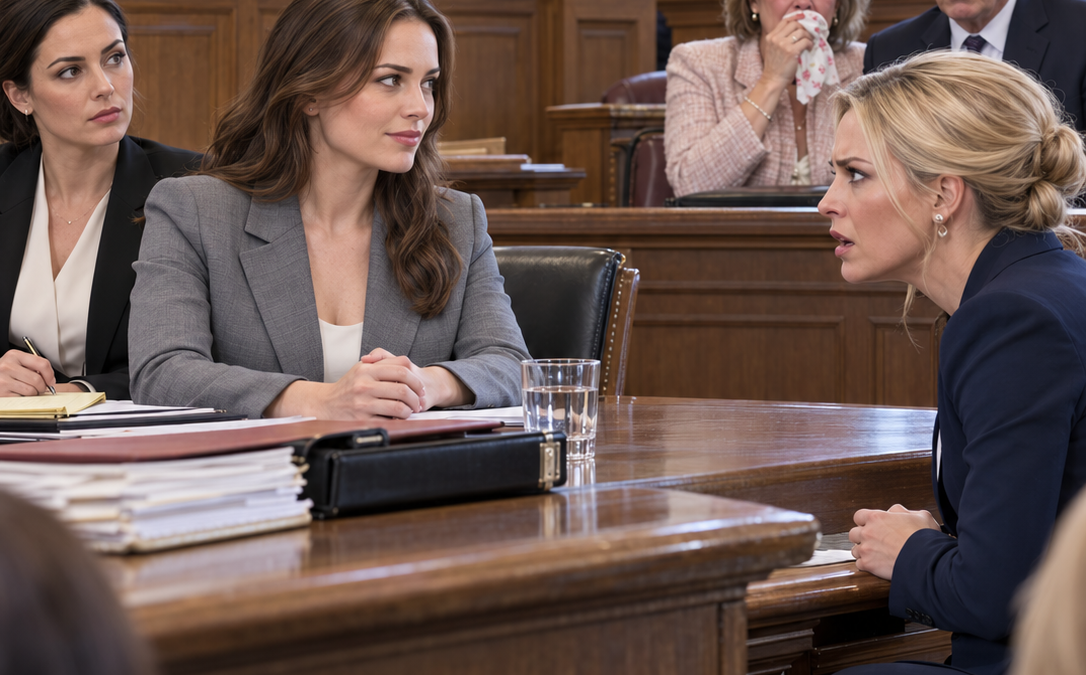
That was the exact moment the atmosphere in the room completely changed.
I noticed it before anyone else did. I saw the way his hand paused for just a fraction of a second as he opened the heavy folder. I watched the way his eyes darted, moving significantly faster than before, scanning a page he clearly had not expected to see. His jaw tightened so hard I thought his teeth might crack. The color drained from his weathered face so quickly that it actually startled me.
He turned another page, then another one. The silence in the room stretched until it felt like a physical weight pressing down on my chest. No one spoke. Not Rowena, not the panel of suits, not even the court reporter, who had stopped typing.
Judge Allaric closed the file with a loud, definitive thud. He stood up from his leather chair, gathered the massive stack of papers into his arms, and walked straight out of the hearing room without saying a single word to anyone.
Beside me, Sabine leaned in, her voice barely a breath against my ear, and whispered, “He saw it.”
Chairs shifted. Someone in the gallery whispered loudly. Rowena glanced around the room, genuine confusion flickering across her flawless face before she quickly smoothed it away into a mask of concerned patience.
No one else knew what was happening, but I did.
As I sat there in that deadly silence, I felt something cold, dark, and incredibly steady settle deep in my chest. Today, someone was going to be completely destroyed in this room. But I knew with absolute certainty that it was not going to be me.
To truly understand how my own sister ended up in a sterile courtroom trying to send me to a federal penitentiary, you have to understand the toxic soil we both grew up in.
The Ashford family house sat on a quiet, expensive street where the lawns were manicured every single Saturday and nothing ever looked out of place. Growing up in that house felt like living inside a tightly sealed picture frame that never changed. My parents, Cresa and Merrick, believed deeply and aggressively in doing things the right way. You went to the right prestigious schools. You chose the right, safe careers. You avoided absolutely anything that made the wealthy neighbors curious or concerned.
Rowena fit that picture flawlessly. She always had.
From the time we were little girls, she knew exactly how to read a room. She learned incredibly early what adults wanted to hear, and she knew exactly how to deliver it to them with a bright smile. Teachers constantly praised her. Relatives constantly bragged about her. My mother kept a dedicated hallway wall covered in framed certificates of Rowena’s accomplishments. It was like a museum exhibit proving that our family was superior to everyone else on the block.
I was different. I was not rebellious in a loud, destructive, dye-my-hair-pink-and-break-curfew kind of way. I was just inconvenient. I asked way too many questions. I noticed contradictions in the way my parents lived their lives. When something felt fundamentally unfair, I simply could not let it go. In a family that valued keeping up pristine appearances over everything else, seeking the raw truth made me a massive liability.
My father believed in reputation above all else. He taught us every single day that once a family name was damaged, it never fully recovered. Rowena absorbed that lesson like a sponge. She built her entire personality around risk management, both in her highly successful corporate career and in her personal life.
I heard the exact same lesson from my father, but I drew a completely different conclusion. I decided that if a system punished honesty just to protect a fake reputation, then that system desperately needed to be challenged.
At our grand family dinners, the difference between the two of us was always glaringly obvious. Rowena would talk about her job in careful, buzzword-heavy terms. She would use phrases like corporate responsibility, compliance frameworks, and supply chain ethics, words that made my parents nod their heads with immense, overflowing pride.
But when I talked about law school, or later about my work as a white-collar criminal defense attorney representing whistleblowers, the entire energy in the room always shifted. My mother would smile tightly, her lips pressing into a thin line, and ask if I ever worried about associating with “those kinds of shady people.” My father would clear his throat aggressively and remind me how competitive the corporate legal field was, strongly hinting that I was throwing away my potential by working independently.
Rowena would always jump in smoothly, playing the role of the benevolent older sister. She would reframe my choices for everyone else at the table. She would say I was just very passionate, that I meant well, but that hopefully someday I would settle down into something more respectable and stable.
It never sounded overtly cruel. That was the absolute genius of her toxicity. Every insult she threw at me came wrapped in a shiny veil of fake concern, but the message underneath was always exactly the same.
Vesper is broken. Vesper is a mess. And I am perfect.
I remember one Thanksgiving dinner clearly. It was a cold evening, and the dining room smelled like roasted turkey and expensive wine. Aunt Tia, the ultimate flying monkey of the Ashford family, was practically glowing as she poured more red wine into Rowena’s glass.
“Director of risk management before you even hit forty,” Tia crowed, raising her glass. “Rowena, you are just carrying this entire family on your back. It is so wonderful to have a real, established professional sitting at the table.”
Tia took a sip of her wine and then turned her sharp, critical gaze directly to me.
“And Vesper, are you still out there defending embezzlers and disgruntled warehouse employees? It must be absolutely exhausting, constantly scraping the bottom of the barrel for clients. When are you going to get a real law firm to finally hire you?”
My mother sighed heavily, placing her silver fork down on the porcelain plate.
“We worry about her constantly, Tia. It is just not a very elegant path for a young woman.”
I took a slow sip of my ice water. I looked at the three of them, perfectly aligned in their disdain for me. I did not tell them the truth.
I did not tell them that in the last two years, my solo defense practice had absolutely exploded. I did not tell them that by taking on massive corporate cover-ups and winning massive settlements for whistleblowers, I was currently taking home three times what Rowena made at her medical supply company.
I kept my financial success completely hidden in the dark. I drove a five-year-old, reliable sedan. I dressed in simple, unbranded suits that did not draw attention. I lived in a modest, beautiful home. I knew my parents and my sister too well.
I knew that if they realized I was wealthy, my parents would immediately demand that I fund Rowena’s extravagant, debt-fueled lifestyle. Or worse, they would find a way to diminish my hard work by claiming my money was somehow tainted by the criminals they assumed I represented.
I thought their ignorance was my greatest shield. I thought that keeping them in the dark protected my peace.
I did not realize it was the exact blind spot Rowena was counting on to frame me.
I remember how she looked at me across that Thanksgiving table. Her eyes slowly scanned my plain gray sweater and my simple watch. I saw a terrifying, cold calculation behind her polite smile. She did not see a sister. She saw a scapegoat.
She saw someone the family already considered a failure. Someone who would be incredibly easy to blame when her own perfect world started to crumble.
When you grow up as the invisible child, the designated scapegoat of the family, your mind inevitably becomes a silent museum of pain. You catalog the injustices over the years, not because you want to hold on to anger or bitterness, but because you desperately need proof that you are not crazy. When everyone around you constantly rewrites history to make you the villain, your memories are your only defense.
Exhibit A in my museum was my law school graduation day.
I had worked three grueling part-time jobs to avoid asking my parents for a single dime. I studied until my eyes bled, and I graduated in the top ten percent of my highly competitive class. On the day of the ceremony, it was sweltering hot. I stood in my heavy black robes, sweating, watching the empty seats I had reserved in the front row for my family.
They arrived exactly one hour after my name was called.
I was standing in the parking lot alone when their car finally pulled up. My mother rushed out, looking flustered but completely unapologetic.
“We are so sorry, Vesper,” she said smoothly. “Rowena found the absolute perfect luxury SUV at the dealership this morning, and they were offering a limited-time financing deal. We had to go help her secure it and co-sign the paperwork. You understand, right? It is for her executive image. She needs to look the part.”
They missed the culmination of my hardest years of struggle for a car lease.
Exhibit B was a business idea I had during my undergraduate years. I had spent four months drafting a detailed proposal for a legal prep tutoring service. I was proud of it. I made the mistake of leaving my notebook open on the kitchen island one weekend when I came home to visit.
A week later, we were at dinner, and Rowena proudly pitched the exact same idea to my father as her own brilliant business school project. She used my exact phrases. She used my exact pricing model.
When I angrily confronted her right there in front of our parents, my father slammed his heavy hand flat on the dining table.
“Stop being so intensely jealous, Vesper,” he barked. “Sisters share inspiration all the time. Rowena just has the polish and the professional acumen to execute it better than you ever could. Learn to be happy for her for once in your life.”
Exhibit C was the day I proudly bought my very first house.
It was a modest, beautifully restored Craftsman home that I bought entirely with my own hard-earned savings. I invited my parents over for a celebratory dinner. I spent hours cooking.
My mother walked through the front door, did not say a single word about the beautiful architecture, did not congratulate me on my achievement, and simply pointed a manicured finger at my living room wall.
“That shade of gray is terribly depressing, Vesper,” she said, wrinkling her nose. “Rowena just painted her new downtown condo a lovely, vibrant eggshell white. You really should ask her for taste advice before you ruin this place.”
For fifteen years, my successes were completely minimized, and my mere existence was treated as a mild, chronic embarrassment to the Ashford name.
But I accepted it. I kept my emotional distance, built my career brick by brick, and survived. I thought the absolute worst thing they could do to me was simply ignore me.
I was so incredibly wrong.
The nightmare escalation began on a rainy Saturday evening in early October. I was sitting at my kitchen island, drinking black tea and reviewing a massive stack of deposition transcripts for a client. The rain was lashing against the windows when there was a sharp, frantic knock at my front door.
I opened it to find Rowena standing on my porch. She was holding a thick, heavy leather briefcase and wearing a beige trench coat that was soaked at the shoulders. She looked unusually frazzled, her eyes wide and anxious. It was a stark, jarring contrast to her normally flawless, untouchable composure.
“Vesper, I need a massive favor,” she said, stepping inside my house without waiting for an invitation, dripping water onto my hardwood floor.
She walked straight to my dining table, dropped the briefcase, and unlatched it. Inside were massive stacks of printed financial spreadsheets, vendor contracts, and internal compliance reports from North Bay Medical Supplies.
“We have a massive internal audit coming up on Monday morning,” Rowena said, her voice tight and breathless. “The regulatory framework for our entire supply chain changed this quarter, and I am completely drowning in paperwork. I need a second set of eyes to review these vendor payout logs, just to make sure the language does not create any legal exposure for my department.”
I looked down at the documents, then back up at her face.
“Rowena, you have an entire corporate legal department for this exact reason. I am a criminal defense attorney. I cannot review your internal financial logs. It is a massive conflict of interest, and frankly, I am not insured to act as your corporate counsel.”
“It is not formal,” she snapped, her tone suddenly sharper, her desperation cracking. “I am not asking you to sign anything or stamp it. I just need you to look at the routing numbers and the vendor entities. Just tell me if anything looks legally suspicious. Please, Vesper. My entire job is on the line here.”
I hesitated.
It was the first time in my entire life she had ever come to me asking for my professional help. A small, pathetic part of me wanted to help my sister. But my instincts, honed by years of cross-examining liars and frauds, screamed at me. Something felt deeply wrong. The panic in her eyes felt manufactured.
I shook my head firmly.
“I cannot do it, Rowena. It crosses a major ethical line. You know that.”
Rowena stared at me. For a split second, the polished mask slipped completely off.
The desperate, frazzled sister vanished into thin air, replaced by a look of cold, calculating, venomous fury. The irritation flickered across her face, just enough for me to know it was real.
Then, as quickly as it appeared, she smoothed it away, smiling her tight, polite smile.
“I appreciate your honesty,” she said softly, quickly packing the thick stacks of documents back into the briefcase. “I just wanted to be careful. Sorry to bother you.”
She rushed out the door into the rain, but in her frantic haste to pack up, a single sheet of paper slipped from the stack and fluttered silently under my dining chair.
After I heard her car speed away down the street, I bent down and picked it up.
It was a vendor authorization form.
My eyes scanned the page, reading the corporate jargon until I stopped dead at the bottom right corner. There, under the section boldly labeled External Legal Consultant Approval, was a signature.
It was my name, Vesper Ashford, written in a near-perfect, flawless forgery of my handwriting.
My blood ran freezing cold. The air in my lungs vanished.
Before I could even process the magnitude of what I was looking at, before my brain could connect the dots of her sudden visit, the doorbell rang again.
It was the mail carrier holding a thick certified envelope.
I stood perfectly still in my hallway, staring down at the certified envelope resting in my shaking hands. The return address printed in the corner was the Massachusetts Board of Bar Overseers, right alongside a terrifying secondary stamp from the District Attorney’s Office.
The paper felt unnaturally heavy, as if it carried the weight of a collapsing building right there in my hands.
I walked mechanically back to the kitchen counter, my heart hammering a frantic, painful rhythm against my ribs. I grabbed a paring knife and sliced the thick envelope open. The paper inside was crisp and official, printed in the kind of clinical legal language that never leaves any room for misunderstanding.
I read the first few lines twice, not because I did not understand the vocabulary, but because my brain absolutely refused to process the violent reality of the words.
The board had received a formal complaint alleging that I had been practicing law illegally and had engaged in gross professional misconduct.
But the nightmare did not stop there.
The document stated that, pending a full criminal review by the state, an immediate temporary suspension of my law license was highly recommended. The core accusation was laid out in bold print. I had allegedly used my solo law practice as a front to authorize, facilitate, and launder $2 million in fraudulent vendor payouts from North Bay Medical Supplies.
I felt intense heat move rapidly up my neck, but my mind stayed sharply, terrifyingly quiet.
I pulled out the massive complaint packet attached to the notice. It was hundreds of pages thick. Inside the packet was a sworn, signed affidavit from the whistleblower, outlining the staggering accusations in meticulous, devastating detail.
I scanned the name printed at the bottom of the sworn affidavit, even though my gut already knew the horrible answer. My stomach clenched so violently I felt physically sick.
Rowena Ashford.
It was not an anonymous tip from a disgruntled employee. It was not a tragic misunderstanding by the accounting department. It was a deliberate, highly calculated accusation signed boldly by her own hand.
The language she used in the affidavit was measured, cold, and entirely clinical. She wrote that during a routine risk management audit, she had discovered massive inconsistencies in several vendor routing numbers. She claimed that I had emotionally coerced her into giving me access to the company’s supply chain database under the guise of family advice, and that I had subsequently forged documents to siphon $2 million into offshore shell accounts.
She wrote that she could not in good conscience ignore this massive criminal misconduct, even if it meant destroying her own sister’s life. She wrote that coming forward was her heavy ethical responsibility to the public and to her company.
I turned the page, my hands now shaking so hard the paper rattled.
There was another sheet attached to the back of her statement. It was a sworn character affidavit supporting Rowena’s claims against me. It bore two distinct signatures at the bottom.
Cresa Ashford. Merrick Ashford.
My mother and my father.
They had actually signed legal statements affirming that they completely trusted Rowena’s judgment. They wrote that I had always been secretive, rebellious, and financially unstable. They stated under penalty of perjury that they believed her concerns about my criminal behavior were entirely legitimate and consistent with my character.
I stared at their signatures until the black ink blurred into a meaningless dark shape.
I had seen my mother’s handwriting all my life, neat, careful, and perfectly cursive. My father’s signature was strong, commanding, and slightly slanted. Seeing both of their names signed directly beneath words that accused me of a massive federal felony felt like a quiet, icy knife sliding straight into my back without a single moment of hesitation.
There were no phone calls to ask for my side of the story. There were no questions about what really happened. There was just absolute, blind, unwavering belief in the daughter they worshipped, the one who fit their perfect world and reassured them with order and prestige.
I set the heavy stack of papers down slowly on the granite counter. I did not cry. I did not scream. I felt something much colder and heavier than shock. It settled entirely across my chest like a lead-weighted blanket.
As I turned the subsequent pages of the fabricated evidence—the forged vendor contracts, the manipulated IP logs, the fake emails—I felt the ground of my life tilt slightly on its axis.
This was not just sloppy work from someone outside the legal system. This was highly curated. This was built carefully over months of planning.
Rowena had not come to my house in the rain to ask for my help. She had come to establish a physical timeline. She came hoping my fingerprints would end up on that leather briefcase. She came to plant evidence, hoping I would touch the papers so she could prove I was involved.
She was framing me to take the complete fall for a $2 million hole she had dug herself.
And my parents had just handed her the shovel.
I do not know exactly how long I stood frozen in that kitchen, staring at the documents that were designed to end my life, before I finally reached for my phone. My hands were surprisingly steady, which shocked me.
I scrolled past my parents’ names, past Rowena’s name, and hit the contact for the most ruthless, brilliant, cold-blooded defense attorney I knew.
Her name was Sabine.
Sabine answered on the second ring, her voice brisk but sharp. I did not bother with pleasantries. I told her exactly what I was looking at. There was a small, heavy pause on the line. Then she exhaled slowly and told me not to panic.
She ordered me to gather every single piece of paper, put it in a secure waterproof bag, leave my cell phone at home to avoid location tracking, and come straight to her office through the private underground parking garage.
Before leaving the house, I stood at the kitchen sink and gripped the cold marble edge. I tried to understand how my entire life had shifted so violently in the span of thirty minutes.
The kitchen looked exactly the same. The evening light filtering through the window was exactly the same. But something essential and foundational had broken. A fragile, invisible cord connecting me to the concept of family had been severed so cleanly it would never, ever be tied back together.
Take a deep breath with me right now. Have you ever been profoundly betrayed by someone you trusted with your very life? Have you ever felt that cold, hollow, sickening drop in your stomach when you realize the exact people who are supposed to protect you from the monsters are the ones holding the knife?
Drop a one in the comments if you know exactly how that terrifying coldness feels, because what Sabine told me next completely changed the trajectory of the entire war.
I arrived at Sabine’s downtown office building, a massive fortress of glass and steel that screamed power and discretion. She greeted me without any emotional fuss and led me straight into a soundproof, windowless conference room in the back of the firm.
I handed her the thick packet of documents and sat across from her. I watched her read through the hundreds of pages one by one in absolute silence. Her expression did not change at all. Her face was a perfect mask of professional stone until she reached the final pages with the affidavit.
She tapped her sharp, manicured finger lightly on Rowena’s signature.
“So, the golden child finally strikes,” she said quietly.
She was not surprised. She was not judging me. She was just confirming the reality of the massive threat sitting on the table.
I swallowed hard, my throat feeling like sandpaper, and nodded. Sabine read the rest of the file with slow, agonizing, surgical precision. When she finally looked up, she pushed her designer glasses higher on her nose and leaned back in her heavy leather chair.
“Vesper,” she said, her voice dropping an octave. “This is not an amateur job. This is someone who deeply understands how to create a corporate narrative that looks incredibly credible to a regulatory board at first glance.”
She continued pointing out specific details. She showed me how certain omissions in the spreadsheets made the documents appear highly suspicious. She pointed out how Rowena deliberately used phrasing common in internal corporate audits to sound authoritative and objective.
When she reached the character affidavit featuring the signatures from my mother and father, she paused again. She looked at me, her sharp eyes softening just a tiny fraction.
“You need to prepare yourself right now,” she said. “This will not be only a legal fight. It will be a deeply personal, brutal slaughter.”
“Should I call them?” I asked, my voice finally cracking under the weight of it all. “Should I call the bar association? Should I release my own financial records immediately to prove I don’t have that stolen money?”
Sabine slammed her hand flat on the oak desk. The sound echoed in the soundproof room like a gunshot.
“Absolutely not.”
I stared at her, completely stunned.
“If you move too quickly, you give the complainant an opening,” Sabine instructed, her voice turning into a fierce, strategic whisper. “She will see exactly what you dispute, and she will adjust her story to cover her tracks. People who file massive complaints in bad faith often look for opportunities to fix their mistakes when the victim panics and reveals their defense early.”
She leaned forward, her eyes locking onto mine with terrifying intensity.
“If Rowena is as confident as she seems, it means she believes she has covered her tracks entirely. We let her believe that. We let her walk into that hearing room with the version of the story she is absolutely certain is airtight. We do not correct her. We do not call your parents to scream at them. We do not defend ourselves on the internet. We stay completely silent. We let her build her own coffin, and then we hand her the nails.”
A slow, freezing sensation spread through my veins.
I understood the strategy logically, but it went against every single emotional instinct I had in my body. I wanted to scream my innocence from the rooftops. I wanted to drive to my parents’ house, kick the front door open, and demand to know how they could sign my life away without even picking up the phone.
“I know this is incredibly hard,” Sabine said gently, noticing the furious tears welling in my eyes. “You are honest by nature. You want to correct the record immediately. But this is positioning. We are going to let her step all the way into the trap before we spring it. We are going to destroy her.”
The very next morning, Sabine brought in her secret weapon.
His name was Bastion.
He was a high-level digital forensics consultant who looked much more like a tired, overworked grad student than a man who could dismantle a multimillion-dollar corporation with a few quick keystrokes. He was soft-spoken, wearing a faded hoodie, with a calm, absolute confidence that immediately lowered my racing heart rate.
We sat in Sabine’s war room, the 426 pages of Rowena’s forged documents spread out across the massive oak table like a jigsaw puzzle from hell.
Bastion opened his heavily encrypted laptop, plugged in a secure drive, and began running deep metadata extraction tools on the digital files Rowena had foolishly submitted to the bar as evidence.
I watched him click through black command windows, lines of green code reflecting in his thick glasses. The room was perfectly silent except for the rapid clicking of his keyboard.
Suddenly, he murmured something under his breath and tapped his screen lightly.
“This is highly interesting,” Bastion said, his voice flat but carrying a spark of absolute triumph.
Sabine leaned in close. I stopped breathing entirely.
Bastion enlarged a metadata panel on the screen so we could read the text.
“Look at the creation timestamps on these vendor payout approvals,” he explained, pointing with a pen. “Rowena claims in her sworn affidavit that these were generated gradually over the course of six months as part of an ongoing fraud. But the hidden file properties show they were all generated in a single batch exactly seven days ago. At two in the morning.”
He kept typing, his fingers flying across the keyboard with practiced speed.
“There are massive discrepancies here. Edits made at extremely peculiar times. And look at this detail.”
He highlighted a field showing the software license ID code.
“This PDF modification software is registered directly to the internal secure network of North Bay Medical Supplies. Your sister didn’t just forge these documents. She forged them using her own company’s server. She left a digital footprint the size of a dinosaur.”
“She rushed it,” Sabine noted, a terrifying, predatory smirk playing on her lips. “She is operating from pure panic and fear, not confidence. She thought because she printed them out, the digital trail was dead.”
But Bastion was not done.
He spent the next three grueling hours tracing the specific routing numbers Rowena claimed I had used to launder the $2 million. He ran them through offshore databases, banking registries, and shell company indexes.
Suddenly, he stopped typing. He took off his glasses and rubbed his tired eyes.
“Vesper,” Bastion said softly, looking up at me. “The money didn’t disappear into the wind. It was routed intricately through three different shell limited liability companies. But the final destination is a domestic trust fund right here in Massachusetts.”
“Who owns the trust?” I asked, my voice barely a whisper, dread pooling in my stomach.
Bastion turned the laptop toward me so I could read the screen.
“It is a blind trust, but the primary beneficiaries listed on the formation documents are Cresa and Merrick Ashford.”
The room violently spun around me. I had to grip the edge of the table to keep from falling out of my chair.
Rowena hadn’t just stolen $2 million from her company. She had hidden the stolen money in a trust fund explicitly under our parents’ names, effectively making them unwitting accomplices to federal money laundering.
She was using them as a human shield.
If the FBI found the money before I could clear my name, my elderly parents would go straight to federal prison for receiving stolen funds. She was willing to sacrifice all of us to save herself.
While Bastion was unearthing these digital graves, my phone buzzed on the table.
It was a text message from Rowena.
“Vesper, Mom and Dad are so incredibly worried about you. I am heartbroken it had to come to this point. Please just cooperate with the authorities and confess. I will help you find a good defense lawyer. We just want to get you help. I love you.”
It took every single ounce of willpower I possessed not to throw my phone full force against the brick wall. Following Sabine’s strict, unbreakable orders, I left the message on read.
I had to play dead. I had to let her think she was winning.
Ten minutes later, a voicemail popped up. It was from Aunt Tia. I hit play and put it on speaker for Sabine and Bastion to hear.
“Vesper, you disgusting, selfish girl!” Tia’s voice shrieked through the phone. “How dare you drag your sister’s beautiful company into your shady, pathetic criminal activities? Your mother is crying her eyes out in the living room. You are a complete disgrace to the Ashford name. Don’t you dare show your face at the house ever again. You are dead to us.”
I looked up at Sabine. She nodded slowly, her eyes gleaming.
“Let them talk. Let them send their nasty messages. The louder they yell now, the harder they are going to hit the concrete when this all collapses.”
We had the metadata proving the forgery. We had the money trail proving the theft. And Sabine had already dispatched a trusted legal courier to the Supreme Judicial Court to retrieve my physical microfiche licensing records.
The microfiche was the one analog, physical thing Rowena could never hack, alter, or manipulate.
Rowena thought she was the apex predator in this family. She thought she was hunting me down. She didn’t know she was already locked securely inside the cage, and I was holding the only key.
Thank you so much for listening to this story so far. If you’re invested in seeing how this toxic family gets exactly what they deserve, please hit that like button, subscribe to the channel, and let me know in the comments if you’ve ever had to deal with a golden-child sibling.
Now, let’s get back to the revenge.
The silence in the hearing room felt stretched thin, like a wire pulled tight enough to snap at any given second. Every single breath taken by the panel members seemed louder than it should have been. Every shift of fabric echoed off the cold walls. Every second without Judge Allaric sitting at the bench felt heavier and heavier.
Rowena, believing her flawless narrative had landed exactly as she intended, folded her manicured hands and waited with a look of quiet, manufactured sorrow.
She did not know that her entire foundation had cracked wide open the moment the judge recognized my name and the details of her fabricated corporate fraud. She did not know that the man she assumed would condemn me was the same man who had the power to see right through her pristine facade.
The tension in the room grew suffocating. Even my mother, Cresa, shifted uncomfortably in her wooden chair, sensing something was fundamentally wrong but entirely unsure of what it was.
I kept my gaze steady on the empty doorway because I knew with undeniable certainty that this was the exact moment the tide turned.
Then the heavy oak door at the back of the room finally opened.
The sound was soft, barely more than a click of a brass handle, but it rolled through the dead-silent room like a thunderclap.
Every head snapped toward the noise. Even Rowena straightened her posture, smoothing her expensive navy skirt, lifting her chin slightly as if preparing for her grand victory to be formally confirmed.
Judge Allaric stepped back inside.
He was holding a different file this time, not the thick fabricated packet Rowena had submitted. He held a darker, significantly heavier folder stamped with the official seal of the Massachusetts Supreme Judicial Court, alongside a secondary manila envelope that looked heavily classified.
He did not look at anyone in the gallery as he returned to his high seat. He placed the new files in front of him with both hands, moving with deliberate, terrifying precision.
He took a slow, deep breath, as if steadying himself against a rising tide of profound anger.
When he finally lifted his eyes, he did not look at me.
He looked directly at Rowena.
The air in the room shifted. It was a small, subtle change, but very real. Rowena smiled politely, waiting for what she truly believed would be the start of the end for my entire life.
My mother gripped her floral tissue a little tighter. My father leaned forward slightly, anticipating the final blow to my career. Sabine sat motionless beside me, a predator waiting in the tall grass.
Judge Allaric began by slowly adjusting his glasses. He opened the Supreme Judicial Court file first, removed a single sheet of microfiche printout, and laid it flat on the mahogany desk.
His voice was calm when he spoke.
Too calm.
“This,” he said, his voice echoing, “is the original, unalterable licensing record for attorney Vesper Ashford, verified directly by the Massachusetts bar admissions office this very morning. It includes her original application, her bar exam results, her oath date, and her spotless renewal history.”
Rowena blinked. A tiny, almost imperceptible twitch of confusion disrupted her perfectly smooth forehead.
The panel members shifted forward in their seats, exchanging uncertain glances. My mother made a small, confused sound in her throat.
Judge Allaric continued, his tone dropping an octave.
“All records are complete. All renewals are entirely timely. All certifications are fully valid. There are zero inconsistencies in her legal standing. Furthermore, there is no evidence whatsoever that she ever acted as corporate counsel for North Bay Medical Supplies.”
My mother let out a small gasp, but Rowena did not crumble.
Not yet. She was too arrogant for that.
She straightened her back even more firmly and spoke with the exact same practiced gentleness she had used from the very beginning of the hearing.
“Your Honor, I deeply understand that her basic licensing might appear intact,” she said smoothly. “But the internal financial documents I provided clearly show massive irregularities and unauthorized vendor payouts tied directly to her name. Perhaps there has been a system error, or she managed to falsify the internal logs. I would be incredibly grateful if the board could focus on the $2 million that was stolen from my department.”
Judge Allaric lifted her fabricated file slowly. He opened it to the first page.
The room went dead silent again.
He tapped the corner of the paper with one finger.
“Miss Ashford, do you truly believe this board is composed of fools?” he asked, his voice suddenly sharp enough to draw blood.
Rowena froze.
The judge opened the second classified manila envelope.
“I recognized the case number printed at the top of the internal routing sheet you provided,” he said, his eyes burning into her. “Do you want to know why I recognized it? Because three days ago, I was the presiding judge who signed a secret emergency federal freeze order on the exact offshore shell accounts you listed in this complaint. Accounts currently under active investigation by the Federal Bureau of Investigation for corporate embezzlement.”
The color vanished from Rowena’s face entirely. It was as if someone had pulled a plug and drained the blood straight out of her body.
“And the name attached to those frozen accounts,” Judge Allaric continued relentlessly, “is not Vesper Ashford.”
The sheer velocity of the moment hit the room like a freight train.
My father dropped his hands to his lap, his mouth slightly open in utter disbelief. Rowena opened her mouth to speak, to spin another web of lies, but no sound came out.
Her pristine, untouchable corporate armor was fracturing into a million pieces right in front of our eyes.
But Sabine was not going to let the judge do all the heavy lifting.
This was our execution to carry out.
“Your Honor,” Sabine said, standing up smoothly, her voice carrying the undeniable weight of absolute authority. “With the board’s permission, the defense would like to present an expert witness to clarify exactly how these fraudulent documents were manufactured to frame my client.”
Judge Allaric nodded sharply.
“Proceed.”
From the back row of the gallery, Bastion stood up. He walked down the center aisle with the quiet, devastating confidence of a man who held all the winning cards.
He approached the evidence table, set down his encrypted laptop, and connected it to the large monitor mounted on the wall for the panel to see.
“I have prepared a deep forensic analysis of the 426 pages of documents submitted by the complainant,” Bastion stated, his voice flat and unbothered.
Rowena gripped the edges of her table so hard her knuckles turned stark white.
“Your Honor,” she stammered, her voice finally losing its polished edge. “This is highly irregular. These are confidential corporate documents. He has no right to display them.”
“You waived confidentiality the moment you submitted them as evidence in a public disciplinary hearing,” Sabine snapped back instantly, cutting her off like a guillotine.
Bastion clicked his mouse. A massive spreadsheet filled with green and white text appeared on the screen. He pointed to a specific line of metadata.
“This document claiming to be an email from Vesper Ashford authorizing a vendor payout was not sent from her law firm. The domain routing signature is entirely inconsistent. In fact, this document was created exactly seven days ago, at 2:14 in the morning.”
The panel members stared at the screen, captivated by the undeniable digital proof.
“Furthermore,” Bastion continued, his fingers flying over the keyboard, zooming in on a string of numbers, “the system identifier embedded in the PDF properties is fully visible right here. This document was forged on a machine registered directly to the internal network of North Bay Medical Supplies, specifically an IP address assigned to the director of risk management.”
My mother buried her face in her hands. A low, wretched sob escaped her throat. My father stared at the screen, his entire worldview collapsing under the weight of raw, unfeeling data.
The irony was profound. Rowena had spent her entire life preaching about corporate ethics, hiding behind buzzwords and expensive suits, and now she was being entirely dismantled by binary code and timestamps.
Rowena stood up, her chair scraping loudly against the wood floor.
“Our systems are incredibly complex!” she shouted, her voice shrill and desperate. “It could be a technical glitch. The servers were migrating last week. He is manipulating the data to confuse the board.”
Bastion did not even look at her. He just shook his head calmly.
“That is mathematically impossible. This specific pattern of alteration requires manual, intentional input. Someone deliberately modified the timestamp fields to backdate the theft.”
He clicked the mouse one final time. A scanned image of the central vendor ledger appeared on the screen.
“And finally,” Bastion said, pushing his glasses up his nose, “whoever forged this ledger made a very sloppy accounting error in their haste.”
I stood up slowly from my chair.
I looked directly across the room at the woman who had spent thirty-eight years trying to make me feel small. I looked at the sister who had smiled while trying to send me to a federal prison just to save her own skin.
“You missed a decimal point in your fake ledger, Rowena,” I said, my voice ringing out clear and cold in the silent room. “You claimed I routed exactly $2 million, but line item forty-seven shows a transfer of $200,000. The math on your forged evidence doesn’t even add up. If you are going to try and destroy my life, you should have at least used a calculator.”
Rowena stared at me, her eyes wide with sheer, unadulterated terror.
For the first time in my entire life, she had no words. She had no polished excuse. She had no way to reframe the narrative.
The silence that followed was not the quiet of a tense room. It was the deafening silence of total ruin.
Judge Allaric stared at the screen for a long, heavy moment before turning his piercing gaze back to Rowena. The disgust in his eyes was palpable.
He closed the fabricated file with a sound of profound finality.
“Miss Ashford,” the judge spoke, his voice dangerously low. “It is deeply concerning that you possess detailed knowledge of how to manipulate electronic documents and falsify financial records. It is even more concerning that you attempted to weaponize this board to cover up an active federal crime.”
“I did not manipulate anything!” Rowena shrieked, all pretense of elegance gone.
Her hair was slightly out of place, her face flushed with frantic panic.
“I was protecting my company! Vesper is lying! She has always been jealous of me. She set this whole thing up to ruin my reputation!”
Judge Allaric raised a hand, cutting off her frantic screaming.
“Save your breath for your defense attorney,” he said coldly.
He turned his attention to me, his expression softening just a fraction, returning to the stoic professionalism I remembered.
“Attorney Ashford,” he said, addressing me by my rightful title, “your licensing status is fully verified and remains in excellent standing. Given the overwhelming evidence of bad faith and document forgery presented today, all allegations against you are hereby dismissed with prejudice.”
I exhaled. The breath I had been holding in my lungs for weeks finally rushed out of me. It felt like a massive iron weight had been lifted off my rib cage.
Sabine placed a steady, warm hand on my shoulder. Bastion gave me a small, respectful nod from the back of the room.
But the judge was not finished.
“Furthermore,” Judge Allaric continued, his voice ringing like a bell, “because this fabricated complaint involves the concealment of a $2 million embezzlement scheme currently under federal investigation, this board has an ethical duty to act immediately.”
He gestured to the heavy oak doors at the back of the room.
As if on cue, the doors swung open.
Two uniformed police officers, flanked by a man in a plain gray suit holding a badge, stepped into the hearing room.
Sabine had made a few phone calls before the hearing started, ensuring the right authorities were fully aware of the impending digital evidence.
Rowena spun around. When she saw the officers marching down the center aisle, she physically recoiled, stumbling backward until she hit the edge of the respondent’s table.
“No, no, wait,” she stammered, holding her hands up, her expensive suit wrinkling as she panicked. “You don’t understand. I am the director of risk management. I am the victim here. You have the wrong person.”
The detective in the gray suit did not hesitate.
“Rowena Ashford,” he said, his voice entirely devoid of emotion. “You are under arrest on suspicion of corporate fraud, grand larceny, and the forgery of legal documents.”
My mother screamed. It was a visceral, horrifying sound that tore through the quiet room.
“Merrick, do something!” she wailed, grabbing my father’s arm and shaking him violently. “Tell them she didn’t do it. Tell them it’s a mistake.”
My father did not move.
He was frozen, staring at his perfect golden child as the police officer firmly grabbed her arms, pulled them behind her back, and secured the heavy steel handcuffs around her wrists.
The sharp click of the metal echoed endlessly.
Rowena twisted her neck, looking desperately at our parents.
“Mom, Dad, help me! Call a lawyer! Vesper, tell them to stop!”
I stood perfectly still, watching the scene unfold.
I felt no pity. I felt no sorrow. I just watched the undeniable truth finally drag her out of the shadows.
As the officers marched her up the aisle, her perfect image shattered into dust. My mother collapsed into her chair, sobbing hysterically.
The gavel cracked down on the wooden block.
“This hearing is adjourned,” Judge Allaric announced.
I gathered my things. I did not look at my sister as she was dragged out the door.
I had won.
But the true devastation for my family was just about to begin.
The hallway outside the hearing room was a chaotic blur of noise. Attorneys rushed past, whispering about the dramatic arrest they had just witnessed. I walked out of the double doors with Sabine and Bastion, feeling an incredible sense of lightness in my steps.
The truth had defended me.
But before we could even reach the elevators, I heard frantic, heavy footsteps echoing on the marble floor behind me.
“Vesper, wait!”
I stopped and turned around slowly.
My mother and father were hurrying toward me. My mother’s face was completely ruined by tears, her makeup smeared across her cheeks. My father looked like he had aged a decade in the span of thirty minutes. His shoulders were slumped, his arrogant posture entirely gone.
They stopped a few feet away from me. Sabine stepped forward defensively, but I held up a hand, signaling her to give me a moment.
“Vesper,” my mother cried, reaching out with a trembling hand, trying to grab my arm. “Oh my God, Vesper, what just happened? This has to be a massive misunderstanding. Rowena was under so much stress at work. She must have just made a terrible mistake. You have to help her. You have to explain this to the police.”
I stared at the woman who had given birth to me.
Even now, after watching her golden child get hauled away in handcuffs for trying to frame me for a felony, she was still trying to excuse the behavior. She was still trying to protect the illusion.
“She didn’t make a mistake, Mom,” I said, my voice cold and entirely detached. “She spent months planning this. She forged my signature. She faked an entire paper trail to send me to federal prison so she wouldn’t have to face the consequences of stealing $2 million. And you both signed your names to help her do it.”
My father swallowed hard, looking down at the marble floor.
“We didn’t know, Vesper. We swear to you. She told us you were in trouble. She told us signing those papers would force you to get help. We were trying to protect the family name. We thought we were doing the right thing.”
“You were trying to protect her,” I corrected him sharply. “You didn’t even call me to ask if it was true. You just assumed I was the failure she painted me to be.”
They stood there looking pathetic and small.
But I was not finished.
The final nail in the coffin was still resting in my briefcase.
I unzipped the leather pouch, pulled out a thick stack of printed financial documents Bastion had recovered, and shoved them directly into my father’s chest.
He reflexively grabbed the papers.
“What is this?” he asked, his hands shaking as he looked down at the banking logos.
“That is the money trail,” I said quietly. “That is where Rowena hid the $2 million she stole from her company. She didn’t put it in her own bank account. She routed it through offshore shell companies.”
My father scanned the first page, his brow furrowing in deep confusion.
“I don’t understand.”
“Look at the beneficiary name on the destination trust fund. Dad, look at who owns the account holding the stolen money.”
He flipped to the second page.
His eyes scanned the legal text, and then he froze entirely.
The paper began to shake violently in his hands. He let out a strange, choked gasp, stepping backward as if the document had physically burned him.
My mother grabbed his arm.
“Merrick, what is it? What does it say?”
He looked up at me, his eyes wide with profound, unadulterated terror.
“It has our names on it,” he whispered, his voice cracking. “Cresa and Merrick Ashford.”
My mother snatched the papers from his hands. When she saw her own name printed as the beneficiary of a fraudulent trust fund, she let out a piercing wail and dropped the papers onto the floor.
“She wasn’t just trying to frame me,” I explained, watching their entire world shatter into pieces. “She was using you as a human shield. If the FBI had traced that money before I proved my innocence, they would have knocked on your front door. They would have indicted both of you for federal money laundering and receiving stolen property. She was fully prepared to let her own elderly parents die in federal prison to protect her perfect corporate image.”
They finally saw the monster they had raised.
The golden child was entirely stripped of her gold, leaving nothing but rot and betrayal.
My mother collapsed against the marble wall, sliding down to the floor, weeping uncontrollably. My father stood paralyzed, staring at the scattered papers as if he were staring at his own grave.
I didn’t yell. I didn’t cry.
I just turned my back and walked toward the elevator.
Two days later, the story hit the front pages of the local business journals. The headlines were ruthless. The director of risk management at North Bay Medical Supplies had been formally indicted on multiple federal charges, including grand larceny, wire fraud, and perjury.
The company’s stock took a severe hit. The pristine Ashford family name, the one my father had spent his entire life obsessively protecting, was dragged violently through the mud for everyone to see.
It was raining heavily when the doorbell rang at my house.
I already knew who it was.
I walked to the front door, unlocked the deadbolt, and pulled it open. My parents stood on my porch. They were holding an umbrella, looking soaked, exhausted, and utterly defeated. The arrogance that had defined them for decades was entirely gone.
They looked like strangers.
“Vesper,” my father said, his voice trembling. “Please, can we come in?”
I did not move out of the doorway.
“No,” I said plainly. “What do you want?”
My mother stepped forward, her eyes red and swollen from days of crying.
“Vesper, please. The lawyers we spoke to said Rowena is looking at fifteen years in federal prison. The evidence your team found is too strong. The public defender they assigned to her is terrible. We need you.”
I stared at her, genuinely astounded by the sheer audacity of the request.
“You want me to defend her?”
“You are the best defense attorney we know,” my father pleaded, his pride completely broken. “You know the case. You know the files. If anyone can get her a plea deal, it is you. She is your sister, Vesper. Our family is falling apart. We are begging you. We will pay you whatever you want.”
I looked at the two of them standing in the freezing rain.
For thirty-two years, I had craved their approval. I had wanted nothing more than for them to look at me the way they looked at Rowena. I had wanted them to ask for my help, to acknowledge my skills, to finally see my worth.
And now they were begging on my doorstep, offering me the exact validation I used to dream about.
But it felt like ashes in my mouth.
It meant nothing to me anymore.
“You don’t have enough money to afford my retainer,” I said coldly. “And even if you did, I would never set foot in a courtroom to defend the woman who tried to ruin my life. She dug her grave. Now she gets to lie in it.”
“Vesper, please,” my mother sobbed, reaching for my hand. “We are so sorry. We were wrong about everything. We see that now. We want to make it right. We just want our family back.”
“The family you want back never actually existed,” I replied, pulling my hand away from her grasp. “You just want the comfortable illusion back. You want everyone to stay quiet and play their roles so you don’t have to face the truth. But the truth is out now.”
I reached into my blazer pocket and pulled out a folded piece of thick paper.
I handed it to my father. He took it with trembling hands and opened it.
It was a certified cashier’s check.
“What is this?” he asked, staring at the massive sum written in bold ink.
“That is enough money to pay off the remaining mortgage on your house and cover your legal fees for untangling yourselves from the fraudulent trust fund Rowena set up in your names,” I explained, my voice devoid of any emotion. “I am buying my peace. Take the money, fix your own mess, and never contact me again.”
My father stared at the check, tears finally spilling over his eyelashes and mixing with the rain on his cheeks.
“Vesper, you don’t have to do this. We can fix this.”
“You can’t,” I said simply. “You made your choice when you signed that affidavit. Now I am making mine.”
I stepped back inside my house and looked at them one last time.
“Goodbye.”
I closed the heavy oak door until it clicked shut, sliding the deadbolt firmly into place.
I stood in the quiet of my hallway, listening to the rain pounding against the roof.
I did not feel angry anymore. I did not feel sad.
I felt incredibly, undeniably free.
Six months later, the dust finally settled.
Rowena Ashford did not go to trial. Faced with the overwhelming mountain of digital forensics Bastion had provided to the FBI, her expensive defense attorneys convinced her to take a plea deal.
She stood in a federal courtroom crying real tears this time and pleaded guilty to wire fraud, embezzlement, and perjury.
She was sentenced to eight years in a federal penitentiary, followed by five years of heavily monitored probation. She lost her corporate license. She lost her luxury condo. She lost every single shred of the arrogant prestige she had spent her life cultivating.
My parents narrowly avoided federal charges, primarily because the digital evidence clearly proved Rowena had forged their signatures on the trust fund documents without their knowledge.
But the legal battle drained their savings, and the public humiliation drove them into deep isolation. They sold the big house on the quiet street and moved to a smaller, obscure town down the coast.
True to my word, I never spoke to them again.
They deposited the check I gave them, which told me everything I ever needed to know about their pride.
As for me, the attempt to destroy my career had the exact opposite effect.
When the news of the hearing and the subsequent FBI investigation leaked into the legal community, my reputation skyrocketed. Clients saw an attorney who was smart enough, resilient enough, and ruthless enough to dismantle a massive corporate fraud perpetrated by her own blood.
My solo practice expanded. I hired Sabine as a senior partner. I hired Bastion as our permanent head of digital investigations. We moved into a beautiful new office building downtown.
Sometimes, late at night, when the office is quiet and I am looking out over the city lights, I think about the concept of karma.
People often expect karma to be this loud, roaring beast that descends from the sky to punish the wicked with dramatic flair.
But karma rarely roars.
It whispers.
It moves silently through the tiny cracks that arrogant people try to ignore. It works quietly, waiting patiently for the exact moment when the truth becomes entirely too heavy for the lies to carry any longer.
Rowena tried to use the system to destroy me. And that very system was the exact thing that locked her in a cage.
My parents tried to protect their perfect image at the cost of my life. And that exact choice destroyed their reputation forever.
I learned the hard way that sometimes the deepest fractures in a family happen not through massive explosions, but through slow, small decisions that finally reveal their ultimate cost.
Walking away from the people who share your blood does not feel like defeat when those people were actively holding you underwater.
It feels like taking your first real breath of air.
My relatives, the flying monkeys like Aunt Talia, who still occasionally leave voicemails I never listen to, say I am ruthless. They say I am cold for not defending my own sister when she was desperate, and for abandoning my parents when their perfect world fell apart.
They say a real family sticks together through thick and thin, no matter what crimes have been committed.
So, I leave it to you, the jury of the internet.
Was I too harsh? Should I have shown mercy and defended the sister who smiled while trying to send me to federal prison? Should I have forgiven the parents who blindly signed away my freedom? Or was walking away the only way to survive?
Thank you so much for listening to my story. If this journey resonated with you, if you have ever had to cut off toxic family members to protect your own peace, please hit that like button, subscribe to the channel for more stories, and tell me in the comments exactly what you would have done in my shoes.
Until next time, stay strong, trust your instincts, and never let anyone dim your undeniable truth.








