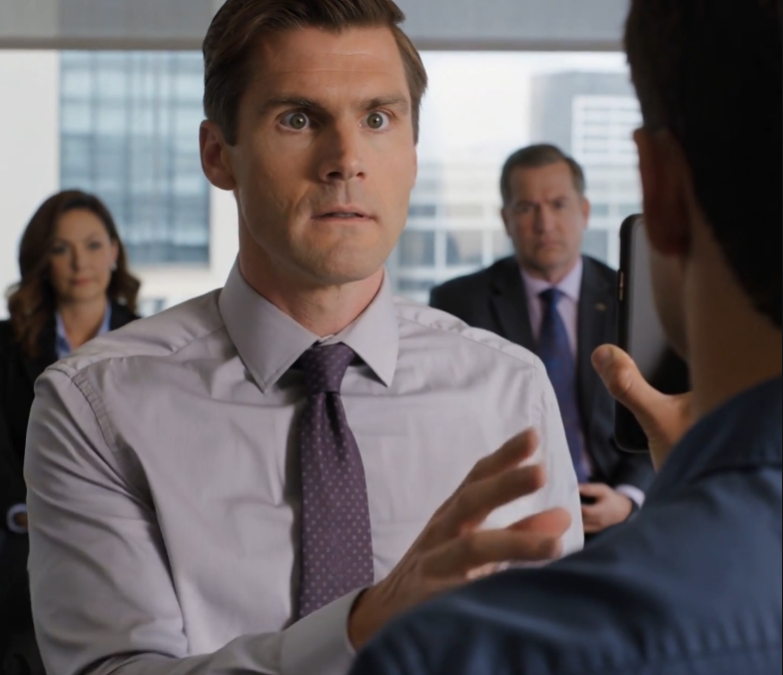
My supervisor fired me in front of everyone, saying, “No one can change my mind.” I turned around and called the chairwoman: “Mom, your son just got fired.”
I joined Crestwell Group at the beginning of March, during one of those late-winter weeks when Chicago couldn’t decide whether it wanted to snow or rain.
I arrived forty minutes early. The lobby lights were still dim, and the security guard was sitting on a sofa, scrolling through his phone. He looked up only when I reached the desk.
“Visitor log,” he said, holding out a clipboard.
“New hire. Ethan Morgan.”
He found my name, checked it twice, and pointed toward the elevators.
“Digital Systems is on twenty-four. HR opens at nine.”
“Thank you.”
I sat beneath the lobby’s glass wall and watched the morning traffic thicken along the avenue. Red taillights blurred against the wet street. People hurried into the building wearing coats, carrying coffee, and already looking tired.
From that day forward, I told myself I was going to be ordinary.
My mother had asked me the same question before I left the house.
“Are you sure?”
“Yes.”
“You understand that if you start at the bottom, nobody will know who you are. You’ll be treated like everyone else. You may be ignored, underestimated, or blamed for things you didn’t do.”
“That’s the point.”
She studied me over the rim of her coffee cup.
Susan Morgan was the chairwoman of Crestwell Group, a sprawling technology and infrastructure company with operations in twenty-three states. I had grown up around board meetings, charity galas, and executives who smiled while negotiating million-dollar decisions.
I didn’t want any of that on my résumé.
I wanted to know what the company felt like to the people who had no family connection to it.
My mother nodded once.
“Then don’t be soft when people disappoint you.”
She left for work.
At nine, a young HR coordinator with a ponytail appeared at the office door.
“Ethan Morgan?”
I stood.
She handed me an employment packet containing a confidentiality agreement, benefits forms, the employee handbook, and instructions for setting up my 401(k).
“Digital Systems Division,” she said. “You report to Mark Ellis. Twenty-fourth floor. He has your workstation ready.”
The twenty-fourth floor opened onto an interior wall decorated with Crestwell’s values.
Practicality. Initiative. Collaboration. Shared Success.
The gold lettering was polished. The plants beneath it were dusty.
The department was an open office filled with cubicles. My workstation was near the far window, with an old monitor, a keyboard, and a mouse pad whose edges had begun to fray.
A sticky note on the desk read Ethan Morgan.
“New guy?” someone asked behind me.
I turned.
Mark Ellis was in his early forties, with a round face, slicked-back hair, and a smile that stopped at the corners of his mouth. He wore a pressed shirt with the sleeves rolled to his elbows. His suit jacket hung over one arm.
“Mark Ellis.”
“That’s me. Ethan Morgan.”
He looked me over, pausing at my sneakers.
“State school?”
“Yes.”
“The hiring bar keeps getting lower.”
I said nothing.
He pointed toward a heavier man wearing glasses.
“Frank Miller will show you the systems.”
Frank stood and offered his hand.
“Welcome. Sit here. The light’s better, although the air conditioning will freeze you in July.”
Mark was already walking away. At the door of his glass office, he turned.
“Attendance is strict. Be at your desk by 8:50. Late arrivals affect your monthly score. Vacation requests need three business days’ notice. And overtime is part of the job, so don’t complain about it.”
“Understood.”
The glass door closed behind him.
Frank leaned closer.
“Don’t take it personally. He treats everyone that way.”
I opened my laptop.
“I’m fine.”
For the first month, I spoke only when necessary.
I arrived at 8:30, cleaned my desk, filled a kettle, and rinsed Frank’s travel mug whenever I took mine to the break room. Then I returned to my station and read requirements, wrote code, and ran tests.
Frank eventually began expecting the clean mug.
“You’re a thoughtful kid,” he would say.
“It takes thirty seconds.”
The division had seventeen employees: Mark, Frank, three front-end developers, four back-end developers, two testers, a product manager, a UI designer, and three interns.
One of the interns was Mia Torres, a senior at a local university. She spoke quietly and kept a row of small succulents beside her monitor.
When she had a technical question, she rarely asked Mark. She would turn in her chair and whisper to me.
“Ethan, can you look at this interface?”
I would pull over her laptop.
“You’re missing a closing bracket. And the request header needs a token.”
She would slap her forehead.
“I swear I checked that.”
“Everyone misses something when they’re learning.”
Mark noticed us one afternoon near the water cooler. He stood there for two seconds, expressionless, then went back into his office and shut the glass door harder than necessary.
Frank coughed softly.
I pretended not to hear him.
Chapter 2: Project A7
By the second week, Mark had learned that I wouldn’t argue with him in front of other people.
He mistook restraint for submission.
He tested it in small ways.
If I arrived at 8:35 because the elevator was under repair, he would call me into his office and remind me that the department opened at 8:50, but that he personally expected everyone at 8:30.
If I asked for a day off, he wanted a written explanation of what I would do with the time.
If I stayed late, he asked why I hadn’t finished earlier.
If I finished early, he asked whether the work had been done carefully.
No answer could satisfy him because satisfaction wasn’t the objective. The objective was to make every ordinary action feel like a favor he was allowing.
One morning, he handed me a three-page conduct supplement and told me to memorize it before the next day.
One paragraph had been circled in red.
Employees must respect management authority and may not report work matters outside the chain of command without authorization.
I read the paragraph twice.
“Does helping an intern count as reporting outside the chain of command?” I asked.
“Don’t be clever.”
“I’m asking because the language is broad.”
He leaned back in his chair.
“In this department, I decide what it means.”
That sentence explained the entire system.
The official rules were vague. Mark supplied the interpretation.
If someone followed the rules, he claimed they had failed to show initiative. If someone used initiative, he claimed they had bypassed him.
I didn’t challenge him.
I went back to the code.
The A7 data layer was more difficult than the kickoff meeting had suggested. One legacy platform stored customer IDs in a field labeled account number. Another used an eight-character code. A third system had no consistent identifier at all.
Two databases recorded dates in different time zones, and an old batch process rounded currency values before sending them downstream.
The dashboard could look perfect and still be wrong.
I spent three nights reconstructing the relationships from source code. I drew the data flow by hand first, then rebuilt it in a modeling tool. I added validation rules that would stop a record instead of allowing an attractive but inaccurate number to reach the customer’s screen.
At 2:14 one morning, Mark sent me a message.
Change the tolerance on the transaction field. It’s slowing the import.
I replied that the tolerance existed because the customer’s contract required exact reconciliation.
His answer came thirty seconds later.
Adjust it so the system runs. I’ll explain it to the client.
I took a screenshot.
Then I changed the design so the import could run faster without weakening the validation rule.
The next morning, Mark presented the improvement as a team decision he had directed.
Nobody corrected him.
Frank didn’t mention it until we were alone in the stairwell.
“You should put your name on the architecture document,” he said.
“The system will show who created the file.”
“Only if somebody checks.”
“Then somebody will check if it matters.”
Frank shook his head.
“You’re too patient.”
“Maybe patience and being invisible aren’t the same thing.”
The A7 team worked well despite Mark.
Mia learned to test her own code before asking for help. The two back-end developers debated whether to use a message queue or a scheduled batch. Frank built a field-mapping table that saved us days of rework.
Mark appeared for the important meetings.
He liked being seen beside the screen when the numbers looked good. He disappeared when someone asked why the numbers were wrong.
During one review, a product manager asked whether the dashboard could show a customer’s inventory position in real time.
“Yes,” Mark answered.
I looked at the source systems.
“Not in the first release,” I said. “The inventory feed refreshes every fifteen minutes.”
Mark’s smile tightened.
“That’s a technical detail. The customer cares about the result.”
“The customer cares about knowing whether the result is current.”
The room went quiet.
After the meeting, Mark told me I had embarrassed him.
“You should have waited until we were alone.”
“The customer was in the room.”
“You need to understand when to speak.”
“I spoke when the information mattered.”
He stared at me.
“You’re going to have trouble here if you keep acting like the smartest person in the room.”
I wanted to tell him that being accurate wasn’t the same as being arrogant.
Instead, I went back to my desk and added the meeting notes to my records.
By the time A7 reached its first internal test, the architecture was stable.
The data-cleaning module passed every test. The interface accepted the legacy formats without corrupting the output.
Mark sent the status report to headquarters.
Under Project Achievements, he wrote:
“Under my direction, the team completed the foundational data architecture ahead of schedule.”
I read the report once and closed it.
Mia saw my expression.
“He did it again.”
“Let him.”
“Why?”
“Because the code is still there.”
She looked at me as if I had failed to understand the point.
Maybe I had.
What I did understand was that Mark needed credit in order to feel safe. If I took it from him in public, he would find another way to hurt me in private.
I wasn’t afraid of his anger.
I was studying its pattern.
The A7 project began during my second month.
Crestwell had won a preliminary opportunity to build a data-visualization platform for a major logistics customer. The client wanted a system that would connect seven existing business platforms, clean and aggregate their data, and display real-time operational dashboards.
The deadline was three months.
Two of the legacy systems were more than twenty years old. Their documentation had disappeared. We had to read the code and reconstruct the database structure ourselves.
At the weekly meeting, Mark announced that he would lead the project.
He assigned me to the data architecture, Frank to field integration, and two other back-end developers to implementation.
“Ethan, you’ll handle the data layer,” he said. “You seem to understand the ugly parts.”
“I’ll take it.”
I worked three straight late nights mapping the tables in all seven systems.
On the fourth morning, I sent Mark a sixty-page architecture document with a complete data-flow diagram.
His reply contained one word.
Okay.
Two days later, headquarters held the official project kickoff.
Mark took me and Frank to the executive office downtown. More than twenty people attended, including the chief information officer and managers from every related department.
Mark opened the presentation.
Every slide contained my work: the data-flow map, the table definitions, the architecture explanation, even several sentences copied word for word from my document.
Only the name in the corner had changed.
It said Mark Ellis.
Frank touched my elbow and raised his eyebrows.
I shook my head.
Not here.
After the meeting, the CIO slapped Mark on the shoulder.
“Solid work,” he said.
Mark smiled.
On the drive back, Mark sat in the passenger seat and hummed along with the radio.
Near the office, he turned toward me.
“You’re talented,” he said. “But talent isn’t enough in business.”
I waited.
“You also need to learn how to manage people.”
I parked and turned off the engine.
“You’re right.”
He smiled and walked away.
I stayed in the car for a moment, opened the Notes app on my phone, and created a file called Work Records.
March 15. Mark Ellis presented my architecture document to headquarters under his name.
I saved it.
After that, the A7 project entered development.
Mark stopped touching the technical work. He attended meetings, sent status updates, and replied to group messages with “Good,” “Keep moving,” or nothing at all.
Every weekly report said the project was progressing under Mark Ellis’s leadership.
When Mark was away on Fridays, the department felt like a normal workplace.
Frank played comedy podcasts through his speakers. Mia moved her succulents toward the sunlight. The developers argued about caching strategies, Redis versus local caching.
One of them asked me, “What do you think?”
“It depends. If the data rarely changes, local caching is faster. If several nodes need to share it, use Redis.”
“What should A7 use?”
I opened the architecture file.
“Both. Redis for the core dashboards, local caching for configuration data. That reduces network traffic.”
Frank glanced at my screen.
“That’s better than Mark’s old architecture by a mile.”
“Don’t say that where he can hear.”
Mia leaned over the divider.
“Why don’t you put your name on the document?”
I kept typing.
“The project needs to work. The name is secondary.”
She frowned.
“That doesn’t seem fair.”
She was right.
I just didn’t yet know what fairness would cost me.
Chapter 3: The Pressure Campaign
The campaign became predictable enough that Frank could often tell which version of Mark was coming down the hallway by the sound of his shoes.
On Mondays, Mark was obsessed with attendance. On Fridays, he was obsessed with loyalty.
One Friday at 5:30, he posted in the team channel that weekend support was needed and asked for volunteers.
Nobody replied.
Ten minutes later, he messaged me privately.
You’re single. You don’t have family responsibilities. Come in tomorrow.
I didn’t correct his assumption.
I came in Saturday and Sunday and finished a data migration that would otherwise have delayed the project.
On Monday morning, Mark praised another employee for volunteering over the weekend.
The employee looked confused because he had spent Saturday at his daughter’s soccer game.
Frank found me at the coffee machine.
“Did he even know you were there?”
“He knew the work was done.”
“That’s not the same thing.”
Another month, Mark organized a team dinner at an expensive steakhouse.
The approved budget covered half the actual bill. He told everyone to pay the difference in cash.
“It’s good for team spirit,” he said.
The next morning, he asked whether anyone had objections to the arrangement.
No one spoke.
Two days later, a training seat opened at a conference in Austin. Mark gave it to a former college classmate who had joined the department three months earlier.
Frank had asked for that training because it covered the legacy systems we were using.
“Don’t take it personally,” Mark told him. “The company wants to invest in people with management potential.”
Frank returned to his desk and opened the old system manual instead.
“I’ve been here eight years,” he said quietly. “Apparently, I’m still a future employee.”
I began recording the incidents without deciding what I would do with them.
Each file had a date, a short description, and supporting material when available.
The folder grew.
I saved the weekend assignment, the reimbursement messages, the training list, and the meeting audio that the conference system had automatically recorded when Mark called me useless in front of the team.
I didn’t secretly record private conversations.
I didn’t provoke him.
I kept what the company’s own systems had already created.
Sometimes I wondered whether I was becoming paranoid.
Then Mark changed my performance rating without notice.
The original rating had been AC. He altered it to AD and entered the change under his own account.
There was no HR review and no comment explaining the reason.
I downloaded the audit record.
That evening, Mia asked whether I was going to report him.
“Not yet.”
“Why not?”
“Because a complaint without a pattern becomes a disagreement. A pattern with records becomes a question the company has to answer.”
She looked worried.
“What if they don’t answer?”
“Then I decide what to do next.”
I understood that keeping records didn’t make me safe.
It only meant that if the moment came, I wouldn’t have to rely on memory while Mark relied on authority.
Mark never tried to destroy a person in one dramatic move.
He wore people down a little at a time.
The first public explosion happened during my fourth week.
I had completed a small export function for another customer. The system generated Excel files. The fields aligned correctly, and every test passed.
Mark called me into his office and threw the test report onto the desk.
Every test case had a red X beside it.
“This is your idea of finished?”
I picked up the report.
“The file worked when I tested it.”
“It worked for you. The customer says it’s corrupted. Is that their problem or yours?”
“I’ll investigate.”
“The customer goes live tomorrow, and you want to investigate now?”
His voice rose until everyone outside could hear.
“What have you been doing?”
Frank tapped on the glass door.
Mark waved him away.
I returned to my desk and ran the tests again.
Everything passed.
I generated a hundred files. All of them opened correctly.
I printed a new report with screenshots and system logs and submitted it to Mark.
He rejected it in the project system.
Reason: Attitude.
The customer went live without a problem.
Mark gave me AC in the monthly performance review.
Only two people in the department received AC. The other was an intern who had been there for one week.
Frank found me in the break room.
“Don’t challenge him head-on,” he said. “Apologize. Let him feel important. It’ll pass.”
“I did nothing wrong.”
“I know. But in this department, he defines right and wrong. You argue facts, he argues attitude. You explain attitude, he explains seniority. You explain seniority, he says he’s the manager.”
I returned to my desk and created a folder for the test reports, approvals, emails, and launch logs.
From then on, I spent five minutes every evening preserving that day’s work.
Not because I had a plan.
Because I had noticed a pattern.
Mark asked me to work weekends, then praised someone else for volunteering.
He scheduled team events at expensive restaurants and required employees to pay half, even though the budget allowed reimbursement.
He reserved conference seats for people who gave him gifts or followed him closely.
He also introduced a weekly report requirement: at least ten PowerPoint slides every Friday, including accomplishments, plans, risks, and improvement actions.
The first week, I submitted eight slides because I had only eight meaningful points.
Mark posted in the department channel:
Weekly reports are for management, not personal convenience. Some people are cutting corners.
He didn’t name me.
He didn’t need to.
The next week, I submitted twelve slides, then fourteen, then sixteen.
At the monthly meeting, Mark said, “Some employees are finally showing progress.”
Frank shook his head when he saw my file.
“He wants you to work more. He just wants you to guess that’s what he wants.”
I understood what made men like Mark powerful.
They controlled information, performance scores, approvals, raises, training opportunities, and the official version of every mistake.
Their authority looked unlimited because nobody could see the keys in their hands.
So I kept records.
On March 12, Mark sent me a message telling me to change an A7 parameter so the system would run, and that he would explain it to the customer.
On March 15, he presented my architecture as his own.
On March 20, he changed my performance score in the system from AC to AD without HR approval or notice.
I downloaded the logs.
On March 28, he placed the customer complaint on my desk.
“A7 has a data error,” he said. “The customer’s launch was delayed. Someone has to take responsibility.”
I looked at the complaint.
“Mark, the data parameter—”
“I’m not listening to excuses.”
He pushed a termination notice toward me.
“Effective today. You’re fired. Sign this. HR is ready. Clear your desk before the end of the day.”
His signature was already on the supervisor line.
“The parameter was changed because you told me—”
He stepped closer.
“What did I tell you? That I told you to change the data? Where’s your proof? The message? The email? The system log? Show me. If you have it, I’ll walk to headquarters and confess.”
He believed I had nothing.
He believed six-month-old records disappeared the moment he needed them.
“Can’t find anything?” he asked. “Then sign and leave.”
He turned to the department.
“No one is going to plead for him. Rules are rules.”
Seventeen people stared at their monitors.
Mia rose halfway from her chair.
“Mark, Ethan—”
“Mia,” I said.
She stopped.
I smiled at her.
“It’s okay.”
Then I packed my box.
My mug, my technical manual, my notebook, my pens, my throat lozenges.
Mark watched from behind his glass door.
He wanted me to beg.
Instead, I put the box down in the hallway and pulled out my phone.
“What are you doing?” he asked.
I opened my favorites.
The contact at the top said Mom.
I called.
She answered immediately.
“Mom,” I said, “your son just got fired.”
There was a pause.
Then her voice changed the temperature of the room.
“Who fired you?”
“Mark Ellis. He says nobody can change his mind.”
“Put him on.”
I held out the phone.
Mark’s hand rose, trembled, and stopped in midair.
“Susan Morgan,” he whispered.
The executive photograph on his own phone suddenly seemed very small.
Chapter 4: The Investigation
The first night after I was fired, my phone kept lighting up.
Mia sent messages asking if I was all right. Frank asked how he should explain the investigation without making it sound like he was taking sides.
Mark called from an unknown number seven times.
I answered none of them.
The next morning, the group channel was full of speculation.
Somebody posted a shocked-face emoji. Somebody else asked whether the chairwoman’s son really worked in Digital Systems.
Mia wrote three messages and deleted all of them.
I left the channel.
My mother had told me that the purpose of the investigation was not to punish Mark for being unpleasant. It was to determine whether he had misused authority, damaged the project, or violated company rules.
That distinction mattered to me.
If Mark had simply been arrogant, I would have left with a bad reference and moved on.
But he had altered data, changed records, claimed other people’s work, and used department resources for private relationships.
Those weren’t personality conflicts.
They were decisions.
At 9:30 the next morning, Diane began the formal interview.
Her assistant read the standard notice. I could provide documents, identify witnesses, and correct the record if I believed a statement was incomplete.
Diane asked me to describe the A7 data error.
“Mark told me to change the tolerance,” I said. “I warned him that it could affect accuracy. He told me to make the system run and that he would explain it to the client.”
“Did you make the change?”
“I changed the design so the import would run faster without removing the validation rule. I did not make the unauthorized change he requested.”
“Who did?”
“The system log shows his account.”
I gave her the record.
She didn’t react dramatically. She simply placed it in the evidence file.
“What happened to your performance rating?”
“It was changed from C to D on March 20. The system log shows the account, time, previous rating, and new rating. I wasn’t notified.”
“Why did you continue working?”
“Because the project still needed to be delivered. I wanted the client to receive a working system even if I later left the company.”
Diane looked at me over the top of her notebook.
“You understand that you’re not required to keep working after being terminated?”
“I know. But I wasn’t trying to punish the customer for Mark’s decision.”
She asked about the stolen architecture.
I showed her the original file’s creation time, the submission history, and the headquarters presentation. I showed her the weekly reports that repeatedly described my work as Mark’s direction.
Then Frank’s name appeared in the interview.
“Has Frank seen Mark alter data?”
“He saw one test-data change. He refused to make it himself.”
“Has he raised concerns?”
“He told me he was afraid. Mark controls his rating and training assignments.”
I didn’t tell her what Frank hadn’t told me.
I didn’t guess.
The report needed to separate what I had witnessed from what I believed.
That was why I had preserved records.
Memory carried emotion.
Records carried sequence.
After the interview, Diane walked me to the elevator.
“You were careful,” she said.
“I wanted the facts to stand on their own.”
“They do.”
“Will Mark be protected because he’s been here longer?”
“Tenure is not immunity.”
The elevator doors opened.
“And your mother?” she asked.
I looked at her.
“She’s the chairwoman. She’s not on the investigation team.”
“That’s what I wanted to hear.”
“You think I’m trying to influence you?”
“I think you’re trying very hard not to.”
She was right.
On the way out of the building, I texted my mother that the interview was complete.
Her response came immediately.
Come home for dinner.
Frank called while I was standing outside.
“I told them about the expense,” he said. “The team-building money that went to Mark’s brother’s company.”
“Did you keep the paperwork?”
“A copy. I always keep copies when someone asks me to sign something that doesn’t make sense.”
“Good, Frank.”
“I’m sorry I didn’t speak sooner.”
“You were protecting your job.”
“So were you.”
“I was protecting the record.”
“Maybe that’s the same thing.”
I didn’t think it was, but I understood why he said it.
The investigation team divided the work into three tracks.
One reviewed A7 approvals and system logs. One compared performance ratings with HR records and timestamps. The third examined expenses, vendors, and training assignments.
Mia later told me that investigators called employees into the conference room one by one.
Frank spent forty minutes inside.
When he came out, he looked older.
“What did you tell them?” I asked.
“What happened. That’s all.”
“That’s enough.”
He had finally said what I had wanted him to say for years.
Not everything. Not an angry speech.
Only the truth.
I walked to the parking garage while Mark begged my mother to let him explain.
The black sedan across from the elevator flashed its lights when I unlocked it. It had been sitting in that garage for six months. No one at work had ever seen me step out of it.
My mother called while I was putting the box on the passenger seat.
“Come home,” she said. “Your father is traveling. It’ll be just us for dinner.”
“Okay.”
“Tomorrow, Diane Brooks will lead an investigation through HR. They’ll review the A7 project, Mark’s approvals, performance changes, department expenses, and training assignments.”
“Mom, you don’t need to do anything.”
“Rest.”
I sat behind the wheel with my eyes closed until my heartbeat slowed.
I hadn’t planned to reveal who I was.
I had wanted to work in the company without my mother’s name opening doors or closing conversations.
But Mark had forced the door open himself.
At home, my mother had made dinner. My father was still out of town.
She served roast chicken, vegetables, and potatoes, then asked me to wash my hands.
“Are you really sending Diane?” I asked.
“Yes. She’ll investigate Mark and the department’s management failures.”
“He may contact me.”
“Then you’ll decide whether to answer.”
“I won’t interfere.”
She studied me.
“Good. Cooperate as an employee, not as the chairwoman’s son. Give them facts. If you have records, provide them. If you don’t know something, say you don’t know.”
“I understand.”
The next morning, the internal portal sent a companywide announcement.
Diane Brooks, vice president of human resources, had formed a special review team. It would spend one week inside Digital Systems examining project approvals, performance evaluations, time records, department spending, and training assignments.
Mark didn’t come to work.
Mia sent me messages saying he had been seen sitting in his car in the parking garage the entire night.
I didn’t ask for details.
I didn’t need to watch him panic.
I needed the record to become accurate.
Diane called me that afternoon.
“Ethan, this is Diane Brooks. We need a formal interview tomorrow at 9:30.”
“I’ll be there.”
My mother looked up when I told her.
“Remember who you’re going as?”
“An employee.”
“Exactly.”
At headquarters, the lobby was larger than the branch office and polished enough to reflect the ceiling lights.
The receptionist checked my name, looked at me twice, and directed me to the seventeenth floor.
Diane sat at the end of a conference table with an assistant, a recorder, and a stack of documents.
She was younger than I expected, with short hair and a precise navy blouse.
“This interview will be recorded. Is that acceptable?”
“Yes.”
She began with basic questions: when I had joined the division, what my role was, and what I had done on A7.
I answered without emotion.
Then she asked whether I had disagreed with Mark during the project.
“Yes.”
“Please explain.”
I began with the March 12 message.
I told her exactly what Mark had written and what I had warned him about.
“Do you still have the record?”
I removed a printed screenshot from my folder and slid it across the table.
Diane studied the timestamp, then gave it to her assistant.
I gave her the original architecture file, the system submission log, Mark’s headquarters presentation, and the record of his unauthorized performance change.
She asked when I had begun preserving evidence.
“The second month.”
“Why?”
“Because Mark regularly placed other people’s work under his name and pushed responsibility downward. I thought that if I ever needed to explain what happened, I should be able to prove it.”
Diane closed her notebook.
“This is the most complete evidence chain we’ve received. Why didn’t you bring it sooner?”
“Would it have helped?”
She didn’t answer.
“Mark was my direct supervisor. If I went to him, he could accuse me of fabricating it. If I went to HR, I didn’t know how closely you worked with him. If I went above him, I could be accused of bypassing management. So I kept it and waited for a process that could examine it fairly.”
Diane nodded.
“Mark told you he had people above him.”
“He showed me a photograph of himself with you.”
Her fingers tightened slightly on the folder.
“I supervise human resources,” she said. “I do not supervise a private version of human resources for one manager.”
She gathered the records.
“I’ll submit these exactly as you provided them. We’ll determine what happened, and we won’t protect Mark or punish him beyond the evidence.”
“That’s all I want.”
After the interview, Frank called me.
He said he had told the investigators that Mark once ordered him to approve a $3,700 team-building expense that was actually paid to an advertising company owned by Mark’s younger brother.
He also told them about the $8,000 consulting contract awarded to Mark’s college roommate.
The investigation expanded quickly.
Mark sent a message claiming the investigators were biased and that he might take customers with him.
Nobody responded.
My father came home that evening and listened while I explained.
“He is betting that the company dislikes trouble more than it dislikes misconduct,” Dad said.
“He doesn’t have much left to bet.”
“He may still believe he is the department.”
My father looked out toward the city lights.
“People who think they’re indispensable stop seeing the people doing the actual work.”
The interim report arrived on the fifth day.
It listed five findings.
Mark had altered A7 data without authorization, claimed a subordinate’s architecture as his own, changed performance scores without HR approval, steered a contract to a related vendor, and misused department expenses.
Each finding included evidence references.
There was nowhere for him to hide.
Chapter 5: The Department Breathed Again
Mark’s suspension lasted three days before he tried to regain control from outside the office.
He sent a long message to the department channel claiming that the investigation was biased, that someone had deliberately framed him, and that he retained the right to appeal to the board.
He added that his customer relationships were essential to Crestwell and that he might take those customers with him if the company didn’t treat him fairly.
No one replied.
Frank showed me the message and laughed without humor.
“He has never met most of the customer decision-makers,” he said. “A7 belongs to headquarters. He thinks knowing a few account managers makes him indispensable.”
“Let the investigators decide.”
“They already have.”
Mark came to the office the next day and argued with Diane in the conference room.
Mia happened to walk past and heard Diane say that every contract, expense report, and performance approval Mark had touched had been collected.
After that, Mark stopped raising his voice.
The interim report described the evidence in plain language.
It didn’t call him evil or incompetent.
It said he had interfered with A7 data, misrepresented a subordinate’s work, altered a performance record without authorization, steered a contract to a related vendor, and approved expenses that didn’t match their stated purpose.
The report also described the department’s fear of retaliation.
That sentence mattered almost as much as the financial findings.
Mark called me on a Saturday night while I was walking with my father around the residential block.
“You blocked every road I had,” Mark said.
“Say what you need to say.”
“Don’t pretend you won. I’ve worked in this industry for fifteen years. I have contacts. There are companies that want me.”
“I hope it works out.”
He inhaled sharply.
“You’re not afraid I’ll expose Crestwell’s problems? A7 had errors. The company has responsibility, too.”
“The original records are with Compliance. The corrected data and cause analysis have already been sent to the customer. They accepted that the failure came from department management, not a groupwide system issue.”
He went silent.
“And I’ve recorded this call,” I added. “You should cooperate with the audit. Return what needs to be returned. Explain what happened. If you continue threatening the company, the matter will become harder for you.”
“You think you can tell me what to do?”
“No. I’m telling you what the evidence already says.”
I ended the call.
My father kept walking beside me.
“He still thinks he has a card,” Dad said. “He doesn’t. He just hasn’t realized it.”
We passed a magnolia tree in bloom.
“When I was young,” I said, “I thought the point of power was being able to make people do things.”
“And now?”
“Now I think the point is making sure the work continues even when you’re not there.”
He nodded.
“Your mother wanted you to learn that.”
“Did you?”
“I learned it after making your mother angry several times.”
I laughed.
“You never told me why you agreed to let me start at the bottom.”
“Because you were too direct and too protected. We thought you needed to meet people who had no reason to flatter you.”
“I met them. And most of them were better than the people who flattered me.”
He squeezed my shoulder.
“Good. Come home. Your mother made roast chicken.”
When I returned to the office to finish A7 documentation, the atmosphere had changed completely.
No one checked the glass office before speaking.
The developers argued loudly. Mia asked whether a data field should be redesigned instead of asking whether Mark would approve the question.
My old desk had been cleaned.
My coffee mug had been washed so thoroughly that the brown ring at the bottom was gone.
Mia had placed new throat lozenges beside it.
“We kept your spot,” she said.
“You’ll need it for someone else.”
She looked upset.
“Are you leaving for good?”
“I’m moving to Strategy.”
Frank came out of the conference room.
“The department will survive,” he said. “We may even improve.”
“That’s the idea.”
At 6:30, everyone packed up.
I put the clean mug in a small box.
Frank shook my hand at the elevator.
“You built the foundation,” he said.
“You and the team are the ones standing on it.”
“Don’t disappear.”
“I won’t.”
After I left, Mia posted a photograph in the department channel.
My desk was empty except for the clean mug and a row of succulents.
She wrote, We’re keeping the spot for you.
A developer replied, He’s not coming back.
Mia answered, I know. Keep it anyway.
Diane appointed Frank acting supervisor while Mark was suspended.
Frank’s first decision was to remove the rules Mark had invented.
Weekly reports returned to one page. Overtime required a real business reason. Team expenses followed the approved budget. Training opportunities rotated through the department.
“Stop celebrating me,” Frank wrote in the department channel when everyone sent him cheering emojis. “Do the work. That’s enough.”
The department changed within a week.
People began discussing technical problems without checking the glass office first. Mia asked questions in meetings. The back-end developers proposed improvements. The product manager finally disagreed with a deadline without apologizing for it.
Five days after Mark’s suspension, I returned to the office to help clean up A7’s documentation.
Frank had asked me to restore comments Mark had deleted.
The old monitor was still on my desk. The keyboard had been replaced. My mug sat beside it, clean for the first time in two years.
A new box of peppermint lozenges rested next to it.
“Mia bought those,” Frank said. “She said your throat gets dry.”
I put one in my mouth.
The mint stung pleasantly.
Mia waited until the others had left, then asked whether the chairwoman was really my mother.
I nodded.
Several people froze in place.
“Why didn’t you tell us?” one of the developers asked.
“Because I wanted to earn something without everyone deciding that I had earned it because of my family.”
Mia’s eyes filled.
“But Mark treated you terribly.”
“I remember. I just recorded it differently than he did. He kept grudges. I kept facts.”
Frank laughed softly.
“He kept every message, every approval, every timestamp. Mark probably hasn’t slept since the investigation started.”
Nobody celebrated Mark’s collapse.
They simply exhaled.
The final decision came the next morning: a severe written warning, demotion by three levels, transfer out of management to the Phoenix support office, and repayment of the improper expenses.
Mark accepted the decision.
He also sent me one text.
Ethan, I’m sorry.
I didn’t answer.
Some apologies required time before they could become anything more than words.
My mother asked me what I wanted to do next.
I thought for two days.
The A7 project was complete. Frank was running the department smoothly. Mia had taken independent responsibility for a data module.
The team was stronger without the fear that had surrounded Mark.
“I want to transfer to Strategy,” I told my mother.
She raised an eyebrow.
“Why?”
“Because Mark wasn’t the entire problem. The hiring system allowed him to rise. The review process allowed him to change scores without a trace. The organization rewarded appearances and ignored stability. Strategy works on systems and processes. I want to understand how to fix the structure.”
She studied me for a long moment.
“You’ll apply through the normal process. Interview, case exercise, and probation. No special treatment.”
“That’s what I want.”
“And if someone treats you differently because of your family?”
“I’ll keep my distance from anyone who does.”
She smiled.
“Good.”
Chapter 6: The Last Phone Call
Before I left Digital Systems, Mark called me from Phoenix.
His voice was quieter than it had been in Chicago.
“I saw the department’s new process,” he said. “Frank changed everything.”
“It needed changing.”
“I’m not calling to argue.”
I waited.
“I want to say I was wrong.”
“You don’t have to say it to me.”
“I know.”
He breathed out.
“I treated you like you were weak because you didn’t fight back. I was wrong about that, too.”
“You weren’t only wrong about me. You hurt Frank, Mia, and the rest of the team.”
“I know.”
“Then say it to them.”
He was silent.
“I’m afraid they’ll hang up.”
“They might.”
“You really don’t want to make this easy for me.”
“You made it difficult for them for six months. Listening to their anger is part of taking responsibility.”
He gave a short, humorless laugh.
“You know what my biggest mistake was?”
“What?”
“Thinking you were an easy person to push around.”
“No. Your biggest mistake was thinking power was the same as respect.”
He said nothing after that.
Mark later called several people.
Frank answered. Mia did not. One developer listened for two minutes and hung up.
Mia told me she wasn’t ready to forgive him.
“You don’t have to,” I said. “Forgiveness isn’t a debt you owe someone who hurt you. Build your own life. That’s enough.”
She nodded.
Two months later, I heard Mark had requested a transfer to a smaller operations site outside Phoenix.
His pay had been reduced, his title was gone, and he managed three servers in a county facility.
Frank visited the site on business and saw him in the cafeteria.
“He’s lost weight,” Frank told me. “He said he can sleep now.”
“Was he still working?”
“Yes. He said he was trying to recover ten years of technical knowledge he’d let disappear.”
I didn’t know whether Mark would change permanently.
I knew only that he had finally been forced to work without a title protecting him.
That could be the beginning of learning.
Chapter 7: The Strategy Interview
Before the interview, I spent one last evening in Digital Systems.
The department had a different sound without Mark.
There was no sudden silence when the glass door opened. Nobody waited for an instruction to begin a conversation.
People still worked hard, but they no longer performed fear for the person with the title.
Frank had created a simple handoff sheet for A7.
It listed every module, its owner, the last test result, and the next decision required.
“This should have existed from the start,” I said.
“It did,” Frank replied. “It was called Ethan.”
I looked at him.
“You carried all of it in your head. We mistook that for efficiency.”
“I let you mistake it.”
“You didn’t have much choice. Mark liked it that way.”
“I could have demanded better.”
Frank shook his head.
“Demanding better from the person who controls your rating isn’t the same as having a real process.”
He was right.
I had spent six months quietly proving that I could survive Mark.
I hadn’t spent enough time asking why survival was the expected standard.
Mia walked over with a folder.
“I made a list of the things I learned from A7.”
She handed it to me.
It had three columns: technical skills, mistakes, and questions for the next phase.
“This is good,” I said.
“I’m nervous about leading the data module.”
“You should be.”
She frowned.
“That isn’t comforting.”
“Being nervous means you understand the responsibility. The goal isn’t to stop feeling nervous. The goal is to prepare well enough that you can act while you feel it.”
She folded the list against her chest.
“Did you feel nervous when you called your mother?”
“Yes.”
“You didn’t look nervous.”
“That was because I’d spent six months preparing for the day I would need the records.”
“Were you preparing to get fired?”
“No. I was preparing not to be helpless.”
She thought about that for a moment.
“There’s a difference.”
“A big one.”
Before I left, Frank gave me the old mug.
He had washed it and dried it completely.
“Take it,” he said.
“It belongs here.”
“It belonged to you before Mark decided the desk belonged to him.”
I put it in my bag.
That night, my father and I ate dinner at the kitchen counter while my mother answered messages from the board.
“You don’t have to go to Strategy,” Dad said.
“I know.”
“You could go somewhere else. A different company. A different city.”
“I want to see whether the things I learned can improve the place that taught me.”
My mother looked up.
“That can become a trap.”
“How?”
“You may spend the rest of your career trying to make one unfair manager prove that you’re right.”
I considered that.
“Then I’ll work on the system, not on Mark.”
“Good.”
She returned to her messages.
“And if the system refuses to change?” Dad asked.
“Then I’ll leave with a better understanding of what I can and cannot control.”
My father smiled.
“That’s the first answer you’ve given me tonight that sounds like an adult.”
“I’m twenty-seven.”
“Exactly.”
The next morning, I reviewed the Strategy case one more time.
I didn’t need to memorize the numbers. I needed to understand what they measured and what they concealed.
The report showed that performance scores changed most often in departments where managers had sole approval authority.
It showed that employees with strong output but low manager ratings were more likely to leave.
It showed that HR received complaints only after people had already accepted other jobs.
The system wasn’t failing because nobody cared.
It was failing because the people who cared had no safe place to speak before leaving.
I wrote that sentence in the margin of my notebook.
I didn’t know whether the panel would agree.
I knew it was true.
The A7 customer accepted the final delivery the week before my interview.
Frank ran the demonstration. Mia presented the data module she had built.
I sat in the back and watched the team handle questions without me.
Afterward, Frank came to my desk.
“You left a good foundation,” he said.
“You did the work.”
“You know the Strategy interview is next week.”
“I know.”
“Three other candidates. Two have better degrees.”
“Then I’ll have to bring better answers.”
Frank grinned.
“When you say you can win, you usually do.”
Diane called me that evening.
“I’m on the interview panel,” she said. “Susan asked me to avoid a conflict, but I declined.”
“Why?”
“Strategy is about governance and process. The evidence you provided showed me that you can collect information, build a logical record, and see structural problems. I want to test that ability. I’m not evaluating you because you’re the chairwoman’s son.”
“Use the same standard as everyone else.”
“That’s exactly what I intend to do. Don’t be late.”
The interview had three rounds.
First, we received three years of management data and one hour to propose reforms.
Second, the panel asked questions.
Third, the candidates debated a hypothetical project as a group.
The data showed a pattern.
Frontline employees’ performance ratings didn’t match their measurable contributions. Direct supervisors had too much control over evaluations. HR review happened after decisions had already hardened.
I proposed three changes.
First, cross-department blind review would count for 40 percent of a performance score. A direct supervisor could no longer control the entire result.
Second, every rating change would require a written reason and an automatic record sent to HR.
Third, employees would have an anonymous channel to report management abuse directly to Compliance.
The Strategy director asked whether the plan could actually work.
“The first change requires a system update. The second requires HR cooperation. The third is hardest because middle managers will resist it. Start with pilot departments, measure the results, and expand gradually.”
An outside consultant asked why I had listed the anonymous channel last.
“Because the first two are technical and procedural. The third is cultural. It takes longer, but it’s the most important because it gives people somewhere to speak before they reach the point of resignation.”
After the interview, one of the other candidates shook my hand.
“That anonymous channel would make managers like Mark Ellis nervous.”
“That’s probably why it’s worth testing.”
Three days later, Diane called.
“Congratulations. Strategy associate analyst. Three-month probation.”
“Thank you.”
“Don’t thank me. I deducted points because your case analysis was badly formatted.”
I paused.
“I’m kidding.”
She hung up before I could answer.
On Monday, I wore a new navy shirt from Uniqlo.
My mother had bought me a new backpack because the straps on the old one had worn thin.
The Strategy floor was quieter than Digital Systems.
Every desk had two monitors. A large screen displayed operating data from across the group.
On my desk was a handbook with three principles.
Use facts. Serve the whole organization.
Build systems. Respect people.
Stay grounded. Think ahead.
I copied the principles into my notebook, one line at a time.
My mother texted me.
Do good work.
I replied:
I will.
Chapter 8: The Reform
The first version of the new system wasn’t glamorous.
It lived in a spreadsheet, a set of permissions on the company portal, and a calendar that told managers when they were expected to explain their decisions.
That was deliberate.
I didn’t want to launch a polished dashboard that made people feel watched while leaving the old power structure untouched.
The pilot began with three departments: Digital Systems, Customer Operations, and Product Design.
Each department had different habits and different reasons to distrust management.
Digital Systems had lived through Mark’s rules. Customer Operations had a history of targets changing near the end of every quarter. Product Design had lost two experienced designers after a director gave the best assignments to friends.
If the system worked only for the department that had inspired it, it would be a publicity exercise, not a reform.
We started with blind review before a manager could submit a final performance rating.
An employee’s work summary went to two people outside the employee’s reporting chain.
They didn’t see the employee’s name, age, salary, or manager. They saw deliverables, dates, documented obstacles, customer feedback, and the employee’s own account of what had happened.
Their job wasn’t to grade personality.
Their job was to ask whether the evidence supported the conclusion.
The supervisor’s assessment still mattered.
I had no interest in pretending that every decision could be made by a committee.
The supervisor held 60 percent of the evaluation, but the remaining 40 percent came from cross-department reviewers and documented collaboration.
More importantly, any rating below expectations required a written explanation tied to specific work.
A manager could no longer type poor attitude and send a person into a maze of meetings.
The system asked: Which behavior? On what date? Who observed it? What support was offered? What changed afterward?
The first review session took nearly three hours.
People argued over definitions, not because they wanted the old system back, but because they were afraid a vague rule would become another weapon.
Diane Brooks chaired the session.
She sat at the end of the table with a legal pad, letting everyone finish before she spoke.
“If we create an anonymous channel,” one Customer Operations manager said, “we’re going to get complaints from people who simply dislike being held accountable.”
“Of course we will,” Diane said. “The question is whether we can distinguish a bad-faith complaint from a real warning without exposing the person who raised it.”
I proposed a three-stage process.
Every report would receive a tracking number. Compliance would acknowledge it within two business days and conduct an initial review within ten.
A report wouldn’t become a finding just because someone submitted it.
Investigators would look for records, witnesses, or a pattern of similar reports.
If a complaint couldn’t be substantiated, it would be closed with a reason.
If it suggested retaliation or an immediate safety risk, it would be escalated at once.
“And what protects a manager from a false accusation?” the manager asked.
“The same thing that protects an employee,” I said. “Evidence, a response window, and a written record. The answer can’t be silence. Silence is what allowed Mark’s version of events to become the only version.”
No one objected to that.
We also added a rule that looked small on paper but changed the way people spoke in meetings.
No performance concern could be raised for the first time during a final review.
If a manager believed an employee was falling short, the manager had to tell the employee early, define the problem, and offer a reasonable chance to improve.
A final evaluation could confirm a pattern.
It couldn’t create one out of thin air.
Frank Miller volunteered to help test the portal in Digital Systems.
Mia Torres tested it from the employee side, clicking every link and trying to submit incomplete information.
Frank found that the system required too many words from managers.
Mia found that it required too few from employees.
“If I write a long explanation, can my manager see it before the review?” she asked.
“Not unless you choose to share it,” I said.
“Then make that obvious. People shouldn’t have to guess who can read what.”
That became one of the first changes.
Every form displayed its audience in plain language: Employee Only, Manager and Employee, Review Panel, or Compliance.
There was no tiny legal notice buried at the bottom of the page.
The right to know where a record went was part of the process, not a privilege for people who knew how to navigate corporate systems.
The first month was messy.
A Product Design supervisor forgot to submit supporting notes for a low rating.
A Customer Operations employee used the anonymous channel to complain about a scheduling decision that had nothing to do with misconduct.
One manager tried to copy a sentence from an old review into a new one, and the system flagged it as unchanged language.
In the past, those problems would have been hidden until someone quit.
During the pilot, they became visible while they were still fixable.
We held office hours twice a week.
People could bring a confusing rating, a missing record, or a question about retaliation without making a formal complaint.
Diane attended the first two sessions and then rotated other HR and Compliance staff through the room so the reform wouldn’t depend on one executive’s personal attention.
The most difficult conversation came from an employee in Customer Operations who had received three low ratings in two years.
Her manager insisted she was careless.
The blind reviewers found that every low rating followed a change in the department’s customer-response target.
The employee had met the old target each time, but the target had been lowered after the work was completed and then applied retroactively.
No one called the manager a criminal.
No one needed to.
The records were enough.
The department corrected the rating, apologized to the employee, and changed the target-setting rule so a metric couldn’t be applied to work completed before the metric existed.
The employee stayed.
Two months later, she became one of the strongest trainers on the team.
That was the kind of result I wanted.
Not a dramatic firing. Not a headline.
A person who had been reduced to a number got her name and her future back.
By the end of the first quarter, voluntary resignations in the pilot departments had fallen 40 percent.
Satisfaction with cross-department collaboration was up nearly 30 percent.
The number that mattered most to me was trust in evaluations.
It had been below 40 percent when the pilot began.
It approached 80 percent after the first full review cycle.
The number wasn’t perfect, and I told the board that trust earned in one quarter could be lost in one careless meeting.
The board asked whether the change was worth the cost.
The pilot required new software controls, training hours, and outside counsel to review the reporting process.
My mother listened to the presentation without looking at me.
When I finished, she asked the board to consider the cost of the old system: lost engineers, delayed projects, concealed conflicts of interest, and managers who learned that fear was cheaper than leadership.
“A company doesn’t become efficient by making people afraid to tell the truth,” she said. “It becomes fragile.”
The vote passed.
Mark’s name came up again during the expansion review, but not as a villain in a presentation.
Frank told me that the Phoenix support office had received a new technical lead who complained about Mark’s first month there.
Mark had interrupted a junior employee during a customer call and then dismissed her suggestion.
Frank expected another incident report.
Instead, Mark asked to redo the call.
He let the junior employee explain the problem, wrote down her proposed fix, and credited her in the follow-up email.
It didn’t erase what he had done in Chicago.
It did show that a person could change when the old rewards disappeared.
In Phoenix, Mark no longer controlled promotions, weekend assignments, or the records that judged his own team.
He had to become useful without being feared.
I didn’t turn his improvement into a redemption story for the company newsletter.
Some people are harmed by the pressure to celebrate an apology before they’re ready to accept it.
Mark’s progress belonged to him.
The people he had hurt were allowed to remain cautious.
Still, when Frank told me Mark had started taking evening classes in system support, I felt something loosen inside me.
Not forgiveness.
Not yet.
Maybe only the recognition that the story didn’t have to end with either of us trapped in the worst version of the past.
The reform spread beyond ratings.
We created a manager-conduct policy with examples of prohibited behavior: public humiliation, threats tied to employment, punishment for taking approved leave, assigning work in retaliation, altering records without authorization, and routing company money to undisclosed related parties.
We created a standard for professional disagreement.
A manager could challenge an employee’s work. A manager couldn’t attack the employee’s character as a substitute for explaining the problem.
The policy also required managers to document their own mistakes.
If a supervisor gave incorrect instructions that caused a delay, the record had to say so.
That clause made some executives uncomfortable.
I understood why.
Most organizations teach employees that mistakes are evidence of weakness while teaching leaders that mistakes are lessons.
A fair system had to apply this second rule to everyone.
At the launch meeting, I stood in a room that looked nothing like the conference room where Mark had fired me.
There was no raised platform, no screen displaying a slogan, and no executive standing behind a microphone.
Employees sat in small groups with laptops open.
Frank sat in the front row.
Mia sat beside him, her old succulent on the windowsill.
“This won’t make every manager fair overnight,” I told them. “It will make unfairness easier to see, harder to hide, and safer to report. That’s the beginning, not the finish line.”
When the meeting ended, nobody applauded right away.
People looked at one another as if they were deciding whether the words meant anything.
Then Mia raised her hand.
“What happens if the next person in charge is worse?” she asked.
“Then the records remain,” I said. “The rules remain. And you won’t have to wait for one person with a private connection to rescue you.”
That answer mattered more than applause.
The entire point of the reform was to make sure no one needed a phone call to their mother in order to be treated like a human being.
After the meeting, Frank waited until most of the room had emptied.
He stood beside the window, turning Mia’s succulent a few degrees toward the light.
“You know what people are going to remember?” he asked.
“The forms?”
“The fact that somebody finally admitted the forms were part of the problem.”
He told me that before the pilot, people in Digital Systems had developed private survival techniques.
They saved screenshots of instructions in case a supervisor later denied giving them.
They copied important emails to personal accounts even though Compliance discouraged that practice.
They kept calendars marked with who had been assigned each weekend and who had been excused.
They warned new hires not to volunteer for visible projects unless they had already learned who would receive the credit.
“That isn’t a culture,” Frank said. “That’s a weather system. Everyone is just trying to stay dry.”
The sentence stayed with me.
A company could publish values on a wall, but employees believed what happened when nobody important was watching.
If the safest choice was silence, then silence was the real policy.
We added a section to the training called What to Save.
It didn’t tell employees to build secret dossiers on their managers.
It taught them to keep ordinary professional records: project briefs, approved changes, meeting notes, feedback they had received, and the dates of major decisions.
Managers were taught to do the same.
The goal wasn’t suspicion.
It was shared memory.
One afternoon, an engineer asked whether the new policy meant every disagreement would become a formal investigation.
Diane answered before I could.
“No,” she said. “A healthy workplace has disagreements every day. An investigation begins when there is a serious allegation, a pattern, a conflict of interest, retaliation, or a reason to believe ordinary channels are unsafe. We’re not trying to turn colleagues into police officers. We’re trying to make sure misconduct doesn’t hide behind the word ‘personality.'”
That distinction helped.
People didn’t want a company where every awkward conversation became a case number.
They wanted a company where a real warning wasn’t dismissed as someone being difficult.
At the end of the second pilot quarter, I asked the data team to compare outcomes without attaching names.
The strongest improvement wasn’t in productivity.
Productivity had moved, but productivity always moved for several reasons.
The strongest improvement was in early correction.
Problems were being raised before they became missed deadlines, resignations, or customer escalations.
Managers were asking for help sooner because asking for help no longer looked like an admission of incompetence.
Digital Systems had one example.
A new developer misunderstood a data-migration requirement and built the wrong validation layer.
Under the old culture, the mistake might have been hidden until testing, and the developer might have spent the next month trying to protect himself.
Under the new process, he reported it the same day.
Frank reassigned two engineers for an afternoon. The requirement was clarified, and the problem lasted less than a day.
“That’s what prevention looks like,” Diane said when she reviewed the incident. “Not pretending mistakes never happen. Making them inexpensive to correct.”
I thought about A7.
My supervisor hadn’t been required to correct a mistake inexpensively.
He had needed a person to blame.
The difference between those two instincts was the difference between management and control.
The board eventually asked me to present the reform at the annual leadership retreat.
I almost laughed when I saw the invitation.
A year earlier, I had been afraid to speak in a meeting of ten people.
Now I was expected to explain how the company should treat thousands.
My mother noticed my hesitation.
“You don’t have to make it sound like you invented fairness,” she said.
“I wasn’t planning to.”
“Good. People trust a system more when they can see the mistakes that shaped it.”
So I told the truth without telling my own entire story.
I said the reform had begun after a serious breakdown in one department.
I said a manager had used authority to rewrite records, isolate employees, and turn a preventable project error into a personal accusation.
I said the company had been lucky that the evidence survived.
Then I told them luck wasn’t a control.
Some leaders shifted uncomfortably in their chairs.
Others took notes.
One vice president asked whether the policy could be softened for high-pressure launches.
“High-pressure work is exactly when records matter,” I said. “Stress explains bad judgment. It doesn’t excuse deliberate intimidation.”
The room went quiet.
My father, who had attended as an adviser rather than a speaker, gave me the smallest nod from the back row.
Later, he and I walked through the hotel lobby while the retreat staff reset the room.
“You sound like your mother when you’re angry,” he said.
“Is that a compliment?”
“It is if you remember that anger can identify a problem, but it can’t design the solution.”
I smiled.
“That’s why I brought spreadsheets.”
He laughed, then grew serious.
“Don’t let the title change you. People will assume you always had a way out because you were born into the company. They won’t see the months when you thought nobody would believe you.”
“I remember.”
“Good. Remembering is useful. Punishing yourself forever is not.”
That night, I rewrote the opening of my presentation.
I removed three paragraphs about efficiency and replaced them with one sentence.
A fair system is not charity to employees. It is infrastructure for the business.
The sentence became the line people quoted afterward, though it wasn’t the line I expected.
At the next family dinner, Mom teased me for sounding like a consultant.
Dad said consultants charged by the hour, so at least I should send the board an invoice.
We ate at the long table in my parents’ home, with roast chicken, green beans, and a pie my mother had bought on the way back from the office.
Nobody mentioned Mark at first.
Then Mom told us the latest update from Phoenix.
Mark had passed his system-support certification exam and had been assigned to train two new hires.
“He got AB on his last review,” she said.
I looked up.
“AB?”
“Steady work, better technical judgment, good teamwork. Still needs improvement in communication.”
Dad lifted his glass.
“A brutally honest B.”
Mom smiled.
“The system works.”
I thought of the day Mark had stood in front of my desk and announced that no one would plead for me.
The memory hadn’t vanished.
It had changed shape.
It no longer filled the room.
It was one fact among many.
He had abused authority. The company had investigated. The people he hurt had been heard. And he had eventually been given a chance to do better without being excused.
“Are you going to forgive him?” Mom asked.
The question was gentle, not strategic.
“I don’t know,” I said. “Maybe forgiveness isn’t the decision I need to make today.”
“What decision do you need to make?”
I looked at the policy draft on my tablet.
“Whether I can build something that works even when the person in charge is ordinary.”
Dad nodded.
“That’s the right decision.”
Months later, I returned to the Chicago office without an executive escort.
I took the elevator to the Digital Systems floor and found Frank at the whiteboard, explaining a deployment schedule to a group of new hires.
Mia saw me first.
She still had a succulent on her desk, though it was much larger now.
“You look lost,” she said.
“I used to work here.”
“That was before the good lighting.”
Frank finished his explanation and walked over.
No one stood up or called me Mr. Morgan.
That was exactly what I wanted.
I was Ethan, the former back-end engineer who had once worked beside them and now happened to spend his days in Strategy.
We had lunch at a small diner across from the office.
Frank ordered a turkey melt. Mia ordered pancakes even though it was almost noon.
They told me the department still argued, still missed estimates, and still had managers who made clumsy decisions.
The difference was that people no longer had to guess whether the rules applied to them.
“We had a disagreement last week,” Mia said. “It lasted forty minutes.”
“That sounds terrible.”
“It was great. Nobody threatened to fire anyone.”
Frank leaned back in his booth.
“That counts as progress.”
When I returned to the office, I stopped at the old row of desks.
The A7 notes were gone.
The empty chair where I had been fired had been assigned to a new engineer.
On the wall above it was a small card explaining how to request a review of a performance decision.
I stood there for a moment, then kept walking.
The past was still part of the building.
It just wasn’t the person in charge anymore.
Most of what happened to Mark after he left came to me through Frank and Mia.
The Phoenix office was outside the city center.
Mark’s commute was long. His new title was modest, and he ate alone in the branch cafeteria.
But the technical director there said he worked steadily, accepted difficult assignments, and never complained about overtime.
“He has to relearn the hands-on work,” Frank said. “But his attitude is better.”
In Strategy, I studied three years of performance and retention data.
Digital Systems had lost twice as many employees as the company average during Mark’s tenure.
Most of the people who left had been rated above average.
The people doing the best work were leaving.
I wrote the conclusion in the report.
Management behavior directly affects team stability. Compensation matters, but the strongest predictor in this division is the quality of the direct supervisor relationship.
I recommended that team stability count for at least 20 percent of a manager’s evaluation.
Diane supported the proposal but asked us to phase it in.
Cross-department review and audit trails would begin first. The anonymous channel would come in the third phase, after people saw that the system could protect them.
I agreed.
The pilot included three departments, including Digital Systems.
Frank sent me a message on the first day.
This is the first time I’ve seen a rating system that can’t be changed quietly.
I sent him a smile.
Mia became the data lead for A7’s second phase.
She was nervous, but she no longer whispered when she had a question.
One Friday afternoon, I went to the old office without going upstairs.
I sat outside the building with a bottle of water and watched employees leave.
Mia saw me.
“Ethan, what are you doing here?”
“Passing by.”
“We’re getting dinner. Come with us next time.”
She opened her backpack and handed me a small succulent.
“I divided one of mine.”
“This is a new plant. You’re giving me another thing to keep alive.”
“It’s easier than a person. Just don’t overwater it.”
I took it home and placed it beside my Strategy monitor.
The leaves were bright green with a thin white coating like frost.
Mark’s story didn’t end with public revenge.
It ended with a lower title, a smaller office, and the slow work of becoming someone who could be trusted without authority.
I wasn’t required to forgive him.
Neither was anyone else.
Chapter 9: The Life After the Call
Six months after I joined Strategy, the performance-reform pilot produced its first results.
Voluntary resignations in the pilot departments fell 40 percent compared with the same period the previous year. Cross-department project satisfaction improved by nearly 30 percent.
Most importantly, frontline employees’ trust in performance reviews rose from below 40 percent to almost 80 percent.
The Human Resources Committee reviewed the results in a large boardroom.
I presented for twenty minutes.
When I finished, Diane spoke first.
“Approved.”
The Strategy director added, “This came from the front line and returns to the front line. That is the kind of reform we need.”
My mother sent me a message after the meeting.
Do good work.
I replied:
I am.
At the end of the year, Crestwell held its annual meeting.
Susan presented the company’s results and described the performance reform as a management initiative shaped by frontline experience.
I sat with the Strategy team beside Diane.
She glanced at me when the room applauded.
That evening, I went home for dinner.
My father had made roast chicken. My mother was reading a report on her phone.
“Mark received AB at the Phoenix office,” she said.
“You asked them to watch him?”
“No. It was in the ordinary HR report. His manager wrote that he works steadily, improves technically, and collaborates well.”
I thought about the man who had once stood in front of seventeen employees and said nobody could save me.
“Can he manage people again?” I asked.
My mother set down her phone.
“Possibly. But he has to understand that managing people is not the same as controlling them. Authority exists to serve the work, not to humiliate the people doing it.”
“Do you think he understands?”
“I don’t know. But he’s changing. As long as someone is willing to change, there’s still a road forward.”
The next morning, I arrived at headquarters early.
The succulent Mia had given me had grown a new shoot.
I opened a blank document.
Title: Proposed Standards for Manager Conduct and Employee Review.
This time, I wasn’t preserving evidence.
I was building a system.
I wanted people at the bottom of an organization to speak before they had to save every message, every approval, and every insult in a private folder.
I wanted rules to manage people instead of people like Mark managing the rules.
Outside the window, the city brightened as morning arrived.
I put my hands on the keyboard and began typing.
The work had started with a termination notice.
It would continue with a policy that made the next one harder to abuse.








