My sister took me to court to steal $3.2 million from me. She told the judge, “My sister is sick. She’s been mentally ill for years.” My mother started crying and nodded along. Then the judge asked, “Do you actually know who she really is?” The courtroom went silent. Their faces turned pale.
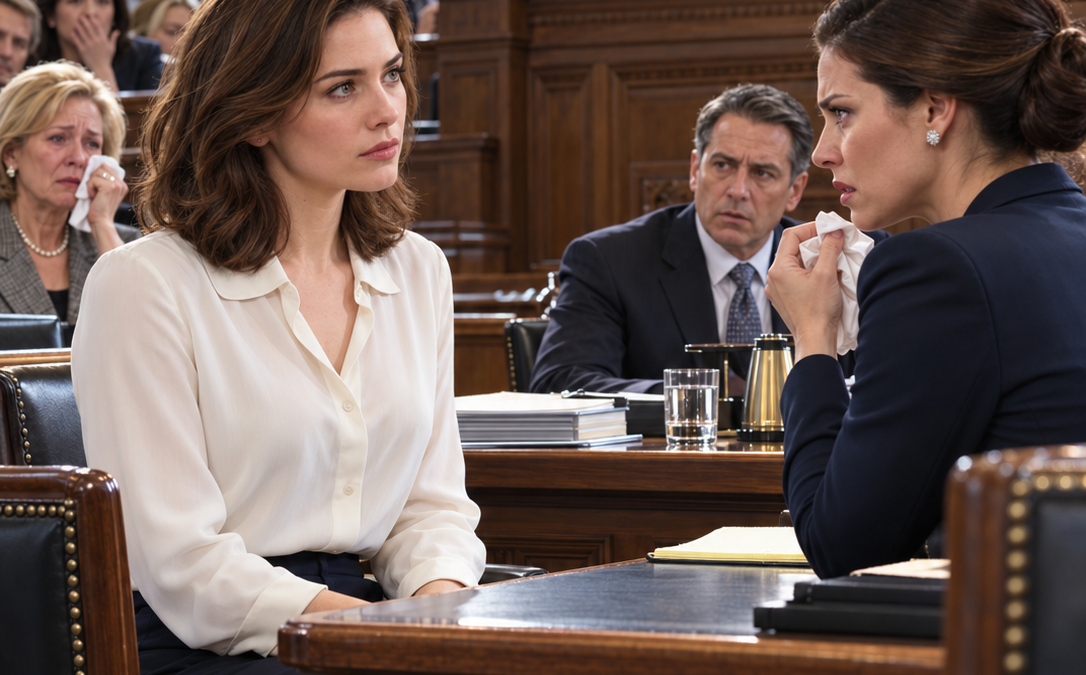
They thought I was crazy. My sister said so. My mother cried and confirmed it. The doctor signed the diagnosis.
Today, in this courtroom, they are all here to prove one thing: I am not competent to manage the $3.2 million that is about to become mine.
But there is one thing no one in this room knows. On the judge’s desk sits a crimson file bearing a federal seal.
I have waited seven years for this moment. And what is about to happen will change everything.
Thank you for spending this time with me. If this introduction sparks your curiosity, please leave a comment telling me where you’re watching from. I’d love to connect with you.
Before we begin, a little note: This story is built around dramatic events interwoven with fictional elements for entertainment and to share profound life lessons. Any similarities in names or locations are purely coincidental. But what about the values and messages of truth? Perhaps you’ll recognize them somewhere in the life around you.
Now, let’s begin Jordan’s journey.
It’s nine o’clock on a cold Wednesday morning in March, and I’m sitting in Courtroom 7B of the Suffolk County Probate and Family Court in Boston. Fluorescent lights hum overhead, casting a sterile glow across the wood-paneled walls and rows of mostly empty benches.
Across from me, my sister Natalie straightens her navy blazer and smiles at the judge. She looks calm and confident, like a woman who has already won.
I sit alone at the respondent’s table. No lawyer. No folders stacked with legal precedents. Just me, a yellow legal pad, and a pen I haven’t touched.
Natalie has Mr. Montgomery, a sharp-suited attorney in his late forties, with slicked-back hair and the aggressive confidence of a man accustomed to getting his way. Behind them, my mother, Barbara, sits in the first row, her hands clasped and her eyes red-rimmed. She’s dressed in muted gray, the very picture of a worried mother.
The gallery isn’t crowded, but there are enough people to make this feel public. Reporters sit near the back, pens ready. Court staff shuffle papers. In the third row, I spot Aunt Susan, my father’s sister, her face carefully neutral.
Near the exit sits a man I recognize but wouldn’t dare acknowledge: Agent Foster, my FBI handler, dressed in plain clothes and blending into the background.
Judge Edward Chambers sits elevated on the bench, his silver hair combed back, his expression unreadable. He’s sixty-one, a seasoned judge who carries himself with the weary authority of someone who has watched too many families destroy themselves in this very room.
He glances at the papers in front of him, then at me, then at Natalie. His gavel comes down once.
“This court is now in session. Case number 2025-CV-4472. In the matter of the conservatorship petition for Jordan Ann Keller. Ms. Natalie Keller, petitioner. Ms. Jordan Keller, respondent. Are both parties present?”
“Yes, Your Honor,” Montgomery says, standing briefly.
“Yes, Your Honor,” I reply, quietly but firmly.
Judge Chambers nods.
“Let the record reflect that this is a conservatorship hearing, not a criminal proceeding. The petitioner seeks to establish legal guardianship over the respondent on grounds of mental incapacity. Mr. Montgomery, you may proceed with your opening statement.”
Montgomery rises, smoothing his tie. He walks to the center of the room with theatrical ease, clears his throat, and addresses the judge.
“Your Honor, this case is about compassion. It’s about family, and it’s about protecting someone who can no longer protect herself.”
He pauses.
“Jordan Keller is twenty-nine years old. She has no stable employment, no verifiable income. For years, she has lived in isolation, consumed by paranoid delusions that have grown more severe with time.”
I feel every eye on me. I don’t flinch. I don’t react. I simply sit with my hands folded and let him talk.
“According to Dr. Anthony Reed, a board-certified psychiatrist with twenty-five years of experience, Ms. Jordan Keller suffers from paranoid delusions of grandiosity. She believes she is employed by the Federal Bureau of Investigation, a claim that is demonstrably false. She believes her family is involved in criminal activity and conspiring against her. She has no insight into her condition. She refuses treatment, and, Your Honor, she poses a risk to herself.”
Montgomery clicks a remote. A screen flickers to life.
Grainy black-and-white security footage appears, time-stamped Saturday, March 1, 10:47 a.m. It shows me at a bank counter, my voice rising, my hands gesturing sharply. A teller steps back. A security guard approaches.
The footage cuts off.
“This video was taken at Commonwealth Bank and Trust four days ago. Ms. Keller’s account had been frozen pursuant to a temporary restraining order, an emergency measure to protect her assets. When she learned of this, she became agitated and verbally aggressive and had to be escorted out by security.”
He pauses, allowing the image to linger in everyone’s mind. Then he turns toward Natalie, who sits with downcast eyes, looking every inch the grieving sister.
“Ms. Natalie Keller is CEO of Keller Properties, a respected real estate firm. She loves her sister. She has tried for years to help her, but Jordan refuses help. She refuses to acknowledge her illness. And now, with a life insurance payout of $3.2 million set to be released in forty-five days, when Jordan turns thirty, there is a very real risk these funds will be squandered or lost.”
Montgomery’s voice softens.
“Your Honor, Ms. Natalie Keller asks this court for one thing: the authority to protect her sister, to ensure she receives the psychiatric care she needs, and to manage her finances until she recovers. This is not about control. This is about love. This is about family.”
He sits.
The room is silent.
Natalie dabs her eyes with a tissue. Barbara lets out a small sob. Reporters scribble in their notebooks.
Montgomery is good. He’s spinning a story that sounds reasonable, even heartbreaking, to anyone who doesn’t know the truth.
But I do.
And so does the man on that bench.
I shift my gaze to Judge Chambers. He’s listening, taking notes, his face professionally neutral. But there’s something else.
On the corner of his desk sits a crimson folder. Thick. Sealed. Stamped in bold black letters.
SEALED FEDERAL FILE — U.S. ATTORNEY’S OFFICE.
That folder hasn’t been opened, but I know what’s inside.
My FBI credentials. The investigation into Natalie’s money laundering. Evidence linking her to Connor Flynn and the Winter Hill mob. The reason this hearing is not what it appears to be.
Natalie doesn’t know what’s in that folder. Neither does Montgomery.
But I do.
And when Judge Chambers opens it, this entire performance will collapse.
I glance at Susan in the third row. Her face remains neutral, but I catch the slightest flicker of acknowledgment. Agent Foster, near the exit, doesn’t move.
He’s waiting.
We’re all waiting.
Judge Chambers clears his throat.
“Thank you, Mr. Montgomery.”
Then he looks at me.
“Ms. Keller, you are representing yourself. Do you wish to make an opening statement?”
“Not at this time, Your Honor.”
Surprise ripples through the gallery. Natalie’s eyes narrow slightly, confusion crossing her face. Montgomery leans over and whispers something to her. She nods, but I see the uncertainty there.
Good.
Let her wonder.
Judge Chambers taps his pen against a folder—not the crimson one, a different one—then looks back at Montgomery.
“Before we proceed with witness testimony, I need to address something.”
The room goes still.
He picks up the crimson folder, holds it for a moment, and looks directly at Natalie.
“Ms. Keller, are you aware that there is a federal file related to this case?”
Natalie’s composure slips.
“No, Your Honor. I’m not aware of any federal involvement.”
Montgomery stands quickly.
“Your Honor, with respect, I’m not aware of federal involvement either. This is a conservatorship matter, not a criminal case.”
Judge Chambers nods slowly.
“I understand. However, I have received this sealed file from the U.S. Attorney’s Office. I am not at liberty to disclose its contents at this time, but I want both parties aware that it exists and may become relevant as this hearing proceeds.”
Natalie’s hand tightens around her tissue. Barbara stiffens. Montgomery’s confidence wavers.
Judge Chambers sets the folder down deliberately in the center of his desk.
“We will proceed with witness testimony as planned. Mr. Montgomery, you may call your first witness.”
Montgomery hesitates, glances at Natalie, then straightens.
“Thank you, Your Honor.”
I sit back, letting the moment wash over me.
Natalie thinks she’s won the first round. She thinks the video, the psychiatrist’s report, and the tearful mother are all falling into place.
But she doesn’t know.
The real game hasn’t even started.
And it all began six days ago, at my mother’s sixtieth birthday party.
Six days earlier, on a Friday evening in late February, I walked into the Harbor Room at Rose Wharf and knew instantly it was going to be a disaster.
The restaurant hovered above Boston Harbor, its floor-to-ceiling windows revealing black water and scattered city lights. It was exclusive, the kind of place where reservations were booked months in advance, servers moved like dancers, and champagne arrived in crystal flutes worth more than my rent.
My mother’s sixtieth birthday.
Thirty guests. A private dining room. White roses, silver candleholders, and linen so crisp it felt staged.
I arrived fifteen minutes late on purpose. Late enough to avoid small talk, late enough to slip in unnoticed.
I wore a simple black dress. Plain. Affordable. Intentional.
The second I stepped inside, I knew it was wrong.
Natalie stopped me before I’d taken three steps.
She wore a red Gucci gown that screamed money, her hair twisted into a perfect updo, diamonds flashing as she moved. She belonged here.
I didn’t.
“You’re late,” she said quietly, sharply. “And what are you wearing? This is a formal event, Jordan.”
“It’s a dress.”
“It’s a black sack.”
She glanced around, then leaned closer.
“Mom’s friends are here. They’ll ask about your job again. What should I tell them?”
“Tell them the truth. I’m a freelance data consultant.”
Natalie laughed softly, cruelly.
“And how much did you make last year? Ten thousand fifteen? While I’m running a fifty-million-dollar company?”
I didn’t answer. I walked past her.
The table stretched across the room, gleaming beneath a chandelier. My mother sat at its head, flushed with champagne, glowing in a silk dress that seemed to match her smile.
“Jordan, darling! Sit next to me.”
Natalie was faster. She slipped beside our mother, placing a hand on her shoulder.
“Mom, Jordan’s fine where she is. The Hendersons need those seats.”
I checked my place card.
The far end of the table, near the kitchen door, surrounded by empty chairs belonging to people who hadn’t shown up or hadn’t mattered enough to attend.
Exiled at my own mother’s birthday.
I sat.
No one approached.
The guests were my mother’s wealthy friends and Natalie’s business associates. Tailored suits, loud voices, market forecasts, distant relatives.
No Aunt Susan.
Natalie had made sure of that.
Dinner arrived. Lobster bisque, filet mignon, vegetables arranged like art. I ate quietly while conversation flowed around me, untouched and invisible.
Which was fine.
Invisibility was part of my job.
At eight o’clock, Natalie stood and tapped her glass.
“I’d like to propose a toast,” she said smoothly. “To the most incredible mother anyone could ask for. You built this family. You supported us through everything.”
Applause filled the room. My mother dabbed her eyes.
“I’m proud to carry on that legacy,” Natalie continued. “Keller Properties is thriving, growing, building, creating opportunity. All because of you, Mom.”
More applause.
Then she looked at me.
“And, of course, my little sister, Jordan.”
A pause. Just long enough.
“She’s finding her way. Still figuring things out. But we love her, don’t we?”
Polite laughter. Side glances.
Heat crept up my neck.
My mother added, “Jordan’s always been sensitive. Not like Natalie. Natalie’s a fighter.”
A woman in pearls leaned toward me.
“What do you do, dear?”
“I’m a data consultant.”
“Oh, who do you work for?”
“I’m freelance.”
“Ah.”
Her smile tightened.
Natalie cut in effortlessly.
“Jordan’s taking her time. No rush. She doesn’t have a family to support.”
I set my fork down.
“Excuse me. Restroom.”
I stood, lifted my purse, and walked out.
Before leaving the table, I’d done one thing. I’d opened a recording app on my phone—an encrypted FBI-issued tool disguised as a weather widget—and pressed Record. Then I’d left the phone inside my purse, hanging from my chair.
I stayed in the restroom for ten minutes, long enough for the guests to move outside to the balcony for cigars, harbor views, and champagne refills.
When I returned, the dining room was mostly empty, but voices carried from the windows.
I stopped just outside the doorway.
Natalie’s voice.
Low. Urgent.
“Mom, we have a problem. Harbor Towers is short twenty-two million. Auditors are asking questions.”
My mother slurred slightly.
“What? How?”
“It doesn’t matter. I need access to the trust. Dad’s life insurance. Three point two million. When does Jordan get it?”
“She turns thirty in forty-five days. That money is hers.”
Natalie laughed bitterly.
“If the project collapses, we lose everything. The house, the company, your lifestyle. You owe three hundred fifty thousand dollars in credit cards. Where do you think that gets paid from?”
Silence.
“Jordan doesn’t need that money,” Natalie continued. “She’s barely functional. No job, no life. If something happened—if she were declared unable to manage her affairs—you or I could be her guardian.”
My mother hesitated.
“Natalie, that sounds like—”
“Survival.”
Every word burned into me.
The phone inside my purse kept recording.
Every confession. Every plan.
I waited, then walked in.
They lowered their voices immediately.
I retrieved my purse and headed for the door.
Natalie glanced up.
“Leaving already?”
“I have work tomorrow.”
She smiled.
“Work. Right.”
Outside, the February air cut through my dress.
I reached the parking garage, slid into my rental car, paid for under an alias, and sat in silence.
I stopped the recording and played it back.
Crystal clear.
Twenty-two million dollars in debt. A plan to seize my trust fund. A plan to declare me incompetent.
I encrypted the file and uploaded it to a secure FBI server.
Then I sat there staring at the dashboard, finally allowing myself to feel it.
The humiliation. The isolation. The cold realization that my own sister was planning to erase me.
I knew Natalie was desperate.
I didn’t know she’d already decided to destroy me.
And by the next morning, everything would change.
Saturday morning. Seven o’clock.
I woke to someone pounding on my door as though they were trying to break it down.
For a moment, I just lay there staring at the ceiling, my heart hammering.
The pounding came again. Three sharp, deliberate knocks that echoed through the narrow townhouse.
I threw off the blanket, grabbed a sweatshirt, and pulled it over my pajamas. My bare feet touched the cold wood floor as I walked downstairs.
Through the front window, I saw a man standing on my stoop. Mid-forties, receding hairline, cheap suit, clipboard.
He looked tired and impatient.
He knocked again.
I opened the door just enough.
“Yes?”
“Jordan Keller?”
“Yes.”
“You’ve been served.”
He shoved a thick manila envelope into my hands, turned, and walked back down the steps without another word.
I watched him climb into a dented sedan and drive away.
I closed the door. Locked it. Leaned against it for a second, feeling the weight of the envelope.
Then I walked into the kitchen, set it on the small wooden table, and sat down.
The morning light was gray and cold through the window. The house was silent.
Just me and whatever was inside that envelope.
I tore it open.
Two documents slid out.
Official letterhead. Legal stamps. My name typed at the top of both.
The first was a temporary restraining order.
I skimmed the text, my pulse quickening.
Petitioner Natalie Keller requests, and the court grants: Respondent Jordan Keller is prohibited from accessing bank accounts, financial assets, or real property. Respondent is prohibited from contacting petitioner or Barbara Keller. Violation will result in immediate arrest.
Signed yesterday, Friday, at six p.m.
Hours before I left the birthday party.
My bank accounts had been frozen at six o’clock that morning.
I set the TRO aside and picked up the second document.
Section 12 Petition: Application for Emergency Evaluation.
Petitioner: Anthony Reed, M.D.
Subject: Jordan Ann Keller, age 29.
Patient Jordan Keller presents with severe paranoid delusions of grandiosity. She believes she is employed by the Federal Bureau of Investigation. She believes her family is involved in criminal activity. She has no verifiable employment history. She exhibits severe paranoia, including the belief that she is being followed.
In my professional opinion, she poses a risk of serious harm to herself and requires immediate psychiatric evaluation and involuntary commitment for seventy-two hours at Brookline Psychiatric Institute.
Filed Friday morning at eight a.m.
Before the party.
Before the toast.
Before I’d recorded Natalie conspiring with my mother.
Natalie had already prepared everything.
She’d been planning this for weeks.
I set the documents down and pressed my palms flat against the table. My breathing was shallow. I forced myself to slow it, to think.
This wasn’t panic.
This was strategy.
I stood and walked to the cabinet above the refrigerator.
I pulled out a small lockbox, unlocked it, and took inventory.
Cash on hand: $340. Twenties and tens rubber-banded together.
Bank account: frozen. I couldn’t access a single dollar.
FBI emergency account: $2,400, stored in a credit union under an alias. My backup, untraceable to Jordan Keller.
But if I used it, if I swiped that card anywhere, it would leave a digital trail. If Natalie’s lawyers subpoenaed financial records, they might find it.
They’d ask where the money came from.
My cover would collapse.
I couldn’t use it. Not yet.
I closed the lockbox and moved to the drawer beneath the microwave.
Inside were two burner phones. FBI-issued, prepaid, registered under fake names.
I powered one on.
Full battery.
Upstairs in my closet, hidden inside a hollowed-out dictionary, was my encrypted laptop. Everything I’d gathered on Natalie was on that drive.
Financial records. Shell companies. Email correspondence. The recording from last night.
And then there was the car.
Or rather, the lack of one.
I didn’t own a car. Never had.
FBI protocol for deep cover. No registration, no insurance, no paper trail.
When I needed transportation, the Bureau provided it. Day to day, I took the T, used Uber, or walked.
Right now, that meant I was stuck.
And Natalie knew that.
I sat back down, staring at the two documents.
Natalie had backed me into a corner.
No money. No transportation.
If I stayed here, she’d send the police to drag me to Brookline for a seventy-two-hour hold.
By the time I got out, she’d have filed the conservatorship petition and seized the life insurance payout.
I needed to move.
But I needed to move smart.
I picked up the burner phone and dialed.
It rang twice.
Then a voice answered, low and controlled.
“Jordan.”
“Foster.”
Agent Marcus Foster. My handler. Seven years together.
I trusted him more than anyone, but right now, even he couldn’t save me.
“I got the papers,” I said. “TRO and a Section 12. Natalie filed them yesterday.”
A pause.
I could almost hear him thinking.
“I know. We flagged it last night.”
“You couldn’t warn me?”
“Too risky.”
“Can you pull me out?”
“No.”
The word was flat. Final.
“If the Bureau intervenes now, it compromises everything. Natalie’s lawyers will scream federal overreach. A judge could throw out every piece of evidence we’ve gathered. Every email, every transaction, every recording. We lose her.”
I closed my eyes.
“So what do I do?”
“Play it out. Go to the bank. Let them see you react. We need Natalie to think she’s winning. Let her believe you’re exactly what she’s painting you as: desperate, unstable, losing control.”
He paused.
“But Jordan, listen. Do not let them Section 12 you. If they commit you to Brookline, we lose control. Understand?”
“I understand.”
“Susan’s on standby. If things go south, she’ll extract you. Until then, you’re on your own.”
“Got it.”
“And Jordan.”
His voice softened slightly.
“Be careful. Natalie’s moving faster than we thought. She’s not just desperate. She’s cornered. And cornered people do dangerous things.”
“I know.”
I hung up and set the phone down.
Then I stared out the window at the gray morning.
No money. No car. No backup.
Just me, $340, and a plan that depended on walking into a trap and pretending I didn’t see it.
I had two choices.
Hide here and wait for the police to show up with a warrant, or go to the bank, confront them, and let Natalie get her video evidence.
Hiding meant Natalie won by default.
So I was going to the bank.
I sat at my kitchen table, staring at the documents spread before me. The TRO. The Section 12 petition.
The clock on the wall read 7:45.
The bank didn’t open until 9:30 on Saturdays.
I had time.
I went upstairs and changed into jeans, a worn sweater, and sneakers. I pulled my hair back into a ponytail. No makeup.
I wanted to look exactly like what Natalie was painting me as: someone falling apart.
Someone desperate.
Back downstairs, I opened the cabinet and pulled out a breakfast bar. I ate it standing at the counter, chewing mechanically without tasting anything.
I counted my cash again.
$340.
I tucked it into my wallet and slipped the wallet into my jacket pocket.
Then I sat back down at the table and waited.
The house was silent. Outside, I could hear the occasional car passing, footsteps on the sidewalk, and the distant hum of the city waking up.
Inside, there was just me and the sound of my own breathing.
At 8:30, I checked the subway schedule on my phone.
The Red Line ran every twelve minutes on Saturday mornings. If I left at nine, I’d be downtown by 9:40. That would give me time to walk to the bank and arrive shortly after it opened.
Not too early.
Not too late.
At nine o’clock, I stood, grabbed my jacket, and walked out the door.
The February air hit me like a slap.
Cold. Sharp.
I pulled my jacket tighter and started walking the ten blocks to the T station. My breath emerged in white clouds.
Jamaica Plain was quiet that early. A few joggers, a dog walker, someone scraping ice off a windshield.
No one looked at me twice.
I descended into the station, swiped my CharlieCard, and stepped onto the platform.
The Red Line train arrived three minutes later, already half full of weekend commuters.
I squeezed into a spot near the door, gripping the pole as the train lurched forward into the tunnel.
The ride took thirty minutes.
I didn’t sit. I just stood there, swaying with the motion, watching stations flash by.
Park Street. Downtown Crossing.
I got off at Downtown Crossing, climbed the stairs back into daylight, and walked five blocks through the financial district.
Glass towers rose on either side of me. Men in suits hurried past, coffees in hand.
No one noticed me.
By 10:30, I was standing in the lobby of Commonwealth Bank and Trust.
The bank was all polished stone and glass, fluorescent lights reflecting off marble floors. Four teller windows lined the left wall, desks for loan officers stood on the right, and a glass-walled office occupied the back corner.
A brass nameplate read: Robert Turner, Branch Manager.
Security cameras hung from the ceiling at every angle.
I walked to the nearest open teller window.
The woman behind the counter was young, in her mid-twenties, with a blonde ponytail and a navy blazer bearing the bank’s logo.
Her name tag said Amanda.
She looked up with a practiced smile that faltered when she saw my face.
“How can I help you?”
“My account’s been frozen. I need to know why.”
Her fingers moved across the keyboard.
The smile disappeared.
Her face paled.
“Um, I see a court order here. You’ll need to speak with Mr. Turner, our branch manager.”
“Where is he?”
She pointed toward the glass office.
“He’s in his office. Just knock first.”
I crossed the lobby.
A security guard near the entrance watched me but didn’t move.
I reached Turner’s office and knocked once on the glass.
He looked up.
Fifty years old. Gray suit. Sharp features. Cold eyes.
He didn’t look surprised.
He looked like he’d been waiting.
“Ms. Keller.”
He stood, smoothed his tie, and opened the door.
“I was expecting you. Please come in.”
I stepped inside. He closed the door and gestured toward a chair.
I sat.
He sat.
We looked at each other.
“Why is my account frozen?”
“We received a court order this morning. A temporary restraining order. I’m not at liberty to discuss the details.”
“I have a right to access my own money.”
“Not when there’s a court order.”
His tone was flat. Clinical.
“If you have an issue, take it up with the court.”
“I need to withdraw cash. At least enough to pay rent.”
“I can’t allow that.”
“You can’t allow it?”
My voice rose. The anger was real.
“It’s my money.”
“Not according to the court.”
I stood.
“This is illegal. I haven’t been notified. I haven’t had a hearing.”
“Emergency orders don’t require prior notification, Ms. Keller.”
He didn’t look sorry.
He looked pleased.
I stepped closer to his desk.
“You’re telling me I can’t access a single dollar? How am I supposed to pay bills? How am I supposed to eat?”
“You’ll need to address that with the court.”
“I need to speak to a supervisor.”
“I’m the supervisor.”
I leaned forward, my palms flat against his desk.
“Then unlock my account. Right now.”
He didn’t flinch.
Instead, he reached beneath his desk and pressed something.
A button.
Within seconds, two security guards appeared.
Both men were built like linebackers, dressed in black uniforms, their expressions unreadable.
Turner stood.
“Ms. Keller, I’m going to have to ask you to leave.”
That’s when I saw it.
The camera in the corner of the office, its lens pointed directly at me. Another above the door. A third in the lobby aimed at Turner’s glass office.
Every angle covered.
This was a setup.
Turner wasn’t just following orders.
He was part of it.
He was baiting me, pushing me to lose control so Natalie could use the footage.
Proof that I was unstable.
Exactly what she needed.
And I’d walked right into it.
But I knew it was a trap.
Which meant I could control how I fell.
I took a breath and let my voice shake, let the frustration show.
“You can’t do this. I need that money. I have bills. I have rent. I have—”
One guard stepped forward.
“Ma’am, please leave.”
“This is illegal!”
My voice grew louder now, just shy of shouting.
“I’m going to report this. I’m going to—”
The guard took my arm, firm but not rough.
I jerked it back.
Not violently.
Just enough resistance.
Just enough for the cameras.
“Don’t touch me. I know my rights. You can’t just—”
“Ma’am, if you don’t leave voluntarily, we’ll escort you out.”
I looked at Turner.
He stood behind his desk, arms crossed, watching with cold satisfaction.
I let my shoulders sag. Let defeat show.
Then I turned and walked toward the door.
The guards followed me through the lobby, past the tellers, past Amanda with her wide eyes, past customers who had stopped to watch.
They walked me to the front door and watched as I stepped outside.
The door closed with a soft click.
I stood on the sidewalk, breathing hard, feeling the cold air sting my lungs.
Around me, the financial district hummed.
People walked past, glancing at me before looking away.
Just another person having a bad day.
I started walking.
Not back to the T.
Not yet.
I walked two blocks, turned a corner, leaned against a brick wall, and closed my eyes.
Natalie had her video now.
Footage of me losing my temper, raising my voice, resisting security.
Perfect evidence for conservatorship.
But here’s what she didn’t know.
In six days, when we stood in front of Judge Chambers, when Montgomery played that video and pointed to it as proof I was unstable, I was going to tell the court exactly what it was.
A setup.
Orchestrated by my sister. Facilitated by a corrupt bank manager.
And when I did, Natalie was going to realize this had been the biggest mistake of her life.
I stood on the sidewalk outside the bank for another moment, catching my breath.
Then I pulled out my phone and opened the Uber app.
The screen loaded.
I entered my home address in Jamaica Plain.
Twelve minutes away. Eighteen dollars.
I tapped to confirm.
Payment method declined. Please update your payment information.
Right.
My bank account was frozen.
My debit card didn’t work.
I closed the app and opened my wallet.
$340 in cash.
But Uber didn’t take cash.
And using my FBI emergency card would leave a digital trail that Natalie’s lawyers could subpoena.
If they found out I had access to money under an alias, my cover would collapse.
Which meant I was walking.
From downtown Boston to Jamaica Plain.
Six miles.
Maybe three hours if I didn’t stop.
Longer if I did.
I started walking.
It was just past eleven in the morning.
The February air was cold and damp, the kind of cold that seeped through your jacket and settled into your bones.
A light drizzle began to fall.
I didn’t have an umbrella.
I pulled up my hood and kept moving.
I walked through the financial district, past glass towers and men in expensive suits carrying briefcases and coffee.
I passed Copley Square and the Boston Public Library, with its stone lions standing guard. I cut through Back Bay, past brownstones with flower boxes in their windows and cars that cost more than most people made in a year.
No one looked at me.
I was invisible.
Just another woman walking in the rain.
By noon, I was crossing into Fenway.
My feet were beginning to hurt. The drizzle had become a steady, cold rain. My jacket was soaked through.
I stopped at a corner store and bought a bottle of water with cash.
Two dollars.
$338 left.
I kept walking.
And as I walked, I thought about my father.
Michael Keller died seven years ago, when I was twenty-two.
It was ruled an accident.
He’d been driving to work on a Tuesday morning, heading west on Route 2 just outside the city.
His brakes failed.
He went off the road, hit a tree, and died on impact.
The police said it was mechanical failure. A corroded brake line. Common in older cars.
No reason to suspect foul play.
But I knew better.
A week before he died, my father had called me into his office.
He closed the door, sat me down, and looked at me with an expression I’d never seen before.
Not anger.
Not sadness.
Fear.
“Jordan,” he said, “I need to tell you something. If anything happens to me, don’t trust Natalie. She’s not who you think she is.”
I remembered laughing.
Nervous, confused laughter.
“Dad, what are you talking about?”
“The life insurance,” he continued. “I’m changing the beneficiary. It was Natalie. Now it’s going to be you. When you turn thirty, you’ll get it. Three point two million dollars. But don’t tell anyone. Especially not your sister.”
“Why?”
He looked at me for a long moment.
“Because she’s desperate, Jordan. And desperate people do terrible things.”
One week later, he was dead.
I didn’t believe it was an accident, but I had no proof.
I was twenty-two years old, fresh out of college, working a dead-end data-entry job.
What was I supposed to do?
Accuse my sister of murder?
Tell the police my father had warned me a week before he died?
So I did the only thing I could think of.
I applied to the FBI.
It took me two years to get in, another year of training at Quantico, and then I was assigned to the Boston Field Office’s Financial Crimes Unit.
I requested undercover work.
Deep cover.
The kind where you disappear into a false identity and stay there for years.
And I stayed.
For seven years, I’d been Jordan Keller, unemployed freelancer, the family disappointment.
And for seven years, I’d been building a case against my sister.
Following the money. Tracing the shell companies. Documenting every transaction, every email, every lie.
Because my father was right.
Natalie was desperate.
And she had done something terrible.
She killed him.
And now, seven years later, she was trying to finish what she’d started.
By three o’clock, I was in Mission Hill.
My feet were screaming. My coat was soaked. I still had two miles to go.
I kept walking.
By 6:30, the sun was setting.
The rain had stopped, but the sky remained gray and heavy. Streetlights flickered on.
I turned onto my street in Jamaica Plain.
And the first thing I noticed was my front door.
It was open.
Just slightly.
An inch, maybe two.
I stopped on the sidewalk.
Every muscle in my body tensed.
I hadn’t left the door open.
I walked slowly up the steps, pushed it wider with my foot, and stepped inside.
The living room was trashed.
Couch cushions thrown onto the floor. Drawers pulled out and emptied. Books swept off the shelves.
Someone had gone through everything.
I ran upstairs to my office.
The desk was a mess. Papers were scattered everywhere.
My laptop was untouched—encrypted, locked, useless to anyone without the password.
But the notebooks were gone.
Three black notebooks.
Handwritten notes. Details about Harbor Towers’ shell companies. Connor Flynn transactions I couldn’t trace digitally.
Seven years of work, written in ink.
I checked the bathroom sink.
Ashes.
Burned pages.
The smell of smoke still hung in the air.
On the desk was a note.
Handwritten.
My mother’s handwriting.
Jordan,
We did this for your own good. You’re not well. We love you.
I crumpled the note in my fist and threw it across the room.
They had destroyed my notebooks.
They’d come into my house, gone through my things, and burned the evidence.
But they didn’t know something.
I had backups.
Encrypted files on my laptop. Cloud storage under an alias.
Every page of those notebooks had been photographed and uploaded the same day I wrote it.
FBI protocol.
Never keep a single copy of anything.
They thought they’d won. They thought they’d erased the evidence.
But they’d only made this easier.
I sat down on the floor, my back against the wall.
For the first time in seven years, I felt it.
Not fear.
Not anger.
Just exhaustion.
Not because I’d lost the evidence. I hadn’t.
Not because my accounts were frozen. I had the FBI emergency fund.
But because I’d finally seen it clearly.
My family was willing to destroy me for money.
My mother had written a note saying she loved me, and then she’d helped my sister break into my house and burn my work.
I closed my eyes and rested my head against the wall.
Tomorrow, they’d come for me.
They’d try to use Section 12 to lock me up at Brookline Psychiatric Institute for seventy-two hours.
And while I was locked away, they’d file the conservatorship petition, seize control of the life insurance payout, and make the money disappear before I could stop them.
But I wasn’t going to let that happen.
Because tomorrow morning, Susan was coming.
My aunt.
My father’s sister.
The only person in this family who had ever told me the truth.
And she was bringing the FBI with her.
Sunday morning. Six o’clock.
I woke to the sound of a soft knock at the front door.
For a moment, I just lay there on the couch, disoriented.
I’d fallen asleep around midnight, still wearing my damp clothes from yesterday’s walk, too exhausted to climb the stairs to my bedroom.
My body ached. My feet throbbed. The house was cold.
The knock came again.
Three gentle taps.
I pushed myself up, walked to the window, and looked out.
A woman stood on my front stoop wearing a denim jacket and carrying two grocery bags.
Fifty-eight years old. Silver-streaked brown hair pulled into a low ponytail. Sharp eyes that missed nothing.
Susan Blake.
My father’s sister.
My aunt.
I opened the door.
“I brought breakfast,” she said, her voice calm and matter-of-fact. “Can I come in?”
I nodded and stepped aside.
She walked in and glanced at the trashed living room—the couch cushions still on the floor, the drawers still pulled out—but didn’t say a word about it.
Instead, she headed straight for the kitchen, set the grocery bags on the counter, and started unpacking.
Bread. Eggs. Butter. Coffee. Orange juice.
“Sit,” she said, nodding toward the small kitchen table.
I sat.
She filled the kettle, set it on the stove, and pulled out a frying pan.
“I heard about the restraining order,” she said, cracking eggs into a bowl. “And the Section 12 petition.”
“How did you know?”
She glanced at me over her shoulder, a slight smile touching her lips.
“I still have friends at the Bureau.”
I blinked.
“The Bureau? FBI?”
She turned back to the stove.
“Where do you think I worked for twenty-five years before I retired?”
And just like that, the pieces clicked into place.
Susan Blake wasn’t just my aunt.
She was former FBI Financial Crimes Unit.
Boston Field Office.
She retired in 2015, the same year I started at Quantico.
And I never knew.
“Your cover was teacher,” I said slowly.
“Retired teacher,” she corrected, whisking the eggs. “It was convincing enough. Your father knew, of course. But no one else. Not Barbara. Not Natalie.”
She poured the eggs into the pan.
“After your father died, I tried to investigate. I suspected Natalie. But I had no proof. No jurisdiction. I was retired. And when I tried to warn Barbara, Natalie shut me out. Stopped inviting me to family gatherings. Told everyone I was bitter and jealous.”
She paused, stirring the eggs.
“So I waited. And watched.”
“For seven years?”
“For seven years.”
She divided the eggs onto two plates, added toast, and set one in front of me.
“I know about Harbor Towers. I know about Connor Flynn. And I know she killed your father.”
I stared at her.
“You know?”
“I suspected. The brake-line failure was too convenient. But I couldn’t prove it.”
She sat down across from me with her own plate.
“Then last year, Agent Foster contacted me. Said you’d joined the Bureau. Said you were working undercover. And I knew you were doing what I couldn’t.”
I picked up my fork but didn’t eat.
“Why didn’t you tell me?”
“Because you had to do this on your own. If I’d interfered, Natalie would have suspected. She had to believe you were exactly what she thought you were—unemployed, unstable, isolated. And you played the part perfectly.”
“Until yesterday.”
Susan nodded.
“Until yesterday. Now she’s moving. Fast.”
She took a bite of toast, chewed, and swallowed.
“Natalie’s coming for you today. She’ll bring Barbara. Probably Dr. Reed. They’ll try to take you to Brookline Psychiatric under Section 12. Once you’re committed for seventy-two hours, she’ll file the conservatorship petition and seize control of the life insurance payout.”
“I know.”
“So we don’t let her take you.”
Susan set down her fork and looked at me directly.
“We let her think she’s winning, but we gather evidence. I’m going to wear a wire. I’ll meet with Natalie and Barbara tomorrow. I’ll pretend I’m worried about you, and I’ll get them to confess.”
“What if they don’t talk?”
“They will. Natalie’s overconfident. She thinks she’s untouchable. And Barbara’s weak. She’ll crack under pressure.”
Susan reached into her jacket pocket and pulled out a small device, a digital recorder no bigger than a USB drive.
“This is FBI-grade encryption. It’s admissible in court. All I need is one confession. About your father’s death. About the conservatorship plan. Anything.”
“When?”
“Tomorrow. Tonight, I’ll reach out to Natalie. Tell her I’m concerned about you. She’ll invite me for coffee, and I’ll record everything.”
I looked at the device in her hand.
It was so small.
So simple.
Seven years of work could come down to one conversation.
“But Jordan,” Susan said, her voice serious now, “you need to understand something. In forty-five days, you turn thirty. That’s when the life insurance payout is released. Three point two million dollars. If Natalie doesn’t have conservatorship by then, she loses. So she’s going to push hard. And she’s going to get desperate.”
“I can handle it.”
“I know you can. But desperate people do terrible things.”
She leaned forward.
“Your father told me that before he died. And he was right.”
I met her eyes.
“Why are you helping me?”
Susan didn’t hesitate.
“Because you’re Michael’s daughter. And because Natalie killed my brother. I want justice as much as you do.”
We sat in silence for a moment.
Outside, the neighborhood was waking up. A dog barked. A car drove past. The morning light filtered through the kitchen window, pale and gray.
Susan stood and picked up the empty plates.
“They’ll be here in a few hours. Are you ready?”
“I’m ready.”
But I wasn’t ready.
Because two hours later, when Natalie and Barbara showed up at my door, they weren’t alone.
The first knock came at 8:53.
I was standing in the kitchen, staring at the burned notebook still sitting in the sink, when the sound echoed through the empty townhouse.
Three sharp raps.
Deliberate and official.
Susan had left an hour earlier. She’d driven off in her old Honda CR-V, promising she’d be back that night with a plan.
But we both knew Natalie wouldn’t wait that long.
The Section 12 petition had been filed on Friday.
The clock was ticking.
I walked to the front door and opened it.
Natalie stood on the stoop in a charcoal wool coat, her arms crossed, her face a mask of concern that didn’t quite reach her eyes.
Behind her, Barbara clutched a tissue to her face, already crying.
And beside them stood a man I’d never met but immediately recognized from the petition paperwork.
Dr. Anthony Reed.
He was in his early fifties, tall and thin, with silver hair and wire-rimmed glasses. He wore a navy suit and carried a leather briefcase.
Everything about him screamed authority.
He extended his hand.
“Ms. Keller,” he said.
His voice was calm. Clinical.
“I’m Dr. Anthony Reed. I’m here to conduct an emergency psychiatric evaluation under Massachusetts General Law, Chapter 123, Section 12.”
I didn’t take his hand.
I looked past him toward the two uniformed officers standing on the sidewalk beside a marked Boston police cruiser.
“You don’t need to do this,” I said, keeping my voice steady. “I’m not a danger to myself or anyone else.”
Natalie stepped forward.
“Jordan, please. We’re trying to help you.”
I wanted to laugh.
I wanted to scream.
Instead, I looked at Dr. Reed.
“You’ve never met me,” I said. “How can you evaluate someone you’ve never spoken to?”
He opened his briefcase and pulled out a manila folder.
“I’ve reviewed the documentation provided by your family. The petition outlines several concerning incidents, including delusional statements, erratic behavior, and a violent episode at a financial institution yesterday morning.”
The bank.
Of course.
Turner had called them the moment I’d left.
Dr. Reed adjusted his glasses.
“Based on the evidence, I have reasonable grounds to believe you pose a risk of serious harm due to mental illness. I’m authorized to sign an order for emergency evaluation and hospitalization.”
He pulled a pen from his pocket and signed the bottom of a form with a flourish.
Just like that.
Twenty-five thousand dollars, Susan had said.
That’s what Natalie had paid him to do this.
I could see it in the way he avoided my eyes, the way his hand had moved too quickly across the paper.
“This is illegal,” I said.
Barbara sobbed louder.
“Jordan, sweetheart, please don’t make this harder.”
One of the officers stepped forward.
“Ma’am, we need you to come with us.”
I looked at Natalie.
She smiled.
It was small, almost imperceptible, but I saw it.
This was her moment.
She thought she’d won.
I took a breath.
I had to play this right.
If I fought, if I resisted, it would only make things worse.
Susan had warned me.
Don’t blow your cover. Let them think they have you.
“Fine,” I said. “I’ll go.”
Natalie blinked.
She’d been expecting a fight.
“You will?” Barbara said, hope creeping into her voice.
I stepped back inside the house and grabbed my jacket. I slipped it on slowly, giving myself time to think.
My phone was in my pocket, one of the burner phones Susan had left me.
When I turned back, Dr. Reed was already walking toward the cruiser.
The female officer gestured for me to follow.
“Let’s make this easy,” she said.
I walked down the steps.
Natalie and Barbara followed at a distance.
As I reached the sidewalk, I glanced back at the townhouse.
The door was still open.
The officer opened the back door of the cruiser.
No handcuffs.
I slid into the seat, and she closed the door with a soft click.
The locks engaged automatically.
Natalie leaned down and tapped on the window.
I didn’t look at her.
The engine started.
Dr. Reed climbed into the front passenger seat. The second officer, a middle-aged man with a thick Boston accent, got behind the wheel.
“Brookline Psychiatric Institute,” Dr. Reed said. “Twenty minutes.”
We pulled away from the curb.
I watched Jamaica Plain slide past the window. Brick row houses, corner stores, bare trees lining the streets.
The city looked gray and cold beneath the March sky.
“You’re doing the right thing,” Dr. Reed said, glancing back at me. “This evaluation is for your own safety.”
I didn’t respond.
I was thinking about the $25,000. About the email Susan would find. About the wire she’d wear tomorrow when she visited Natalie.
The cruiser turned onto Huntington Avenue, heading west toward Brookline.
Traffic was light on a Sunday morning.
We passed the Museum of Fine Arts, the brownstones of Fenway, and the campus of Simmons University.
At 9:42, we turned onto a narrow side street and stopped in front of a tall brick building surrounded by a wrought-iron fence.
A sign by the gate read:
Brookline Psychiatric Institute — Emergency Services.
The officer unlocked the doors.
Dr. Reed stepped out first and opened mine.
“This way,” he said.
I followed him through the gate and up a concrete path to the entrance.
The building was old and institutional, with narrow windows and heavy double doors.
Inside, the lobby smelled of disinfectant and stale coffee.
A security guard sat behind a desk, and a nurse in pale blue scrubs waited beside a set of locked interior doors.
“Doctor.”
Reed handed her the signed Section 12 form.
She scanned it, nodded, and looked at me.
“Ms. Keller, I’m Nurse Patel. I’ll be processing your intake. Please follow me.”
The interior doors buzzed open.
Beyond them stretched a long hallway painted institutional beige, with fluorescent lights overhead and linoleum floors that squeaked beneath my shoes.
We passed a day room where a television played silently, a medication station, and a row of closed doors.
Nurse Patel stopped at a small office and gestured for me to sit.
“I need to collect your personal belongings. Phone, wallet, keys, jewelry.”
I pulled the burner phone from my pocket and set it on the desk, followed by my wallet and house keys.
She placed everything into a clear plastic bag and sealed it with a label.
“You’ll get these back when you’re discharged.”
“When will that be?” I asked.
“The seventy-two-hour hold begins now. Dr. Reed will conduct your evaluation over the next three days.”
Seventy-two hours.
Three days locked in here while Natalie dismantled my life outside.
“Can I make a phone call?” I asked.
“Not until after your initial evaluation,” Nurse Patel said. “Hospital policy.”
She led me down another hallway to a small room containing a bed, a chair, and a narrow window reinforced with wire mesh.
The door had a lock on the outside.
“Someone will be in to see you shortly,” she said.
Then she stepped out and closed the door.
I heard the lock click.
I sat on the bed.
The mattress was thin, the blanket scratchy. The window looked out onto a courtyard enclosed by high walls.
But I wasn’t worried.
Not yet.
Natalie thought she’d trapped me.
She thought that with me locked in here, she could finalize the conservatorship, seize my assets, and take control of the life insurance payout in forty-three days.
She didn’t know about Susan.
She didn’t know about the wire.
She didn’t know that in twelve hours, I’d be walking out of here.
I lay back on the bed and stared at the ceiling.
Twelve hours.
I could do twelve hours.
Outside, somewhere in Boston, Susan was already moving.
And when I got out, Natalie was going to realize this had been the biggest mistake of her life.
The room was dark.
I lay on the thin mattress, staring at the ceiling, counting the hours.
Eight o’clock.
Nine.
Ten.
The fluorescent light in the hallway hummed through the gap beneath the door. Somewhere down the corridor, a woman was crying. Somewhere else, a man was shouting at shadows.
Susan had promised she’d have a plan.
I just didn’t know what it would look like.
At ten o’clock, the lights went out.
Not just in my room.
Everywhere.
The hallway went dark.
The humming stopped.
For a moment, there was silence.
Then the fire alarm started screaming.
Red emergency lights flashed in the corridor.
I sat up.
Footsteps pounded past my door. Staff, patients, security. Someone was shouting instructions I couldn’t hear over the noise.
Then my door flew open.
A nurse stood there, breathless, her scrubs disheveled.
“Ms. Keller, we have an emergency situation. We need to move you to the medical wing.”
“What’s happening?” I asked.
“Just come with me. Now.”
I didn’t argue.
I swung my legs off the bed and followed her into the hallway.
The scene was chaos.
Patients stumbled out of their rooms, blinking in the strobing red light. Staff members herded them toward the day room. Security guards ran in the opposite direction, their radios crackling.
The nurse grabbed my arm and pulled me toward the far end of the corridor, away from the main group.
“This way.”
We turned a corner.
Ahead of us, an emergency exit stood wide open.
The door that was always locked.
The door that was never supposed to be open.
The nurse looked at me.
“Go.”
I stared at her.
“What?”
“Go,” she repeated. “You have thirty seconds before someone notices.”
I didn’t wait for her to change her mind.
I ran.
The stairwell was concrete and cold, lit only by red emergency lights.
I took the stairs two at a time, my bare feet slapping against the steps.
My heart hammered in my chest.
I reached the ground floor and shoved open the exterior door.
Cold night air hit my face.
I was in the ambulance bay, a narrow strip of asphalt behind the building.
And there, engine running, was Susan’s Honda CR-V.
Susan leaned across and pushed the passenger door open.
“Get in!”
I didn’t need to be told twice.
I jumped into the seat, and Susan hit the gas before I’d even closed the door.
We shot out of the parking lot and onto the side street, tires squealing.
“What did you do?” I asked, breathless.
Susan kept her eyes on the road.
“Agent Foster called in a fake medical emergency. Patient in anaphylactic shock in the high-security wing. While everyone was distracted, I pulled the fire alarm and triggered the emergency exit locks remotely. The FBI still has a few friends in facilities management.”
I stared at her.
“You hacked the fire system?”
“I didn’t hack anything,” Susan said. “I made a phone call.”
We turned onto Beacon Street, blending into the sparse late-night traffic.
Susan drove carefully, obeying every speed limit and signaling every turn.
Nothing that would draw attention.
“Where are we going?” I asked.
“Somewhere safe.”
We drove north on Route 1, past strip malls, gas stations, and fast-food restaurants with flickering neon signs.
The city fell away behind us.
After twenty minutes, Susan pulled into the parking lot of a low-slung motel with a faded sign that read Riverside Inn.
The place looked as though it hadn’t been updated since the eighties.
Peeling paint. Cracked asphalt. No security cameras that I could see.
Susan parked near the office and got out.
“Wait here.”
I watched through the window as she went inside and spoke to the clerk.
She paid cash.
Sixty dollars.
The clerk handed her a key attached to a plastic tag.
Room 12.
Susan returned to the car and drove around to the side of the building.
Second floor.
We climbed the exterior stairs, and she unlocked the door.
The room was small and smelled of cigarettes and mildew.
A double bed with a sagging mattress. A television older than I was. A bathroom with a dripping faucet.
But it was warm.
And it was safe.
Susan locked the door behind us and drew the curtains.
“You’ll stay here for the next three days. Don’t leave. Don’t use your phone. Natalie’s probably tracking it.”
“I left my phone at Brookline,” I said. “They took it during intake. I still have the burner you gave me.”
“Good. Keep it off unless you need to reach me.”
Susan set a canvas bag on the bed.
Inside were clothes, toiletries, granola bars, and bottled water.
“I’ll bring you food and anything else you need. In the meantime, you need to go through everything you have on Natalie. We need ironclad evidence for the hearing on Wednesday.”
“What about you?” I asked. “What are you going to do?”
Susan met my eyes.
“Tomorrow, I’m going to visit Natalie and Barbara. I’ll be wearing a wire. And I’m going to make them confess.”
I sat down on the edge of the bed.
For the first time in three days, I could breathe.
My feet were cold and dirty from running barefoot through Brookline. My hands were shaking from adrenaline.
But I was out.
“Susan,” I said, “once we do this, once we play the recording, there’s no going back. Natalie will go to prison. Barbara will go to prison. The family as I knew it will be gone.”
Susan nodded slowly.
“I know.”
“Are you sure you want to do this?”
She looked at me for a long moment. Her expression was hard, but there was something else in her eyes.
Grief, maybe.
Or regret.
“Jordan,” she said quietly, “they stopped being family the day they killed your father.”
I felt something tighten in my chest.
My father.
Michael Keller.
The man who taught me how to ride a bike, how to tie a tie, how to stand up for what was right.
The man whose brake line had been cut seven years ago on a rainy night in February.
“Okay,” I said. “Then we do this.”
Susan reached into her jacket and pulled out a small black device, a digital voice recorder no bigger than a USB drive.
“This is FBI-grade, encrypted. If I can get them to talk, this will capture every word.”
She set it on the nightstand.
“Get some sleep. Tomorrow’s going to be a long day.”
She turned to leave, but I stopped her.
“Susan.”
She looked back.
“Thank you.”
She nodded.
“Your father would have done the same for you.”
Then she was gone.
I locked the door behind her and sat back down on the bed.
The motel was quiet. Outside, I could hear the occasional car passing on Route 1. Inside, the radiator clanked and hissed.
I pulled the burner phone from my pocket and stared at it.
I wanted to call Agent Foster.
I wanted to check in.
But Susan was right.
Any call could be traced. Any signal could give me away.
So I turned the phone off and set it on the nightstand beside the recorder.
Tomorrow, Susan would meet Natalie.
She’d wear the wire.
She’d ask the right questions.
And by tomorrow night, we’d have everything we needed to destroy my sister.
I lay back on the bed and closed my eyes.
Three days.
That’s all I needed.
Three days until the hearing.
Three days until I could walk into that courtroom and blow Natalie’s world apart.
I could do three days.
Monday morning, I woke at six, showered in the dingy motel bathroom, and made instant coffee with the ancient machine on the dresser. By eight o’clock, I was sitting cross-legged on the bed, my encrypted laptop balanced on my knees, the curtains drawn tight against the daylight.
I logged into the secure cloud storage under one of my aliases. The files were all there: backups of everything from the notebooks Barbara had burned, financial records, email threads, transaction histories, shell company registrations, and everything else I’d been collecting for months.
I opened the Harbor Towers file first. The numbers were stark.
Thirty-five million dollars in municipal bonds had been issued to fund the construction of affordable housing for 120 low-income families in South Boston. The project had been Natalie’s flagship achievement as CEO of Keller Development. She’d held a press conference, shaken hands with the mayor, and posed for photographs with smiling families who’d been promised a chance at homeownership.
And then $22 million had disappeared.
I clicked through the transaction records. The money had moved fast, from the Harbor Towers construction account to a holding company called Seabreeze Holdings, registered in the Cayman Islands. From Seabreeze, it had gone to Oceanview Capital, and from Oceanview to Blue Horizon LLC.
Each transfer had been carefully spaced, each one just below the threshold that would trigger automatic federal reporting.
At the end of the chain, the money had landed in an offshore account.
Owner unknown.
But I knew who owned it. I just needed to prove it.
I opened the email archive. Thousands of messages. I’d spent weeks sorting through them, flagging anything that mentioned Flynn, Turner, or Harbor Towers. Now I went back through the flagged messages, looking for the smoking gun.
I found it at 10:30.
The first email was dated January 15, 2025.
From: Natalie Keller
To: CF
Subject: Harbor Towers
The project is running behind schedule. I need more time to move the funds. Can you give me sixty days?
The response was addressed to Natalie Keller.
Subject: RE: Harbor Towers
Sixty days. Not one day more. If the feds start asking questions, you’re on your own.
Connor Flynn.
The name had come up again and again in my investigation. A Winter Hill associate, a money launderer, a man who’d been moving dirty cash through Boston real estate for a decade.
And my sister’s business partner.
I sat back against the headboard and stared at the screen.
This was it.
This was the connection I needed.
Natalie wasn’t just embezzling from Harbor Towers. She was laundering money for the Irish mob.
I kept reading.
At eleven o’clock, I found the second email.
From: Natalie Keller
Subject: Jordan
Date: February 28, 2025
The account freeze has been executed. Make sure she can’t access any cash. And when she shows up at the bank, record everything. I need proof that she’s unstable.
The response came from Richard Turner at Commonwealth Bank and Trust.
Subject: RE: Jordan
Date: February 28, 2025
Done. Cameras are ready. She’ll walk right into it.
I felt my jaw clench.
Turner wasn’t just a bank manager. He was an informant. He worked for Flynn, monitoring federal investigations and reporting back.
That’s how Natalie had known to move so fast. That’s how she’d known I was closing in.
Turner had sold me out.
I took a breath and kept working.
By two o’clock, I had the complete picture. I opened a new document and began building the evidence file.
Evidence Package: Natalie Keller / Connor Flynn
Financial Records — Harbor Towers
Municipal bond issuance: $35,000,000.
Funds transferred to shell companies: $22,000,000.
Chain of custody: Harbor Towers to Seabreeze Holdings, Cayman Islands; Seabreeze Holdings to Oceanview Capital, Cayman Islands; Oceanview Capital to Blue Horizon LLC, Cayman Islands; Blue Horizon LLC to offshore account.
Email Correspondence — Natalie Keller / Connor Flynn
Coordination of fund transfers. Sixty-day timeline. Concerns regarding federal investigation.
Email Correspondence — Natalie Keller / Richard Turner
Conspiracy to freeze accounts. Surveillance coordination. Fabrication of evidence of mental instability.
Shell Company Documentation
Seabreeze Holdings: Registered in the Cayman Islands, December 8, 2024.
Oceanview Capital: Registered in the Cayman Islands, December 15, 2024.
Blue Horizon LLC: Registered in the Cayman Islands, January 3, 2025.
False Psychiatric Evaluation
Dr. Anthony Reed. Section 12 petition, March 1, 2025. Suspected payment: $25,000, unconfirmed.
Temporary Restraining Order
Filed by Natalie Keller, February 28, 2025. Signed by Judge Edward Chambers.
Audio Recording
Barbara Keller’s sixtieth birthday party, February 28, 2025. Conversation between Natalie and Barbara discussing the plan to seize Jordan’s trust fund.
I encrypted the entire file, uploaded it to the FBI’s secure server, and sent a copy directly to Agent Foster’s classified inbox.
Then I sat back and waited.
At five o’clock, my burner phone buzzed.
Foster.
“I got the file,” he said. “This is solid, Jordan. We have enough to arrest Natalie, Turner, and Flynn right now.”
“Not yet,” I said. “We need the confession. We need them on record admitting what they did to my father.”
“Jordan, if we wait, Natalie could run.”
“She won’t run. She thinks she’s winning. She thinks I’m locked up in Brookline, and she’s forty-two days away from three point two million dollars. She’s not going anywhere.”
Foster was quiet for a moment.
“What about Susan? Is she ready?”
“She meets them tomorrow,” I said. “She’ll get the confession, and then we’ll have everything.”
“And if she doesn’t?”
I looked at the laptop screen, at the evidence file I’d just compiled, at the emails, the money trail, and the names.
“Then we still have enough to put them away for twenty years,” I said. “But I want justice for my father, and that means I need them to say it out loud.”
Foster sighed.
“All right. But Jordan, be careful. These people have already killed once. They won’t hesitate to do it again.”
“I know.”
I hung up and set the phone down on the nightstand.
Outside, the sun was setting. The motel room was growing dark. I could hear traffic on Route 1, the steady hum of cars heading north toward the city.
Tomorrow, Susan would visit Natalie and Barbara. She’d wear the wire. She’d ask the right questions. And if everything went according to plan, by tomorrow night we’d have the final piece of evidence we needed.
The confession.
I closed the laptop and lay back on the bed. My body ached from sitting still all day. My eyes burned from staring at the screen.
But I felt something I hadn’t felt in days.
Hope.
Two more days. That’s all I needed. Two more days until the hearing, until I could walk into that courtroom and destroy Natalie once and for all.
I could do two more days.
At eight o’clock Monday night, I turned on the television. I’d spent the entire day hunched over my laptop, and my eyes ached from staring at financial spreadsheets and email threads.
I needed a break. I needed to hear voices that weren’t my own thoughts echoing inside my head.
I flipped to Boston 7 News.
The anchor was mid-sentence, her expression serious.
“Breaking news tonight. Boston police are searching for Jordan Keller, age twenty-nine, who escaped from Brookline Psychiatric Institute late last night. Keller was admitted under Section 12 for emergency psychiatric evaluation. Authorities say she may be a danger to herself. If you see her, please contact Boston police immediately.”
My driver’s license photograph filled the screen.
The one where I looked tired and vaguely annoyed, taken three years ago at the DMV.
I stared at the television.
Then I turned it off.
For a long moment, I sat in the silence of the motel room. The only sounds were the hum of the ancient refrigerator and the distant rush of traffic on Route 1.
I picked up my burner phone and dialed Foster.
He answered on the first ring.
“I know,” he said before I could speak. “I’m watching it now.”
“There’s a warrant out for my arrest,” I said.
My voice sounded flat, detached.
“Natalie’s playing this perfectly,” Foster said. “She’s making you the villain. The unstable sister who escaped from a psychiatric facility. The dangerous fugitive.”
“Can you pull the warrant?”
“No.” His voice was firm. “If the Bureau intervenes now, your cover is blown. Natalie’s lawyers will argue federal overreach, and the judge could throw out everything we’ve built. We have to let this play out.”
I closed my eyes.
“So what do I do?”
“You stay hidden. You don’t leave that motel. You don’t use your real name. Susan will bring you food. And in two days, when we walk into that courtroom, we’ll reveal everything, and the warrant becomes irrelevant.”
“And if someone recognizes me before then?”
Foster was quiet for a moment.
Then he said, “Then we lose.”
I hung up and set the phone down on the nightstand.
I sat on the edge of the bed, my head resting against the wall, my hands folded in my lap.
For the first time in seven years, I felt completely alone.
Not just physically alone. I’d been alone plenty of times during this investigation. Alone in surveillance vans. Alone in rented apartments. Alone at family dinners where I smiled and nodded while secretly recording every word.
But this was different.
This was a different kind of isolation.
I had no family. Natalie and Barbara were trying to lock me up. My father was dead, murdered by the people who were supposed to love him.
My mother, wherever she was, had never truly been part of my life.
I had no friends. Seven years undercover meant seven years of lies. No close relationships. No one I could trust. Every conversation was calculated. Every smile was strategic.
I had Susan. And I had Foster.
But Susan was risking everything to help me, and Foster was bound by rules and protocols that sometimes felt like chains.
I thought about my father, Michael Keller, the man who taught me how to throw a baseball, how to change a tire, how to stand up when someone knocked you down.
The man whose funeral I’d attended seven years earlier, knowing in my gut that his death hadn’t been an accident but unable to prove it.
Seven years.
I’d spent seven years chasing Natalie. Seven years building a case. Seven years pretending to be someone I wasn’t: the unemployed little sister, the failure, the burden.
And now, two days before the hearing, I was hiding in a motel room, watching my face on the evening news and hoping no one would recognize me.
This was the cost of going undercover. You gave up everything—your identity, your family, your life—for the mission.
And sometimes it felt as though the mission was all you had left.
At nine o’clock, there was a knock on the door.
Three soft taps.
I looked through the peephole.
Susan.
I unlocked the door and let her in.
She was carrying a paper bag from a diner down the road. A sandwich, fries, bottled water.
“I saw the news,” she said quietly.
“Yeah.”
“Are you okay?”
“I’m fine.”
She set the bag on the small table by the window and turned to look at me.
“No, you’re not. But you will be. In two days, this will be over. Natalie will be in prison. Barbara will be in prison. And you’ll get your life back.”
“I don’t even know what my life is anymore,” I said.
Susan sat down on the edge of the bed.
“Then you’ll figure it out after this is over. But first, we have to finish what your father started.”
I looked at her.
She was fifty-eight years old, retired from the FBI, living a quiet life as a supposed schoolteacher.
But right now, sitting in that dingy motel room, she looked like the agent she used to be.
Focused. Determined. Ready to fight.
“Tomorrow,” she said, “I’m meeting with Natalie and Barbara. I’ll be wearing the wire. And I’m going to make them tell me what they did.”
“What if they don’t talk?” I asked.
“They will.”
Susan’s voice was calm, certain.
“I know how to get them to talk. I’ve been doing this for twenty-five years.”
I nodded.
“Okay.”
Susan stood.
“Get some rest. Tomorrow’s going to be a long day.”
She moved toward the door, then paused.
“Jordan,” she said, “your father would be proud of you. You know that, right?”
I felt something tighten in my chest.
“I hope so.”
“He would be.”
She opened the door.
“I’ll see you tomorrow night.”
Then she was gone.
I locked the door behind her and sat back down on the bed.
The sandwich sat on the table, still warm.
I should eat.
I knew I should eat.
But I wasn’t hungry.
I lay back and stared at the ceiling.
The motel room was quiet. Outside, I could hear the occasional car passing and the hum of the neon sign flickering in the parking lot.
Tomorrow, Susan would meet Natalie. She’d wear the wire. She’d ask the right questions.
And if it worked, if we got the confession, then none of this would matter.
The warrant. The news. The humiliation.
It would all become evidence.
And Natalie would become a prisoner.
I closed my eyes.
Two more days. Just two more days.
I could do this.
Tuesday morning. Seven-thirty.
I was sitting on the bed in the motel room, my encrypted laptop open, my burner phone in my hand.
The curtains were drawn.
The door was locked.
And I was about to listen to my aunt walk into a room with two women who wanted to destroy me.
My phone buzzed.
Susan.
“I’m ready,” she said. Her voice was calm and steady. “The wire is on. Can you hear me?”
I opened the audio-monitoring app on my laptop. A green waveform flickered across the screen.
“Loud and clear.”
“Good. I’m calling her now.”
I heard the dial tone through my earpiece.
Then Natalie’s voice, bright and pleasant.
“Aunt Susan! What a surprise.”
“Natalie, sweetheart. I heard about Jordan. I’m so worried. Can we talk?”
There was a pause.
I could almost see Natalie calculating, weighing her options.
“Of course,” Natalie said finally. “I’m so glad you called. Mom and I have been trying to reach you.”
“I want to help,” Susan said. “Where should we meet?”
“Caffè Nero, downtown. Eight o’clock. I’ll bring my mother.”
“I’ll see you there.”
Susan hung up.
Then, a moment later, she spoke directly to me.
“She took the bait. I’m going to get it all on tape.”
I watched the clock.
7:45.
Eight o’clock.
I put in my earpiece and listened.
At 8:15, I heard the sounds of the café: espresso machines hissing, chairs scraping against tile floors, voices murmuring in the background.
Then Susan’s voice, clear and close.
“Natalie. Barbara. Thank you for meeting me.”
“Aunt Susan.”
Natalie’s voice was warm and saccharine.
“Thank you for coming.”
I heard the sound of an embrace.
Then Barbara’s voice, trembling and anxious.
“We’re so worried about Jordan. She’s not well.”
“What happened?” Susan asked. “I heard she was at Brookline.”
“She was,” Natalie said. “But she escaped. The police are looking for her everywhere. We don’t know where she is.”
“Escaped? Why would she do that?”
Natalie sighed, a performance of exasperation.
“Because she’s paranoid, Aunt Susan. She thinks we’re trying to hurt her. But we’re not. We’re trying to help her.”
I clenched my jaw.
I wanted to scream, but I forced myself to stay silent and listen.
“What can I do?” Susan asked.
“If she contacts you,” Natalie said, “please call us immediately. We need to find her before she hurts herself.”
There was a pause.
Then Susan spoke again, her voice softer and more concerned.
“I still don’t understand. Why was she at Brookline in the first place?”
Barbara jumped in, her voice high and nervous.
“She’s been unstable. For years. No job, no income. Just sitting in that house, writing in those notebooks. We had to—”
“We had to take her in under Section 12,” Natalie interrupted smoothly. “For her own safety.”
“And the conservatorship?” Susan asked.
I held my breath.
There was a long pause.
Then Natalie’s voice, cautious.
“How do you know about that?”
“I heard through the family,” Susan said. “You know how people talk.”
Natalie exhaled.
“It’s a precautionary measure. Jordan is turning thirty soon. There’s a life insurance policy. Three point two million dollars. If she’s deemed incapable of managing that money, someone needs to step in.”
“And that someone is you.”
“I’m her sister,” Natalie said. “Who else would it be?”
“And the money?” Susan pressed. “What will you do with it?”
I could hear the tension in Natalie’s voice now.
She was being careful.
“I’ll use it to take care of Jordan. To get her the help she needs.”
Then Barbara spoke, her voice breaking.
“We need that money, Susan. The company is in trouble. If we don’t—”
“Mom!”
Natalie’s voice was sharp.
Barbara went silent.
I stared at the laptop screen.
The waveform was spiking.
Barbara had been loud, almost frantic. And then Natalie had cut her off.
Susan let the silence hang for a moment.
Then she spoke again, her voice neutral, curious.
“So this is about the company.”
“It’s about family,” Natalie said firmly. “It’s about making sure Jordan is safe.”
“Of course,” Susan said. “Well, if I hear from her, I’ll let you know.”
“Thank you, Aunt Susan. That means so much to us.”
I heard chairs moving and goodbyes being exchanged.
Then Susan’s voice quieted. She was speaking directly into the wire.
“I’m leaving. Recording is secure.”
Ten minutes later, there was a knock on my motel room door.
I opened it.
Susan stepped inside, her face pale but composed.
“I got it,” she said.
She pulled the digital recorder from beneath her blouse and set it on the table.
“Natalie admitted the conservatorship is about the money. Barbara almost gave everything away.”
I played back the recording on my laptop.
Barbara’s voice was desperate and raw.
“We need that money, Susan. The company is in trouble.”
And Natalie’s voice, cold and controlled.
“Mom!”
“This is admissible,” I said. “This proves motive. This proves conspiracy.”
Susan nodded.
“But it’s not enough.”
I looked at her.
“What do you mean?”
“We have evidence that they’re trying to steal your money,” Susan said. “But we don’t have evidence that they killed your father. That’s what we really need, Jordan. That’s the confession that will put them away for life.”
I sat back on the bed.
She was right.
The recording was damning. It proved fraud, conspiracy, maybe even false imprisonment.
But it didn’t prove murder.
“So what do we do?” I asked.
Susan was quiet for a moment.
Then she looked at me, her expression hard.
“I go back,” she said. “Tomorrow, I push harder. I ask about Michael, and I make them tell me what they did.”
I felt something cold settle in my chest.
“That’s dangerous. If they suspect you’re working with me—”
“They won’t,” Susan said. “They think I’m just a worried aunt. They think I’m on their side.”
I looked at her.
She was fifty-eight years old. She’d been retired for years, but right now she looked like the agent she used to be.
Focused. Determined. Ready to do whatever it took.
“Okay,” I said. “One more time. Tomorrow.”
Susan picked up the recorder and slipped it back into her bag.
“Get some rest. Tomorrow’s the day we finish this.”
She left.
I sat alone in the motel room, staring at the laptop screen.
The waveform was still there, frozen on the moment Barbara had said, We need that money.
We had proof of conspiracy. We had proof of motive.
But we didn’t have the full truth.
Not yet.
Tomorrow, Susan would go back. She’d push harder. She’d ask the questions that mattered.
And if everything went right, by tomorrow night we’d have the confession we needed.
The confession about my father.
One more day.
That’s all we needed.
One more day until the hearing, until I could walk into that courtroom and bring Natalie’s world crashing down.
I could do one more day.
At one o’clock Tuesday afternoon, my phone buzzed.
Susan.
“She called,” Susan said.
Her voice was steady, but I could hear the tension underneath.
“Natalie wants me to come to the house. She says there are things I don’t know. Things about the family.”
I sat up on the motel bed.
“She’s inviting you to the estate?”
“Yes. She wants to talk privately. Just her, Barbara, and me.”
I felt my pulse quicken.
This was it.
She was going to open up.
“That’s what I’m thinking,” Susan said. “She thinks I’m on her side. She thinks I’m family.”
“Be careful,” I said. “If she suspects anything—”
“She won’t. I know how to handle her.”
I heard the sound of her putting on the wire: the soft click of the recorder, the rustle of fabric.
“Battery’s good for four hours,” Susan said. “Audio is clear. I’m leaving now.”
“I’ll be listening.”
She hung up.
I put in my earpiece and opened the monitoring app on my laptop.
At 2:15, I heard Susan’s voice.
“Natalie. Barbara. Thank you for inviting me.”
Natalie’s voice was warm, but there was something underneath it, something calculating.
“Aunt Susan, come in. We’re so glad you’re here.”
I heard footsteps, heels on marble, and the sound of a door closing.
Then the softer sounds of a living room. The creak of a sofa. The rustle of cushions.
“Please sit,” Natalie said. “Can I get you anything? Tea? Coffee?”
“I’m fine,” Susan said. “What did you want to talk about?”
There was a pause.
Then Natalie spoke, her voice quieter now.
“About Jordan. And about the family legacy. Aunt Susan, you’re Michael’s sister. You understood him better than anyone. Did he ever talk to you? About us?”
“What do you mean?” Susan asked.
Barbara’s voice trembled.
“About how Natalie became part of the family.”
Susan played it perfectly.
“I know you adopted her when she was a baby.”
Natalie’s voice sharpened.
“How do you know that?”
“Michael told me years ago,” Susan said smoothly. “He said it didn’t matter. You were his daughter, blood or not.”
Natalie laughed.
It was a bitter sound.
“He said that, but he didn’t mean it. When he died, he’d changed the life insurance beneficiary to Jordan. Not me. Jordan, his real daughter.”
“Natalie, that’s not—”
“Don’t!”
Natalie’s voice was cold.
“I know what it was. He found out I knew. That I’d known for years. And he punished me for it.”
Barbara’s voice broke.
“We never wanted you to find out that way.”
“I found out when I was sixteen, Mom. I found the adoption papers in your bedroom. And I never said anything. Because I thought maybe if I worked hard enough, if I was successful enough, he’d treat me like I mattered.”
I sat frozen on the motel bed, listening.
Sixteen.
She’d known since she was sixteen.
Susan’s voice was careful, measured.
“He did treat you—”
“He left me nothing,” Natalie said. “Three point two million for Jordan. And what did I get? The company drowning in debt. So I did what I had to do.”
There was a long silence.
Then Susan spoke.
“What do you mean? What you had to do?”
Another pause.
Then Natalie’s voice came through, cold and clear.
“I took care of it.”
“Took care of what?”
“Him. Michael. That accident wasn’t an accident, Aunt Susan.”
Barbara gasped.
“Natalie!”
“She knows, Mom. Look at her face. She’s not surprised.”
I could barely breathe.
My hands were shaking.
I pressed the earpiece deeper into my ear.
Susan’s voice remained calm and neutral.
“What did you do?”
“I cut the brake line,” Natalie said. “February 14, 2018. He was driving to work. The brakes failed on Route 2. He went off the road, hit a tree. Killed instantly.”
Barbara was sobbing now.
“We didn’t have a choice. We—”
Susan’s voice was sharp.
“We?”
“I knew,” Barbara said. “I knew what she was planning, and I didn’t stop her.”
“Mom helped me,” Natalie said. “She let me into the garage the night before. She made sure the cameras weren’t working. And after he died, we played the grieving family. The police never suspected.”
I felt tears running down my face.
My father.
My father, who’d taught me how to ride a bike, who’d helped me with my homework, who’d told me I could be anything I wanted to be.
They killed him.
Susan’s voice was tight.
“Why? Why would you kill your own father?”
“Because he was going to cut me out,” Natalie said. “He told me two weeks before he died that he was changing his will. Everything would go to Jordan. The company, the house, the life insurance. I’d get nothing. So I made sure that didn’t happen.”
Barbara’s voice was desperate.
“But it didn’t work. He’d changed the beneficiary a week before he died. We didn’t know until after he was gone.”
“And by then, it was too late,” Natalie said. “So I spent seven years waiting. Waiting for Jordan to turn thirty. Waiting for that three point two million to be released. And now I’m going to take it.”
Susan stood.
I could hear the chair scraping against the floor.
“I think I need to go,” she said.
“Why?” Natalie asked.
Her voice was light, almost amused.
“You’re not going to tell anyone, are you? Who would believe you? We’re family, Aunt Susan. We protect each other.”
“Right,” Susan said. “Family.”
I heard footsteps.
A door opening.
Then Susan’s voice, low and urgent.
“I’m out. Recording is secure.”
I pulled out the earpiece and sat in the silence of the motel room.
She did it.
Natalie killed my father.
She cut his brake line and watched him drive away that morning, knowing he was going to die.
And Barbara knew.
Barbara helped her.
Seven years.
I’d spent seven years looking for proof.
And now I had it.
I played the recording back on my laptop.
Natalie’s voice was clear and cold.
“I cut the brake line. February 14, 2018. He was driving to work. The brakes failed on Route 2.”
This was admissible. Massachusetts was a one-party-consent state. Susan had been part of the conversation. The recording was legal.
This was murder.
First-degree murder.
Premeditated.
Conspiracy.
This was everything I needed.
At five o’clock, Susan knocked on my door.
I let her in.
She looked pale and exhausted.
“You heard?” she asked.
I nodded.
I couldn’t speak.
She sat down on the bed beside me.
“I’m sorry, Jordan. I’m so sorry you had to hear that.”
I wiped my eyes.
“It’s okay. I needed to hear it. I needed to know.”
Susan pulled the recorder from beneath her blouse and set it on the table.
“This is it. This is the evidence we need. Tomorrow, we walk into that courtroom. We play this recording. And Natalie goes to prison for the rest of her life.”
I looked at the recorder.
A small black device. No bigger than a USB drive.
But inside it was my father’s voice.
My father’s death.
My father’s justice.
“Tomorrow,” I said.
Susan nodded.
“Tomorrow.”
She left.
I sat alone in the motel room, staring at the recorder.
Seven years.
I’d been chasing Natalie for seven years.
And tomorrow, in that courtroom, she was going to hear her own voice confessing to murder.
There would be nothing she could do to stop it.
One more day.
That’s all I needed.
One more day until justice.
I could do one more day.
At six o’clock Tuesday evening, Susan knocked on my door.
I opened it, and she stepped inside, holding the digital recorder as though it were something fragile, something sacred.
“I have it,” she said quietly.
I took the recorder from her and sat down on the bed. My laptop was already open.
I plugged in the device and opened the audio file.
Natalie’s voice filled the small motel room.
“I cut the brake line. February 14, 2018. He was driving to work. The brakes failed on Route 2. He went off the road, hit a tree. Killed instantly.”
I closed my eyes.
Tears ran down my face.
For seven years, I’d been searching for this.
For proof.
For certainty.
And now I had it.
Not suspicion. Not theory.
Truth.
Susan sat down beside me.
“I’m sorry you had to hear that.”
“Don’t be,” I said.
My voice was steady.
“This is what I’ve been waiting for.”
I copied the file to my encrypted cloud storage, uploaded it to the FBI’s secure server, and sent a copy to Agent Foster with the subject line:
Confession — Michael Keller Murder Case.
Then I sat back and stared at the laptop screen.
Tomorrow.
Tomorrow, Natalie would hear this recording played in open court, and there would be nothing she could do to stop it.
Susan stood and moved to the small table beside the window.
“We need to put together the final evidence package. Everything we’re presenting tomorrow.”
I nodded and joined her.
We spread the documents across the table and the bed: printed files, labeled folders, USB drives. Everything we’d collected over the past week.
Everything I’d been gathering for seven years.
Evidence A: Audio Recordings
Two files, both from Susan’s wire.
Meeting One: Caffè Nero. Natalie admitting the conservatorship was about seizing the $3.2 million. Barbara’s slip: We need that money. The company is in trouble.
Meeting Two: Keller Estate. Natalie confessing to cutting Michael’s brake line. Barbara admitting complicity. Both on record. Both admissible in Massachusetts court.
Evidence B: Financial Records
Harbor Towers project documentation. Thirty-five million dollars in municipal bonds issued for affordable housing. Twenty-two million diverted through shell companies in the Cayman Islands: Seabreeze Holdings, Oceanview Capital, Blue Horizon LLC.
Final destination: an offshore account linked to Connor Flynn.
Evidence C: Email Correspondence
Natalie to Connor Flynn: I need more time to move the funds. Can you give me sixty days?
Natalie to Richard Turner: Make sure she can’t access any cash. And when she shows up at the bank, record everything. I need proof that she’s unstable.
Evidence D: False Psychiatric Evaluation
Dr. Anthony Reed’s Section 12 petition. Signed without ever meeting me. Suspected payment: $25,000.
Evidence E: Temporary Restraining Order and Section 12 Documentation
Proof of conspiracy. Proof that Natalie had planned this from the beginning.
Evidence F: Bank Surveillance Video
Commonwealth Bank and Trust, February 29, 2025. Footage of me asking for access to my frozen accounts. Turner’s setup. Natalie’s trap.
I printed everything, organized everything, and labeled each folder clearly.
By eight o’clock, we had six thick binders sitting on the table.
Susan looked at them and shook her head.
“Seven years of work, all in six folders.”
“It’s enough,” I said.
At 8:30, I called Foster.
“Did you get the recording?” I asked.
“I got it.”
His voice was somber.
“Jordan, I’m sorry. I know this was your father.”
“I’m okay,” I said. “What’s the plan for tomorrow?”
Foster took a breath.
“Judge Chambers has been briefed. He knows you’re with the Bureau. He knows about the investigation. Tomorrow morning, after Montgomery presents his witnesses, the judge will open the sealed federal file. He’ll reveal your identity and credentials. Then we’ll play the recordings. And then arrests. Natalie, Barbara, Turner. All of them.”
“What about Flynn?”
“We’ll take him separately, but Natalie’s the priority. Once she’s in custody, she’ll flip on Flynn to get a lighter sentence.”
I shook my head.
“She won’t flip. She’s too proud.”
“Then she’ll spend the rest of her life in prison,” Foster said. “Either way, justice gets served.”
I hung up and sat in the silence of the motel room.
Tomorrow.
Tomorrow, this would all be over.
At ten o’clock, Susan left.
She hugged me at the door.
“Get some sleep,” she said. “Tomorrow’s going to be a long day.”
“I will.”
She looked at me for a long moment.
“Your father would be so proud of you, Jordan. You know that, right?”
I nodded.
I couldn’t speak.
She left.
I locked the door and sat back down on the bed.
Then I reached into my wallet and pulled out the photograph I’d been carrying for seven years.
A small, creased picture of my father, Michael Keller, fifty years old, standing in front of the Keller Properties office, smiling.
I looked at the photograph and spoke quietly.
“Dad, I know you’re not here. But if you were, I think you’d be proud. I did what you always told me to do. I didn’t believe Natalie, and I found the truth. Tomorrow, she’s going to pay for what she did to you. And I’m going to make sure everyone knows you didn’t die in an accident. You were murdered by your own daughter.”
I set the photograph down on the nightstand and wiped my eyes.
Seven years ago, I’d made a promise.
I’d promised I’d find out what happened.
I’d promised I’d get justice for my father.
And I’d kept that promise.
Tomorrow, I would finish it.
I lay back on the bed and stared at the ceiling.
The motel room was quiet. Outside, I could hear the distant hum of traffic on Route 1.
Tomorrow morning, I would walk into that courtroom. I would sit across from Natalie and watch her world fall apart.
She thought she’d won. She thought she’d trapped me, discredited me, taken everything from me.
But she’d made one critical mistake.
She’d underestimated me.
Tomorrow, she would learn just how big that mistake was.
I closed my eyes.
One more night.
That’s all I needed.
One more night until I could stand in front of that judge and destroy Natalie once and for all.
I could do one more night.
At 9:30, Judge Chambers looked at Montgomery.
“Mr. Montgomery, you may call your first witness.”
Montgomery stood, buttoning his suit jacket.
“Thank you, Your Honor. I call Barbara Keller to the stand.”
My mother rose from her seat beside Natalie. She walked slowly to the witness box, her hands clutching a tissue.
She wore a pale blue dress, the same one she’d worn to my father’s funeral seven years ago.
The court clerk stepped forward.
“Do you swear to tell the truth, the whole truth, and nothing but the truth?”
Barbara’s voice was small.
“I do.”
Montgomery approached the witness box, his hands clasped behind his back.
“Mrs. Keller, can you describe your relationship with the respondent, Jordan Keller?”
“She’s my daughter,” Barbara said. “My youngest.”
“And how would you describe her mental state over the past several years?”
Barbara’s voice trembled.
“Jordan has been struggling. She doesn’t have a job. She rarely leaves the house. She spends all her time writing in these notebooks, page after page of—I don’t even know what—conspiracy theories. She thinks people are watching her. She thinks we’re…”
She stopped to press the tissue to her eyes.
“She thinks we’re trying to hurt her.”
“Have you witnessed any violent behavior?”
“Yes. Last Saturday, she went to the bank and caused a scene. Security had to escort her out. And before that, she… she threatened Natalie. Said terrible things.”
“What kinds of things?”
“She said Natalie was stealing money. That Natalie had killed her father. It’s not true, of course. But Jordan believes it.”
I sat at the defense table, my hands folded in my lap, watching my mother lie under oath.
She was good.
She played the victim perfectly, the worried mother desperate to help her troubled daughter.
But she didn’t know I had her voice on tape, confessing to everything.
Montgomery nodded slowly.
“Thank you, Mrs. Keller. No further questions.”
Judge Chambers looked at me.
“Ms. Keller, do you wish to cross-examine?”
I stood.
“Not at this time, Your Honor.”
A murmur ran through the courtroom. Natalie looked at me, confused.
Barbara stepped down from the witness box and returned to her seat beside Natalie.
Montgomery leaned toward Natalie and whispered something.
She smiled.
I sat back down and waited.
At ten o’clock, Montgomery stood again.
“Your Honor, I call Dr. Anthony Reed.”
Dr. Reed walked to the witness box.
He was fifty-two, tall and thin, with silver hair and wire-rimmed glasses. He wore a gray suit and carried himself with the kind of authority that came from years of testifying in court.
The clerk administered the oath.
Reed raised his right hand.
“I do.”
Montgomery approached.
“Dr. Reed, can you describe your professional credentials?”
“I’m a board-certified psychiatrist with twenty-five years of experience. I specialize in severe mental disorders and risk assessment.”
“And you evaluated Jordan Keller?”
“Yes, on March 1, pursuant to a Section 12 petition.”
“What was your diagnosis, Doctor?”
Reed folded his hands.
“Ms. Keller exhibits delusions, specifically grandiose delusions. She believes she’s an agent of the Federal Bureau of Investigation, which is demonstrably false. She has no verifiable employment history. She believes her family members are involved in criminal activity and conspiring against her. These are classic symptoms of paranoid schizophrenia or delusional disorder.”
Montgomery nodded.
“In your professional opinion, is Ms. Keller capable of managing her own affairs?”
“No, she is not. She lacks insight into her condition. She refuses treatment, and she poses a risk of harm to herself. Without intervention, her condition will deteriorate.”
“And what do you recommend?”
“Conservatorship is appropriate. She needs a guardian to manage her finances and ensure she receives psychiatric care.”
“Thank you, Dr. Reed. No further questions.”
Judge Chambers looked at me.
“Ms. Keller, do you wish to cross-examine?”
I stood.
My voice was calm and steady.
“Dr. Reed, how much did my sister pay you to write that evaluation?”
Reed stiffened.
“I don’t know what you’re talking about.”
“Your Honor,” I said, “I’ll be addressing this with additional evidence shortly.”
Judge Chambers nodded.
“Noted. Dr. Reed, you may step down.”
Reed left the witness box.
As he walked past the defense table, he didn’t look at me.
Montgomery stood for his closing statement.
It was 10:15.
“Your Honor, the evidence is clear. Jordan Keller is suffering from a severe mental illness. She has no job, no income, and no ability to care for herself. Her own mother has testified to her aberrant behavior. A licensed psychiatrist has diagnosed her with delusions, and she refuses treatment.”
He paused, looking toward the judge.
“Without conservatorship, she will continue to deteriorate, and the $3.2 million life insurance payout will be squandered or lost. Her sister, Natalie Keller, is the appropriate guardian. She is financially stable, successful, and she loves Jordan. I ask the court to grant this petition.”
Montgomery sat down.
Natalie smiled at me across the courtroom.
It was the smile I’d seen a thousand times.
The smile that said, I’ve won.
Barbara sat beside her, dabbing at her eyes with the tissue.
In the back of the courtroom, I could see Susan sitting in the third row, her face expressionless.
Two rows behind her, Agent Foster sat in a gray suit, his hands folded, watching.
Judge Chambers turned to me.
“Ms. Keller, do you wish to present a defense?”
I stood.
The courtroom fell silent.
“Yes, Your Honor,” I said. “But first, I’d like to address the sealed federal file.”
The murmur in the courtroom grew louder.
Natalie’s smile vanished.
Montgomery looked at the judge, confused.
Judge Chambers picked up the crimson folder from his desk. He held it for a moment, then looked at me.
“Very well,” he said. “We’ll address that now.”
I looked at Natalie.
Her face had gone pale.
This was it.
The moment she realized she’d been played.
Thank you for being here with Jordan through these intense moments. If you’re still watching, leave a comment and let me know. I have a question for you.
If you were Jordan right now, with all the evidence stacked against you, when even your own mother had turned her back on you and labeled you unstable, would you stay silent? Or would you fight back and turn the tables?
Let me know in the comments.
A quick note: This story contains dramatic and fictional elements for entertainment. If you’re uncomfortable, feel free to stop here. But if you want to witness the most shocking truth, the real secret is coming next.
After Montgomery finished his closing statement at 10:15, Judge Chambers called a brief recess.
Natalie and Barbara left the courtroom, whispering urgently in the hallway. Montgomery packed his briefcase, avoiding eye contact with me.
I stayed in my seat, hands folded, waiting.
Susan caught my eye from the third row and gave me a small nod.
Agent Foster remained in the back, expressionless.
At 10:45, the bailiff called us back.
Natalie and Barbara returned, Natalie’s confident smile back in place.
She thought she’d won.
She had no idea what was about to happen.
Judge Chambers held the crimson folder in his hands.
The courtroom was silent, everyone waiting.
He ran his fingers along the edge of the seal, dark red wax embossed with the seal of the United States Attorney’s Office.
“Before we proceed,” he said, his voice measured, “I need to address the sealed federal file. This file was delivered to me by the United States Attorney’s Office with instructions that it be opened only if this conservatorship petition reached a formal hearing.”
He paused.
“We are at that point.”
He broke the seal with a small knife from his desk.
The wax cracked cleanly.
He opened the folder, removed several documents—typed pages, photographs, official forms—and began to read them silently.
Ten seconds passed.
Twenty.
Thirty.
The tension in the room was unbearable.
I could hear Natalie breathing heavily across the aisle. Barbara’s tissue rustled as she dabbed at her eyes. Montgomery shifted in his chair, glancing at the folder with growing unease.
Finally, Judge Chambers looked up at me.
His expression was unreadable.
“Ms. Keller,” he said, “would you please state your full name and occupation for the record?”
I rose to my feet.
My voice was clear and steady, loud enough for every person in the courtroom to hear.
“Jordan Ann Keller. Special Agent, Federal Bureau of Investigation, Boston Field Office, Organized Crime and Racketeering Unit. Badge number 7824. Seven years of service.”
For a moment, the courtroom was utterly silent.
Then it erupted.
Reporters scrambled for their notebooks, pens flying across pages. The audience broke into frantic whispers.
Natalie shot to her feet, her chair scraping loudly against the floor.
“What?” she screamed. “That’s impossible! She’s lying!”
Montgomery looked as though he’d been struck in the face.
His mouth opened, then closed.
He looked at Natalie, then at me, then at the judge.
“Your Honor, I… I had no knowledge…”
Judge Chambers slammed his gavel three times.
The sound echoed through the courtroom like gunshots.
“Order! Everyone sit down! Now!”
Slowly, the room quieted.
Natalie sat back down, gripping the edge of the table so tightly her knuckles were white. Barbara was crying openly, her face buried in her hands.
I remained on my feet, meeting Judge Chambers’ eyes.
He set the documents down on his desk and looked directly at Natalie.
“According to this file,” he said, his voice cold, “Ms. Jordan Keller has been working undercover for the Federal Bureau of Investigation since February of 2018. Her cover story was that of a freelance data consultant with minimal income and no verifiable employment.”
Natalie’s face drained of color, then flushed scarlet.
Her jaw clenched.
Judge Chambers continued, his tone sharp.
“Her actual assignment was to investigate financial crimes related to Keller Properties and Keller Development, including money laundering, racketeering, wire fraud, and connections to organized crime figures, specifically Connor Flynn of the Winter Hill Criminal Organization.”
Natalie’s face twisted.
“The file also indicates that Ms. Jordan Keller became the subject of a conservatorship petition filed by her own sister, Natalie Keller, who is the primary target in the FBI’s investigation. The petition was filed as part of an effort to obstruct the federal investigation and to seize control of a $3.2 million life insurance payout that would otherwise be released to Ms. Jordan Keller upon her thirtieth birthday.”
He paused, letting the words sink in.
“In other words,” Judge Chambers said, “this court was used as a tool in an ongoing criminal conspiracy.”
Montgomery stood, his face red.
“Your Honor, I swear to you, I had no knowledge of any of this. My client assured me that her sister was mentally ill, that she needed help.”
“Mr. Montgomery,” Judge Chambers interrupted, “your client lied to you, and she lied to this court. You may sit down.”
Montgomery sat down heavily.
He looked at Natalie with something close to disgust.
She wouldn’t meet his eyes.
Judge Chambers turned his attention toward the witness box.
“Dr. Reed, please stand.”
Dr. Reed rose slowly from his seat in the gallery.
His face was ashen, his hands trembling.
“Dr. Reed,” Judge Chambers said, “you testified under oath that you conducted a psychiatric evaluation of Ms. Keller. You diagnosed her with paranoid schizophrenia or delusional disorder. You stated that she believed she was an FBI agent, which you characterized as a grandiose delusion.”
Dr. Reed nodded stiffly.
“Yes, Your Honor, but—”
“Ms. Keller is, in fact, an FBI agent.”
Dr. Reed said nothing.
Judge Chambers leaned forward.
“Dr. Reed, did you accept payment from Natalie Keller to falsify a psychiatric evaluation?”
Dr. Reed’s voice was barely audible.
“I… no, I conducted a legitimate—”
“Answer the question. Yes or no.”
There was a long silence.
Then, quietly, “Yes.”
Judge Chambers leaned forward farther.
“How much did she pay you?”
Dr. Reed swallowed hard.
His voice cracked.
“Twenty-five thousand dollars.”
The courtroom erupted again.
Gasps. Shouts. Reporters scribbling furiously.
Judge Chambers nodded toward the bailiff.
“Marshal, please take Dr. Reed into custody. Charges: perjury and conspiracy to commit fraud.”
The marshal moved quickly, pulling handcuffs from his belt.
Dr. Reed held out his wrists, his face twisted with anger and humiliation.
As he was led past Natalie’s table, he glared at her with pure, undisguised hatred.
“You said this was legal,” he hissed. “You said—”
“Keep moving,” the marshal said, pulling him toward the door.
Natalie stared straight ahead, her jaw tight, her breathing shallow.
Judge Chambers turned back to the room.
“Agent Foster, please stand and identify yourself.”
From the back of the courtroom, a man in a gray suit rose.
He was in his mid-forties, with close-cropped hair and the calm, professional demeanor of someone who’d spent decades in federal law enforcement.
He held up a badge.
“Special Agent Marcus Foster, FBI Boston Field Office. I am Agent Keller’s supervising officer. Everything Judge Chambers has stated is accurate. Agent Keller has been working undercover since February 2018. The conservatorship petition is part of an active obstruction-of-justice investigation.”
Natalie looked around the courtroom.
Her face was no longer pale.
It was flushed with rage.
Barbara sat beside her, sobbing into her hands, her shoulders shaking.
Montgomery was packing his briefcase.
He knew this case was over.
Judge Chambers looked at me.
“Agent Keller, do you have additional evidence you wish to present?”
“Yes, Your Honor.”
I reached into my bag and pulled out a USB drive.
“I have audio recordings, financial documents, and email correspondence proving my sister’s involvement in money laundering, racketeering, and…”
I paused, letting the words settle in the air.
“The murder of our father, Michael Keller, in 2018.”
The courtroom exploded.
Reporters shouted questions. The audience surged forward.
Natalie lunged toward me, her face twisted with fury.
Two marshals grabbed her arms and held her back.
“You bitch!” Natalie screamed. “You set me up! You fucking set me up!”
Judge Chambers brought his gavel down with such force that the sound cracked through the room like a whip.
“Order! Ms. Natalie Keller, sit down, or you will be removed from this courtroom in handcuffs!”
Natalie sat, breathing hard, her eyes burning with hatred.
Her hands were shaking.
Barbara was crying openly now, her face buried in her hands, her body racked with sobs.
Montgomery stood.
“Your Honor, I move to withdraw from this case.”
“Motion granted,” Judge Chambers said. “You’re dismissed, Mr. Montgomery.”
Montgomery gathered his things and walked out.
He didn’t look at Natalie.
He didn’t look at anyone.
Judge Chambers turned back to me.
His expression was grim.
“Agent Keller, please proceed with your evidence.”
I walked to the clerk’s desk and handed her the USB drive.
“Your Honor, I’d like to play two audio recordings. The first was recorded at Caffè Nero on March 4. The second was recorded at the Keller Estate, also on March 4. Both were obtained legally under Massachusetts one-party-consent law by my aunt, Susan Blake, a retired FBI agent who participated in both conversations.”
I looked at Natalie.
Her face was pale again.
She knew what was coming.
Judge Chambers nodded.
“Play the first recording.”
The clerk inserted the USB drive into the courtroom’s audio system, and Natalie’s voice filled the room.
The first recording, the one from Caffè Nero, finished playing.
Natalie’s voice had admitted that the conservatorship was about the money.
Barbara’s slip about the company being in trouble had been heard by everyone.
The courtroom was silent.
Natalie sat frozen, her hands clenched on the table.
Barbara was crying quietly.
Judge Chambers looked at me.
“Agent Keller, please continue with your evidence.”
I moved to the front of the courtroom.
A projector screen had been set up beside the judge’s bench.
I picked up the remote control and clicked.
The first slide appeared.
“Your Honor, I’d like to present the financial records related to the Harbor Towers Development Project.”
I turned toward the screen.
“In 2024, the City of Boston issued thirty-five million dollars in municipal bonds to fund Harbor Towers, a mixed-use development with forty percent affordable housing for low-income families. Keller Properties, run by Natalie Keller, was the prime contractor.”
I clicked to the next slide.
The numbers were stark on the screen.
“Of that thirty-five million, only thirteen million can be accounted for. The remaining twenty-two million was diverted through three shell companies registered in the Cayman Islands: Seabreeze Holdings, Ocean View Capital, and Blue Horizon Ventures.”
I let the numbers sit before continuing.
“These companies have no physical offices, no employees, and no legitimate business operations. They exist solely to launder money.”
Murmurs ran through the courtroom.
Natalie’s voice was tight.
“That’s not true.”
Judge Chambers looked at her.
“Ms. Natalie Keller, you will have an opportunity to respond. Agent Keller, continue.”
I clicked to the next slide.
A flowchart appeared, showing the money trail.
“This is a documented money trail. Every transaction is traceable. Every wire transfer is logged. And the ultimate beneficiary is Connor Flynn, an associate of the Winter Hill Criminal Organization.”
The murmurs grew louder.
I looked at the audience.
Reporters were writing furiously.
Susan sat in the third row, her face calm but her eyes shining.
Agent Foster stood near the back, arms crossed, watching.
I turned back to Judge Chambers.
“Your Honor, I’d now like to present email correspondence between Natalie Keller and Connor Flynn.”
I clicked the remote.
An email appeared on the screen.
I read it aloud.
“On January 15, 2025, Natalie Keller wrote to an encrypted email address registered to Connor Flynn. She wrote, ‘The project is running behind schedule. I need more time to move the funds. Can you give me sixty days?'”
I allowed a moment for the words to settle.
“Flynn responded the next day, ‘Sixty days. Not one day more. If the feds start asking questions, you’re on your own.'”
I clicked to the next slide.
“On February 28, the day of Barbara Keller’s birthday party, Natalie sent another email. This one was to Richard Turner, branch manager at Commonwealth Bank and Trust.”
I looked directly at Natalie before reading.
“She wrote, ‘The account freeze has been executed. Make sure she can’t access any cash. And when she shows up at the bank, record everything. I need proof that she’s unstable.'”
I clicked again.
Turner’s response appeared.
“Turner replied within an hour. ‘Done. Cameras are ready. She’ll walk right into it.'”
Judge Chambers looked at Agent Foster.
“Agent Foster, has Mr. Turner been apprehended?”
Foster stood.
“FBI agents are en route to Commonwealth Bank as we speak, Your Honor. We’ll have him in custody within the hour.”
Judge Chambers nodded.
“Noted. Agent Keller, continue.”
I took a breath.
This was the part I’d been dreading.
Not because it would hurt Natalie.
But because it would reveal just how deeply this family had been broken.
“Your Honor, there’s one more piece of evidence. It relates to motive.”
I clicked the remote.
A document appeared on the screen.
An adoption certificate from the Commonwealth of Massachusetts.
The courtroom erupted.
Gasps.
Shouts.
Natalie’s eyes widened with horror.
“Natalie Keller was adopted on March 12, 1987,” I said. “She was three months old. The adoptive parents were Michael and Barbara Keller. According to family records, this information was kept confidential. However, Natalie discovered the truth when she was sixteen years old.”
Barbara sobbed.
“Natalie, I’m so sorry.”
“Shut up, Mom,” Natalie said, her voice shaking.
I continued, keeping my voice steady.
“One week before my father died, he discovered that Natalie had known about the adoption for years. They had an argument. He told her it didn’t matter, that she was still his daughter, no matter what. But he also told her he was changing his will. He was concerned about her financial decisions and wanted to ensure the family assets were protected.”
I clicked the remote.
The next document appeared: a beneficiary change form from Prudential Financial.
“On February 7, 2018, my father changed the beneficiary on his life insurance policy from Natalie Keller to Jordan Keller. The policy was worth three point two million dollars.”
I paused.
“Seven days later, on February 14, 2018, my father died in what was ruled an accident.”
The courtroom was silent.
I looked at Natalie.
Her eyes were red, her face twisted in pain and rage.
“My father didn’t reject you because you were adopted,” I said quietly. “He rejected you because he saw what you were becoming, and he tried to stop it.”
Natalie surged to her feet, slamming her palms onto the table.
“He betrayed me!” she screamed. “He said I was his daughter, and then he took everything away! He gave it all to you!”
Judge Chambers raised his hand sharply.
The courtroom fell silent.
“Ms. Natalie Keller—”
But Natalie wasn’t listening.
She was looking at me, tears streaming down her face.
“You don’t know what it’s like!” she shouted. “Growing up thinking you belong, and then finding out you’re just some random kid they picked up. And then he rewarded you, his real daughter, and left me with nothing!”
Barbara reached for her.
“Natalie, it wasn’t like that.”
“Shut up!” Natalie screamed. “You lied to me my whole life! Both of you!”
“Order!” Judge Chambers snapped, his voice cutting through the chaos. “Marshal, restrain Ms. Natalie Keller.”
The marshal moved toward her.
Natalie sat down abruptly, breathing hard, her face buried in her hands.
Her shoulders shook with sobs.
For a moment, I almost felt sorry for her.
Almost.
I could see the pain in her face, the decades of feeling as though she didn’t belong, the rage of being discovered and then discarded.
But then I remembered what she’d done to my father.
The brake line cut in the dark. The lies she’d told afterward. The seven years she’d spent trying to destroy me.
And the sympathy vanished.
Barbara was crying openly now, her hands covering her face.
Montgomery sat motionless, staring at his empty briefcase.
He’d already packed up. He knew this case was over.
Judge Chambers looked at me.
His expression was grave.
“Agent Keller, you mentioned murder. Do you have evidence to substantiate that claim?”
I picked up the USB drive.
“Yes, Your Honor. I have a recorded confession.”
Natalie looked up, her eyes wide with horror.
“On March 4, 2025, my aunt Susan Blake met with Natalie Keller and Barbara Keller at the Keller Estate in Brookline. During that conversation, Natalie confessed to cutting the brake line on my father’s car. Barbara admitted to being complicit. The entire conversation was recorded with a wire provided by the FBI. Massachusetts is a one-party-consent state. The recording is admissible.”
Judge Chambers leaned forward.
“Play the recording.”
I handed the USB drive to the clerk.
She inserted it into the audio system.
The courtroom fell silent, everyone waiting.
And then Natalie’s voice filled the room.
Cold.
Clear.
Unmistakable.
“I cut the brake line. February 14, 2018. He was driving to work. The brakes failed on Route 2. He went off the road, hit a tree. Killed instantly.”
The courtroom was silent.
Judge Chambers looked at me, waiting.
“Your Honor,” I said, “I’d like to call Susan Blake to the stand.”
Susan stood from the third row.
She was fifty-eight, dressed in a gray blazer, her silver hair pulled back.
She walked to the witness box with calm confidence.
The clerk stepped forward.
“Do you swear to tell the truth, the whole truth, and nothing but the truth?”
“I do,” Susan said.
I approached.
“Ms. Blake, what is your relationship to me?”
“I’m your aunt. Your father’s sister.”
“And your professional background?”
“Special agent with the FBI for twenty-five years. Financial Crimes Unit. Retired in 2015.”
“On March 4, did you meet with Natalie Keller and Barbara Keller?”
“Yes. Twice. Morning at Caffè Nero, afternoon at the Keller Estate.”
“Did you wear a recording device?”
“Yes. An FBI-issued digital recorder, encrypted. Massachusetts is a one-party-consent state. The recordings are legal and admissible.”
“What was the purpose?”
Susan’s voice was steady.
“To obtain a confession related to my brother’s death in 2018.”
The courtroom murmured.
I walked to the clerk’s desk.
“Your Honor, I’d like to play the recording from the second meeting. Keller Estate, March 4, 2:15 p.m.”
Judge Chambers nodded.
“Proceed.”
I inserted the USB drive.
The courtroom filled with voices.
Susan’s voice was calm.
“What did you do?”
Natalie’s voice was cold.
“I took care of it. Him. Michael. That accident wasn’t an accident, Aunt Susan.”
Barbara’s voice came through, shocked.
“Natalie! Natalie!”
“She knows, Mom. Look at her face. She’s not surprised.”
Then Susan.
“What did you do, Natalie?”
“I cut the brake line. February 14, 2018. He was driving to work. The brakes failed on Route 2. He went off the road, hit a tree. Killed instantly.”
I stepped forward, my hands steady at my sides, listening to my sister confess to murdering our father.
Barbara’s voice followed, broken by sobs.
“We didn’t have a choice.”
Susan pressed her.
“We, Barbara?”
“I knew. I knew what she was planning, and I didn’t stop her.”
Natalie’s voice cut in.
“Mom helped me. She let me into the garage the night before. She made sure the cameras weren’t working. And after he died, we played the grieving family. The police never suspected.”
Susan’s voice was tight.
“Why? Why would you kill your own father?”
Natalie answered without hesitation.
“Because he was going to cut me out. He told me two weeks before he died he was changing his will. Everything would go to Jordan. The company, the house, the life insurance. I’d get nothing. So I made sure that didn’t happen.”
Barbara’s voice, desperate.
“But it didn’t work. He’d changed the beneficiary a week before he died. We didn’t know until after he was gone.”
Natalie again.
“And by then, it was too late. So I spent seven years waiting. Waiting for Jordan to turn thirty. Waiting for that three point two million to be released. And now I’m going to take it.”
The recording ended.
The courtroom was completely silent.
Judge Chambers sat back.
He looked at Natalie for a long moment, then at me.
“Marshal,” he said quietly, “please take Barbara Keller and Natalie Keller into custody. Charges: first-degree murder, conspiracy to commit murder, obstruction of justice.”
The marshal moved forward.
Two FBI agents stepped up from the back.
Natalie rose sharply from her seat.
“No! No, you can’t!”
One agent took her arm.
“Natalie Keller, you are under arrest for the murder of Michael Keller. You have the right to remain silent. Anything you say can and will be used against you in a court of law. You have the right to an attorney. If you cannot afford an attorney, one will be appointed for you.”
Her hands were pulled behind her back.
The handcuffs clicked.
She looked at me, her eyes filled with rage.
“You did this,” she said, her voice shaking. “You destroyed this family.”
I looked at her.
My voice was calm.
“No. You did that. Seven years ago.”
Barbara sobbed as the second agent cuffed her.
She didn’t resist. She just stood there, tears streaming down her face.
“I’m sorry,” she said, looking at me. “Jordan, I’m so sorry. I never wanted—”
“You had seven years to tell the truth, Mom,” I said.
My voice was flat.
“You chose not to.”
The agents led them toward the door.
Natalie struggled.
Barbara walked slowly, her head down.
The courtroom erupted.
Reporters shouting.
Cameras flashing.
Judge Chambers brought the gavel down once, firmly.
“Order!”
The door closed behind them.
Judge Chambers turned back.
“This court hereby dismisses the conservatorship petition with prejudice. Jordan Keller is declared mentally competent and fully capable of managing her own affairs. I am referring this matter to the Massachusetts Attorney General for prosecution. This hearing is adjourned.”
He brought the gavel down one final time.
It was over.
I stood there, my hands still at my sides, my heart pounding.
Agent Foster approached, his hand extended.
“Good work, Keller.”
I shook his hand.
“Thank you, sir.”
Susan came to stand beside me.
She put her hand on my shoulder.
“You did it,” she said quietly.
I nodded.
I couldn’t speak.
Seven years.
Seven years of lies. Seven years of pretending. Seven years of watching my sister destroy everything my father had built.
And now it was over.
But I didn’t feel triumphant.
I didn’t feel vindicated.
I just felt tired.
I looked at the empty seats where Natalie and Barbara had been.
The table was littered with papers and a half-empty water glass.
Evidence of a life now destroyed.
My family was gone.
My mother and sister would spend their lives in prison. The company would be dismantled. The house sold.
Everything my father had built was gone.
But he would have justice.
Finally, after seven years, he would have justice.
And as I walked out of that courtroom, I knew the hardest part was just beginning.
Because family betrayal doesn’t end when the handcuffs click.
It lives in the silence afterward, in the empty chairs at Thanksgiving, in the questions you’ll never get to ask, in the knowledge that the people who were supposed to love you chose greed instead.
I had won.
But what exactly had I won?
Justice for my father.
Truth for the world.
And for myself?
I’d won my freedom, but I’d lost my family.
I picked up my bag.
Susan followed me toward the door.
The reporters were waiting, but I didn’t care.
Seven years.
It was finally over.
At one o’clock, I stepped out of the courtroom.
Reporters swarmed us, camera flashes erupting all around. Agent Foster and Susan flanked me, creating a path through the crowd toward the parking garage.
Foster’s car was a dark FBI sedan. I slid into the back seat, Susan beside me.
“You did good, Jordan,” Foster said as he drove. “Your father would be proud.”
I stared out the window.
“I just sent my sister and mother to prison.”
Susan touched my hand.
“You did what was right.”
“I know,” I said quietly. “But it doesn’t feel like a victory.”
We drove through Boston in silence. I watched the streets pass, the familiar buildings and sidewalks, the traffic lights changing at intersections. Everything looked the same, but everything had changed.
“Where do you want to go?” Susan asked.
I had nowhere to go.
The townhouse felt like a crime scene. The estate was being seized.
“I don’t know,” I said.
“You can stay with me,” Susan offered. “For as long as you need.”
I nodded, unable to speak.
I had no family left.
Except Susan.
Two weeks later, I sat in Susan’s living room watching the news.
Breaking news.
Richard Turner had been arrested on federal racketeering charges. Connor Flynn had also been arrested in a coordinated FBI operation. Both men were being held without bail.
Susan sat beside me.
“It’s all falling apart.”
“Good,” I said. “That’s what Dad wanted.”
Three months later, the trials ended.
I didn’t attend the sentencing. I couldn’t. I just wanted it to be over.
I watched on television instead.
Natalie Keller was convicted of first-degree murder and sentenced to life in prison without the possibility of parole. Barbara Keller received twenty-five years for conspiracy.
Neither showed any emotion.
I turned off the television.
On the table were documents from Prudential Financial.
Life insurance payout: $3,200,000.
Deposited April 18, my thirtieth birthday.
It was real.
But it didn’t feel the way I’d thought it would.
Six months later, I stood in front of Harbor Towers.
The buildings were finished now, two modern glass towers rising against the September sky.
A banner stretched across the entrance.
Harbor Towers Affordable Housing Project — 120 Families.
Funded by the Michael Keller Memorial Fund.
I’d donated one million dollars to complete the project Natalie had destroyed. The city had renamed it in honor of my father.
Susan stood beside me.
“Your father would be so proud.”
“I hope so,” I said. “I wanted to do something meaningful. Something he would have wanted.”
“You gave homes to one hundred twenty families. And you gave your father justice.”
Through the windows, I could see families moving in. Children ran through rooms while parents carried boxes, unpacked belongings, and began arranging their new lives.
For a while, I simply watched them.
Then I turned to Susan.
“Do you think he knew?” I asked. “Before he died, do you think he knew Natalie was planning to kill him?”
Susan was quiet.
“I think he suspected. That’s why he changed the beneficiary. He wanted to protect you.”
I looked back at the buildings.
“I miss him.”
“I know,” Susan said. “I do too.”
We watched a little girl chase a soccer ball across the courtyard, her mother calling after her.
Laughter echoed between the buildings.
This was what my father wanted.
Not money.
Not the company.
Just people having homes.
“What are you going to do now?” Susan asked.
“I resigned from the Bureau last month. Seven years undercover is enough. I need to figure out who I am without a cover story.”
“And the money?”
“I’m keeping the remaining two point two million. I’m going to travel. See the places Dad talked about. Italy, Greece, Japan. And then maybe I’ll start over somewhere new.”
Susan smiled.
“Can I visit?”
I smiled for the first time in months.
“Yes. I’d like that.”
We turned to leave.
As we walked away, I looked back.
The sun was setting behind the buildings, casting long shadows across the courtyard. Families were still moving in, still laughing, still beginning.
Seven years ago, I’d made a promise to my father.
I’d promised I’d find the truth.
And I did.
Natalie would spend her life in prison. Barbara, too.
The company was gone. The house sold. Everything destroyed.
But Harbor Towers stood.
One hundred twenty families had homes.
My father’s name was honored.
And the truth, after seven years of lies, was finally known.
Now it was time to make a new promise.
To myself.
I would live.
Not as an undercover agent. Not as someone’s daughter or sister.
Just as Jordan.
I looked up at the sky.
The clouds were breaking, and sunlight streamed through.
For the first time in seven years, I could breathe.
For the first time in seven years, I was free.
And for the first time in seven years, that was enough.
And to you listening to this story, remember this: Family betrayal doesn’t come with a warning label.
It shows up at birthday parties. It hides behind concerned phone calls and the words, I’m doing this for your own good.
I spent seven years pretending to be someone else just to expose the sister who smiled at me while plotting my destruction.
Here’s what I wish someone had told me earlier.
Family revenge is a poison you drink while hoping someone else will die. Natalie destroyed our father for money and pride, and in the end, she destroyed herself.
I wanted justice, not family revenge.
There’s a difference.
Justice brings peace. Revenge only brings more pain.
God carried me through the darkest moments.
When I sat in that psychiatric ward, stripped of everything, I prayed for strength, and He gave it to me.
When I heard Natalie’s voice confessing to murder on that recording, I thanked God for the truth, even when it shattered what was left of my family.
And when the judge finally dismissed that conservatorship, I knew God had been with me every step of the way.
If you’re dealing with family betrayal, don’t ignore it. Don’t excuse it. Don’t wait for someone else to fix it.
Document everything. Find people you trust, the way I trusted Aunt Susan.
And most importantly, don’t let family revenge become your mission.
Let truth be your weapon and faith be your shield.
Family betrayal will leave scars, but those scars can become your testimony.
Choose truth.
Choose healing.
Choose freedom over family revenge.
Some parts of this story are dramatized for educational purposes. If it’s not for you, that’s okay. Choose content that fits you better.
But if this story resonated with you, leave a comment below. Share this story. Subscribe to the channel, and remember that God sees the truth even when the world doesn’t.
Thank you for listening.
I pray you never have to walk a road like mine. But if you do, I pray you walk it with courage.
May God bless you with strength when your truth calls.








