My sister accidentally found out my salary and posted it online to humiliate me. She laughed as the comments poured in. Minutes later, she was desperately deleting everything. When she entered the house, two police officers were waiting. Dad looked at her and whispered, “You really don’t know?” Her face drained of color. “Police? What happened?”
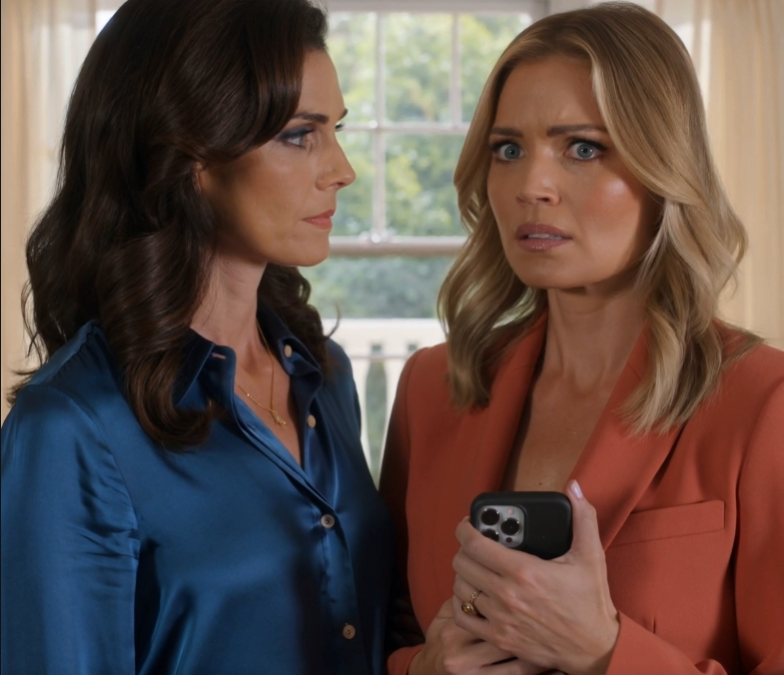
My name is Mara Cole. I’m 31, and until one Friday afternoon, I believed the worst thing my younger sister could do with a phone was turn a private family moment into content. I was wrong. She found out what I earned by opening a payroll page on my work laptop while I was away. Instead of closing it, she recorded the screen, laughed, and posted the clip with a caption suggesting I had spent years pretending to be successful while earning less than people would guess.
At first, the comments gave her exactly what she wanted. People mocked my career, my apartment, even the way I dressed. She replied with laughing emojis and kept feeding the crowd. Then someone paused the video. Another person zoomed in. Viewers noticed details she hadn’t understood, including the company portal she had opened and numbers that made her joke look very different. Her laughter disappeared. Within minutes, she was deleting the post, comments, reposts, anything she could reach. But deleting a viral video is like trying to put smoke back into a match.
By the time she rushed home, two police officers were already in our living room. Our dad looked at her and said quietly, “You really don’t know.” Her face lost all color. “Police? What happened?” What she didn’t understand was that the salary wasn’t the most important thing she had exposed.
Before I tell you why that post cost her far more than she expected, tell me where you’re listening from and what the weather is like there today. Does it match your mood? I’d love to see how far this story travels. Wherever you are, I hope you’re having a calm, beautiful day.
My younger sister’s name is Sloan. She was 27 and had spent three years building an online following around lifestyle content, career confidence, expensive restaurants, weekend trips, and short videos about knowing your worth. We had never been especially close, but our relationship worsened as her audience grew. Sloan measured almost everything by visibility. If a restaurant didn’t photograph well, she wasn’t interested. If a birthday gift couldn’t become a post, she barely mentioned it. If someone disagreed with her, she rarely argued privately. She found a way to turn the disagreement into content.
I was the opposite. I worked in compensation strategy for a risk management company called Northstar Systems. My job was quiet, technical, and deliberately boring to anyone outside the field. I helped evaluate salary structures, retention plans, and internal compensation policies. Because of that, I was careful about privacy. Sloan interpreted privacy as secrecy, and secrecy, in her mind, meant there was something embarrassing underneath.
The tension between us became worse three weeks before the video. She asked me to put $20,000 into a production studio she wanted to rent with two other creators. She called it an investment. I called it a lease with no business plan. When I refused, she smiled and said, “You can just admit you don’t have the money.” I should have recognized the tone. She wasn’t asking anymore. She was collecting material.
That Friday, we were both at our father Graham’s house. He was hosting family dinner, and I had arrived early because I needed to finish a compensation report before logging off. I worked from the study using my company-issued laptop. Around two in the afternoon, Graham asked me to pick up a few things from a nearby store. I locked the screen, or at least I believed I had, and left. Later, I learned the laptop had not fully locked because a software update had interrupted the timer.
Sloan went into the study looking for a charger. That part may actually have been accidental. What happened next wasn’t. My payroll portal was open in a browser tab because I had checked a benefit deduction that morning. At the top was my latest deposit amount: $4,862. Sloan saw that number and decided she had discovered my monthly salary. She didn’t understand that it was one net payment after taxes, retirement contributions, insurance, and other deductions. She also missed the annual compensation summary lower on the page.
She pulled out her phone. Her first clip lasted 43 seconds. In it, she pointed at the number, laughed, and said I had spent years acting like the family’s financial expert while earning less than some influencers charged for one campaign. Then she turned the camera toward the laptop again. That second angle became her real mistake. The annual figure was visible. So was part of Northstar’s employee portal, my staff identification number, and a security banner showing the laptop was company property. She uploaded it anyway.
Within 20 minutes, it had thousands of views. Sloan stayed in the comments, encouraging people. Someone wrote that I must be pretending to be successful. She liked it. Someone else joked that my apartment probably belonged to the bank. She answered with laughing emojis. Then a payroll specialist entered the comments and pointed out that Sloan was reading the statement incorrectly. Another viewer froze the video and calculated my annual compensation from the year-to-date figures.
Suddenly, the joke changed direction. People began asking why a woman who built content around financial confidence didn’t understand a basic pay statement. Others noticed the corporate portal. One person wrote, “Forget the salary. Why are you filming someone else’s employee account?” Sloan deleted it. Then another person asked the same question. Then another.
While this was happening, I was standing in a grocery aisle with my phone ringing. The caller ID showed Northstar Security. I answered immediately. The security analyst asked whether I was currently using my work computer. I said no. He asked whether anyone else had access to it. I said absolutely not. Then he told me their monitoring system had flagged unusual activity involving my account, followed by a public social media post containing part of a Northstar interface.
My first thought was that someone had remotely compromised my account. I abandoned the cart and drove toward Graham’s house while security remotely locked my laptop. I still didn’t know Sloan was involved. Northstar asked me to document the incident because an unauthorized person appeared to have accessed a company-owned device. Following their instructions, I contacted the local non-emergency line so there would be an official record.
When I reached the house, Graham was standing in the kitchen holding his phone. He had already seen the video. He simply turned the screen toward me. There was my payroll page. There was Sloan’s face in the corner. And there was a caption designed to make me look ridiculous. That was the moment I stopped wondering who had accessed my laptop.
The two officers arrived less than an hour later to take a report. They weren’t there because someone had mocked my salary online. They were there because a company-owned computer had been accessed without permission, private employment information had been recorded, and Northstar had preserved system logs connected to the incident. That distinction mattered. Graham understood it almost immediately. Sloan did not.
She came through the front door looking irritated rather than frightened, gripping her phone so tightly her knuckles were pale. She had apparently spent the drive home trying to delete every copy of the clip. The original post was gone. Her repost on another platform was gone. Her comments were disappearing. Unfortunately for her, the video had already escaped her account. People had downloaded it. Reaction channels had clipped it. Screenshots were circulating. One account had reposted the entire thing with the caption, “Influencer tries to shame her sister and accidentally prove she can’t read a paycheck.”
Sloan stopped when she saw the uniforms. “Police? What happened?” Graham stared at her. “You really don’t know?” For once, Sloan had no clever response. One officer asked whether she had recorded the video. Her first instinct was to minimize what she’d done. “I posted a joke. I already deleted it.” The officer explained calmly that they weren’t investigating whether the joke was funny. They were documenting a complaint concerning access to a computer that didn’t belong to her.
Sloan turned toward me as if I had arranged the scene for dramatic effect. “You called the police on me over a salary post?” I looked back at her. “I called before I knew it was you.” That silenced her for about three seconds. Then she tried another angle. She said the laptop had been open. She said she had only looked at one page. She said we were sisters. She said I was turning a private family issue into something legal because I wanted revenge.
I didn’t argue. I simply told the officer what had happened. I had left the study. Northstar had detected activity. Their security department had called, the device had been remotely locked, and my father had shown me the public video after I returned. The officer wrote everything down. Then he asked Sloan whether she had touched the keyboard. She hesitated. That hesitation told me there was more.
“I might have moved the mouse,” she said.
“Did you navigate between pages?” he asked.
“I don’t remember.”
“Did you search for salary information?”
“It was already there.”
“Did you send anything from the computer to yourself?”
“No,” she answered too quickly.
I looked at her. So did Graham. Sloan’s expression changed. She knew we had noticed.
A few minutes later, my phone buzzed with an email from Northstar’s incident response team. Their initial review showed several clicks after I left the house. Someone had opened the compensation summary, expanded the year-to-date section, and attempted to download a PDF statement before the system flagged the activity. I read it twice. Sloan had not simply walked past an open number. She had explored.
When I told the officer about the email, Sloan’s posture changed. “I didn’t download anything,” she insisted. “It didn’t even work.” The officer asked her not to delete anything else from her phone because digital records might be relevant. That was when she finally understood why frantic deleting had been such a terrible idea. Every deletion now looked less like embarrassment and more like an attempt to erase a timeline.
Graham sat down without speaking. I had seen him disappointed before. This was different. He looked tired. Sloan turned to me and whispered, “Tell them you don’t want to do this.”
I almost did. Some reflex from childhood told me to protect her. When we were younger, Sloan could break a lamp and I would help rearrange the furniture before Graham noticed. She could forget a bill and I would cover it. She could insult me at dinner and later act affectionate enough that everyone expected me to move on. For years, peace in our family depended on someone cleaning up after Sloan. Usually, that person was me.
But this time, my employer owned the laptop. My workplace had opened its own incident. Copies of the video were public. I couldn’t make that disappear by calling it a family misunderstanding. “I’ll tell the truth,” I said. “That’s all I’m going to do.” Sloan stared at me as if I had betrayed her.
One officer gave her a reference number and explained that the report would be reviewed along with information Northstar provided. No one put her in handcuffs. No one dragged her anywhere. There was no dramatic arrest. Somehow, that made it more real. Consequences weren’t arriving as one giant explosion. They were arriving as paperwork, timestamps, archived posts, corporate emails, and questions she could no longer laugh away.
After the officers left, Sloan turned on me. “Do you understand what this could do to my career?” I looked at the phone still in her hand. “Do you understand that you posted mine for entertainment?” She opened her mouth, then closed it. For the first time that day, the room was silent.
By Saturday morning, the original video had become bigger than anything Sloan had intentionally posted in months. Her account was flooded with people arguing over whether she had crossed a line, whether I had overreacted, whether salary information should be private, and whether accessing a relative’s work computer counted as harmless curiosity. The debate kept the clip alive. Every person defending her attracted others criticizing her. Every repost created another copy she couldn’t erase.
I stayed offline. Northstar temporarily disabled my remote access while security completed its review. That frightened me more than I wanted to admit. I had worked there for six years. I had built a reputation for being careful, reliable, and almost annoyingly precise. Now my name was attached to a viral privacy incident because someone in my own family had decided humiliation was content.
Monday morning, I met with my manager and two people from information security. I expected suspicion. Instead, they showed me the timeline. My activity ended at 2:07 p.m. At 2:16, the laptop woke. At 2:17, the payroll tab became active. At 2:19, someone opened the detailed compensation panel. At 2:21, there was an attempted PDF export. At 2:24, the public clip appeared. At 2:27, a monitoring alert was generated.
The sequence was almost insulting in its clarity. My manager told me I had followed procedure as soon as I was contacted, and nothing indicated I had intentionally disclosed company data. My access would be restored after a password reset and device inspection. I nearly cried from relief, but I thanked them, signed the incident statement, and returned to my desk.
Then Sloan made everything worse.
At noon, she uploaded a three-minute video titled “When Your Own Sister Chooses Corporate Rules Over Family.” She sat in her car speaking softly, telling her audience that she had made one silly mistake and that I had responded by involving police and threatening her future. She claimed she had accidentally seen my salary while borrowing a charger. She claimed the laptop was just sitting open. She said she removed the video the second she realized I was upset.
None of that matched the timeline. She had deleted it when commenters started criticizing her, not when she learned I was upset. At the end, she said, “I guess some people care more about protecting their image than protecting their own sister.”
That sentence changed something in me. Until then, I had felt embarrassed, angry, and conflicted. After that, I felt clear. Sloan wasn’t sorry she had exposed me. She was sorry the crowd had turned. I still didn’t respond publicly. I saved the video and sent the link to the investigator handling Northstar’s report because it contained statements about the incident.
Then I called Sloan and asked one question. “Are you really going to lie about what happened?”
“I’m telling my side,” she said.
“Your side says you deleted the video because I was upset. You didn’t even know I had seen it when you started deleting.”
She paused. “That’s not the point.”
“Then what is?”
“You could make this go away.”
There it was. She still believed I had a button labeled consequences and was choosing not to press it for her. I explained that Northstar owned the device and had its own investigation. The police report existed. I couldn’t erase platform archives or other people’s screen recordings. More importantly, I wasn’t going to lie to protect her.
She became furious. She said I was jealous of her audience. She said I had always looked down on her work. Then she said something so revealing that I wrote it down afterward. “You’ve spent years acting like the responsible one. I wanted people to see you’re not that impressive.”
That was the real motive. Not curiosity. Not comedy. She wanted to reduce me in public because I refused to fund her project and because my boundaries made her feel powerless.
Two hours later, Graham called. Sloan wanted him to convince me to tell Northstar I had given her permission to use the computer. Graham asked whether that would help. “It would be a lie,” I said. He was quiet. Then he said, “Then I’m not asking you to do it.”
That mattered more than he realized. For once, the family solution wasn’t going to be making me absorb the damage so Sloan could move on.
That evening, another message arrived from a woman named Karine, who had worked with Sloan on several sponsored campaigns. She said she didn’t want to get involved in family drama, but she thought I should know the salary video might not have been as spontaneous as Sloan claimed. Attached was a screenshot from a private creator group chat. The timestamp was from the night before.
Sloan had written, “Tomorrow, I’m finally proving Miss Corporate isn’t nearly as successful as she acts.”
Someone replied, “Leave your sister alone.”
Sloan answered, “Relax. She can take a joke.”
I stared at that screenshot for a long time. The discovery of the payroll page might have been accidental. The humiliation had been planned.
I did not post Karine’s screenshot. That surprised Sloan later because she assumed revenge meant immediately doing to her what she had done to me. I wanted something different. I wanted a record so complete that she couldn’t rewrite it. I forwarded the screenshot to the investigator and to the attorney Northstar had assigned to coordinate the privacy issue. Then I saved it with every relevant timestamp, message, repost, and communication.
That folder became the one thing Sloan couldn’t argue with.
Meanwhile, her public strategy became increasingly chaotic. On Tuesday, she said the video was accidental. On Wednesday, she said it was satire. By Thursday, she claimed I had always known she might use our family life for content. Each explanation contradicted the previous one. Viewers noticed, and reaction videos began placing clips side by side.
One showed Sloan laughing under the original salary post next to her new statement that she had never intended to embarrass anyone. Another compared her claim that she never touched the laptop with a frame from her recording showing her hand on the trackpad. The more she defended herself, the more evidence she supplied against her own story.
Then the business consequences started.
Sloan had been preparing for the biggest sponsorship of her career, a six-month campaign with a financial planning app aimed at young professionals. She had mentioned it constantly without naming the company. The campaign included a podcast appearance, short-form videos, and a live event. According to Graham, she expected the contract to cover almost half her annual income.
The company postponed the launch. Two days later, it withdrew from the agreement. I didn’t contact them. I didn’t have to. The original video and Sloan’s response were public. A brand centered on financial responsibility apparently didn’t want its new spokesperson becoming famous for misreading a pay statement she accessed without permission.
Sloan blamed me anyway.
She showed up at my apartment Thursday evening without calling. I opened the door but didn’t invite her in.
“They canceled it,” she said.
“I heard.”
“You sound happy.”
“I’m not.”
“Don’t do that.”
“Do what?”
“Act calm like you’re above all this.” Her voice rose. “You got exactly what you wanted.”
“I wanted you not to post my private information.”
“It was one number.”
“It was my employment information on a company computer.”
“And now my agency is reviewing my account because you made this into a legal issue.”
I looked at her. “You made it public before I even knew it existed.”
She had no answer, so she switched targets. She told me the internet was destroying her reputation. She told me strangers were questioning every piece of advice she had posted. She told me a panel had postponed her appearance. She told me a longtime collaborator had stopped answering messages.
Every sentence began with something being done to her. Not once did she say what she had done to me.
Finally, she asked what I wanted. “Do you want an apology? Fine. I’m sorry.”
“For what?”
“For posting it.”
“Why?”
She rolled her eyes. “Mara, no.”
“If you want me to believe you’re sorry, tell me what you’re sorry for.”
She stared past me. “I shouldn’t have posted your salary. And I shouldn’t have used the laptop.” Her expression hardened. “What else do you want?”
That was the answer. She still thought an apology was a transaction: say the required words, receive relief from consequences.
I told her I wasn’t contacting sponsors, encouraging anyone to attack her, or going online to humiliate her. But I also wasn’t withdrawing truthful statements or telling Northstar she had permission.
“So, you’re just going to let this ruin me?” she asked.
“I’m going to stop rescuing you from things you chose.”
She laughed once, without humor. “You’ve been waiting years to say that.”
Maybe I had.
She left. The next morning, Northstar told me its internal review was finished. My employment status was completely cleared. The company found no evidence that confidential client material had been exposed, which was an enormous relief. The incident was limited to my employment records, the internal portal interface, and unauthorized use of the device. The company still intended to cooperate with the police report because the computer belonged to them and the access had not been authorized.
My manager told me something I hadn’t expected. “You handled this correctly,” she said. “You reported it immediately, preserved evidence, and didn’t try to hide the family connection.”
After days of feeling as though my professional identity had been dragged through the mud, those words gave me something solid.
But the biggest twist arrived that afternoon.
Karine called again. She had found the original planning messages from Sloan’s creator group. There wasn’t just one screenshot. There was a sequence. The night before she came to Graham’s house, Sloan had told the group she planned to get something embarrassing about me because I had refused to invest in her studio.
One message read, “She thinks saying no makes her the smart sister. Let’s see how smart she looks when people find out what she actually earns.”
Another member told her it sounded mean. Sloan responded, “Mean gets views.”
I didn’t feel victorious reading that. I felt something colder. For years, I had been told Sloan was impulsive, dramatic, careless. Those words made her behavior sound accidental. This wasn’t accidental. She had treated our relationship like material and my humiliation like a marketing strategy.
I added the messages to the folder.
If Sloan had stopped talking, then the story probably would have faded. Internet crowds move quickly. Another scandal appears. Another argument takes over, and yesterday’s outrage becomes background noise. But Sloan had built her career on attention, and silence felt like defeat.
The following Sunday, she announced a livestream called “The Truth About What My Sister Did.” More than 20,000 people were waiting before it began. I knew because Graham called me 20 minutes beforehand.
“She says she’s going to clear her name,” he told me.
“She can say whatever she wants.”
“Are you going to watch?”
“No.”
I meant it. Then my phone filled with messages. Friends, coworkers, Karine, even a cousin I hadn’t spoken to in a year. Sloan wasn’t just talking about herself. She was talking about me.
She told viewers I had used my company connections to frighten her. She implied the police visit had been staged to teach her a lesson. She said I was angry because the video exposed that my perfect corporate life wasn’t as impressive as I wanted people to believe. Most importantly, she repeated that she had never intentionally entered my payroll account. According to her, the screen had simply been sitting there when she walked into the room.
Then she said, “There is zero evidence that I went looking for anything.”
I opened my evidence folder.
For five days, I had refused to fight publicly because public fights usually reward the loudest person, not the most accurate one. But Sloan had now attached my professional integrity to a false version of events while thousands watched.
I called the attorney coordinating with Northstar and asked what I could safely correct. She told me to avoid sharing confidential company information, avoid posting Sloan’s private data, and stick to verifiable facts.
So I did.
I recorded a 90-second statement. No dramatic music, no insults, no salary figure, no screenshots of personal conversations. I said that because public claims were being made about my conduct, I wanted to clarify four facts.
First, I had not known about the video when my employer contacted me regarding unauthorized activity. Second, the police report was made after my employer’s security team instructed me to formally document access to a company-owned device. Third, system logs showed navigation through multiple payroll pages while I was away. Fourth, I had never given anyone permission to access or record information from my work computer.
I ended with one sentence. “I will not discuss private details further, but I will not accept responsibility for consequences created by someone else’s decision to publish my information.”
I posted it and closed the app. That should have been the end.
Instead, Sloan saw it while she was still live. Someone sent it to her in the comments. I later watched the clip because it became the moment everyone shared. She read my statement aloud, laughed, and said, “System logs, please. She’s acting like this is some spy movie.”
Then a viewer asked whether she would release the original unedited recording to prove she hadn’t navigated through the laptop. Sloan said she no longer had it. Another asked why she had deleted everything so quickly if she believed she had done nothing wrong. She said she deleted it because I was threatening legal action.
The comments immediately pointed out the timeline. She had begun deleting before she and I had spoken. Sloan became defensive. She started blocking accounts. The audience count kept rising.
Then Karine entered the chat. I had not asked her to. She wrote one sentence. “Should I post the messages from Thursday night?”
Sloan froze. It lasted maybe two seconds, but two silent seconds on a livestream can feel enormous. “I don’t know what she’s talking about,” Sloan said.
Karine didn’t post the private chat publicly. Instead, she wrote, “Then stop saying this was accidental.”
That was enough.
Viewers began asking what messages she meant. Sloan ended the livestream seven minutes later. But once again, ending something did not erase it. Clips of that exchange spread faster than the original salary video. People who had defended her began changing their minds. Commentators weren’t focused on my income anymore. They were focused on contradictions.
Why had Sloan planned to embarrass me before she supposedly stumbled onto the page? Why did she say there was no evidence of navigation when system logs existed? Why did her explanation change every day?
The viral crowd she had invited to laugh at me had become an audience examining her credibility.
The next morning, her management agency announced it had ended its representation agreement with her. They didn’t publish details. They said only that their professional relationship had concluded after reviewing recent events. Another event organizer removed her from a creator panel. Two smaller brands paused campaigns.
Her follower count dropped, but the number mattered less than the comments. For years, Sloan’s brand depended on an image of effortless confidence. Now, every new post received questions about the salary video, the laptop, and the livestream. She disabled comments, which made people talk more. She made her account private. Screenshots spread anyway. She deleted old financial advice clips. People reposted them beside footage of her misunderstanding my pay statement.
Graham called me that evening. “She says you destroyed her career.”
I leaned back in my chair. “Did she mention that I didn’t send those messages to anyone publicly?”
“I told her,” he said, and sighed. “She said that doesn’t matter because you could have stopped this.”
There it was again. The belief that my role in the family was to stop reality before it reached her.
I asked Graham something I had never asked before. “How many times have we protected her from a consequence and called it helping?”
He was silent. Then he said, “Too many.”
A week later, Sloan’s attorney contacted the investigator. She was finally ready to cooperate.
The sudden change had nothing to do with remorse. Northstar’s forensic report was complete, and the evidence was straightforward. It showed the laptop had been actively used while I was absent and several payroll screens had been opened before the video was uploaded. Sloan could no longer plausibly claim she had simply walked past a number already displayed.
Her lawyer advised her to stop making public statements. For the first time since the incident began, Sloan disappeared from the internet, and the silence was louder than anything she had posted.
The legal outcome was quieter than social media expected. There was no dramatic courtroom showdown. After the investigation, Sloan accepted formal responsibility for accessing the company device without authorization. The matter was resolved through an agreement requiring cooperation, payment of certain costs connected to the incident, and conditions designed to prevent anything similar from happening again.
The important part was simple. What happened was no longer being dismissed as a family misunderstanding. Sloan had made a choice, and the record reflected that.
Her bigger punishment came professionally. The financial planning sponsorship disappeared. The studio project collapsed after her partners refused to sign a lease while her income was unstable. Her management agency never took her back. Some brands eventually worked with her again, but on smaller projects. Whenever she tried to post advice about money or professional boundaries, someone remembered the video.
She had wanted one private number to define me. Instead, her own recording became the thing people associated with her.
My life recovered much more quietly. Northstar restored my access, replaced my laptop as a precaution, and cleared me of wrongdoing. Three months later, I received a promotion I had already been under consideration for before the incident.
I didn’t announce it online. I didn’t tell Sloan my new salary. I no longer needed her or strangers to decide whether I was successful.
Graham changed, too. He stopped carrying messages between us and stopped asking me to soften my boundaries whenever Sloan was unhappy. For years, our family had confused protecting her from consequences with keeping the peace. Once we stopped doing that, everything became simpler.
Six months later, Sloan asked to meet me at a coffee shop. She arrived without a camera bag, which told me more than she probably realized. After several minutes of small talk, she said, “I owe you an apology.”
I waited.
“I wanted to embarrass you,” she admitted. “I was angry you wouldn’t invest in the studio. I wanted people to see you weren’t as impressive as everyone thought.”
She admitted the group messages were real. She admitted searching through the payroll page. She even admitted she enjoyed the first comments mocking me.
Then she said the one thing I needed to hear. “When everyone turned on me, I kept thinking you should save me because you always did.”
“That’s why I stopped,” I said.
She nodded.
I didn’t instantly forgive her, and our relationship didn’t magically return to normal. I told her my private life was no longer content. My work was completely off-limits. And I would never lie or spend money to protect her from another choice she made herself. If she crossed those boundaries again, I would walk away.
She agreed.
Before we left, she stared down at her coffee and said, “The worst part was watching all those people laugh at me.”
I asked, “Wasn’t that what you wanted them to do to me?”
She had no answer.
That was the real revenge.
I never exposed her secrets. I never contacted her sponsors. I never created a scandal for her. I simply stopped protecting her from the one she created herself.
Sloan gathered a crowd because she believed humiliation gave her power. Instead, that crowd watched her mock me, change her story, deny the evidence, and finally lose control of the narrative she created.
Most people forgot my salary within days. What they remembered was the woman who invaded her sister’s privacy for attention and discovered that attention has no loyalty.
Sometimes the strongest revenge isn’t destroying someone. It’s stepping aside and letting their own choices finish the job.
So if your own sister humiliated you publicly, then begged you to protect her when the crowd turned against her, would you save her one more time or finally let the truth speak for itself?
We hope this fictional story gave you something valuable to take away. All events and characters are made only for entertainment, education, and dramatic reflection. We hope it reminds you that the person who dismisses your boundaries may be showing you how little they planned to respect them. Believe that lesson before it costs you more of your peace.








