My parents invited me to dinner, then slid a real-estate contract across the table. “We found a buyer for your house,” Dad said. Mom smiled. “Your sister’s getting married. This solves everything.” I asked: “Who gave you permission?” Dad laughed. “We’re your parents.” I called my lawyer that night. Three days later, they were begging me to answer.
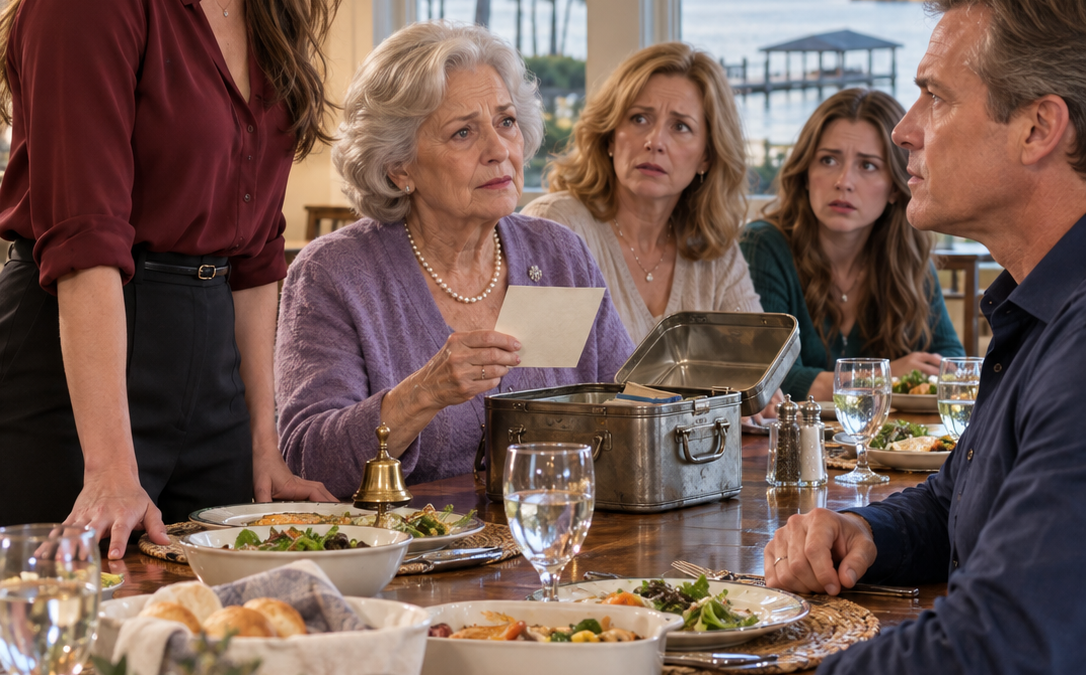
My name is Peggy Wilson, and I’m thirty-nine years old. The first thing I saw on my father’s Sunday dinner table wasn’t dinner. It was a real estate contract, already signed by two strangers listed as buyers, with my name typed on the seller’s line and a pen waiting for me as though the entire matter had already been settled.
“We found a buyer for your house,” Dad said.
Mom smiled. “Your sister’s getting married. This solves everything. You can buy something smaller.”
When I asked who had given them permission, my father laughed in my face.
“We’re your parents,” he said. “You never needed anything.”
My mother’s purse sat open beside the roast. Inside it, my spare house key hung from a red lanyard. I photographed every page of the contract, set the pen down, and refused to sign. They had forgotten who had paid to keep that house the first time. I hadn’t.
I called my lawyer that night. At midnight, my sister sent me a text with a red heart and a single sentence: “Mom says you’re being amazing about the house.”
I hadn’t agreed to a single word.
Three days later, my parents weren’t begging me to sign anymore. They were begging me to stay quiet. And the contract wasn’t even the worst thing on that table.
Welcome back to Hidden Shadows, where ordinary people set quiet boundaries that change everything, and dignity always gets the last word. If your family has ever tried to spend a house you already saved, type “I kept the papers” in the comments and subscribe. Stay for what happened after that laugh.
The invitation had arrived on a Friday afternoon while I was finishing notes on a client file.
“Sunday dinner, just the three of us,” my mother wrote. “Dad wants to talk about the wedding.”
Just the three of us.
My younger sister, Ashley, was getting married in three weeks, on the Saturday of Memorial Day weekend. For eight months, every family dinner had revolved around that wedding: the venue, the flowers, the string lights in the barn, and the number my mother repeated so often that I could practically have sung it.
Fifty-two thousand dollars.
Every previous dinner about the wedding had included Ashley. This one didn’t.
I work as a debt counselor at Three Rivers Community Credit Union, just outside Pittsburgh. Most of my working day is spent sitting across a desk from people who are hiding something from someone they love. After enough years in that job, you learn to notice who gets left out of a conversation. You also learn that it usually isn’t an accident.
My parents rent a townhouse in Canonsburg, twelve minutes from my house. I pulled into their parking lot at five o’clock on Sunday, May 3. My father’s truck was parked crookedly, the way it always was, and the kitchen window was fogged from the roast cooking inside.
My mother had set the table with the good china, white plates with thin blue rims. Those plates only came out for Easter, Christmas, and Ashley. Ashley’s graduation. Ashley’s engagement. Ashley’s first real job. There was always a reason to bring them out for her.
That was when I noticed the papers.
A stack of documents sat between the roast and the salt shaker, squared neatly on a placemat. A gold pen lay across the top page. My father had received that pen when he retired from the warehouse, and he kept it in his shirt pocket for important occasions.
“Where’s Ash?” I asked.
“At the Brennans’ tonight,” Mom answered. “Sit down, honey.”
Dad came in from the living room with his phone in his hand and placed it facedown beside his plate.
“You watch the Derby yesterday?” he asked.
“No.”
“You missed a good one.”
He pulled out his chair, but I didn’t sit down. I was already reading my own name.
The document was an agreement of sale. The property listed was 412 Hawthorne Drive, Bethel Park, Pennsylvania.
My house.
The buyers were Carl and Jolene Hayes. Their signatures were already on the page, and the purchase price was $395,000. At the bottom, under the heading for the buyer’s agent, was the name Denise Hart of Hart and Doyle Realty.
The seller’s line read Peggy A. Wilson.
My name was typed there, waiting for my signature.
“We found a buyer for your house,” Dad announced.
He said it the same way he used to tell me he’d found a good mechanic.
Mom smiled at me across the roast. “Your sister’s getting married. This solves everything. You can buy something smaller.”
I looked at the price again. The house two doors down from mine had sold in March for $440,000. Mine had a newer roof.
“Who gave you permission?” I asked.
My father laughed.
It wasn’t a nervous laugh or an embarrassed chuckle. It was a genuine laugh, with his head tipped back, as though I’d just said something particularly charming.
“We’re your parents,” he said. “You never needed anything, Peg. You’ll be fine.”
My mother’s purse sat open beside her plate, next to the roast. I could see her wallet, her reading glasses, and my spare key hanging from a red lanyard. The lanyard came from a charity 5K my credit union had organized two years earlier. I’d given her that key in 2020, strictly for emergencies.
I picked up the contract and discovered one more page stapled behind the last sheet. It clearly wasn’t part of the realtor’s paperwork. I recognized the curly font immediately because my mother used it on her Christmas letters every year.
Across the top, it said: Family Gift Agreement.
According to the document, I was agreeing to give Kenneth and Barbara Wilson $120,000 from the proceeds of the sale for family expenses, including Ashley’s wedding.
I read it twice.
The wedding cost $52,000. I’d been hearing that number since October. They were asking for more than twice that amount.
“What’s the rest for?” I asked.
“Expenses,” Mom said. “Things come up. You’ll still walk away with plenty, honey. Buy a condo. It’s just you.”
It’s just you.
She said it gently. That was the worst part.
Dad’s phone buzzed against the table. He ignored it. It buzzed a second time. On the third buzz, he flipped it over, glanced at the screen, and turned it facedown again so quickly that all I caught was a flash of green light.
In my profession, when a number is twice the size of the story attached to it, the story is usually a cover for something else. I didn’t yet know what this one was covering, but I knew it wasn’t the wedding.
I took out my phone and photographed every page: the contract, the signatures, and the gift agreement. My mother watched me do it with the expression of someone observing a dog digging up her garden.
“For my records,” I explained.
“Peggy, just sign it,” she said. “Don’t make this a whole thing.”
I set the gold pen down beside my plate.
I did not sign.
“I’d like my key back, Mom.”
She looked at her purse, then back at me. Reaching across the table, she closed it.
“What if something happens to you?” she asked. “Who’s going to get in?”
I didn’t answer. I stood up and got my jacket.
My father walked me to the door and rested one hand against the frame. He wasn’t exactly blocking my way. He simply wanted me to feel his presence.
“Denise needs it signed by Friday,” he said. “They’re nice kids, Peg. They’re expecting a baby. Don’t embarrass us.”
Once I was inside my car, I didn’t start the engine. Instead, I opened the photographs on my phone and zoomed in on the buyers’ signatures.
Beside each signature was a date.
April 27.
Six days before dinner.
They hadn’t invited me over to ask permission. They had invited me over to sign.
To understand why that date affected me the way it did, you have to understand the house.
My parents bought 412 Hawthorne Drive in 1990, when I was three years old. It was a small brick house with a maple tree in the front yard and a kitchen so narrow that two people had to turn sideways to pass each other.
They paid $98,000 for it. My father was twenty-nine, and my mother was twenty-six.
On the kitchen doorframe leading into the back hallway, my mother drew a pencil line at the top of my head on the day we moved in. Beside it, she wrote my initial, my age, and the date.
P 3.
Every year after that, on the first day of school, she added another line.
My sister was born when I was nine. When Ashley turned three, she began getting her own measurements beside mine. Then, sometime around 2000, my parents stopped doing it.
I was thirteen. I think they simply forgot.
I didn’t.
That fall, I stood Ashley against the doorframe, laid a cookbook flat on top of her head, and drew the line myself.
A 4.
The following year, I wrote: First day of kindergarten, August 2001.
She wouldn’t hold still unless I stood directly behind her.
“Stand behind me,” she would say, “so I don’t fall.”
Every mark on that doorframe after 2000 was written in my handwriting.
My parents never noticed.
That was how things worked in our family. Ashley was the bright, loud, easy one. I was the one who handled things.
I put myself through college with scholarships and a part-time job. I graduated from Slippery Rock University in May 2008.
My parents missed the ceremony.
Ashley had a dance recital that same afternoon. She was twelve.
I called my father that evening from the parking lot of a diner, where I had eaten dinner alone with my graduation cap resting on the passenger seat.
“You don’t need us there, Peg,” he told me. “You never needed anything.”
He meant it as a compliment. I understood that even then. What took me years to understand was that it also served as a permission slip.
If I never needed anything, nobody ever had to give me anything.
The following year, I started working at the credit union. I processed loans for twelve years before moving into debt counseling, and I’m good at what I do. People sit across from me and confess things they haven’t even told their husbands.
In December 2019, I was thirty-three and living in an apartment in Dormont when my phone rang one Tuesday evening.
It was Evelyn Shaw, my parents’ next-door neighbor.
Evelyn had lived at 414 Hawthorne since 1978. She was the woman who had taught me how to ride a bicycle.
“Honey,” she said, “there’s a paper taped to your parents’ front door. It’s from the sheriff.”
I was there within fifteen minutes.
The paper was a notice of sheriff’s sale. My parents’ house was scheduled to be auctioned on February 3.
They were both sitting at the kitchen table when I walked in. My mother was crying. My father wasn’t.
He explained their situation in the same matter-of-fact tone he might have used to deliver a weather report. The warehouse had reduced his hours. My mother’s gallbladder surgery had buried them in medical bills. They had fallen behind on the mortgage, and the bank had stopped listening.
“Don’t tell your sister,” Dad said. “She’s got her own life in Philly.”
Ashley was twenty-three that year and living in Philadelphia, three hundred miles away.
I asked what they needed.
My mother wiped her eyes with a dish towel.
“If you really love this family,” she said, “you’d find a way.”
So I found a way.
On January 24, 2020, ten days before the scheduled auction, I sat in a conference room at a law office called Cain and Sutter and bought my parents’ house.
The purchase price was $210,000.
That was the amount required to pay off their mortgage, the missed payments, the accumulated fees, and everything else attached to the property.
I put down $44,000, every cent I had saved since college, and took out a thirty-year mortgage for the remaining balance.
After everything had been paid, my parents walked away with approximately $19,000 and moved into a rented townhouse.
The attorney who handled the closing was a quiet man named Russell Cain. When the transaction was complete, he handed me a blue folder containing every document.
“Keep this forever,” he advised. “Houses have long memories.”
I put the folder on the top shelf of my hallway closet.
The following year, I spent another $38,000 replacing the roof and renovating the kitchen. The contractor wanted to replace the old doorframe, but I instructed him to sand around the pencil marks and leave them untouched.
He looked at me as though I were crazy.
Nevertheless, he left them alone.
That Thanksgiving, we had a small family gathering at my aunt Colleen’s house. I was carrying a pie into the dining room when I overheard my mother talking in the kitchen.
“We let Peggy have the house for a song,” she told my aunt. “We wanted to give her a start.”
Nobody corrected her.
Not even me.
At 9:40 that Sunday night, after the dinner where my parents had presented me with the contract, I took the blue folder down from the closet shelf.
I hadn’t opened it in six years. The paper inside had grown soft at the corners.
I spread the settlement statement across my kitchen table and examined it the way I examine a client’s credit report, reading every line from top to bottom.
Sellers: Kenneth and Barbara Wilson.
Buyer: Peggy A. Wilson.
Payoff to the mortgage lender. Late charges. Sheriff’s costs.
Then I noticed a line I had signed my name beneath in 2020 and never thought about again.
Judgment payoff: Keystone Consumer Finance, $6,800.
At thirty-three, I’d seen the company name and the amount and simply continued turning pages. At thirty-nine, I knew exactly what the word judgment meant.
It meant a lender had taken my parents to court and won.
A personal loan doesn’t reach that stage overnight. It gets there after months of missed payments and unopened letters. That loan had gone bad long before anyone reduced my father’s working hours.
I wasn’t sure what to do with that information yet, so I did the one thing I could do.
Russell Cain’s business card was still clipped inside the folder. He had written his cell phone number on the back.
I called him.
He answered on the fourth ring.
He was sixty-one now and mostly retired, but he remembered me. I told him about Sunday dinner and sent him the photographs while we spoke. For a while, he was silent. I could hear him turning pages on his end of the call.
“All right,” he finally said. “Here’s the simple part. They can’t sell what they don’t own. Your name is on the deed. Nobody else’s. No signature, no sale.”
“Then why does it feel like they can?”
“Because people can do a lot of damage pretending they can.”
He paused.
“Does anyone besides you have a key?”
“My mother.”
“Change the locks tomorrow if you can. Don’t sign anything, and don’t argue with them by text. I’ll email the buyer’s agent in the morning and make it clear that you’re not selling and nobody speaks for you.”
“Thank you.”
“One more question, Peggy.”
Something in his voice changed.
“Did anyone give your parents money? A deposit, a hold payment, anything like that?”
“I don’t know.”
“Find out,” he said. “That’s usually where it gets ugly.”
After we hung up, I sat for a long time with my phone in my hand.
I wrote a lengthy text to my parents, then deleted it. I composed a shorter one containing every true thing I had never said to them, only to delete that one as well. I didn’t even finish the third attempt.
In the end, I sent a single sentence to the message thread I shared with my parents, the one my mother had named Family Business.
“I’m not selling my house. Please don’t speak to anyone on my behalf.”
At 11:02, the word Read appeared beneath my message.
My mother had seen it.
She didn’t respond.
At 11:40, my father finally replied.
“We’ll talk when you calm down.”
I was calm. I had been calm the entire evening.
That was the part they never understood about me. Being calm wasn’t the same thing as being agreeable.
At midnight, my phone lit up on the nightstand.
It was Ashley, texting only me. First came a red heart, followed by a single sentence.
“Mom says you’re being amazing about the house.”
I stared at the message in the darkness.
I hadn’t agreed to anything, and my parents had already told my sister I’d said yes.
On Monday, May 4, at 9:15 in the morning, Russell’s email arrived. It was addressed to Denise Hart, with a copy sent to me, and it was only four sentences long.
The owner of 412 Hawthorne Drive had not agreed to sell. Nobody was authorized to act or speak on her behalf. All further contact should go through his office. He thanked Ms. Hart for her attention.
I read it at my desk just as my first client of the day sat down across from me.
She was in her fifties, neatly dressed, wearing a cardigan with a church pin on the collar. She had accumulated $11,000 in credit card debt that her husband knew nothing about. Both her hands were wrapped around a cup of coffee she never drank.
“It was supposed to be temporary,” she told me. “I was going to fix it before anyone noticed.”
I’d heard that sentence in one form or another a hundred times. I’d written it in case notes. I’d gently explained to clients that trying to fix something quietly was usually how they ended up making it worse.
That morning, for the first time, those words sounded like my father.
At lunchtime, I sat in my car in the credit union parking lot and typed Jolene Hayes’s name into a search bar.
Her Instagram account was public. Most of her posts were ordinary things: a sonogram, a dog wearing a bandana, a sunset over a strip mall.
Then I found a post dated April 18.
It was a photograph of my kitchen.
I recognized it before I fully understood what I was looking at. The white cabinets I had personally selected. The window above the sink. My gray coat hanging over the back of the chair where I always left it.
And in the center of the picture was the doorframe.
Every pencil line was visible, including the record of my sister’s first day of kindergarten, written in my handwriting.
The caption read: “Can’t believe this might be ours! First project: painting over this.”
She had added a laughing emoji.
I sat perfectly still.
A man walked past my car carrying a sandwich, and I watched him all the way to the building’s entrance.
The weekend before that post, on April 10 and 11, I had been in Harrisburg attending a credit union conference two hundred miles away. My parents knew about the trip. I had mentioned it at dinner the week before leaving.
Someone had stood inside my kitchen, looked at the doorframe where I had recorded my sister’s childhood, and decided it needed a coat of paint.
My parents had let them in.
I took screenshots of the photograph, its caption, and the date. Then I called a locksmith.
His name was Terry Bole, and he met me at the house at three that afternoon. He replaced all three locks: the front door, the back door, and the side door leading into the garage.
The bill came to $285.
I kept one of the old keys and dropped it into my coat pocket. Even now, I’m not entirely sure why.
When Terry reached the back door, he crouched down and ran his thumb over the old deadbolt.
“Somebody’s been using this door a lot lately,” he observed. “These scratches are fresh. A couple of weeks, maybe. More than once.”
More than once.
I paid him, and after he left, I walked slowly through my own house as though I were a guest seeing it for the first time.
Nothing was missing. Nothing was broken.
Somehow, that made everything worse.
At 4:30, Denise Hart replied to Russell’s email.
She explained that she represented the buyers. Ken Wilson had told her his daughter owned the property, had agreed to a private sale without a listing agent, and preferred to sign the offer in person during a family dinner.
Denise had never been told that the actual property owner had not consented to the sale. Under the circumstances, she would not be proceeding with the transaction.
Ten minutes later, my phone rang.
The number was local.
“Ms. Wilson, this is Denise Hart. I hope it’s all right that I’m calling you directly.”
“It’s all right.”
She had the kind of voice that suggested she had delivered bad news to plenty of people over the years.
“I want you to know that I asked your father for your email address three times. He kept telling me you’d rather handle it in person. I should have pushed harder.”
“You couldn’t have known.”
“There’s something else.”
She hesitated.
“When I brought up the earnest money, your father told me a hold payment had already been handled, and I’m quoting him here, ‘within the family.’ Do you know what he meant by that?”
I thought about what Russell had said the previous evening.
That’s usually where it gets ugly.
“No,” I answered.
Denise was silent for a moment.
“Then I’m going to call Carl Hayes.”
That evening, Denise texted to ask whether she could give Carl my phone number. I agreed. I wanted to hear his side of the story directly from him.
Carl Hayes called at 7:50 the following morning.
He sounded young and exhausted. He repeated his name twice, as though he wasn’t certain I would recognize it.
“Ms. Wilson, I’m really sorry to call you like this. I didn’t know until last night. I swear I didn’t.”
“It’s okay, Carl. Tell me what happened.”
“I gave your dad $15,000.”
He sent me a photograph while we were still on the phone.
It showed a cashier’s check from his bank, dated April 10, made payable to Kenneth Wilson for $15,000.
Someone had written Hold 412 Hawthorne on the memo line.
“He said you wanted it that way,” Carl explained. “To keep the house off the market and away from the realtor, so nobody paid commission on that part. He said you’d rather keep it in the family.”
My name.
My father had used my name to take money from a stranger.
“When did you give it to him?”
“That Friday, the tenth. The next day, he showed us the house. He said you were out of town for work.”
Carl had known my father since he was ten years old. Dad had coached his Little League team from 2005 to 2008, and I remembered those uniforms tumbling around in our dryer.
In February, Carl had run into my father at the American Legion, and they had started talking.
Carl and Jolene were renting. Their lease expired on May 31, and Jolene was five months pregnant. They had been outbid on four houses since the previous fall.
“He said you wanted a young family to have it,” Carl told me. “He said that’s why the price was so good. I remember thinking, what a nice thing for her to do.”
In the background, I could hear a woman speaking in a low, distressed voice.
“That’s Jolene,” Carl said. “She wants you to know she took the post down last night. The kitchen one. She feels sick about the doorframe. She didn’t know what those marks were. Your dad told her it was just old paint.”
I closed my eyes.
Old paint.
“Carl, did my father say what the fifteen thousand dollars was for?”
“The wedding. Your sister’s wedding. He said every dollar was going straight to the venue and that it would come off the purchase price at closing. It made sense at the time. Jolene went to high school with Ashley. We figured it was all one happy thing.”
He asked whether he would get his money back.
I told him the truth.
I didn’t know.
I explained that it wasn’t my money and it wasn’t my decision, but I promised that I would never lie to him about anything I discovered.
“Your dad called me this morning,” Carl added. “He said if the sale fell through, he’d have it back to us by Friday.”
It was Tuesday.
Friday was the exact same deadline my father had given me to sign the contract.
At two that afternoon, between appointments with clients, my phone buzzed.
It was Ashley.
“Why is Jolene Hayes texting me asking if the house sale is off? What is going on?”
I typed my response carefully.
“I never agreed to sell. I’ll explain everything in person.”
Three dots appeared on the screen. Then they disappeared. A moment later, they returned.
“Mom says you backed out at the last minute.”
Another message followed.
“Mom says you’re lying, Peggy.”
I read that one while standing in the hallway near the coffee machine. A coworker walked past and said hello. I said hello back.
My sister believed them.
Of course she did.
She had absolutely no reason not to.
For thirty years, I had kept every ugly thing away from her. The result was that she had no idea there was anything she needed to be protected from.
At nine that evening, my mother called.
I watched the phone ring until the call ended. Thirty seconds later, a voicemail appeared.
“Peggy Anne.”
She only used my middle name when she was extremely angry.
“You pick up this phone. You have no idea what you’ve done. No idea.”
I played the message twice.
All I had done was say no. I had sent one sentence. I had changed the locks on my own house.
What, exactly, had I done?
Before I could decide whether to return her call, someone knocked on my front door.
I looked through the narrow window beside it and saw Evelyn standing on the porch in her cardigan, holding a lemon loaf wrapped in aluminum foil.
Evelyn Shaw is eighty-one years old. She still takes a walk every morning, still bakes on Tuesdays, and still brings me whatever she has made because she insists it’s a sin to eat an entire loaf alone.
She came inside, set the lemon loaf on my counter, and glanced at the new deadbolt on the back door.
“I saw the locksmith yesterday,” she remarked. “I’m glad you’re here.”
Then she sat down at my kitchen table without waiting to be invited. She had earned that privilege a long time ago.
“Your father’s truck was here twice in April,” she told me. “Both times on weekdays when you were at work, and once on a Saturday when you were away. That time, there was a young couple with him. He walked them all around the yard. I thought maybe you knew.”
“I didn’t.”
“I figured that out when I saw the locksmith.”
She folded her hands together.
“I should have called you. I didn’t tell you everything last time, either.”
I sat down across from her.
“Last time?”
She didn’t answer immediately. Instead, she took her phone from the pocket of her cardigan.
It was an old phone with a crack running across one corner of the screen. She scrolled slowly with one finger, the way people do when they’re searching for something important.
Finally, she turned the screen toward me.
It was a photograph of my parents’ front door from December 2019.
The white paper was clearly visible, along with the sheriff’s seal.
I had seen that notice in person, but I had never seen it from Evelyn’s perspective, photographed from her own porch before anybody else knew what was happening.
“I took that before I called you,” she explained. “I didn’t want you to think I was making it up.”
“Evelyn, I remember. You’re the reason I found out.”
“I know, honey. That’s not the part I didn’t tell you.”
She went on to explain that in 2019, she had regularly taken a bus from the senior center to Rivers Casino every other Thursday. It was an inexpensive afternoon out: a cheap lunch, a little time playing the slot machines, and home by five.
She had followed that routine for most of the year.
“Your father was there,” she said. “Every time I went. Not at the slots. At the sports betting lounge, by the big screens. Every other Thursday, Peggy, I saw him there more than I saw him in his own yard.”
I didn’t say anything.
“Once, he saw me and came over. Bought me a coffee. He asked me not to mention it to you girls. Said it was his one thing.”
Keystone Consumer Finance.
$6,800.
A judgment.
“Did my mother know?” I asked.
Evelyn studied me for a long moment. I think she was trying to decide how much I could bear to hear.
“Your mother came once,” she finally said. “Not to play. To bring him home.”
After Evelyn left, I took the blue folder down from the closet again.
At the very back, behind the closing documents, I found a single sheet of paper I had printed in December 2019 and never thrown away.
It was an email from my mother, sent the night after I had discovered the sheriff’s notice.
“Your dad’s hours were cut, and the surgery bills buried us. We are so ashamed. Please don’t tell Ashley.”
I read it while standing in the hallway beneath the ceiling light.
Six years earlier, I had emptied every savings account I owned because of that email. I had taken on a mortgage I wasn’t financially ready for. Then I had sat through Thanksgiving while my mother told the rest of the family she had done me a favor.
I had done every bit of it believing my parents were victims of terrible luck.
I folded the email in half, then folded it in half again.
The Kentucky Derby. My father’s phone facedown on the dinner table. That sudden flash of green. The family gift agreement demanding more than twice the wedding expenses.
I still didn’t know for certain.
I help people deal with debt for a living, and the first rule I remind myself of every morning is that suspicion is not proof. I wasn’t going to accuse my father of anything I couldn’t demonstrate with evidence.
But I could no longer believe the story I had been told.
For six years, I had believed I’d saved my parents from bad luck. Now I needed to discover what I had really saved them from.
By seven o’clock on Wednesday morning, I had fourteen missed calls.
My father. My mother. My mother again. My aunt Colleen, who hadn’t called me directly since my thirtieth birthday.
I sat in my car before work with the engine turned off and listened to the voicemails.
My father’s came first. He sounded loud and cheerful, using the same voice he always used at family cookouts.
“Peg, it’s Dad. Listen, Carl’s saying some things. He wants his money by Friday. All you have to do is call him and tell him it’s a timing issue. That’s all. A timing issue. Call me back.”
Then came my aunt.
“Peggy, it’s your aunt Colleen. Your mother’s blood pressure is through the roof. Seventeen days before your sister’s wedding! I don’t know what’s gotten into you, but this isn’t who you are.”
That was the thing about my family.
They always knew exactly who I was because they had decided it for me a long time ago.
At work, I placed my phone facedown on my desk. It took me until noon to realize that I had done it exactly the way my father did.
At 1:15, another voicemail arrived from him.
This one was different.
He no longer sounded like he was entertaining people at a cookout. He was whispering.
“Peg, please. I can’t. Just… please pick up.”
I listened to that message three times.
In thirty-nine years, my father had never once said please to me.
At six that evening, I heard someone at my front door.
They weren’t knocking. They were trying the lock.
I opened the door to find Ashley standing on my porch with a key in her hand.
My mother’s key.
The red lanyard dangled from her fingers.
“Mom gave me her key,” she explained.
She jiggled it in the lock one more time, as though another attempt might somehow make it work.
“Why doesn’t it work?”
“Because it’s my house, Ash.”
She looked at me as though I had slapped her.
“Mom and Dad said they let you have it cheap. They said it was always supposed to come back to the family.”
“Come inside.”
She didn’t want to.
She came anyway.
Ashley followed me down the hallway and into the kitchen, still clutching the useless key.
I didn’t say a word. I simply stopped beside the doorframe.
She saw it and fell silent.
She hadn’t been inside my kitchen in almost a year. She was always busy with wedding preparations and everything else going on in her life.
Now she studied the pencil lines running up the wood, her measurements and mine arranged side by side.
Then her eyes found a mark near her knee.
First day of kindergarten, August 2001.
“That’s your handwriting,” she said.
“Most of them are.”
For a moment, she looked five years old again.
Then she shook off the memory.
“Nancy called Mom last night.”
Nancy Brennan was her future mother-in-law.
“She wants to know where her eighteen thousand dollars went. She sent it to Dad in March for the venue. Do you know what that means? Because nobody will tell me.”
I hadn’t known anything about that money.
I kept my expression still.
“I don’t know yet,” I said. “But I’m going to find out. And I’ll tell you the truth when I can prove it.”
“Prove it?”
She laughed, and the sound was exactly like our father’s.
“You sound like a cop, Peggy. It’s my wedding.”
“I know.”
She walked back toward the front door. Once she reached the porch, she turned around.
“If this wedding falls apart because of you,” she warned, “I will never forgive you.”
She got into her car.
Before she backed out of the driveway, I saw her glance toward the house one more time.
She wasn’t looking at me.
She was looking at the kitchen window.
By ten o’clock that night, my phone showed thirty-one missed calls.
The final voicemail was from my mother.
She wasn’t angry anymore. Her voice had lost its usual polished certainty. She sounded like someone standing at the edge of something she couldn’t see her way out of.
“Peggy, please don’t tell anyone about 2020. Whatever you do, please. Not the Brennans. Not your sister. Please.”
I set the phone on my nightstand.
Facedown this time.
Three days after that Sunday dinner, my parents were no longer begging me to sign the contract.
They were begging me to stay quiet.
If you’ve ever been the person in your family who was expected to fix everything without ever talking about it, tell me in the comments. I read every single one.
My mother appeared on my porch at seven the following morning.
She didn’t knock. She simply stood on the other side of the screen door, holding her car keys and dressed as though she were on her way to church.
I didn’t open the screen door.
We spoke through it like two neighbors who didn’t entirely trust each other.
“Sunday is Mother’s Day, Peggy,” she began. “Don’t do this to me before Mother’s Day.”
“Did Dad take Carl’s money?”
“It was a deposit.”
“It was a cashier’s check made out to Dad. Not to the realtor. Not to escrow. To Dad.”
Something shifted behind her eyes.
Then it disappeared, and her carefully composed expression returned.
“You have a house. You have a good job. Nobody depends on you, Peggy. Ashley has everything to lose. Her whole future is sitting in a barn in Washington County, and you’re going to let it fall apart over a technicality.”
“It’s my house, Mom. That’s not a technicality.”
She moved closer to the screen.
When she spoke again, her voice was very low.
“If you say one word about 2020 in front of the Brennans on Saturday, you will lose this family. Do you understand me?”
“What’s on Saturday?”
She stared at me for a second too long.
She hadn’t intended to tell me.
Then she turned and walked back to her car.
At 12:30, while I was eating a sandwich at my desk, an unknown number called.
The woman on the other end introduced herself as Nancy Brennan.
She had worked as a middle school principal for twenty years before retiring. You could hear it in her voice. She didn’t raise it, and she certainly didn’t need to.
“Ashley gave me your number,” she explained. “I hope that’s all right. I’m going to be direct because I suspect you’d prefer it.”
“I would.”
She told me that in the middle of April, my father had asked her to recommend a realtor for what he described as the young couple buying their family house.
Nancy had given him Denise Hart’s name. Denise had sold the Brennans their home years earlier.
On Monday evening, Denise had called Nancy, extremely upset, to explain that the house didn’t actually belong to my father.
“So I called Ken and Barbara that night and asked about our money,” Nancy continued. “I didn’t get a straight answer. Yesterday, I called the venue myself. Maple Glenn Barn. I spoke to the coordinator.”
She paused.
“There’s a four-thousand-dollar deposit on file from October. That’s all. The eighteen thousand dollars Phil and I sent Ken on March second never arrived. The remaining balance is twenty-one thousand five hundred dollars, and it’s due Monday.”
I didn’t respond.
I was too busy writing the numbers on the back of an envelope.
“Saturday at six,” Nancy continued. “I’ve reserved the private room at Carile’s. Denise will be there, and she’s bringing the buyers. Your parents will be there. So will Ashley, Cody, and my husband. I’d like to hear this once, from everyone, at the same table. And I’d like it settled before Monday.”
“I’ll be there.”
“Good.”
She paused again.
“Your mother told me you’ve been unstable lately. I’d like to see that for myself.”
That evening, I spread everything across my kitchen table.
The blue folder. Screenshots of Jolene’s Instagram post. The photograph of Carl’s cashier’s check. Denise’s email. My mother’s email from 2019. And the envelope with Nancy’s numbers written on the back.
Then I walked next door.
Evelyn listened while I told her everything. When I asked whether I could bring her photograph of the sheriff’s notice to Saturday’s meeting, she didn’t hesitate.
“Take it,” she said. “I’m too old to protect anybody’s pride.”
Back at home, I called Russell and asked whether he thought I should bring him along.
“You don’t need a lawyer at a dinner, Peggy,” he told me. “You need the folder.”
I stayed up late that night thinking about Ashley.
If I told the truth in that room, I might ruin the happiest day of my sister’s life. If I remained silent, I would be the villain in my family for the rest of my life, and my parents would eventually do the same thing again.
I knew that as certainly as I know when one of my clients is approaching another missed payment.
On Friday morning, my phone buzzed.
It wasn’t a call. It was a text message, the first one my father had sent me all week.
“I’ll tell them the truth myself on Saturday. Just don’t bring the folder.”
I barely slept on Friday night.
Around eleven, I went into the kitchen for a glass of water and found myself standing in front of the doorframe instead.
The house was quiet. The refrigerator hummed, and the only light came from the small fixture above the stove.
I ran my finger along the pencil marks.
P 3. P 7. P 12.
Then my own measurements stopped, while Ashley’s continued climbing year after year, each new mark recorded in my handwriting.
A 8, with a tiny drawing of a missing front tooth that I had added as a joke.
A 14, from the year she was furious with me for making her take her shoes off before I measured her.
The final mark was high up near the top of the frame.
Leaving for Philly, August 2018.
She was twenty-two. Her car was already packed, and she had stood against the wood telling me to hurry up.
I thought about the very first mark I had ever made for her and how she wouldn’t hold still unless I stood directly behind her.
Stand behind me so I don’t fall.
That was what this house meant to me.
It wasn’t the roof or the kitchen. It wasn’t a price someone could type onto a real estate contract.
It was the only place in the world where there was written proof that I had been there for my sister.
And someone had wanted to paint over it.
My parents had shown them the way inside.
I didn’t know whether Ashley would ever stand in front of that doorframe again.
Eventually, I returned to the kitchen table, printed another copy of my mother’s 2019 email, and slipped it into the blue folder.
I took the old key from my coat pocket, the one from the locks Terry had replaced, and dropped it into my tote bag.
Then I wrote two words on a yellow sticky note and pressed it against the inside cover of the folder, where nobody but me would see it.
Say less.
I had spent my entire life explaining myself to my family. I had justified my decisions, softened my words, and apologized for having needs they insisted I didn’t have.
Tomorrow would be different.
I wasn’t going to explain.
The documents could speak for themselves. Denise could speak. Carl could speak. And if my father meant what he had written in his text message, he could speak, too.
At 11:18, my phone buzzed again.
“Are you coming tomorrow?”
It was Ashley.
I typed a single word in response.
“Yes.”
The three dots appeared on my screen and remained there for a long time.
Then her reply arrived.
“Dad’s scaring me. He hasn’t slept.”
Carile’s Steakhouse is in Mount Lebanon, about fifteen minutes from my house. It’s the kind of restaurant people choose for anniversaries and retirement dinners. Ashley and Cody had already booked it for their rehearsal dinner in two weeks.
The private dining room was at the back of the restaurant, with dark wood paneling and a long table set for ten people.
I arrived at exactly six o’clock.
Everyone else was already seated.
Nancy Brennan occupied the chair at the head of the table. She wore a navy blazer and had a legal pad open in front of her. Her husband, Phil, sat beside her with his arms folded across his chest.
Cody sat next to Ashley, holding her hand beneath the table.
Denise Hart was halfway down one side, with a slim leather folder in front of her. Across from Denise sat Carl and Jolene Hayes. Jolene had one hand resting on her stomach, and she didn’t look up when I entered.
My parents were seated at the far end, nearest the door.
My mother was wearing her pearls.
My father’s phone lay facedown beside his water glass.
There was one empty chair left, directly across from them.
I sat down and placed my tote bag at my feet.
Nobody had touched their ice water.
“Thank you all for coming,” Nancy began. “I’d like facts tonight, not feelings. There will be plenty of time for feelings later.”
She looked toward my father.
“Ken, you asked to speak first.”
My father stood up, buttoned his jacket, and smiled at the room.
It was the same smile he used to give the parents of his Little League players after a difficult loss.
“I want to apologize,” he began. “This whole thing is a misunderstanding. Peggy agreed to the sale. She did. We had a timing problem, that’s all. Some paperwork got ahead of itself. Nobody’s losing anything. Carl, you’ll have every penny by Friday.”
Then he sat down.
My mother patted his arm.
He had promised to tell everyone the truth.
Everyone turned toward Denise.
She opened her leather folder but didn’t read from it.
“Ken,” she said, “I asked you for Peggy’s email address three times. You told me she wanted to sign at a family dinner. I have never met her before tonight. I never had a listing agreement. I was told she owned the house in name only.”
Beside her, Carl nodded slowly.
My mother didn’t miss a beat.
She leaned forward, warm and reasonable, and addressed Nancy as though they were two mothers chatting over a backyard fence.
“Nancy, you have to understand. It’s the family house. The girls grew up there. When Ken and I downsized, we let Peggy have it for a song. We wanted to give her a start. It was always understood that it would help the family someday.”
For a song.
Six years later, she was still using exactly the same words.
Nancy didn’t look at my mother.
She looked at me.
“Did they?” she asked.
I reached into my tote bag, took out the blue folder, and slid it across the table.
It passed the bread basket and my father’s water glass before stopping directly in front of Nancy.
“That’s the settlement statement from January twenty-fourth, 2020,” I explained. “It shows what I paid and where the money went.”
Nancy opened the folder. Phil leaned over to examine the documents beside her.
“The photograph on top,” I continued, “was taken at my parents’ front door in December 2019. Their neighbor took it.”
Nancy lifted the photograph.
The white notice and the sheriff’s seal were clearly visible.
“I didn’t get the house for a song,” I said. “I stopped a sheriff’s sale. It was scheduled for February third. I paid two hundred and ten thousand dollars, and every cent went toward their debts.”
Nobody moved.
Ashley released Cody’s hand.
She was staring at our mother.
“A foreclosure?” she asked. “You told me you downsized. You told me Peggy wanted the house.”
My mother opened her mouth.
Nothing came out.
At the far end of the table, Carl cleared his throat.
He sounded like a man who had been holding the same question inside himself for an entire week.
“Then where’s my fifteen thousand dollars?”
Carl took out his phone and laid it on the table, screen facing upward.
There was the photograph of the cashier’s check.
Pay to the order of Kenneth Wilson.
Hold. 412 Hawthorne.
Nancy tore a single sheet from the back of her legal pad and placed it beside Carl’s phone.
“This is the invoice from Maple Glenn Barn,” she explained. “A four-thousand-dollar deposit in October. Nothing since. Phil and I sent Ken eighteen thousand dollars on March second for the venue balance. It never got there.”
She tapped the paper once with her pen.
“Fifteen thousand from the Hayeses. Eighteen thousand from us. That’s thirty-three thousand dollars.”
She turned toward my father.
“Ken, where is it?”
He looked at the photograph of the check, then at the venue invoice, and finally at the ceiling.
“I was going to put it back,” he said.
Phil Brennan spoke for the first time.
His voice was very quiet.
“Back from where, Ken?”
My father didn’t answer.
Then his phone buzzed.
The sound of it vibrating against the wooden table seemed unusually loud in the silence.
My mother grabbed for it.
She moved so quickly that she reminded me of someone snatching a pan off a hot stove. Her fingers caught the edge of the phone, causing it to flip over and slide toward the center of the table.
It came to rest directly in front of Cody, screen facing upward.
Cody glanced down.
I watched his expression change.
Cody is a physical therapist. He’s a gentle, careful person, the sort of man who thinks before he speaks.
He read the notification aloud anyway, slowly, as though he wanted to make absolutely certain he had read it correctly.
“Deposit declined. Add a new payment method.”
The logo beside the notification was green.
The same flash of green I had noticed at Sunday dinner.
For a moment, nobody said anything.
Jolene covered her mouth.
Ashley stared at the phone as though it might somehow explain itself.
Then my father broke.
It didn’t happen all at once. His shoulders sagged first, followed by his hands. He pressed his palms flat against the table on either side of his plate.
When he finally spoke, his voice was nothing like the cheerful one he used at family cookouts.
“I was up nine thousand in March,” he said. “Nine thousand dollars. March Madness. I just had a bad April. I was going to fix everything before the wedding. Everything. Nobody was ever supposed to know.”
“Ken,” my mother said. “Stop.”
That was when I spoke.
I asked the one question I had been carrying since Tuesday night.
“Was it the same in 2019, Dad?”
He didn’t answer.
He didn’t have to.
Instead, he looked at my mother.
Everyone at the table followed his gaze.
She sat perfectly upright, wearing her pearls.
For a long time, I thought she wasn’t going to say anything. Then she lowered her eyes to the tablecloth.
“I did it to protect you girls,” she said quietly.
So she had known.
Every word of that email. The reduced hours. The surgery. The bills.
We are so ashamed.
She had known the truth all along.
I looked at both my parents and said the only thing I had come there to say.
“You didn’t find a buyer for my house. You found a way to pay for the same secret twice.”
The entire room fell silent.
Somewhere beyond the closed door, a waiter laughed at something. The sound seemed to come from very far away.
Ashley stood up.
Her chair scraped across the floor.
“Who gave you permission, Dad?”
Her voice was trembling.
“Who gave you permission to use her? To use me?”
My father looked up at her.
He said nothing.
Ashley turned toward our mother.
“Did you ever even thank her?”
My mother didn’t answer.
That was the answer.
Nancy closed the blue folder and slid it back across the table toward me.
Then she turned to my father.
“Phil and I will pay the venue ourselves on Monday,” she said. “Directly. You won’t be handling any more of our money, Ken.”
Carl spoke next.
“I still need that fifteen thousand by Friday, Mr. Wilson.”
My father nodded without looking up.
“I’ll put everything in writing for the Hayeses tonight,” Denise said. “Every conversation, with dates. And I’ll help you two find a rental before the end of the month. That’s the least I can do.”
Jolene began crying quietly.
Carl put his arm around her.
Then my mother opened her purse.
For a moment, I had no idea what she was doing.
She reached inside and took out my old house key, still attached to its red lanyard. Then she did exactly what my father had done with the real estate contract the previous Sunday.
She slid it across the table toward me.
“Here,” she said. “Is that what you wanted?”
I looked down at the key.
I didn’t pick it up.
“The locks were changed on Monday, Mom,” I said. “I came for the truth, not the key.”
I placed the blue folder back inside my tote bag, stood up, and thanked Nancy.
Then I walked out of the private dining room, through the restaurant, past couples celebrating their anniversaries, and into the parking lot.
The evening air was cool, and the streetlights had just come on.
I already had my car keys in my hand when I heard the restaurant door open behind me.
“Peg!”
It was my sister.
“Wait.”
I turned around.
Ashley stood beneath a streetlight in her good dress. Her mascara had already begun to run.
“I didn’t know,” she said. “I swear to God, Peggy, I didn’t know any of it.”
“I know you didn’t.”
That was when she really started to cry.
I didn’t say anything comforting.
I’ve never been particularly good at that, and anything I tried to say would probably have turned into a speech.
Instead, I stepped behind her and stood close, exactly the way I used to stand when she was five years old.
After a minute, she leaned back against me.
“Would you still come?” she asked.
“To the wedding?”
She nodded.
“If they’re there, I’ll think about it,” I answered.
It was the most honest response I had.
The following day was Mother’s Day.
For the first time in thirty-nine years, I didn’t call my mother.
Instead, I bought a bunch of peonies at the grocery store and carried them next door to Evelyn.
She arranged them in a mason jar and cut me a slice of lemon loaf.
Neither of us said why I had brought the flowers.
On Monday, the Brennans paid Maple Glenn Barn the remaining $21,500 directly.
They canceled the band and the open bar. The guest list was reduced from 160 people to 110.
Ashley told me that Nancy personally called every family whose invitation had to be withdrawn.
That sounded exactly like Nancy.
My father sold his truck that week.
It sold quickly.
On Friday, May 15, Carl and Jolene received a cashier’s check for $15,000, delivered through Denise.
Denise had also found them a two-bedroom rental in Castle Shannon. They would be able to move in before their existing lease expired.
Jolene sent me a message.
“I’m so sorry about the doorframe. I hope you never paint it.”
I wrote back that I never would.
Ashley told me what happened with the rest of the family.
My father attended his first Gamblers Anonymous meeting that Wednesday evening in a church basement in Canonsburg.
He would still walk Ashley down the aisle, but Phil would deliver the welcome speech at the reception.
Nancy had made that decision, and nobody argued with her.
As for my mother, I blocked her number.
I didn’t do it out of anger.
I had simply heard everything she was ever going to say to me.
I kept my father’s number for one reason.
I sent him a single text message.
“When you’ve been to thirty meetings, you can call me.”
He didn’t reply.
I hadn’t expected him to.
On Tuesday, May 19, I discovered an envelope in my mailbox.
There was no return address, but I recognized the handwriting before I even opened it.
It was the same handwriting that used to sign my report cards.
Inside was a single sheet of paper, folded once.
There was only one line written on it.
“Thank you for 2020. I should have said it then.”
I read those words while standing in my driveway.
Then I carried the letter inside and attached it to the refrigerator, right beside the kitchen doorframe.
Six years late.
It was still the first time anybody had said it.
On the Friday before the wedding, Ashley came over after the rehearsal dinner.
She was still wearing the dress she had worn to Carile’s, and she had a garment bag draped over one arm.
Before she could even make it through the front door, I handed her something.
A new house key on a plain silver ring.
“It’s not Mom’s,” I told her. “It’s yours.”
She held the key in her open palm for a long time.
We eventually found ourselves in the kitchen, the way everyone always seems to do.
Ashley stopped in front of the doorframe and studied it for a while.
Then she opened one of the drawers, found a pencil, and handed it to me.
“One more,” she said. “Last night as a Wilson.”
She took off her shoes without being asked.
Then she stood with her back straight against the wood.
I laid a cookbook flat on top of her head, exactly the way I had done when she was four, and drew a new pencil line.
Beside it, I wrote:
May 22, 2026. Last night as a Wilson.
Ashley stepped away from the doorframe and examined the mark.
Then she held out her hand for the pencil.
“Now you,” she said.
At first, I didn’t understand what she meant.
Then I did.
My measurements had stopped in 2000.
Nobody had measured me in twenty-six years.
I took my place against the doorframe.
I felt Ashley settle the cookbook on top of my head, then rest her other hand firmly against my shoulder while she drew the line.
When I turned around, she had written something in her own careful handwriting.
P 39. Still here.
The wedding took place the following afternoon at Maple Glenn Barn, beneath strings of lights and a sky that couldn’t decide whether it wanted to rain.
I sat in the front row on the bride’s side.
My parents sat in the same row, two seats farther down.
There were two empty chairs between us.
Nobody asked to fill them.
My father walked Ashley down the aisle.
His hands were shaking.
He didn’t give a speech.
When Ashley passed my row, she looked at me instead of him.
And she smiled.
If you’ve ever had to choose between keeping the peace and keeping yourself, I hope you chose yourself.
Tell me what you would have done at that table.
My parents once sat across from me and announced that they had found a buyer for my house.
They never understood what they were holding.
You can’t sell something another person has already paid for, especially when she paid for it to save—








