My mother-in-law said: “You’re not welcome at Thanksgiving dinner.” My husband smiled: “My mother’s word is law.” I just smiled, got in my car, and drove back to base. The next day—I had 67 missed calls.
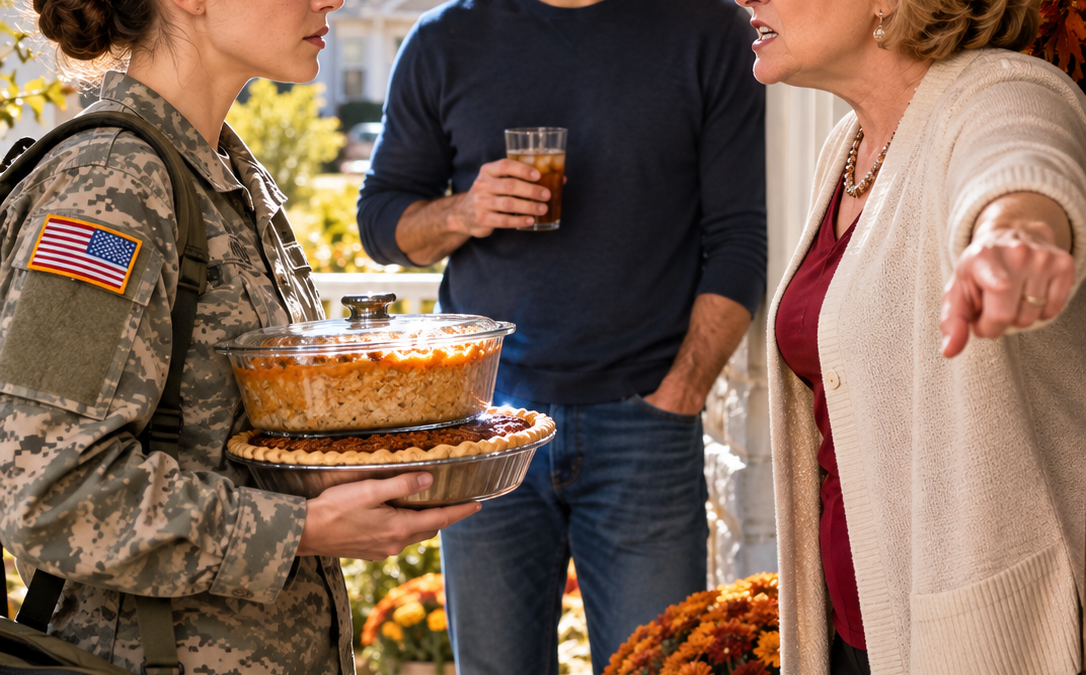
“You’re not welcome at Thanksgiving dinner.”
For a second, I honestly thought I’d heard my mother-in-law wrong. I stood on Diane’s front porch, holding a warm sweet potato casserole against my chest with my mother’s pecan pie balanced on top. Through the open doorway, I could smell turkey and sage dressing. I could hear silverware clinking and Mark’s sister laughing somewhere near the dining room.
Then Diane folded her arms. “You heard me, Clare.”
I looked past her. My husband was standing maybe fifteen feet away, a glass of iced tea in his hand. “Mark?” He looked at his mother, then at me, and smiled. Not a happy smile. More like the uncomfortable little grin he used whenever he wanted to avoid choosing a side. “My mother’s word is law,” he said.
Something inside me went completely still. Fourteen years of marriage, and that was his answer. I didn’t yell. I didn’t ask Diane what I’d done. I didn’t give Mark another chance to embarrass me. I just smiled. “All right.”
I turned around, walked back to my car, placed the casserole and pie carefully on the passenger-side floor, and drove back toward base. By the next morning, I would have sixty-seven missed calls on my phone. But at that moment, I had no idea what was coming. All I knew was that, for the first time in fourteen years, I was done begging for a chair at someone else’s table.
That Thanksgiving morning had started at 4:47. I remember the exact time because my alarm was set for five, but I woke before it. Mark was still asleep beside me. I slipped quietly out of bed, pulled on sweatpants and an old gray T-shirt, and headed downstairs.
My mother’s pecan pie recipe was taped inside one of my kitchen cabinets. The paper was yellow around the edges, and there was still a little brown fingerprint near the bottom, where she’d once touched it with flour and cinnamon on her hands. Mom had been gone six years. Making that pie was one of the ways I still brought her into the holidays.
By 6:30, the pie was cooling. The sweet potatoes were next. Mark came downstairs around eight. “Smells good,” he said, pouring coffee. “Your mother asked me to bring two dishes,” I told him. He grunted. That should have been my first warning.
“You okay?” I asked. “Fine.” I watched him for a moment. “Is your mom okay?” He stared into his coffee. “She’s been in one of her moods.” I actually laughed. “When isn’t she?” Mark didn’t laugh.
I should explain something about Diane. She never liked my career. She didn’t hate me when Mark and I first married. At least, I don’t think she did. But over the years, every missed birthday, every duty weekend, every holiday schedule I couldn’t control became evidence in a case she seemed determined to build against me.
According to Diane, I was always choosing the Army. It didn’t matter that I’d spent years rearranging everything I could rearrange. It didn’t matter that I’d driven across North Carolina after working all day because Richard was in the hospital. It didn’t matter that when their roof started leaking two summers earlier, I quietly helped cover the repair. Diane remembered the dinners I missed. She forgot everything I showed up for.
That year, Thanksgiving mattered to me because I had specifically worked things out so I could be there. I’d told Mark that, and he knew. Around eleven, I showered, changed, checked my phone, and saw a message from Diane.
Dinner at 2. Don’t be late.
Nothing else. I showed Mark. “See?” I said. “Maybe she’s over whatever was bothering her.” He barely looked. “Probably.”
We drove separately because Mark had gone over earlier to help his father move some folding chairs from the garage. At 1:43, I pulled onto Diane and Richard’s street in Fayetteville. Cars lined both sides of the road. I remember feeling relieved. Normal Thanksgiving. That was all I wanted. Normal.
I carried the food up the walkway and rang the bell because my hands were full. Diane opened the door. She was wearing the burgundy sweater I’d given her the previous Christmas. She looked at the casserole, then at me, and said those words.
“You’re not welcome at Thanksgiving dinner.”
The strange thing about humiliation is that sometimes the smallest details become the clearest. I remember a football game playing on television. I remember Richard standing near the dining room. I remember Melissa suddenly stopping mid-sentence. And I remember Mark smiling before saying, “My mother’s word is law.”
Maybe he thought I’d argue. The old Clare probably would have. She would have tried to fix it. But standing there, something finally made sense. Diane wasn’t the biggest problem. Mark was.
So I left. The drive back was quiet. No radio, no angry phone call, nothing. About twenty minutes later, my phone buzzed at a stoplight. It was Mark.
Where are you going?
I didn’t answer. Another message arrived.
Clare, seriously. Mom will calm down eventually. Don’t make this bigger than it is.
I read that one twice. Then I placed my phone facedown.
When I got back near base, I still had an entire casserole and pecan pie in my car. I could have gone home. Instead, I stopped by a common area where I knew a handful of people were spending Thanksgiving. A young specialist named Torres was sitting there eating something from a plastic container.
“Ma’am,” he said when he saw me. “You already eat?” He looked down at his meal. “Depends what you call eating.” I held up the casserole. “I can do better than that.”
Within forty minutes, somebody found instant mashed potatoes. Someone else brought rolls. A civilian employee showed up with leftover turkey from his sister’s house. There were nine of us by the time I cut Mom’s pecan pie. Nine people who hadn’t planned on spending Thanksgiving together. And somehow, there was more laughter around that mismatched table than I’d heard at Diane’s house in years.
My phone buzzed again. Mark.
Are you coming back?
I looked around the table. Torres was telling a terrible joke. Someone was arguing about football. A young woman across from me was calling her grandmother on speakerphone. I turned my phone over. “No,” I whispered.
For once, I wasn’t going back just because somebody expected me to. And I had no idea that one quiet decision was about to expose everything my marriage had been hiding.
By six that evening, our accidental Thanksgiving dinner had grown from nine people to fourteen. Nobody had planned it. That was what made it special. Sergeant Lewis found two cans of cranberry sauce in a cabinet. Torres came back with a bag of ice and three bottles of soda. A civilian mechanic named Walter Hayes arrived carrying a foil pan of turkey his daughter had packed for him.
Walter was seventy-two, retired Army, and still worked part-time because, as he liked to say, there were only so many mornings a man could spend arguing with cable news. He took one look at our table and laughed. “This looks like Thanksgiving after a tornado.”
“It tastes better than it looks,” Torres said. Walter grinned. “That’s what my first wife said about her meatloaf.”
Everybody laughed. So did I. For a few minutes, I forgot why I was there. We pushed two tables together, used paper plates, and passed food in mismatched containers. Someone found plastic forks. Someone else made coffee strong enough to wake the dead. There was nothing elegant about it, but everyone had a chair. That mattered to me more than I wanted to admit.
Walter sat beside me. “You made the pie?” he asked. “My mother’s recipe.” He took another bite. “Your mother knew what she was doing.” “She did.” He glanced at me. “Gone?” I nodded. “Six years.”
He didn’t offer one of those automatic lines people use when they don’t know what else to say. He simply nodded back. After a moment, he asked, “So, why are you here?” I looked at him. “Thanksgiving.” He gave me a knowing look. “You know what I mean.”
Apparently, I wasn’t hiding things as well as I thought. “My plans changed.” Walter glanced at the casserole dish I’d brought from Diane’s house. “Plans change. Faces usually don’t look like that when they do.” I smiled. “You always this nosy, or only when there’s pie involved?”
I told him the short version. Mother-in-law. Front porch. Not welcome. Husband standing behind her. My mother’s word is law.
Walter’s expression changed at that last part. He set down his fork. “He actually said that? Word for word?” I nodded. Walter leaned back. “I was married forty-three years before my wife passed. I loved my mother. Loved my wife, too. Never once confused which one I’d made vows to.”
That hit harder than I expected. I looked down at my plate. “I keep wondering if I should have said something.” Walter looked at me. “You did.” “I walked away.” “Sometimes that’s saying plenty.”
Across the table, Torres was trying to convince everyone that canned cranberry sauce was superior to homemade. Walter watched them for a moment. Then he said quietly, “Family isn’t the table you’re assigned to. Sometimes it’s the table where somebody notices your chair is empty.”
I didn’t answer. I couldn’t, because for years I had been telling myself Diane’s behavior didn’t matter. She criticized my schedule. I adjusted it. She complained I missed family events. I tried harder to attend. She said Mark spent too much time accommodating my career. I swallowed that, too.
The worst part was that Mark always had the same explanation. “That’s just Mom.” Four words that had excused fourteen years of disrespect.
When Richard had his health scare two years earlier, I was the one who drove him to follow-up appointments when Mark couldn’t leave work. When their property taxes came due during a difficult year, I helped. When a storm damaged their roof, Mark told me his parents couldn’t cover the deductible and repairs. We covered it, mostly from money I had saved.
I never told Diane. I didn’t want gratitude. They were family. Or at least, I thought they were.
My phone buzzed again around seven. This time, it was a picture from Mark. Diane sat at the head of the table. Richard was beside her. Melissa and her husband were smiling. Children crowded around the far end. Everyone looked happy. Under the picture, Mark had written:
See? No drama. Maybe next year will be different.
I stared at those words. No drama. Apparently, throwing your wife out of Thanksgiving dinner wasn’t drama. Objecting to it would have been.
Walter noticed my expression. “Bad news?” “No.” I locked my phone. “Actually, I think something just became very clear.”
I stayed another hour. Before leaving, I wrapped the remaining pie for Torres and helped clean up. A young lieutenant named Hannah stopped me near the door. “Ma’am?” “Yeah?” “Thanks for doing this.” I smiled. “You all did it.”
She shook her head. “I was supposed to fly home to Ohio. Flight was too expensive. I didn’t tell my grandmother because she’d worry.” She glanced back toward the table. “I thought tonight was going to be pretty lonely.”
That sentence followed me all the way home.
The house was dark when I arrived. Mark was still at his parents’. I changed into sweatpants, made tea, and sat at the kitchen table. For the first time all day, there was no noise around me. That was when the hurt finally arrived. Not anger. Hurt.
I had spent years making myself useful to people who apparently considered my presence optional.
I opened my laptop.
At first, I wasn’t looking for anything specific. Then I opened our household budget. Mortgage, utilities, insurance, savings. Then the expenses I had quietly helped manage for Mark’s parents. Property taxes. Roof repair. A monthly household bill I’d placed on automatic payment after Richard’s health problems. Appointment reminders. Maintenance contacts. Christmas travel reservations.
I stared at the screen. It wasn’t the amount of money that bothered me. It was the pattern. Whenever something went wrong, I was family. Whenever something needed organizing, I was family. Whenever someone needed money, a ride, a phone call, or a solution, I was family.
But when Thanksgiving dinner was served, I suddenly wasn’t welcome.
I closed my eyes. Then I heard Mark’s words again. My mother’s word is law.
I opened a new document and began making a list. Not of ways to hurt anyone. Not revenge. Just every responsibility I had taken on because I believed marriage meant carrying things together.
By the time Mark finally came home, I understood something he didn’t yet understand. I wasn’t going to punish his family. I was simply going to stop protecting them from the consequences of treating me like I didn’t belong. And for the first time in fourteen years, Mark was about to discover exactly how much I had been carrying.
Mark came home a little after ten. I heard his key in the front door while I was still sitting at the kitchen table with my laptop open. He walked in carrying a foil-covered plate. “Mom sent you leftovers.”
I looked at the plate. That almost made me laugh. She wouldn’t let me sit at her table, but she sent leftovers. Mark sighed. “Clare, please.” I looked at him. “Put them in the refrigerator.”
He did, then came back and stood across from me. “You embarrassed her.”
I stared at him. “I embarrassed her?” “You left without saying anything.” “She told me to leave.” “She said you weren’t welcome at dinner. She didn’t tell you to make some dramatic statement.”
I closed my laptop. “Mark, I said, ‘All right,’ and walked to my car.” He shook his head. “You know what I mean.”
Actually, I did. He meant I was supposed to stand there and negotiate for permission to be treated like family. I wasn’t doing that anymore.
“I’m tired,” I said. “We’ll talk tomorrow.” He shook his head. “You always shut down when you’re angry.” “No. Usually, I explain myself until everybody else feels better. Tonight, I’m tired.”
I went upstairs. Mark slept in the guest room.
The next morning, I woke before him and reopened the list I had made. Looking at it in daylight made something painfully obvious. I had become the unpaid manager of two households. Richard’s medical appointments were in my calendar. I kept the number for Diane’s plumber because Mark always lost it. Their homeowner’s insurance renewal date was saved in my phone.
I had arranged the family’s Christmas cabin reservation near Asheville. I even reminded Mark when his mother’s prescriptions were ready because Diane would call me if he forgot. None of those things were obligations. I had volunteered because I thought that was what families did.
So I started separating kindness from responsibility.
I did not touch anything legally owed. I didn’t cancel payments that would create penalties without warning. I didn’t move shared money. Instead, I wrote Mark an email listing every expense and task involving his parents that I had voluntarily handled.
At the bottom, I wrote, Beginning December 1st, these will be your responsibility. I’ll send you every account, contact, and date you need.
Then I transferred the information to him. No traps. No surprises. Just boundaries.
The Christmas cabin was different. I had booked it myself and paid the refundable deposit from my personal account. I canceled it.
Then I packed a suitcase.
Mark found me upstairs around nine. “What are you doing?” “I’m staying near base for a while.” His face changed. “You’re leaving me over Thanksgiving?” “No.” “Then what is this?”
I zipped the suitcase. “I’m leaving because my husband watched his mother humiliate me and smiled.” “I wasn’t smiling at you.” “That makes it better?” “I was uncomfortable.” “So was I.”
He rubbed his forehead. “You know how Mom is.”
There it was. I looked directly at him. “Yes, Mark. I know exactly how your mother is. The problem is that after fourteen years, I also know how you are when she treats me that way.”
He went quiet.
I carried my suitcase downstairs. He followed. “You’re being dramatic.” I stopped at the door. “I hope you keep saying that.” “What?” “Because every time you do, you remind me why I need to go.”
I left.
That afternoon, Diane texted.
Mark says you canceled Christmas.
I didn’t answer. Another message appeared.
You’re punishing the entire family because you didn’t get your way.
I stared at it for a moment, then put my phone away. Later, Mark called. I let it ring. Then he called again. Finally, I sent him one message.
I wasn’t angry because I missed dinner. I was hurt because my husband watched someone humiliate me and smiled.
He didn’t respond for almost six hours. That silence told me more than an argument would have.
Over the next two days, the practical consequences started arriving. Mark called because he couldn’t find Richard’s cardiology appointment information. I forwarded it. He asked which company had repaired his parents’ roof. I sent the number. He asked about the December insurance payment. I explained where the paperwork was.
Every time, I gave him the information. I simply didn’t do the job for him.
By Sunday evening, his frustration was obvious. “You’ve been handling all this for years,” he said during one call. “Yes.” “I didn’t realize there was this much.” “I know.”
There was a long pause. “Why didn’t you tell me?”
That question almost hurt more than Thanksgiving. “I did, Mark. Every time I asked you to help.” He had no answer.
Meanwhile, something was happening at Diane’s house that I knew nothing about. Sunday afternoon, Richard was looking through Thanksgiving photographs Melissa had sent him. He noticed I wasn’t in any of them.
Apparently, he asked Diane why. She told him the same story she’d told several relatives after I left. Clare had decided she’d rather be back at the base.
Richard knew that didn’t sound right. He remembered seeing me on the porch. He remembered the casserole in my hands. So he called Melissa. Melissa had heard enough of the confrontation to know the truth.
“No, Dad,” she told him. “Clare didn’t decide to leave. Mom told her she wasn’t welcome.”
Richard confronted Diane that evening. Mark was there. Later, Melissa told me Richard asked Mark one question.
“Did your wife come here expecting to eat Thanksgiving dinner with us?”
Mark admitted I had. Then Richard asked, “And you let her drive away alone?”
Nobody answered.
That should have been the end of it. Instead, Richard started asking more questions. Questions about the roof, about the property taxes, about the bills I had helped manage after his hospitalization. He had always assumed Mark handled most of it. Mark finally admitted the truth. A large part of the help had come from me.
Richard sat silently for a long time. Then he asked Diane, “Did you know any of this?”
She didn’t.
That night at 8:16, my phone rang.
Richard.
I nearly ignored it. Something made me answer. “Hello?” His voice sounded tired. “Clare. It’s Richard.” “I know.”
There was a pause. Then my father-in-law said something I had never expected to hear. “I think this family owes you the truth.”
I sat down on the edge of my bed. “What truth?” He took a slow breath. “The one Diane has been telling everybody about why you left Thanksgiving.”
And just like that, I realized the story had become much bigger than one empty chair.
For a moment, I didn’t say anything. I sat on the edge of the narrow bed in the room I was using near base, listening to Richard breathe on the other end of the phone.
“What has Diane been telling people?” I finally asked. “That you chose not to stay.” I closed my eyes. Richard continued. “She told Melissa and the others that you decided the Army was more important than Thanksgiving. Again.”
Again.
I knew that one word carried more shame than any long apology could have.
“I came with food, Richard.” “I know that, too.” “I got up before five to make that pie.” His voice softened. “Your mother’s recipe?” “Yes.”
Another pause. “I’m sorry, Clare.”
I looked out the window. “You didn’t throw me out.” “No, but I was standing there.”
That surprised me. Most people apologize by explaining why something wasn’t really their fault. Richard didn’t.
“I heard Diane,” he said. “I saw you leave. I told myself it was between you, Mark, and her. That was cowardly.”
I swallowed. “You were in your own house.” “Exactly.”
Then he said the sentence I needed more than I realized. “You should have had a chair at my table.”
My eyes burned. “Thank you.”
Richard cleared his throat. “There’s something else.”
He told me about the questions he’d asked after discovering Diane’s lie. The roof, the taxes, the medical appointments. He had believed Mark handled most of it.
“Mark told me the truth tonight,” Richard said. “Most of the money for that roof came from your savings.” “Some of it.” “And the property tax?” I hesitated. “Yes.”
“Why didn’t you tell us?” “Because you were family. I wasn’t buying recognition.”
Richard gave a tired laugh without humor. “Well, apparently we were happy enough to take your help while doing a poor job of giving you recognition for free.”
I didn’t know what to say. He didn’t ask me to forgive Diane. He didn’t ask me to come back. Before hanging up, he simply said, “I’m sorry.”
That mattered.
The next morning, Melissa called. She apologized, too. She admitted she’d known Diane was angry with me but assumed it would blow over.
“I should have said something when Mom stopped you at the door.” “You were surprised.” “So were you.” “Fair point.”
Then she told me something else. Diane’s version of Thanksgiving had already traveled through the family. Two cousins believed I had shown up, started an argument, and stormed out. An aunt had been told I never intended to stay.
That hurt, but I wasn’t going to begin a familywide campaign defending myself.
“Tell anyone who asks you the truth,” I said. “That’s all.” Melissa hesitated. “You don’t want me to call everybody?” “No.” “Why?” “Because I’m tired, Melissa.”
I really was.
That afternoon, Mark texted asking if we could meet. I almost said no. Then I decided fourteen years deserved one conversation where neither of us could hide behind a phone.
We met at a coffee shop off Skibo Road. Mark was already sitting in the back when I arrived. He looked exhausted. I sat across from him. For a while, neither of us spoke.
Finally, he said, “Dad tore into me.” “This isn’t about your dad.” “I know.” “Do you?” He rubbed both hands over his face. “Clare, I screwed up.” “Yes.” “I should have stopped Mom.” “Yes.”
He looked almost irritated by how calmly I agreed. “I’m trying to apologize.” “Then apologize. Don’t explain.”
That stopped him. He stared at his coffee. “I’m sorry.”
I waited.
“I’m sorry I let her speak to you that way. And I’m sorry I said what I said.”
“Why did you?”
He thought about it. “I didn’t want to fight with her.” “So you chose to hurt me instead.” “I didn’t choose that.”
“You did, Mark.”
His eyes lifted. “You had two uncomfortable options. Tell your mother she was wrong or let your wife walk away. You chose the one that was easier for you.”
He had no response.
After a minute, he said, “You know how Mom is.” I almost smiled. “Yes. The problem is that after fourteen years, I also know how you are when she treats me that way.”
He looked down.
I told him I had never expected him to abandon his mother. I wasn’t asking him to choose between us.
“Marriage isn’t about choosing your wife every time your mother speaks,” I said. “It’s about knowing right from wrong, even when the person who’s wrong raised you.”
He nodded slowly.
Then I brought up something I hadn’t planned to say. “Do you know what bothered me about that picture you sent?” “The Thanksgiving picture?” “You wrote ‘no drama.'”
His face tightened.
“You really believed that?” “I was trying to calm things down.” “No. You were relieved. Your mother got what she wanted. Everybody stayed at the table, and the only person who paid for that peace was me.”
That landed.
Mark leaned back. For the first time, he looked less defensive than ashamed. “I didn’t see it like that.” “I know.”
Those two words hurt him. I could tell.
He asked when I was coming home. “I don’t know, Mark. I’m not filing for divorce tomorrow. But I’m not coming home just because you finally understand I’m serious.”
“What do you want me to do?” “Figure out why keeping your mother comfortable became more important than protecting our marriage.”
He nodded. I suggested counseling. “Maybe that’s something,” he said. “It’s a beginning.”
I left him there.
That evening was strangely quiet. No calls from Diane. No angry messages. Richard sent one text.
Thank you for talking to me.
I answered, Take care of yourself.
Then I went to bed early.
At 5:38 the next morning, I woke naturally. The room was still dark. I reached for my phone to check the time. The screen lit up. For several seconds, my sleepy brain couldn’t understand what I was seeing.
Sixty-seven missed calls.
Mark. Melissa. Richard. Diane. Two cousins. Three numbers I barely recognized.
My stomach dropped.
There were seventeen text messages, too. The most recent was from Mark, sent four minutes earlier.
Clare, please answer. Dad collapsed. We’re at Cape Fear Valley.
Whatever anger I had been carrying disappeared beneath one immediate thought.
Richard.
I was out of bed before I even finished reading the message. Because boundaries were one thing. But leaving someone alone on the worst morning of their life? I knew exactly what that felt like. And I wasn’t going to become the kind of person who did it back.
I was dressed and out the door in less than seven minutes. The roads were still dark, and there was hardly any traffic. I called Mark through the car’s hands-free system. He answered on the first ring.
“Clare?” “I’m coming. What happened?” “Dad collapsed in the bathroom.”
His voice sounded nothing like the man I had met for coffee the day before.
“He got up early. Mom heard something fall. The ambulance brought him in about an hour ago.” “Is he conscious?” “Off and on.” “What have the doctors said?” “They’re running tests. I don’t know.”
I could hear Diane crying in the background. “I’ll be there soon.” “Clare?” “Yes?” “Thank you.”
I ended the call.
I wasn’t going for Mark. I wasn’t even going for Diane. I was going because Richard had called me when he could have protected himself with silence. He had admitted he was wrong. That counted for something.
When I reached Cape Fear Valley Medical Center, Melissa was waiting near the emergency department entrance. She hugged me before I could say anything.
“Dad’s stable.”
I exhaled. “What happened?” “They think it may be related to his heart medication. His blood pressure dropped badly. They’re still checking everything.” “Where’s Diane?” “With Mark. Inside.”
The waiting room had that strange hospital stillness where everyone seemed afraid to speak at a normal volume. Mark stood when he saw me. Diane didn’t. She sat hunched forward with both hands wrapped around a paper cup. Her hair was uncombed. I had never seen her look old before.
Diane had always seemed larger than the room she was in. Certain. Controlling. Ready with an opinion before anyone asked for one. That morning, she just looked frightened.
I sat two chairs away. “Have they given you Richard’s medication list?” Mark blinked. “I think so.” “Think?”
He looked through a plastic bag the paramedics had apparently brought from the house. Diane suddenly looked at me. “I don’t know which pills he took yesterday.”
“All right.” “I usually know.” “I know.”
Her hands began trembling. “What if I told them something wrong?” “Then we correct it. We don’t panic.”
That sentence came automatically. Years of dealing with emergencies had taught me that panic usually took up space needed for useful information.
I helped Mark organize the prescription bottles and wrote down the dosages. Melissa called Richard’s cardiologist. Nobody mentioned Thanksgiving. Nobody needed to.
Around 7:30, a physician came out and told us Richard was awake and responding well. His blood pressure had improved, but they wanted to admit him for observation and additional testing.
Diane covered her face. Mark put an arm around her. I sat back and finally breathed normally.
A nurse later allowed Diane to see Richard first. When she returned, she looked directly at me. “He asked if you came.” “I’m here.” “He wants to see you.”
Richard looked pale against the hospital sheets, but he smiled when I entered. “Well,” he said, “this is embarrassing.”
I laughed despite myself. “You always did know how to get attention.” “Sixty-seven calls enough?” “So you know about that?” “Melissa told me.”
I pulled a chair closer. “You scared everybody.” His expression became serious. “I’m glad you came.” “Of course I came.”
He studied me. “Would’ve understood if you didn’t.”
“No.” I shook my head. “I can be angry with someone and still care whether they’re alive.”
Richard’s eyes watered. He reached for my hand. I stayed with him until the nurse came back.
When I stepped into the hallway, Diane was waiting. “Can we talk?”
Every instinct told me I wasn’t ready, but I nodded. We found a quiet corner near a vending machine. For several seconds, she stared at the floor.
Then she said, “I was cruel to you. No excuse.”
That surprised me. “Yes,” I said.
“I was angry.” “I know.” “I’ve been angry for years.”
I waited. She twisted a tissue between her fingers.
“When Mark married you, I thought things would stay mostly the same. Then he started calling you first.”
I frowned. “That’s what married people usually do.” “I know that now.”
She gave a small, embarrassed laugh. “You had your career. You knew how to handle things. When Richard got sick, you knew which questions to ask. When something broke, you found somebody to fix it. Mark depended on you.”
Her voice cracked.
“And instead of being grateful, I felt replaced.”
There it was. Not justification, but truth.
“So you punished me for being his wife?” “Yes.”
She looked at me. “I’m ashamed of that.”
I could have reminded her about the porch, the lies, the years of comments. I didn’t need to. She remembered.
“I need you to understand something,” I said. “Helping you today doesn’t erase Thanksgiving.” “I know.” “And feeling sorry for you right now doesn’t mean I’m ready to trust you.” “I know.”
She nodded. Then she started crying. Not loudly. I reached into my bag and handed her a tissue.
After a minute, she whispered, “Why did you come?”
That question stayed between us.
Finally, I said, “Because I would never leave you alone on the worst day of your life just because you left me alone on Thanksgiving.”
Diane covered her mouth.
I didn’t say it to hurt her. That was simply the truth.
Compassion didn’t require me to forget what happened. Forgiveness, if it came, would not mean pretending there had been no wound.
Around noon, Richard was moved upstairs. Mark walked me toward the elevator.
“Clare.”
I turned. He looked exhausted. “Are you coming home?”
There was hope in his face. Maybe the old me would have mistaken one frightening morning for proof that everything had changed. But emergencies can make people promise things ordinary Tuesdays expose as untrue.
So I gave him the only answer I could. “Not yet.”
His shoulders dropped.
“I came because your father needed us,” I said. “Our marriage still needs work.”
He nodded slowly. The elevator doors opened. Before stepping inside, I looked back at him.
“If you really want me home, Mark, don’t ask me when I’m coming back.” “What should I ask?”
I held his gaze. “Ask yourself what has to change before I should.”
The doors closed between us, and for the first time, fixing our marriage was no longer my job alone.
Richard went home two days later. The doctors adjusted his medication and told him to take things easier for a while. Advice Richard immediately complained about. Apparently, taking it easy was an insult to a man who still insisted on mowing his own lawn at seventy-one.
I visited once that week. Diane made coffee. She didn’t mention Thanksgiving. Neither did I. Something between us had changed, but I wasn’t ready to call it forgiveness.
Sometimes people think reconciliation happens when someone says, “I’m sorry,” and the other person says, “I forgive you.” Real life usually isn’t that clean. An apology opens a door. It doesn’t rebuild the room.
Mark and I started counseling the following Tuesday. He chose the counselor. That mattered to me because, for once, I wasn’t organizing the repair.
During our second session, the counselor asked Mark why he had smiled when Diane told me I wasn’t welcome. Mark stared at the floor. Finally, he said, “Because I was nervous.”
“And what were you afraid of?” the counselor asked.
“My mother getting angry.”
The counselor waited. Mark looked at me. “I knew Clare would handle it.”
Those words hurt in a completely different way.
“What does that mean?” I asked. “You’re strong.”
I almost laughed. “So because I’m strong, I was the safer person to hurt.”
His face changed. “I never thought about it like that.” “That’s exactly what you did.”
He nodded. “I know.”
For years, Mark had confused my ability to endure something with permission to make me endure it.
Once he understood that, the real work started.
I gave him three conditions before I would consider moving home. First, counseling continued. Second, our finances and family responsibilities became completely transparent. I was no longer going to quietly manage everything until nobody noticed I was doing it.
Third, his mother could no longer control decisions inside our marriage.
“I’m not asking you to abandon her,” I told him. “If she needs help, we help when we reasonably can. But she doesn’t get a vote in our marriage.”
“She won’t.”
“That isn’t enough.”
He looked confused.
“You have to be the one who tells her.”
A week later, he did. I wasn’t there. He told me afterward that Diane cried. Then she got angry. Then she accused me of turning him against her.
The important part was what Mark did next.
Nothing.
He didn’t blame me. He didn’t call and ask me to smooth things over. He simply told his mother, “Clare didn’t make me say this. I should have said it years ago.”
That was the first moment I believed our marriage might survive.
Still, I didn’t move home. Not yet.
About three weeks after Richard left the hospital, Melissa invited everyone to her house for a simple Sunday lunch. I almost declined. Then Richard called.
“I’d like you there,” he said. “But only if you’re comfortable.”
So I went.
The dining room was smaller than Diane’s, and Melissa had squeezed extra chairs around the table. For once, nobody cared where anyone sat. We had pot roast, carrots, mashed potatoes, and store-bought rolls.
Halfway through lunch, Mark put down his fork. “Can I say something?”
The room went quiet. I immediately felt uncomfortable.
Mark looked at me, then at everyone else. “Thanksgiving shouldn’t have happened the way it did.”
Diane stared at her plate. Mark continued.
“Clare was disrespected in front of this family, and instead of standing beside my wife, I made it worse.”
Nobody moved.
“That was my failure,” he said. “Not hers.”
I felt my throat tighten. He wasn’t performing. There was no speech about how difficult his mother could be. No explanation. No request for sympathy. Just responsibility.
Then Diane spoke. “I need to say something, too.”
She looked at me. “I deliberately told Clare she wasn’t welcome.”
Her voice trembled.
“And afterward, I lied about why she left because I knew what I had done was wrong.”
Melissa looked down. Diane continued.
“I blamed Clare’s career for things that were really about me. I resented the fact that my son built a life that didn’t revolve around me anymore.”
She swallowed. “I’m sorry, Clare.”
The room remained silent.
I could have said everything was fine. Older versions of me would have. Instead, I said, “Thank you.”
Diane waited.
“I accept your apology,” I continued. “But I need time.”
“I understand.”
And I believed she did.
Richard leaned forward. “I’ve got something to say, too.”
Diane gave him a tired look. “Of course you do.”
A few people laughed, breaking the tension.
Richard looked around the table. “When you get to my age, you start thinking keeping the peace is the same as having peace.”
He shook his head. “It isn’t.”
Nobody interrupted.
“I watched things happen in my own family because I didn’t want an argument. Thanksgiving was one of them. All I accomplished was making sure the wrong person had to swallow the argument alone.”
His words stayed with me.
After lunch, Diane approached while I was helping Melissa carry plates into the kitchen. “I know you canceled the Christmas cabin,” she said.
“Yes.”
“I was angry when I heard.”
“I figured.”
“I’m not anymore.”
I looked at her. She smiled faintly. “Maybe we shouldn’t go anywhere together until we can survive lunch.”
I laughed. It was the first genuine laugh we had shared in months. “That might be wise.”
Mark drove me back toward base that evening. When we reached my building, he didn’t ask whether I was coming home. That was another change.
Instead, he said, “Counseling Thursday, 6:30. I’ll be there.”
I opened the door.
“Clare?”
I looked back.
“I miss you.”
“I miss you, too.”
His eyes widened slightly.
“But missing each other isn’t enough,” I added.
“I know.”
And this time, he really did.
I still didn’t know exactly when I would return home. Trust had been damaged slowly over years. It deserved to be rebuilt slowly, too.
But for the first time since Thanksgiving, I could see something ahead of us besides anger.
Not a perfect marriage. Not a perfect family. Something better.
A family learning that love without boundaries becomes resentment, and an apology without changed behavior is only another way of asking someone to tolerate the same pain again.
The next Thanksgiving arrived almost exactly one year later.
The alarm went off at five. For one strange second, I lay there staring at the ceiling, remembering another Thanksgiving morning. Another pie cooling on another counter. Another drive across Fayetteville, believing I was about to spend the holiday with family.
A year changes more than a calendar.
This time, I woke up in my own bedroom. Mark was asleep beside me. We had been living together again for nearly four months. Not because everything had magically healed, but because we had spent months rebuilding something we almost lost.
Counseling was still on our calendar every other Thursday. Some conversations were uncomfortable. Some were exhausting. But neither of us had missed a session.
Mark had learned something that took him forty-three years to understand. Keeping his mother comfortable had often come at the expense of keeping his marriage safe.
And I had learned something, too. Being the strong one had become my identity for so long that I stopped telling people when I was hurt.
Strength without honesty eventually becomes loneliness.
I slipped quietly into the kitchen. The recipe card was still taped inside the cabinet. Mom’s handwriting looked exactly the same.
I smiled. “Well, Mom,” I whispered, “let’s try Thanksgiving again.”
An hour later, Mark walked into the kitchen wearing an old sweatshirt. “Need help?”
I handed him pecans. “You’re officially promoted to chopping nuts.”
“To participating?” he asked with a laugh. “I’ll take it.”
A year ago, he would have poured coffee and wandered into the living room while I handled everything. Now, he stayed. He washed dishes as I cooked. He peeled potatoes. He even admitted he’d been cutting celery the wrong way for years.
Progress sometimes looks very ordinary.
By eleven, our house smelled like turkey, rosemary, cinnamon, and butter. The dining table looked different, too. It was longer. Mark had borrowed two folding tables from the community center on base. We had enough chairs for sixteen people.
He noticed me counting. “What?”
“There are two extra places.”
He smiled. “They’re supposed to be.”
That had become our new Thanksgiving tradition. It started by accident the previous year. Now it was intentional. Every Thanksgiving, we invited service members who couldn’t make it home. Nobody should spend the holiday alone if we could help it.
Around noon, the doorbell rang. Richard arrived first. He looked healthier than he had the year before. Still thinner, still moving slower, but smiling.
“I brought pie.”
“You brought my pie?”
He grinned. “Your recipe now belongs to the family.”
Behind him came Diane. She stood quietly on the porch holding a bowl of homemade cranberry relish. For a moment, we simply looked at each other.
Then she said, “Happy Thanksgiving.”
“Happy Thanksgiving.”
No tension. No performance. Just two women remembering a year neither of us wanted to repeat.
Inside, Diane looked around the dining room. “So many chairs.”
“We’re expecting company.”
“I noticed.”
She hesitated. Then she asked a question I never thought I’d hear.
“Where would you like me to sit?”
It was such a small sentence, but I understood what it meant. She wasn’t claiming the head of the table. She wasn’t assigning seats. She was asking.
I looked toward the dining room. There was one empty chair beside mine. “Right there.”
Her eyes filled with tears almost immediately. She nodded. “Thank you.”
She sat down and began helping Melissa arrange silverware. No announcement. No dramatic hug. Sometimes reconciliation is quiet because everyone finally understands how loud the damage was.
By one o’clock, the house was full. Melissa’s children were chasing each other through the hallway. Richard was explaining football rules to anyone willing to pretend they cared. Mark was carving turkey.
Then another knock came.
Torres walked in carrying cornbread stuffing. I laughed. “I told you it became a tradition.”
He saluted dramatically. “Yes, ma’am.”
Behind him came Hannah, now promoted to captain, with her husband. Walter arrived last. He carried sweet tea and wore a navy-blue sweater with tiny embroidered turkeys across the front.
“You actually bought a Thanksgiving sweater.”
“It was on sale.”
“Of course it was.”
Walter hugged me. “I’m proud of you.”
“For cooking?”
“For building a better table.”
That sentence stopped me because it described exactly what had happened.
Dinner began with Richard asking everyone to hold hands. He looked around the table.
“There was an empty chair last Thanksgiving.”
The room grew quiet.
“I don’t mean physically.” He glanced at me. “I mean we failed somebody who belonged here.”
Nobody interrupted.
“This year, I’m thankful we learned that family isn’t about pretending nothing happened.”
He squeezed Diane’s hand. “It’s about being willing to admit when something did.”
“Amen,” Walter said softly.
We ate. We laughed. Nobody argued about football for more than five minutes. The younger soldiers told deployment stories. Melissa’s little granddaughter insisted everyone compliment her mashed potatoes even though she hadn’t made them.
For the first time in years, I wasn’t watching the room for tension.
I was simply inside it.
Later that afternoon, I found Diane alone in the kitchen rinsing dishes. “You don’t have to do those.”
“I know.”
She kept rinsing. Then she stopped. “I’ve been thinking about something.”
“What?”
“The porch.”
I leaned against the counter.
“I keep replaying it.” She shook her head. “I wish I could take it back. I know I can’t.”
“No.”
She turned off the water. “I spent years believing respect meant everybody adjusting to me because I was the mother.”
She looked directly at me. “I was wrong.”
I nodded. “We both learned something.”
“What did you learn?”
“That boundaries aren’t punishment.”
She smiled sadly. “I needed yours.”
We hugged. Not because everything was forgotten, but because forgiveness had finally caught up with accountability.
That evening, after everyone left, Mark and I stood on the back porch, watching the sun disappear behind the trees. The house was quiet again. He slipped his hand into mine.
“Thank you for giving us another chance.”
I looked at him. “You earned another chance. That’s different.”
“Yes,” he said with a smile. “And I intend to keep earning it.”
I believed him.
Inside, I noticed one empty pie plate sitting on the counter. Mom’s pecan pie was completely gone.
I smiled.
She would have liked that.
As I cleaned the kitchen, I thought about those sixty-seven missed calls. A year earlier, I believed they were the story. Now, I understood they were only the turning point.
The real story was learning that love without respect becomes obligation, that silence can wound as deeply as cruel words, and that the strongest revenge is not making someone suffer.
It is refusing to let someone else decide your worth.
If you’ve ever had to leave a table where you weren’t treated with respect, I hope this story reminds you that walking away is not always giving up. Sometimes, it’s the first step toward building a better place to come home to.
And if this story touched your heart, I’d love to hear from you. Have you ever had to set a difficult boundary with someone you loved? Share your story in the comments. Someone else may need to read it today.
Thank you for spending this Thanksgiving story with me. If stories about courage, family, and second chances speak to you, I hope you’ll join me again.
The end.








