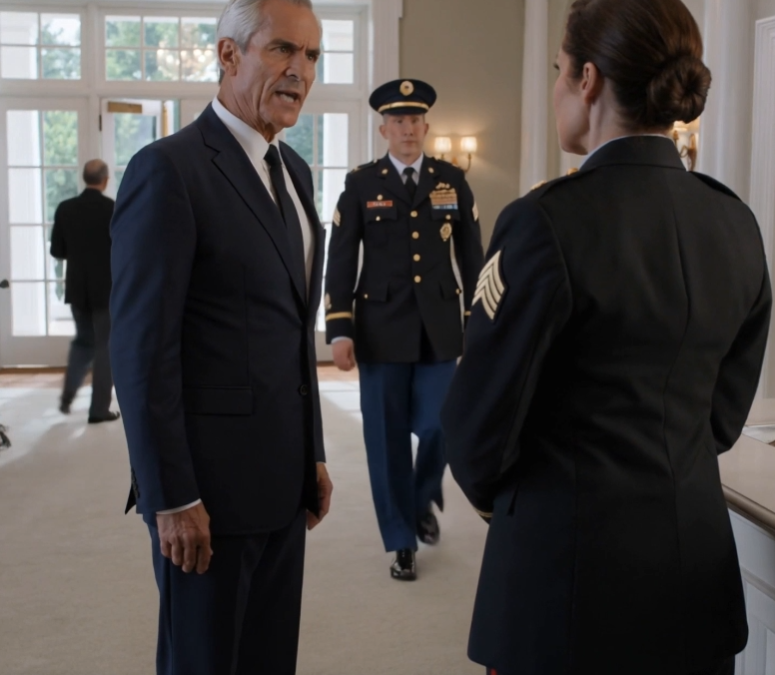
“My father knew I had joined the Army years ago. He just had no idea how far I’d risen.” “I ran into my millionaire father at a White House ceremony.” He sneered, “Don’t embarrass me.” I quietly handed the receptionist my White House invitation. She scanned the QR code… and froze. Then a nearby general looked at me and whispered, “Sir… she’s here.”
I learned how to lead when I was exhausted. I learned how to listen when I disagreed. I learned that confidence wasn’t always the loudest voice in the room. Sometimes, it belonged to the person who stayed calm when everyone else was afraid.
Over the years, my father and I drifted further apart. He knew I was still serving. He knew I had been promoted. He knew I had moved into increasingly demanding assignments, but he never asked for details. Whenever I tried to tell him about my work, he would eventually steer the conversation back toward business.
“How long are you planning to stay in? Do you have a retirement plan? Have you thought about doing something more practical?”
Eventually, I stopped explaining. And eventually, he stopped asking.
The last time I saw him before that White House ceremony was almost three years earlier. He had looked at my uniform and said, “You still wear that thing?”
I had smiled politely. “Yes, Dad.”
He shook his head. “Some people never outgrow their rebellion.”
I didn’t argue. I simply said goodbye.
Then came the invitation.
It was for a formal White House ceremony recognizing leaders and public servants from across the country. I almost declined. I had spent enough years proving myself to people who didn’t understand me. But the invitation was official, and the event mattered professionally, so I accepted.
I arrived that morning expecting nothing more complicated than a formal ceremony, a few handshakes, and a long drive home. I certainly didn’t expect to see my father.
Yet there he was, standing near the reception area in a tailored suit, surrounded by people who knew his name. He turned, and our eyes met. His expression changed, but not to joy or surprise. It was something closer to discomfort.
He walked toward me slowly.
“Emily.”
“Hi, Dad.”
His eyes moved over my uniform. Then he glanced around the room.
“You’re attending this?”
“Yes.”
He lowered his voice. “Please don’t make this awkward.”
I didn’t answer. He stepped closer, his expression tightening.
“Don’t embarrass me.”
Then he walked away.
I stood there for a moment, letting the words settle. After taking a breath, I turned toward the reception desk and handed the receptionist my invitation.
She smiled professionally. “Good morning, ma’am.”
“Good morning.”
She scanned the QR code. Her expression changed almost immediately. She looked at the screen, then at me, then back at the screen.
“Ma’am, could you wait just a moment?”
I nodded.
Behind me, I heard my father begin talking again. He had no idea what was about to happen.
Neither did I.
My father knew I had joined the Army years ago. He simply had no idea how far I’d risen. That was the truth I had to remind myself of as I stood beside the reception desk, watching the young woman behind it study the information on her computer.
She looked up again.
“Colonel Carter?”
“Yes.”
Her posture straightened slightly. “Thank you. Everything is in order. Someone will escort you inside shortly.”
“Thank you.”
I stepped away from the desk.
Behind me, my father was still talking with two men he knew from the business world. I could hear his familiar laugh, the same laugh I had heard at countless dinners when I was growing up. For a few seconds, I wondered whether he had even noticed the receptionist address me as colonel.
Then I realized something.
He probably hadn’t.
That was my father. He noticed titles when they belonged to people he considered important. He just never thought to ask whether his daughter had earned one.
My father had never been completely unaware of my military career. That would have been easier to explain. He knew I had joined the Army. He knew I had completed officer training. He knew I had been promoted more than once, and he knew I had spent years moving from one assignment to another.
What he didn’t know was what those years had done to me.
He didn’t know about the first time I had been responsible for people whose lives depended on my judgment. He didn’t know how many nights I had sat alone in a temporary room, exhausted, trying to prepare for the next morning. He didn’t know about the soldiers who had called me when they were struggling, or the young officers I had mentored.
He didn’t know how many times I had stood in front of a group of people and had to make a decision when there was no perfect answer.
He knew the résumé. He didn’t know the woman behind it.
When I first joined the Army, I called my father often. In the beginning, he actually answered.
“How’s it going?” he’d ask.
“Hard.”
“You’ll get used to it.”
Sometimes I wanted to tell him everything. I wanted to tell him about the woman who had encouraged me during training when I was ready to quit. I wanted to tell him about the first time a soldier came to me with a problem he was too embarrassed to share with anyone else.
I wanted to tell him that leadership was nothing like the movies. It wasn’t about looking powerful. It was about carrying responsibility when nobody was watching.
But whenever I started explaining, my father’s attention seemed to drift.
Once, after I’d been talking for nearly ten minutes about a difficult assignment, he interrupted me.
“Emily, have you thought about getting an MBA?”
I laughed because I thought he was joking.
He wasn’t.
“Dad, I’m talking about my career.”
“I know. That’s why I’m asking.”
“I like what I’m doing.”
“You’re young. You don’t know what you’ll want ten years from now.”
I remember sitting in my apartment after that call, staring at the phone after the line went dead. I wasn’t angry, not exactly. I was disappointed. There is a particular kind of loneliness that comes from realizing someone you love is listening to your words but not hearing them.
I kept serving.
Years passed. My responsibilities increased. My rank changed. My confidence changed. I changed. But every time I spoke with my father, I felt as though he were still talking to the twenty-two-year-old woman who had stood in his office and announced she was joining the Army.
When I received a promotion, I called him.
“I made it.”
There was a pause. “Congratulations.”
“Thanks.”
“What does that mean for your long-term plans?”
I smiled sadly. “It means I got promoted.”
“Emily, I understand that, but—”
He didn’t ask what the promotion meant. He didn’t ask what I had accomplished, who I was leading, or what I was proud of. Instead, he told me about a new business acquisition.
So I listened.
That became our pattern. He talked, and I listened. Whenever I tried to talk about my life, the conversation eventually moved somewhere else.
I don’t think my father intended to hurt me. That was what made everything so complicated. He wasn’t a monster. He wasn’t cruel every day. He loved me in the way he understood love. He believed providing money, opportunities, connections, and protection was what a father was supposed to do.
The problem was that I didn’t need him to build my life for me.
I needed him to care about the life I was building.
By the time I reached my thirties, I had stopped trying to convince him. I still sent occasional updates—a promotion, a new assignment, a photograph from an official event, a holiday message. Sometimes he responded with a thumbs-up. Sometimes he sent a short sentence. Sometimes he didn’t respond at all.
Eventually, I learned to stop waiting for the phone to ring.
And then, unexpectedly, the Army became my family in a way I hadn’t anticipated.
Not because it replaced my father. Nothing could do that. But because the people around me knew me. They knew when I was exhausted. They knew when something was wrong. They knew what I was capable of. They challenged me when I was wrong and trusted me when things became difficult.
That mattered.
So when I walked into the White House ceremony that morning, I wasn’t there to impress my father. I wasn’t even thinking about him until I saw him.
Now, as I waited for the escort, I watched him from across the room.
He looked exactly as I remembered. Silver hair, an expensive suit, perfect posture, and a watch that probably cost more than my first car. He was speaking confidently to a group of people when one of them noticed me.
The man’s eyes widened slightly. He leaned toward my father.
“Richard, is that your daughter?”
My father glanced over. “Yes.”
There was a pause.
“She looks…” The man didn’t finish.
My father gave a small shrug. “She’s always been stubborn.”
I looked away.
That word had followed me for most of my life.
Stubborn.
When I refused to attend the university he had chosen, I was stubborn. When I joined the Army, I was stubborn. When I turned down an opportunity in the private sector, I was stubborn. When I refused to leave a career I loved, I was stubborn.
But there was another word I had learned to use for myself.
Determined.
The difference depended on who was looking.
A staff member approached me.
“Colonel Carter?”
“Yes?”
“General Hayes is looking for you.”
I nodded. “Thank you.”
I followed her a few steps. Then I heard my father behind me.
“Emily?”
I turned.
He was looking at me differently now. Not warmly, not yet, but carefully.
“Who is General Hayes?”
I almost smiled.
For years, my father had never asked who I worked with. Now, suddenly, he wanted to know.
Before I could answer, a senior officer approached from the other side of the room. He saw me, stopped, and smiled.
“Colonel Carter.”
I returned the greeting. “General.”
My father went completely silent.
For the first time that morning, I saw uncertainty in his eyes. He was beginning to understand that the daughter he thought he knew had been living an entire life just beyond his attention.
The general’s greeting changed everything. Not because he raised his voice or because anyone applauded. It was the opposite. He simply looked at me with the quiet recognition of someone who had worked alongside me before and addressed me by my rank.
“Colonel Carter.”
My father heard it.
I saw his face change. He looked at the general, then at me, then back at the general.
“Colonel?”
The general gave him a polite nod. “Yes, sir.”
My father stared at me.
For years, he had treated my military career like a temporary chapter in my life, something I would eventually outgrow, something I had chosen because I was stubborn. Now he was hearing my rank spoken by a general inside the White House, and I could tell he was trying to put the pieces together.
I didn’t help him.
Not because I wanted him to suffer, but because, for once, I wanted him to discover something about me without my having to explain it.
The general excused himself after a brief exchange and moved toward another group of officers. My father waited until he was gone.
“How long have you been a colonel?”
I looked at him. “A while.”
“A while?”
I nodded.
He lowered his voice. “You never told me.”
I almost laughed. Not because it was funny, but because the statement was so familiar.
“You never asked.”
He frowned. “I asked about your career.”
“You asked whether I planned to leave the Army. That isn’t the same thing.”
He looked at me, and for a moment, neither of us spoke.
“No,” I said gently. “It isn’t.”
Then the receptionist approached.
“Colonel Carter, we’re ready for you.”
My father looked at the receptionist, then at me.
“Wait.”
I turned. “What?”
“What exactly are you doing here?”
I held his gaze. “I’m attending the ceremony.”
“I understand that. But why were they looking for you?”
I could have answered with a long explanation. I could have told him about the official invitation, the work I had done, the responsibilities I carried, and the people who had trusted me.
Instead, I simply said, “I was invited.”
He stared at me. “You were invited?”
“Yes.”
He looked toward the reception desk, then toward the officers across the room. Something about his expression softened, but there was still disbelief there.
My father had spent decades around powerful people. He knew what respect looked like. He knew how rooms changed when someone important entered them. And slowly, painfully, he was beginning to realize that people were treating me differently because they respected what I had done.
Not because of my last name. Not because of his money. Not because he had introduced me to anyone.
Because of me.
A few minutes later, the receptionist asked me to confirm my credentials. I stepped forward and handed her the formal invitation again. She scanned the QR code attached to the event credential, and the screen displayed my information.
She paused, then looked at me.
“Colonel Carter, everything is confirmed.”
“Thank you.”
She smiled. “Someone will escort you shortly.”
My father was standing close enough to hear. He looked uncomfortable, then said, almost defensively, “I told her she was in the wrong place.”
The receptionist glanced at him. Her expression remained professional.
“She is exactly where she is supposed to be, sir.”
That sentence seemed to hit him harder than anything I could have said.
He looked away.
I felt something inside me loosen. Not satisfaction. Relief.
For years, I had wondered what it would feel like if my father finally saw me. I had imagined a dramatic conversation, maybe an apology, maybe tears, maybe him telling me he had been wrong all along.
But the reality was quieter.
It was simply a receptionist politely confirming that I belonged. No argument. No explanation. No defense.
Just the truth.
I was exactly where I was supposed to be.
Then I heard a familiar voice behind me.
“Emily.”
I turned.
A senior officer was approaching. He had served in Washington for years, and I had worked with him during an earlier assignment. His face immediately brightened.
“Colonel Carter. I didn’t know you were coming.”
“Neither did I until recently.”
He smiled, then noticed my father.
“I’m sorry. I don’t think we’ve met.”
My father extended his hand. “Richard Carter.”
They shook hands.
The officer’s expression changed slightly. “Carter?”
“Yes.”
He looked at me. “Your father?”
I nodded. “Yes.”
The officer smiled. “Sir, you must be very proud of her.”
My father looked at me.
For one second, I thought he might say something meaningful. Instead, he cleared his throat.
“She has always been determined.”
The officer smiled. “I’ve noticed.”
Then he turned to me. “We’ve been waiting for you.”
Those words made my father look at me again.
“We?” he repeated.
“Yes,” the officer said. “There are several people inside who wanted to see Colonel Carter.”
My father didn’t say anything.
I could almost hear his thoughts.
Who wanted to see her? Why? How many people knew her? What had she been doing all these years?
The answers were suddenly surrounding him.
Not in a presentation. Not in a résumé.
In people.
People who greeted me warmly. People who trusted me. People who knew my name and understood what I had contributed.
That was the part my father had missed.
Rank alone meant very little to me. The relationships were what mattered. The lives I had been trusted with. The young officers who had once come into my office nervous and uncertain. The soldiers who had needed someone to tell them they could make it through a difficult assignment. The colleagues who had stood beside me when things went wrong.
That was what my career had become.
Not a title, but a responsibility.
The general from earlier returned to the room. He spotted me almost immediately.
“Colonel Carter.”
“Yes, General.”
He approached with a smile. “Good to see you.”
“You, too.”
Then he noticed my father standing beside me. His expression became curious.
“Is this your father?”
I nodded. “Yes, sir.”
The general extended his hand. “It’s a pleasure.”
My father shook it. “Likewise.”
Then the general looked at me.
“I’ve heard good things about your work.”
“Thank you.”
He gave me a brief nod and moved on.
My father watched him leave. Then he turned toward me.
“How many generals know you?”
I smiled slightly. “I don’t keep count.”
For the first time that morning, my father actually laughed.
It wasn’t his confident business laugh. It was smaller, almost embarrassed.
“You really have been doing something with your life.”
I looked at him.
“I’ve been doing something with my life for a long time, Dad.”
His smile disappeared.
He knew I was right.
A few minutes later, the event staff began moving guests toward the ceremony area. I prepared to follow them.
My father reached for my arm, then stopped before touching me.
“Emily.”
I looked back.
He hesitated. “I didn’t know.”
There were a hundred things I could have said.
Instead, I gave him the simplest truth.
“I know.”
Then I walked inside.
Behind me, my father remained standing in the reception area. For the first time in years, he wasn’t looking at the daughter he remembered. He was looking at the daughter he had never taken the time to know.
And somewhere behind those quiet White House doors, I knew the hardest conversation between us was still waiting.
By the time the ceremony ended, my father had stopped pretending he wasn’t watching me.
I noticed him several times from across the room. He stood near the back with his hands folded in front of him, listening to conversations he normally would have dominated. Every few minutes, his eyes drifted toward me.
Not toward my uniform. Not toward my rank.
Toward me.
That was new.
After the ceremony, people gathered for photographs and quiet conversations. There were handshakes, introductions, and the usual exchange of professional courtesies. I wasn’t trying to attract attention, but people I had worked with over the years kept coming over.
One former colleague hugged me. Another officer asked about my current assignment. Someone else thanked me for something I had done years earlier.
My father watched all of it.
At one point, a man standing beside him asked casually, “Richard, you never told us your daughter was a colonel.”
My father’s face tightened.
“I didn’t realize she was at that level.”
The man looked surprised. “You didn’t?”
My father shook his head. “No.”
The man glanced toward me. “Well, you should be proud.”
My father didn’t answer immediately.
I saw something move across his face. Pride, perhaps, but also regret. He had spent years assuming that if something important happened in my life, I would tell him.
And I had.
He just hadn’t listened.
Eventually, he approached me.
“Can we talk?”
I nodded.
We moved toward a quieter hallway where the noise from the reception faded behind us. For a moment, neither of us spoke.
My father looked older than he had that morning. Not physically, but emotionally. His shoulders seemed heavier.
“I didn’t know,” he said.
“I know.”
“You really never told me you were a colonel.”
I looked at him.
“I told you when I was promoted.”
“When?”
“Three years ago.”
He frowned. “I don’t remember.”
“I know.”
He looked down.
That answer seemed to hurt him more than an accusation would have.
“You could have told me again.”
“I could have.”
“Why didn’t you?”
I took a breath. “Because I got tired of telling you things you didn’t really want to hear.”
He looked at me. “I wanted to hear.”
“Did you?”
He seemed ready to defend himself, but I continued.
“Dad, when I called you after my first major promotion, you spent fifteen minutes talking about a business deal.”
He opened his mouth, then closed it.
“When I told you about my new assignment, you asked when I was going to get a real career.”
“I didn’t mean it that way.”
“I know. When I told you I had been given more responsibility, you asked whether the Army paid enough.”
He looked away. “I was worried about you.”
“I know.”
“Then why does it sound like you think I didn’t care?”
I looked at him for a long moment.
“Because caring and listening aren’t always the same thing.”
He didn’t respond.
The hallway suddenly felt very quiet. I could hear footsteps in the distance and the faint sound of conversation drifting from the reception area. My father leaned against the wall.
“I thought you were unhappy.”
“I wasn’t.”
“I thought you were wasting your potential.”
“I wasn’t.”
“I thought you were going to wake up one day and realize you could have done more.”
“I did more.”
He looked at me.
I continued softly. “Just not the kind of more you imagined.”
That sentence stayed between us.
My father had always believed potential meant money, influence, education, and business success. I had learned that potential could also mean service, leadership, character, and being the person someone else could depend on when their own confidence disappeared.
My father looked down at his hands.
“Why didn’t you ever ask me to come to something like this?”
I almost smiled. “I did.”
He looked up quickly.
“When?”
“Several times.”
He shook his head. “I don’t remember.”
“I know.”
There it was again.
The same answer. Not angry. Not cruel. Just true.
He had forgotten because he had never understood how important those moments were to me.
I remembered one particular evening years earlier. I had been preparing for a promotion ceremony, and I called him.
“Dad, I’d really like you to come.”
He had paused. “When is it?”
“Next Friday.”
“I have a meeting.”
“You could come after.”
“Emily, it’s just a military ceremony.”
I remembered standing in my kitchen, holding the phone against my ear.
“It’s important to me.”
He sighed. “I’ll see what I can do.”
He never came.
I told myself it didn’t matter. I told myself I was an adult. I told myself I didn’t need anyone’s approval.
But that night, after the ceremony, I sat alone in my car for twenty minutes before driving home. Not because I regretted the Army, but because I wished my father had been there to see me.
Now, years later, he was finally standing in front of me.
“You should have told me how important it was,” he said.
I looked at him. “I did.”
His eyes filled with something I hadn’t seen in a long time.
Shame.
“I don’t remember.”
“I know.”
He rubbed his forehead.
“I was a terrible father.”
“No.”
He looked surprised.
I shook my head. “I won’t say that.”
“Why not?”
“Because you weren’t terrible all the time.”
He gave a quiet, almost bitter laugh. “That’s a generous way of putting it.”
“I remember the good things, too.”
He looked at me. “You do?”
“Of course.”
“When you were little…” He smiled faintly. “I remember teaching you to ride a bike. I remember you fell into the grass, and I told you to get back up.”
“I remember you saying that.”
I smiled.
“You also told me that falling wasn’t the problem. Staying down was.”
He laughed softly. “I actually said something useful.”
“You did.”
For a moment, we were simply father and daughter again. Not millionaire and colonel. Not businessman and military officer. Just two people remembering a time when things had been easier.
Then his expression became serious.
“Are you happy?”
The question caught me off guard.
I looked toward the windows. Outside, Washington moved on as if nothing important had happened. Cars passed. People walked along the sidewalks. The city continued doing what cities always do.
I thought about my life. The hard years. The people I had lost. The people I had helped. The choices I had made.
“Most days,” I said.
He nodded. “That’s good.”
Then I looked at him.
“But I would have liked to have had my father beside me.”
His eyes dropped. “I know.”
“No,” I said gently. “I don’t think you do.”
He looked back at me.
“I wanted you beside me before anyone else thought I was important.”
He swallowed. “And I wasn’t.”
“No.”
He took a slow breath.
“I thought you didn’t need me.”
“I didn’t need you to fix my life.” I paused. “I needed you to be interested in it.”
He nodded slowly.
Then he said something I had never expected to hear.
“I think I was waiting for you to become someone I could understand.”
I looked at him.
He gave a sad smile.
“And instead, you became someone I never bothered to understand.”
That was the first completely honest thing he had said to me that day.
I didn’t hug him. I didn’t tell him everything was forgiven. But I stepped closer, and for the first time in years, neither of us felt the need to pretend.
My father had spent decades looking for success in numbers. That afternoon, he finally realized he had been standing beside one of his greatest accomplishments all along.
He just hadn’t taken the time to look.
My father didn’t apologize that afternoon. Not immediately.
And strangely, I was grateful for that.
A rushed apology would have been easy. He could have said he was sorry, hugged me, and promised to do better. Then we could have walked back into the reception as if a few words had somehow repaired twenty years of distance.
But real life doesn’t work that way.
Some wounds are too old to close simply because someone finally says, “I’m sorry.”
We stood together in that quiet hallway for another minute. Then my father looked at me.
“Can I ask you something?”
“Sure.”
“Why did you stop telling me things?”
I thought about it before answering.
“Because I stopped believing they mattered to you.”
He nodded slowly. “I understand.”
“I don’t think you do.”
He looked at me. “What do you mean?”
“I don’t need you to understand the Army. I don’t need you to understand every assignment, every promotion, or every decision I’ve made.”
I paused.
“But when your daughter tells you something she’s proud of, you should care because she’s proud of it.”
He looked down.
“You’re right.”
I wasn’t prepared for how easily he said it.
No argument. No defense. Just two words.
You’re right.
For most of my life, I had imagined my father admitting he was wrong as some dramatic moment. Instead, it sounded almost ordinary, and somehow that made it more meaningful.
He leaned against the wall.
“I thought I was protecting you.”
“From what?”
“From disappointment.”
I frowned. “What do you mean?”
“When you joined the Army, I thought you’d eventually get hurt. Maybe not physically, but I thought you’d spend years sacrificing things other people take for granted.”
He gave a small shrug.
“I wanted you to have an easier life.”
I looked at him.
“Dad, I never thought my life was easy.”
“I know.”
“I chose it.”
“I know that now.”
He was quiet for several seconds. Then he said, “I also thought you were trying to prove something to me.”
That one hurt.
“Maybe I was at first.”
He looked up.
I continued. “When I was younger, I wanted you to see that I wasn’t making a mistake.”
“And now?”
“Now I don’t need to prove anything to you.”
He nodded.
“That probably makes me sad.”
“Why?”
“Because I realize I spent years waiting for you to prove something that you never owed me.”
I didn’t know what to say, so I said nothing.
My father looked toward the reception area.
“There are a lot of important people in there.”
“Yes.”
“They all seem to respect you.”
I smiled faintly. “I hope so.”
“I watched them talk to you.” He paused. “They weren’t being polite because you’re my daughter.”
“No.”
“They genuinely respect you.”
“I’ve worked with some of them for years.”
He nodded. “I didn’t know.”
Again, those words.
I didn’t know.
For once, I didn’t feel the urge to correct him. I simply let him sit with it.
Then he asked, “Were you ever embarrassed by me?”
The question surprised me.
“Sometimes.”
He closed his eyes briefly.
“That hurts.”
“I know.”
“But you were embarrassed by me?”
“Not because you’re wealthy.”
He opened his eyes. “Then why?”
“Because sometimes you made me feel like what I did wasn’t enough.”
He nodded slowly. “I see.”
“You used to introduce me as your daughter who joined the Army.”
He smiled faintly. “What else was I supposed to say?”
“You could have said my name.”
He looked confused. “What, just Emily?”
I smiled. “I didn’t need a résumé attached to me.”
He was quiet for a moment. Then he laughed softly.
“You always were stubborn.”
I raised an eyebrow.
He caught himself immediately.
“Sorry.”
I laughed. “No, it’s okay.”
He smiled. “I suppose I should find a new word.”
“Determined works.”
“I’ll try that.”
For the first time that day, we both laughed.
The tension eased. It didn’t disappear, but it eased. There was still too much between us for everything to suddenly feel normal, yet something had changed. We weren’t defending ourselves anymore. We were beginning to hear each other.
Then he became serious again.
“I owe you an apology.”
I looked at him. “For what?”
“For making you feel like you had to become impressive before I would be proud of you.”
I felt my throat tighten.
He continued.
“I should have been proud when you were twenty-two and scared and walking into something neither of us understood.”
He swallowed.
“I should have been proud when you called me after your first promotion.”
“I was scared that day,” I admitted.
“I know.”
“No, you didn’t.”
He looked at me.
“I was terrified.”
“Of what?”
“Of failing.”
He nodded. “And you still went through with it.”
“Yes.”
“I wish you’d told me.”
“I tried.”
He looked down.
“I know.”
This time, when he said it, he meant something different.
He wasn’t defending himself. He wasn’t trying to explain away all the times he had dismissed my career or changed the subject when I needed him to listen.
He was accepting responsibility.
I reached over and touched his arm.
It was the first physical gesture of affection between us that day. He looked at my hand, then at me.
“I don’t expect you to forgive me today,” he said.
“I appreciate that.”
“I mean it.”
“I know.”
He nodded.
Then he asked the question I had been waiting years to hear.
“Would you tell me about your work?”
I studied his face.
There was no impatience there. No attempt to change the subject. No business call waiting to pull his attention away. For once, he didn’t seem to be searching for a way to turn the conversation toward something he understood.
He genuinely wanted to know.
“If you really want to know,” I said.
“I do.”
I smiled.
“Then I’ll tell you.”
We sat together for almost an hour.
I told him about leadership, about the people I had served with, about young officers who reminded me of myself at twenty-two, about the hardest decision I’d ever made, and about the people who had taught me humility.
I told him that the best part of my career wasn’t the rank. It was knowing that someone had trusted me enough to come to me and say, “I don’t know what to do.”
My father listened.
Actually listened.
He asked questions. Real questions.
“What happened after that?”
“Were you scared?”
“How did you handle it?”
“Do you still talk to them?”
And he waited for the answers.
At one point, I realized something I hadn’t expected.
I wasn’t telling him these things because I wanted his approval anymore. I wasn’t trying to convince him that the Army had been the right choice or that my accomplishments deserved his attention.
I was telling him because he was finally interested.
And that was enough.
Before we left, he looked at me.
“I wish I could go back.”
“So do I.”
“What would you change?”
I thought about it.
“I wouldn’t change my life.”
He nodded. “Neither would I.”
I smiled.
“But I would have liked you to be there.”
He looked at me.
“I know.”
This time, I believed him.
Not because the White House had changed him. Not because my rank had impressed him. But because, for the first time, he understood that I hadn’t needed a wealthy father to open doors for me.
I had needed a father who would simply stand beside me while I walked through them.
We walked out of the building together.
There were no cameras waiting for us. No applause. No generals.
Just a father and daughter walking down a Washington sidewalk.
And somehow, that felt more important than everything that had happened inside.
Three months after the White House ceremony, I drove to my father’s house on a Saturday afternoon.
There were no cameras, no military ceremony, no generals, and no polished reception room filled with people who knew my rank before they knew my name.
Just me and my father.
I almost laughed when I pulled into the driveway.
For years, I had imagined that if my father ever truly accepted me, it would happen somewhere impressive. At a formal event, perhaps, in front of important people. Maybe after someone introduced me with a title that finally made him proud.
Instead, the most meaningful change between us happened at his dining table.
He had cooked dinner himself.
That alone was unusual.
My father had spent most of his adult life surrounded by assistants, staff, and people who could arrange almost anything he needed. Yet when I walked into the kitchen, he was standing over a pot of chili.
“Don’t laugh,” he said.
“I wasn’t going to.”
“You were thinking about it.”
“Maybe a little.”
He smiled. “Your mother taught me how to make it.”
I paused.
I hadn’t heard him mention my mother that way in years.
He tasted the chili and frowned.
“Needs something.”
I leaned over to look. “More salt.”
He looked offended.
“You sound exactly like her.”
“I’ll take that as a compliment.”
“It wasn’t.”
We both laughed.
It was easy.
That surprised me most.
There was no careful tension. No need to figure out what we were supposed to say to each other. No silent calculation about whether a particular subject would lead to another argument.
We simply talked.
Over dinner, he asked about my work.
Not once, but repeatedly.
He wanted to know what my days were like. He asked about the people I led. He asked what I found difficult. He even asked what I was most proud of.
I told him the truth.
“It’s not the rank.”
He nodded. “I figured that out.”
“What is it?”
“The people.”
He waited.
I thought for a moment before continuing.
“When someone who doesn’t believe in themselves starts believing they can do something difficult, and you get to be there when it happens.”
My father smiled.
“That sounds like you.”
“What does?”
“You care more about people than I realized.”
I looked down at my plate.
“Maybe I learned it from you.”
He raised an eyebrow. “Me?”
“You taught me to work hard.”
“I did.”
“You taught me not to stay down after I fall.”
“I remember.”
“You just didn’t realize I was going to use those lessons somewhere you didn’t expect.”
He laughed.
“Apparently not.”
We ate quietly for a few minutes. Then he put his fork down.
“Emily?”
“Yes?”
“I owe you another apology.”
I looked at him. “For what?”
“For the White House.”
I smiled faintly. “You already apologized.”
“I know. But I don’t think I explained myself.”
He leaned back in his chair.
“When I told you not to embarrass me, I wasn’t embarrassed by you.”
I waited.
“I was embarrassed by myself.”
That caught me off guard.
He continued.
“I saw you standing there in that uniform, and suddenly I realized everyone else seemed to know something about you that I didn’t.”
He shook his head.
“I had spent years telling myself that you were the stubborn one, the difficult one, the daughter who had chosen a strange path.”
He looked directly at me.
“But maybe the truth was that I was the one who couldn’t accept that your life didn’t need to look like mine.”
I didn’t answer immediately.
He reached across the table.
“I thought being your father meant showing you the right road.”
He paused.
“I never understood that sometimes being a father means standing back and watching your child choose her own.”
My eyes began to sting.
I looked away.
He noticed.
“Are you okay?”
“Yeah.”
I laughed softly.
“I’m just not used to you saying things like this.”
“I know.”
He smiled sadly.
“I’m not used to saying them.”
That was probably the most honest thing he had ever admitted.
After dinner, we sat on the back porch.
The evening was quiet. No business calls. No television. No guests. Just the two of us.
My father looked out over the yard.
“You know,” he said, “I used to think your career was taking you away from me.”
I turned toward him.
“What do you mean?”
“I thought every promotion, every assignment, every move was another reason you didn’t need me.”
He sighed.
“I took your independence personally.”
I thought about that.
“That wasn’t fair to either of us.”
“No.”
He looked at me.
“You were becoming independent. I should have been proud.”
“You can be proud now.”
“I am.”
He paused.
“But I don’t want to be proud only because you’re a colonel.”
I smiled. “Good.”
“I want to be proud because you’re Emily.”
That sentence stayed with me for years.
I had wanted those exact words. And yet, hearing them now didn’t magically erase everything that had happened.
It didn’t give me back the missed ceremonies. It didn’t change the phone calls he hadn’t answered. It didn’t undo the times I had sat alone, wondering whether my father was disappointed in me.
But it gave those memories somewhere new to go.
They no longer had to define our relationship.
We could build something different.
Something smaller.
Something more honest.
Before I left that evening, my father walked me to my car.
He stood beside the driver’s door.
“I’ll see you next weekend.”
I smiled. “You’re asking?”
“I’m asking.”
“I’ll be here.”
He nodded.
Then he hesitated.
“Emily?”
“Yes?”
“I’m proud of you.”
I looked at him.
“I know.”
He smiled.
“And for the record, you were always enough.”
That was the sentence I had needed when I was twenty-two.
But I was forty now.
And I realized something important.
Sometimes the apology arrives late. Sometimes recognition comes after you’ve stopped waiting for it. And sometimes healing doesn’t mean pretending the past didn’t hurt. It means deciding that the past doesn’t get to control what happens next.
I never needed to embarrass my father at that White House ceremony. I never needed to announce my rank. I never needed to show him the people who respected me.
The truth did all of that without my help.
The real victory wasn’t watching my father realize I had become someone important.
The real victory was realizing I no longer needed him to think I was important.
I had known who I was long before he finally saw me.
And maybe that’s the lesson I would want someone listening to this story to remember.
If you have a parent, spouse, sibling, or friend who doesn’t understand the life you’ve chosen, don’t spend your entire life trying to earn their approval.
Explain yourself when you can. Love them when you can. But don’t shrink yourself just to make someone else comfortable.
And if you’re the person who has been overlooking someone you love, don’t wait for a ceremony, a title, or a room full of important people to remind you of their worth.
Ask them about their life.
Listen when they answer.
Be interested before they’re successful. Be proud before everyone else is, because sometimes the person standing quietly beside you has been waiting for years to hear one simple sentence.
“I see you.”
My father finally said it to me, but I wish he had said it sooner.
And if there’s someone in your life who needs to hear it, maybe today is a good day to say it.
Tell them you see them. Tell them you’re proud. Tell them their worth was never dependent on what they achieved.
And if this story reminded you of someone, share it with them. Sometimes a story reaches a heart that a conversation couldn’t.
If you want more stories about family, dignity, second chances, and the quiet strength it takes to choose your own path, stay with me.
Because sometimes the greatest revenge isn’t making someone regret underestimating you.
Sometimes it’s building a life so full of meaning that you no longer need their approval at all.
My father finally understood that.
And so did I.
She was never a disappointment.
She was simply a daughter he had never taken the time to truly know.








