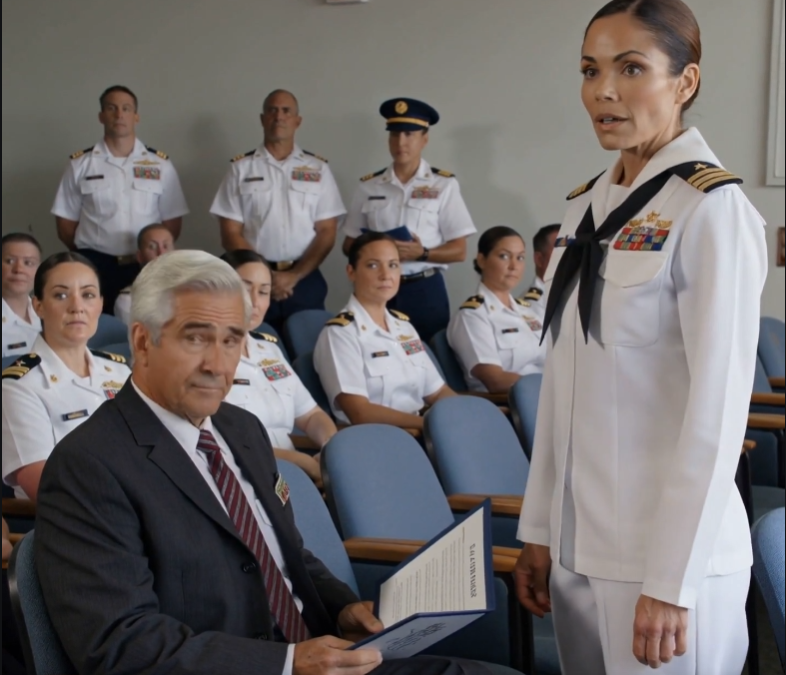
My family had four reserved seats at my ceremony. They used none. “Six hours for a ribbon? Just FaceTime us,” Mom said, already dressed for my sister’s brunch. I didn’t argue. I walked to the stage past three empty chairs. The fourth wasn’t empty. The retired admiral Mom has worked for since 2004 sat in it, holding a program with my name circled. 3 missed calls in 5 minutes.
I knew she’d be at her desk because my mother had eaten lunch at her desk at 11:30 every day since 2004.
She answered on the second ring.
“Ashley River Marine Systems, Admiral Ellery’s office.”
“Mom, it’s me.”
“Oh, Natalie.”
Her voice changed. It always did. It went from the warm office voice to something flatter.
“Is something wrong?”
“Nothing’s wrong. I have news.”
“I only have a minute. He’s got a board call at noon.”
“I was selected for promotion. The ceremony is this Saturday, here in Norfolk. Ten o’clock. I’d like you to come. I’d like all of you to come.”
There was a pause. I heard her keyboard. She was still typing while I talked.
“Saturday,” she said. “This Saturday?”
“Yes, Mom.”
“Saturday is Kelsey’s birthday.”
“I know. I’m sorry. The date was set by the admiral’s staff. I didn’t pick it.”
“We have the brunch at the harbor. I booked it in June. Twenty-two people.”
The keyboard stopped.
“It’s six hours each way, honey.”
“I know how far it is.”
“Six hours for a ribbon. Just FaceTime us. It’s Kelsey’s birthday, Nat. Thirty-eight only happens once.”
“So does this.”
I regretted it as soon as I said it.
My mother made a small sound, the sound she used to make when I was 12 and had talked back.
“Don’t do that,” she said. “Don’t make it a competition. You always make it a competition.”
“I’m not making it anything, Mom. I’m inviting you.”
“And I’m telling you we can’t. I’ll put it on the calendar. You can send us the video.”
I heard a man’s voice in the background, deep and calm. She covered the phone and said, “Yes, sir. Coming.”
Then she came back to me.
“I have to go. He needs the board packet.”
“Okay.”
“Congratulations, honey.”
“Really?”
She hung up before I could answer.
I sat in the car for a long time. The air conditioning ticked. A group of sailors in blue working uniforms crossed the parking lot, laughing about something.
An hour later, my phone buzzed.
A text from my mother.
Just send pictures.
That was all. Three words and a period.
I want to explain something about my family because otherwise none of this makes sense.
My father, Frank Coburn, was a high school chemistry teacher who loved the Navy more than anything in the world except my mother. He never served. His eyesight kept him out in 1976, and he carried that disappointment like a stone in his pocket for the rest of his life.
When I got into the Naval Academy in 2000, he cried in the driveway.
When I was commissioned in May 2004, he wore a tie with little anchors on it that he had bought for the occasion and never wore again.
My mother came to that ceremony, too. She took pictures. She told me I looked tall.
My father died of a heart attack in February 2011. He was 54. He died on a Sunday afternoon in his reading chair, with a book about the Battle of Midway open on his chest.
After that, something in my mother closed.
I don’t blame her for grieving. I blame nobody for grieving. But grief took a particular shape in our family, and that shape was this: Kelsey stayed.
Kelsey lived 15 minutes away. Kelsey came to Sunday dinner. Kelsey sold houses in Summerville and knew everybody at church.
Kelsey was the daughter who showed up, and I was the daughter who left.
Somewhere in those first years, my mother started telling people that I counted boats in an office in Norfolk.
I heard her say it at my cousin’s wedding. I heard her say it at my father’s memorial on the one-year anniversary. I heard her say it at Thanksgiving to Kelsey’s new in-laws.
And Kelsey laughed and said, “She’s basically a secretary with a sword.”
I didn’t correct them.
I had stopped arguing with my mother the year my father died. Arguing with her felt like arguing with the empty reading chair.
The refrigerator in my mother’s kitchen tells the whole story if you know how to read it.
There are photographs of Kelsey’s wedding. Kelsey’s house. Kelsey’s dog.
There is a photograph of my mother at a company Christmas party in 2016, standing beside a tall, white-haired man in a navy blazer. She has her hand on his arm. She is smiling in a way I haven’t seen her smile at me since I was a child.
Underneath it, in her handwriting on a strip of tape, are two words: The Admiral.
She has worked for him since 2004.
Retired Vice Admiral Graham Ellery. Thirty-four years in the Navy. Three stars. A destroyer captain in his day and later a fleet commander.
After he retired, he became the chief executive of a marine engineering company in North Charleston. My mother became his executive assistant.
And in 21 years, she has never once been late.
She is proud of him the way my father was proud of the Navy: completely, without reservation.
And there is one thing about the admiral that my mother doesn’t know.
He knows me.
He has known me since 2013. He knows exactly what I did with my career, and he knows exactly what happened in the spring of that year.
For 12 years, he has kept a promise I asked him to keep.
The last time I saw my family’s pattern play out was Thanksgiving, 10 months before the ceremony.
Kelsey hosted that year. She had a new house in a development called Carolina Oaks, with a kitchen island the size of a small boat and a wine refrigerator she showed to everyone who walked in.
Jeff’s parents drove down from Columbia. His father was a retired insurance executive with a golf tan. His mother wore pearls to carve a turkey.
I got there at two.
I wore a long-sleeved sweater, the way I always do at family events. It was 74 degrees outside.
We were eating pie when Jeff’s father turned to me.
“Diane tells us you’re in the Navy.”
“Yes, sir.”
“What do you do up there?”
Before I could answer, my mother laughed and touched his arm.
“Oh, Natalie counts boats in an office in Norfolk. Don’t get her started, Hal. She’ll tell you about paperwork for an hour.”
Kelsey was pouring coffee.
“She’s basically a secretary with a sword,” she said.
Everybody laughed, including Jeff’s mother, who laughed with her hand over her pearls.
Jeff didn’t laugh.
I noticed that. He looked at his plate.
“That’s not quite it,” I said. “I’m on a staff that manages the readiness of the surface ships on the East Coast. The destroyers and cruisers.”
“Readiness?” Jeff’s father repeated, nodding the way people nod at a word they have already decided not to understand. “So logistics?”
“Some of it.”
“Well, somebody has to do it,” he said kindly, and turned back to his pie.
My mother squeezed his arm.
“Now, my boss,” she said, “my boss commanded a whole fleet. Three stars. You should hear the stories he tells. He gives this speech about a fire on a ship, a lieutenant who went down into an engine room. And I swear to you, every time I type it up, I get goosebumps.”
“Every time you type it?” Kelsey asked. “How many times has he given that thing, Mom?”
“Oh, dozens. Maybe 40. He changes a word here and there, and I print it fresh.”
I put my fork down very carefully.
“That sounds like a good speech,” I said.
“It’s a wonderful speech,” my mother said. “That’s what real service looks like.”
I excused myself and went out to Kelsey’s back porch.
I stood there in the warm November air for 11 minutes. I know it was 11 because I timed it. I’ve always timed things.
When I came back inside, they’d moved on to football, and nobody asked where I’d been.
That night, driving back to Norfolk, I almost called the admiral.
I almost said, Sir, please, just this once, tell her.
I had his number. I’d had it for 11 years.
I didn’t call.
I had made the promise to myself, not just to him.
I wanted my mother to be proud of me without being told to be.
I wanted her to ask.
I thought that one day she would ask what I actually did, and I would tell her, and she would hear it from me.
In 11 years, she never asked.
That Tuesday night, I took a heavy cream envelope out of my desk drawer.
Inside was the fourth invitation.
I had printed it on the good paper. On the envelope, I wrote his home address on Wappoo Creek in Charleston.
Not the office. Never the office.
My mother opens the office mail.
I wrote a short note and folded it inside.
Sir, I would be honored if you would administer the oath. I have seated you beside my mother. I hope that is all right.
Natalie.
I drove to the blue mailbox on Colley Avenue at ten o’clock that night and held the envelope over the slot for a long time.
Then I let it go.
Saturday, September 13, 2025.
I woke at 4:50, ten minutes before my alarm, the way I’ve woken for 21 years.
I made coffee. I ironed the white coat a second time, even though it didn’t need it. I set the old shoulder boards on the kitchen table, three gold stripes with a star on a black background, and looked at them for a while.
I had worn those boards for six years. I’d worn the ones before them for five. Every set had a story, and my mother knew none of those stories.
At 7:15, I tried her on FaceTime. It rang 11 times. Nobody answered.
At 7:40, I tried again. The call rang out. A minute later, a text came through.
Getting ready for brunch. Crazy morning. Send pics later!!
Two exclamation points.
I remember that detail because my mother never uses exclamation points. She says they’re for teenagers. She used two that morning, and I understood that she was happy, and that her happiness that day had nothing to do with me.
At eight o’clock, while I was pinning my ribbons to the coat, my phone rang.
It was Jeff.
Jeff Ser is 40 years old. He’s an electrical contractor. He married my sister in June 2013 and has spent 12 years trying to be decent in a family that doesn’t always make room for decency.
We’ve never been close. He had never called me before in his life.
“Natalie. Hey, it’s Jeff.”
“Jeff? Is everyone okay?”
“Everyone’s fine. They’re doing hair.”
He lowered his voice. I could hear a blow dryer somewhere behind him.
“Listen, I just wanted to say congratulations. I looked it up, what the promotion is. That’s a big deal.”
“Thank you.”
“I told Kelsey maybe we could drive up after brunch. Get there by the reception, maybe. She said that was crazy.”
He paused.
“She said it’s her day.”
“It is her day, Jeff. It’s okay.”
“It’s not okay,” he said quietly. “I’m sorry. I should have pushed harder. I just wanted you to know somebody in this family knows what today is.”
I stood in my kitchen with a ribbon rack in my hand and didn’t trust my voice for a moment.
“Thank you, Jeff,” I said. “That means more than you know.”
“Send me a picture, okay? Just me. I’ll show her later when she’s in a better mood.”
After we hung up, I finished with the ribbons.
The Navy and Marine Corps Medal ribbon sits near the top of the rack. It’s navy blue, gold, and scarlet. Most people have never seen one.
I straightened it with my thumbnail, then rolled down the sleeve of my undershirt over my right forearm, the way I do every morning out of habit, even on days when the coat will cover everything anyway.
The scar runs from my wrist to just below my elbow. It’s shiny and pale, and it pulls a little when I make a fist.
My mother has never seen it. Not once in 12 years.
I’ve worn long sleeves through Christmas after Christmas, to Kelsey’s wedding, to my father’s memorials, and to every Fourth of July.
She never asked why I was always cold.
I drove to the base at 8:30. The protocol officer met me at the side entrance of the hall.
Her name was Lieutenant Priya Nandakumar. She was 27, had organized something like 40 ceremonies in the past year, and carried a clipboard as if it were a weapon.
“Good morning, ma’am. Everything is set. The official party is confirmed. Rear Admiral Whitfield is on her way.”
She looked down at her clipboard.
“Your guests on the reserved list. Are they here yet? I can have someone walk them in.”
“No,” I said. “They’re not coming.”
She looked at the clipboard again.
“All four, ma’am?”
“Three of them aren’t coming. I don’t know about the fourth.”
She was a good officer. She didn’t ask.
She just nodded and wrote something small beside the list.
“Ma’am, do you want me to pull the placards? Sometimes that’s easier.”
I thought about it.
I thought about 300 people walking past three empty chairs with my family’s names on them. I thought about what my father would have said.
“Leave them,” I said.
“Yes, ma’am.”
At 9:15, I checked my phone one more time in the green room behind the stage.
Kelsey had posted to her Instagram story.
I don’t know why I looked. I think part of me wanted to see my mother’s face.
The first picture was a table by the water in Charleston. A long white tablecloth, 22 place settings, and a gold balloon shaped like the number 38.
The second picture was my mother and Kelsey with their cheeks pressed together, both holding mimosas.
My mother was wearing the green dress she’d bought for Kelsey’s wedding 12 years earlier.
The caption said:
38 and thriving. Brunch with the only daughter who shows up.
Under it were three laughing faces.
I read it twice. Then I turned the phone facedown on the table and didn’t pick it up again until after the ceremony.
I want to be honest. It hurt.
It hurt the way a burn hurts after the first shock wears off, when the nerves wake up and start telling you the truth.
But I’ve learned something about hurt over the years. It doesn’t need to be answered. It just needs to be carried to the end of the day.
So I carried it.
At 9:55, Lieutenant Nandakumar opened the side door for me.
“They’re ready for you, ma’am.”
The hall was full.
Three hundred people. Sailors from my staff in their dress uniforms. Officers I’d served with on three ships. A row of chiefs near the back. Families of the other officers on the program. A few retirees in blazers with ribbons pinned to their pockets.
The room smelled of floor polish and coffee.
Everyone stood when I walked in.
That is just protocol. It isn’t about the person. I’ve stood for a hundred people I barely knew.
Twenty-two steps.
The first placard said Diane Coburn. The chair was empty.
The second said Kelsey Ser. Empty.
The third said Jeff Ser. Empty, with the placard leaning to one side.
Then the fourth chair.
I had typed that placard myself. It said, in the same plain black letters as the others:
Vice Admiral Graham Ellery, United States Navy, Retired.
He was there.
He had driven up from Charleston that morning. I found out later he’d left his house at 3:30, in the dark, alone, without a driver, and hadn’t told a single person where he was going.
He wore a dark gray suit and sat perfectly straight. He held the program open on his knee, and when I passed, he looked up and nodded to me once, the way a captain nods to an officer of the deck when the ship is in good hands.
My name on the program was circled in blue ink.
He had circled it twice.
I took the stairs. I took my place. I didn’t look at the empty chairs again.
A promotion ceremony in the Navy has an order to it, and the order doesn’t change for anybody.
First, the colors.
A color guard of four sailors marched down the center aisle with the national ensign and the Navy flag. The room held a salute while a petty officer from the band sang the national anthem without any music at all.
She had a clear, high voice that filled the hall all the way to the steel beams in the ceiling.
Then came the invocation.
The chaplain was a Lutheran commander from the Carolinas with a soft accent. He prayed for the ships at sea and the families at home.
He said, “For those who could not be here today, and for those who are here in their place.”
I don’t think he meant anything by it. It was just a line he used.
But I felt it land somewhere under my ribs.
Then came the reading of the promotion certificate.
A senior chief from my staff stepped to the microphone and read it in a loud, flat voice, the way chiefs read everything.
“To all who shall see these presents, greeting. Know ye that, reposing special trust and confidence in the patriotism, valor, fidelity, and abilities of Natalie Vance, I have nominated, and by and with the advice and consent of the Senate, do appoint her…”
He read the whole thing.
It takes about a minute. It is the same wording for every officer in the Navy, and it still makes the hair on my arms stand up, even the arm with the scar.
I stood at attention through all of it.
And during all of it, I watched the front row without moving my eyes.
That’s a skill they teach you during your first summer at the Naval Academy. You learn to see the whole room while looking at one fixed point on the far wall.
Three empty chairs. One man reading.
Rear Admiral Sharon Whitfield presided. She had been my commander for two years. She isn’t a warm speaker, and she knows it, and she doesn’t pretend otherwise.
She stood at the podium and read my biography exactly as it was written in the program, without any adjectives.
“Commander Vance graduated from the United States Naval Academy in May 2004 with a degree in mechanical engineering. She has served aboard three destroyers and one cruiser. She served as the engineer officer of USS Carol from 2012 to 2013. She has served on the staffs of Destroyer Squadron 22 and Commander, Naval Surface Force Atlantic. Her personal awards include the Meritorious Service Medal, the Navy and Marine Corps Medal, and the Navy and Marine Corps Commendation Medal.”
Three hundred people listened politely.
Most of them didn’t know what the Navy and Marine Corps Medal is. It’s awarded for heroism that doesn’t involve direct combat with an enemy.
It isn’t a medal people talk about.
That suits me fine.
On the back page of the program was a short section called Acknowledgments. Every officer being promoted writes one.
Mine was four lines long.
To the crew of USS Carol, who taught me what a ship is.
To Master Chief Raymond Toiver, who taught me what a chief is.
To my father, Frank Coburn, who taught me to love the Navy before I ever saw it.
And to my mother, Diane Coburn of Summerville, South Carolina, who taught me to never be late.
I had written that last line in August, when I still thought she might come.
I watched Admiral Ellery turn the page. I watched him read it.
His hands stopped.
It was a small thing. Nobody else in the room saw it, but I did, because I was facing him and because I’d spent 21 years learning to notice when a senior officer’s hands stopped moving.
He read the last line. Then he read it again.
Then he looked at the empty chair to his right, the one with my mother’s name on it.
He looked at it for a long time.
Then he looked up at me.
He knew.
In 12 years, he had never connected the two things.
He knew the lieutenant from Main Engine Room Two as Natalie Vance, my married name, the name I’d kept after my divorce because it was the name on every set of orders I’d ever received.
He knew his assistant, Diane Coburn.
He knew, because she’d told him many times, that Diane had an older daughter in Norfolk who pushed paper for the Navy.
He had never put those three things on the same table.
He put them on the same table now.
Admiral Whitfield turned to him.
“It is Commander Vance’s request that her oath of office be administered by Vice Admiral Graham Ellery, United States Navy, Retired. Admiral?”
He stood.
He walked up the stairs slowly, one hand on the rail. He stopped beside me, and then, instead of taking his place for the oath, he turned to Admiral Whitfield.
“Admiral, with your permission, I’d like two minutes before the oath.”
It wasn’t on the program.
Admiral Whitfield looked at me. I didn’t know what he was going to say. I nodded anyway.
“Two minutes, sir,” she said.
He stepped to the podium.
He didn’t take any notes out of his pocket. He didn’t need them.
He put both hands on the sides of the podium and looked out at 300 people.
“I have given a speech about leadership in something like 400 rooms,” he said. “Boardrooms, wardrooms, graduations, the Naval War College. A few of you here have heard it. It’s about an engineering casualty aboard a destroyer in the Arabian Sea on the ninth of March, 2013.”
The hall became very quiet.
At the back, a chair creaked.
“At fourteen minutes past two in the morning, a fuel oil line failed in Main Engine Room Two. Fire. Nine sailors were in that space. The ladder to the upper level was burning.”
He paused, and when he continued, his voice was steady.
“The standard procedure, the one we all learned, was to evacuate what you can, seal the space, and flood it with suppressant. The engineer officer was a lieutenant, 30 years old. She had the authority to seal that space.”
He paused again.
“She didn’t seal it. She went down the escape trunk with a hose team and a breathing apparatus. And for fourteen minutes, she held that fire back with her own body while her sailors came up past her, one at a time.”
“All nine came out. Nine.”
He let the number hang in the silence.
“She came out last. The report says she went back in once. The report is wrong.”
He looked toward the back of the hall.
In the last row, a heavy man in a navy blazer with a gray beard slowly stood up. He was 61 years old. His hands were shaking.
I hadn’t known he was there.
I had sent him an invitation, too, and he’d never answered it.
Master Chief Raymond Toiver.
“She went back in twice,” the admiral said. “The second time was for that man.”
People turned in their seats to look at him.
The Master Chief didn’t sit down.
“I chaired the Navy’s independent review of that fire,” the admiral continued. “I interviewed that lieutenant for six hours. At the end of it, she asked me for one thing. She asked me never to use her name when I told the story. She said it was nine sailors, not one lieutenant.”
He looked across the room.
“So, for twelve years, I have told it 400 times, and I have called her the lieutenant in Main Engine Room Two.”
He turned his head and looked at me.
“I have never once said her name because she asked me not to.”
Then he said, “Today, I’m going to disobey a lieutenant.”
Somebody in the chiefs’ row laughed quietly. It was a warm sound.
“Nine sailors. Fourteen minutes. Lieutenant Natalie Vance.”
He stepped back from the podium.
For a moment, nobody moved.
Then the chiefs in the back row stood. Then my staff stood. Then everyone was standing.
I stood there in my white coat with my hands at my sides, and I didn’t know where to look.
So I looked at the one thing in the room I couldn’t stand to look at.
Three empty chairs.
The admiral saw where I was looking.
He didn’t follow my eyes.
He just stepped beside me, raised his right hand, and waited until I raised mine.
“Repeat after me,” he said.
His voice was completely steady.
“I, Natalie Vance, do solemnly swear…”
“I, Natalie Vance, do solemnly swear…”
I said the whole oath.
I’ve said it five times in my life. I’ve never said it more slowly.
The rest happened the way it always happens.
Admiral Whitfield read the order. A senior chief handed the admiral the small blue box.
He took out the new shoulder boards, four gold stripes on black, and stood there holding them for a moment while the photographer crouched in the aisle.
Normally, a family member pins them on. A mother, a husband, a child. That’s the tradition.
The protocol office had written it into the script weeks before, with my mother’s name in the blank.
The admiral looked at the empty chair one more time.
Then he unbuttoned the old board on my left shoulder himself, with his own old fingers, slowly, the way you would handle something that might break.
Admiral Whitfield did the right side.
They buttoned the new ones on at the same time.
“Captain Vance,” Admiral Whitfield said. “Congratulations.”
The room applauded.
I shook hands. I said the things you say.
I thanked my staff and my old shipmates. I thanked the crew of USS Carol. I thanked Master Chief Toiver by name, and he stood in the back row with his big arms crossed, his chin up, and tears running down into his beard.
I didn’t mention my family.
There was nothing I could have said that wouldn’t have sounded like an accusation, and I’ve never believed a promotion ceremony is the place for one.
The reception was in the lobby outside the hall.
Sheet cake, coffee in steel urns, and punch in a glass bowl that nobody touched.
There is always a line to shake hands with the person being promoted. I stood at the head of it for 35 minutes.
The admiral didn’t get in line.
He stood off to the side near a window with a paper cup of coffee he never drank. He watched me, and he waited.
When the line finally thinned, he walked over.
Up close, he looked older than he had onstage. The skin around his eyes had gone soft and creased.
“Captain,” he said.
“Sir, thank you for coming. Thank you for all of that. You didn’t have to.”
“I had to.”
He held up the program. It was folded open to the back page, to the acknowledgments.
He put one finger under the last line.
“Diane Coburn of Summerville.”
“Yes, sir.”
“My Diane?”
“Yes, sir.”
He looked at me for a long time without saying anything.
Then he said, very quietly, “Twenty-one years that woman has sat outside my door. Twenty-one years. She knows how I take my coffee. She knows my grandchildren’s birthdays.”
He looked down at the program.
“She typed that speech. You understand me? She typed it. Every draft.”
“I know, sir.”
“You knew.”
It wasn’t a question.
“You’ve known since the review.”
“Since the second day of the review, sir. I saw her name on the cover letter. Prepared by D. Coburn. And I remembered the photograph on her refrigerator.”
“And you said nothing to her or to me.”
“No, sir.”
“Why?”
I had rehearsed this answer for 12 years. In my car. In the shower. On the bridge wings of three ships at night.
It came out simpler than I had ever rehearsed it.
“Because I wanted her to be proud of me because I was hers, sir. Not because you were.”
He closed his eyes for a second.
When he opened them, he took his phone out of the inside pocket of his suit coat.
It was an old phone with a cracked corner and the font set very large.
“Sir,” I said. “You don’t need to do that.”
“Captain, with respect, you have given me my last order today. I disobeyed the first one already.”
He pressed a name at the top of his favorites.
I saw it on the screen.
Diane — Office Cell.
It rang.
We both heard it ring through the little speaker. Four times. Five. Six.
Then her voicemail answered in her office voice.
“You’ve reached Diane Coburn, executive assistant to Vice Admiral Graham Ellery. I’ll return your call as soon as possible.”
He hung up without leaving a message.
He looked at his watch and dialed again.
It rang out.
Around us, the reception was still going. A lieutenant from my staff was cutting the sheet cake. Someone’s toddler was running in circles around the punch bowl.
Master Chief Toiver had made his way to the front of the lobby. He stood a few feet away, very still, listening.
The admiral dialed a third time. His jaw was tight.
Six rings. Voicemail.
“It’s Saturday,” I said. “She’s at a brunch. It’s loud. She probably can’t hear it.”
“She can hear it.”
He looked at the phone.
“Diane has answered my calls at three in the morning. She answered my calls the week her husband died. She answered when she had the flu. She is looking at that phone right now and deciding that whatever I want on a Saturday can wait until Monday.”
He was right.
I found out later exactly how right he was.
At the brunch in Charleston, at a long table by the harbor, my mother’s phone lay facedown beside her plate.
It buzzed at 11:42. It buzzed at 11:44. It buzzed at 11:46.
Kelsey reached over, turned it over, and read the name aloud to the whole table.
“Oh my God, Mom, it’s the admiral on a Saturday. Tell him you’re off the clock.”
Everyone laughed.
My mother laughed, too.
“Three times, though,” she said. “That’s not like him.”
“He’s probably lost his reading glasses again.”
She turned the phone back over.
Three missed calls in five minutes.
The fourth time, he didn’t use the office cell.
He called her personal number.
The one I didn’t know he had. The one she’d given him the week my father died in 2011 and told him to use only for emergencies.
She picked up on the first ring.
I could hear the brunch through the phone. Glasses clinking. A woman laughing. Music, something from the eighties, playing too loudly.
“Admiral? Is everything all right? Are you all right?”
“Diane, it’s Graham.”
He didn’t put her on speaker. He didn’t have to. He kept his voice low and even, and I heard every word.
“Where are you?”
“I’m at Kelsey’s birthday at the harbor. Sir, what’s wrong? Did something happen at the office?”
“Nothing happened at the office.”
“Then what is it? You scared me half to death. Three calls.”
He looked at me. He looked at the new shoulder boards. Then he looked at the program in his other hand.
“Diane,” he said. “I am standing next to your daughter.”
There was nothing on the line for a moment but the eighties song.
“Kelsey’s right here, sir,” my mother said slowly. “She’s sitting next to me.”
“Your other daughter.”
Another silence.
The music on her end seemed to get quieter, then quieter again. I understood that she was walking away from the table, through a door, and out onto some deck or sidewalk by the water.
“Natalie,” she said.
Her voice had gone thin.
“Why is Natalie with you? Where are you?”
“I’m in Norfolk, Diane. At her promotion. I’ve been here since ten.”
“You’re…”
She stopped.
“Sir, I don’t understand. How do you even know Natalie?”
The admiral closed his eyes again.
When he spoke, it was gentle. It was the gentlest thing I’d ever heard a flag officer say.
“Diane, do you remember the speech? The lieutenant in Main Engine Room Two?”
“Of course I remember it. I typed it.”
She stopped.
She didn’t finish.
“Diane,” he said. “It’s her.”
I heard my mother make a sound I’d never heard her make.
It wasn’t crying. It was smaller than crying. It was the sound of somebody who has missed the last step on a staircase in the dark.
The admiral held the phone out to me.
I took it and held it to my ear.
I could hear her breathing, fast and shallow. I could hear seagulls behind her and traffic.
And somewhere far off, my sister was calling, “Mom! Mom! The cake is coming out!”
“Hi, Mom,” I said.
That was all I said. I didn’t say anything else.
I didn’t need to.
Twelve years of words were sitting in my chest, and not one of them needed to come out right then.
“Natalie,” she whispered. “Natalie, why didn’t you tell me?”
I thought about the Tuesday phone call. The keyboard clicking while I talked. The text.
Just send pictures.
“You didn’t ask, Mom,” I said. “I’ll send pictures.”
I handed the phone back to the admiral and walked across the lobby to Master Chief Toiver.
And I let him hug me.
In 21 years of service, I had never once let a master chief do that.
By 1:30, the lobby was empty.
The caterers had taken the urns. Lieutenant Nandakumar had collected the placards from the front row and stacked them on the edge of the stage, faceup, with my mother’s name on top.
She didn’t say anything about it. She just left them there for me.
The admiral, the Master Chief, and I sat in the front row of the empty hall.
The admiral sat in my mother’s chair.
I don’t think he noticed.
“Tell me the part I don’t know,” he said to the Master Chief. “You said the report was wrong.”
The Master Chief rubbed his big hands together.
He was a machinist’s mate by trade. He’d spent 30 years in engine rooms. He retired in 2018 and now ran a small engine repair shop outside Virginia Beach.
He wasn’t a man who told stories.
“The report says she went back in once, sir,” he said. “That’s because nobody else was alive down there to see the second time except me, and I was unconscious when I got interviewed the first time. By the time I could talk, the report was signed.”
“Go on.”
“March ninth. Oh-two-fourteen. I was the top watch in Main Two. The fuel line let go over the number two main engine, and it just…”
He opened his hands.
“It just lit like somebody opened a door to the sun. The upper ladder was gone in about forty seconds. We had nine people on the lower level. We had one way out, the escape trunk, and the escape trunk was right under the fire.”
I sat very still.
I’d heard this story many times in my own head. I’d never heard it in someone else’s voice.
“The procedure says if the space is lost, you seal it and flood it,” the Master Chief went on. “We all knew that. The officer of the deck on the bridge was already asking for permission. And the chief engineer comes down the escape trunk with a hose team behind her and a breathing mask on, and she keeps that fire off the trunk with a hose for fourteen minutes.”
He shook his head.
“Fourteen minutes, sir. Sending people up past her. One, two, three. Counting out loud. I could hear her counting.”
“Eight,” I said quietly. “I counted eight.”
“Eight,” he agreed. “Because the ninth was me, and I was on the deck behind the number two engine with a broken ankle and a lung full of smoke.”
He looked at the admiral.
“Everybody was out. She could have come up. The hose team was yelling for her. And she handed the nozzle to a second class, and she went back into the dark. She found me by my boots and dragged me forty feet. Two hundred and twenty pounds of me.”
He nodded toward my right arm.
“That’s how she got the arm.”
The admiral looked at my right sleeve.
“The report says one entry,” he said.
“The report was written by people who weren’t there, sir, begging your pardon.”
“Including you.”
“Including me,” the admiral said. “Yes.”
I remember what the burn center in San Antonio smelled like. Antiseptic and something sweet.
I was there five weeks.
My husband then, Daniel, flew out and stayed the whole time. He was the one the Navy called because he was my next of kin. He was the one who called my mother.
She didn’t come.
I don’t say that to make her a villain. Kelsey’s wedding was in June, and my mother was in the middle of it. Caterers, flowers, a dress fitting.
When I finally called her myself, three weeks in, when I could hold a phone again, I told her there’d been a fire aboard the ship and I’d been hurt, but I was going to be fine.
She was quiet for a moment.
Then she said, “Well, honey, you chose boats.”
Then she asked if I’d still be able to be in the wedding because the bridesmaids’ dresses were sleeveless.
I was in the wedding.
I wore a long-sleeved wrap over the dress. It was 91 degrees in Charleston.
Kelsey told me I looked like a nun.
In October of that year, the Navy convened an independent review of the USS Carol fire.
The Chief of Naval Operations asked a retired three-star admiral to chair it because a retired officer has no career left to protect.
I was called to testify on the second day.
I walked into a conference room in Norfolk and sat across a long table from Vice Admiral Graham Ellery.
The cover of the binder in front of him said, at the bottom in small type:
Prepared by D. Coburn.
I knew the handwriting on the sticky notes inside it.
I’d known that handwriting my whole life. I’d watched it write my name on my lunch bags.
I testified for six hours.
At the end of it, when the recorder was off, the admiral said, “Lieutenant, I want to use this. Not the report. I mean, I want to tell people what you did. Young officers need to hear it.”
And I said, “Sir, please don’t use my name. It was nine sailors, not one lieutenant.”
He looked at me for a long moment.
Then he said, “All right. You have my word.”
I never told him why I was really asking.
Now, 12 years later, in an empty hall, he took off his glasses and rubbed his eyes with his thumb and forefinger.
“I’ve been standing next to her mother for twenty-one years,” he said.
“I know, sir.”
“She cried the first time she typed it. Did you know that?”
I looked at him.
“She came into my office with the draft, and she was crying. She said, ‘Sir, I hope that young woman’s family knows what they have.'”
I didn’t know that.
I hadn’t known that.
I looked down at my hands.
“Captain,” the Master Chief said very gently. “Your phone.”
It was buzzing on the chair beside me.
I turned it over.
Seven missed calls from my mother. Four texts from Kelsey. One from Jeff.
I read Jeff’s first.
She just left. Walked out in the middle of the cake. Took her keys. I think she’s driving to you.
Kelsey’s texts came in order, and I read them in order.
Where are you?
Mom just walked out of my birthday. On my birthday.
Natalie, seriously? You planned this. You always have to make it about you every single time.
Congratulations. You win.
I read them standing in the parking lot beside my car, in my white uniform, with the new shoulder boards catching the afternoon light.
I read them twice.
I didn’t answer them. There was nothing I could write that she would read the way I meant it.
I did answer Jeff.
Thank you for telling me. Please make sure she stops for gas and coffee. She won’t want to.
He wrote back one word.
Already did.
The admiral and the Master Chief walked me to my car.
The admiral had a six-hour drive home ahead of him, and he refused to let anyone drive him.
The Master Chief offered twice.
The admiral said, “Raymond, I commanded a fleet. I can command a Buick.”
Before he got in, he turned to me.
“She’s going to come to your door tonight,” he said. “Whatever she says, Captain, listen to it all the way to the end before you answer. She’s a woman who has never once in twenty-one years finished a sentence she was ashamed of. Let her finish this one.”
“Yes, sir.”
“And Natalie…”
It was the first time in 12 years he’d used my first name.
“Your father would have worn the tie.”
I didn’t ask how he knew about the tie.
I think my mother must have told him. Sometime in the last 21 years, in some quiet moment outside his door, I think she told him more about me than she ever told me.
I went home.
I live in a small brick house in the Ghent neighborhood of Norfolk, with a porch that faces west and a crape myrtle that drops pink petals onto the steps from July through September.
I hung the white coat on the back of the bedroom door. I put on jeans and a T-shirt.
For the first time in 12 years, I put on a short-sleeved shirt with no plan to cover it.
Then I sat on the porch and waited.
My mother called 11 more times that afternoon.
I didn’t answer.
That wasn’t cruelty. I knew that if I answered, she would start explaining over the phone while driving on Interstate 95, and she would say the wrong things in the wrong order, and we’d both hang up worse than before.
The admiral was right.
Some sentences need to be finished face-to-face.
At 9:40 that night, headlights turned onto my street.
My mother’s car is a silver sedan she’s driven for nine years. It came down the block very slowly, the way you drive when you’re reading house numbers in the dark.
It stopped at the curb.
The engine turned off.
For almost two minutes, nobody got out.
Then the door opened, and my mother stepped onto the sidewalk.
She was still wearing the green dress from Kelsey’s brunch. It was wrinkled from six hours in the driver’s seat. Her hair had come loose on one side.
She was holding her purse in one hand and a thick manila folder in the other, pressed against her chest the way a schoolgirl holds books.
She stopped at the bottom of the porch steps and looked up at me.
She looked at my face.
Then her eyes went down to my right arm, bare in the porch light, and stayed there.
“Hi, Mom,” I said.
“Natalie.”
Her voice cracked on the second syllable.
She didn’t come up the steps.
“Natalie, I went to the office.”
“What?”
“Before I got on the highway, I drove to the office. I have a key.”
She held up the folder.
“I needed to see it. I needed to see if I was remembering it right.”
She came up two steps and held the folder out to me with both hands.
I took it.
It was heavy.
Inside were printed pages, dozens of them. Each one was a version of the same speech.
The title at the top of every first page was the same.
The Lieutenant in Main Engine Room Two.
Remarks by Vice Admiral Graham Ellery, United States Navy, Retired.
And then a date and a place.
The Naval Academy. November 2013.
A shipyard in Mississippi.
A college in Ohio.
The Naval War College.
A Rotary Club in Mount Pleasant.
A graduation. Another graduation. Another graduation.
“Forty-one,” my mother said. “I counted them in the parking lot. I keep a copy of every speech he gives. I have a whole drawer. Forty-one times I typed that speech. I fixed his commas. He always puts the commas in the wrong place.”
She was crying now, not loudly.
Her face was just wet.
“The first time I typed it, I cried at the part about the ladder,” she said. “I cried about a stranger. I went into his office and I told him, ‘I hope that young woman’s family knows what they have.'”
She looked at me.
“I cried about a stranger, Natalie. And the whole time it was you.”
I turned the pages.
On one of them, in the margin, in my mother’s handwriting, was a small penciled note beside the paragraph about the second trip down the trunk.
It said:
Brave girl.
I closed the folder.
“You didn’t have to know it was me to be proud of me, Mom,” I said. “That was the whole thing. That’s all I ever wanted. For you to ask.”
She tried to say something and couldn’t.
Her knees seemed to give a little, and she sat down on the top step of my porch, right there in her green dress, with her purse in her lap.
She sat down because her legs wouldn’t hold her anymore.
I sat down beside her.
We sat there for a long time.
The crape myrtle dropped a petal onto the folder. A car went by with its windows down, playing something with a lot of bass.
“Can I see it?” she finally asked.
She was looking at my arm.
I held it out to her in the porch light, palm up.
She didn’t touch it at first.
She just looked at it, the whole length from the wrist to the elbow, the way you would read a page you were afraid of.
Then she put two fingers on it very lightly, the way she used to check my forehead for a fever when I was small.
“Does it hurt?”
“Not anymore. It pulls when I make a fist.”
“All those long sleeves,” she said. “Every Christmas. Kelsey’s wedding. I thought you were just always cold.”
“I know.”
“I never asked.”
“I know, Mom.”
We went inside a little after 10:30.
I made tea.
My mother sat at my kitchen table and looked around as if she’d never seen my kitchen before.
And I realized she hadn’t.
She had never been to this house. I bought it in 2020. I had invited her to Thanksgiving here twice. Both years, she went to Kelsey’s.
At midnight, over the second cup of tea, she started talking.
And I did what the admiral told me.
I let her finish.
“When your father died,” she said, “I thought I was going to die, too. You know that. You were there for the funeral, and then you went back to your ship, and Kelsey stayed.”
She looked down into her tea.
“Kelsey came over every day. She brought me soup. She slept on the couch for a month.”
“I know. I’m glad she did.”
“And you were so far away. And your father…”
She stopped and pressed her lips together.
“Your father loved you so much, Natalie. The Navy. The academy. He used to talk about you at dinner like you were a ship he’d built.”
She drew a breath.
“I’m not proud of this. I was jealous of my own daughter. He had this whole world with you that I was never part of. And then he was gone, and you were still in it, and I wasn’t.”
I didn’t say anything.
I put my hand around my mug and held it.
“So I made it small,” she said. “Do you understand? I made your world small. Counting boats. Paperwork. If what you did was paperwork, then he didn’t love something I couldn’t understand.”
Her fingers tightened around the cup.
“And then, when you got hurt, when Daniel called me and said burn center, I was in the middle of the wedding, and I didn’t go.”
Her voice broke badly on the word go.
“I didn’t go, Natalie. My daughter was burned, and I stayed home and picked out napkins.”
She was quiet for a moment before she continued.
“And every year after that, it was easier if you were small. Because if you were small, then I didn’t miss anything that mattered.”
The kitchen was very quiet.
The refrigerator hummed.
“That’s the truth,” she said. “That’s the whole ugly truth. I’ve been telling people you count boats for twelve years so I wouldn’t have to know what I missed.”
I waited the way the admiral had told me to.
I waited to make sure she was finished.
She was finished.
“Mom,” I said, “this was never about the ribbon. I don’t care about the ceremony. I’ve been promoted five times. I’ll probably never be promoted again. It was never about the boards on my shoulders.”
I turned my right arm over on the table between us.
“It was about being erased by the person I most wanted to see me.”
“I know.”
“Kelsey called me a secretary with a sword at Thanksgiving, in front of people, and you laughed.”
“I know. I know I did.”
“And on Tuesday, when I called to tell you, you were typing while I talked.”
She closed her eyes.
“I was typing his board packet,” she said. “I was typing his board packet while my daughter told me she’d been made a captain in the United States Navy, and I told her to send pictures.”
We sat there.
It was nearly one in the morning.
“What happens now?” she asked. “At the office Monday. What do I say to him?”
“I don’t know, Mom. I think you tell him the truth. He’s good at hearing it.”
She drove home on Sunday afternoon.
She called me on Monday at 11:30, from her desk, on her lunch break.
“He called me into his office at nine,” she said.
Her voice was steady, but I could hear that she’d been crying earlier.
“He closed the door. He’s never closed the door with me in twenty-one years. I thought he was going to fire me. I had a box in my car. I brought a box, Natalie.”
“What did he say?”
“He said, ‘Diane, sit down.’ And I sat. And he said, ‘I’m not going to fire you. You’re the best assistant I ever had, and I’ve had eleven, and three of them were lieutenant commanders.'”
She gave a small, unsteady laugh.
“And then he said…”
She stopped, laughing a little through the tears still caught in her voice.
“He said, ‘You don’t owe me an apology. You owe her a trip.’ And he told me to take Friday off. And every Friday I ask for, for as long as I work for him.”
“Mom,” I said. “What about Kelsey?”
She was quiet for a long moment.
I heard the office door close on her end.
“She won’t talk to me,” she said. “She says I ruined her birthday. She says I chose you.”
“You didn’t choose me. You just came.”
“I know. I told her that. She said, ‘You never drove six hours for me.’ And I said, ‘Kelsey, honey, you live fifteen minutes away.'”
My mother made a sound that was half a laugh and half something else.
“That didn’t help.”
“No, I don’t imagine it did.”
“She thinks you set it up. The admiral, the seat. She thinks you did it to shame me.”
I looked at the placards Lieutenant Nandakumar had left on the stage for me.
I had brought them home.
They were on my desk, all four of them, in a neat stack.
“I did put him beside you, Mom,” I said. “That part’s true. I thought if you were sitting next to him when he heard my name, you’d finally see it. I didn’t think you’d leave the chair empty.”
“Neither did I,” she said quietly. “Until I did.”
“Tell Kelsey the truth, then. All of it. Tell her I wanted you there. Not him. You.”
“I’ll try,” she said. “She’s not ready to hear it.”
“Then tell her when she is.”
Gail Fenwick, the office manager, had seen my mother come out of the admiral’s office. My mother told me that, too.
Gail hugged her in the copy room and said, “Honey, I always wondered why that speech made you cry so hard.”
Three weeks later, my mother came back.
It was Sunday, October 5.
She had driven up on Friday, the first of the Fridays the admiral had given her, and stayed at a hotel near the base because she said she didn’t want to be a burden.
On Sunday morning, she came to my house with a box of pastries from a bakery in Charleston. She had carried them in her lap for six hours so they wouldn’t get crushed.
Master Chief Toiver came, too.
So did his wife, Bernadette, a retired Navy nurse with a laugh you could hear from the end of the block.
I had asked them to be there.
I wanted someone in the room who had been in Main Engine Room Two. And I wanted someone in the room who could keep my mother talking if the silence got too long.
We did it in my kitchen.
There was no hall, no program, no 300 people. Just the four of us, the pastries, and the September light that was already turning into October light through the window over the sink.
I put the white coat on.
My mother had asked me to.
“I want to see it the way I should have seen it,” she said.
The new shoulder boards were already on, but I took the left one off and handed it to her.
“There’s a tradition,” I said. “A family member pins them on. The admiral did it for you. I think he’d want you to have a turn.”
She held the board in both hands.
She looked at the four gold stripes and ran her thumb over them.
“Your father would have worn the tie,” she said.
“That’s what the admiral said.”
She looked up, surprised.
Then she smiled. A small, sad smile.
“I told him about that tie years ago, at a Christmas party. I told him about my husband and his anchor tie. I must have told him about you then, too.”
She shook her head.
“I must have told him about you a hundred times, Natalie. I just never told him anything true.”
She buttoned the board onto my left shoulder.
Her fingers weren’t steady. It took her three tries.
The Master Chief didn’t help her, and he didn’t look away.
When she finally got it, he said very softly, “Well done, ma’am.”
Then she stepped back and looked at me.
She started to cry again.
This time, she didn’t stop to wipe her face.
“I’m sorry,” she said. “I’m going to say it right, the way I practiced it in the car.”
She drew a breath.
“I’m sorry I told people you counted boats. You didn’t count them. You were bringing them home.”
Her voice trembled, but she kept going.
“I’m sorry I didn’t come to San Antonio. I’m sorry I made you wear long sleeves in July. I’m sorry I typed that speech forty-one times and never once asked my own daughter what she did for a living.”
She looked directly at me.
“And I’m sorry about Tuesday. I’m sorry I was typing.”
It was specific.
That was what mattered.
It wasn’t a general sorry, the kind you say to make a moment end. It was a list, and every item on it was something I had carried.
And she named every one.
“I accept it, Mom,” I said. “I do. But I need to tell you something, and I need you to hear it all the way through.”
“All right.”
“You don’t get to tell my story anymore. Not to Kelsey’s in-laws. Not at church. Not to anyone. You get to hear it. If someone asks what I do, you can say, ‘Ask her.’ And then you can listen to what I say. That’s the deal.”
She nodded.
She nodded several times.
“Ask her,” she repeated. “I can do that.”
Bernadette Toiver put a hand on my mother’s back.
“Diane, I have been married to a chief for thirty-six years. Asking is the whole job. Come sit down and have a pastry, and ask me anything.”
My mother laughed through her tears, sat down, and asked Bernadette about the nursing school she’d attended.
The Master Chief winked at me over her head.
I want to be honest about what this cost because I think stories like mine are sometimes told as if everything gets fixed at the end.
Not everything got fixed.
Kelsey didn’t come to my kitchen that day.
She didn’t come the next month, or at Thanksgiving, which my mother spent with me in Norfolk for the first time.
Kelsey told my mother that I had humiliated her on her birthday on purpose.
She told her that I had invited the admiral to make a point. She said I’d taken her mother away from her in front of 22 people, right in the middle of the cake.
In November, she blocked my number.
I wrote her one letter on paper and mailed it to the house in Carolina Oaks.
I told her I was sorry the day had hurt her. I told her I hadn’t planned for it to happen that way, and that was true.
I told her that the thing I’d wanted most in my life was for our mother to see me, and that I understood better than she might think what it feels like to watch our mother look past you.
She never answered it.
Jeff still texts me now and then.
A picture of the dog. A picture of a sunrise over the marsh.
Once in February, he sent a picture of Kelsey from behind, sitting on their back porch, with a message that just said:
She kept your letter. It’s in her nightstand. Give it time.
So I’m giving it time.
But I got my mother back, and I lost my sister, and I won’t pretend that the first thing doesn’t cost the second.
Both things are true.
I’ve learned to carry two true things at once.
The Navy taught me that.
So did the fire.
On the refrigerator in my mother’s kitchen in Summerville, there are two photographs now where there used to be one.
The first is still her and the admiral at the Christmas party, with the strip of tape that says The Admiral.
The second is me in my white coat, in my kitchen, with my mother standing beside me, holding the left shoulder board.
Under it, on a new strip of tape, in her handwriting, it says:
Captain Natalie Vance. Ask her.
In June 2026, I took command of a destroyer squadron in Norfolk.
A squadron is a group of ships. Mine is six destroyers.
Every one of them has a Main Engine Room Two.
I walked down into every one of those engine rooms during my first week aboard. I stood there in the heat and the noise, looked at the escape trunk, and said a quiet thank-you that I never say out loud.
The change of command was on a pier under an awning, with the ships moored behind us and the flags snapping in the wind off the Elizabeth River.
There were 200 people in white folding chairs.
The front row on the left was reserved for family.
My mother sat in the first chair.
She wore a navy blue dress, and on the collar she wore a small gold anchor pin that had been my father’s, clipped from the end of the tie he wore to my commissioning.
Beside her sat Vice Admiral Graham Ellery, retired, in his dark gray suit.
Beside him sat Master Chief Raymond Toiver and Bernadette.
Jeff came alone and sat at the end of the row.
When I caught his eye, he raised his hand a few inches off his knee and put it back down.
There was one more chair in that row with a placard on it.
Kelsey Ser.
It was empty.
I had asked the protocol office to leave it that way.
I will keep leaving it that way at every ceremony for as long as I serve.
Not as a reproach.
As a door that stays open.
When the ceremony was over and the crowd had moved toward the reception tent, my mother came and stood beside me at the edge of the pier.
The wind was pulling at her hair.
“Can I ask you something?” she said.
“Always.”
“What’s it like down there in the engine rooms? I’ve typed about it forty-one times, and I’ve never asked you what it’s like.”
So I told her.
I told her about the heat and the sound, like standing inside a jet engine. I told her about the smell of fuel oil and hot steel, and the way the whole ship hums up through the soles of your boots.
I told her about the young sailors who stand watch down there at three in the morning when the rest of the ship is asleep.
I told her about the nine.
She listened to all of it.
She didn’t look at her phone once.
If my story has taught you anything, I hope it’s this.
You don’t have to announce who you are to be worth something. The truth has a way of arriving on its own, in its own time.
Sometimes through the one person you never expected to carry it.
The strongest thing I ever did wasn’t in that engine room.
It was letting the truth arrive on its own and being there with my arms open when it finally did.
And if there is someone in your life whose world you’ve made small because it was easier than admitting what you missed, it isn’t too late to ask them.
It’s never too late to ask.
If this story moved you, please share it with someone who needs to hear it today. Maybe someone who has served. Maybe someone who has been overlooked by the very people who should have seen them first.
I’d love to hear from you in the comments. Has someone in your family ever looked past what you did? Or have you been the one who finally asked?
Tell me your story. I read them.
And if you’d like more stories about courage, justice, and hope, please subscribe so you never miss the next one.
Thank you for listening, and thank you for staying with me until the end.
It means more than I can say.
The end.








