My coworker claimed my work as his own at the celebration dinner. I stayed silent—until the client asked about the core data engine. I pointed at him: “Ask him.”
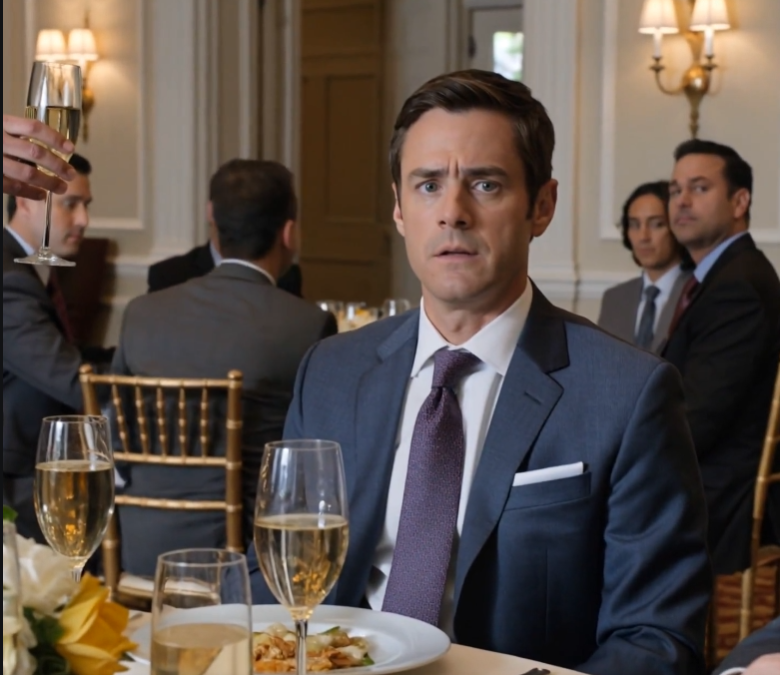
At the company celebration dinner, my coworker accepted praise for the system I had built. I stayed quiet until the client asked him one question he couldn’t answer.
“What was the thinking behind the core data dispatch engine?” the client asked. “Our engineering team wants to understand how you solved consistency under heavy concurrent traffic.”
The room went silent. The coworker who had stolen my work turned white. I lowered my glass, pointed at him, and said, “You should ask him.”
The spotlight shone on the stage at the front of the ballroom. Victor Crane, Northstar Technologies’ executive vice president, stood beneath it with a microphone in one hand and a smile bright enough to sell a dozen bad ideas.
“Landing the Horizon Systems contract would have been impossible without Jason Crane,” Victor announced. “He worked late for a month, rebuilt the proposal more than a dozen times, and never once complained. That kind of dedication is what makes Northstar great.”
Applause rolled across the ballroom. I stood beside a marble column with a champagne flute in my hand, watching Jason accept the microphone with practiced humility.
“I’m grateful to the company for believing in me,” he said. “And I want to thank Mr. Crane for his trust and guidance.”
Maya Torres, the engineer whose desk was beside mine, leaned toward me and lowered her voice.
“Ethan, you built that entire system,” she whispered. “He didn’t change a single line before presenting it. Are you really going to let this go?”
I smiled and said nothing.
My name is Ethan Miller. I had worked at Northstar for three years as a senior systems engineer. In plain English, I was the person who did the most work and received the least attention.
Jason had joined a year after me. He knew how to make himself visible. He laughed at the right jokes, stayed close to the executives, volunteered whenever a camera was nearby, and somehow appeared at every crucial moment with a polished answer.
The Horizon proposal had cost me three sleepless nights. I designed the architecture, built the code framework, wrote the test cases, and ran the performance simulations. Jason had corrected a few typos in the final document. The next morning, he told the department that he had led the project.
I had been debugging another module when I heard him say it. My fingers paused over the keyboard for half a second, then continued typing.
It wasn’t that I had no temper. I simply didn’t think fighting would change anything.
Three years earlier, my father had spent a month in the ICU. I took an extended leave to care for my family. When I returned, the project I had led for more than a year had been handed to someone else, and my desk had been moved to a corner near the supply closet.
That was when I learned the rule at Northstar. Technical ability mattered less than personal connections.
I stopped competing. As long as my paycheck arrived on time, I could tolerate the rest. There were more important things waiting for me after work. But refusing to fight didn’t stop other people from stepping on me.
“This project succeeded because the whole team worked together,” Jason continued from the stage.
His gaze swept through the ballroom and settled on me. He raised his glass. The smile he gave me carried a message only the two of us understood.
Maya ground her teeth. “He actually has the nerve to look at you.”
“Don’t let it ruin the wine.” I took a sip. “It’s pretty good.”
Jason came down from the stage, and Victor led him toward the head table. The Horizon Systems delegation sat there. At its center was a serious-looking man in his forties wearing thin, gold-rimmed glasses. I recognized him as Richard Lang, Horizon’s vice president of engineering.
Richard exchanged a few pleasantries with Victor, then turned to Jason and asked about the project.
Jason answered smoothly. That didn’t surprise me. Before he took the proposal to Horizon, I had explained the system to him. His memory was good. He could repeat almost anything he had heard once.
For fifteen minutes, the conversation went well. The executives relaxed. I assumed the evening would end without anything else happening and began looking for a chance to leave early.
Then Richard set down his fork.
“Jason, I have one technical question,” he said casually. “The data dispatch engine at the bottom of your architecture. How did you design it? Our engineering team was impressed by the demonstration and wants to understand the reasoning behind it. Specifically, how did you maintain data consistency under high concurrency?”
The silence came so quickly that I could hear the ballroom’s air conditioning.
Jason’s smile froze.
The data dispatch engine was the heart of the entire system. It was also the part I had spent the most time on. When I had walked Jason through the proposal, he had decided the low-level details were too technical for a client presentation and stopped paying attention.
Now he had no answer.
His mouth opened, then closed. Sweat appeared along his hairline. His eyes moved around the table before landing on me.
Help me.
The request was clear. So was the threat behind it.
Victor noticed the exchange. He knew exactly who had written the system, but handing me the question in front of Horizon would expose Jason. He looked at me, then at Richard, caught between protecting his nephew and protecting the deal.
That hesitation was enough.
Richard followed his gaze. “Who’s that?”
Victor had no choice. “That’s Ethan Miller, one of our senior engineers. He worked on the project.”
“Ethan.” Richard turned to me. “Can you answer the question?”
Every face at the table turned in my direction.
Jason’s eyes pleaded with me. His expression said, Don’t embarrass me. You’ll regret it if you do.
Victor’s brow tightened. He wanted me to smooth things over and make Jason look competent.
I lowered my glass.
Three years earlier, I had stood outside the ICU listening to my manager say over the phone, “Ethan, give the project to someone else for now. Take care of your family.”
I remembered the call ending, the sterile smell in the hallway, the white fluorescent lights, and the way my project disappeared before I even had time to return to my desk.
Suddenly, I felt tired of cleaning up messes that other people had made.
I raised my eyes to Richard, then slowly pointed toward Jason.
“That question,” I said, my voice quiet but perfectly clear in the silence, “should be answered by him.”
Shock moved through the head table. Jason’s face went from white to red, then gray. His lips trembled, but no sound came out.
Victor slammed his glass onto the table. The entire atmosphere hardened, and standing in the center of it, I felt something I hadn’t felt in years.
Relief.
Richard looked from me to Jason. He had spent twenty years navigating corporate negotiations. He understood immediately.
“Interesting,” he said.
The word landed softly, but it hit Victor and Jason like a hammer.
The rest of the dinner became painfully strange. Jason kept wiping his forehead. Victor stared at me whenever he thought I wasn’t looking. The other guests tried to restart small talk, but every conversation died within seconds. Richard, meanwhile, behaved as if nothing unusual had happened.
When the dinner finally ended, I stepped outside. Early autumn air brushed across my face, cool and clean after the stale warmth of the ballroom.
Maya hurried after me.
“Ethan, are you out of your mind?”
“Probably.”
“You know Victor is going to—”
“Ethan, wait.”
I turned. Richard stood outside the hotel with an assistant holding his coat. He came down the steps and studied me for a moment.
“Do you have a few minutes?”
Maya read the situation and walked away.
Richard pulled a business card from his jacket and handed it to me. It was simple: Richard Lang, Horizon Systems, Vice President of Engineering. Beneath the printed information was a handwritten cell phone number.
“I saw exactly what happened in there,” he said. “Your technical ability is far beyond what Victor seems to believe. I recognized the architecture of that dispatch engine during the demonstration. Someone who can build that shouldn’t be buried on a team where another employee steals his work.”
I looked at the card without answering.
“Horizon is building a new core engineering group. I need someone who truly understands systems architecture.”
His eyes sharpened.
“The compensation would be three times your current salary.”
Wind tugged at the card between my fingers.
Behind us, the hotel doors opened again. Victor stepped outside. When he saw Richard and me standing together, the color drained from his face.
“Richard, what is this?”
Richard didn’t look back. He kept his eyes on me, waiting.
At that moment, my phone began to vibrate.
The screen said Mom.
My mother never called that late unless something was wrong.
I nodded to Richard. “I’ll think about it and get back to you.”
Then I stepped away and answered.
“Mom?”
Her voice sounded exhausted.
“Ethan, Lily has another fever. A hundred and three. I gave her medicine, but she keeps saying her head hurts.”
My stomach tightened.
“I’m coming home. Don’t panic. I’ll be there in thirty minutes.”
By the time I hung up, Richard had left in a black SUV. Victor was still outside the hotel, watching me with open hostility.
“Ethan,” he said sharply, “what exactly were you trying to pull in there? You humiliated Jason in front of our biggest client. Do you even want to keep your job?”
I stopped and looked at him.
Victor Crane was forty-five and had spent fifteen years climbing through Northstar’s management ranks. He knew very little about technology, but he knew how to reward people who made him look good.
“I have a family emergency,” I said. “We can talk tomorrow.”
“You’d better come to my office first thing in the morning.”
I walked toward the parking lot without answering.
He called after me. “Don’t think this is over.”
I started my car and drove away.
The city lights smeared across the windshield. Richard’s card lay on the passenger seat, its handwritten number turned face up.
My life was already complicated before that night.
Lily Collins was fifteen and my half sister. She had been born while I was in high school, two years after my biological father died. My mother had later married Joe Collins, a quiet, hardworking cab driver.
Joe was a good man, but a damaged spine had forced him to stop driving in his forties. He took odd jobs near our neighborhood when he could. My mother worked the register at a small grocery store, and between the two of them, they kept the household running.
Three years earlier, my father had become seriously ill. I had just started working, and every dollar I had saved went toward his medical bills.
We still lost him.
That was when I learned what money really meant. It seemed abstract until the moment someone needed it. Then it could crush an entire family.
I had tolerated Northstar for three years because I needed the paycheck. But that night, looking at Jason’s smug face and Victor’s shameless protection of him, I realized I had reached the end of my patience.
Endless compromise did not buy fairness. It only taught people how much more they could take.
I pulled into our aging apartment complex. The buildings were old, the paint was peeling, and two of the parking lot lights had been broken for months. The remaining lamps cast yellow circles across the pavement.
I ran up five flights of stairs and unlocked the door.
My mother sat beneath a small lamp in the living room. When she saw me, her shoulders loosened.
“The fever came down a little,” she said. “She’s at a hundred.”
I went into Lily’s room.
She lay curled beneath a blanket, her face flushed and her breathing shallow. When she saw me, her eyes opened halfway.
“Ethan.”
“I’m here.”
I sat beside her and touched her forehead. She was still burning.
“Does your head hurt?”
She nodded, and tears filled her eyes.
“Do I have to go back to the hospital?”
Her question tore through me.
Lily’s headaches were not ordinary headaches. Three months earlier, a CT scan and an MRI had revealed a small aneurysm near the brainstem. Surgery was possible, but the location made it extremely dangerous.
The hospital estimated that the operation, recovery, and rehabilitation could cost between $350,000 and $400,000.
We had less than $100,000 between my savings and everything our family could sell. The neurosurgeon had recommended monitoring her closely while we gathered the money, but an aneurysm didn’t wait for a family to become financially ready.
“It’s just a fever,” I told her gently. “Take your medicine and get some sleep. You’ll feel better tomorrow.”
Lily was fifteen. She understood that I was lying, but she nodded anyway and closed her eyes.
When I came back into the living room, my mother was standing in the kitchen doorway. Her eyes were red.
“Mom, don’t worry about the money. I’ll find a way.”
“What way?” she asked, her voice breaking. “Your salary barely covers rent and food. Lily needs medication. Joe can’t work full-time anymore.”
“I’ll find a way.”
My voice came out firmer than I intended. She looked at me, then lowered her eyes.
I went into my bedroom and closed the door. The room was barely large enough for a bed, a dresser, and a desk. The most noticeable thing in it was the oversized whiteboard covering one wall. It was covered with formulas, code diagrams, and architecture sketches.
That was my private project, a low-level distributed data dispatch framework.
The concept was complicated, but the basic idea was simple. It could process larger volumes of concurrent requests while using fewer resources than most existing systems.
The engine inside the Horizon proposal was only a simplified version of my framework. I had never shown anyone the complete version.
I opened the bottom drawer of my desk and pulled out a silver flash drive with no label. It held three years of work: the full framework code, technical documentation, test data, and performance results.
I held it for a long time. Then I took out Richard’s card and called the number he had written by hand.
He answered on the third ring.
“Richard, this is Ethan Miller. I’d like to talk more about what you offered tonight.”
There was a short pause. Then he laughed quietly.
“I knew you’d call. Tomorrow at three. Horizon Tower, twenty-sixth floor.”
“I’ll be there.”
After I hung up, I looked through the window at the broken parking lot lights. The neighborhood was still dark, but not quite as dark as before.
At nine the next morning, I arrived at Northstar on time.
The atmosphere was wrong as soon as I entered the office. Usually, people were eating breakfast at their desks and easing into the day. That morning, everyone was sitting upright, typing too loudly, and stealing glances in my direction.
Maya caught my eye and mouthed, “Be careful.”
I had barely opened my laptop when Victor’s assistant, Kevin Reed, hurried over.
“Ethan, Victor wants you in his office. Now.”
His tone was professional, but his expression carried a trace of satisfaction.
I walked to the executive office at the end of the hall. Victor wasn’t alone. Jason sat on the couch wearing a smug smile, and Karen Lopez from human resources sat beside him with a folder in her lap.
Victor pointed to the chair opposite Jason.
“Sit down.”
I sat.
“We need to discuss last night,” Victor said. “You undermined a colleague in front of a major client. Do you understand the damage you caused?”
“Which part of what I said was untrue?”
Victor blinked, clearly expecting an apology instead of a question.
Jason leaned forward.
“Ethan, we’re coworkers. If you have a problem, you bring it up privately. You made me look incompetent in front of Horizon. What good does that do anyone?”
“You were incompetent.”
The room went still.
Jason shot to his feet.
“What did you just say?”
“The logic for that engine is documented in the proposal. You never studied it. Horizon asked a basic technical question, and you couldn’t answer.”
I met his eyes.
“That isn’t my fault.”
Victor slapped his palm against the desk.
“Enough! I don’t care how talented you are. In my department, people follow management and support the team. I have no use for someone who refuses to cooperate.”
I listened without speaking.
Victor mistook my silence for surrender. His voice softened.
“You’ve been here three years. I’m willing to give you a chance to fix this. Write an apology. Acknowledge Jason’s contribution at the next team meeting, and we’ll put the matter behind us.”
For several seconds, I said nothing.
Then I smiled.
Victor’s expression tightened.
“My resignation will be in HR’s inbox before the end of the day,” I said.
All three of them froze.
Jason’s smugness remained on his face for one second too long before collapsing. He had assumed I needed Northstar so badly that I would accept anything.
Karen was the first to recover.
“Ethan, are you sure?”
“I’m sure.”
Victor’s face changed several times. He wasn’t sad to lose me. He was offended that I had made the decision without asking permission.
More importantly, the Horizon contract had just been signed. The hardest technical work was mine. Jason couldn’t take over the delivery or support work without me.
“Think carefully,” Victor said, his voice turning cold. “Leaving Northstar will make your next job difficult. If you regret this, don’t expect us to take you back.”
“You don’t need to worry about my future.”
I stood and walked out.
“Fine!” Victor shouted behind me. “Don’t come crawling back when you realize what you’ve done.”
The entire office fell silent when I returned to my desk.
Maya sent me a message.
You really quit?
Yes.
Are you insane? Do you have a backup plan?
I didn’t answer. I touched the flash drive in my pocket, then Richard’s business card.
Maybe one was a way out. Maybe one was the beginning of something else.
I packed my belongings. There wasn’t much. The laptop belonged to Northstar. My technical books were mine.
I gathered the printed documents scattered across my desk and placed them in my backpack. The pages were full of notes about the framework and its architecture. I wasn’t leaving my thoughts behind for Jason to claim, too.
Halfway through packing, my phone rang.
The number was unfamiliar.
“Hello?”
“May I speak with Ethan Miller?” a young woman asked.
Her voice was confident and businesslike.
“My name is Natalie Reed. I’m an executive recruiter. Do you have a few minutes?”
“How did you get my number?”
“A friend who prefers to remain unnamed recommended you. We understand you’re a senior engineer at Northstar with extensive experience in distributed systems architecture. One of our clients is looking for a systems architect. The compensation range is $500,000 to $800,000 a year.”
I gripped the phone.
At Northstar, I earned $4,000 a month. With my annual bonus, I took home less than $50,000 a year.
Five hundred thousand dollars would cover Lily’s surgery in a single year.
“I’m willing to learn more,” I said carefully. “Please send me the job description.”
“Of course. Also, the client is very interested in meeting you. Could you interview tomorrow morning?”
I hesitated. I had already promised Richard I would meet him that afternoon.
“Tomorrow morning works.”
After we hung up, I stared at the call log.
The timing was too perfect.
The only person I knew with enough influence to recommend me anonymously was Richard Lang. Why would he send me through a recruiter instead of hiring me directly?
Before I could think it through, a message appeared in the department group chat.
Victor had written it in formal corporate language.
Ethan Miller is leaving Northstar Technologies for personal reasons. Jason Crane will assume responsibility for the Horizon Systems project. Ethan is expected to complete the transition within three business days.
No one replied.
That was corporate life. Once a person left, the warmth disappeared immediately.
I slung my backpack over my shoulder and headed for the exit.
Jason stepped into my path in the hallway. He had just come from Victor’s office, and his expression was full of triumph.
“Good luck, Ethan,” he said. “Be thorough with the handoff. Don’t leave anything important out.”
I stopped.
“I won’t. You should spend the next few days studying the dispatch engine. Horizon’s engineers are very good. When they ask questions, you don’t want another embarrassing silence.”
His smile stiffened.
I stepped closer and lowered my voice.
“One more thing. The engine has an encryption wrapper I wrote myself. The key is in my head. Without it, you can’t properly reverse-engineer the protected modules. There’s also a self-check routine. If it doesn’t detect a valid key update, the system will downgrade to its lowest operating mode.”
Jason’s face changed.
“That mode can’t handle more than a hundred concurrent requests.”
I patted his shoulder.
“So pay attention during the handoff. If the project fails, Victor will blame you.”
I walked into the elevator.
When the doors closed, Jason remained in the hallway, looking as if he had swallowed something alive.
Outside, the sky was bright and blue. I took a deep breath.
My phone buzzed.
Richard: 3:00. Don’t forget.
A second message followed.
Did a recruiter contact you? I made a recommendation. Take a look at the opportunity. No need to thank me.
I stared at the message, then replied with one word.
Okay.
At three, I arrived at Horizon Tower.
Northstar rented space in an aging office building. Horizon occupied a glass high-rise overlooking the river. The lobby was lined with dark stone. The reception staff were discreet and polished, and the engineers worked at desks equipped with machines far better than anything Northstar had provided.
As I crossed the open office, I heard people discussing distributed consistency protocols. Their terminology was precise, and their questions were difficult.
It was the kind of environment I had wanted for years.
Richard’s office was at the end of the hall, behind a wall of windows overlooking the river. He was on the phone when I entered. He nodded toward a sofa.
“That clause is not negotiable,” he said into the phone. “Tell the supplier that if they delay again, I’ll find someone else.”
He ended the call and sat across from me.
“I heard you resigned.”
“I did.”
“Why?”
“I got tired of tolerating things I shouldn’t have had to tolerate.”
Richard laughed once, genuinely interested.
“I’ve heard hundreds of resignation explanations. Low pay, no advancement, bad management. Very few people say they’re simply done tolerating it.”
He leaned forward.
“Do you know why I’m interested in you?”
“The dispatch engine.”
“That’s the surface reason. After last night, I had my engineering team analyze the demonstration system’s backend logs.”
I waited.
“They said the architecture is unlike the major systems currently on the market. The latency curve under heavy load is unusually stable. If the complete version performs the way the demonstration suggests, it could be at least thirty percent faster than the best commercial solutions.”
Richard watched my face.
“Was the demonstration version the complete version?”
I took the silver flash drive from my pocket and placed it on the table.
“No. It used about forty percent of the framework’s full capability. The complete version is roughly eighty-five percent finished. The core scheduling algorithms and consistency protocols are done. The remaining work is mostly tools and documentation.”
Richard’s eyes settled on the drive.
“And you wrote all of it?”
“Yes.”
“What do you want?”
“A position where I control the team building it. I don’t want to be a technical ornament attached to someone else’s presentation.”
Richard smiled.
“Then I’ll offer you the position of chief technology officer for a new division. Independent engineering authority, a $600,000 annual salary, and an equity package tied to the product’s success.”
The offer was better than the recruiter’s lower range, but I didn’t answer immediately.
Richard opened a folder and placed another document on the table.
“Before you decide, I want you to understand why I called you through a recruiter.”
I looked down.
It was the Horizon-Northstar contract.
“The contract value is five million dollars. The first payment of $1.5 million cleared yesterday.”
He tapped an attachment.
“The key personnel clause requires the core technical team to remain stable throughout delivery. If Northstar changes the team and the project fails, the penalty is twice the contract value.”
“Ten million dollars.”
I looked up.
“You added this clause?”
“I did. A client’s worst fear is paying for a team of experts and receiving a group of interns after the contract is signed.”
Richard leaned back.
“When Northstar receives your resignation, Victor will remember this clause. You are the only person listed as a key technical employee. If you leave, the company risks ten million dollars.”
My phone vibrated.
Victor was calling.
I let it ring once more.
“Richard, what do you really want?”
His expression became serious.
“I want you to understand that your leverage is greater than you think. You spent three years hiding your ability because you believed you were only a small bird in a company that didn’t value you.”
He paused.
“You’re not a small bird, Ethan. You’re an eagle, and an eagle shouldn’t live in a chicken coop.”
My phone kept vibrating.
I answered.
“Ethan.” Victor’s voice was completely different from that morning. He sounded almost cheerful. “Where are you? Can you come back to the office? I have some good news.”
“Does it concern the ten-million-dollar penalty in the Horizon contract?”
Silence.
Five full seconds passed.
“How do you know about that?” Victor asked.
“I can return to Northstar,” I said. “But the terms will change.”
“What terms?”
“First, Jason is removed from the Horizon project. I control the technical team and all delivery decisions.”
Victor breathed heavily into the phone.
“Second, I become director of engineering at $400,000 a year. Third, I receive ten percent of the project’s net profit as a technical bonus. All three conditions go into a written amendment.”
“You resigned. You have no position from which to make demands.”
“My position is that without me, you can’t deliver the project. The cost of failure is ten million dollars.”
The silence grew longer.
Richard sat across from me, watching with quiet amusement.
“You have two hours,” I said. “If I don’t receive written confirmation by six, I’ll send our call records and the relevant documentation to Horizon’s legal department. After that, you won’t be negotiating with me.”
I ended the call.
Richard nodded.
“You’re smarter than I expected. I thought you’d accept my offer and walk away from Northstar.”
“Your offer is excellent,” I said. “But leaving immediately would make things too easy for them.”
“Why do you care?”
“I worked there for three years. I built seven projects and trained four new engineers. Jason and Victor benefited from my work for years. Now that they’re in trouble, they want me to leave quietly.”
I held the flash drive in my palm.
The penalty would hurt Northstar, but it wouldn’t pay Lily’s medical bills. Victor might lose his job. Jason might be fired. Then they’d move somewhere else and repeat the same behavior.
I looked at Richard.
“You’re right that I’m an eagle. But before I fly away, I intend to recover what they owe me.”
Richard studied me for a long moment.
Then he stood, picked up the offer letter, and tore it in half.
“When you finish settling your account with Northstar, Horizon’s doors will be open. And the contract I offer you won’t be for chief technology officer.”
He held out his hand.
“It will be for partner.”
I shook his hand.
“Go,” he said. “Let them learn what happens when they push a quiet person too far.”
I drove straight to the hospital.
The neurology floor smelled of disinfectant and old coffee. I knew the route to Lily’s room by heart.
The nurse checked her chart.
“She had another CT scan this morning. Dr. Patel wants to speak with you.”
My heart dropped.
Dr. Patel studied the images on his computer with a deep frown.
“The aneurysm has grown by three-tenths of a millimeter in three months,” he said.
It sounded insignificant. Near the brainstem, it wasn’t.
“It’s growing faster than we expected. I recommend moving the surgery up. The safest window is within the next two months.”
“What happens if it ruptures?”
The doctor paused.
“The mortality rate is above forty percent. Even if she survives, the risk of paralysis, speech loss, or a permanent coma is substantial.”
The office became very quiet.
“How much do we need?”
“Plan for $350,000 to $400,000, including the operation and rehabilitation.”
When I left the hospital, evening had fallen.
Two months.
I had less than $100,000.
Even if Victor accepted my terms, a salary would arrive in monthly installments. I needed money that could be available immediately.
I called an old friend, Aaron Blake, who had once told me I was wasting my skills by accepting a small salary.
“Ethan,” Aaron said, “I was wondering when you’d finally wake up. Your work is worth more outside Northstar. Give me a minute. I know a company looking for someone to build a distributed trading system.”
When we hung up, I made a list.
First, force Northstar to accept my conditions. Second, use the title and resources I gained there to finish my private framework faster. Third, take on high-value consulting work and raise Lily’s surgery money. Fourth, after Lily’s operation, leave Northstar for good and join Horizon as a partner.
Each piece depended on the others.
Victor sent a message.
Come back. We’ll negotiate in person.
I drove to Northstar.
The conference room was tense. Victor sat at the head of the table with Karen from HR and Paul Whitaker from legal.
“Your conditions are under review,” Victor said. “The director title and $400,000 salary are possible. Ten percent of net profit is not. The board won’t approve it.”
I stood.
“Then there’s nothing to discuss.”
“Wait.”
Victor’s jaw tightened.
“Five percent.”
“Eight.”
“Six.”
“Eight.”
Victor looked at Paul. The attorney gave a small nod.
“Fine,” Victor said. “Eight percent. But you must deliver the core module within thirty days and remain on-site with Horizon until final acceptance.”
“Agreed. My condition is that I control all engineering assignments and technical decisions. No one interferes, including you.”
Victor’s face darkened, but he nodded.
I turned to Paul.
“Who else is listed as key technical personnel in the contract?”
“No one,” he said. “Only you.”
“Then add one more provision. If Northstar removes me from the project or interferes with my authority, the penalty clause remains active, and the company owes me a separate compensation payment.”
Victor slammed his hand on the table.
“You’re being ridiculous.”
“Ridiculous?”
I looked at him.
“Last year, I spent three nights building the Smart Campus Project. Jason entered it in a city technology competition and won a $20,000 award. You gave me a $200 meal stipend.”
Victor opened his mouth, but no words came out.
“The year before that, you gave me a C in my performance review for poor teamwork. When I asked why, you told me technical skill didn’t matter if I didn’t know how to behave.”
I leaned over the table.
“I needed this job then. I don’t need it now. You do.”
Victor stared at me.
“You have thirty minutes,” I said. “After that, I walk out, and I don’t come back.”
At eighteen minutes, Victor left the room to make a phone call. Through the glass wall, I watched him stand in the hallway, nodding respectfully.
At twenty-five minutes, he returned.
“The board approved it,” he said. “The amendment will be ready tomorrow.”
I left the conference room.
Jason was waiting in the hallway. He had clearly heard that I was coming back. His expression held anger, resentment, and a sliver of fear.
“Ethan—”
“Pack your things. Starting tomorrow, you’re transferring to administration.”
“You can’t do that.”
“I’m the director of engineering.”
I walked past him.
“And during your two years in engineering, you produced very little. Try not to lose anything during the handoff.”
That night, Aaron sent me the details of the consulting project. A financial technology company needed a distributed trading system. The budget was $800,000, and the schedule was aggressive.
Maya sent another message.
They say you’re coming back as director. Is that true?
Yes.
Then I’m coming with you. Administration has been making my life miserable.
Prepare your résumé. We’re hiring.
The following morning, I signed the amendment and formally became Northstar’s director of engineering.
The company chat exploded. People who had silently watched me leave the day before suddenly sent congratulations and offers of support.
I answered only Maya.
Team meeting at two. Notify everyone.
Twenty engineers gathered in the conference room that afternoon. Some were looking at their phones. Others whispered. A few leaned back in their chairs with the unmistakable attitude of people waiting to see how much power a new manager really had.
I stood in the doorway for three seconds and studied them.
Frank Dawson, the department’s most experienced engineer, was in his forties. He watched me without hostility or approval, measuring me.
The young man slouched in the back was Tyler Brooks, a capable but difficult engineer who had reportedly driven the previous director into shouting matches.
At the corner table sat Olivia Chin, the department’s only female software engineer. She kept her eyes on her notebook, but before the meeting began, she looked at me with a flash of guarded hope.
I walked to the whiteboard and wrote, Horizon Project.
“Most of you know me,” I said. “Yesterday, I was your coworker. Today, I’m your director. I’m only going to say this once, so listen carefully. The core module is due in thirty days. I need complete cooperation. If we deliver on time, the project bonus doubles. If you don’t want to be part of it, you can resign today, and I’ll sign the paperwork.”
Tyler let his chair drop onto all four legs.
“Is that a threat?”
“No. It’s a notice.”
Frank raised his hand.
“What happens to Jason’s front-end integration layer?”
“I’ll take it over. The core logic is built on my engine. I’ll refactor it within three days and hand maintenance to Olivia.”
Olivia looked up.
“Why me?”
“You optimized the internal reporting system last year. Your code was clean, documented, and easy to maintain. The complexity is comparable.”
She nodded slowly.
I projected the task list onto the screen. Every owner, deadline, dependency, and technical standard had been mapped out.
The room changed as people read it.
The whispering stopped. Tyler sat upright.
They realized I hadn’t come to occupy a title.
I had come prepared to do the work.
After the meeting, Frank came to my office.
“The department has bigger problems than Jason,” he said. “We’ve proposed improvements for three years, and Victor rejected all of them because they cost money. The servers are outdated. The database is three major versions behind, and we still use an old repository system. Nobody dared push back.”
“Do you want me to fix those problems?”
“Do you?”
“Yes, but not today.”
Frank waited.
“If I ask Victor for new servers and a database upgrade now, he’ll see only the cost. He won’t care what happens two years from now. He cares about this quarter’s numbers.”
“Then what’s your plan?”
“Let the Horizon project run until the old hardware becomes the bottleneck. When delivery is at risk, Victor will come to us asking for the upgrades instead of us begging him to approve them.”
Frank considered it.
A reluctant smile appeared.
“I understand. The department has been holding its breath for years. Maybe you can finally give it room to work.”
“I intend to.”
After he left, I asked Maya to collect every project document, performance review, and personnel record from the previous three years.
“What are you looking for?” she asked.
“Graves.”
She stared at me.
“Never mind. Just find Tyler’s performance records first.”
When she left, I logged into the engineering server.
The infrastructure was as bad as Frank had described. The database was outdated, the security patches had gaps, and the hardware was barely adequate.
But the most urgent problem was the code Jason had left behind.
I opened his repository and read it line by line.
Half an hour later, I stopped.
An obscure configuration value had been changed. It controlled error handling in the data ingestion layer. Under the correct setting, errors from the underlying engine were logged and returned as standardized failure codes.
Jason had changed the settings so that certain failures were not logged at all. The system returned a false success response instead.
It was a time bomb.
When the engine encountered a rare edge-case failure, data would disappear without warning. The client might not notice for weeks or months.
Jason had done it deliberately.
I called him. He ignored the first call, then answered just before the second one timed out.
“Director Miller,” he said with exaggerated politeness. “What can I do for you?”
“Did you change the error-handling configuration?”
“I have no idea what you’re talking about. I’m not in engineering anymore.”
“The change was made last Thursday at 3:12 p.m. The username is yours, and the IP address belongs to your workstation. Do you want me to send you the server login records?”
He went silent.
“I want a written explanation by nine tomorrow morning,” I said. “If I don’t receive it, the logs go to legal and the police.”
I saved screenshots in three locations, including an offline drive.
Maya returned carrying several folders.
“I found some of the performance records, but the files from three years ago are missing. Administration says they were lost during a database migration.”
Three years ago.
The year my father died. The year I took leave. The year my project and my desk were taken from me.
“Put the records here,” I said. “I’ll find the missing files myself.”
She hesitated at the door.
“You’ve changed.”
“For better or worse?”
“You’re harder to mess with. That’s probably useful.”
I opened the old folders.
During the previous three years, seven engineers had left Northstar. Their official reasons were personal circumstances or career development, but four of them had received a sudden drop from an A or B to a C in the quarter before leaving.
The manager who had given every one of them that rating was Victor Crane.
I needed someone who knew what had really happened three years earlier.
That night, I met Daniel Brooks at a small barbecue restaurant on the south side of the city.
Daniel had once been Northstar’s director of engineering. Three years earlier, he had resigned without a farewell party, a goodbye email, or even a final lunch.
He now worked as an ordinary programmer at a small company for less than half his old salary.
“I heard you became director,” he said.
“I did.”
“Congratulations.”
We clinked beer bottles.
“Why did you leave?” I asked.
Daniel’s hand stopped halfway to his mouth.
“It’s in the past.”
“It’s in my future if I don’t understand it.”
He looked at me.
“Jason Crane is Victor’s nephew,” he said.
My fingers tightened around the bottle.
“Only three people at Northstar knew. Victor, me, and Frank. When Jason joined, Victor ordered me to train him. His technical foundation was weak, and he cut corners. I wrote an honest evaluation recommending that his probation be extended.”
“What happened?”
“Victor told me to change the evaluation to excellent. I refused. After that, every proposal I submitted was rejected. My budgets were cut. My performance rating fell from A to C. Then the intellectual property from a project I helped create was transferred to another company. They blamed me for poor management.”
Daniel’s voice remained calm, which made the story worse.
“Victor told me, ‘This is how the world works. Talent isn’t enough. You have to understand the rules.’ I asked what rules. He said, ‘Obey.'”
Smoke from the grill drifted between us.
“At Northstar, technology didn’t matter. Rules didn’t matter. The only thing that mattered was whose person you were.”
He looked at me.
“When your father became ill, you took leave. While you were gone, Jason told Victor that you were deliberately neglecting your work because you were unhappy with your pay. Victor believed him. Even if he didn’t, he needed a reason to give your project to Jason.”
For three years, I had believed I was simply unlucky. I thought I had been too quiet, too bad at office politics, too distracted by family emergencies.
It had never been my failure alone.
The system was designed to protect people like Victor and Jason.
“Do you still have the documents from the intellectual property transfer?” I asked.
“I do.”
“If there were a way to recover that project, would you help me?”
Daniel removed his glasses and polished them with a napkin.
“Do you know why I agreed to meet you?”
“Why?”
“Frank called me this afternoon. He said the new director had controlled the first department meeting and that Northstar might finally change.”
Daniel put his glasses back on.
The tired man I had known from old photographs seemed to disappear.
“I’ve been waiting three years for someone to ask me that question.”
We clinked bottles again.
“Then let’s do it.”
On the drive home, I called Richard.
“Three years ago, Northstar transferred the intellectual property of a core project to an affiliated company. Did Horizon know?”
Richard went quiet.
“We did. The project was supposed to become a partnership. Then the technical specifications suddenly deteriorated, so we walked away.”
“I’m director of engineering now. I found evidence that the demonstration and delivery versions were deliberately altered. Do you still have the technical records?”
“Probably. Send me your location.”
At 1:20 a.m., I was back at Horizon Tower.
Richard had called Oliver Price, Horizon’s technical director. They pulled up archived images of Northstar’s original demonstration system and the version eventually delivered to Horizon.
Oliver ran a comparison program.
After ten minutes, he pushed up his glasses.
“The core engine is the same, but critical parameters were changed. The demonstration used dynamic adaptive scheduling. The delivered version replaced it with fixed thresholds and cut processing capacity by roughly seventy percent.”
He opened another section.
“The monitoring and logging modules were complete in the demonstration. In the delivered version, they’re shells. The system appears to work, but it records almost nothing.”
Richard’s expression hardened.
“Someone deliberately hid the good technology.”
“The demonstration code was mine,” I said. “The corrupted delivery version wasn’t.”
“Jason,” Richard said. “Or Victor ordered Jason to change it. The demonstration was used to win the contract. The inferior version forced the customer to return for paid customization. They could release improvements a piece at a time and charge for each one.”
“A recurring harvest,” Richard said bitterly.
Oliver looked stunned.
“Isn’t that fraud?”
“Morally? Yes,” Richard said. “Legally, it’s difficult. They can call it cost control, staged delivery, or a new customer requirement. Once the client signs acceptance, every failure becomes a new billable feature.”
I stared at the altered code.
“I’m going to review every project handled this way.”
“What will you do with the evidence?” Richard asked.
“I don’t need to sue anyone. I need the right people to see it. Northstar’s board, its clients, the technology community. A company that depends on deceiving customers doesn’t need a lawsuit to collapse. The market can do that.”
Richard walked to the window.
“I once called you an eagle,” he said. “I was wrong.”
He turned back.
“You’re a blade that has been kept sheathed for too long. Now that it’s out, I wonder how many people will bleed.”
“The people who deserve it will,” I said. “No one else.”
He held out his hand.
“Horizon remains open to you. Not as an employee, as a partner.”
We shook hands.
The next two weeks turned me into three different people.
During the day, I led the Horizon delivery team. I repaired Jason’s malicious configuration, added redundant error checks, and reviewed every line of code. Frank took charge of the back end. Olivia rebuilt the front-end integration layer. Tyler was assigned stress testing. He hated the assignment until he discovered that designing a reliable stress-testing system was its own technical challenge.
At lunch, I held conference calls with Apex Fintech, the company interested in outsourcing an $800,000 distributed trading system. Its technical director, Graeme Lee, was a former engineer who switched between English and technical shorthand so quickly that most people struggled to follow him.
He asked me seven difficult questions during our first call. I answered while eating cold takeout at my desk.
Afterward, he was quiet for several seconds.
“Ethan, your technical foundation is exceptional. Can you fly to Seattle next Wednesday? Our CTO wants to meet you in person.”
“I can.”
“We’ll arrange the flight and hotel.”
At night, I went home and checked on Lily. Her fever had gone down, but she was still pale. She was reading a science fiction novel I had given her.
“You haven’t slept,” she said.
“I sleep.”
“You’re lying. Your eyes look like a rabbit’s.”
I touched her forehead. The fever was gone.
“Does your head hurt?”
“Not today.”
She studied me.
“Are you fighting people?”
I blinked.
“Why would you ask that?”
“Your eyes look like the way Tyler looks before he starts a fight at school.”
I laughed.
“I don’t hit people.”
“Then what’s in your eyes?”
I thought for a moment.
“Fire.”
She didn’t understand. I ruffled her hair and stood.
“Get some sleep. I still have work to do.”
Back in my room, I opened Daniel’s files.
Maya had found a paper backup of the missing performance records in an old storage cabinet. I spent three nights comparing every document connected to Victor and Jason.
The timeline was clear.
One week after I took leave three years earlier, Jason’s title changed from associate engineer to project lead. The approval form was signed by Victor. Its stated reason was that the original project lead had been absent too long, but the date on the form was three days earlier than my leave request.
Victor had prepared to replace me before I had even left.
I prepared an email to Northstar’s three independent directors. I copied the audit committee and compliance office.
The body contained only three lines. The attachments contained seventeen files: altered project records, performance review evidence, intellectual property transfers, code histories, and financial records connecting Victor and Jason.
Aaron had helped me trace several large payments. A friend of his worked in banking risk management and could not disclose private customer information, but he could confirm suspicious transaction patterns.
Victor had sent Jason more than $80,000 across three payments, each arriving after a project was accepted.
I stared at the final line for a long time.
Then I wrote, Further investigation is recommended.
I clicked Send at 3:42 a.m.
The next morning, Maya rushed into my office.
“Something big is happening. Victor was called into the chairman’s office. Finance is reviewing accounts.”
“I know.”
She stared at me.
“You did this.”
“I sent an email.”
“One email turned the company upside down.”
“If the email contains enough explosives, one is enough.”
The door flew open.
Victor stood there with his tie crooked and his eyes bloodshot.
“Ethan!” he shouted. “What are you trying to do?”
I leaned back in my chair.
“I don’t know what you mean.”
“Stop pretending!”
He slammed his palm on my desk.
“You sent those materials to the board.”
“Yes. As director of engineering, I’m required to report serious compliance concerns. That obligation is in the company charter.”
His face shifted from red to white.
“Do you think this will bring me down?” he asked, lowering his voice. “I’ve been here fifteen years. You think a few emails can erase that?”
“I’m not trying to bring you down. I’m making the facts visible. What the board does with them isn’t my decision.”
He stared at me as if seeing me for the first time.
“You’ve changed.”
“Working with you taught me a lot.”
“We’ll see how far this gets you.”
He slammed the door behind him.
Maya stood in the doorway, pale.
“He’s going to retaliate.”
“Yes.”
“What are you going to do?”
“Nothing yet.”
I turned back to my computer.
“He thinks the email was the attack. It wasn’t. It was bait. The real fish hasn’t bitten.”
Three days later, Northstar’s audit committee opened a formal internal investigation.
Two investigators arrived in gray suits and requested every project file and technical record from the previous three years.
I gave them seven boxes of organized evidence.
The woman looked at the boxes, then at me.
“You came prepared.”
“I don’t like preparing at the last minute.”
“We’ll need to interview your department employees.”
“You’ll have full cooperation. Start with Jason. He handled most of the code transitions before his transfer.”
The investigators exchanged a glance.
Frank came to my desk after they left.
“That was brutal,” he whispered. “Jason won’t survive questioning.”
“I know.”
“Aren’t you worried he’ll drag you into it?”
“Everything he did happened before I became director. The first thing I did afterward was repair the malicious configuration. The code history and timestamps prove it. I can move forward or defend myself.”
Frank sighed.
“I’ve been here eight years. I’ve never seen anyone turn a losing game into this.”
“The board was crooked. It needed to be overturned.”
That afternoon, the chair of the audit committee, George Bennett, called me.
“We reviewed your email and the attachments. The board is taking this seriously. Please come to headquarters tomorrow at ten.”
“I’ll be there.”
“One more thing. Victor requested medical leave this afternoon. The operations director will act in his place.”
Medical leave.
I knew that move.
Step away before the investigation concluded. Protect your reputation by buying time and working your connections until the problem became someone else’s problem.
“There’s another matter,” I said. “Three years ago, several core projects were transferred to an affiliated company. The receiving company was controlled by Victor’s brother-in-law. Legal records describe it as ordinary business cooperation.”
George’s tone changed.
“Are you certain?”
“I can provide the contracts and transfer records. I don’t know how the law will classify them.”
“Bring everything tomorrow.”
After the call, my palms were damp.
Not from fear. From relief.
That night, my mother made my favorite pot roast. Lily ate a full bowl of mashed potatoes and looked healthier than she had in days.
“You can go fight your war,” she said.
“What war?”
“You know what I mean. You’re the kind of person who runs up a hill carrying a flag.”
She pointed her fork at me.
“The flag matters, but so do you. Don’t charge so hard that you forget to come back.”
The words echoed something my father had said when I was seven, during a hike when I had run ahead toward the top of a hill.
“Eat your dinner,” I told her.
She grinned and took another bite.
Outside, one of the broken parking lot lights flickered on. The yellow light spread across the cracked pavement.
The next day, I spent six hours in a headquarters conference room answering questions from the audit committee.
George Bennett was in his fifties, gray-haired and calm, but every question went straight to the center of the issue.
I laid out the project documents, code histories, performance records, intellectual property transfers, and payment trails.
Every file was a bullet. By the end of the interview, I had emptied the magazine.
George shook my hand.
“The audit report should be completed within a week. The board will issue a formal decision afterward.”
When I stepped outside, the sunset had turned the clouds red.
Maya called.
“Ethan, Jason is gone.”
“What do you mean?”
“The investigators went to administration to interview him. He wasn’t there. He isn’t answering his phone. And his wife says he packed a bag after receiving a call this morning.”
I thought quickly.
Jason had run. That meant Victor knew the situation was collapsing and was trying to create an escape route.
“What about Victor?”
“He’s still on leave. Administration says he came in yesterday and removed a lot of personal items.”
Victor wasn’t giving up. He was retreating to a position where his connections could work without him being visible.
I called Richard.
“Jason is gone. Victor may be helping him disappear.”
Richard was quiet.
“You can’t cut down an enemy you can’t see,” he said. “Do you know where the real enemy is?”
“Tomorrow, I’m hosting dinner. A few people want to meet you.”
“Who?”
“Horizon’s CEO, a representative of Northstar’s third-largest shareholder, and Daniel Brooks.”
The dinner took place at a private restaurant outside the city.
It had no sign, no public parking lot, and no menu posted outside. A discreet attendant verified my name before letting me in.
Richard sat at the head of the table. To his left was Martin Hayes, Horizon’s CEO, a reserved man in his fifties who had begun his career as an engineer. To Richard’s right sat Rebecca Stone, the representative of Northstar’s third-largest shareholder.
Rebecca’s first question made my chest tighten.
“I read the email you sent to the audit committee,” she said, lifting her tea. “What is your purpose?”
I put down my fork.
“Three years ago, my father became ill. I took leave, and when I returned, my project was gone, my desk had been moved, and my work had been altered into something used to deceive customers. I tolerated it because I had a family to support.”
I looked at her.
“Three months ago, my sister was diagnosed with a brain aneurysm. The surgery costs more than $350,000. I don’t have that money.”
“So this is revenge?”
“Revenge is incidental. I want three things: the money for Lily’s surgery, the respect I earned, and a clean battlefield.”
Rebecca raised an eyebrow.
“Clean battlefield?”
“If Northstar can be cleaned up, I’m willing to continue working there. If it can’t, I’ll leave. But before I go, I’ll expose everything that should never have been hidden.”
Rebecca turned to Daniel.
“What do you think?”
Daniel set down his glass.
“I spent ten years at Northstar. When I joined, it was a technology leader. By the time I left, it had become a company that made money through connections and deception. I didn’t leave because I lost a job. I left because I watched people destroy the work we had built.”
He looked at me.
“If Ethan can restore it, I support him.”
Rebecca turned to Martin.
Martin wiped his mouth with a napkin.
“I’m not an outsider,” he said. “Horizon has a contract with Northstar, and Northstar’s engineering affects the quality of our product. My technical team says Ethan’s engine could outperform current industry leaders by thirty percent.”
He looked directly at me.
“Richard tells me you want to become a partner. Is that serious?”
“Yes.”
Martin took a folded agreement from his jacket and slid it across the table.
“Then read this. Horizon will create an independent subsidiary. You will serve as its CEO. You contribute the completed framework as intellectual property and receive fifteen percent equity.”
The room went still.
Daniel inhaled sharply. Rebecca’s hand stopped above her cup. Richard calmly peeled a shrimp as if he had expected this exact moment.
I looked at the agreement without opening it.
“I’ll take it,” I said. “But I can’t sign yet.”
Martin nodded toward the document.
“Why not?”
“The Northstar matter isn’t finished. I promised Horizon I would deliver the project. I owe Northstar a dignified ending, even if the people running it don’t deserve one.”
I kept my voice steady.
“I don’t want anyone saying Ethan Miller destroyed his former employer and ran away with its technology. My work isn’t meant to be used that way.”
Martin smiled.
“Richard said you had principles. He was right.”
Rebecca stood.
“I’ll push the board to finish the investigation quickly. Victor’s conduct is not an isolated issue. It’s a governance problem. If the board removes only the obvious offenders and protects the system that created them, I won’t support the result.”
At the door, Richard stopped me.
“Do you know why I’ve helped you?”
“No.”
“Because you remind me of myself twenty years ago. I was a technician. Everyone stepped over me. Someone finally pulled me up and told me this: When you climb, put the ladder down so the people behind you can climb, too.”
He touched my shoulder.
“Your power will grow from here. Don’t forget the people still struggling below.”
My phone buzzed as I reached the car.
A message from Daniel appeared.
I wanted my work back. Now I want to help you get all of it back.
Then one from Maya.
The audit committee issued preliminary findings. Victor and Jason are under formal investigation. The board is restructuring management. People think you’re going to become an executive.
And finally, one from Mom.
Lily’s pre-op tests look better. The doctor says surgery can go ahead if she stays stable.
I read the messages three times.
Then I looked up at the night sky.
The city lights hid almost every star, but a break in the clouds revealed one bright point above the buildings.
I still had a war to finish, but for the first time, I knew exactly what I was fighting for.
The next morning, George Bennett called an emergency board meeting.
The audit team had confirmed the altered performance records, the payments between Victor and Jason, the intellectual property transfers to Victor’s brother-in-law, and the deliberate corruption of client software.
Jason was located two states away and returned with an attorney.
Victor’s medical leave ended when the board demanded his presence. He entered the hearing room with his old confidence, but it no longer fit him.
“These accusations are based on interpretation,” he said. “Every project decision had a business justification.”
George placed the first report in front of him.
“Then explain why your nephew’s performance was changed from failing to exceptional after you overruled the department director.”
Victor looked at Daniel.
Daniel answered before Victor could.
“Because I refused to sign a false review.”
George placed another document on the table.
“Explain the $80,000 in payments to Jason after three project acceptances.”
Victor said nothing.
The third file showed the intellectual property transfer. The receiving company was owned by Victor’s wife’s brother.
The fourth contained the code history proving Jason had altered the error configuration.
The fifth compared Northstar’s demonstration and delivery versions for Horizon.
Martin Hayes addressed the board by video.
“Horizon will pursue every contractual remedy available if the project was deliberately misrepresented,” he said. “We are prepared to cooperate with any law enforcement or regulatory inquiry.”
Victor’s confidence finally broke.
The board voted to remove him from his executive position, terminate Jason for cause, restore the affected intellectual property rights, and commission an independent review of every major Northstar project from the previous five years.
The company had not been saved by one email. The email had only opened the door. The evidence had forced people to walk through it.
After the vote, George asked me to remain in the room.
“The board wants you to continue as director while the restructuring begins,” he said. “We also want you to present a plan for the engineering division.”
“I’ll do it.”
“And your sister’s surgery?”
“I’ll handle the money.”
Northstar released my $400,000 retention package immediately, along with the first installment of my project bonus.
Apex Fintech signed the consulting agreement, and its initial payment arrived two days later.
Between those funds, the company’s medical assistance program, and an emergency contribution from Horizon, Lily’s surgery was fully covered.
I didn’t ask Richard to pay for my family’s medical bills. He offered anyway, and I accepted only a structured investment in the future subsidiary.
It was not charity.
It was partnership.
Lily’s surgery lasted seven hours.
I sat in the hospital waiting room with my mother, Joe, Maya, and Daniel. Nobody talked much. The clock moved too slowly.
When Dr. Patel finally stepped through the doors, his surgical mask hung beneath his chin.
“The aneurysm has been secured,” he said. “The operation went well.”
My mother covered her face and began to cry.
I closed my eyes.
For the first time in months, my body remembered how to breathe.
Lily spent weeks in rehabilitation. She had headaches and weakness, but she could walk, speak, and complain about the hospital food.
Every complaint sounded like music.
While she recovered, I finished the Horizon project and delivered it on schedule.
The client’s engineering team tested every layer. This time, no one could steal the credit because every decision, commit, and performance result was documented.
The system passed acceptance with a thirty-two percent performance improvement over Horizon’s existing platform.
Northstar’s board approved the new subsidiary six weeks later.
Martin Hayes signed the incorporation documents. Richard signed as Horizon’s representative. I contributed my completed framework and became CEO with fifteen percent equity.
Daniel joined as chief engineering officer. Maya became director of developer operations. Frank led infrastructure. Olivia became the head of integration engineering.
Tyler, after surviving the audit and several weeks of honest work, became the team’s performance testing lead.
“You’re still difficult,” I told him.
“You’re still bossy,” he replied.
“Good. Then we understand each other.”
At Northstar, I introduced changes that had once seemed impossible.
Every frontline employee received supplemental accident coverage. Directors were required to spend two weeks each year working directly with site teams. The company created an anonymous reporting channel, and I reviewed the submissions every Friday.
Performance reviews required written evidence. Project credit was tied to code histories, design documents, and measurable contributions.
No manager could quietly erase a person’s work with a private conversation.
The first message in the new reporting channel came from an engineer who wrote, I used to think staying silent was the only way to keep my job. Thank you for proving that it isn’t.
I read it twice.
That evening, I visited Lily in the rehabilitation wing.
She was sitting by the window, balancing a plastic cup on her head.
“What are you doing?”
“Testing my balance.”
“You could use your hand.”
“That would be cheating.”
My mother brought us dinner from a nearby diner. Joe complained about the coffee. Lily complained about everything else.
I watched them and realized that the money had never been the only thing I was trying to save.
I had wanted my father’s death not to be the moment our family quietly disappeared. I had wanted Lily to grow up without believing illness meant surrender. I had wanted my mother to stop apologizing for needing help.
And somewhere along the way, I had wanted to become the kind of person my younger self needed.
After the ICU doors closed, life continued. One afternoon, Richard visited me at the new subsidiary.
He looked around the office at the engineers arguing over architecture and the whiteboard crowded with new ideas.
“You built this quickly,” he said.
“A lot of people helped.”
“That’s different from the way you used to talk.”
I looked at the team through the glass wall.
“I used to think being strong meant carrying everything alone.”
“And now?”
“Now I think strength is knowing what must be carried, what can be shared, and who deserves a place on the ladder.”
Richard smiled.
“You’re learning.”
“I had a good teacher.”
He shook his head.
“Don’t give me too much credit.”
“I won’t.”
That weekend, I visited my mother at the neighborhood grocery store.
She was arranging apples and tomatoes beneath a canvas awning outside the entrance. When she saw me step out of the car, she wiped her hands on her apron.
“You look different,” she said.
“Do I?”
“You stand straighter.”
I looked back at the car, the hospital bills now paid, the new company documents in my briefcase, and the city stretching beyond the parking lot.
“I’m still the same person.”
“No,” she said. “You’re still my son, but you’re not hiding anymore.”
I hugged her.
She patted my back.
“Your father would have been proud.”
The words still hurt. They probably always would. But the pain no longer felt like a weight pulling me under.
It felt like a hand at my back.
Months later, Lily returned to school.
She complained about the teachers, the homework, and the fact that everyone treated her like fragile glass.
“Tell them you’re not fragile,” I said.
“I do. Then they ask if I need help carrying my backpack.”
“You could let them help.”
She narrowed her eyes.
“You’re becoming wise. It’s annoying.”
“I’m the CEO now. Wisdom is part of the compensation package.”
She threw a pillow at me.
The company’s first independent product launched the following year.
It was based on the framework I had written in my tiny bedroom, refined during sleepless nights, and protected through every battle at Northstar.
The launch succeeded, but when the applause came, I did not stand alone under a spotlight.
I brought Daniel, Maya, Frank, Olivia, and the entire engineering team onto the stage.
“This product was built by people who refuse to let one person take credit for everyone else’s work,” I told the audience. “That is not just a technical principle. It is a human one.”
Afterward, Richard found me backstage.
“You know what a successor is now?” he asked.
I thought of the ballroom, Jason’s frozen smile, and the question that had changed my life.
“Someone who can carry a company after the person who built it can no longer do so.”
Richard nodded.
“And can you?”
I looked through the curtain at the team celebrating together.
I thought about my mother’s market stall, my father’s ICU room, Lily’s hospital bed, and the broken parking lot light that had come back on just when I needed it.
“I can,” I said. “But I won’t carry it alone.”
That was the lesson I had missed for most of my life.
I had believed silence was dignity until silence became permission for other people to use me. I had believed endurance was strength until endurance became an excuse to remain trapped.
Real strength was different.
It was knowing when to speak, knowing when to walk away, knowing when to stay long enough to recover what had been stolen, and knowing that revenge was only the first step.
The real victory was building something cleaner in the place where corruption had once seemed permanent.
I still keep the silver flash drive in my desk.
The framework on it is no longer secret. It became the foundation of a company, a team, and a future my family once thought we might not live to see.
Whenever I feel the old anger returning, I remember the champagne glass in my hand at that celebration dinner.
I remember how quiet the room became. I remember pointing at the man who had stolen my work and saying, “You should ask him.”
That was the moment I stopped waiting for someone else to recognize my value.
I recognized it myself, and once I did, no one could take it from me.








