My company demoted me from director to warehouse worker—and cut my monthly pay from $22,000 to $4,200—so I signed without a word. The next day, the auditors called me in a panic.
The document sitting on my desk that Tuesday morning was only one page long, but it hit me like a wrecking ball to the chest. I read it twice before I believed what it said. Then I folded my hands in my lap, looked out the floor-to-ceiling window on the forty-first floor, and watched a hawk circling the river far below.
The memo bore the gold seal of Hargrove Industrial Solutions and the signatures of two people I had known for years. After eighteen years with the company, after building its entire materials verification division from a two-person unit into a department of thirty-one engineers, I was being reassigned to a packing station on the loading dock of Warehouse 7. My compensation was being reduced from $22,000 a month to $4,200.
Effective the following Monday.
Patricia Lennox, the chief people officer, leaned forward across the conference table and spoke in the careful tone of someone who had rehearsed the meeting at least three times in a private office before walking in.
“Steven,” she said, “the company deeply values your institutional knowledge. This is a structural realignment, not a disciplinary action. Your new role in materials handling will allow you to apply your process experience at the operational level.”
She smoothed a crease in her portfolio before continuing. “The alternative, of course, is voluntary separation, which would mean forfeiting your unvested stock awards.”
At the opposite end of the table sat Ronald Meade, executive vice president of corporate development and my direct superior for the past six years. Ronald was fifty-four years old, a man who wore his ambition plainly, like a second jacket. He had a gold signet ring, an aggressively organized calendar, and a way of looking at people that made them feel like problems he had already decided how to solve.
He leaned back in his leather chair with his arms folded, watching me the way a man watches a fire he has already built.
“Steven,” Ronald said smoothly, “you’ve been an obstacle to the Bergstrom acquisition for the better part of four months. Their integration team requires rapid compliance signoffs. You keep throwing up technical delays over material-grade certifications that no one else in this industry treats as a blocking issue.”
He paused, letting the accusation settle over the polished conference table.
“We need people who move at commercial speed. There’s a place for your caution. It’s just not at the executive table anymore.”
Three of Ronald’s subordinates sat along the left wall. None of them looked at me.
I was fifty-one years old. I had spent my career in structural materials compliance, and I had turned down offers from two other companies to stay at Hargrove. My name was on the certification architecture that had kept the company out of six federal investigations over the previous decade. I knew every metric, every process standard, and every contractual covenant in our materials procurement chain.
And I knew exactly what was buried inside the Bergstrom acquisition files.
That was why they wanted me gone.
I looked at Patricia, then at Ronald. I did not raise my voice.
“I accept the reassignment,” I said.
Patricia blinked. Ronald’s chin lifted slightly.
“Voluntarily?” Patricia asked.
“Voluntarily,” I confirmed. “I assume the standard operations handbook governs my new role. I’ll report to Warehouse 7 on Monday at six-thirty, as directed.”
Ronald recovered quickly. He reached forward and clicked his pen.
“Excellent. Patricia will process the payroll adjustment and issue your revised badge access. You should know that your executive key card will be deactivated at the close of business today. Building access will be restricted to the warehouse perimeter.”
“Understood,” I said.
I stood. I shook neither of their hands because neither of them offered. Then I walked to the elevator, descended forty-one floors, and drove home through the afternoon traffic with the radio off.
My wife, Carol, was in the kitchen when I came through the door. She took one look at my face and set down the dish she had been drying.
“How bad?” she asked.
“Bad,” I told her.
I poured two glasses of water, sat down at the kitchen table, and told her everything. I described the memo, the salary reduction, Ronald’s accusations, Patricia’s carefully chosen words, and the warehouse assignment they seemed so certain would humiliate me into leaving.
Carol listened without interrupting. By the time I finished, she had fallen quiet, her fingers interlaced on the tabletop. She stayed that way for a long moment before looking up at me.
“You already have a plan,” she said.
It wasn’t a question.
“I’ve had it for eleven weeks,” I told her.
She nodded slowly, studying my face with the familiarity of someone who had spent years learning the difference between my worry and my determination.
“Then go finish it.”
Warehouse 7 was a corrugated metal structure at the eastern edge of Hargrove’s regional campus in Covington, Kentucky. Two acres of employee parking separated it from the main corporate buildings, along with a chain-link fence lined with overgrown forsythia.
Inside, the air smelled of polyurethane packaging and diesel exhaust. Fluorescent fixtures cast hard, shadowless light over rows of steel racking that stretched forty feet toward the ceiling. Conveyor lines ran the length of the south wall, fed by a receiving bay that handled inbound freight from twelve supplier depots scattered across the Midwest.
It was a world away from the glass conference rooms, carefully controlled temperatures, and polished furniture of the executive floors. Here, every sound had a purpose. Pallet jacks rattled across concrete. Forklifts sounded their warning signals. Metal shelving vibrated when a heavy shipment settled into place.
My supervisor was Franklin Oaks, a compact, deliberate man of sixty who had worked in Hargrove’s warehouse operations for twenty-two years. He met me at the time-card station on Monday morning with a level gaze and a plastic identification badge.
“Steven Wear,” Franklin said, reading the name before handing it to me. “I was told you used to work upstairs.”
“Eighteen years,” I said.
Franklin studied my face for several seconds with the practiced patience of someone who had observed enough nervous newcomers to recognize when a man was neither nervous nor new.
“You know how to use a pallet jack?” he asked.
“I learn quickly,” I told him.
“Good enough.”
He turned toward the receiving floor and pointed to a workstation beside the incoming conveyor.
“Station Three. You verify inbound material shipments against purchase orders. Each pallet gets a quantity count, a condition inspection, and a receiving notation in the terminal. If a shipment is short, damaged, or tagged with a supplier discrepancy, you hold it and log it for review. You don’t release it without a supervisor’s countersignature.”
“Understood,” I said.
I clipped the badge to my work vest and walked to Station Three.
My bench partner was a man named Gus Foreman, sixty-three years old, with the shoulders of someone who had spent four decades carrying things that were too heavy. Gus had been at Hargrove long enough to remember when the warehouse occupied half its current space.
He watched me work through the first hour without saying a word. When the receiving-bay bell rang for our first break, he handed me a coffee thermos.
“You gonna tell me what you actually did for eighteen years?” Gus asked. “Or are we gonna pretend you always worked in shipping and receiving?”
“Materials compliance director,” I said.
Gus set his own cup down and looked at me again, this time with considerably more interest.
“And they put you here?”
“They put me here,” I agreed.
He scratched the back of his neck.
“What’d you do? Tell somebody their numbers were wrong?”
I looked at him evenly.
“Something like that.”
“Huh,” Gus said.
He poured himself a second cup.
“Sounds about right.”
By the end of my third day, I understood the rhythm of the warehouse the way I had once understood the flow of a compliance audit. I knew which suppliers routinely came up short on unit counts. I knew which receiving clerks worked too quickly to notice damaged pallet wrapping. I could tell when a shipment had been rushed through the loading bay simply by looking at how the paperwork had been completed.
I also discovered that the system terminal at Station Three had not been updated in eight months. It was logging timestamps in Central Time instead of Eastern Time, which meant seventeen weeks of inbound receiving records had been timestamped incorrectly.
I reported the problem to Franklin. He thanked me with a dry nod and submitted a correction request to IT.
He didn’t ask why a former executive had bothered to trace a warehouse timestamp discrepancy back through seventeen weeks of receiving records. He simply looked at the evidence, understood the problem, and made sure the appropriate request was filed.
That was one of the things I liked about Franklin. He had spent too many years dealing with actual problems to waste much time pretending they were something else.
The day I had been quietly preparing for arrived on a Thursday afternoon in the fourth week of October.
I was at Station Three, verifying a shipment of industrial-grade structural fasteners from a supplier in Dayton, when my work phone buzzed. The message was from Andrea Pulk, a compliance coordinator I had worked alongside for nine years.
Andrea had survived the departmental reshuffling after my removal by keeping her head down and her records impeccably clean. She was the kind of employee who understood that a carefully maintained audit trail could say more than a dozen executive meetings.
Her message was brief.
“The auditors arrived this morning. Bergstrom.”
I read it once, then finished what I was doing.
I logged the fastener receipt, signed my count notation, and placed the pallet card in the green bin.
The Bergstrom Group was a German industrial conglomerate that had been negotiating to acquire Hargrove’s structural components division for the better part of a year. The transaction was valued at $63 million, making it the largest deal in Hargrove’s history.
It had also been Ronald Meade’s personal project since the first term sheet landed on his desk fourteen months earlier.
Ronald had attached his professional future to that acquisition. Every executive presentation, every integration meeting, and every financial projection pointed toward the same objective: closing the deal and securing the recognition he believed would follow.
What Ronald needed—and what he had been engineering toward with increasing desperation over the preceding four months—was a clean set of material certification records.
Those records were supposed to prove that every structural fastener, every load-bearing connector, and every high-tensile plate Hargrove had shipped to industrial clients over the previous three years met the published ASTM and AS material-grade standards under which they had been certified.
The problem was that approximately fourteen percent of those shipments did not meet those standards.
They had been sourced from a secondary supplier called Westfall Materials LLC, an Ohio-registered company whose metallurgical products consistently tested below the minimum grade thresholds for tensile strength.
Westfall had been awarded those contracts at a twelve-percent cost savings over Hargrove’s primary vendor.
The difference in cost had created a margin that went somewhere, but not into Hargrove’s main accounts.
I had discovered the Westfall discrepancy eleven weeks before my demotion.
It had started with the kind of detail that most people would never have noticed—a discrepancy in a purchase order that didn’t align with the corresponding material-grade certification. To someone unfamiliar with structural materials compliance, it might have looked like an ordinary administrative irregularity.
To me, it was the beginning of a much larger problem.
I had done what any compliance director with eighteen years of professional obligation was required to do. I wrote a formal hold memorandum, suspended the associated batch certifications, and initiated a supplier audit.
Then I made copies of everything.
I assembled the documents into a secure, encrypted package and sent it to an attorney I trusted, with instructions to open it if I stopped communicating or if certain conditions were triggered.
Those conditions had been specific. They concerned the integrity of the suspended certifications and whether anyone in executive management would attempt to bypass the safeguards that were supposed to prevent uncertified materials from being passed off as compliant.
Twenty-six days after my reassignment to Warehouse 7, those conditions were triggered.
Ronald Meade authorized an executive override of my suspended certifications and had them refiled as compliant in preparation for Bergstrom’s due diligence review.
He had apparently believed that removing me from the compliance department would remove the obstacle.
What he failed to understand was that the evidence he had access to was not the evidence that mattered most.
I had never handed them my evidence.
I had handed them a copy of my evidence.
The originals, preserved with their complete chain of custody, had been sitting inside a fireproof document safe at my attorney’s office in Cincinnati for the better part of three months.
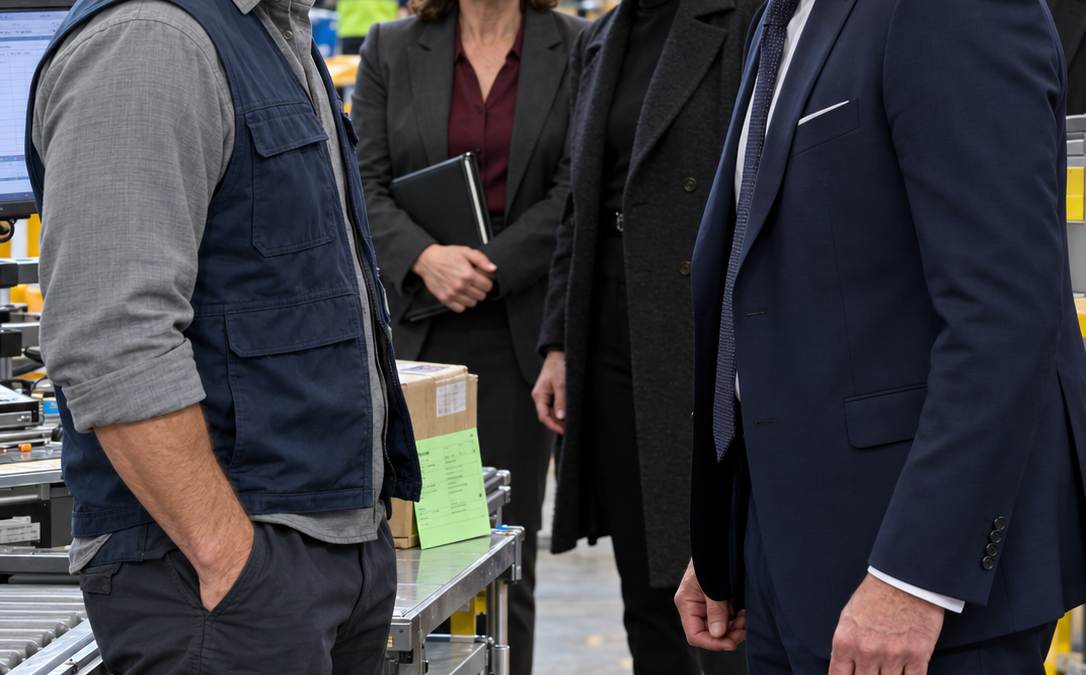
I was at Station Three, eating my lunch, when the warehouse door opened and four people walked across the concrete floor toward me.
Ronald Meade was in front, his tie loosened and his jaw tight. Beside him walked Patricia Lennox, her carefully maintained professional composure visibly strained.
Behind them came two people I didn’t recognize, a man and a woman in dark wool overcoats. They moved with the unhurried authority of people who had no need to impress anyone in the room.
Gus, who was sitting at the next bench unwrapping a sandwich, glanced over his shoulder and then looked at me. He tucked his sandwich back into its paper bag.
“I’ll go check the rear dock count,” he said quietly.
He stood and walked away without being asked.
Ronald stopped six feet from my workstation. He looked at my work vest, the Station Three label on the bench, and the receiving terminal. Only then did he look directly at me.
Something crossed his face that I had never seen there in eighteen years.
It wasn’t anger.
It was fear.
“Steven,” Ronald said, “we need to resolve an issue with the Bergstrom audit.”
“Good afternoon, Ronald,” I replied. “Is there a formal work order for this consultation? Per the Hargrove operations manual, external business contacts with warehouse personnel during shift hours require a supervisory authorization form submitted twenty-four hours in advance through the shift supervisor’s chain of command.”
Patricia opened her mouth, then closed it again.
The woman in the dark overcoat spoke. Her accent was measured and northern European, every word delivered with quiet precision.
“Mr. Wear, my name is Ingrid Soulberg. I’m the lead due diligence director for Bergstrom Group. We have a significant documentation problem with your company’s material certification archive.”
“That sounds like an executive-level concern,” I said pleasantly. “I’m a receiving verification associate. I count pallets.”
Ronald stepped forward, lowering his voice.
“Steven, this is not the time. The Bergstrom panel is upstairs right now reviewing our certification files. Their technical analyst flagged seventeen batch records where the override authorization signatures don’t match the original material test data. They want the compliance director who built the original certification system.”
I regarded him for a moment before answering.
“There is no compliance director,” I said. “That position was eliminated as part of a structural realignment. The function was consolidated.”
“Stop,” Ronald said.
The single word came out hollow.
“I know what you’re doing.”
“I’m verifying inbound freight,” I replied.
Patricia leaned forward, clasping her portfolio tightly against her side.
“Steven, the company is prepared to reinstate your full directorship, restore your complete compensation, and remove all record of the transfer from your personnel file. Effective immediately, you would be classified as though the reassignment never occurred.”
I looked at Ingrid Soulberg instead of Patricia.
“Ms. Soulberg,” I said, “may I ask you a direct question?”
Ingrid studied me.
“Please.”
“How long has your due diligence team been aware of the Westfall Materials supply substitution?”
The silence that followed lasted approximately four seconds.
It felt considerably longer.
“Since yesterday afternoon,” Ingrid said. “Our technical analyst pulled the underlying metallurgical test reports from the original vendor certification files and compared them against the batch override records.”
“Then you already know what the certification discrepancy means,” I said.
“We know that a substantial volume of structural load components sold as Grade B or above were sourced from a supplier whose test records indicate consistent Grade C outputs,” Ingrid replied, her voice steady and factual.
She glanced briefly at Ronald before continuing.
“We also know that the original hold memorandum was issued by the compliance director eleven weeks before the override was processed, and that the compliance director was subsequently reassigned to a nonsupervisory role four days after submitting that memorandum.”
Ronald went completely still.
The sounds of the warehouse continued around us. Somewhere beyond the receiving bay, a forklift reversed, its warning signal echoing against the metal walls. A conveyor motor hummed steadily in the distance. None of those ordinary sounds seemed to reach the people standing in front of me.
“The acquisition,” Ingrid continued, “as currently structured, cannot proceed. Bergstrom Group does not acquire entities with undisclosed material certification fraud in their supply chain.”
Ronald turned toward me.
The last trace of executive composure had left his face. His shoulders were no longer squared, and the confident expression he had worn through years of boardroom negotiations had disappeared.
“You could have come to me directly,” he said. “We could have handled this internally.”
“I did come to you directly,” I replied.
My voice remained level.
“I wrote a formal hold memorandum on August fourteenth, addressed to your office, with a copy to the chief compliance officer. You signed the receipt. Three days later, you called it bureaucratic obstruction.”
Ronald said nothing.
I stood from the bench and removed my work vest. I folded it carefully, smoothing the fabric before setting it on the station counter.
“I never handed you my evidence,” I said. “I gave your override team a certified copy.”
Patricia’s eyes moved from my face to the folded vest and back again.
“The original documentation, including the complete metallurgical test chain, the Westfall supplier financial records, and the executive override authorization trail, has been in the custody of a federal compliance attorney since August twenty-second.”
I let the words settle before finishing.
“He filed a voluntary disclosure with the Department of Commerce Regulatory Enforcement Division last Friday.”
Patricia made a sound that wasn’t quite a word.
Ronald stared at me. The man who had reduced my salary, stripped away my executive access, and reassigned me to a loading dock now seemed unable to find anything to say.
“Ronald,” I continued, “you demoted me to a receiving dock to keep me quiet. The problem is that a man who spent eighteen years building compliance systems tends to build them to last, even after he leaves the room.”
Franklin Oaks had appeared in the doorway of the floor office. He stood with his arms folded, wearing the neutral expression of a man who had learned not to involve himself in matters above his pay grade.
He didn’t interrupt. He didn’t approach the group or ask what was happening. He simply watched from the doorway, taking in the executives, the unfamiliar visitors, and the folded work vest resting on my counter.
But when our eyes met, he gave me the smallest nod I had ever seen.
And I understood that he had known, in the way experienced warehouse men always seemed to know, that something was going to break open before the month was through.
Ingrid Soulberg reached into the inner pocket of her overcoat and produced a business card.
She walked to my bench and placed it beside the folded work vest.
“Mr. Wear,” she said, “Bergstrom Group is not acquiring Hargrove Industrial Solutions. But we are actively establishing an independent quality assurance and materials compliance center in the Cincinnati corridor.”
She paused, allowing me to consider what she was saying.
“We require a founding director with the kind of credentials that cannot be manufactured.”
Her gaze remained steady.
“The kind that can only be built over eighteen years of refusing to sign something wrong.”
I looked down at the card.
It was a small, ordinary piece of paper, lying beside the vest I had worn every day since my reassignment. For a moment, I considered the difference between the two documents that had defined the past several weeks of my life.
One had sent me to a loading dock.
The other offered me the opportunity to build something entirely new.
“My attorney will need to be part of any preliminary conversation,” I said.
“That is already expected,” Ingrid replied.
Ronald Meade was escorted from the building by corporate security and two federal compliance investigators from the Commerce Department’s Cincinnati Field Office later that same afternoon.
Patricia Lennox submitted her resignation before the close of business.
An internal board investigation opened within seventy-two hours. By the following Tuesday, Hargrove’s outside counsel had publicly confirmed that the company was cooperating fully with federal regulators and had suspended trading of its corporate notes pending a comprehensive materials audit.
I wasn’t part of that process.
I had already moved on.
The Bergstrom North American Compliance Center opened its doors in a purpose-built facility outside Covington. Eight months later, we occupied a converted industrial building with good bones, good light, and enough floor space to accommodate both a working laboratory and a technical staff of twenty-two.
The building had none of the polished executive grandeur that had defined my former office. Its appeal was more practical. The spaces were designed around the work itself, with room for material testing, receiving inspections, technical review, and the careful documentation that made every certification defensible.
I designed the materials verification protocols myself, drafting every standard from the ground up with the deliberate patience of someone who understood exactly how systems failed when people were allowed to override them without accountability.
Every procedure had to serve a purpose. Every test result needed a traceable record. Every certification had to mean exactly what it claimed to mean, regardless of who wanted a shipment approved or how much money depended on the answer.
Andrea Pulk joined us as senior compliance coordinator.
After nine years of working together at Hargrove, I knew precisely what kind of professional she was. Her meticulous approach to documentation and her refusal to let administrative convenience replace accuracy made her a natural fit for the center we were building.
Franklin Oaks came aboard to run our inbound materials receiving and vendor intake operations, bringing with him the kind of credibility that only comes from two decades of getting things right on a warehouse floor.
He approached the new responsibility with the same quiet deliberation I had seen on my first morning at Warehouse 7. He studied the receiving protocols, identified the practical requirements of the operation, and made sure the procedures worked for the people who would actually be using them.
Gus Foreman, who had spent thirty-eight years doing receiving verification for a company that barely knew he existed, became our lead receiving standards trainer.
He oversaw the onboarding of every new intake associate who came through our doors, teaching them the details that rarely appeared in executive presentations but often determined whether a material inspection was worth the paper it was recorded on.
He still carried the same battered thermos.
He still wore the same work boots.
But his base compensation was nearly double what Hargrove had paid him.
And every morning, when I passed his desk, I noticed that he took a little longer with his coffee than a man in a hurry would.
There was something satisfying about that. Gus had spent most of his working life doing difficult, necessary work without much recognition. Now he was responsible for teaching the next generation how to do that work correctly, and the organization around him understood its value.
The Westfall Materials case moved slowly through the federal regulatory process, as these things tend to do.
Ronald Meade was eventually indicted on four counts of fraudulent certification filing and two counts of commercial misrepresentation under federal material standards law.
The case settled before trial.
It wasn’t the dramatic conclusion that anyone in the warehouse breakroom had been hoping for. There was no lengthy courtroom spectacle, no final confrontation in front of a jury, and no grand public moment in which everything that had happened was laid out for an audience.
But the outcome mattered less to me than the principle that had driven every decision I made from the moment I first read that purchase-order discrepancy in mid-August.
I had spent eighteen years learning what happened when organizations began treating technical standards as obstacles rather than safeguards. I had seen how small exceptions became ordinary habits, how those habits gradually hardened into procedures, and how people who raised legitimate concerns were dismissed as difficult when their questions threatened a profitable arrangement.
I had also learned that the integrity of a system depended on what happened when someone with authority wanted to bypass it.
It wasn’t enough to have standards written in a handbook. They had to survive the moment when following them became inconvenient.
That belief had guided me through the original Westfall investigation, the formal hold memorandum, and the decision to preserve the evidence outside the company’s control. It had stayed with me when Ronald and Patricia sat across from me on the forty-first floor and told me that my eighteen years of work had been reduced to a packing station.
And it was still guiding me now.
On a cold Wednesday in February, a few weeks after the facility opened, I was standing at the metrology bench reviewing a set of incoming tensile reports from our primary fastener supplier when my cell phone rang.
It was Carol.
“I’m at the front entrance,” she said. “I brought lunch.”
She had never come to my office at Hargrove in eighteen years.
There had never seemed to be a reason. The place had always felt, in some way I had never quite articulated to her, like a space I occupied rather than one I had built.
It was an office I reported to every morning, a building in which I attended meetings, reviewed records, and spent countless hours defending the standards I believed in. But despite everything I had contributed, there had always been a distance between the work that mattered to me and the people who controlled the organization around it.
I walked out to the lobby and held the door for her.
Carol stepped inside and stopped.
For a long moment, she simply looked around.
The metrology laboratory was visible through the glass partition. Two engineers were running surface-hardness assessments on a batch of structural plate, moving methodically between the testing equipment and their documentation.
At the far end of the main floor, Franklin was walking a new receiving technician through the intake logging protocol. His clipboard was tucked beneath one arm, and his voice was measured and clear as he explained the steps involved in recording an incoming shipment.
Beyond them, the rest of the technical staff continued working. The laboratory equipment operated with its familiar mechanical rhythm. Conversations remained focused and practical. Reports were examined, measurements checked, and results entered without anyone glancing nervously toward an executive office.
The entire building had the particular hum of a place where people were doing precise work without being afraid of what they might find.
Carol turned toward me.
There was an expression on her face that I hadn’t seen in a long time. It was quiet and thoughtful, with something beneath it that reminded me of all the evenings she had watched me come home from Hargrove carrying the frustrations I rarely talked about.
She looked once more through the glass partition, taking in the engineers, the laboratory, and the people moving confidently through their work.
“This is what it was supposed to feel like, wasn’t it?” she asked.
“Yes,” I told her.
We ate lunch at my desk, which was modest and practical and looked out over the floor.
There was nothing impressive about the furniture, nothing designed to advertise rank or status. I had a working surface, the reports I needed, and a clear view of the people whose work depended on the standards we had built together.
It was enough.
Carol and I sat there eating the lunch she had brought, watching the ordinary business of the center continue beyond the glass. There were no urgent executive calls, no carefully worded conversations about commercial priorities, and no reason for either of us to pretend that the place was something other than what it was.
Afterward, she drove home, and I returned to the metrology bench.
I picked up the tensile report where I had left off.
The numbers were exactly what they were supposed to be.
I reviewed them carefully, entered the results into the system, and initialed the certification line.
It was an ordinary task. Nothing about it would attract the attention of a corporate board or appear in an executive presentation. It was the kind of quiet, precise work that thousands of people performed every day without anyone noticing.
But I knew what those numbers represented.
They were measurements of real materials that would become part of real structures. Somewhere beyond our laboratory, engineers and construction teams would make decisions based on the accuracy of those certifications. They would trust that the materials supplied to them had been tested honestly and that the people responsible for verifying them had done their jobs.
That trust was the reason the work mattered.
Some people had believed they could take everything from me with a reassignment memo, a pay cut, and a badge deactivated before sundown.
They had believed that eighteen years of professional experience could be reduced to a line in a personnel file, that stripping away a title would strip away the authority behind it, and that moving me from the forty-first floor to a warehouse loading dock would make everything I knew irrelevant.
What they failed to understand was that the thing worth protecting had never been on the forty-first floor.
It was here.
It was in the precise, ordinary discipline of checking a measurement, recording a number honestly, and refusing to write anything different, no matter who was asking.
It was in the willingness to hold a shipment when the numbers didn’t match, to question a certification when the test results didn’t support it, and to protect the integrity of a process even when doing so came at a personal cost.
That wasn’t a job.
That was the only thing worth building a working life around.
And once you’ve built it that way, no piece of paper in the world can take it from you.








