My co-founder bought my patent for $2.5M and fired me—then owned the 11 patents his $900M company needed.
The certified bank check sat in the middle of the conference table like a grenade with the pin already pulled.
$2.5 million.
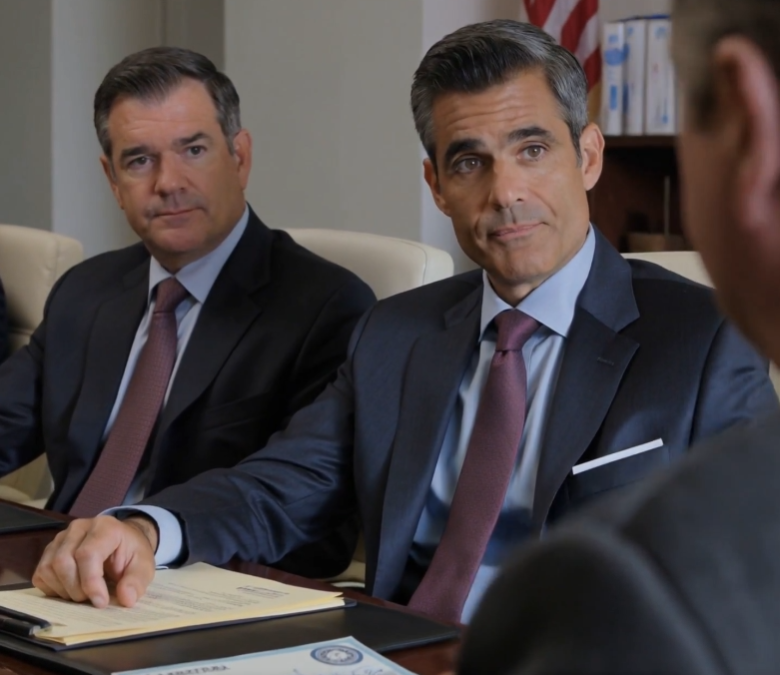
My co-founder, Derek Langham, had placed it there with the same casual indifference a man uses when leaving a business card at a networking event. Around him sat nine board directors, all of whom had spent the better part of eighteen months systematically dismantling everything I had built—reassigning my core engineers, blocking my access to the product roadmap, and whispering into every investor’s ear that Axiom Software had simply outgrown the man who created it.
I was fifty-two years old that morning, and I had survived every business cycle the enterprise software industry had thrown at me. But sitting at that polished table in our Chicago headquarters, watching Derek’s practiced smile, I understood exactly what this meeting was supposed to be.
The final act.
“Sign it, Leonard,” Derek said, leaning back in his executive chair with his hands laced behind his head.
He still had that same easy confidence that had first drawn me to him eleven years ago, when we were two broke engineers sharing a rented office space above a dry cleaner in Evanston.
“Two and a half million is clean. It’s fair, and it lets you walk out of here with your dignity intact. Patent Alpha 1 belongs to Axiom. Now take the check and let us all move forward.”
Beside him sat my former engineering partner, Craig Austerfeld. Craig was staring at the center of the table, unwilling to look at me directly. Thirteen months earlier, Derek had offered him the CTO title and a restructured equity package that tripled his stake in nonvoting shares. Craig had accepted within forty-eight hours.
The man who once drove four hours through a snowstorm to help me debug a collapsed data pipeline at two in the morning was now sitting on the other side of the table.
“Dignity,” I said, letting the word hang there for a moment. “Walk me through the terms one more time, Derek. For the record.”
Derek’s smile flickered almost imperceptibly.
“Axiom purchases full rights to Patent Alpha 1, the core encryption and routing framework underpinning the Sentinel platform, in exchange for $2,500,000 in cash, twelve months of continued health insurance, and accelerated vesting on your remaining nonvoting shares. You sign a mutual non-disparagement covenant, and you’re free.”
Their outside attorney, a sharp woman named Pauline Getz, kept her expression carefully neutral. She had reviewed every line of this agreement, and her job today was to make the transaction feel inevitable.
Free.
That was the word Derek used.
What he meant was gone.
I picked up the settlement document and turned to page four, running my finger down the assignment clause. The language transferred all right, title, and interest in Patent Alpha 1 to Axiom Software and included boilerplate asserting that the agreement resolved all ownership claims on inventions previously incorporated into company products.
That language was the gamble Derek had been making for the past fourteen months.
It was also the thing he never fully understood.
Seven years ago, when we incorporated Axiom, I had retained outside intellectual property counsel and refused to execute an unlimited invention assignment. The original corporate charter contained a provision that was straightforward: Patent Alpha 1, which covered the dynamic encryption core of our Sentinel platform, was licensed to the company under a purchase option.
But that charter also contained an explicit carveout. Any independent research, modular extensions, or secondary architectures developed by me on personal equipment and personal funds were my exclusive property unless I separately and explicitly transferred them by a standalone deed of assignment.
For the first four years of the company, that distinction was merely theoretical.
Then Derek began his transformation from technical co-founder into a revenue-focused executive who viewed engineering integrity as an obstacle to quarterly earnings calls.
The breaking point came during a board meeting two years earlier, when I objected to shipping a telemetry update that hadn’t been fully stress-tested under high-load hospital network conditions. Derek overruled me and labeled my objections as the predictable anxiety of an engineer who had never learned to think like a businessman.
He pushed the update to production.
It failed catastrophically inside a hospital system in Indianapolis three weeks later, triggering a federal compliance audit and eighteen months of remediation costs. Derek blamed the implementation team. He never once acknowledged the underlying design decision.
That was the night I drove home from the office and sat at my kitchen table until three in the morning, thinking very carefully about what I needed to do.
Over the following twenty-two months, I worked on my own time, on my own hardware, in the spare bedroom of my house in Oak Park. I kept meticulous lab notebooks with timestamped entries and hired a private IP attorney named Sandra Okafor to manage my filings.
Every concept I developed that overlapped with Axiom’s existing roadmap, I submitted to Derek in writing as a formal internal research proposal. Derek rejected each one by email, citing budget constraints and dismissing them as academic distractions.
Those rejected proposals became the evidentiary backbone of eleven distinct granted United States patents.
Patent Alpha 2 covered an adaptive key rotation protocol for encrypted multi-tenant data environments. Patent Alpha 3 described a distributed failover coordination engine with sub-second recovery guarantees. Alpha 4 governed a zero-trust device authentication handshake for edge hardware.
The remaining seven patents covered adaptive compression under variable bandwidth conditions, automated state reconciliation across distributed nodes, low-latency telemetry validation without cloud dependency, and dynamic load redistribution during partial network failure.
Individually, each patent addressed a specific technical gap. Together, they constituted the entire operational nervous system of the Sentinel platform.
Axiom had been building on them for over a year without a license.
I set the settlement documents down.
“Before I execute this agreement,” I said, “I want to be precise about what is being transferred. This instrument assigns Patent Alpha 1 as listed in Schedule A. That is the exclusive subject of this conveyance. Is that Axiom’s formal position?”
Pauline Getz looked up from her own copy of the document.
“Schedule A designates Patent Alpha 1. The assignment conveys that specific registered asset. The company preserves its pre-existing rights under the corporate charter with respect to all other matters.”
“Understood,” I said.
I picked up the pen and signed my name on the signature line.
Craig finally looked up at me from across the table. The expression on his face was something between relief and unease, and I couldn’t tell which was winning.
Derek immediately reached across and slid the check toward me.
“Pleasure doing business, Leonard.”
I folded the check once, placed it inside my jacket, and stood up.
“Likewise,” I said.
I buttoned my jacket, picked up my briefcase, and walked out of the boardroom without looking back.
I took the elevator down to Wacker Drive and stepped out into the January cold. I called Sandra Okafor before I reached the corner.
“Are we done upstairs?” she asked.
“Signed and closed,” I said. “Pauline Getz confirmed on the record that Schedule A conveys only Patent Alpha 1.”
“Then we’re ready,” Sandra said. “Give me two hours.”
I walked to a coffee shop on Michigan Avenue and ordered a black coffee I barely touched.
Two hours and seventeen minutes later, Derek Langham’s assistant stepped into his office, where he was celebrating with the board’s inner circle, and placed a tablet in his hands.
The screen showed a docket entry from the United States District Court for the Northern District of Illinois.
Sandra Okafor had filed a federal complaint alleging willful patent infringement of eleven United States patents, accompanied by an emergency petition for a temporary restraining order under Rule 65 of the Federal Rules of Civil Procedure.
From what I was later told, Derek read the first page and laughed. He assumed it was a nuisance wrongful termination claim filed by a disgruntled co-founder. He handed the tablet to Craig and told him to call outside counsel.
Then Craig read the claim charts.
Every one of the eleven patents Sandra had scheduled was mapped in exhaustive technical detail to a specific operational component of the live Sentinel platform. She had attached timestamped internal design documents, regulatory submissions, product marketing white papers, and Craig’s own technical memos as exhibits proving that the company had knowingly deployed these systems without a license.
The petition specifically sought to enjoin all new commercial activations, contract renewals, and enterprise marketing of infringing Sentinel configurations, while carving out existing critical infrastructure deployments for healthcare and municipal emergency services to avoid judicial reluctance on public safety grounds.
Craig reportedly set the tablet down on the conference table and said nothing for almost thirty seconds.
“Can Sentinel operate without these eleven modules?” Derek demanded.
Craig looked at him the way a surgeon looks at a patient who has just asked whether he really needs his liver.
“The early prototype we ran in the first year of the company? Maybe. In production across nineteen thousand enterprise nodes? No. These protocols are embedded at the kernel level. The encryption handshakes, failover coordination, telemetry validation—it all runs on Leonard’s architecture.”
“Then rip them out and rewrite them,” said the chief financial officer, a man named Burton Faraday, who had joined the board in a Series C restructure and had never written a line of code in his life.
“That would require fifteen to twenty months of clean-room development, full regression testing, and recertification across every regulated customer environment,” Craig said. “We cannot survive six weeks without renewed enterprise contracts.”
Derek’s voice dropped to something quiet and dangerous.
“You’re telling me we bought Patent Alpha 1 for $2.5 million, and the entire company depends on eleven other patents that we do not own?”
Craig did not answer.
By early afternoon, news of the emergency filing had reached the business press. By the close of trading that day, Axiom Software shares had dropped nineteen percent on heavy volume.
The following morning, two institutional investment funds filed disclosure statements acknowledging material uncertainty regarding the company’s IP position. A major telecommunications client in Atlanta formally paused its renewal negotiations pending legal clarity.
I spent those first three days in Sandra Okafor’s office in the Loop. She was methodical, precise, and completely unruffled by the volume of correspondence pouring in from Axiom’s outside counsel attempting to negotiate a quick settlement.
On the afternoon of the second day, she brought me a mug of green tea and sat down across from me.
“Derek’s camp is floating eight million dollars as a full settlement figure,” she said.
I looked at the wall of exhibit binders stacked behind her desk.
“What does eight million buy them?”
“A license to all eleven patents, plus a release from the infringement claims, plus your continued public silence.”
“And what does it cost them if we proceed?” I asked.
Sandra leaned back in her chair.
“At current enterprise run rates, the Sentinel platform generates roughly nine hundred million dollars in annual recurring contract revenue. If the court upholds our preliminary injunction and blocks new commercial activations, Axiom cannot execute a single enterprise renewal without our authorization. Their credit facilities are contingent on sustained contract velocity. They’ll be in breach of their senior lending covenants within sixty days.”
“Then eight million isn’t a real offer,” I said. “It’s a probe to find out whether I’m afraid.”
“That’s my read as well,” Sandra said.
On the fourth day, Derek went public.
He held a press conference in the lobby of Axiom’s Michigan Avenue headquarters and described me as a disgruntled founder attempting to hold two thousand employees hostage after cashing a generous buyout check.
He used the word extortionist three times.
Sandra filed a declaration with the court within four hours.
The declaration attached the original corporate charter carveout provisions, my personal patent prosecution records, private equipment invoices verified by a third-party forensic accountant, and nine of Derek’s own email responses formally rejecting funding for the research behind each of the eleven patents.
The declaration also included a verified technical summary explaining in plain language the functional relationship between each patent and the live Sentinel platform.
The engineering press read the declaration overnight and reached its own verdict.
By morning, multiple software architecture forums had published independent analyses confirming that Patent Alpha 1 was the foundation slab, while my eleven additional patents were the structural framing, the electrical system, and the plumbing running through every wall.
On the morning of day six, Sandra walked into the war room and set her phone face down on the conference table with a deliberate calm that told me something had shifted.
“Derek Langham wants a private meeting,” she said. “Just the two of you and their principals. No attorneys initially. He suggested the Metropolitan Club.”
The man who had dismissed me from the company I co-founded six days ago was now requesting a personal audience.
Derek arrived at the Metropolitan Club before I did, which was unusual. He had always been the kind of man who calibrated his arrivals for maximum psychological effect.
When I was led to the private dining room, he was seated at the far end of the table with a glass of water in front of him that had not been touched.
He looked like a man who had not slept since Tuesday.
I sat down without being invited to.
“I want to be direct with you, Leonard,” he said. “I made errors in judgment. I underestimated the scope of your independent filing program, and I handled your departure in a manner that was neither respectful nor professionally appropriate.”
He paused, watching my face.
“But the reality on the table right now is that two thousand people work for this company. If you keep tightening this injunction, people who had nothing to do with any of this are going to lose their jobs, their health insurance, their retirement savings.”
He leaned forward.
“Name your number. Whatever it takes to make this go away.”
I had been waiting for that phrase.
Whatever it takes.
As if everything in the world were a transaction, and the only variable was price.
“The assumption embedded in that question is exactly why we’re sitting here,” I said. “You believe that intellectual honesty, engineering integrity, and basic contractual faithfulness can always be neutralized with a large enough check.”
I held his gaze.
“That belief is what drove you to override a safety validation eighteen months ago, ship a compromised update to a hospital network, and then spend fourteen months trying to strip me of my ownership rights so you could hand over my life’s work to your investors and call it a business transformation.”
Derek’s jaw tightened.
“You built those patents as a trap.”
“I built those patents because you rejected the research in writing and refused to invest company resources in it,” I replied. “And then you deployed it commercially for fourteen months without a license because you assumed I lacked either the documentation or the resolve to enforce my rights.”
He stared at the tablecloth.
“What’s your endgame, Leonard? Tell me what you actually want.”
I had spent twenty-two months in the spare bedroom of my house in Oak Park answering that exact question.
I produced a folder from my briefcase and placed it on the table between us.
Inside was a five-part restructuring compact.
First, Axiom would retract all public statements characterizing me as an extortionist and issue a formal correction through the same press channels Derek had used to deliver the original accusation.
Second, the company would execute a royalty-bearing commercial license for all eleven patents, with royalties directed into an independent inventor stewardship fund.
Third, Axiom would establish a permanent engineering ethics and safety committee with board-level authority, including the right to halt any deployment that failed documented reliability thresholds.
Fourth, an employee equity protection program would be established, funded partly by a clawback of Derek’s own executive compensation tied to the period during which the infringing deployment occurred.
Fifth, Derek Langham and the directors who had knowingly approved the infringing commercialization would surrender their supervoting shares into an employee ownership trust and step down from their positions.
Derek read the compact in silence. When he finished, he set it down and pressed his fingers against his temples.
“You want me to hand over control of the company I took public?”
“I want you to choose between an orderly restructuring and a federal injunction that closes your enterprise sales pipeline while your lenders call their covenants,” I said. “You have until Friday afternoon to take this to the full board.”
I stood up, buttoned my overcoat, and walked out of the Metropolitan Club into the winter air.
Sandra was waiting in the car at the curb. She handed me her phone as I settled into the passenger seat.
On the screen was a freshly filed court document from an entity called Fortis Analytics Group, Axiom’s primary competitor in the enterprise security platform market.
Fortis had moved to intervene in our patent infringement case.
Their motion included sworn declarations from a senior researcher named Dr. Philip Crane, alleging that the foundational concepts in my eleven patents had originated inside a research initiative conducted over eight years ago.
Dr. Crane’s declaration ran to 240 pages of technical documentation, server logs, and laboratory notebooks purporting to show prior invention predating my earliest prototype by nine months.
If the claims were legitimate, my patent portfolio could be invalidated, and I could be branded a plagiarist.
Sandra drove without speaking for several blocks.
Then she said, “We do not panic. Fabricated documents leave traces. Find the anomaly.”
That night, I read through Dr. Crane’s declaration in full at Sandra’s office conference table.
I got to page ninety-four at 11:40 in the evening and stopped.
Dr. Crane’s laboratory notebook, supposedly authored eight years ago, contained a technical term in a footnote that I recognized with absolute certainty.
The phrase was distributed integrity sequencing.
It described a validation method for asynchronous distributed checkpoints.
The problem was simple.
That phrase did not exist eight years ago.
The industry-standard terminology at that time was checkpoint coherent synchronization.
I had personally coined the phrase distributed integrity sequencing during a closed technical workshop at Northwestern University’s Kellogg engineering program five years earlier, during a presentation that had been formally recorded, transcribed, and archived with cryptographic timestamps by the university.
There was no prior published record of that phrase anywhere in technical literature before that presentation.
I called Sandra at midnight.
Forty-five minutes later, one of her forensic examiners found the second fracture.
A system architecture diagram in Dr. Crane’s notebook referenced a specific open-source concurrency library called libthread sync adaptive.
That library had not been released on its public repository until three years after the date allegedly stamped on the notebook page.
“This is fabricated,” Sandra said flatly. “Someone constructed these documents after the fact and inserted technical terminology and software references they copied from your own published work.”
At that precise moment, an encrypted message arrived on my personal phone from an anonymous address.
It contained four sentences and an attached image.
The image was a still frame from what appeared to be a parking garage surveillance camera. In the frame stood Craig Austerfeld, handing a portable hard drive to a woman I recognized from her professional photograph as Fortis Analytics Group’s deputy general counsel.
The message read:
“If you want to know where Fortis obtained your private research materials, meet me tomorrow evening at the warehouse facility on North Ston that Axiom decommissioned last spring. Come before midnight.”
Sandra refused to let me go without a licensed investigator and a forensic chain-of-custody specialist.
The following evening, we arrived at the decommissioned facility on North Ston in an unmarked car.
At 11:15, the loading dock door opened, and a woman stepped out into the cold.
Her name was Yolanda Pitts.
She had spent four years as Axiom’s lead quality assurance engineer before Craig removed her from the Sentinel team eight months ago after she refused to sign off on an undisclosed performance deviation in a government contract submission.
She handed me an encrypted drive and a printed chain-of-custody log without preamble.
“Nine days before Derek handed you that check,” she said, “Craig logged into the legacy archive cluster using an emergency admin credential that bypasses the standard audit trail.”
She glanced at the drive in my hand.
“He exported six years of your private research notebooks, rejected proposal drafts, and prototype specifications that were stored on the company’s legacy backup system from the early days when your personal and company work overlapped in storage. Then he and two contractors copied the drive and transmitted it to Fortis Analytics’ legal team.”
“Why?” I asked, though I already knew.
“Because this was never just about buying your patent and pushing you out,” Yolanda said.
“Craig and Derek cut a private arrangement with Fortis. If the court upheld your injunction and drove Axiom into insolvency, Fortis had a signed memorandum giving them the right to acquire Axiom’s enterprise customer contracts and platform assets at distressed prices.”
She paused before continuing.
“Craig would receive a senior vice president position and a restricted stock package worth fifteen million dollars. Derek would receive executive advisory fees and twelve million in Fortis equity.”
Sandra’s forensic examiner immediately took custody of the drive, sealed it with tamper-evident tape, and executed a formal chain-of-custody transfer document signed by Yolanda on camera.
We said nothing publicly until the federal evidentiary hearing six days later.
The courtroom was standing room only.
Fortis arrived with eight attorneys who portrayed my filing as an opportunistic attack on legitimate prior research.
Dr. Philip Crane took the stand and delivered his declaration with practiced confidence.
Sandra cross-examined him for forty minutes.
“Dr. Crane,” she said, displaying an enlarged exhibit of the disputed laboratory page. “This notebook entry contains the phrase distributed integrity sequencing. You have testified under oath that this document was created eight years ago. Is that correct?”
“That is the date on the notebook,” he answered smoothly.
“Are you aware that this phrase was coined by Leonard Holt at a documented engineering symposium at Northwestern University five years ago, with a university-archived recording carrying cryptographic timestamps, and that there is no prior publication record of this terminology anywhere in academic or industry literature before that date?”
Dr. Crane shifted in his seat.
“Technical terminology develops in parallel across multiple research environments.”
“Parallel development,” Sandra noted.
She turned toward the enlarged diagram.
“Then please explain to the court how this system diagram on page seventeen of your exhibit incorporates a reference to libthread sync adaptive, an open-source library that was not publicly released until three years after the alleged date of this notebook entry.”
The courtroom went quiet enough that I could hear the ventilation system.
Fortis’s lead attorney shouted an objection.
The federal judge overruled it without looking up from her copy of the exhibit.
Dr. Crane stared at the screen displaying the enlarged diagram.
His answer, when it finally came, was that the records might have been digitally updated during administrative archiving procedures.
“So your sworn declaration that these records existed in their original, unaltered form since eight years ago is not accurate,” Sandra pressed.
He did not answer.
Four full seconds of silence passed before the judge called for order.
Sandra then introduced Yolanda Pitts’s declaration and the verified forensic log from the encrypted drive.
She walked the court through the digital audit trail: Craig Austerfeld’s administrative credential accessing the legacy archive cluster, the bulk export of my private research materials, the transmission to Fortis’s legal team, and the draft distressed acquisition memorandum outlining the plan to liquidate Axiom’s customer base once my patent claims were invalidated.
The federal judge removed her reading glasses.
In seventeen years of federal litigation, Sandra told me afterward, she had never seen that judge’s expression carry that particular weight of controlled fury.
The judge denied Fortis Analytics Group’s motion to intervene with prejudice, dismissed its fraudulent prior art claims, and issued an emergency referral to the United States Attorney’s Office for the Northern District of Illinois regarding potential criminal liability for perjury, evidence fabrication, and obstruction of justice under federal statute.
She simultaneously converted our temporary restraining order into a broad preliminary injunction, freezing all infringing commercial operations indefinitely until full resolution on the merits.
In the courthouse corridor, Derek intercepted me near the exit.
“Leonard, stop. Listen to me.”
He was breathing hard, his tie loosened, his voice stripped of the boardroom polish.
“I’ll wire you fifteen million dollars personally this week. Cash wired directly to your account. You drop everything. We call it a licensing dispute, and we move forward together.”
I looked at him for a long moment.
The man I had known in that rented office above the dry cleaner in Evanston, before the money and the investor calls and the executive compensation packages had replaced whatever engineering conscience he once carried.
“Committing perjury in federal court and fabricating evidence are not licensing disputes,” I said. “And they are not transactions.”
Within forty-eight hours, Craig Austerfeld, facing personal criminal referral, produced internal audio recordings of Derek explicitly directing the research archive export and authorizing the Fortis arrangement.
The independent directors called an emergency board session that evening.
By ten o’clock, they had voted unanimously to terminate Derek Langham for gross cause with no severance.
Craig was suspended pending investigation. Burton Faraday resigned without explanation before the vote concluded.
A week later, a woman named Dr. Abigail Rosenthal arrived at Sandra’s office.
Dr. Rosenthal was a former appellate court judge who had been appointed to chair Axiom’s independent board restructuring committee. She was composed, unhurried, and clearly someone who had seen corporate disasters from both sides of the bench.
She placed a proposal on Sandra’s conference table.
$180 million for a clean purchase of all eleven patents, with a full liability release.
It was more money than any court-ordered damages calculation would likely yield after years of appeals.
Dr. Rosenthal said so directly because she was not the kind of person who wasted time on flattery.
I pushed the folder back across the table.
She raised an eyebrow.
“One hundred eighty million dollars leaves the system that produced Derek Langham fully intact,” I said. “The next management team will make the same choices on a different quarterly earnings cycle.”
“Then what are you proposing?” Dr. Rosenthal asked.
I laid out the restructuring compact I had placed in front of Derek at the Metropolitan Club, with certain modifications I had refined with Sandra over the past ten days.
Derek and the directors who had approved the infringing deployment would surrender their supervoting equity into an irrevocable employee ownership and stewardship trust.
The board would be reconstituted with a permanent independent majority, including technical specialists and ethics practitioners.
I would execute an exclusive royalty-bearing commercial license for all eleven patents, contingent on the company’s continuous compliance with a newly established engineering ethics and safety charter.
And I would return to Axiom, not as chief executive officer, but as chief technology architect and chairman of the engineering ethics and safety committee, with statutory veto authority over any commercial deployment that failed documented reliability, security, or safety thresholds.
Dr. Rosenthal read through the compact twice.
Then she set it down and looked at me with something that might have been respect.
“This is not a settlement,” she said. “This is a complete corporate reconstitution.”
“It is the only arrangement under which my patents will operate inside this company,” I replied.
The restructuring compact was ratified by the board within five days and approved by the federal court.
With the patent claims resolved through formal licensing, the court dissolved the preliminary injunction.
Markets responded immediately.
Institutional investors returned as the company’s IP position stabilized and the governance overhaul signaled a credible operational reset. Axiom shares recovered roughly fifty-five percent of their losses in the first two weeks of resumed trading.
On my first morning back at the office on Wacker Drive, I took the elevator to the thirty-eighth-floor engineering division, where most of our core platform developers worked.
When the elevator doors opened, the engineers were standing.
All of them.
Every desk, every row of workstations—260 people on their feet, standing in complete silence for a full four seconds before someone actually started clapping.
And then it was loud.
Yolanda Pitts was standing near the front. Beside her was a young systems engineer named Felix Adami, who had spent two years developing a low-power distributed sensor protocol that Craig had shelved because it did not fit the quarterly roadmap.
“We have a backlog,” Yolanda said simply, shaking my hand.
“I know,” I said. “Let’s do it correctly this time.”
The first real test of the new engineering ethics structure arrived four months later, when a regional power utility in the Pacific Northwest running Sentinel detected an anomalous synchronization failure during a scheduled maintenance window.
Under the old regime, that kind of incident would have been classified as external environmental interference and buried inside a quarterly operational report footnote.
Instead, our automated safety monitoring triggered an immediate alert to the engineering ethics and safety committee.
A junior executive from the legacy management team urged us to categorize the failure as a third-party network issue to protect market positioning.
I looked at him and said, “We stopped doing that the day Derek Langham left this building.”
Felix Adami’s team published a transparent incident report within three hours, identifying the precise edge condition responsible.
Concurrently, they deployed a cryptographic fix across all affected utility nodes within ninety minutes.
The utility’s chief information officer issued a public statement praising Axiom Software for transparency and response speed that, in her words, she had never encountered from any enterprise vendor in her twenty-year career.
Three competing utilities signed multi-year contracts within the following eight weeks, citing the public incident response as evidence of a governance culture they could trust with critical infrastructure.
Fourteen months after the morning Derek Langham slid that $2.5 million check across the conference table, I was standing at the window of my office on the thirty-eighth floor, watching the sun set over Lake Michigan.
The winter light turned the water a cold, dark blue that matched the color of the sky above the city.
On the day I first drove into Chicago twenty-seven years ago with a laptop bag and a printout of a company formation checklist, Derek had genuinely believed he understood what a software company was.
He thought it was a go-to-market strategy, a competitive positioning deck, a network of investor relationships, and a revenue multiple.
He thought the engineers sitting in quiet rooms at midnight, working through problems nobody had fully solved before, were interchangeable components in a financial machine.
He was wrong in a way that cost him everything.
A company is not the contracts it signs or the press releases it issues.
A company is the accumulated honesty of the people who build its actual products. The ones who stay late not because someone is watching, but because the work is not yet right.
Strip that out, and all you have left is an accounting ledger dressed up in a corporate headquarters.
I had known that for twenty-seven years.
It just took Derek eleven months and a federal courtroom to learn it.








