My brother Logan was closing our dad’s small auto shop when Ryder’s gang dragged him into the street and shot him in front of our house. At the funeral, Ryder leaned on his truck, laughing and calling my father a weak old man while my mom sobbed over the coffin. Ryder had no idea the quiet man he mocked had once been the Pentagon’s deadliest invisible operative. Now the killer list is open.
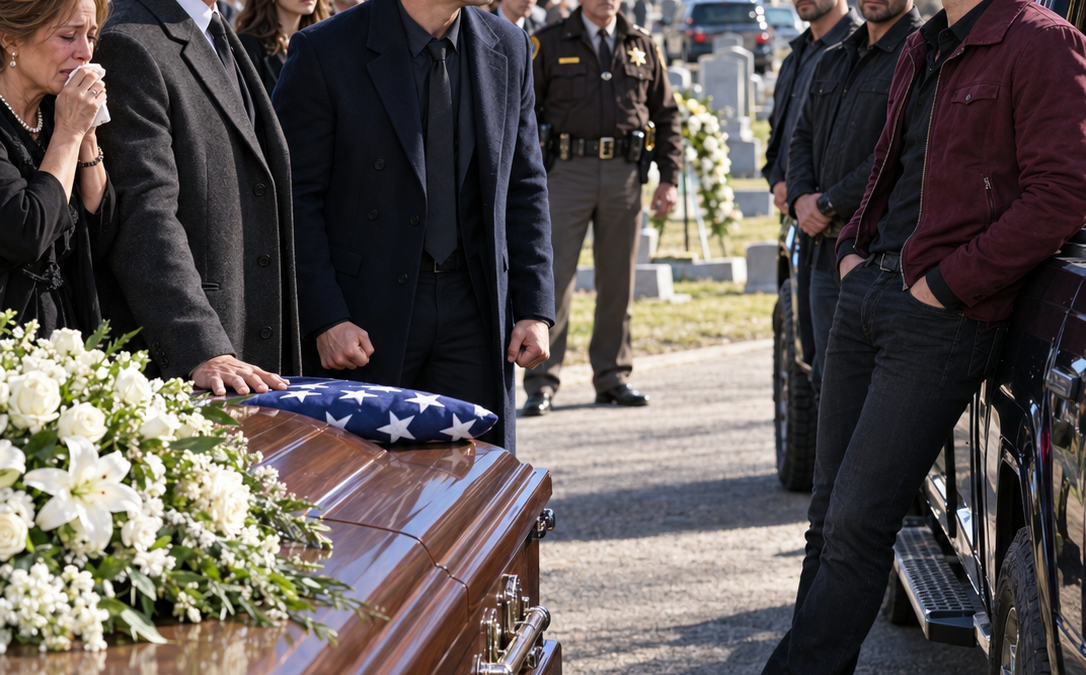
They buried my brother on a cold Tuesday morning. But the worst part wasn’t the silence. It was the laughter.
Ryder, the man who shot him, stood across the cemetery road, smirking at my father like he owned the world. My mom was shaking, and my dad didn’t even blink. That day, I learned that silence could be louder than gunfire, and my father’s quiet was the kind that promised a storm.
Hit like, subscribe for more betrayal stories, and comment your city or country.
I remember the weight of that morning more than anything else. The coffin looked too small for someone like Logan. He had a way of filling every room he entered, always laughing too loudly, always talking about his big plans. But there he was, swallowed by polished wood, with a flag folded tightly beside him, the kind they give when someone dies in service. My brother had never even gotten the chance to wear a uniform.
The wind never stopped blowing. I kept my eyes lowered, pretending not to see Ryder leaning against his black truck across the fence line. Two of his men stood beside him, smoking like they were attending a party instead of a funeral. Nobody said a word, not even the sheriff standing nearby, pretending to care.
Then Ryder called out, his voice rough and mocking. “Guess the old man ran out of bullets.”
The world seemed to freeze. My spine went rigid, but my father didn’t move. Grant Miller stood beside the coffin, his jaw set, his eyes hidden behind dark glasses. People whispered, thinking perhaps he hadn’t heard. But I’d lived with that man my entire life. He heard every word.
I turned toward him, waiting for something. Anything. A look, a breath, some sign that the insult had reached him. But nothing came. He simply placed his hand on Logan’s coffin and whispered something I couldn’t hear.
Then he walked away.
There were no tears, no rage, just a calm so unnatural that it frightened me more than Ryder’s smirk.
That night, our house felt hollow. Mom stayed in her room, and I sat in the kitchen, staring at the porch light flickering outside. Dad hadn’t come home yet, and the dirt from the funeral still clung to my boots. I kept turning Ryder’s words over in my mind, worrying at them like a wound I couldn’t stop touching.
Weak old man.
But my father had never been weak. At least, not in the ways that mattered.
At midnight, the front door creaked open. I should have felt relieved, but I didn’t. He walked in like a stranger, wearing an old field jacket I hadn’t seen since I was a kid. His eyes were cold as they swept the room, though he didn’t seem to be seeing any of it.
He looked at me for a long moment before speaking.
“Go to bed, Evan.”
There was no warmth in his voice. It wasn’t a request. It was a command, the kind that came from an instinct deeper than family. I wanted to ask where he’d been, but the question died in my throat. Something about him told me not to ask.
When I woke the next morning, he was gone.
Mom said he’d gone out early, probably to clear his head, but our kitchen table told a different story. The old phone he never used was missing, along with the small safe from the bottom drawer, the one he’d always claimed held nothing but old paperwork.
A heavy feeling settled in my stomach, telling me that none of this was random.
Later that day, I went out back because I needed some air. The shed door stood slightly open. Inside, dust drifted through shafts of sunlight, settling over metal boxes lined up with perfect precision against the wall.
I knelt beside one and brushed it open.
There weren’t any tools inside. There was tactical gear, marked with faded serial numbers and identification tags that didn’t belong to ordinary supply chains. Beneath it, I found old maps showing rural routes and airstrips, along with a black notebook filled with coordinates and names scrawled in tight handwriting.
The first name seemed to stare straight back at me.
Ryder.
It was underlined twice. Below it was a list of initials matching every one of the men who had stood along the fence at Logan’s funeral.
My hands started shaking. I couldn’t tell whether it was fear or adrenaline. By the time I stepped out of the shed, our property looked different. The quiet seemed to have layers now, as though even the birds knew something had shifted.
That night, Mom tried calling Dad again, but his number had been disconnected. She kept telling herself that maybe his truck had broken down somewhere, or he’d gone to a motel, or perhaps he just needed some space.
Her words came faster each time, as though she were trying to outrun what her heart already knew.
I didn’t sleep. I sat at the kitchen table, watching the old wall clock tick through one minute after another until something tapped against the window.
I turned sharply. Nothing.
Then it came again, another faint tap.
When I stepped closer, I saw a thin piece of paper taped to the glass. It contained a single message, written in my father’s unmistakable handwriting.
“Do not call the police. Stay away from them.”
That message told me everything I needed to know. Dad wasn’t missing. He was moving.
Over the following days, quiet reports began spreading through town. Two of Ryder’s men had been found miles out by the highway with their tires slashed. There were no fingerprints, no camera footage, nothing that could identify whoever had done it.
People blamed rival gangs. But I knew that somewhere out there, my father had begun pulling at a thread.
I still remember the last normal sound in our house before everything changed. It was my phone buzzing late one night.
There was no caller ID. I answered, but nobody spoke at first. All I heard was static. Then a man’s voice came through, low but unmistakably clear.
“Your father’s file just went active again.”
Before I could ask what he meant, the line went dead.
For the first time in my life, I realized that the man I’d always called Dad wasn’t merely a grieving father trying to survive the loss of a son. He was something bigger, something dangerous, the kind of man whose silence concealed a lifetime of ghosts.
The following morning felt like waking inside a dream I couldn’t remember entering. The air in the house was still, almost untouched, as though my father had vanished from existence.
He wasn’t simply gone. His presence had been stripped from every surface. The old boots he kept by the door were missing. The family photograph he always kept on his nightstand had disappeared, too.
It was as though he’d erased himself, efficiently and methodically.
Mom kept pretending his absence was temporary. She washed dishes she’d already washed and held her voice steady whenever neighbors stopped by to ask questions. But each time she thought I wasn’t looking, I saw her hands trembling.
I spent most of that day retracing my father’s habits. I checked his desk drawers, searched the shed again, and examined the truck he always parked perfectly beneath the oak tree. I found nothing. Not a note, not a trace that explained where he’d gone. All that seemed to remain was the faint smell of metal and motor oil, a scent I associated with his military days.
That night, I discovered the gate standing halfway open. It had been closed when I’d gone outside thirty minutes earlier.
My pulse jumped as I looked across the field, waiting for my eyes to adjust to the shifting shadows along the tree line. Nothing moved, but I knew someone was out there watching.
I shut the gate, went back inside, and locked every window. Sleep never came.
Around two in the morning, headlights moved slowly along the road. It was Ryder’s truck. He didn’t stop this time. He simply let his headlights linger over our house before turning back toward town.
The message was quiet but unmistakable.
We know you’re alone now.
Over the next few days, the pattern grew stranger. I began noticing small traces that didn’t belong, subtle changes that only someone trained to pay attention might recognize. The screws on an air vent were slightly misaligned. A faint trail of footprints behind the shed didn’t match any of ours.
Someone had been on the property, checking something.
More than once, I considered calling the police. But every time I reached for the phone, my father’s note stopped me.
Stay away from them.
By the fifth day, the silence finally broke.
A package was waiting for me at the post office, addressed in my name, with no return address. Inside were a simple flash drive and a small bronze coin stamped with an eagle. The coin was old, the kind issued by the military.
That night, I plugged the drive into my computer.
The screen filled with encrypted files labeled with long strings of numbers. But one folder caught my attention immediately.
RYDER / CLASSIFIED DEBRIEF.
I opened it, and documents filled the screen: photographs, scanned reports, field notes, and operational records. My father’s name appeared throughout them.
So did Ryder’s.
My chest tightened as I read further.
Ryder hadn’t always been a gang leader. Years earlier, he’d been involved in a covert arms-recovery mission overseas. Grant Miller, my father, had been his handler.
The report ended abruptly, stamped with two words.
OPERATION COMPROMISED.
Beneath that was another word.
TERMINATED.
There was no explanation of what had gone wrong, but the signature at the bottom of the document contained a single name.
Spectre.
I’d seen that alias before, carved faintly into the handle of one of Dad’s old field knives years earlier. Back then, I’d thought it was just a nickname. I’d never asked him about it.
Now, pieces of the past were beginning to fall into place.
Logan’s death hadn’t been random. It wasn’t some street conflict or a case of being in the wrong place at the wrong time.
It was unfinished business.
The following night, Mom’s phone rang. She answered with a look of relief, perhaps expecting a neighbor or someone who might finally have news about Dad. But after only a few seconds, the color drained from her face.
“Who is this?” she whispered, her voice trembling.
Silence followed. Then a click.
When I took the phone, there was nothing left but static. Yet beneath the noise, I heard something faint and rhythmic.
Three short bursts, one long, then two short.
I opened my laptop immediately and began checking the pattern. It was a coded signal, a form of Morse code, and the message was only one word.
ALIVE.
The next day, I began noticing more signs that my father was moving through the shadows of our town, unseen but always a few steps ahead.
There was the smell of burned rubber behind Ryder’s garage. Rumors spread in hushed voices. Two more of his men had disappeared overnight, leaving behind no signs of a struggle and no trace of where they’d gone.
People whispered that Ryder had made enemies across the border. But I knew this wasn’t the work of some rival gang.
This was precision. A surgical dismantling.
My father was taking Ryder’s organization apart piece by piece, using the same tactics that had once made him a Pentagon legend. Quiet. Untraceable. Effective.
The fear Ryder carried was different now. You could see it whenever he drove past the town square, his jaw locked, his eyes constantly checking corners and shadows. He didn’t mock anyone anymore.
He was being hunted, and he knew it.
Yet none of that brought me peace. The closer my father seemed to get to Ryder, the deeper my own dread became.
Because my father wasn’t a man who stopped halfway.
Whatever he’d begun all those years earlier, he intended to finish now. And I couldn’t tell whether finishing it meant he’d ever come home.
Late one night, I opened the flash drive again. At the bottom of the directory, half hidden among the encrypted records, I found another file.
AUDIO_LOG_17.
The recording was rough and distorted, clearly captured somewhere in the field. But the voice was unmistakable. It belonged to my father, lower and calmer than I remembered, steady as ever.
“If you’re hearing this, Evan, it means they came back. Don’t follow. Don’t fight. You’ll know when it’s time.”
The recording ended before I could even draw a breath.
Those words haunted me for the rest of the night. If he wanted me to stay away, why had he left so many breadcrumbs? And what exactly did he mean when he said I’d know when it was time?
The following morning began with a knock unlike that of any ordinary visitor.
It wasn’t casual. It was measured.
Three knocks, a pause, and then two more.
I froze halfway down the stairs, my heart pounding. Mom called out from the kitchen, but the voice that answered wasn’t one she recognized. It was a woman’s voice, calm yet unmistakably authoritative.
When I opened the door, I found a woman in a gray suit and dark sunglasses. Her posture was almost impossibly straight. She introduced herself as Agent Daphne and showed me a badge from the Defense Intelligence Bureau.
The name sounded official and important, though vague enough that it could have meant almost anything.
“Your father, Grant Miller,” she began, her eyes narrowing slightly, “was a ghost. Pentagon records list him as inactive. That changed seventy-two hours ago.”
For a moment, her words didn’t register. The only thing I could focus on was that one word.
Ghost.
Before I could respond, she stepped past me and examined the living room, studying the family photographs and the unnatural stillness hanging over the house.
“We have reason to believe he’s reactivated mission protocols from two decades ago,” she said. “Do you have any idea what might have triggered that?”
I didn’t answer. I didn’t need to. The folder labeled RYDER flashed through my mind.
She turned toward me as though she already knew what I was thinking.
“Grant Miller wasn’t a regular soldier. He ran operations that didn’t exist on paper. When men like that resurface, someone usually ends up dead.”
Mom’s face went pale. She gripped the edge of the kitchen counter to steady herself.
“You’re saying my husband is dangerous?”
Daphne didn’t blink.
“I’m saying he never retired.”
That same night, I found myself drawn toward the field road leading out of town, the one Ryder’s trucks often took toward the abandoned quarry.
I parked my car two miles away and made my way through the darkness, accompanied by nothing but the sound of wind scraping over dry earth.
For nearly an hour, the world remained still. Then a faint engine hum emerged in the distance.
Two black SUVs rolled toward the quarry in formation, their headlights off. I crouched behind a fallen tree and watched as they stopped near the old loading bay.
Six men climbed out carrying duffel bags. I didn’t recognize any of them until Ryder stepped down from the vehicle at the far end.
He looked tense, constantly checking the shadows. The arrogance he’d displayed at Logan’s funeral was gone. This was a man who seemed afraid of the very air around him.
Then I saw someone else.
A silhouette appeared behind the steel support beams.
My father.
He moved as though he were part of the night itself. There was no hesitation, no unnecessary sound. Every motion carried discipline, purpose, and precision. It wasn’t violence for its own sake. It was a craft he’d spent a lifetime mastering.
He didn’t shoot. He waited.
The men spread out while Ryder barked orders about a shipment, his voice echoing against the metal walls. My father remained in the shadows, studying every movement until his attention settled on Ryder’s lieutenant, the same man who’d joined in mocking him beside Logan’s coffin.
Seconds later, the lieutenant collapsed without a sound.
I never saw how it happened. One moment he was standing, and the next he was on the ground.
Ryder panicked. He drew his gun and spun around, shouting orders his men couldn’t follow.
My father stepped out of the darkness just long enough for Ryder to see his face.
It was a silent revelation.
Then he vanished again.
I left before anything else could unfold. I knew that if I stayed, I’d become part of whatever war my father had started, a war I wasn’t equipped to survive.
The following morning, Agent Daphne returned. She had clearly spent the night tracking something. Exhaustion showed around her eyes, and her voice was quieter than before.
“We intercepted communication from a foreign network,” she told me. “Ryder wasn’t just a street criminal. He worked black contracts under a disbanded operation called Silence Protocol.”
I stared at her, struggling to keep my voice steady.
“And my father?”
She hesitated, choosing her next words carefully.
“Spectre led Silence Protocol. He was their final commander.”
Everything connected in that moment. Ryder’s hatred, my father’s withdrawal from ordinary life, the mockery at the funeral. None of it had been random. It was an echo from a history that had never truly ended.
Daphne warned me that the government wanted my father contained, not found.
“He’s going against direct directives. If he eliminates Ryder, he’ll expose intelligence the Pentagon buried decades ago.”
Her words left a chill that followed me throughout the day.
That night, I returned to the flash drive, digging deeper into its encrypted layers. Eventually, a hidden folder opened, revealing field photographs of men in military fatigues standing beside unmarked convoys.
It wasn’t the soldiers who caught my attention.
It was the man standing at the far left of one photograph.
Ryder, years younger, shaking my father’s hand.
That image destroyed whatever innocence I had left about our family. Logan’s death hadn’t been a terrible accident of fate. It had been written into a history of lies long before we were old enough to understand them.
As I shut down my computer, my phone buzzed.
A single message had arrived from an unknown number.
“Do not trust Agent Daphne. She’s not here to protect you.”
I froze, staring at the screen, my throat suddenly dry. A moment later, the number disappeared, as though it had been erased from the network entirely.
Whoever had sent the message knew what was coming next.
And so did I.
Because ghosts don’t hunt alone. They reopen every grave left waiting.
The night I received that warning, I sat in the darkness long after my phone screen had gone black. The quiet inside the house felt colder than usual. Snow drifted down from the mountains, settling softly against the windows, and I couldn’t stop hearing those words.
Do not trust Agent Daphne.
She hadn’t called since our last conversation, yet I felt watched. Every time a car passed, I noticed its headlights lingering in the window reflections a little too long. The neighbors had stopped asking questions, and Mom had stopped sleeping.
She moved through the house like a shadow herself, checking locks, burning meals, and whispering old memories of Logan as though speaking about him might somehow keep him alive. But nothing could stop the silence from growing heavier.
One evening, as the amber sunset stretched across the field, I found a letter slipped halfway beneath our front door. There was no name and no postmark. The paper smelled faintly of oil and metal.
It contained only four words.
“He’s cleaning the list.”
I didn’t tell Mom. I couldn’t bring myself to explain something I barely understood.
Instead, I drove toward town, following a strange instinct I couldn’t put into words. It led me to the rusted railway bridge, a place none of us had any reason to visit.
That was where I saw him.
My father stood some distance away, watching the frozen river below.
For a moment, I convinced myself it was a trick of the fading light. But when I blinked, he stepped backward and disappeared behind the concrete pillars.
I ran down the slope, my heart hammering, calling his name. Only the wind answered.
Then I noticed something near the base of the bridge.
Burn marks scarred a small patch of earth beneath the snow. Spent shell casings glinted faintly around it. The scene didn’t look like the aftermath of a fight. It seemed more like the remains of warning shots, as though someone had been testing weapons or deliberately sending a message.
By the time I returned home, another vehicle was parked across the road. Its windows were tinted, and its engine remained running.
It stayed there until dawn, leaving only when I stepped onto the porch and stared directly at it.
The following morning, Agent Daphne returned.
She didn’t smile this time.
“We need to talk,” she said, pushing past me before I could respond.
She placed a file on our kitchen table. Inside were photographs, timestamps, and evidence reports.
“Three of Ryder’s men turned up dead last night outside the bridge. Clean work. No prints. No identification. This has your father’s signature all over it.”
I kept my face still, though inside I felt as though I were unraveling.
She studied me carefully.
“You went there, didn’t you?”
I said nothing.
Daphne leaned closer and lowered her voice.
“Evan, listen carefully. Your father isn’t acting out of grief. He’s enacting an old protocol. Spectre’s Doctrine. Every name on that list in his possession connects to operations that never legally existed.”
She paused.
“Including me.”
Her admission struck like a punch.
“You’re on the list?”
Her silence was all the answer I needed.
Before she could explain further, her phone vibrated. She glanced at the screen and froze. The color drained from her face.
“He’s close. We have to go. Now.”
I refused to move.
“If he’s close, I’m not running.”
She exhaled sharply and glanced toward the windows.
“You don’t understand. When Spectre finishes clearing a list, he erases the witnesses next.”
Before either of us could say anything more, engines roared outside.
It was the same dark SUV I’d seen the night before, its headlights cutting through the gray half-light of morning.
Daphne drew her sidearm and motioned for me to stay low as footsteps approached the front door. She peered through the curtain, and her breath caught.
“That’s not your father.”
The next five seconds happened brutally fast.
A crash shattered the silence, and the front door splintered inward.
Men in tactical gear stormed the house, ordering Daphne to get down. She shouted her credentials, but none of them seemed to care. Their uniforms bore no official insignia, and their movements were too controlled, too exact, to belong to ordinary criminals.
They weren’t federal agents.
They were private operators.
One of them grabbed me and wrenched my arms behind my back. As he pulled me away from the table, I caught a glimpse of the patch on his gear.
There was no lettering, only the outline of a silent mask.
Spectres. The real kind.
I shouted for Mom, but she didn’t answer.
The men swept through the house in less than a minute. Then, as suddenly as the assault had begun, everything stopped.
One of the soldiers pressed a finger against his earpiece. He listened, nodded once, and ordered a retreat.
The men vanished almost as quickly as they’d arrived, leaving the front door hanging open and snow curling across the floor.
Daphne stood trembling in the middle of the wreckage, her face ashen.
“They weren’t here for you,” she managed to say. “They were confirming his work radius.”
“What does that mean?” I asked, my throat raw.
She shoved the photographs back into her bag.
“It means your father isn’t hunting them. He’s drawing them somewhere.”
She looked straight at me.
“He’s setting a trap.”
That night, I couldn’t stay home. The house smelled of fear and broken wood, and every shadow seemed to conceal another threat.
I drove until the road split into the woods, where cell service disappeared and the forest swallowed every distant sound. My father used to take us fishing there when I was a kid. He always said it was the only place left without eyes.
At dawn, I found fresh tire tracks near a clearing, the deep impressions left by off-road vehicles. I followed them until I reached a small cabin hidden beneath the pines.
Its windows were covered with blackout material, and the faint hum of a generator vibrated through the frost.
Inside, dusty footprints circled a steel table covered in maps. Each sheet was marked in different colors, with locations, routes, and lines connecting points across the surrounding countryside.
I didn’t need to understand every symbol to recognize what I was looking at.
My father was triangulating the locations of Ryder’s remaining network, closing in from multiple directions. Every movement had been calculated, every route plotted with the precision of a chess match.
Then I noticed something pinned to the center of the largest map.
An old, cracked photograph.
Logan’s face.
Beneath it, written in my father’s thick black handwriting, were two words.
FINAL DEBT.
I couldn’t look away.
My father wasn’t being driven by madness. He was being driven by mourning that had hardened into absolute focus.
Suddenly, footsteps crunched through the snow outside.
I backed toward the wall, every muscle in my body tightening. The door creaked open, and a narrow blade of daylight moved across the room.
Then he stepped inside.
For a moment, neither of us moved.
He looked thinner and older. His beard was untrimmed, and his eyes were hard as steel. Yet beneath that hardened expression, I saw something deeper.
It was grief that had aged into control.
“You shouldn’t have come here, Evan,” he said quietly, as though speaking too loudly might break something sacred. “You’ve already seen too much.”
I took a step toward him, forcing out the question that had been tearing me apart.
“Did Logan die because of something you did?”
He didn’t answer with words.
Instead, he reached into his jacket and placed a small, scorched photograph on the table. It showed him years earlier, standing beside Ryder’s crew near a helicopter. They were younger, their faces untouched by the years that had followed.
In that moment, I had my answer.
My father turned away and began preparing his equipment, checking his gear and loading weapons with slow, practiced precision.
“You need to go home,” he said. “This is my mess to bury.”
I wanted to stop him, but something in his expression held me still. It wasn’t anger.
It was farewell.
He glanced back once as he opened the door to the storm.
“They took my son to send a message. I’m sending one back.”
Then he stepped outside and disappeared into the snow.
I realized that I hadn’t simply found my father. I’d met the ghost the Pentagon had built, the man they thought they’d buried.
And now the hunt was fully awake.
After he left, I stood in the doorway long after the snow had swallowed his figure. The forest was silent, but it was the kind of silence that made your chest ache because you knew what might follow.
Violence. Truth. Or both.
The cabin still smelled of diesel and cold metal. My father’s maps stretched across the table, every sheet covered with coordinates, dates, and names I didn’t recognize.
One name stood out, underlined twice in black ink.
Ryder.
I stared at it until dawn, unable to decide whether the pounding in my chest came from grief or fear.
Beneath a stack of papers, I found a notebook filled with my father’s handwriting. It wasn’t neat and disciplined like his usual reports. The words seemed frantic, pressed into the paper so hard that the pen had nearly torn through several pages.
The first entry froze me.
“They killed Logan because of me.”
The rest read like a confession dragged out of memory.
Years earlier, my father had gone undercover to intercept a weapons cartel that had embedded itself deep within contracts involving rogue military contractors. Ryder had been their domestic arm, a handler for operations that could never be allowed to exist in daylight.
My father had dismantled the organization, exposed its chain of command, and vanished under witness protection.
But decades later, Ryder had resurfaced. He’d reinvented himself as a gang lord while maintaining connections to the weapons pipeline that had never truly disappeared.
Logan’s name appeared two pages later, beside a single phrase.
“Wrong place. Wrong bloodline.”
My father had tried to protect us by erasing everything about his past. But ghosts don’t stay buried forever.
They wait for family to find them.
Outside, dawn burned pale above the tree line. I gathered the papers and tucked them into my bag, knowing that the truth I’d discovered was heavier than anything I’d ever carried.
On the drive back toward town, an unmarked truck blocked the road.
I slammed on the brakes, my tires skidding over the frost.
Two men stepped out of the vehicle.
They weren’t Ryder’s street thugs. These were professionals. They wore plain clothes, but they moved with the kind of controlled confidence that came from years of training.
One of them, a man with a scar beneath his jaw, called my name as though we’d met before.
“You need to come with us, Evan.”
My fingers tightened around the steering wheel.
“Who are you?”
“Friends of your father’s,” he answered, his voice unnervingly even. “Spectre needs you out of the way. He started something the Pentagon doesn’t want finished. Before it’s too late, hand us what he left.”
They didn’t come any closer. They didn’t need to. Their calm made the threat worse.
“I don’t have anything,” I said.
My voice sounded rough, but almost believable.
The scarred man smiled slightly and nodded toward my bag.
“You carry his plans in there, boy. You shouldn’t. They’ll bury you both.”
Without another word, the men climbed back into their truck and turned into the woods, leaving tire tracks twisting through the ice.
I sat motionless for a long time after they’d gone.
Every instinct told me to run. But another part of me wanted to stay, to discover why my father had trusted me with evidence that no one else was supposed to see.
That night, I returned to the flash drive.
There was one final file I’d never managed to open. It had been locked behind a password, and every previous attempt to access it had failed.
I tried three combinations.
The third worked.
A video began playing. The image flickered weakly before resolving into a familiar face.
Logan.
My brother sat inside the same cabin I’d just left.
“If you’re watching this, something went wrong,” he said, his voice steady but exhausted. “Dad never told you the truth, Evan. He didn’t just leave the military. He was ordered to. He exposed them.”
I leaned closer to the screen.
“Ryder worked for higher hands. People who keep wars turning no matter how many families burn. If Dad’s back in the field, it’s because he knows too much.”
Logan paused. His eyes lowered briefly before lifting to look directly into the camera.
“If he can’t finish this, you have to survive it.”
The video cut off.
For several minutes, I couldn’t breathe properly.
It was a message from my dead brother. Proof that he’d known what was coming. Proof that his death hadn’t been a mistake, but an execution disguised as a random tragedy.
Before I could replay the footage, a notification flashed across my screen.
“We warned you once.”
A second later, glass shattered at the front of the house.
I dropped beneath the table as gunfire ripped through the windows. Mom screamed from the back hallway. I crawled toward her, shouting her name, while bullets tore through the walls and furniture around us.
The shooting ended almost as quickly as it had begun.
Outside, tires screeched against the road, their sound fading into the distance.
When I reached Mom’s room, I found her unharmed. But everything around us had been destroyed. Picture frames lay shattered across the floor. The walls were gouged and broken, and the furniture had been torn apart.
I pulled her close, holding on to her while the last echoes of gunfire seemed to ring through the house.
When the noise had completely faded, I cautiously checked outside.
Across the yard, a knife had been driven into the fence, pinning another message written in red marker.
“One ghost is enough.”
They had wanted to frighten me, not kill me.
Not yet.
I packed what remained of the flash drives and notes, along with Mom’s essentials. We drove through the night toward the coast, following one of the coordinates my father had marked on his map.
It led us to an abandoned military base on federal land, a facility that had been closed since the early 2000s.
By the time we arrived, the sun was low, and the wind cut across rusted fences and torn flags. Most of the buildings were little more than skeletons, but one hangar remained sealed behind heavy locks, seemingly untouched by time.
When I forced the door open, dust swirled through air carrying a strangely familiar scent.
The power still worked.
Somewhere deep underground, a generator hummed.
My father had used this place before. Every wall and workbench reflected his unmistakable language of order and readiness.
On an old workbench lay another note written in his precise, mechanical handwriting.
“Ryder isn’t the root. Find the buyers.”
Before I could finish absorbing those words, Mom gasped.
Through the hangar window, I saw a column of smoke rising above the trees, in the direction of our old house.
Dark flames twisted against the horizon.
We didn’t need a news report to understand what had happened.
They’d burned our past.
Now there was nothing left to lose.
That night, I stood staring through the hangar’s dark glass and made my decision.
Ryder wasn’t just my father’s enemy anymore.
He was mine, too.
What I didn’t know yet was that pursuing him would uncover something far bigger than our family, something buried so deeply that even my father had tried to keep it secret.
And by the time the truth came to light, not everyone would live to see it.
Smoke from our old house haunted my dreams. Every time I closed my eyes, I saw flames climbing into the sky, felt the heat, and heard the silent threat behind that destruction.
You run, and we erase everything you love.
Mom barely spoke during the drive back from the coast. She kept turning toward the horizon as though she expected Dad to emerge from the smoke and appear beside the road.
He didn’t.
I was beginning to understand that his silence wasn’t absence anymore. It was strategy. He had wanted us far away when the attack came. Somehow, he’d known exactly what they would do.
At sunrise, I found his old satellite tracker inside the glove compartment. Someone had slipped it there overnight. The small device flashed a new set of coordinates every few minutes.
It was Dad’s way of calling without speaking.
The coordinates led us straight toward the canyons north of Stevenville, the kind of remote terrain only someone with military experience would know how to use. There were hidden entrances, supply caches concealed beneath artificial ground coverings, and old sensors that still blinked with power.
When we reached the final beacon, the landscape opened into a sandy pit surrounded by rusted fencing.
A single truck sat in the middle, its windows rolled down and its radio humming faintly.
On the dashboard, a cell phone had been duct-taped upright, its camera facing straight ahead. A recorded message was waiting on the screen.
I pressed play.
My father appeared, looking directly into the camera.
“If you’ve reached this point, it means they came after you, too. I’m handling Ryder. But this goes deeper than him. The people funding his gang used to fund operations through me. When I broke Silence, they buried the evidence. And one of those buried files has your brother’s name on it.”
I went still.
He continued, his voice as steady as ever.
“Logan helped me once. He was supposed to disappear when things ended. He didn’t. That’s on me.”
The words seemed to settle over the empty canyon.
“But if you want the truth, if you want to end this, follow the river road tonight. Alone. You’ll find what I couldn’t destroy.”
Before the recording ended, he added one final warning.
“Trust no badge. Trust no uniform.”
I looked around the canyon one last time, then drove toward the river as dusk settled over the landscape.
The air grew colder, and narrow trails vanished into gathering fog. A half-moon cast small patches of silver light through the trees.
Eventually, my headlights illuminated what appeared to be a collapsed bunker hidden beneath rock and ivy.
A steel hatch hung halfway open, its chains cleanly cut.
Inside, I found remnants of military equipment, stacks of paper logs, and hard drives covered in dust. The bunker had been stripped years earlier, except for one steel cabinet bolted directly into the concrete.
Inside the cabinet, sealed in plastic, was a single classified folder.
PROJECT HOUSE — RESTRICTED.
I didn’t open it there. Something about the place made me feel watched.
I slipped the folder into my bag and started back toward the car.
Then a spotlight tore through the darkness, blinding me.
“Stop right there!” a voice shouted.
Two SUVs moved into position, blocking my car from both sides.
Agent Daphne stepped out of the first vehicle, her gun raised, her hands perfectly steady.
“Evan, hand me the folder.”
I remained where I was, anger rising through my fear.
“You lied. You said Dad went rogue. All this time, you’ve been tracking me.”
She stepped closer through the glare.
“You don’t get it, kid. Your father didn’t go rogue. He went clean.”
I stared at her.
“He tried to expose everything,” she continued. “But when he discovered who approved those missions, he realized the corruption ran through our own command. He called me because he wanted to leak the truth. Instead, they framed him.”
Her words struck hard and fast, leaving me no time to understand one revelation before the next arrived.
Then she lowered her weapon slightly.
“That file you’re holding, Evan, contains the contracts connecting Ryder’s criminal organization to Pentagon contractors. If it leaks, half of Washington burns. They’ll kill you before they let that happen.”
Before I could answer, headlights appeared along the ridge.
More trucks were approaching.
They weren’t government vehicles, and they didn’t belong to law enforcement.
They were Ryder’s crew.
I could see black hoods and automatic weapons through the windows as the vehicles descended toward us.
Daphne gave a tight, humorless smile.
“Looks like your father isn’t the only one drawing attention.”
Gunfire shattered the quiet.
Dirt exploded around us as bullets struck the ground. We dove behind a cluster of rocks while Daphne returned fire.
“We have to move! Now!” she shouted.
For fifteen brutal seconds, chaos rained down around us.
When the shooting eased, she seized my arm and dragged me toward a ditch leading into a dry streambed.
Behind us, explosions tore through the bunker as Ryder’s men set fire to what remained inside.
By the time we reached the shoulder of the highway, the folder in my hands felt heavier than steel.
Daphne knelt beside me, breathing hard.
“They’ll trace us within the hour.”
I finally asked the question that had been troubling me since she’d first appeared at our door.
“Why help me if it puts everything at risk?”
She looked at me, exhausted but certain.
“Because your father once saved my sister’s life overseas. This is my way of paying that debt.”
She stood and brushed the dust from her jacket.
“Go to the base north of Fairfax. He’ll find you there.”
Before I could reply, she disappeared into the darkness.
A moment later, I heard tires crunching over gravel as another vehicle approached.
A familiar voice came through its open window.
“Get in, Evan.”
My father.
He was alive, and this time he wasn’t pretending to be a ghost.
His face was streaked with smoke and ash, and his jacket had been torn by crossfire. But his eyes were clear.
I climbed into the truck without a word.
The engine purred as we sped into the desert.
For the first time, I could see the full weight my father carried, not just as a parent who’d lost a child, but as a soldier burdened with enough guilt for two generations.
After miles of silence, I finally spoke.
“What’s in that file?”
He kept his eyes on the road.
“The truth about your brother’s death. He was never an accident. He was the warning they gave me not to talk.”
His grip tightened around the steering wheel.
“Now it’s their turn to listen.”
The night stretched endlessly ahead of us, and I knew there was no turning back.
Whatever the truth was, it had already begun to devour our lives.
But at least we were facing it together.
The desert seemed endless, the horizon shimmering with heat and dust. My father drove without speaking, the engine’s steady hum the only heartbeat left between us.
Moonlight washed the cracked road in pale silver, occasionally catching the pistol holstered beside his leg.
I’d never truly seen this side of him before, the soldier who moved through the world as though every place might become a battlefield.
But as I watched him steer through the emptiness, I finally understood why people had once called him a ghost.
We reached what looked like a junkyard filled with abandoned aircraft on the edge of nowhere.
Rusted wings, cracked fuselages, and shredded tarps covered the ground. It was all that remained of an old storage base, concealed from ordinary maps decades earlier.
My father switched off the headlights and pulled the truck behind a wall of wreckage.
“We stay until sunrise,” he said quietly. “They’ll expect movement before dawn.”
I wanted to ask why he hadn’t told me everything from the beginning, why he’d always believed silence was safer than the truth.
But then I noticed the tremor in his left hand, the kind that came from years of carrying guilt heavier than any rifle.
Inside an old hangar, he unfolded a tattered operations map.
Red markings circled urban routes surrounding Navy yards and logistical checkpoints. In the upper corner, a phrase had been written in block letters.
CONDUITWICK CLEANSE.
“What is this?” I asked.
He stared at the map as though looking directly into the past.
“Project House wasn’t about weapons,” he answered. “It was about control. They created parallel routes for smuggled arms that never appeared on military rosters. Contractors funded it. Our government looked away, and anyone who pushed back disappeared.”
He paused, his expression hardening.
“I was ordered to erase the names attached to it, to clean my own operation.”
Then he looked straight at me.
“When I refused, they sent Ryder to finish the job.”
I felt the air leave my chest.
“And Logan?”
His eyes changed.
“His name got pulled into it because he tried to protect me. They silenced him for half the price it took to build a missile.”
He rubbed his face, his jaw clenched.
“I thought killing the network would end it. But all it did was bury the truth deeper.”
Before I could respond, static hissed from the small radio attached to his gear.
A coded frequency cut through the feedback, sharp pulses repeating beneath the noise.
My father went completely still.
He listened for several seconds before his expression changed.
“They’ve got Daphne. Ryder’s taken her into the extraction yard.”
“How do you know?”
“Because she triggered the signal I gave her years ago. A panic code. It won’t last long.”
He grabbed his rifle and began loading it with the smooth, familiar rhythm of a man who’d performed the same action countless times.
When he noticed me watching, he spoke firmly.
“You’re not coming.”
“Then you’re walking into it alone.”
Something flickered in his eyes. Sorrow, perhaps, though he tried to conceal it.
“You already lost your brother. You’re not losing your father the same way.”
But I couldn’t let him face whatever waited there without me.
While he prepared the rest of his equipment, I removed a spare magazine from his pack and slipped it into my jacket.
When he left, I followed through the darkness, keeping enough distance that he wouldn’t easily notice me.
Every sound in the desert seemed unnaturally sharp.
We reached the extraction yard before midnight.
A massive crane stood rusting above the broken pavement. Men’s shadows drifted through beams of flashlight light, and the low chatter of radios in another language echoed through the open space.
Ryder’s men had positioned spotters along the roof of the central warehouse.
Through a crack in the wall, I saw Daphne.
She had been tied to a pipe. Blood ran down her forehead, but she was alive.
Ryder stood across the room, pacing slowly with a cigarette glowing between his fingers.
He looked thinner and wilder than before, but the cold arrogance in his expression hadn’t disappeared completely.
“You think hiding behind screens protects you, Spectre?” he shouted into the empty warehouse. “I built your empire! You abandoned me! Left me to take the fall! You made me this!”
No answer came.
Ryder kicked over a wooden crate, his rage shaking every word.
“You can’t erase me again!”
At that exact moment, the lights went out.
The confusion that followed barely sounded human.
It sounded surgical.
Boots struck concrete. Figures moved through the darkness faster than the gunfire that followed them. Shadows fell one after another, bodies collapsing silently where men had been standing only moments earlier.
Then everything went still.
Ryder spun around, his gun raised.
“Where are you?”
My father stepped through the smoke.
For the first time since Logan’s funeral, he spoke in a voice stripped of grief. Calm, quiet, and final.
“You already know.”
Ryder fired twice.
Both shots missed.
In less than a breath, my father was beside him, twisting the weapon from his hand. The sound of impact echoed once, then again.
Ryder stumbled backward, clutching his arm.
“You should have stayed dead,” he muttered, spitting blood.
My father didn’t answer immediately. He stood there with his chest rising and falling, memories and fury moving behind his eyes.
“You took my son,” he said softly. “Now you’ll tell me who ordered it.”
Ryder laughed through his split lip.
“You think I did it alone? You think any of this ends with me?”
Something in his laughter wasn’t defiance.
It was resignation.
He dragged himself upright.
“Go ahead, ghost. Pull the trigger. The man who wrote the order signs your pension checks.”
My father hesitated.
Only half a second.
But it was enough.
An explosion ripped through the far wall before I even realized that a barrel inside the warehouse had been rigged to detonate.
My father lunged toward Daphne, pulling her down and shielding her beneath a steel girder.
The shock wave threw me onto the ground outside the doorway.
Heat rolled through the warehouse. Fire climbed the walls, and Ryder vanished behind a curtain of falling debris.
When the worst of the explosion had passed, I crawled toward the wreckage, coughing through the thick smoke.
My father was on one knee, his hands burned and his eyes bloodshot, but he was alive.
Daphne lay beside him, unconscious but still breathing.
“Ryder?” I asked.
He looked toward the inferno.
“Gone or buried? Doesn’t matter. He wasn’t the root.”
He coughed and struggled to steady his breathing.
“They wanted this erasure. Another ghost story to close the files.”
We helped Daphne into the truck and drove along back roads until dawn began bleeding over the hills.
None of us spoke.
Behind us, the fire painted the sky like a second sunrise.
Finally, my father broke the silence.
“We’ve got a lead inside the Pentagon now. One last name. The one who orchestrated it all.”
I asked him who it was.
He met my eyes through the dim reflection of the rearview mirror.
“You wouldn’t believe me if I told you.”
We continued driving while distant sirens echoed across the desert, their sounds slowly fading into the wind.
By the time daylight broke, the smoke still seemed to be following us.
The sunrise looked exactly like burning metal, raw orange bleeding into gray, as though the sky itself refused to rest.
Daphne was only half-conscious in the back seat, pale and wrapped in bandages. My father’s hands had been cut by shrapnel, and streaks of dried blood darkened his sleeves. Yet he never flinched as he drove.
We didn’t speak about Ryder, the explosion, or the man who had given the final order.
The silence between us felt heavier than any truth.
We eventually stopped at a desert motel surrounded by empty fields. It was little more than a worn-out shell with faded walls, but it offered something my father had been searching for since the beginning.
Obscurity.
For hours, he sat beside the window, staring into the distance while working through military reports on an old laptop.
Daphne slept through her injuries in the other bed, and I tried to make sense of the files and coded information we’d recovered.
One phrase appeared again and again.
SPECTRE AUTHORITY REVOKED.
CONTAINMENT PROTOCOL AUTHORIZED.
“What does that mean?” I asked quietly.
“It means they sanctioned my execution,” my father replied without looking up. “Ryder wasn’t hunting me out of vengeance. He was paid to finish the government’s cleanup.”
I stared at him.
“You’re saying all of it? Logan, the gang, the bomb? It was all part of a cover-up?”
He nodded slowly.
“And they’ll keep coming until no trace of what we did exists. Until every ghost is accounted for.”
That was when the full weight of our situation finally struck me.
We weren’t running from criminals anymore.
We were running from our own country.
Daphne stirred behind us.
“If you’re right, there’s no safe way out,” she said. “They’ll erase us next.”
My father finally looked at her.
“That’s why we finish it first.”
She frowned.
“Finish it? There’s nothing left to finish. Those files are death warrants. The more you open them, the faster they find us.”
My father leaned forward. His eyes were cold, but there was still something fiercely alive behind them.
“No. They want control, not truth. We take their truth away.”
He showed me a printed page. One location had been circled deep inside Virginia.
“This facility houses the physical copies of Project House’s original authorizations, including mine. We destroy those records, and they can’t prove any of us existed.”
I looked at the circled location.
“But destroying them won’t bring Logan back.”
The words came out harsher than I’d intended.
My father didn’t flinch.
“No,” he said. “But it’ll stop them from killing in his name again.”
We left the motel before dawn, following back roads through mist and silence.
The world outside seemed empty, as though everything around us were holding its breath in anticipation of the coming collision.
When we finally reached Virginia, a steel compound stood hidden behind a curtain of fog. It was a private data vault concealed beneath federal storage facilities.
Cameras rotated slowly from hidden towers. There were no guards visible inside the gate, only machines watching everything that moved.
My father switched off the engine.
“Stay here,” he said.
“I’m not staying behind again.”
He looked at me.
“Not this time.”
He exhaled, heavy and knowing.
“Then stay behind me.”
We entered through an old service passage.
The tunnels were colder than ice, lined with dormant electrical equipment and rows of storage servers. Encoded numbers marked the walls and cabinets.
My father moved quickly but precisely.
He eventually found a storage box marked with faded initials.
His own.
He raised his flashlight and began searching for the drive inside, but stopped halfway through.
His face changed in a way I’d never seen before, the way a person’s expression changes when something from the past suddenly comes back to speak.
“What is it?” I whispered.
He moved closer to the system.
“The files have already been accessed.”
He pointed toward the timestamps in the access logs.
“Somebody beat us here.”
Before I could answer, the echo of footsteps confirmed his suspicion.
I turned, my pulse hammering, and watched a figure emerge from the darkness.
The man lifted his mask and lowered his gun.
Ryder.
Alive.
Half his face was scarred by burns, his features twisted by pain and rage. He looked like a shadow of the man who had once stood laughing beside my brother’s grave.
“You didn’t think fire could kill me that easily, did you, ghost?” he rasped.
My father leveled his weapon.
“You should have stayed underground.”
Ryder smiled faintly.
“Oh, I like it underground. Close to what you buried.”
He pointed his gun toward me.
“The boy doesn’t even know the full game. Tell him, Spectre. Tell him who signed my paycheck.”
My father’s silence said enough.
Ryder laughed.
“He doesn’t know, does he? The man who ordered Logan’s death wasn’t me. It was your own command. Your friend inside the Pentagon. The one who built Spectre in the first place.”
His words crashed through the sterile room like thunder.
My father didn’t deny them.
He simply whispered one name.
“Nathaniel.”
Ryder grinned.
“So you remember the righteous hero who became Director Nathaniel Grant? Now he runs everything from his marble office while ghosts like us clean up his history.”
Ryder raised his weapon and fired again.
The shot missed deliberately, striking the ceiling and sending sparks across the room.
“They’re watching now,” he hissed. “You, me, all of us. Just pieces to be erased.”
Suddenly, another shot rang out.
It hadn’t come from Ryder.
His body jerked forward, blood spreading across his chest.
Behind him stood Agent Daphne.
She was shaking, but the gun remained steady in her hands.
Ryder collapsed without another word.
The lights overhead flickered. Alarms began howling throughout the facility.
Daphne looked between us.
“You have two minutes before the kill team reaches the lower floors.”
My father backed toward the central server frame.
“Then we end it now.”
He reached into his vest and removed a small device.
An EMP charge.
“Once this detonates, every Project House record burns with it.”
He looked toward the surrounding servers.
“So do we.”
I stepped forward and seized his arm.
“There has to be another way.”
He met my eyes, calm even beneath the flashing red emergency lights.
“There never is for ghosts, son.”
Daphne shouted for us to move.
Soldiers stormed into the hallway, and gunfire tore through the narrow space.
My father shoved me behind the servers and activated the detonator’s countdown.
He turned toward me one last time.
His expression was unreadable, but his voice was clear.
“Live free of this, Evan. That’s all I want now.”
Then the ceiling shattered as he triggered the charge.
A single shock wave erupted through the facility.
White light swallowed everything, devouring every visible trace of the past.
Hours later, I woke beneath concrete dust and twisted cables.
Daphne sat nearby, whispering my name.
“He’s gone,” she said softly. “He took it all with him.”
Fire glowed faintly in the distance, consuming what remained of the vault.
Somewhere inside that brightness, my father’s ghost seemed to have disappeared for good, leaving behind nothing but silence, ashes, and a truth no one could completely bury.
The world after the explosion didn’t go quiet.
It simply learned a new kind of silence.
The kind that settles over everything still standing, making survival itself feel somehow wrong.
The air smelled of burned copper and ash. The ground seemed to tremble long after the last echo of the explosion had faded.
When I finally crawled out from beneath the shattered concrete, the world above looked like another planet.
The ground was cracked. Steel had twisted into unnatural shapes, and smoke rolled across the ruins.
The blast had erased an entire piece of history.
And with it, my father.
There were no headlines, no witnesses, no rescue teams waiting beyond the wreckage. Only crows circling high above the thick smoke.
Daphne found me half-buried beneath debris. She dragged me free with raw, bleeding hands, whispering my name in a voice stripped of all the authority she’d once carried.
“He’s gone,” she repeated between breaths. “He took it all with him.”
And in a way, he had.
He’d taken their lies, their files, and their shadows, leaving only ghosts behind to haunt the truth.
We walked for hours through black ash until we reached what had once been a service road.
My mind kept replaying his final words.
Live free of this.
I wanted to hate him for dying the same way he’d lived, halfway between a man and a myth.
But grief, like war, doesn’t follow logic.
It simply settles inside you, quietly burning through everything that remains.
By sundown, we reached an abandoned truck stop. Daphne hotwired a rusted pickup, and we found just enough fuel to carry us into the next state.
We barely spoke during the drive.
There was too much silence between everything my father had done and everything he’d left unfinished.
That night, at a cheap roadside motel, I sat alone in the corner while Daphne tended to her wounds.
The television flickered with news reports.
“Federal storage fire.”
“Data center meltdown.”
“No survivors confirmed.”
They made it sound like a technical failure. An accident.
The coverage was too quick, too polished.
Someone had already cleaned up the story.
Just as those men had always done.
Daphne watched me through the mirror.
“He wanted you alive for a reason,” she said. “You know that.”
I kept staring at the flickering television.
“Do you think he’s really gone?”
She exhaled slowly.
“Spectres don’t die easily. Maybe not at all.”
I didn’t know what she meant until two days later, when a message arrived.
There was no sender and no subject line, only a set of coordinates and a single word in the body of the email.
Son.
The location pointed somewhere off the coast of North Carolina.
Burroughs Island.
An old military relay station that had been abandoned since the Cold War.
When I showed Daphne, she didn’t hesitate.
“Then that’s where we go.”
We spent what little cash we had left on an unregistered boat from a fisherman who didn’t ask questions.
By nightfall, the sea was churning beneath thunderclouds, waves striking the hull like hammer blows.
The trip should have taken two hours.
It took six.
Lightning flashed over the island, revealing twisted antennas and concrete bunkers half-swallowed by vines.
As we approached the dock, the smell of salt and rust filled the air, as though memory itself had begun to corrode.
Inside the main compound, the walls were stained with mold and decay.
I counted twelve steps from the entrance tunnel before the beam of my flashlight struck rows of metal crates.
Each carried a Pentagon insignia.
The stenciled letters on their sides read:
PROJECT HOUSE — CLASSIFIED ARCHIVE.
My pulse surged.
This was it.
The very heart of everything my father had nearly destroyed himself trying to bury.
“Are you sure about this?” Daphne asked from behind me.
Her voice was barely a whisper.
I drew a breath.
“I need to know what he died for.”
I pried open the first crate.
The lid cracked beneath my hands.
Inside were binders filled with authorizations, military accounts, and covert memoranda connected to global trade fronts.
Every page tied weapons transfers to people sitting in polished offices, men who had never fired a shot in their lives but had built entire empires from those who had.
Halfway through the stack, I came across two familiar names.
Ryder.
Spectre.
I expected to feel anger.
Instead, what I felt was smaller and somehow more painful.
Grief disguised as clarity.
My father hadn’t simply been hunting revenge. He’d been trying to make sure nobody could ever use his name again.
Daphne opened another file, her expression tightening as she read.
“These orders were meant to keep Project House active. They approved killing their own agents if those agents became liabilities.”
She pointed toward a line in the document.
“That’s what they used to justify Logan’s death.”
The words blurred before my eyes.
My brother’s death.
The entire nightmare had begun as a bureaucratic authorization signed by men who had never even met him.
“Do we burn it?” Daphne asked softly.
I slowly shook my head.
“Dad already burned enough. Let’s finish this differently.”
She frowned.
“Meaning?”
I took out my phone, established a satellite connection, and began uploading the files to an encrypted leak site.
My father had believed his enemies survived through secrecy.
I thought that perhaps sunlight could finally destroy them.
One file transferred after another.
Contracts. Authorizations. Military accounts. Records of covert operations that had shaped lives and ended others without ever becoming public knowledge.
But just before the final file finished transferring, the laptop screen flickered.
My heart seemed to stop.
A video launched automatically.
The image was fuzzy at first, then gradually sharpened.
My father’s face appeared on the screen.
Scars lined his features, but his breathing was steady.
He was alive.
“Evan, if this reaches you, it means they’ll come again. Not for me. For whatever truth is left.”
I couldn’t move.
“Don’t chase ghosts anymore. Let them bury themselves. You’ve got something they’ll never understand. A name free of war. Keep it clean.”
He turned slightly, revealing the wall of a bunker behind him.
It was the same wall beside which I was standing.
“If you need me, just listen for the static.”
The screen glitched and dissolved into white noise.
The static grew louder.
At first, I thought it was coming from the video.
Then I realized the sound was real.
Somewhere at the far end of the island, an old radio tower had flickered to life, broadcasting static into the storm.
I stepped outside into the rain and stared up at it while lightning cracked overhead.
Daphne followed close behind, shielding her face from the wind and rain.
“He’s here, isn’t he?”
I nodded slowly.
The static repeated in a deliberate pattern.
Morse code.
One word.
ALIVE.
My eyes burned.
That was all I needed.
My father had built a world in which ghosts could hide.
And maybe, just maybe, he’d finally found a way to be free inside it.
When we returned to the mainland several weeks later, the uploaded files had already become public.
Millions of documents exposed decades of black operations.
Nobody claimed responsibility for the leak.
Conspiracy theories filled every news feed, but beneath all the speculation and noise, the truth remained.
The government called it digital terrorism.
The rest of the world called it justice.
I didn’t use my real name.
Afterward, I began traveling under different aliases, taking quiet cybersecurity jobs in small towns where nobody asked too many questions.
Sometimes, late at night, when the air felt heavy with memories, I’d check old radio channels on a battered receiver.
Every once in a while, at exactly 0300 hours, I’d catch faint static pulsing through the noise.
The rhythm was too deliberate to be accidental.
Three tones.
A pause.
Two more.
Our signal.
My father’s way of saying, I’m still watching, kid.
And somehow, I knew he always would be.
The sea was calm on the morning everything changed.
For the first time in months, there was no noise from a world hunting ghosts.
Only the wind, carrying memories of everything that had burned away.
I stood on the sand, watching the horizon blur between gray water and white sky.
Somewhere beyond that fog, my father was supposed to be dead.
But ghosts have their own kind of truth.
Ryder was gone.
The networks that had killed my brother had crumbled into dust.
Official reports closed every file with the same explanation.
“Data corruption. Records lost in incident.”
The Pentagon had tried to erase everything, but it hadn’t moved quickly enough.
The truth had continued leaking, quietly and relentlessly, piece by piece, until no one could stop it.
Governments turned against one another. Politicians resigned. Corporate back channels collapsed under the weight of their own secrets.
Nobody officially called it the Spectre incident.
But those who understood the codes knew what had happened.
My father hadn’t simply erased his enemies.
He’d set the world on a course toward resetting itself from underground.
After the chaos began to fade, I stayed along the coast.
I rented a small shack that creaked whenever the salt breeze swept in from the water.
I repaired radios for passing ships, fixed old surveillance scanners, and tried to live as quietly as possible.
Daphne visited sometimes.
She no longer wore her badge. She dressed simply, tied her hair back, and carried no weapons.
She rarely spoke about what had happened, but her eyes held the same unspoken truth that lived inside mine.
Spectre hadn’t died in that explosion.
He had simply disappeared into a silence he’d finally earned.
One evening, while I was cleaning an old transmitter, I caught a distorted signal on a frequency nobody used anymore.
Static came first.
Then three quick pulses followed by two more.
The same rhythm I’d heard long ago.
It repeated twice, then faded.
My heart seemed to stop inside my chest.
Nobody else listening to that frequency would have understood what the pattern meant.
He was alive somewhere.
Still keeping watch.
I didn’t tell Daphne.
I didn’t need to.
Several weeks later, a package arrived through a courier who claimed he’d found it drifting near the pier.
Inside was a Navy insignia I’d never seen before, its sharp edges darkened with age.
Beneath it lay a folded sheet of old notebook paper covered in my father’s familiar block handwriting.
“The world thinks peace is quiet, but real peace is just the absence of noise you can’t control. Keep yours.”
A postscript had been scribbled beneath the message.
“Tell Daphne she still owes me a chess match.”
I smiled for the first time in years.
It wasn’t closure, not really.
But it was something close enough to keep the ache from taking over.
As the months rolled into seasons, people moved on.
The world found another scandal to chase.
But sometimes, when rain struck the coastline at just the right angle, I’d hear those familiar frequencies humming again.
Brief signals, like whispers passing between storms.
That was enough to remind me that not every disappearance means an ending.
Some disappearances are beginnings that nobody else needs to witness.
Daphne eventually retired near the mountains.
She sent postcards every few months, always without a return address.
Each carried a short message written in the same familiar pattern.
Three words.
Two dots.
It was her way of saying she could still hear the ghosts echoing somewhere in the world.
As for me, I kept writing.
I turned the memories into stories, stories like this one, so people wouldn’t forget the kind of men who fought without medals or headlines.
Not for fame.
Not even for revenge anymore.
But for love, loss, and the right to protect what still matters when everything else falls apart.
One night, during a late storm, a young soldier came into my repair shop.
He recognized the sound coming from one of my radios and paused beside the workbench.
“Sir, I’ve been hearing this strange coded pattern for a month now,” he said. “Like heartbeat static. Always repeats after midnight.”
I looked up from the dial.
“What does it sound like?”
He listened to the radio for a moment, then mimicked the rhythm.
“Three short, two long.”
My hand slowed over the controls.
A faint smile crossed my face.
“That’s not static, kid,” I said softly. “That’s a promise.”
He looked confused, but I didn’t explain.
Some truths weren’t meant to start new wars.
That night, I returned to the same window overlooking the sea.
The storm clouds broke just enough to reveal a stripe of moonlight glimmering across the water.
I could almost hear my father’s voice in the wind.
Calm.
Collected.
Always one step ahead.
The ghost wasn’t gone.
He’d simply traded battlefields.
The mission wasn’t vengeance anymore.
It was legacy.
Because quiet men who disappear into smoke sometimes leave behind echoes louder than any explosion.
My father had built his justice from patience, not rage.
He’d made certain that someday, when people like me looked back, we could say the story had ended the right way.
And it had.
I finally found something resembling peace.
Not the kind that comes from forgetting.
The kind that comes from understanding.
My father’s words still guide me whenever I reach for the radio dial.
Some ghosts don’t haunt you to frighten you.
They stay to remind you how to live.
And if you’ve stayed through every moment of this story, every heartbreak, every twist, and every breath, I have one question for you.
Would you have forgiven the world if it took everything from you?
Or would you have become the ghost they never saw coming?
Tell me in the comments where you’re watching from and what kinds of stories you’d like to hear next.
Emotional wars, betrayal, military vengeance, or redemption that reaches deep into the heart.
Because the stories you ask for are the ones I’ll keep bringing to life.
And if this story moved you, even a little, support us in your own quiet way. Tap that like button, subscribe when your heart says you’re ready, and join me again for the next epic thriller and emotional revenge story that will keep you holding your breath until the final second.
Until then, take care of yourself, stay sharp, and remember this.
Ghosts fade.
But legacies don’t.
I’ll see you soon in the next story.








