My boss raised her glass to “the people who will carry this company into next year”—while I stood outside the Christmas party she had deliberately excluded me from. She saw me through the glass doors. So did several of my coworkers. The laughter around them faded. Preston Blackwell smiled into his drink. But Celeste Whitmore didn’t stop her toast. She finished it, lowered her glass, and went right back to her conversation as though I weren’t standing there. I didn’t confront her. I didn’t walk inside. I didn’t give anyone the satisfaction of watching me lose my temper. Instead, I took out my phone and photographed the guest list taped beside the door. Both columns. Because I’d spent nearly sixty hours studying another list that looked disturbingly similar. And Celeste had no idea I knew it existed. I’d worked at Hion Ridge Technologies for almost eleven years. I was forty-three, a senior operations analyst, and the man everyone called when the numbers stopped making sense. I’d caught expensive errors, rescued failing projects, and built financial models that helped keep clients from leaving. And I’d watched other people accept the applause. Preston Blackwell, our director of corporate strategy, had turned it into something of a routine. He’d ask me for an analysis, put his name on the presentation, and accept congratulations while I stood quietly in the background. Celeste was more sophisticated. She’d call me at six in the evening, ask me to rebuild a forecast overnight, thank me warmly, and accept the praise the following morning without mentioning my name. I kept working. Not because I didn’t notice. I had a mortgage, an eighteen-year-old son named Evan, and a college fund I added to every other Friday. His future mattered more than my pride. But on December 22, something happened that I couldn’t explain away. A woman from the events team walked our floor, placing heavy cream-colored Christmas party invitations edged in gold on nearly every desk. The analyst beside me got one. A coordinator hired just four months earlier got one. My desk stayed empty. I waited an hour, thinking someone might have made a mistake. Then Naomi Pierce, a project manager who knew my work, went to HR to ask why I’d been overlooked. Victoria Ashford told her invitations were limited to employees in leadership-facing roles. Naomi pointed out that junior analysts and even a facilities coordinator had been invited. Victoria simply said the list had already been approved and closed. By eleven that morning, half the floor knew. People who had worked beside me for years suddenly found reasons not to make eye contact. Someone quietly slid their invitation beneath a folder. Then Preston appeared at my desk, coffee in hand, wearing that familiar practiced grin. He told me not to take it personally. After all, the company would still need somebody to fix the spreadsheets tomorrow. Two people laughed. One of them was a colleague who actually liked me. Preston kept going, explaining that the party was mostly handshakes and small talk, and I’d never seemed like a handshake person anyway. I looked at him for about two seconds. Then I told him the reconciliation would be finished by close of business and turned back to my monitor. He’d expected anger. Maybe an argument. My silence seemed to disappoint him. Around noon, Celeste passed my desk on her way to lunch. She didn’t stop walking. In that polished, perfectly pleasant voice of hers, she explained that the party was a networking event, not an employee appreciation night, and I shouldn’t think of it as an exclusion. Then the elevator doors closed behind her. My hands stayed steady on the keyboard. My chest didn’t. At four that afternoon, an email arrived from her office. I was assigned a complete reconciliation of two divisional ledgers, including variance explanations, due at eight the following morning. It was normally three days of work for two analysts. And they wanted me to complete it alone, while everyone else celebrated upstairs. I read the message twice. Then I replied that I’d have it ready. What Preston and Celeste didn’t know was that three weeks earlier, I’d received an unexpected phone call from Graham Holloway, our sixty-three-year-old board chairman. He’d summoned me to a private conference room on the nineteenth floor. Two cups of coffee were waiting. Graham told me the board was preparing a major restructuring and wanted an independent assessment of which departments actually produced value. He called it Project Lantern. For almost two years, he’d quietly read the analytical summaries I attached to my quarterly reports—the ones other executives rarely bothered to open. He knew my numbers were reliable. He gave me written authorization to examine the company’s internal records and instructed me to report directly to him. Nobody else was supposed to know. During that investigation, I’d uncovered something that made me sit motionless at my kitchen table one morning. Roughly $18 million in operating costs had been classified and reclassified in ways that didn’t match the underlying records. And every adjusted summary had traveled upward through the same office. I was still tracing the discrepancies. That Christmas party gave me another piece of the puzzle. At 8:20 that evening, while I was working beneath my desk lamp, the elevator opened. Preston stepped out to retrieve his phone. He’d been drinking upstairs. He looked relaxed, confident, almost amused to find me still working. He leaned against my partition and told me not to stay too late. Because apparently, several people would need to clear out their desks the following morning. The way he said it stayed with me. He wasn’t warning me. He seemed to enjoy knowing something I didn’t. I watched him return to the elevator without asking a question. A little before nine, Naomi came downstairs carrying a plate of food from the party. She told me the room upstairs was exhausting and that she’d partly come down for her own sake. I thanked her but gently declined. I wasn’t going to sit at my desk eating leftovers so other people could feel better about a decision they hadn’t made. Before she left, she quietly told me again that excluding me had been wrong. At 9:40, I finally completed the reconciliation. Then I remembered my winter coat. I’d left it in a closet outside the executive dining hall after a meeting two days earlier. It was eleven degrees outside. My car was parked in the north garage. I needed that coat. So I went upstairs. That’s when I saw Celeste raising her glass. That’s when the laughter faded. And that’s when I noticed the guest list beside the door. I read it once. Then again, much more slowly. During Project Lantern, I’d examined divisional staffing records prepared under Celeste’s authority. Certain employees had been labeled essential to the restructuring. The names on the party list closely matched those protected positions. And the people missing from the invitations? I recognized several of them immediately. A financial analyst who had questioned a revenue recognition date. A procurement lead who had challenged an unusually generous vendor contract. An operations manager who had twice refused to approve a forecast she believed was unrealistic. They weren’t all junior employees. They didn’t even work in the same department. But they had something in common. They’d questioned the numbers. I photographed the list and returned to my desk. My inbox showed eleven new messages. Ten were automated. The eleventh had arrived at 9:51. It had been sent from Celeste’s account into a departmental folder I was authorized to access for Project Lantern. The subject line read: **Final Retention Recommendations.** I opened the attachment. My name was the first one under the separation column. Beside it were the words: *Limited strategic value. Redundant analytical function.* I sat there staring at those words. For eleven years, I’d been the person they called when their numbers didn’t add up. Now someone had officially described my work as redundant. But the deeper I read, the less personal the document became. The financial analyst who’d questioned the revenue date was marked for separation. So was the procurement lead. So was the manager who’d refused to sign the optimistic forecast. All six other employees excluded from the party appeared in that same column. And Preston? *Retain, with a recommendation for expanded scope.* Celeste’s closest associates were protected, too. I didn’t forward the document to my personal email. I didn’t access anything outside my written authorization. I recorded where it came from and when I’d received it. Then I opened the original performance records and compared them with the scores presented to the board. Name by name. Quarter by quarter. People close to Celeste had been rated slightly higher than their actual records justified. People who’d questioned divisional reporting had been rated lower. Not dramatically. Just consistently enough to change who appeared valuable and who appeared expendable. And the discrepancies led back toward the same eighteen million dollars I’d been investigating. I could finally see why certain people had been marked for removal. I spent the rest of the evening completing my assessment. Eighty-one pages. No complaints about the party. No description of Preston’s jokes. Not one accusation based on hurt feelings. Only the records, the differences, the documented approvals, and the evidence supporting each finding. At 11:43, I sent the report to Graham Holloway. I turned off my desk lamp, walked to the garage, and sat in my cold car for a moment. I thought about telling Evan. But I knew he’d ask what happened next. And I couldn’t honestly answer him. As I pulled onto the river road, my phone lit up. A reply from the chairman. He’d received my report. I was to be in Boardroom A at 7:30 the next morning. I arrived at 7:25 carrying my travel mug and the same worn leather folder I’d used for years. Graham was already waiting with two board members and a woman from outside counsel. For forty minutes, they questioned me. Could the accounting discrepancies be explained by a change in policy? Were the performance score revisions tied to identifiable users? Could I document where each figure originated? I answered every question with a page number. Nobody congratulated me. Nobody expressed outrage. Then Graham told me operations leadership had been summoned for an emergency meeting at 8:15. And I was to enter with him. The executives arrived in small groups, still relaxed from the previous night’s celebration. Someone was laughing about a colleague’s dancing. Preston came in with sunglasses pushed onto his head, joking about emergency meetings so close to Christmas. Celeste took her usual seat and poured herself a glass of water. Victoria sat nearby with her legal pad. Then I walked through the door. At first, nobody even stopped talking. Preston noticed me and smiled. He gestured toward the small chair against the wall, the one normally used by assistants and interns. He told me I could sit back there. A few people smiled. I hadn’t decided whether to answer when the door opened again. Graham Holloway entered. He walked to the head of the conference table, set down his folder, and pulled out the chair immediately to his right. “Actually, Caleb will sit here.” The room went quiet. I walked across the carpet and sat beside the chairman. Preston slowly removed his sunglasses. Celeste watched me from the opposite side of the table. Graham began describing the independent investigation, the financial reporting irregularities, and the problems uncovered in the company’s performance review system. He explained the board’s decision concerning the restructuring and the responsibilities I would now hold. I watched Preston’s expression change. The easy confidence he’d carried into the room disappeared. Celeste set down her glass. For the first time that morning, she seemed determined to challenge what was happening. She raised a procedural objection. She reminded Graham that I’d been excluded from the company Christmas party less than twelve hours earlier. She acknowledged that the exclusion had been unfortunate. But she argued that giving me authority over personnel decisions immediately afterward could expose the company to accusations of retaliation. Then she looked directly at the chairman. She insisted that after the previous evening, this was obviously personal. Nobody interrupted. Graham let her words hang in the silence. Then he opened the folder in front of him. He removed a single sheet of paper. It was an official board resolution authorizing the independent committee and naming its chair. Five directors had signed it. Without raising his voice, Graham slid the document across the polished table until it stopped directly in front of Celeste. She looked down. Her eyes moved across the signatures. Then they reached the date printed at the bottom of the page.
A man with a mortgage, a son, and a college fund does not get to be theatrical. He gets to be steady.
That distinction was the architecture of Caleb’s entire adult life, and everyone at Hion Ridge had mistaken it for a lack of spine.
Preston Blackwell, director of corporate strategy, had a habit so consistent it had almost become a form of weather.
He would stop by Caleb’s desk on a Tuesday, lean against the partition, and ask whether Caleb had ever pulled the margin breakdown by region. Caleb would send it that night.
On Thursday, the same breakdown would appear in a presentation with Preston’s initials in the corner. When the chief executive praised the analysis, Preston accepted the compliment with a small, modest shrug that suggested long nights.
Caleb had watched this happen enough times to recognize the rhythm of it. Once, a vice president had turned to him in the hallway afterward and said, without irony, that he should learn from Preston’s initiative.
Celeste Whitmore, senior vice president of operations, worked a different way.
She never raised her voice. She never insulted anyone in a manner that could be written down. She called Caleb at six in the evening to rebuild a forecast that had to be clean by morning, thanked him in a warm tone that felt almost genuine, and the following day accepted a compliment for that forecast in an executive session where his name was not spoken.
There was a promotion packet with Caleb’s name on it that had been submitted eleven months earlier and had never come back. Not rejected, simply suspended somewhere in the space between his manager and her office.
When large decisions were made, Caleb built the material for those decisions and then stood near the wall while other people sat at the table discussing it. He would collect the printouts afterward.
Nobody thought that was strange, and that was the part that should have told him everything.
Then, three weeks before Christmas, the phone on his desk rang at ten minutes after seven in the morning, before the floor filled up, and the man on the other end was Graham Holloway.
Graham was sixty-three, chairman of the board, a person most employees had seen only from a distance at annual meetings where he spoke for nine minutes and sat down.
He asked Caleb to come to a conference room on the nineteenth floor. He did not explain.
Caleb went and found the chairman alone at a table with a folder and two cups of coffee, one of which had already been placed on the far side for him.
What Graham described was an internal assessment the board had named Project Lantern.
The company was preparing a restructuring that would touch every operating division in the first quarter of the new year. Before any of it happened, the board wanted an honest measurement of which functions actually produced value and which ones only produced reports about value.
Graham said he had been reading the summaries Caleb attached to his quarterly submissions for almost two years, the ones nobody else seemed to open, and that the arithmetic in them had a habit of being right when more confident documents were wrong.
He wanted Caleb to build the assessment. He wanted it delivered directly to him, and he wanted absolute silence about it, because the moment a review like that becomes known, it stops measuring anything real.
Caleb worked on it at night after Evan went to bed, using data access the chairman had authorized in writing. For the first two weeks, it was ordinary, tedious, satisfying work.
Then, in the second week of December, while reconciling capitalized expenses against divisional reporting, he found a gap.
It was not a small gap.
Across the two most recent fiscal years, roughly eighteen million dollars in operating costs had been classified, reclassified, and presented to the board in a form that did not match what the underlying systems recorded.
Every one of those adjusted summaries had gone upward through a single office.
Caleb sat very still in his kitchen at one in the morning, looking at a number that did not belong to any story he had been told, and understood that he was no longer auditing a company.
He was auditing a person.
On the morning of December twenty-second, a young woman from the events team walked the twelfth floor with a wicker basket and laid a heavy cream envelope on every desk, each one edged in gold, each one bearing a name in raised lettering.
The annual Christmas party at Hion Ridge was a real event, held in the executive dining hall on the twentieth floor, catered, with a string trio and a view of the river. People talked about it in November.
Caleb came back from a meeting at a quarter to nine and found his desk exactly as he had left it, with a cold mug, a stack of printouts, and no envelope.
The desk to his left had one. The desk behind him, belonging to a coordinator who had been hired in August, had one.
He waited an hour in case the basket had run short and a second pass was coming, because that was the more comfortable explanation, and he preferred comfortable explanations to the alternative.
Naomi Pierce noticed before he said anything.
She was thirty-four, a project manager who had worked with Caleb on the supply integration the previous spring and had learned during that project that when Caleb said a timeline was wrong, the timeline was wrong.
She walked down to the human resources floor and asked Victoria Ashford directly whether a name had been missed.
Victoria did not look up from her monitor for the first part of the conversation. When she did, her answer arrived in the flat, pleasant tone of a person reading a policy she had written herself.
The list this year had been limited to employees in leadership-facing roles, and the limitation had come from operations, not from her office.
Naomi pointed out that two junior analysts and a facilities coordinator were on that list.
Victoria said the list had been approved and closed.
News like that does not need to be announced. By eleven, half the floor knew that Caleb Rowan had not been invited, and the knowledge produced the specific awkwardness of people who are relieved it did not happen to them.
A colleague who had sat beside Caleb for six years suddenly needed to look into a filing cabinet whenever Caleb walked past. Someone slid their envelope under a folder.
It was Preston who decided the situation needed narration, arriving at the end of the aisle with a coffee in his hand and a grin he had practiced somewhere.
He said Caleb should not take it personally, since at least tomorrow the company would still need somebody to fix the spreadsheets.
Two people laughed, one of them a man who genuinely liked Caleb and hated himself for the sound as it left his mouth.
Preston kept going, adding that the party was mostly handshakes and small talk, and that Caleb had never seemed like a handshake person anyway.
Caleb looked at him for perhaps two seconds, said that the reconciliation would be finished by close of business, and turned back to his monitor.
The absence of a reaction seemed to disappoint Preston more than anything Caleb could have said.
Celeste came through at noon on her way to lunch, and she did not stop walking, which made it worse.
She said in passing, in a voice warm enough to be quoted innocently, that this was a networking event rather than an employee appreciation night, and that he should not think of it as an exclusion.
Then she was in the elevator.
It was the most efficient humiliation Caleb had received in eleven years, delivered in nineteen words. He noticed that his hands were steady on the keyboard, and that his chest was not.
He thought about Evan and the savings account, and the fact that a man cannot pay tuition with dignity, and he kept working.
At four in the afternoon, an email arrived from Celeste’s office assigning him a full reconciliation of two divisional ledgers, with variance explanations due at eight the following morning.
It was a task that would normally be split between two analysts over three days. The message closed by thanking him for his flexibility during a busy season.
Caleb read it twice and understood the design.
He would be at his desk on the same floor while the music played upstairs, so that everyone who walked past would see the natural order of the place confirmed.
He replied with a single line saying he would have it ready.
Then he opened a blank document and did something he had not planned to do.
He wrote down every name Naomi had recited from the invitation list, and beside it he wrote the names of the people he knew were not on it.
There were six of them besides himself. He knew all six.
One was a financial analyst who had asked in a divisional review in September why a revenue recognition date had moved. One was a procurement lead who had flagged a vendor contract as unusually generous and had been told it was strategic. One was an operations manager who had twice refused to sign a forecast she said was optimistic.
The pattern was not about seniority, because two of them outranked people who had been invited. It was not about department, because they were drawn from four different groups.
Caleb sat back in his chair as the floor emptied around him and considered what he was actually looking at.
A party list is an ordinary thing, assembled by an assistant in an afternoon, meaningless. But a list that excluded precisely the people who had questioned a specific set of numbers, assembled under the authority of the office that produced those numbers, was not ordinary at all.
He did not have proof, and he did not have a theory he would have been willing to say out loud.
He only had the sensation, cold and quiet, of a shape beginning to appear underneath something that everyone else regarded as a social invitation.
He began to wonder whether the sheet taped beside that door was really a list of guests or a list of something else entirely.
The party began at six-thirty, and by seven the sound of it had spread downward through the building the way water finds a floor.
The executive dining hall sat two flights above the operations wing, but the stairwell carried everything: the string trio, the particular ring of good glassware, a burst of laughter that rose and collapsed.
Caleb stayed at his desk under a single lamp, with two ledgers open on separate monitors and a legal pad beside his elbow, where he wrote variance notes by hand because writing by hand slowed him down enough to catch what typing let him miss.
He had texted Evan that he would be late and had received a thumbs-up and a photograph of a bicycle wheel. That small exchange had steadied him more than anything else in the day.
At eight, he was two-thirds finished.
At eight-twenty, the elevator opened and Preston stepped out onto the twelfth floor.
Preston had come down for his phone, which he had left charging at his desk, and he was pleasantly loose in the way of a man on his third drink among people he wanted to impress.
He saw the lamp and the man beneath it, and he could not walk past.
He said it was dedication, really, and that he admired it. Then he leaned on the partition, looked at the two screens without understanding anything on them, and told Caleb not to stay too late because in the morning there would still be a few people who needed to clear out their desks.
He said it the way a man says something he is not supposed to know, enjoying the fact of knowing it.
Then he lifted his phone off the charger and went back to the elevator.
Caleb sat with the sentence for a long minute after the doors closed, because Preston had just told him, without meaning to, that a personnel decision had already been made somewhere above him.
A little before nine, Naomi came down with a plate.
She had gone through the buffet line and taken the things she thought a person would actually eat. She carried it across the empty floor and set it on the corner of his desk without ceremony.
She said the room upstairs was exhausting and that she had come down partly for her own sake.
Caleb thanked her and told her gently that she should take it back, because he was not going to eat at his desk to make anybody feel better about a decision they had not made.
Naomi did not argue, and she did not apologize for attending. He respected her more for both.
Before she left, she said quietly that what had happened with the list was wrong and that she had told Victoria so.
Caleb filed that away, not as a debt anyone owed him, but as information about a person, which is a different thing entirely.
At nine-forty, he finished.
He saved the file, sent it, and then remembered that his winter coat had been hanging in the closet outside the executive dining hall since a morning meeting two days earlier.
It was eleven degrees outside, and his car was in the north garage, so there was no version of the evening where he did not go up.
He took the stairs.
The doors of the hall stood open at the far end of a glass-walled corridor. Warm light lay across the floor in a long rectangle, and inside it perhaps ninety people stood in clusters holding drinks.
Caleb opened the closet, found his coat, and was putting his arm through the sleeve when Celeste’s voice came clearly through the open doors.
She had a glass raised, and the room had grown attentive.
She said it had been a demanding year and a proud one. Then she offered a toast to the people who would carry the company into next year.
Glasses rose.
It was at that moment that several people saw Caleb through the glass, standing in the corridor with his coat half on, and the laughter around the nearest cluster dropped by a noticeable degree.
Preston, at Celeste’s left, smiled into his drink.
Celeste turned her head, saw him, and did not stop. She completed the toast, lowered her glass, and returned to the conversation she had been having.
The room resumed its noise like a machine clearing a jam.
Caleb did not step inside. He had no speech prepared and no interest in delivering one.
But as he turned to go, he saw the sheet of paper taped to the wall beside the doorframe.
The printed guest list the events team used to check names against arrivals.
He stopped and read it. Then he read it a second time, more slowly, and something at the base of his skull went cool.
He took out his phone and photographed it, both columns. Then he walked back down the stairwell with the coat over his arm.
He had not photographed it because he intended to complain. Complaining about a party was, to Caleb, an unserious use of a life.
He had photographed it because in the past two weeks he had spent close to sixty hours inside the divisional staffing files for Project Lantern, and he had seen another list that looked almost exactly like this one.
In the restructuring materials prepared under Celeste’s authority, every role had been tagged with a designation, and the highest tag was essential.
The names in the first column of that party list and the names carrying that tag were, as far as he could tell while standing in a cold stairwell, nearly the same set of people.
Two lists. Two different purposes. One shape.
He got back to his desk and sat down without taking off the coat.
His inbox had eleven new items. Ten were automated.
The eleventh had arrived at nine-fifty-one, sent by Celeste’s account into a departmental folder that operations leadership used for working documents, a folder Caleb had been granted access to by the chairman’s authorization for the duration of Project Lantern.
It had clearly been intended for a smaller distribution and had gone to the group instead, the way such things go when a person sends a message from a phone in a loud room.
The subject line was three words long.
Final Retention Recommendations.
Caleb opened the attachment, and the first name under the column marked for separation was his own.
There is a particular silence that arrives when a person reads a document that was written about him by people who believed he would never see it.
Caleb sat in it for a while.
The spreadsheet ran to four pages. Beside his name, in a column headed Rationale, someone had typed: Limited strategic value. Redundant analytical function.
He read that phrase several times, not with anger, but with the strange detachment of a man examining a description of a stranger.
In the previous eleven months, he had identified the pricing error that saved the logistics platform, and he had built the cost model that convinced two clients not to leave.
Both of those outcomes had been presented to the board by other people.
Redundant was an interesting word for the only person in the building who knew where the money actually went.
He read through the rest of it, and the document stopped being personal very quickly, because he was not alone on that page.
The financial analyst who had asked about the revenue date was there. So was the procurement lead. So was the operations manager who would not sign the optimistic forecast.
All six of the people missing from the party list appeared in the separation column, and beside each of them sat language of the same texture.
Insufficient alignment. Capability overlap. Limited forward contribution.
Meanwhile, every name he recognized as belonging to Celeste’s immediate circle carried a single word in the adjacent column.
Retain.
Preston Blackwell: Retain, with a recommendation for expanded scope.
Two managers who had never produced an original analysis in three years: Retain.
Caleb did not do anything improper with that file, and he was careful about it in a way that later mattered more than he could have guessed.
He did not forward it. He did not copy it to a personal account. He did not enter a single system he had not been given written authorization to enter as part of the board’s assessment.
Everything he touched that night sat inside the data perimeter Graham Holloway had defined in the memorandum he had signed on the second of December, and Caleb noted the time and source of each document he opened in a log he had been keeping since the first day.
Because the value of an audit collapses the moment its author starts improvising.
Then he set four things side by side.
The party list. The retention recommendations. The performance metrics as they existed in the underlying system, pulled from the source rather than from any summary. And the performance metrics as they had been presented in the quarterly packages that went upward to the board.
The first three had been available to him all along.
It was the fourth that turned the evening into something else, because Caleb finally laid the presented numbers directly against the recorded ones, name by name, and watched a pattern rise off the page like heat off a road.
People close to Celeste had been scored upward. Not wildly, not absurdly, but consistently.
A half point here, a rating category there, enough over two cycles to convert an average performer into a protected one.
People who had questioned the divisional reporting had moved the other way, their scores drifting downward through revisions none of them had ever seen until the record itself justified the conclusion someone had reached long before.
The eighteen million dollars in misclassified costs was not a clerical failure.
It was a position that had to be defended, and defending it required a staff composed entirely of people who would not look.
The restructuring had arrived as an opportunity, an orderly, board-approved reason to remove everyone capable of noticing.
And so the thing Caleb had believed about his evening turned over completely.
He had assumed he was not invited because Celeste found him useful but unimpressive, a man who fixed spreadsheets and was not decorative enough for a room with a string trio.
That was not it at all.
He had not been invited because, in the document that would land on the board’s desk in January, he was already gone.
The party upstairs was not a celebration of the year that had ended. It was a gathering of the people who had been told, in the particular way such things are told, that they were safe.
The glasses had gone up in a room full of survivors, and the survivors did not know yet that the man in the corridor with the coat over his arm had spent three weeks building the document that would decide whether any of it held.
He worked until twenty minutes before midnight.
He did not add a paragraph about the invitation. He did not mention a single remark anyone had made to him that day, and he never used the word unfair anywhere in the eighty-one pages.
He wrote what the systems recorded, what the summaries claimed, the size of the difference, the route the difference had traveled, and the names of the approvals attached at each stage.
He appended the retention document with a note of when and how it had arrived. He attached the score histories with their revision timestamps.
Then he wrote a short transmittal message to Graham Holloway, attached the assessment, and sent it at eleven-forty-three.
He shut the lamp off and stood in the dark for a moment.
The building above him was quiet now. The hall had cleared, the trio was gone.
In the garage, he sat in his cold car and let the engine run. He thought about telling Evan and decided not to, because the boy would ask what happened next, and Caleb had no honest answer.
He was pulling onto the river road when his phone lit up on the passenger seat.
The reply from the chairman contained two lines, and Caleb read them at a red light with the heater finally working.
Received. Be in Boardroom A at 7:30.
Caleb arrived at seven-twenty-five with a travel mug and the same worn leather folder he had carried for years.
Graham Holloway was already at the table with two board members and a woman from outside counsel whose name Caleb had never heard before.
They worked for forty minutes.
Nobody congratulated him, and nobody expressed outrage, which he appreciated.
They asked precise questions about sourcing, about whether the variance could be explained by a change in capitalization policy, about whether the score revisions carried authenticated user identifiers.
He answered every question with a page number.
At eight, the chairman closed his folder, looked at the clock, and said that operations leadership had been called in for an emergency session at eight-fifteen, and that Caleb should walk in when he did.
They came up in twos and threes, eleven of them, and the mood in the corridor was the loose, indulgent mood of people the morning after a good party.
Somebody was describing a colleague’s attempt at dancing.
Preston arrived last, sunglasses pushed up on his head, and made a joke about the timing of emergency meetings in the holiday season that earned an easy laugh.
Celeste took her usual place at the near end of the long table, poured herself water, and asked whether anyone knew what this was regarding.
Victoria Ashford sat two seats down with a legal pad squared in front of her and said nothing at all. Her silence was the most informative thing in the room, though nobody was reading it.
Then Caleb came through the door.
He was wearing the same gray jacket he wore every day and carrying the leather folder.
For a moment, the conversation did not even pause, because his presence did not register as an event.
Preston recovered first and found it funny.
He said brightly that they must be taking real notes today, gestured with two fingers toward the small chair against the wall near the credenza, the one used by assistants and interns, and told Caleb he could sit back there.
A few people smiled.
Caleb had not yet decided whether to answer when the door opened again behind him.
Graham Holloway walked to the head of the table, set down a folder, and pulled out the chair immediately to his right, the one that had been empty.
He looked at Caleb and said evenly, “Actually, Caleb will sit here.”
Nobody shouted.
There was no music, no speech, no moment of triumph.
There was only a sixty-three-year-old man drawing back a chair and a room that went quiet on its own because every person in it possessed enough political instinct to understand that the arrangement of a table is never accidental.
Caleb crossed the carpet, sat down, and set his folder in front of him.
Preston removed the sunglasses from his head.
Graham began without preamble.
He said the board had spent the autumn conducting an independent assessment of operational performance ahead of the restructuring, that the assessment had been commissioned in October and completed the previous night, and that it had surfaced material irregularities in the divisional reporting chain and in the performance review system itself.
He said the restructuring would no longer be administered by the office of the senior vice president of operations.
That authority was suspended effective immediately, pending a formal review conducted jointly by the board’s audit committee and outside counsel.
He delivered all of it in the voice of a man reading a weather advisory, and the effect was considerably worse than anger would have been.
Then he said the board had established an independent retention review committee to complete the staffing decisions that the restructuring required.
The committee would be led by Caleb Rowan, who was appointed interim director of operational integrity as of that morning.
Caleb would hold authority to make retention determinations for every position inside the restructuring perimeter, with final ratification by the board.
Graham added one sentence more, and it was the sentence that changed the temperature of the room.
Every determination would be made against verified performance records, not against the ratings currently held in the system, because the board no longer regarded those ratings as reliable.
Preston’s face lost its color in stages, the way a wall does when a light is turned down.
He had spent two years building a professional identity out of other people’s work, and he had spent the previous evening telling the man now sitting at the chairman’s right hand that a few people would be clearing out their desks.
Victoria Ashford wrote a single word on her pad and stopped writing.
Two directors at the far end exchanged the specific look of people rapidly reviewing their own conduct.
Celeste did not wait.
She set down her glass and said, with the composure of someone who had managed difficult rooms her entire career, that she needed to raise a procedural concern.
She said Caleb Rowan had been excluded from a company function the previous evening, that the exclusion had been unfortunate, and that she regretted the impression it created.
She went on to say that elevating him to authority over personnel decisions less than twelve hours later would place the company in an indefensible position.
She said the word retaliation without raising her voice.
Then she looked directly at the chairman and said, “After last night, this is obviously personal.”
Graham let the sentence sit for a moment.
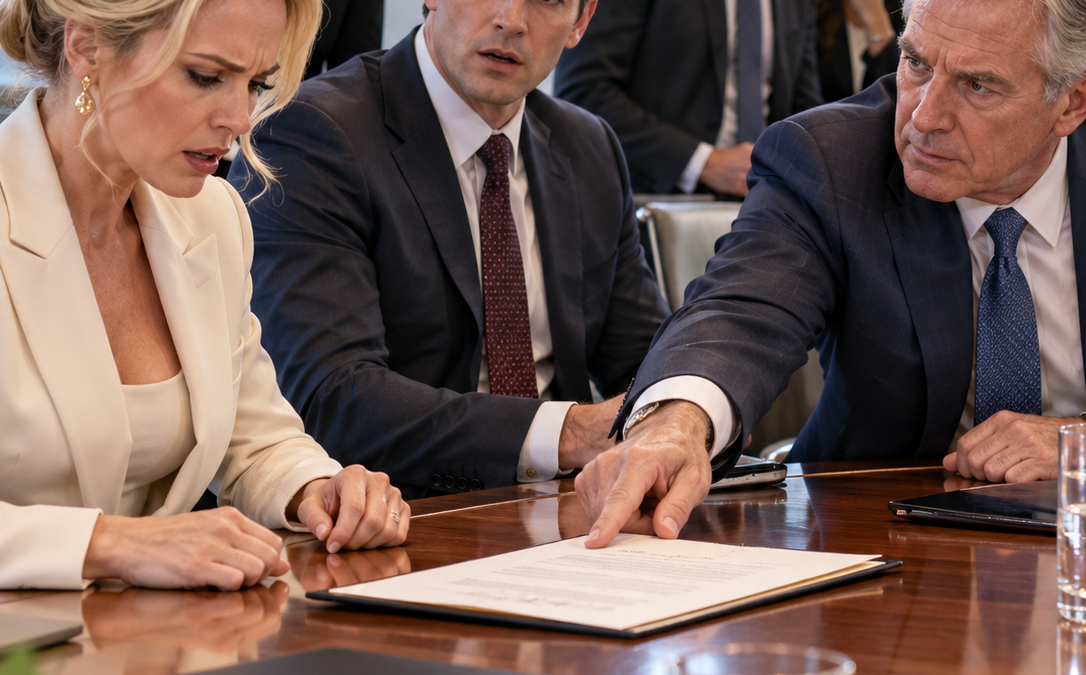
Then he opened the folder in front of him, removed a single sheet, and slid it down the polished surface until it stopped in front of Celeste.
It was a board resolution, two paragraphs long, authorizing the formation of the independent committee and naming its chair.
It carried the signatures of five directors.
At the bottom, in the space where such documents record the date of execution, it read December eighteenth.
Four days before the invitations were laid on the desks of the twelfth floor.
Six days before this morning.
Celeste read it twice.
The room watched her read it twice, which was worse for her than any announcement could have been, because in that interval everyone present performed the same reconstruction of the past week and arrived at the same conclusion.
Caleb had not been elevated because he had been insulted.
He had already been chosen when the invitation list was drawn.
Whatever the exclusion had been intended to accomplish, it had been aimed at a man who, by that date, had already been handed the authority she was now asking the chairman to withhold from him.
Caleb spoke for the first time since entering the room.
He did not lean forward, and he did not raise his chin.
“The decision wasn’t made after your party,” he said. “It was made before you decided I didn’t belong there.”
Then he stopped talking, which was more effective than continuing, because the silence that followed was filled entirely by other people’s memories of their own behavior.
Somebody’s chair creaked.
Preston looked at the table.
Graham closed the meeting with the logistics.
The restructuring perimeter covered ninety-four positions across four divisions. Each department head would meet individually with the committee chair during the day, beginning at nine-thirty in the small conference room on the nineteenth floor.
They would bring their own performance documentation and be prepared to describe in concrete terms the work their teams had produced in the past four quarters.
He said that by five that afternoon, Mr. Rowan would tell the board which positions this company could still justify.
The room emptied slowly, the way rooms do when nobody wants to be seen leaving first.
Caleb stayed at the table, gathering his pages. Graham stood beside him for a moment and said only that the hard part had not been the audit.
Then the chairman left, too.
Through the glass wall, Caleb could see the corridor filling with the people who, eleven hours earlier, had lifted their glasses to the ones who would carry the company forward.
They were walking back to their desks to find the documentation that would prove they should remain.
Some of them had not spoken to him in months.
Every single one of them would speak to him today.
The small conference room had a round table, four chairs, and a window that faced the parking structure. Caleb chose it deliberately over the large room with the long table because he did not want the furniture doing any work on his behalf.
He laid out the verified records, the corrected score histories, the project outcomes by quarter, and a plain notebook.
He asked Naomi Pierce to sit in as an observer and to take her own independent notes.
When she asked why, he said that any process that could not withstand a witness did not deserve to be called a process.
She had been invited to the party. He was aware of that when he asked her.
The first hour taught him something he had not anticipated, which was that the dominant emotion in the building that morning was not resentment but fear, and that fear made people behave in ways that had nothing to do with their competence.
A finance manager came in and, before sitting down, apologized for a remark he had made at a team lunch in October.
A supervisor from logistics arrived with a printed list of every occasion on which he had defended Caleb’s work in meetings, which Caleb suspected had been assembled that morning and partly invented.
A woman from procurement cried before she had said anything, then apologized for crying, then produced the cleanest documentation of anyone that day.
Caleb made a decision in that first hour and held to it for the next seven.
He would not ask a single person about the previous evening.
Naomi’s own session came at eleven.
She sat down across from him and said she wanted to state plainly that she had attended the party, that she had known he was not invited, and that she had gone anyway.
Caleb thanked her for saying it and then set that entirely aside, because the file in front of him held the supply integration she had delivered eleven days early, the vendor consolidation that removed four hundred thousand dollars of annual cost, and two quarters of the most accurate delivery forecasts produced by any manager in her division.
He told her that her position was retained and that the committee would recommend expanding her scope in the first quarter.
She asked carefully whether the party had factored into it at all.
He said it had not, and that if a guest list were a valid instrument for deciding employment, then he would be doing exactly what the board had asked him to stop.
The manager who had laughed at Preston’s joke came in at half past one.
His name was Douglas Fenwick, and he sat down like someone waiting for a verdict already written.
He did not defend himself.
He said he had laughed on the twelfth floor two days earlier, that he had been embarrassed about it before he had finished doing it, and that he understood the situation he was in.
Caleb let him finish, then turned the file around so the man could see his own numbers.
A team with the lowest error rate in fulfillment. Two process redesigns that had held up under load. And a retention record among his direct reports that nobody else in the division came close to.
Caleb told him that laughing at a colleague was a reason to be a better man, not a reason to lose a livelihood, and that his position was retained.
He did add one thing, and it was not punishment.
Fenwick’s team would be moved under a different reporting line in the new structure because the division he currently sat inside was being restructured around functions rather than personalities, and because Caleb had no intention of building an organization where people advanced by standing near the right person.
Fenwick was at the door when he turned around and asked why Caleb had not simply cut him.
Caleb said that a company where everyone is afraid produces exactly the same reporting problems as a company where everyone is protected, and that he had just spent three weeks reading what those problems cost.
Then he called for the next name on the schedule.
Preston Blackwell arrived at three, and he arrived armed.
He sat without being asked, crossed one leg over the other, and led with the line he had evidently been rehearsing since eight-fifteen that morning.
He asked whether this was what happened when a person did not get invited to a party.
He said it with a small smile, watching for the flinch, because if he could make the day about wounded feelings, then the day could not be about anything else.
Naomi’s pen stopped moving.
Caleb reached down and set two folders on the table between them.
He put his hand on the first one and said that it was the guest list from the twentieth floor, printed that morning.
Then he pushed it to the side of the table, out of the space between them, and said that the list did not decide anyone’s job.
He put his hand on the second folder, which was considerably thicker, and slid it directly across to Preston.
“This one does.”
Preston did not open it because he did not need to.
He had lived inside those pages for two years.
The folder contained the original analytical files Caleb had built, with creation timestamps laid beside the presentation decks Preston had delivered to the executive committee under his own name, with the same figures and the same sentence structure.
It contained the revenue projections for two initiatives in which Preston had altered the assumptions after the model was locked, raising the forecast by nineteen percent and moving the shortfall into a later period.
It contained the documentation on two projects whose losses had been carried as deferred costs rather than reported, one of them for five consecutive quarters.
And it contained eleven performance certifications bearing his signature, attesting to ratings that did not match a single underlying record in the system.
Caleb told him that the committee would not be retaining his position, that the matter of the altered projections and the certifications was no longer a personnel question and had been referred to outside counsel, and that the company’s legal group would contact him before the end of the week.
Preston said, with the last of his composure, that everyone adjusted assumptions.
Caleb agreed that everyone did, and then said that most of them wrote down what they had changed and why.
He did not raise his voice once.
Preston lost the position not because he had laughed in a hallway, but because the moment anyone actually opened the record, there was nothing inside it willing to protect him.
By four, there were two names remaining on the schedule.
Victoria Ashford’s session was brief and would be revisited by the board directly, since the integrity of the review system fell inside the counsel investigation rather than inside Caleb’s authority.
That left one line at the bottom of the page.
Celeste Whitmore had been placed last at her own request, relayed through an assistant that morning.
She had spent the day in her office with the door closed, and at eleven minutes before five, she walked down the corridor with Victoria beside her.
At the door, she stopped and said quietly enough that only Victoria heard it that if he intended to fire her, she would make certain that everyone understood exactly why.
Celeste sat down without being invited and did not apologize for anything.
She said the ledger reclassifications had been reviewed by the outside auditors and that she would answer for them in the proper forum.
Then she moved to the matter she had actually come to discuss.
She told him that if he separated her within a day of a party from which she had excluded him, no arbitrator in the state would fail to see it. The company would spend two years and a great deal of money defending it, and his own appointment would be the first thing dragged into the light.
She offered him an arrangement instead.
She would remain in her role. She would support his permanent promotion, and the events of the week would simply become something neither of them discussed again.
Caleb did not answer for a moment.
Then he opened the leather folder, removed a single page, and turned it so she could read it.
It was the staffing recommendation he had written for Project Lantern, dated December seventeenth, filed with the chairman five days before the invitations went out.
Her name appeared near the top.
Beside it, in capital letters, he had typed: RETAIN WITH GOVERNANCE OVERSIGHT.
She read her own name and stopped breathing for a beat.
He told her plainly what that page meant.
Before the party, before the retention document, before any of it, he had written down that she was difficult, that she took credit that belonged to other people, and that none of those things justified ending a career.
He had recommended that she keep her position with a monitoring structure placed around her reporting authority because her operational capability was real and because he had never believed that unpleasantness was a firing offense.
He said that he had defended her to the board on the seventeenth, that she had never known it, and that he had not expected her to.
Then he opened the second document.
Between eight and ten on the night of the party, while the trio played upstairs, her account had transmitted a revised retention package to human resources for preclearance.
In that package, six performance scores had been amended after the review cycle had closed, all of them belonging to people who had questioned her divisional numbers.
Four members of her immediate circle had been reclassified upward into protected roles.
His own name had been moved to the top of the separation column, with a rationale that no record supported.
The timestamp sat beside the toast she had delivered.
He told her that the party had not cost her the job.
She had lost it because she believed the people outside that room did not matter, and because she had spent the one evening she thought he had no power rearranging the record of other people’s work to protect her own.
Then he told her that the committee was removing her from the operating role, that the remainder of the matter belonged to the board and to outside counsel, and that anything further she wished to say should be said to them.
She stood, straightened her jacket, and asked him one question from the doorway.
“What happens now to everyone who was in that room last night?”
Caleb looked past her through the glass at the floor beyond it.
“They’ll be judged by their work,” he said. “The same thing you should have given everyone else.”
Two months later, the tower on the north side of the river looked almost exactly as it had.
Sixty-one of the ninety-four positions inside the perimeter were retained. Nine people moved to different divisions, and the remainder were separated with severance under terms the board approved.
Most of the people who had lifted a glass that night still had their badges.
Victoria Ashford kept hers, though the performance review system no longer sat inside her office alone, and every rating change now carried a second signature and an audit trail she could not edit.
Preston and Celeste were gone, not for laughing, not for a list, but for what the record finally said about them out loud.
Caleb was confirmed as director of operational integrity in February.
The corner office on the twentieth floor stood empty and available, and for the first six weeks he did not move into it.
He kept the same desk on the twelfth floor, under the same lamp, with the same mug.
A young analyst finally asked him why, and he looked up and said there was nothing wrong with the desk.
There never had been.
The trouble had always been with the way people decided who was sitting behind it.
He got home that night at seven, and Evan had made pasta again, badly. They ate it at the kitchen counter with the acceptance letter from the community college pinned under a magnet on the refrigerator door.
Evan asked whether his father was the boss now.
Caleb thought about it while he reached for the pepper.
He said he was responsible now, and that the two things were different.
The boy rolled his eyes and asked for the Parmesan, and that was the entire ceremony.
Some people offer courtesy only to those they believe can help them. A person’s real character shows in how they treat someone they are certain can do nothing for them at all.
Caleb Rowan did not win because he punished the people who left his name off a list.
He won because, when the power moved, he refused to become them.
If you believe true respect matters more than a title, subscribe and stay with this channel for our next story.








