My 16-year-old daughter spent two days cooking the reunion dinner for 23 relatives. She was loading the car when Mom texted: “Your sister only wants real family this year. Just drop the food off.” My daughter untied her apron. I dialed one number. An hour later, Mom was pounding on our door: “Open up! Who did you call?!”
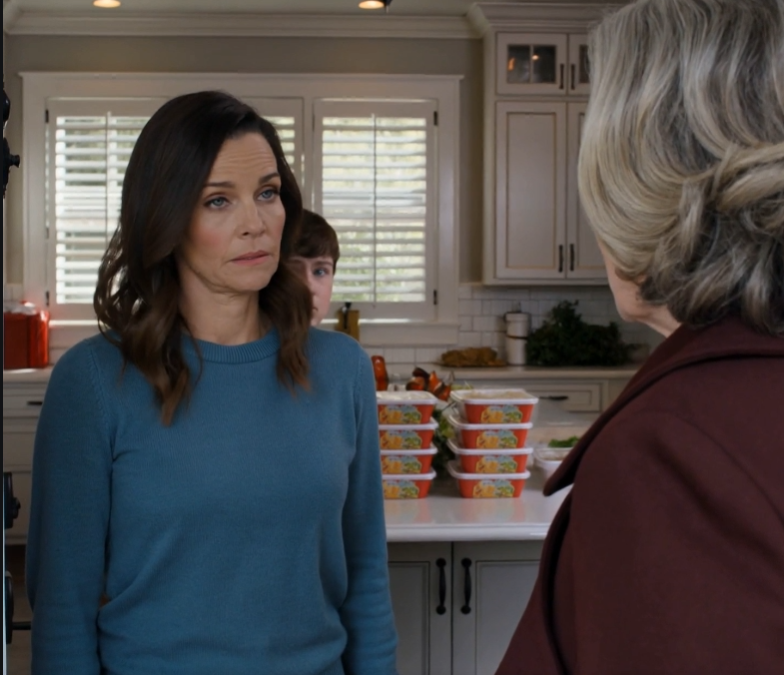
My 16-year-old daughter spent two days cooking the reunion dinner for 23 relatives.
Then Mom texted, “Just drop the food off. Your sister only wants real family this year. Just drop the food off.”
My mother sent that text at 2:14 on Thanksgiving afternoon while my 16-year-old daughter was loading 23 labeled containers into our car. Two full days of cooking for people she still called family.
She had written every name by hand, even Uncle Pete’s. No walnuts, because she remembered what everyone could eat.
They remembered only what she wasn’t.
She read the message, untied her apron, folded it once, then again, and laid it beside the food. No tears. No argument.
I didn’t answer my mother.
I dialed one number and spoke for less than a minute.
Exactly an hour later, my mother was pounding on our door hard enough to shake the wreath.
“Open up! Who did you call?”
I looked at my daughter, then at the 23 containers lined across the counter.
To understand why my mother was suddenly so afraid, you have to understand what my family had been taking from us long before that Thanksgiving.
Wherever you’re listening from tonight, I’m glad you’re here. Tell me where in the comments if you like.
I’m Carolyn. I’m 41.
And the taking didn’t start with that text.
It started so quietly that for 20 years, I mistook it for love.
Come back with me two days.
A Tuesday.
The Tuesday before Thanksgiving, my kitchen smelled like salt and bay leaves before the sun was up. Ren had her mother’s recipe card propped against the sugar canister, a grease-stained index card in Jess’s handwriting—the only handwriting she has left of her.
Jess was my best friend. She’s been gone ten years.
Her daughter has been mine ever since, and every holiday, Ren cooks from that card like it’s scripture.
In Baldwin, the lighted sign outside St. Adelbert’s fire hall on Streets Run Road tells the whole parish which family holds the hall for the holidays. And for 30 years, “Marsh Thanksgiving” going up every November was how my mother took attendance on her own standing.
Ren ran through the menu out loud while the turkey went into the brine.
Twenty-three relatives.
She knew every plate by heart.
“Grandma J likes the skin extra crisp,” she said, penciling a star next to it. “And Uncle Pete, no walnuts. His throat closes.”
I watched her plan food for people who had never once planned a thing for her.
Sixteen years old, and she carried their preferences around like family photos.
“You don’t owe them 23 dishes,” I said.
She shrugged, the way she does when she’s already decided.
“Feeding people is how you get a seat, right?”
I didn’t answer that.
I should have.
Twenty-three labels, and every label had a name.
Late that night, I found the container marked “Grandma J” sitting apart from the others. The label had been peeled off, smoothed flat, and stuck back down.
Ren never said why.
Wednesday afternoon, I clipped a check under the refrigerator magnet.
Check number 2214.
$3,860, made out for my mother’s property taxes.
The twentieth November, by my count, that I’d written one.
That was our ritual. At Thanksgiving dinner, I would slide it across the table, and my mother would fold it into her purse without looking at it.
The way you pocket something that’s owed.
The hall was on my card, too.
It always was.
The $600 deposit had gone on the card back in September, the way it did every year, and the balance sat on file at St. Adelbert’s under my name.
Applause going to hers.
Meredith called while I was drying dishes.
My sister doesn’t ask.
She assigns.
“Folding tables from the church basement. Come early for setup. Bring the extension cords. Mom says you always handle it.”
She said handle.
I remember the word snagging on something, the way a sweater catches a nail.
I let it go.
“Is Ren at the big table this year?” I asked.
A pause, with furniture being moved somewhere inside it.
“We’ll figure out seating.”
Then my mother’s voice sounded somewhere behind her, and the line went dead.
Twenty-three dishes assigned.
A check written.
A hall paid.
The seating chart was the only thing nobody would confirm.
At five in the morning on Thanksgiving Day, the kitchen window was still black when Ren started packing.
Twenty-three containers stood in rows across the counter, each lid labeled in her careful print. Names. Allergies. Reheating times for the aunts who always ask.
I stood in the doorway with my coffee and noticed something I had been not noticing for three weeks.
She hadn’t mentioned her grandmother once.
Not since the day she went over to help pack up the garage.
Ren tells me everything in pieces eventually.
About Grandma Judith since that day?
Nothing.
“You’ve barely mentioned Grandma since you helped her pack,” I said.
She turned toward the oven like it had called her name.
“Do you think they’ll notice the labels?”
“They’ll notice,” I said.
I still believed it.
I saw the swerve. I chose not to follow it.
That one is mine to carry.
I was raised to leave certain doors closed. Somewhere along the way, I taught my hands the same habit without meaning to teach it to her.
By seven, the car smelled like sage and butter.
And my phone, which every Thanksgiving morning fills up with logistics—who’s bringing what, when to arrive, who’s picking up Aunt Rose—sat silent on the counter.
Not one text all morning.
At 2:14 in the afternoon, Ren was on her fifth trip to the car. A box of rolls balanced on top of the stuffing when my phone buzzed on the porch rail.
Thirteen words.
She read them over my shoulder.
I felt her go still before I finished.
She set the box down.
She untied the apron—Jess’s apron—folded it once, folded it again, and laid it on the counter the way you return something borrowed.
“It’s okay, Mom.”
Her voice stayed level.
“I’ll carry the boxes in myself.”
“No,” I said. “You won’t.”
We didn’t discuss it.
We carried everything back, trip after trip, in through the screen door until all 23 containers stood in their rows on the counter again, labels facing out, every name she’d written looking up at us.
Six minutes of walking.
Neither of us spoke the whole time.
Then I stood at the counter with my thumb on my phone.
I scrolled past Mom. Past Meredith. Past every number a daughter is supposed to call in a moment like that.
And stopped on one I had never dialed on a holiday in my life.
The only number in that phone that had never once called me first.
I didn’t type a reply.
The call connected at 2:20.
First Keystone Bank card services, the line that answers on holidays because money doesn’t take Thanksgiving off.
I gave my name, my account number, the verification answers I could recite in my sleep because I’m a bookkeeper and my sleep is full of numbers.
Then, in the voice I use for other people’s invoices, I said, “There’s a card authorization on file with St. Adelbert’s Fire Hall. Cancel it, please.”
Typing.
“Done, Ms. Marsh.”
“And check 2214. Stop payment.”
“There’s a $32 fee for that.”
“That’s fine.”
More typing.
Somewhere inside it, the agent asked, “Anything else, Ms. Marsh?”
I looked at the check still pinned under its magnet.
I could have torn it up.
A bookkeeper knows better.
Habits don’t die in your hand.
They die in the system.
$3,860 of habit.
Dead where it hung.
“That’s everything,” I said.
And I meant it in both directions.
The screen said 0 minutes, 52 seconds.
When I set the phone down, that was the whole revolution.
No shouting.
No speech.
Twenty years in the making.
A woman canceled one authorization, stopped one check, and went back to her kitchen.
Ren watched from the doorway.
“That’s who you called?”
“The bank.”
“That’s who you called.”
She looked at the 23 containers, then at me, doing math she didn’t have all the numbers for yet.
An email arrived while the kettle heated.
Subject line: Stop Payment Confirmation.
Check number 2214.
The coldest sentence ever to land on a national holiday.
Across town, at ten to three, in a fire hall strung with paper turkeys, my mother was directing folding tables when Rick, who has run St. Adelbert’s rentals for as long as anyone can remember, came over with the card reader to settle the balance before dinner service, the way he does every year.
The card declined.
He ran it again because Rick is polite.
It declined again.
In front of my mother.
In front of Meredith.
In front of the parish volunteers slicing pies along the back wall.
I know this the way Baldwin knows everything, because half the room called me within 20 minutes.
My phone went from six missed calls to nineteen.
The texts stacked up like cars on ice.
Hall says card issue.
Then:
Call Mom now.
Then, from a cousin I hadn’t heard from since Easter:
What did you do?
I peeled potatoes for our dinner.
Ours.
Ren sat at the counter, watching the phone rattle face down against the wood.
“Your phone’s going to walk off the counter.”
“Let it.”
“Aren’t you going to answer?”
I set another potato in the bowl.
The pot behind me had just come to a boil, steady and unbothered, and that felt like the only company I needed.
“They know where we live,” I said.
It took 30 more minutes to prove me right.
Gravel first.
Then an engine cutting short in front of our house, followed by a car door slamming hard enough to echo down the block.
Across the street, Mr. Kowalski’s curtain moved aside and stayed aside.
At 3:20 exactly, one hour to the minute after I hung up with the bank, the pounding started.
The wreath jumped on its nail.
“Open up! Who did you call?”
I opened the door four inches.
The chain stayed on.
Through the gap, my mother’s face was red from cold and something that wasn’t cold. Her church coat was still buttoned to the throat.
“Take the chain off, Carolyn.”
“No.”
“Do you have any idea what you’ve done? Rick ran that card in front of everyone. In front of Father Kaminski’s whole kitchen crew. You are humiliating this family in front of the entire parish.”
“Ren cooked for two days,” I said. “You texted her out of her seat.”
“That is not what your sister wanted. A smaller—”
She stopped.
Rebuilt her face.
And then the sentence slid out of her the way truth does when a person is too angry to dress it up.
“That money comes to me. It has always come to me. You don’t get to touch it.”
Not helps me.
Not family.
Comes to me.
Like a tide.
Like a right.
Twenty years, and I had never once heard her say it out loud.
It took exactly 60 minutes without the money.
The porch light buzzed.
Behind me, Ren stood at the foot of the stairs, listening to her grandmother put it on the record with her own mouth.
“Ren had a seat,” I said. “Or my card had a limit. You picked.”
I closed the door.
The chain went slack through the shrinking gap.
Her voice dropped to almost nothing.
“You have no idea what you just did.”
The latch clicked on the rest.
By five, the street was quiet again, and Ren found me at the kitchen table.
“Was it because of me, Mom?”
Her thumb worried the seam of her sleeve.
“If I hadn’t cooked, if I’d just stayed home—”
“Come here. I want to show you something.”
I dragged the step stool to the tall cupboard, the one where the cereal used to live, and brought down a shoebox with tape gone amber at the corners.
She had never seen it.
I had made sure of that.
“When I was 15,” I said, “$60 went missing from your grandmother’s purse. Your aunt Meredith took it. I got blamed. And that Sunday at dinner, I was made to stand up and apologize to the whole family for something I didn’t do while your aunt ate her pie and watched.”
Ren didn’t move.
“I apologized at 15 for a theft that wasn’t mine. Then I spent 20 years apologizing with checks.”
The words came out smaller than I meant them to.
I had to press my thumbnail into the table edge before I could manage the rest.
“This box is every receipt since.”
She lifted the lid like it might be hot.
Bank slips.
Hall invoices.
Carbon copies going back to a different president.
“Why do you keep all this?”
“Because at 15, nobody believed me. Paper doesn’t need to be believed.”
She reached in, and I eased the lid back down.
But not before she saw the folded card sitting on top.
The one I wasn’t ready to explain yet.
The knock at seven that evening was nothing like the afternoon’s.
Two soft raps.
Almost apologetic.
Mr. Kowalski from across the street stood on the mat holding a bottle of sparkling cider, his good cardigan buttoned wrong.
“I heard there was a dinner going spare,” he said. “Ella never let me miss a Thanksgiving. I don’t intend to start.”
Behind him came Sadi from two doors down with her mother.
Then my cousin Deb, Uncle Pete’s daughter, carrying a tray of lemon cookies and wearing a look on her face I couldn’t read yet.
“I heard the fire hall version,” Deb said, stepping in out of the cold. “I came for the real one.”
Eleven of us in the end.
Neighbors.
Deb.
Her father, Pete, who arrived without a word and hung his cap on the hook like he’d done it a hundred times.
Ren moved down the counter with a pen.
Where a label carried a name that wasn’t coming, she peeled it off, smoothed it flat, and wrote a new one.
Grandma J became Mr. Kowalski in her careful print.
He read it out loud when she handed him the container, pronounced her name right when he thanked her, and asked what was in the glaze.
I watched my daughter’s shoulders come down from her ears one inch at a time.
At the door, leaving, Deb paused by the counter where I’d forgotten to put the shoebox away.
Her eyes went to it, then to me.
“Still keeping receipts, Carol?” she said quietly.
“Good.”
Halfway down the walk, she turned around.
“I count things too, you know.”
Ren was drying dishes when she said it, almost to herself.
“They said my name, right?”
That was the whole review.
It was enough.
The screenshots started arriving Friday morning.
Deb sent them.
I’d been deleted from the family group chat years ago, back when they decided things about me worked better without me in the room.
My mother had been busy.
In her telling, there was no text.
There was a daughter who canceled Thanksgiving out of spite. A daughter who cut off her own mother in front of the parish. A daughter who ruined a sacred family day.
Unstable since she was a girl, one message read.
I’ve sheltered her from herself her whole life. You’ve all seen it.
Then came the phone calls.
My aunt.
My mother’s cousin.
Uncle Ron, who had never once dialed my number for a birthday.
Suddenly overflowing with concern.
“Your mother is heartbroken,” Ron said. “Whatever this is, just pay the hall. Fix it before Christmas.”
“Did she tell you why?” I asked.
Static.
A cleared throat.
“Well, she said you’d twist it.”
“Did she tell you why, Ron?”
He hung up on the question.
One way or another, they all did.
That night, I scrolled through the whole thread Deb had forwarded.
Days of messages.
Everyone had an opinion on my stability, my gratitude, my duty.
And in that entire wall of words, not one person mentioned money moving the other direction.
Not the taxes.
Not the hall.
Not one dollar of the 20 years.
Like there was a fence around the subject that everyone knew not to touch.
And in all of it—every message, every call—not one of the 23 ever asked Ren a single question.
There’s a photograph in the shoebox from March of 2015.
Jess in a hospital bed.
Ren asleep on her chest, five years old.
Both of them worn down to the same pale.
Jess made me promise while she could still hold a pen.
Three weeks later, she was gone, and Ren came home with me in a booster seat holding a backpack of everything she owned.
My family had opinions.
“You’ll ruin your chances of a real family of your own,” my mother said, standing in my kitchen that spring, arms crossed like a verdict.
That August, I bought this house.
Small brick.
Two bedrooms.
A porch with a light.
The bank looked at a single bookkeeper with a brand-new dependent and wanted a co-borrower on the loan.
My mother offered before I finished asking.
At the title office, she signed with a flourish and smiled at the closing agent.
“So my girls have roots,” she said.
I thanked her.
God help me.
I thanked her.
And for ten years, I mistook that signature for a gift.
The adoption went through the following February.
In the whole courtroom, family-wise, it was Deb, Pete, and us.
The judge said, “Congratulations, Ms. Marsh. Both of you.”
And Ren, six years old, swinging her feet off the bench, looked up at me and whispered, “Do I say your name now?”
A week later, a card arrived in my mother’s looping hand.
No congratulations.
One sentence.
A name doesn’t make a family.
It’s still in the shoebox.
Some paper you keep as proof.
Some you keep as a warning you weren’t ready to read.
Mid-December, a voicemail.
Forty-one seconds.
I know because Ren and I stood in the kitchen and watched the counter tick while my mother’s voice filled the room.
“Carolyn, I’m sorry you took it that way. After everything I’ve done for you, I would think your sister needs peace this year. You know how fragile things are. Fix the hall money before you embarrass us at Christmas, too. Family forgives, Carolyn. I raised you to know that.”
An apology with my name on it and her innocence inside it.
Sorry you took it that way.
Not sorry it was thrown.
I reached to delete it.
Saved it instead.
The bookkeeper in me had started making decisions the daughter didn’t understand yet.
Ren stood very still by the stove, white around the mouth.
Then she said, “Mom, three weeks before Thanksgiving, when I helped Grandma pack the garage…”
Her throat closed on it.
Whatever it was had been sitting inside her for six weeks, and it was heavier coming up than it had been going down.
The kitchen clock ticked nine times.
I counted because counting was all I allowed myself to do.
“Take your time,” I said. “We’ve got nothing but.”
She looked at the saved voicemail on the screen.
Then at me.
And decided.
“You need to sit down,” she said. “It’s about the mail.”
The sixth of November had been raw and bright, one of those days when the cold has edges.
Ren told it at the kitchen table with her hands wrapped around a mug she never drank from.
And I’m going to tell it to you the way she told me.
Her grandmother had called that morning, the way she only ever called Ren when there was lifting to do.
The garage needed clearing before winter.
Ren went because Ren always went.
Being useful was the one door into that family that ever opened for her.
She was carrying a box of Christmas decorations off the workbench when a stack of mail slid out from underneath it and fanned across the concrete.
Three envelopes on top.
Heavy paper.
Red block letters visible through the little plastic windows.
FINAL NOTICE.
DELINQUENT.
COUNTY TREASURER’S OFFICE.
And on one, through the window, a number.
$11,600.
She wasn’t snooping.
She was picking mail up off a garage floor.
She had two of the envelopes in her hand, squaring them into a neat stack, when her grandmother came around the shelving fast enough to knock a rake off its hook.
She snatched the envelopes.
Recounted them.
One.
Two.
Three.
Right in front of the child, like Ren might have eaten one.
“Little girls who snoop don’t get invited back,” she said.
“I wasn’t snooping.”
My daughter’s voice, sixteen years old, built as steady as she could build it.
“I was helping.”
Her grandmother slid the envelopes into her coat and looked at her.
And Ren said this part carefully, like it was made of glass.
Like a stranger in her house.
Ren left through the side door, got to the sidewalk, realized her coat was still on the peg by the workbench, and went back for it.
Quietly.
The way teenagers are quiet in houses where they’re only halfway welcome.
The garage door was open.
Her grandmother stood at the paint shelf with her phone to her ear, back turned.
My daughter stood in the cold doorway with her coat in her arms.
And heard it.
“The transfer lands the first of the month, same as always.”
A pause.
“No, Doug doesn’t need to know where it comes from. That’s the point of it, Meredith.”
The smell of paint thinner and cold metal.
Ren says that’s what she remembers most.
The smell got into the words so that even now, thinking about them tastes like the paint shelf.
Then, quieter, in the voice her grandmother saves for the priest:
“I’ve handled Carolyn for 40 years. I’ll handle her now.”
Handle.
There it was.
The word come home to its owner.
And then the last piece.
The one my daughter had been carrying alone since three weeks before that text.
“And if the girl mentions those letters to her mother, we cut them off before she can ask questions.”
The girl.
Not her name.
Not granddaughter.
The girl.
A problem with feet.
Ren walked home without her coat.
She went back for it two days later and told everyone she’d forgotten it.
At our table, she finished with her thumb pressed white against the mug.
“Then Grandma said something about your name and a paper. I didn’t understand that part.”
I got the laptop.
Back in 2018, my mother had wanted online banking and wanted no part of learning it.
So I’d set it up myself.
My email on the alerts.
My habits in the passwords.
My fingerprints on all of it.
I had never once looked.
It felt like a line.
The line was behind me now.
The statements loaded.
And there it was, marching down the page in identical rows.
$1,500.
The first of every month.
Two years of it without a single miss.
Pay M. Hail.
My sister’s married name printed as plainly as a grocery receipt.
I scrolled the other way, looking for the county.
Looking for tax payments.
The last one had posted three years ago.
After that, nothing.
Nothing.
Nothing.
Then a notation that spring that I had to read twice.
Municipal lien recorded.
March.
The tax money I handed across a Thanksgiving table every year had stopped becoming taxes a long time ago.
It went into her account, put on a coat with her name on it, and walked out the back door as $1,500 a month to my sister, covering a hole Meredith was hiding from her own husband.
Ren read over my shoulder.
She was quiet for a long time.
“That’s why I wasn’t real family,” she said finally.
Not a question.
“I’d seen the mail.”
“You were the only one in that house telling the truth,” I said.
Then I scrolled one screen farther and stopped.
An old transfer memo in my mother’s own entry from a year I’d sent the tax money electronically.
C. Hall plus tax. God bless.
C.
Not Carolyn.
Not my name.
A ledger line.
I had been a vendor with a first initial for 20 years.
I have to stop right here and ask you something.
Honestly, if you had been at that table, your money marching down her statements, your name shrunk to an initial, what do you do that night?
One word in the comments is enough.
Confront or collect?
Because what I chose next is the reason there’s a story to tell.
What I chose was Deb.
She came the next evening with her coat still smelling like outside, and I laid it in front of her.
Not all of it.
Just the shape.
The hall.
The taxes.
Twenty years.
She didn’t look surprised.
That was the part that made my hands go cold around my cup.
“I book the hall calendar for the auxiliary, Carol,” she said. “Have since Rita retired. Your card. Every year. Seventeen times since 2008.”
She turned her coffee cup a slow half circle.
“And I’ve watched a check change hands at that Thanksgiving table more Novembers than I can count. Everybody’s seen it. Nobody said it.”
“Why didn’t you?”
“Because you never asked me to see it.”
She let that sit between us.
Gentle and terrible.
“You’d have died before you asked. So I minded my business. I’m done minding it.”
She reached across and laid her hand flat on the table like she was swearing on it.
“What do you need me to remember out loud?”
Behind her, Uncle Pete let himself in the way he does and set a casserole dish on the counter, scrubbed to shining, with a $20 bill folded small on top of the lid.
“For the chef,” he said. “And tell the kid her stuffing beat your mother’s by a mile. I’ve eaten both for most of my life. I’m qualified to rule.”
Ren laughed from the stairs.
The first laugh in that house in days.
The whole room changed its weather.
At the door, Deb stopped and lowered her voice.
“One more thing. Ask a lawyer about your deed.”
Gail Novak’s office sits above the pharmacy on Baldwin’s main street.
One desk.
One window.
A diploma hanging slightly crooked.
I went in with the shoebox under my arm and a small plan.
Ask how to make my mother stop working through my relatives.
A harassment question.
A boundary question.
Gail listened without touching her pen.
Then she lifted the shoebox lid, thumbed through a stack of hall invoices 20 years deep, and asked, “Who taught you to keep all this?”
“Being 15,” I said.
She nodded like that was a complete answer.
Then she asked the question that rearranged the room.
“Before we talk about her, whose names are on your deed?”
I started to say mine.
Stopped.
The closing file was in the box near the bottom, in the folder I never opened because it lived in the part of 2015 where Jess had just died.
Gail slid the deed out and turned it to face me.
Two names.
Mine.
And beneath it, in the same patient typeface, my mother’s.
The co-borrower signature I had thanked her for.
So my girls have roots.
The radiator ticked.
Gail watched me read my own house.
“Then you don’t have a harassment problem,” she said. “You have a countdown.”
She pulled a sticky note toward her, wrote one word on it, and pushed it across the desk without explaining.
Partition.
Christmas morning smelled like Jess’s cinnamon rolls.
Which is to say, it smelled like the person who taught my daughter that recipes are letters you send forward in time.
Ren was up first.
Paper everywhere by eight.
Her gift to me was a small tin box she’d filled by hand.
Every one of Jess’s recipe cards copied over in her own print.
“So there’s a backup, Mom.”
Two handwritings.
One voice.
Deb came by at noon.
Pete arrived behind her carrying, of all things, a bundle of folding chairs, which he stacked in the corner by the coat hooks without asking where they should go.
“For next year,” he said. “You’ll need extras.”
I didn’t ask what he meant.
Some sentences you just put in your pocket for later.
Across town, my mother hosted.
Deb had driven past on her way over and gave me the census.
A family that used to fill a fire hall had shrunk to nine people.
A store-bought pie sat on the sideboard where three of Ren’s used to sit.
“Meredith answered the door,” Deb said, looking like she hadn’t slept in a week.
I waited to feel something like victory.
It didn’t come.
What came instead was arithmetic.
The quiet kind that had been running in the back of my head since the bank call.
That table had never been fed by love of gathering.
It was fed by a card on file and a check under a magnet.
And when the fuel stopped, the machine just coasted.
Nine people.
A bought pie.
Ren looked at the folding chairs in the corner, then out the window toward her grandmother’s street, and did her own arithmetic out loud.
No heat in it.
Just numbers.
“Nine people. Twenty-three fit in our living room, you know.”
All season, my sister’s name never lit my phone.
My mother left three more voicemails.
Meredith, nothing.
And her silence was somehow louder than the pounding on the door had been.
On the thirteenth of January, my mother went to my daughter’s school.
Ren told me that night, sitting on the bottom stair with her backpack still on, one hand wound into the strap and twisting it.
Pickup line.
Ten minutes before the bell.
Her grandmother’s car easing along the curb where the seniors come out.
Window down.
That voice.
The sugared one.
The one she uses on priests and store managers.
“There she is. Sweetheart, you didn’t tell your mother any silly stories about Grandma’s mail, did you?”
Ren stood on the sidewalk with January going through her coat and said nothing.
Her grandmother smiled wider.
“Because stories have consequences, honey. For everybody.”
That was when Ms. Anton, the vice principal, came off the steps.
She works the pickup lane every day, sharp-eyed and allergic to unfamiliar cars.
She got within ten feet, and my mother’s window went up smooth as a curtain.
The car slid out of the lane and was gone.
“She wasn’t asking, Mom.”
Ren’s knuckles were white on the strap.
“She was checking.”
I called the school the next morning to thank Ms. Anton.
She was brisk and careful, the way people get when they smell smoke somewhere nearby.
“I don’t know your family situation, Ms. Marsh,” she said. “But I logged the visit. Time, plate, what I observed. If you ever need the log, the school keeps them.”
I wrote her name in the notebook that was quietly becoming a second shoebox.
My mother had stopped working through relatives.
She had started working on my child.
The fifth of February was a Thursday.
Gray as dishwater.
The knock came at four while Ren sat at the table with her chemistry homework.
The man on the porch wore a windbreaker, held a manila envelope, and had the air of a person who does this all day.
“Carolyn Marsh?”
“Yes.”
“You’ve been served.”
Not unkind.
Just Thursday for him.
The envelope was heavier than paper should be.
At the table, I slid the packet out, and the caption at the top of the first page assembled itself in front of me like something surfacing from underwater.
Court of Common Pleas of Allegheny County.
Case No. GD-26-1832.
Judith Marsh, Plaintiff,
v.
Carolyn Marsh, Defendant.
Complaint in Partition.
The word from Gail’s sticky note.
Grown teeth.
Ren read over my shoulder, always at my shoulder for the worst of it.
Page three had our address on it.
The legal description of our lot.
Our house translated into surveyor’s language, as if the porch light and the cereal cupboard could be reduced to a parcel.
“She’s suing us.”
Ren’s voice cracked in the middle.
“For our house?”
“She’s suing me,” I said. “For the half she never paid for.”
My thumb found the raised seal of the court at the bottom of the page and pressed it.
The way you press a bruise to check that it’s real.
It was real.
And near the back, on the attorney’s signature block, was a date.
Her lawyer had signed the complaint on the fourteenth of January.
One day after the pickup line.
She had gone to my daughter’s school to count her cards.
Then she filed.
Gail cleared her conference table—which is to say, she moved the coffee maker—and laid the complaint flat between us like a patient.
“Partition,” she said. “When two people are on a deed and can’t agree, either one can ask the court to force a sale and split the proceeds. The nuclear option for co-owners.”
She tapped the caption.
“Your mother is on your deed, so on paper, she can ask.”
The numbers went up on Gail’s whiteboard in squeaking marker.
House appraised around $195,000.
Mortgage balance: $88,000.
Equity: $107,000.
And my mother’s complaint asked the court for half of it.
$53,500.
Demanded by the woman who had never made a payment from the woman who had made every single one.
“On paper, she owns half,” Gail said. “Paper is where she’s strongest.”
She kept the marker in her hand.
“And where she’s weakest.”
Then she gave me three words I want you to hear because they carried the next three months.
Purchase-money resulting trust.
“When one person pays for a property and another sits on the title as a formality, the law can rule that the title holder holds their share in trust for the person who actually paid. The name is decoration. The money is the truth.”
“She never paid a dollar,” I said.
“Then we make the dollars testify.”
She circled a date on her desk calendar.
May 18.
A hearing set by a judge neither of us had ever met in a room my mother couldn’t decorate.
Flipping through the complaint’s exhibits, Gail paused.
A photocopy of my 2015 deed with my mother’s name already highlighted in yellow.
“This wasn’t drafted in a week,” she said. “She’s been holding this card a long time.”
The mediation room in early March had a round table, bottled water, and a box of tissues placed at the exact center like a prop on its mark.
My mother came in on her lawyer’s arm wearing her funeral cardigan.
Meredith did not come at all.
For 40 minutes, my mother performed grief.
I watched her voice catch every time the mediator looked up and level out every time he looked back down at his notes.
Tears that waited for their audience.
Twice, she reached toward the tissue box and let her hand fall short so the reaching could be seen.
The offer, when it came, arrived through her attorney in the tone of a great mercy.
She would withdraw the complaint for $30,000 “so your mother can retire in peace.”
Then he added, consulting his legal pad, “The family would prefer that the tax business not be discussed further by anyone.”
Thirty thousand for the lawsuit.
My silence thrown in free.
Then my mother leaned forward and did her own version.
Soft.
Pitched for the mediator.
“Thirty thousand, and we go back to being family.”
There it was.
The seat at the table with the price tag finally printed where everyone could read it.
“You put a number on us,” I said. “Now the court can.”
The mediator wrote something down.
The tissue box sat untouched in the center of the table, full to the top.
When we all walked out into the hallway, her lawyer paused beside Gail and offered a quiet professional courtesy.
“Between us, they’ll call it all gifts. Every cent. Twenty years of gifts.”
Gail smiled the way she does when someone shows her their whole hand.
“Noted.”
The dining table became a war room in stages.
First the shoebox.
Then the folders.
Then the adding machine from my office, because I am a bookkeeper, and when my hands don’t know what to do, they total things.
Ren pulled out a chair one night and sat down in front of the pile like it was a job interview.
“It’s my house too,” she said. “Put me to work.”
So I did.
I read.
She ran the tape.
Hall invoice, 2011.
Hall invoice, 2012.
Property tax, year over year.
The roof I paid to patch on my mother’s house.
The $11,000 that quietly settled Meredith’s credit cards back in 2019.
A family emergency, I was told.
Never to be mentioned again.
Near midnight, the tape curled off the machine and touched the floor.
My daughter pressed the total key.
$112,000.
Give or take the mercies I never wrote down.
And in its own folder, the house itself.
One hundred twenty-six mortgage payments.
$1,320 each.
Every one drawn from one account.
Mine.
Not a dollar of anyone else’s money had ever touched this house.
“They’re going to say it was all gifts,” I told her, because Gail had warned me, and I believed the warning.
Ren didn’t look up from her tabs.
“Gifts don’t have due dates,” she said. “Grandma collected on schedule.”
Sixteen years old.
I wrote the line down for Gail word for word.
Then Ren went quiet over one invoice.
St. Adelbert’s.
February 2016.
The month her adoption went through.
The hall on my card, rented that month for Meredith’s baby shower.
That month, I paid for both parties.
Only one of them didn’t include us.
She filed it under E for exhibit in her food-label print and asked, “Exhibit A goes first, right?”
The text from Meredith surfaced at the end of March.
After four months of silence.
No greeting.
You could have just paid her. Why are you making everyone pick sides?
I read it standing at the counter and understood, with a tired kind of clarity, that my sister spoke the family language fluently.
Not what was done to you.
What you did about it.
The theft is never the crime.
The receipt is.
I didn’t answer.
There was nothing left in me to translate for her.
Two nights later, my phone lit with a name that had never once called it.
Doug.
My sister’s husband.
Decent in the bewildered way of men who mow the lawn and trust the ledger to their wives.
“Carolyn, I’m sorry to—look, this is going to sound strange.”
Paper shuffling.
“Judith told me the money was from her savings. The help she’s been sending us the first of every month. But I’ve been pulling things together for the lawyers, and…”
He stopped.
Started over.
“What savings?”
For one second, I stood at the fork.
Hand him the statements.
Watch that side of the fence catch fire on its own.
Instead, I said the only sentence that was mine to say.
“Ask your wife where the first of every month comes from.”
A long breath down the line.
“Yeah,” he said, mostly to himself.
“Yeah. Okay.”
After that call, Doug went dark.
Every channel.
Two full weeks.
In my family, silence is never empty.
It’s inventory.
April insisted on being ordinary, and we let it.
Ren had midterms.
I had tax season.
She tried a brisket rub on a Tuesday because a boy in culinary club dared her, and the house smelled like smoked paprika for two days.
For two days, we talked about rubs and not about court.
The calendar by the fridge wore two circles now.
May 18 in red ink.
June 20 in green.
Her seventeenth birthday, which she had asked to host at our house.
“Our table this time,” she said.
She taped the Culinary Club’s summer program flyer beside it like a dare to the universe.
The letter from the program came midmonth.
She read it on the porch, one leg bouncing, then held it out flat so I could see the word ACCEPTED doing its quiet fireworks in the first line.
Scholarship for half.
Deposit due in June.
“After the eighteenth,” she said, folding it back into thirds, careful as evidence. “Everything’s after the eighteenth.”
Pete came by on a Sunday with a socket set to fix the porch rail I hadn’t asked anyone to fix.
Halfway through, without looking up from the bolt, he started talking.
“Your dad and I split a job site for eleven years. You know what he told me once in the truck, back when you girls were small?”
The ratchet clicked twice.
“He said, ‘Pete, watch the quiet one. Judith spends her like money.’”
The ratchet clicked again in the quiet.
“Back in 2004,” I said, mostly to the railing. “Before I’d written the first check.”
Twenty-two years he’d carried that in his pocket.
Then again, so had I.
I’d just been carrying it from the inside, where you can’t read the label.
“He’d have liked the kid,” Pete said, tightening the last bolt. “The stuffing alone.”
Gail pulled the county records that week.
What came back was so clean, she read it to me twice over the phone.
Every year, my mother’s property taxes got paid.
The payment posted within days of a withdrawal from my account.
Check or transfer.
November after November.
Two columns dancing in step going back nearly two decades.
Then three years ago, my column kept going and hers went empty.
The money left me and never arrived anywhere a county could see it.
“She built your case for me,” Gail said, tapping the two matched columns when I came in. “Year after year of matching dates. I couldn’t have staged it better.”
One night, alone with the printouts, I found the flaw in the pattern.
A single year.
No payment leaving my account at all.
And yet the county showed my mother’s taxes paid that November.
On time.
In full.
Someone else’s money.
One year only.
And no name on my side of the ledger to explain it.
I circled it, couldn’t explain it, and set it in the folder with the unexplained things.
Every family has that folder.
Ours was about to be opened in public.
The night of May 17, I ironed a blouse I’d already ironed.
Ren came down at eleven in her pajamas, took an envelope from behind the recipe tin, and set it next to my keys where it couldn’t be forgotten.
“For the court,” she said. “If they let me, I want it read. If they don’t, I want it to exist.”
She went back upstairs before I could answer.
The envelope said, in her food-label print:
FOR THE COURT, IF ALLOWED.
I didn’t open it.
Paper doesn’t need to be believed.
But it does need to be respected.
At 11:40, my phone lit with my sister’s name.
Three dots appeared.
Lived.
Died.
Came back.
Then one line:
Tomorrow when they ask about the transfers, I—
Nothing after it.
The dots pulsed once more, like something breathing under ice.
Then went out for good.
I slept four hours and dreamed of tape curling off an adding machine.
I woke before the alarm to a house that smelled faintly, impossibly, of cinnamon.
Ren, at six in the morning, baking her mother’s rolls for nerves the way other people pace.
We ate them warm at the counter.
The calendar’s red circle watching us.
Everything unsaid stacked in labeled folders downstairs.
The Allegheny County Courthouse eats sound.
Marble floors.
Forty-foot ceilings.
And by 8:40 in the morning, the hallway outside the courtroom was already lined with family.
Twenty-three of them, give or take.
In church clothes on a Monday.
The same faces that had blown up my phone on Thanksgiving now studied the wall art like it was for sale.
My mother sat at the plaintiff’s table in the funeral cardigan, a lace handkerchief laid out in front of her like an exhibit of her own.
Meredith sat in the second row with sunglasses pushed up in her hair.
Doug was not beside her.
Doug was three rows back.
Alone.
A folder in his lap.
I noticed.
Gail noticed.
My sister spent the whole morning not turning around.
Ren wore her interview blouse and sat where I could find her eyes.
Ms. Anton came, subpoenaed, with a folder.
So did Deb with the auxiliary’s booking calendar.
So did Pete, in a tie no one had seen since a funeral.
At the side door, the bailiff crossed to the bench and handed the judge a sealed envelope.
The judge glanced at it and set it close at hand.
My mother’s side went first.
Her lawyer built the story like a model home.
A devoted mother who co-signed so her struggling daughter could nest.
Who gave and gave.
Gifts.
Always gifts.
Gifts have no paper trail because love doesn’t invoice.
And who now, in her tender years, asked only for her lawful half.
Then my mother took the stand, and the performance from mediation got its bigger room.
The catch in the voice timed to the judge’s glances.
The handkerchief lifted.
Lowered.
She spoke of sacrifice.
Of a daughter who had grown cold.
Who had cut her off from her granddaughter.
Her granddaughter.
Twice.
A word I had never once heard cross her lips at any table we shared.
Then her lawyer asked why she had co-signed in 2015.
My mother looked at the judge and reached for the biggest brick she had.
“Because family,” she said, “is the only thing I have ever cared about.”
I felt Gail go still beside me.
The way a fisherman goes still.
Cross-examination.
Gail rose unhurriedly and put a single sheet on the document camera.
“Mrs. Marsh, Exhibit A. Do you recognize this text message?”
The screen on the wall lit up.
And there they were.
Ten feet tall.
Your sister only wants real family this year. Just drop the food off.
Sent by the petitioner.
Thanksgiving Day.
2:14 in the afternoon.
Gail let it hang.
“Mrs. Marsh, you just testified that family is the only thing you’ve ever cared about. Could you read this message to the court?”
Slowly.
All thirteen words.
The handkerchief stopped moving.
“That’s out of context.”
“Your Honor, we’ll be providing the context.”
All of it.
And she did.
For two hours.
In the driest voice in Pennsylvania.
Gail read my family its own mail.
Exhibit C.
Twenty years of canceled checks and transfers.
My account to my mother’s.
Blown up big enough that the memo lines were legible from the gallery.
C. Hall plus tax. God bless.
Exhibit D.
County tax records for the petitioner’s residence, side by side with the defendant’s bank withdrawals.
Sixteen years.
The dates matched within days.
The two columns went up on the projector.
Rows of dates marching in step.
Somewhere behind me, a chair creaked.
One of the aunts had stopped studying the wall art.
Exhibit E.
Seventeen hall rentals since 2008.
All on the defendant’s card.
Deb on the stand in her auxiliary voice.
“I booked the calendar. It was always Carolyn’s card. Everyone knew.”
Everyone knew.
Words that cost her every future holiday on that side of the family.
Spent like pocket change.
Exhibit F.
One hundred twenty-six mortgage payments.
Single account.
No exceptions.
The purchase money.
The closing costs.
The taxes on our own house.
The insurance.
“Your Honor, the petitioner’s financial contribution to the property she seeks to partition is zero dollars and zero cents across eleven years.”
Then Gail paused.
Squared her papers.
“Your Honor, one more set. I’ll note these arrived by subpoena from the petitioner’s own bank.”
My mother’s statements.
The first-of-the-month transfers marching down the page in identical rows.
$1,500.
M. Hail.
Two years.
No misses.
“The petitioner stopped paying her property taxes three years ago. The defendant’s money kept arriving every November, so we asked where it went.”
Gail looked up.
“It went here.”
A chair scraped in the gallery.
Loud.
Doug was on his feet, staring across the aisle at my sister.
He had been carrying that question since March.
Now it was answered on a screen in front of everyone.
Meredith didn’t turn around.
Her sunglasses came down off her hair.
Indoors.
In a courtroom.
The judge said, “Sir, you’ll need to sit.”
Doug sat slowly, like a man lowering himself into cold water.
The folder lay forgotten in his lap.
My mother watched her whole architecture stand there naked and chose that moment to reach for the handkerchief again.
The judge didn’t look at her.
He was reading the columns.
Gail’s last question was almost gentle.
“Mrs. Marsh, the tax money your daughter gave you every November in good faith for 20 years—where did it go?”
Silence.
“Mrs. Marsh?”
Then my mother stood up.
Her lawyer’s hand came up too late.
“The girl is not blood.”
The cardigan voice was gone.
This was the garage voice.
“I gave her a family, and Carolyn was supposed to pay for it.”
The gavel came down once.
“Forty years I managed her. I managed all of it. The house, the money, all of it. And you people—”
“Mrs. Marsh.”
The judge’s voice could have frozen the river.
“Sit down.”
She sat.
The handkerchief lay on the table, forgotten.
A prop from a play that had closed.
In the third row, very quietly, one of the aunts began to cry.
Not for my mother, I don’t think.
For the 20 years of Thanksgivings that had just been repriced in front of her.
Into that silence, the judge picked up the sealed envelope from the corner of the bench.
“The court received a letter this morning from the defendant’s daughter, a minor, offered through counsel. Since this child has been invoked repeatedly in testimony about this family, I’m going to read a portion into the record.”
My mother’s lawyer did not object.
He had stopped objecting to anything by then.
The judge opened it with care.
The paper was loud in the quiet room.
He put on his glasses.
And then my daughter’s words, in a stranger’s steady voice, filled the courtroom.
“My grandmother says family is everything. I used to believe her. Then I found out my seat at her table costs $3,860 a year, and my mother had been paying it since before I could read.
“I don’t want a refund. I want the court to know that my mother never once made me feel like a bill.
“Our house has a porch light she leaves on when I’m out late. That light doesn’t cost anyone anything.
“That’s the difference.
“And I learned it this year.
“Also, for the record, my name is Ren. My grandmother has never once used it.
“She keeps them where the cereal used to be. My mom keeps receipts. I mean, I helped file them. Every word my mother says, there’s paper for.
“You can stop counting me out. I already have a name.
“Respectfully,
Ren Marsh.”
The judge folded the letter with the same care he’d used opening it.
Across the aisle, my mother stared at the envelope like it had testified.
Ren looked straight ahead.
Chin level.
Her mother’s daughter.
Both of her mothers’ daughter.
The ruling came from the bench.
Plain as arithmetic.
Purchase-money resulting trust established.
Every dollar of purchase, mortgage, tax, and insurance traced to one account.
Mine.
My mother’s name on the deed, the court found, was security for a co-signature, not ownership.
A formality she had held in trust for the person who actually paid.
Her half-interest extinguished.
The partition action dismissed with prejudice, which is legal language for don’t come back.
Quitclaim deed to be executed within 30 days.
And in the matter of costs, the court noted the petitioner’s “creative recollection.”
The judge paused on the words.
And awarded fees.
She lost the house she never paid for in front of the family she rented with my money, in a room where the tissue box stayed exactly where it was.
Our house was ours.
It always had been.
Now it was true on paper.
And paper, in my family, is the only language that cannot be shouted down.
The hallway afterward was a receiving line nobody had planned.
Meredith reached me first, cutting through the crowd.
Mascara gone to smoke.
“Carolyn, please. I need to tell you what the money was for.”
The sentence the three dots swallowed at 11:40 the night before.
It had found daylight one day too late.
I raised my hand.
Not hard.
Just final.
“Tell Doug,” I said. “He’s the one still standing in your hallway.”
He was, too.
By the elevators.
Hands in his pockets.
Looking at my sister like a man rereading a contract he’d signed in the dark.
My mother came out last, lawyer at her elbow, smaller than I had ever seen her.
She stopped in front of me because the hallway only went one direction.
“You’ve destroyed this family,” she said.
I looked at her.
Really looked.
The way you look at a ledger one last time before you close the year.
“You spent it,” I said. “I just stopped covering the account.”
Then I said, “Goodbye, Judith.”
Her first name.
I watched it land.
The demotion read into the record out loud in a hallway full of witnesses.
She swept past, every heel a gavel.
And I heard it.
The smallest sound.
The lace handkerchief hitting the marble floor.
Nobody bent to pick it up.
Not even her.
One of the aunts stopped in front of me on her way to the elevators, purse held in both hands.
“We didn’t know,” she said.
“You didn’t ask.”
It came out gentler than she’d earned and truer than she liked.
Deb appeared at my shoulder with the booking calendar under her arm.
“Pierogi night. My place. Friday,” she said. “Bring the kid. Bring the recipe tin.”
And Pete, in his funeral tie, shook my hand like we’d finished a job site and said, “Your dad would have sat in the front row for that.”
On the courthouse steps, May doing its best impression of spring, my phone buzzed once.
St. Adelbert’s.
Refund processed.
$600.
Ren read it over my shoulder.
Always at my shoulder.
But now for the good parts too.
“I know exactly what this is for,” she said.
The quitclaim deed came back recorded on June 2.
Fifteen days early.
Her lawyer, I imagine, wanted it over.
I stood at the kitchen counter and read my house with one name on it.
Then I did the bookkeeper thing.
I filed it.
But not in the shoebox.
The shoebox is for proof against people.
This went in the folder with Ren’s adoption decree.
Papers that hold instead of papers that defend.
Gail called that afternoon.
“One more document. No charge,” she said. “Transfer-on-death deed. The house goes to Ren someday automatically. No probate. No relatives with opinions.”
I signed it that week.
Some inheritances are money.
Ours is a porch light and a recipe tin.
And now no one can put either of them up for sale.
For 20 years, I kept my proof in a shoebox.
This one I put in the courthouse.
A card came from my mother in mid-June.
Ren brought it in from the mailbox, holding it flat like lab results.
Inside, in the looping hand I know better than my own:
I forgive you for what you’ve done to this family. We’re even now.
Folded into the card was a $50 bill.
Twenty years.
$112,000.
A lawsuit for my home.
And at the end of it, absolution priced at fifty dollars.
Mailed to the wrong debtor.
Ren watched me read it.
“What do we do with it?”
I put the fifty into the culinary program envelope on the fridge.
“Tuition,” I said.
And the card went into the shoebox.
On top.
Where the warning labels live.
News drifted in the way it does.
Easter at my mother’s had been six people.
The auxiliary quietly took “Marsh” off the reserved list at St. Adelbert’s.
Twenty years of November, gone from the calendar with one line of correction tape.
In June, Deb sent me a photo of the lighted sign on Streets Run Road.
The one that had announced my mother’s standing to the whole parish every November for 30 years.
It read:
MARSH FAMILY REUNION CANCELLED.
Nobody had paid the deposit.
And Meredith—
Meredith sent one more message in July.
A long one.
I read every word because she is still my sister somewhere under the arithmetic.
In the middle of all the explaining, one sentence stood up straight.
You were always the strong one, so nobody worried about you.
That one, I answered.
“Being handled isn’t strength, Mer. It just photographs the same.”
She didn’t reply.
Doug, I hear, is sorting things out with a counselor and a spreadsheet, which might be the most honest combination this family has ever attempted.
June 20 was a Saturday.
It was 80 degrees.
Our living room smelled like brisket and birthday cake.
Fourteen chairs.
Not one of them owed anybody anything.
Ren cooked.
Insisted on it.
Birthday or no.
Because cooking for people who show up is a different food group entirely.
Place cards ran down the table in her food-label print.
Mr. Kowalski.
Sadi.
Deb.
Pete.
Ms. Anton, who came off duty and brought oven mitts as a gift, which made Ren laugh until she had to sit down.
Gail, who arrived on time and ate two helpings of stuffing like a woman billing by the hour somewhere else.
The two ladies from my new client accounts.
Tessa from culinary club.
Pete’s folding chairs came out of the corner where they’d waited since Christmas.
He counted the table, said, “Told you,” and put his cap on the hook.
Halfway through dinner, the doorbell rang.
Doug stood on the porch with his two kids and a bakery box held like a passport.
“The kids miss their cousin,” he said simply.
Ren was already reaching behind the door where the spare chairs lean.
Three more snapped open.
That’s what this table does now.
It extends.
No one from the old table called.
My mother’s number sat dark in my phone all day.
I checked exactly once.
Ren saw me check.
Neither of us said anything because some empty chairs you leave empty on purpose and grieve anyway, quietly, while the brisket goes around.
Pete stood up with his lemonade for a toast.
Cleared his throat.
Looked at me a beat too long.
“2009,” he said. “November. Your mother’s taxes.”
The table went quiet.
“Jess was sick. You were at her place more nights than your own. And, Carol, you missed one November. First one ever. Your mother stood in my kitchen and said the county would come after the house. And what would people think?”
He turned his glass slowly.
“So I paid it. Cash. Told her to keep it between us.”
She kept it, all right.
Kept it so well she let me believe I’d never missed a year in my life.
The unexplained folder.
The 2009 gap.
Twenty-two years after my father told him to watch the quiet one, Pete had quietly covered the quiet one and said nothing for seventeen years because that’s what the good ones in my family do.
They mind their business until minding it starts to look like lying.
“You were busy becoming somebody’s mother,” Pete said. “Figured the least I could do was cover the previous administration.”
Ren raised her lemonade.
“To Uncle Pete. The only audit that ever came back clean.”
The whole table drank to that.
Pete went red to his ears.
And somewhere in my chest, a 19-year-old ledger line finally balanced.
Then Ren stood.
Seventeen years old.
She raised her lemonade.
“To the people who said my name right.”
Every glass at that table went up.
When the plates were cleared, one place card still lay face down at the empty end of the table where she’d set it and told no one.
I turned it over while she cut the cake.
Jess.
In her mother’s actual handwriting.
Scissored, I realized, from the old recipe card.
The grease stain still on the S.
“She cooks with us anyway,” Ren said, not looking up from the knife. “Figured she should have a seat.”
Both of her mothers’ daughter.
I put the card back face up and left it there for the rest of the night.
Her summer program letter hung on the refrigerator.
Signed.
The deposit paid from the $600 St. Adelbert’s refund.
Late that night, dishes done, guests gone, Ren sat on the porch steps under the light with a plate of leftover cake.
I sat down beside her.
For a while, the street was just crickets and the hum of the bulb.
“Grandma’s porch light,” she said eventually. “Does she leave hers on?”
“I don’t know, baby. I don’t live in that ledger anymore.”
She nodded.
Ate her cake.
Leaned her head on my shoulder.
And we sat under the light that doesn’t cost anyone anything.
The shoebox still lives in the tall cupboard where the cereal used to be.
Ren adds to it now.
The acceptance letter.
Pete’s folded twenty.
A place card in her mother’s handwriting.
It used to count what I was owed.
Now it counts who showed up.
Here’s what I know now that I didn’t know last Thanksgiving.
In some families, love is a bill that arrives every November.
And the polite thing, the daughterly thing, is to pay it quietly for 20 years and call the invoice a bond.
I paid.
I told myself it was a bridge.
It was a toll.
I know the difference now.
And it only cost me everything the toll was supposed to buy.
Being needed is not being loved.
And the person who finally stopped me wasn’t a lawyer or a judge.
It was a 16-year-old with a label maker and her dead mother’s recipes, who cooked 23 dishes for people who couldn’t spend one thirteen-word text on her, and who folded her apron instead of begging because somewhere in my house, without me teaching it, she had learned the thing it took me 41 years to learn.
You cannot buy a seat at a table where you were never on the guest list.
You can only build a longer table, screw the extra leaf in yourself, and let the folding chairs multiply.
Family isn’t who shares your blood.
Or who signs your deed.
Or who holds the hall in their name while you hold the bill.
Family is who says your name right.
Family is who counts things out loud in front of you.
Family is a porch light somebody leaves on for free.
If a story like mine is sitting in your chest right now—if you’ve been the quiet one, the strong one, the one nobody worried about—tell me in the comments about the day you finally folded the apron.
Even one line of it.
I read them.
And I believe them the first time.
Around here, that’s the house rule.
And if you want more nights like this one, subscribing is how you save yourself a seat at the next one.
Ren’s toast is the ending I’d write if endings were mine to write.
So I’ll just repeat it.
To the people who say your name right.
May you find them.
May you feed them.
May you leave the porch light on until they’re all the way home.
I left it on.
I always will.








