Mom took the grandkids to Florida. All of them but my daughter. “The van only seats seven, sweetheart.” My girl was 9. She waved from the curb. I’d driven Mom to dialysis for 4 years. I’d even booked her Florida treatments. I took my girl for pancakes. Midweek, Mom called me, crying…
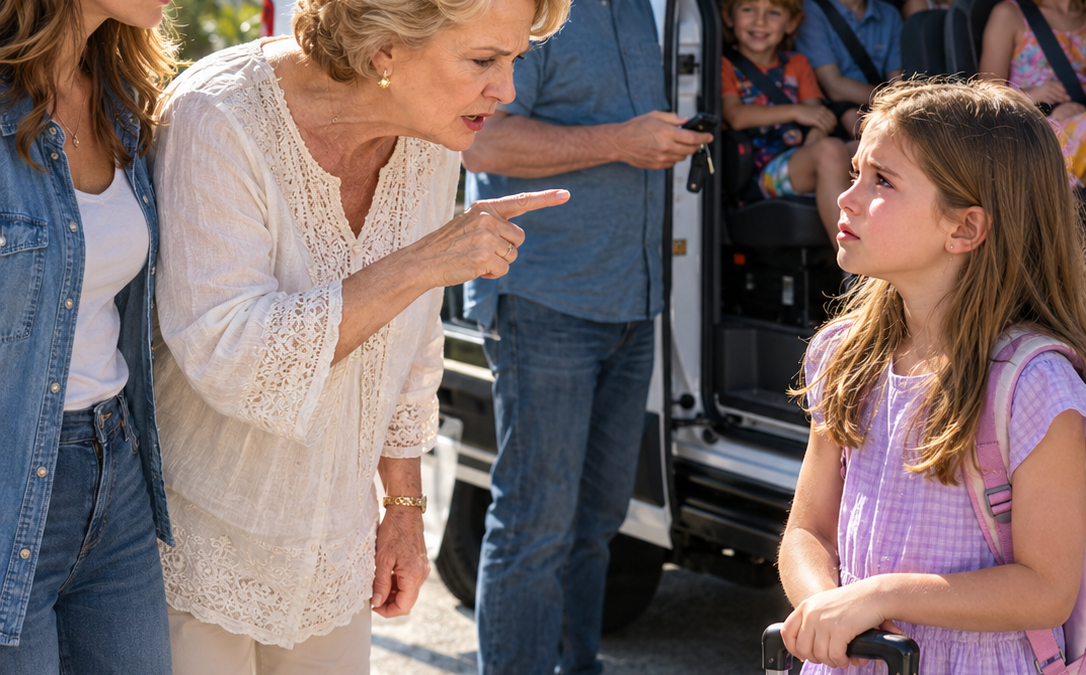
“The van only seats seven, sweetheart.”
My mother said that to my nine-year-old daughter at seven o’clock on a Saturday morning in July, on the curb in front of her house in Mobile, Alabama. June was holding a purple suitcase with a unicorn tag. Behind the van windows, seven of her cousins were already buckled in, eating powdered donuts out of a box.
I had driven my mother to dialysis three mornings a week for four years. I had booked every one of her treatments in Florida myself.
Four days after that morning on the curb, on a Wednesday afternoon, my mother called me from a beach house in Florida, crying so hard I couldn’t make out my own name. She said there was something she had to tell me. Something she would only tell me to my face.
Some secrets get kept so long they start doing the keeping.
This is Gentle Drama Stories. If you stay with me through this one, you’ll hear what my mother had been carrying since before I could walk. And if you’d like the next story, too, subscribe. While you’re here, tell me in one word what you’d call a woman who drives someone at five in the morning for four years. I’ve got a few words of my own. We’ll get to them.
I’m Naen. I’m forty-six now, and I clean teeth for a living. I was forty-four that summer.
I’ll start with the mornings, because nobody in my family ever saw them.
My alarm went off at 5:15 on Mondays, Wednesdays, and Fridays. I slept in a T-shirt and leggings on those nights so I could just add a bra and shoes. My husband, Curtis, worked second shift as a pipefitter at the shipyard. He’d say, “Drive careful,” without opening his eyes, and in four years, he never once skipped it.
I’d fill a thermos with coffee. The thermos had a dent in the lid from the time it rolled off the roof of my car on Government Street, and the lid only screwed on if you started it a quarter turn to the left. That’s the kind of thing you learn when you do something six hundred times.
Mom lived eleven minutes from me, in the same brick house on Pinerest Drive where I grew up. Her porch light would be on. She’d be sitting in the front room in her church coat, even in August, because a dialysis unit is kept cold enough to hang meat in. She’d have her afghan folded over her arm, the green-and-gold one my grandmother crocheted, and her purse in her lap with her medication list on top.
I typed that list. I updated it every time a doctor changed something. I laminated it at work.
Her kidneys quit in the spring of 2020. Diabetes and high blood pressure, forty years of both, and one day her numbers fell off a cliff. She started hemodialysis that June, the same month the whole world was learning how to fold a mask.
Three mornings a week, about four hours at a time, in a recliner at a unit off Airport Boulevard, with two needles in a fistula in her left forearm. If you’ve never seen a fistula, it’s where the surgeon joins an artery to a vein so the vein grows strong enough for the needles. You can feel it buzz under the skin like a cat purring in a tube.
Mom used to make the grandkids put their fingers on it. They thought it was the coolest thing about her.
Her chair time was 5:45. I’d pull up at 5:30, help her down the two porch steps, and hand her the coffee she wasn’t supposed to drink much of because of her fluid limit. She’d take three sips and hand it back like she was doing me a favor.
Then I’d drive her to the unit, walk her in, wait while she got weighed, and kiss her on the top of the head before I left.
Some mornings she said, “Thank you, baby.”
Most mornings she said, “You’re running late.”
On Fridays, I stayed.
The dental office where I work, Dr. Hollis’s family practice, closes on Fridays. So on Fridays, I sat beside her for the full four hours in a plastic chair the charge nurse, Odessa, would drag over for me.
I did crossword puzzles with Mom. I rubbed her calves when she cramped, which happens when they pull the fluid off. I listened to her tell the man in the next chair about her grandbabies.
That’s the other thing about the mornings. My mother talked about her family the whole time, and I was in the room, and I was hardly ever in the story.
I’m the oldest of three. My brother Wade is three years younger than me, and my sister Christy is six years younger. Mom called them “my babies” until they were nearly forty.
Wade has four kids, and Christy has three, and Mom keeps all seven of their school pictures on the refrigerator in a grid like a little yearbook.
I have one child.
June was born when I was thirty-five, after Curtis and I had mostly given up. She has a cowlick at the crown of her head that no brush on earth can flatten, and a laugh so loud and sudden that strangers turn around in restaurants.
June’s school picture was on the side of Mom’s refrigerator. Not in the grid. On the side, held up by a magnet shaped like a crab.
I noticed.
I’m always the one who notices whose medication is running low. But I told myself it was about space. Seven fit neatly. Eight didn’t.
When people asked Mom about her children, she’d say, “Wade’s got his own business, and Christy’s my sweetheart, and Naen is my reliable one.”
She meant it as a compliment.
You’d be amazed how lonely a compliment can be.
So here’s where the trip comes from.
In March of 2024, Mom got a letter from her younger sister. Aunt Bonnie lived in Santa Rosa Beach, Florida, about two hours east of us, and she and my mother had barely spoken in my whole life. There had been some falling-out before I was born, and nobody would ever tell me what it was.
Aunt Bonnie’s husband, Jean, had died the year before. In the letter, she offered Mom her beach house for a week in July.
“Free for you and all your grandbabies,” it said.
Mom read that line out loud to me twice at her kitchen table, and her voice went funny the second time.
At Easter dinner, she made the announcement.
Grandbaby Beach Week.
Wade would rent a van and drive. Christy would come to help. Mom would take all eight grandchildren to the Gulf.
She said all eight.
I remember because June stood up on her chair at the table, and Christy told her to sit down before she broke her neck.
June went home that night and made a countdown calendar out of construction paper.
One hundred and four days.
She drew a little van at the top with eight stick kids in the windows and Mom driving, which was funny because Mom hasn’t driven in years. She put an X on one square every night before bed.
One hundred and three. One hundred and two.
In May, I sat at Mom’s kitchen table with my laptop to start the paperwork for her Florida treatments.
You can’t just walk into a dialysis unit on vacation.
I needed the address where she’d be staying. Mom took a pen and an envelope and started writing it out for me.
Bonnie Castle.
Then a house number on County Road 3A, the beach road.
Her hand was shaking so badly that the word Castle went downhill off the edge of the envelope.
“Mom, are your sugars low?”
“I’m fine,” she said.
She put the pen down and smoothed her afghan over her knees.
She did that when she was lying.
I didn’t know it yet. I know it now.
Booking dialysis away from home is a job. The social worker at Mom’s unit, a patient young man named Terrence, gave me a list.
The Florida unit would need her recent lab work, her hepatitis B status, a chest X-ray report, her treatment orders, her medication list, and her insurance cards, all sent at least a few weeks ahead. Then they’d decide whether they had a chair.
Summer on the Gulf is busy for dialysis. Same as for hotels. People want their grandkids on the beach, too.
I found a unit in Destin, twenty minutes from Aunt Bonnie’s house. I called them on my lunch break four times in one week. I faxed things from the dental office, which made our office manager, Tammy, roll her eyes and say, “Who on God’s earth still faxes?”
Hospitals, Tammy.
Hospitals and dialysis units.
On the twelfth of June, a scheduler in Destin called me back and said Mrs. Loretta Tilman was confirmed for six in the morning on Monday the fifteenth, Wednesday the seventeenth, and Friday the nineteenth of July.
I wrote it on a sticky note and put it on Mom’s refrigerator, right in the middle of the grid of seven school pictures where nobody could miss it.
Nobody thanked me.
I want you to understand, I didn’t expect thanks. In my family, you don’t thank the oldest daughter any more than you thank the stove.
While I was doing all that, I kept thinking about Aunt Bonnie.
Here’s everything I knew about her before that summer.
She was my mother’s little sister, seven years younger. She’d moved to Florida when she was a teenager and never moved back.
She sent me a birthday card every year of my life. Every single year, on the eleventh of February, a card would come, usually a day or two early, with a ten-dollar bill inside when I was little and no money once I was grown.
She never wrote much. Just “Happy birthday, Naen.”
And then always, “B.”
Wade and Christy never got cards from her.
When I was about twelve, I asked why, and Mom said, “Bonnie’s always been peculiar.”
That was the whole answer.
I met her for real exactly once. It was at my grandmother’s funeral in 2009.
Mama Pearl, we called my grandmother.
Aunt Bonnie came in after the service started and sat in the very last pew in a navy dress. At the graveside, she walked up behind me and put her hand on the back of my head just for a second, the way you’d touch a child’s hair.
Then she said, “You turned out fine, didn’t you?”
And left before the dinner.
My mother didn’t speak for the rest of the day.
There was family lore about me, too. Every family has its little stories that get told so often they wear smooth.
Mine was that I was born in Pensacola, Florida, three weeks early, while my mother was visiting her Aunt Ivy. Mom had gone over to help Aunt Ivy after an operation, and I came early. So I was the only one of the three of us not born in Mobile.
My daddy, Earl, used to call me “my Florida girl.”
He said it over good report cards and on my wedding day. He said it in the hospital two weeks before he died in 2016.
“There’s my Florida girl.”
Wade and Christy have hospital pictures. Mom in a gown, holding a red, squalling baby.
I don’t.
The first picture of me ever taken is in Mama Pearl’s front room in Mobile, when I was already three weeks old. Mom is in her church dress with her hair done, holding me like I might go off.
“The camera was broken in Pensacola,” she told me the one time I asked.
I had every piece in my hands for years.
I just never put them on the same table.
There’s one more piece, and it’s the one that still stings.
In the fall of 2020, a few months after Mom started dialysis, I asked her transplant team about being a living donor. You can live a full life with one healthy kidney, and a kidney from a living donor usually lasts longer than one from the waiting list.
I was forty. My blood pressure was fine back then.
I filled out the first questionnaire and called the coordinator, a soft-spoken woman in the transplant office, and we set up the first round of blood work.
Two days before that appointment, the coordinator called me. She was very kind about it.
She said that a transplant candidate is allowed to decline a specific donor, and my mother had declined me.
No reason given.
I drove straight to Pinerest Drive with the motor still running in my chest.
“Mom, why would you do that?”
She was in her recliner with the afghan. She didn’t look at me.
“Because I’m not taking a piece out of my child. I’m sixty-four years old. I’ve had my life.”
“It’s my piece to give.”
“It’s my body to say no.”
And she smoothed the afghan over her knees.
Flat, flat, flat.
“That’s the end of it, Naen.”
It was the end of it.
For four years, that was the end of it.
I drove her three mornings a week to sit in a chair hooked up to a machine, and the whole time, I privately believed my mother would rather do that than take one thing from me.
That’s a strange thing to carry on a 5:30 drive.
Here’s the last piece, and then we’ll go to the curb.
Two summers before the trip, we had a crawfish boil in Wade’s backyard. June was seven. Somebody’s cousin told a joke about a goat, and June laughed that big, honking laugh of hers. Threw her head back, cowlick and all.
My mother was sitting in a lawn chair with a plate of corn. She looked at June and said, clear as day, “Bonnie, hush.”
Everybody laughed.
Christy said, “Mama, that’s June.”
And Mom said she was tired and her blood sugar was off.
And I said, “Go easy. She’s been up since four,” because I’m the one who always covers.
That’s everything I had.
Pensacola. No hospital picture. Daddy’s Florida girl. A card every February signed with one letter. A kidney my mother wouldn’t take. A seven-year-old called by the wrong name.
On Friday the twelfth of July, the night before the trip, my phone rang at 9:40.
Mom never called after nine.
“Is June packed?” she said.
“She’s been packed since Tuesday. She packed her own swimsuit and four pairs of socks. I’m not sure why socks.”
Mom didn’t laugh.
There was a long silence on the line, long enough that I said, “Mom?”
“Bring her,” she said. “Bring her suitcase.”
And she hung up so fast I heard the phone clatter in the cradle.
Saturday, the thirteenth of July, came up hot and white.
By 6:30, the air in Mobile already felt like a wet towel. June was dressed before I was. She had her pink swimsuit on under her jean shorts. She wanted to get in the water the second we got there.
She had sunscreen on her nose that she’d put on herself, which meant it was mostly on one side.
She’d crossed off the last square on her countdown calendar the night before and written the word TODAY in it in purple marker, with three exclamation points and a drawing of a crab.
I didn’t go on the trip.
That was never the plan. Somebody had to work, and somebody always means me. Curtis was on shift that week, too.
So June would go with Grandma and the cousins, and I’d have a quiet house for a week. Maybe Curtis and I would eat supper on the porch like we did before we had a kid.
We pulled up on Pinerest Drive at five till seven.
Wade had rented a white twelve-passenger van from a place out on Schillinger Road. It was parked at the curb with the side door slid open.
Wade’s four were in the back two rows. Cody, who was seventeen and too cool to be there; Mason, fifteen; Laney, twelve; and Bo, ten.
Christy’s three were in the middle. Ava, eleven; Tucker, eight; and little Hazel, who was six and already asleep with powdered sugar on her chin.
The box of donuts was going hand to hand.
Mom was standing on the porch with her purse and her afghan and a rolling bag I’d packed for her on Thursday night.
In the side pocket was a gallon zipper bag with her pill organizer sorted by day, her laminated medication list, and her treatment orders.
There was also a sheet of paper with the Destin unit’s address and phone number and Aunt Bonnie’s. I’d typed it up in a big font so she could read it without her glasses.
June hopped out of my car with her purple suitcase and ran up the walk.
“Grandma, I’m here! I’ve got four socks!”
My mother came down the two porch steps by herself.
I remember that because she never did those steps by herself.
She held the rail with one hand and her purse with the other, and she walked straight past June to the end of the walk where the van was.
Then she turned around.
She looked at June. Then she looked at me. Then she looked down at June again and smiled with just her mouth.
“The van only seats seven, sweetheart.”
June stood there holding her suitcase handle.
She looked at the van. She looked at the seven kids in it.
You could see her nine-year-old brain trying to make that sentence fit anything.
“But I’m on the calendar,” she said.
“Not this time, baby. Grandma’s sorry. Next time.”
“Mom.”
Just that.
I said it the way you’d say it if somebody had stepped off a curb in front of a truck.
“It’s done, Naen,” she said. “Wade’s got the paperwork for the van. It’s seven. We’ll be late.”
I looked at my brother.
Wade was standing at the driver’s door with the keys in his hand, and he looked down at his phone like there was a map on it he urgently needed.
I looked at my sister.
Christy was in the front passenger seat with her sunglasses on. She rolled her window halfway down and said, “Naen, it’s just this once. Don’t make a scene in front of the kids.”
In front of the kids.
One of the kids was standing on the sidewalk holding a purple suitcase.
I want to tell you I said something perfect.
I didn’t.
What I said, very low so June wouldn’t hear it, was, “Mother, you will explain this to me.”
My mother said, “Wade, help me up.”
He did.
She climbed into the front bench beside him, and the side door rolled shut with a sound I can still hear when I close my eyes.
I counted later.
Wade, Christy, and Mom up front. Seven kids behind.
Ten people in a twelve-seat van.
June didn’t cry.
That’s what got me.
She did what I would have done at nine. She was polite about it. As the van pulled away from the curb, she lifted one hand and waved the way you wave at a parade float.
Little Hazel had woken up, and she waved back through the glass with her sugary hand. Then the van turned left onto the parkway, and it was gone.
June stood there a second longer.
Then she said, “Can we still go somewhere?”
“We can go anywhere you want, baby.”
“Pancakes,” she said.
So I took my girl for pancakes.
There’s a breakfast place on Airport Boulevard called The Sunny Plate, with red vinyl booths and a waitress named Sherry who’s been there since I was in high school.
June ordered the stack with strawberries and whipped cream and a chocolate milk, and she ate maybe half. She kept turning her fork over.
She asked me if Grandma was mad at her. I said no. She asked if it was because of the time she spilled grape juice on Grandma’s couch. I said no.
Then she asked if it was because she was loud.
And I said, “No, baby. It’s not anything you did.”
I believed that. But I didn’t have one other word to give her after it.
Let me stop here a second. If you’d been standing on that curb with your child holding her suitcase, what would you have done? Put her in that van yourself and dared them, or taken her hand and walked away like I did? Tell me what you’d have done. I’ve asked myself every way there is.
That night, I put June to bed in her swimsuit because she wouldn’t take it off. I sat in the kitchen with a glass of iced tea going warm and texted my mother one sentence.
June wants to know what she did wrong.
No answer.
I didn’t expect one.
On Sunday afternoon, Christy posted a photo on Facebook.
You know the kind. All seven kids lined up in front of the van in Aunt Bonnie’s driveway, with the Gulf a strip of green behind them and the sun making everybody squint.
Christy’s caption said, “All my babies at Aunt Bonnie’s Grandbaby Beach Week,” with a row of heart emojis and a palm tree.
Mom shared it within the hour.
Her caption said, “My grandbabies.”
I hadn’t meant for June to see it, but she was on my tablet in the den, and she had found it. She was doing that thing kids do with two fingers to make a picture bigger.
She’d zoomed all the way in on the van’s open side door.
“Mama,” she said. “Come look.”
I sat down beside her on the couch.
She pointed with one finger, very serious, like a lawyer.
“It had twelve seat belts,” she said.
I counted in the picture.
Twelve seat belts. Ten people. Two empty seats.
I sat on that couch with my daughter and looked at her finger on the glass, and something in me that had been folded up for forty-four years came a little unfolded.
“You’re right, baby,” I said. “You counted right.”
“So why did Grandma say seven?”
“I don’t know yet.”
“Are you going to find out?”
“Yes,” I said.
I heard my own voice, and it was my mother’s voice when she says something is the end of it.
When Curtis got home that night, a little after midnight, I was still up at the kitchen table. He took one look at me and got two beers out of the refrigerator, even though neither of us drinks much.
I showed him the photo. I showed him the open door. I told him what June said.
Curtis is a man of very few words, and most of those are about pipe. He looked at the picture a long time.
Then he said, “Your mama’s scared of something.”
“My mama’s mean is what she is.”
“Could be both,” he said. “Mean’s usually scared wearing a coat.”
I didn’t want to hear it. I went to bed mad at him for being right before I was ready.
Here’s what I did the next three days, which is to say almost nothing, which is to say what I always do.
On Monday morning, I woke up at 5:15 out of pure habit and lay there in the dark with nowhere to drive. It was the strangest feeling, like reaching for a stair that isn’t there.
At 6:40, the Destin unit called my cell phone because I was still listed as her emergency contact, just to confirm that Mrs. Tilman had arrived, been weighed, and was on the machine.
Wade had dropped her off.
Good. Fine.
I thanked the nurse. I hung up. I made June waffles from the freezer and drove her to day camp at the church. Then I went to work and scraped tartar off the backs of a man’s lower teeth for forty-five minutes while he told me about his boat.
On Monday night, I typed out a text to Wade.
When you get back, you’re driving her Monday, Wednesday, Friday, 5:30. I’m done.
I read it eleven times.
I didn’t send it.
A lot of you will know exactly why.
It’s not that I was afraid of Wade. It’s that I knew what would happen. Wade would say, “What do you want me to do about it, Naen? I’ve got a business.” Christy would say she couldn’t with the kids.
And on Monday at 5:30, my mother would be sitting in her front room in her church coat, with her purse in her lap, and nobody would come.
Her chair would sit empty. Her potassium would creep up, and her lungs would start to fill.
Dialysis isn’t a thing you skip because your feelings are hurt. It’s not a hair appointment. The machine is doing the job her kidneys stopped doing.
So you don’t stop.
You can’t stop.
And everybody in the family knows you can’t stop, which is exactly how you end up the one who never gets to.
If you’ve ever been the one who keeps the pill organizer, you’ll know this next part.
The one who packs the pill organizer is never in the picture.
Go look at your own family’s photos.
Somebody took them. Somebody packed the cooler, filled out the forms, made the call to the unit, remembered the reading glasses.
That person is standing just outside the frame, holding everybody’s sweaters.
On Tuesday morning, I found June’s countdown calendar in the recycling bin under the kitchen sink, folded in half, the page with the word TODAY and the crab on it.
I took it out and smoothed it flat and put it in the drawer where I keep the birthday cards from Aunt Bonnie.
I don’t know why that drawer.
It was just the drawer my hands went to.
Christy posted more photos on Tuesday.
Kids on a sandbar. Kids eating shrimp. Mom under a beach umbrella in a folding chair, wearing a big straw hat, smiling into the sun with Hazel in her lap.
And in the corner of one picture, half cut off, was a woman I didn’t quite recognize, in a man’s work shirt and a ball cap, holding a pitcher of tea.
Aunt Bonnie.
You could only see her chin and her hands. She wasn’t smiling at the camera. She was looking at the kids.
I studied that half a face longer than I’d like to admit.
On Wednesday morning, I went to work like always.
At eleven, I had a woman named Mrs. Callaway, who comes in every six months, cries when I scale her lower front teeth, and thanks me every single time on her way out.
I have a soft spot for Mrs. Callaway.
She knows how to thank a stove.
At 11:40, I was halfway around her lower arch with the scaler when Tammy opened the door of my operatory.
Tammy doesn’t do that. Tammy knocks and waits, then slips a sticky note under the door if it’s important.
“Naen,” she said, “I’m sorry. There’s a dialysis place in Florida on line two. They said it’s about your mother, and they said they need you now.”
I took the call at the front desk with my gloves still on.
The woman on the line was the charge nurse in Destin. She had a calm, flat voice, the kind nurses use when they’re trying not to scare you and also want you to know they’re a little scared.
Mom had finished her treatment at 9:50. Her blood pressure had come down low, which is common right after, so they’d kept her in the recliner an extra half hour with her feet up.
She was fine now, but nobody had come to get her.
It was 11:40.
Her ride wasn’t answering.
They couldn’t release her into a taxi by herself in that state, and they had a full second shift coming in.
“She’s sitting in our lobby,” the nurse said. “She asked us not to call you. We called you anyway.”
“Who was supposed to get her?”
“Her daughter. Christy.”
I called Wade first from the break room. It went straight to voicemail.
I found out later he’d taken his two oldest boys on a deep-sea charter out of Destin Harbor at six that morning. A surprise he’d booked. They were thirty miles out in the Gulf with no signal.
He’d borrowed Uncle Jean’s old pickup from Aunt Bonnie and dropped Mom at the unit at 5:40 on his way to the dock, which I’ll give him.
Then I called Christy four times.
Voicemail. Voicemail. Voicemail. Voicemail.
She’d taken the van to a water park out on Highway 98 with her three and Wade’s two youngest, ten minutes from the unit, and her phone was in a locker with her flip-flops.
She’d set an alarm on it to remind her to get Mom.
It was a very good alarm.
It went off in the locker at 9:45 all by itself.
I stood in our break room with Mrs. Callaway waiting in my chair with half her teeth clean, and I looked at the clock and did the math.
Two hours and fifteen minutes from Mobile to Destin.
If I left that very second and the bridge traffic was kind, my mother would be sitting in that lobby until two in the afternoon, after a treatment, in a cardigan, with no lunch and no insulin plan.
Then I remembered the sheet of paper.
The one I’d typed in big print and put in the side pocket of her rolling bag.
It had the Destin unit’s number, and under it, Aunt Bonnie’s.
I had never once called Aunt Bonnie in my life.
I’d typed her number from Mom’s shaky envelope in May. I didn’t even know if it was a landline.
It rang three times.
“This is Bonnie.”
Her voice was lower than I expected. Rougher, like a woman who’d spent a lot of years on boat docks.
“Aunt Bonnie. It’s Naen. Loretta’s Naen.”
There was a pause on the line. Not a long one. Just the length of somebody setting something down very carefully.
“Naen,” she said.
Only my name.
“What’s happened?”
I told her fast. The unit. The lobby. Wade on the boat. Christy at the water park.
“I’m twenty minutes from there,” she said. “I’ll get her. Don’t you leave work. Don’t you drive over here in a panic. I’ve got her, sweetheart.”
She said sweetheart, too.
But it didn’t sound anything like my mother’s.
I went back and finished Mrs. Callaway’s cleaning. I don’t remember a word I said.
At 12:25, the Destin nurse texted to tell me Mrs. Tilman had been picked up by her sister, Bonnie Castle, who’d brought her a ham sandwich and a cold bottle of water and signed her out.
I sat in my car on my lunch break and let my forehead rest on the steering wheel.
At 3:15, my cell phone rang.
It said Mom.
I almost didn’t answer it.
I’d been angry for four days, and I could feel the anger trying to decide whether it was done.
I answered.
At first, there was nothing on the line but breathing.
Then my mother started to cry.
This was a sound I had never once heard my mother make. Big, ugly, gulping sobs, like a child who’s been lost in a store.
She was trying to talk through it, and I couldn’t make out a single word.
“Mom. Mom, slow down. Are you hurt? Are you breathing okay?”
I heard her try to say my name and fail twice.
Finally, she got it out.
“Naen, baby, can you come get me tonight? Tonight, please.”
She took a big, shuddering breath.
“I have to tell you why June stayed home.”
“Then tell me.”
“Not on the phone. I can’t do it on the phone.”
She was crying again.
“To your face. Friday, in my chair. I’ll be on that machine, and I won’t be able to get up and leave. And that’s the only way I’m going to get it out. Naen, I know myself.”
“Mom, what is going on?”
“Your aunt says if I don’t tell you by Sunday, she will. And she’s right. She’s been right for forty-four years.”
Then she hung up.
I sat in the dental office parking lot with the phone in my hand while the afternoon thunderheads stacked up over the bay.
I finished my last patient at 4:40.
I called Curtis, who said, “Go,” before I finished the sentence.
I picked June up from church camp and dropped her at Curtis’s mother’s house with her pajamas and a bag of pretzels.
At 5:30, I got on Interstate 10, heading east, through the tunnel, over the bay, into Florida.
The same road my mother had taken in 1979 to help her Aunt Ivy, if that’s what she’d gone for.
Aunt Bonnie’s house was on the beach road, up on stilts, painted a pale blue that had gone almost white from the salt.
There were seven pairs of flip-flops on the bottom step and a busted boogie board leaning on the rail.
I parked behind the white van.
She opened the door before I could knock.
A tall woman, sixty, in that man’s work shirt from the photo, with gray hair cut short.
She didn’t hug me.
She looked at me for a long moment, the way you’d look at a painting you’d only ever seen in a book.
“She’s packed,” Aunt Bonnie said. “She’s on the couch. Come in.”
The stairs inside went up along a wall of framed photographs, old ones, black-and-white and faded color.
Mama Pearl as a young woman. Jean with a fish.
And halfway up, a girl of about nine standing on that same beach in a striped swimsuit, squinting with her mouth wide open, laughing so hard her eyes were shut.
Her hair stuck straight up at the crown in a cowlick no brush on earth could have flattened.
I stopped on the step.
I couldn’t help it.
My heart did something it had no business doing.
“That’s me,” Aunt Bonnie said from behind me. “1972.”
“She looks just like June,” I said.
And the words were out before I could stop them.
Aunt Bonnie didn’t answer that.
She went past me into the front room, where my mother was sitting very small on a wicker couch, with her rolling bag at her feet and her afghan in her lap.
Then she came back and stood in the doorway with me.
“She’s yours to tell,” Aunt Bonnie said quietly. “Not mine. I promised a long time ago, but I’m not waiting forty-four more years, Naen. I’m sixty. I’d like to hear that child laugh before I die.”
My mother didn’t say one word for the first hour of that drive.
She sat in my passenger seat with her afghan over her knees, even though it was eighty-six degrees at eight at night, and she kept one hand flat on the dashboard, bracing for a stop that wasn’t coming.
The seven grandkids had come running out to hug her goodbye when we left. Hazel cried. Christy cried, too, mostly about the water park, and kept saying, “Mama, I set an alarm. I swear I set an alarm.”
Mom patted her cheek and told her to get the kids fed.
Wade was still at the harbor cleaning fish with his boys. He didn’t know she was gone.
So my mother left her own Grandbaby Beach Week on a Wednesday night, three days early, with seven grandchildren standing in a driveway waving at her.
I don’t think the irony was lost on either of us.
Somewhere past Pensacola, she finally spoke.
We were on the long bridge over Escambia Bay, all those lights on the water.
“You were born over there,” she said, nodding off to the left toward the city lights.
“I know, Mom. Three weeks early. Aunt Ivy’s operation.”
She made a little sound in her throat and didn’t say anything else until we got to Pinerest Drive.
In the driveway, she said, “Friday.”
And I said, “Friday.”
I walked her in, set her pill organizer out for Thursday, turned on her porch light, and drove home.
I lay awake beside Curtis until two.
Before I take you into that unit on Friday, here’s a question for you.
By now, you’ve heard everything I had. The card signed with one letter. The hospital picture that didn’t exist. The kidney she wouldn’t take. Aunt Bonnie on the stairs at nine years old with June’s hair.
What do you think my mother was about to tell me?
Just give me one word. One word for the reason.
A lot of you are going to be closer than I was.
Thursday was the longest workday of my life.
I cleaned six mouths. I don’t remember one of them.
I know I called Mom’s home unit on my break because she’d been booked in Destin for Friday, and her regular chair here had gone to somebody else for the week.
Odessa, the charge nurse, picked up.
Odessa is a short, square woman with gray braids pinned up and no patience for nonsense, who has run that unit since before my mother’s first needle.
She said, “Naen, honey, I have exactly zero chairs on Friday, first shift.”
Then she put me on hold for four minutes and came back and said, “6:10. I moved Mr. Duma to second shift, and he owes me now. Tell her not to be late.”
That’s the thing about a unit like that. It looks like machines and tubing, and it runs on women like Odessa moving people around a whiteboard.
When I picked June up from Curtis’s mother on Thursday evening, she climbed into the back seat, buckled herself in, and said, “Is Grandma sick? Is that why she came home?”
“She’s okay, baby. She’s just tired.”
June was quiet for a few blocks.
Then she said, “I made her something,” and handed a folded piece of printer paper up over the seat.
It was a get-well card.
On the front, in crayon, she had drawn a white van. She’d drawn it big, with all its windows. In every window, there was a little stick kid.
I counted.
There were twelve.
Inside, it said, “Feel better, Grandma. Love, June.”
And under that, in smaller letters:
There is room.
I had to pull over on Airport Boulevard in front of a tire shop.
I told June I needed to check something in the trunk.
I stood behind the car in the heat and put my hands on my knees.
I didn’t give Mom that card.
Not then.
I put it in my purse, flat between my checkbook and my reading glasses.
I told myself I was protecting June. I think I was also protecting the card.
That night, after June was asleep, I sat on the edge of the bed while Curtis got ready for his shift.
I told him I didn’t know if I could go in there in the morning. I told him maybe this was the day I let Wade figure it out.
He was home now, or nearly.
Wade had texted from the harbor at nine that evening.
Mama left. Christy says you came and got her. What happened.
No question mark on the last part, like it was a statement I owed him.
Curtis buttoned his work shirt slowly.
“You going to stop driving her?” he asked.
“I don’t know.”
“You can keep driving her,” he said, “and still stop carrying it. Those aren’t the same job.”
Then he kissed my forehead and went to work.
I’ve thought about that sentence a thousand times since.
On Friday, I was up before the alarm.
Thermos. Dented lid. Quarter turn left.
Mom was on the porch in her church coat with her afghan and her purse.
She didn’t say, “You’re running late.”
She didn’t say anything.
At the unit, Odessa weighed her. Mom had gained four pounds of fluid since Wednesday, which Odessa noted with a look.
They cleaned her arm. The tech put in the two needles while Mom looked at the ceiling tiles.
The machine started its low, steady hum, and the blood started moving through the clear lines, out of her and back in.
Odessa dragged the plastic chair over for me without being asked, like any Friday.
Mr. Abernathy was already in the next recliner with his crossword and his hearing aid. He’s eighty, and he’s been on the machine longer than my mother.
He nodded at me.
I nodded back.
Mom pulled the afghan up to her chin with her free hand and turned her head on the pillow to look at me.
“Sit down, Naen,” she said. “I’m not going anywhere for four hours, and neither are you.”
I sat down.
For a while, the only sound was the machine.
If you’ve never been in a dialysis unit, it’s not loud. It’s a steady pump and hum, and every so often a soft chime from somebody’s station across the room, and a nurse’s sneakers squeaking on the floor.
There were sixteen recliners in two rows. Most of the people in them were asleep under their blankets.
My mother looked at the ceiling.
Then she said, “Bonnie got pregnant the summer she was sixteen.”
She said it without any warm-up, like she’d rehearsed that first sentence for years and had never gotten past it.
“1979. A boy from her school who joined the Navy that August and never wrote her once. Mama found out in September.”
She kept her eyes on the ceiling.
“You didn’t keep a baby at sixteen in our church in those days, Naen. You didn’t even say the word. Mama sent her to Aunt Ivy in Pensacola and told everybody at church Bonnie had gone to help with Ivy’s operation.”
She closed her eyes.
“Aunt Ivy never had an operation in her life.”
I didn’t say anything.
I’m not sure I could have.
“Your daddy and I had been married three years. I’d lost two. One in ’77 and one in the spring of ’79, at almost five months. The doctor told me I might not carry one.”
Her free hand found the edge of the afghan and smoothed it.
“So Mama came to me at the kitchen table with a cup of coffee and said, ‘Loretta, God has solved two problems at once.'”
That’s how she put it.
Two problems.
Bonnie and me.
She turned her head on the pillow and looked straight at me.
“I went to Pensacola in December. You were born on the eleventh of February, 1980. At the hospital there. Not early. Right on time. Seven pounds even.”
The machine hummed beside her.
“Bonnie held you for one night. The next week, a lawyer in Mobile drew up the papers, and your daddy and I adopted you. Your daddy signed his name, and he never once looked sorry about it. Not one day in thirty-six years.”
She paused, watching my face.
“The state of Florida made you a new birth certificate with our names on it. And I came home to Mobile and told the whole church you came three weeks early while I was visiting Ivy.”
Her voice had grown so quiet I could barely hear her over the machine.
“The camera wasn’t broken. I said there wasn’t a camera. There wasn’t any me in a hospital gown. I was sitting in a waiting room in Pensacola in my church dress.”
I looked at her arm.
The two needles taped down. The blood going out and coming back.
I thought, I have been driving my mother to this chair for four years, and she’s my aunt.
And then I thought, No. No, she isn’t. She’s the one who went to Pensacola.
Both of those were true at the same time.
I’m still learning how to hold that.
“Mama made Bonnie promise,” Mom went on. “She’d stay away. She’d never tell you. She could send a card on your birthday, and that was all.”
Bonnie was sixteen years old, and Mama was Mama, and she promised.
And she kept it.
“Naen, forty-four years. Every February.”
“Always B,” I said.
Mom’s mouth crumpled.
“Always B.”
Then she told me about the kidney.
“When you went to that transplant office,” she said, “I’d been reading a magazine in the waiting room here. There was a story about a man who wanted to give his father a kidney, and the blood tests showed the doctors he wasn’t the man’s son.”
She looked down at the blanket.
“They don’t go telling people that. I know that now, but I didn’t know it then. All I knew was they’d take your blood and test it against mine, and somebody in a white coat was going to find out you weren’t mine.”
She was crying again, without any sound.
“I’d rather sit in this chair till I die than have you find out from a stranger in a hallway.”
“So you told them no.”
“So I told them no. And I let you think I was too proud to take it.”
Mr. Abernathy turned a page of his crossword.
I’m almost certain his hearing aid was off.
Almost.
“Now June,” I said. “Tell me about June.”
My mother took a long breath and let it out.
“When Bonnie’s letter came in March, I almost tore it up. But Jean was gone, and she sounded so lonesome, and she said she’d never say a word. She said she just wanted the house full of children for one week.”
Mom swallowed.
“She said, ‘Bring all of them, Loretta. Bring Naen’s girl.’ And I thought, she’s earned that. She has. So I told everybody at Easter, all eight.”
“I know,” I said. “June stood on a chair.”
“Then Bonnie called me the night before we left. Friday night.”
Mom’s voice went thin.
“She said she’d made up the little room at the top of the stairs for June, with the seashell quilt. She’d seen June’s pictures on Christy’s computer. She asked me if June still had that cowlick.”
Her fingers tightened on the afghan.
“She said she wanted to hear her laugh. And I hung up the phone and sat in my kitchen, and I saw it. I saw that picture of Bonnie on the stairs, nine years old, on that same beach, with her mouth wide open.”
She shut her eyes.
“Christy had already said it once at the crawfish boil. Remember after I called June by the wrong name? Christy said, ‘Mama, June favors that old picture of Aunt Bonnie in Mama Pearl’s hall.’ She meant it as a joke. Everybody laughed.”
I didn’t remember that part.
I’d been up to my elbows in the crawfish pot.
But I believed her.
“Then I lay awake all Friday night thinking about Christy walking up those stairs and seeing that picture, and Bonnie watching that baby all week like a grandmother watches.”
She looked at me.
“Wade’s not stupid. Christy’s not. Somebody would put it together. And then somebody would say it at Christmas with a drink in their hand, and you’d find out at my dining table from your little sister. And then…”
“And then what, Mom?”
She stared at the ceiling for a long moment.
“And then you’d stop.”
Her voice broke.
“You’d stop coming. Why would you keep coming? I’m not your mother. I’m the woman who lied to you for forty-four years. You’d stop coming at 5:30.”
She looked straight at me.
“And you’d be right, too.”
The machine hummed.
Somewhere down the row, a chime went off, and a tech walked over to silence it.
“So I told your baby the van was full,” my mother said. “I looked at her on that curb with her little suitcase, and I chose me. I chose keeping you over her.”
Tears ran into the sides of her hair.
“And that’s the worst thing I’ve ever done. And I’ve done some things.”
I sat in that plastic chair with my hands in my lap.
I could feel June’s card in my purse against my hip.
Twelve windows.
There is room.
“You told a nine-year-old she didn’t fit,” I said, “so you wouldn’t have to tell me where I came from.”
“I’m sorry, sweetheart.”
“Don’t,” I said.
She stopped.
“Don’t call me that. Not today. That’s the word you used on her.”
For a long time after that, neither of us spoke.
My mother cried with her eyes closed.
I watched the numbers on the machine.
Blood pressure. Flow rate. Fluid off.
I wasn’t thinking about being adopted. Not yet.
That came later, over weeks, in the car, in the mirror at three in the morning.
Right then, I was thinking about a purple suitcase.
After a while, Mom opened her eyes and started talking again.
And this time, it was the apology.
She’d clearly been working on it since Wednesday.
She said she was so sorry. She said she’d been so scared. She said she’d loved me from the first night in that Pensacola hospital, when Bonnie handed me over and I grabbed her finger.
She said she’d been afraid every day of my life that somebody would take me back.
She said she knew she’d been harder on me than on Wade and Christy, and she thought it was because some part of her was always bracing for me to leave.
She said she’d never forgive herself for June.
She said a lot of things.
Every one of them was true.
I could tell.
And every one of them was about her.
When she was finished, I said, “Mom, that’s a reason.”
She looked at me.
“Everything you just told me is why you did it. I believe all of it. But a reason isn’t an apology. It’s only the first thing you owe.”
I kept my voice low because of the other chairs.
“You haven’t apologized to the person you did it to. She’s nine. She ate half a stack of pancakes and asked me if it was because she’s loud.”
My mother made a sound like I’d pressed on a bruise.
“So here’s what I need,” I said. “You tell June yourself. Not me. And not ‘Grandma was tired,’ and not ‘Grandma wasn’t feeling good.’ You tell her you were wrong and the van had room.”
I watched her face.
“Second, you tell Wade and Christy the truth yourself. I’m not carrying this one for you.”
She nodded.
“Third, you call Aunt Bonnie, and you thank her for picking you up on Wednesday, and you thank her for forty-four years, and you let her see June.”
Mom was quiet for a while.
Then she asked, “And you? What do you want for you?”
I didn’t have an answer for that.
I still don’t fully.
“I’ll let you know,” I said.
Right then, her left calf cramped.
It happens near the end when they’ve pulled a lot of fluid. Her whole face went tight, and her foot pointed like a ballerina’s.
I was out of that plastic chair before I decided to be.
I put both hands on her calf under the afghan and pressed and kneaded like I’ve done on two hundred Fridays.
Odessa came over and turned something down on the machine and gave her a little saline.
In a minute, it let go.
Mom was gripping my wrist.
She didn’t let go when the cramp did.
From the next recliner, without looking up from his crossword, Mr. Abernathy said, “Took you long enough, Loretta.”
So much for the hearing aid.
At 10:10, they unhooked her.
I drove her home.
She slept the whole way with her head against the window, and I sat in her driveway afterward with the engine running and cried harder than I had since my daddy’s funeral.
Not for me.
Not even for June, exactly.
For a sixteen-year-old girl in Pensacola holding a baby for one night.
The van came home Saturday afternoon, sandy and sunburned.
On Sunday, Mom asked everybody to supper.
Not me.
She called them herself.
Wade and his wife and four kids. Christy and her husband and three. Curtis and June and me.
She had Christy make the pot roast because Mom can’t stand at a stove that long anymore. But she set the table herself.
And when I came in, there were eight children’s plates on the kids’ table.
After supper, she sent the kids out back with a bucket of popsicles and asked the grown-ups to stay at the table.
Then she told them.
Not well.
She stopped and started. She cried twice. She got the year of Mama Pearl’s funeral wrong, and Wade corrected her.
But she told it all.
Pensacola to the curb.
With her hands flat on the tablecloth.
Christy put her face in her napkin.
When she came up, she said, “I left you in that lobby, Mama, for two hours. I was on a lazy river.”
Wade sat very still.
Then he said, “So Naen’s not even—”
“Naen is my daughter,” Mom said.
So sharp the whole table flinched.
“She’s the one thing in this family I got completely right. Don’t you ever finish that sentence.”
We didn’t finish it.
Wade looked at me across the pot roast, and he looked ashamed and a little bit scared.
The way you look when you realize the thing holding up your house was a beam you never thought about.
On Monday morning, my alarm went off at 5:15.
I lay there in the dark for a minute.
I’d told myself all weekend that Wade could take a turn. That I’d earned one Monday. That she hadn’t even talked to June yet. She hadn’t done any of the three things I’d asked.
And I’d said out loud in a dialysis unit that I would let her know what I wanted.
Then I got up.
Thermos.
Quarter turn left.
At 5:30, I pulled up on Pinerest Drive.
The porch light was on.
Mom was sitting by the window, dressed and waiting, with her purse in her lap.
When she saw my headlights, she put her hand over her mouth.
I know some of you are going to tell me I was wrong to go. That I let her off the hook before she’d paid a dime of what she owed my child.
Maybe you’re right.
I went back and forth on it the whole eleven minutes.
But her potassium doesn’t care what she owes June, and I wasn’t going to let my mother’s worst choice make mine for me.
I walked her in.
She got weighed.
I kissed the top of her head.
On Wednesday evening, she called me at six.
“Bring June over,” she said. “Please. Just June and you.”
Mom was on the porch glider when we pulled up.
The old green metal one that squeaks on the back swing.
She had a little white gift bag on the cushion beside her, with tissue paper sticking out the top.
June went up the steps slowly, holding my hand.
She hadn’t been to that house since the curb.
Mom reached for the gift bag.
I knew what it was before she got it open.
It was one of those seashell necklaces from the shops on the beach road in Florida. The kind with a little puka shell on a cord.
She’d bought it on Tuesday of beach week, the same day she sat under that umbrella with Hazel in her lap, smiling for Christy’s camera.
I shook my head just once.
Mom saw it.
Her hand stopped.
She put the bag back down on the cushion.
Then she patted the glider, and June climbed up beside her.
The glider squeaked.
And my mother took my daughter’s hand in both of hers.
“June,” she said, “I told you something on Saturday that wasn’t true. I said the van only had seven seats. It had twelve. I knew it had twelve.”
June watched her.
“I wanted you to stay home because I was scared of something that had nothing to do with you. You didn’t do anything wrong. Not the grape juice, not being loud, nothing.”
My mother’s voice shook, but she kept going.
“I was wrong, and I hurt your feelings on purpose, and I’m sorry. And I’m going to spend a long time making it up to you.”
June looked at her for a while with that serious face she gets.
“You can’t count, Grandma,” she said.
“I can count, baby,” my mother said. “I counted. I lied.”
June thought about that.
Then she reached into the pocket of her shorts and pulled out a folded piece of printer paper, soft from being carried, and handed it over.
I hadn’t known she’d taken it out of my purse.
Mom unfolded it.
A white van with twelve windows and twelve stick kids.
There is room.
My mother cried for about the fourth time that week, and June patted her arm right above the fistula, very gently, the way the grandkids do to feel it buzz.
Then, and only then, Mom handed her the necklace.
June put it on and didn’t take it off for a month.
Mom did the other two things, too.
She’d already told Wade and Christy.
On Thursday, she called Aunt Bonnie herself from her own phone, and they talked for an hour and ten minutes.
I know because I was in the kitchen pretending to clean out her refrigerator so I could hear.
And then she did a fourth thing I hadn’t asked for.
She booked her own dialysis.
Labor Day weekend, she wanted to take June to Aunt Bonnie’s.
Just June and me to drive, and her.
She told me she’d handle the Destin unit herself.
I want you to know it nearly killed me.
She faxed the wrong number twice. She called the scheduler in Destin and gave them her old address on Pinerest Drive as the address in Florida.
She had to call Terrence, the social worker, three times to ask what hepatitis B surface antigen meant on the form.
And Terrence, God bless him, told her three times.
But on the Friday before Labor Day, a scheduler in Destin called my mother, not me, to confirm Mrs. Loretta Tilman for six in the morning on Monday, the second of September.
Mom wrote it on a sticky note and stuck it to the middle of her refrigerator.
Somewhere in there, June’s school picture moved into the grid.
It made a ragged row of eight.
Mom didn’t care how it looked.
We drove over on Saturday morning, the three of us, in my car.
June sat in the back with her purple suitcase on the seat beside her, buckled in like a passenger.
Aunt Bonnie was waiting at the bottom of her stilt house stairs in that same work shirt.
June ran right up to her because June runs right up to everybody.
And Aunt Bonnie bent down and looked at her face for a long, long time.
Then June said something about the boogie board and laughed her big, honking laugh.
Head back.
Cowlick standing straight up in the wind off the Gulf.
And Aunt Bonnie laughed, too.
The same laugh.
The exact same sound, forty years older, a little rougher from the docks.
The two of them standing there laughing at each other in the driveway, neither one knowing why it was so funny.
And my mother on my arm, squeezing so hard I had marks.
That night, after June was asleep upstairs in the little room with the seashell quilt, Aunt Bonnie and I sat on the porch with our feet on the rail.
My mother had gone to bed early, washed out from the drive.
You could hear the water but not see it.
I didn’t know what to call her.
I told her so.
“You call me Aunt Bonnie,” she said. “I’ve been Aunt Bonnie for forty-four years. I’m good at it. If something else comes along later, it’ll come.”
Then she said, “Your mama did the hard part. You know, I held you one night. She got up with you every night after that.”
She looked out into the dark.
“Don’t you let what she did on that curb erase what she did for forty-four years. It counts, too. Both of them count.”
I’ve thought about that a lot.
Both of them count.
That was two years ago.
I’m forty-six now. My mother is seventy.
She’s still on dialysis, three mornings a week, and I still drive her.
Monday, Wednesday, Friday.
5:30.
Thermos with the dented lid.
Quarter turn to the left.
Some mornings she says, “Thank you, baby.”
She hasn’t said, “You’re running late,” in two years.
Even when I am.
Wade drives her on the first Monday of every month now.
He asked to.
He’s late every time, and she doesn’t mention it to him either.
Last spring, my mother called the transplant office herself and asked them to put my name back in her file.
I’m going through the evaluation now.
It’s slow. They want my own blood pressure lower first, which is fair considering what I’ve been through.
Whatever the tests say about whose I am, I already know.
June is eleven.
She spends a week at Aunt Bonnie’s every July now.
Grandma goes, too.
They book the treatments together, the two of them, at Mom’s kitchen table, and June does the faxing because she thinks it’s hilarious that anybody still does.
Here’s what I learned in a plastic chair beside a machine.
A reason isn’t an apology.
It’s only the first thing you owe.
My mother owed my daughter the truth, and then she paid the rest of it in small payments.
The way you pay anything real.
I still argue with myself about one thing.
That Monday, before my mother had said one word to June, I was back in her driveway at 5:30.
Would you have kept driving her?
Yes or no?
Tell me in the comments, and tell me why.
Send this to the woman who drives everybody, the one just outside every family photo.
And if you’d like to sit with me for the next story, subscribe.
Thanks for staying for the whole ride.
Count the seat belts, y’all.
There’s usually room.








