I was taken to surgery unconscious. On the phone, Mom yelled: “Did that useless girl faint again? Call when she wakes, my youngest Sophie has a fitting!” A week later, parents came for cabin keys, but the flat was empty. Dad read the note & fell: “Brenda… who gave her blood?”
She lived alone in a one-bedroom apartment downtown and had been saving for eight years to buy a farmhouse with enough land to keep a horse. Her savings account held exactly $124,000. Every dollar represented years of planning, careful decisions, and the promise of a life that belonged entirely to her.
It was Mia who had taught her to love horses.
They were both nineteen when they met. Mia worked as a stable hand at a local equestrian center, while Eliza, who had grown up in the city, had never properly ridden a horse. During her first attempt to climb into a saddle, she froze halfway up, clutching the animal’s mane as though her life depended on it.
“Don’t be afraid,” Mia told her, interlocking her hands beside the stirrup to make a step. “I’ll give you a leg up.”
From that day forward, the phrase became their answer to everything. Moving apartments, miserable days, unexpected problems, and actual disasters all received the same promise. Whenever one of them needed help, the other was there to give her a leg up.
In Eliza’s phone, Mia’s contact name was saved as “Mia—Leg Up.”
But the emergency contact visible on her locked screen was her mother. That was simply how Eliza had always done things. It seemed like the standard protocol, the same way someone might keep an old address on a form because changing it required an uncomfortable explanation.
Her phone’s PIN and the code for her banking application were both Brenda’s birthday: 0703.
Brenda herself had entered those four digits when Eliza was fourteen, announcing that at least this way her daughter wouldn’t forget her own mother’s birthday. Eliza had intended to change the code for twenty-three years. At first, she had simply been too lazy. Later, keeping it became an odd form of stubbornness, as if those four digits were the last thin thread connecting her to a relationship she had never quite managed to repair.
A year before the accident, Eliza arrived at her parents’ house for their thirty-eighth wedding anniversary after working thirty hours without sleep. The pharmaceutical plant was in the middle of a massive federal audit, and she was so exhausted she could barely keep her eyes open.
Her mother greeted her in an apron, looking irritated rather than pleased.
“Finally. I can’t manage everything alone. It’s time to take the roast turkey out.”
Eliza went straight into the kitchen. She pulled the heavy roasting pan from the oven, carried it toward the dining room, and collapsed in the doorway. Somehow, even as she fell, she managed to twist the pan just enough that the turkey landed intact on the rug. Her elbow took the full force of the impact, and the fracture required a month to heal.
“The workhorse decided to sprawl out,” Brenda announced to the guests as she picked up the turkey. “She always needs everyone running around after her.”
Eliza’s father helped her to her feet, sat her on a stool in the hallway, and brought her a glass of water. Then he returned to the dinner table.
Eliza remained on the stool, holding a wet towel against her injured elbow. For the first time, what she felt wasn’t shame. It was coldness, an unfamiliar emptiness spreading through her chest.
All through childhood, she had mistaken her father’s silence for kindness. He never shouted at her the way Brenda did. He rarely criticized her, and he occasionally offered small gestures of comfort. But sitting alone in that hallway, listening to the family’s conversation continue without her, she finally understood that his silence wasn’t kindness at all.
It was ordinary cowardice.
Nine days before the accident, during Sunday dinner at her parents’ house, Sophie and her fiancé, Derek Stanton, announced that their wedding was only a month away. They also had another piece of news. They had found a two-bedroom condominium in a building overlooking the river, with beautiful bay windows and a kitchen Sophie had apparently fallen in love with.
The owner, a retired judge, was selling the place because she planned to move closer to her son. It was a $400,000 cash deal, with closing scheduled in two and a half weeks.
“We only have $276,000,” Sophie admitted, immediately sending her older sister the real estate listing. “Ellie, look at that kitchen. You have money just sitting dead in your account for a farmhouse.”
Brenda was cutting an apple pie when she joined the conversation.
“You won’t even help your own sister? It’s just a loan.”
“We’ll pay it back as soon as I get promoted,” Derek added.
“No.”
Eliza said the word once, clearly and without apology. It was the same tone she used when signing deviation reports at the factory, leaving no room for someone to reinterpret her meaning later.
Brenda set down the pie knife.
“Why do you need a house all to yourself? To breed horses? I don’t know who I raised.”
Then, as though the subject had been settled, she added, “The second day of the wedding, we’re celebrating at our cabin with a barbecue.”
“The cabin was Grandma’s,” Eliza corrected her. “And it belongs to me.”
Brenda dismissed the objection with a wave of her hand, as though swatting away a fly. Sophie stared down at her plate. Derek glanced quickly at Eliza, and beneath his polished, agreeable exterior, something hard flickered across his face. Her father simply continued chewing.
Eliza left without waiting for tea.
Sitting in her car afterward, she remembered the PIN on her phone. She should change it. She knew that. But the thought of protecting herself with a password against her own mother made her feel ashamed and petty. She decided to deal with it in a few days, when everything had settled down.
On the last Tuesday of September, Eliza spent the entire day inspecting a raw-material supplier in a remote rural county. By the time she finished, darkness had fallen and a torrential rainstorm had swept across the roads.
At 10:31 p.m., driving through the downpour, she recorded a voice memo for Mia.
“The deer are walking around here like they own the place. I’ll call you when I get back.”
Mia responded with a photograph of a shaggy, big-eared, six-month-old foal.
Eliza smiled.
At that exact moment, as she entered a curve beside the forest, a deer stepped out of the darkness.
The collision shattered the windshield and crushed part of the roof. Everything that followed came to her in disconnected fragments: the explosive crack of the airbag, the metallic taste of blood in her mouth, a stranger repeatedly asking her name, the terrible screech of metal-cutting shears, and blue lights flashing against the rain.
Her last coherent thought was about the potatoes.
Alone again. Trying to do everything herself again. Acting foolishly heroic, just as she had at twelve years old. And nobody knew where she was.
In the emergency department of a regional hospital, Dr. Harrison stared at the ultrasound screen and issued a sharp command.
“Her abdomen is full of blood. Prep the operating room.”
Inside a plastic bag containing Eliza’s belongings, her phone kept ringing.
Nurse Clara ignored it at first. Eventually, she glanced at the illuminated screen and saw the name of the caller.
“Mia—Leg Up,” she read aloud. “You don’t save someone who won’t show up under a name like that.”
She answered.
After hearing what had happened, Mia said exactly two words.
“I’m driving.”
Ten minutes later, she was pulling her boots on over her sweatpants, dropping her keys twice in her haste. She hurried out of the suburbs and onto the highway, driving toward the hospital while rain hammered against her windshield.
At 11:41 p.m., Dr. Harrison personally called the number saved as “Mom” in Eliza’s emergency contacts.
“Brenda Vance, your daughter is in critical condition. She has severe internal bleeding and may not survive the surgery. Her blood type is O negative, which is extremely rare. We’re going to need compatible donors in the morning.”
“Is she conscious?” Brenda asked.
“No.”
“That workhorse worked herself into the ground again. Call me when she wakes up. Sophie has a dress fitting.”
“Will you come?”
Brenda repeated her statement about the dress fitting and hung up.
She had heard the doctor’s warning about donors. Somewhere at the edge of her awareness, she remembered that her husband had O-negative blood. But the thought was inconvenient. Arthur would make a fuss. Sophie would get upset. Their salon appointment was scheduled for nine the next morning, and everything had already been arranged.
Brenda turned off the lamp beside her bed.
Her husband was asleep.
For only the third time in his twenty-year career, Dr. Harrison entered a relative’s exact words into a patient’s medical chart. He recorded the precise time of the conversation and added a final note.
“Refused to arrive. Issue of donors unresolved.”
Meanwhile, thick fog had settled over the bridge crossing the river. Mia’s headlights illuminated what looked like a solid white wall, and directly ahead of her, a jackknifed semi-truck blocked the lanes.
She stopped with her hazard lights flashing and sat motionless for a moment, gripping the steering wheel. Her heart was pounding, and the road beyond the truck had disappeared into the fog.
“Leg up, Ellie,” she whispered aloud. “Leg up.”
Then she steered onto the shoulder and continued through the thick white darkness, cursing herself for being afraid.
At 1:40 in the morning, Mia burst into the emergency department wearing muddy boots and a jacket thrown hastily over her pajamas.
The surgery lasted more than three hours. Dr. Harrison and his team removed Eliza’s spleen and repaired the damage to her liver. Her broken ribs and wrists would have to wait until morning. She received nine units of blood and plasma, exhausting the hospital’s entire supply of O-negative blood.
Mia sat in the nearly deserted waiting area, where a muted television played an endless infomercial about miracle frying pans. By the third hour, she had memorized the announcer’s repeated promise that absolutely nothing would stick to them.
At 3:40 a.m., Dr. Harrison emerged from the operating room and surveyed the corridor.
He saw exactly one person.
“Are you a relative?” he asked.
“I’m everyone for her today.”
The surgeon looked at Mia for a long moment, his expression suggesting that he was comparing her presence with something he had heard earlier that night.
“She’s alive,” he finally said. “We’re moving her into intensive care on a ventilator. The next twenty-four hours are critical. By morning, we need O-negative donors. And we need a lot of them.”
Mia nodded.
She shifted into the same practical mindset she used when a horse developed colic at the equestrian center. There would be time to cry later. Right now, there were things to do.
She spent the remainder of the night sitting in her car in the hospital parking lot, calling everyone she knew. By eleven that morning, seven people had arrived at the blood bank: Dany, a stable hand; Khloe, a riding instructor; two parents whose children took riding lessons; and three complete strangers who had responded to Mia’s online plea.
Dany, who stood six feet tall, folded smoothly onto the floor at the mere sight of a needle. A nurse hurried over, pressed an ammonia inhaler beneath his nose, and looked around at the unusual group.
“Where did you all come from? An equestrian center or something?”
“Pretty much,” Khloe answered.
For the first time in twenty-four hours, Mia laughed. Then she immediately felt ashamed of herself for finding anything funny while Eliza lay in intensive care.
Closer to noon, a post from Brenda Vance appeared on Mia’s Facebook feed. It showed Sophie wearing a bridal veil, accompanied by three heart emojis and the caption, “Our princess.”
Mia turned her phone facedown on her lap and kept her palm pressed against it for a long time.
At that exact moment, Eliza’s father was standing inside a bridal salon, holding a woman’s purse, completely unaware of what had happened to his older daughter.
That evening, Brenda called the hospital’s head nurse.
“I’m her mother. I know people steal things over there. My younger daughter’s fiancé will come pick up her belongings.”
At 8:01 p.m., Derek signed the property log with the discharge nurse and left carrying a plastic bag containing Eliza’s purse, phone, keys, and bank cards.
He didn’t go in to see her.
When Mia learned that a relative had collected Eliza’s belongings, she actually felt relieved. At least the family was finally doing something.
That night, Derek’s phone ran out of battery. He used Eliza’s phone to call his mother-in-law because the speed-dial number for “Mom” worked even from the locked screen.
At 1:51 a.m., Arthur got out of bed to fetch a glass of water. Passing the kitchen, he heard his wife speaking in a low voice, almost whispering four numbers into the darkness. When Brenda noticed him, she quickly shut the door.
Moments later, a voice memo was sent to Eliza’s phone.
“Derek, the code is my birthday. Zero seven zero three. She’s used it her whole life. Put it in quickly before she wakes up.”
At 1:58 and 2:03 a.m., two transfers were made from Eliza’s savings account. The first was for $60,000. The second was for $64,000.
Both went directly to Brenda Vance’s debit card.
Derek entered the SMS verification codes himself while Eliza lay unconscious in intensive care with a breathing tube down her throat.
Arthur felt uneasy about what he had overheard, but he returned to bed without asking a single question.
On Thursday morning, Brenda requested a large cash withdrawal from her bank. The following day, she collected the money and concealed the thick stacks of bills inside the inner pocket of the garment bag holding Sophie’s wedding dress.
At 10:40 Thursday morning, the medical team removed Eliza from the ventilator.
That afternoon, Nurse Clara allowed Mia into the ICU for two minutes. Eliza lay pale and gray against the pillows, her body covered in tubes, bandages, and casts. When she heard Mia’s voice, her eyelids opened slightly.
“Where’s my car?” she whispered. “I finished the audit report.”
“You’ll finish plenty more,” Mia said, gently stroking her uninjured arm. “The car isn’t going anywhere.”
By evening, Eliza had been transferred to a two-bed step-down unit, and Mia was allowed to remain as her caregiver. No other relatives or volunteers had appeared.
By nightfall, Eliza was completely lucid.
“Tell me facts first,” she instructed Mia. “Then conclusions.”
Mia explained everything in chronological order: the fog on the bridge, the empty hospital corridor, Dr. Harrison’s announcement, the blood bank, Dany fainting beside the donation cot, and Derek collecting the plastic bag containing her belongings.
Then she told Eliza about her mother’s phone call.
Mia had never learned how to lie to Eliza, not even when the truth was going to hurt her. So she repeated exactly what the surgeon had told her: the refusal to come, the remark about the workhorse, and Sophie’s dress fitting.
“What time?” Eliza asked.
Mia told her.
Eliza nodded, anchoring the information to a specific point in the timeline.
Later, when Mia left the room to get hot water for her mint tea, Eliza cried without making a sound. She pressed a pillow against her surgical incision and took tiny, shallow breaths because every attempt to sob sent a tearing pain through her abdomen.
Family, she thought, wasn’t necessarily the people listed in your emergency contacts.
The next morning, Eliza asked for Mia’s phone and dialed her mother.
She wanted so little from that conversation. Just one question about whether she was in pain. Just one indication that her mother understood how close she had come to dying.
“Oh, you’re awake,” Brenda said. “I told everyone you’d bounce back. Do you know Sophie had to delay her dress fitting by an hour because of your stunts? You’ve drained all my nerves.”
“Mom, why didn’t anyone come?”
“What do you mean, why? The dress fitting, my high blood pressure, Sophie’s wedding. And anyway, you have Mia. You always manage to find somebody.”
Eliza listened and calculated.
The conversation lasted one minute and fifty seconds. Nearly half of that time was spent discussing a dress.
She didn’t argue. She simply registered the information, and something inside her became very quiet, like the factory floor when the enormous ventilation fans were finally switched off.
Her mother had never told her that she loved her. Eliza realized she could survive perfectly well without hearing those words now.
She handed the phone back to Mia, hesitated, and then reached for it again.
“Give it to me one more time. I want to check my bank account.”
The banking application refused her login attempt. The verification code was being sent to her own phone number, and her phone was somewhere in Derek Stanton’s possession.
Eliza called the bank’s customer service line.
“Please state your security word,” the operator said.
“Blizzard.”
It was the name of the gray gelding Mia had helped her mount when they were nineteen.
The operator typed for a moment.
“On Thursday at 1:58 and 2:03 in the morning, two transfers were made to a card belonging to Brenda Vance. Both transactions were confirmed with SMS codes sent to the registered device.”
Eliza stared at the wall.
“Can you reverse them?”
“I’m afraid we can’t. The transactions were authenticated using the client’s credentials. You’ll need to contact the police.”
Eliza asked the bank to block her application and every card attached to her account. Then she dialed her mother again.
“Mom, someone got into my account at two in the morning. Do you have the money?”
“You told me yourself to take it for Sophie,” Brenda replied without the slightest hesitation. “Are those painkillers making you forget things?”
Eliza ended the call.
Then she called the police.
That evening, Rachel, her deputy quality assurance manager, arrived at the hospital with a bag of tangerines and a brand-new smartphone.
Because Eliza’s phone number belonged to a corporate account, the factory’s IT specialist had been able to issue a replacement SIM card.
“The old SIM stopped working at 6:10 yesterday evening,” Rachel explained. “Wherever that phone is lying around now, it won’t receive anything else.”
They activated the new device, and the messaging application synchronized with the cloud.
A voice recording appeared.
Eliza tapped it.
“Derek, the code is my birthday.”
Brenda’s voice filled the hospital room.
Eliza played the recording three times.
Until that moment, she had still allowed herself the possibility that her mother hadn’t fully understood what she was doing. Perhaps Brenda had convinced herself the money was only being borrowed. Perhaps she genuinely believed she was entitled to make decisions for her unconscious daughter.
But the phrase before she wakes up destroyed even that last excuse.
Eliza placed the phone facedown on the bedsheet, exactly as Mia had done at the blood bank when she saw Brenda’s Facebook post.
One thought rose above everything else.
This must be preserved.
On Friday night, Mia went down to her car to retrieve a phone charger. While she was gone, Derek entered through the emergency department doors.
He slipped the security guard a twenty-dollar bill and claimed he was delivering urgent medication from the patient’s mother. By 1:52 a.m., he was standing beside Eliza’s bed.
She was heavily sedated from her pain medication, drifting between sleep and consciousness. When she managed to open her eyes, she saw the bluish glow of a phone screen and Derek’s face hovering over her.
“Say you transferred it to your mom yourself.”
He held the phone inches from her mouth.
“Come on. Repeat it. ‘I sent it myself to Mom.'”
Eliza tried to say his name, but only a weak breath escaped her lips. Her body felt impossibly heavy. She couldn’t even raise her hand to push the phone away.
They didn’t need her agreement.
They only needed her mouth.
“What the hell are you doing?”
Mia stood frozen in the doorway, the charger clutched in one hand.
“Her mom asked me to check on her,” Derek said.
Mia lunged toward the phone.
Derek shoved her hard by the shoulder, sending her crashing into the heavy metal IV pole. The pole toppled with a violent clatter, tearing the catheter from Eliza’s hand. Blood spread rapidly across the white bedsheet as the medical pump began shrieking.
Mia grabbed Derek’s sleeve with both hands.
He wrenched himself free, and the sharp corner of his phone struck her face, slicing open the skin above her eyebrow. He fled toward the stairwell.
For one second, Mia turned as though she might chase him. Then she looked back at Eliza and immediately abandoned the thought.
She rushed to the bed and pressed her palm firmly over the bleeding puncture in Eliza’s hand.
“I’m right here,” she kept saying. “I’m here.”
Blood from Mia’s own injured eyebrow dripped onto the blanket, but she didn’t stop to wipe it away.
The security guard recorded the incident in his logbook. At 1:58 a.m., a male visitor had run into the stairwell. By 2:20, Mia was receiving four stitches in the trauma unit, and the hospital had officially notified the police.
On Saturday morning, Eliza woke at seven.
Mia was asleep in a chair beside her bed, still wearing her jacket. A bandage covered her eyebrow, and one hand rested lightly against the edge of Eliza’s blanket.
Eliza refused to look toward the door.
She already knew nobody else was going to walk through it.
When Mia finally opened her eyes, Eliza asked, “Do you know what my mom calls me?”
“A workhorse?” Mia snorted. “I’d recognize a workhorse anywhere. I own fourteen of them. Every single one is smarter than your mother, and not one of them has ever carried as much weight as you.”
Eliza laughed for the first time since the crash, then immediately grabbed her stitched abdomen as pain shot through it.
For thirty-seven years, she had been the one who drove across town, dropped everything, and solved other people’s problems. When she needed someone, only one person had come for her. And that person was now sitting beside her with stitches in her face because of her sister’s fiancé.
The emotional numbness that had protected Eliza since the accident began to recede. In its place, something colder and stronger took shape.
Anger.
That afternoon, a young detective named Davis came to take her statement.
“Please write down that my phone wasn’t lost,” Eliza told him. “It was collected from hospital storage by Derek Stanton. And please record the exact time.”
“I’ll be honest with you,” Davis said, carefully writing down the numbers. “The money went to your mother’s card. She’ll probably claim you gave her permission. That investigation could take a long time. But the nighttime visit and your friend’s split eyebrow? That’s a completely different conversation.”
Hearing her family discussed in the cold, procedural language of a police investigation made Eliza feel sick. But the same language also offered something she understood.
Facts. Documentation. Accountability.
The paperwork began moving through the system, and the detective promised there would be updates within a few weeks.
Meanwhile, Brenda had already begun constructing her own version of events.
She called the hospital department head.
“My daughter is delirious from the anesthesia. She’s accusing her own family of terrible things. That friend of hers is manipulating her for money. She needs to see a psychiatrist.”
Then another Facebook post appeared.
“Pray for our dear Ellie. She’s not in her right mind. And pray for me as a mother. This is so hard.”
The neighborhood women’s group responded with dozens of heart emojis and sympathetic comments.
Eliza understood exactly what was happening.
At the bank, Brenda was claiming permission. At the hospital, she was claiming delirium. In public, she was portraying her daughter as mentally unstable.
Her mother had managed to strike first in every arena.
It was a perfectly coordinated system, and Eliza knew better than most people how to examine a system in its entirety.
A psychiatric evaluation was scheduled for Monday.
That night, Eliza seriously considered giving up. She imagined discharging herself against medical advice, hiring an attorney, recovering whatever money she could, and never speaking to her family again.
“Mia,” she whispered into the dark.
Her friend looked up.
“If I hadn’t woken up, who would I have been to them?”
Mia remained silent for a long time.
“The crazy one,” she finally answered.
Eliza lay awake after that.
It was no longer only about the money. It was about who would be allowed to tell the story of her life.
As she drifted toward sleep, she began mentally organizing the incident into a timeline. The painkiller injection at 1:30 a.m. Derek’s arrival roughly twenty minutes later. The security guard’s entry at 1:58.
Something about those numbers didn’t fit.
It was the same irritating sensation she experienced when a row of figures failed to reconcile in an audit report. But before she could isolate the discrepancy, the thought slipped away.
On Sunday, Mia was scheduled to attend a major youth riding competition. She had spent six months preparing for it and repeatedly offered to cancel.
Eliza wouldn’t allow it.
Before leaving, Mia borrowed a thick marker and wrote two large words across Eliza’s arm cast.
“LEG UP.”
Beneath them, she added her phone number.
Eliza had been transferred to a standard four-patient hospital room, where her closest roommate was Martha Higgins, a retired dairy farmer recovering from a broken hip. Martha snored so loudly that the water pitcher on her nightstand sometimes rattled.
Eliza was more frightened by her own physical helplessness than by Derek Stanton. She couldn’t move quickly, couldn’t defend herself properly, and couldn’t even get out of bed without help.
But the words Mia had written on her cast felt strangely warm, like a steady hand resting on her shoulder.
At three that afternoon, Derek walked into the room carrying white chrysanthemums wrapped in cellophane.
The official report from his previous nighttime visit was still sitting on a hospital administrator’s desk. Brenda had already persuaded members of the staff that the chaos had been nothing more than a family misunderstanding aggravated by a hysterical friend.
Martha looked at the flowers.
“Are you heading to a funeral, kid?” she asked loudly.
Derek gave her a strained smile, sat beside Eliza’s bed, and placed a printed document on the nightstand.
It was a declaration written in the first person.
“I, Eliza Vance, transferred the funds to my mother voluntarily as a gift for my sister’s apartment. I have no claims. I request that the investigation be terminated.”
“Sign it,” Derek instructed her. “It’s just a formality. The police will back off. Sophie can’t handle this kind of stress right now.”
“Two weeks ago,” Eliza said hoarsely, “you called it a loan.”
Derek ignored her.
He placed a pen in her right hand, wrapped his fingers firmly around hers, and began guiding it toward the signature line as though helping a first grader complete a workbook.
Eliza deliberately relaxed her grip.
The pen rolled over the edge of the mattress and clattered onto the floor.
Derek’s expression changed.
He seized her left arm just above the cast and squeezed hard. The pressure forced her broken bones against each other, sending a blinding flash of pain through her body.
“Are you going to sign it,” he hissed, “or is your mother going to tell everyone you belong in a psychiatric ward? The shrink’s already been called. Who do you think they’ll believe? You and your stable-hand friend?”
He had already moved her phone toward the windowsill, safely out of her reach.
Eliza made a decision in a fraction of a second.
Her body had been at the mercy of other people for days. They had touched her, drugged her, restrained her, and tried to use her weakness against her.
This time, she would make that weakness work for her.
She swung her legs over the side of the bed and threw herself violently toward the door.
Her weakened legs buckled almost immediately. She fell hard, dragging the IV pole down with her. Something inside her abdomen gave way with a sickening sensation, and her hospital gown suddenly felt warm and wet.
Martha awoke at the crash.
She saw Eliza writhing on the floor, with Derek standing over her.
The elderly woman grabbed her heavy wooden cane and bellowed at the top of her lungs.
“Murder! Clara! They’re killing the girl!”
Then she swung the cane and struck Derek sharply across the knee.
Nurse Clara, another nurse, and an orderly pushing a wheelchair came racing into the room.
“She got up on her own!” Derek protested, backing toward the doorway. “I was just holding her!”
Eliza lay on the floor, barely able to breathe. She raised her left arm as high as she could.
Above the cast, five distinct bruises were already darkening to purple. Four marks were visible on one side of her arm, with a fifth opposite them.
“Write it down,” Eliza managed. “And write down the time.”
Clara immediately photographed the bruising and radioed hospital security.
Two of Eliza’s surgical staples had torn open during the fall. Dr. Harrison had to stitch the wound closed again. He warned her that without a spleen, an infection could become life-threatening, and the additional injury would significantly delay her discharge.
Derek was escorted from the hospital property and permanently placed on the banned-visitors list.
The unsigned declaration remained on Eliza’s nightstand.
She asked Clara to turn the paper over and write on the back.
“Date. Time. Left behind by visitor Derek Stanton. And sign it.”
“Put my name down too,” Martha demanded from her bed. “I’m an eyewitness. My eyes still work perfectly fine.”
She signed her full name with a flourish so dramatic that Eliza almost smiled.
Mia returned at six Monday morning, without even stopping at home. She found Eliza sitting upright in bed with a notepad on her lap.
“For five days, people have been doing things to me, and I’ve just been trying to catch up,” Eliza said.
She looked at her friend.
“That’s over. We’re building an incident report.”
It was precisely how the quality assurance department investigated manufacturing deviations at the pharmaceutical plant.
What happened? Who authorized it? Who signed off on it? How could each fact be independently verified?
Rachel brought detailed phone records for Eliza’s corporate number. One entry showed an outgoing call to her mother’s number at 1:51 Thursday morning, lasting two minutes.
Eliza labeled it Exhibit A.
When she viewed herself only as a victim, she felt as though she were drowning. But when she approached the case as a quality assurance specialist examining someone else’s critical failure, she found solid ground beneath her feet.
Mia watched her work and recognized the same woman who had once meticulously audited every single page of the equestrian center’s safety documentation after a state inspection.
When Dr. Sterling, the psychiatrist, arrived for the evaluation Brenda had demanded, he began with the usual questions.
“What is today’s date? Where are you? Can you tell me your full name?”
Eliza answered without hesitation.
She gave him the date, the name of the hospital wing, her exact room number, the time of her last painkiller injection, and the surnames of the nurses currently assigned to the ward.
Dr. Sterling studied her for a moment.
“You’re better oriented than I am,” he admitted. “I can’t even remember what time I had lunch.”
From the next bed, Martha burst into such loud laughter that a nurse came to check on her.
A new entry appeared in Eliza’s medical chart.
“Consciousness clear. Fully oriented. Highly critical. No signs of delusional ideation.”
Her mother had personally summoned a professional witness who could now attest to Eliza’s mental clarity.
The irony was both hilarious and sickening.
At Eliza’s written request, the department head personally delivered a complete copy of her medical record. She began reading it while eating a bowl of cereal.
The report documented mechanical ventilation from Tuesday evening until 10:40 Thursday morning, deep sedation, nine units of O-negative blood, and the original emergency surgery.
Then she reached Dr. Harrison’s note, entered at 11:41 Tuesday night.
“Mother informed of critical condition and possible fatal outcome. Requested to organize donors.”
Immediately below those words was a verbatim transcription of Brenda’s response about the workhorse and Sophie’s dress fitting.
Beneath that was the notation: “Refused to arrive.”
Eliza read the passage four times.
Her entire professional life had been built around documenting people’s exact words so that nobody could twist or reinterpret them later. She had never imagined that somewhere in the world, a permanent official record might exist of the way her own mother spoke about her when she believed nobody important was listening.
And then there was the matter of the blood donors.
Her father had O-negative blood.
He had donated it to strangers for forty years. On the lapel of his Sunday suit jacket, he proudly wore a small honorary donor pin.
Brenda knew that.
She had known exactly whom she could have called.
And she had chosen not to.
Late that night, Eliza phoned Mia at the motel across the street.
“It’s in the official medical record,” she told her. “Dad probably knew absolutely nothing.”
For the first time, Eliza was beginning to distinguish the things her father had knowingly ignored from the things her mother had deliberately kept hidden.
That evening, Brenda called Eliza’s new number, having somehow managed to obtain it.
She began in a strangely gentle voice.
“Derek was thrown out of the hospital because of you. Sophie’s crying. On Thursday, the kids are signing the papers for the condo, and you’re ruining everything with your police reports.”
Then her voice hardened.
“Derek’s relatives are flying in for the wedding. They’ll be staying at the cabin. On Tuesday, your father and I are coming by your apartment to get the spare keys. I have my own key to your place.”
“The money was taken from my account at two in the morning,” Eliza replied, “while I was breathing through a plastic tube.”
“You always loved counting every minute.”
“Your father hasn’t called me either, which means he agrees,” Eliza said. “I told you no in front of everyone.”
“I don’t recall anything like that.”
The line went dead.
Her mother’s refusal to acknowledge the theft no longer surprised Eliza. What hurt was the reminder that her father hadn’t called.
But after reading the medical chart, she strongly suspected that Arthur had been told a heavily edited version of events.
She stopped expecting anything from Brenda.
Instead, she began calculating her next moves.
Her parents intended to enter her apartment on Tuesday with Brenda’s spare key. Eliza had absolutely no intention of returning to a home where people who had betrayed her could let themselves in whenever they pleased.
On Monday evening, Mia arrived at the apartment with Dany, Khloe, and two parents of riding students.
Within three hours, they had emptied the entire one-bedroom apartment. Furniture, clothing, personal belongings, vital documents, and the keys to Grandma Agnes’s cabin were all packed and removed.
Everything went into the equestrian center’s enormous horse trailer because nobody had access to another vehicle large enough to carry it.
Neighbors came out onto their balconies to watch Eliza’s living room sofa disappear into a trailer normally used for transporting horses.
“He’s behaving better than a show pony,” Dany reported over a video call, patting the side of the sofa. “Not kicking at all.”
From her hospital bed, Eliza watched the apartment where she had once been so happy slowly become an empty shell.
She wasn’t mourning the furniture or the physical objects.
She was mourning the feeling of home.
She deliberately decided not to change the locks.
“The room above the club office is empty,” Mia remarked, trying to sound casual.
“I know,” Eliza answered.
They didn’t discuss the matter further.
Late that night, Eliza took a sheet of paper and began writing a letter with her right hand. The skin still bore dark purple bruises from the IV catheter that had been violently torn away.
Twice, she began a sentence with the word Why.
Twice, she tore up the paper.
She had been asking her mother why for most of her life, and she already knew every answer Brenda was capable of giving.
A formal audit report, she realized, was the only language in which nobody could interrupt her.
She titled the page Deviation Protocol and began recording the events in precise chronological order.
Tuesday, 10:31 p.m. Voice memo sent to Mia about deer on the road.
11:20 p.m. Admission to the hospital.
11:41 p.m. Surgeon informed Mom that I might not survive the operation and that O-negative blood donors were urgently needed.
Mom’s response, quoted directly from the medical chart: “That workhorse worked herself into the ground again. Call me when she wakes up. Sophie has a dress fitting.”
1:40 a.m. Mia arrived after driving for two hours through the storm.
I received nine units of blood. The blood bank asked relatives to help replenish its supplies. Seven people I had never met before came to donate.
Dad, you and I have exactly the same rare blood type.
Thursday, 1:51 a.m. Outgoing call from my phone to Mom’s number.
1:53 a.m. Mom dictated my PIN in a voice memo.
1:58 a.m. and 2:03 a.m. Exactly $124,000 was transferred from my account while I was unconscious and connected to a ventilator.
Then she wrote the final section.
Corrective action: The emergency contact in my phone has been permanently changed. If anyone from a hospital ever calls you about me again, it is a mistake. There is no need to come. You never did anyway.
Eliza.
She spent the longest time on the sentence addressed to her father. It hovered somewhere between accusation and a desperate, stubborn hope that he might finally understand.
The next morning, Mia carried the folded paper to Eliza’s empty apartment and placed it on the clean windowsill, directly in the sunlight.
There, it waited for its audience.
On Tuesday, Brenda Vance entered the apartment first.
She stopped so abruptly that Arthur nearly walked into her. The rooms were empty, every piece of furniture gone, the bare walls making the apartment look unfamiliar.
Arthur noticed the paper on the windowsill and picked it up.
Now he sat on the hallway floor, his back against the wall, while Brenda stood above him. His question about the blood hung heavily in the echoing apartment.
“The doctor mumbled something about donors,” Brenda began defensively. “I figured they’d find it. They always find it. They have a whole blood bank over there.”
“I have O-negative blood.”
Arthur’s voice was quiet.
“Brenda, you pinned the honorary donor medal to my jacket yourself.”
“You would have driven out there,” she snapped. “You would have gotten yourself all worked up, and Sophie had her dress fitting. And anyway, Mia obviously wrote this. Eliza doesn’t write like that.”
Brenda tugged her coat straight with an angry jerk, as though restoring the appearance of order could somehow settle the matter.
“We’re signing the papers on Thursday regardless. That money belongs to the family.”
Arthur barely heard her.
For forty years, he had donated blood to strangers because his blood type was rare and people needed it. He had spent decades feeling proud of those donations, knowing that somewhere, on days he would never hear about, his blood might help keep another human being alive.
And on the one night his own daughter had needed that same blood to survive, nobody had told him.
He remained on the floor for a long time.
Eventually, he pushed himself upright, carefully folded Eliza’s letter, and slipped it into the inner breast pocket of his jacket, directly beside his donor identification card.
It was the first truly independent action he had taken in years.
The keys to the cabin were nowhere to be found.
That evening, Sophie posted a photograph of the condo’s beautiful bay windows.
“On Thursday, this is our home.”
Brenda immediately commented, “So proud of you, sweetie.”
Eliza called her younger sister.
“Mom said you gave us the money yourself,” Sophie explained, her voice wavering. “She said you changed your mind because of the heavy medication. You really did give it to us yourself, right?”
There was something desperate in Sophie’s voice. It sounded less like an accusation than a plea for reassurance.
“Please say I had nothing to do with this,” she whispered.
“I was breathing through a plastic tube at the time, Soph.”
Sophie hung up without saying goodbye.
On Wednesday, Detective Rollins, who had taken over the financial theft investigation, admitted that she wouldn’t be bringing Derek in for questioning until the following week.
She was handling twenty active cases, and Brenda had already withdrawn the money in cash. There were no accounts left to freeze.
Once that physical cash was handed to the real estate seller, the money would become the purchase price of the condominium. Recovering it could become considerably more complicated.
Eliza opened the property listing Sophie had sent during that disastrous family dinner. She scrolled through the details until she found the seller’s telephone number.
Then she called Eleanor Wright.
The retired judge listened while Eliza explained what had happened.
“Come by at ten-thirty tomorrow morning,” Eleanor said dryly. “At my age, it takes a lot to surprise me. But I absolutely refuse to let anyone make a fool of me.”
That night, Mia went to the business center at her motel and printed every relevant document.
Eliza assembled the papers into a complete audit binder, organized with labeled exhibits and a timeline that could be verified against independent records.
Judge Wright had already informed the buyers that Eliza would be present at the closing.
On Thursday morning, Dr. Harrison examined Eliza’s healing surgical incision for a long time before finally signing her discharge papers.
“You cannot stand for more than four minutes at a time,” he warned. “After that, you sit down. And you cannot lift anything heavier than a carton of milk.”
Martha Higgins crossed herself when she learned where Eliza was going.
“If that fellow tries anything,” she commanded, “whack him with a cane.”
Mia rented a wheelchair from a medical supply store and drove Eliza to the judge’s vintage apartment building.
The elevator was so narrow that the wheelchair would fit only sideways. Getting Eliza situated required an awkward maneuver, and Mia ended up climbing seven flights of stairs herself, cursing violently at every landing.
By the time she reached the apartment, she was breathing hard.
At the front door, she leaned toward Eliza.
“Don’t look at her,” she said quietly. “Look at me. I’m right behind you.”
Everyone was gathered in the kitchen.
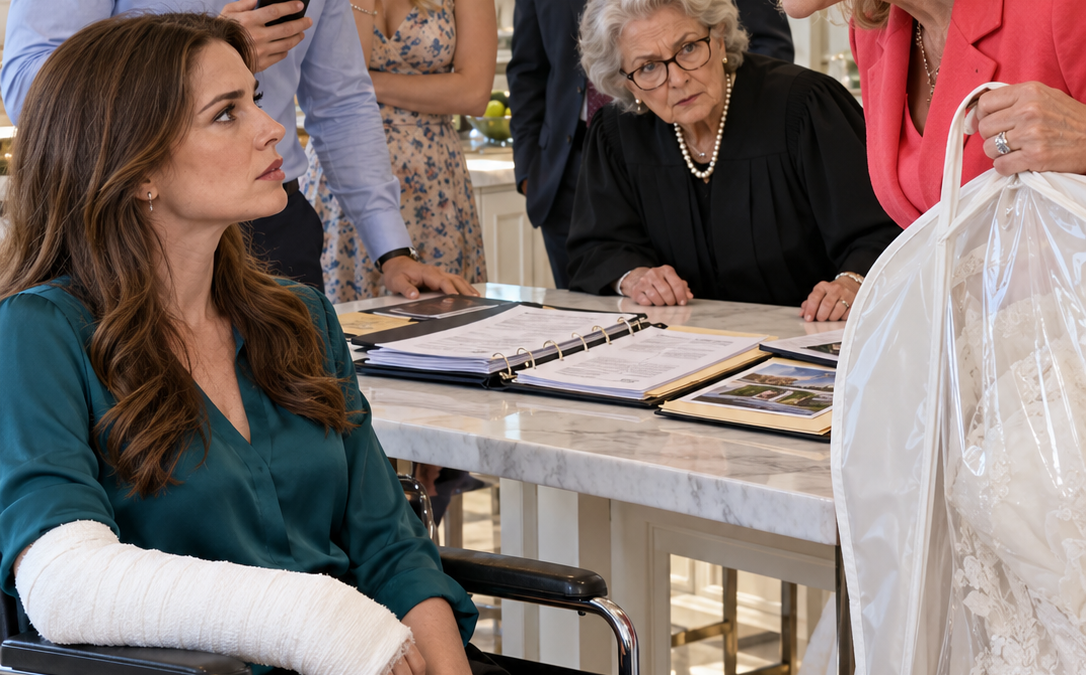
Judge Wright stood near the table with the realtor, Ashley. Derek was there in a blue dress shirt Eliza had bought him for his birthday. Sophie sat nearby, visibly tense. Arthur wore his Sunday suit jacket, and Brenda had a massive garment bag containing Sophie’s wedding dress draped over one arm.
They were planning to go directly to the final fitting after the closing.
Brenda noticed Eliza first.
For a fraction of a second, her hands lifted, almost as though she intended to approach her injured daughter. Then they dropped back to her sides.
“She isn’t allowed to be here,” Brenda announced loudly. “She’s on heavy narcotics. She doesn’t know what she’s doing.”
Derek leaned forward.
“Couldn’t you give us one single day of peace?” he hissed.
Arthur stared at the plaster cast on Eliza’s arm and said nothing.
Sophie flushed a deep, furious red.
Judge Wright looked over the top of her reading glasses.
“Ten minutes,” she said. “I’ll hear her out before anybody starts counting money in my kitchen. But understand that a seller has no legal obligation to verify where a buyer’s funds came from.”
Eliza placed the audit binder on the kitchen table.
She opened it and began turning the pages one by one.
First came eight years of bank statements, showing a long, uninterrupted history of salary deposits and carefully accumulated savings.
Then came the record of the two outgoing transfers, made at 1:58 and 2:03 in the morning, totaling $124,000 and directed to Brenda Vance’s card.
Next was the printout from Eliza’s intensive care medical chart.
Judge Wright leaned closer.
“At 1:58 in the morning, you were heavily sedated and on a mechanical ventilator?”
“Yes,” Eliza answered. “I had a breathing tube down my throat.”
She turned to the phone company records, showing an outgoing call from her stolen phone at 1:51 a.m.
Then she opened the audio file and pressed play.
Brenda’s recorded voice echoed sharply around the stranger’s kitchen.
“Put it in quickly before she wakes up.”
Judge Wright looked directly at her.
“Is that your voice?”
“I was just helping her,” Brenda replied. “She had bills to pay over there.”
Sophie stared at her mother with an expression that made Brenda turn away.
Arthur closed his eyes tightly.
Derek suddenly slammed his own phone onto the table.
“Here,” he snapped. “She said it herself. Enough of this circus.”
He played a recording.
A weak, raspy voice came from the speaker.
“I sent it myself to Mom.”
Eliza didn’t even look at him.
“Could you please check the timestamp of that recording?” she asked.
Judge Wright picked up the phone and examined the file properties.
“Saturday. 1:52 a.m.”
Eliza turned her binder to Exhibit Six.
The first document was the medication administration log, showing that she had received a powerful painkiller injection at 1:30 a.m.
The second was the hospital security guard’s incident report, recording a male visitor fleeing into the stairwell at 1:58.
The third was the emergency department record documenting the injury to Mia’s eyebrow and the four stitches she received at 2:20 a.m.
The final piece was the unsigned waiver Derek had tried to force Eliza to sign, preserved with Nurse Clara’s annotation and Martha Higgins’s unmistakably dramatic signature on the back.
Eliza rested her hands on the binder.
“You just played the judge a recording made at two in the morning, twenty minutes after I received a heavy narcotic injection,” she said calmly. “You held a phone to my mouth while I was barely conscious.”
She looked up.
“Exactly three minutes before you split my friend’s face open.”
Sophie slowly turned toward her fiancé.
Judge Wright removed her glasses and laid one hand flat against the open binder.
“The sale is canceled.”
The kitchen went silent.
“Money with this kind of history will not be counted in my home.”
Realtor Ashley muttered an apology and slipped out through the front door, already reaching for her phone.
Derek lunged across the table and violently yanked the binder toward himself.
Mia grabbed the opposite side.
The metal rings snapped open, scattering documents across the floor. Pages fluttered beneath chairs and against the kitchen cabinets.
The intensive care report slid toward the edge of the table, directly beneath Derek’s arm.
Forgetting every medical restriction Dr. Harrison had given her, Eliza pushed against the wheelchair’s armrests, struggled to her feet, and grabbed the paper.
Derek shoved her in the chest with both hands.
The force struck directly against her freshly sutured, broken ribs. The wheelchair rolled backward and slammed into a heavy bookcase.
Thick legal volumes rained from the shelves, hitting the floor around her.
Eliza couldn’t draw a breath.
And then, finally, her father stood up.
Arthur walked swiftly around the table, seized Derek from behind by both elbows, and hauled him backward. He slammed him into a wooden dining chair and pinned him firmly by the shoulders.
“Sit,” Arthur said.
Derek struggled.
“I said sit down.”
Brenda rushed forward, not toward her injured daughter, but toward Derek and the overturned wheelchair.
“Look what you’re doing!” she cried. “Sophie’s wedding is coming! Look what you’ve done to him!”
Eliza pressed one hand hard against her ribs.
In the other, she clutched the crumpled medical chart.
“You did this on the night of my surgery,” she said.
Brenda abruptly stopped speaking.
Eliza turned toward Judge Wright.
“Please call the police. He assaulted me in front of five witnesses. I want it officially documented.”
Asking for that required more strength than throwing herself out of a hospital bed.
The police arrived nine minutes later.
This time, not a single person in the room, not even Brenda, attempted to claim that nothing had happened.
Derek was handcuffed and escorted into the hallway.
Then Eliza informed the officers that her mother was carrying cash stolen from her bank account.
“I don’t have anything!” Brenda cried, clutching her purse tightly against her chest.
“In the garment bag,” Arthur said.
His voice was low and flat.
One of the officers unzipped the thick plastic covering Sophie’s wedding dress.
Between the layers of white lace and tulle lay stacks of hundred-dollar bills, carefully concealed inside the garment bag.
Judge Wright looked at the money.
“This is the first time I’ve ever seen a wedding fund hidden inside the dress quite so literally,” she observed.
The officers seized the money as evidence in the presence of the witnesses.
Sophie sank onto a stool.
For a long moment, she stared down at her hands. Then she slowly slid her engagement ring off her finger.
Arthur accompanied Eliza down to the car.
While Mia helped her settle into the passenger seat, he held the door against the wind. He repeatedly opened his mouth as though searching for something to say, only to close it again.
No apology came.
No explanation.
At last, he raised one hand in an awkward, stiff little wave.
He remained standing on the curb until the car disappeared around the corner.
At the emergency department, the doctors discovered that one of Eliza’s fractured ribs had shifted slightly, but her internal stitches had held.
A young physician with a ponytail examined her cast, checked the surgical wound, and reviewed her X-rays.
“Eliza Vance,” she said, “you really need to stop letting people drop you on the floor.”
Mia burst into laughter so loud and inappropriate that she had to cover her face with both hands.
Then, for the first time since that terrible September night, she began crying openly in front of Eliza.
She cried until she had no tears left. When she was finished, she wiped her face roughly with her sleeve and tried to compose herself.
“So,” she said at last, “about that room above the office. It already has my sofa in it.”
For the next five weeks, Eliza recovered at the equestrian center in Indiana, living in a room with a broad window overlooking the paddocks.
Every other day, Mia’s mother, Sarah, arrived carrying a bowl of warm oatmeal with pecans and maple syrup.
“You’re practically see-through,” Sarah grumbled. “Blood doesn’t just magically replace itself.”
Khloe installed sturdy metal grab bars in the bathroom without bothering to ask permission.
Dany drove Eliza to every appointment for her bandage changes, proudly informing whichever nurse happened to be on duty that he had donated blood for her.
“Sure, I passed out on the floor,” he would announce. “But I donated.”
For nearly her entire life, Eliza had been the person who traveled to help everyone else. Now she was slowly learning how to be the person other people traveled to help.
The adjustment was almost as difficult as learning to stand up from a chair without using her arms.
In the mornings, she sat beside the window and watched the stable workers lead the horses toward the pastures. She listened to the familiar sounds of hooves on gravel, gates opening, and people calling quietly to animals that knew their voices.
The world continued around her, but for once, she wasn’t required to hold all of it together.
Detective Rollins questioned Derek that same afternoon.
For forty minutes, he aggressively denied everything. He insisted the transfers had been authorized, that Eliza was confused, and that the incidents at the hospital had been exaggerated.
Then the detective placed his own audio recording beside the security guard’s timeline and Brenda’s voice memo.
Derek listened to the evidence.
His posture slowly collapsed.
Finally, he lowered his head onto the metal table and confessed.
“Brenda gave me the code,” he admitted. “She rushed me. She kept saying her daughter would never file a police report.”
He paused.
“She said Eliza always swallows everything.”
Arthur formally testified that he had heard his wife speaking the four-digit code in the middle of the night but had failed to ask what she was doing or why.
Brenda, however, maintained her position.
“I genuinely thought Eliza had authorized the transfer herself.”
Investigators couldn’t establish Brenda’s criminal intent beyond a reasonable doubt, so she remained legally classified as a witness rather than being charged.
Derek was formally charged with felony wire fraud and assault against both Mia and Eliza.
For a long time, Eliza considered whether she should push for harsher penalties. Part of her wanted every possible consequence pursued to its conclusion. Another part was simply exhausted by the prospect of spending more of her life fighting people who had already taken so much from her.
Eventually, she decided she had done enough.
Her mother’s exact words were now permanently preserved in police records bearing official signatures.
They could never be twisted into something else again.
For three weeks, Brenda sent text messages.
“I’ll never call you again.”
“Sophie called off the wedding. Are you satisfied?”
“From now on, consider the cabin yours, but forget about our house. I’ve rewritten the will.”
Then came another demand.
“Write a letter to the detective saying you authorized the transfer, and this will all go away.”
And another.
“You’re the one who always fixes everything for us.”
Finally, Brenda announced, “We’re driving out to your stable on Saturday. You’d better come out and talk to us.”
Eliza didn’t answer a single message.
She did, however, carefully save every one of them.
You’re the one who always fixes everything for us.
She read that sentence dozens of times.
For the first time in her life, she allowed herself to leave something broken.
On Saturday, Dany, Khloe, and two of the original blood donors stood near the heavy iron gates of the equestrian center, prepared to turn Brenda away if necessary.
But her parents’ car never appeared.
Arthur had flatly refused to drive them.
Not long afterward, word spread that Brenda had resigned from her neighborhood women’s committee, citing personal reasons.
A month later, Eliza received a voice memo from her father.
It was the first voice message he had ever sent her in her entire life.
He spoke slowly, with long, heavy pauses between his sentences.
“I donated blood today for the forty-first time.”
There was a silence before he continued.
“The donation was in your name. The first one that was actually yours.”
He told her that he had given Detective Rollins the unvarnished truth before Brenda had a chance to rearrange the facts into another version of events.
He also told her something he had apparently been struggling to admit to himself.
For thirty-seven years, he had sat quietly at the dinner table with a knife and fork in his hands while life happened around him. He had watched his daughter absorb insults, expectations, and humiliations without ever stepping in to stop them.
He wasn’t asking Eliza to take him back.
He wasn’t asking to be forgiven.
He only wanted her to know that he had seen the hospital footage and that her handwritten letter was still in his breast pocket, right beside his donor card.
Eliza listened to the message without interrupting.
Then she typed a reply.
“Thank you for holding him down.”
After thinking for a while, she sent a second message.
“Mia has the keys to Grandma’s cabin. If you want them, come get them yourself.”
A week later, Arthur drove to the equestrian center alone.
He and Eliza stood quietly beside the wooden fence overlooking the paddock. Arthur watched the horses for a long time, his gaze following them as they moved through the grass.
“Grandma Agnes would be so happy,” he said softly.
He took the cabin keys and drove away.
The visit was brief, slightly awkward, and almost painfully ordinary. There were no dramatic embraces, no tearful declarations, and no grand apologies.
But Eliza didn’t need anything more.
Her father was going to the cabin.
And this time, he was going alone.
In the spring, Derek accepted a plea agreement. He received three years of probation, was ordered to pay mandatory restitution to Mia, and was required to cover all of Eliza’s legal fees.
The cash seized during the confrontation at Judge Wright’s apartment was officially returned to Eliza’s bank account in April.
Sophie eventually sent a text message.
“I’m so sorry. I didn’t know about the blood.”
Eliza left the message unanswered for an entire month.
Then, one afternoon, she took a photograph of a newborn foal at the stables and sent it to her sister without a single word attached.
It wasn’t a calculated gesture or a carefully designed attempt at reconciliation. She simply had no idea what words would be appropriate, and the photograph was all she could offer.
Brenda sent two separate voice messages.
In the first, she complained about how unfortunate it was that Eliza had chosen to interpret everything so negatively.
Eliza deleted the second message without listening to it.
There was no glorious, triumphant victory.
What followed felt more like the quiet aftermath of a fever finally breaking: an overwhelming physical weakness, a hollow emptiness, and a clarity so sharp that every detail of the world seemed newly visible.
Eliza no longer had a spleen, which meant an endless schedule of additional vaccinations and medical precautions. Even a slight rise in her temperature required immediate medical attention. A permanent medical alert now appeared on her phone’s lock screen.
A thick, raised scar ran from her sternum to her navel, ending in a hard ridge where the surgical staples had once torn open.
Her left wrist developed a dull, persistent ache whenever the weather was about to change. It often began throbbing a full twenty-four hours before a storm, allowing her to predict rain more accurately than the local meteorologists.
Around the equestrian center, she acquired a new nickname.
“The Barometer.”
She transferred to a smaller pharmaceutical branch in Indianapolis, accepting a lower job title while keeping roughly the same salary.
For the first time in her professional life, she didn’t feel any particular need to defend the choice.
She felt no shame about her scarred body either.
The scars had become a physical audit report of everything she had survived.
In August, Eliza used the savings she had accumulated over eight years to purchase a tiny farmhouse on a parcel of land bordering the equestrian center.
It had two bedrooms, a kitchen sink positioned beneath a bright window, and a weathered stall in the backyard.
When the closing day arrived, she sat alone at a wide desk and signed every document herself.
Nobody hovered over her.
Nobody tried to persuade her to give up what she wanted.
Nobody wrapped a hand around her fingers and forced a pen toward a signature line.
The house belonged to her.
A week later, she visited a livestock dealer who sold unwanted horses for meat.
There, she found an elderly chestnut draft horse with a ruined back. The mare had spent most of her life pulling heavy loads and carrying burdens until her body could no longer bear the work.
She was, in the most literal sense, a workhorse.
Eliza bought her and named her Cherry.
Cherry wasn’t an easy animal. She pinned her ears flat whenever a person approached and flinched violently at the slightest unexpected movement. Her body carried the memory of too many rough hands and too many years spent being forced to perform.
Every evening, Eliza walked out to the old stall and stood quietly beside her.
She never demanded that Cherry approach her.
She never insisted on touching her.
She didn’t try to make the horse useful or prove that rescuing her had been worthwhile.
She simply stayed nearby, asking absolutely nothing.
Nearly a year after the crash, on a violently stormy September night, Eliza’s phone rang at 11:40 p.m.
It was Mia.
“The horse trailer broke down on the interstate on the way back from a show,” she explained. “It’s pouring rain. The mare’s panicking and kicking the walls. My phone’s at six percent.”
Eliza was already reaching for her keys.
“Leg up.”
She drove at exactly fifty miles an hour through rain so heavy that passing semi-trucks threw solid walls of water across her windshield.
Twice, she nearly pulled over because she could no longer see the highway lane markings.
Her scarred wrist throbbed with a sharp, biting pain. Her fingers resisted closing comfortably around the steering wheel, and her eyes kept scanning the dark tree line for deer.
Every curve in the road seemed capable of carrying a memory.
She could still remember the shattering windshield, the airbag exploding against her chest, and the cold, terrible certainty that nobody knew where she was.
But she kept driving.
She found Mia standing beneath the awning of a closed, abandoned gas station, soaked to the bone. The pale scar above her eyebrow stood out beneath the flickering amber streetlight.
The horse trailer was stranded nearby, and the frightened mare inside was still restless.
While they waited an hour for the heavy-duty tow truck, Eliza stood outside in the darkness, holding the terrified animal by its lead rope.
She spoke softly, steadily, without trying to hurry the mare into calming down.
It was the same voice Mia had used while driving blindly through the fog on the bridge nearly a year earlier, when the roads had been blocked and Eliza’s life had hung somewhere between the operating room and the intensive care unit.
“I’m so sorry I dragged you out of bed in the middle of the night,” Mia said.
“Don’t even dare,” Eliza replied.
Mia laughed.
During the tow ride back, Mia fell asleep sitting upright in her soaked jacket. Her hand slipped from her lap and came to rest on the center console, close beside Eliza’s.
She wasn’t holding Eliza’s hand.
She was simply resting it there.
It was the same way a person might place a palm against a horse’s neck, not to control the animal or ask it to do anything, but simply to let it know that someone was there.
In Eliza’s phone, the emergency contact was now permanently set to Mia.
Mia had already shown her that her own phone listed Eliza in exactly the same way.
Just after three in the morning, they finally pulled up outside the little farmhouse.
The warm yellow porch light was still burning.
When Eliza had hurried out earlier that night, she had deliberately left it on.
She hadn’t done so because she was afraid of returning to a dark house. She had left it burning because, for the first time in her life, she knew with absolute certainty that she was coming back.
And she knew exactly who she would be coming back with.
Eliza shifted the truck into park and looked toward the glow of her front porch.
Family, she thought, isn’t the people the hospital calls when you’re dying.
Family is the people who actually show up.








