I was fired and ran into my wife on the way out—she smiled: “Honey, congratulations. Starting today, you’re the new CEO of this company.”
It looked like mine.
It was not.
“I wasn’t in the server room,” I said.
Grant shrugged. “The log says otherwise. The badge readers have video correlation.”
Mark Ellison finally looked at me. Mark was the kind of chief executive who could talk for forty minutes about culture and then forget the name of the engineer who had saved his largest customer. He adjusted the cuff of his white shirt.
“The security team says the camera feed for that window is unavailable.”
“Unavailable?” I repeated.
“Storage error.”
“And you’re firing me based on a forged signature and a missing video?”
Grant smiled then. Not broadly. That would have been too obvious. Just enough to make sure I saw it.
“You’re being terminated for cause based on the totality of the evidence.”
The totality of the evidence.
I remember those words because of how professional they sounded. A clean sentence for a dirty act.
I looked around the table. Noah Kim, the backend engineer who had been beside me through most of Daybreak, stared at his laptop. Melissa from product kept turning one page of a legal pad without reading it. My intern, Owen, moved his chair several inches away from mine.
Nobody spoke.
I did not blame them.
Not yet.
Grant waited until I had packed my desk before he came to stand at the edge of my cubicle.
“Daniel,” he said quietly, “don’t make this harder than it has to be.”
His breath smelled like stale coffee and peppermint gum.
“This business doesn’t care how many lines of code you wrote. It cares who can protect the company and who can’t.”
I looked at him. He leaned closer.
“You’re a good engineer, but good engineers are replaceable.”
I tightened my grip on the box.
He gave me a small, satisfied smile.
“People like you always think the work speaks for itself. It doesn’t. People speak. Titles speak. Relationships speak. Learn that, and your next job might last longer.”
My hands were shaking hard enough that the wedding mug clicked against the books. I walked away before I gave him the reaction he wanted.
At the elevator, my badge was already dead. The red light blinked twice. A security officer I had known for two years came over, avoided my eyes, and tapped his override card.
“Sorry, Dan.”
“It’s fine.”
It was not fine. But I had learned that it’s fine was one of the most useful lies in American office life.
Outside, late-morning sunlight hit me hard.
Aperture Logic occupied twelve floors of a glass tower in South Lake Union. All polished concrete, living walls, and conference rooms named after mountains. I had once loved walking into that building. I had believed I was helping build something important there.
Daybreak was supposed to become our future, a software platform that could reroute warehouse labor, trucking capacity, and inventory in real time when disruptions hit. We had pitched it to retailers, hospital networks, and industrial distributors. The demo could take a simulated port shutdown and rebalance a regional supply chain in under four minutes.
I had designed the core scheduling engine with Noah.
Grant had shown it to the board as his strategic architecture.
Now he had the title.
I had a cardboard box.
I set the box on a low concrete planter and pulled out my phone. Claire’s name sat near the top of my favorites.
My wife had never complained about the rent going up, or about how many dinners I reheated at midnight, or about the fact that I had once missed our anniversary dinner because a database replication job failed.
She would ask one question.
Are you okay?
I did not know how to answer it.
For three years, I had told myself I was giving us stability. Claire worked from home most days, doing what she called family investment consulting. She never talked much about it.
I knew her family had money somewhere in the background. Old money, maybe private business money, the kind people did not discuss at barbecues. But our life had never looked wealthy.
We rented a two-bedroom townhouse in Queen Anne, and we shared a seven-year-old Subaru. Claire bought flour in bulk because she liked baking bread. The nicest thing she owned was a platinum watch she said had belonged to her grandmother.
When we married, she told me one thing clearly.
“My family has money. I don’t want it to be the reason anybody stays with me.”
I told her I did not care.
I meant it.
I still did.
I had never asked how much money.
That omission became important about thirty seconds later.
I was staring at Claire’s contact photo when a black sedan stopped at the curb. Not a rideshare. A long-wheelbase Mercedes with tinted windows.
The rear door opened.
Claire stepped out.
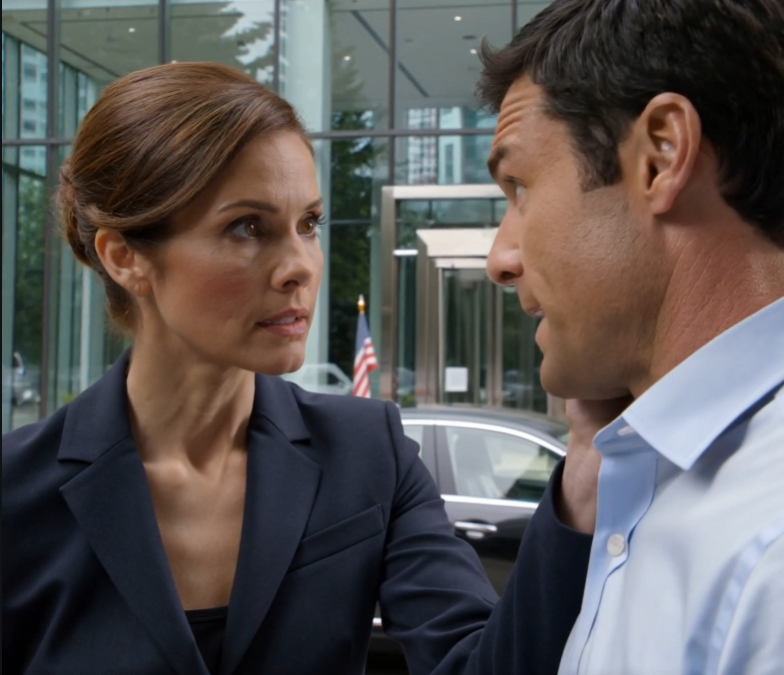
For a second, I thought my mind had manufactured a version of my wife out of stress. She wore a navy suit cut so perfectly it made every business suit I owned look rented. Her hair was pinned back. The platinum watch was on her wrist.
Behind her came a woman in a gray suit carrying a hard-sided document folio and moving with the brisk precision of someone who billed in six-minute increments.
Claire saw the box.
Her face changed. Not dramatically. Claire never did anything dramatically. Her mouth tightened. Her eyes moved from my box to the tower behind me.
Then she crossed the street.
“Dan.”
I swallowed. “What are you doing here?”
She ignored the question and touched the side of my face.
“Did they walk you out?”
I hated how quickly my eyes burned.
“They fired me.”
“For what?”
“They say I created a security breach.”
“Did you?”
“No.”
“I know.”
The certainty in her voice stopped me.
The woman in gray had reached us now. Claire took the box from my hands.
“Hey,” I said. “I can carry it.”
“I know.”
She held it anyway. Then she looked directly at me.
“Daniel, I owe you a conversation. A very long one. But first, you need to know what happened upstairs while you were being fired.”
I laughed once without humor.
“I’m not sure anything could make this morning stranger.”
Claire glanced at the woman beside her.
The woman opened the folio.
“My name is Rebecca Sloan,” she said. “I’m general counsel for Meridian Ridge Holdings.”
I knew that name.
Everybody in business knew it.
Meridian Ridge was a private holding company with logistics assets, industrial software, medical distribution, and data infrastructure across North America. Business schools wrote case studies about its acquisitions because it had a reputation for buying companies quietly and fixing them without laying off half the staff.
I looked from Rebecca to Claire.
“No.”
Claire exhaled slowly.
“Meridian Ridge was founded by my grandfather.”
My mind rejected the sentence.
She continued.
“My father became chairman after him. When Dad got sick last year, the family trust transferred voting control to me. I’ve been chair of the trust since January.”
I stared at her.
“You told me you were consulting.”
“I was.”
“For your own multibillion-dollar company?”
“For the family office and portfolio companies. Yes.”
“You said your family had money.”
“They do.”
“That’s not the same as saying your family owns Meridian Ridge.”
“No.”
At least she had the decency not to defend that distinction.
Cars moved behind us. A delivery truck hissed to a stop. Somewhere down the block, a construction crew started drilling concrete.
My whole marriage seemed to tilt half an inch.
Rebecca cleared her throat gently.
“There’s another piece.”
I looked at her.
“Of course there is.”
“Meridian Ridge has been in confidential acquisition discussions with Aperture Logic for six weeks.”
I turned toward the building.
Claire spoke before I could.
“I did not start the deal because of you. I learned Aperture was in distress through our logistics software portfolio. Their lenders wanted a transaction. We signed the definitive acquisition agreement nine days ago, subject to final closing conditions.”
“And you didn’t tell me?”
“I was legally restricted from telling you before closing. And because you worked here, telling you would have created a serious insider information problem.”
That annoyingly made sense.
Claire went on.
“The deal closed at 10:07 this morning.”
I looked at my phone.
10:42.
Thirty-five minutes.
“So you bought my company while they were firing me.”
“Meridian Ridge bought the company.”
“Claire.”
“Yes.”
“Did you know they were firing me?”
“Not until our compliance team flagged the termination memo during closing review. Your name was in an open intellectual property attribution issue, so it came across our counsel’s desk.”
My skin went cold.
“What attribution issue?”
Rebecca answered.
“Daybreak. During technical diligence, our team found a mismatch between repository authorship, invention assignment records, and the executive presentation submitted by Grant Holloway. We also found discrepancies in the security incident used to justify your termination.”
Grant’s smile flashed through my head.
The fake signature.
The missing video.
Rebecca removed a second document.
“The new board met by written consent after closing. Mark Ellison has been placed on administrative leave pending a governance review. Grant Holloway has been suspended, effective immediately. Their access is being preserved for forensic analysis.”
I could only stare.
Claire shifted the box against her hip.
“And the board asked me to speak with you about going back.”
I almost laughed.
“I was fired thirty-five minutes ago.”
“As interim chief technology officer.”
That did make me laugh. It came out sharp and wrong.
“Absolutely not.”
Claire did not flinch.
“The independent directors reviewed your employment record, the repository history, the customer feedback, and the Daybreak project documents. This is not me handing my husband a company.”
“It sure sounds like it.”
“That’s why I refused to vote on your appointment.”
I stopped.
Rebecca nodded.
“Mrs. Warren recused herself. The other directors voted four to zero to offer you the interim role for ninety days while an external search and internal review proceed. Compensation will be set by the independent compensation committee. You can accept or decline.”
That mattered more than Claire probably knew.
I looked at the building again.
Aperture’s logo gleamed above the entrance.
An hour earlier, I would have given almost anything to have someone in authority look at the evidence and say, Daniel did not do this.
Now the door was open, and I wanted to keep walking.
“What happens if I say no?”
Claire’s answer came without hesitation.
“Then we go home. Rebecca’s team still investigates. Your termination is still reviewed. Grant and Mark still answer for what they did. I am your wife before I am chair of anything.”
I looked at her.
“Were you my wife when you decided not to tell me who you were?”
Pain crossed her face.
There it was.
The problem money could not buy away.
“I was,” she said quietly. “And I was afraid.”
“Of what?”
“That if I brought Meridian Ridge into our marriage, it would become the third person in every room.”
I looked at the black car, the general counsel, the tower our family had apparently just acquired.
“It found us anyway.”
“Yes.”
We stood there for a while.
Finally, I took the box back from her. Not angrily. I just needed something solid in my hands.
“What exactly would I be walking back into?”
Rebecca answered this time.
“A company with about four months of unrestricted cash, a major product launch delayed twice, a patent and authorship dispute, questionable vendor payments, a leadership credibility problem, and a security incident that may have been fabricated.”
I looked at her.
“So, a relaxing Tuesday.”
She almost smiled.
Claire did that tiny smile familiar from grocery stores and rainy Sunday mornings.
I looked down at our wedding mug inside the box, then at the glass doors.
“I’m not going back upstairs to get revenge.”
Claire nodded.
“I know.”
“If I take the job, nobody gets fired because they looked away when Grant came after me.”
“Agreed.”
“Nobody gets promoted because they’re my friend.”
“Agreed.”
“And I want outside counsel, an independent forensic firm, and a written instruction preserving every server log, email account, badge record, and device connected to yesterday’s incident.”
Rebecca opened her folio again.
“Already drafted.”
I looked at her.
She held out a pen.
For the first time that day, I smiled. Not because I had won. I had not.
Not yet.
I signed the acknowledgment for the interim appointment. Then I tied the shoelace I had been too numb to fix upstairs.
Claire took my hand.
We crossed the street together.
At the entrance, my old badge still flashed red.
The security officer behind the desk looked up and went pale.
Rebecca stepped forward.
“Please issue Mr. Reed a temporary executive credential. Permanent access will be provisioned after identity verification.”
The officer’s mouth opened. Closed. Then he nodded.
I stopped before the turnstile.
The glass door reflected me holding a cheap cardboard box, wearing the same wrinkled shirt I had been fired in.
Nothing about me looked powerful.
That was fine.
I had spent too long confusing power with appearance anyway.
The light on the turnstile changed from red to green.
I walked through.
This time, the door did not close me out.
Chapter 2
The same lobby felt different when everyone knew the badge at my belt could open the executive floor.
That was exactly why I hated it.
Power changed rooms before a person ever spoke.
Receptionists straightened. Conversations stopped mid-sentence. People who had avoided my eyes forty minutes earlier suddenly looked eager to make contact.
I remembered every face, but I did not make anyone pay for being afraid.
Rebecca’s preservation notice hit the company before we reached the elevator. It was blunt and specific: no emails deleted, no devices wiped, no Slack histories altered, no badge or camera logs overwritten, no paper records destroyed.
Grant Holloway and Mark Ellison were placed on paid administrative leave while outside counsel conducted an independent investigation. Their laptops and phones were secured by a forensic firm hired by the new board.
No security guards dragged anyone away.
No one was ordered to kneel.
There was no applause.
Real consequences, I was learning, usually arrived as calendar invitations, legal holds, and people suddenly discovering that their passwords no longer worked.
The executive conference room was already full when Claire, Rebecca, and I walked in. The new board had kept two existing independent directors, added two Meridian Ridge directors, and appointed a retired software executive named Helen Park as lead independent director.
Claire sat at the far end of the table, not beside me.
That was deliberate.
Helen stood and offered me her hand.
“Daniel, I’m sorry about the way this morning was handled.”
“Thank you.”
“I also want to make one thing clear before we start. Claire did not participate in the vote that appointed you interim CTO. She will not participate in decisions about your compensation, performance evaluation, or permanent appointment.”
I glanced at Claire.
She gave me the smallest nod.
Helen continued.
“You have authority over technology and product execution. You do not have authority over the investigation into your own termination. Outside counsel reports to the board’s special committee, not to you.”
“Good.”
She seemed mildly surprised.
“I mean that,” I said. “If I can control the investigation, nobody will trust the result.”
“Exactly.”
The first hour was painfully ordinary.
Cash runway. Customer renewals. Payroll. Cloud expenses. Three enterprise accounts that had delayed payments. A warehouse automation client threatening to cancel unless Daybreak shipped by the end of the quarter.
The company was not a golden trophy Claire had bought for me. It was a machine running hot with several warning lights already on.
Aperture had $18.4 million in unrestricted cash, but operating expenses were burning nearly $4 million a month. Receivables looked healthy until you noticed how much was more than ninety days old. A planned credit facility had stalled after the lender requested stronger covenants.
“Four to five months,” the CFO said. “Maybe six if collections improve.”
His name was Paul Danner. I had seen him at company meetings but had never spoken with him.
“So we don’t have time for a victory parade,” I said.
Helen folded her hands.
“No.”
“Good. I wasn’t planning one.”
At noon, I asked Rebecca to schedule an all-hands meeting for the engineering and product organization.
She looked at me over her glasses.
“You just got fired and rehired as CTO. Are you sure you want to address three hundred people today?”
“No.”
She waited.
“But I’m doing it anyway.”
The auditorium filled in twelve minutes. Nobody knew where to sit. People who had worked beside me that morning now seemed unsure whether sitting too close would look opportunistic or sitting too far away would look disloyal.
I stood at the front without a podium.
“I’m going to make this short,” I said.
It became quiet.
“This morning, I was terminated based on allegations that I caused a security incident. The board is investigating that process and the evidence behind it. I am not running that investigation.”
A few people shifted.
“I’ve accepted a ninety-day appointment as interim CTO. That does not mean everyone who disagreed with me is now in danger. It does not mean people who stayed quiet this morning are getting punished. And it absolutely does not mean I get to settle personal scores with company payroll.”
Noah Kim looked up from the third row.
Owen, my former intern, sat two seats away from him.
“The rules are simple,” I continued. “We preserve evidence. We tell the truth. We give credit where it belongs. We document decisions. We do not use access, title, or personal relationships to steal someone else’s work.”
I let that last sentence sit.
“If you made an honest mistake, say so. If you followed a bad instruction because you were afraid, say so. If you falsified records, destroyed evidence, stole intellectual property, or approved money you knew was improper, get a lawyer.”
That produced a ripple through the room.
I did not smile.
“Daybreak still has to ship. Customers still expect support. People still have mortgages and kids and lives outside this building. So we’re going to investigate what happened without turning the entire company into a courtroom.”
I looked toward Noah.
“And we’re going to build the product correctly.”
When the meeting ended, no one clapped at first.
I was relieved.
Then one person did.
Owen.
He immediately looked embarrassed.
A few more joined. I raised a hand.
“Please don’t.”
The clapping stopped.
“Save it for when we ship something.”
People laughed lightly, and the room finally exhaled.
Noah waited until almost everyone had left. He approached me carrying a small laptop and looking like he had not slept.
“Dan.”
I glanced at the badge clipped to my belt.
“Still Dan.”
He nodded. Then he swallowed.
“I should have said something this morning.”
“You didn’t know what was happening.”
“I knew the access record was wrong.”
That stopped me.
“What do you mean?”
He looked toward the door. Rebecca was still in the room with one of the forensic consultants.
I waved them over.
Noah set his laptop on the table.
“Three weeks ago, Grant told me to create an auxiliary logging pipeline for the model registry. He said security wanted redundancy before launch.”
“Did security request it?”
“I don’t think so. I checked the ticketing system later. There was no request.”
He opened a terminal and pulled up a local copy of text logs.
“I mirrored authentication events and repository access metadata to an immutable bucket in our disaster recovery account. Grant didn’t know I kept the mirror after testing.”
Rebecca’s posture changed.
“Did you access anything you were not authorized to access?”
“No. It was within my normal admin role. I didn’t copy source code, just security metadata and checksums.”
“Good,” she said. “Do not send those files to anyone. Our forensic team will image your device and collect them properly.”
Noah looked at me.
“The mirror shows your badge token never authenticated in the server room yesterday. Grant’s did, at 2:34 p.m. His token opened the inner vestibule.”
My stomach tightened.
“The printed log in the meeting showed mine.”
“I know.”
He pulled up another entry.
“At 2:51, an admin account associated with Grant’s team edited the employee access export.”
Rebecca leaned toward the screen but did not touch the keyboard.
“Can you establish whether Grant personally used that account?”
“No. Not from this alone.”
“That distinction matters,” she said.
Noah nodded quickly.
“There’s more.”
Of course there was.
He showed us repository metadata.
At 3:02 p.m., while I was still in the basement records room, a privileged account downloaded the Daybreak release branch and a set of model configuration files.
The destination was an approved corporate laptop assigned to Grant Holloway.
I sat down for the first time since walking back into the building.
The anger arrived cleanly.
Not hot.
Cold.
Intentional.
“He didn’t just frame me,” I said.
Rebecca’s expression stayed neutral.
“We don’t know yet.”
“He sent me downstairs, changed the logs, and copied the release branch.”
“We know evidence currently suggests those events occurred. We still need attribution and context.”
I looked at her.
“You make revenge very inconvenient.”
“That is one of the services lawyers provide.”
Noah made a sound that might have been a laugh.
The forensic team took over.
I went back to work for the rest of the afternoon. I did the least dramatic thing possible.
I reviewed Daybreak without Grant hovering over it.
The project looked worse than I expected.
He had frozen several architecture changes because they would have made the system easier to audit. He had redirected two senior engineers into presentation work for an investor demo. He had ordered the team to use a third-party analytics vendor I had never approved.
The vendor was called Blue Lantern Media, which made no sense.
Daybreak did not need media services.
I clicked through the purchase orders available to me as CTO.
Blue Lantern had received $420,000 over eight months for market intelligence, competitive technical analysis, and launch positioning.
The scopes were vague.
The invoices were round numbers.
The approvals came from Grant and, above a certain threshold, Mark Ellison.
I did not investigate further myself.
That was another lesson from Rebecca.
Instead, I wrote a two-line note to the special committee.
Potential related-party or sham vendor. Recommend finance preservation and forensic review.
Then I returned to architecture documents.
At 6:30, Claire appeared in the doorway of my temporary office. She had changed out of the suit jacket and rolled her sleeves to her elbows.
“Are you coming home?”
“In a minute.”
“You said that forty minutes ago.”
I stared at the whiteboard.
“I spent three years trying to get enough authority to fix things here. Now I have it, and I don’t know where to start.”
“You started.”
“How?”
“You told three hundred people you weren’t going to punish them for being scared.”
I looked at her.
“That’s not technical leadership.”
“No. It’s just leadership.”
I leaned back.
For a while, neither of us spoke.
Then I said, “How rich are you?”
Claire blinked.
“That is not the question I expected.”
“I should probably know.”
She sat in the chair across from me.
“My personal liquid assets are not as dramatic as the holding company’s balance sheet.”
That was an extremely rich-person answer.
She winced.
“Fair.”
“Claire.”
“The family trust controls Meridian Ridge. Depending on valuations, the assets under the group are a little over eleven billion.”
I stared at her.
“Eleven.”
“Yes.”
“Billion.”
“Yes.”
I rubbed both hands over my face.
“We argued for twenty minutes last month about whether to replace the dishwasher.”
“It still works.”
“It sounds like a helicopter.”
“It still works.”
Despite myself, I laughed.
Then the laugh disappeared.
“You should have told me.”
“I know.”
“Not because I wanted your money. Because I wanted to know you.”
“You do know me.”
“I know the woman who sleeps with cold feet and steals the crispy edges off my lasagna. I didn’t know the woman who could close a billion-dollar credit line before breakfast.”
“Both are me.”
“That is the problem. You decided I only got one.”
She looked down at her hands.
“I was twenty-four when my grandfather died. Every boyfriend, every college friend, every new person I met somehow found out what the family owned. People changed. Some got nicer. Some got resentful. Some started pitching me companies.”
“I’m not them.”
“I know that now.”
“You’ve known me for five years.”
“I was still afraid.”
I had no answer for that.
Fear was not logical just because the person feeling it was rich.
I stood.
“We’re not solving this tonight.”
“No. But we are solving it.”
“Yes. And no more surprises that can move stock prices, buy companies, or change which board I report to.”
A tiny smile touched her mouth.
“That is a very specific marital boundary.”
“I’ve had a strange day.”
We left together in the elevator.
My phone buzzed.
Unknown number.
The message contained one sentence.
You think Grant was the problem. Ask your wife what Meridian Ridge lost seven years ago.
I read it twice.
Claire saw my expression.
“What is it?”
I showed her.
The color did not leave her face. That would have been easier.
Instead, she became very still.
Too still.
“Claire.”
She handed the phone back.
“Seven years ago, one of Meridian Ridge’s software subsidiaries had a trade secret breach.”
“What was stolen?”
“A scheduling engine.”
My pulse shifted.
“What kind?”
“Distributed resource allocation.”
I thought about Daybreak. About the parts of its architecture that had come to me almost intuitively after years of work in the same field.
About Blue Lantern.
About Grant copying the release branch.
“Was anyone caught?”
“No.”
“Did your family stop looking?”
Claire looked at the elevator numbers as they descended.
“My father did.”
“That wasn’t my question.”
The doors opened.
She looked at me then.
“No,” she said. “I didn’t.”
Outside, Seattle had started to rain. Not hard, just enough to make the sidewalk shine.
Claire took my hand.
I let her.
But the unknown message stayed in my head all the way home.
I had walked back into Aperture thinking I was going to prove who framed me. By the end of the day, I understood the problem was older than Grant, larger than one stolen report, and tangled somehow with the part of my wife’s life she had hidden from me.
The company had changed owners.
The real question was whether we had inherited a business problem or a crime scene.
Chapter 3
By Thursday morning, Aperture Logic had stopped feeling like a company I had returned to and started feeling like a building we were excavating. Every layer exposed another one.
The forensic team recovered the deleted camera segment from a local recorder that Grant apparently did not know existed. It showed Grant entering the secure vestibule at 2:34 p.m., carrying his laptop. It showed a systems administrator named Trevor Bell entering four minutes later. It showed both men leaving before three.
It did not show me.
Trevor asked for a lawyer before answering questions. Grant, through his attorney, denied altering any records and said he had entered the server area as part of routine executive oversight.
Outside counsel did not argue with him.
They preserved his statement.
That was more useful.
The fake signature on the printed access sheet was sent to a document examiner. The security export showed signs of manual editing. The file’s metadata listed Trevor’s admin account as the last user.
Still, Rebecca would not let anyone announce that I had been exonerated.
“Not until the special committee adopts a finding,” she said.
“I was literally on camera somewhere else.”
“Which is excellent evidence.”
“You enjoy this.”
“I enjoy keeping people from saying stupid things that create new lawsuits.”
By Friday, I understood why Meridian Ridge paid her so much.
My own job was simpler and harder: ship Daybreak without breaking the company.
I reorganized the technical teams around actual ownership instead of title. Noah became acting director of platform engineering. Melissa from product took customer integration. I did not give either of them a raise or permanent title on the spot.
HR benchmarked the roles. The compensation committee approved temporary differentials, and we documented why.
That process took longer than pointing at someone in a hallway and saying, “You’re promoted.”
It also meant the decision could survive me.
Noah liked that.
“You’re making bureaucracy sound romantic,” he said when I explained it.
“I was framed with paperwork. I’ve developed respect for paperwork.”
He laughed, then became serious.
“There’s something else you should see.”
We were in the architecture room, surrounded by whiteboards. He pulled up a dependency map.
A third-party module embedded in an older part of Daybreak had been supplied by Blue Lantern Media.
“Why would a media vendor write optimization middleware?” I asked.
“They didn’t officially. It came through a subcontractor called Lattis Forge.”
“Do we have an agreement with Lattis Forge?”
“Not that I can find.”
“Then don’t touch it.”
He nodded.
I called the forensic team that afternoon. They traced the module’s package history to a private repository associated with a company called Vector Arc Technologies.
I knew Vector Arc. Everybody in logistics software did.
They were Aperture’s nearest rival, larger than us, better funded, and famous for buying smaller competitors and stripping their engineers. Six months earlier, Vector Arc had announced a push into public-sector logistics and emergency response systems.
Their chief executive was Victor Hail.
The name meant nothing to me.
Claire recognized it immediately.
We were at home when I told her. She had flour on her cheek. That was the kind of detail that kept breaking my brain. At work, she chaired a holding company controlling billions in assets. At home, she forgot to dust flour off her face while kneading pizza dough.
“Victor Hail,” she repeated.
“You know him?”
“My father did.”
“Good know him or bad know him?”
“Bad enough that Dad refused to do business with him after 2019.”
She washed her hands and sat across from me at the kitchen island.
“Victor ran corporate development at a software company Meridian Ridge almost acquired. During diligence, we found evidence that he had used confidential technical material from another bidder. The deal died. He left a year later and started Vector Arc.”
“Was he involved in the old breach?”
“We never proved it.”
“But you suspected him.”
“Yes.”
“Why didn’t you tell me that in the elevator?”
“Because suspicion isn’t evidence.”
I stared at her.
“Rebecca has infected you.”
“She’s very good.”
The pizza dough sat between us, forgotten.
I asked who investigated the breach seven years ago.
“A man named Henry Morales. He was head of security for Meridian’s software division.”
“Where is he now?”
“Runs a cyber forensics firm in Tacoma.”
“Can we talk to him?”
Claire hesitated.
“Through counsel.”
I groaned.
“Fine. Through counsel.”
Henry Morales arrived at Aperture the next morning with a canvas laptop bag and the posture of a man who had spent twenty years expecting doors to open badly.
He was in his late fifties, broad-shouldered, gray at the temples, and unimpressed by executive titles.
He shook my hand.
“So you’re Daniel.”
“I’m told.”
He looked at Claire.
“You finally told him.”
Claire sighed.
“Good morning to you too, Henry.”
He smiled for the first time.
Rebecca sat in. So did counsel from the board committee.
Henry explained the old case carefully.
Seven years earlier, a Meridian Ridge subsidiary called Cascade Routing Labs had developed a distributed allocation engine for freight networks. It had never been commercialized.
During a strategic partnership review, a confidential build and several design documents were copied from an internal repository.
“The access came through a legitimate engineer account,” Henry said. “The engineer was Aaron Pike.”
The name pulled something loose in my memory.
“Aaron Pike sat on Aperture’s architecture committee.”
Henry nodded.
“He joined Aperture five years ago.”
“He voted against my promotion last year.”
Claire looked at me.
I continued.
“He left three months ago.”
“Where did he go?” Henry asked.
“Vector Arc.”
No one said anything for a moment.
Henry opened an old case summary.
“We interviewed Aaron at the time. He denied copying anything. His credentials had been used from a workstation on a shared engineering floor. We couldn’t establish whether he was present. Three weeks later, he resigned from Cascade.”
“Did you find money?” Rebecca asked.
“Not then.”
“What did Claire’s father do?”
Henry’s jaw shifted.
“He shut down the internal investigation.”
Claire looked at him sharply.
“You told me the trail went cold.”
“It did.”
“That isn’t the same thing.”
“No.”
The room changed.
I watched Claire, not Henry.
“You knew he stopped it,” I said.
“I knew he decided not to pursue litigation.”
“Why?”
Henry answered.
“Because he was protecting someone.”
“Who?”
“I never found out. He told me the exposure from discovery would be worse than the loss.”
Claire’s face hardened.
“That sounds like him.”
There was history in those four words. Not affection. Not exactly anger. Something older.
Henry turned to me.
“The reason this matters is that the architecture in Daybreak resembles Cascade’s engine in a few conceptual ways. Not source-code identical, not enough to call it copied, but enough that someone familiar with the old system would notice.”
I understood.
“Aaron noticed.”
“Probably. And Vector Arc wanted to know whether Daybreak independently recreated something they had built from the stolen material, or whether your work could threaten their freedom to operate.”
The idea was nauseating.
I had spent three years thinking my biggest problem was Grant stealing credit.
It was possible Grant had been stealing something much more valuable than credit.
The forensic team kept pulling threads.
Blue Lantern Media was registered in Delaware and used a virtual office in Nevada. Its beneficial owner was hidden behind a manager-managed LLC, but Aperture’s own payment records gave us more than enough to keep asking questions.
The $420,000 did not go directly to Vector Arc.
It went from Aperture to Blue Lantern, then to a consulting entity called Pike Strategy Partners.
Aaron Pike’s firm.
The invoices matched dates when Aaron had voted on architecture decisions, including my promotion and the Daybreak release plan.
Outside counsel obtained the downstream records, not by hacking bank accounts or calling in favors, but by sending a formal preservation demand and preparing a civil action.
Aaron’s attorney contacted them before the complaint was even filed.
People become cooperative when they realize evidence is about to enter a courtroom.
Grant’s situation got worse, too.
The forensic image of his laptop contained exported Daybreak code packaged under a misleading folder name. There were emails to a personal account with subject lines like Market Scan and Comparison Notes.
Some attachments had been deleted, but not securely.
By Tuesday, the special committee issued its first findings.
My termination was rescinded. The stated cause was withdrawn. My personnel record was corrected.
A companywide email did not call me a hero.
It said the evidence used to terminate me was unreliable, key records had been altered, and the company apologized.
That was enough.
More than enough.
I printed one copy and put it in the drawer beside my desk.
Then I went to work.
Grant remained suspended. Mark Ellison resigned as CEO rather than return from leave. The board accepted the resignation but reserved all rights related to the investigation.
I did not celebrate either event.
The first time I saw Mark after his resignation was in a conference room with his lawyer.
He looked ten years older.
“I should have asked one more question,” he told me.
“You should have asked any question.”
He nodded.
“I trusted Grant.”
“You trusted convenience.”
He looked down.
That was harsh.
It was also true.
“I’m sorry, Daniel.”
I believed he meant it.
Meaning it did not make him qualified to keep running the company.
That distinction felt important.
At home, things were more difficult.
Claire and I had stopped fighting, which was not the same as being fine.
One night, I found her on the balcony watering the jasmine plant she had somehow kept alive through two Seattle winters.
“I need to ask you something,” I said.
She set down the watering can.
“Okay.”
“If Meridian Ridge had not already been buying Aperture, what would you have done when I got fired?”
She looked at me for a long time.
“I would have hired a lawyer for you, with your permission.”
“And if I said no?”
“I would have hated it.”
“That isn’t an answer.”
“I would have respected it.”
I nodded.
“That helps.”
She leaned against the railing.
“Can I ask you something?”
“Sure.”
“If I had told you on our third date that my family controlled Meridian Ridge, would you have kept seeing me?”
I opened my mouth, then stopped.
She gave a small, sad smile.
“That’s why I was afraid.”
“I probably would have.”
“Probably.”
“I was twenty-eight and making ninety-two thousand dollars a year. A billionaire heiress would have terrified me.”
“Exactly.”
“But I married you. At some point, fear stopped being a reason and became an excuse.”
She looked away.
“You’re right.”
The words came quietly.
No defense.
That mattered, too.
My phone buzzed.
Rebecca.
I answered.
“We have Aaron Pike’s counsel on the line,” she said. “He wants to discuss a proffer.”
“What does he want?”
“Protection from being buried by everyone else.”
“Can we promise that?”
“No.”
“Good.”
Rebecca paused.
“You’re getting better at this.”
“At being suspicious?”
“At not making promises you don’t control.”
I looked at Claire.
She was listening.
“What did Aaron offer?”
Rebecca’s voice became flat.
“Evidence that Grant was paid to deliver Daybreak materials to Vector Arc.”
My grip tightened on the phone.
“And?”
“And evidence that the order did not start with Grant.”
I already knew the answer.
“Victor Hail.”
“Yes.”
Rebecca paused again.
“There is one more thing.”
Of course there was.
“Aaron says Victor has been holding evidence over him for seven years. He says the original Cascade breach was not a one-time theft. It was the beginning of the relationship.”
Claire closed her eyes.
I asked, “Will Aaron meet?”
“With counsel present, under a written proffer agreement.”
“When?”
“Tomorrow at ten.”
I looked out over the wet city.
A week earlier, I had been worrying about whether I could afford to take Claire to the coast after launch.
Now my wife’s family company owned my employer, a rival CEO might have spent years infiltrating it, and an old architecture vote might be part of a seven-year trade secret operation.
The absurdity should have made me laugh.
It did not.
I thought about Grant telling me the world did not care how many lines of code I wrote.
For once, he had been partly right.
The work mattered, but so did who protected it. So did who took credit for it. So did the rules around it.
And if somebody had spent seven years treating those rules like obstacles for honest people, then I wanted the next part done differently.
Not with threats.
Not with back doors.
Not with power used simply because we had more of it.
With evidence. With witnesses. With signatures that could not be forged. With a record nobody could quietly delete.
I told Rebecca, “I’ll be there.”
Chapter 4
Aaron Pike arrived at the law firm ten minutes early with an attorney and no tie.
I almost did not recognize him.
At Aperture, Aaron had always looked polished enough to be printed in an annual report. Dark suits, silver hair, expensive glasses, the calm voice of a man who never expected anyone to interrupt him.
Now he looked thin. Not sick. Compressed, as if seven years of keeping one story straight had physically narrowed him.
Rebecca had insisted the meeting take place at outside counsel’s office downtown. No Aperture conference room. No Meridian Ridge building. No home-field advantage for anyone.
Aaron’s lawyer began by reading the terms.
Nothing Aaron said would automatically immunize him from civil liability or criminal investigation. Aperture and Meridian Ridge could use independently obtained evidence. If law enforcement became involved, nobody in the room could promise what prosecutors would do.
Aaron listened.
Then he said, “I understand.”
Rebecca pressed record.
“Aaron,” she said, “tell us about Cascade Routing Labs.”
He removed his glasses.
Seven years earlier, he had been a senior engineer at Cascade. He had a gambling problem no one at work knew about. Sports betting mostly, then online poker, then loans to cover losses from the loans that covered earlier losses.
“I owed a hundred and eighty thousand dollars,” he said.
Claire’s face did not move.
Victor Hail, then working in corporate development for another software company, found out.
Aaron still did not know how.
Victor offered him $200,000 for an internal build of Cascade’s allocation engine and its design documentation.
“I told myself it wasn’t source code that mattered,” Aaron said. “I told myself the patent filings would eventually make the concepts public.”
Henry Morales, sitting beside counsel, said nothing.
Aaron looked at him.
“I copied it. The build, the design notes, the benchmark reports.”
“Your access credentials were used from a shared workstation,” Henry said.
“Yes.”
“You lied to me.”
“Yes.”
The answer came without defense.
Aaron folded his hands.
“Victor paid the debt. Then he owned me.”
That was the part I had not understood from a distance.
Blackmail did not require dramatic threats every morning. Sometimes it was an email twice a year, a reminder that the first crime still existed, a request disguised as a favor, a favor that became another crime.
Victor asked Aaron to leave Cascade, wait, then join Aperture once the company’s logistics work began attracting attention.
Five years ago, Aperture hired him to its architecture committee.
“Were you working for Vector Arc then?” Rebecca asked.
“Not on paper.”
“Were you receiving money through consulting entities?”
“Yes.”
“How much?”
Aaron stared at the table.
“About four hundred thousand over five years.”
Claire’s expression hardened.
“And in exchange?”
“Information. Product direction. Hiring plans. Which projects were real and which were slides.”
“Daybreak?” I asked.
He looked at me.
“Yes.”
My hands stayed flat on the table.
“When did Victor become interested in it?”
“About eighteen months ago. He saw a conference abstract one of your product people published. The architecture sounded too close to Cascade’s engine.”
“Did I copy Cascade?”
“No.”
That answer came fast.
“You built the same class of solution from first principles. There are similarities at the conceptual level, but I never saw evidence you had Cascade material.”
“Then why stop my promotion?”
“Because if you became principal architect, you would get broader access, more visibility, and probably patent counsel. Victor was afraid somebody would start mapping prior art and discover Vector Arc’s products were built on stolen material.”
“So you voted me down.”
“Yes.”
“And Grant?”
Aaron looked exhausted.
“Grant came later. Victor liked Grant because Grant wanted two things more than he wanted competence. Status and money.”
Blue Lantern Media became the payment channel.
Aperture paid Blue Lantern for vague competitive intelligence. Blue Lantern paid Pike Strategy Partners and two other entities.
Aaron took a portion.
Another portion came back to a consulting LLC controlled by Grant’s brother-in-law.
Rebecca wrote something.
“How much to Grant?”
“About two hundred and sixty thousand over fourteen months.”
I thought of Grant’s office, the custom shoes, the private club photos, the way he talked about executive presence as if it were an engineering discipline.
“Why frame me now?” I asked.
Aaron rubbed his face.
“Because Daybreak was close to launch, and Victor wanted the release branch. Grant had already copied earlier builds, but you changed the deployment signing process. The final package needed your credentials or a reason to remove you.”
“So he created a reason.”
“Yes.”
“Did Mark Ellison know?”
“Not that I know.”
That mattered.
Negligence was not conspiracy.
I wanted clean lines, even when clean lines made the story less satisfying.
Rebecca asked, “What evidence do you have?”
Aaron’s lawyer placed a sealed drive on the table.
“Mr. Pike preserved emails, payment records, Signal exports, and two recorded calls with Mr. Hail. We have not represented that every recording was made in a jurisdiction where one-party consent applies. Counsel should assess admissibility.”
Rebecca nodded.
That was what real evidence sounded like.
Not a magic USB drive.
Complicated, qualified, potentially useful, potentially dangerous.
Aaron looked at Claire.
“There’s something about your father.”
Claire’s shoulders went still.
“What?”
“He knew.”
The room changed.
“He knew what?” she asked.
“Not everything. But he knew I was probably the source of the Cascade breach.”
Claire stared at him.
Aaron continued.
“Henry got close. Too close. Your father called me into his office before the investigation closed.”
Henry turned sharply.
“He interviewed you without me?”
“Yes.”
“What did he say?” Claire asked.
Aaron’s voice dropped.
“He said if I signed a resignation and disappeared from Meridian companies, he would not refer the matter to prosecutors.”
Claire looked almost angry enough to stand.
“Why?”
“I asked him.”
Aaron swallowed.
“He said a public case would expose that Cascade’s access controls were a mess and that he had personally pushed the team to skip a security redesign before a strategic transaction. He said the company could survive the stolen code more easily than the scandal.”
Claire’s eyes closed.
I understood then why her father had ended the investigation.
Not mercy.
Risk management.
He had protected the company’s reputation and, in doing so, left the thief available for someone worse to use.
Henry leaned back slowly.
“I spent seven years thinking I failed.”
Aaron looked at him.
“You didn’t.”
“No,” Henry said. “I was just working for a man who changed the definition of success without telling me.”
Claire opened her eyes.
“My father is dead. I can’t ask him why.”
“No,” Aaron said.
Claire looked at Rebecca.
“But I can decide what we do now. Full disclosure to the special committee.”
Rebecca nodded.
“And if there is evidence of criminal trade secret theft,” Claire continued, “we refer it appropriately. No quiet settlement because Meridian might look bad.”
Rebecca’s expression softened by half a degree.
“Understood.”
The meeting lasted four hours.
By the end, outside counsel had enough to recommend a federal referral and enough civil evidence to prepare a complaint under the Defend Trade Secrets Act.
They did not file immediately.
First came preservation, then corroboration, then a temporary restraining order request drafted narrowly enough to protect Aperture’s intellectual property without pretending every similar algorithm belonged to us.
The technical experts spent days separating independently developed Daybreak code from concepts traceable to old Cascade materials.
That distinction mattered to me more than anything.
I would not save my reputation by stealing someone else’s.
Three days later, the first real threat arrived.
Not to me.
To Aaron.
Someone photographed his sixteen-year-old daughter walking from school to a bus stop. The image came by text with no explicit threat.
Only five words.
You still have choices, Aaron.
He called his lawyer. His lawyer called the police. Rebecca called the federal agents now reviewing the trade secret referral.
Claire’s security team offered protection, but only after Aaron and his ex-wife consented.
No one followed the girl secretly.
No one played games.
A retired police officer sat in a marked car near the house for two nights while investigators traced the message.
The sender turned out to be a private investigator hired through a law firm that represented Vector Arc. The law firm immediately claimed it had authorized only background research and terminated the investigator.
Maybe that was true.
Maybe it was not.
Either way, the incident changed Aaron.
The next morning, he signed a formal cooperation agreement in the civil case and agreed to speak with federal investigators through counsel.
“I spent seven years telling myself I was protecting my daughter by staying quiet,” he told me afterward.
We were standing in the law firm hallway.
“Turns out I was teaching the people controlling me exactly which button to push.”
I said nothing.
He looked at me.
“You hate me.”
“I don’t know you well enough to hate you.”
“That’s worse.”
“No. It’s just accurate.”
He nodded.
“I deserve that, probably.”
He almost smiled.
Then I added, “Your daughter doesn’t.”
His face changed.
“No.”
“Keep her out of it. Whatever happens to you, she does not inherit your debt.”
He looked down.
“Thank you.”
I went back to Aperture.
Daybreak had missed its original launch date.
I moved it again.
Two weeks.
The sales team reacted as if I had set fire to the building.
“We promised customers this quarter,” one vice president said.
“You promised a date before engineering signed off.”
“We’ll lose credibility.”
“We lose more credibility if we ship software that can’t prove where its own code came from.”
He opened his mouth.
I kept going.
“Two weeks. Full dependency audit. Reproducible build. New signing keys. No undocumented third-party packages.”
Paul, the CFO, backed me.
That helped.
So did Claire not being in the room.
People needed to see that I could make decisions without my wife standing behind my chair.
We cut Blue Lantern. We froze every questionable vendor. We did not fire whole departments.
We reviewed scopes.
Some contracts were legitimate and badly documented. Some were useless but not fraudulent. Three were referred to the special committee.
That was slower than declaring everyone corrupt.
It was also fair.
At home, Claire and I finally opened a bottle of wine we had been saving since our second anniversary.
Not to celebrate.
To talk.
She brought a stack of documents to the dining table.
Trust structure. Board roles. Family entities. Her personal assets. Her obligations. Everything she should have told me in words years earlier.
“You do not need to show me account numbers,” I said.
“I know.”
“You definitely should not.”
“I know.”
“What I need is no more hidden lives.”
She nodded.
“Same.”
I looked up.
“Same?”
“You came home for three years saying Grant was difficult. You never told me he was taking your work.”
“I thought I could handle it.”
“You came home at two in the morning and told me the release was busy. You didn’t tell me people were putting their names on your architecture.”
“I didn’t want to sound like I was complaining.”
Claire leaned forward.
“That is your version of hiding.”
I hated how right she was.
“So we both lied.”
“No. We both edited.”
“That sounds worse.”
“It probably is.”
We sat there with the trust documents between us.
Then I laughed.
Claire did too, for the first time since the acquisition.
The laughter did not feel fragile.
My phone rang at 9:18.
Rebecca.
I put her on speaker.
“The federal team accepted the referral,” she said. “They’re coordinating with the U.S. Attorney’s Office. Separately, the court granted a limited preservation order against Vector Arc. No destruction or transfer of specified repositories, devices, or records tied to the disputed technology.”
“Not an injunction shutting them down?”
“No.”
“Good.”
Rebecca paused.
“You sound disappointed that I’m not more dramatic.”
“I’m learning.”
“There’s more. Vector Arc’s counsel contacted us.”
Claire and I looked at each other.
“What do they want?”
“A meeting.”
“With whom?”
“Victor Hail wants to meet Daniel.”
I stared at the phone.
“Why?”
“He says this has become personal.”
I thought of the photograph of Aaron’s daughter, the fake logs, the stolen code, the seven years of leverage.
“No,” I said.
Rebecca was silent.
“No private meeting. No restaurant. No back room. If Victor has something to say, he can say it to counsel.”
Claire reached across the table and squeezed my hand.
Rebecca said, “That was also my recommendation.”
“Then why did you ask?”
“Professional curiosity.”
“Lawyers are strange.”
“So are engineers.”
She hung up.
I looked at Claire.
“What?”
She was smiling.
“You didn’t take the bait.”
“I’ve taken enough bait for one career.”
Outside, rain tapped against the windows. The jasmine plant sat on the sill, green and stubborn.
For the first time since the glass door closed behind me, I did not feel like I was waiting for the next humiliation.
I felt like we had stopped reacting.
We were choosing the ground now.
And this time, every step was going into the record.
Chapter 5
Victor Hail did not get his private meeting.
Instead, five days later, he got a conference room with six lawyers, two independent directors, a court reporter, and a glass wall overlooking Elliott Bay.
He did not enjoy that nearly as much.
The meeting happened because Vector Arc wanted to discuss the preservation order before the next court hearing. Victor attended voluntarily with his general counsel and outside litigation team. I attended because the board committee asked me to explain Daybreak’s architecture.
Claire did not attend.
That was her decision.
“This is your company’s technology dispute,” she told me that morning. “If I sit beside you, every sentence becomes ‘billionaire wife attacks competitor for husband.'”
“You’ve been reading the headlines.”
“I own companies. Reading bad headlines is part of the job.”
Victor Hail looked smaller than his photographs.
Not physically. He was tall, silver-haired, perfectly dressed. But magazine profiles had always given him the atmosphere of a man who entered rooms already owning them.
In person, across a table controlled by other people’s rules, he looked more ordinary.
His lawyer opened the meeting.
“We are here to resolve a misunderstanding before it causes unnecessary damage to both businesses.”
Rebecca’s colleague, Martin Ellis, replied, “Then we can begin by discussing the provenance of the Lattis Forge package.”
Victor smiled at me.
“Daniel, right?”
I did not answer.
Martin did.
“Please direct comments through counsel unless they concern technical architecture.”
Victor’s smile tightened.
The next two hours were dry enough to put a normal person to sleep.
That was their power.
Checksums. Commit histories. Invoice dates. Email headers. Package dependencies. A seven-year-old design memo. A Cascade Routing Labs benchmark document that appeared in a Vector Arc development directory with identical formatting errors.
No speeches. No table pounding. No declarations about who could destroy whom.
Facts accumulated until the room felt crowded with them.
Then Aaron’s name came up.
Victor stopped smiling.
His attorney asked for a break.
When everyone returned, Victor looked at me again.
“You built Daybreak from scratch.”
“Yes.”
“You’re certain?”
“Yes.”
“Because parts of it resemble Cascade.”
“They solve similar classes of problems. Our source history shows independent development.”
“And if a jury disagrees?”
“Then a jury disagrees.”
That seemed to surprise him.
He had expected me to defend my ego.
I had spent two weeks with lawyers teaching me a more useful sentence.
The evidence will show what it shows.
Victor leaned back.
“You know, Grant told me you were talented but naive.”
There it was.
Martin spoke immediately.
“Mr. Hail, this is not an opportunity to discuss privileged settlement communications or make personal comments.”
Victor ignored him.
“He said you believed good work protected itself.”
I looked at him.
“I used to.”
“And now?”
“Now I make backups.”
No one laughed.
Victor’s face changed anyway, just a fraction.
He knew what the sentence meant.
After the meeting, Martin told me I had done well.
“I said six words.”
“Exactly.”
The special committee issued its final report the following week.
Grant Holloway had directed an employee to alter an access export, falsely attributed the resulting record to me, copied Daybreak materials outside ordinary release procedures, concealed vendor conflicts, and failed to disclose payments linked to Blue Lantern.
He was terminated for cause.
The company referred the findings to law enforcement and filed civil claims for fraud, breach of fiduciary duty, and trade secret misappropriation.
Trevor Bell, the administrator who edited the log, cooperated. He admitted Grant had told him the change was required to correct a badge synchronization error.
When Grant later asked him to delete the source export, Trevor refused.
That refusal probably saved his career.
He received a final written warning, lost privileged access temporarily, and was reassigned under a new manager.
Some employees thought he should have been fired.
I did not.
A company that says tell the truth and then destroys everyone who admits being manipulated teaches only one lesson.
Keep lying.
Mark Ellison’s report was different.
The committee found no evidence he knew about the espionage or fabricated security event. It found plenty of evidence that he had ignored controls, allowed Grant to concentrate authority, and approved my termination without adequate review.
He lost his CEO role permanently.
No criminal referral.
No theatrical ruin.
Just the consequence of failing at the job he had been paid to do.
I respected the distinction.
Then Vector Arc went public.
Its press release accused Meridian Ridge and Aperture of attempting to weaponize litigation against a competitor during a market transition.
Victor gave an interview calling the allegations a family-office power play dressed up as intellectual property enforcement.
He never used my name.
He did not have to.
The story became irresistible online.
Fired engineer returns as CTO after wife’s holding company buys employer.
It sounded fake.
I knew because I had lived it and still thought it sounded fake.
Reporters waited outside the building for three days.
I made one statement.
“The investigation into my termination is complete. The technology dispute is being handled through the courts. My job is to build software.”
That quote disappointed everyone, which meant it was probably the right one.
Daybreak launched two weeks late.
Not with fireworks.
At 6:12 on a Tuesday morning, Noah typed the final deployment confirmation. Melissa hit the customer release toggle, and thirty-two people stared at dashboards.
Nothing happened.
Then requests began.
Green.
Green.
Green.
A distribution customer in Oregon pushed a live planning run across six warehouses.
Four minutes later, the system returned a schedule.
No crash.
No unexplained dependency call.
No ghost package from Blue Lantern.
No stolen name on the release note.
The authorship record listed the team.
All of them.
Noah looked at me.
“Is this where we clap?”
“Wait ten minutes.”
At minute eleven, he started clapping anyway.
This time I let him.
The first month was not perfect.
One customer found a routing bug that only appeared when a warehouse crossed midnight in two time zones. Another integration failed because an old API returned null values nobody had documented.
We fixed both.
Real products were less satisfying than revenge fantasies.
They made you work after the ending.
That was why I liked them.
Daybreak’s successful launch changed our financial picture.
A national medical distributor renewed early and expanded its contract. A grocery network entered a pilot.
Meridian Ridge’s portfolio companies became customers only after procurement teams documented that they had compared alternatives.
Claire insisted on that.
“No sweetheart deals,” she said.
“Was that for me or for the regulators?”
“Yes.”
The federal investigation moved more slowly.
Months, not days.
Agents interviewed Aaron, Trevor, Grant, former Cascade employees, and people at Vector Arc. Search warrants were sealed, then partly unsealed after filings appeared on the docket.
Victor was not marched out of his headquarters in handcuffs while cameras rolled.
Instead, one morning, Vector Arc disclosed that federal authorities had executed warrants related to an investigation into trade secret theft and wire fraud.
Their biggest public-sector customer paused a pending award.
Two directors resigned.
Their lender tightened covenants.
That was what panic looked like in a real company.
Not screaming.
Liquidity.
Victor’s lawyers became much more interested in settlement.
The civil case eventually produced a preliminary injunction barring Vector Arc from using specific disputed materials while discovery continued.
It did not shut down their entire business.
It did something better.
It forced them to prove what was actually theirs.
One Friday night, Claire and I ate takeout on the floor of our townhouse because the dining table was covered with trust documents again.
Not secret ones this time.
She was showing me how Meridian Ridge governed related-party decisions.
“You realize most couples watch movies?” I said.
“Most couples don’t accidentally acquire each other’s employers.”
“Fair.”
She set down a container of noodles.
“Do you want the permanent CTO job?”
The question surprised me.
“The board asked you?”
“Helen asked whether I knew your preference. I told her to ask you directly.”
“Thank you.”
She smiled.
“I’m trainable.”
I leaned against the couch.
“I don’t know.”
“Why?”
“Because I’m not sure I want to spend the rest of my life proving I didn’t get it because of you.”
“You never will.”
“That’s optimistic.”
“No. I mean you will never prove it to everybody. Someone will always believe whatever version makes them comfortable.”
I looked at her.
“That doesn’t bother you?”
“It used to. Then I inherited eleven billion dollars of other people’s opinions.”
I laughed.
She nudged my foot.
“What do you want?”
That was harder.
Before the firing, I wanted a promotion. Then I wanted my name back. Then I wanted the truth.
Now I had to choose something that was not a reaction.
“I want to build,” I said.
“Then build.”
“I also want to be home.”
“Then come home.”
“You make it sound simple.”
“It isn’t simple. It’s just clear.”
The permanent appointment came a month later.
The board interviewed me like an actual candidate.
Helen asked what I would do if Meridian Ridge demanded a feature that was bad for Aperture.
“I’d say no.”
Another director asked what I would do if Claire asked privately.
“I’d sleep on the couch.”
Apparently, even Helen laughed.
Then I answered seriously.
“I would disclose the request and follow the conflict policy.”
The board appointed me CTO unanimously.
Claire recused herself again.
My employment agreement included a clause requiring independent approval for changes to my compensation and authority.
I liked that clause more than the salary.
The first thing I did after signing was replace the executive chair in my office.
Not because Mark Ellison had sat in it.
Because it was terrible for my back.
I bought the same adjustable chair Noah used.
He walked in, saw it, and grinned.
“Very humble.”
“It has lumbar support.”
“Power has corrupted you.”
“Get out.”
He did not.
He handed me a test report.
Daybreak 2.0 had delivered 4.3 times the concurrency.
I looked at the numbers, then at him.
“Who built the scheduling layer?”
He named six engineers.
I wrote all six names on the board presentation.
That habit became policy.
Credit traveled with evidence.
So did blame.
It turned out both were easier to manage when you stopped treating either one like a personal favor.
By the end of summer, Aperture had enough cash runway for fourteen months.
Not because Meridian Ridge wrote an endless check.
Because customers paid us.
That mattered.
One evening, I left at six.
Owen, the intern who had moved his chair away from me on the morning I was fired, was still at his desk.
“You staying late?” I asked.
He froze.
“Just finishing something.”
“Is it due tonight?”
“No.”
“Then go home.”
He stared at me.
I smiled.
“That is an instruction from management.”
He shut his laptop.
As we rode down together, he said, “Dan?”
“Yeah?”
“I’m sorry about that day.”
I knew exactly what he meant.
“You were twenty-two and watching a senior executive accuse someone of a security breach. Fear is allowed.”
“I still feel bad.”
“Good. That means next time you’ll recognize the choice.”
The elevator opened.
He walked out.
I stayed for one second longer and looked at my reflection in the steel door.
The man staring back at me had the same face as the guy with the cardboard box.
That was important.
A title had changed.
The person did not have to become cruel just because cruelty was finally available to him.
Chapter 6
Nine months after the day I was fired, Victor Hail was indicted.
The news reached me while I was making scrambled eggs.
That felt appropriate.
Claire came into the kitchen barefoot, holding her phone.
“Wire fraud. Conspiracy to steal trade secrets. And obstruction.”
I turned down the burner.
“Grant?”
“Charged separately. He entered a not-guilty plea. Aaron is cooperating. No charging decision announced.”
I slid the eggs onto two plates.
“Then we don’t know how it ends.”
“No.”
That was the thing about real cases.
They refused to give you satisfying final chapters on schedule.
Victor’s indictment did not prove him guilty. Grant’s charges did not erase the years when people had praised his leadership. Aaron’s cooperation did not undo what he had stolen.
So I stopped waiting for court documents to tell me how to feel.
Aperture had work.
By then, Daybreak was running in nineteen environments. The medical distributor had expanded nationwide. The grocery pilot had turned into a three-year contract.
Two customers had left, which nobody mentioned in board presentations until I made them.
“If we only study wins,” I told the executive team, “we’ll eventually deserve the losses.”
Paul Danner, still our CFO, began laughing before I finished the sentence.
“You really know how to energize a room.”
“I learned from engineers.”
The biggest change at Aperture was not revenue.
It was memory.
Decisions had owners now. Product documents included contributors. Security exceptions expired automatically instead of becoming permanent because an executive once said so. Vendor conflicts were disclosed before contracts were signed.
Employees could report concerns to an outside hotline that went to the audit committee rather than through their direct manager.
None of that made us morally pure.
It made misconduct more expensive and honesty less dangerous.
That was enough.
One afternoon, Helen Park asked me to stay after a board meeting. Claire had already left because the final agenda item involved my compensation.
Helen closed the door.
“We’re planning succession for the operating company.”
I waited.
“The board wants to separate the CEO role from Meridian Ridge’s integration team next year. Paul doesn’t want it. Melissa doesn’t want it. We think you could do it.”
I laughed.
Helen did not.
“You’re serious.”
“Yes.”
“I’m a CTO.”
“You’re already doing half the job.”
“That sounds like an argument for hiring someone to do the other half.”
She smiled.
“Why don’t you want it?”
That question followed me home.
For most of my career, CEO had sounded like the summit. The person in the chair. The one who said yes. The one nobody could push out in three minutes.
But I had learned what chairs did to people who wanted them for protection.
“I like building things,” I told Claire that night.
We were folding laundry.
Our glamorous billionaire life included mismatched socks.
Claire held up one of mine.
“You also like fixing organizations.”
“I like fixing systems.”
“Organizations are systems with worse documentation.”
“That may be the smartest thing you’ve ever said.”
“I control eleven billion. I’ve said smart things before.”
“Allegedly.”
She threw the sock at me.
Then she became serious.
“If you don’t want the CEO role, don’t take it because you think refusing proves you’re humble.”
“That sounds like advice from experience.”
“It is.”
“Do you want me to take it?”
“I want you to stop asking what choice makes the best story about you.”
That one landed.
I sat on the edge of the bed.
“I’m afraid if I become CEO, I’ll turn into someone who only sees people as risks.”
“Then build guardrails.”
“And if they fail?”
“I’ll tell you.”
“You hid a multibillion-dollar trust from me.”
She put down the towel in her hands.
“Daniel.”
“I’m kidding.”
“Too soon.”
“Fair.”
We had gotten better at that.
Not the hiding.
The repairing.
Every Sunday night, no matter what was happening, we sat at the kitchen table for thirty minutes and asked each other one question.
What are you not saying because you think it will make my week harder?
Sometimes the answer was nothing. Sometimes it was a board fight. Sometimes it was that I hated the new living room rug and had been pretending otherwise for two months.
Trust, it turned out, was less like a vault and more like housekeeping.
Ignore it long enough, and dust gathered everywhere.
I accepted the CEO role under conditions.
The board created a separate chief technology officer position and promoted Noah into it after an external process. My compensation remained under the independent committee.
Claire’s votes were excluded from decisions involving my employment. Meridian Ridge contracts with Aperture required approval from directors who were independent of both of us.
I became CEO eleven months after my firing.
No companywide coronation.
No giant banner.
My first morning in the role, my badge failed at the turnstile.
I stood there while the same security officer from the day I was fired tried not to laugh.
“New access profile didn’t sync,” he said.
“Should I call my wife to buy the building again?”
He laughed so hard he had to look away.
Then he used the override card.
Some things deserved to become jokes.
Others did not.
Grant’s case ended the following spring.
He pleaded guilty to one count of wire fraud tied to the vendor payment scheme and admitted directing the alteration of internal records. The trade secret charges were resolved as part of the plea.
He received prison time.
I learned the length from a news alert and closed it.
I did not go to sentencing.
Aaron entered a deferred prosecution agreement after extensive cooperation, paid restitution, surrendered illicit consulting proceeds, and was barred from certain fiduciary and government contracting roles for years.
He sent me one email.
No excuses. Just this: My daughter graduates in June. She is okay. I am trying to become someone she can know the truth about.
I replied, Good. Keep doing that.
Victor fought longer.
His lawyers challenged evidence, attacked Aaron’s credibility, and argued that overlapping technical concepts were not theft.
Some of those arguments were legitimate.
Then forensic records showed source archives from Cascade on Vector Arc systems, along with messages tying Victor to payments and concealment.
He eventually entered a plea agreement on federal fraud and trade secret counts.
Vector Arc survived without him.
That pleased me.
Thousands of employees had not committed his crimes.
The company sold part of its logistics business, replaced its board chair, and licensed certain technology under a settlement supervised by the court.
Aperture received damages.
Meridian Ridge received compensation for the old Cascade theft.
Claire directed a portion of the recovery into a security research fellowship named for Henry Morales.
When she told him, he said, “That sounds embarrassingly respectable.”
He accepted anyway.
The old wound in Claire’s family never became clean.
Her father had known enough to act seven years earlier and chose silence.
No settlement changed that.
Claire had the old investigation files reviewed by an independent committee and added the findings to Meridian Ridge’s permanent board record.
“Why make it permanent?” I asked.
“Because families are good at turning bad decisions into legends.”
“What legend would this become?”
“That Dad protected the company.”
She shook her head.
“He protected the appearance of the company. Those are not the same thing.”
I thought of Mark Ellison. Of the three-minute meeting. Of the forged record he had been too busy to question.
Appearances had almost ended my career because they were easier to process than truth.
That year, Aperture changed its termination policy for security incidents.
No employee could be fired for cause based on a material security allegation until an independent reviewer confirmed the core evidence, except where immediate removal was necessary to protect systems or people.
Access could be suspended.
Investigation could begin.
But a permanent accusation required more than one executive’s confidence.
HR called the policy Enhanced Security Separation Review.
Engineers called it the Daniel Rule.
I hated that name.
Naturally, it stuck.
One Friday, Noah dropped into my office.
He was CTO now and had become dangerously comfortable disagreeing with me.
“We need to delay the next Daybreak release.”
“Why?”
“Performance regression under mixed warehouse loads.”
“How bad?”
“Seven percent.”
“Customer-visible?”
“Not yet.”
“Delay it.”
He blinked.
“That easy?”
“You have data?”
“Yes.”
“Then why would I overrule you?”
He smiled.
“Just checking whether the CEO chair had changed your brain.”
“Get out.”
He turned to leave.
“Noah.”
He looked back.
“Thanks for keeping that log mirror.”
His expression softened.
“Thanks for not pretending that made me brave that morning.”
We both remembered.
He had evidence.
He had also stayed silent in the room.
Both things were true.
People were allowed to be more than one moment.
So were companies.
So were marriages.
So was I.
There was one more change I made quietly.
The cardboard box from the day I was fired stayed in my office closet.
Not as a trophy.
Not as a threat.
I kept the two old books, the wedding mug, and the photograph inside it.
Every few months, when a presentation ran too smoothly or someone agreed with me too quickly, I opened the closet and saw the bent corners of that box.
Authority made forgetting easy.
The box reminded me that a person could move from valued employee to security risk in three minutes if the people in charge stopped asking questions.
I never wanted anyone at Aperture to depend on my personal goodness for protection.
Good bosses leave.
Bad bosses arrive.
Systems had to survive both.
That lesson was worth more than the office, the title, or the satisfaction of seeing my name restored.
Chapter 7
A year and three days after the glass door closed behind me, HR asked me to review a termination.
I almost said no.
Not because I did not care, but because CEOs who personally intervene in every personnel decision create exactly the kind of company we had spent a year trying to dismantle.
Then I saw the subject line.
Security Incident Review — Software Engineer, Build Systems.
I opened it.
A twenty-six-year-old engineer named Priya Shaw had been accused of deleting a production configuration file before a failed deployment.
Her manager wanted termination for cause.
Security had already suspended her credentials.
Under the old Aperture, somebody might have put a printout in front of Mark Ellison, received a nod, and ended a career before lunch.
Under the new policy, the case went to an independent reviewer.
The reviewer found that Priya had deleted a duplicate staging file, not the production file.
The production configuration had been removed automatically by a broken cleanup script created six months earlier.
Her termination request was denied.
Her access was restored.
The manager received coaching for escalating before verifying the evidence.
Nobody needed me.
I read the report twice and closed it.
For the rest of the morning, I was in an embarrassingly good mood.
At lunch, Noah found me in the cafeteria.
“You look happy.”
“A process worked.”
“You really are a CEO now.”
“That is a terrible reason to be happy.”
“You’ll understand when you’re old.”
“You’re thirty-four.”
“Ancient.”
He sat across from me.
Daybreak 3.0 was entering beta.
Aperture had grown, though not explosively. We had hired carefully, avoided three acquisitions I thought were overpriced, and lost a flashy executive candidate because he wanted a guaranteed bonus larger than our original engineering budget.
I slept fine after that one.
The company’s best quarter did not come from a miracle contract.
It came from retention.
Customers stayed.
Employees stayed.
People stopped leaving just because one manager had decided someone was difficult.
We still had politics. Of course we did.
We still had weak managers, stubborn engineers, salespeople who promised things product had never heard of, and product managers who believed timelines were a form of negative thinking.
We had not become a corporate fairy tale.
We had become a healthier company.
That was harder and more useful.
At two, Helen Park called me.
“I’m retiring from the board at year-end.”
“You’re abandoning us.”
“I’m seventy-one.”
“Excuses.”
She laughed.
“I wanted you to know before the formal notice. Also, Claire nominated an independent director to replace me.”
“Who?”
“A former regulator, which means you’re going to hate her.”
“Perfect.”
Helen became quiet.
“You did well, Daniel.”
I looked at the city beyond my office window.
“There were a lot of people.”
“There always are.”
“I mean it. Noah, Rebecca, you, the forensic team, Claire.”
“That is also what doing well looks like. Bad leaders need the story to have one hero.”
I smiled.
“Are you trying to give me a final lesson?”
“Yes. I’m old. We like those.”
After the call, I opened the closet.
The cardboard box was still there.
The wedding mug had a tiny chip in the handle. Now I used it sometimes. The photo from Kerry Park had curled at one corner.
I picked it up.
Claire and I looked younger, though only a few years had passed.
Maybe everyone looks younger before they learn what the other person is capable of hiding.
That sounded bitter.
I did not mean it that way anymore.
Marriage had become less romantic in some ways and more intimate in others.
I knew which committees Claire dreaded. She knew which customer calls made me pace. I knew that her father’s birthday made her quiet even though she was still angry at him. She knew I sometimes woke from dreams about the conference room, the forged signature, and the red badge light.
We did not pretend love erased any of that.
Love gave us someone to tell.
That evening, I left at 5:30.
Not six.
Not seven.
5:30.
At the lobby turnstile, the security officer from that morning a year earlier was training a new employee.
He saw me.
“Badge working today?”
I tapped it.
Green.
“Miracle.”
He grinned.
The glass doors opened.
Outside, the sky was clear. One of those rare Seattle evenings that made people forgive the entire winter.
Claire was waiting across the street.
No black Mercedes.
No general counsel.
Just our old Subaru.
She had rolled the windows down.
I crossed over and got in.
“You drove this?”
“It still works.”
“The passenger window makes a noise.”
“It still works.”
“The check-engine light has become a member of the family.”
“It’s an emissions sensor.”
“You own an industrial conglomerate.”
“And yet, the Subaru persists.”
I kissed her.
“Happy anniversary.”
Her eyebrows lifted.
“That is a disturbing way to describe the day your career was nearly destroyed.”
“Not that anniversary.”
I reached into my bag and handed her an envelope.
Inside were two tickets to the Oregon coast.
She looked at me.
“You remembered.”
A year before my firing, I had promised that after Daybreak launched, we would take a weekend and go somewhere with no laptops.
Then Grant stole the credit.
Then I got fired.
Then Claire bought the company.
Then federal agents, lawyers, boards, and product releases swallowed our calendar.
We had never taken the trip.
“I booked a place with terrible cell service,” I said.
“You hate terrible cell service.”
“I’m growing.”
She folded the tickets carefully.
“Can I bring one laptop?”
“No.”
“One tablet?”
“No.”
“Kindle?”
“Allowed.”
“Controlling.”
“I’m CEO at work.”
“Right.”
She started the car.
We stopped at a grocery store on the way home. Claire bought flour, basil, tomatoes, and an unnecessary amount of cheese.
“What are we making?” I asked.
“Lasagna.”
“On a Tuesday? Billionaire privilege.”
“That finally makes sense.”
At home, she changed into an old sweatshirt with paint on one sleeve.
I rolled pasta sheets while she made sauce.
We were bad at working in the same kitchen.
I used too much counter space. She left cabinet doors open. At one point, we argued about whether the ricotta layer needed an egg.
Then we looked at each other and laughed because a year earlier our arguments had involved billion-dollar trusts, corporate control, and seven-year-old trade secret crimes.
“This is better,” I said.
“Much.”
While the lasagna baked, Claire went to the balcony.
The jasmine had outgrown its pot.
We had been saying for months that we needed to move it. I brought out the larger planter we had bought that weekend.
Together, we loosened the roots.
Dirt got under my nails.
Claire held the plant steady while I packed fresh soil around it.
“Do you remember what you called this?” I asked.
“The jasmine?”
“Years ago.”
She smiled.
“The night watchman’s flower.”
“Because it blooms when normal people are asleep. Like you used to.”
“I still work late sometimes.”
“Sometimes.”
The distinction was the life we had built.
Sometimes.
Not always.
Not because a Grant Holloway could take my nights and attach his name to the result.
Not because I believed exhaustion proved loyalty.
Not because fear made every request sound mandatory.
We carried the repotted jasmine back to the railing.
Claire rested her head on my shoulder.
“Do you regret going back into the building?”
I thought about it.
“Yes.”
She lifted her head.
I laughed.
“And no.”
“That’s useful.”
“I regret that I had to. I’m glad I did.”
She waited.
“If I had walked away forever, I might have spent the rest of my life believing Grant had taken something from me that I could never get back.”
“Did you get it back?”
“My job?”
“Whatever.”
I looked through the balcony door at our kitchen.
At the flour on the counter.
At the cheap dish towel hanging crookedly from the oven handle.
At the old wedding mug beside the sink because I had brought it home again.
“No,” I said.
Claire frowned.
“I found out I didn’t need to get the old thing back.”
I took her hand.
“I needed something better.”
Her eyes softened.
The oven timer rang.
Inside, the cheese had browned at the edges exactly the way Claire liked.
We ate too much.
After dinner, I washed the dishes while she packed leftovers.
My phone buzzed once.
Work email.
I looked at the screen, then turned it face down.
Claire noticed.
“Emergency?”
“No.”
“Sure?”
“Yes.”
The company would still exist in the morning.
That might have been the biggest change of all.
Before bed, I checked the front door.
Old habit.
Turn the deadbolt. Pull once. Make sure.
Claire stood behind me holding two glasses of water.
“Dan.”
“Yeah?”
“What did Helen want today?”
“She’s retiring.”
“That’s big.”
“She said bad leaders need every story to have one hero.”
Claire nodded.
“She’s right.”
“I know.”
“So who’s the hero in yours?”
I turned from the door.
“No one.”
“That is a very executive answer.”
“I mean it. Grant chose what he chose. Aaron chose what he chose. Mark failed where he failed. Noah preserved a log. Trevor refused to delete one. Rebecca built a record. Helen protected the process. Claire used power and then learned when to step away from it. I went back through a door.”
I looked at her.
“None of those things alone saved anything. Together, they changed the ending.”
I picked up my water.
“Come on.”
Claire switched off the kitchen light.
The jasmine leaves moved faintly in the air from the open balcony window.
As I pulled the bedroom door closed, the latch caught with a small click.
For a second, I was back in that hallway at Aperture with a cardboard box against my ribs, hearing another glass door close and thinking something inside me had broken.
The sound was almost the same.
But this time, it did not sound like a bone breaking.
It sounded like a bone that had healed.
If this story made you think about a time when someone else tried to define the value of your work, tell me in the comments what finally made you stop accepting their version of you.
And if you enjoy grounded stories about work, loyalty, power, and the choices that reveal who people really are, subscribe and come back for the next one.








