I was fired and about to leave when I saw the chairman with his biggest client—the client spotted me and shouted, “Brother!” Our chairman froze.
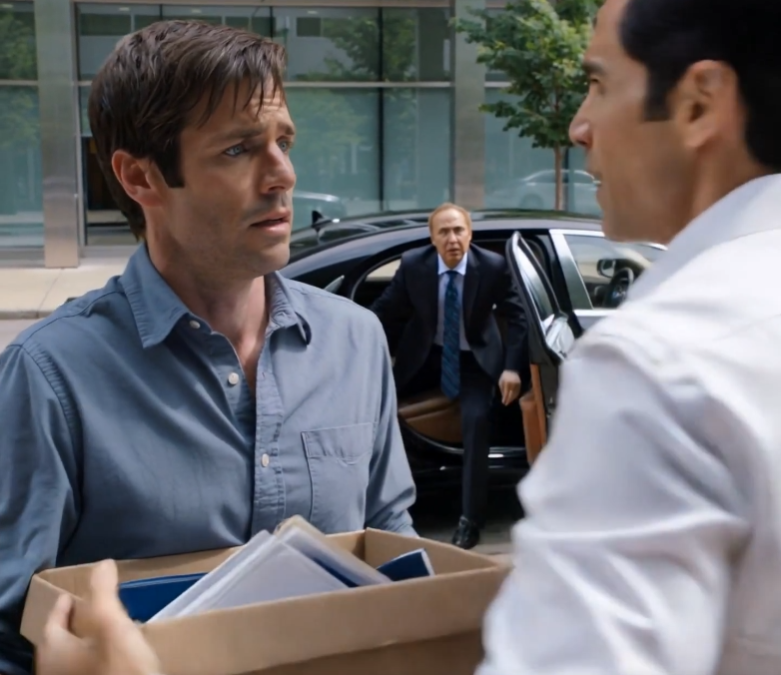
I was carrying a cardboard box out of the office when I saw our chairman step out of a black Mercedes Maybach with a potential client. The client took one look at me and shouted, “Ethan, is that really you?”
Our chairman froze.
That was how I found out that the man who had just been laid off was best friends with the billionaire everyone at the company was desperate to impress.
When I stood on the sidewalk outside Northstar Commerce, my head was still spinning. I was thirty-seven years old, and I had just been laid off. It hadn’t been a graceful departure. The young HR coordinator had handed me a printed notice, her face red and her hands trembling. She told me the company was restructuring, my position had been eliminated, and my severance package would be the minimum required under company policy.
“Sign here and leave quietly,” she’d said without quite looking me in the eye. “Please don’t make this difficult.”
So I signed.
I had worked there for eight years. I joined at twenty-eight as an entry-level employee and eventually became an associate operations manager. My hair had gone from thick to noticeably thin, and my stomach had gone from flat to slightly round. After eight years of late nights, impossible deadlines, and loyalty I had mistaken for security, the company dismissed me with a single sheet of paper.
Everything I had left behind fit into the cardboard box in my arms: a stainless steel travel mug, a few notebooks, a framed picture of my wife, Sarah, and our seven-year-old son, Lucas, and a small succulent that was already halfway to dying. That box held almost every visible trace of my career.
I stood outside the building beneath the harsh September sun. I was about to walk toward the subway when a black Mercedes Maybach pulled up to the curb. The rear door opened, and Robert Cole, Northstar’s chairman, stepped out of the front passenger seat and personally opened the back door.
I had seen Robert plenty of times. I had never seen him like that.
He bent at the waist, smiling so broadly it looked painful. I knew that smile. It was the smile a subordinate wore in front of an important customer: deferential, eager, and slightly terrified.
The man who stepped out wore a plain white button-down shirt, black trousers, and polished leather shoes that were expensive without being flashy. He looked to be in his early forties and carried himself like someone who had stopped needing to prove anything.
His eyes swept over the entrance, the security desk, and the employees hurrying through the lobby. Then he saw me.
I was standing there with a cardboard box against my chest, wearing a faded blue shirt and looking like a man who had forgotten where he was supposed to go next. He stared at me for two seconds. Then his eyes widened.
“Ethan Walker!”
The box nearly slipped out of my hands.
I knew that voice. Ten years earlier, it had been the voice that called my name from the bunk above me in our college dorm room at exactly eleven every night.
I narrowed my eyes. The face had grown leaner and more weathered, but the shape was the same. The broad forehead, the strong brow, the slight lift at the left corner of his mouth whenever he smiled.
“Daniel? Daniel Brooks?”
He crossed the sidewalk in a few long strides. Robert followed him with a confused expression.
Daniel Brooks was my best friend from college. I hadn’t seen him in ten years.
He didn’t say a word. He simply pulled me into a hard, almost painful hug. The box was crushed between us, and my half-dead succulent fell to the ground. The pot shattered, scattering dark soil across the concrete.
“You son of a gun,” Daniel said, his voice rough. “It really is you.”
I stood there as the past came rushing back.
After graduation, Daniel had moved across the country to start a company. I stayed in Chicago and joined Northstar. At first, we called and texted constantly. Then our jobs became more demanding. One missed call became a week of silence. A week became a year. Eventually, the friendship that had once felt unbreakable went quiet.
I had never imagined seeing him again while holding a box of discarded office belongings.
“What are you doing here?” I asked.
Daniel didn’t answer. He turned toward Robert, who was crouched on the sidewalk, trying to gather the broken pieces of the succulent pot. Robert handled the fragments as if he were picking up priceless glass.
Daniel’s expression changed. The warmth disappeared, and in its place came the calm authority of a man whose decisions moved markets.
“Robert,” he said, “this is my brother.”
Robert nearly dropped the largest piece of ceramic.
“Your brother?”
“Yes.” Daniel looked at him. “Why is he carrying a box?”
Robert’s face changed in less than a second. Confusion became alarm, and alarm became naked panic. He looked at me as if I were a bomb with a countdown he couldn’t see.
“Mr. Walker,” he said suddenly, much too warmly, “there may have been a misunderstanding with HR. Please don’t leave. I’ll take care of it personally.”
I stared at him. The whole thing was absurd.
Ten years ago, Daniel and I had shared a dorm room, split cheap takeout, and talked about getting rich, seeing the country, and what kind of people we would become. We had believed the world was waiting for us.
Ten years later, I had been escorted out of my job with a cardboard box while Daniel arrived in a Maybach to negotiate a deal worth hundreds of millions of dollars.
That was life.
Robert brought me back into the building. He personally walked me to my desk and ordered someone to get me coffee. My coworkers kept glancing over as if I had returned from the dead.
Daniel stayed in the executive conference room. Robert told me they would finish the business meeting after I had dealt with HR.
“Ethan.”
Paul Rivera from the next desk leaned toward me and whispered, “You know that guy?”
“We went to college together.”
Paul inhaled sharply. “You know who he is, right? Daniel Brooks, founder and CEO of Brooks Energy. Northstar has been trying to win their contract for over a year. Robert flew to Seattle three times and never got a meeting.”
I picked up the coffee cup. My hand was shaking.
Brooks Energy was impossible to miss. The clean-energy company had exploded across the country in the last two years. Analysts estimated its valuation at more than a billion dollars. Daniel was the founder everyone described as brilliant, ruthless, and impossible to reach.
I remembered him at the train station the day we graduated, carrying one backpack and wearing a jacket with a broken zipper.
“Ethan,” he’d said, “when I make something of myself, I’m taking you out for the best dinner in the city.”
I thought he was joking.
The HR director came to my desk herself. Her smile was so strained I could see sweat near her hairline.
“Mr. Walker, the notice you received this morning has been withdrawn. Your position will remain open. In fact, we’re prepared to move you up two salary bands immediately.”
She kept smiling.
“Would that be acceptable?”
I looked at her for a long moment.
“No.”
She blinked.
“I’m sorry?”
“I said no. I was already planning to leave.”
It wasn’t a bluff.
The moment the layoff notice reached my hands, part of me had felt relief. I had spent eight years at Northstar doing the same work, attending the same meetings, and repeating the same explanations to the same people. I had been exhausted for a long time. I simply hadn’t had the courage to resign.
Now the company had made the decision for me.
I packed my things again. The succulent was gone, but the rest of my belongings were still there. Robert walked me all the way to the elevator, telling me that Northstar would always welcome me back.
I didn’t answer.
Daniel was waiting outside beside the Maybach. When he saw me, he straightened.
“Come on,” he said. “I’m buying you dinner.”
We went to the little barbecue restaurant near campus where we had spent half our college years. The restaurant was still there. The owner had changed, but the sign hadn’t, and the menu was almost identical.
We took a booth in the corner and ordered grilled chicken, fries, peanuts, and two bottles of beer. The first swallow made the day feel real again.
“So,” I said, looking at him, “the Daniel Brooks everyone in the business world is terrified of is my college roommate.”
He smiled. The left corner of his mouth still rose a little higher than the right.
“I’m still the same Daniel.”
“You’re not.”
He lowered his eyes and took a drink.
“When did you come back?” I asked.
“Last month. We’re opening a new headquarters here.”
“No wonder Robert was nervous.”
“That wasn’t why I came. I was here to discuss a partnership. Running into you was luck.”
I nodded.
“What about you?” he asked. “Are you still at Northstar?”
“Today was my last day.”
He looked at me but didn’t ask why.
That was one thing about Daniel that had never changed. He didn’t force people to explain their pain. But whenever you truly needed him, he was there.
During our sophomore year, my father became seriously ill. My family couldn’t cover all the hospital bills, and I spent weeks barely sleeping. Daniel never asked for details. One afternoon, he put an envelope in my hand. There was enough money inside to cover my living expenses for an entire semester.
“Where did you get this?” I asked.
“Scholarship money,” he said.
I found out later that he had worked three part-time jobs that semester.
“How are Sarah and your son?” he asked, bringing me back to the restaurant.
“They’re good. Lucas is in second grade and has enough energy for three children.”
Daniel laughed. “He gets it from you.”
“He’s worse than I was.”
We drank and talked about harmless things. Which classmates had gotten married? Who had moved overseas? Who had gained thirty pounds? We stayed on the surface, circling the deeper water without touching it.
But some things can’t stay hidden forever.
“You’ve changed,” Daniel said.
“Everybody changes.”
“That’s not what I mean.” He set down his bottle. “You used to have light in your eyes. It’s gone.”
I almost laughed.
“Daniel, you showed up in a Maybach, and you’re giving me a speech about light in my eyes?”
“The car has nothing to do with it.”
“It has everything to do with it,” I said. “You made it. You have money, a company, and people who bend over backward to impress you. I got laid off at thirty-seven and walked out carrying a box while Robert followed you around like a nervous intern. And now you’re telling me I don’t have enough light in my eyes?”
My voice rose. People at the next table looked over.
Daniel didn’t get angry. He watched me for a few seconds and said, “I’m divorced.”
I went still.
“Last year,” he continued. “She was with me for ten years. She stayed when I had nothing, and she stayed through the first years of the company. Then she left. She said she couldn’t do it anymore. She said there was room in my life for a company, but not for a family.”
He ran a finger along the neck of his beer bottle.
“I succeeded, Ethan. I got money, a company, and the status everyone thinks they want. But I lost my wife. Our daughter lives with her, and I get one weekend a month. My parents still live in our hometown. My mother had surgery last year, and I didn’t go home. It wasn’t that I didn’t want to. I couldn’t get away. By the time I finally could, the distance between us had become something neither of us knew how to cross.”
He looked up. Something unsteady moved behind his eyes.
“You see the Maybach? Fine, I drive one. But when was the last time I took the train? Three years ago. When was the last time I stayed out drinking with friends until midnight? Five years ago. When was the last time I laughed so hard my stomach hurt?”
He paused.
“Ten years ago. With you.”
The smell of grilled food drifted through the restaurant, mixing with beer and smoke from the kitchen vent. My throat tightened.
“Don’t get sentimental on me,” I muttered.
This time, he laughed for real.
We ordered two more beers and stayed until two in the morning. Daniel sent the driver home and insisted on getting a rideshare with me.
At the entrance to my apartment complex, he looked up at the building.
“Which floor?”
“Third. Last unit on the left.”
“Your lights are on.”
“Sarah is waiting for me to explain why I came home at two.”
He clapped a hand on my shoulder.
“Go inside. Call me tomorrow.”
“About what?”
“Your job search. I need people at Brooks Energy.”
I didn’t answer.
“This isn’t charity,” he said. “I have an actual opening, and your background is exactly what I need.”
“I’ll think about it.”
“Don’t think too long,” he said with a tired smile. “You’re thirty-seven, not twenty-seven. Opportunities don’t wait forever.”
He was right. I still didn’t say yes.
It wasn’t pride. I simply didn’t know whether I could start over.
After eight years in one place, you become accustomed to its routines. You know what Monday will look like before Sunday is over. You know which meetings matter and which ones are theater. You know how long it takes to get coffee and who will answer an email.
Then, without warning, all of it disappears.
The emptiness can’t be filled by a new job overnight.
I went upstairs with unsteady hands. Sarah was still awake on the couch with the television on. When she saw me, she turned it off and stood.
“Why are you so late?”
“I ran into an old friend. We had a couple of drinks.”
She came closer and smelled the alcohol on my shirt. She didn’t comment. Instead, she went to the kitchen, poured me a glass of water with honey and lemon, and handed it to me.
“Your eyes are red.”
“The wind was bad.”
She didn’t call me a liar.
Sarah had always been like that. After ten years of marriage, she knew exactly when I was hiding something. She rarely exposed me. She said she was giving me room, but sometimes I wondered whether she simply didn’t know how to start the conversation.
We sat together in silence.
“How was work?” she asked carefully.
“Fine.”
She studied me.
“Good,” she said, even though she knew it wasn’t.
That night, I lay awake staring at the ceiling. I saw Robert’s panicked expression. I heard Daniel say that he was divorced. I remembered the HR coordinator’s flushed face as she handed me the layoff notice.
I was thirty-seven. Lucas was seven. We had fifteen years left on the mortgage and three years left on the car loan.
I had been laid off.
The next morning, I got up at seven as usual. I showered, dressed, grabbed my bag, and walked to the front door. Sarah was making breakfast. She turned around.
“Isn’t today Saturday?”
“Yes.”
“Why are you dressed for work?”
My hand rested on the doorknob. In my bag were five copies of my résumé, revised three times during the night.
“I’m going for a walk.”
She didn’t ask anything else.
She had always been good at giving me space. Sometimes I hated how much space she gave me.
I walked out of the complex and stopped at the corner, suddenly unsure where to go. For eight years, I had left home at seven-thirty, taken the train, spent forty minutes commuting, badged into Northstar, and begun my day. I could have walked the route blind.
Now I had nowhere to be.
I sat on a bench in a nearby park for most of the morning. At noon, Daniel called.
“Have you decided?”
“Decided what?”
“Whether you’re coming to Brooks Energy.”
I was quiet for a moment.
“What kind of position?”
“Chief operating officer.”
I thought I had misheard him.
“What?”
“COO. You would oversee company operations. Your experience is a direct match.”
“What would the salary be?”
“About three times what you made at Northstar.”
I said nothing.
“Don’t get stuck on the money,” Daniel said. “I need someone who can execute. People with your experience aren’t easy to find. I’ve been looking for six months.”
“I need to think about it.”
“You said that last night.”
“Give me two days.”
He sighed.
“Fine. Two days. Then call me.”
When we hung up, I stayed on the bench and watched people cross the park. An older man walked a golden retriever. A mother pushed a stroller. A middle-aged man sat alone at the far end of the path, staring at his phone just as I was.
I opened a job-search app and sent out three applications for positions similar to the one I had held at Northstar.
Two companies replied that afternoon and scheduled interviews.
The first was a small firm. The owner looked at my résumé and asked only three questions.
“How old are you? What did you make at your last job? Would you accept a pay cut?”
I stood up and left.
The second company was more professional. The HR manager was a woman in her thirties who spoke politely and took notes as I described my experience.
At the end, she said, “Mr. Walker, your background is strong, but our budget is limited. We probably can’t match your previous compensation.”
“How much can you offer?”
“Forty-five thousand a year.”
I had been making more than a hundred and twenty thousand.
“All right,” I said.
It wasn’t because I wanted the job. It was because I suddenly understood how the market saw me: a thirty-seven-year-old man who had been laid off.
Nobody cared what I had accomplished at Northstar. They cared what I could do now, how much I would cost, and whether they could find someone younger for less.
I signed the offer letter.
On the way home, I texted Daniel.
I found something.
His response came immediately.
Where?
I sent him the company name. There was a long pause before he replied.
Don’t settle, Ethan.
I didn’t answer.
The new company was called Harborline Imports. It handled shipping and international wholesale goods. My title was operations manager, but in practice, I did whatever needed doing.
The owner, Gloria Mason, was in her forties. People said her husband was a real estate developer and that she ran Harborline mostly because she wanted something of her own.
On my first day, I was assigned a desk in the corner with an old computer. Several keys on the keyboard stuck when pressed. Gloria handed me a stack of folders and told me to familiarize myself with the business.
I opened the first folder. The information inside was three years out of date.
“Gloria, these reports are obsolete.”
“Use them for now,” she said. “The updated files haven’t been organized.”
I sat in the corner, looking at the damaged keyboard and the stale folders, and felt a strange, almost comic disbelief.
At thirty-seven, I had once managed a team of twenty people. Now I was sorting through old paperwork beside a printer that sounded like it was dying.
But I didn’t quit.
This wasn’t about pride or some grand principle. We had bills. The mortgage still came due. Lucas needed school supplies. Sarah had changed jobs the month before and was earning less than she had before.
I needed income, so I stayed.
In my second month, Gloria asked me for a market analysis. I spent three days on it and worked through two nights. I delivered a thirty-slide presentation with clean data, clear logic, and charts that made the trends easy to understand.
Gloria looked at it for five minutes.
“This is too complicated. Cut it down to five slides.”
I did.
She looked for two minutes.
“Still too much. Write it in plain English. One page.”
I reduced the entire analysis to one page. She glanced at it for thirty seconds.
“Fine. This works.”
Later, I found that page under her coffee mug.
I sat at my desk and laughed. It wasn’t a happy laugh. It was the laugh of a man who had finally understood something unpleasant.
For eight years, I had believed I was building experience, skills, and relationships that belonged to me. Once I left Northstar, I realized how much of my identity had been tied to that company.
Outside its walls, I was simply another applicant with an expensive mortgage and a résumé nobody had read carefully.
My value had been erased at the front entrance with a single printed notice.
Three months after I joined Harborline, Daniel called again.
“How’s the new job?”
“Fine.”
“What does fine mean?”
“It means fine.”
He was silent for a moment.
“I looked into Harborline,” he said. “Gloria’s husband is in serious financial trouble. His development company defaulted on several loans. Harborline is barely operating. It may not survive the year.”
“I know.”
“You know, and you’re still there?”
“I have a mortgage.”
“I’m offering you three times your old salary, and you’re arguing about a mortgage.”
“It’s not about the money.”
“Then what is it about?”
I couldn’t answer.
It was fear.
Brooks Energy was growing fast in a competitive industry. Daniel needed people who could move quickly and carry enormous responsibility.
I was thirty-seven. What if I went there and failed? What if I was laid off again? What if the only thing worse than being at the bottom was climbing toward the top and falling all over again?
When someone is already in a deep hole, the thought of another fall can feel more frightening than the hole itself.
“Daniel,” I said, “give me some time.”
“How much?”
“I don’t know.”
He hung up.
In the months after I left Northstar, Sarah began to realize that I had been hiding the truth about my work. She was organizing the hall closet one day when she found my old Northstar badge. She turned it over in her hand.
“Why is this here?”
“The new company hasn’t issued my badge yet.”
She didn’t respond, but she watched me for a long time.
The next evening, she asked, “Why have you been working so late? You never used to get home this late at Northstar.”
“The new job is busy.”
“You said you’re the only person handling operations there.”
I had no answer.
She stopped asking questions after that, but her eyes changed.
In the fifth month, Lucas’s teacher called us in for a meeting. His grades had dropped. He was distracted in class and often stared out the window.
I asked him what was wrong.
“Dad, you don’t play with me anymore,” he said. “You used to read to me every night.”
I stared at him.
When had I stopped?
I thought back and realized it had begun the day Northstar laid me off. After that, I came home, ate dinner, and sat on the couch scrolling through job listings or rewriting my résumé. When Lucas asked me to play, I told him I was busy.
I thought I was working toward a solution.
In truth, I was hiding.
I was hiding from the unemployed version of myself, from the man who was thirty-seven and felt as if he had accomplished nothing, from the unfamiliar face in the mirror.
Sarah watched all of it without saying anything. She stopped asking about my work, my hours, and my prospects. She cooked, cleaned, helped Lucas with homework, and paid the bills.
The less she asked, the more ashamed I became.
Then Harborline collapsed.
Gloria’s husband’s real estate company officially filed for bankruptcy. A court-appointed trustee froze its assets. Gloria stopped coming to the office. Paychecks stopped. Health benefit payments were three months behind.
I sat alone in the empty office, staring at a new succulent on my desk. I had bought it after the first one broke outside Northstar.
The plant was healthy.
My life was not.
Eight years had ended with a notice. Six months later, a second company had vanished beneath me.
I was thirty-seven, unemployed for the second time, nearly out of savings, and one month behind on the mortgage.
That evening, I came home and stood in the kitchen doorway while Sarah cooked dinner. She glanced over her shoulder.
“You’re home. Sit down. Dinner’s almost ready.”
“Sarah.”
“What?”
“The company is gone.”
Her spatula paused over the pan. Then she kept stirring.
“I know.”
I looked at her.
“How do you know?”
“Paul called me. He said Harborline closed.”
Paul Rivera had worked beside me at Northstar. I had no idea he had Sarah’s phone number.
“He asked me not to tell you he’d called,” Sarah said. “But I think you deserve the truth.”
My legs felt weak.
“What else did he say?”
She turned off the stove and faced me. Her eyes were red, but she wasn’t crying.
“He said you were laid off from Northstar and never told me. He said you took a job at a company that wasn’t stable. He wanted to tell me earlier, but he thought you would be embarrassed if you knew he’d called.”
I opened my mouth. No words came out.
Sarah crossed her arms.
“How long were you going to keep this from me?”
I looked at the floor.
“You were laid off, and you didn’t tell me. You took a bad job, and you didn’t tell me. You left every morning pretending you had somewhere to go. Did you think I didn’t know?”
Her voice wasn’t loud. That made it worse.
“Did you think I didn’t notice you lying awake every night? Did you think I didn’t see you staring at your phone? Did you think I didn’t know you were terrified?”
Each sentence landed like a hammer.
“I’m not angry because you lost a job,” she continued. “I’m angry because you shut me out. You used to tell me everything. We used to make decisions together. You think you’re protecting me, but you’re pushing me away.”
I looked at the woman who had stood beside me for ten years and felt a wave of shame.
When we married, I had almost nothing. We rented a small apartment. I rode an old bicycle to work. I made barely enough to cover groceries.
Sarah never complained.
“We’ll build a life together,” she had said.
For ten years, she had done exactly that. She changed jobs, cared for Lucas, managed our home, and supported my career. She had never asked for luxury. She had never demanded that I become someone else.
And the first thing I did when I lost my job was hide it from her.
Not because I was afraid she would worry, but because I was afraid she would look at me and see a failure. I was afraid she would decide I couldn’t support our family. I was afraid she would regret marrying me.
I wasn’t afraid of unemployment.
I was afraid of losing her.
“I’m sorry,” I said.
Sarah came to me and wrapped her arms around my waist. Her shoulders felt thinner than I remembered.
“Don’t apologize,” she whispered. “Tell me the truth.”
I held her and began to cry. It wasn’t a dramatic breakdown. It was silent crying that had been trapped inside me for months. Tears ran down my face and soaked into her shoulder.
“I’m scared,” I said.
“Of what?”
“That I’m not good enough. That I can’t give you and Lucas the life you deserve. That you’ll regret choosing me.”
She was quiet for a while. Then she said, “Do you remember what you told me on our wedding day?”
I remembered.
“I told you I couldn’t promise a perfect life,” I said. “But I would always be there with you.”
“And you are. That’s enough.”
We talked until three in the morning.
I told her everything: the layoff, the awkward interviews, the bad job, the broken keyboard, the lost paycheck, and the fear that had kept me from calling Daniel.
She listened. Sometimes she asked a question. Sometimes she nodded.
When I finished, she said, “Call Daniel tomorrow.”
“What?”
“He offered you a way forward. Take it.”
“I don’t know if I can do the job.”
“That’s not what you’re afraid of.”
I looked at her.
“You’re afraid of failing again,” she said. “You need more than a job that lets you survive. You need a chance to stand up. Daniel can give you one.”
She was right.
I wasn’t afraid of work. I was afraid of trusting another opportunity.
Eight years at Northstar had taught me that what looked like security could disappear in a morning. A printed notice could erase an entire career.
I didn’t know how to believe in stability anymore. Not in a company, not in a promise, and not even in a friend who had become powerful enough to change my life.
“You weren’t always like this,” Sarah said.
“Like what?”
“Afraid to try.”
She reminded me of college. I had once dragged her to an outdoor concert where we stood for hours in the rain. I had told her that one day I would take her places neither of us had seen.
“You had nothing then,” she said. “But you still dared to imagine something better. Now you have experience, a family, and people who believe in you, and you’re afraid to move.”
She placed both hands on my face.
“You’re not incapable, Ethan. You’ve just forgotten that you are capable.”
The next morning, I called Daniel.
“I’ve made my decision,” I said.
“About what?”
“I’m coming to Brooks Energy.”
There was a two-second silence. Then Daniel laughed.
“Good. Come in tomorrow.”
“We should discuss compensation.”
“We’ll discuss how to build the operation first. We’ll talk money after you get here.”
When I hung up, I stood on the balcony and looked down at the street. The morning was bright. The wind was warm.
From the living room, Lucas called, “Dad, come build the spaceship with me.”
I walked inside and sat on the floor beside him. He was building a red spaceship out of plastic blocks.
“Can it leave the planet?” he asked.
“Absolutely.”
“Can it go somewhere really far?”
“As far as you want.”
“Then someday we should take it on a trip.”
“We will.”
I watched him grin at the crooked little spaceship and thought that maybe Sarah was right.
I wasn’t incapable.
I had simply forgotten that I was capable.
Brooks Energy’s headquarters occupied forty floors of a new glass tower downtown. On my first morning, a receptionist gave me a badge, a laptop, and a security card. My desk was beside a window overlooking Chicago.
The city spread beneath me in lines of traffic, rooftops, and elevated train tracks.
Daniel called me into his office and handed me a folder.
“This is your first assignment. We’re building a nationwide network of electric vehicle charging stations. You have experience in operations and rollout planning.”
I opened the folder. The first page contained a map marked with thirty cities. Red, blue, and green dots covered the country like a military strategy board.
“This is only phase one,” Daniel said. “We need ten cities operational within three months. You will own the operations side, from site selection through launch.”
“Ten cities in three months?”
“Is that a problem?”
I looked at him. His face was calm, but there was a brightness in his eyes I remembered from college.
“No problem,” I said.
Daniel smiled.
“I knew you could do it.”
For the first month, I worked fourteen hours a day. I arrived at seven in the morning and left around nine at night. Weekends became workdays. Daniel was there before me and stayed later than anyone. The light in his office seemed to be on every time I looked up.
But I didn’t feel trapped.
For the first time in years, I felt grounded. I knew what I was doing. I knew why it mattered. I could see how decisions became results.
The pressure was difficult, but it was honest pressure.
In the second month, the first city went live. In the third month, all ten were operating.
During the launch review, Daniel looked at the numbers and said, “Outstanding work, Ethan.”
I watched the data move across the screen and realized how much time I had wasted at Northstar.
Not because I had learned nothing there. I had learned a great deal. I had simply stayed in a place that had trained me to make myself smaller.
People need pressure. They need the kind that makes them lose sleep because something meaningful is at stake. They need challenges that make their hearts race and remind them they are alive.
That is different from being slowly boiled in a pot of routine while calling it stability.
In my fourth month, Daniel asked me to come to his office.
“I want to talk about something.”
“Sure.”
“I want you to become COO.”
I stared at him.
“What?”
“Chief operating officer. You would oversee all company operations.”
“Daniel, I’ve been here four months.”
“Four months was enough to show me what you can do. Those eight years at Northstar weren’t wasted. You only lacked a platform where your judgment mattered.”
I thought of the envelope he had given me in college. He wore the same expression now: serious, certain, and unwilling to let me talk myself out of something I had earned.
“What if I can’t do it?”
Daniel laughed.
“You always say that. In college, I asked you to enter the public speaking competition, and you said you were afraid. You won second place. When we graduated, I told you to apply for Northstar, and you said you were afraid. You stayed there for eight years.”
“That was luck.”
“No. You were capable. You just needed someone to believe it before you did.”
He leaned back in his chair.
“I believe in you, Ethan.”
I became COO.
It wasn’t a ceremonial title. Brooks Energy had more than two hundred employees, and over a hundred people worked in operations. I managed hiring, logistics, vendor relationships, budgets, schedules, and daily decisions that affected the entire company.
I was constantly busy. But for the first time at thirty-seven, I felt that my life was beginning instead of narrowing.
Sarah said the light had returned to my eyes. Lucas said my bedtime stories were better now.
I didn’t know whether either statement was objectively true. I only knew that I slept well. When I went to bed, I no longer stared at the ceiling until dawn.
Daniel remained as busy as ever, but we made time to drink together. We didn’t go to expensive restaurants. We usually sat in a small place beneath the office and ordered two dishes and a bottle of bourbon.
One night, after too many drinks, Daniel reached across the table.
“Thank you,” he said.
“For what?”
“For never looking down on me.”
I frowned.
“When did I do that?”
“Sophomore year. My father got sick, and my family was buried in debt. I thought everybody was judging me, but you kept asking me to eat with you, play basketball, and skip class. You never questioned me about my family.”
“That was your business.”
“Exactly. You respected my privacy. You had no idea how much that mattered.”
He lifted his glass.
“You’re the only brother I have.”
I clinked my glass against his.
“And you’re the only one I want.”
Life kept moving.
I settled into my new role. Brooks Energy grew rapidly. Six months later, the company completed a Series B financing round and doubled its valuation. My operations team expanded from a hundred people to three hundred. Our charging network grew from ten cities to thirty.
I had to learn how to see myself differently.
At Northstar, I had thought of myself as an executive. Management told me what to do, and I did it. When the result was good, someone above me accepted the praise. When it went badly, the blame traveled downward.
I had grown comfortable in that role. It meant I didn’t have to take responsibility for direction.
As COO, there was nowhere to hide.
I had to determine priorities, allocate resources, settle disputes, answer investors, and make decisions without anyone handing me an instruction sheet.
I made mistakes.
Once, I chose the wrong site for a major charging hub. The project fell two months behind, costing the company several million dollars.
Daniel didn’t shout at me.
He simply said, “Learn from it. It cost us millions. Money can be earned again. Experience can’t.”
I remembered that.
Sarah changed, too.
She was doing well at her own company and became a supervisor. She told me she was considering a professional certification.
“Go for it,” I said. “You have my support.”
One night, she asked, “Was I too dependent on you when you lost your job?”
“What do you mean?”
“I waited for you to solve everything. I should have found work sooner. I should have shared more of the pressure.”
“You were already carrying plenty.”
“Not in the way I mean. I should have realized earlier that this family doesn’t belong to one person. It belongs to both of us.”
I looked at her and thought she had never been more beautiful. Not because her face had changed, but because she had become more confident, steadier, and more willing to claim her own life.
“Sarah,” I said, “thank you for not giving up on me.”
She smiled.
“I married you, not your job.”
Around that time, Brooks Energy ran into trouble.
After the Series B round, the investors sent in a new CEO to help with management. Everyone understood what it meant.
They wanted control.
The interim CEO, Malcolm Price, was in his forties, had an impressive résumé, and spoke constantly about professionalizing the company. His first move was to reduce Daniel’s authority by half.
Daniel didn’t fight him in public. He simply worked longer hours.
But I could see that he was exhausted in a way sleep wouldn’t fix.
He had spent five years building Brooks Energy. Now investors wanted to take the company out of his hands. He needed their money to keep growing. The Series B cash had already been spent on infrastructure, and without a Series C round, the company might not survive.
One evening, he asked me to stay after everyone else had left.
“If I leave someday, can you keep this company alive?” he asked.
I knew what he meant.
“Don’t leave.”
“That isn’t entirely my decision. They may force me out.”
“Then don’t let them.”
“How?”
“Find the Series C money. If we have another source of capital, they can’t hold the company hostage.”
Daniel studied me.
“Will you help?”
“Of course.”
For the next two months, we met with seventeen investors.
Daniel spoke first. I followed with operating figures, launch metrics, and financial projections. He described the future. I explained how we would get there.
By the seventeenth meeting, we moved like a practiced team.
The seventeenth investor was William Shaw, a man in his fifties who had built a manufacturing company before moving into venture capital.
After our presentation, he sat in silence for five minutes.
Finally, he said, “One of you dreams, and the other makes the dream executable. That’s a good combination.”
Daniel leaned forward.
“We need capital, but we don’t want to surrender control.”
William nodded.
“I understand. I’ll invest, but I have one condition. Until the IPO, your shares must be tied together. Neither of you can sell out or leave alone.”
Daniel looked at me.
I nodded.
“Deal,” Daniel said.
The Series C round raised forty-five million dollars.
Malcolm resigned a month later. He received a generous settlement and moved to another company. Daniel regained control of Brooks Energy.
At the celebration dinner, he drank too much and held my wrist across the table.
“Do you know why I came looking for you?” he asked.
“Because you needed a COO.”
“No. I needed my brother.”
“You needed somebody who would tell you the truth.”
“That, too.”
He leaned back and stared at the ceiling.
“Sometimes I wonder what you would be doing if I hadn’t seen you outside Northstar.”
“Probably working at Harborline until they put a coffee cup on my résumé.”
Daniel laughed.
“So I rescued you.”
“Sarah rescued me.”
He turned toward me.
“What?”
“She told me to call you.”
Daniel was quiet for a second.
“Then I owe her dinner.”
“She’ll accept.”
Our lives continued.
The company improved. Plans for an IPO moved forward. My team expanded, and so did my responsibilities. But I no longer felt afraid.
Not because I was sure everything would work out. I had finally learned that certainty was a luxury nobody possessed.
Fear or no fear, the work still had to be done. It was better to move while afraid than to wait for fear to disappear.
Most of the time, courage arrived after the first few steps, not before them.
Sarah earned her certification and was promoted to manager. She wanted to see how far she could go.
“Go find out,” I told her. “I’ve got things at home.”
Lucas turned eight. He was good at math and announced that he wanted to become a scientist.
“Then you’ll have to learn a lot,” I told him.
“I can start now.”
Daniel’s ex-wife approached him about getting back together. He thought for three days and said no.
“It’s not because I hate her,” he told me. “We can’t go back. Neither of us is the person we were back then.”
“Do you regret it?”
“No. That marriage taught me something. No matter how big your career becomes, it can’t fill every empty place inside you. You need somebody willing to carry the weight with you.”
“You have that now.”
He raised his glass.
“Yes, I do.”
On my thirty-eighth birthday, Brooks Energy paid out a substantial quarterly bonus. I used part of it to take Sarah and Lucas to the Gulf Coast for a week.
At sunset, Lucas ran along the beach while Sarah sat beside me, watching the water turn gold.
“Ethan,” she said. “Do you remember the day you got laid off?”
“I remember.”
“You thought the sky had fallen.”
“It felt that way.”
“What do you think now?”
I watched Lucas chase the foam at the edge of the waves.
“The sky didn’t fall. And even if it had, we could build another one.”
Sarah rested her head against my shoulder.
“I’m proud of you.”
I looked at her profile in the fading light.
“I’m proud of you, too.”
When we returned to Chicago, everything at Brooks Energy looked familiar. Daniel was still busy enough to forget meals. I still sat through meetings, approved budgets, and made decisions that affected hundreds of employees.
But something had changed.
I wasn’t afraid anymore.
Not because I held an important title, but because I finally understood that nothing in life was permanent.
Jobs disappeared. Money ran out. People changed.
But some things stayed with you: what you learned, what you survived, the people you loved, and the people who loved you back.
No one could take those things away.
The day Northstar laid me off, I thought my life was over. Looking back, it was the best turning point I had ever been given.
Without that notice, I might still be sitting in the same office, repeating the same routines, and calling it stability.
Sometimes fate pushes you toward the edge of a cliff, and you think you’re falling.
You may simply be learning how to fly.
The day Brooks Energy went public, the bell-ringing ceremony took place at the Chicago Stock Exchange.
Daniel stood in the center. I stood beside him. Cameras flashed from every direction.
The host asked us to say a few words.
Daniel took the microphone.
“Thank you to our investors and to every employee who helped build this company. And especially to one person, my brother Ethan Walker.”
He turned to me.
“Ten years ago, we had nothing. Today, we’re standing here together. Success isn’t measured by how much money you make. It’s measured by who is still beside you when you arrive.”
The applause rolled through the exchange floor.
I took the microphone. For a moment, I thought about the man carrying a cardboard box outside Northstar.
“I was laid off at thirty-seven,” I said. “At the time, I thought it proved I was worthless. Today, I want to tell that version of myself something.”
I paused.
“You weren’t worthless. You were simply in the wrong place.”
The applause rose again.
After the ceremony, Daniel and I stood outside beneath a clean blue sky. He tapped my shoulder.
“Brother.”
“Yeah?”
“What are you doing next?”
“Taking care of what we have. Then I’m taking Sarah to see the Rockies. We talked about it in college and never went.”
Daniel smiled.
“Go. I’ll pay.”
“I can afford it.”
“Having money has made you arrogant.”
“It has.”
We stood on the sidewalk and laughed like two idiots.
When I got home, Sarah had cooked enough food for a dozen people. Lucas had drawn a picture of the three of us. Above our heads, in uneven block letters, he had written, “Dad is the best.”
I looked at the picture and felt my eyes burn.
Sarah noticed.
“What’s wrong?”
“Nothing.”
“Are you crying?”
“No, you’re crying. I got something in my eye.”
She came over and wiped the corner of my eye with her thumb.
“Happy birthday,” she said.
I put my arms around her. Lucas ran over and hugged my leg.
“Dad, why are you crying?”
“Because I’m happy.”
“Why does being happy make you cry?”
I looked down at him.
“Sometimes happiness gets so big it looks like sadness.”
Lucas considered that and nodded as if it made perfect sense.
That night, I lay in bed looking at the ceiling.
The room was the same. I was in the same position I had been in one year earlier. But I was no longer the same man.
A year ago, I had lain there convinced my life was finished.
Now I felt as if it had finally begun.
Thirty-eight wasn’t young. But it wasn’t too late.
Daniel had been right.
Success wasn’t the amount of money in your bank account. It was the people beside you when the noise died down.
I had Sarah. I had Lucas. I had Daniel.
And finally, I had myself.
That was enough.
People later asked whether I regretted being laid off.
I always said no.
Not because I had become successful afterward. I said no because I finally understood that no road is wasted.
Every step counts.
The eight years at Northstar, the six months at the bottom, the uncertain restart, the sleepless nights, the moments when I broke down, and the moments when I stood back up.
All of them became part of me.
I didn’t succeed because I was laid off.
I came back to life because I was.
The old version of me had already gone numb. I repeated the same days and told myself to accept them. The layoff was a slap that woke me up.
Once I was awake, I realized how much of the world I had never seen.
Now I saw more.
Daniel was negotiating an international project. If it closed, he planned to send me to Europe for the launch. Sarah wanted to learn how to drive. I promised to teach her. Lucas’s school needed parent volunteers for its field day. I signed up.
Our days continued, one after another. They weren’t perfect, but they were real.
There were arguments and reconciliations, exhaustion and laughter. There was a mortgage to pay, work to do, and a child to raise.
All of it was proof that we were alive.
I was laid off at thirty-seven.
That wasn’t the end.
It was the beginning.








