I was being laid off when the founder asked how much of the company I owned. I looked at him: “Sixty-five percent.” The room went silent.
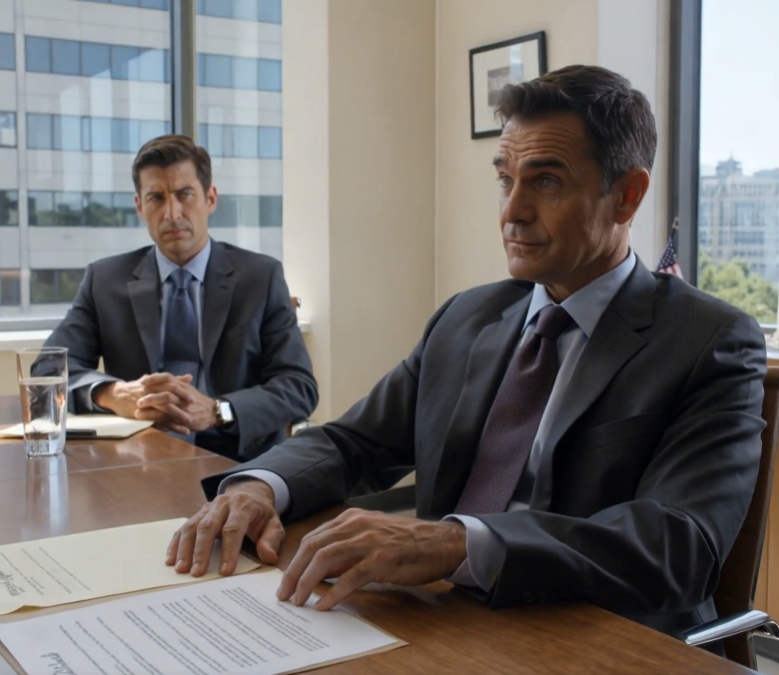
Victor. Victor Grant, founder, chief executive officer, and the company’s second-largest shareholder. At least according to every cap table anyone had been shown in the last two years.
I folded the cloth into a neat square and placed it beside the pot.
“I’ll be there.”
Megan remained behind me as if she wanted to say more. I turned around. She had joined Cedar Ridge only the previous year, and the roundness in her cheeks still made her look younger than her twenty-six years. She was diligent, decent, and far too new to understand how quickly a company could turn on the people who had built it.
Her eyes were red.
“Take care of yourself, Mr. Mercer,” she said.
“You too. Keep your head down until you know who is asking you to carry the risk.”
She gave me a confused look, nodded, and walked away. Her heels tapped across the floor, each step fading like an unfinished sentence.
Cedar Ridge occupied the middle floors of a glass office tower near downtown. It was not the tallest building in Denver, but it was high enough to make the streets below look harmless. I had spent six years inside it, from the days when there were seven of us in a cramped startup suite to the present, when more than a hundred employees filled the company’s offices, labs, and customer support rooms.
Six years was long enough for a child to learn to run. It was also long enough for a hopeful young engineer to become a quiet man who no longer believed every promise made in a conference room.
My desk held very little: a four-year-old laptop, a glass tumbler, a pair of wired headphones, and several sticky notes covered with fragments of code and meeting times. My handwriting had become so compressed that even I had to study it.
I gathered the notes and placed them in a cardboard box. My personal belongings fit inside one box. That was the physical evidence of six years of my life.
Peter Dawson, the junior developer at the next desk, leaned over the divider and held out a pack of cigarettes.
“You’re really leaving, Ethan?”
I pushed the pack back toward him. “I quit.”
“When?”
“Last year. Dr. Harper said my lungs were not going to negotiate forever.”
Peter gave a solemn nod.
“Who’s going to keep the operations team from changing the test framework every time a client complains?”
“You are.”
His face tightened. “I’m a junior developer.”
“Then you have the advantage of still noticing when people are doing something stupid.”
I picked up the box.
“Watch the validation framework. Don’t let anyone turn a test into a decoration.”
Peter nodded, but his eyes had started to shine. I pretended not to notice and carried the box toward the elevators.
As the elevator climbed, red numbers blinked on the stainless-steel panel. I remembered my first ride in that elevator with Victor. Back then, his hair was thick, his shirts were never wrinkled, and his eyes held the kind of energy that made exhausted people believe the future belonged to them.
“Ethan, do you believe we can become a serious player in this industry within three years?” he had asked, gripping my shoulder.
I had believed him. That was why I stayed.
I worked through nights, rewrote proposals, fixed systems no one else understood, and once used my own savings to cover payroll after a client delayed payment. In those days, everyone joked that I was the man behind Victor Grant. I laughed because the phrase sounded harmless.
Then we received our first round of funding, then the second, then the third. The company grew, and the people inside it became harder to recognize.
Victor moved into a larger office with a private sitting area. He hired a driver. When he spoke to employees, he leaned back in a leather chair and looked at them as though they had entered his room to ask permission to exist.
My title changed from director of technology to senior technical adviser. The salary did not change. The authority did. It was not technically a demotion, which was exactly why it was effective.
Two years earlier, Victor had recruited Marcus Bell, an operations executive from a much larger software company. Victor called him a proven leader with valuable corporate relationships. Marcus arrived with a slide deck full of phrases like operational efficiency, lean execution, and measurable accountability.
His first cost-cutting plan eliminated several engineers who had been with Cedar Ridge since the beginning. Two of them had written the first production services with me in a rented coworking space.
I went to Victor’s office and asked him to reconsider. He was sitting behind a new walnut table, preparing a pot of expensive coffee as if the company’s survival depended on the correct water temperature.
“Ethan,” he said, “you have to understand that the company is changing. Management has to keep up with growth.”
“Marcus is cutting the people who know the system best.”
“He’s removing duplicated work.”
“He’s removing institutional memory.”
Victor poured coffee into a porcelain cup.
“That’s why I’m moving you into a senior adviser role. Your compensation stays the same. You can focus on architecture and mentor younger engineers. Leave operations to people who are trained for it.”
That was when I understood that the company was no longer the place we had started together.
But I stayed.
I stayed because I knew the platform better than anyone else. I stayed because our contracts, patents, and customer relationships were tied to systems I had designed. I stayed because leaving would mean walking away from the money I had put into the company when it was nearly dead.
Most of all, I stayed because I had not yet decided whether Victor had simply lost his way or had always been waiting for the chance to use me.
At ten o’clock, Megan found me again.
“The executive room is ready.”
I carried no documents except the separation checklist. The pothos was still beside my chair. I left it there.
The executive conference room occupied the top floor. Its walls were glass on two sides, and the winter sky beyond them had turned the city into a gray watercolor.
Victor sat at the head of the table. Marcus Bell sat to his right, broad-shouldered and expressionless. Peter Lang, the finance director, sat beside him. Samuel Price, the company’s outside attorney, had arranged a leather folder in front of his chair.
There were no coffee cups on the table. That told me the meeting was not meant to last.
Victor gestured toward the empty chair across from him.
“Sit down, Ethan.”
I sat.
Marcus opened the meeting with a neutral smile.
“This is an amicable separation discussion. No one wants the process to become unpleasant.”
“Then why does everyone look as though they’re waiting for a fire alarm?” I asked.
Peter Lang cleared his throat. Victor gave him a quick glance.
“Your role is being eliminated as part of a restructuring of the technology organization.”
“I see.”
“You’ll receive the standard separation package: three months of salary continuation, health insurance assistance for six months, and a neutral reference.”
I looked at Samuel Price and the paperwork. The lawyer slid a packet across the table.
“The standard release and transfer documents.”
“Transfer of what?”
Marcus answered before Samuel could.
“Customer materials, architectural documents, access credentials, and any outstanding work product. That’s the normal handoff. There is also a small equity clarification.”
Victor leaned back.
“The shares held in your name were part of an early financing arrangement. They were never intended to remain with you after your departure.”
There it was.
The layoff was not the point. The desk, the title, the package, and the carefully rehearsed language were only the cover story. The real purpose of the meeting was to make me sign away the one thing they had not realized was still mine.
I glanced at the document. The transfer line was blank. The transferee was Victor Grant Holdings LLC. The percentage was blank, too. The papers smelled faintly of toner and expensive law-firm formatting.
“How many shares?” I asked.
Victor’s expression relaxed. He had been waiting for that question.
“How many do you own?”
The room seemed to lose oxygen.
Peter Lang stared at the tabletop. Marcus folded his hands. Samuel’s eyes moved from Victor to me, and a small bead of sweat appeared beside the bridge of his glasses.
Outside the glass wall, clouds pressed against the city. Inside, the heat was high, but I felt cold.
Victor thought he had cornered me. He believed an exhausted engineer, freshly laid off, would sign any document placed in front of him in exchange for the promise of a clean exit.
He had forgotten that I had spent two years preparing for this conversation.
“Sixty-five percent,” I said.
Victor’s cigarette slipped from his fingers and landed on the dark table. It left a glowing ember beside the untouched separation papers. Peter’s mouth fell open. Marcus turned toward me so quickly that his chair rolled backward. Samuel caught the equity transfer packet before it slid from his hand.
For a few seconds, no one spoke.
I watched their expressions change. Shock became calculation. Calculation became fear.
“What did you say?” Victor asked.
I placed one finger on the blank percentage line in the transfer agreement.
“I said I own 65% of Cedar Ridge Technologies.”
I stood and gathered the separation checklist.
“I’ll complete the ordinary handoff. Anything involving equity or ownership can go through my attorney.”
I reached the door.
“Ethan, wait,” Victor said.
I did not turn around.
“You need to explain this.”
“Not to you in this room.”
I opened the door and walked out.
The hallway felt colder than the conference room, but the air was easier to breathe. I crossed the bright glass corridor and pressed the elevator button. When the doors opened, I stepped inside alone and selected the lobby.
As the elevator descended, the numbers changed from fifteen to fourteen, thirteen, twelve. For six years, I had made myself into a shadow: a useful adviser, a quiet expert, a person whose work everyone depended on but whose judgment no one had to respect.
That morning, the shadow had stepped into the light.
I took out my phone and called Daniel Brooks. He answered after two rings. His voice was calm, warm, and annoyingly unsurprised.
“Did you finish?”
“Yes.”
“Did they ask for the transfer?”
“They did. And I told them the percentage.”
Daniel was quiet for a beat. Then he laughed softly.
“You finally said it out loud.”
“Sixty-five percent is a little hard to keep secret when someone puts a blank transfer agreement in front of you.”
“The documents are ready. I only need your signature on the demand for a formal cap table correction and the notice preserving your voting rights.”
“Good. I’ll come by tonight.”
“Bring dinner. You still owe me for the last three times I ate frozen pizza while reviewing your agreements.”
“I’ll bring ingredients. You cook.”
“That is not how legal fees work.”
“It is how friendship works.”
He sighed. “Fine. I’ll make the pasta.”
Daniel had been my closest friend since college and my attorney for almost as long as Cedar Ridge had existed.
Two years earlier, when Victor began pushing me out of the operational center of the company, I had asked Daniel to review the original shareholder documents. He had found what I remembered but had assumed no one would dare challenge.
“The ownership never transferred back,” he told me at the time. “Victor may have treated the arrangement as temporary, but temporary is not a legal category by itself. The signed agreement is.”
“If I enforce it now, the company could fracture.”
“The company is already fractured. You’re just the only person pretending the crack is a shadow.”
I had asked him whether I should resign.
“Are you sure you want to do this?” he said. “It will be ugly. Once you assert control, every old promise becomes evidence.”
“I’m not choosing the road,” I told him. “They’re forcing me onto it.”
He had been silent for a moment.
“Then I’ll walk with you.”
The elevator reached the lobby. I carried my cardboard box through the crowd, one hand steadying the pothos plant I had finally lifted from my desk. People moved around me without looking up. To everyone in the lobby, I was only another employee leaving with a box.
The new receptionist glanced up and gave me a shy smile.
“Have a good afternoon, Mr. Mercer.”
“You too.”
I pushed through the revolving glass doors. Cold air rushed against my face. Behind me, the tower reflected the winter sky like a huge frozen mirror.
I knew Victor was probably still in the conference room, shouting at Marcus and asking why no one had found the ownership documents. I also knew he would soon learn where the 65% had come from.
He would not understand how a man he had treated as an obedient workhorse had acquired control of the company under his own signature. He would understand even less why I had waited two years to reveal it.
I could have walked away when Victor stripped my title. If I had left then, I would have had a strong résumé and a bitter story, but no leverage. I stayed because I wanted to see what he would do when he believed there would never be a consequence.
The pothos leaves trembled in the wind. I held the box closer and walked toward the parking garage.
My car was an ordinary black sedan. It was not expensive, but it was reliable, quiet, and easy to overlook. I placed the box on the passenger seat, started the engine, and let the heater run for a minute. The windshield wipers swept away the last beads of rain. The sky had opened in one narrow place, and a pale strip of sunlight touched the tops of the buildings.
The story had just begun.
The next several days were strangely peaceful. The quiet gave me time to look at the ownership records without the pressure of an active emergency.
Daniel and I spent the first evening in his home office, surrounded by printed agreements, scanned exhibits, and the kind of legal stationery that made every sentence look more important than it felt. His wife had taken their children upstairs, and the house had settled into the soft, ordinary sounds of a family preparing for bed.
“Start at the beginning,” Daniel said.
I placed the first agreement on the table. It was dated six years earlier, when Cedar Ridge had still operated under a different name. The company had been called Frontier Signal Labs then, and the name appeared on the first page in a typeface that looked as though someone had designed it in a hurry.
“This is the emergency financing,” I said. “The company had eight employees, two unpaid invoices, and no money for payroll.”
“And you transferred the capital.”
“My savings, a small family loan, and money from the sale of my old apartment. I had planned to use it as a down payment on a house.”
Daniel looked up.
“You sold your apartment for this?”
“Victor said the company would die without the money.”
“That is not a legal argument. It is an emotional one.”
“At the time, it was both.”
He turned the page. The agreement created a new class of voting shares and assigned 65% of them to my holding company until a future financing round replaced the structure through a signed amendment.
“The amendment was never executed,” Daniel said.
“Victor kept saying it would happen after the next round.”
“The next round happened three times. The paperwork was never finished.”
“Paperwork is rarely unfinished by accident when the unfinished part determines who controls the company.”
I did not answer.
Daniel spread the bank statements across the desk. Every transfer had a matching entry in the company ledger. The money had gone into payroll, server leases, insurance, and a production deployment that had secured Cedar Ridge’s first serious customer.
“Do you regret it?” he asked.
“The money?”
“Everything.”
I looked at the old photograph beside his computer. Daniel and I were twenty-four in it, sitting on the floor of the first office. Victor stood behind us with one hand raised as if he were already giving a speech.
“I regret believing that loyalty could replace documentation,” I said. “I don’t regret trying to save the company. Those are different things.”
“I know that now.”
The next morning, Daniel sent preservation notices to the company, its accounting firm, and its outside counsel. The notices instructed them not to destroy or alter records related to the original financing, cap table revisions, intellectual property, or my employment separation.
Victor called before lunch.
“Did your attorney send that letter?”
“He did.”
“You’re making this adversarial.”
“You put an equity transfer agreement in front of me during a layoff meeting.”
“I thought we could handle it as friends.”
“Then you should have spoken to me before removing my authority.”
Victor exhaled sharply.
“You’re acting as if I plan to steal from you.”
“I’m acting as if I found a document asking me to give away 65% of a company without a stated purchase price.”
He had no answer to that.
After the call, I returned to the office to finish the handoff. Several employees watched me as I moved through the engineering area. They knew something had happened upstairs, but nobody knew what.
Peter approached with a folder.
“They want me to sign this access inventory.”
“Read it carefully.”
“It says, ‘I acknowledge responsibility for all systems I’ve ever touched.'”
“That is too broad.”
“Should I refuse?”
“Ask them to identify the systems, the dates, and the limits of your authority. A signature should describe a responsibility, not absorb one.”
Peter looked at the folder, then at me.
“Is this why you’re leaving?”
“Partly.”
“Did Victor really not know about the shares?”
“He knew about the financing. He chose not to remember what it purchased.”
Peter lowered his voice.
“What happens now?”
“Now the people who made decisions have to explain them.”
That afternoon, I walked through the server room one last time. The room was colder than the rest of the building because the cooling system never stopped. Racks of equipment blinked in orderly rows.
Every light suggested a decision made by someone, approved by someone else, and maintained by people whose names rarely appeared in investor presentations.
I had spent six years making sure the company’s systems did not fail in public. Now I wanted the company itself to survive the truth in private.
When I returned home, Clare was waiting with takeout containers and a stack of medical journals.
“You look tired,” she said.
“I spent twenty minutes saying goodbye to a server room.”
“That is the most you thing I’ve ever heard.”
I set the cardboard box on the kitchen counter.
“Victor called.”
“Did he apologize?”
“He said I was making things adversarial.”
“That is not an apology.”
“I know.”
Clare opened a container of noodles.
“Eat first. Become a controlling shareholder after dinner.”
I laughed for the first time that day.
The next week, the company’s accountants requested a formal meeting. They had discovered that several internal reports described my holding company as a temporary financing vehicle, while the state filings described it as the owner of the voting shares.
“How did no one notice?” I asked.
The senior accountant looked embarrassed.
“The cap table we received from management was treated as the operational version.”
“Operational version?”
“The version used for internal planning.”
“A company can have an internal planning version of reality?”
He sighed. “I’m not defending it. I’m explaining how it happened.”
“Then explain who approved the discrepancy.”
He looked down at his notes.
The answer was Victor.
The meeting lasted two hours. By the end, every participant understood that the issue was not simply whether I held 65%. It was whether the company had knowingly represented a different ownership structure to employees, lenders, and investors.
That question would take time to answer.
I was willing to wait.
I arrived at Cedar Ridge on time, finished the remaining handoff, organized the architecture files, and said goodbye to the few colleagues I trusted.
The 65% incident created a small explosion on the top floor, but almost no one below it knew what had happened. Victor had ordered everyone to keep quiet. He could not afford to let employees learn that the company’s presumed founder did not control its most important voting block. His authority would collapse before the lawyers finished explaining the cap table.
I did not seek him out. I knew what he was doing.
He was searching old financing records, archived emails, and the state business registry. He was probably calling people who had left the company years earlier and asking whether they remembered the emergency loan that had kept Cedar Ridge alive.
The money had come from me. That was the part he had decided to forget.
Six years earlier, Cedar Ridge had not been a real company in the way people meant when they used the word. It was four engineers, two folding tables, a rented office, and a prototype that looked excellent in a demo but broke whenever a real customer sent it real data.
Victor was good at finding customers. He could stand in front of a room of executives and make an unfinished product sound inevitable. I was good at taking the promises he made and turning them into something a customer could actually use.
The first year nearly killed us.
One client delayed payment for four months. Another demanded custom work we had never priced correctly. Payroll was due on a Friday, and the company account held less than the amount needed to pay half the staff.
Victor called me that night from the empty office.
“If we miss payroll, we lose the team,” he said.
I asked how much he needed.
He named a number that was larger than what I had in my checking account but smaller than the money I had saved after college. I transferred the funds before I could talk myself out of it.
The next morning, Victor brought me a draft financing agreement. It gave me a controlling interest in exchange for the emergency capital, with the understanding that an outside financing round could later restructure the ownership.
“This is temporary,” Victor said. “Once we raise properly, we’ll clean everything up.”
“Put the arrangement in writing,” I told him.
He did. I signed. He signed. Two witnesses signed. The company’s attorney at the time filed the relevant documents with the state.
But when the financing arrived, the cleanup never happened.
Victor kept postponing it. First, he said the new investors wanted the cap table left alone until the next round. Then he said our accountants were changing systems. Later, he said it was a harmless administrative detail.
By then, Cedar Ridge had become valuable enough that the administrative detail could not be harmless.
I learned to keep copies of everything. That habit began with the ownership agreement, but it spread to the rest of my life.
I kept the original financing records, the payment confirmations, and the messages where Victor thanked me for saving the company. Daniel kept a second encrypted copy. A third copy sat in a safe-deposit box under my name.
Victor had once called my caution excessive. He had been right about one thing.
It was excessive if the people around me were honest.
I no longer had the luxury of assuming that.
On the fifth day after the separation meeting, I was crouched in the hallway outside my apartment, repotting the pothos. The soil had hardened into a dense block, so I loosened the roots carefully and mixed in fresh potting soil. The vines had grown in every direction, searching for light.
My phone rang.
It was my mother.
“Ethan, are you busy?” Linda Mercer asked.
Her voice carried the cautious warmth of someone who wanted information but did not want to sound as though she was asking for it.
“I’m repotting a plant.”
“Then you’re not too busy to come to dinner. Your father bought salmon.”
“I’ll be there.”
She paused. “Is work all right?”
“Work is changing.”
“That sounds like something you say when work is not all right.”
I smiled despite myself. My mother had spent forty years identifying problems from the way people closed kitchen cabinets.
“I’m fine, Mom. I may bring someone with me.”
There was a short silence.
“Someone?”
“Clare Harper.”
The silence became very long.
“The doctor?”
“The doctor.”
“The woman you’ve known since college?”
“That one.”
My mother’s voice immediately brightened.
“Tell her we’ll make enough food.”
“You are already making enough food.”
“Not enough for a guest.”
“She isn’t a guest. She’s Clare.”
“That is exactly why she deserves a proper dinner.”
I laughed.
“Keep it simple.”
“I know what simple means to you. It means six dishes and a pie.”
“Mom—”
“Bring her home, sweetheart.”
She hung up before I could answer.
Clare was my closest friend after Daniel, though the line between friendship and something else had become increasingly difficult to see.
We had met during our first year of college, when she studied biology and I studied computer science. She had eventually gone to medical school and become an internal medicine physician at a Denver hospital.
She kept her dark hair short, spoke in a calm voice even when the emergency department was chaotic, and carried a faint scent of eucalyptus because she used a hand balm between patients.
We had been close for years. Close enough that she could call me at midnight to describe an unusual case. Close enough that I could eat a baked potato in front of her with my hands and never feel embarrassed. Close enough that neither of us had risked saying the sentence that might change everything.
Sometimes people delayed the truth because they were afraid of losing the lie.
At six, I picked Clare up outside the hospital. She wore a cream sweater under a camel coat and carried a paper bag filled with pastries.
“For your parents,” she said when I looked at the bag.
“My mother has already planned a banquet.”
“Then these are for tomorrow.”
She fastened her seat belt and glanced at me.
“Are you really taking me home?”
“I told my mother you were coming.”
“That wasn’t my question.”
The city was turning blue with early winter darkness. Traffic lights reflected on wet streets, and headlights stretched into white lines across the windshield.
“What question are you asking?”
Clare looked out the window.
“Whether your parents are going to assume I’m your girlfriend.”
I drove for half a block before answering.
“That wouldn’t be an assumption.”
She turned toward me.
“What did you say?”
“I said it wouldn’t be an assumption.”
The next traffic light turned red. I stopped and faced her.
“Clare, if you’re willing, I’d like you to come home with me as my girlfriend.”
She stared at me.
Someone behind us honked because the light had turned green. I moved the car through the intersection. My hands were steady on the wheel, but my heart had forgotten how to keep time.
Clare laughed softly.
“You are the least romantic man in Colorado.”
“That is not an answer.”
“It is a complaint.”
“Clare.”
She leaned back against the seat and watched the city pass.
“You’re not romantic, but you are sincere.”
“So?”
“So I’ll give you a chance.”
The tension in my chest loosened.
At my parents’ house, Linda had prepared roasted salmon, potatoes, green beans, a salad, and a pie she claimed had turned out badly. It had not turned out badly.
My father, Robert, poured himself half a glass of wine and spent the first ten minutes pretending not to study Clare.
Clare won him over by asking about the old pickup truck in the driveway. He launched into a story about restoring the engine, and she listened as if the mechanical history of a twenty-year-old truck were the most important thing she had heard all day.
My mother asked about Clare’s work, her parents, her hours, and whether she ate properly during hospital shifts. Clare answered every question without becoming defensive.
At one point, she reached across the table and served my father another piece of salmon.
Linda looked delighted.
“Ethan used to come home alone,” she said. “It’s nice to see him bring someone who knows how to make him sit down.”
Clare glanced at me.
“He still doesn’t sit down voluntarily.”
“I knew I liked you,” my mother said.
Under the table, Clare’s shoe touched mine. I nudged her ankle.
She did not move away.
After dinner, I drove her home. She did not get out immediately. The street was quiet, and the windows of the apartment building glowed against the dark.
“How are you going to handle Victor?” she asked. “He’ll call again.”
“He owns 15%.”
“According to the agreement?”
“Yes. The rest is spread across early employees and the financing pool.”
“And you own 65%.”
“Yes.”
“He’s not going to accept that easily.”
“I know.”
She unfastened her seat belt and leaned closer.
“Don’t let him make you angry enough to make a mistake.”
“I won’t.”
“You say that as if you’ve never made one.”
“I’ve made plenty. I’m just trying not to make the same one twice.”
Clare reached over and kissed my cheek. It was quick, almost weightless. Before I could process it, she opened the door.
“Good night, Ethan.”
“Good night.”
She walked toward the entrance, then turned and waved once before disappearing inside.
I sat in the car for several minutes, touching the place where her lips had been.
The following weeks felt like a long, unexpected vacation. I ran in the mornings, read in the afternoons, and cooked dinner when Clare’s schedule allowed her to eat at a normal hour. Sometimes I picked her up after a hospital shift. Sometimes she came to my apartment with a bag of groceries and told me that a man who owned a company had no excuse for living on takeout.
I had almost forgotten Victor when he called on the tenth day after my official separation.
I had just left the farmers market with vegetables and two pieces of fresh salmon. The street smelled of roasted chestnuts, coffee, and wet pavement. The incoming number belonged to Cedar Ridge.
“Hello?”
Victor’s voice was rough.
“Ethan.”
“Victor.”
“Are you playing games with me?”
I stopped outside the market. People moved around me carrying paper bags and bouquets of flowers.
“Watch your language.”
“Don’t give me that. I treated you like family, and you spent years hiding a controlling interest behind holding companies. You think you can steal Cedar Ridge from me because you found an old agreement?”
I waited until he finished shouting.
“Are you done?”
There was heavy breathing on the line.
“The shares were not stolen. They were issued in exchange for emergency capital when the company was about to fail. You signed the agreement. You knew exactly what it said.”
“You were supposed to transfer them back.”
“That was never completed.”
“You know what you did.”
“I know what you did when you fired me.”
The line went quiet.
I continued.
“If you want to discuss the company, we can meet. If you want to threaten me, speak to my attorney.”
“What do you want?”
“A meeting. Just the two of us.”
Victor agreed to meet the next afternoon in a private room at a downtown restaurant we had used when Cedar Ridge was young.
I bought the salmon and went home.
That evening, I prepared dinner for Clare. While she chopped vegetables, I stood by the window and remembered the first apartment we had shared with three other people after college.
Clare had been studying for medical school entrance exams. Victor and I had been building Cedar Ridge’s first prototype at night. The apartment had no reliable air conditioning. We sat on the roof with cheap beer and a watermelon, talking about changing the world.
Victor had believed it then.
So had I.
Clare came up behind me and rested her chin on my shoulder.
“You’re thinking too loudly.”
“Victor called.”
“I know.”
“How do you know?”
“You cut the salmon into identical pieces whenever you’re angry.”
I looked at the cutting board. Every piece was exactly the same size.
Clare took my hand.
“Don’t go alone if you think he might do something reckless.”
“It will be in a public place.”
“That doesn’t mean people behave well.”
“I’ll be careful.”
She studied me.
“You have the legal advantage. You don’t need to prove that you’re the strongest person in the room.”
“I’m not trying to prove that.”
“Then what are you trying to prove?”
I looked toward the kitchen, where the salmon waited beneath a sheet of foil.
“That I was never just the man behind Victor.”
Clare squeezed my hand.
“You don’t have to prove that to me.”
The next afternoon, I met Victor at a small restaurant in an old brick building. The private room had once been a storage area. Now it held a polished table, two leather chairs, and a window facing an alley where snow had collected in gray ridges.
Victor was already there. He looked worse than he had during the separation meeting. His suit was expensive but creased. His eyes were dark from lack of sleep.
He poured tea into two cups.
“Sit.”
I sat across from him.
“I checked everything,” he said. “You did put in the money. You did receive the controlling interest. But you never acted like an owner.”
“You never treated me like one.”
Victor rubbed his forehead.
“That’s not the same thing.”
“It becomes the same thing when you ask me to sign away the company as part of a layoff.”
He looked at me for a long time.
“Ethan, think about what each of us gave Cedar Ridge. I found the first customers. I raised capital. I dealt with regulators and lenders. I took the calls when everyone else was asleep.”
“I know what you did.”
“Then how can you claim the whole company?”
“I’m not claiming the whole company. I’m claiming the voting control I received in exchange for saving it.”
Victor’s fingers tightened around the teacup.
“You wrote code.”
“I built the platform that made your sales promises possible.”
“You always thought you were the only person who mattered.”
“No. I thought the people who did the work should be allowed to speak when decisions were made about their work.”
He laughed without humor.
“You know what your problem is? You believe technical ability gives you the right to run a business.”
“And you believe the ability to sell a story gives you the right to own everything inside it.”
The tea went cold between us.
Victor leaned back.
“What do you want?”
“Operational control. You keep your 15% and your title as executive vice president, but you stop interfering with finance, hiring, and technical decisions.”
His face hardened.
“You want to turn me into a ceremonial founder.”
“You can remain involved in sales and external relationships. You just don’t get to fire the people who built the system because you want to make room for a friend.”
“I am the founder.”
“You are the founder. I am the controlling shareholder. Both facts can exist at the same time.”
He stood so quickly that the tea rippled in the cup.
“You’ve changed.”
“People change when they discover that being reasonable only gives other people more time to take advantage of them.”
Victor turned toward the window. For a moment, he looked older than his fifty-two years.
“Do you want to destroy the company?”
“No. I want it to survive without pretending that one person built it alone.”
I stood and buttoned my coat.
“Think about the offer. If you reject it, we’ll call a shareholder meeting.”
At the door, I stopped.
“The tea is on me. We may not have another chance to sit together like this.”
Outside, the snow had begun again. I walked down the brick alley feeling as though someone had removed a weight from my chest.
Clare was waiting beside her car. She had brought a gray wool scarf she had knitted herself. The stitches were uneven, but the scarf was warm.
“How did it go?” she asked.
“He’ll fight. But he knows the facts now.”
She wrapped the scarf around my neck twice and tucked the end beneath my coat.
“Come on,” she said. “Let’s go home.”
I repeated the word quietly.
Home.
For the first time, the word felt like a person standing beside me in the cold.
Two weeks after the restaurant meeting, Cedar Ridge scheduled a special shareholders’ meeting.
Victor tried to delay it. He questioned the validity of the old financing agreement, demanded a second opinion from the company’s accountants, and sent a letter accusing me of exploiting an administrative mistake.
Daniel answered every letter in language so calm that it made Victor’s arguments look even more frantic.
The signed agreement held. The bank records matched. The state filings had never been amended.
The meeting was held in the largest conference room at the company’s office. The long table had been designed for twenty people, but only eleven shareholders and directors attended in person. Three joined by video.
Victor sat at the far end with Marcus beside him, while I sat near the chair reserved for the board secretary.
No one brought food.
Daniel had warned me that a shareholder meeting was not a courtroom and not a revenge ceremony. It was a legal action with minutes, ballots, and consequences that would outlast whatever anyone said under stress.
“Do not improvise,” he told me that morning. “Answer questions precisely. Don’t turn every sentence into a judgment about Victor.”
“What if someone asks whether he behaved dishonestly?”
“Say that the records speak for themselves.”
“That sounds evasive.”
“It sounds like a person who intends to win without giving the other side a sentence they can quote out of context.”
He was right.
The chair opened the meeting by reviewing the original financing. The company’s outside counsel displayed the agreements on a screen.
The signatures were clear. The bank transfers were clear. The later cap tables were inconsistent, but none contained a signed amendment transferring the controlling shares back to Victor.
Marcus argued that the company had operated for years under the assumption that Victor controlled the voting block.
“An assumption is not a transfer,” Daniel said.
“The employees believed Victor was the owner,” Marcus replied.
“Employees do not amend shareholder agreements by believing something.”
Victor stared at Daniel.
“You’re treating a financing arrangement like a weapon.”
“No,” Daniel said. “The weapon was the document placed in front of Ethan during his separation. The document made the ownership issue impossible to ignore.”
The room grew tense.
One early investor asked me whether I intended to remove Victor from the company.
“No,” I said. “I intend to stop confusing the founder’s history with the company’s current needs.”
“Do you trust him?”
I considered the question.
“I trust documented commitments. Personal trust can be rebuilt, but it cannot substitute for governance.”
That answer appeared in the meeting minutes.
Victor’s lawyer proposed a settlement in which I would surrender most of the voting shares in exchange for a large cash payment. The number was high enough to make several people lean forward.
I did not.
“The offer assumes the shares are negotiable,” I said. “The issue before us is whether they are already mine.”
“You are asking to control a company you did not found,” Victor said.
“I am asking to exercise the control I received when I financed the company, and the control you promised to respect in writing.”
“You’ve made the company your personal property.”
“No. I’m trying to keep it from becoming your personal property.”
The chair called for a recess.
In the hallway, Peter found me beside the vending machines.
“Everyone is whispering,” he said.
“That’s what people do when they think the room is too expensive for shouting.”
“Are you going to win?”
“The documents are going to win.”
He looked toward the closed conference room doors.
“What happens to us?”
“If the vote goes the way I expect, you keep your job.”
“That wasn’t what I meant.”
I understood.
“The company can change without pretending the past did not happen. I’m not going to erase Victor’s contribution. I’m not going to erase yours either.”
When the meeting resumed, the vote was called. My shares represented 65% of the voting power.
The resolution passed.
Victor remained seated for several seconds after the result was announced. Then he signed the revised governance agreement.
His signature was steady.
Mine was too.
The company’s new board structure required two independent directors, a formal conflict-of-interest policy, and written approval for related-party transactions.
The policy directly affected Victor’s family connections and the vendors he had introduced over the years.
He read the conflict section twice.
“You planned this,” he said.
“I planned to prevent the next conflict from being hidden.”
“You’re making everything formal.”
“Formal is what people call a rule after they realize a handshake cannot protect them.”
The meeting ended after sunset.
I walked through the engineering area and found several employees still working. The new governance agreement had not changed the code, but it had changed the way people looked at their monitors.
They understood that the company’s future was no longer being decided by whatever Victor could persuade people to accept in a private office.
That night, I sent an email to the entire company.
I did not announce victory. I explained the new reporting structure, the board’s responsibilities, and the protections for employees who raised concerns about safety, compensation, or conflicts of interest.
At the end, I wrote one sentence.
No one should have to discover their importance only when someone tries to remove them.
The next morning, Peter printed the sentence and taped it beside the testing dashboard.
“You know people are going to call that a slogan,” he said.
“Then we’ll make sure the process proves it isn’t one.”
When the vote took place, the result was inevitable. Victor retained 15% of the company and the title of executive vice president. The other shareholders divided the remaining 20%. I became chair of the board and assumed operational control.
Victor did not attend the first board meeting under the new arrangement.
I understood why.
Losing control in front of the people who had watched you claim control for years was a particular kind of humiliation.
I did not move into his office. The room was too large, too polished, and too full of reminders that he had once believed comfort could substitute for trust.
Instead, I asked facilities to clear a small office beside the engineering team. I added two bookshelves, a standing desk, and three new plants. The old pothos went in the window.
My first decisions were not dramatic.
I reinstated several engineers Marcus had pushed out under the cost-cutting plan. I canceled two projects that existed mostly to impress investors. I changed the compensation structure so that maintenance, testing, and incident response counted toward promotion instead of being treated as invisible labor.
The company’s mood changed slowly.
People did not cheer when they saw a new salary band. They looked at it twice, showed it to one another, and began asking questions.
Those questions mattered more than applause.
Peter Dawson was promoted to engineering manager after he demonstrated that he could protect the validation framework under pressure.
He tried to refuse the position.
“I’m still learning,” he said.
“That’s not a reason to reject responsibility,” I told him. “It’s a reason to ask for support.”
He asked for support.
We gave it to him.
Clare began bringing lunch to my office twice a week. Sometimes it was soup and a sandwich. Sometimes it was a container of pasta she had cooked at midnight after a hospital shift.
She insisted I would forget to eat if no one put food directly in front of me.
The employees noticed. They began referring to her as the doctor who keeps the boss alive.
Clare pretended to dislike the nickname.
She also remembered everyone’s names within a month.
The first major winter storm arrived in December. Snow covered the sidewalks and turned the parking lot into a field of white ridges.
I drove Clare to my parents’ house on a Saturday afternoon. Linda had planned a family dinner. Robert sat in the living room with the news playing quietly on television.
Clare took off her coat, carried a stack of groceries into the kitchen, and immediately began helping my mother prepare dinner.
The two women worked well together. Linda chopped vegetables. Clare washed them. They talked about hospital schedules, flower arrangements, and a neighbor’s dog that had learned to open the refrigerator.
After dinner, my mother brought out a bowl of dough and a tray of cinnamon filling. She had decided to make small holiday pastries and insisted Clare try folding them.
Robert’s phone rang while we sat around the table.
He listened, made a few quiet sounds, and ended the call.
“Your brother-in-law needs to borrow money again,” he told Linda.
Linda’s mouth tightened.
“He still hasn’t repaid the last loan.”
“His daughter needs a car to get to community college.”
“We are not a bank.”
Robert lowered his eyes.
“We can help family.”
“Helping once is one thing. Sending money every year and never asking what happens to it is another.”
The warmth in the room changed.
Clare concentrated on the pastry dough as though she had not heard the argument.
My father had always treated family obligation as a form of weather. If someone needed help, you stood in the rain with them. My mother knew that rain could last for years if no one built a roof.
“Dad,” I said carefully, “you can help without sending cash.”
He looked at me.
“What do you mean?”
“If my niece needs transportation, I can help her find work or an apprenticeship. If the car is the problem, we can buy a safe used one and make a plan for repayment. But I don’t want a loan that disappears into the family fog.”
My mother gave me an approving look.
Robert sighed, but he nodded.
Clare touched my knee beneath the table.
Later, when we drove home, she said, “Your parents aren’t really in conflict. They’re protecting different things.”
“My father protects people from immediate pain. My mother protects the family from long-term damage.”
“And you?”
“I’m trying to protect both.”
She smiled.
“That sounds exhausting.”
“It is.”
“Then let me help.”
The next morning, I received a call from an unfamiliar number with the area code of my hometown in western Nebraska.
“Is this Ethan Mercer?” an older man asked.
“Yes.”
“This is your Uncle James. Ethan, your father has been hurt.”
The report in my hand slid to the floor.
“What happened?”
“He went out to look at the property behind my farm. There’s a drainage embankment near the old access road. He slipped and went over the side. He hit his head.”
I gripped the edge of my desk.
“Is he conscious?”
“Not yet. He’s at the county hospital. They’re running scans.”
The office around me lost its shape.
I called Clare. She answered immediately.
“Ethan?”
“My dad fell. He’s at the county hospital back home.”
“I’m coming with you.”
“You don’t know what your schedule—”
“I’m coming with you. Book the first flight, or we’ll drive if that’s faster.”
I called my mother next.
She started crying before I finished the first sentence.
“Mom, listen to me. We’re going to the hospital. Pack a bag and wait downstairs. I’ll pick you up.”
She tried to say she could manage, but her voice broke.
By the time I reached the house, she was standing outside with a suitcase and a coat thrown over her pajamas. I put the suitcase in the trunk and helped her into the passenger seat.
Clare met us at the airport with a small bag, bottled water, and enough snacks to feed a family through a delayed flight.
The flight to the regional airport was delayed by weather.
We sat beneath the departure board while snow moved across the windows in thick white sheets. My mother held her purse in both hands and stared at the clock.
Clare sat beside her, one hand resting over my mother’s fingers.
I kept refreshing the messages from Uncle James.
The CT scan was complete. The doctor was observing him. His blood pressure was stable.
The words were not enough.
They were all we had.
The regional airport was more than an hour from the hospital. Uncle James met us in his pickup truck and drove through the snow without speaking much.
The farmland on either side of the highway disappeared into darkness.
“Your dad went out because of me,” he said finally.
“Don’t say that.”
“I asked him to look at the east field. I thought the ground had settled enough to bring equipment in during spring.”
“We’ll talk about the field later.”
He nodded, wiping his face with the back of his hand.
The county hospital was a low brick building with bright emergency room lights. The waiting area smelled of disinfectant and wet winter coats. A nurse directed us to the third floor.
Robert lay in a narrow hospital bed. His head was wrapped in gauze. His left arm was immobilized in a temporary splint. His face looked pale and strangely small against the white pillow.
My mother’s knees weakened.
Clare caught her before she fell.
“Dad.”
I took his uninjured hand. It was rough, warm, and familiar.
“It’s Ethan. We’re here.”
He did not respond.
A doctor entered with a tablet in hand. He introduced himself as Dr. Michael Alvarez, the attending physician.
“Your father fell from an embankment of roughly fifteen feet,” he explained. “The CT shows a small traumatic subarachnoid hemorrhage. At the moment, there is no sign that it’s expanding, but we need to observe him closely for seventy-two hours.”
“And his arm?”
“A comminuted fracture. Orthopedics plans to repair it tomorrow morning. He’ll need a consent form signed by next of kin.”
“I’ll sign.”
Dr. Alvarez nodded.
“He’s unconscious, but his vital signs are stable. If anything changes, we’ll tell you immediately.”
When the doctor left, Clare took my mother into the hallway for air.
Uncle James followed me into the stairwell and sat on the bottom step with his head in his hands.
“James, get up.”
“I should never have asked him to go out there.”
“You didn’t push him.”
“He said he wanted to help me figure out what to plant in the east field. He said your company was doing well and that you were too busy to worry about the farm.”
I looked through the narrow stairwell window at the snow.
My father had spent his life worrying about everyone else’s future.
He had worked construction when I was a child, coming home with blistered hands and dust in the seams of his jacket. He never complained.
When I brought home a science award, he called every relative in the state.
“My son is going to design things,” he used to say. “He won’t have to earn every meal with his back.”
When I began working, he told me not to send money.
“We have enough,” he said.
He did not tell me that he continued helping relatives who had less.
I turned to Uncle James.
“The field can wait. My father cannot. After he’s stable, we’ll figure out another way to help you.”
He wiped his eyes and nodded.
That night, Clare stayed in the hallway so my mother and I could be with Robert.
My mother fell asleep in a chair. I sat beside the bed and watched my father’s chest rise and fall.
My phone buzzed.
Clare had texted.
Don’t blame yourself. You couldn’t have known. When he wakes up, tell him the things you keep postponing.
I looked through the frosted glass of the door. Clare’s shadow moved in the hall, soft and steady.
The night seemed endless.
I remembered being eight years old, watching my father wrap gauze around his hands after a construction shift. He had still lifted me above his head when I ran to him.
I remembered the first time I brought home a computer science award. He had not understood what I had built, but he had held the certificate as if it were a legal document proving that his sacrifices had mattered.
I remembered every time I had told him I was too busy to visit.
At dawn, his fingers moved.
I leaned forward.
“Dad.”
His eyelids trembled. Slowly, he opened them.
For a moment, he looked through me.
Then his eyes focused.
“Ethan,” he whispered.
“I’m here.”
“Don’t tell your mother.”
I almost laughed and cried at the same time.
“She already knows. She’s right there.”
He turned his head and saw Linda sleeping in the chair.
“I’m fine,” he whispered. “James’s field—”
“Forget the field. Get better first.”
He studied my face.
“I know you’re busy,” he said. “I didn’t want to cause trouble.”
“Dad, you have never caused me trouble.”
I lowered my head until my forehead rested against his hand.
“I’m the one who wasn’t here enough.”
His fingers moved over my hair. The touch was weak, but it struck me harder than any accusation.
The next morning, the orthopedic team took my father into surgery.
I signed the consent form and found an empty corner near the waiting room. I slid down the wall until I was sitting on the floor.
My phone rang.
Victor.
I almost ignored the call. Then I answered.
“Ethan, I heard you went home. There’s an issue at the company.”
“My father is in surgery.”
Victor stopped.
“I didn’t know.”
“Now you do.”
“Then focus on your family. We’ll discuss Cedar Ridge when you return.”
I ended the call.
Across the waiting room, the surgical light glowed red above the double doors. My mother held a tissue in both hands. Clare sat beside her, holding her hand.
At that moment, the company’s voting rights, the board, and Victor’s anger all seemed small.
The things that mattered were the light above the operating room, my mother’s trembling fingers, and Clare’s quiet presence beside her.
The surgery took three hours.
Dr. Alvarez eventually came out and said the arm had been stabilized successfully. The bleeding in my father’s head had not increased.
The relief lasted only a few minutes before another nurse came to explain the recovery process.
My father would need neurological checks every hour, medication for pain and swelling, and help with nearly everything he normally did without thinking.
My mother listened carefully, then asked whether the hospital would keep him overnight.
“At least several nights,” the nurse said. “The head injury is the reason. The arm is serious, but the brain comes first.”
Linda nodded as if she had understood every word, then turned to me in the hallway.
“What did she say?”
I explained it again in simpler language.
My mother pressed her fingers to her lips.
“He hates hospitals.”
“So do I.”
“You both hate being told to rest.”
“That may be genetic.”
Clare returned with coffee and a paper bag of crackers. She had spoken with the nursing supervisor and arranged for my mother to use a recliner in the family waiting room when she needed to sleep.
“You’re not going to stand beside the bed for three straight nights,” Clare told me.
“I can.”
“That wasn’t the question.”
“What was the question?”
“Whether you should.”
I glanced through the window at my father. Machines surrounded him, each one making a small, measured sound.
“I should be here.”
“You can be here and sleep.”
“That sounds inefficient.”
She raised an eyebrow.
“You are not allowed to optimize your father’s recovery.”
I gave up.
The first night after surgery, my father woke confused and tried to remove the oxygen monitor from his finger. A nurse came in, explained where he was, and asked him to squeeze her hand.
“I’m not a child,” Dad muttered.
“No one said you were,” I told him.
“Then stop watching me.”
“I’m your son. Watching you is part of the job.”
He closed his eyes.
“You have a company.”
“The company can wait.”
“Your mother worries.”
“She is already worrying. You being in the hospital is not helping.”
He opened one eye.
“You’re getting bossy.”
“I learned from the best.”
For a moment, he smiled.
The next day, I made a list on the back of a hospital menu: medication times, physical therapy questions, insurance calls, Uncle James’s farm, Noah’s apprenticeship, my mother’s meals, and Clare’s hospital schedule.
The list grew until there was no empty space left on the paper.
Clare took the menu from my hand.
“This is not a business plan.”
“It’s a coordination sheet.”
“It’s a way for you to pretend that if every box is checked, nothing bad can happen.”
I looked at her.
She softened.
“I know why you do it, but people are not systems, Ethan.”
“I know.”
“Do you?”
I folded the menu in half.
“I’m learning.”
My father’s recovery was uneven.
Some mornings, he spoke clearly and argued with the nurses. Other mornings, he stared at the television without knowing what program was on.
The neurological checks made him irritable. He had to answer the date, the hospital’s name, and my mother’s name over and over.
One afternoon, the nurse asked him who I was.
He looked at me and said, “The man who thinks he can fix everything.”
The nurse laughed.
“That’s not one of the official answers.”
“It’s accurate.”
I leaned closer.
“And who are you?”
“The man who raised him.”
The nurse wrote it down as a joke.
I kept it in my memory.
While my father was in the hospital, Victor sent three emails.
The first asked whether my absence would delay the board process. The second asked whether I intended to exercise my voting rights immediately. The third said he hoped my family situation was under control.
I showed the messages to Daniel.
“Should I respond?”
“No.”
“Not even about the board?”
“The board can wait. His wording can remain in the record.”
I forwarded the emails to the preservation folder and turned off my phone.
For once, there was something more important than being available.
On the fifth day, my father asked for a mirror.
His face had bruises along the cheekbone, and his hair was flattened around the bandage.
“I look terrible,” he said.
“You look alive.”
“That is a low standard.”
“It’s the standard I’m using.”
He studied his reflection.
“Your mother has been crying.”
“She loves you.”
“I know.”
“Then stop trying to act fine when you’re not.”
He turned toward me.
“I wanted to check the farm for James. If he can grow something there, maybe Noah won’t have to leave home.”
“Noah is coming to Denver for training.”
My father’s eyes widened.
“You arranged that?”
“He’ll learn equipment maintenance. He can choose what he does afterward.”
“You shouldn’t take on another person’s future.”
“You told me to help people without making them disappear.”
“I told you to use your judgment.”
“I am.”
He looked at me with the same expression he had worn when I was a child and insisted I could build a computer from spare parts.
“Then use it gently.”
I did not understand what he meant until much later.
When he was finally discharged, the hospital gave us a thick envelope of instructions. My mother held it like a legal summons.
Clare organized the medication containers on the kitchen counter and wrote the times in large letters.
My father watched her.
“You’re a doctor?”
“Internal medicine.”
“Then you can tell Ethan to stop hovering.”
Clare looked at me.
“He should stop hovering.”
My father nodded with satisfaction.
I realized that I had lost an argument before it began.
At home, recovery became a family project.
My mother cooked soft meals. Clare checked his incision and made sure he did the exercises recommended by physical therapy. I handled the insurance calls, the follow-up appointments, and the changes to my father’s bedroom so he would not need to climb stairs.
On the third night, he called me into the kitchen.
“Sit down,” he said. “You’re trying to solve everyone’s problem at once.”
“I’m managing what needs to be managed.”
“Your grandfather used to say that a man can carry a sack of grain or a sack of worry, but not both forever.”
“I never met Grandpa.”
“He still had opinions.”
I smiled.
Dad reached across the table with his good hand.
“Your company matters. Your mother matters. Clare matters. I matter. But none of us needs you to become a machine.”
The words stayed with me.
I had spent years building machines that could continue after a component failed. I had forgotten that people were allowed to stop before they broke.
After that, I asked for help sooner.
I asked Peter to handle an engineering review. I asked Daniel to represent me at the next corporate meeting. I asked Clare when she needed a night without hearing about ownership records.
She told me she needed one immediately.
We ordered pizza.
She fell asleep with her head on my shoulder while a movie played on television. I sat still for nearly two hours because moving would have woken her.
It was the least productive evening I had spent in years.
It was also one of the best.
My mother closed her eyes and cried.
For the next two weeks, Clare and I divided our time between the hospital and my parents’ house. Clare spoke with the nurses and helped my mother understand the discharge instructions.
My father hated being treated like a patient and repeatedly tried to prove he could get out of bed without help. On the third attempt, he nearly pulled out his IV.
“You are not allowed to be heroic,” I told him.
“I raised you,” he said. “I’m allowed to be whatever I want.”
“You are allowed to be supervised.”
He glared at me, but he let the nurse help him sit.
Uncle James visited every afternoon. He brought soup, homemade bread, and updates about the farm.
When my father was strong enough to talk, he called James to the bedside.
“Stop blaming yourself,” Dad said. “The field will still be there in spring.”
James nodded, crying openly.
While they talked, I called my cousin Noah.
Noah was nineteen and working at an auto repair shop in town. He was honest, hardworking, and had never had the chance to finish a technical program.
“Come to Denver after the holidays,” I told him. “I can get you into Cedar Ridge’s equipment maintenance program. You’ll learn automation and controls. If you ever want to go back home, you’ll have a skill no one can take away.”
There was a long silence.
“Are you serious?”
“Yes.”
“I don’t know anything about software.”
“You know how machines sound when they’re about to fail. That matters more than you think.”
He agreed before I finished explaining the salary.
My mother squeezed my hand when I told her.
“You’re helping him properly,” she said. “Just don’t become your father and carry every problem by yourself.”
“I won’t.”
“You sound exactly like him when you say that.”
My father came home after two weeks.
Clare had cleaned the guest room and stocked the kitchen with groceries and medical supplies. My mother protested that Clare was spending too much. Clare said she was a doctor and knew the difference between health and extravagance.
They argued for twenty minutes and then made tea together.
That night, I sat beside my father’s bed and told him everything.
I told him about Victor, the ownership agreement, the board meeting, and my plan for Cedar Ridge.
He listened without interrupting.
When I finished, he was quiet for a while.
“I don’t understand computers,” he said. “But I understand when someone takes credit for another person’s work.”
I looked at him.
“Your mother and I built our life one paycheck at a time. No one praised us for it. We still knew who carried the bricks.”
He adjusted the blanket with his good hand.
“Take what belongs to you. Just don’t become the kind of person who makes other people disappear.”
“I won’t.”
As I reached the door, he called my name.
“Clare is good.”
“I know.”
“Be good to her. Don’t work until she forgets what you look like.”
I smiled.
“You’re going to give a speech at our wedding.”
His face brightened.
“Then I need to recover properly. I can’t embarrass my son.”
Spring arrived faster than expected.
My father’s arm healed enough for him to walk without assistance. He began visiting a neighborhood park every morning, where he played chess with retired teachers and argued about baseball with men he had met only weeks earlier.
My mother’s health improved, too. She joined Clare in a weekend flower-arranging class, and our apartment soon filled with vases no one had asked for.
The board continued to meet.
Victor did not attend every meeting, but he occasionally sent suggestions through his executive assistant. I answered the useful ones and ignored the rest.
The most important change was not that Victor lost authority. It was that nobody had to guess who was responsible anymore.
Every major project had a named owner. Every hiring decision had an accountable manager. Every technical promise made to a client had to be reviewed by the team that would eventually carry the consequences.
People complained at first. Then they discovered that clear responsibility protected them from vague blame.
Clare’s friend Rachel worked at a residential care community on the south side of Denver. Clare took me there one Saturday because Rachel’s parents lived in the facility.
Cherry trees were blooming along the walkway. The building was quiet and bright, and the residents sat in the courtyard beneath blankets.
Clare checked several patients’ blood pressure while Rachel spoke with us.
“So you’re Ethan,” Rachel said. “Clare talks about you constantly.”
“Only when I do something embarrassing.”
“Mostly when you forget to eat.”
Rachel’s father had recently been diagnosed with Alzheimer’s disease. Her mother needed more help than the facility could provide, and Rachel was considering leaving her job to care for them at home.
“I spent years telling myself I’d visit more once work settled down,” she said. “Work never settled down. My father’s memory did.”
Clare’s expression changed.
On the drive home, she was quiet.
“I keep thinking about my parents,” she said. “What if we wait too long?”
I reached across the console and took her hand.
“We won’t.”
“We say that now. Then the next deadline arrives.”
“Then we put visits on the calendar before the deadlines.”
She rested her head against the window.
“Don’t let us become people who are successful everywhere except at being present.”
“We won’t,” I said again.
This time, I knew a promise needed a schedule.
Clare and I married in May at a small mountain lodge outside Denver.
We invited our parents, a few close friends, several former Cedar Ridge employees, and Daniel, who served as both my attorney and best man.
My father wore a charcoal suit and walked slowly but without a cane. My mother wore a burgundy dress and cried before the ceremony even began.
Clare walked down the aisle with her father. When he placed her hand in mine, he held my gaze.
“Take care of her,” he said.
“I will.”
During the reception, my father stood at the microphone. His left arm was still stiff, and his hand trembled slightly.
I rose to help him, but he waved me back.
“I can say a few words.”
He looked at the guests.
“I’m not a businessman or a doctor or an engineer,” he said. “I’m just a man who worked with his hands. But I’m proud of my son, not because he owns a company. I’m proud because he knows how to start again when something is taken from him.”
My mother began crying.
My father turned toward Clare.
“And I’m proud that he found someone who can tell him when he is being foolish.”
The guests laughed.
Clare squeezed my hand.
“Take care of each other,” Dad said. “That’s all any family can ask.”
After the wedding, Clare and I moved into a smaller house with a sunny back porch.
She brought the pothos plant from my apartment and placed it near the kitchen window. Its vines had grown long enough to touch the floor.
“This plant has been through layoffs, shareholder meetings, and family emergencies,” she said. “It deserves a larger pot.”
“It also deserves better management. I’m assigning you as caretaker.”
“What are the performance criteria?”
“Water it when the soil is dry. Don’t overreact when one leaf turns yellow. And stop trying to optimize everything.”
I nodded solemnly.
“A difficult role.”
“You’ll receive no equity.”
“Then I resign.”
She kissed my cheek.
“You can’t. I’m the controlling shareholder.”
At Cedar Ridge, I continued building a new management team.
Peter became engineering manager. I hired an experienced CFO and an HR director who understood that a handbook was not a substitute for fairness.
Victor still held the title of executive vice president, but he spent most of his time pursuing a new line of business.
He and I maintained a careful public civility.
One evening, he called and asked me to dinner.
I almost declined. Then I remembered the man who had once sat on a rooftop with us, drinking cheap beer and promising to change the world.
“All right,” I said. “One dinner.”
He chose a small steakhouse and requested a private booth.
When I arrived, he was already there, pouring two glasses of beer.
“Sit,” he said.
I sat across from him.
For several minutes, we ate in silence. The restaurant’s lights reflected in the dark window behind him.
Victor finally set down his fork.
“I was in too much of a hurry,” he said.
“You still are.”
He smiled without offense.
“Probably.”
“Why did you ask me here?”
“Because I wanted to say that the company is stable. You did what you said you would do. We had good people. You brought some of them back.”
“They should never have been pushed out.”
Victor looked at his beer.
“I thought you were soft.”
“A lot of people make that mistake.”
“I thought you would accept whatever title I gave you because you cared more about the work than the credit.”
“I did care more about the work.”
“And then you showed up with 65%.”
“The percentage was there the whole time.”
He nodded slowly.
“I know. That is what bothers me.”
“You should be bothered by the fact that you never checked.”
He raised his glass.
“I’m sorry.”
The words were not dramatic. They were not enough to erase six years of decisions, but they were more honest than anything he had said in the executive conference room.
I touched my glass to his.
“I don’t want to destroy Cedar Ridge. I know it belongs to more people than us.”
Victor looked toward the kitchen, where the staff moved between tables.
“I’ll try not to make your job harder.”
“That would be a meaningful contribution.”
He laughed, and for one moment, we sounded almost like the men we had been before money made every conversation a negotiation.
In the fall, Clare told me she was pregnant.
I was on the back porch trimming a dead vine from the pothos plant when she walked outside holding a pregnancy test.
I looked at her face and understood.
“Really?”
She nodded. Her eyes were wet.
I stood so quickly that I dropped the pruning shears.
I hugged her, then pulled back because I was afraid I was holding her too tightly, then hugged her again.
“You’re going to be a father,” she said.
“I know.”
“Do you?”
“No.”
She laughed through her tears.
I began listing everything I would change.
I would stop working late. I would buy a safer car. I would learn to cook more than six meals. I would never be the kind of father who told his child that he was too busy to come home.
Clare placed a finger over my lips.
“Start with one thing.”
“What?”
“Come inside and make dinner.”
That night, we called both sets of parents.
My mother cried so hard that she had to hand the phone to my father. Clare’s parents immediately began discussing names.
My father said, “I’ll be ready to hold my grandchild.”
But his voice trembled.
The company continued to grow.
Cedar Ridge released a new data platform based on the architecture I had designed years earlier.
We stopped promising that every problem could be prevented. Instead, we documented what the system did when a problem occurred.
Clients trusted the change. Investors took longer to understand it.
That was all right.
I had spent enough years making complicated things look simple for people who never intended to carry the consequences.
The following winter, I stood in the top-floor conference room before a major product launch.
The room had been remodeled. Victor’s abstract painting was gone, replaced by a wall of glass overlooking the city.
Snow covered the roofs and streets below, smoothing every sharp edge into a clean white surface.
My phone buzzed.
Clare had sent a photograph of the pothos on the kitchen windowsill. The vines were thick and bright. Beside it sat the instructions for assembling a crib, surrounded by unopened parts.
The message read:
Your son says his father should come home early.
I smiled at the photo.
Peter appeared in the doorway.
“The presentation begins in five minutes.”
I straightened my jacket.
“Then let’s begin.”
I walked toward the conference table, where engineers, clients, and board members were waiting.
The system we were presenting was not perfect. No system was. But its owners were named. Its assumptions were documented, and its failures had a process for being seen.
Outside, snow continued to fall over Denver.
It covered the road behind me, but it did not erase it.
I knew where I had come from. I knew who had stood beside me. I knew what I owned, what I owed, and what I still had to learn.
The story had no need of an ending.
Life continued moving forward, slow and steady, like the hands of an old clock.
For the first time in years, I was not afraid of what would happen when the next hour began.








