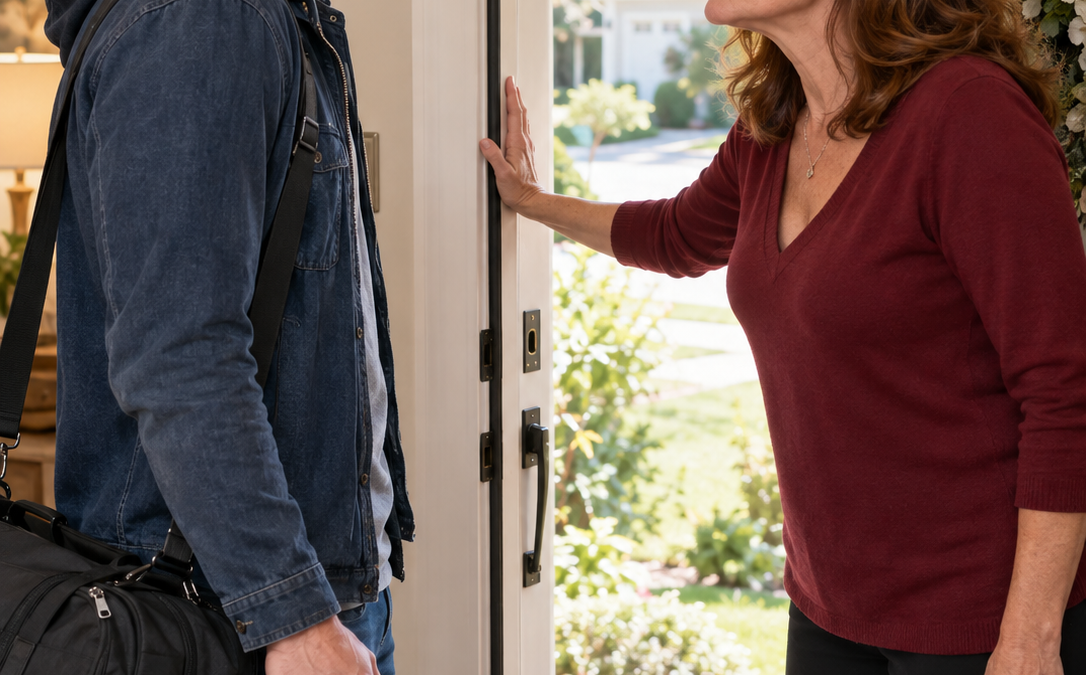
I threatened to cut off my 24-year-old son, canceled his financial support, and told him he’d stop being my son if he chose his girlfriend and his own life over me.
I never wanted to be a mother, so I treated my youngest son like a mistake while his older brother begged me to stop.
Before we go on, make sure to subscribe to the channel and let us know in the comments which city you’re watching from.
I’m not writing this so you’ll forgive me. I’m writing because I need to understand whether I deserve the punishment I’ve been living with. I’m not trying to justify what I did. I only want someone to know that, in my own way, I’ve been dying inside ever since—slowly, silently, with every memory tearing another piece out of me.
I never wanted to be a mother.
It wasn’t something I could easily admit out loud. I kept it buried because I was afraid the world would judge me even more harshly than I already judged myself.
When I met the father of my first son, he felt like fresh air.
I came from a dysfunctional family, from years of fighting, screaming, and scarcity. He was the opposite of everything I knew: patient, hardworking, kind. A good man. The kind of man you start believing doesn’t exist anymore.
He treated me as though I was worth something, as though I had potential.
And I, who was still trying to piece myself together from the rubble of my own mistakes, let myself be carried along.
Everything happened quickly.
Too quickly.
We moved in together without getting married because he said a piece of paper didn’t change love. At first, I thought he was right.
We didn’t have luxuries, but we had peace.
After years of chaos, peace felt like wealth.
Then, one day, between nervous laughs, he told me he wanted a child.
The calm I had loved suddenly felt like pressure.
I didn’t know how to tell him no. I didn’t know how to admit that I had never dreamed about cribs or bottles or holding a baby in my arms. I didn’t seem to possess that tenderness other women talked about as though it were the most natural thing in the world.
So I stayed quiet.
And because I stayed quiet, life moved forward without my ever truly choosing it.
I got pregnant.
He was happy.
I pretended to be.
And that was how the life I had never asked for began.
At first, everything was a blur.
The house filled with small things—diapers, cries, toys. I barely slept. I ate poorly. And although I tried to love that baby the way I believed a mother should, something inside me never fully connected.
I felt as though my body had been invaded, and now my mind had been invaded too.
There was no space left for me.
Not one minute.
Not one corner.
Sometimes I wondered what my life would have looked like if I’d had the courage to say, I’m not made for this.
But I continued because that was what good women were supposed to do.
They continued.
Even when they were breaking.
Our son grew. He was beautiful, healthy, curious, and I was permanently exhausted.
I’d watch him play and feel something that resembled love, but it was tangled with a sadness I couldn’t explain, as if every smile reminded me of everything I thought I had lost.
Time.
Freedom.
A future that belonged only to me.
Then I met another man.
He was younger. He had no children. He was free, and he looked at me in a way no one had looked at me in years.
And yes, I was unfaithful.
I’m not going to make it prettier than it was.
It was selfish. Dirty. Cowardly.
But for a while, it made me feel alive.
It made me feel something.
When my partner found out, everything collapsed.
We argued. We screamed. We cried. He asked me to stay and try. He suggested therapy. He asked me to think about our son.
But by then, I was already emotionally far away.
I couldn’t imagine returning to the place where I felt trapped.
Eventually, he told me he no longer wanted a relationship with me. When it came to our child, everything became complicated and painful. For one brief moment, I considered whether my son might be better off staying with the father who seemed naturally capable of giving him what I struggled to give.
But in the end, whether because of guilt, pride, or fear, I took my son with me.
I packed a few things, took his hand, and left for another city to start over.
I’ll never forget the way he looked at me that day.
He didn’t understand what was happening. He didn’t understand why his father wasn’t coming with us. He didn’t understand why I was crying when I kept insisting we were beginning a new life.
As I drove with blurred eyes, one bitter thought repeated in my head.
How ironic.
I was leaving the only man who had genuinely loved me, and I still didn’t know what kind of life I was driving toward.
The man I had risked everything for failed me too.
Or maybe I was the one who had confused desire with love.
When I told him I was pregnant, he disappeared.
There were no explanations.
No goodbye.
He was simply gone.
And there I was, alone with a five-year-old and another baby on the way.
No stable home.
No partner.
No job.
The first months were hell.
We lived in a tiny rented room. Some days there was barely enough food. I moved through every morning with anger, sadness, exhaustion, and a resentment so deep it seemed to be eating me from the inside.
I’d look at my older son and feel pain because I knew I was dragging him through the wreckage with me.
And my younger son?
For a long time, I could barely look at him without seeing everything I believed had gone wrong in my life.
I blamed a child for circumstances he had never chosen.
That is one of the hardest truths for me to write.
When I held him as a baby, instead of feeling the joy I thought was supposed to arrive automatically, I felt numbness. Coldness. A terrible emptiness.
I gave him a name because he needed one, not because some beautiful name had been living in my heart waiting for him.
Whenever people asked me about him, I performed motherhood.
I smiled.
“Yes, he’s beautiful.”
“He’s mischievous, but sweet.”
I knew exactly how a loving mother was supposed to sound.
Inside, though, I kept wishing someone else could do the job I didn’t know how to do.
My older son was different.
He was five when his brother was born, and he already knew how to read. He hugged me without being asked. He brought me flowers he found on the street.
He called me Mommy with a kind of love that hurt because it reminded me how far I was from the mother he imagined I was.
It wasn’t fair to either of them.
Not to the child I could love only imperfectly.
And certainly not to the child I treated as though he had to apologize for existing.
Over time, the difference between the two brothers became a chasm.
I dug it.
My younger son cried often—for hunger, cold, fear, boredom, all the ordinary reasons small children cry.
And his crying enraged me.
I was exhausted and angry, but none of that excuses what I became.
Sometimes I handled him roughly. Sometimes I left him alone with his tears because I couldn’t bring myself to comfort him. Other times, I lashed out over things no child should have been punished for: a broken glass, a stain on his clothes, noise at the wrong moment.
Every time I lost control, I promised myself it would be the last.
It never was.
One day, when he was three, he broke a glass in the kitchen while trying to reach something.
I was exhausted, sleepless, hungry.
I grabbed his arm and said something no child should ever hear from a parent.
“You’re the worst mistake I ever made.”
I said it with enough venom to frighten even myself.
That night, he became very quiet.
My older son tried to compensate for everything I failed to provide. He told his brother stories. He taught him to draw. He tucked him into bed. When I couldn’t bring myself to get up, he was the one who found something for his brother to drink or stayed with him when he was sick.
A child was doing the work I should have been doing.
One day, he confronted me.
He was seven.
“Why do you hurt him when it isn’t his fault you’re sad?”
I didn’t know how to answer.
So I screamed at him to go to his room, then sat on the kitchen floor and cried until exhaustion took over.
There were good days too, though there weren’t many.
They felt like mirages, little lies so convincing that for a few hours I could almost believe we were a normal family.
Once, we went to a park with old playground equipment and rusted swings. We brought a bottle of water and bread with butter.
I watched my boys laugh.
Really laugh.
My younger son fell and hurt his knee. He cried, and without thinking, I pulled him into my arms.
He froze.
That reaction stays with me.
He seemed confused by being comforted, as though he hadn’t known my arms could be used for that.
But when we came home, everything returned to normal.
I shut myself away.
They stayed together in the living room.
The laughter disappeared.
Another time, a neighbor asked if everything was all right. She said she had heard shouting and noticed things that worried her.
I made excuses.
I told her children fell down. Children got bruises. Children made noise.
She looked at me differently after that.
Eventually, she stopped speaking to me altogether.
I started going out less.
I was ashamed of the judgment in other people’s eyes.
What hurt more was knowing they might be right.
My younger son began to fade.
He became quieter.
More obedient.
He stopped asking for things.
He stopped crying as much.
He learned to move carefully around the apartment, almost as though every sound might bring down a storm.
His older brother kept trying to protect him.
And sometimes I resented even that.
Seeing someone else give my younger son the tenderness I withheld forced me to confront what I wasn’t doing.
So I found ways to separate them.
Then came an ordinary day that changed everything.
It was my younger son’s tenth birthday.
I had almost nothing to give him.
No money.
No celebration.
And, shamefully, not even the words a mother should have found.
I got up as though it were any other morning, left food on the table, and went to work.
I walked the same broken streets in the same worn clothes, carrying the same guilt around like a useless coin in my pocket.
I came home around six.
The apartment was too quiet.
At first, I assumed the boys were asleep or with a neighbor.
Then I realized something was terribly wrong.
What followed is the moment around which the rest of my life has revolved.
My younger son had died.
There was a notebook with him.
There were emergency calls, questions, strangers moving through my home, and my older son staring at me with an expression I have never been able to forget.
He had found his brother before I came home.
Then he gave me the notebook.
Inside was a final message.
I won’t repeat it word for word.
I can’t.
What mattered was that every line forced me to understand what my son had believed about himself, about me, and about the place he occupied in my life.
He had absorbed years of rejection until he believed disappearing was the only thing he could give me.
My hands shook as I read.
My older son stood nearby, devastated and furious.
The message made one thing painfully clear: despite everything, his little brother had still wanted my love.
That knowledge destroyed whatever defenses I had left.
My older son finally broke the silence.
“What did you do?”
His voice didn’t sound like the voice of a child anymore.
I wanted to approach him, hug him, apologize, tell him I hadn’t understood how much damage I was causing.
He stepped away from me.
“You left him alone all these years,” he said. “You made him feel like a shadow.”
I tried to answer, but there were no words that could change what had happened.
Everything after that moved as though I were underwater.
Emergency workers came.
Authorities asked questions.
People told me I shouldn’t stay alone.
I heard all of them and almost none of them.
That night, I sat in the dark with the notebook in my hands and felt as though my soul had turned to ash.
Later, my older son came to the doorway.
He stood there quietly.
Then he said, “You know the worst part?”
I looked at him.
“He still loved you.”
My chest seemed to break open.
“After everything,” he continued, “he still thought you might change. He still wanted you to love him.”
I covered my face.
He told me he had tried to protect his brother. He had tried to care for him, comfort him, make life easier for him.
“But it wasn’t enough,” he said.
“I’m sorry,” I managed.
“Don’t be sorry now. It’s too late.”
He turned away.
Then he went to his room and packed a backpack.
I watched him, paralyzed, almost believing that if I didn’t move, the next loss wouldn’t become real.
“Where are you going?” I asked.
“Anywhere but here.”
I ran after him.
I begged him not to leave me alone. I told him I loved him. I told him I needed him.
But he couldn’t hear those words from me anymore.
Or maybe he had heard too many words that meant nothing.
“You’re the worst mother anyone could have,” he shouted from the sidewalk. “And I don’t know if I’ll ever be able to forgive you.”
Then he left.
Within two days, I had lost both of my sons in different ways.
One was gone forever.
The other was running from me as though escaping the only danger he had ever truly known.
I contacted the police because he was still a minor. I filed a report. They asked questions and said they would look for him.
Weeks passed.
Then months.
Eventually, the calls stopped coming.
I was left alone in a home full of silence, with an empty bed and a notebook I could barely bring myself to touch.
Sometimes I’d wake from sleep calling my younger son’s name.
Other times I dreamed of my older boy standing in the doorway on that last night, his eyes filled with rage and broken love.
Seven years passed without hearing his voice.
Seven years without knowing whether he was safe, whether he had somewhere to sleep, whether he was eating well, whether he hated me, or whether he had managed to forget me completely.
I never forgot him.
Not for one day.
I imagined him walking through the door. I imagined hearing him call, “Mom,” from the hallway.
Sometimes I woke with a start, certain I had heard him.
But it was only remorse echoing through an empty apartment.
I remained alone in that small, gray, dead place.
I kept some of his things: an old shirt he had forgotten, a childhood notebook filled with drawings, a pair of socks.
I kept the notebook connected to his brother too, inside a box I couldn’t bring myself either to open regularly or to throw away.
Sometimes I wrote letters to my older son.
Letters I never sent.
I told him I missed him.
That I was sorry.
That I would give anything to go back.
Then I’d read what I’d written and realize I was still trying, in subtle ways, to explain myself.
So I tore the letters up.
My only routine became survival.
I worked just enough.
Ate just enough.
Slept badly.
Thought too much.
Then, one ordinary night, without looking for it, I found him.
It happened on Reddit.
I used to read other people’s stories as a distraction, losing myself in strangers’ lives for a few minutes at a time.
That night, the algorithm put a post on the front page.
Thousands of upvotes.
Hundreds of comments.
The title described a man telling the story of how his mother had destroyed his childhood and his brother’s.
Something struck me in the chest.
I opened it.
Every paragraph felt like a shattered mirror forcing me to see myself from the outside.
He wrote about his brother’s death.
About an absent, cruel, aggressive mother.
About a childhood defined by fear.
About running away.
About silence.
About hatred.
About carrying the pain into adulthood as though it were a backpack filled with stones.
It was him.
I knew it from the dates.
The details.
Small memories no stranger could possibly know.
He had told his story.
Our story.
And now it was public.
Viral.
Analyzed by thousands of people who didn’t know me.
People who judged the anonymous mother in the story with devastating severity.
For once, what hurt wasn’t being hated.
It was realizing how much of their anger I had earned.
For the first time, I understood the scale of what I’d done without filtering it through my own version of events.
I saw it from the perspective of a child who had lived it.
A child who had suffered it.
A child who had somehow survived it.
And I knew I had no right to defend myself.
For days, I barely slept or ate.
I read the post over and over, as though there might be some clue hidden between the lines, some crack through which hope could enter.
There wasn’t.
There was only rage.
Pain.
An old wound that had never truly closed.
Finally, in a moment of impulse, I sent him a private message.
It was short.
It’s me. I have no excuses. I just want to listen to you. Please.
Days passed.
Then weeks.
I assumed he would never answer.
One afternoon, while I was pouring coffee, my phone vibrated.
There was one message.
We’ll meet once. Don’t expect forgiveness.
I didn’t cry.
I didn’t feel relief.
I felt fear.
I prepared as carefully as I could. I did my hair the way I used to when he was young. I gathered a small box of memories—a photograph of the three of us from one of those Christmases when we pretended to be happy, an old toy, a letter he had once left behind.
Then I went.
We met in a small, quiet, old coffee shop.
I saw him before he saw me.
He had changed.
Taller.
Thinner.
His face was harder.
But the eyes were the same.
The same eyes that had once looked at me with fear and somehow still managed to love me.
He sat across from me.
He didn’t smile.
He didn’t hug me.
“So,” he said. “You read the post.”
“Yes.”
Every word.
Every line that had opened me from the inside.
He didn’t react.
He simply nodded.
Then, in a firm voice, he said, “Don’t talk. Just listen.”
And I did.
Not because he ordered me to, but because I finally understood that his voice no longer belonged to a child speaking to his mother.
It belonged to a survivor speaking to the person who had failed him.
“You don’t know how many times I imagined this moment,” he began. “But I never thought it would happen. Honestly, I didn’t think you’d have the courage to look for me.”
He paused and studied me.
“I’m not here for you. I’m here for me.”
Then he let everything out.
No filters.
No effort to protect me.
He told me how young he had been when he learned to prepare basic food because sometimes I didn’t. He told me how he took care of his little brother when I disappeared emotionally, how he comforted him after my anger, how he stayed alert at night because he was afraid something would go wrong.
He told me how desperately trapped he had felt as a child, how often he had wanted to take his brother away but had nowhere to go.
He told me what the day of his brother’s death had done to him.
He told me about the night he ran away.
About uncertainty.
About places where he slept.
About work he took simply so he could afford another night indoors.
About going hungry.
About spending birthdays alone.
About sitting in libraries for hours because reading was easier than thinking.
I cried without interrupting.
He wasn’t telling me these things so I would pity him.
He was saying them because, after years of carrying them, he needed to put them somewhere outside himself.
He told me that for years he had dreamed of the day I would finally understand exactly what I had been.
“I wanted you to understand what abandonment feels like,” he said.
He looked at me with something close to contempt, but sadness lived underneath it.
“I posted that story because I needed to get it out of me. And it helped. But it wasn’t complete. This was missing. I needed to tell you everything to your face.”
He took a drink of water and breathed slowly.
“I’m not here to rebuild anything. I’m not here so you can ask me for forgiveness. I’m not here to heal this relationship. I’m here to close it. To bury it. To leave it behind.”
He paused.
Then he told me, without shouting, that he wanted a life in which I no longer had a place.
The calmness hurt more than rage would have.
It sounded final.
Not like an insult.
Like a door closing.
He stood.
He didn’t touch the box I had brought.
He didn’t accept my tears.
He didn’t hug the woman who had given birth to him.
He simply walked toward the door.
Before leaving, he stopped.
“You know what my therapist told me?” he asked without turning around. “Sometimes healing means letting go of ghosts that are still alive. You were mine.”
Then he left.
I didn’t follow.
I couldn’t.
I stayed in that chair holding a box of memories that weren’t enough to rebuild anything.
That night, I went home and didn’t turn on the lights.
I didn’t eat.
I sat on the floor with that old toy in my hands and spoke into the silence.
I told it I understood.
I told it I deserved what had happened.
I told my absent sons that even though I had loved them in a broken, selfish, inadequate way, I had loved them.
That doesn’t excuse anything.
Love that arrives too late doesn’t rescue anyone from the years when it was missing.
The next morning, I woke in the same apartment.
Gray.
Empty.
The notebook was still in its drawer.
The photographs were still hidden away.
The memories still weighed like stones.
I made coffee.
I looked into the mirror.
And for the first time, I didn’t see a victim.
I saw the woman I had actually been.
A woman who didn’t know how to love properly.
A woman who should never have allowed her resentment to become her children’s burden.
If living with that knowledge is my punishment, then I accept it.
Because regret doesn’t rewrite childhood.
And love spoken after the damage is done cannot make the past disappear.
Today there are no dramatic tears.
Only routine.
I get up as always.
I boil water.
I make coffee.
I sit in the same chair I’ve been sitting in for years and stare at the window without opening it.
The world outside continues.
All I have left is memory.
No one calls me.
No one waits for me.
I don’t have friends.
I don’t have a partner.
I don’t have children in my life anymore.
Sometimes I wonder how many times a person can break before there seems to be almost nothing left.
The television stays on all day without sound, only so the apartment doesn’t feel quite so hollow.
I keep my younger son’s notebook in the same drawer, beside the old toy.
Sometimes I take it out.
Not because I want to torture myself, but because it contains the truth I spent years refusing to see.
I wonder what would have happened if I had made different choices while there was still time.
What if I had hugged him more?
What if, instead of making him carry my resentment, I had simply told him that he mattered?
But questions don’t change the past.
They only illuminate it with a flashlight that arrives too late.
I also keep the letters I wrote to my older son and never sent.
One for almost every year after he left.
In one of them, I wrote about a dream.
In the dream, he came back—not as an adult, but as a child.
His clothes were dirty.
His hair was messy.
His hands were full of crayons.
He touched my face and asked, “Do you love me now, Mom?”
And I hugged him.
In the dream, he didn’t disappear.
Not that time.
But when I woke up, I was alone.
As always.
Sometimes I clean compulsively.
I scrub corners until they shine, though no one will ever see them.
Other times, I sit on the floor in the same part of the apartment where I cried the night my older son left.
There’s still a crack in one of the tiles.
Sometimes I run my finger along it as though it were a wound the apartment and I share.
I keep a box containing what remains of my old family life.
A shirt.
A drawing.
A Christmas photograph in which all of us were pretending to be happy.
Whenever I open the box, I sit perfectly still, almost holding my breath as though I might hear their voices again.
I never do.
But I keep opening it.
I know my older son is alive.
I’ve found traces of him online a couple of times under another name.
He hasn’t reached out, and I no longer believe I’m entitled to ask him to.
He posts photographs of books, mountains, sometimes a dog.
Rarely people.
From what little I’ve seen, he’s in therapy.
He has steady work.
He seems to have found some measure of peace.
And if that’s true, I’m glad.
Because even though I never knew how to be the mother he needed, I finally understand one thing about love.
Sometimes love means wishing peace for someone who has every reason to live without you.
Once, I dreamed about my younger son.
We were in a park.
It was night, but somehow there was light everywhere.
He looked at me, and in that impossible place, I felt forgiven for one brief moment—not because I believe forgiveness was owed to me, but because dreams don’t follow the rules of waking life.
I woke crying.
For once, though, the dream itself hadn’t hurt.
I don’t want to erase the pain.
I’m not looking for forgiveness.
I only want to hold on to what remains—the small pieces that still connect me to the two people who once called me Mom.
Because I wasn’t the mother they deserved.
I was absence.
Fear.
Neglect.
Rejection.
And somehow, despite all of that, they once loved me.
More than I deserved.
My name is Lasia.
I’m 47 years old.
I was the mother of two sons.
One died when he was still a child.
The other left and built a life beyond me.
And today, after everything, I can only say—








