I testified against my own daughter for $40,000 to help my son. Now she hates me and my son’s going to lose his leg.
I testified against my own daughter for $40,000 to help my son. Now she hates me, and my son’s going to lose his leg.
The first time my daughter screamed in a courtroom that I was a liar, the judge told her to be quiet, and I just sat there swearing to God that everything I was saying was true, even though it wasn’t.
But to understand why we got there, you have to go back a bit. Not much. Just a couple of months, to my granddaughter’s birthday, to the day my daughter took away any respect I had left for her.
Yama was turning four.
Sandra, my thirty-year-old daughter, had been separating from Fernando for months. Fights, lawyers, custody messes—the usual. But she still organized a simple little party in her apartment. Little balloons, gelatin, sugar-free cakes. She only invited the closest people.
I went with Jose, my younger son, who’s nineteen. He’s all I have. His dad died seven years ago, and I raised him alone. Sandra had always helped financially. She’d send money without me asking. That’s how a family works, right? Helping each other.
But that day was different.
We arrived with a modest little gift, a doll. There were some friends, cousins, Aunt Laura, all with wrapped gifts.
Except Sandra.
Yes. The girl’s mother brought nothing.
She said she couldn’t afford it, that everything was in the hands of the lawyers, that she couldn’t take it anymore. I leaned in quietly and said, “You couldn’t even bring a stuffed animal?”
She gave me a cold look.
“You want me to give her the IOU from the lawsuit, Mom?”
I didn’t say it out loud, but it burned me. Not because of the money. Because of the attitude. The way she looked at me, as if I were a bother.
And that’s when I let it out. Yes, in front of everyone.
“You used to be more generous. You’ve forgotten your family.”
The silence was so sharp that even the children’s music seemed to have turned itself down. Aunt Laura’s jaw dropped. Jose touched my arm as if to say, That’s enough.
But no. I was already hurt.
And when a mother is hurt, she defends herself.
“I’m just saying that now that you’re separated, it seems you’ve forgotten who was there for you your whole life,” I added, louder.
Sandra gave me a death glare.
“I didn’t come here to fight, Mom.”
“Me neither. But if Fernando wants custody, now I understand why.”
An uncle blurted something out from the back, and that’s when everything exploded.
Sandra stood up, picked Yama up in her arms, and said, “You know what? Enjoy the cake, because it’s the last you’ll see of me.”
And she left.
The rest of the afternoon was a disaster. Everyone murmured. Some said I was right. Others wondered if I had gone too far.
Jose didn’t say anything, but that night, while we were having dinner, he told me something I’ll never forget.
“Mom, we’re not going to be able to pay for tuition.”
I froze.
“What do you mean?”
“It’s not enough anymore. The scholarship didn’t come through. I have three weeks to pay it or I lose my spot.”
I fell apart right there.
We had trusted that Sandra would keep helping. It was the logical thing, the fair thing, but not anymore. I sent her a message. I asked her to talk, to think about her brother, not to be like this.
She left me on read.
I wrote to her again.
Nothing.
A couple of days later, Jose came into my room. He showed me the email with the due-date notice.
“I’m going to do something,” I told him. “Don’t worry.”
But I didn’t know what.
Not until Fernando called me.
We hadn’t spoken in years. After his separation from Sandra, I stayed out of it. But his voice was kind.
Too kind.
“I need to see you. You and Jose.”
“What for?”
“It’s about something that can help you.”
“Help us?”
“Yes. I know you need money.”
I froze.
“What do you know about that?”
“Sandra isn’t the only one who talks. Let’s meet. Just listen to what I have to say.”
And he hung up.
Jose was in the kitchen. I told him, not like a mother, but like a desperate woman.
“And what does he want?” he asked.
“I don’t know.”
“What if it’s something shady?”
“What if it’s the only way?”
Jose looked at me. I looked at him, and right there, I knew we were already on our way to doing something irreversible.
I didn’t sleep that night. Every time I closed my eyes, I saw Sandra’s hardened face, carrying Yama as if she were running from something—or someone. From me.
But I also saw Jose. His open email. The tuition amount. The counter ticking down the days like a bomb.
When Fernando told us he wanted to see us on Saturday, I agreed without arguing. I didn’t even ask where. I just said yes.
Jose did too.
Neither of us pretended this was a good idea.
The coffee shop was on a quiet corner far from downtown, one of those places where nobody knows you and nobody asks questions. Fernando was already there when we arrived, an untouched coffee in front of him and that calmness that had always bothered me.
Too proper. Too confident.
“Thanks for coming,” he said, as if he were doing us a favor.
Jose didn’t answer. He just sat down and crossed his arms. I adjusted my purse on my lap as if it could protect me from something.
“I’ll be direct,” Fernando continued. “I don’t want to beat around the bush because time is working against me.”
“Against you or against Sandra?” I asked.
He smiled slightly.
“Against my daughter? She’s my child.”
It pierced me like a needle. Yama wasn’t just his daughter. She was our granddaughter.
But he didn’t wait for a response.
“I’m fighting for full custody, and I need credible witnesses. Family members.”
Jose looked up.
“Witnesses to what?”
Fernando leaned forward a little.
“To the truth.”
I felt a knot in my stomach.
“What truth?”
“That Sandra’s not well. That she has anger issues. That she drinks. That she sometimes loses control in front of the girl.”
I gave a short, nervous laugh.
“That’s not true.”
“It doesn’t matter,” he replied.
“What do you mean, it doesn’t matter?”
“What matters is what can be proven. What you’ve seen—or what you can say you saw.”
Jose was the first to understand.
“How much?”
Fernando didn’t even blink.
“Forty thousand.”
I felt the air leave the room.
“How?”
“Twenty before the trial. Twenty after.”
He took a sip of coffee.
“With that, Jose can pay for college. You can be at ease.”
I rose from my chair in a huff.
“Are you crazy? She’s my daughter.”
Fernando looked at me seriously for the first time.
“Your daughter left you alone when you needed her most.”
Jose rested his elbows on the table.
“She knows we don’t have that money, and still she didn’t help.”
Fernando finished the thought for him.
“I’m not asking you to invent something monstrous. Just to exaggerate. Enough for the judge to have doubts.”
“You’re asking us to lose our daughter,” I said, my voice trembling.
“You’ve already lost her,” he replied. “You just haven’t accepted it yet.”
Silence.
A thick, uncomfortable, definitive silence.
“Mom,” Jose said without looking at me. “She left us hanging.”
“Jose, no.”
“Listen to me.”
He finally looked at me.
“I don’t want to do this. But I don’t want to be left without an education, without a future either. She’s the one who let go of our hand.”
At first, I wanted to say something to defend her. I wanted to say she was going through a divorce, that she wasn’t well.
But then I thought about the party. About the gift she didn’t bring. About the way she looked at me when I asked for help.
Fernando took an envelope out of his bag and placed it on the table.
“This is just so you see I’m serious.”
I didn’t open it.
I didn’t need to.
“And what if she denies it?” I asked.
“Let her scream whatever she wants. Judges listen to family. Especially to a mother.”
That word hurt me.
Mother.
“Think about it,” he said, getting up. “But I don’t have much time.”
He left without saying goodbye.
We stayed seated for a few more minutes. Nobody spoke. People came in and out of the coffee shop as if the world were still the same.
“We can’t do it,” I finally said.
Jose clenched his jaw.
“Then what do we do?”
“We’ll find another way.”
“Like what?”
I didn’t know what to say.
“Tuition is due in two weeks,” he added. “After that, I lose my spot.”
He looked at me, not with anger, but with something worse.
Expectation.
“Mom, you always said a mother does whatever it takes for her children.”
I swallowed hard.
That night, Fernando sent us a message with the lawyer’s information. The next day, another one with a tentative trial date.
Sandra didn’t answer any of my messages.
On Sunday, Jose came into my room with a printed sheet.
“It’s the automatic drop,” he said. “If I don’t pay, they take me out of the system.”
I sat on the bed.
I felt something inside me break, but it wasn’t guilt.
It was resignation.
“Okay,” I said. “We’ll do it.”
Jose didn’t smile.
He just nodded.
A week later, we walked into the courthouse together.
Sandra was sitting on the other side.
She didn’t know we were going to testify.
When she looked up and saw us, her face transformed. It wasn’t surprise.
It was betrayal.
And in that moment, as the judge called the witnesses, I knew there was no turning back.
Sandra shot up instantly. Her chair fell to the floor. The judge asked her to calm down, but she wasn’t listening.
“What are you doing here?” she yelled at us, her eyes red with fury.
The judge slammed her palm on the table.
“Ma’am, if you interrupt again, I’ll have you removed.”
Sandra didn’t quiet down out of respect. She quieted down for Yama because she knew that if they threw her out, she’d look even worse.
Jose testified first. Firm. Without hesitation.
I went next.
My mouth was dry, my stomach tied in a knot, but I repeated what we had rehearsed: that Sandra had mood swings, that she yelled, that it wasn’t an ideal environment for a child.
She didn’t say anything.
She just looked at me.
Not a tear. Not a word.
That was worse.
It was the face of someone who was dying inside and didn’t even want to defend herself anymore.
A week later, the ruling came down.
Full custody for Fernando.
Sandra would have supervised visits once a month if she completed an anger-management program.
Fernando transferred us the second half of the money. Forty thousand dollars, just as he had promised.
Jose paid for college. I paid off debts. We even replaced the old refrigerator and fixed the bathroom door that had been broken for two years.
And for a while, I convinced myself we’d done the right thing.
That we’d done it out of necessity.
But then came the silence.
Not the silence of the phones.
The other kind.
The kind that settles into the air when someone you love decides to erase you from the map.
Sandra never answered again. No messages. No calls. Not even through third parties.
Jose said it was better this way, that she didn’t need us anymore, that we had to think about ourselves.
But I’m a mother, and the void she left couldn’t be filled with new furniture or paid-off accounts.
I tried writing to her on her birthday.
I miss you. I think about you every day.
It was never read.
I asked Aunt Laura to talk to her. She told me Sandra had blocked her just for mentioning my name.
And then I understood.
It wasn’t anger.
It was something deeper. A complete break. A definitive erasure.
A year went by like that.
A year without my daughter.
Jose was moving forward with his studies. Sometimes he came home happy, sometimes frustrated, like any young person. But at least he was moving forward.
I didn’t say anything.
I just watched him and thought, At least one of my children is okay.
Until one night, a noise woke me up.
Jose was in the living room arguing on the phone. I got closer without him seeing me.
“No, I already told you I don’t have the money. No, I can’t. I’ve already been scammed once.”
He hung up, slammed the table in anger, and just stayed there with his head in his hands.
“What’s wrong?” I asked.
He told me he had tried to sell his computer to help me with the house. He’d posted it online. They gave him a fake transfer.
He lost everything.
“We can’t go on like this,” he told me. “We’re running out of everything.”
And he was right.
The money had evaporated.
College. Expenses. Food. Bills.
To make matters worse, I got a notice from the court. We had to testify about Yama’s child support. Fernando had claimed he hadn’t received enough financial support from Sandra.
They were asking us to testify in his favor again.
Jose wanted nothing to do with it.
“One was enough for us,” he said.
We didn’t go.
And maybe that’s what triggered what came next.
One night, Jose went out in the car. He was nervous. He told me he had to see about a job.
I didn’t hear from him again until three in the morning.
The phone rang.
It was the hospital.
“Your son had an accident,” a dry voice told me. “We need you to come now.”
I ran out in my pajamas, my documents in my hand and my heart in my throat.
When I arrived, he was conscious but pale, with tubes in him, his right leg covered in bandages and dried blood.
“He was lucky,” the doctor said. “But the fracture is serious. He needs surgery urgently. If we don’t operate soon, he could lose it.”
“How much does it cost?”
“Between twenty-five and thirty thousand.”
I didn’t say anything.
I couldn’t.
On top of that, as if that weren’t enough, the people in the other car had sued us for damages, medical expenses, therapy.
The lawyer they recommended was clear.
“Without money, you’re going to lose. And with Jose’s record, the attempted sale, the financial history, they could leave you in debt for years.”
Everything came back like a whirlwind.
The trial.
The lie.
The money.
The loss of Sandra.
And there, with my son in a bed, bandaged and shaking with fever, I thought of only one thing.
Sandra.
She could help.
She had to help.
Not for me.
For her brother.
I sent her a message. Just one. No beating around the bush.
Jose had an accident. It’s serious. We need your help.
Hours later, the reply came.
And what does that have to do with me?
That was all.
Not a sorry. Not another question.
I wrote back immediately, my hands trembling, the phone almost falling from them.
Sandra, he’s your brother. He’s in the hospital. The doctors say he could lose his leg.
Minutes passed.
Nothing.
Jose was sleeping badly. He was sweating, moaning in his sleep. The nurse told me he couldn’t go on like this, that the infection was spreading and we needed to make a decision quickly.
I wrote to her again.
I’m not asking for me. I’m asking for him.
The reply came almost an hour later.
Cold. Sharp.
You all already chose. I did too.
That’s when I understood I wouldn’t get anywhere over the phone.
Sandra could ignore a screen.
But she couldn’t ignore me standing in front of her.
The next day, I went to the public hospital to get a more detailed report. I needed something concrete, something that would make her react.
The doctor was brutal and made no effort to lower his voice, even though there were other patients around.
“Look, ma’am,” he told me, “without the money, there’s no surgery. And if there’s no surgery, amputation is a matter of days. Not weeks. Days.”
I felt several people looking at us.
A woman murmured something like, “Poor kid.”
Another shook her head.
“Isn’t there a plan? Something?” I asked.
“This isn’t a charity,” he replied. “If you can’t pay, we can’t do anything.”
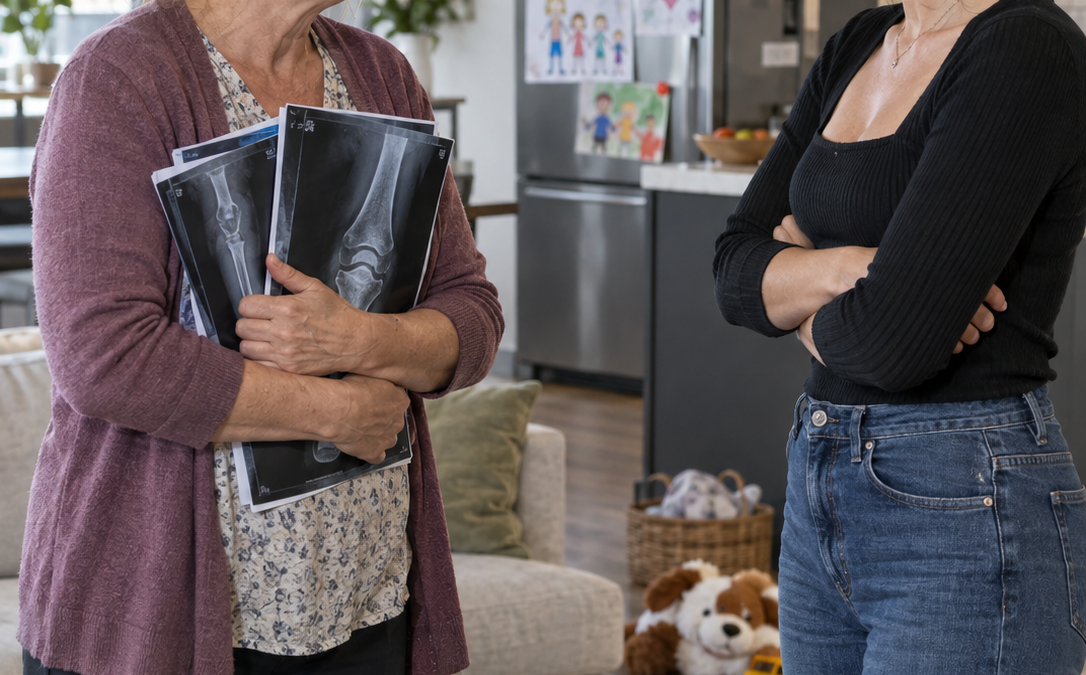
I left there humiliated, with the X-rays under my arm and the feeling that there were no doors left open.
So I went to find her.
I didn’t call. I didn’t give notice. I took the bus and got off in front of her building, one of those new ones with an electric doorman and cameras.
I waited.
When a neighbor came out, I slipped in behind her, rang the bell, and heard footsteps.
The door opened just a crack.
When she saw me, Sandra tried to slam it shut.
I stuck my foot in.
“No,” she said. “Don’t you dare.”
“Sandra, please.”
“Not now. Not with your brother like this.”
“Move your foot or I’ll call the police.”
“Listen to me for five minutes,” I begged. “Five.”
She looked at me with a mix of hatred and exhaustion.
Finally, she let go of the door and turned around.
“Five. Nothing more.”
I went in.
The apartment was tidy.
Too tidy.
As if there were no room for chaos.
On the table were drawings by Yama held up with magnets.
That pierced me.
“Tell me,” she said, crossing her arms.
“Jose is very sick.”
I took out the X-rays.
“The doctors say without surgery, he’ll lose his leg. I have no one else to turn to.”
“And what does that have to do with me?”
She repeated it exactly the way she had in the message.
“He’s your brother,” I said, raising my voice. “You can’t just leave him like this.”
“I’m not leaving him like this,” she replied. “You did when you lied in that courtroom.”
“It was a difficult decision,” I defended myself. “We had no other choice.”
That’s when she exploded.
“You had no other choice?” she screamed. “Do you know what it’s like to lose your daughter? Do you know what it was like to have her ripped from my arms because my own mother said I was a violent alcoholic?”
“That’s in the past,” I said without thinking.
“For you,” she corrected me. “Not for me.”
The silence was heavy.
I was breathing hard. I felt that if I didn’t say something quickly, I’d lose her forever.
“If he’s not operated on now,” I said, “he’ll be disabled. And if that happens, it’ll be because of you.”
She stared at me without blinking.
“You want me to help you?” she asked suddenly.
I felt immediate relief.
“Yes.”
“Anything?”
“Anything.”
“Then I have one condition.”
My stomach clenched.
“Tell me.”
“I’m fighting for full custody of Yama again. The trial is in two weeks.”
She paused.
“I want you to tell the truth. That you lied the first time. That you did it for money. That Fernando bought you.”
“That’s going to get me in trouble.”
“He took my daughter from me,” she replied. “Choose.”
I looked at the X-rays.
I thought about Jose. His leg. His future.
“And if I do it,” I asked, “will you pay for the surgery?”
She nodded.
“After the trial. I promise you.”
I didn’t trust her.
But I didn’t have a choice either.
“Okay,” I said. “I’ll do it.”
And in that moment, without knowing it, I had just dug the deepest hole of all.
The trial was quick.
Sandra’s lawyers had everything prepared. They asked me to testify in person to make it more impactful.
And so I did.
I sat in front of the judge with my eyes down and my hands clasped. I wore that old jacket I used for funerals, the one for pity, because this time what suited me wasn’t the truth.
It was guilt.
“Do you affirm that you lied in your previous testimony?” the judge asked.
“Yes,” I replied in a broken voice. “I got carried away. I had financial problems. They pressured me.”
“Who pressured you?”
“Fernando and my son.”
I swallowed.
“I didn’t want to.”
“So everything you said about your daughter was false?”
“Everything. Absolutely everything.”
I lied to lie about a lie.
And I cried.
This time, without faking it, because I knew I was sinking myself to save someone else.
Again, the ruling came a week later.
Sandra regained full custody of Yama.
Her lawyer called me. He thanked me. He said that without my testimony, it would have been impossible to reverse the damage.
And I thought it was worth it.
The humiliation was worth it.
The $3,000 fine for perjury. The whispers in the hallway. The neighbors who already knew the story.
It was all worth it because my son was going to be operated on.
Because that had been the promise.
That day, I approached Sandra outside the courthouse.
She was with Yama, hugging her tight. They were both crying. I waited for them to separate.
I walked toward her.
“How do we do the money?” I asked.
She looked at me as if she didn’t recognize me, as if I were a shadow of something that once existed.
“Money?”
“Jose’s operation. You said you’d help me if I supported you in this. I kept my end of the deal.”
Sandra bent down, wiped Yama’s nose, and then stood up straight.
“And you also lied under oath again.”
“For you.”
“No. For yourself. For your guilt. For your son.”
“Then help us.”
She took a step closer.
She didn’t yell.
She didn’t insult me.
She just spoke with a calm so cold it made my skin crawl.
“You made me lose my daughter. You made up that I was an alcoholic. You made me out to be an abuser. You left me alone. You made me hit rock bottom.”
“Sandra, please.”
“And now you want me to save you?”
She crossed her arms.
“But this—this is karma.”
I felt like I couldn’t breathe.
“What are you saying?”
“That I’m not giving you anything.”
“You can’t do this to me. You promised me.”
“And what did you promise me when you testified against me for money?”
“I did it out of necessity.”
“And now I choose not to. Out of dignity.”
She turned, took Yama’s hand, and started walking toward the car.
I ran after her.
“No, Sandra, please. You don’t know what you’re saying. Jose’s going to lose his leg.”
She stopped and turned around.
“And I lost my daughter for a year because of you.”
“You got her back.”
“And have you gotten anything back?”
And she left just like that.
With that last sentence.
Without looking back. Without a tear. Without a single shred of compassion.
I screamed right there on the sidewalk.
I screamed like a madwoman.
People walked by and looked at me. A lady with a shopping cart stopped. A guy on a bike almost crashed from staring at me crying.
“She’s trash! She has no soul! She’s trash!” I cried.
I held on to a light pole.
My legs were shaking.
I had sold my dignity for the promise of help.
And now I had a $300 fine and not a single cent to save my son.
When I got home, Jose looked at me from the bed. He had dark circles under his eyes. His leg was more swollen than ever.
And I didn’t know how to tell him.
“Mom, do you have the money?”
I sat on the edge of the bed.
I shook my head.
“She said no. She’s not going to help us.”
Jose didn’t say anything at first.
He just looked away.
“So I’m losing my leg,” he whispered.
“No. I tried. We’ll do something. Something will come up.”
“No, Mom,” he interrupted me. “You’ve already done enough.”
And that’s when I started to hate her.
Not before.
Not when she ignored us.
Not when she blocked us.
Not when she left us without money.
It was when she turned her back on me, knowing I had nothing left.
No pride.
No daughter.
No future.
And then I knew that this time, the punishment was really coming for me.
Jose stopped asking me about the operation.
He stopped talking in general.
He spent his days in bed with his leg bandaged, getting more and more swollen. The purple skin, the metallic smell of the infection—it got into everything.
Into the clothes.
Into the corners.
Into my head.
The last time the doctor came to the house, because we couldn’t even go to the hospital anymore, he was clear and cold.
“If we don’t get the money this week, the leg is lost. It’s irreversible.”
I didn’t argue.
I didn’t cry.
I just nodded.
I had no tears or dignity left. Just a thick guilt, like lead, swallowing me alive.
I sold everything that was left.
The television.
The microwave.
The fridge.
I slept on the floor because I sold my bed.
Jose’s fan was the last thing I could give away, and it still wasn’t enough.
The lawsuit from the accident was still ongoing. The lawyers wrote to me every week. I wanted to think they wouldn’t garnish our wages, but I’d already received three official letters, notifications I didn’t even bother to open completely.
One day, my cell phone vibrated.
It was a message from Sandra.
For a second, I thought—I don’t know—that she’d had a change of heart. That she was going to offer help. A transfer. A number. A doctor.
Something.
I opened it.
Don’t ever look for me again. Ever.
That was it.
Nothing more.
No period. No kind word. Not even an insult.
Just a door locked forever.
I replied immediately, with rage, with pain, with the desperation of a mother who had lost everything.
You’re trash. You’re letting your brother die, letting him lose his leg. This is your fault. You’ll carry this forever.
She never replied.
But she blocked me again.
I lied to Jose.
I told him I was talking to doctors, that a foundation was interested. I don’t know if he believed me.
I think he just pretended.
He slept badly. He moaned in his sleep. The fever wouldn’t break. He no longer asked me about the money.
He just asked for water.
Sometimes not even that.
The doctor came one more time.
He didn’t bring new words.
He just told me, “Prepare yourself.”
That night, I didn’t sleep.
I walked through the empty house.
I sat on the plastic chair I hadn’t sold yet. I went to Jose’s room. He was sleeping, or something like it.
I went closer.
I touched his forehead, pushed his hair back, kissed his hand—the one I’d always held since he was little, the one that was now so cold.
And I told myself that no one will ever understand why I did what I did.
Because to everyone, I’m the bad guy.
The traitor.
The narcissistic mother.
The one who sold out her daughter.
But nobody knows what it’s like to watch your son rotting in a bed, unable to do anything.
Nobody knows what it’s like to lose everyone, even when you did everything for them.
Because that’s what happened.
I did it for them.
I betrayed out of necessity.
I lied for love.
I knelt out of duty.
And I was left with nothing.
Today, I received a new notice from the court. Another fine. Another threat of foreclosure.
I look around.
There’s nothing left for them to take.
Jose’s leg is going to be amputated this week.
There’s no going back.
And I’m going to have to carry that.
Not Sandra.
Not Fernando.
Me.
The one who raised him.
The one who lied.
The one who fell.
But the one who never stopped being a mother.
So if I have to be the villain, so be it.
If I have to be hated, let them hate me.
But don’t ask me for forgiveness, because I gave everything and was left with nothing.
They say I’m a bad mother, but in the end, I just helped my son.
Is that so wrong?
Comment one: “You lost your daughter for $40,000, and you still have the nerve to say you did it for love. It wasn’t love. It was selfishness.”
Comment two: “You ruined two lives, your daughter’s and your son’s, and you still expect people to agree with you.”
The narrator replies: “My daughter ruined herself when she turned her back on us. I did what any mother would do so at least one of her children could get ahead. Jose deserved a chance.”
Comment three: “She didn’t bring a gift to her daughter’s party. Seriously? That was your argument for destroying her? You’re sick.”
Comment four: “You sold your soul to the guy who destroyed your daughter. You’re not a victim. You’re an accomplice.”
Comment five: “The worst part is you’re not even sorry. You’re crying for yourself, not for what you did.”
The narrator replies: “And what do you want? For me to get on the floor and crawl, begging for forgiveness? Of course I’m suffering, but nobody gives me the right to show it because, to you all, I’m already condemned.”
Comment six: “Jose lost his leg. Yes, but you used him as an excuse from the very first moment. He was your perfect excuse to sink your daughter.”
Comment seven: “You’re the typical narcissistic mother. Everything revolves around you, even when you destroy others.”
The narrator replies: “If putting my children first makes me a narcissist, then yes, I am. But I prefer that to being indifferent. At least I fought for them even when everyone turned their backs on me.”
Comment eight: “Sandra did the right thing by erasing you from her life. The only thing I regret is that she didn’t do it sooner.”
The narrator replies: “How easy it is to talk from the outside. But don’t forget, if she has her daughter today, it’s thanks to me. Or did you already forget that I testified again to help her? That doesn’t count, does it? No.”
Comment nine: “The saddest part is you don’t even understand what you did. You’ll die convinced that your daughter owes you something.”
Comment ten.








