I spent 15 years saving for my dream beach house. On my first night, Mom called: “Your sister’s getting married. We gave her your house as a wedding gift.” Dad added: “You’re single. Start over.” I asked: “You gave away my house?” Mom laughed. “Family shares.” I hung up. The next morning, they arrived with a moving truck. I was waiting…
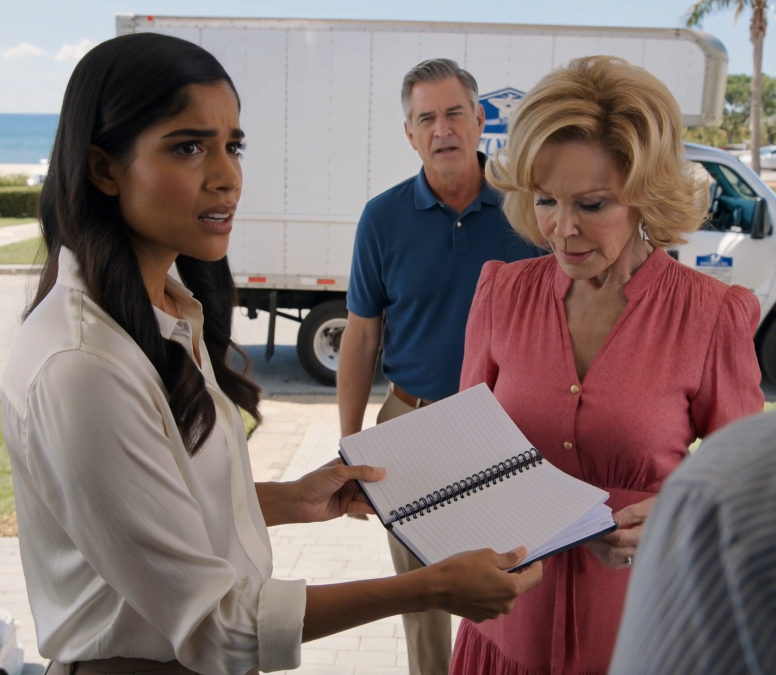
“Your sister’s getting married. We gave her your house as a wedding gift.”
That was my mother on my first night in the Galveston house I had spent fifteen years buying. Extra shifts. Same car. No vacations. My name on the deed, nobody else’s.
My father took the phone. “You’re single. Start over.”
I asked one question. “You gave away my house?”
She laughed. “Family shares.”
I hung up. I didn’t argue. Arguing tells a person like her what you’re about to do.
The second bedroom already had three boxes in it with my sister’s name on them. I thought it was a mistake until that call. It wasn’t a discussion. It was a notice.
The next morning, a moving truck backed into my driveway. They had practiced the speech. They had practiced the laugh. They expected me alone on that porch, holding the key out like an apology.
They were half right about the porch. They were wrong about who I had already called.
My name is Julia Watts. I’m thirty-eight years old. If anyone has ever been told their house was a wedding gift while they were standing in it, tell me where you’re listening from. And if this one landed, subscribe. I’ll keep telling them.
Let me go back six days, to the afternoon I got the keys.
Closing was on a Thursday, the fifth of March, in a title company office two blocks off the seawall. The escrow officer had a candy dish on her desk and a pen she kept clicking, and she walked me through the stack one page at a time.
Four hundred ten thousand dollars. Twenty-five thousand down. The rest on a mortgage with one name on it.
Mine.
When it was over, she shook my hand like I’d done something ordinary, which I suppose to her I had. Her text came in at 2:15 while I was sitting in my car.
Funded and closed. Keys are yours. Congratulations, Julia.
I read it three times in the parking lot before I started the engine.
I’m a hospice nurse. I’ve spent twelve years walking into other people’s houses, and I know exactly how much it matters who has a way in. So the first thing I did, before I unpacked a single plate, was drive to the hardware store and buy a keypad deadbolt.
I installed it myself that afternoon, kneeling on the porch with a screwdriver and the instructions spread across the boards. The code I picked was 0211. February of 2011, the month I opened the account.
I had a couch coming Monday and four shifts I couldn’t move, so I hung a lockbox on the doorknob with the spare key inside. I texted my mother the combination for the couch delivery.
Just let them in and lock up.
She answered faster than she’d answered anything in years.
Perfect. Don’t worry about anything.
I didn’t.
That was my mistake.
The shifts were twelve hours each, Friday through Monday, on the inpatient unit in Houston. I won’t describe them except to say that a hospice floor in early March is not a place where you check your phone often.
On Monday afternoon, somewhere between a family meeting and a med pass, a photo came through from my mother. My couch, gray and new, sitting in the front room of my house with the afternoon light on it.
Everything’s in. Then Dad helped. Don’t come down till you’ve slept.
I remember smiling at it. I remember thinking that everything was a funny word for one couch. I remember a nurse’s aide asking me something about a patient’s daughter, and I answered her and put the phone back in my pocket.
I didn’t ask what everything meant.
I should have.
Tuesday, I boxed up the apartment. Wednesday, I loaded the car, drove south on the interstate, and crossed the causeway just as the sun was going down over the bay.
I got to the house at seven.
The keypad worked. The couch was where I’d wanted it. I walked through the front room and the kitchen, touching things the way you do when you’re checking whether a place is real. Then I carried the first bag down the hall to the second bedroom, where I’d planned to put my desk.
There were three boxes in the middle of the floor.
Brown cardboard. Packing tape smoothed flat with somebody’s thumb. The way my mother smooths everything. Her handwriting in black marker, block capitals.
PAIGE — KITCHEN.
PAIGE — LINENS.
PAIGE — WEDDING.
For a second, I honestly thought a delivery had gone to the wrong address. Then I looked at the handwriting again.
I set my bag down in the hallway. I didn’t open the boxes. I stood in the doorway of my own guest room like I was the one who had walked into the wrong house, and I tried to build a version of this that made sense.
Storage.
Maybe she’d asked and I’d missed the text.
Maybe.
My phone rang at 9:30.
Mom.
She started the way she starts when she’s already decided something, bright, almost singing.
“Did you see the boxes? We wanted to get a head start.”
“A head start on what?”
“Your sister’s getting married. We gave her your house as a wedding gift.”
I could hear the kitchen behind her. The clock. The refrigerator. My father’s chair creaking. She said it the way you’d tell someone you’d booked a restaurant.
Then my father’s voice came closer. She’d handed him the phone, or he’d taken it.
“You’re single, honey. Start over.”
A pause.
“You’re good at that.”
I want to be honest about what happened in my body when he said that.
Nothing.
My hands were steady. My face was steady. I’ve sat with families while they were told the worst thing they would ever hear, and I’ve learned that the calm arrives before the feeling does.
I had the calm.
“You gave away my house.”
My mother again.
She laughed.
Not cruelly. That’s the part I still turn over. She laughed the way she laughs when a child asks a question with an obvious answer.
“Family shares, Julia.”
“Okay.”
“Okay, Julia.”
She got one more thing in before I ended the call.
“Nine tomorrow. The truck. They’ll bring the rest.”
I put the phone facedown on the kitchen counter. The clock on the microwave said 9:32.
They were coming at nine.
I had eleven and a half hours.
I didn’t call her back. I want that on the record because, for a long time, calling her back was the only move I knew.
I went out to the porch first. The lockbox was still hanging on the doorknob where I’d left it. I dialed the combination, took out the spare key, put the key in my pocket, and unhooked the box.
Then I went inside and changed the code on the deadbolt.
Not to a date this time.
I used my hospice badge number, five digits I’ve typed into a time clock every working day for twelve years. Something my mother would never guess because it was something she had never once bothered to learn.
Then I went back down the hall and stood in front of the boxes.
PAIGE — WEDDING.
I tried to picture my sister packing that box, and I couldn’t. I couldn’t picture her doing much of anything.
And that was the thing that finally moved in my chest.
I didn’t know what Paige knew. I didn’t know if she’d asked for this or been handed it. I didn’t know because I hadn’t had a real conversation with her in three years.
I opened my contacts and scrolled to her name. The last call in the thread was from three years ago. It had lasted four minutes.
It was almost one in the morning.
I pressed her name anyway.
But I need to go back before I tell you what she said, because that call doesn’t make sense without 2011.
I was twenty-three that January. I’d been out of nursing school a year and a half, working nights at a hospital in the medical center, still sleeping in my childhood bedroom in Pearland so I could throw everything at my loans.
And I was engaged.
His name was Grant Mercer. He was a year older than me, a software engineer with a bad haircut and a good laugh. In December, he’d gotten an offer from a company in Austin that started in March.
We were going to go together.
I’d already started looking at nursing jobs there. I’d told my parents at Thanksgiving, and my mother had smiled and said, “We’ll talk about it.”
Grant ended it on a Tuesday night in January, in his car in my parents’ driveway.
He didn’t yell. He looked tired, mostly. He said he’d been thinking and he didn’t believe I was ever going to go.
“You’re never going to leave them, Julia.”
I asked him who had told him that.
He looked at the house for a while.
“Nobody had to.”
I gave him the ring back through the window.
He drove off.
I sat on the front steps for a long time in the cold. When I came inside, my father was at the kitchen table with a cup of coffee he wasn’t drinking.
He didn’t ask what happened.
He’d heard enough through the wall.
I think he put his hand on my shoulder for exactly two seconds.
“You’re single, kiddo. Start over.”
I moved out in April.
And for fifteen years, I believed that Grant had simply seen something true about me. That I was the kind of woman who talks about leaving and doesn’t.
I built a whole life around not being that woman.
Fifteen years later, I found out somebody had told him.
In February of that year, a month after the ring went back through the car window, I opened a savings account at a different bank from the one my family used. The app let you give it a nickname.
I typed Galveston.
I’d been to Galveston maybe a dozen times as a kid. Day trips. My mother complaining about the sand. I don’t know why it was the place. Maybe because it was close enough to reach and far enough away to be mine.
I bought a postcard of the seawall at a gas station on the way home from one of those trips and taped it inside my locker at work. It moved with me through two hospitals and into the hospice.
For fifteen years, it was the first thing I saw when I clocked in.
I won’t give you the whole ledger. Three things.
I drove the same silver sedan the entire time. It had 104,000 miles on it when I bought it used, and it has a lot more now. I had roommates until I was thirty. And I picked up one extra shift every pay period for twelve years.
Not two.
One.
You can do one forever.
In 2019, I took the only vacation of that whole stretch. Three days in Galveston. I wasn’t close to having enough. I walked the streets on the East End and stood in front of houses I couldn’t afford and pictured which window I’d put the desk in.
Then I drove home and went back to work.
I want to be clear that I had a life. I had friends. I had Renee, who’s worked the unit with me for most of those twelve years and knows where the bodies are buried, so to speak.
I dated.
I just never let anyone talk me out of the account.
My mother knew about the account. I’d told her in 2013 over lunch, the way you tell your mother something you’re proud of.
She’d said, “Well, that’s nice, honey.”
I didn’t know it at the time, but 2013 was also the year she started keeping a notebook of her own.
I’ll get to the notebook.
Here is how it worked in my family, and I didn’t see the shape of it until I was thirty-eight years old, standing in a room full of my sister’s boxes.
My mother was the switchboard.
If I wanted to know how Paige was doing, I asked my mother, and my mother always had an answer ready.
“She’s so busy with school.”
“She said not to make a big deal about her birthday.”
“Honestly, I think she’s a little intimidated by you.”
And if Paige wanted to know how I was doing, I have to assume she got the same service.
Everything went through the kitchen in Pearland.
Nothing went direct.
I’ll give you one example because one is enough.
In May of 2018, Paige graduated from college. I found out the date from my mother, and I asked if I should come.
My mother said Paige had told her she’d rather keep it small.
“She gets embarrassed. You know how she is.”
I didn’t know how she was.
That was the whole problem.
But I said okay. I worked that Saturday and sent a card.
I found out years later what Paige was told about that day.
Here’s the part that’s mine to own: it was easier to ask my mother how Paige was doing than to ask Paige. Every time my mother said she was busy, a small part of me was relieved because it meant I didn’t have to try.
I told myself my sister was the golden child, and golden children don’t need older sisters.
It was a tidy story.
My mother didn’t have to work very hard to sell it to me.
Three years ago, Paige and I talked on the phone for four minutes. She’d called about something, a family dinner I’d missed, and at the end of it she said quietly, “Mom said you didn’t want to come.”
I didn’t ask, “Come to what?”
I said, “I was working.”
And we hung up.
That was the last real thing we’d said to each other before one in the morning on March twelfth.
Before I called her, I thought about my father.
My father was a foreman at a petrochemical plant for thirty-one years. He can fix anything in a house. What he has never once fixed, in my hearing, is a sentence my mother started.
When she says something he doesn’t agree with, he doesn’t argue. He gets up and goes to the garage.
Our garage has the cleanest workbench in Texas.
I have one memory of him from January 2011 that I didn’t understand for fifteen years.
A few days after Grant, I came down the hall and heard my mother on the phone with her sister, my aunt Bev. My mother’s voice was low and satisfied.
My father was standing in the hallway listening with his hand on the wall.
He saw me.
He didn’t say anything.
He went out to the garage, and I heard the workbench light click on.
He isn’t cruel. I want to be fair to him.
He just chose the garage every single time.
That night, for the first time in my life, I didn’t call my parents to ask about my sister.
I called my sister.
She picked up on the second ring, and her voice was already scared because nobody calls at one in the morning with good news.
“Jules, what’s wrong? Is it Mom?”
Nobody but Paige has ever called me Jules. She started when she was five and couldn’t manage the whole thing.
“Nothing’s wrong with Mom. Paige, I need you to answer me straight. Did you know Mom and Dad are bringing a moving truck to my house tomorrow?”
Silence.
Not the silence of someone caught.
The silence of someone doing math.
“Your house?” she said. “Mom told me you gave it to us.”
I sat down on the floor of the hallway.
“She said what?”
“In January. She said you were giving Ethan and me the beach house as a wedding present. She said you wanted it to be a surprise at the wedding and I wasn’t supposed to bring it up with you. She said you’d be embarrassed if I made a fuss.”
Her voice was climbing.
“Jules, I didn’t. She said it was your idea.”
“Paige, I found out tonight. She called me two hours ago and told me she gave it to you.”
A long breath on the other end.
Then, very quietly, “I wrote you a card.”
“What?”
“Three pages. I gave it to Mom to give to you back in February.”
“I never got a card.”
We talked for forty minutes.
I told her about the boxes. She told me she hadn’t packed any boxes, that she and Ethan had a lease through June and had never once said they wanted to move to Galveston. She told me she had told my mother twice that they wanted to buy their own place someday.
She told me what my mother had said about me over the years.
And I told her what my mother had said about her.
By the end of it, we were both very quiet because it was the same story told in two directions by the same person.
“I’m coming down,” she said. “It’s spring break. I’m off. Don’t let them in before I get there.”
“Nobody’s getting in. I changed the code.”
“Give it to me.”
I did.
She got there at eight through the back deck door, carrying two coffees from the gas station on the causeway.
She looked exactly like the girl from the four-minute phone call and nothing like her.
She stood in the doorway of the second bedroom and looked at the boxes for a long time.
“I didn’t pack these,” she said. “This is my stuff from Mom’s garage. The kitchen things are from my apartment in college.”
She looked at me.
“She packed my life without asking me to.”
She took out her phone and showed me a photograph. A handwritten card, three pages laid side by side on a table.
“Ethan made me take a picture before I gave it to her. He said he had a feeling.”
She almost smiled.
“He’s had a feeling about this whole thing since January.”
I looked at the first few lines and stopped.
I wanted the real one.
I don’t know why that mattered, but it did.
At two minutes past nine, we heard the truck.
It was a fifteen-foot U-Haul. My father was at the wheel, backing into my driveway with the careful competence of a man who has backed up a lot of things.
My mother got out first. She was carrying a plastic file box against her hip like a purse.
She looked up at the porch, saw me, and her face arranged itself.
She had a speech.
I could see it in her shoulders.
Then Paige stepped out of the front door and stood next to me.
My mother stopped walking.
“Paige, sweetheart.”
Her voice found the sugar.
“What are you doing here?”
“Julia called me,” Paige said. “At one in the morning.”
My father looked over from the cab of the truck, honestly confused.
“Paige, I thought you were sleeping in this week.”
My mother came up the steps anyway.
She’s not a woman who stops.
She reached for the doorknob, for the lockbox, the way you’d reach for a light switch in your own house.
Her hand closed on nothing.
She looked down at the empty knob.
It was the only time that morning I saw her surprised.
“You took it off.”
“It’s my door,” I said.
She set the file box down on the top step and took the lid off.
Inside was a spiral notebook, the kind you buy in a three-pack for school. On the cover, in the same block capitals as the boxes:
JULIA ACCOUNT.
She opened it to the first page and held it up like a hymnal.
“Since 2011,” she said, “this family has given you $58,600, Julia. I have every line.”
She read.
Four months’ rent after the breakup: $3,200.
Car insurance, 2012.
Nursing textbooks, which I had paid for myself with a check she cashed.
My graduation party.
Christmas every year, itemized.
A tank of gas in 2016.
She read it in the voice she uses for grocery lists.
When she got to the total, she looked up at me as if she’d proven something.
“Your sister is starting a family. You are not. This house makes us even.”
I didn’t answer her.
I couldn’t have.
What I felt wasn’t anger yet. It was the strange, cold recognition of learning that someone has been keeping score against you for thirteen years while you were sending them flowers on Mother’s Day.
Paige took the notebook out of her hands.
My mother let her because it was Paige.
Paige turned the pages and turned them. Then she turned the notebook around so my mother could see the last page.
“There’s a page with my name on it, Mom.”
Her voice was very even.
“PAIGE ACCOUNT. It’s blank.”
My mother reached for the notebook.
Paige didn’t give it back.
My father had gotten out of the truck. He came up the walk slowly, looking at the notebook in Paige’s hands, then at me, then at his wife.
“Judy.”
He said her name like a question.
“You told me Julia agreed.”
I had never heard him ask her anything in front of me.
Not once.
“Paul, get back in the truck.”
“Did she agree or not?”
My mother’s mouth tightened.
“She would have agreed if you’d let me explain.”
That was the answer.
All three of us heard it.
My father stood there for a long moment.
Then he looked past my mother at me.
“Can I come in?”
I opened the door for him.
Only for him.
I stood in it so that was clear.
He walked down the hall to the second bedroom and came back with the box marked PAIGE — KITCHEN in his arms. He walked past my mother on the steps without a word and set it in the back of the truck.
“Paul.”
He went back in for the second one.
“Paul, stop it.”
He picked up the box marked LINENS instead.
When he came out with the third, the one marked WEDDING, Paige put her hand on it.
“I want to see what’s in that one,” she said.
He set it on the porch.
Then he stood by the truck with his hands at his sides, a sixty-six-year-old man who had just carried two boxes against his wife’s wishes and did not seem to know what to do next.
My mother put the lid back on her file box. She came down the steps with it, stopped at the bottom, and turned to me.
“You just cost your sister her wedding,” she said. “The Caldwells think we’re hosting the rehearsal dinner here. In this house. I told Karen in February.”
Beside me, I felt Paige go still.
My mother got into the truck.
My father got in on the other side. He didn’t look at either of us.
The U-Haul pulled out of my driveway with two boxes in it and a notebook that wasn’t in it anymore, then turned north toward the causeway.
Paige was staring at the empty driveway.
“What did she mean?” she said. “The Caldwells?”
We sat on the couch.
My couch. The one my mother had let the delivery men carry in with the combination I’d handed her.
I noticed that and put it away for later.
We did the thing you do when you’ve been handed two halves of the same map.
We laid them side by side.
Paige went first.
Her graduation in 2018. My mother had told her I was working that Saturday and had said, in that voice, that I didn’t really do family things.
Paige had watched the door during the ceremony anyway.
My version: She’d rather keep it small. She gets embarrassed.
Her twenty-fifth birthday.
Christmas of 2021.
The family dinner three years ago.
Every event had a version for me and a version for her.
The two versions never touched.
Then Paige said something that stopped me.
“She told me you didn’t like kids.”
She wasn’t crying yet. She was almost curious about it, the way you’re curious about a bruise.
“She said you’d never want to be an aunt. That you’d made that pretty clear.”
I sit with dying people’s grandchildren. I have held more babies in hospital waiting rooms than most people hold in a lifetime. I have a drawer at work full of crayon drawings from kids whose grandmothers I helped die.
I didn’t say any of that.
I just said, “I’ve never said that in my life.”
That’s when Paige started to cry, quietly, the way our family does everything.
I didn’t.
I’m not proud of that.
I’m a professional at not crying in front of people who need to, and I couldn’t turn it off.
She wiped her face with the heel of her hand.
“Do you know she used to tell me you thought I was the favorite? That you stayed away because it was easier than being around me?”
“I did think that.”
“I know. But I never wanted to be. I just didn’t know how to be anything else.”
We sat with that.
Then she said, “There’s something from 2011 I never understood. I think I understand it now.”
She’d been fifteen. She remembered the week I got unengaged mostly because the house had gone quiet and because our mother had been on the phone a lot.
One afternoon, she’d come down the hall and heard my mother in the kitchen talking to Aunt Bev with that low, pleased voice she gets when a plan has worked.
“I talked to Grant,” my mother had said. “He agreed it’s for the best.”
“I thought she was being nice to him,” Paige said. “I was fifteen. I thought that’s what moms did after a breakup. Called the guy. Smoothed it over.”
She looked at me.
“It was before the breakup, wasn’t it?”
I thought about the timeline.
The offer in December.
Thanksgiving, when I’d told them about Austin and my mother had said, We’ll talk about it.
Grant in the car in the dark.
Nobody had to.
“I don’t know,” I said.
I don’t know if I wanted to know that was true.
I’d built fifteen years on a certain story about who I was, and it had a load-bearing wall in it that said Grant had seen me clearly. If my mother had made that call, then I’d built my whole life on a lie somebody else told, and I wasn’t sure I could stand in that house yet.
Paige didn’t push.
She’s better at that than our mother.
Ethan got there a little after four, still in his coaching polo, straight from a Thursday game. I’d met Ethan Caldwell maybe four times.
He’s a high school baseball coach and a PE teacher. Thirty-one. The kind of tall, easy man who looks like he’s never been in a hurry.
He was in a hurry now.
He hugged Paige. Then he stood in my front room and looked at me like a man walking into the wrong side of an argument on purpose.
“I owe you an apology,” he said. “And I’m going to give it to you before I tell you the rest, because the rest is worse.”
The rest was this.
In our part of Texas, the groom’s family hosts the rehearsal dinner. Back in February, when my mother had told Karen Caldwell that the family had a beach house in Galveston and wouldn’t it be lovely to have the dinner there, Karen had taken it as an offer of a venue and started planning.
She’d booked a caterer.
She’d put a deposit down on forty rental chairs and six tables.
Delivery was scheduled for the fifteenth of May.
To this address.
My address.
“My mom has met you twice,” Ethan said. “She thinks she’s throwing a party at your house next month.”
“And you didn’t ask her whose house it was?”
“I asked Paige. Paige said you’d given it to her.”
He looked at the floor.
“I didn’t believe it. Not because of you. Because of your mother. Something about the way she said ‘the family beach house.’ That’s why I had Paige take the picture of the card. I should have called you in February. I’m sorry I didn’t.”
It was a real apology.
I’ve heard enough of the other kind to know.
“Your mother’s going to call me,” I said. “Before the weekend. Probably tomorrow.”
He rubbed the back of his neck.
“And she’s going to have been told a version of this by then.”
Paige stood up, went out to the porch, and came back with the box marked WEDDING.
She set it on the coffee table and looked at me.
“Can I?”
I nodded.
She cut the tape with a kitchen knife.
Inside were folded tablecloths, white, still creased from the package. A bag of tea lights. Blank place cards. And near the bottom, wrapped in tissue paper, a picture frame.
It was one of those frames that comes with a printed insert to show you where the photo goes, except this insert had been custom-ordered.
Pale blue script on white.
OUR BEACH HOUSE
ESTABLISHED 2026
Paige turned it over in her hands and didn’t say anything.
I looked at that frame for a long time.
Then I said the thing I’d been walking around all day.
“I let her do it, too.”
Paige looked up.
“Every time she said you were busy, I was relieved. I didn’t have to try. I didn’t have to find out if you liked me. I got to be the sister who worked hard and stayed out of the way. She handed me that story, and I took it because it was easier than calling you.”
I put the frame back in the box.
“That’s on me. Not on her. Me.”
Paige was quiet for a while.
Then she said, “Let’s stop letting her. Starting with Grant.”
I found him the next evening, Friday, on LinkedIn.
Because that’s where you find someone you haven’t spoken to in fifteen years.
Grant Mercer. Senior engineer at a company in Austin. Married, judging by the photo. A profile that hadn’t been updated in two years, which somehow made it feel more like him.
I wrote the message three times and deleted it three times.
The first version was too long.
The second one explained.
The third one asked how he was, and I deleted that one fastest because I didn’t care how he was, and pretending would have been my mother’s kind of message.
I want to say clearly what I was doing because I know how it sounds.
I wasn’t looking for him.
I wasn’t looking for anything from him.
I was looking for one fact that only he had.
The fourth version was three sentences.
Grant, this is Julia Watts. I’m not reaching out for any reason except one question. Did my mother ever call you back in 2010 or 2011 before we ended things? You can say no, and I’ll never write again.
I read it once and sent it before I could make it longer.
The little word appeared under it a few minutes later.
Seen.
Then nothing.
Not that night.
Not the next morning.
I checked it the way I used to check the Galveston account, and I hated that I was doing it.
Thirty-six hours.
In those thirty-six hours, my mother made some calls of her own.
Aunt Bev called Saturday morning.
My mother’s younger sister lives in Friendswood, does part-time bookkeeping, and has never in her life originated a piece of family news.
She relays it.
Her voice on the phone had the careful softness people use on the sick.
“Honey, I just want to check on you. Your mother’s worried you’re not sleeping.”
“I’m not,” I said. “But that’s not why she’s calling you.”
A pause.
Bev doesn’t do well off script.
“She said you changed the locks on your parents. That you wouldn’t let them in the house. That you called Paige in the middle of the night and got her all worked up.”
Another pause.
Then the word my mother had planted came up right on schedule.
“She thinks with your job, all that death, maybe things have been building.”
She used the word unstable.
“Julia, she’s scared for you.”
I looked at the couch.
I looked at the box marked WEDDING, still open on the coffee table.
“Bev, did she tell you whose name is on the deed?”
“Well, she said it was complicated.”
“It’s one name. It’s not complicated. It’s just not the story she wants.”
I didn’t argue past that.
Arguing with Bev is arguing with a mirror.
But after I hung up, I understood something about the shape of what was happening.
My mother had stopped fighting about the house.
She’d lost that on the porch, and she knew it.
She’d moved on to the thing she could still win, which was the story of who I was.
And she was telling it to the people who would repeat it.
Paige texted an hour later.
Karen Caldwell had called her, warm and puzzled, asking whether there was some kind of trouble with your sister.
Paige had told her the truth in two sentences and asked if she could explain the rest in person.
Karen had said, “Of course.”
Then Karen had said gently that Judy had made it sound quite different.
That afternoon, my phone lit up with a number I didn’t have saved.
Austin area code.
Grant sounded exactly like himself.
Fifteen years and two kids later, a little lower, a little more careful with his words, the way people get when they’ve had to explain things to small children.
“I read your message about twenty times,” he said. “I’m sorry it took me two days. I wanted to make sure I told you right.”
“You don’t have to tell me anything.”
“I do, actually.”
He breathed out.
“Yes. She called me.”
I sat down on the edge of the bed in the second bedroom. The floor was bare where the boxes had been.
“It was December, right after I got the offer. She got my number off the fridge, I think, or from your phone. I never knew. She called me at work.”
I didn’t say anything.
“She said you’d been crying to her about Austin. That you didn’t want to go, and you were terrified to tell me because you thought I’d leave you over it. She said you’d never be happy that far from your family, and you were too loyal to admit it.”
He paused.
“And she asked me to let you off the hook. Her words.”
My hand tightened around the phone.
“She said if I ended it, you’d never have to be the one who broke a promise. She said it would be a kindness.”
“And you believed her.”
“I was twenty-three. She was your mother. She was crying, Julia. Or she sounded like it.”
A long silence sat on the line.
“I thought I was being kind. I thought I was doing the decent thing for you. I never once considered that she was—”
He stopped.
“I should have asked you. I’m sorry I asked her instead.”
I asked him one more thing because I had to.
“Did I ever say anything to you? Anything at all that made you think I didn’t want to go?”
“No,” he said. “You’d already picked out a nursing job. You showed me the listing.”
That was the whole call.
Twenty-two minutes.
He asked if I was all right, and I said I would be.
He said he hoped the house was everything I’d wanted.
And I could tell he meant it.
Then it was over.
He has a wife and two boys and a life, and I didn’t want any of it. I want to be clear about that.
I wanted one fact.
Now I had it.
I didn’t cry on the phone.
I put the phone down on the bare floor of the guest room and sat there with my back against the wall.
Then it came.
All of it.
Fifteen years of it.
And I let it.
Not for the house.
For the twenty-three-year-old on the front steps in January who believed a man had seen through her.
Nobody had seen through her.
Somebody had just gotten there first.
When it was done, I understood something that rearranged everything before it.
The house wasn’t the first time my mother had decided my life for me.
It was only the first time I’d caught her.
What happened next in Pearland, I didn’t see.
My father told me two days later, standing on my porch, and I’m going to tell it to you the way he told it to me.
On Monday, he went looking for the U-Haul receipt so he could close out the rental.
My mother keeps the paperwork in the kitchen, in the second drawer on the left under the dish towels.
My father hadn’t opened that drawer in probably a decade because that drawer is hers.
He opened it.
Receipts.
Warranties.
The water bill.
And near the bottom, flat under everything, a pale blue envelope with one word on the front in my sister’s round handwriting.
Julia.
It was still sealed.
He said he stood there in the kitchen for a long time with it in his hand.
He said he thought about putting it back.
He said he thought about the garage.
Then he said something I’ve been carrying ever since.
“I’ve been putting things back in that drawer for forty years, Julia.”
He didn’t confront my mother.
That isn’t in him yet.
Maybe ever.
On Tuesday morning, he told her he was returning the truck, which he’d already done, and he drove fifty minutes to Galveston with the envelope on the passenger seat.
He didn’t ring the bell.
I saw him through the front window, standing on the porch in his work jacket, holding it out in front of him like it was hot.
I opened the door.
“It was in the drawer,” he said. “I don’t know how long. I didn’t read it.”
I took it.
The seal was still good.
He’d really not read it.
He stood there with nothing in his hands, and I watched him decide whether to say the rest.
“I should have asked you in January, Julia. Or on the phone. Or in 2011.”
His eyes went somewhere over my shoulder.
“I heard her that week on the phone with Bev. I knew what she’d done. More or less. And I went to the garage instead.”
That was the first time in my life my father had told me what he knew.
I didn’t tell him it was all right.
It wasn’t.
But I didn’t close the door either.
I opened the envelope on the porch with him standing there because I didn’t want to read it alone, and I didn’t want him to leave before he’d heard it.
Three pages.
Her handwriting, small and round.
Dated the sixth of February.
I’m not going to read you the whole card. It’s hers, and some of it is just for me.
But there are three things in it.
The first page thanked me for a gift I had never given. She’d written that she didn’t understand how I’d done it, saving that kind of money on a nurse’s salary, and that she and Ethan would take care of the house like it was a person.
The second page was an apology.
Fifteen years of one.
She said she’d always assumed I’d stopped calling because I didn’t want to know her, and that she’d let that be true because it was easier than finding out.
Mom always said you needed space. And I let that be the reason.
She said she’d been scared of me since she was a teenager. Not because I’d ever done anything, but because I was the one who’d left, and she didn’t know how to be the one who stayed without it looking like she’d chosen a side.
The third page was short.
I read the last line out loud to my father on the porch.
I don’t need the house, Jules. I just wanted a reason to call you, and I was too scared to make one up. Thank you for making one for me.
My father put his hand over his mouth.
“What do you want me to do?” he said when he could.
“I don’t know yet.”
And that was true.
Paige came down Wednesday evening with a bag of tacos and the look of someone who had spent the day thinking.
We ate on the porch because it was one of those March nights when the wind off the water is almost warm.
When the tacos were gone, she set her drink down and asked me two things.
“Do you think Mom and Dad should come to the wedding?”
“That’s not my call.”
“I’m asking anyway.”
I thought about it honestly.
“I think your father should be there. I don’t know about your mother. I don’t know what she does with a microphone.”
Paige nodded like she’d expected that.
Then she asked the second thing, and she looked at the water while she did it.
“Will you walk me in?”
I didn’t answer right away.
“Not instead of Dad,” she said. “I’m going to ask him to be there. I’m asking you to walk me in instead of Mom deciding who does.”
She rubbed her thumb along the rim of her cup.
“She’s had the whole thing planned since November, Jules. The flowers. The seating. Who stands where. I let her because she wanted it so badly, and I didn’t want to fight.”
She finally looked at me.
“I don’t want to punish her with my wedding. But I’m done letting her run it. I want the one thing in it that’s mine to be you.”
I told her I needed to think.
She said she knew.
After she left, I sat on the porch for a long time with the question.
I didn’t like what I found because I wanted to say yes.
And I couldn’t tell if I wanted to say yes for her or because of what it would do to my mother.
Standing in a church, watching me walk her younger daughter down an aisle she’d spent six months arranging.
The two reasons were sitting right next to each other, and I couldn’t get a piece of paper between them.
So I called the one person who would tell me the truth.
Renee has worked the unit with me for twelve years. She’s forty-one, has three kids and a husband who cooks, and she has never once in that time told me what I wanted to hear.
I told her all of it.
The boxes.
The notebook.
The card.
Grant.
She listened the way we both listen at work, without interrupting.
When I was done, she asked one question.
“Are you setting a boundary, or are you building a case?”
“What’s the difference?”
“You know the difference. You’ve watched families do both at a bedside.”
I didn’t say anything.
“You’ve got the notebook,” she said. “You’ve got the card. You’ve got the man on the phone. Julia, you already have the case. You could walk into that rehearsal dinner and take your mother apart in front of her in-laws with nothing but the truth, and half the room would thank you. So that’s not the question.”
“What is?”
“The question is what you want to do with your mother. Not what you can prove.”
I’ll ask you what Renee asked me.
If you had the notebook and the card and the phone call, would you use them, or would you just lock the door and let her figure it out?
Tell me in the comments.
I made my choice that Sunday.
I drove to Pearland.
It was the first time I’d been in that house since the Sunday in January when I had told them about the closing, and I noticed the drawer as soon as I walked into the kitchen.
Second on the left.
Closed.
My father wasn’t in the room. I’d told him I was coming, and he’d said he’d be in the garage.
I understood that he wasn’t hiding this time.
He was leaving us alone on purpose.
It’s the same act.
It’s a different man doing it.
My mother made coffee.
She always makes coffee.
She set a cup in front of me the way she’s set a cup in front of me my whole life, then sat down across the table and waited with her hands folded for me to start.
She’s very good at waiting.
I know where I got it.
I didn’t accuse her of anything.
I decided that in the car.
I asked her three questions.
“Why did you put Paige’s boxes in my house before you told me?”
“Because you’d have said no before you’d thought about it. You always say no first. I wanted you to see it done.”
“Why did you keep Paige’s card in the drawer?”
That one landed.
I watched it.
“I was going to give it to you at the wedding. It would have meant more.”
“Why did you call Grant?”
“I never called Grant.”
I let that sit.
Then I said, “Let her off the hook.”
Just that.
Her words from a phone call fifteen years ago.
In her kitchen.
My mother’s face did something I’d never seen it do.
It stopped arranging itself.
For about three seconds, I saw the woman underneath the management.
And she was afraid.
Then she found her footing.
What she found wasn’t a denial.
It was worse.
“I did it for you.”
She said it quietly, like a confession she’d been rehearsing so long it had turned into a belief.
“He would have taken you to Austin, and you’d have been alone up there with nobody. You’d have called me crying inside of a year. You needed us, Julia. You’ve always needed us more than you’re willing to admit.”
“Mom.”
I kept my voice level.
“I saved for fifteen years so I would never need anyone to hand me anything. That was the point. That was the whole point.”
She looked at me across the table.
Then she said the truest thing she has ever said to me.
“That’s exactly what worried me.”
I understood her then.
Completely.
Not forgave.
Understood.
My mother wasn’t greedy. She wasn’t even cruel in the way people mean it.
She was a woman who believed that a family is a thing you hold together by deciding what everyone in it knows.
And she had looked at a daughter who was building a life that didn’t require her and experienced it as an emergency.
Everything she’d done, from the phone call in 2010 to the boxes in my guest room, was the same act.
She’d been putting me back in the drawer.
I stood up.
“Here’s what happens next.”
I told her three things, and I said each one once.
“Nothing happens at the beach house. Not the rehearsal dinner, not a brunch, not a family photo on the porch. Nothing. Ever. It’s not a family house. It’s mine.”
She opened her mouth.
I kept going.
“You come to Paige’s wedding as a guest. You sit where she puts you. You don’t host. You don’t plan. You don’t speak. If she wants you to do a reading, she’ll ask you directly.”
She was very still.
“And that’s the third thing. Paige and I talk to each other now. Not through you. You don’t carry messages anymore. If you tell either of us what the other one thinks, we’re going to check.”
I waited.
“I’m not telling the Caldwells about Grant. I’m not telling Aunt Bev. Nobody has to know what you did in 2010 except the people it was done to. That’s the deal. But if you stand up at that dinner and tell a story about me, I will answer it. In the room.”
My mother didn’t say yes.
She didn’t say no.
She looked at the coffee cup I hadn’t touched.
My father walked me out to the car.
He didn’t say anything until I had the door open.
“I’ll make sure,” he said.
I nodded.
It was fifty-five days until the wedding.
My mother didn’t speak to me for almost all of them.
Paige made her call the Wednesday after.
She did it from my kitchen on speaker, with her hand flat on the counter like she was bracing for a wave.
She’d asked me to be there. I’d asked if she was sure she didn’t want to do it alone.
She’d said, “I’ve done fifteen years of things alone because I thought that was what you’d want. I’m done guessing.”
Karen Caldwell answered on the third ring, warm, a little wary.
“Mrs. Caldwell, it’s Paige. I need to tell you something, and I need you to hear the whole thing before you say anything.”
A breath.
“The beach house isn’t ours.”
Silence.
“It’s Julia’s. It was always Julia’s. My mother told you something that wasn’t hers to tell. The rehearsal dinner is moving. Ethan and I are going to find a place, and we’re going to pay for it. Whatever you’ve lost on the deposit, we’ll cover that too.”
There was a long silence.
Long enough that I started to worry.
“Paige,” Karen said finally, “does your sister know you’re telling me this?”
Paige looked at me across the counter.
“She’s sitting next to me.”
I heard Karen breathe out.
“All right. Okay.”
Then, more quietly, “Your mother called me yesterday, sweetheart. She told it differently.”
“I know,” Paige said. “That’s why I’m calling you myself.”
They talked for another twenty minutes.
Karen was gracious about the chairs, which she’d already canceled. There was a deposit she wouldn’t get back, a couple hundred dollars, and when she tried to wave it off, Paige said no firmly and Karen let her.
It was a small thing.
It was the first time I’d heard my sister pay for something our mother had ordered.
The rehearsal dinner moved to a seafood place in Kemah with a private room in the back, forty seats, a view of the boats.
Ethan found it.
Paige put down the deposit.
Nobody consulted Pearland.
On the last day of March, I turned in the keys to my apartment in Houston and drove everything I owned across the causeway for good.
Paige came down to help.
We didn’t say much.
We carried boxes.
When we got to the second bedroom, she stopped in the doorway, and I knew what she was seeing because I saw it too.
The floor where her boxes had been.
“It’s a guest room,” I said. “Not a wedding gift. You get a key, not a deed.”
She laughed.
Really laughed.
For the first time in weeks.
“That’s the best offer anyone’s made me all year.”
We set up the bed together.
Before we were done, I went and got the picture frame out of the box marked WEDDING, the one that said OUR BEACH HOUSE — ESTABLISHED 2026.
I slid the printed insert out of it, folded it in half, and put it in the trash.
The frame I set on the dresser.
Empty.
I didn’t know what went in it yet.
I just knew it wasn’t that.
On the first of April, I started with the home hospice team out of Galveston County.
Different roads.
Same work.
I stopped driving through Pearland on my way to anything.
For seven weeks, my mother didn’t send a single word.
My father did.
Every Sunday evening, one line.
Fence looks like it needs a post. Let me know.
Bev asked about you. I told her to ask you.
Made your mother’s pot roast. Wasn’t as good.
He never mentioned the wedding.
He never mentioned her.
He was telling me he was still there.
One sentence at a time.
And I’d answer with one sentence back.
That was how my father and I learned to talk.
On the fourteenth of May, the Thursday before the rehearsal dinner, at eleven at night, a message came into a group text I hadn’t known existed.
My mother had made it.
Three people.
Her.
Me.
Paige.
Even now, she wanted to be in the middle.
I’ll be there tomorrow. I have something to say. You both owe me that much.
Paige called me before I’d finished reading it.
“I’m not letting her in,” she said. “I’ll tell the restaurant. I’ll tell Ethan’s dad. She can sit in the parking lot.”
“Let her speak.”
“Jules.”
“I told her if she spoke, I’d answer. I meant it.”
I looked at the phone.
“She spent fifteen years talking about me in rooms I wasn’t in. Tomorrow, I’ll be in the room.”
Paige was quiet.
“You’re sure?”
“No. But I’m done being the one who isn’t there.”
I called my father.
He picked up on the first ring, which meant he’d been waiting.
“She’s been writing it all week,” he said. “At the kitchen table. Wouldn’t let me see.”
“Are you coming?”
“I’ll be there.”
A pause.
Then, carefully, the way he says everything that costs him:
“I’ll be sitting with you.”
The private room at the restaurant had one long table and windows on the marina side. The boats were doing what boats do in the evening, rocking a little, lights coming on.
I got there early.
I chose a seat two down from Paige on the side facing the door.
The Caldwells came in first, Karen and Doug.
Karen came straight around the table and took both my hands.
“Thank you for letting Paige tell me herself,” she said.
Then, lower, “I’ve been told two versions. I’d like to hear yours if it comes to that. I hope it doesn’t.”
“I hope it doesn’t too.”
My parents arrived at 6:15.
My mother was in navy blue, hair done, carrying a small clutch. In her other hand was a piece of paper folded once.
She smiled at the room.
She hugged Ethan.
She kissed Paige on the cheek, and Paige let her.
Then she looked for her seat.
While she was looking, my father walked around the table, pulled out the chair next to mine, and sat down in it.
My mother saw.
She kept the smile.
She sat down beside Karen at the far end and put the folded paper by her plate.
Dinner came.
Shrimp, mostly, and people being kind to each other about the weather.
Ethan’s uncle told a story about Ethan at nine.
Paige squeezed my hand under the table once, hard, then let go.
When the plates were cleared, Ethan stood up and tapped his glass. He started to thank everyone for coming.
He got about one sentence in.
My mother stood up.
Nobody had asked her to.
She unfolded the paper.
“I just want to say a few words about my girls.”
She was good.
I want you to understand that.
She’d been telling this story for so long that it came out of her like a song she knew.
She talked about having two daughters who were nothing alike. One who’d come out of the womb reaching for the door, and one who’d needed to be held.
She talked about how a mother has to be different things to different children.
She talked about sacrifice.
About how a family gives and gives so that one child can chase a dream far from home, and how sometimes that child forgets to look back.
She never said the word house.
She didn’t have to.
Everyone in that room knew what she meant.
And she knew they knew.
“Some children need to be pushed out of the nest,” she said.
She smiled down the table at me.
“And some need to be kept close. A good mother knows which is which.”
Then she folded the paper and said the last line to the room, not to me.
“And Julia knows in her heart that everything we ever did was for her.”
The room was very quiet.
Doug Caldwell was studying his water glass.
Karen was looking at me.
I didn’t stand up.
I’d said I would answer, and I was going to.
But I’d learned something about my mother in that kitchen in March, and it was this:
The worst thing you can do to a person who runs the story is let someone else tell it first.
Paige stood up.
“Mom,” she said. “I need to read something. You’ve had it since February.”
She took a pale blue envelope out of her clutch.
My father’s hand next to mine went flat on the tablecloth.
“In January,” Paige said to the room, in the voice she uses to quiet a classroom, “my mother told me my sister was giving Ethan and me her beach house as a wedding present.”
She looked at me.
“My sister never said that. My sister didn’t know. But I believed it. And I wrote her a thank-you card, and I gave it to my mother to deliver.”
My mother didn’t move.
“My mother put it in a kitchen drawer. My father found it there five weeks later.”
Paige held it up.
“This is it.”
She opened the card and read one page.
She didn’t read the part about the house.
She read the middle page.
The apology.
“Mom always said you needed space, and I let that be the reason.”
Her voice held steady.
“I’m sorry I let anyone be the reason.”
It held.
She read the last line, the one I’d read to my father on the porch.
It held until the very end of it.
Then it didn’t quite.
She folded the card.
She looked at the whole table.
“The beach house is my sister’s. It was always my sister’s. Nobody in this room was supposed to have to hear that from me. But you’re hearing it from me because I’m the one who should have asked.”
My mother’s voice cut across the room, sharp for the first time all night.
“Paul, tell them you didn’t.”
“I found it, Judy,” my father said.
He didn’t raise his voice.
“In your drawer. I drove it down myself.”
Now I stood up.
I want to tell you what I didn’t say because I think it matters.
I didn’t say Grant’s name.
I didn’t say the word notebook.
I had promised, and I keep my promises.
Even the ones I make to her.
Especially those.
I’m not like her.
That was the whole point of getting up.
“I’m going to say three things,” I said, “and then I’m going to sit down, and I hope we can have dessert.”
A couple of people laughed.
Nervous.
Good.
“The first thing is that the house in Galveston is mine. I bought it. My name is on the deed, and my name is on the mortgage, and nobody else’s is on anything. That’s not a family matter. It’s just a fact, and I don’t need anyone at this table to agree with it for it to stay true.”
Nobody interrupted.
“The second thing is that I wasn’t pushed out of any nest. I built one. It took me fifteen years, and it has a keypad lock with a code my mother is never going to have.”
I looked at her then for the first time since she’d sat down.
“Not because I hate you. Because it’s mine.”
Then I turned to Paige.
“The third thing is for my sister.”
I said it to her.
Not to the room.
“We don’t need a translator anymore. If you want to know what I think, you call me. If I want to know what you think, I call you. That’s the whole system. It only took us thirty years.”
Then I said the last part to my mother, quietly, across the length of the table.
And I’ll tell you, it was the hardest sentence of the night because it was an open door, and I wasn’t sure I wanted it open.
“You can come to the wedding tomorrow, Mom. As a guest. That offer stands. But you don’t get to tell this story anymore. Not about me. Not about her.”
I sat down.
Nobody clapped.
I was grateful for that.
Applause would have made it a performance.
It wasn’t.
It was a correction.
My mother put the folded paper in her clutch.
She stood up.
She looked at my father.
“We’re leaving, Paul.”
He looked at her for a long moment.
I realized I was holding my breath.
So was Paige.
Maybe so was the whole room.
“You are,” he said. “I’ll get a ride with the girls.”
It was the first time in my life I’d heard him finish a sentence she’d started.
My mother didn’t slam anything.
She never does.
She said good night to Karen and thanked Doug for the lovely dinner. Then she walked out of the room with her back straight, and the door closed softly behind her.
Her chair sat empty at the far end of the table for the rest of the night.
Karen got up and moved to the chair next to Paige and put an arm around her.
Doug leaned across to me while dessert came out.
“The chairs are canceled,” he said. “There was a deposit. The kids covered it. I told them not to.”
He shrugged.
“Don’t let it be on you.”
None of it.
I looked down the table at the empty chair.
And I want to be honest about what I felt because I’d expected it to be triumph.
It wasn’t.
She’d sat at the head of every table I’d ever eaten at.
And now there was just a chair.
I felt the absence of a thing that had been pressing on me so long I’d stopped knowing it was pressure.
Ethan finished his toast.
It was about Paige.
It was short.
And it was good.
Tomorrow, my sister was getting married.
Somebody had to walk her in.
The wedding was at four on Saturday at the Caldwells’ church in League City. Brick and white steeple. A parking lot full of pickup trucks.
Paige wore our grandmother’s pearls.
My father wore the suit from his retirement party and sat in the front row on the bride’s side alone, with his hands on his knees.
My mother came.
She sat in the third row on the aisle in the same navy blue.
She didn’t speak to anyone.
She didn’t try to fix a flower or a program or a seat.
She sat.
She watched.
She stayed until the last dance.
Then she left.
It wasn’t an apology.
But it was the first time in my life she’d let a story about this family happen without narrating it.
When the music started, I stood at the back of the church with my sister’s hand in the crook of my arm.
She looked at me.
“Ready, Jules?”
“I’ve been ready for fifteen years. I just didn’t know for what.”
And we walked.
At the reception, over cake, she leaned in.
“Guest room,” she said. “Next weekend.”
“Bring your own key.”
“I have one.”
Two weeks later, on the last Saturday in May, I heard tires on the shell driveway.
Not a truck.
My father’s pickup.
He hadn’t called.
He got out with a toolbox in one hand and something small in the other. Then he stood at the bottom of the porch steps like he wasn’t sure of the rules anymore.
“Back fence has a post going,” he said. “Noticed it when I was here in March. Thought I’d fix it, if that’s all right.”
“It’s all right.”
He came up the steps and held out the small thing.
It was a postcard.
The seawall, faded.
One corner bent.
I’d taped it inside a locker fifteen years ago and lost it somewhere in a move between hospitals.
Or thought I had.
He’d found it in a box of my old things in his garage, in a drawer of the workbench.
He’d kept it, he said, because he’d figured someday I’d want it, and he hadn’t known how to give it to me.
He didn’t ask me to forgive him.
He went around the side of the house, and I heard him start on the fence.
I took the postcard inside.
In the guest room, on the dresser, the empty frame was still waiting.
I slid the postcard into it.
It fit like it had been measured.
Then I went into the kitchen.
The card from my sister lives in the second drawer on the left.
Same drawer my mother used.
Same place in the kitchen, under the dish towels.
I thought about that when I put it there.
I decided it was right.
The difference is what a drawer is for.
She used hers to hide things.
I use mine to keep them.
That’s my story.
If you’re the one in your family who’s always been told what everyone else is thinking, maybe make one call this week.
Not to the person in the middle.
To the person on the other end.
Thanks for listening.








