I spent 12 years in my father’s company. He gave my BIL 60% ownership when he retired. The BIL ran a fraud operation. I kept copies of the real books. Now he’s facing federal charges.
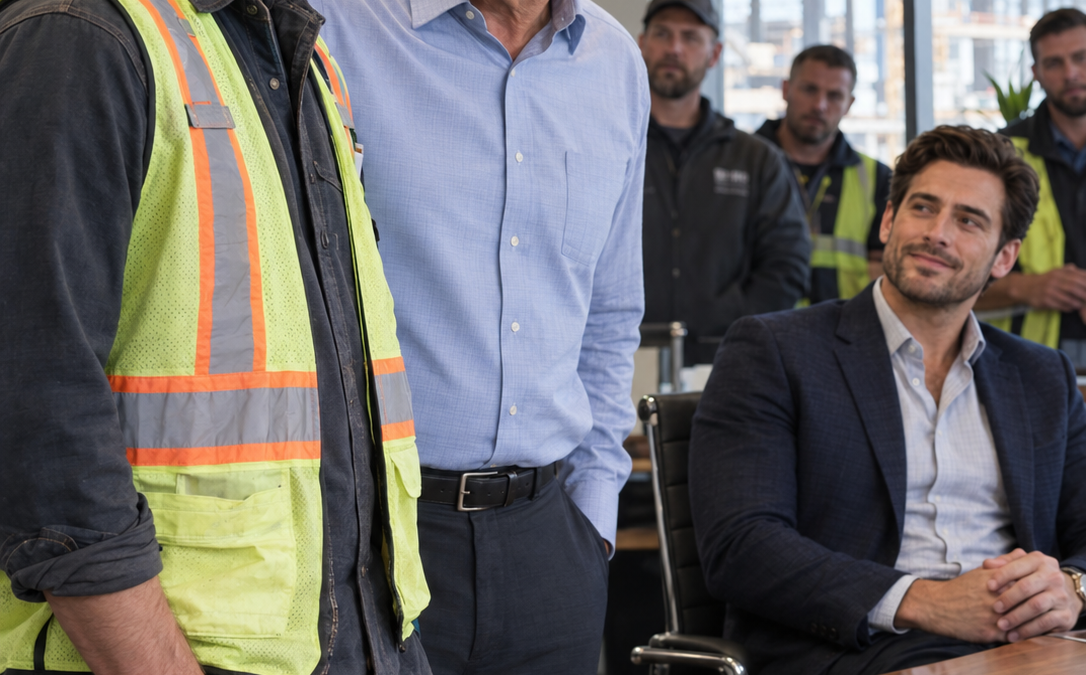
There are certain stories that strike a nerve with anyone who has ever worked hard for something, only to watch someone else walk away with the credit. This is one of them. It’s about a man who devoted twelve years of his life to his father’s commercial building services company. He started at the bottom, learned every part of the business, managed crews, handled permits, supervised projects, and earned his position through years of hard work.
Then his father retired and handed sixty percent of the company to his son-in-law, a man who had married into the family and had been involved in the business for only five years. His reasoning was simple: the son-in-law had a family to support.
Rather than walk away immediately, the son stayed. He continued doing his job while watching his brother-in-law gradually dismantle everything his father had spent nearly three decades building. Cheap materials replaced reliable ones. Undocumented workers appeared on job sites. Client invoices were inflated, and expenses began showing up for work that had never been performed. What his brother-in-law didn’t realize was that the quiet man he had pushed aside had been keeping meticulous copies of the company’s actual financial records.
Eventually, a building inspector discovered serious problems with a commercial renovation project. The resulting investigation uncovered far more than defective construction. State investigators became involved, followed by federal authorities. What began as an investigation into building violations ultimately exposed a much larger operation involving fraudulent records, unreported payroll, and questionable tax filings.
The consequences were devastating. Federal charges followed, a family business collapsed, and a retired father lost much of the income he had spent his working life preparing for. At the center of it all stood a man who had never raised his voice or made a public scene. Instead, he had quietly filled a filing cabinet with the truth.
This is his story.
I spent twelve years working for my father. When he retired, he gave my brother-in-law sixty percent ownership of the company and left me with forty. My brother-in-law proceeded to run the business through a series of fraudulent schemes, while I quietly preserved copies of the original financial records. Now he’s facing federal charges, and the company my father spent his life building is gone.
Before I tell you what happened, there’s something I need to make clear. I take no pleasure in any of it. People like to imagine stories like mine ending with the good guy opening a bottle of champagne, celebrating his victory, and enjoying the satisfaction of watching the villain get exactly what he deserves. Real life rarely provides that kind of ending. What it gives you instead are family dinners that never happen again, a father who refuses to answer your calls, and a sister who looks at you as though you personally burned down her house.
In a strange way, I suppose I did. Just not in the way she believes.
My name is Cole. I’m thirty-six years old, and for twelve years, I worked at Beckett Commercial Services, the company my father founded. We specialized in commercial renovations and building maintenance. Office buildouts, retail space overhauls, facility upgrades—anything involving the construction, renovation, or maintenance of commercial properties was generally within our wheelhouse.
My father, Warren Beckett, started the company in 1997. He rented a garage, bought the equipment he could afford, and hired exactly one employee: himself. Over the following years, he built it into a respectable regional business. By the time I joined at twenty-four, he had approximately fifteen employees, a solid list of clients, and a reputation for honest, dependable workmanship. We weren’t the cheapest contractor around, and we certainly weren’t the flashiest, but people knew what they were getting when they hired us. If Warren Beckett put his name on a project, that project would be done properly.
I need to explain exactly what my responsibilities were because they’ll become important later. When I started working for my father, I started at the bottom. And when I say the bottom, I mean it quite literally. During my first two years, I delivered materials, cleaned construction sites, organized the supply warehouse, and learned how to interpret permits and technical specifications. Being the owner’s son didn’t earn me special treatment. If anything, my father made me take the longer route because he wanted to be certain that nobody could accuse me of getting ahead simply because of my last name.
He had a saying he repeated so often that I can still hear his voice whenever I look at an invoice. If you couldn’t explain every single line on a materials invoice, you had no business putting your signature on it. He believed that a person had to understand the details before he could be trusted with responsibility, and he made sure I understood them. I learned how to estimate projects, schedule construction crews, negotiate with suppliers, deal with inspectors, and manage the inevitable last-minute changes that came with commercial contracting.
One particularly valuable skill was handling clients who suddenly decided, at four-thirty on a Friday afternoon, that they hated the color of a wall and wanted it repainted before Monday morning. You might think that sort of thing would be unusual, but it happened far more frequently than anyone outside the industry would imagine. People can become remarkably emotional about paint colors.
By my fifth year, I’d become a project supervisor. By my eighth, I was essentially running the company’s daily operations. I coordinated work schedules, maintained vendor relationships, helped manage payroll, inspected finished work, and made sure our crews had everything they needed to complete projects properly. My father continued handling the broader business responsibilities, including bids, accounting, and client meetings, but by my tenth year, I had begun participating in those discussions as well.
He didn’t invite me into them. I asked to be included because I wanted to understand the entire business, not merely the construction side. I wanted to learn how the company operated as a whole, from the first conversation with a potential client to the final payment on a completed project. I assumed that one day the business would pass to me, or at least that I’d eventually become its majority owner. I didn’t believe I deserved that simply because I was Warren Beckett’s son. I believed I’d earned it through twelve years of work.
Those twelve years meant early mornings, late evenings, missed vacations, and countless problems that nobody else wanted to handle. I rarely took time off. I didn’t call in sick whenever I felt tired or overwhelmed. I showed up because the company depended on people showing up, and I wanted to be someone my father could always rely on.
It’s easy to hear someone say they devoted twelve years to a business and think of it as nothing more than a number. But twelve years isn’t just a number. It’s a substantial part of a person’s life, measured in sacrifices, lost weekends, and decisions made because the company always seemed to need something more.
When I was twenty-seven, we were renovating an entire floor of an office building for an insurance company. Halfway through the project, the client’s fire suppression system malfunctioned during testing and flooded approximately three thousand square feet of flooring we’d just installed. It happened on a Saturday, when nobody was supposed to be working. I happened to be there because I’d decided to stop by and double-check the electrical layout.
I called my father immediately. He was attending my niece’s first birthday party. My older sister Laura’s daughter had just turned one, and he told me he’d come to the site on Monday morning. I didn’t blame him for wanting to stay at the party. But I also knew that waiting until Monday would turn a serious problem into a disaster.
For the next eleven hours, I coordinated with a water remediation company, photographed and documented the damage for the insurance claim, removed the compromised flooring before moisture could cause mold problems, and contacted our materials supplier to arrange an emergency replacement order. By the time my father arrived on Monday morning, the damaged flooring had already been removed, the affected area had been prepared for repairs, and the replacement materials were waiting in our warehouse.
He walked through the building, examined what I’d done, and looked at me. Then he gave a small nod and said, “Good man.”
That was all he said. Two words, no grand speech, no congratulations in front of the other employees. But coming from my father, those two words meant everything.
I should probably tell you about my sister before I go any further. Laura is three years older than I am, and she married a man named Greg Haynes approximately seven years ago. I want to describe Greg fairly, although being fair about him isn’t particularly easy after everything that’s happened. He’s the kind of man who has a better idea about absolutely everything. It doesn’t matter whether you’re discussing construction, finances, cooking, or something he knows next to nothing about. Greg will invariably suggest a shortcut, a workaround, or some acquaintance who can accomplish the same thing faster and cheaper.
He has a certain charm about him. I’ll give him that much. He possesses the effortless confidence of a successful salesman, the kind who can make you feel exceptionally intelligent simply for agreeing with him. My father loved that quality. He called Greg a natural go-getter and admired his ambition. My mother thought he was wonderful because he complimented her cooking and never forgot her birthday. Laura adored him, and I could understand why. When things were going his way, Greg could be genuinely likable.
Privately, I called him the Shortcut King. I never said it to his face, but the nickname seemed appropriate because practically everything he touched involved finding some way to skip a necessary step. Greg had no interest in understanding a process when he could jump directly to what he imagined the result should be. In small doses, that approach could look like efficiency. It could even pass for ambition. It wasn’t until he gained control of the company that I finally understood how dangerous it really was.
Greg joined Beckett Commercial Services about five years before my father retired. Unlike me, he didn’t start by sweeping floors or carrying materials. My father hired him as a business development associate, which sounded suspiciously like a job title Greg had invented himself. His official responsibility was finding new customers and bringing additional projects into the company. To be fair, he did manage to bring in some business, primarily through personal connections and bids that substantially undercut our competitors.
Unfortunately, those bids were frequently so low that the profit margins barely existed. Once we secured a contract, we still had to figure out how to complete the work within Greg’s unrealistic numbers. That inevitably created pressure to reduce expenses and compromise somewhere. I raised the problem with my father several times, explaining that winning contracts meant very little if we couldn’t complete them properly and make a reasonable profit.
He always brushed aside my concerns. Greg was simply aggressive, he told me, and eventually he’d learn how to balance competitive pricing with the realities of running a business. But Greg never learned that balance. He didn’t seem particularly interested in learning it.
Still, this was a family business, and Greg was family. I decided not to create unnecessary conflict. I kept doing my job, assuming we’d figure out our working relationship when my father eventually retired. After all, I had twelve years of practical experience. I knew the clients, the construction crews, the suppliers, and the building inspectors. I knew the projects we’d completed and the problems we’d encountered. I could walk into practically any building we’d worked on and tell you where the important pipes and electrical connections were located.
Greg had five years of networking, charming potential customers, and collecting business cards.
I wasn’t particularly concerned about competing with him. Looking back, I absolutely should have been.
Consider that situation for a moment. Cole spent twelve years learning his father’s business from the ground up, progressing from material deliveries and site cleanup to supervising projects and managing daily operations. Meanwhile, Greg married into the family, received a comfortable position with a custom-sounding title, and spent five years bringing in projects through questionable bids and friendly conversations over lunch.
It’s rather like watching one man build a house brick by brick while another stands nearby, occasionally offers advice, and eventually announces that he helped build the whole thing. Cole may be too polite to dwell on the distinction, but Greg truly deserves his nickname. This man doesn’t merely cut corners. He seems determined to eliminate the entire concept of geometry.
And then comes the day Warren Beckett announces his retirement.
My father announced that he was retiring on a Thursday. I remember the day specifically because we held our regular crew meeting every Thursday morning at seven, and he walked into that particular meeting wearing a collared shirt instead of his usual work jacket. That was the first indication that something unusual was happening. The second was Greg, who was already sitting in the room when I arrived.
Greg never attended our Thursday crew meetings.
My father stood in front of us and delivered a brief speech about his twenty-eight years building Beckett Commercial Services. He talked about how proud he was of what we’d accomplished and how much the business meant to him. Then he explained that the time had come for him to step away and enjoy the life he’d spent so many years working to create.
My mother’s health had become a concern. She’d undergone knee replacement surgery the previous year, and her recovery was taking longer than expected. My father wanted to spend more time at home with her. He also wanted to travel, enjoy his grandchildren, and experience retirement while he was still healthy enough to appreciate it.
I understood all of that. More than that, I was genuinely happy for him. He’d worked hard throughout his entire adult life, and if anyone deserved the opportunity to slow down, it was my father.
Then he began talking about the company’s ownership.
He explained that he’d considered the decision carefully and believed Beckett Commercial Services needed strong leadership to carry it into the future. He’d therefore decided to divide ownership between Greg and me. I would receive forty percent of the company. Greg would receive sixty percent.
I didn’t react. At least, nothing showed on my face. I’ve always been the kind of person who processes things internally before responding to them. My expression tends to remain calm even when my mind is racing through a dozen different thoughts. So I sat in my chair, nodded occasionally, and listened as my father explained the reasoning behind his decision.
Greg, he reminded everyone, had a growing family to support. Laura was pregnant with their second child at the time, and my father believed that giving Greg majority ownership reflected both his family’s needs and the direction the company should take. Under the new arrangement, Greg would be responsible for operations and business development. I would continue working as a project supervisor.
That last part stayed with me.
Continue as a project supervisor.
I’d already been performing that role for seven years. Despite everything I’d learned, everything I’d managed, and every responsibility I’d taken on, my position would remain essentially unchanged. No promotion. No expanded authority. No opportunity to take over the operations I’d already spent years helping to run. I would simply continue doing what I’d been doing, this time under the authority of my brother-in-law.
I understood the family reasoning, at least as my father saw it. Greg had children, and I was single with no dependents. In my father’s mind, it was a straightforward calculation. Greg needed more financial security, so Greg should receive a larger share of the business.
My twelve years with the company apparently didn’t factor into that calculation. Neither did my practical knowledge, my relationships with our employees and suppliers, or my ability to identify problems on a construction site before they became expensive disasters. It didn’t matter that I’d turned down two job offers from competing firms because I believed I had a future at Beckett Commercial Services.
None of that seemed to carry much weight. Greg had a family photograph sitting on his desk. I had a coffee mug.
After the meeting, my father asked me to stay behind. He approached me, placed a hand on my shoulder, and gave me the familiar look fathers sometimes have when they’re preparing to say something they know their sons won’t want to hear.
He asked whether I understood his decision. Greg needed the opportunity, he explained. I was strong, capable, and independent, and he had every confidence that I’d be fine.
There was that word again. Fine. It’s such a convenient word, especially for people who would rather not examine whether someone actually is fine.
I told my father that I understood. And I did understand. I understood his reasoning, his assumptions, and the decision he’d made. I simply didn’t agree with any of it.
There’s something else that happened that day. It doesn’t directly affect the outcome of this story, but I’ve thought about it many times since. On my way home after the retirement announcement, I stopped at a gas station to fill my truck. A woman at the neighboring pump was struggling with the gas cap on her car. It was an older vehicle, one of those models with a cap that sometimes sticks. I walked over and helped her open it.
She thanked me, then looked at my face and remarked that I seemed to be having a difficult day. Without thinking, I told her I was fine. She gave me an amused look and said that nobody who answered that quickly was ever actually fine.
We both laughed. She finished filling her car, got in, and drove away. I never saw her again.
But I’ve never forgotten that brief conversation because a complete stranger at a gas station managed to understand my emotional state in ten seconds better than my own father had managed to understand it in twelve years.
Imagine spending twelve years playing a video game. You complete every side quest, master every skill, maximize every statistic, and memorize every corner of the map. Then, just as you’re preparing to reach the highest level, the developer logs into the game, examines your account, and decides to give your friend—who joined five years ago and mostly spends his time hanging around the lobby—administrative privileges and sixty percent of the rewards.
Why? Because your friend has more characters to feed.
Meanwhile, your reward for twelve years of grinding is permission to keep playing in exactly the same position, reporting to the man who never even bothered to finish the tutorial.
That’s essentially what happened to Cole. His father’s retirement arrangement wasn’t merely a disappointing business decision from his perspective. It was the culmination of twelve years of effort being handed over to someone who hadn’t made anything close to the same investment. And while Cole sat quietly, processing the betrayal internally, Greg was about to demonstrate precisely what happens when a man obsessed with shortcuts gains control of an entire company.
I remained at Beckett Commercial Services for fourteen months after my father retired. I want to explain exactly what I witnessed during those fourteen months because the details are essential to understanding everything that happened afterward.
The first major change Greg made came within two weeks of taking control. He began replacing our established suppliers. My father had spent years developing relationships with companies that provided reliable materials at reasonable prices, and those relationships were part of the foundation of our business. We knew what we were purchasing, we understood the quality of the products, and we could count on deliveries arriving when we needed them. Greg discarded three of our primary suppliers almost immediately and replaced them with companies whose names I’d never heard before.
When I asked why, he explained that the new suppliers offered better rates. Technically, he wasn’t lying. Their prices were lower. Unfortunately, so was the quality of their merchandise.
The difference became apparent as soon as the first shipments arrived. We were receiving cheaper fasteners, lower-grade finishes, and substitute products that appeared nearly identical on specification sheets but performed very differently once installed. On a small residential renovation, those differences might have escaped the average customer’s attention. On a commercial project, where building codes, engineering specifications, and professional inspections determined whether a building could legally be occupied, those differences could create enormous problems.
I explained my concerns to Greg, but he dismissed them as unnecessary worrying. In his opinion, the clients wouldn’t notice the difference. We weren’t building rocket ships, he reminded me, as though the absence of aerospace engineering requirements somehow justified using inferior construction materials.
That became his favorite response whenever I questioned his decisions. Whether I raised concerns about materials, scheduling, or staffing, Greg invariably reminded me that we weren’t building rocket ships. Apparently, his definition of acceptable workmanship was that the finished product didn’t immediately explode.
The second major change involved our construction crews. My father had always insisted that everyone working on our projects be properly documented, included in our payroll records, and covered by the appropriate insurance. Maintaining that system cost more money, but it also protected the company when something went wrong. Construction is an industry where accidents, liability disputes, insurance claims, and regulatory inspections are facts of life. My father understood that trying to save a little money by ignoring those responsibilities could eventually cost far more than we’d saved.
Greg saw the situation differently. He began bringing in additional workers who weren’t included on our payroll. They were paid in cash, had no proper employment documentation in our records, and weren’t covered by the workers’ compensation arrangements we’d maintained under my father’s management.
I discovered the situation when I arrived at a commercial renovation site downtown. We were overhauling a three-story office building for a property management company, and I expected to find the crew I’d assigned to the project. Instead, there were eight unfamiliar men working on the premises. I didn’t recognize any of them. They weren’t listed in our employee management system, and none of them had company identification.
When I asked the site supervisor who they were, he told me Greg had sent them.
I went directly to Greg and demanded an explanation. He told me he’d decided to supplement our regular crews with independent labor to reduce costs and keep projects moving. When I asked whether these new workers were insured, he shrugged off the question. They were independent contractors, he said, so their insurance was their own responsibility.
That was an astonishingly simplistic way of looking at commercial construction liability. As the general contractor, our company had legal and contractual responsibilities involving everyone performing work under our supervision. If one of those undocumented workers fell from a scaffold or suffered a serious workplace accident, Beckett Commercial Services could find itself facing enormous financial exposure.
I explained that to Greg in terms that I believed were impossible to misunderstand. He told me to relax. He had everything under control, and I should stop worrying about problems that didn’t exist.
Then he said something I’ve never forgotten. I should worry about the walls, he told me, and leave the wallet to him.
The third major change involved our invoices, and that’s where the situation became considerably more serious.
My responsibilities included a substantial amount of project administration. I reviewed material orders, maintained delivery confirmations, coordinated change orders, and handled much of the documentation associated with ongoing jobs. Roughly four months after Greg assumed control, I began noticing discrepancies between the actual cost of our projects and the invoices being submitted to clients.
These weren’t minor discrepancies caused by rounding, clerical mistakes, or differences in how expenses were categorized. The amounts were significantly higher than our documented project costs.
Materials that had cost eight thousand dollars were being billed to clients at twelve thousand. Jobs requiring two hundred documented labor hours were being invoiced as though they’d required three hundred and fifty. Certain invoices even included charges for services that, according to every record I could locate, had never been performed at all.
Phantom expenses. Labor hours that didn’t exist. Charges that couldn’t be reconciled with the work we’d actually completed. The numbers simply didn’t make sense.
I started investigating the discrepancies myself. I retrieved the original purchase receipts, obtained copies of our suppliers’ invoices, and reviewed the time sheets for the construction crews I directly supervised. Then I compared those documents, line by line, against the invoices Greg was sending to our clients.
The discrepancies weren’t isolated incidents. They formed a consistent pattern. Project after project had been overbilled by approximately thirty-five percent, and the differences were too substantial and too repetitive for me to dismiss as ordinary accounting errors.
I didn’t immediately confront Greg. I realize that might seem strange, especially knowing what ultimately happened, but I wanted to understand the full extent of the problem before I did anything. I’d spent twelve years learning the importance of documentation, and I wasn’t prepared to make accusations I couldn’t substantiate.
So I began doing what I’d always done when faced with a complicated situation. I collected information and documented everything.
For three months, I maintained two parallel sets of records. One reflected the company’s actual transactions, while the other reflected the figures Greg was reporting. I preserved receipts, supplier invoices, labor records, and client billing statements. Whenever possible, I made copies of the original documents and compared them against the corresponding entries in Greg’s records.
I kept the information on a personal drive, completely separate from the company’s servers. That drive stayed at my apartment. I also created duplicate copies and organized everything by project number, date, and supplier. Every document had a place, and every discrepancy could be traced back to its underlying records.
I didn’t announce what I was doing. I didn’t discuss it with my coworkers or approach my family with dramatic accusations. I simply continued gathering evidence.
During that process, I discovered another disturbing problem. Greg was reporting fewer employees to the state than were actually working on our projects. The workers he’d hired and paid in cash didn’t appear in the company’s official employment records. From the government’s perspective, many of them effectively didn’t exist.
That meant Greg wasn’t paying the required payroll taxes associated with their work. It also created significant inconsistencies between the revenue generated by our projects and the labor expenses reflected in the company’s books. The more closely I examined the records, the clearer it became that we weren’t dealing with a few questionable business decisions. We were dealing with fraudulent financial reporting.
I want to emphasize something about my decision to preserve those records. I wasn’t assembling them because I wanted revenge against Greg. I wasn’t planning some elaborate scheme to humiliate him or take back control of the company. I kept the records because twelve years of watching my father run an honest business had taught me that the practices Greg was adopting would eventually catch up with him.
Building inspectors talk to one another. Clients compare experiences. Regulatory agencies maintain records, and financial discrepancies have a way of attracting attention when enough of them accumulate. I didn’t know exactly when or how the situation would unravel, but I was increasingly certain that it would.
When that day arrived, I wanted the truth to be available. More than anything, I wanted there to be an accurate record of what had happened to my father’s business. The Beckett name still meant something to me, even if Greg’s decisions suggested that it meant considerably less to him.
There are different ways people respond when they recognize that a disaster is developing. Some immediately confront the problem, hoping to extinguish it before it grows. Others recognize that the situation may already be beyond their ability to control and begin documenting what is happening so that, when the consequences arrive, nobody can pretend they came without warning.
Cole belonged to the second group. He watched Greg inflate invoices, evade payroll obligations, and bring undocumented workers onto commercial construction sites. But instead of creating a dramatic confrontation, he spent three months building a detailed archive. Every receipt, invoice, and time sheet became another piece of a much larger picture.
That wasn’t simply a matter of being patient. Cole had spent twelve years learning how an honest construction company was supposed to operate. His father had taught him the correct procedures so thoroughly that he could recognize exactly how far Greg had departed from them. And while Greg continued looking for shortcuts, Cole quietly preserved the information that would eventually reveal where those shortcuts had led.
I left Beckett Commercial Services fourteen months after Greg received majority ownership. There wasn’t a dramatic confrontation or a particularly memorable final argument. I’d certainly imagined one. More than once, I’d pictured myself walking into Greg’s office, slamming a stack of incriminating documents onto his desk, and delivering some devastating speech before walking out.
But I’m not that kind of person, and no amount of frustration was going to turn me into someone who enjoyed theatrical exits.
Instead, I submitted my resignation, gave two weeks’ notice, and did everything I could to ensure an orderly transition. I trained the man hired to replace me, a younger employee named Dennis who seemed capable and intelligent, although he had absolutely no idea what kind of situation he was entering. Then I packed my belongings and cleared out the desk I’d been using for most of my professional life.
I’d had the same desk for ten years. It had an oak top, one leg that never stopped wobbling, and an old coffee stain that vaguely resembled the state of Ohio. As I packed, I briefly considered taking the nameplate that had sat on it for so long. In the end, I left it behind. Taking it seemed unnecessarily sentimental, and I felt that the circumstances demanded a clearer head.
Greg made no effort to convince me to stay. If anything, he appeared relieved that I was leaving. The man who kept questioning his decisions, pointing out discrepancies, and reminding him about construction standards was finally going to be someone else’s problem.
Before I left, he asked whether there were any hard feelings between us. I told him there weren’t. It was a lie, of course, but a relatively small one considering everything else that had happened.
I accepted a position with another construction firm on the other side of town. The salary was better, the daily frustrations were considerably fewer, and, perhaps most importantly, I didn’t have a brother-in-law running the business. I enjoyed the work. I knew I was good at it, and I made a deliberate effort to concentrate on building a new professional life rather than worrying about what Greg was doing with my father’s company.
Unfortunately, deliberately trying not to think about something is often the most reliable way to ensure that it remains in your thoughts.
Every time I drove past one of our former construction sites, I found myself wondering what might be happening behind the walls we’d installed. Whenever someone in the industry mentioned Beckett Commercial Services, my attention sharpened immediately. I could be halfway through an entirely unrelated conversation and still recognize the company name as clearly as a dog recognizes the sound of a can opener.
I also began hearing things. I wasn’t actively investigating Greg or contacting former employees in search of information. The construction industry in our region simply wasn’t large enough for news to remain isolated, and I continued interacting with many of the same professional contacts I’d known for years.
One of our longtime suppliers told me that Greg had begun paying invoices late. A project manager at another construction firm mentioned that Beckett had recently underbid his company on a government contract by an amount that made no mathematical sense. Those conversations reinforced my suspicions, but there wasn’t anything useful I could do with secondhand information. I made mental notes and continued with my life.
My father called several times during that period. Our conversations were ordinary and superficial. We talked about the weather, sports, my mother’s knee, and whatever else seemed unlikely to cause an argument. He never directly asked me why I’d left the company. I suspected he knew, at least on some level, but preferred not to have his suspicions confirmed.
Fathers can be peculiar that way. Sometimes they recognize the truth as soon as they walk into a room but spend the rest of their time rearranging the furniture so they don’t have to look directly at it.
Laura called me once as well. She said it was unfortunate that I’d decided to leave and insisted that Greg was trying very hard to make the business successful. I responded politely and changed the subject. By then, I had no interest in arguing with my sister about her husband’s management decisions. I doubted that anything I said would change her opinion.
Seven months after I left the company, Dennis called me.
I could hear the tension in his voice before he’d even finished explaining why he was calling. A building inspector had discovered serious problems with one of Beckett’s commercial projects. It was the three-story office building downtown, the same project where I’d first encountered the eight unfamiliar workers Greg had hired.
The inspector had identified substandard construction materials, building code violations, and structural concerns significant enough to halt the project. The property management company that had hired Beckett was furious, and the city had issued a stop-work order. To make matters worse, the inspector had referred the findings to the state for further investigation.
Dennis sounded overwhelmed. I felt sorry for him. He was a competent young man who’d accepted what he probably believed was a promising position with an established construction company, only to find himself caught in a situation he hadn’t created and couldn’t easily control.
I told him I was sorry about what had happened, explained that I couldn’t offer much assistance from my new position, and wished him luck.
After ending the call, I remained in my truck in the parking lot outside my new office. For approximately twenty minutes, I sat behind the steering wheel, staring straight ahead and thinking about what was coming.
I’d known that Greg’s decisions would eventually have consequences. But knowing something in theory is very different from hearing the first unmistakable evidence that those consequences have finally arrived.
What I’d been expecting came approximately three months later.
A state investigator called me and introduced herself. She explained that her office was examining Beckett Commercial Services following the issues uncovered during the building inspection. Because I’d worked for the company during the period under review, she wanted to know whether I’d be willing to answer some questions.
I agreed.
Then she asked whether I possessed any documentation concerning the company’s operations during my employment. I told her that I had extensive records.
There was a noticeable pause. For a moment, the only sound I could hear was her breathing on the other end of the line. Then she asked me exactly how extensive those records were.
I told her everything.
I explained that I’d maintained parallel financial records showing discrepancies between actual project expenses and the figures reported in the company’s invoices. I described the inflated billing statements, undocumented workers, fabricated expenses, and inconsistencies between labor hours actually performed and labor hours charged to clients.
I also told her about the changes in suppliers, the use of inferior materials, the cash-paid construction crews, and the discrepancies involving payroll and tax reporting. I explained that I’d preserved copies of the relevant documents, organized them by project and date, and maintained records that could be cross-referenced against the company’s reported figures.
I offered to provide all of it.
She asked whether I could come to her office. I went the following day, carrying two banker’s boxes filled with documents and a flash drive containing the electronic records.
The investigator’s name was Patricia. She was calm, precise, and exceptionally methodical. She had the sort of professional composure that made me suspect she used a pen that cost considerably more than my wristwatch. We spent approximately four hours reviewing the information I’d brought. She examined the documents, asked detailed questions, made notes, and obtained copies of everything I provided.
At one point, she stopped reading, looked at me over the top of her glasses, and remarked that I’d maintained remarkably thorough records.
I told her my father had taught me to do that.
She nodded, returned her attention to the documents, and continued working.
Those records eventually became evidence in the state’s investigation. From that point forward, the inquiry expanded beyond the original building inspection findings. State authorities discovered financial discrepancies substantial enough to involve federal investigators, particularly because the tax-related issues extended beyond ordinary construction regulation.
I don’t know everything that happened behind the scenes. My direct involvement was largely limited to providing the initial evidence and explaining the records I’d preserved. I wasn’t part of the investigative team, and I wasn’t privy to every discussion between state and federal authorities. Most of what I learned afterward came from information that eventually became public record and from occasional conversations with Dennis before the investigation grew too serious for informal updates.
Greg was eventually charged with multiple counts involving tax fraud, falsified business records, and wage-reporting violations. The investigation revealed that the inflated client invoices weren’t merely a matter of overcharging customers. They also contributed to financial reports that misrepresented the company’s actual revenues and expenses, creating discrepancies that carried over into its tax filings.
The undocumented workers presented an entirely separate set of problems. Their employment wasn’t simply an insurance liability. Investigators treated the off-the-books labor arrangements as part of a broader scheme involving payroll tax evasion and inaccurate employment reporting.
According to the state’s calculations, Greg had underreported approximately three hundred thousand dollars in payroll over a two-year period. The federal charges were connected to false tax returns filed during that same general timeframe.
On paper, it probably sounds like an extremely satisfying outcome. A man who mistreated someone finally gets caught. The misconduct is exposed, the evidence reaches the authorities, and the person responsible finds himself facing serious legal consequences. You could describe it as justice, karma, or whatever other term makes the situation sound like a neatly resolved story.
But that’s not how it felt to me.
Watching the investigation unfold was more like standing outside a burning house. Not just any house, but the house where you’d grown up, the house you’d spent years helping to build and maintain. You might not have started the fire. You might even have recognized the danger long before anyone else was willing to acknowledge it. But none of that changes the experience of standing there while something you love is consumed.
And somewhere in the back of your mind, no matter how hard you try to dismiss it, there’s a question that refuses to disappear. What if you’d done something differently? What if you’d tried harder to stop the fire instead of concentrating on documenting how it started?
Maybe you could have saved something. Maybe you couldn’t have changed a thing.
The problem is that once everything is gone, you don’t get the opportunity to find out.
And then there’s the part that still keeps me awake at night: my father’s pension.
When my father retired, his financial arrangement included a deferred compensation plan tied to the company’s continuing performance and financial standing. Essentially, Beckett Commercial Services was supposed to make regular contributions to a fund that would provide him with monthly retirement income. It was part of the financial security he’d spent twenty-eight years working toward, and it depended on the company continuing to fulfill its obligations after he stepped away.
Greg stopped making those contributions almost immediately. Instead of depositing the required money into the retirement fund, he redirected it elsewhere.
When the federal investigation began, the company’s accounts were frozen. The deferred compensation fund, or whatever remained of it by that point, became entangled in the investigation. My father’s retirement income was suddenly connected to the same financial misconduct that had brought the business to the attention of state and federal authorities.
He lost most of his pension.
Not all of it, fortunately. Certain legal protections applied, and his attorney managed to separate a portion of the remaining retirement funds from the company’s broader financial liabilities. But the monthly income my father had expected to receive for the rest of his life was reduced by approximately sixty percent.
Think about that for a moment. My father started Beckett Commercial Services in a rented garage with almost nothing. He spent twenty-eight years building it into a respectable business. He worked long hours, made difficult decisions, and established a reputation based on honesty and dependable workmanship. He taught me that a company’s integrity was more valuable than any individual contract because, once customers stopped trusting your name, the rest of the business would eventually collapse.
That same man now has to live on a fraction of the retirement income he worked so hard to secure because the son-in-law he entrusted with his life’s work treated the company as though it were his personal bank account.
I haven’t spoken to my father in five months.
During our last conversation, he told me that he’d trusted Greg. Then he added that he’d trusted me, too. I asked him what he meant, and his answer has stayed with me ever since. He said I could have warned him before things became so bad. I could have approached him, explained what was happening, and given him an opportunity to intervene.
Then he hung up.
That’s the part of stories like mine that people rarely consider. Everyone wants the ending to be simple. The hero wins, the villain loses, justice is served, and the credits roll. There should be some reassuring final moment when the people who made the right decisions are rewarded and the people who made the wrong ones finally recognize their mistakes.
Real life doesn’t work that way.
My father blames Greg for everything he did to the company, but he also blames me for not stopping him sooner. And the more time passes, the less certain I become that my father is entirely wrong.
I had the records. I knew about the inflated invoices, the questionable employment arrangements, and the financial discrepancies. I documented what was happening, preserved the evidence, and made sure I could prove that the reported figures didn’t match reality. But I never raised the alarm in a way that might have allowed my father to intervene before the situation became irreversible.
I never sat him down, put the documents in front of him, and told him exactly what was happening to the business he’d spent his life building.
At the time, I convinced myself that I was being strategic. I believed that gathering comprehensive evidence was more important than making accusations Greg would undoubtedly deny. I thought that if the situation eventually attracted official scrutiny, having complete and reliable records would be considerably more valuable than having warned someone who might not have believed me.
Perhaps I was right about that part. Those documents became evidence in a state investigation and helped authorities build a federal case. But they didn’t save my father’s pension, and they certainly didn’t preserve my relationship with him.
My sister no longer speaks to me, either. Laura holds me responsible for much of what happened, and although I disagree with her, I can understand why she feels the need to blame someone.
Her husband is facing federal charges. The business that supported her family has collapsed, and the life she believed they were building together has been thrown into uncertainty. Everything familiar has suddenly become unstable. From her perspective, she needs someone to hold responsible, and blaming me is considerably easier than confronting what Greg’s actions might mean about the man she married.
If she accepts that Greg deliberately created the situation, she also has to confront the implications for her marriage and her family’s future. Being angry with her brother offers her an easier explanation, even if I believe it’s the wrong one.
I don’t expect her to see it that way anytime soon.
Greg’s case is still working its way through the legal system. I don’t know what the final outcome will be, and I’ve learned enough from watching the investigation to avoid making confident predictions about how legal proceedings will end.
From what I’ve heard, his attorney is arguing that the billing discrepancies resulted from accounting errors and that the workers paid in cash were independent subcontractors rather than unreported employees. To me, that explanation sounds suspiciously like someone claiming he didn’t rob a bank but merely made a withdrawal without authorization.
I find it difficult to believe that the explanation will account for everything investigators uncovered. The records I preserved were extensive, and the financial discrepancies followed a consistent pattern. Still, legal proceedings are complicated, and the justice system moves slowly and sometimes unpredictably. Whatever happens next will ultimately be determined through that process.
Meanwhile, Beckett Commercial Services has effectively ceased to exist as an operating business. Once the stop-work order became public and news of the investigation began circulating, the company’s contracts gradually disappeared. Clients stopped hiring us, existing business relationships deteriorated, and the remaining work was no longer sufficient to keep the operation running.
Our employees, the legitimate ones whose employment had been properly documented and who’d spent years performing honest work, eventually found positions elsewhere. Dennis landed a job at another construction firm similar to the one where I now work, which was a relief. He’d been caught in an impossible situation through no fault of his own, and I was glad he managed to get out.
The Beckett name, which my father had spent twenty-eight years turning into a symbol of reliable workmanship, had become associated with fraudulent financial practices and building code violations. In an industry where reputation often determines whether a customer trusts you with a project, the damage was enormous.
That was the legacy Greg left behind.
As for me, I’m doing reasonably well. I’m still employed at the firm I joined after leaving my father’s company. The work is good, my responsibilities are clear, and I feel respected in a way I never completely experienced at Beckett. Looking back, I think the people there probably did respect my abilities, but being the owner’s son created a shadow I could never entirely escape.
No matter how hard I worked, there was always the possibility that someone would assume my position had something to do with my father rather than my own capabilities. Even when nobody said it aloud, I was conscious of that perception. I felt compelled to prove myself repeatedly, as though twelve years of practical experience could somehow become less valuable simply because the company happened to have my family’s name on it.
At my new firm, none of that matters. I’m simply Cole, the guy who arrives early, stays late when necessary, and notices problems that other people sometimes overlook. My colleagues know me through my work rather than my family connections. My reputation belongs to me, and I’ve discovered that I genuinely prefer it that way.
About a month ago, I had a conversation with my new boss that I’ve found myself thinking about quite often. We’d just finished reviewing a project when she asked how I’d originally gotten into commercial construction. I gave her the abbreviated version of my professional history. I’d grown up around the industry, worked for my father, and eventually decided to move on.
She repeated that last part thoughtfully. I’d moved on from a family business. In her experience, she said, there was usually an interesting story behind a decision like that.
I admitted that there was.
She didn’t press me for details, which I appreciated. Instead, she offered an observation. In her experience, people who leave family businesses generally fall into one of two categories. Either they couldn’t manage the work themselves, or they couldn’t bear to continue watching someone else demonstrate that same inability.
I didn’t tell her which category I believed I belonged to.
I had a feeling she already knew.
I still think about my father constantly. Sometimes I wonder whether I should have confronted Greg directly the moment I discovered the first discrepancies. Other times, I question whether I should have approached my father before leaving the company, placed all the evidence in front of him, and demanded that he examine what was happening. Perhaps I should have contacted state authorities myself instead of waiting until a building inspector discovered the problems that eventually triggered the investigation.
There are countless decisions I can revisit now that I know how everything turned out. Unfortunately, hindsight doesn’t provide the ability to change any of them.
I also find myself thinking about that woman at the gas station. A complete stranger looked at me for a few seconds and recognized that I wasn’t nearly as fine as I claimed to be. She saw something my father either couldn’t recognize or didn’t want to acknowledge. I’ve wondered more than once whether things would have been different if I’d been more willing to admit how I actually felt instead of swallowing my disappointment and continuing to work.
Then I think about the ownership arrangement. My father gave sixty percent of his life’s work to a man who managed to dismantle it in less than two years. He gave me the remaining forty percent, but the inheritance that ultimately mattered most had nothing to do with ownership percentages. It was everything he’d taught me about loyalty, competence, diligence, and professional integrity.
Those lessons turned out to be worth more than the majority ownership he’d handed to Greg.
And then, inevitably, I think about the boxes of records still sitting in my closet.
They’re the copies of the copies, the documents I preserved when I first realized something was wrong. They contain the actual financial records, the original invoices, and the supporting information that shows what really happened, rather than the version of events Greg wanted everyone to believe.
I assembled that archive over three months, spending my evenings at the kitchen table after returning home from work. I sorted receipts, organized project documents, and cross-referenced invoices until I could account for every discrepancy I’d identified.
It wasn’t glamorous work. Most evenings, it was tedious and repetitive. There was no satisfying confrontation, no dramatic revelation, and certainly no guarantee that anyone would ever need to examine what I’d collected.
But it may have been the most important work I’ve ever done.
I didn’t do it because I wanted revenge. I didn’t do it because I wanted to see Greg destroyed or because I believed exposing his actions would somehow return the company to me.
I did it because my father raised me to believe that financial records should always reflect the truth, even when the people responsible for those records are unwilling to tell it.
I just wish that truth hadn’t cost him so much.
And there it is. Cole spent twelve years learning the importance of integrity from a man who’d built an entire company around that principle. He started at the bottom, worked his way into management, and devoted a substantial part of his adult life to maintaining the standards that had made his father’s business successful. Then he watched Greg, the man who’d always preferred shortcuts, dismantle much of that work in less than two years.
Greg didn’t merely manipulate financial records or exploit the opportunities created by his position. He betrayed the trust of the man who handed him control of the company in the first place.
And the quiet son, the one everyone assumed would be fine because he always seemed capable of handling whatever came his way, turned out to be the only person preserving an accurate account of what was happening.
The records became evidence. The company disappeared. The father’s retirement income was devastated, and the family relationships that had surrounded the business were fractured almost beyond recognition.
Perhaps the most painful irony is that Warren believes his son should have warned him. In a sense, Cole did recognize and repeatedly warn the people around him about Greg’s dangerous decisions. He raised concerns over inadequate bids, inferior materials, undocumented workers, and the company’s increasing exposure to serious liability. But when those concerns were dismissed, he stopped arguing and started documenting.
His father still doesn’t appear to understand what that silence represented, or how much information Cole was preserving while everyone else continued trusting the man in charge.
Sometimes the most significant warning doesn’t come from the person making the loudest accusations. Sometimes it comes from the person who stops talking, begins paying attention, and quietly writes everything down.
And that’s where Cole’s story leaves us.
There isn’t a triumphant final scene. Nobody gets to open a bottle of champagne, celebrate a perfect victory, or walk away knowing that everything has been put right. Cole maintained the records, preserved the evidence, and eventually helped authorities uncover what had been happening inside Beckett Commercial Services.
But the truth came with consequences that extended far beyond Greg’s legal troubles. A father lost most of his pension. A sister’s marriage and family life were thrown into turmoil. A once-respected business disappeared, and the family that had built its life around that company no longer sits together at the same dinner table.
That’s one of the most destructive things about fraud. Its effects rarely remain confined to financial statements or legal proceedings. When a business depends on relationships, professional reputations, and the trust people place in one another, financial misconduct can destroy far more than the company itself. It can undermine the very relationships on which that company was built.
Which brings us to the question at the heart of this story.
If you’d been in Cole’s position, would you have approached your father earlier with the evidence you’d discovered, even knowing that he might have refused to believe you and chosen to defend Greg instead? Would you have risked creating a family confrontation in the hope of stopping the damage before it became irreversible?
Or would you have done what Cole did—remained quiet, carefully preserved the records, and allowed the situation to develop until the authorities eventually uncovered the misconduct themselves?
Is there an alternative version of this story in which Cole manages to save both the company and his relationship with his family? Could an earlier confrontation have changed what happened, or had his father’s decision to hand majority ownership to Greg already set the business on a path toward disaster?
Those are difficult questions, and they’re worth considering because situations like this rarely offer simple answers. Looking back, it’s easy to identify decisions that might have been made differently. Living through those decisions, particularly when they involve your livelihood and the people you love, is something else entirely.
Share your perspective in the comments. I’m genuinely interested in hearing how other people would have handled Cole’s situation, and I read every response.
And if this story struck a personal chord—if you’ve ever worked tirelessly to build something, only to watch another person receive an opportunity or recognition they never earned—then you’ll understand why Cole’s experience is about more than a failed family business.
It’s about trust, sacrifice, resentment, and the painful realization that doing what you believe is right doesn’t guarantee that everyone will thank you for it.
If you found the story meaningful, hit the like button and subscribe if you haven’t already.
I’ll see you in the next one.








