I quit my job and lost my home caring for my dying stepfather. His two sons never visited. After he died, they threw my suitcase out. “You’ve served your purpose. Get lost!” I didn’t argue. Three days later, his lawyer opened the will. He read the first line. Both brothers shot to their feet: “He can’t do that!”
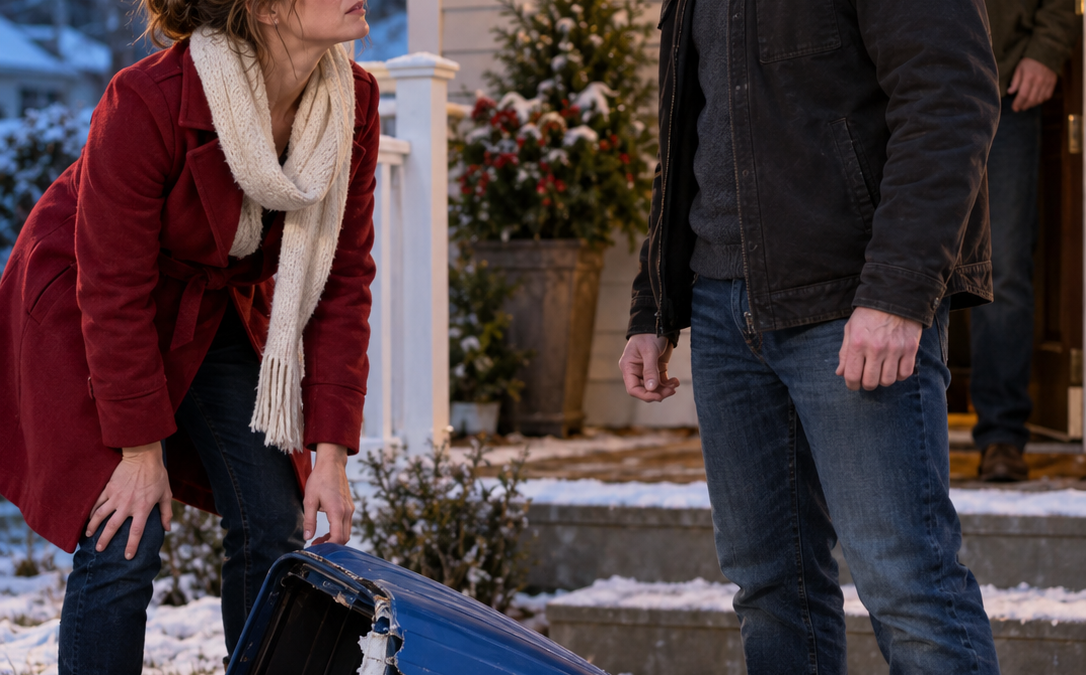
“You’ve served your purpose. Get lost.”
That is what my older stepbrother said the night of the funeral as he threw my mother’s blue suitcase off the porch.
The latch that had held for thirty years broke against the frozen grass. My clothes spilled into the yard. His brother stood in the doorway and nodded.
For sixteen months, I had fed their father, bathed him, and sat up with him through the nights. One of them lived an hour and fifteen minutes from that bed. Neither of them ever made the trip.
I turned in my badge at the school district payroll office after eleven years. I gave up the duplex I had rented for eleven years so that man would not die alone.
I picked my things up off the lawn, and I did not argue.
They took the silence for defeat.
They did not know what he had been keeping in the old mail tray beside his bed, or what he had written down from the cards that arrived at the house in his name.
Three days later, in a lawyer’s office in Seymour, Indiana, the first line of the will was read.
Both brothers shot to their feet.
“He can’t do that.”
He could.
My name is Tilly Reed. I’m forty-three years old. If you’re new here, hit subscribe. I tell these stories every day, and I would hate for you to miss the next one.
Then tell me in the comments where you’re watching from, and answer me this while you’re there: If the ones who never came called you disposable the night you buried him, would you stay silent too?
That suitcase had been my mother’s since the spring of 1994.
She bought it for her honeymoon, a blue hard-shell case with a latch that closed with a sound like a door being locked. I was ten years old, one week short of eleven, standing in a backyard in Seymour in a dress I hated, watching a quiet man carry that suitcase to the car as if it held something that could break.
His name was Earl Whitaker.
He had just married my mother, Ruth.
I did not know what to call him, and I had been worrying about it for weeks. He must have seen it on my face because he set the suitcase down, crouched to my height, and said, “You can call me whatever feels true. I’ll answer to it.”
I called him Earl.
I called him Earl for the next thirty-two years.
And he answered every time.
At the back of that yard, near the fence, two young men in suits stood apart from everyone else. When the guests clapped, they didn’t.
I already knew Earl by then because of Saturdays.
He was a rural mail carrier. For thirty-four years, he delivered the mail on the county roads outside town in his own Jeep, the kind with the steering wheel on the right side so he could reach the boxes.
The fall before the wedding, when he was still just the man taking my mother to dinner, he started letting me ride along.
He wasn’t supposed to. The post office had a rule about passengers.
But on a Saturday morning on a gravel road in southern Indiana, some rules had a little give in them.
I sat on the left with a white plastic mail tray on my lap, and my job was to hand him each bundle in order.
“Line of travel,” he called it.
The mail goes in the tray in the order the boxes come up on the road, not in alphabetical order.
“Every address is a person, Tilly,” he told me. “You get the address wrong, you’ve let a person down.”
And he knew the people.
He knew who was sick. He knew who was waiting on a letter from a son in the Navy.
One Saturday, he stopped at a box that was stuffed full. Three days of mail nobody had collected.
He looked at it for a long moment.
Then he parked, walked up to the house, knocked, and called the sheriff.
The old man inside had fallen in his kitchen two days earlier.
He was still alive when they got to him.
I made exactly one serious mistake on that route. I let a letter slip out the window into a wet ditch, and by the time I confessed, we were a mile down the road.
I started crying. I wanted him to go after the big truck that carried the outgoing mail, as if that would fix it somehow.
Earl turned the Jeep around, fished the letter out of the ditch, dried it on the dashboard, and carried it to the door himself with an apology.
“You don’t chase the truck,” he said on the way back. “You do your part right, and the mail gets there.”
I would hear that sentence one more time, more than thirty years later, and I would not understand it then either.
It took me longer to understand the two young men by the fence.
They were Earl’s sons.
Dean was twenty-two that day, and Curtis was eighteen.
Earl and their mother had divorced when Dean was sixteen and Curtis was twelve, and she had moved the boys up to Indianapolis.
Earl worked six days a week. The visits that started as every other weekend became once a month, then holidays, then less than that.
Dean had been asked to stand up as his father’s best man.
He said no.
At the reception, he walked over to me. He wasn’t cruel about it. He just sounded tired, the way a much older man sounds.
He bent down and said, “Enjoy him, kid. We never got the chance.”
I didn’t know what he meant.
I do now.
Earl gave me the Saturdays he owed them.
It took me most of my life to see that, and by then the bill had come due.
I left Seymour at eighteen. I went two hours north to Lafayette to study accounting, and I stayed.
By the time I was thirty, I had a job in the payroll office of a school district and one half of a duplex on a quiet street.
And I was proud of both.
I made sure two thousand people were paid correctly and on time every two weeks. I balanced to the penny.
I never asked anyone for anything.
My mother called every Sunday evening. She would ask what I needed, and I would give her the answer I always gave.
“I don’t need anything, Mom. Really. I’m fine.”
I said it so often that I stopped hearing it.
I thought it meant I was independent.
Mostly, it meant I was alone, and I had found a respectable name for it.
One Sunday in October of 2020, she didn’t call.
I called her.
Nobody picked up.
My mother died of a stroke at sixty-five.
Dean and Curtis drove down for the funeral and drove home the same day.
I might not remember that except for what happened in the hallway of the funeral home.
Dean had taken Earl by the elbow and walked him to a corner, and I heard him ask, in a low, reasonable voice, about the paperwork on the house—whose name it was in now, whether anything needed to be updated.
I am not a person who raises her voice.
I raised it then.
“She’s been dead four days, Dean. The house can wait.”
People turned around.
Dean looked at me the way you look at a stranger who has spoken to you on the street.
By that night, he had blocked me on Facebook.
I noticed, and I didn’t care.
It would matter later, more than I could have guessed.
Earl said nothing to either of us.
Back at the house, he took my mother’s old Christmas cookie tin, the one where she kept her photographs, and set it back on the shelf where it had always been.
“That stays,” he said.
The following year, without telling anyone, he went to the funeral home and paid for his own funeral in full.
When I found out, he shrugged.
“So nobody has to pass a hat.”
Here is the part I am not proud of.
With my mother gone, I felt like a guest in that house.
So I behaved like one.
I came down for Thanksgiving and for Father’s Day, and I called when I remembered to.
When Earl was diagnosed with heart failure, I learned about it four months late because I hadn’t asked the kind of question that would have gotten me the answer.
“Didn’t want to bother you,” he said. “You’ve got your own life up there.”
There was a new recliner in the living room that visit. He had bought it because he could no longer sleep lying flat.
I admired the recliner.
I did not ask why he needed it.
I told myself he had his own sons.
I was wrong about what that meant.
The call came on a Thursday in September of 2024, to my desk at work.
“Honey, it’s Doy from next door. Doy Kesler. I found Earl on his porch and he couldn’t get his breath. The ambulance has him. I’m calling you because yours was the only number on his refrigerator.”
I was on the interstate within twenty minutes.
It is two hours from Lafayette to Seymour, and for all two of them I thought about that refrigerator.
One slip of paper.
One number.
He had put my name where a person puts the name of whoever will come.
And I had been coming twice a year.
At the hospital, a nurse handed me his wallet for safekeeping.
Inside it was a second slip of paper, folded small, with Dean’s number and Curtis’s number in Earl’s block capitals.
The creases had gone soft as cloth.
It had been opened and refolded more times than I could count.
He was in that hospital six days. His heart was failing, and his kidneys were failing along with it.
A doctor explained that dialysis might buy him some time.
Earl listened to all of it, asked two good questions, and said, “No. I’ve read enough addresses to know when a route is ending.”
Then he told her, “I want to finish mine at home.”
He signed the refusal himself in the same square capitals he had used on ten thousand delivery slips.
Nobody in that room could have doubted that he understood what he was signing.
The doctor told us we were looking at a year, maybe a little more.
Then she asked, “Who’s the family contact?”
Earl looked at me.
I hadn’t opened my mouth yet when he said, “She is.”
That night, I started a group text with Dean and Curtis.
I laid it out plainly: the diagnosis, the prognosis, what their father wanted.
I said he would need help at home and that I would be driving down on weekends.
Dean answered in under a minute.
Keep us posted.
Curtis called.
He lives in Fort Myers, Florida, where he runs a small business cleaning and servicing boats, and he has never been comfortable on the phone.
He stumbled through it. He said he couldn’t get away, but he could pay for somebody to come in for a week. A respite service. He had looked one up.
And I said what I always say.
“We’re fine. Really.”
Dean lived in Fishers, north of Indianapolis, one hour and fifteen minutes from his father’s front door.
I want you to hold on to that number.
I did.
As for what I told Curtis, that was the last time anyone offered.
I have thought about that sentence more than any other I spoke that year.
From September to December, I kept my job and drove down on Friday night, back on Sunday night, and down and back again every Wednesday.
Five hundred miles a week.
I learned how to fill his pill organizer and how to cook without salt.
I learned that with a heart like his, you weigh the man every morning because water shows up on the scale before it shows up anywhere else.
“Two pounds up since yesterday, Earl. I’m calling the clinic.”
He wrote each morning’s weight on the back of an old envelope.
One line a day, neat as a ledger.
I found a rhythm.
I even thought I was managing.
Somewhere in those same weeks, an hour and fifteen minutes to the north, Dean was busy with a project of his own.
I would not learn what it was for more than a year.
In December, the human resources office asked me to stop by.
I had exactly one and a half days of leave left.
There is a federal law that lets you take twelve weeks of unpaid leave to care for a parent, and it covers the person who raised you whether or not he is your father on paper.
On the first Monday of January 2025, I started my twelve weeks.
I packed my mother’s blue suitcase, moved into my old bedroom in Seymour, and kept paying rent on the duplex because I was coming back.
“It’s twelve weeks, Earl. They have to hold my desk. That’s the law.”
I had a plant on that desk. I asked the woman in the next cubicle to water it.
Earl looked at me for a long time.
“Twelve weeks,” he said, “is a long time to bet on a man dying on schedule.”
I told him not to talk like that, but he was only doing the arithmetic I refused to do.
By the end of March, he was weaker.
And he was very much alive.
The district could not hold my position past the twelve weeks.
It wasn’t anybody’s fault.
I drove up to Lafayette on a Friday in early April and signed my resignation.
My supervisor had hired me eleven years earlier.
She walked me to the door herself.
“Eleven years, Tilly. I’d hold it for you if the board would let me.”
I set my badge on her desk.
I told the woman in the next cubicle to keep the plant.
My health insurance ended with the job, so I went home and applied for the state’s plan for people with low incomes.
For eleven years, I had processed that kind of paperwork for other people.
It is a different form when the name at the top is your own.
On the drive back to Seymour, I did the math I do for a living.
Rent on an empty duplex was $1,050 a month.
I had no paycheck.
My savings would be gone before the leaves turned.
I paid it anyway.
April. May. June. July.
Every month, that money left my account for rooms I only entered to collect the mail.
In June, I told my landlord I would not be renewing.
In the last week of July, I sold nearly everything I owned to strangers on the internet.
Is the couch still available?
That was the message.
I had saved for half a year to buy that couch.
A young couple carried it out while I held the door for them, and I helped them angle it through.
All told, the furniture brought in $1,850.
What was left of eleven years fit into six cardboard boxes, which I stacked in a corner of Earl’s garage and covered with a tarp so he wouldn’t ask about them.
Nothing dramatic happened to me.
No bank took anything.
Nobody threw me out.
It was only subtraction.
When I locked that door for the last time, it occurred to me that there was no longer a single address anywhere with my name on it.
So I went to the post office and fixed that quietly.
I filled out a change-of-address form to send all my mail to Earl’s house.
There are two boxes on that form: temporary and permanent.
I checked permanent.
A few days later, he asked how the duplex was doing.
“I sublet it,” I said. “It’s working out fine.”
I told myself I was protecting him.
He was dying, and he did not need to lie there knowing what it had cost me.
That was true.
It was also true that I had never in my life learned how to be looked at with pity.
And I was not going to start in that living room.
But I want you to notice what I did.
I lied about mail to a mailman.
I should have known how that would end.
I have to back up a few months now, to April, because something else had started arriving at the house.
It was a get-well card with a cardinal on the front from a family out on County Road 400, people Earl had delivered to for decades.
I read it aloud to him the way I read him everything.
I got to the last lines and slowed down.
Hope the $100 helps with the nurse. You carried our mail for thirty years.
There was no nurse.
There was me.
I assumed an elderly woman had mixed something up, and I said so.
Earl didn’t answer.
He held out his hand for the card.
He turned it over, took the pencil from his shirt pocket, and wrote something small on the back.
Then he set the card in the old plastic mail tray he kept within reach.
That evening, he asked for his phone.
It was a smartphone with oversized letters that I had set up for him.
He asked me to step out on the porch for a while.
Through the screen door, I heard his half of the conversation.
“What nurse, Dean?”
A long silence.
“No. Then you come down here and say it to my face.”
A shorter one.
“I’ll be here. I’m not going anywhere.”
When I came back in, the phone was lying on his lap with the name Dean still lit on the screen.
His hand was shaking.
I asked what that was about.
“That’s between a father and his son,” he said.
And I let it be.
It was not my place, and he was tired.
Dean did not come down.
Not that week.
Not that month.
In May, Earl went on hospice.
If you’ve never been through it, hospice at home means the nurses come to you.
Ours was a woman named Connie who came once a week. An aide came twice a week to help with bathing.
They brought in a hospital bed whose head could be raised because he couldn’t breathe lying flat.
We set it up in the middle of the living room where he could see the street.
The mail tray moved to the table beside that bed.
The nights were still mine.
I slept on the couch four feet away.
Twice, Connie told me that hospice could take him for five days at their facility so I could rest.
Twice, I said, “We’re fine.”
The cards kept coming.
Earl kept every one.
And every one got a line of pencil on the back before it went into the tray.
Around then, I was picking up his prescriptions and the pharmacist smiled at me across the counter.
“Those boys of his are really something, aren’t they? You tell them the whole town’s behind them.”
I thought about that the whole drive home.
Those boys had not been inside the city limits in years.
I decided it was small-town manners.
People say kind things about a dying man’s family.
I was too tired to decide anything else.
I did ask Earl what he was writing on the backs of the cards.
“Addresses,” he said. “Old habit.”
Then, in late September, an envelope came for me from the company that managed my old duplex.
Stuck to the front was a yellow forwarding sticker, the label the post office puts on mail that has had to follow you somewhere.
In thirty-four years, Earl never opened a piece of mail that wasn’t his.
He didn’t open this one.
He didn’t need to.
He read the outside of that envelope the way I read a pay stub.
He ran his thumb across the yellow sticker and asked me again about the duplex.
I gave him the same lie.
“Thirty-four years, Tilly,” he said quietly. “Nobody forwards their mail for good from a place they still live.”
I told him he was reading too much into a sticker.
He didn’t argue.
He only asked, “What’s the date today?”
Then he asked me to look up the number for Stanley Linfist, the lawyer who had handled my mother’s estate.
“Something about Ruth’s old paperwork,” he said.
On a Tuesday in late October, Earl became very insistent about errands.
“The pharmacy. The grocery. And get that oil changed. You’re overdue.”
Doy came over to sit with him.
I was gone about two and a half hours.
When I got back, he looked exhausted and more at peace than I had seen him in a year.
On her way out, Doy squeezed my hand a little longer than usual.
“He’s a stubborn old mule,” she said. “Thank God.”
A few weeks after that, I went to dust the table beside his bed, and there was a clean rectangle in the dust.
The tray of cards was gone.
I asked him where it went.
“I sent it out for delivery,” he said.
On the first of December, I texted Dean and Curtis and invited them for Christmas.
I did not dress it up.
I told them it would be his last one.
Earl watched me set the table on Christmas Eve, and when I reached for two plates, he stopped me.
“Four.”
“Earl, nobody has answered.”
“Set the places anyway. A man should be able to say he left the door open.”
So I set four places.
Dean sent a fruit basket with a printed card.
Curtis called on video for about three minutes.
I watched his eyes find the oxygen tubing under his father’s nose, and I watched him lose his nerve.
He said the connection was bad.
It wasn’t.
After dinner, Earl asked me to bring him the two clean plates and a dish towel.
He dried them himself, slowly, in his lap, though they had never been wet.
Then he had me put them back in the cupboard.
When the second plate was away, he said, “That’s the last time I ask.”
In the second week of January, Connie took me into the kitchen and told me we were down to days.
On that Saturday, the tenth, I sent the group text one more time.
I made it impossible to misread.
If you want to say goodbye, come now.
Dean replied in ten minutes.
Slammed at work this week. Keep me posted.
Curtis replied an hour later.
Praying. Tell him I love him.
One hour and fifteen minutes of highway.
As it turned out, Dean had three days to drive it.
That night, Earl was clearer than he had been all week.
He motioned me close.
“When the boys come,” he said, “and they’ll come after, don’t chase the truck.”
I asked him what he meant.
I asked him twice.
He was already asleep.
On Monday evening, he opened his eyes while I was straightening his blanket.
He smiled at me and said, “You got the mail in, kid?”
Those were the last clear words he spoke.
He died on Tuesday at 4:40 in the morning, in that bed in the middle of the living room, with his hand in mine.
It was quiet.
I won’t describe it further because he would not have wanted me to, and because the quiet is what I remember.
Afterward, I sat there a while.
On the table was the old envelope with its column of morning weights.
The last line was blank.
I had not thought to weigh him on Monday.
I don’t know why that, of everything, is what undid me.
I called hospice, and a nurse came out to make it official.
Then, at five in the morning, I called Dean.
He picked up on the fourth ring.
I told him his father was gone.
“Okay,” he said.
There was a pause.
“Is the house locked?”
He asked about the locks before he asked how his father died.
He never did ask that.
Dean took charge of the arrangements from an hour and fifteen minutes away, by phone.
The funeral home dealt with him because a funeral home deals with next of kin, and a stepdaughter is not next of kin.
I understood that.
I had processed enough paperwork in my life to know which box I belonged in.
I did not see the obituary until it ran in the local paper.
I read it standing at the kitchen counter.
It was a good obituary.
It mentioned the thirty-four years on the route, and it ended like this:
He is survived by his loving sons Dean and Curtis, his granddaughter Paige, and his caregiver and friend Tilly Reed.
Caregiver and friend.
After thirty-two years.
I told myself it was pettiness, and that pettiness costs nothing to ignore.
The online version carried one extra line that the newspaper had left out.
Memorial gifts may be made through the family’s page.
There was no link that I could see.
I didn’t think about it again.
The visitation was on Friday evening.
Curtis flew up from Fort Myers that afternoon.
Two and a half hours in the air and a little over an hour on the road.
It was a trip he had not managed to make once in sixteen months, and he made it in a single day for the funeral.
He would not go near the casket.
Dean stood at the head of the receiving line and shook hands like a man closing sales.
And the line was long.
It seemed like half the county came through.
I stood off to the side near the table with the guest book, which I realized later is where the funeral home puts its own staff.
I heard an older man grip Dean’s shoulder.
“You boys did right by him. Not every family would have gone to those lengths.”
I did not know what lengths he meant.
Nobody offered me their condolences.
People nodded at me pleasantly, the way you nod at someone who is working.
Then a woman from Earl’s church took both my hands in hers.
She had the kindest face in the room.
“Are you with the agency, honey?” she asked. “You people are angels.”
I have been insulted by people who meant it.
It doesn’t compare.
She meant every word as a gift.
The service was Saturday morning at eleven.
Dean gave the eulogy, and I will be fair to him.
He is a gifted speaker.
He talked about a father he had not laid eyes on in well over a year, and he never stumbled.
“My brother and I did everything we could to keep Dad comfortable at home,” he said. “We couldn’t have done it without every one of you. Every one of you.”
I turned that phrase over in my head, and I could not make it mean anything.
Across the aisle, Doy Kesler was staring at Dean with her mouth pressed into a hard, straight line.
Doy had sat in that living room every single week.
She knew exactly who had been there and who had not.
I wanted to stand up.
I stayed in my seat because it was Earl’s funeral and not mine.
We buried him beside my mother.
Afterward, there was a lunch in the church fellowship hall, and I watched Doy’s granddaughter lean over and show her something on a phone.
I watched the color leave Doy’s face.
I was carrying trays back to the kitchen when I saw the last of it.
An elderly woman pressed a folded bill into Dean’s palm.
“For whatever the nurse still needs, dear. I know those bills don’t stop.”
It was a twenty.
Dean thanked her warmly and slid it into his jacket pocket.
Then he glanced over his shoulder.
I understood that he was checking how far away I was.
Curtis was standing right there.
He saw the whole thing, and his face didn’t change at all.
As if nothing about it was strange.
I meant to ask Dean about that at the house that night.
I never got the chance.
By seven that evening, the three of us were in the living room.
The hospital bed was still there.
Dean walked past it and sat down in Earl’s recliner.
He was the first person to sit in that chair since the hospice people had brought in the bed.
He had a briefcase with him, and he spoke like a man reading from an agenda.
A dumpster was coming Monday morning.
The house would be listed by the end of the month.
Their father’s lawyer had set a meeting for Tuesday to get the paperwork done, and Dean had a copy of the will from 2009, so he already knew what it said.
“This is our father’s house,” Dean told me. “You lived here free for a year, and you got paid for it. I’d call that a fair deal.”
I heard every word, but I only caught one of them.
Paid.
I looked at Curtis.
He was nodding slowly, like a man hearing a bill read back correctly.
I opened my mouth to ask who exactly they thought had paid me.
But Curtis had already turned and started down the hall toward my bedroom.
You know what happened on the porch.
I told you at the beginning.
What I didn’t tell you is how little of it I saw.
I was still standing in the living room when Curtis came back up the hall with my mother’s suitcase.
My clothes were stuffed inside it, and one sleeve was caught in the seam.
He carried it as far as the front door, and there he stopped, as though that were the edge of what he was willing to do.
It was Dean who took it from him.
I asked for one thing.
“I’d like my mother’s photographs. The cookie tin on the shelf.”
“We’ll mail it,” Dean said.
He said that to the daughter of a mailman, and he didn’t hear it.
People have asked me why I didn’t fight, and I’ve had time to work out the honest answer.
There are three.
I was more tired than I had known a person could be.
I truly believed that a stepdaughter had no claim to anything under that roof.
And somewhere underneath both of those things, a dying man had asked me not to chase the truck.
I didn’t understand him.
I obeyed him anyway because it was the last thing he ever asked of me.
It was nineteen degrees out.
The broken latch was lying in the frozen grass, and I picked it up and put it in my coat pocket.
I still don’t know why.
While I was bent over gathering my clothes, the porch light came on at Doy’s house next door.
There’s a motel near the interstate exit.
Sixty-two dollars a night.
“Just the one night?” the clerk asked.
“I don’t know yet.”
In the room, I checked my account on my phone.
About $2,900.
No job.
No address.
The suitcase would no longer close, so I tied it shut with my phone charger.
I didn’t call anyone.
I had never learned how to make that kind of call.
I was forty-two years old, and everything I owned that wasn’t in a garage I could no longer enter was tied shut with a phone cord.
It was the lowest I had ever been.
It was also, though I didn’t know it, the last night those two men would have any say over my life.
Before I tell you about those three days, take a guess.
What do you think he had been writing down?
Leave it in the comments.
Day one was a Sunday.
I spent most of it lying on top of the bedspread with my coat on.
Late in the afternoon, my cell phone rang with a Seymour number.
“Miss Reed, this is Stanley Linfist. I was Earl’s attorney.”
I knew the name.
He had handled my mother’s estate, and I had looked up his number for Earl back in the fall.
“I left two messages on the house phone,” he said. “One on Thursday and again on Friday. I take it you never got them.”
I never had.
There had been no messages on that machine when I checked it.
It took me until that moment to understand that someone else had checked it first.
He told me there was a meeting Tuesday morning at ten.
Monday was the federal holiday, and his office was closed.
I told him the brothers had made it clear I wasn’t family and that I would not be welcome.
“Miss Reed, I don’t take instructions from Dean Whitaker. I took them from Earl. He asked that you be in the room at ten.”
I said I would come.
I thought it would at least be a chance to ask for the cookie tin with a witness present.
Before he hung up, he asked me one more thing.
“Did he ever mention a mail tray to you?”
Day two.
I did something I had promised myself I wouldn’t do.
I drove past the house.
The dumpster was already sitting in the driveway.
Dean and Curtis were carrying things out the front door, and they didn’t see me.
On the very top of the pile, thrown over the edge, were the flowered curtains my mother had sewn for the kitchen.
I had promised myself I wouldn’t look.
I looked.
I didn’t stop the car.
For the first time in sixteen months, I felt something other than tired.
I felt angry.
And it was almost a relief.
That evening, somebody knocked on the door of my motel room.
It was Doy.
She had spotted my car from the road.
She was seventy-four years old, and she had driven a school bus for thirty years.
She was holding two things.
One was a tablet that belonged to her granddaughter.
The other was my mother’s cookie tin, with coffee grounds stuck to the lid.
“I waited till it was dark,” she said. “Then I climbed in there and got it.”
I couldn’t speak.
I held that tin against my chest, and I could not get a word out.
Doy let me have the minute.
Then she sat me down on the edge of the bed and turned the tablet toward me.
It was a fundraising page.
The title read:
Earl’s Fight: Help Our Dad Stay Home.
The organizer was Dean Whitaker.
There were photographs of Dean and Curtis with their father, smiling at a fish fry.
I recognized that fish fry.
It was in 2015.
Two hundred sixty-three people had given money.
The total at the top of the page was $41,300.
Dean had posted updates all along about how Dad was doing and about the nurse—how good the nurse was, how much the nurse cost.
The most recent update was dated the day after Earl died.
Dad passed peacefully at home with his sons by his side. Thank you for making his nursing care possible.
Nowhere on that page was there a single word about me.
I do payroll.
I can’t help it.
A night aide in that county runs about thirty-two dollars an hour.
That money would have put someone in the chair beside his bed two nights a week for the entire sixteen months, with some left over.
I could have slept.
And then everything turned over at once.
The card with the cardinal on it.
The pharmacist.
Those lengths.
Every one of you.
Are you with the agency, honey?
The folded twenty.
You got paid for it.
Doy hadn’t known either.
She isn’t online.
Her granddaughter had shown her the page at the funeral lunch, right after Dean’s eulogy.
“I sat in that house every week,” Doy said. “There was never any nurse. If you won’t say something, I will.”
After she went home, I opened the page on my own phone.
I typed a comment under that last update.
It was long.
It had dates in it.
My thumb was on the button.
And I heard him.
Don’t chase the truck.
For the first time, I wondered whether that sentence had been an instruction and not just the wandering of a tired mind.
I deleted the comment.
I called Doy and asked her for one thing.
“Give me until Tuesday. Earl asked me not to chase the truck. I think I’m starting to understand why.”
Then I remembered the tray of cards beside his bed.
And I remembered that it was gone.
Stanley Linfist’s office is on the second floor of a brick building downtown, above a shop that sells sewing machines.
I got there ten minutes early on Tuesday.
Dean and Curtis were already seated, and Dean had his briefcase flat on his knees.
He looked up when I came in.
He didn’t speak to me.
He spoke to the lawyer.
“Why is the help here?”
Stanley is sixty-seven years old, and he talks the way some men drive.
Never fast.
Never over the line.
“Because your father asked for her by name, Mr. Whitaker. He did not ask for anyone else by name.”
There were three chairs.
Two of them were side by side facing the desk, and the brothers had taken those.
The third had been placed at the end of the desk on Stanley’s side.
I sat down in it.
Then Stanley bent down, lifted something from the floor beside his chair, and set it on the desk between us.
It was a white plastic mail tray packed end to end with greeting cards.
I knew it instantly.
Dean glanced at it and looked away, the way you look away from someone else’s luggage.
He had no reason to recognize it.
He had never sat beside that bed.
“Let me be clear about what today is,” Stanley said. “I am going to read you the will your father signed on the twenty-eighth of October. This afternoon, I will file it with the court. Nothing changes hands today. Your father signed it at his kitchen table in front of two witnesses from my office. Miss Reed was not in the house. He made sure of that.”
The pharmacy.
The grocery.
Get that oil changed. You’re overdue.
I sat very still.
Dean’s hand had been resting on his briefcase, on the copy of the will from 2009.
I watched him slowly take that hand away.
Stanley put on his glasses.
Then he read the first line.
“Before one dollar of mine goes to either of my sons, the $41,300 they raised in my name will go back by their own hands to the door of every person who gave it.”
Both of them were on their feet before the sentence had settled.
“He can’t do that!”
That was Dean.
Curtis was half a second behind him, and what he shouted was different.
“That money paid for his nurse!”
Stanley took off his glasses.
He looked at Curtis with what I can only call curiosity.
“What nurse, Mr. Whitaker?”
Nobody answered him.
I have been in quiet rooms.
I have never been in one like that.
It struck me that for the first time in sixteen months, everyone else was standing and I was the one sitting down.
Curtis turned his head and looked at me.
Then, slowly, he turned and looked at his brother.
“Dean,” he said. “What nurse?”
“Sit down, Curt.”
Curtis didn’t sit.
“I sent you two hundred dollars a month, every month since that page went up. For the nurse. You told me the fund didn’t quite cover her.”
“We’ll talk about it outside.”
“You told me she was drawing four hundred a week out of that fund.”
He pointed at me without looking at me.
“You said she was living there free and getting a paycheck on top of it. That’s what you told me.”
“Sit down, Curt.”
He stayed on his feet.
I don’t think Curtis had refused an order from his brother since they were boys.
And there it was.
The word I had been carrying since Saturday night.
Paid.
Curtis had brought my suitcase up that hallway believing I was a hired woman who had been compensated in full and then some.
I did not forgive him for it sitting there.
But I understood him.
And that is a different thing.
I had not planned to say anything that morning.
I said one sentence.
“I never saw a dollar of it. I didn’t know the page existed until last night.”
Curtis closed his eyes.
Stanley waited for the room to go quiet again.
“There is more,” he said. “I’d suggest you hear it sitting down.”
They sat.
He read the rest plainly, and he didn’t hurry.
The money Earl had in the bank was left to his two sons, half to each.
But the $41,300 would be paid back first out of the share of whichever son had put his name on that page.
After that, each son would receive what remained of his own half only if he personally carried that money to those doors within ninety days.
If a son chose not to, what remained of his share would go to the county hospice instead.
Then Stanley reached into the tray and drew out several sheets of lined paper covered in square pencil capitals.
Names.
Amounts.
Addresses.
I saw at a glance that the names were not in alphabetical order.
They were in the order of the road.
Line of travel.
“I printed the public list of donors from that page for him,” Stanley said. “He added every address himself from memory.”
He turned the page of the will.
“To Tilly Reed, who was my daughter in every way that counted, I leave the house she came home to and everything in it.”
I don’t remember breathing.
In thirty-two years, he had never used that word.
Neither had I.
It was a word I had always believed I would have to earn, and I had never been sure what the price was.
Dean’s palm came down flat on the desk.
“She had him alone in that house for a year. We’ll contest it.”
“That’s your right,” Stanley said mildly. “You should know a few things. First, the hospice nurses charted your father every week, and they charted him as alert and clear-headed in October. Miss Reed did not know this document existed. And your father can’t make you walk to a single door, Mr. Whitaker. He only decided what happens if you don’t.”
He folded his hands.
“One more thing. No one had the authority to put anyone out of that house on Saturday night. Not then, and as it turns out, not ever. I’ll be filing this afternoon. From this moment, nothing else leaves that property.”
He looked at Dean.
“The keys, please.”
For a second, I thought Dean would refuse.
Then he dug the ring of keys out of his pocket and threw it.
It skidded across the desk and stopped in front of me.
I thought of a blue suitcase sliding across frozen grass.
Stanley handed me a sealed envelope.
My name was on the front in square pencil capitals.
“He asked me to give you this today,” he said.
Through the office window, I could see down into the parking lot.
Dean was already out there, standing beside his car with his head bent over his phone.
His thumbs were moving very fast.
The dumpster was still in the driveway when I let myself in.
The house smelled the same.
Hospice had come for the hospital bed, and there was a bare rectangle in the middle of the living-room carpet where it had stood.
The first thing I did was put my mother’s cookie tin back on its shelf.
The second thing I did was sit down on the floor in that bare rectangle and open the envelope.
Taped to the top corner of the letter was a yellow forwarding sticker.
He had peeled it off my envelope and saved it.
Tilly, he wrote,
I read that yellow sticker and knew you had no home left but mine. You told me otherwise, and I let you because I knew why.
That was the day I stopped waiting on the boys and called Stanley.
I have known about the money since April. I asked Dean to come tell me to my face. You know how that went.
I didn’t tell you because you would have emptied your own pockets to pay those people back, and you had nothing left to empty.
I was a better father to you than I ever was to them. And they know it.
That part is on me, not on you.
So don’t pay it back for them.
Don’t explain for them.
Don’t chase the truck.
You did your part right.
The mail will get there.
I read it three times.
It is a strange thing to be completely seen by someone who is already gone.
And underneath the gratitude, I felt shame.
I had called my silence a kindness.
But if he had not been a man who could read an envelope, my silence would have let him die without knowing.
And Dean would be listing this house.
Two days later, on Thursday, my phone buzzed.
Doy had sent me a screenshot.
Dean had posted a new update to the fundraising page.
He had also put it in the community group that most of the town belongs to.
We were kept away from our own father in his final months. We only learned why this week. Please, please pray for our family as we fight for what Dad really wanted.
He never used my name.
He didn’t need to.
It spread fast because it fit so neatly onto the story the town had already believed for more than a year.
Two devoted sons.
One hired stranger.
Now the stranger had the house.
Doy called me within the hour.
“Now, Tilly. Now you say something.”
I looked at the letter in my lap, and I told her no.
That answer cost more than I had expected.
I want to be specific, because it was not just hurt feelings.
In the cereal aisle at the grocery store, a woman I half recognized from the funeral stopped her cart in front of mine.
“Earl’s boys did everything for that man,” she said. “And you walked off with their house. I hope you can sleep in it.”
I had applied for a payroll job with the county.
It was a good fit.
And the first phone call had gone well.
After Dean’s post, the calls stopped.
I had a little over two thousand dollars left and nothing coming in.
In the second week of February, a certified letter arrived from a law firm in Indianapolis.
It said the will would be contested, and it demanded that I vacate the property.
I had to sign for it at the counter of the Seymour Post Office, the same building Earl had worked out of for thirty-four years.
The clerk who slid it across to me didn’t meet my eyes.
Stanley read the letter and set it aside.
“Don’t answer it,” he said. “Don’t answer anyone.”
The ninth of February would have been Earl’s eightieth birthday.
I cooked a real dinner that night for one.
Halfway through, I picked up the salt and shook it into the pan.
Then I realized I had not cooked with salt in sixteen months, and that there was no longer any reason not to.
I turned off the burner and sat down on the kitchen floor.
That was the night I broke my promise.
Or nearly did.
Stanley had given me a copy of Earl’s list.
I wrote a post that laid out everything, with dates and numbers.
I was going to attach a photograph of the list, so I went through it page by page, looking for the clearest one.
On the third page, in Earl’s handwriting, I found a name.
Paige Whitaker — $500.
Beside it, he had copied the note she had left on the page.
For Grandpa’s nurse. I love you. Paige.
Dean’s daughter.
She was twenty-four years old, and she had given five hundred dollars to her own father’s lie.
If I posted what I had written, the first person it would land on was her.
I deleted it.
At the end of February, a car I didn’t recognize pulled up in front of the house.
The young woman who got out had Earl’s eyes.
She stopped at the bottom of the porch steps, on the exact patch of lawn where my suitcase had landed.
She didn’t introduce herself.
She didn’t have to.
“Why wouldn’t you let me see him?”
I asked her what she meant.
“I asked three times,” Paige said. Her voice was shaking. “Three times I told my dad I wanted to drive down and see Grandpa. And every time he said you wouldn’t allow visitors. Doctor’s orders. He said you ran that house like a guard.”
So that was how he had done it.
He hadn’t only stayed away himself.
He had held the door shut on the one person in his family who wanted to walk through it.
And he had put my hand on the knob.
I could have argued with her.
I found I didn’t want to.
“There were never any orders like that,” I said. “Come inside. I’d rather show you than tell you.”
She followed me in.
I opened the drawer of the table that had stood beside his bed, and I took out Earl’s phone, the one with the oversized letters.
I opened the call history and handed it to her.
It went back the full sixteen months.
I had counted it one night when I couldn’t sleep.
Fifty-eight outgoing calls to Dean.
Thirty-nine to Curtis.
Most of them lasted a few seconds.
The length of time it takes to reach a voicemail greeting and give up.
Paige scrolled.
The same four letters ran down the screen again and again.
Dean.
Dean.
Dean.
Then I gave her my own phone, open to the group text.
And I let her read it from the beginning.
The hospital in September.
The Christmas invitation.
Hospice in May.
All the way to the tenth of January.
She read the last exchange out loud, I think without meaning to.
“If you want to say goodbye, come now.”
Her voice dropped.
“Slammed at work this week. Keep me posted.”
She looked up at me.
“He was home that week. I was at their house that Sunday. He was home watching basketball.”
Neither of us said anything for a while.
She was angry.
But it wasn’t pointed at me anymore.
And underneath the anger was the thing I recognized because I had been living in it for weeks.
Her grandfather had waited.
He had kept dialing.
Nobody had told her.
When she finally spoke, it was very quiet.
“The page. The nurse money. Where did it go?”
I hadn’t known how to raise it.
I brought her the list, turned to the third page, and put my finger under her own name.
She read Earl’s handwriting.
She read her own note, copied out in his pencil.
And then I watched her do the arithmetic on her own life.
I did not help her because she didn’t need it.
Her wedding had been in October.
Her father had contributed twelve thousand dollars toward it.
“A bonus from the dealership,” he had said. “Best year ever.”
And her mother had been complaining for two years about the sports betting apps on his phone.
“He told me it was his bonus,” Paige said.
Then she looked down at the page.
“I walked down the aisle on Grandpa’s nurse money while Grandpa didn’t have a nurse.”
She pulled off her wedding ring and held it in her palm.
She looked at it.
Then she slid it back on.
It wasn’t the ring’s fault.
And it wasn’t her husband’s.
Before she left, she asked if she could photograph the call history.
“Not to post,” she said. “To show him.”
I never learned what was said between the two of them.
I only know that in the first week of March, Paige stopped answering her father’s calls.
That same week, Stanley sent three things to the law firm in Indianapolis:
The hospice records.
A printout of the fundraising page, updates and all.
And a signed statement from Curtis describing what he had been told and what he had paid.
No second letter ever came.
The contest simply stopped being mentioned.
Then, on an evening in early March, my phone rang with a Florida number.
I could hear water behind him and rigging knocking against a mast.
“I’m coming up to walk it,” Curtis said. “All of it. But I don’t know those roads, Tilly. I never learned them.”
He was asking me for the one thing his father had given me and never given him.
The route.
Curtis arrived on a Monday in March.
Stanley gave him a box of checks drawn on the estate account, one for every name, and a stack of photocopies of a short note in Earl’s handwriting, one to go with each check.
Donors who lived outside the county would get theirs by certified mail.
The gifts that had been made anonymously would go to the county hospice.
Everything else was to be delivered by hand.
Curtis brought the list to my kitchen table, and I explained what he was looking at.
It wasn’t alphabetical.
It began with the first box Earl had served every morning for thirty-four years, and it followed the road from there.
I drew the turns for him on the back of an envelope.
He asked if I would ride along.
“He asked you, Curtis. Not me. I already walked my part.”
He nodded.
Then he picked up the note that would go with every check, and I read it over his shoulder.
Thank you for thinking of me. This money never reached my house. The one who cared for me was my daughter, Tilly. — Earl
Curtis read it twice.
“He wrote daughter,” he said. “He never once wrote son on anything he sent me.”
I had no answer for that.
I’m not sure there is one.
He walked that route in two stretches.
Two weeks in March, and then eleven days in April.
Every evening, he stopped at my porch to tell me how far he’d gotten.
The first few nights, I didn’t invite him in.
After that, there was a pot of coffee.
He looked like a man who had been rained on.
And it wasn’t the weather.
It was what people told him when they opened their doors.
“There’s a widow on the East Loop,” he said one night. “Dad walked her mail up to her door all winter. Every winter after her husband passed, so she wouldn’t have to cross the ice.”
Another night, he said, “A man out by the county line told me Dad saved his father’s life in 1995. Found him on his kitchen floor.”
“I was in the Jeep that day,” I said.
Curtis stared at me.
“I never knew that.”
Then, quieter:
“I never knew any of it.”
He turned his cup around on the table.
“I sat with my mother when she went back in 2011. I told myself I couldn’t do that twice. That’s not a reason, Tilly. It’s just what I told myself.”
I asked Stanley later whether Earl had meant that condition as a punishment.
Stanley thought about it in his careful way.
He said that when Earl dictated that first line, he had added something that didn’t go into the will.
“My boys never met me. Let the route introduce us.”
So it was not only a sentence handed down.
It was the one introduction he had left to give.
One of his sons was out there receiving it door by door, with gravel dust on his shoes.
The other would not pick up the phone.
“Dean won’t take my calls,” Curtis told me. “He says I’m humiliating the family.”
Earl’s note traveled faster than any post.
Within two weeks, people began walking up to my porch from the other direction.
A casserole.
A pie.
An apology delivered to the doormat more than to me.
People reported the fundraising page.
And one morning, it was simply gone.
The county office called me back about the payroll job.
The woman from the cereal aisle came on a Sunday.
She stood on the top step crying before she had said a word.
“I said an ugly thing to you in the grocery. I’ve carried it every day since.”
“I know,” I told her. “Thank you for coming to the door.”
I took her casserole.
I didn’t hug her.
My kitchen table filled up with other people’s dishes, each with a strip of masking tape on the bottom and a name on the tape.
I washed every one and returned it.
But those five weeks had happened.
And a casserole doesn’t reach back that far.
I noticed I no longer needed the town to love me in order to know who I was.
On a Wednesday night in the middle of April, day eighty-five, headlights swung across my living-room wall.
Dean was alone.
He stopped at the foot of the porch steps.
I stood in the doorway.
I didn’t invite him up.
The man from the recliner was gone.
This one had not been sleeping.
He wanted me to tell Stanley that I had no objection to his mailing the checks instead of carrying them.
He wanted me to post something kind.
His sales were drying up.
Half his customers had always come from down here, from people who had known his father.
Paige had not spoken to him in six weeks.
I let him finish.
Then he said the truest thing I ever heard from him.
“You got the dad we didn’t. You know that, don’t you?”
“I do know that,” I said. “It’s true. And I’m sorry for it. I was ten. I didn’t know I was taking anything.”
Something in his face loosened.
I knew that feeling.
All my life, I have been the person who covers the shortfall and makes the hard thing easier for somebody else.
I felt all of it rise up in me, right on schedule.
“But it was never my condition, Dean. It was his. And it isn’t mine to fix.”
He looked out at the dark road for a long time.
“I can’t knock on those doors,” he said.
And he didn’t.
That Saturday, Curtis asked me to come with him to one door only.
It was the last name on the last page.
Doy Kesler had given fifty dollars, long before she learned where it was going.
She took her check.
She read Earl’s note with her lips moving.
Then she pressed a fifty-dollar bill from her own purse into my hand.
“For a new latch, honey. For that suitcase.”
“I’m not fixing the latch, Doy,” I said. “But I’ll take the fifty.”
It was the first time in this whole story that I accepted something a person held out to me.
Curtis folded the list along its creases and put it in his shirt pocket.
“Route’s done,” he said.
And for one second, he sounded exactly like his father.
The ninety days ran out on a Monday in April.
Dean never knocked on a single door.
Stanley confirmed the result in his even way.
After the repayment, there was a little under thirteen thousand dollars left in Dean’s half.
When the estate closes, that money will go to the county hospice—the people who sent Connie to us every week.
In the end, most of Dean’s inheritance went to paying back what he had taken.
And the rest will go to the people who actually sent a nurse.
I am told his customers from down here have gone elsewhere.
His daughter still isn’t speaking to him.
I don’t know whether anything further came of that page.
I never asked.
And I don’t intend to.
Curtis flew home to Florida.
In the first days of May, an envelope arrived from him.
His share of the estate had not been paid out yet, and it won’t be for a while.
This was a personal check from his own account for ten thousand dollars.
On the memo line, he had written:
For the night nurse Dad never had. It should have been me.
See, that check sat on my kitchen table for three days.
Two years ago, I would have mailed it back with a polite note.
I know exactly what that note would have said.
We’re fine. Really.
On the fourth day, I drove to the bank and deposited it.
I started work on the second Monday in May, doing payroll for the county.
It pays less than my old job did.
It is ten minutes from my front door.
The estate is still open, and there is not yet one piece of paper anywhere with my name on it as the owner of this house.
For the first time in my life, I don’t seem to need a piece of paper to know where I belong.
Curtis calls on Sundays.
One week, he said, “You don’t have to pick up every week.”
“I know,” I told him. “That’s why I sometimes do.”
I have nothing to say to Dean, and I don’t pretend that I do.
There is a slip of paper on my refrigerator now.
It has three numbers on it.
Curtis’s.
Paige’s.
People ask me whether I’ve forgiven them.
I tell them that forgiveness and access are two different addresses.
A few days ago, just after my forty-third birthday, I walked out to the mailbox.
There was an envelope in it from the county personnel office.
It had my name on it and this address and nothing else.
No yellow sticker.
For the first time since last summer, a piece of mail had found me without having to go the long way around.
My mother’s blue suitcase is on the floor of my closet.
The latch is still broken.
And it’s going to stay broken.
I keep it that way so I remember that I once believed I was worth exactly as much as what I could do for other people, and not a penny more.
I called him Earl for thirty-two years.
I’m done with that.
My father delivered other people’s mail for thirty-four years.
The last thing he ever delivered was the truth.
And he sent it to every door but mine because he knew I already had it.
At the start, I asked whether you would have stayed silent too.
Now you know what that silence cost me, and what it bought.
Earl asked me not to defend myself, and for five weeks I let a whole town believe a lie about me.
Would you have waited for the truth to arrive on its own?
Or would you have posted everything the night you found out?
Tell me in the comments.
I read them.








