I ordered a $10 fried rice at my own hotel—the bill said $100. I smiled and said, “Get the manager.”
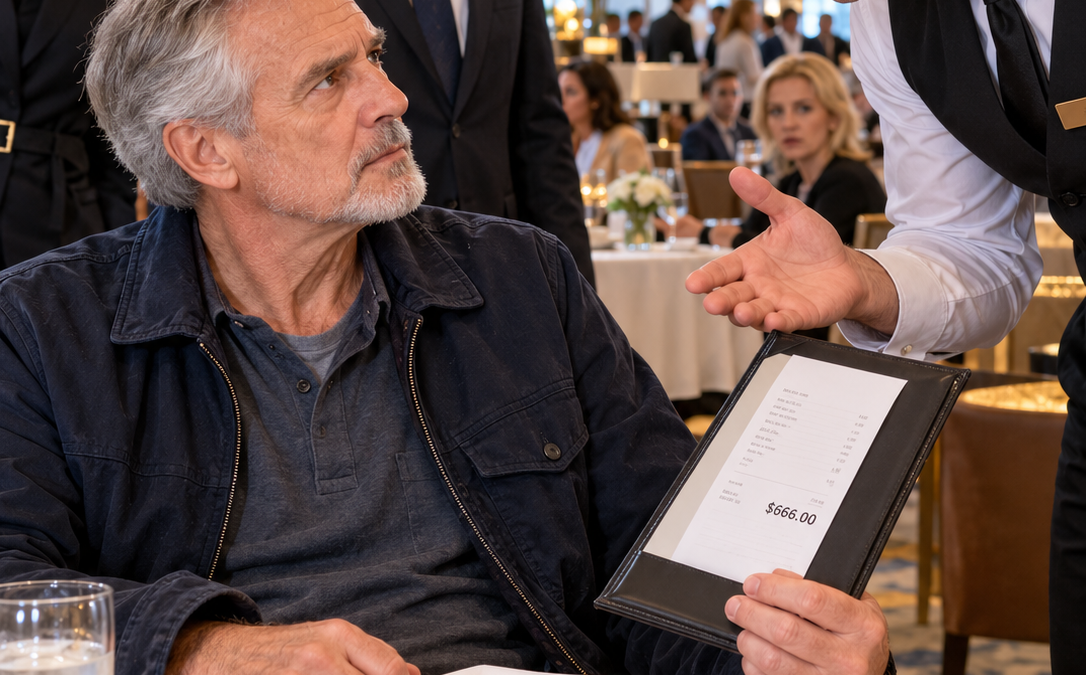
I quietly went to eat at my own hotel, ordered a $66 fried rice, and got a bill for $666. I called a manager over on the spot.
The fried rice had arrived twelve minutes after I ordered it, and the first thing I noticed was the rice itself. It was wrong. The grains were damp and clumped together, the way fresh rice does when someone rushes it straight from the cooker into a wok. Three shrimp sat on top, each one smaller than my thumb. I found a few pieces of ham, a scattering of peas, and no scallops at all.
I had approved that dish myself when Riverbend Grand opened six years earlier. The menu price was $66 because it was supposed to be ridiculous in a very specific way: Maine lobster, dry-packed scallops, country ham, duck egg, English peas, and rice rested overnight so every grain stayed separate. Guests complained about the price until they tasted it. Then they ordered it again.
I took one bite of the plate in front of me. Too much salt on the left side, almost none on the right. I put the fork down.
The server came by and asked whether everything was all right. She looked about twenty-two, with a tight ponytail and a name tag that read Emily. I told her I was fine and asked for the check.
She brought it in a black leather folder. I opened it and stared at the number long enough that she shifted her weight from one foot to the other.
$666.00.
I looked across the page to make sure I hadn’t accidentally ordered a bottle of wine, a room service package, or a private dining minimum.
One item. Riverbend Signature Fried Rice. $666.00.
I took out my phone, opened the menu page I had photographed ten minutes earlier, and set the phone beside the bill.
“Your menu says $66.”
Emily glanced at the screen. Her eyes moved back to me.
“There’s a guest experience adjustment on some items today.”
“A $600 adjustment?”
She lowered her voice. “I just ring what the system gives me, sir.”
“What is the adjustment for?”
“Special service.”
“What special service did I receive?”
Her mouth opened, then closed. She looked toward the host stand.
“Would you like me to get my supervisor?”
“Yes.” I slid the bill back into the folder. “Please do.”
She walked away quickly. I stayed in the booth near the wall and looked around the dining room.
Riverbend Grand occupied twelve floors on the south edge of Louisville, with 214 guest rooms, two ballrooms, a lobby bar, a rooftop lounge, and this restaurant on the first floor. I owned 76% of the company that owned both the building and the hotel operation. My name was on every major loan document, every liquor license renewal, and every insurance policy that mattered.
But very few people in the dining room knew my face.
That had been deliberate at first. I had spent most of the previous four years away from daily operations. I still reviewed monthly numbers and attended quarterly management meetings, but I no longer sat in an office upstairs. When you’re sixty-four and have spent most of your adult life getting up before sunrise, an empty calendar starts to look like a reward.
That afternoon, I wore a navy work jacket I’d owned since before Riverbend opened, a gray button-down shirt, faded jeans, and running shoes with the tread worn smooth at the heels. My truck was parked in a public garage two blocks away. I’d walked over with a baseball cap pulled low and entered through the restaurant like any other local customer.
I wanted to see the hotel without anyone preparing for me.
Three weeks earlier, my nephew Ryan had called me after ten at night. Ryan was twenty-eight and worked in the kitchen operation. His father, Tom Hail, was my wife Elaine’s younger brother, and the man who had stood beside me when our first breakfast place had six tables, one broken griddle, and a freezer that had to be kicked twice before it would shut.
Tom’s liver had been giving him trouble for the past two years, so he’d stepped away from daily work. Ryan stayed. He had started as a prep cook, moved into receiving, and recently taken responsibility for kitchen inventory.
On that call, he skipped hello.
“Uncle Frank, do you want to know if somebody’s stealing from you?”
I’d been sitting at the kitchen table at home, rubbing liniment into my right knee.
“Slow down.”
“I checked seafood receiving against accounts payable. The numbers don’t match.”
“How far off?”
“A lot. Last Tuesday, the invoice says we received 180 pounds of king crab. I was there. I signed for sixty-two.”
I stopped rubbing my knee.
“Same vendor?”
“Bluegrass Coastal Supply.”
That vendor had been with us for years.
“What else?”
“Lobster tails, scallops, halibut, some of the premium beef, too. The invoice quantities are higher than receiving. Sometimes way higher.”
“Do you have copies?”
“I have my receiving sheets. I photographed two invoices when they were left on the desk.”
“Don’t take anything else. Don’t confront anyone. Don’t tell your dad yet.”
Ryan went quiet.
“You think Dad knows?”
“I don’t know. That’s why you keep your mouth shut until I do.”
I ended the call and sat at the kitchen table until Elaine came in from the den. She had been married to me for thirty-six years. She took one look at my face and pulled out the chair across from me.
“What happened?”
“Ryan found something in purchasing.”
“Bad?”
“I don’t know yet.”
She waited when I didn’t add anything. Then she reached over, twisted the cap back onto the liniment bottle, and handed it to me.
“Then don’t decide before you know.”
That sentence was one reason our marriage had lasted.
The purchasing operation had been controlled for nearly seven years by Wayne Keller, a man I’d known since before the hotel existed. Wayne was related to Tom by marriage and had started helping us back when our business consisted of a diner and a catering van.
He knew every purveyor in the region. He could find twenty cases of tomatoes during a shortage, get linens delivered on Christmas Eve, and convince a meat supplier to extend terms when our bank account was thin.
I’d trusted him because he’d earned that trust when we were poor.
That kind of history makes a man dangerous when you stop checking his work.
So I decided to come to Riverbend without announcing myself. I expected to inspect receiving, watch breakfast, see whether housekeeping had slipped, and maybe sit in the lobby long enough to hear what guests complained about when management wasn’t standing nearby.
I did not expect a $666 bowl of fried rice.
A man in a black suit crossed the dining room toward me. He was in his early thirties, with hair combed back and a jacket fitted too tightly through the shoulders. His badge said Derek Cole, Dining Supervisor. I’d seen his name in staffing reports. I couldn’t remember meeting him.
He stopped beside the booth and gave me a hospitality smile that ended at his cheeks.
“Good afternoon, sir. I’m Derek. I understand there’s a question about your check.”
I pushed the folder toward him.
“There’s no question. The menu says sixty-six. The check says six hundred sixty-six.”
He opened it, barely looked, and closed it again.
“Our listed menu reflects standard pricing. Certain non-member dining transactions can carry a premium service adjustment during high-demand periods.”
I looked around the room.
Eight occupied tables. More empty chairs than guests.
“What high demand?”
Derek’s jaw shifted slightly.
“It’s a pricing policy, sir.”
“Show it to me.”
“The policy is in our guest terms.”
“Show me where.”
He picked up the menu and flipped to the back. At the bottom, in small type, was a generic sentence.
Pricing subject to change for special events, private functions, and seasonal offerings.
Derek tapped it with one finger.
“There.”
“This is lunch on a Thursday.”
“We’re operating under a seasonal program.”
“What season?”
His eyes narrowed for a moment.
“Sir, if you refuse payment, hotel security may need to get involved.”
I studied his face. He had said that line before. I could hear it in the way he spaced the words. No hesitation, no embarrassment, just a rehearsed warning delivered politely enough to sound official.
I leaned back against the booth.
“All right.”
Derek seemed relieved.
“Will you be paying by card?”
“No. I said all right, get whoever you report to.”
“I am the floor supervisor.”
“Then get the manager on duty.”
He held my gaze another second, then turned away.
Emily remained near the host stand, pretending to rearrange menus. Her shoulders were tight.
While Derek was gone, I took pictures of the $666 check, the menu price, and the plate as it sat on the table. I photographed the check number and timestamp. Then I slipped my phone back into my jacket.
A minute later, Gordon Pike came out of the service corridor.
Gordon had worked for me almost ten years. He’d started as a banquet captain, moved to restaurant manager, and was now one of the hotel’s rotating managers on duty. I knew his wife’s name. I’d sent flowers when his mother died. He’d been in my office twice asking for advances when his oldest daughter started college.
He saw me from twenty feet away.
His step broke.
His hand, which had been adjusting the cuff of his shirt, dropped to his side.
Derek was still talking as they approached.
“Guest says he won’t pay the adjusted—”
Gordon stopped at the table.
“Mr. Dalton.”
Derek turned his head.
The dining room seemed to lose a layer of sound.
I pointed to the empty chair across from me.
“Sit down, Gordon.”
He sat. Derek remained standing.
I slid the check across the table. Gordon looked at the total. His thumb pressed into the paper hard enough to leave a bend.
“What is this?” he asked.
Derek spoke first.
“It’s the seasonal adjustment code. We’ve been using it on—”
“I didn’t ask you.”
Gordon’s voice came out rough. Derek took half a step back.
I kept my eyes on Gordon.
“How long?”
He looked at me, then at the bill again.
“Frank, I need to check the system.”
“How long have guests been charged more than the menu?”
He swallowed.
“I’ve seen adjustments.”
“That isn’t what I asked.”
His gaze dropped.
“Several months.”
I folded my hands on the table.
“Call the controller. Call the general manager. Tell them to preserve the POS system exactly as it is. No deletions, no refunds, no edited checks until we have copies. Then pull every dining check from the past ninety days that had a manual price override.”
Gordon looked up.
“Right now?”
“Yes.”
I nodded toward Derek.
“And nobody leaves with a laptop, a cash drawer, or a stack of paper until we know what belongs to the hotel.”
Derek’s face had gone pale under the dining room lights.
I took the black check folder and stood.
“Gordon, give me the key to your office.”
His hand shook once while he separated it from the ring.
I noticed because ten years earlier, that same hand had carried a full tray of champagne through a crowded ballroom without spilling a drop.
Gordon’s office was on the second floor, behind the banquet sales area. The carpet in the hall had been replaced the previous spring, but his office still looked exactly the way I remembered it.
Two filing cabinets, a dent in the drywall where a banquet cart had hit it, family photos beside the monitor, and a small coffee maker with a burned ring on the warming plate.
I locked the door behind me and called our outside attorney before I touched the computer.
Her name was Rachel Monroe. She had represented Riverbend since we refinanced the building four years earlier, and she’d spent enough time around hospitality companies to know that a strange restaurant charge could be an accounting problem, an employee theft problem, a consumer protection problem, or all three at once.
I told her what had happened and what Ryan had found in receiving.
“Do not start deleting charges or confronting half the building,” she said. “Preserve first, figure out scope second. If you think there’s theft, I want an outside forensic accountant involved before people start explaining away missing numbers.”
“I already told them to freeze manual changes.”
“Good. Who has admin access to the POS?”
“Gordon, the controller, general manager, me, maybe IT.”
“And you’re physically there?”
“Yes.”
“Then log in. View what you need as owner. Export through the normal reporting function and don’t alter source data. I’ll send a preservation notice to management within the hour.”
That was how we started.
The point-of-sale report took less than five minutes to make my stomach tighten.
The $666 charge was not a typo.
The signature fried rice had been sold 417 times in the previous ninety days. Most checks showed the correct $66 menu price. Eighty-three showed manual overrides. Some were $126, some $186, some $266.
Seven were exactly $666.
The higher charges clustered around walk-in guests who weren’t staying in the hotel, weekend convention traffic, and customers who paid with corporate cards. The user IDs responsible belonged to three employees, including Emily’s register ID, though that didn’t tell me who had actually keyed in the price. Supervisors could approve changes from the same terminal.
Then I ran a second report.
Steaks, seafood towers, wine, room service fees, banquet corkage, parking.
Manual overrides everywhere.
The pattern was clever enough to survive a casual monthly review. Revenue looked healthy. Average checks looked strong. Food-cost ratios were bad, but management had been blaming inflation.
A guest who challenged an absurd charge was often given a courtesy reduction. The adjusted total would still be higher than the printed menu. A guest who paid without arguing became easy money.
I found voids after closeout, too.
A $266 entrée charge could be paid at the table, partially voided after the shift, then reentered at the menu price. The difference didn’t disappear into one obvious pile. It moved through cash adjustments, tip corrections, manager comps, and petty cash reimbursements.
I stopped scrolling and rubbed the bridge of my nose.
Someone had spent time building this.
The door opened twenty minutes later, after Gordon knocked. He entered with Laura Bennett, our general manager, and Marilyn Price, the controller.
Laura had been with us eighteen months. I’d hired her from a convention hotel in Indianapolis because I wanted somebody who had no family connection to me or Tom. She was forty-seven, disciplined, and usually hard to read. That afternoon, she carried a legal pad against her chest and looked furious with herself.
Marilyn was fifty-two and had worked for our company since before Riverbend opened. Her eyes were red around the edges.
I turned the monitor so they could see the override report.
“Laura, did you authorize a seasonal program that turns $66 fried rice into $666?”
“No.”
“Marilyn?”
“No.”
“Then why is it happening?”
Laura stepped closer to the screen. She read the user list twice.
“I knew guest complaints were up,” she said. “Derek kept reporting them as misunderstandings over premium items and special event charges. We refunded some.”
“How many complaints did you personally read?”
She pressed her lips together.
“Not enough.”
That answer angered me more than an excuse would have.
I pointed to a column on the report.
“Who approves these overrides?”
“Dining supervisors up to twenty percent. Manager on duty above that. Anything larger should require a reason code.”
“Seven checks went from sixty-six to six hundred sixty-six.”
Laura leaned over the keyboard without touching it.
“That should not be possible under the policy.”
“It was possible in the software.”
Gordon shifted in the chair beside her.
I looked at him.
“Did you approve any of them?”
His face tightened.
“I approved adjustments. I didn’t know all the final amounts.”
“You knew guests were being charged above the menu.”
“Yes.”
“Why?”
He rubbed his palms down the front of his trousers.
“Wayne said we were leaving money on the table. He said the hotel was behind target and walk-ins were less price-sensitive. He said he had cleared it with senior ownership.”
“Senior ownership is me.”
Gordon looked at the floor.
“I know that now.”
I stared at him long enough that he finally raised his head.
“You have my cell number.”
“I know.”
“You have called me about your daughter’s tuition, banquet equipment, a broken dishwasher, and once because a guest’s dog bit a bellman. You could not call me about this?”
His eyes watered. He blinked hard and looked away.
“Wayne made it sound like you knew.”
“That sentence is going to become very popular around here.”
Nobody spoke.
Rachel’s preservation email arrived while we were sitting there. She directed management to preserve POS data, purchasing records, vendor communications, receiving documents, security footage, email, company phones, and access logs.
Laura read it on her own phone and nodded.
“I’ll lock down admin credentials with IT.”
“Do it with Rachel copied. Nobody wipes anything because they’re scared.”
Laura left immediately.
Gordon started to follow. I told him to stay. Marilyn remained seated, too.
I pulled Ryan’s text up on my phone, then looked at Marilyn.
“Seafood.”
Her expression changed before I said anything else.
“I saw it.”
“Tell me.”
She took off her glasses and wiped them with the hem of her blouse. Her hands were unsteady.
“I noticed the food-cost problem last year.”
“Last year?”
“Yes.”
“How much?”
“I didn’t know. I still don’t know exactly.”
“Did you ask Wayne?”
“I asked why receiving quantities didn’t reconcile cleanly with accounts payable. He said kitchen waste, banquet transfers, and emergency purchases weren’t being coded correctly.”
“And you accepted that?”
“Not completely.”
Marilyn put her glasses back on. She looked older with them.
“I ran a sample. Then Wayne came into my office with copies of expense reports from years ago. Cash tips to inspectors, charity tables, complimentary meals for local officials. Things that were normal in the old days, or at least things people treated as normal. He said if I started accusing him of fraud, he could make the whole company look dirty.”
My stomach tightened again.
“Were the expenses illegal?”
“I don’t know. Some were sloppy. Some were embarrassing. He wanted me to think you’d approved everything he did.”
“Did you take money from him?”
Her head came up fast.
“No.”
Gordon flinched.
I looked at him next.
“Did you?”
He stared at his shoes.
“How much over time?”
“Maybe $18,000.”
Marilyn turned toward him.
“What?”
Gordon’s voice became hoarse.
“He called them management bonuses. Cash sometimes. Gift cards. Tickets. I knew it was wrong.”
“Were the payments tied to the price overrides?”
“I never got told, ‘Charge this guest more and I’ll pay you.’ He’d give me something after a good month. Then he started pushing the adjustment program. I didn’t ask questions I should have asked.”
I reached for the legal pad Laura had left and wrote down 18,000.
Gordon watched my pen move.
“Frank, I can pay it back.”
“This is not a tab at a bar.”
He sat very still.
“Rachel is going to tell you how to cooperate. You will not delete a message or call Wayne to warn him. If you do, you’re making your own problem worse.”
He nodded.
I turned back to Marilyn.
“Tomorrow morning, I want six months of purchasing detail, vendor payment history, and receiving reconciliation. Do not build anything new tonight. Pull existing records and preserve them.”
“I can do that.”
“And go home after you do the preservation steps. You look like you haven’t slept.”
She stood, then hesitated at the door.
“Frank?”
“Yes?”
“I should have called you.”
I did not tell her it was fine.
It wasn’t fine.
“I should have made it easier for you to call.”
Her eyes filled. She nodded once and left.
Gordon stayed behind another minute.
“I’m sorry,” he said.
I looked at the family photo on his desk. His daughter wore a graduation gown. His wife had one hand on his shoulder.
“Go home. Keep your phone on. Rachel may call you tonight.”
He stood at the door, then turned back.
“Are you going to fire me?”
“I don’t know yet.”
He absorbed that and left.
By 6:30, I’d been in the hotel almost five hours. I’d eaten three bites of fried rice and learned more about Riverbend than I had from six months of management packets.
I went downstairs and booked a room under my own name.
The front desk clerk did not recognize me.
That suited me. I wanted one more night as a guest.
Room 814 had a good view of the river, a loose bathroom handle, dust along the top edge of the television, and one lamp with a bulb that flickered before it warmed up.
I wrote those things in the notebook I kept in my jacket.
At 9:15, Ryan knocked.
He came in carrying a black grocery tote full of paper.
“Dad knows something’s happening,” he said before sitting down. “He called me twice.”
“What did you tell him?”
“That you were at the hotel looking at numbers.”
“Good.”
Ryan spread receiving logs across the small desk. He’d made his own comparison sheet. His handwriting was tight and square.
Bluegrass Coastal Supply invoiced 180 pounds of king crab on March 7. Kitchen receiving logged sixty-two pounds.
Invoice: ninety-six lobster tails. Receiving: forty-eight.
Invoice: seventy pounds of dry scallops. Receiving: twenty-two.
Invoice: 120 pounds of prime tenderloin. Receiving: sixty-four.
The differences were too large to be waste or bad counting.
“Who signs the delivery tickets?” I asked.
“Different people. I sign some. Marcus in receiving signs some. Wayne signs anything he calls direct delivery.”
“Do direct deliveries actually come through the kitchen?”
“Sometimes. Sometimes we never see them.”
Ryan opened a photo on his phone. It showed an invoice approval screen. Wayne’s digital initials were on the last line.
“Who sent this to you?”
“Nobody. I photographed the screen when accounts payable left it open.”
I frowned.
“Stop doing that.”
His eyebrows rose.
“You told me to get proof.”
“I told you to preserve what you already had. You’re an employee, not a detective. We have counsel now. From here on, if somebody gives you a document through work, keep it where company policy says it belongs. If you see something, write down what you saw and tell Rachel.”
Ryan leaned back.
“Okay.”
I softened my voice.
“You did the important part. You noticed.”
He looked at the papers again.
“Are you going after Wayne?”
“I’m going after the numbers. If they lead to Wayne, he can explain them.”
Ryan nodded, though I could tell he wanted a stronger answer.
Before he left, I asked the question I’d been avoiding.
“Do you think your dad knew?”
Ryan took a long time.
“I heard them argue once last winter. Wayne said something like, ‘Your family didn’t build all this so outsiders could get rich off it.’ Dad told him he was getting greedy. I don’t know what they were talking about.”
“Did your dad take money?”
“I don’t think so.”
“That isn’t an answer.”
Ryan’s face hardened.
“He’s my dad.”
“He’s my brother, too. In every way that matters. That’s why I need the truth.”
Ryan stared at the carpet.
“I don’t know.”
“That’s an answer.”
He left at 10:30.
I sat beside the window after he was gone. Down in the parking lot, the Riverbend sign glowed over the entrance. Guests came and went through the revolving door. A valet ran after an SUV carrying a forgotten umbrella from eight floors up.
The hotel still looked healthy.
The next morning, I went to breakfast at 6:45. The buffet had opened at 6:30. The scrambled eggs had already formed a skin. Biscuits were hard at the edges. A tray of bacon sat in grease. One of the coffee urns was empty.
I filled a bowl with oatmeal and took a boiled egg.
A bus driver at the next table asked a server for more coffee. She said she would get it, then disappeared for eleven minutes.
I wrote that down, too.
At 8:40, Rachel arrived with a forensic accountant named Ben Alvarez from a regional firm in Cincinnati. Ben wore no tie, carried two laptops, and asked for a room with a door that locked.
I gave him the boardroom.
By nine, the three of us were looking at the first purchasing extracts. Ben highlighted duplicate invoice numbers, weekend approvals, quantities that exceeded storage capacity, and vendor payments split just below internal review thresholds.
He leaned back, rubbed his chin, and looked at me.
“How long has one person controlled vendor selection, price negotiation, receiving exceptions, and invoice approval?”
I knew the answer would sound bad before I said it.
“Too long.”
“That structure is the first thing I change.”
I wrote it down.
Rachel opened another folder.
“Frank, I also want you prepared for guest claims. If the POS analysis confirms systematic overcharging, we need to identify affected customers, refund where we can, and decide whether any regulator needs to be notified. We do this before a television reporter explains your own restaurant to you.”
I looked at the $666 receipt lying beside my notebook.
“Find everybody we overcharged.”
“That could be expensive.”
“It was expensive when we took the money.”
Ben glanced at me, then went back to the screen.
At 10:12, Marilyn entered with two binders and a flash drive containing reports exported from the accounting system. She set them on the table and remained standing.
“There’s something else,” she said.
Rachel gestured toward the empty chair.
Marilyn sat but kept both hands on her purse.
“Wayne has a side company.”
I felt my shoulders stiffen.
“What kind?”
“I don’t know if it’s legally his. It’s called Kaline Hospitality Services. We’ve paid consulting fees for vendor coordination and emergency sourcing. The mailing address is a UPS Store.”
“How much?” Ben asked.
“About $240,000 over two years.”
“Who approved the payments?”
Marilyn looked at me.
“Tom approved the first contract. After Tom stepped back, Wayne approved renewals under his delegated authority.”
The room became very quiet.
Tom. My brother-in-law. My original partner. Elaine’s little brother. The man who had slept on sacks of flour in our first shop because we couldn’t afford an overnight cleaner and somebody had to be there when the bread delivery came at four in the morning.
Rachel closed her pen.
“Do not call him yet.”
I’d already reached for my phone.
I stopped.
“Why?”
“Because right now, you don’t know whether Tom signed something careless, something dishonest, or something he was lied to about. Give Ben a few hours. Facts first.”
I put the phone back on the table.
Through the boardroom wall, I could hear banquet staff rolling tables down the hallway. The wheels bumped over the threshold every few seconds.
I sat there listening to them and thought about how many decisions I’d signed over the years because the person on the other side of the page had once stood beside me when we had nothing.
History had become a control system, and I’d been calling it trust.
By early afternoon, Ben had enough to give me a number, though he warned me it was still rough.
“Across the vendors we’ve sampled, I’m seeing about $800,000 in questionable purchasing over twenty-eight months,” he said. “That includes inflated quantities, duplicate invoices, consulting charges, and price spreads that don’t make commercial sense. It does not mean $800,000 was stolen. Some of it may have a legitimate explanation, but I wouldn’t sign a financial statement without digging through it.”
I asked him to show me the worst example.
He turned his laptop around.
A seafood invoice billed Riverbend for 240 pounds of lobster tails. The kitchen’s weekly inventory sheet showed that the hotel had started the week with thirty-nine pounds on hand, received seventy-two, used eighty-four, and ended with twenty-seven.
The math worked perfectly at seventy-two.
There was nowhere for the other 168 pounds to have gone.
“How much did we pay?”
“$31,000.”
“For seventy-two pounds?”
“The invoice says 240.”
I ran my tongue over the inside of my cheek. It was a habit Elaine hated because she knew it meant I was angry.
Ben clicked to another file.
“Here’s the payment. Here’s the receiving record. Here’s Wayne’s approval. And here’s a second payment, eight days later, to Kaline Hospitality Services for expedited sourcing consultation tied to the same week.”
I picked up my phone.
Rachel didn’t stop me this time.
Tom answered on the second ring.
“Frank, where are you?”
“At Riverbend. Can you come in?”
A pause.
“Is this about Wayne?”
That told me more than I wanted it to.
“Come in. Bring nothing. Don’t call him.”
Tom arrived forty-five minutes later, using the cane he’d started carrying after his last hospital stay. He’d lost weight. The old roundness in his face was gone, and his shirt hung loose at the collar.
He came into the boardroom, saw Rachel and Ben, and stopped.
“Looks serious.”
“It is.”
He sat across from me.
For a few seconds, I saw us thirty years earlier in a rented diner after closing, both too tired to stand, splitting the last piece of pie because we couldn’t afford to throw food away.
Then I put the Kaline contract in front of him.
“Your signature?”
Tom read the first page and nodded slowly.
“I signed it.”
“What did you think you were buying?”
“Emergency sourcing. Wayne said our regular suppliers couldn’t cover convention demand and we needed somebody to coordinate secondary vendors.”
“Did you know who owned Kaline?”
“No.”
“Did you ask?”
Tom looked at me.
“No.”
“Why?”
“Because Wayne brought it to me. He said he’d used them before.”
Ben slid another page across the table.
“The registered agent is an attorney in Lexington. The beneficial ownership filing lists a trust. The trustee is Wayne’s sister.”
Tom stared at the paper. His left hand closed around the head of his cane.
“You’re sure?”
“Public and bank records line up,” Rachel said. “We’re still tracing the account.”
Tom leaned back and shut his eyes.
“Son of a—”
I watched him for a moment.
“Ryan heard you and Wayne arguing last winter.”
Tom opened his eyes again.
“He was pushing too hard. Costs kept going up. I told him he was getting greedy with vendors.”
“Greedy how?”
“I thought he was leaning on them for rebates and free product. Everybody in this business does some version of that.”
“Everybody does not invoice 180 and deliver sixty-two.”
His face changed.
“What?”
I showed him Ryan’s sheets.
Tom read one page, then another. His hand shook against the cane.
“I didn’t know this.”
“Did you take anything from Wayne?”
He looked offended, then saw that I wasn’t backing away from the question.
“No.”
“Any cash? Profit share? Gift cards? Vendor trips?”
“Christmas bourbon. Two ballgame tickets. Stuff like that.”
“Anything tied to Kaline?”
“No.”
He bent forward with both elbows on his knees.
“I should have told you when I started getting suspicious.”
“Why didn’t you?”
“Because he’s Carol’s cousin. Because Carol’s mother still calls him every Sunday. Because when my liver went bad, Wayne drove me to appointments twice. Pick one.”
Tom rubbed his face with both hands.
“I kept thinking I’d sit him down when I felt better. Then I stopped coming in. I told myself you had good people watching the books.”
“So did I.”
He looked at me then.
Neither of us had much room to criticize the other.
Tom asked to see the $666 bill. I slid it across.
He stared at it for a long time.
“Sixty-six dollars,” he said. “That was your idea. I told you nobody in Louisville would pay $66 for fried rice.”
“You were wrong.”
“I was.”
His finger tapped the sixes on the check.
“And now somebody tried to make it $666.”
He pushed the paper back toward me.
“What do you want me to do?”
“Tell Rachel everything you remember. Then go home and take care of yourself.”
He frowned.
“That’s it for today? I helped build this place.”
“I know.”
“I can help clean it up.”
“You can help by not protecting anybody because they ate breakfast with us twenty years ago.”
The words landed hard.
Tom looked down at his cane. After a while, he nodded.
“All right.”
Before he left, he stood at the boardroom door and turned back.
“Frank, what if Wayne did this? Don’t soften it for me.”
“I won’t.”
Tom’s mouth tightened.
“Good.”
That evening, Rachel sent formal interview notices to the employees whose records touched the suspicious transactions. She hired an outside investigator for the employment side and instructed IT to image Wayne’s company laptop and preserve his email when he reported for work the next morning.
Ben kept tracing payments.
I stayed at the hotel another night.
At 11:30, Ryan came up from the kitchen with a man I knew from the early days named Mike Pharaoh.
Mike supplied seafood out of a warehouse east of the city. He’d started with one refrigerated van and a folding table at a wholesale market. Over the years, he’d become respectable enough to sponsor charity golf tournaments and complain about parking like a man who’d forgotten he once delivered shrimp in a truck that had to be started with a screwdriver.
He wouldn’t sit at first.
“I don’t want my name in this.”
Rachel, who had stayed late, folded her arms.
“Then you shouldn’t say anything tonight. If you give information, we document where it came from. We’re not going to invent an anonymous source and pretend it fell from the ceiling.”
Mike looked at me.
“You hired a tough lawyer.”
“I hired one who doesn’t like sloppy stories.”
He sat.
Ryan closed the hotel room door and stood near the desk. Mike rubbed both palms against his jeans.
“Wayne started asking for rebates about two and a half years ago.”
“What kind?” I asked.
“At first, regular volume rebates. Two percent, three percent. Fine. Then he wanted invoices written higher than actual delivery. Said Riverbend had banquet waste and he needed room in the numbers.”
“What did you do?”
Mike looked at the carpet.
“I did it.”
“How did the money come back?” Rachel asked.
“Sometimes I wrote a check to Kaline. Sometimes cash. Sometimes Wayne told me to pay another vendor bill for him.”
“How much?”
“I don’t know exactly.”
Rachel waited.
Mike scratched the back of his neck.
“Maybe $170,000. $180,000 through me.”
Ryan swore under his breath.
Mike looked at him.
“Kid, I’m not proud of it.”
“You billed us for food you never delivered.”
“I know what I did.”
Ryan started forward.
I lifted one hand.
He stopped.
Mike continued.
“Wayne always said the owners knew. Said it was how Riverbend kept money off the books for favors, comps, local relationships. He made it sound like Frank wanted flexible cash.”
“Did I ever tell you that?” I asked.
“No.”
“Did Tom?”
“No.”
“Then why did you believe Wayne?”
Mike met my eyes for the first time.
“Because believing him made me more money.”
The room stayed quiet.
That answer, at least, was clean.
Mike agreed to sit for a recorded interview with Rachel and the investigator the next morning. He also said Wayne kept a handwritten ledger of side payments.
“Where?” Rachel asked.
“I heard him brag after he’d been drinking. Said he never kept the real book anywhere near Riverbend. His brother-in-law owns a bait-and-tackle shop out by Shively. Wayne said nobody looking for hotel money would search behind a wall of fishing rods.”
Rachel wrote down the shop’s name.
“Do not go there,” she said to me.
“I wasn’t planning to.”
She looked at Ryan.
“Neither of you.”
Ryan lifted both hands.
“I got it.”
At eight the next morning, before Mike’s formal interview started, Wayne called me.
I was in the lobby drinking coffee.
“Frank, I hear you’ve been having meetings without me.”
His voice sounded light.
“I’ve been reviewing the hotel.”
“Anything I can help with?”
“Yes. Come in at ten and meet with counsel.”
A small pause.
“Counsel?”
“Rachel Monroe.”
“What’s this about?”
“We’ll discuss it at ten.”
“I’m actually out with a vendor this morning.”
“Come back.”
Another pause.
“Frank, if this is Ryan stirring up drama over receiving, he doesn’t understand how purchasing works.”
“He understands that sixty-two is smaller than 180.”
Wayne stopped talking.
I could hear road noise through his phone.
Finally, he said, “I’ll be there.”
He never came to the meeting.
At 9:54, IT saw his remote credentials hit the purchasing system from outside the hotel. The preservation controls Rachel had put in place blocked deletion.
At 10:03, Wayne’s company email received an automatic alert telling him his password had been changed pending an internal review.
At 10:06, the parking system recorded his personal SUV entering the employee garage.
At 10:11, a camera showed him walking into his office with an empty briefcase.
Laura called me from the second floor.
“He’s here, but he’s packing.”
“Don’t touch him. Security stays nearby. Rachel is coming down.”
Wayne emerged seven minutes later carrying the briefcase and a banker’s box.
I met him in the service hall with Rachel and Laura.
He stopped when he saw us.
“What is this?”
Rachel spoke before I did.
“Wayne, the company has placed you on paid administrative leave pending investigation. Hotel property stays here. We’ll inventory personal items with you.”
His grip tightened on the box.
“This is insane.”
“Set the box on the table,” Rachel said.
“It’s my stuff.”
“Then we’ll document it, and you can take it.”
Wayne looked at me.
“Frank, you’re letting a lawyer treat me like a thief in a hallway.”
I pointed to the small conference table.
“Set it down.”
For a second, I thought he might walk past us.
Then he placed the box on the table hard enough to rattle the framed fire evacuation map on the wall.
Most of the contents were ordinary. Family pictures, a travel mug, two jackets, a pair of shoes, a desk clock.
At the bottom was a thick folder labeled Vendor Performance.
Rachel opened it in front of him.
Copies of invoices, notes, a printed spreadsheet.
Nothing that looked like the ledger Mike had described.
Wayne folded his arms.
“Happy?”
Rachel closed the folder.
“You’ll receive instructions about next steps. Do not contact employees about the investigation except through counsel.”
He laughed once.
“You think you can run purchasing without me?”
I looked at the man I’d trusted for years.
“We’re going to find out.”
His face changed. Then the friendliness dropped away.
“You built this place with family money and handshake deals, Frank. Don’t start pretending you’re a public company because one accountant scared you.”
“No one scared me.”
“Then you should be scared of what happens when you pull every thread. You think everybody who took a free dinner, a vendor favor, a cash rebate, or a box of bourbon is going to survive your clean little audit?”
Laura shifted beside me.
Wayne saw it and smiled.
“There you go. Ask her. Ask all of them.”
I opened the service door toward the lobby.
“Your car is downstairs.”
He walked past me, his shoulder brushing the doorframe.
At the elevator, he turned.
“Tom signed my contract.”
“I know.”
“Tom knew how business got done.”
“He signed a piece of paper. That doesn’t make everything you did underneath it his decision.”
Wayne shook his head.
“You always did like being the good guy.”
The elevator arrived.
He stepped inside and looked at me until the doors closed.
Five minutes later, Rachel asked security to preserve footage of the garage exit.
At 10:42, Wayne’s SUV left Riverbend.
At 11:15, Mike Pharaoh signed his written statement.
By lunch, Rachel was on the phone with the Louisville Metro Police Financial Crimes Unit.
I sat across from her while she explained what we had: vendor invoices inconsistent with receiving, a shell consulting company linked to Wayne’s family, witness statements about kickbacks, POS manipulation, and a possible off-site ledger.
The detective on the call didn’t promise anything.
She asked questions.
She wanted copies of records and affidavits. She wanted to know how evidence had been obtained and who had system access.
When the call ended, Rachel looked at me.
“That is how this goes now. We hand them facts. They decide what process they can use.”
I nodded.
It felt slower than anger.
It was also the first time in two days I felt the floor stop moving under my feet.
The police didn’t move that afternoon. That was good for the case and terrible for my nerves.
I spent Thursday in the hotel while Rachel and Ben assembled records. The financial crimes detective assigned to the matter, Nora Ellis, called twice with follow-up questions.
She wanted the original receiving logs, not scans made after the investigation started. She wanted to know who could alter vendor master data. She wanted the bank information for Kaline Hospitality Services and every payment Riverbend had made to it.
She asked Mike Pharaoh whether Wayne had ever texted instructions about invoice quantities.
Mike found three messages.
One read, Bill full count, credit difference to Kaline.
Another said, Same as last month. Do not put rebate on Riverbend statement.
The third was a photograph of a handwritten number followed by the words You know where.
Those messages changed the tone.
Friday morning, Rachel told me the detective had presented an affidavit to a judge seeking warrants for Wayne’s home, his vehicle, Kaline’s bank records, and the bait-and-tackle shop Mike had identified.
I asked when they would execute them.
“She didn’t tell me,” Rachel said. “And she shouldn’t.”
I’d spent thirty years solving problems by getting up, driving somewhere, and putting my hands on the thing that was broken.
Legal investigations punish that instinct.
So I went to the kitchen instead.
Ryan was receiving produce when I found him. He had a clipboard in one hand and a box cutter in the other.
“Two cases short,” he told the driver.
The driver checked his manifest.
“You sure?”
Ryan pointed at the pallet.
“You can count them with me.”
They counted together.
The driver corrected the delivery ticket before Ryan signed it.
When the truck left, Ryan looked at me.
“You watching me?”
“I’m watching the door.”
“You used to say counting boxes was beneath management.”
“I used to say a lot of things when I thought reports told the truth.”
Ryan smiled and clipped the corrected ticket behind the receiving log.
At 11:30, Detective Ellis called Rachel.
The warrant had been executed at the tackle shop.
They found a blue canvas bank bag in a locked cabinet behind old reel inventory. Inside were four spiral notebooks, several prepaid debit cards, copies of vendor checks, and a thumb drive.
They also found envelopes labeled with initials that matched people at Riverbend.
Wayne wasn’t at the shop. He was picked up later that afternoon after officers located him at his sister’s house in Lexington.
He hadn’t been charged yet.
The police wanted an interview first.
I heard the news from Rachel in the executive office. She stood beside my desk with her phone still in her hand.
“They have the ledgers.”
I looked out the window toward the hotel entrance.
A shuttle van pulled up. A family climbed out carrying shopping bags and a stroller. The father held the lobby door for an older couple behind him.
“Did they find my name?” I asked.
Rachel sat across from me.
“They found initials. Nobody is drawing conclusions until the books are analyzed.”
“What initials?”
She hesitated.
“GP. DC. MP. TH. A few others.”
Gordon Pike. Derek Cole. Marilyn Price. Tom Hail.
I felt the chair under me more clearly than I had a moment earlier.
“Tom?”
“It could mean anything. Don’t call him and accuse him based on two letters in a notebook.”
I picked up the phone anyway, not to call Tom, but to look at the time.
1:48.
“Bring him in with counsel present.”
“I was already going to suggest that.”
Tom came at four.
He looked exhausted before he even heard why we’d called him.
Rachel explained that his initials appeared in one of the seized notebooks, but nobody had yet established what the notation meant.
Tom sat very still.
“Show me.”
“We don’t have the physical notebook,” Rachel said. “The detective gave us one page because it references Riverbend.”
She turned the page toward him.
“The entry says, ‘TH 12/18 35K start.'”
Tom’s brow furrowed.
“December eighteenth?”
“Yes.”
He stared at the tabletop.
Then he let out a breath.
“That was the opening retainer for Kaline. I approved $35,000 to start the contract.”
Rachel made a note.
“Any cash back to you?”
“No.”
“Any side agreement?”
“No.”
“Any reason Wayne would write your initials beyond the approval?”
“That would be enough.”
Tom rubbed his cane handle with his thumb.
“Frank, I was careless. That’s what you’re going to find. I trusted Wayne, signed things I should have read harder, and let family history stand in for controls. But I didn’t steal from you.”
I looked at him.
“From us?”
He nodded.
“From us.”
Later that evening, Detective Ellis confirmed the same thing.
The ledger used initials to mark who authorized a payment or who received a share. Some entries had a percentage beside them.
Tom’s did not.
Gordon’s did.
Derek’s did.
One set of initials belonged to a banquet sales manager I’d barely spoken to in two years. Another belonged to a kitchen supervisor.
Marilyn’s initials appeared next to entries that said AP hold or asked questions.
Ben believed Wayne had been tracking her as a risk, not paying her.
The distinction mattered.
So did the damage.
Over the next forty-eight hours, the hotel’s internal review grew from one ugly restaurant check into a map of small permissions people had learned to abuse.
Wayne had coordinated inflated vendor invoices. Kaline collected consulting fees. Several employees received cash or gift cards. Dining supervisors used manual price overrides to increase guest checks.
On some nights, the excess revenue stayed with the hotel and made the restaurant look more profitable. On others, managers manipulated voids and refunds after settlement and skimmed the difference.
Derek had approved twenty-one of the suspicious fried-rice checks, including checks that reached $666.
When Rachel interviewed him, he first blamed the software, then he blamed Wayne. Then he said guests in expensive hotels expected to overpay.
I watched the recorded interview later.
Derek sat with one ankle on the opposite knee until Rachel placed a sample of guest complaints in front of him.
His foot came down.
He started rubbing his palms together.
One complaint came from a seventy-two-year-old man who’d brought his wife to Riverbend for their anniversary. They’d ordered one fried rice to share because she liked the lobster version.
Their bill had been changed from $66 to $266.
The man disputed it.
Derek reduced it to $166 and wrote Customer satisfied in the note field.
The complaint email said otherwise.
My wife was embarrassed, so I paid, the guest had written. We will not return.
I read that sentence three times.
I knew exactly what $100 meant to some retirees. I also knew what humiliation felt like when money was tight.
Elaine and I had once stood at a grocery register removing items one by one because our debit card balance was lower than we’d thought.
I told Rachel to terminate Derek for policy violations and dishonesty after the employment review was complete.
“What about Gordon?” she asked.
“He admitted taking money before we showed him a ledger.”
“That helps him, but it doesn’t erase it.”
“I know.”
I met Gordon myself the next morning.
He came into the office without his jacket. His tie was crooked. He had the look of a man who’d slept in short pieces.
He set an envelope on my desk.
“$18,400,” he said. “Cashier’s check. That’s the total I can document. If the ledger says more, I’ll make it right.”
I didn’t touch the envelope.
“Why did you take it?”
He sat down.
“The first time, Wayne gave me a $1,000 gift card after a big wedding month. He said it came from a vendor incentive pool. I knew vendors gave bonuses sometimes. I told myself it was normal.”
“And the second time?”
“Cash.”
“You knew then.”
His eyes dropped.
“Yes.”
“Why keep taking it?”
“My daughter was in school. My wife had surgery. Then after a while, those reasons weren’t the reason anymore. It had just become money I expected.”
He pressed both palms flat against his knees.
“When Derek started raising checks, I hated it. I also signed off on some. Wayne kept saying we were protecting margin. I knew a $600 jump wasn’t margin.”
I picked up the cashier’s check and put it in a folder for Rachel.
“You’re done at Riverbend.”
Gordon’s mouth tightened. He nodded.
“I figured.”
“We’ll tell the police you came forward, returned the money, and cooperated. What they do with that is up to them.”
“Thank you.”
“Don’t thank me.”
He stood at the door and looked back at the office.
“I loved this place.”
“I know.”
That was what made it hurt.
After Gordon left, I spoke with Harold Bennett, the man whose anniversary dinner had been ruined by the overcharge.
“I don’t want a free dinner,” he said.
“I’m not offering one to buy your silence.”
“Then what are you offering?”
“An apology and your money back, because the charge was wrong.”
He was quiet.
“My wife cried in the car,” he said. “She thought I’d ordered something stupid and was hiding it from her. We argued on our anniversary because your manager made me feel like a cheapskate in front of a room full of people.”
I gripped the phone harder.
“I’m sorry.”
“That manager still works there?”
“No.”
Another silence.
“Good.”
I asked whether he would send us any paperwork he still had. He said he’d saved the bill in a drawer because he’d planned to challenge the card charge and never did.
“Why didn’t you?” I asked.
“My wife told me to let it go. She said we didn’t need the aggravation.”
I understood that, too.
After we hung up, I asked Ben to estimate how many guests had probably let it go.
The answer was 312 checks over fourteen months.
Not all as extreme as mine.
Total suspected overcharges: just under $94,000.
I authorized refunds with interest wherever we could identify the customer. For cash transactions, Rachel helped create a claims process that required proof but didn’t make people crawl through glass to get twenty or fifty dollars back.
Laura asked whether I wanted a public statement.
“Yes. Before police charges. Only about the guest pricing. We don’t speculate about the criminal investigation.”
“What do you want it to say?”
I thought about Harold Bennett sitting across from his wife while a manager told him a printed price didn’t mean what it said.
“Say we found unauthorized manual price changes. Say we’re contacting affected guests. Say menu prices are the prices. And put my name on it.”
Laura wrote while I spoke.
When she finished, she looked at me.
“People are going to ask how the owner didn’t know.”
“They should.”
“What do I say?”
“Tell them the owner didn’t know because he stopped looking closely enough.”
She gave a small nod and wrote that down, too.
Monday morning at nine, twenty-seven managers and supervisors sat around the ballroom training room.
I’d asked for department heads, shift leaders, and anyone with authority to approve money, discounts, inventory, or payroll. Some people looked at me. Most looked at the table.
Laura sat to my right. Rachel sat along the wall with a legal pad. Ben had gone back to Cincinnati with copies of the records he was authorized to review.
Ryan stood near the back because there were no chairs left.
I put the $666 bill on the table in front of me.
“I came in last Wednesday and ordered one plate of fried rice.”
A few people looked up.
“The menu price was sixty-six dollars. The check was six hundred sixty-six.”
I held the paper by one corner so the front row could see it.
“I asked why. I heard three explanations before anybody told me the truth. Seasonal pricing. Guest experience adjustment. System issue.”
Derek’s old seat was empty.
I set the bill down.
“Since then, we’ve found manual price changes, false purchasing records, vendor conflicts, kickbacks, and employees who were afraid to report what they saw. Police are handling the criminal part. Lawyers and auditors are handling the evidence. My job is this hotel.”
No one moved.
I looked around the room.
“If you’re waiting for me to yell, you can stop waiting. I need you to listen.”
A banquet supervisor in the front row lifted her eyes.
“Starting today, every menu has one public price. No member price hidden behind a QR code. No walk-in premium. No manager-created service fee. Taxes and gratuities will be disclosed the way they’re supposed to be disclosed. If we change a price, the menu changes before the guest orders.”
Laura slid copies of the new policy down the table.
“Purchasing changes, too. The same person will not choose the vendor, confirm delivery, approve the invoice, and authorize payment. High-dollar items need a second approval. Receiving gets weighed and photographed for premium proteins. Accounting reconciles purchase orders, receiving records, and invoices before payment.”
One of the kitchen managers raised a hand.
“Frank, are we going to have to photograph every box of lettuce now?”
“No. Use judgment. A case of lettuce is not a $7,000 seafood delivery. We’re fixing controls, not starting a museum of produce.”
A few people smiled.
The tension in the room moved a little.
I went on.
“There will be an outside reporting line. If your supervisor is the problem, you don’t have to report the problem to that supervisor. Nobody loses shifts, gets transferred, or gets punished for raising a good-faith concern. If somebody uses the hotline to settle a personal grudge, we’ll deal with that, too.”
I glanced toward Ryan.
“My nephew works here. My brother-in-law helped build this business. Those facts will not get anybody a free pass.”
Ryan’s expression stayed steady.
“Family is not a control procedure.”
That sentence made Laura look at me.
I knew why.
I’d spent years treating it as one.
A housekeeping supervisor named Denise spoke from halfway down the table.
“What happens to the people who knew something was wrong but didn’t take money?”
“Depends on what they knew, what their job required, and what they did with the information.”
“What if they were scared?”
“I understand being scared. I also expect managers to use judgment. We’re going to review people one at a time.”
She nodded.
Another manager asked whether payroll was safe.
“Yes.”
That answer mattered. I saw shoulders loosen around the table.
I told them the hotel had enough cash. Wages would be paid on schedule, and no one was going to discover on Friday that management’s fraud had become a line cook’s missed rent.
Then I said the part I’d been thinking about since Marilyn’s first interview.
“If you believed Wayne spoke for me, I need to know why. Some of you were wrong. Some of you used that belief because it was convenient. I also created a place where people could say, ‘Wayne knows,’ and nobody checked with Frank. I own that problem.”
Laura’s pen stopped for a second.
The room was quiet, but it didn’t feel like the silence from the first day.
People were watching now.
“Ask questions,” I said.
They did.
The meeting lasted two hours and twenty minutes.
By the end, my coffee was cold, my knee hurt, and three managers had volunteered information that hadn’t been in the initial review.
One described suspicious banquet comps.
Another said Wayne had repeatedly overridden preferred-vendor rules.
A housekeeping supervisor reported that managers sometimes used vacant rooms for visiting vendors without proper folios.
Rachel wrote down names and dates without making faces.
That afternoon, I walked the property with Laura.
We started at receiving. Ryan showed us the new scale log. Each premium delivery got a photo of the weight display, a timestamp, and two initials.
At the loading dock, the seafood driver complained that it took too long.
Ryan handed him the clipboard.
“It took four minutes.”
The driver looked at me.
I checked my watch.
“Three and a half.”
He signed.
In the restaurant, printed menus had replaced the QR-only version Derek had used to justify changing prices.
The signature fried rice still showed $66.
I stopped at the line.
The cook brought me a spoonful from a test batch.
It was better than the one I’d eaten the previous week, but not good enough.
“Rice is too wet,” I said.
The executive chef tasted it and frowned.
“You’re right.”
“And where are the scallops?”
“They got cut last year. Cost reduction.”
“Put them back.”
He raised his eyebrows.
“Food cost on that dish will be high.”
“It was designed to have a high food cost. That’s why it’s sixty-six dollars.”
He nodded and wrote it on the prep sheet.
I spent the rest of that week in places I’d stopped visiting years earlier.
I stood with housekeepers while they turned rooms. I rode the freight elevator with banquet porters. I sat at the front desk during a late-arrival rush and watched a new clerk get rattled by three guests asking questions at once.
I ate staff meal twice.
On Thursday, I found an old maintenance technician named Ray fixing a door closer near the ballroom.
He’d been with us since opening.
“Boss,” he said without looking up. “You planning to live here now?”
“Thinking about charging myself rent.”
He snorted.
Then he tightened a screw and said, “It’s better you’re around.”
“Was it bad?”
Ray put the screwdriver in his pocket.
“Depends who you ask.”
“I’m asking you.”
He looked down the hallway before answering.
“People stopped telling senior managers little things because little things got you labeled difficult. So the little things sat around until they got bigger.”
“Who labeled people? Wayne? Derek? Gordon?”
“Sometimes. Laura didn’t. But people figured she was too busy.”
“Did you ever call me?”
“No.”
“Why?”
He shrugged.
“You were the owner. Owners don’t want the guy fixing door closers calling about petty stuff.”
I thought about the $666 bill folded in my wallet.
“Maybe owners should hear more petty stuff.”
Ray smiled.
“Careful what you wish for.”
He went back to the door.
That evening, I drove home for the first time in several days.
Elaine had made pot roast.
The kitchen smelled the way our first house used to smell on Sundays. She put a plate in front of me and sat across the table.
“You lost weight.”
“Everybody keeps saying that.”
“Everybody has eyes.”
I cut a piece of carrot.
She watched me, too.
“How bad?”
“Bad enough.”
“Tom?”
“Careless. I don’t think he stole.”
She let out a breath she’d probably been holding for a week.
“And Ryan?”
“He did the right thing.”
A small smile crossed her face.
“He was terrified when he called you.”
“He sounded mad.”
“That’s how young men hide terrified.”
I looked at her.
“You know that from experience?”
“I married you.”
I laughed for the first time all day.
After dinner, I showed her the $666 bill.
Elaine held it under the pendant light and read every line.
“You going to keep this?”
“Yes.”
She folded it on the same crease and handed it back.
“Then keep the menu, too.”
“Why?”
“So you remember what it was supposed to cost.”
The next morning, I printed the menu page and put both pieces of paper in the same envelope.
Three weeks after my unannounced lunch, the forensic review produced its first formal report.
The questionable purchasing total had risen to $842,300 over twenty-eight months.
Ben separated it into categories: false quantities, duplicate billing, inflated vendor pricing, payments to Kaline, and expenses that required more investigation.
He estimated the hotel’s direct loss at between $610,000 and $735,000, depending on how much product had actually been delivered through undocumented channels.
The guest overcharge problem was smaller in dollars and uglier in another way.
Three hundred twelve checks had been materially altered above disclosed menu prices. Two hundred forty-seven customers could be identified.
Riverbend issued $96,418 in refunds, including card fees and a small interest amount Rachel recommended. We posted a notice on the hotel website with a claims number for the rest.
Online reviews were brutal for a while.
Some guests appreciated the refunds. Others asked why anyone should trust a hotel that had to be caught by its owner.
One local television station parked a van across the street for two days.
A reporter asked me whether my undercover visit had been a publicity stunt.
I looked at the camera and said, “If I wanted publicity, I would’ve picked a cheaper lunch.”
That clip traveled farther than I expected.
The joke helped.
The work mattered more.
Occupancy dipped seven points that month. Restaurant covers dropped almost twenty percent.
We didn’t hide those numbers from employees. I put them on the weekly management sheet with a refund total and complaint count.
By the second month, complaints about undisclosed charges had nearly disappeared.
The new receiving process caught two vendor shortages before payment.
The hotline produced eleven reports. Eight were ordinary workplace disputes. Two involved scheduling favoritism. One led us to a maintenance vendor that had been billing for quarterly filter replacements while changing them twice a year.
When Laura brought me that last report, she dropped the folder on my desk and gave me a look.
“You wanted petty stuff.”
I opened the folder.
“How much?”
“$28,000 over three years.”
I sighed.
“Ray warned me.”
Laura sat down.
“Frank, you can’t personally inspect every filter and every lobster tail.”
“I know.”
“Do you?”
I looked at her.
She had become less careful around me since the investigation began.
I considered that progress.
“I’m learning.”
She nodded.
“Good. Because the fix is not you signing every invoice until you die.”
That sentence stayed with me.
For the first two weeks after the scandal, I’d required my signature on almost every meaningful expenditure. It made me feel safer. It also created a stack of paperwork outside my door and taught the organization to wait for me.
So we changed again.
By the end of the month, approval authority went back to managers, but with limits, documentation, and review that didn’t depend on one person.
Laura approved operational purchases.
Marilyn moved out of controller duties during the investigation and later accepted a non-supervisory accounting role after the review cleared her of taking money.
A new controller, Karen Whitfield, came from a regional restaurant group and asked so many questions during her first week that half the staff thought she disliked them.
I liked her immediately.
We added quarterly outside reviews of purchasing, random guest folio tests, and automated alerts for unusual price overrides.
The system could still change a price when there was a real reason.
It just couldn’t do it quietly.
One Friday afternoon, Karen came into my office carrying a report.
“Seven manual overrides this week.”
My stomach tightened.
She put the report down.
“All legitimate. Two allergy substitutions. One wine vintage change. Four banquet adjustments documented in contracts.”
I looked at the signatures.
“Why bring it to me?”
“Because I want you to get used to seeing exceptions that are explained.”
I leaned back in the chair.
She was right.
Controls weren’t supposed to eliminate judgment.
They were supposed to make judgment visible.
The criminal case moved more slowly than hotel gossip wanted it to.
Wayne was charged after the financial crimes unit finished tracing Kaline’s accounts and matching the handwritten ledgers to vendor payments.
The county prosecutor alleged felony theft, fraud, commercial bribery, and conspiracy.
The complaint didn’t use the dramatic language people around town used when they called me. It listed dates, check numbers, wire transfers, and names.
That made it more serious to me.
Mike Pharaoh’s company entered a cooperation agreement and paid restitution on the false invoices tied to his business.
Two other suppliers did the same.
One refused and hired a lawyer.
The police dealt with him.
Gordon was charged with receiving improper payments connected to the scheme. Because he’d disclosed his role, returned the money, and cooperated before investigators confronted him with the ledger, his lawyer eventually negotiated a plea that kept him out of prison.
He lost his job, paid restitution and fines, and spent a year reporting to probation.
Derek’s conduct stayed mostly on the employment and civil side because investigators couldn’t prove he knew the full purchasing scheme.
He had, however, manipulated guest charges and received cash from Wayne.
Riverbend sued to recover part of the loss.
His lawyer settled.
None of those outcomes felt satisfying.
I’d imagined in the first angry days that some official decision would make the building feel clean again.
It didn’t work that way.
A plea agreement arrived by email while I was reviewing linen bids. A restitution check showed up on the same morning a water heater failed on the ninth floor.
Life refused to stop and admire justice.
Tom came by one rainy afternoon in January.
He’d gained a little weight and moved without the cane for short distances.
I found him in the restaurant at the same wall booth where I’d eaten the fried rice. He’d ordered coffee.
“You picked this table on purpose,” I said.
“Maybe.”
I sat across from him.
For a minute, we watched a server clear plates from a nearby family.
Tom rubbed the rim of his coffee cup.
“Carol won’t speak to Wayne’s sister.”
“I’m sorry.”
“She blames me.”
“For what?”
“For signing that Kaline deal. For bringing Wayne into the hotel years ago. For not seeing what he was.”
“What do you tell her?”
“That she’s partly right.”
I nodded.
He looked at me.
“You could say something comforting.”
“I could.”
He laughed quietly.
After a while, he asked, “Do you regret calling the police?”
“No.”
“Even with all this?”
I looked around the dining room.
Occupancy had recovered some, but the restaurant still had empty tables at times that used to be busy.
“No.”
Tom turned his coffee cup in small circles.
“I kept thinking loyalty meant protecting people long enough for them to fix themselves.”
“Sometimes it does.”
“Wayne didn’t fix himself.”
“No.”
“I should have called you sooner.”
“Yes.”
He gave me a tired look.
“You’ve gotten worse at comfort.”
“I’m sixty-four. I’m trying to simplify.”
That got another laugh out of him.
When the server came back, Tom asked whether the signature fried rice was good again.
She brightened.
“It’s one of our best sellers now.”
“How much?” he asked.
“Sixty-six dollars.”
Tom glanced at me.
“Any seasonal adjustment?”
The server looked confused.
I kicked him lightly under the table.
“Ignore him.”
After she left, Tom grinned for the first time since the investigation began.
In February, Ryan asked for a meeting.
He showed up with a three-page proposal instead of the loose notebook he used to carry.
“I want to change how we buy premium food,” he said.
“We already changed it.”
“I know. I want to change the vendor mix, too.”
He laid out his plan.
Two approved seafood suppliers instead of one dominant source. Weekly benchmark pricing. Blind quality checks on expensive proteins. Seasonal local sourcing where it made sense. No vendor representative allowed to entertain the same manager who negotiated the contract without disclosure.
I read the whole thing.
“This is good.”
Ryan shifted in his chair.
“There’s one more thing.”
“What?”
“I don’t want you to promote me because I found the invoices.”
I looked up.
“Who said I was promoting you?”
His ears reddened.
“Nobody. Dad said you might.”
“Your dad talks too much.”
Ryan sat back.
I kept my face straight for another second, then pushed his proposal back across the desk.
“You want more responsibility?”
“Yes.”
“Apply when we post the job.”
His expression sharpened.
“Against outside candidates and internal ones?”
“Yes.”
“What if I lose?”
“Then you ask why and get better.”
He picked up the proposal.
“Fair enough.”
He made it to the door before I called him back.
“Ryan.”
He turned.
“Finding those numbers mattered.”
He nodded.
“Thank you.”
Three weeks later, he interviewed with Laura, Karen, the executive chef, and one outside hospitality operator I trusted.
I did not sit on the panel.
He got the job.
Assistant director of food and beverage wasn’t a glamorous title, but it gave him responsibility for purchasing coordination, receiving controls, and front-of-house service standards.
He came to my house that Sunday wearing a tie that was too wide and carrying a bottle of bourbon.
Elaine hugged him before I could say hello.
“You got the job?”
He looked at me.
“You told her?”
“I did not. Your father did.”
Elaine said, “Your father cannot keep a secret from anyone with a telephone.”
Ryan laughed and put the bourbon on the counter.
During dinner, he asked me what I thought his biggest mistake would be.
I chewed a piece of chicken and considered him.
“You’ll try to prove you deserve the job every day.”
He frowned.
“Isn’t that good?”
“Not if you turn every shift into an audition. Your staff need a boss who can listen when the answer isn’t flattering.”
Elaine pointed her fork at me.
“Write that down for yourself, too.”
Ryan laughed so hard he almost spilled his drink.
Spring brought conventions back.
A regional nursing conference filled the hotel for three nights. Then a construction association booked both ballrooms. Weekend weddings returned.
The restaurant gradually stopped being known as the place with the crazy bill and started appearing in local food posts again.
I watched the reviews more closely than before, but I stopped reading them at midnight.
One guest complained that the lobby music was too loud. Another loved the mattress. Someone gave us one star because it rained during her wedding weekend.
Laura printed that one and taped it inside a cabinet in her office with Weather Control Plan written across the top.
The useful complaints were handled.
The foolish ones were allowed to remain foolish.
Ben’s final forensic report arrived in May.
Confirmed direct financial loss: $688,420.
Probable additional loss: $13,700.
Guest overcharges refunded or reserved for claims: $96,418.
Recovery from vendors, insurance where applicable, employee restitution, and settlement agreements eventually returned a little more than half the direct loss.
The rest was gone.
I signed the final report in the same boardroom where the investigation had started.
Karen collected the signed copy.
“You okay?”
“I’m deciding whether $688,000 is enough to ruin lunch.”
“Depends what you ordered.”
“Fried rice.”
She laughed.
By then, people could joke about it around me.
That mattered, too.
The state case against Wayne ended the following summer.
He pleaded guilty to felony theft and commercial bribery after prosecutors dropped several secondary counts.
The judge ordered restitution, and Wayne received a prison sentence long enough to erase any idea that what he’d done was merely aggressive business.
I didn’t go to sentencing.
Ryan asked why.
“I already know what he did.”
“You don’t want to hear him apologize?”
“If he has something to say to the judge, he can say it to the judge.”
A week later, a letter arrived at my house.
Wayne’s return address was the county jail.
I left it on the kitchen counter for two days before opening it.
He wrote four pages.
Some of it was apology. Some was self-defense.
He said he’d convinced himself that the hotel owed him for years of low pay in the early days. He wrote that he’d watched me and Tom become owners while he remained an employee, even though he’d helped just as hard when the business was young.
There was truth in that resentment.
There was also a sentence about how easy the first false invoice had been.
Nobody noticed.
That line stayed with me.
He said after the first one cleared, he did another. Then suppliers started treating the arrangement as normal.
Eventually, he stopped thinking of the difference as the hotel’s money. It became the pool, something that belonged to the people who knew how to move it.
I folded the letter and put it in a drawer.
I never answered.
That summer, I changed my own routine.
I came to Riverbend two mornings a week instead of seven days.
Laura ran the hotel. Karen ran finance. Ryan handled food and beverage under Laura. Outside auditors tested controls quarterly.
My role went back to ownership, strategy, and the decisions that actually required me.
The first week I stayed home on a Tuesday, I kept picking up my phone.
Elaine finally took it from me and set it on top of the refrigerator.
“You hired people.”
“I know.”
“Then let them work.”
“What if something happens?”
“They know your number.”
I looked at her.
She smiled.
“You spent a year teaching them to call you. Now let them.”
I went outside and trimmed a hedge that had been bothering me for months.
At 11:15, my phone rang from the top of the refrigerator.
I went inside expecting disaster.
It was Laura.
“Just wanted to tell you the fire marshal inspection passed.”
“That’s it?”
“That’s it.”
“You could’ve texted.”
“You said call if something happened.”
I could hear the smile in her voice.
“Very funny.”
I hung up and went back to the hedge.
The hotel didn’t collapse because I spent Tuesday morning in my yard.
That was a lesson I should have learned years earlier.
In late August, almost eleven months after the lunch that had started everything, Ryan came into my office carrying a covered plate.
“What’s that?”
“Lunch.”
“I didn’t order lunch.”
“You are now.”
He set the plate on the small conference table and lifted the cover.
Signature fried rice.
The smell reached me before I got out of my chair.
Toasted rice. Scallops. Egg. Butter from the lobster. Smoke from the wok.
“Who cooked it?”
“I did.”
“That worries me.”
“Sit down, old man.”
I sat.
The rice was dry enough to separate and soft enough to chew. The lobster pieces were thick. Scallop threads ran through the egg.
The ham had a deep, salty edge that didn’t overpower the seafood. The peas were bright and still had a little bite.
I ate another spoonful.
Ryan watched my face.
“Well?”
“Needs a little more white pepper.”
He groaned.
I smiled.
“It’s good.”
“Good enough for sixty-six dollars?”
I took another bite before answering.
“Yes.”
He sat across from me.
“Remember when you said I should remember what this bowl was supposed to taste like?”
“I remember.”
“I do.”
He pulled a check presenter from behind his back and set it in front of me.
I opened it.
Riverbend Signature Fried Rice: $66.00.
Below it, in the notes field, he’d typed:
Owner pays full price.
I looked at him.
“You charging me?”
“Menu price is menu price.”
“That’s my boy.”
He grinned.
I paid with my card at the front desk downstairs.
Emily was working the afternoon shift.
She’d stayed through the investigation. The review showed that the $666 transaction on her register had been approved remotely by Derek’s supervisor code. She’d rung the check because he’d instructed her to.
She also told investigators she’d complained twice and been told to stop questioning pricing decisions.
We’d moved her into guest relations after she asked for a transfer.
When she saw me come through the lobby, she smiled.
“Lunch good, Mr. Dalton?”
“Better.”
“Correct price?”
I held up the receipt.
“Sixty-six dollars.”
She laughed.
The front doors opened behind me.
A couple came in pulling suitcases. One of the bellmen stepped forward to help them. A child ran toward the lobby fountain, and his mother caught the back of his sweatshirt before he reached the water.
The hotel sounded like a hotel again.
Rolling luggage. Silverware from the restaurant. Phones at the desk. Somebody laughing near the bar.
I went outside and stood beneath the Riverbend sign.
The letters had been cleaned that spring. The brass caught the late-afternoon sun.
I took the old envelope from inside my jacket.
It held two pieces of paper.
The menu that said $66.
The check that said $666.
The paper had softened along the folds after nearly a year in my desk drawer.
I could have thrown it away.
The refunds were done. The case was closed. The people responsible had been dealt with.
I put it back in the envelope.
I kept it because I’d spent years believing ownership meant knowing the monthly numbers, hiring strong managers, and staying out of their way.
Those things matter.
So does walking through your own front door once in a while and seeing what a stranger sees.
That night, Elaine and I had dinner at home.
She made meatloaf and mashed potatoes.
Halfway through the meal, she asked whether I’d eaten at Riverbend.
“Ryan made fried rice.”
“How much did he charge you?”
“Sixty-six.”
She put down her fork and smiled.
“Finally.”
I told her about the note on the receipt.
Owner pays full price.
She laughed until she had to wipe her eyes.
Then she reached across the table and tapped the back of my hand.
“Good. Maybe you learned something.”
“I learned plenty.”
“Such as?”
I looked toward the kitchen window.
The yard outside was dark except for the porch light.
I thought about Wayne’s first false invoice. Gordon’s cashier’s check. Marilyn wiping her glasses while she admitted she’d been afraid. Tom sitting with both hands on his cane. Harold Bennett telling me his wife had cried in the car. And Ryan counting produce cases with a driver who wanted him to hurry.
“People watch what the owner allows,” I said. “Even when the owner doesn’t know he’s allowing it.”
Elaine nodded once.
“That sounds expensive.”
“It was.”
We finished dinner.
The next morning, I drove to Riverbend, parked in the public garage two blocks away, and walked over.
I still do that sometimes.
I wear whatever I’d wear to the hardware store. I sit in the lobby. I order coffee. I listen when a guest complains.
I ask employees questions and try to let them finish answering before I tell them what I think.
Most visits are boring.
I’ve come to appreciate boring.
On one of those visits, a new server brought me the signature fried rice.
She’d been hired three weeks earlier and didn’t know who I was.
She placed the plate on the table and said, “Just so you know, sir, it’s sixty-six dollars. It’s our most expensive rice dish, but it has lobster and scallops. I like to make sure people see the price before I send it.”
I looked up at her.
“Thank you.”
She nodded and walked away.
The rice was excellent.
When the bill came, it said $66.
I paid, left a tip, and walked out through the front doors without asking for a manager.
That was the best meal I’d eaten at Riverbend in years.
A few weeks after that, Laura called me from the restaurant and asked whether I remembered Harold Bennett, the man whose anniversary dinner had been overcharged.
“I remember.”
“He and his wife are here,” she said. “They made the reservation themselves. I thought you might want to know.”
I almost went downstairs immediately.
Then I pictured myself barging into their anniversary again, this time with an apology tour.
I stayed in my office for twenty minutes before deciding to walk through the dining room on my way out.
Harold sat at a corner table with his wife. She wore a blue scarf and had one hand around a wineglass.
Their plates were nearly empty.
Between them sat the large white bowl we used for the fried rice.
He spotted me first.
“Mr. Dalton.”
I stopped beside the table.
“Mr. Bennett. Good to see you.”
His wife looked from him to me.
“This is the hotel owner?”
“That’s him.”
She pointed her fork toward the bowl.
“He made me order the rice again.”
Harold shrugged.
“I wanted to see if the story was true.”
“What story?” I asked.
“That you fixed it.”
I looked at the empty bowl.
“How was it?”
His wife answered before he could.
“Good. And the server told us the price before she put the order in.”
Harold reached into the black check folder and held up the receipt.
“Sixty-six dollars.”
I laughed.
He did, too.
Then his expression settled.
“My refund came through,” he said. “The full amount.”
“I’m glad.”
“My wife told me we should give the place another chance. I told her I didn’t want to.”
She raised an eyebrow at him.
“He complained for three days.”
Harold ignored that.
“Then I saw the statement you put out. You put your own name on it.”
I nodded.
“That mattered.”
I didn’t know what to say.
So I thanked him for coming back.
His wife lifted her glass.
“Just don’t make us part of another investigation.”
“I’ll do my best.”
I left them to finish dinner.
At the host stand, Emily was checking a reservation against the tablet.
She glanced up and asked whether everything was okay.
“Table twelve seems happy.”
She looked over, recognized the Bennetts, and smiled.
“Mrs. Bennett asked for the recipe.”
“Did you give it to her?”
“I told her Ryan would kill me.”
“Good answer.”
Outside, I stood under the awning while a light rain started.
The valet brought a guest’s sedan around and wiped the driver’s side mirror with his sleeve before handing over the keys.
Through the glass doors, I could see Harold signing the receipt.
He showed it to his wife.
She checked the total, and they both laughed at something I couldn’t hear.
That small scene stayed with me longer than the court updates.
A business can survive losing money. It can survive bad press.
What takes years to rebuild is the moment when a customer looks at a bill and assumes somebody is trying to fool him.
I went home that night and put the old $666 receipt back in its envelope.
Beside it, I placed a copy of Harold’s new $66 receipt that Laura had printed from the system after he left.
Same dish.
Same dining room.
Same hotel name across the top.
The difference fit on one line.
That line had taken almost a year to earn back.
If you’ve ever discovered that a place you trusted had changed while you weren’t looking, tell me what you would have done in my position. And if you enjoy stories where one small detail opens the door to a much bigger truth, subscribe and stay with the channel. There are more stories ahead.
I walked in quietly after dark.
No fancy suit, no calling card. Just a simple meal, a little peace, a quiet moment, a chance to breathe.
The menu said sixty-six, but the bill had quite a different twist. I read it twice and smiled a while. Some things can still surprise a man.
You can’t put a price on honesty. You can’t buy a man’s integrity. A little respect goes a long, long way, and the truth will have its day.
I don’t need to raise my voice. I don’t need to make a scene. Sometimes all a man must do is stand for what he knows is true.
I asked to see the manager with a steady voice and a quiet smile. Nobody knew who owned the place. I was just another passing face.
I’ve seen enough through all these years to know what’s right and what is fair. A fancy room and a polished floor mean nothing if you can’t trust anymore.
A man’s true worth is not his gold. It’s in the promises he holds. And every lesson life can bring is worth more than the finest things.
You can’t put a price on honesty. You can’t buy a man’s integrity. A little respect goes a long, long way, and the truth will have its day.
I don’t need to raise my voice. I don’t need to make a scene. Sometimes all a man must do is stand for what he knows is true.
You can’t put a price on honesty. You can’t buy a man’s integrity.
A little respect goes a long, long way.
And the truth will have its day.
Love you, a gentle breeze, and a little more peace.
For I love you.








