I never told my son’s fiancée I was a retired NCIS investigator. Her brother threatened my family to keep us quiet. They came to my house anyway. When he showed up at my property… we were all waiting on the porch. – True story –
I never told my son’s fiancée that I spent 28 years as a Navy criminal investigator hunting people who thought they were untouchable. To her, I was just a quiet 66-year-old widower who fixed lawnmowers in his garage and grew tomatoes badly.
She told my son that if he ever tried to walk away from her, she would make sure he lost his kids, his house, and his good name before the week was out. He believed her. And when her brother showed up at my property with two of his friends to make sure I understood the same thing, well, let’s just say I’d already been expecting them for three days.
Before I get into this, tell me in the comments what state you’re watching from tonight. And if you believe a father never really stops standing guard, hit that like button and subscribe.
The voicemail from my son Caleb came in at 11:40 at night. It was four seconds long, just him breathing hard and saying, “Dad, I need you,” before the line went dead.
I didn’t call him back.
When your boy leaves you a message like that after midnight, you don’t ask questions. You get in the truck.
I pulled on my boots, grabbed my keys off the hook by the door, and backed my old Chevy out of the driveway so fast I clipped the mailbox. The drive from my place out in the county to Caleb’s rental house in town usually took 22 minutes. I made it in 14.
His porch light was off, which was wrong because Caleb always left it on. It was a habit from when he was a boy, afraid of the dark, one he’d never quite grown out of.
I parked crooked in the street and walked up fast. Before I even reached the steps, the door opened, and my son stood there in a T-shirt and no shoes, his hands shaking, a duffel bag already packed by the door behind him.
“Dad,” he said, his voice cracking in a way I hadn’t heard since his mother’s funeral. “I have to get the kids out of here tonight.”
I didn’t ask why. Not yet.
I just nodded slowly, the way I’d learned to nod at a hundred doorsteps over the years when the person standing in front of me needed to see calm more than they needed to hear questions.
Inside, his two kids were asleep on the couch, already wrapped in blankets. My granddaughter Ruthie’s small sneakers were still on her feet because there hadn’t been time to take them off properly.
Caleb’s fiancée, a woman named Deline Ror, was standing in the kitchen doorway with her arms crossed, watching us with an expression that held no fear at all. Only calculation.
She was 34, sharp-featured, and dressed for a night out even at that hour, as though she’d planned to be seen looking composed no matter what happened. She looked at me the way people look at furniture they’re deciding whether to keep.
“Going somewhere, Frank?” she asked, using my first name the way some people use a slur, just to remind you they think you’re small.
I kept my shoulders a little rounded, the way I had for years without even meaning to anymore. It was an old habit of making myself look smaller and slower than I really was.
“Just helping my son with the kids tonight, ma’am,” I said, my voice pitched soft and a little uncertain.
“That’s not what this is,” Deline said, stepping forward. “And if he walks out that door with my children, I will call every family court judge in this county personally, and I will make sure he never sees them again except in a supervised room with a stranger watching.”
Her voice didn’t rise.
That was the part that told me everything.
She wasn’t threatening him in anger. She was threatening him the way a woman does when she’s done it before and knows exactly how far her words will carry.
Caleb froze in the hallway, the duffel bag hanging slack in his hand, and I watched 29 years of my son’s life collapse into the posture of a boy waiting to be told what to do.
That’s when I stepped between them, moving slowly, keeping my hands loose and open at my sides. The posture of an old man who wanted no trouble.
“Ma’am,” I said gently, “nobody’s taking anybody anywhere they don’t have a right to be. I’m just an old man helping load a car.”
Deline looked at me and laughed, short and sharp. It was the laugh of someone who had never once in her life been wrong about a room.
“You’re an old man who fixes carburetors, Frank,” she said. “You are not a lawyer, and you are not going to lecture me about rights in my own home.”
“This isn’t your home,” I said, still gentle, still slow. “It’s a rental, and the lease is in my son’s name.”
That seemed to surprise her, just slightly. I caught a flicker behind her eyes before the composure slid back into place.
She stepped closer to Caleb and put a hand on his arm the way you’d put a hand on a dog you wanted to keep calm before a vet appointment.
“Caleb,” she said softly, sweetly even, “don’t do something you’re going to regret for the rest of your life. Think about the kids. I have people who would testify to things about you that would end this before it starts.”
I saw my son’s jaw tighten. Saw him begin to waver.
And I understood in that moment that whatever she had on him, real or invented, had already done its work on his nerves over months, maybe years, wearing him down one quiet threat at a time until he’d forgotten he was allowed to leave a room.
I picked up Ruthie first, careful not to wake her, settling her against my shoulder the way I used to carry Caleb himself 30 years earlier. Then I nodded toward my grandson, Miles, who was seven and somehow still asleep through all of it.
“Caleb,” I said quietly, “get your boy. We’re going to your sister’s for the night, that’s all. Nothing dramatic. Just a sleepover.”
Deline’s eyes narrowed at the calm in my voice, as though she were recalculating something. But she didn’t move to stop us. Not yet.
Stopping an old man carrying a sleeping child in front of witnesses on a public street was not a fight she was ready to have.
We loaded the kids into my truck, Caleb moving like a man underwater. As I pulled away from the curb, I watched Deline standing in the doorway beneath the porch light she’d apparently turned back on just to watch us go.
Her phone was already up to her ear.
We drove in silence for the first ten minutes, the kids asleep in the back, Caleb staring out the window with the particular stillness of a man replaying every mistake of the last two years.
“Dad,” he finally said, his voice barely above the hum of the engine. “She’s going to ruin me. She’s got text messages. Some of them are edited, I think, but I can’t prove it. And she knows people.”
He swallowed before continuing.
“Her brother runs some kind of security consulting business. Ex-military types. And she’s told me before that if I ever tried to leave with the kids, she’d have people watch the house, follow me, make my life so uncomfortable I’d beg to come back.”
I didn’t say much. I just kept my eyes on the road, watching my mirrors out of a habit that had never really left me.
About four miles outside of town, I noticed a dark green pickup that had pulled out of a gas station behind us and was keeping exactly two car lengths back, no matter how I adjusted my speed.
When I slowed for a yellow light, it slowed. When I picked up speed on the open stretch past the feed store, so did it.
Caleb never noticed. He was too far inside his own head.
I didn’t say anything to alarm him. I just took a right I wouldn’t normally take, down past the old grain elevator, then a left through the trailer park, cutting through the back lot behind the hardware store where the delivery trucks parked.
By the time we came out the other side onto the county road, the green truck was gone.
Whoever they’d sent to watch us didn’t know these roads the way I did. I’d lived out here longer than they’d been alive.
We got the kids settled at my daughter Renata’s place across town, and Caleb sat at her kitchen table with his head in his hands while I made coffee. I didn’t really want any. I just needed something to do with my hands.
“Dad,” he said finally, “you don’t understand what she’s capable of. She had a man served with a restraining order once for something that never happened, just because he crossed her at work. She got him fired from two different jobs afterward. I know people who are scared of her. Real people. Tough people.”
I set the coffee down in front of him and sat across the table, folding my hands the way I used to when I was about to tell a young sailor something he didn’t want to hear.
“Caleb,” I said, “you let me worry about people who think they’re untouchable. That’s something I’ve had some experience with.”
He looked up at me, confused, the way children look at their fathers when they suddenly suspect there’s a whole life underneath the one they grew up watching.
“What’s that supposed to mean?” he asked.
I didn’t answer him directly. Not yet.
I just told him to get some sleep on Renata’s couch and let me handle the morning.
I drove home a little after two in the morning, back out to my place at the edge of the county, where the streetlights ended and the tree line began.
When I turned into my own driveway, my headlights caught something in the yard that made my stomach go cold in a way it hadn’t in a long time. It was a feeling I remembered from another life entirely.
My mailbox, the one I’d clipped on the way out earlier, was now lying flat in the grass, deliberately run over. Tire tracks cut fresh gouges through my lawn all the way up to my porch steps.
And nailed to my front door, driven in hard enough to split the wood, was a single photograph.
I got out of the truck slowly, my old joints protesting, and walked up to look at it under the porch light.
It was a picture of Ruthie and Miles at their school, taken from across the street.
Clearly through a long lens. Clearly recent. Clearly meant to say one simple thing without a single word being spoken.
We know where your grandchildren go to school, and we can get close enough to take their picture whenever we want.
I stood there for a long moment, looking at that photograph, and something that had been sleeping quietly inside me for 11 years, ever since I put in my papers and moved out here to grow bad tomatoes, woke up fully for the first time.
I didn’t call the police that night.
That’s not because I don’t respect the badge. I do, more than most people ever will.
But I understood something the local sheriff’s department did not yet know: whoever had sent that truck and taken that photograph was not a jealous ex-boyfriend or an angry brother-in-law acting on impulse.
That kind of surveillance, that kind of message delivered with that kind of precision, told me I was not dealing with an amateur.
I unlocked the barn out back, the one I told everyone in town was just for storing the tractor and the old canning equipment that had belonged to my late wife, Colleen.
I moved the tractor aside and knelt beside a loose floorboard I hadn’t touched in over a decade.
Underneath it was a small steel case.
Inside the case, wrapped in oilcloth, were the tools of a life I thought I’d closed the book on for good. A set of covert surveillance equipment issued to me back when I ran counterintelligence investigations for the Naval Criminal Investigative Service, chasing people who laundered money through defense contractors and sold secrets to men who paid in cash and silence.
I hadn’t touched that case since Colleen’s funeral.
I pulled it out anyway.
By dawn, I had six discreet cameras placed around my property, hidden in the eaves of the barn, tucked into the hollow of the old oak by the driveway, and angled to cover every possible approach a vehicle could take.
I am not a young man anymore. My knees complained about every ladder I climbed that morning, but my hands still remembered how to do the work.
Steady and unhurried. The way you learn to move when a mistake in placement could cost someone their life.
When Caleb called around seven to check on me, I told him the perimeter was secure and left it at that, because he wasn’t ready yet to hear those words come out of his father’s mouth.
And because there was work to do before I could afford to explain anything.
I drove into town that morning, still playing the part I’d been playing for years without anyone questioning it. The slow, soft-spoken, retired mechanic who kept mostly to himself.
I stopped at the diner on Main Street, where I knew I’d find Sheriff Nolan Petri having his usual eggs at the counter.
Nolan and I went back a long way, though not the way most folks in town assumed. He thought I’d retired from a small parts supplier down in Norfolk. I’d never corrected him, because a man in my old line of work learns early that most of what keeps you and your family safe is simply nobody knowing what you actually are.
I sat down next to him and quietly asked whether he’d heard of a security consulting outfit run out of the next county over by a man named Garrett Ror.
Nolan’s expression changed the moment I said the name. Just a small tightening around the eyes that told me plenty before he even opened his mouth.
“That name comes up more than it should, Frank,” he said, lowering his voice. “Ror’s company does contract work, mostly repossessions, skip tracing, that kind of gray-area stuff. But there’s been talk for two years that it’s a front for something uglier. Insurance fraud rings, staged accident claims, maybe worse.”
He paused, looking down at his plate.
“Nothing’s ever stuck because nobody wants to testify against him. Folks who cross him have a habit of having very bad luck with their cars, their jobs, their reputations.”
I nodded slowly and thanked him for the eggs.
I didn’t tell him anything more. Not yet.
I needed to understand exactly what kind of animal had put a photograph of my grandchildren on my front door before I decided how loud to make this.
That afternoon, I drove out to a storage facility 40 minutes from home, one I’d kept quietly for years under a name that wasn’t quite my own. It was the kind of arrangement a man keeps just in case the past ever needs a door back into the present.
Inside was a second phone, one that had never touched a commercial network in its life, charged and waiting the way those government-grade devices are built to wait for decades if they have to.
I sat in my truck in that storage lot and dialed a number I hadn’t used in 11 years.
It rang twice before a familiar voice answered. Sharper now, tired in the way people get after decades of this work, but unmistakably the same man.
“Delqua,” he said.
“It’s Frank Merryweather,” I told him.
There was a pause long enough that I could hear him setting something down on the other end.
“Frank,” he said finally. “I thought you were retired and dead to the world out there with your tomatoes.”
“I need a favor, Ellery,” I said. “And I need you to understand up front that this involves my family, which means I’m not going to ask twice, and I’m not going to let this go once we start.”
“Tell me,” he said.
His voice had already shifted into the register I remembered from 20 years of working cases together. Calm, focused, all business.
I told him everything. Deline, the threats against Caleb, Garrett Ror’s security company, and the photograph nailed to my door.
Ellery Delqua had spent the last decade climbing the ranks inside the Naval Criminal Investigative Service until he was overseeing a joint task force that worked closely with the FBI on financial crimes touching military families.
I knew that if anyone still had the access to pull threads on a man like Ror without tipping him off, it was Ellery.
“Frank,” he said slowly after I finished, “if this Ror is running the kind of operation your sheriff thinks he is, insurance fraud, staged claims, that’s exactly the profile of something we’ve had flagged for 18 months and couldn’t get a foothold into. Nobody would talk. You might have just handed us our foothold.”
“Then help me use it,” I said. “But understand something, Ellery. I don’t want this handled through the front door. If we go through official channels first, Ror’s lawyer has him lawyered up and denying everything before we get a warrant signed. And my grandchildren are still sitting targets the whole time it takes the system to grind forward.”
I paused, watching the empty stretch of pavement beyond my windshield.
“I want to know exactly what he’s doing before he knows we’re looking.”
Over the following two days, working through Ellery and a forensic accountant he brought in named Priscilla Yun, a picture began to form that was far uglier than a controlling girlfriend and her thuggish brother.
Garrett Ror’s security consulting business was, on paper, legitimate. Contracts for repossession work, corporate skip tracing, and minor surveillance jobs for insurance companies.
But underneath that surface, Priscilla found a pattern of staged vehicle accidents stretching back four years. They always involved the same small network of collision shops and the same two chiropractors. The claims were always filed with the same three insurance carriers and always settled quietly for amounts just under the threshold that would trigger a deeper fraud investigation.
Deline Ror, it turned out, wasn’t simply Garrett’s sister riding on his reputation.
She was the operation’s paper-trail specialist, the one who filed the claims, coached the fake accident victims on what to say to adjusters, and kept the books clean enough to survive a casual audit.
And Caleb, my son, sweet and trusting and exhausted from two years of emotional wear, had unknowingly signed as a witness on one of those staged accident reports eight months earlier at Deline’s request.
Back when he still believed she loved him and would never put him at risk.
His signature was now sitting on a fraudulent insurance document worth $61,000.
And if that fraud ring ever came under formal investigation, my son would be the easiest, most convenient person to sacrifice.
That was the piece that made my blood go cold in a way the photograph on my door hadn’t quite managed.
This wasn’t only about control anymore, or about a bad relationship curdling into threats.
Deline needed Caleb bound to her. She needed him too afraid and too implicated to leave.
Because a clean, uninvolved ex-boyfriend walking away with the kids was a survivable inconvenience. But a bitter one who understood what she’d made him sign was a liability who could bring the whole operation down with one phone call to the right investigator.
She wasn’t just threatening to take his children from him out of spite.
She needed him controlled. And controlled meant afraid.
Afraid meant a man too broken to ever look closely at what he’d signed his name to.
I called Caleb that evening and asked him to come out to the house alone, without the kids.
When he arrived, I sat him down at my kitchen table, the same table his mother used to grade papers at every night for 31 years, and I told him some of the truth. The part he needed to hear.
“Son,” I said, “I need you to trust me completely for the next several days. And I need you to understand that I have resources and experience you don’t know anything about because I never told you. There’s a reason for that, which I’ll explain someday when this is over.”
He looked at me the way Adeline in some other story might have looked at some other father, confused, searching my face for the man he’d always known underneath whatever this new version of me apparently was.
“Dad,” he said quietly, “what did you actually do before you retired?”
I reached across the table and put my hand over his the way I hadn’t done since he was a boy, afraid of a thunderstorm.
“I spent 28 years finding people who thought their money and their meanness made them invisible,” I told him. “And I was very good at my job.”
I let him absorb that for a moment before continuing.
“Now, show me the document she had you sign eight months ago. I think I already know what it is, but I need to see it with my own eyes.”
The document was exactly what Priscilla had described.
A witness statement for a staged three-car collision on Route 9, with Caleb’s signature at the bottom underneath a description of an accident he had, in reality, never witnessed.
A statement coached word for word by Deline over dinner one night when he still trusted her completely.
He stared at that paper on my kitchen table like it might bite him.
“She told me it was just a formality,” he said, his voice hollow. “For insurance purposes. Nothing that mattered. She said it would help speed up a settlement for a friend of hers who’d been hurt.”
I told him gently that his signature on that document was now the single most valuable piece of leverage his fiancée’s family had over him.
And once he understood that, he would also understand why she’d been willing to threaten his father’s mailbox and photograph his children outside their school.
“Fear only works on people who don’t yet know what they’re actually afraid of,” I told him. “Once you understand exactly what’s happening, the fear starts losing its grip.”
The following morning, I drove to a diner two towns over, one where nobody knew my face, and met Ellery Delqua and Priscilla Yun in person. It was the first time I’d seen Ellery in over a decade.
Ellery had aged the way men in this line of work age, gray at the temples, with a stillness in his eyes that comes from having seen things civilians never have to carry.
“Frank,” he said, sliding into the booth across from me, “we have enough now to open a formal case, but I want your read on something first.”
I settled back and listened.
“Garrett Ror has two associates who’ve been showing up at his properties over the last week. Men with military bearing, careful movement, the kind of men who don’t behave like repo agents. We think they’re private security he’s brought in because he suspects someone’s already looking at him.”
That tracked with something Nolan Petri had mentioned in passing: a dark green pickup had been seen parked outside my son’s old rental house twice in the last three days.
“I want to accelerate this,” I told Ellery. “If Ror suspects he’s being investigated, he becomes unpredictable. And unpredictable men do reckless things to the families of people they think might expose them. I’d rather control the timeline than react to his.”
We spent that day building what Ellery called a controlled collapse.
The plan was to simultaneously freeze the fraudulent insurance claims through a formal Special Investigations Unit referral, which would trigger an immediate hold on all pending payouts to Ror’s network of collision shops, while quietly serving federal subpoenas on the three insurance carriers for their full claims history with his company.
The idea was simple in its cruelty.
Take away the money before Ror even understood the walls were closing in, because a man drowning in his own greed rarely notices the tide until his feet are already off the bottom.
“I want Caleb protected from prosecution,” I told Ellery directly. “He was manipulated into signing that statement without understanding what it truly was. If he cooperates fully and testifies to what Deline told him, I want immunity guaranteed in writing before any of this becomes public.”
Ellery didn’t hesitate.
“Consider it done, Frank,” he said. “A witness who comes forward voluntarily against people running an operation like this is worth more to us than a hundred paper trails. We need him more than we need to punish him.”
That night, back at my property, my perimeter cameras caught the dark green pickup again.
This time, it parked at the end of my long gravel driveway just after eleven, headlights off, engine idling.
I watched the feed from the small monitor I kept in what used to be Colleen’s sewing room, now converted quietly back into something closer to what my old study had looked like decades ago.
Two men got out, moving with the deliberate, unhurried confidence of people who believed they were the only ones watching.
They walked halfway up my driveway before one of them threw something toward my porch.
Even through the grainy night-vision feed, I could see it was a tire iron, thrown hard enough to crack one of the porch railings my father had built with his own hands 60 years earlier.
They didn’t linger.
They got back into the truck and left within 90 seconds.
The entire visit was a message rather than an attack, a warning shot meant for an old man they still believed was too frail and too frightened to do anything but call the local sheriff and hope for the best.
I did not call Nolan that night either.
Instead, I called Ellery, told him what had happened, and told him it was time to move the timeline up by 24 hours.
Because a man who sends people to throw tire irons at an old widower’s porch railing at midnight is a man who has stopped thinking clearly and started reacting out of fear.
The next morning, the freeze went into effect.
Every pending insurance payout connected to Garrett Ror’s network, more than $400,000 in claims working their way through three different carriers, was suspended pending a Special Investigations Unit review.
Federal subpoenas landed on the desks of two collision shop owners and one chiropractor by ten in the morning.
By early afternoon, according to Ellery, Garrett Ror had called his primary contact at one of the insurance carriers four times in 90 minutes. The adjuster, who eventually spoke to investigators, described Ror’s voice moving from irritated to openly panicked with each call.
Deline showed up at Renata’s house that afternoon, unannounced, banging on the door and demanding to see the children. Her composure was finally starting to crack around the edges in a way it hadn’t during our first encounter.
Renata, thankfully, did not open the door.
She called me instead, her voice tight with a fear I hadn’t heard from my daughter since she was small.
I drove over immediately. By the time I arrived, Deline was sitting in her car at the curb.
When she saw my truck pull up, she got out, and for the first time I saw something other than calculation on her face.
Something closer to the beginning of real fear.
“Frank,” she said, dropping the ma’am altogether now. “Whatever you think you’re doing, you need to stop. My brother is not a patient man, and he does not respond well to feeling cornered.”
I looked at her for a long moment and let my posture straighten just slightly. Just enough.
The way you let a predator see one flash of teeth before deciding whether to press forward.
“Deline,” I said, my voice different now, quieter but with none of the softness from before, “your brother’s entire operation is currently being dismantled by federal investigators who have four days of subpoenaed documents proving a pattern of staged accidents, false witness statements, and insurance fraud going back four years.”
I watched the color begin to leave her face.
“And by tomorrow morning, every account connected to his business will be frozen. You should be more worried about protecting yourself than about my grandchildren. Because right now, the only person in this story with any real leverage left is my son, and he’s already decided to cooperate.”
She stared at me, her mouth slightly open.
It was the same look I imagined had crossed her brother’s face somewhere across town that same hour when his banker stopped returning his calls.
“Who are you?” she finally asked, her voice barely above a whisper.
“I’m the man who spent 28 years finding people exactly like your brother,” I told her.
And I let that sentence sit in the air between us the way you let a door close slowly instead of slamming it, because sometimes the quiet ending is more frightening than the loud one.
Then I told her to get in her car and go home, and to think very carefully about which side of this she wanted to be standing on when the federal agents arrived.
Because right now, there was still a narrow window where cooperation might mean something different for her than it was about to mean for her brother.
Garrett Ror did not take the news of his frozen accounts with anything resembling patience.
By that evening, according to the surveillance Ellery’s team had already quietly established around his primary property, he had made eleven phone calls in under two hours.
His voice, recorded on a wiretap that had been approved that morning based on the mounting evidence, moved through denial, then rage, then something that sounded very much like desperation.
He called Deline twice, demanding to know what she’d told me and accusing her of being the reason everything was unraveling.
He called his lawyer, who told him plainly that there was very little that could be done about a federal claims freeze once the subpoenas were already in motion.
And late that night, according to the recording, he called one of the men who’d thrown the tire iron at my porch and told him they were going to pay the old man’s property one more visit.
This time, it wasn’t going to be a message.
It was going to be a lesson.
And he wanted it finished before sunrise so he could get ahead of whatever story I was apparently building against him.
I got the call from Ellery a little after ten that night. He warned me that the wiretap had picked up something serious, that Ror and at least two associates were likely headed in my direction within hours, and that federal agents could have a protective detail on my property within 90 minutes if I wanted it.
“I want them there,” I told him, “but not in front of the house. I want them in the tree line, quiet, the way we used to do it.”
I heard him listening on the other end.
“Because if Ror sees flashing lights, he panics and runs. And if he runs, this drags on for months with lawyers and delays, while my grandchildren keep growing up with a stranger’s photograph of them tucked into some criminal’s phone.”
I looked toward the dark window, past my own faint reflection in the glass.
“I want him walking up that driveway believing he’s still the one in control, right up until the exact moment he understands he never was.”
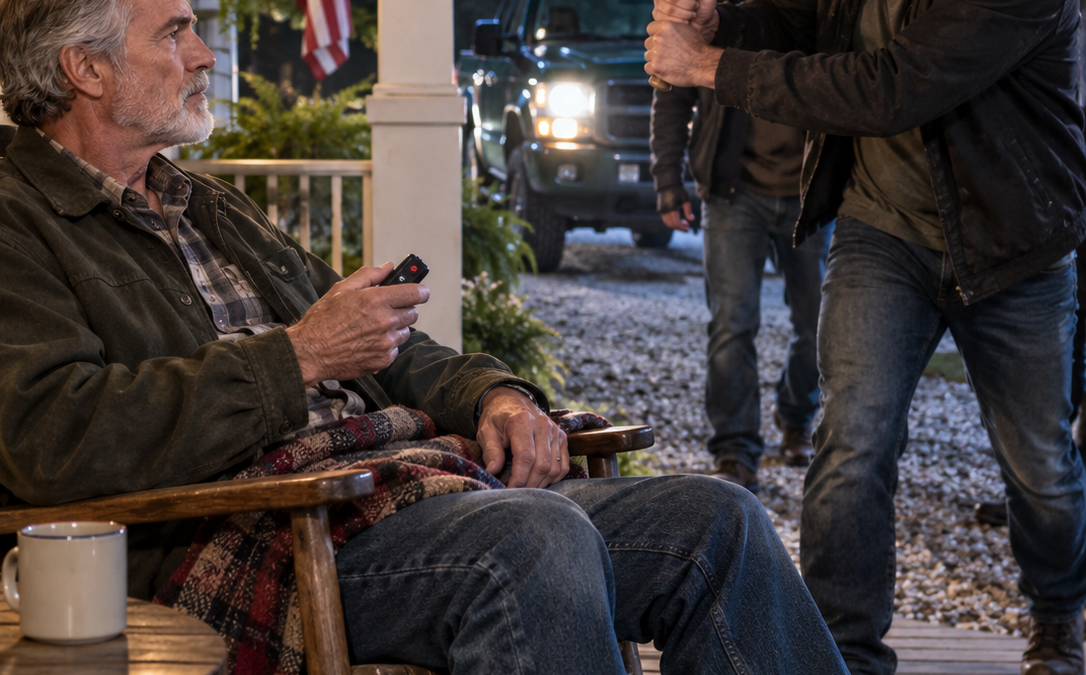
I sat in my rocking chair on the front porch a little after two in the morning, the same chair I’d sat in every evening for 11 years, watching the sun go down over the tree line.
A mug of coffee that had long since gone cold rested on the small table beside me.
And beneath the folded blanket across my lap was the old service pistol I hadn’t drawn in over a decade.
Not because I expected to need it, but because you don’t invite wolves onto your property without keeping something within reach.
The night was quiet, the kind of quiet that only exists this far out from any streetlight. Somewhere beyond the tree line, I knew there were four federal agents lying flat in the cold grass, patient in a way civilians never quite understand.
Patient. Waiting.
The way I’d once waited for hundreds of nights across a career nobody in this town had ever known about.
At 2:41, my perimeter sensors lit up.
Moments later, the dark green pickup came barreling up my driveway with none of the caution from its earlier visits.
Headlights blazing. Engine roaring. Gravel spraying out behind its tires as it skidded to a stop 30 feet from my porch.
Garrett Ror stepped out of the driver’s seat first.
He was a heavyset man in his forties, with the kind of restless, aggressive energy of someone who had never once in his life had to sit quietly with a consequence.
Behind him came the same two men who’d thrown the tire iron, one of them now carrying a baseball bat loosely in his right hand.
Ror didn’t see me at first, sitting still in the shadow of the porch overhang.
It wasn’t until he was halfway up my front steps, shouting something about teaching an old man to mind his own business, that he finally noticed me sitting there calmly, coffee mug in hand, watching him the way you’d watch weather rolling in when you already knew the forecast.
He stopped midstep, confused by the stillness.
The same way Deline had stopped, confused by it, two days earlier.
“You think sitting there quiet makes you tough, old man?” he said.
But his voice had already lost some of its certainty, just from finding me exactly where he hadn’t expected to find me.
“Calm,” I said.
I took a slow sip from the cold coffee and set the mug down deliberately on the little table beside my chair, the small clink of ceramic against wood cutting cleanly through the tense silence.
“You drove out here at two in the morning to threaten a 66-year-old widower over a mailbox and a photograph,” I said, my voice even and unhurried. “But I think you already know by now that your accounts are frozen. Your lawyer already told you there’s nothing he can do about a federal subpoena. And somewhere in the last few hours, you’ve probably started wondering exactly how much your sister has already told me.”
Ror’s face changed in the porch light, the aggression flickering into something closer to alarm.
Behind him, his two men exchanged a glance neither of them had expected to be exchanging that night.
“How do you know about the subpoenas?” he demanded, taking another step forward.
The man carrying the bat moved up beside him.
“I know because I’m the one who requested them,” I said quietly. “And I know your entire insurance fraud network going back four years. The collision shops, the chiropractors, the coached witness statements, all of it. Sitting right now in a federal case file that opened three days ago, the same day you nailed a photograph of my grandchildren to my front door.”
That was the moment his composure fully broke.
The same way Damon’s had broken on some other porch, in some other story, the mask of a man who believed money and intimidation made him untouchable finally cracking under the weight of an old man who had simply refused to be afraid.
“You set us up,” he said, his voice rising into something raw and desperate. “You and that lawyer sister of mine, you’ve been working against me this whole time. You destroyed everything. I’m going to burn this house down with you inside it.”
He raised the bat he’d taken from the man beside him and took two aggressive steps toward the porch stairs.
That was the signal I’d been waiting for.
The final, unmistakable threat that closed the trap completely.
I didn’t reach for the pistol under the blanket.
I simply reached into my shirt pocket, pulled out a small remote-control device, and pressed the single button.
The property erupted into blinding white light.
Tactical floodlights mounted along the barn roofline and high in the old oak flared on all at once, turning the pitch-black yard into something closer to daylight.
Garrett Ror froze midstride, throwing an arm up against the sudden glare as the bat clattered out of his hand and onto the porch steps.
His two associates spun in confusion, their hands instinctively going toward their waistbands before four sets of red laser sights converged on their chests from the tree line.
Steady, silent, and absolutely final.
From the darkness beyond the floodlights, federal agents in dark tactical gear rose out of the grass where they’d been lying patiently for the better part of an hour.
And Ellery Delqua himself stepped forward with a megaphone, his voice booming across my property with the calm authority of a man who had done this a hundred times before.
“Federal agents! Drop what you’re holding and get on the ground now!”
The two men with Ror didn’t hesitate.
They’d clearly done this kind of calculation before and understood exactly what four converging laser sights meant.
Their hands went up immediately, their knees hitting the gravel.
Garrett Ror, however, stood there a moment longer, blinking against the light.
He looked at his hired men lying facedown in my driveway. Then at the dozen armed agents closing in around him.
And finally, for the first time, he looked at me.
I was still sitting calmly in my rocking chair, with an empty coffee mug beside me.
He asked the same question they all seemed to ask in the end, in a voice that had lost every trace of the man who’d threatened my porch railing two nights earlier.
“Who are you?” he whispered.
I stood up slowly from my chair, my old knees protesting the movement the way they always did now, and walked to the top of the porch steps so he could see my face clearly in the flood of white light.
“I spent 28 years hunting men who thought their money and their meanness made them untouchable,” I told him.
I looked straight at him.
“You threatened my son. You photographed my grandchildren outside their school. And you sent men to throw a tire iron at a porch my own father built.”
I let the words settle before I finished.
“You should have looked a little closer at the quiet old man before you decided he was harmless.”
He collapsed to his knees on the gravel then, the same way I imagine every version of this man collapses in every version of this story.
The federal agents moved in to secure him without a single shot fired, without a single person hurt.
The whole ugly weight of his operation finally came down, not through violence, but through patience, information, and the simple mistake of underestimating a father who had never really stopped being what he used to be.
Deline Ror was arrested three days later at her apartment.
She cooperated fully once she understood the extent of the evidence already assembled against her brother. In exchange for her testimony regarding the coached witness statements, prosecutors agreed she would serve no additional time beyond probation, provided she permanently relinquished any custody claims connected to my grandchildren.
It was a condition Caleb’s attorney had insisted on personally.
Garrett Ror pleaded guilty eleven months later to insurance fraud, conspiracy, and witness tampering charges. He is currently serving a federal sentence of fourteen years.
His security consulting business dissolved, and his assets were seized to cover restitution to the insurance carriers he’d defrauded for four years running.
Caleb finalized custody of Ruthie and Miles that spring and moved with them into a small house two streets over from mine.
Close enough that I see them most days now. Close enough to hear Ruthie’s laughter carry across the yards on quiet evenings.
He asked me once, sitting on my porch with a beer in his hand while the kids played in the grass below, whether I regretted keeping my old life a secret from him for so many years.
I told him the truth.
A man in my old profession learns that the people you love are safest when they don’t carry the weight of what you used to do.
But some secrets are worth setting down once the danger that required them has finally passed.
I still sit out here most evenings with my coffee, watching the sun go down over the same tree line.
The same rocking chair. The same quiet property.
And my perimeter cameras are still active in the eaves of that barn.
Because old habits, once you’ve earned them the way I earned mine, don’t retire, even when the man carrying them finally does.
If there’s one thing this entire ordeal taught me, it’s that the people who threaten a family usually make the same mistake every time.
They mistake quiet for weakness and patience for fear.
When, in truth, the quietest man in the room is very often the one who was never afraid at all.








