Hours before my wedding, my sister stole my dress. She left my old high-school prom dress instead—ripped, stained, and two sizes too small. The note said: “Wear what you’re worth.” I forced myself into it and walked down the aisle. She looked thrilled, until my husband held up his phone and said: “Everyone should see what she sent me last night.”
My name is Lily Florence, and I was thirty-one the afternoon I unzipped my garment bag three hours before my wedding and found my high school prom dress where an $1,800 gown should have been.
Pale blue bodice ripped. Skirt stained. Two sizes too small.
Pinned to it was my 2013 prom ticket. On the back, in careful block letters, someone had written:
“Wear what you’re worth.”
I didn’t scream.
I sat on the edge of the bed and counted my breaths the way I have taught hundreds of 911 callers to count theirs.
My sister sang as I walked down the aisle and never once looked at the groom. She looked at the dress.
My mother had already asked 140 guests to be gentle with me because I might have a hard day. She said it before anyone was supposed to know the real dress was gone.
My father walked me anyway. His arm was shaking.
I laced that old dress shut with ribbon. I walked to the altar.
My husband did not flinch.
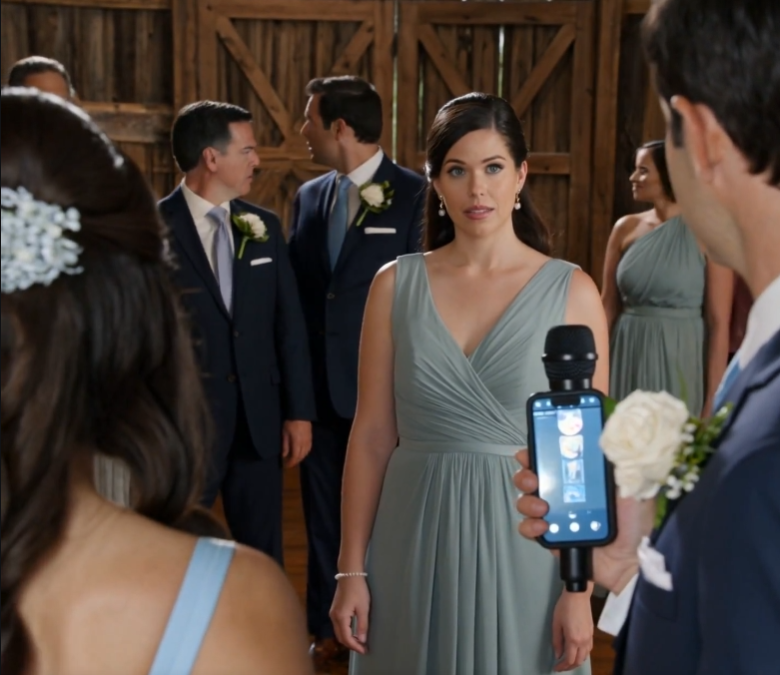
He asked for the microphone, held up his phone, and the barn went quiet in a way I will never forget.
They thought they knew which daughter would crack.
They had no idea the story had already changed hands.
Welcome back to Hidden Shadows, where ordinary women face impossible families and walk out with their dignity intact. If quiet justice is your kind of justice, you’re in the right place.
Comment “worth” if someone ever decided your value for you. Subscribe so you don’t miss what was on that phone.
Eight days before my wedding, I took a call from a woman who told me she was fine.
She said it three times.
Her voice was steady, almost pleasant. Behind her, a television was playing too loudly, and underneath the television, a man kept saying her name.
The way people say a name when they’re standing in a doorway and not leaving.
“Ma’am,” I said, “I need your address first. Then I need you to tell me what you can hear around you.”
I have worked as a 911 dispatcher in Lexington, Kentucky, for eight years. The first thing the job teaches you is that people rarely say the thing they’re actually calling about.
The second thing it teaches you is harder.
The calmest voice on the line is not always the safest person in the room.
So you listen past the words.
You listen for the television, the breathing, the name said one time too many.
Officers were at her door in six minutes. She was okay. Most nights, you never find out how the story ends.
That night I did, and I drove home feeling like I had done one small thing exactly right.
I had spent eight years hearing what people didn’t say.
I had never once turned that skill on my own family.
The Friday before the wedding, Owen’s mother hosted the rehearsal dinner at a steakhouse downtown. Joanne Hail had booked the long table in the back room, the one with the brick wall and the low yellow lights, and she had made place cards by hand.
She was that kind of woman.
Precise. Generous. Polite to me in a way that had always felt like a door held open by someone who wasn’t sure I should walk through it.
I had noticed it since our engagement party in February of the year before.
I had decided it was me.
Maybe I was too quiet. Maybe I didn’t laugh enough at the right moments.
That was usually the explanation in my family. When something felt cold, it was usually me.
My family took up one end of the table.
My father, Walter, sixty-four, retired after thirty years of fixing air conditioners, sat with his hands folded like he was waiting for a sermon to end. My mother, Diane, sat beside him and talked to everyone within reach.
She had given us $5,000 toward the wedding.
Owen and I had paid for the rest.
She had never let it be only $5,000.
My sister Vanessa sat across from me.
She was thirty-four, the worship leader at my parents’ church, and the kind of beautiful that makes a room lean toward her without knowing why.
The chair next to her was empty. There was a place card on the plate in Joanne’s neat handwriting.
Brent Callahan.
“Denver,” Vanessa said when Owen’s aunt Paula asked.
“A client thing. He’s heartbroken about it.”
She smiled and touched the card as if he might feel it from there.
Later, while the servers cleared the salads, I heard my mother lean toward Joanne and Paula at the other end of the table.
“Just be gentle with her this weekend,” she said. “She gets overwhelmed.”
She didn’t lower her voice all the way.
My mother never did.
Joanne nodded slowly, the way you nod at something you’ve already been told once before.
I let it go.
I had been letting things go for thirteen years.
It was practically my love language.
After dessert, the venue coordinator stopped by our table to confirm the timeline. She was a brisk woman who lived on the horse farm where we were getting married, twenty-five minutes outside the city.
She went through the schedule, tapped her clipboard, and added one more thing on her way out.
“And your sister has the third key to the bridal cottage, like your mom asked. For the music setup.”
There were three keys.
Mine, hers, and now apparently my sister’s.
My mother had arranged it without asking me, which was so ordinary that it barely registered.
Vanessa was singing the processional. It had been my mother’s idea after I asked my best friend Tessa to be my maid of honor.
“So Vanessa has a part,” she’d said.
I had agreed because agreeing was cheaper than the alternative.
“Your father’s driving me in the morning,” Vanessa told me. “My car is still in the shop, and you know I’m at Mom and Dad’s until the kitchen’s done.”
She had been living in our old house since February.
A kitchen renovation, she’d said.
It seemed to be taking a very long time.
She left before the toasts were over.
A migraine, she said.
On her way out, she hugged me.
She held on longer than she ever had.
“Get some sleep,” she whispered. “Tomorrow’s going to be a lot.”
On Saturday morning, Tessa and I sat side by side in a salon downtown with our hair pinned up in rollers and two iced coffees sweating onto the counter.
Tessa and I had met our freshman year at Eastern Kentucky University. That was twelve years ago. She was a pediatric nurse now, and she had the nurse’s gift of saying serious things in a casual voice and casual things in a serious one.
“Your groom texted me last night,” she said. “Asking if you were okay around eleven-thirty. He’s so nervous. It’s adorable.”
“What did you tell him?”
“That you were asleep with your mouth open and you’d been glowing all week. Which is true.”
I laughed.
It sounded like Owen.
He taught high school history, and he was the kind of man who read the footnotes.
We’d met at a trivia night in October of 2022, when his team lost to mine on a question about the Louisiana Purchase and he came over afterward to argue the date politely, with sources.
He proposed on Christmas Eve two years later.
I said yes before he finished the question.
A few minutes later, my phone lit up with his name.
“Hey,” he said.
His voice was soft, like he was standing somewhere he didn’t want to be overheard.
“How are you doing?”
“Getting sprayed within an inch of my life. How are you?”
“Good. I’m good.”
A pause.
“Lily, is there anything you want to tell me before today?”
I laughed again.
“Only that I’m going to be the one who cries first. Is that what you wanted to hear?”
He was quiet for a beat.
It was a little too long.
I remember noticing it the way you notice a song skip.
“Okay,” he said. “I love you. I’ll see you at the end of the aisle.”
I held the phone in my lap afterward and smiled at it.
And I didn’t think about that pause again for several hours.
Then my photographer texted.
Just confirming your mom called Thursday and said to skip the gown details and the getting-dressed shots. Still want those?
I read it twice.
My mother had called my photographer on Thursday to cancel the pictures of my wedding dress.
No, I typed. Please keep everything. I’ll see you at the cottage.
Tessa read it over my shoulder.
“Why would your mom cancel the dress pictures? Those are the ones you’ll actually frame.”
“She probably thinks they’re a waste of money,” I said. “It’s her $5,000. She likes to remind people.”
I told myself it was about control.
It usually was with my mother.
She liked to edit things, including people.
I put the phone facedown and tried to be irritated instead of uneasy, because irritated was a feeling I knew what to do with.
We drove out to the farm after lunch.
The dogwoods along the fence line were in full bloom, white against all that green, and the barn looked exactly the way it had in every picture I had saved for a year.
The bridal cottage sat behind it, a small white house with a porch and a narrow closet in the bedroom where, the afternoon before, I had hung my dress with my own hands and locked the door behind me.
The door was still locked.
I unlocked it.
The garment bag was hanging exactly where I’d left it.
Same hanger.
Same white bag with the bridal shop’s name in gray script.
Tessa went to put the coffees down, and I reached for the zipper.
It caught halfway.
I didn’t pull harder.
Through the gap, I could see a color that wasn’t ivory.
It was blue.
“Tessa,” I said. “That’s not my dress.”
I opened the bag the rest of the way.
The fabric was pale blue satin, cheap and shiny, the kind you can buy at a mall when you’re eighteen and have saved your paychecks from a frozen yogurt shop.
The bodice had been torn open along one side.
A long faded stain the color of weak wine ran down the front of the skirt.
I knew the stain before I saw it.
I knew the dress before I saw the stain.
A small rectangle of card stock had been pinned to the shoulder. It said Senior Prom 2013 on the front, with a date in April and a little printed crown.
The edges had gone yellow.
I turned it over.
Wear what you’re worth.
I sat down on the edge of the bed.
I put my hands on my knees and counted.
In for four. Hold for four. Out for four.
I have walked strangers through that count while they sat beside someone who wasn’t breathing.
It works.
It gives your body something to do while your mind catches up.
My mind caught up.
There was only one place in the world that ticket could have come from.
It had been sitting in a dry-cleaning bag for thirteen years in the cedar closet in my mother’s bedroom.
And it wasn’t my closet.
I checked the cottage the way I would have walked a caller through checking a house.
Windows first.
All latched.
The back door deadbolted from the inside.
The front lock clean. No scratches around the plate.
Nothing broken.
Nothing forced.
I called the coordinator.
She came across the gravel in under two minutes, and when she saw the dress, her face did something complicated.
“Only three keys,” she said. “Mine hasn’t left my pocket. You have yours, and your sister has the third one.”
She scrolled through her phone.
“Your mom asked on Wednesday. Here.”
She turned the screen toward me.
Could you give Vanessa a key? She needs to set up early for the music. Thank you. ❤️
Wednesday.
Three days before my wedding.
I looked back at the ticket in my hand.
The letters on the back were square and deliberate. Every one the same height.
Nobody in my family writes like that.
My mother writes in a slanted cursive she learned from nuns. Vanessa writes in big looping letters with circles over the i’s.
Block capitals are what people use when they don’t want their handwriting recognized.
“Do you want me to call your sister?” the coordinator asked.
“No,” I said. “I want to see who comes first.”
It was Vanessa.
She came in from the barn, where she had been warming up with the string trio, wearing a sage-green dress and her hair already done in soft, perfect waves.
She stopped in the bedroom doorway and looked at the prom dress laid across the bed.
Then she looked at me, her face filled with something that, on anyone else, I would have called compassion.
“Lily,” she said. “Honey.”
She crossed the room and put her hand on my shoulder, right where the seam had been torn thirteen years ago.
“Did you do this?”
I didn’t answer.
I watched her.
That was the job.
And some part of me had quietly gone to work.
“Where’s my dress, Vanessa?”
She tilted her head.
“Honey, you tell me.”
Tessa stepped forward.
“She was fine this morning. She was laughing on the phone with Owen this morning.”
“She’s always fine right before,” Vanessa said softly, without taking her eyes off me. “Do you remember senior year, Lily? You were fine then, too.”
She didn’t ask where my wedding dress was.
Not once.
After that, she asked if I was okay. She asked if I had slept. She asked, very gently, whether I had been feeling like myself lately.
Every question was about me.
None of them were about the dress.
My mother arrived next.
She came in fast, the way she enters every room, like she’s already late to fix something.
She took one look at the bed and shut the door behind her.
“Okay,” she said, lowering her voice. “Okay, sweetheart. Let’s not do this again.”
“Do what, Mom?”
She sat down beside me and took my hand.
Her perfume reached me before her words did.
Lavender.
She has kept lavender sachets in her cedar closet for as long as I’ve been alive.
To this day, it is the smell of being in trouble.
“Why don’t you lie down for a while?” she said. “I can tell people you’re not feeling well. We can push things back. Nobody has to know anything. Just not like last time.”
“Last time,” I repeated.
She looked away.
She didn’t answer that.
“Mom,” I said, “you asked the coordinator to give Vanessa a key on Wednesday for the music.”
Her hand tightened around mine.
“Please don’t start inventing things. Not today. You know how you get.”
You know how you get.
I had heard that sentence so many times that I used to think it was a fact about me, like my height or my blood type.
Vanessa had moved to the window.
She was holding a set of keys, turning them over in her fingers, and I recognized the worn leather fob.
They were my father’s truck keys.
“If it helps,” she said lightly, “I brought a spare. A white sundress. It’s in Dad’s truck. It’s nothing fancy, but it would work. Nobody would even notice.”
I looked at her for a long moment.
“Why would you bring a spare white dress to my wedding?”
The room went still.
My mother turned toward her.
Vanessa didn’t miss a beat.
She smiled at me the way she used to smile at me across the dinner table when we were kids, when she already knew how the argument was going to end.
“Because I know you,” she said.
Then she walked out onto the porch, keys in hand, and let the screen door close softly behind her.
My mother went after her.
Tessa waited until the porch was empty, then followed me into the small bathroom and closed the door.
I was standing at the sink with the prom dress over my arm.
I didn’t remember picking it up.
“Lil,” she said quietly. “What happened to this dress?”
In twelve years, Tessa had never asked me.
I had never offered.
There is a certain kind of story you don’t tell because telling it means admitting it still matters.
I told her it was April of 2013.
I was eighteen, a senior, and I had bought that dress with my own money from a job at a frozen yogurt shop.
I had been proud of it.
It was the first thing I had ever picked out that made me look like I belonged somewhere.
Vanessa was twenty-one then, a junior at the University of Kentucky, fifteen minutes from our house.
She came home the night of my prom with her boyfriend, a guy named Colby Nash, to watch my mother take pictures in the living room.
I came down the stairs.
Colby looked up from his phone.
“Wow,” he said. “Lily, you look like a completely different person.”
That was all.
One sentence.
He meant it kindly, and he went right back to his phone.
Vanessa smiled at me.
Then she said one of my straps looked twisted and she’d fix it for me upstairs.
“What happened upstairs?” Tessa asked.
I looked down at the torn bodice.
“In her bedroom, Vanessa took hold of the strap and pulled. Not hard enough to look like an accident. Hard enough to open the seam all the way down my side.”
I remember the sound more than the pain.
“Before I could say a word, she picked up the red plastic cup of punch she’d carried upstairs and threw it at my skirt. Then she ran.”
She was crying before she hit the stairs.
By the time I got to the landing, she was in my mother’s arms in the living room, sobbing that I had thrown my drink at her and ripped my own dress because Colby had looked at her instead of me.
And I screamed.
That was the only thing anyone actually saw that night.
A girl in a ruined dress screaming on the stairs.
My mother held Vanessa.
Colby stared at the carpet.
And my father stood at the bottom of the staircase, looking up past me toward Vanessa’s open bedroom door.
He looked at it for a long time.
Then he turned and walked into the kitchen.
Later that night, after Colby had left and the house had gone quiet, I knocked on my parents’ bedroom door.
My mother opened it in her robe.
I told her exactly what had happened.
The strap.
The cup.
Vanessa’s room.
I didn’t scream.
I told it the way I would tell it today, in order, with nothing added.
She listened all the way to the end.
Then she said, “Vanessa has no reason to lie, Lily. You do.”
Behind her, my father was lying on his side in bed, facing the wall.
I didn’t go to prom.
That summer, my parents sent me to six sessions with a family counselor for what my mother called anger management.
The counselor was kind.
She asked good questions.
I don’t think she ever believed I had done it, but I was eighteen, and I had screamed.
And screaming was the only fact anyone in my family had witnessed.
“We’re not punishing you,” my mother told me in the car after the first session. “We’re getting you help.”
She had the dress cleaned, not repaired.
Cleaned as much as a cleaner could manage.
Then she zipped it into a dry-cleaning bag, pinned my prom ticket to it, and hung it in her cedar closet.
“So you’ll remember what losing control costs,” she said.
From that year on, in every family story, I was the one who got overwhelmed. The fragile one. The one you had to handle.
And Vanessa was the one who handled things.
Tessa didn’t say anything for a while.
Then she reached over and turned off the faucet I hadn’t realized I’d turned on.
I looked at the dress, then at the door my sister had walked out of.
“She wasn’t trying to ruin my wedding,” I said. “She was trying to repeat 2013 in front of 140 witnesses.”
Tessa’s car was parked on the gravel beside the cottage.
I asked for her keys, and she gave them to me without a word.
I got into the driver’s seat, started the engine, and sat there with both hands on the wheel.
The dashboard clock said I had a little over two hours.
I took out my phone and opened my messages with Owen.
Can we postpone? I’ll explain later. I’m so sorry.
I didn’t send it.
My thumb hovered over the button, and I made a plan the way I make a plan on a bad call.
One step at a time.
Drive back to the city.
Tell Owen in person.
Let my mother tell the guests whatever she was going to tell them anyway.
Reschedule.
Move on.
There would be other Saturdays.
There would never be another way to get through this one without becoming the girl on the stairs.
I put the car in reverse.
The tires moved on the gravel.
I backed up maybe three feet before I put my foot on the brake, and I sat there half in and half out of the parking space with the cottage framed in the windshield.
I think I would have done it.
I want to be honest about that.
I was very close.
Leaving felt like the only choice in which nobody got to watch.
Then someone tapped on the window.
It was Paula Hail, Owen’s aunt.
She was fifty-eight, his late father’s younger sister, and since Owen’s dad passed in 2020, she had become the family’s designated adult.
She was holding a white clothes steamer, the cord wrapped neatly around the handle, and a stack of wedding programs tucked under her arm.
I rolled the window down.
“Your mom asked me to bring this by,” she said, lifting the steamer.
Then she looked at me more carefully, and her voice softened.
“Your mother asked us to be gentle with you today, honey. She had the program ladies pass it along, too. I just want you to know nobody here is going to judge you. Whatever you’re dealing with.”
The program ladies.
Two women from my mother’s Sunday school class.
My mother had asked them to stand at the barn doors and hand out programs to every guest.
“When did she tell you that?” I asked.
Paula thought about it.
“Around lunch, when I got here to help with the flowers.”
Around lunch.
I had opened my garment bag more than an hour after that.
“Did she say why?” I asked.
“Just that you’d had a rough week.”
Paula frowned a little, remembering.
“She had the programs stacked and ready before the florist had even unloaded the van. And she said it like she’d said it before, honey. More than once. Like it was already the plan.”
My mother had prepared the room for a breakdown I hadn’t had yet.
Paula hesitated.
She looked like a woman deciding whether something was her business and then deciding it was.
“She said one more thing,” Paula said. “She said if you walked in wearing something unexpected, we shouldn’t stare.”
I didn’t move.
I kept my face exactly where it was, because that is what you do when a caller tells you something that changes the entire call.
You don’t gasp.
You don’t interrupt.
You write it down.
My mother had known what I was going to be wearing.
Not that I might be upset.
Not that I might be tired or overwhelmed.
She had known there would be no wedding dress.
She had called my photographer on Thursday to cancel the pictures of it.
She had asked for a key on Wednesday.
And at lunch, while I was still sitting in a salon laughing at my fiancé on the phone, she had told the people handing out my wedding programs to be kind to me about a dress I hadn’t seen yet.
“Thank you, Paula,” I said. “Really.”
She squeezed my arm through the open window and walked back toward the barn.
I deleted the message to Owen.
I turned off the engine and pulled the keys out of the ignition.
Tessa was standing on the cottage porch with her arms crossed, watching me.
“If I leave,” I told her, “their story becomes true.”
Back inside, I found that Vanessa had been to the truck while I was in the car.
Her white sundress was lying across the bed, still with the price tag hanging from the armhole.
I laid the prom dress beside it.
The blue satin with the torn bodice and the stain.
“They built two doors for me,” I said.
Tessa waited.
“If I fall apart, I’m the girl on the stairs again. Everybody’s already been told to be gentle with me. They’ll be gentle all the way to the parking lot. And if I put on that sundress, Vanessa is the sister who saved the day. She brought a spare. She knows me so well.”
I looked at the price tag.
“Either way, the story is hers.”
“So what’s the third door?”
I picked up the prom dress.
“Lily,” Tessa said carefully. “It’s two sizes too small.”
“Then we’ll make room.”
The coordinator brought us the venue’s emergency kit, a fishing tackle box full of safety pins, fashion tape, a sewing kit, and a seam ripper.
Tessa has closed wounds on screaming toddlers.
She was not intimidated by satin.
She opened the side seam the rest of the way, then ran the seam ripper along the back until there was enough fabric to work with.
She cut the extra ivory ribbon from my bouquet wrapping, about two yards of it, and threaded it through a row of safety pins down my spine like the laces on a boot.
I had been a size four at eighteen.
I was a size eight now.
The ribbon made up the difference, mostly.
When I breathed in, I could feel every pin.
Tessa reached for the fashion tape and a folded piece of tulle.
“I can cover the stain,” she said. “Nobody will see it from the pews.”
“Leave it.”
She looked up at me.
“Leave the stain,” I said. “It’s been there for thirteen years. I’m done hiding what happened to me.”
She put the tool down.
I looked at myself in the long mirror on the back of the closet door.
From the front, I looked almost exactly like the girl in the living room in 2013.
Same color.
Same neckline.
Same hopeful little shine to the fabric.
The difference was in my face.
That girl had been waiting for someone to tell her she was allowed to go.
This one wasn’t asking.
I was halfway through the last row of pins when the screen door creaked.
Vanessa had come back for her sundress.
She stopped in the bedroom doorway.
For a second, she just looked at me.
The blue satin.
The ribbon.
The stain left out in the open.
And something moved across her face that I couldn’t name.
Not guilt.
Something closer to surprise.
“You’re really going to wear that,” she said. “In front of everybody.”
“You picked it out for me,” I said.
She held my eyes for a moment.
Then she smiled slowly, and the smile came back all the way, as if she had just checked the math and found it still worked in her favor.
The girl in the ruined dress was still the girl in the ruined dress.
Whatever I chose, the room had already been told how to see it.
“Oh,” she said lightly. “Okay. It’s your day.”
She picked up the sundress, price tag swinging, and left.
At a quarter to five, there was a knock on the cottage door.
My father stood on the porch in his gray suit, the same suit he had worn to every wedding and funeral for a decade.
He had come to walk me to the barn.
He looked at my face first and smiled.
Then his eyes moved down to the dress.
The smile stayed on his mouth for a second after it left the rest of him.
He looked at the dress for a long time.
Longer than surprise.
Then he turned his head just slightly and looked past me toward the gravel lot, where his white pickup truck was parked beside the fence.
When I took his arm, it was trembling.
“You don’t have to do this, Lily,” he said quietly.
“I know, Dad,” I said. “That’s why I’m doing it.”
What happened in that barn over the next hour is the reason I’m telling this story at all.
So stay with me for this part.
You’ll want to hear exactly what my husband read.
The barn doors opened, and 140 people turned around.
I heard it before I saw it.
A shift in the room, like wind moving across tall grass.
People were still holding their programs.
A few of them lowered them slowly into their laps.
A woman on the aisle whispered to the man beside her.
Not quietly enough.
“Bless her heart. They said she might have a hard day.”
At the front of the barn, beside the string trio, my sister began to sing.
“Be Thou My Vision” is an old Irish hymn, slow and plain and beautiful.
And Vanessa’s voice is the best thing about her.
It always has been.
It filled every corner of that barn.
She sang the first verse with her hands folded at her waist and her chin lifted, and she smiled the entire time.
She never once looked at the groom.
She was looking at the dress.
Her eyes went from the torn bodice to the stain to the ribbon at my waist, the way you’d check items off a list.
Every program in that barn had the same line printed near the top:
Processional: Be Thou My Vision, sung by Vanessa Callahan, Sister of the Bride.
I had approved that wording myself in a coffee shop in February, and it had seemed like such a small thing to give.
In the front row, my mother dabbed at her eyes with a white handkerchief.
She did it in rhythm, on the downbeats, like someone who had rehearsed.
Then she leaned back toward the row behind her and whispered something.
I read it on her lips.
I told you she might.
On the groom’s side, Joanne Hail watched me walk with her hands pressed together under her chin, and her face held the kind of pity you’d give a stranger in a hospital waiting room.
Only one face on that side of the aisle didn’t hold pity.
Paula’s.
She wasn’t looking at me at all.
She was looking at my mother.
It is about forty steps from the doors of that barn to the altar.
I counted them.
The last time I had walked anywhere in that dress, it was down a staircase toward a room that had already decided what I was.
This was the same walk.
Longer.
With more witnesses.
My father’s arm shook the whole way, and I held it a little tighter each time it did.
Halfway there, he said my name.
“Lily.”
Just that.
Then he closed his mouth, and whatever came after it stayed inside him.
Owen’s groomsmen stood in a line beside him.
Three men in navy suits.
The one closest to the aisle, his cousin, looked at the dress and then quickly at the floor, the way you look away from a car accident.
The other two kept their faces carefully blank.
Then I looked up at Owen.
I had prepared myself for his face.
I had pictured shock or confusion or the careful, tender expression of a man who had been warned that his bride might not be well.
I was ready for any of those.
He had none of them.
Owen looked at the dress.
Then he looked at me directly and steadily, the way he looks at a primary source when a student has cited it wrong.
He looked like a man who had just confirmed something.
My father placed my hand in Owen’s.
Then he stepped back and sat down in the front row next to my mother and did not look at either of us.
Owen leaned in close enough that only I could hear him.
“Did you choose this?”
Nobody had asked me that all day.
Not my sister.
Not my mother.
Not the guests with their programs.
Everybody had told a story about me.
Owen asked.
“No,” I said.
His hand tightened around mine.
Something settled in his face.
Not relief exactly.
Resolve.
“Okay,” he said softly. “Then marry me first.”
The officiant was Owen’s friend from college, a man with a soft voice and a gift for keeping things short.
He welcomed everyone.
He said something warm about love being a choice you make every morning.
Then he turned to Owen for his vows.
While the officiant spoke, I noticed Owen touch the inside pocket of his jacket.
Once.
Then again a minute later.
The way you check for your keys before you leave the house.
I didn’t understand it yet.
I filed it away.
The way I file away a sound on a call.
Owen unfolded a sheet of paper.
I had heard him practice those vows in our kitchen.
I knew how they went.
He read them the way I remembered until the last line, which was written in a different ink, squeezed into the bottom margin.
“And I promise,” he said, “to believe you before I believe any story about you.”
I heard my own breath catch.
Beside the string trio, my sister’s smile faltered for about half a second.
Then it came back.
In the front row, my mother leaned toward the aisle and caught the eye of one of her program ladies.
She gave her a small, tight nod, like a stage manager checking that the next cue was ready.
Marry me first, he had said.
I understood a little more of it now.
Whatever he was carrying in that pocket, he wanted our marriage to exist before anyone else got a say in it.
In the front row, my father turned his head toward the tall window on the side of the barn, the one that looked out over the gravel lot.
He stared at it the way you stare at a phone you’re afraid will ring.
I said my vows.
I had written them months earlier about building a home where nobody had to be the loud one or the quiet one, where two people could just tell each other the truth.
When I got to that line, I heard someone in the front row shift on the pew.
I didn’t look to see who.
I don’t remember every word I said after that.
I remember my voice didn’t shake.
“By the power vested in me by the Commonwealth of Kentucky,” the officiant said, “I now pronounce you husband and wife. You may kiss the bride.”
Owen kissed me.
Vanessa was the first one clapping and the loudest.
It was a strange sound, a single pair of hands going too fast before the rest of the room caught up.
Then the room applauded politely, the way people applaud when they aren’t sure what they are applauding.
My father looked toward the window again.
The trio lifted their bows for the recessional.
This was the part where we were supposed to turn and walk back up the aisle together, into the cocktail hour, into the rest of our lives.
Owen didn’t turn toward the aisle.
He turned toward the officiant.
“Could I borrow that for a second?”
The officiant blinked, then handed him the wireless microphone.
The trio lowered their bows.
In the front row, I heard my mother’s voice, not quite a whisper.
“What is he doing?”
Owen cleared his throat.
His free hand was still holding mine.
“Thank you all for being here,” he said. “I know this has been an unusual afternoon. I won’t keep you long, but before we walk out of here, there’s something I need to do.”
He reached into the inside pocket of his jacket and took out his phone.
He held it up.
The screen was lit.
“Everyone should see what she sent me last night.”
And beside the string trio, still holding her own microphone, my sister stopped smiling so suddenly that her face looked like a photograph of itself.
Owen didn’t rush.
He read in the same voice he uses to read old letters to his students.
Slowly.
Without performance.
Letting the words do the work.
“Last night after the rehearsal dinner, I got a text from Vanessa. Here’s what it says.”
He looked down at the screen.
“‘She’s been struggling again, like in high school. She wants to wear her old prom dress tomorrow to see if you’ll love all of her. Please don’t react, and please don’t tell her I told you. She made me swear.’”
Nobody moved.
A glass on one of the high-top tables near the back had been halfway to someone’s mouth.
It stayed there.
“Tomorrow,” Owen said. “She sent that last night at eleven. Lily’s dress was locked in that cottage all night long. Lily didn’t see this one until this afternoon.”
He let that sit.
I watched it travel down the rows, one face at a time.
“There was a photo attached,” he said.
He didn’t turn the screen around.
He lowered the phone and held it flat against his chest.
“I’m not going to show you this picture. It’s of Lily when she was eighteen. She’s crying, and she’s wearing that dress.”
He looked across the barn at my sister.
“I’d like Vanessa to tell you who took it.”
Vanessa took one step away from the string trio.
She was still holding her microphone, and for a moment, the two of them faced each other down the length of the aisle.
Two microphones.
One wedding.
When she spoke, her voice was perfect.
Warm.
Wounded.
A worship leader’s voice.
“Owen, she made me promise.”
She pressed her free hand to her chest.
“I was trying to protect her. That’s all I’ve ever done. And I’m sorry, but what you’re doing right now, in front of everyone on her wedding day, this is exactly what I was trying to protect her from.”
Around the barn, a few heads nodded.
I saw it.
An older man two rows back.
One of the women from my mother’s church.
It would have been easy in that moment to believe her.
She was so good at being believed.
For a few seconds, the room belonged to her again.
“I asked you one more question that night,” Owen said.
He looked back down at his phone.
“I asked if anyone else knew. Here’s what you wrote back.”
He read it slowly.
“‘Just me and Mom. Mom’s handling the family side.’”
Every head in the barn turned toward the front row.
Near the doors, the two women from my mother’s Sunday school class looked at each other.
One of them set her leftover stack of programs down on an empty chair very carefully, as if it had suddenly gotten heavy.
My mother’s handkerchief slipped out of her hand and landed on the floorboards.
She didn’t pick it up.
She stood, smoothed the front of her dress, and put on the voice she uses with waiters who have brought the wrong order.
“This is not the place,” she said.
I let go of Owen’s hand.
I took half a step forward, and he understood before I asked.
He handed me the microphone.
I didn’t raise my voice.
I have never needed to raise my voice to be heard.
I have spent eight years speaking to people on the worst night of their lives.
And the thing I have learned is that calm carries farther than loud.
“That dress has been in my mom’s cedar closet for thirteen years,” I said. “I haven’t been inside that house since Christmas. I worked a twelve-hour shift on Easter. Everybody in my family knows that.”
I reached into my bouquet and took out the small yellow ticket.
“So tell them how I planned to wear it.”
Vanessa’s mouth opened.
Then closed.
Then opened again.
“You asked me to bring it,” she said.
My mother took a step toward me.
“Lily, sweetheart, you’re upset. Let’s all go inside and talk about this privately.”
“I’m not upset, Mom,” I said. “I’m answering the question.”
Vanessa found her footing again.
She turned to Owen, and her voice went low and reasonable.
“You’ve known her for three years, Owen. I’ve known her for her entire life. You don’t know what she’s like when she gets like this.”
“Then you knew exactly where that dress was,” Owen said.
Vanessa looked back at me.
“You asked me to bring it.”
“When?”
She didn’t answer.
Her eyes flicked to our mother.
It was the smallest movement, but everybody saw it.
And in the third row on the groom’s side, Paula Hail stood up.
She was still holding her program.
She didn’t look at me.
She looked at my mother.
“Diane told me to be gentle with Lily around lunchtime,” Paula said.
Her voice was steady and a little bit sad.
“Before Lily even got here. Before anyone knew there was a problem with the dress. She asked the ladies at the door to tell every guest the same thing. And she told me that if Lily walked in wearing something unexpected, we shouldn’t stare.”
“Paula,” Vanessa said, and her voice had an edge now. “With respect, you’ve known my sister for three years.”
“I’ve known your mother since noon,” Paula said. “That was long enough.”
She sat back down.
It wasn’t dramatic.
That was what made it land.
Paula was not family.
She had no reason to lie and every reason to stay quiet.
And she said it the way you’d read a grocery list.
Owen took the microphone back from me gently.
“Diane asked every one of you to be gentle with Lily today,” he said. “So I’m going to be gentle with her. I’m going to believe her.”
The barn was silent in a way I didn’t know a room that full could be.
Then my father stood up.
He didn’t say a word.
He didn’t look at my mother or at Vanessa or at me.
He walked straight down the side of the aisle, past the program ladies, and out through the barn doors into the afternoon.
Nobody spoke.
For about two minutes, 140 people sat in a barn and listened to the string trio’s music stands creak and a horse somewhere in the far paddock stamp at the ground.
Then the doors opened again.
My father came back in carrying my wedding dress.
It was draped over his arm.
Ivory silk.
The long train gathered up against his chest so it wouldn’t touch the floor.
He walked it down the aisle the way he had walked me down that aisle half an hour earlier.
Carefully.
Slowly.
He laid it across the front pew.
“She put it behind my seat this morning,” he said.
His voice was low.
“Told me it was her dress for tonight. I didn’t ask.”
Across the aisle, Joanne Hail had one hand pressed over her mouth.
My photographer, standing near the side wall, slowly lowered her camera.
Nobody had told her to stop.
She just did.
Vanessa looked at the dress on the pew.
Then she looked out at the rows of faces.
All those people she had sung to on Sunday mornings.
And I watched the mask begin to slide.
“It’s a misunderstanding,” she said.
Her voice had climbed half an octave.
“Dad got confused. Lily knows exactly what I mean. She’s always done this. She makes everything into—she twists—”
Nobody nodded now.
“Why are you all looking at me?” she said. “Why is everyone looking at me?”
And then it came out of her.
Not about me at all.
“Everyone was going to ask me where Brent is.”
The words echoed off the rafters and came back down.
Vanessa’s hand flew to her mouth.
She looked around the barn as if she were trying to find the place those words had come from so she could put them back.
The women from her church were staring at her.
Her empty chair from the night before seemed to be sitting in the middle of the room.
I understood in that moment what had been under the words all along.
I took a breath.
I looked at my sister and then at my mother, standing beside the front pew with her handkerchief still on the floor.
“You can go now,” I said. “Both of you.”
Vanessa set her microphone down on the straw-covered floor.
It was still on.
It picked up the sound of her heels as she walked away.
Nobody clapped.
Somewhere outside, a horse whinnied in the far paddock, and that was the only answer anyone gave.
The coordinator was very good at her job.
Within a minute, she had the string trio playing again and was announcing that cocktail hour would begin early on the back patio.
The guests rose and filed out with the grateful speed of people who had been handed something to do.
She led my family through a side door into the tack room.
It was a narrow room that smelled of leather and saddle soap, with a dozen saddles hanging in a row along one wall and a single wooden stool in the corner.
Owen came in behind me.
My father stood by the door.
My mother and Vanessa were already inside.
Tessa waited in the doorway with her arms crossed like a nurse guarding a patient’s room.
My mother turned to my sister.
For the first time in my life, I heard her voice shake.
“Vanessa, tell me you didn’t do this.”
Vanessa laughed.
It was a short, dry sound with no humor in it at all.
“You didn’t ask me in 2013 either.”
The room went very still.
“What does that mean?” my mother said.
“It means you never asked.”
Vanessa turned on her, and her face was blotchy now, her perfect waves coming loose.
“I told you she ripped her own dress, and you believed me in about one minute. One. You never even went upstairs. Mom, you never looked at my room. You never looked at anything. You just picked me.”
She pointed at the torn bodice of the dress I was still wearing.
In the doorway, my father closed his eyes.
“I did that. Okay? I did it. She looked better than me for one night, and Colby noticed, and I couldn’t stand it. And nobody ever asked. So don’t stand there acting like you’re surprised.”
She took a breath.
“I thought it would work again.”
My mother stared at her.
Then, very slowly, she turned to me.
“Why didn’t you tell me?”
I thought about all the things I could say.
The car ride after the first counseling session.
The six Tuesday afternoons.
The years of being handled.
The dress in the cedar closet with my name on its ticket.
“I did,” I said. “I was eighteen.”
My mother sat down on the wooden stool in the corner.
She sat heavily, like her legs had decided before she did.
For a long moment, she didn’t say anything at all.
She looked, for the first time I could remember, like a woman with nothing left to manage.
Owen spoke quietly from beside me.
“Diane, why did my mother already think something was wrong with Lily before today? Before any of this?”
My mother’s hands were folded in her lap around her phone.
She turned it facedown.
“At your engagement party,” she said without looking up. “I told Joanne that Lily had some trouble with her temper when she was younger. That she’d done a lot of work on it. I just didn’t want her to be surprised.”
“Surprised by what?” I asked.
She didn’t answer.
“And this week?”
She took a breath.
“Vanessa asked me for the key on Wednesday. For the music. And last night, she told me you were planning to wear that old prom dress today to make a point. To embarrass the family. She said you’d been talking about it.”
“So you called me,” I said.
My mother said nothing.
“You didn’t call me. You called my photographer.”
“I was trying to keep things from getting out of hand.”
She said it the way she had said everything my whole life, like it was obviously the reasonable choice.
“If something was going to happen, I wanted people prepared. That’s what a mother does.”
“You called her on Thursday, Mom.”
I kept my voice level.
“Thursday. Vanessa told you on Friday night. Which is it?”
My mother opened her mouth.
Then she closed it.
Vanessa looked away at the wall of saddles.
That was the answer.
My mother hadn’t been fooled on Friday night.
She had known since Thursday at the latest.
She hadn’t taken the dress, and she hadn’t written the note.
She had simply opened every door for the person who did and then stood at the barn entrance telling people how to feel about it.
“It was going to be back in the closet by dinner,” Vanessa said suddenly, to no one. “Nobody was supposed to get hurt. It was going to be back in the cottage, and everyone was going to think she’d hidden it herself. That’s all. She’d have been fine. She always ends up fine.”
Nobody answered her.
I looked at my mother on the stool.
“You managed the story, Mom,” I said. “You just never managed to call me.”
Vanessa pushed past Tessa and out the door.
My mother rose slowly and followed her, picking up her purse from the floor on her way out.
She didn’t look at me.
My father stood by the door.
The whole time, he had not said a single word.
He looked at me for a long moment.
I thought he might say something.
I think he thought so, too.
“I’ll take them home,” he said.
“I know you will,” I said.
Through the small window of the tack room, I watched his white truck back out of the gravel lot, my mother in the passenger seat and my sister in the back.
The taillights turned red at the gate and then disappeared behind the wooden fence.
My father had carried my dress back into that barn.
He still hadn’t said a single word about 2013.
Owen found me on the back porch of the cottage a few minutes later.
He was carrying my wedding dress over his arm the same way my father had.
“You can change,” he said, “if you want to. Tessa can get you into it in ten minutes.”
I looked at it for a long time.
$1,800 of ivory silk.
The dress I had chosen in a quiet shop with Tessa the summer before.
The one I had stood in front of the mirror in and thought, There you are.
Then I looked down at the blue satin.
The ribbon.
The pins.
The stain.
“I got married in this,” I said. “I’m staying in it.”
We danced our first dance under the string lights on the patio in front of everyone who had stayed, which was almost everyone.
The father-daughter dance had been quietly taken off the schedule.
The ribbon down my back swung a little every time Owen turned me, and by the end of the song, the people watching us weren’t looking at the stain anymore.
They were looking at my face.
Later, Tessa gave her maid-of-honor toast.
She had written three funny pages about our college dorm and a disastrous road trip to Nashville.
She folded them in half, put them in her clutch, and raised her glass.
“I’m going to skip what I wrote,” she said. “I’ve known Lily for twelve years. I’ve seen her tired and sick and heartbroken and furious. I have never once seen her be the problem.”
She lifted her glass a little higher.
“To Lily. And to Owen, who asked her.”
People drank.
Nobody cheered.
Some of them looked down at their plates.
It was better than cheering.
When the music stopped, Joanne Hail was waiting at the edge of the dance floor.
She took both of my hands.
Hers were cold.
“Your mother told me you’d had problems,” she said. “She said it at the engagement party. She said you’d worked very hard on it and she just wanted me to know. And I believed her.”
Her eyes filled.
“For more than a year, I watched you waiting for something that was never there. I’m so sorry, Lily. I should have just looked at you.”
I thought about all the family dinners at the Hails’ house over the past year.
All the careful questions.
The way Joanne always seemed to be listening for something underneath my answers.
She had been listening for my mother’s story.
It had never occurred to me that someone had handed it to her.
I didn’t know what to say, so I held her hands a little longer than she expected.
It seemed to be enough.
Afterward, Owen and I sat at the sweetheart table while everyone else ate.
He had turned his phone facedown beside his plate, and he hadn’t picked it up since the barn.
“Tell me about last night,” I said. “All of it.”
He did.
Vanessa’s text had come in while he was brushing his teeth.
He read it three times.
“It didn’t sound like you,” he said, “but it didn’t sound like nothing either. She had written the words I was most afraid of. That you were struggling. That if I reacted, I’d make it worse. That you had made her swear.”
“So?”
“So I texted Tessa. I didn’t want to tip Vanessa off, so I just asked if you were okay. She said you were asleep and you’d been happy all week.”
He paused.
“Then I asked Vanessa if anyone else knew. She said, ‘Just her and your mom.’”
He shook his head.
“That’s when I stopped believing her. Because you tell Tessa everything. If you were really planning something, Tessa would know. Your mother wouldn’t.”
“You could have called me.”
“I know.”
He didn’t look away.
“I thought about it for an hour. I thought, What if I’m wrong? What if I wake her up the night before our wedding to ask her if she’s having a breakdown? What if that’s the thing that actually hurts her? So I called you in the morning instead. And I asked, and you laughed, and I knew she’d lied. I just didn’t know what she was going to do with the lie.”
He paused.
“I should have called you. I’m sorry.”
I believed him.
That didn’t mean it was fine.
“Next time,” I said, “you call me even if I’m asleep.”
“Even if you’re asleep.”
We shook on it like a contract.
Then he kissed my knuckles, and I laughed for the first time in hours.
My phone buzzed on the table.
It was my mother.
The first line was already visible on the lock screen.
We need to talk about how this looked.
Owen and I spent two nights in a cabin at Red River Gorge, an hour east of Lexington.
It was all either of us could take off.
A teacher in April and a dispatcher who had already traded every shift she could.
The real honeymoon would have to wait for summer.
We didn’t mind.
We hiked and slept and didn’t turn on our phones.
When we got home, the version of the story my mother had been telling was already falling apart.
She had spent Sunday on the phone with relatives, explaining that Vanessa had only been trying to help, that it had all gotten out of hand, that emotions had been running high.
But too many people from our church had been sitting in that barn.
Paula had told the Hails.
My cousins had told each other.
There were 140 witnesses, and my mother couldn’t call all of them.
The following Sunday, the pastor asked Vanessa to step back from leading worship for a season.
He was kind about it, I heard.
Within a week, everyone at church knew that Brent had moved out in January and that the kitchen renovation at my sister’s house had never existed.
In the middle of May, Vanessa moved out of my parents’ house and into a small apartment on the other side of town.
A few days later, she sent me a text.
I didn’t think you’d actually walk out there.
I read it once.
Then I archived it.
It wasn’t an apology, and I didn’t need it to be one.
But before any of that, on the Wednesday after the wedding, my father knocked on the door of my apartment.
He was alone.
He sat at my kitchen table without taking off his jacket, and he put a small envelope in front of me.
Inside was a scrap of pale blue satin about the length of my finger, with a few loose threads still hanging from one edge.
“The morning after your prom,” he said, “I went into your sister’s room to fix the window unit. It was stuck behind her desk.”
He stared at the scrap.
“I knew from that morning. I knew. And I told myself it would only make things worse. And then it was a year later. And then it was ten.”
His voice broke.
“I kept it. I couldn’t throw it away. I don’t know why.”
I looked at the scrap for a long time.
Thirteen years of being the fragile one.
And the proof had been sitting in my father’s dresser drawer the whole time.
I didn’t cry.
I got up and found the prom ticket in my purse, the one with the block letters on the back, and I put it in the envelope with the fabric.
I wrote 2013 across the front.
Then I slid it back across the table to him.
“You kept this for thirteen years, Dad,” I said. “You can keep it now. You tell them. Not me.”
He held the envelope in both hands for a long time.
Then he nodded.
In early May, Paula told me that my father had called every single one of our relatives, one at a time, and told them what really happened on the night of my prom in his own voice.
I made other changes.
Quieter ones.
I went to the HR office at the dispatch center and updated my emergency contact form.
For eight years, the first name on it had been my mother’s.
I crossed it out and wrote Owen’s.
Underneath it, Tessa’s.
I stopped going to Sunday dinner at my parents’ house.
And when my mother texted to invite me to Mother’s Day brunch, I wrote back one line.
I won’t be at brunch on Sunday. Please don’t ask me to explain.
She didn’t answer.
For the first time in my life, I didn’t wait for her to.
At the end of April, I took the prom dress to a dry cleaner.
They got most of the punch out.
A seamstress down the street rebuilt the bodice and let out the side seams.
Then I drove it to the prom closet at Owen’s high school.
A classroom full of borrowed dresses where any student who can’t afford one can pick one out.
No questions asked.
Before I hung it on the rack, I pinned a new note to the shoulder.
Be gentle with her.
On the second Saturday in May, a senior borrowed it for her prom.
I never learned her name.
I didn’t need to.
On Memorial Day, we went to a cookout at Paula’s house with the whole Hail family.
Joanne saved me a seat next to her.
Halfway through the afternoon, Owen handed me an envelope from the teacher who runs the prom closet.
Inside was a handwritten thank-you card.
The girl who wore my dress had asked the teacher to pass along a message.
She said that dress made her feel like herself.
I read that line several times.
If someone in your life has been telling a version of you that isn’t true, you don’t owe them a louder version of the truth.
Sometimes you just stop answering to it.
Tell me in the comments what you would have done in that barn.
For eight years, I’ve told strangers the same thing on the worst night of their lives.
Stay on the line.
Help is coming.
It took me thirty-one years to learn the other half of the job.
Sometimes the call you have to end is the one you grew up inside.
My family can keep telling their version of me.








