He posted it under my photo for the whole battalion. Forty-one laughing emojis. I asked him once, quietly, to take it down. He read my request aloud to the staff. A captain scrolled the comments. Went pale. Stood up. “Sir… somebody overseas just shared this.”
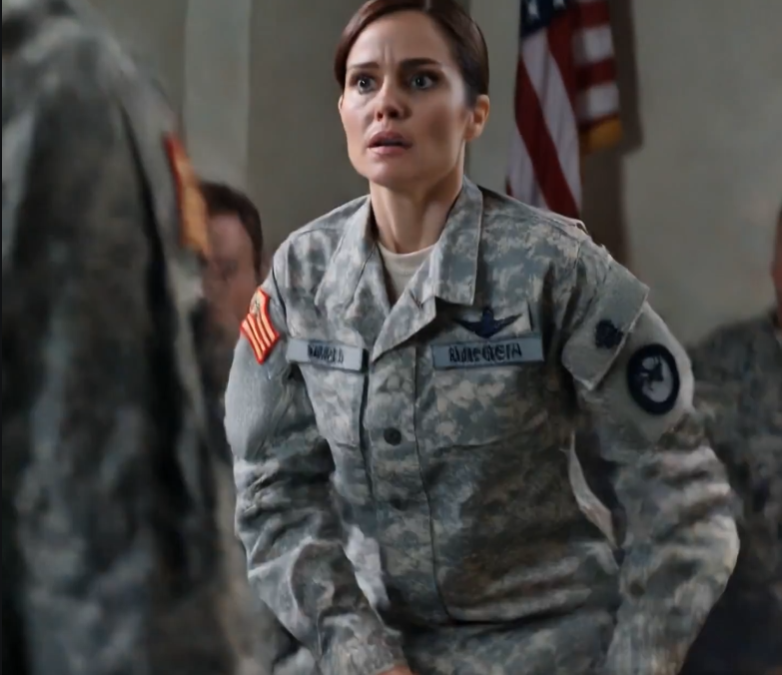
“Privately,” he repeated. “You hear that? Very mysterious. Very hush-hush.”
The laughter was smaller that time. Some people had started looking at me.
I kept writing in my notebook. I wrote the word privately. I underlined it. I don’t know why.
At the end of the table, Captain Jordan Ellery wasn’t laughing. He was the battalion intelligence officer, the S2, and my boss. Thirty years old, thin, serious, a West Point graduate with a habit of reading everything twice.
His laptop was open. He had the battalion page on his own screen, and he was scrolling through it.
Not the post itself.
The comments underneath it.
I watched him scroll. I watched his finger stop. Then I watched his face.
It didn’t change all at once. The color drained out of it as though somebody had opened a valve. He looked at the screen, then at me, then at the screen again.
He stood so suddenly that his chair rolled backward and struck the wall.
“Sir,” he said to Faulk.
His voice sounded strange. Thin.
“Sir, somebody overseas just shared this.”
Faulk smiled.
“Good. We’re going international.”
“Sir, I mean it.”
“Ellery, relax. It’s a picture of a sergeant at a tug-of-war.”
I didn’t look at the screen. I didn’t have to. I already knew what alphabet it would be in.
I closed my notebook, stood, and slipped the pen into my sleeve pocket.
“Excuse me, sir,” I said to the room, to nobody in particular.
“Calder,” Faulk said. “Come on. It’s a joke. Sit down.”
“Yes, sir,” I said. “I have to make a phone call.”
I walked out, closing the door gently behind me. I continued down the hallway, past the battalion photographs showing old commanders from old wars, past the colors standing in their display, and into the stairwell where there were no windows and the phone signal was bad.
I went down one flight, to where the reception was better. Then I dialed a number I had memorized seventeen years earlier and had used exactly once before.
It rang twice.
“Counterintelligence.”
A woman’s voice.
“Go ahead.”
“This is Sergeant First Class Tessa Calder,” I said. “I’m reporting a suspected foreign intelligence contact.”
My hand was steady. I noticed that. For seven years, I had wondered whether it would be.
Before I go back to the beginning, for anyone listening during a commute or a long shift, I made an audiobook called The Woman Nobody Saluted. Eight stories, more than twelve hours, no ads, and five stories never told on this channel. You can scan the code on your screen or use the link in the description at dressbluestories.com.
I had arrived at Fort Drum six weeks earlier, in the middle of August. Northern New York. Green and wet and very far from everything. Pine trees, gray barracks, and a long, straight road to the main gate with nothing on either side but woods.
They called it a protective posture assignment. I didn’t call it anything. I was told where to go, and I went.
For five years before that, I had worked for an organization I am not going to name. I will say that it supports other organizations. I will say that I was good at the work.
And I will say that when you leave that kind of job, the Army puts you somewhere quiet for a while. A conventional unit. A normal job. Somewhere your face can be a normal face.
During my first week, I fixed the threat briefing. That was the first thing anyone noticed about me.
The old briefing was forty slides long, delivered by a lieutenant in a monotone at 0630 to soldiers who had been awake since four in the morning. Half the room slept through it.
I cut it down to nine slides. I removed the clip art. I put in three photographs of the actual roads the soldiers would drive during their next training rotation and three real incidents from other units, with the names removed.
I gave the briefing standing up, without notes, in eleven minutes.
Nobody slept.
Afterward, a private came up and asked me a question about the second road. A good question. I answered it.
“Sergeant,” he said, “how do you know all that?”
“I read a lot.”
He believed me because it was true.
And so I became the intelligence NCO for an infantry battalion. Nine hundred soldiers. Mountain infantry. Good people.
My section consisted of three soldiers and a captain. My desk faced a cinder-block wall. My job involved threat briefings, security clearances, maps, and weather.
I liked it. I liked it more than I had expected to.
My records were mostly blank. That is normal for people like me. Seventeen years of service, the first twelve readable, the last five reduced to a single line. An assigned unit identification code and nothing else.
Most people didn’t notice.
Major Faulk noticed.
On my second day, he called me into his office. He had my enlisted record brief on his desk, and he had circled the blank portion in red pen.
“Seventeen years,” he said. “And five of them are blank. Help me out here, Sergeant.”
“I was assigned to a support activity, sir.”
“Supporting what?”
“Other units, sir.”
“Doing what?”
“I’m not able to discuss it, sir. The S2 can verify my clearance and my access. He has a phone number he can call.”
Faulk leaned back in his chair. He looked at me for a long time, not unkindly, more the way someone looks at a puzzle.
“See, here’s my problem,” he said. “I’ve been in sixteen years. I’ve met a lot of people who couldn’t discuss it. You know how many of them actually had anything to discuss?”
I waited.
“Two. Maybe. The rest were supply sergeants who went to a training exercise with some guys who had beards.”
“Yes, sir.”
“I’m not calling you a liar.”
“No, sir.”
“I’m just saying, in my experience, people who can’t say usually don’t have much to say.”
“Yes, sir,” I said. “That’s been my experience, too.”
He laughed at that. A genuine laugh. He liked it.
I think that for a little while, he decided he liked me.
He was wrong about one thing and right about another. He was wrong that I had nothing to say. He was right that I wouldn’t say it.
I had learned long before Fort Drum that being doubted was the cheapest thing in the world. It costs nothing. You just let people be wrong.
The rules I lived by were simple. Three rules. I had written them on an index card in 2019 and carried them ever since.
No photographs. No social media. No stories.
I didn’t have a social media account. I hadn’t had one since 2018. I didn’t appear in unit photographs. If a camera came out, I found a reason to be somewhere else.
Most of the time, nobody noticed. People aren’t paying as much attention to you as you think. That’s the first thing they teach you, and it’s mostly true.
Organization Day fell on the last Friday in August. The entire battalion gathered on the field behind the gym. There were grills, volleyball games, and a dunk tank with the command sergeant major sitting inside it.
There was also a tug-of-war competition, company against company, with the battalion staff competing as its own team.
Faulk had his phone out all day. He ran the battalion’s social media page, though not officially. Public affairs belonged to the brigade, but the battalion page was his hobby.
He was good at it. He posted soldiers’ birthdays, promotions, and pictures of the dining facility’s Thanksgiving pies. Families loved it.
Nine thousand followers. That was a lot for a battalion.
Before the tug-of-war, Faulk called the staff together for a group photograph. Twelve of us.
I stepped out of the line.
“Sir,” I said, “I’d prefer not to be photographed.”
He lowered the phone.
“Calder, it’s a group picture.”
“Yes, sir. I’d still prefer not to be in it.”
“Everybody’s in the picture. That’s the point of a unit.”
Lieutenant Colonel Craig Sutter, the battalion commander, was standing nearby with a hot dog. He glanced at us, then looked away. Not his fight.
“I’ll hold the rope, sir,” I said. “I’ll be right here.”
Faulk looked at me. Then he shrugged and took the group photograph without me.
I thought that was the end of it.
It wasn’t.
Ten minutes later, the competition was underway. I wasn’t pulling. I was standing at the end of the rope because my shoulder had been bothering me that week, and the command sergeant major had told me to anchor from the side.
Which isn’t a real thing. It was his way of being kind.
Out of the corner of my eye, I saw Faulk turn toward me and raise his phone. He was laughing.
I turned away, but too slowly.
Mia Holloway, my analyst, was standing beside me. She was twenty-five, and she saw it, too.
“Want me to ask him to delete it, Sergeant?” she said.
“No,” I said. “It’s fine. He’ll forget about it.”
He didn’t forget.
Northeast Syria. March 2019.
I was twenty-eight, a staff sergeant, and a source handler assigned to a joint task force. There were four of us on the team, plus the warrant officer who ran it, and contractors who came and went.
The war against the caliphate was almost over. On the maps, the last town was falling.
On the maps.
On the ground, it wasn’t over. There were men who had shaved their beards, gone home to their villages, and kept their weapons hidden beneath the floor. There were cells, stockpiles, and plans for what came afterward.
My job was to find people who knew where those things were, persuade them to tell me, and keep them alive while they did.
That last part is the whole job. Everything else is paperwork.
Yousef was a schoolteacher. Forty-one years old. He taught arithmetic and geography in a village school with no glass in the windows.
He had two daughters, eight and eleven, a wife with a bad heart, and a brother who had joined the wrong side in 2014 and died for it in 2017.
He came to us. That is important.
I didn’t find him.
He walked up to a checkpoint with his hands open and said he wanted to talk to an American woman. Not a man. A woman.
He said a woman would understand about his daughters.
I understood about his daughters.
We met eleven times over five months, never in the same place twice. Usually, we met in a car. A beat-up white sedan parked near a market, its engine running. Yousef sat in the passenger seat. I sat behind the wheel wearing a headscarf and a long coat.
My interpreter was in the back. Nobody else.
My interpreter was a quiet young man from Haka who had studied English literature before the war. He still carried a paperback collection of short stories in his vest.
He liked Yousef. Everyone liked Yousef.
After the third meeting, my interpreter spoke to me in English so Yousef wouldn’t hear.
“He talks about his daughters the way my father talked about us. Like they’re the only reason the world is still turning.”
“Then we’d better keep the world turning,” I said.
He nodded. He didn’t smile. He knew what the job was.
Yousef told me where things were. Weapons beneath a mosque floor. A list of names in a ledger kept by a pharmacist. A truck that came on Thursdays.
He was precise. He was a teacher.
He drew maps in pencil on the backs of his students’ worksheets. When he got something wrong, he carefully erased it and drew it again.
“My daughters think I go to the market for oranges,” he told me once. “So I bring oranges every time. They think their father has become very fond of oranges.”
He left one on my dashboard after every meeting. A small orange.
I ate them. They were very good.
His code name was Lantern. I chose it. He didn’t know it.
Sources never know their own code names. That is a rule, too.
The rules I taught my team were the same rules I would carry on an index card for the next seven years.
“No photographs,” I told them. “Not of me. Not of him. Not of the street. Not of the car. Not of anything you can see from the car. If you take a picture of a sunset, somebody will figure out where the sunset was.”
“Copy, Calder,” they said.
They were good soldiers. They listened.
The contractors were another matter.
Most of them were older, former military, and paid three times what we earned. Some were very good at their jobs. Others were on their fourth war and had stopped believing in rules a long time ago.
Rick Dorsey was one of those.
He was fifty-two, with a big laugh, a former Army staff sergeant who had gone private in 2006 and never come back. He ran communications equipment for the task force.
He told good stories.
He had a social media account with four thousand followers, mostly contractors and veterans. He posted photographs of his meals, his dog back home, and sunsets.
He posted a lot of sunsets.
I talked to him about it in May, quietly, in the chow tent.
“Rick,” I said, “the sunset pictures. Can you hold off?”
“Why?”
“Because people can match a skyline.”
He laughed.
“Calder, they’re sunsets. Every sunset in this country looks the same.”
“No, they don’t.”
“You’re very intense. You know that?”
“Yes,” I said. “I know that.”
He didn’t stop posting, but he stopped tagging the locations.
That was something. I wrote it in my notes.
I thought that was the end of it.
At our ninth meeting in July, Yousef was nervous. His hands kept moving against his knees.
He told me that a man had approached him at the market and asked who he was meeting. Yousef said he had told the man he was buying oranges.
The man had laughed.
“Be careful,” I told him. “Change the days. Change the markets.”
“I am careful,” he said. “I am a very careful teacher.”
He left an orange on my dashboard. It was bruised on one side, and he apologized for it.
I ate it anyway.
The woman on the counterintelligence line didn’t waste words. Neither did I.
She asked for my name again and my unit. She asked about my clearance and the name of my last assignment. I gave her a unit identification code instead of a name.
She didn’t ask me to say the name. I heard her typing for a while.
“What’s the contact?” she asked.
“A public post on my battalion’s page. My photograph, posted last night by my operations officer. Approximately ninety minutes ago, it was shared by an account I believe is associated with a foreign collection effort. I haven’t looked at the account myself. My S2 has it on his screen.”
“Why do you believe it’s foreign collection?”
“Because I’ve seen what it looks like before. In 2019. I can give you the file number.”
I gave her the number. I had memorized that, too.
She was silent for about five seconds. Then her voice changed. Not much. Just enough.
“Stay where you are, Sergeant. Don’t touch the post. Don’t ask anyone to delete it. Don’t let anyone delete it. Is the officer who posted it still in the building?”
“Yes, ma’am.”
“Keep him there if you can. We have agents on the installation. Someone will be with you within the hour.”
“Yes, ma’am.”
“And Sergeant Calder?”
“Ma’am?”
“You did the right thing.”
I didn’t say anything to that.
She hung up.
I stood in the stairwell for a minute, surrounded by concrete steps, a fire extinguisher inside a glass box, and the smell of floor wax. Somewhere above me, through the door, I could hear the staff meeting continuing. People talking. Somebody laughed.
I went back upstairs. The meeting had ended by the time I reached the conference room. People were coming out carrying their coffee cups. Some looked at me. Others made a point of not looking at me.
The personnel officer smiled at me in a way that was meant to be friendly but was mostly embarrassed.
The logistics officer said, “Hey, operator,” as he passed. The major behind him laughed.
Captain Ellery was still sitting at the table with his laptop. He waited until everyone else had left, then closed the door.
“Calder,” he said. “Sit down.”
I sat.
“Who did you call?”
“Counterintelligence, sir.”
He stared at me.
“Over a picture?”
“Over who shared it, sir.”
He turned his laptop around.
On the screen was the battalion post. My photograph. The caption. The laughing emojis. And beneath them, the comments.
Most were from families. A wife had written, “LOL, be nice.” A retiree had commented, “Back in my day, the operators had beards.” A private’s mother had written, “What a beautiful girl.”
And there was one share from an account with a profile picture of a mountain lake and a name written in Cyrillic letters.
The account had shared the post at 0750 that morning. No caption at all. Just the photograph. Just my face.
Beneath it, two other accounts had already commented. One in Cyrillic. One in Arabic.
“I don’t read either of those,” Ellery said.
“I read one of them, sir.”
“What does it say?”
“It says, ‘Is this the same one?'”
He looked at the screen for a long time. Then he looked at me.
“Who are you, Sergeant?”
“Your intel NCO, sir.”
“That’s not an answer.”
“Yes, sir,” I said. “It’s the only one I’m allowed to give.”
I let him sit with that for a moment.
“There’s a phone number in your safe, in the blue folder,” I continued. “It was in my in-processing packet. If you call it, they’ll tell you what you’re cleared to know, which won’t be much, but it’ll be enough to know I’m not lying.”
He leaned back and rubbed his face with both hands.
He was thirty years old and three months into the job, and nobody at West Point had taught him about this.
“Okay,” he said finally. “Okay. What do you need from me?”
“I need you to keep the major in the building, sir. And I need nobody to delete that post.”
“He’ll want to delete it the second he finds out it’s a problem.”
“Yes, sir. That’s why I’m asking you.”
Ellery nodded. He stood and walked toward the door, then stopped and turned back.
“I didn’t laugh,” he said. “In the meeting. I want you to know that.”
“I know, sir. I saw.”
He went out.
I sat in the empty conference room with the projector still humming. The screen was blank now. The blind was still cracked. Through the gap, I could see the parade field, wet and green, and a company doing physical training in the far corner.
Push-ups in the grass.
My phone buzzed.
The staff group chat. Twenty-three members. A message from Major Faulk.
It was a photograph of a trench coat on a mannequin. Underneath it, he had written, “Uniform of the day for our S2 shop. Very secret.”
Eleven laughing faces beneath that one.
I put the phone facedown on the table.
I thought about Yousef’s daughters. I hadn’t let myself think about them in a long time. They would be fifteen and eighteen now, if they were anything.
I thought about how the account with the mountain lake had found the post within ten hours. A battalion page in northern New York. Nine thousand followers. Ten hours.
Somebody had been looking.
Somebody had been looking for a long time.
August 2019.
A rooftop.
The task force occupied a building on the edge of a town. Three stories of concrete, with a low wall around the roof and a view of the river and the hills beyond.
In the evenings, the team went up there to escape the generators. It was the only place where you could hear yourself think.
It was Rick Dorsey’s last week. He was rotating home.
On his final night, he brought a cooler of soft drinks onto the roof, along with a little speaker. He played country music, people laughed and told stories, and the sun went down over the hills the color of a peach.
Dorsey climbed onto the low wall and held out his phone.
“Team picture,” he said. “Come on, everybody. Last night.”
Everybody came. Eleven people.
They crowded together against the wall, the sunset behind them, arms draped around one another’s shoulders. Somebody held up a soda can like a trophy.
I didn’t join them.
“Calder,” Dorsey called. “Get in here.”
“I’m good, Rick.”
“It’s my last night.”
“I know. Have a good flight.”
Chief Warrant Officer Victor Ames was in the front row. Our team chief. Forty years old. A good officer, mostly. Tired.
He looked at me over his shoulder.
“Calder,” he said. “Come on. Nobody’s going to see it.”
“Sir, it’s got the river in it. And the hills. And the water tower.”
“It’s got eleven people with their faces blurred by the sun.”
“It’s got the water tower, sir.”
Ames sighed. It was a particular kind of sigh. I had heard it before. The sigh a man makes when he has decided that you are the problem.
“Calder,” he said, “you’re seeing ghosts.”
“Maybe, sir.”
“Rick, take it without her.”
Rick took the picture without me. He posted it at 2130.
I saw it the next morning because one of the younger soldiers showed me, grinning.
Eleven people on a rooftop. The river. The hills. The water tower.
The caption read, “Last night with the best team in the world. Going home.”
No location tag. He had remembered that much.
I went to Ames and asked him to tell Dorsey to take the photograph down. Ames said Dorsey was already on a plane.
I asked Ames to email him. Ames said he would.
I don’t know whether he did. I know the photograph was still there two weeks later.
Yousef and I met for the tenth time on August 20.
He was calm that day. He told me he had been sleeping better. The man who had approached him at the market hadn’t come back.
He brought me a map of a farm where a truck had been parked under a tarp for a month. It was precise, drawn in pencil on the back of a worksheet about the rivers of the world.
He left an orange on the dashboard.
A good one. Not bruised.
On September 3, an account with a profile picture of a mountain lake shared Rick Dorsey’s rooftop photograph.
No caption. Just the picture.
Beneath it was a comment in Arabic.
“Is this the building near the bridge?”
I found the share on September 5. I took it to Ames. Ames took it to the task force security officer. The security officer said he would look into it.
On September 14, Yousef went to the market in the morning to buy oranges.
He didn’t come home.
They found him on September 16.
I’m not going to tell you where. I’m not going to tell you how.
His wife identified him. His daughters were at school.
There was an investigation. There always is.
It was careful and slow. It found that the source had likely been compromised through multiple vectors, which is the language investigations use when they cannot, or will not, draw a straight line.
It noted that the task force should review its social media practices. It made two recommendations.
Nobody was punished.
Dorsey was already home. Ames received a letter in his file that wouldn’t stay there long.
Nobody said the word photograph to me. Not once. Not during the investigation. Not afterward.
I was interviewed for forty minutes, and the interviewer didn’t ask me about the rooftop. When I brought it up myself, he wrote it down and moved on.
I wasn’t punished either.
I was moved. Sent home a month early.
A kindness, they said. I had been working too hard. I was seeing ghosts.
On my last day, I cleaned out my desk.
At the back of a drawer, behind a stack of maps, I found an orange. The one from August 20. I had forgotten it.
It had gone soft and gray and caved in on one side.
I stood there holding it for a long time.
Then I took a blank index card out of my pocket and wrote three lines on it in pen.
No photographs. No social media. No stories.
I have carried that card for seven years.
I had it in my pocket that Tuesday in September, in the conference room at Fort Drum, with the projector humming, the major’s joke on the screen, and the account with the mountain lake asking a question in Arabic beneath my face.
“Is this the same one?”
I went back to my office.
It wasn’t really an office. It was a corner of the S2 section with a desk facing a cinder-block wall and a safe that weighed as much as a small car.
Sergeant Holloway was at her computer. She looked up when I entered.
“Sergeant,” she said, “everybody’s talking about it.”
“I know.”
“Do you want me to say something to the major? I’ll say something. I don’t care.”
“No,” I said. “Don’t say anything to anybody. Don’t touch the post. If anyone asks you to delete anything from any computer, you tell them to talk to Captain Ellery.”
She stared at me.
“Is this a real thing?”
“Yes,” I said. “It’s a real thing.”
She nodded slowly and turned back to her screen. Her hands remained still for a while before she started typing again.
At 0940, Major Faulk passed our door on his way to the commander’s office. He leaned his head inside.
“Calder,” he said. “No hard feelings, right? It’s a morale post. Families love that stuff. You’re famous.”
“Yes, sir.”
“Who’d you call? Your handler?”
He grinned at Holloway, inviting her to join the joke.
She didn’t grin back.
“Sir,” I said, “Captain Ellery asked if you’d stay in the building this morning.”
“I’m always in the building this morning. It’s Tuesday.”
He knocked twice on the doorframe, cheerful as ever, and continued down the hall.
At 0951, Ellery came to our door. He had a blue folder in his hand, and his face was the color of the cinder blocks.
“I called the number,” he said.
“Yes, sir.”
“They told me almost nothing.”
“Yes, sir.”
“They told me enough.”
He didn’t come inside. He stood in the doorway, holding the folder against his chest like a shield.
“They told me to stay with the major. I’m going to go stay with the major.”
He left.
At 0958, two men came up the stairs.
I heard them before I saw them. Two sets of footsteps, not quite in step with each other. Not boots.
Civilian shoes on a waxed floor.
They passed our door. One glanced inside.
He was in his late thirties, with short dark hair and a gray suit jacket over a polo shirt and khakis. The other was younger, perhaps thirty, wearing a navy windbreaker.
Neither wore a name or rank. Both had small leather cases clipped to their belts.
The older man stopped.
He looked at me. Not for long. Just long enough to match a face to a photograph.
“Sergeant Calder?”
“Yes, sir.”
“Special Agent Dana Ferrer, Army Counterintelligence. This is Special Agent Theo Rasque. We’ll want to talk to you in a little while. Please don’t go anywhere.”
“Yes, sir.”
They continued down the hall toward the commander’s office.
I didn’t follow them. I didn’t need to.
The walls in that building were thin, the commander’s door was open, and Holloway and I sat at our desks in absolute silence and listened.
“Major Faulk.”
Ferrer’s voice.
“That’s me. Can I help you, gentlemen?”
“Sir, we need your phone. Unlocked, please.”
A pause.
Then Faulk laughed. Not as confidently as before.
“I’m sorry. Who are you?”
“Special Agent Ferrer, Army Counterintelligence.”
The sound of a leather case opening.
“Here are my credentials, sir. Agent Rasque has a copy of the authorization.”
“Authorization for what?”
“To take custody of your personal device, sir, in connection with a reported foreign intelligence contact.”
Another pause. Longer this time.
“A what?”
“Sir,” Ferrer said, “your phone, please.”
“This is about the picture?”
Faulk’s voice rose.
“Are you serious? It’s a picture of a sergeant at a tug-of-war.”
Then he was speaking to the commander.
“Sir, this is insane. She called them over a joke.”
Lieutenant Colonel Sutter answered quietly.
“Brent, give them the phone.”
“Sir, with respect—”
“Brent.”
Silence.
Then the small sounds. A phone sliding out of a pocket. A phone being placed on a desk.
Agent Rasque spoke. Younger voice. Polite.
“Thank you, sir. And the passcode, please. Also, any other devices you use to access the battalion page. Laptop. Tablet.”
“My laptop’s in my office.”
“We’ll walk with you, sir.”
They came back down the hallway a minute later.
Faulk first. The two agents behind him. Captain Ellery following, looking as if he wanted to be anywhere else on Earth.
They passed our door.
Faulk looked inside.
I will remember his face for a long time.
Not because he looked angry. He didn’t.
The anger had gone out of him somewhere in the commander’s office, leaving something I hadn’t expected to see.
Confusion.
A grown man. An officer. Sixteen years in the Army.
Walking past a doorway, looking at a sergeant he had decided was a fraud, and understanding for the first time that he didn’t know what he was looking at.
He wasn’t laughing.
Then they were past us. The footsteps continued toward the end of the hall, and a door opened and closed.
Holloway let out a breath she had been holding.
“Sergeant,” she said very quietly, “what did you do overseas?”
“My job,” I said.
They interviewed me that afternoon in a borrowed office at brigade headquarters.
Windowless. A table, three chairs, and a box of tissues nobody touched.
Ferrer asked the questions. Rasque wrote.
Neither man was unkind. Neither was warm. They were working.
They wanted the whole history. Organization Day. The text message. The staff meeting. The share.
And then they wanted 2019.
I told them all of it. The rooftop. The water tower. The account with the mountain lake. The orange.
I had told that story once before, to an investigator in Syria who wrote it down and moved on.
This time, Ferrer didn’t move on.
When I finished, he leaned back in his chair and looked at the table for a long moment.
“We pulled the old file this morning,” he said. “Before we came over. Your file number was in the report you called in.”
He paused.
“I want you to know something, Sergeant. The account that shared your photo today. It’s the same account. Different name, same account. Same people behind it. We’ve been watching it for six years.”
“I know,” I said.
“How did you know?”
“The lake,” I said. “They never changed the lake.”
He almost smiled. Not quite.
“It found your post in under ten hours,” Rasque said.
He had a printout in front of him.
“Within nine minutes of sharing it, the same network ran your photograph through face search on four other platforms. We can see the queries. It didn’t find anything. You don’t have any accounts.”
“No. Not even an old one. I deleted the last one in 2018.”
“Smart,” Rasque said.
He meant it.
“It’s not smart,” I said. “It’s a rule.”
They told me what would happen next.
My protective posture was being reviewed.
In plain language, I couldn’t stay at Fort Drum.
Not now. Not with my face sitting on a foreign server beside the words pretend operator, the name of a battalion, and the name of a military post.
The Army would move me. Quietly. Soon.
Somewhere with no public page and no tug-of-war.
“How soon?” I asked.
“Weeks,” Ferrer said. “Two, probably.”
I had been at Fort Drum for six weeks. I had started to like it. I had learned the names of the cooks in the dining facility. Holloway had invited me to her wedding in the spring.
“Okay,” I said.
The battalion didn’t know any of this.
That was the problem.
The battalion knew only what it had seen. And what it had seen was this:
On Tuesday morning, the operations officer made a joke about the new intelligence sergeant. The new intelligence sergeant walked out of the staff meeting. Forty minutes later, two men in civilian clothes arrived, took the operations officer’s phone and laptop, and walked him out of the building.
He didn’t come back that day. Or the next.
You can do that math.
Everybody did that math.
By Wednesday morning, the story in the barracks was that I had reported Major Faulk to the inspector general for harassment. By Wednesday afternoon, it was that I had reported him to the FBI.
By Thursday, somebody had decided I was a plant from the Pentagon, sent to find officers who made jokes on social media.
The logistics officer stopped saying, “Hey, operator.” He stopped saying anything at all.
When I walked into the dining facility on Thursday, a table of lieutenants went quiet.
There was a cook in that dining facility named Sergeant Ortega. He was in his fifties, a reservist on orders, with forearms like hams and a laugh you could hear from the parking lot.
He had been giving me extra hash browns since my first week, for no reason I had ever understood.
On Thursday, when the lieutenants went quiet, he looked across the serving line at me. Then he looked at them.
He put an extra scoop of hash browns on my tray, banging the serving spoon against the metal loudly enough for everyone to hear.
“Eat, Sergeant,” he said, loud enough for the lieutenants. “You look like you’ve been working.”
I ate.
He didn’t know anything. He didn’t need to. He had decided, the way some people decide things, that a woman who could walk into a quiet room and sit down anyway deserved hash browns.
I have thought about him more than I have thought about most generals.
Holloway fought for me, too, in her own way. I didn’t ask her to. I heard about it later from Ellery.
On Thursday afternoon, a specialist from headquarters company had said something in the motor pool about the S2 shop being full of snitches.
Holloway walked over to him, brought her face very close to his, and said, “You don’t know anything. Neither do I. That’s how you know it’s serious.”
Then she walked away.
Apparently, the specialist didn’t say anything else for the rest of the day.
On Friday, I heard another comment in the hallway, from around a corner. A voice I didn’t recognize.
“Couldn’t take a joke,” it said. “Ruined a guy’s career over a picture.”
I kept walking.
On Friday afternoon, Lieutenant Colonel Sutter called me into his office.
He had a stack of papers in front of him, a cup of cold coffee, and the face of a commander who had spent four days answering questions he didn’t know the answers to.
“Sit down, Sergeant.”
I sat.
“I’ve been read in,” he said. “Partly. I know what I need to know, which isn’t much. Enough to know you did what you were supposed to do.”
He rubbed his eyes.
“Here’s my problem. My battalion thinks you destroyed one of its most popular officers over a joke. Faulk’s suspended from the page and from operations pending the investigation. Morale on the staff is on the floor, and I’ve got nine hundred soldiers who don’t know who to trust.”
“Yes, sir.”
“I need you to give them something.”
“Sir?”
“Stand up at the staff meeting on Tuesday. Say a few words. You don’t have to say anything classified. Just enough to explain that it was a security issue, not a personal one. That you didn’t report him for the joke. That you had to do something. Anything. Give them a reason to stop whispering.”
I looked at him.
He meant well. He was a good commander trying to fix his unit.
“Sir,” I said, “anything I say makes it worse.”
“How?”
“If I tell them it was a security issue, they’ll want to know what kind. If I don’t tell them, they’ll guess. Some of them will guess right. Some of them will guess out loud, in the dining facility, on the phone to their wives, on the page.”
I paused.
“Sir, the whole reason this is a problem is that people talked about me. I can’t fix that by talking about me.”
He was quiet for a long time.
“So they keep thinking you couldn’t take a joke.”
“Yes, sir.”
“That doesn’t bother you?”
“It bothers me, sir,” I said. “It’s supposed to. That’s what it costs.”
On Monday morning, my orders came by email.
Report to a new duty station in fourteen days.
The location was a post in another state. The unit was one I had never heard of. That was the point.
That night, I called Sergeant Major Ruth Abernathy.
She was fifty years old. She had run the enlisted side of the organization I am not going to name for six of the years I was in it.
She was the only person in the Army I had ever called at home.
She answered on the first ring.
“I heard,” she said.
“Of course you did.”
“They pulled your file in front of me on Wednesday. I told them they’d better have a good reason.”
She was quiet for a moment.
“Are you all right?”
“I’m moving.”
“I know. I picked the post.”
I waited.
“It’s a good one. Flat. Boring. No tug-of-war.”
I laughed.
It surprised me. It was the first time I had laughed since the projector.
“Tessa,” she said, “they’re going to bring the major in next week. Agent Ferrer. He’s going to sit down with him and the commander and tell him what he did. They asked me how much he should be told about you.”
“What did you tell them?”
“I told them I’d ask you.”
I sat on the edge of the bed in my quarters. Bare walls. Boxes I had never fully unpacked because I had learned not to.
Outside the window, rain fell on the pines.
“You could let them tell him,” Abernathy said. “Some of it. Not the classified parts. Just that you were somebody. That your face was worth protecting for a reason. He’d understand then. He’d know he wasn’t laughing at a nobody.”
“He’d tell people.”
“Maybe not.”
“He would. Not on purpose. He’d tell his wife. She’d tell her sister. He’d tell a buddy at a promotion party years from now, after a few drinks.”
I could hear the conversation already.
I knew a woman once. You wouldn’t believe what she did.
And somebody would hear it.
“Probably,” Abernathy said.
“He doesn’t need my name, Sergeant Major,” I said. “He needs the account. He needs to know what it is and what it does and how fast it found me. He needs to know there were people on the other end of that share. That’s what he needs.”
I looked at the boxes stacked against the wall.
“Who I am doesn’t help him learn anything. It just makes him feel better about being wrong.”
She didn’t say anything for a while.
I could hear her kitchen in the background. A dishwasher. A television playing in another room.
“You know they’ll never know,” she said. “Any of them. The captain. The girl in your section. The commander. They’ll go on thinking whatever they think. I know that’s a lot to carry out the gate.”
“I’ve carried more,” I said.
After she hung up, I sat in the dark for a while.
I thought about Yousef’s daughters.
I let myself, for once.
The older one had been eleven. I had seen her once, from a distance, through the windshield of the white sedan. She was walking home from school with a backpack too big for her, a younger girl holding on to her sleeve.
Yousef had pointed. He wasn’t supposed to.
“That one wants to be a doctor,” he had said. “That one wants to be a horse.”
Then he had laughed at himself and apologized for breaking a rule.
I never found out what happened to them.
I asked once in 2020, through a channel I wasn’t supposed to use for questions like that. The answer came back three weeks later.
Relocated. Status unknown.
That was all.
Two girls I had seen once through a windshield. Somewhere in the world, if they were lucky.
They didn’t know my name either.
That was the only thing I had ever been able to give them.
I sat with that.
It was a long time before I turned on the light.
Then I took the index card out of my wallet. Seven years old. Soft at the corners. Three lines in blue pen.
I turned it over.
The back was blank. I had never written anything on the back.
I took out a pen and wrote one word.
A name.
Yousef.
Then I put the card back in my wallet and went to sleep.
And for once, I slept all night.
They brought him in the following Tuesday, September 15. One week after the projector.
The commander’s office. 1300 hours.
Lieutenant Colonel Sutter sat behind his desk. Special Agent Ferrer was in a chair beside the window. Major Faulk sat facing the desk.
Captain Ellery stood near the door because there weren’t enough chairs, and he wouldn’t have sat down anyway.
I was there because Ferrer had asked me to be.
I had agreed on one condition: nobody in that room would be told anything about me that they didn’t already know.
I stood against the wall, where the NCOs stand.
Faulk looked bad.
A week without sleeping. A week of sitting at home in civilian clothes while his phone rested in an evidence bag somewhere inside a building he was no longer allowed to enter.
He had shaved, but badly.
When I came in, he looked at me, then looked away, then looked back, as if he couldn’t decide which was worse.
“Major,” Ferrer said. “I’m going to tell you what happened. Then you can ask questions. Some of them I’ll answer.”
“Okay.”
Ferrer opened a folder. He took out three sheets of paper and laid them along the edge of the commander’s desk, facing Faulk.
“On September seventh at 2120, you posted this photograph to your battalion’s public page.”
The first sheet.
My photograph.
The caption.
“At 0750 the next morning, this account shared it.”
The second sheet.
The mountain lake.
The name in Cyrillic.
“This account is attributed with high confidence to a foreign intelligence service. I won’t say which one. It’s been active for at least six years. It collects photographs of American service members from public pages. Unit pages. Family pages. Base newspapers. Promotion ceremonies. Organization Days.”
Ferrer paused.
“It’s patient. It’s very good.”
Faulk was staring at the second sheet.
“Within nine minutes of sharing your post,” Ferrer continued, “the network behind this account ran Sergeant Calder’s face through facial search on four other platforms. Here are the queries.”
The third sheet.
A list of times, recorded down to the second.
“They were looking for any other photograph of her anywhere. Anything with a name, a location, a date. Anything that could connect this face to something else.”
“Did they find anything?” Faulk asked.
His voice was hoarse.
“No,” Ferrer said. “Because there’s nothing to find. Because she has spent seven years making sure there’s nothing to find.”
He let that sit for a moment.
“Because, Major, she asked you not to take that picture. And then she asked you to take it down.”
Faulk didn’t move.
“Two people commented under the share within the hour. One in Russian, one in Arabic. The one in Arabic asked whether this was the same one.”
“The same one as what?”
“I’m not going to answer that, Major.”
Faulk brought his hand to his mouth. He held it there.
“I need you to understand what this is,” Ferrer said. “This isn’t a reprimand for a mean joke. You can make mean jokes. There are regulations about that, and the commander will deal with those.”
His voice stayed level.
“This is a security violation. You published a photograph of a soldier whose identity is protected on a public platform over her stated objection. You kept it up after she asked you to take it down. And you read her request aloud to a room of twelve people as entertainment.”
Ferrer looked directly at him.
“A foreign service found it in ten hours. That’s what happened. That’s the whole of it.”
“I didn’t know,” Faulk said.
Barely.
“No, sir. You didn’t.”
“Nobody told me.”
“She told you, sir,” Ferrer said. “Twice. In writing once.”
The room was very quiet.
I could hear the clock on Sutter’s wall. I could hear a vehicle starting in the motor pool across the road.
Faulk slowly took his hand away from his mouth. He turned in his chair and looked at me.
“Who are you?” he asked.
He didn’t say it the way he had said it in his office six weeks earlier, with my record brief on the desk and the red circle around the blank years.
He didn’t sound like a man trying to solve a puzzle.
He sounded like a man who had stepped off a curb in the dark and discovered there was no street.
Ferrer answered before I could.
“She’s your intel NCO, sir. That’s all you need.”
“That’s not—”
Faulk stopped.
He tried again.
He was looking at me, not Ferrer.
“Sergeant, please. I need to know what I did. Who did I put in danger?”
I thought about Abernathy on the phone.
He’d know he wasn’t laughing at a nobody.
I thought about a rooftop. A water tower. An orange.
“Somebody whose picture shouldn’t be on your page, sir,” I said.
He waited for more.
There was no more.
“That’s it?” he asked.
“Yes, sir.”
“I don’t get to know?”
“No, sir.”
“For the rest of my life, I don’t get to know who I—”
He stopped again.
There was no good ending to that sentence.
“Sir,” I said, “you get to know what you did. That’s more than the man who taught me this got.”
He looked at me for a long time.
Then he nodded very slowly.
The way you nod at something you don’t understand but have decided to believe.
He turned back around in his chair and looked down at the three sheets of paper on the commander’s desk.
He didn’t look at me again.
Sutter cleared his throat.
“Sergeant Calder. Thank you. You can go.”
“Yes, sir.”
Ellery opened the door for me.
As I passed him, he spoke very quietly, so nobody else could hear.
“He asked me about you last week. Before the agents. He asked me if you were really anything.”
He swallowed.
“I told him I didn’t know. That was true then.”
“It’s still true, sir,” I said.
“No,” Ellery replied. “Not all of it.”
I walked out into the hallway, past the old commanders and the colors, down the stairs, and out into the gray afternoon, where rain was beginning to fall on the parade field.
A company was doing push-ups in the wet grass in the far corner.
I stood under the overhang beside the door for a minute and watched.
A staff sergeant was calling cadence. The privates were slow on the way up.
One of them dropped flat into the grass and lay there with his cheek against the wet ground.
The staff sergeant crouched beside him and said something I couldn’t hear.
The private laughed.
Then he pushed himself up again.
Ordinary. All of it.
Rain and push-ups and a sergeant who knew his soldier’s name.
Nobody saluted. Nobody stood. Nobody had any reason to.
That was exactly right.
The investigation finished faster than most. They usually do when the facts are simple.
Major Faulk received a security violation finding. It went into his permanent file.
It meant his clearance would be reviewed, and while that review was underway, he couldn’t serve as an operations officer.
It also meant that when the review was finished, whatever the outcome, the officers sitting on future promotion boards would read about it.
He was moved out of the battalion on September 21, reassigned to a brigade staff position.
A desk with no access and no social media page.
Ellery told me that Faulk had asked to be the one to speak to the staff.
He stood up at the staff meeting that Tuesday, the one I didn’t attend, and said he had made a serious mistake that had put people at risk.
He told them the intelligence sergeant had done exactly what she was supposed to do, and anybody who said otherwise could come and talk to him.
Ellery said nobody laughed.
He said the room was very quiet.
He said Faulk’s voice cracked once on the word people.
And Faulk didn’t explain which people, because he didn’t know.
I believe that.
I believe he didn’t know.
I hope he never does.
The battalion page came down on September 16.
All of it. Every post.
Six years of birthdays and promotions and Thanksgiving pies.
Brigade Public Affairs rebuilt it two weeks later, under new rules.
The rules were pinned at the top of the page in plain language, where every spouse, every retiree, and every private could read them.
No photographs of soldiers without their consent.
No captions that identify a soldier’s job, history, or assignment.
If a soldier asks you to remove a photograph, remove it.
Do not ask why.
That last line was Ellery’s.
He told me so on my last morning, a little embarrassed.
“I thought about the text you sent him,” he said. “‘Sir, please remove the photo.’ That was all you asked. You didn’t explain. You weren’t supposed to have to.”
Holloway printed the new rules and taped them to the inside of the S2 door at eye level, where every officer coming in to ask about a clearance would have to read them.
She did it without asking me.
When I saw it, I didn’t say anything. Neither did she.
She simply went back to her desk and kept typing, with that slightly defiant set to her shoulders that young sergeants get when they’ve done something right and are waiting to be told it was wrong.
“Good placement,” I said finally.
“Thought so, Sergeant,” she replied without looking up.
The account with the mountain lake was reported and suspended.
It would come back under another name.
They always do.
Ferrer told me that without my asking.
He told me something else, too, the last time I saw him.
We were standing in the parking lot outside brigade headquarters, his jacket collar turned up against the rain.
“There was a man,” he said. “Someone you worked with once, a long time ago. Not a source. Someone near one.”
I waited.
“We moved him and his family on the twelfth. Precaution. He’s fine. They’re fine.”
I didn’t ask his name.
Ferrer didn’t offer it.
“Does he know why?” I asked.
“He knows somebody was looking. That’s all.”
“Good,” I said. “That’s enough.”
Ferrer studied me for a moment.
“You could have let them tell Faulk who you were,” he said. “Abernathy said you were asked.”
“I was asked.”
“Most people would have.”
“Most people haven’t seen what a name costs,” I said.
He nodded. Then he extended his hand.
I shook it.
He walked to his car. I walked to mine.
Major Faulk found me two days later.
Saturday morning. The commissary parking lot.
I was loading groceries into my trunk. Boxes of cereal, coffee, the things you buy when you know you’re going to be driving for two days.
He was wearing civilian clothes. A fleece jacket and jeans.
He had a little girl with him, maybe six years old, holding his hand and carrying a balloon from the bakery counter.
He saw me and stopped.
The little girl kept walking until his hand pulled her back.
For a second, I thought he would turn around.
I wouldn’t have blamed him.
Instead, he said something to the little girl. She went and stood beside their car with her balloon.
Then he walked toward me.
Not close.
He stopped at the back of the next car.
“Sergeant Calder.”
“Sir.”
“I’m not going to ask you anything,” he said. “I promised Ferrer. I’m going to keep that one.”
He put his hands in the pockets of his fleece jacket.
“I just wanted to say I’m sorry. Not for the investigation. I deserve that. For the meeting. For reading your text out loud. I keep hearing my own voice doing it, like a movie trailer.”
He looked down at the asphalt.
“My daughter asked me why I’m home all the time now. I told her I made a mistake at work. She asked if I said sorry.”
He paused.
“I said not yet.”
I closed my trunk.
“Thank you, sir,” I said. “I accept it.”
He waited.
I think he was waiting to see whether I would say anything else. Give him a piece of it. A hint. Something he could take home.
I didn’t.
He nodded.
Then he returned to his car, picked up his daughter, balloon and all, and settled her into her seat.
The last I saw of Major Brent Faulk, he was leaning into the back of a minivan in a commissary parking lot, fastening a car seat.
Very carefully.
The way you do something when you’ve just learned how much depends on getting the small things right.
Here is what it cost.
It cost me a unit.
Six weeks isn’t a long time. Long enough to learn the cooks’ names. Long enough to fix the threat briefing so the privates stopped falling asleep during it. Long enough to like a place.
I had stopped letting myself like places a long time before.
Fort Drum had gotten past that somehow.
Then I had to leave it.
It cost me Holloway’s wedding.
She cried when I told her I was leaving. Not much. She was twenty-five and a sergeant, and she had her pride.
She asked whether she could write to me.
I said yes.
Then I gave her an address that wasn’t mine, one that forwarded mail to me because that was how it had to be.
She looked at the address. She understood something about it.
She didn’t say anything.
I was proud of her for that.
It cost me the story.
Inside the battalion, it is still the story of the intelligence sergeant who couldn’t take a joke.
Ellery fought it. Faulk fought it in his way. The commander fought it.
But a story that begins in a staff meeting with laughter and ends with two men in civilian clothes taking an officer’s phone is a better story than the true one.
And people keep the better story.
Some of the lieutenants who went quiet in the dining facility will go on telling it for twenty years. They will become captains, majors, and colonels.
They will tell it to their staffs as a warning.
Be careful what you post. You never know who’s going to take it the wrong way.
They will have it backward.
I have made my peace with that.
It cost me something I hadn’t expected.
For seven years, I had thought that if I ever told anybody about the rooftop, the water tower, and the orange, it would feel like something lifting.
I told Ferrer. I told Rasque. I told Abernathy, who already knew.
Nothing lifted.
It turns out that telling the truth to the right people doesn’t make it lighter.
It only makes it true in more places.
My last morning was September 22.
A Tuesday.
Two weeks to the day after the projector.
Ellery came to the S2 shop at 0630 with two cups of coffee. He set one on my desk and stood there while I packed the last of my things into a single cardboard box.
A coffee mug.
A stapler I had bought myself.
A small map of northern New York that I had taped to the cinder-block wall and had now taken down.
“I’ll never know, will I?” he asked.
“No, sir.”
“Not even in twenty years? When you’re retired and I’m retired and we run into each other at some reunion?”
“There won’t be a reunion, sir.”
He laughed a little.
Then he stopped.
“That’s the job,” he said. “Isn’t it? Being somebody nobody’s allowed to know about?”
“That’s how you’ll know it worked, sir,” I said. “If you never find out.”
He picked up the box before I could.
He carried it down the stairs, out to my car, and placed it in the trunk.
Then he stood back on the wet asphalt.
He didn’t salute because I was a sergeant and he was a captain, and we were standing in a parking lot.
He just nodded.
I nodded back.
I drove out of the main gate at 0715.
The long, straight road through the pines.
Nothing on either side.
The guard at the outbound lane waved me through without looking up.
A young man, bored, looking at his phone.
He didn’t glance at my face.
Nobody had any reason to.
At the first gas station past the gate, I stopped. I bought a coffee and a bag of oranges from a bin near the register.
Small ones. A little bruised.
I ate one in the car with the engine running.
It wasn’t very good.
It didn’t matter.
I took the index card out of my wallet and looked at the front.
Three lines in blue pen.
Then I turned it over.
One word.
Yousef.
I put it away and pulled onto the highway heading south.
Abernathy called somewhere past Syracuse.
I put her on speaker.
“You out?” she asked.
“I’m out.”
“Anybody see you go?”
“A captain carried my box. A gate guard didn’t look up.”
“Good,” she said. “That’s a clean exit.”
She was quiet for a moment.
“Tessa, for what it’s worth, seven years ago, you told a team chief there was a water tower in a picture, and he told you that you were seeing ghosts. This time, you told one person on one phone line, and two agents were in the building in forty-three minutes.”
I watched the highway ahead.
“That isn’t nothing,” she continued. “The system you wished you’d had in 2019 worked in 2026. Partly because of you.”
“It worked because I’d already lost somebody, Sergeant Major.”
“Yes,” she said. “That’s usually how systems get built.”
I drove for a while without saying anything.
The trees were beginning to turn red at the tops of the maples, the way they do in late September in New York.
As if somebody had touched each one with a match.
“Eat something,” she said finally. “You never eat on the road.”
“I bought oranges.”
She didn’t say anything to that.
She knew.
She just said, “Good.”
Very quietly.
Then she hung up.
I want to say something to you.
If you’ve ever done work you couldn’t explain. If you’ve ever been laughed at for a silence. If you’ve ever had someone circle the blank part of your life in red pen and ask you to help them out.
If you’ve ever been called paranoid, intense, mysterious, or pretend because you wouldn’t say the thing that would have made them stop, you don’t owe anyone the story.
Some stories aren’t yours to tell.
Some of them belong to people who aren’t here anymore. And some of them belong to people who are still alive only because nobody has told them.
The world will fill your silence with whatever it likes.
It will decide you couldn’t take a joke. It will decide you were nothing. It will decide you were a little too much.
Let it.
A silence that protects someone is worth more than a reputation that protects you.
And to whoever is holding the phone at the tug-of-war, at the promotion, at the party, or at the parade, ask first.
If someone steps out of the picture, let them stay out of it.
If someone asks you to take it down, take it down.
And don’t ask why.
You may never know what you did by listening.
That is the point.
Some of us are only safe while nobody knows our names.
And some of the people we kept safe are only alive for the same reason.








