He hit me in front of forty officers. “Sit down and be quiet.” I didn’t move. A major three seats down went pale and reached for his phone. The colonel laughed. “Who are you calling?” That call ended his career.
By the time the sun came up, they had folded away the tablecloths, and the whole thing looked like it had never happened. It was 0600 hours. The mess hall was empty and smelled of floor wax and old candle smoke. The chairs were stacked along the far wall in leaning towers of ten. A single soldier in a food service coat pushed a wide dust mop down the center of the room in long, patient strokes, and he did not look up at me, because to him I was only a woman in a service uniform, standing where she had no particular reason to stand. The banquet tables were bare. Someone had already carried out the little brass bell the president of the mess had rung to open the dinner. Someone had wiped down the head table until it shone.
There was nothing left on it. No glasses, no cards, no sign at all that ten hours earlier, a colonel had stood up at that table and hit me across the face in front of forty officers. I knew better. So did the man in the holding cell on the other side of the post. I want to tell it plainly because plain is the only way it means anything. I am not going to pretend I did not feel the first second of it. I did. I am also not going to pretend the first second is the part that matters, because it is not. What matters is the hour that came after, and what a room full of people decided to do with it, and what I decided not to do. But you should see the thing itself before you see anything else. So let me take you back one night, to the noise and the candlelight and the smell of coffee and cut flowers, to the moment before the quiet.
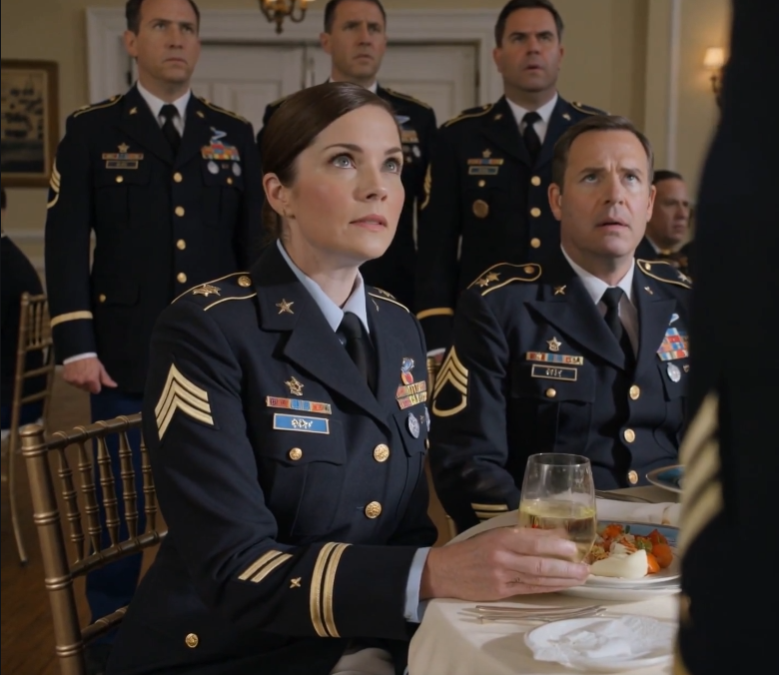
The regimental dining-in was in full swing. If you have never been to one, picture a wedding reception run by people who own exactly one nice thing each and have decided to wear all of it at once. Dress uniforms, miniature medals catching the light, old unit traditions dusted off for the night, the grog bowl, the toasts, the fines read out for made-up offenses, the laughter that comes a little too easily because everyone is relieved to be, for one evening, not at work. The room was warm. The tables ran in long parallel lines, with the head table across the top, and the candles had burned down to about half. The whole place had that loosened, late feeling a formal event gets around the third hour, when the ties have not come off yet but everyone has stopped pretending they might.
I was seated among the lieutenant colonels and colonels, about a third of the way down one of the long tables, and no one at that table knew who I was. That was on purpose. I had landed on the installation two days earlier. In thirty-six hours, I would stand on a parade field and take command of the brigade. I had told the protocol office, very specifically, to leave my name off the seating card and to sit me wherever there was a gap. I wanted one evening to see the command the way it actually was before it arranged itself into the shape it thought I wanted to see. You learn more about a unit from the back of the room than from the front of it. I had learned that a long time ago, standing at the back of rooms I had not been invited to sit in.
So I sat in my dress uniform, with my name concealed the way a name is at a table where the place cards have your rank and nothing else, and I ate the chicken and I listened. A dining-in runs on ritual, and the rituals had all been observed. The president of the mess had rung the little brass bell and welcomed the regiment. There had been the toasts to the nation and to fallen comrades and to the regiment itself, everyone rising and sitting in the ragged unison of people who have done it a hundred times and still cannot quite manage to stand up all at once.
There had been the grog bowl, that revolting ceremonial punch every unit builds out of whatever is on hand, a great deal of it deliberately awful, and the mess sergeant reading out fines for invented offenses in a booming carnival voice while the room laughed. Someone had been fined for a cell phone that rang during the toast. Someone had been fined for wearing the wrong cuff links. It was, for most of the room, a good night, the kind of evening that a regiment puts on to remind itself that it is a family and not only a machine. I had been enjoying watching it, the way you enjoy watching a thing you are about to be responsible for behave well while it does not yet know you are watching.
The man across and two seats down from me was a colonel named Grant Mercer. I recognized him the moment I sat down. He did not recognize me. That asymmetry is the whole story, really, so hold on to it. He was fifty-seven years old, and he had the particular weight a man carries when he has been passed over for promotion twice and has decided the fault lies everywhere except in the mirror. He had been drinking since the receiving line. Not falling-down drinking. Worse than that. The steady, competent drinking of a man who has done it at a hundred of these dinners and believes it makes him funnier and sharper and more honest, when in fact it only removes the last thin floor between what he thinks and what he says.
He held court. He told stories in which he was always the only adult in the room. The captains near him laughed on cue, the way you laugh at a senior officer’s stories when you would like to keep your evaluation clean. I had watched him for two hours before he ever noticed me, and in two hours you can learn a great deal about a man who is drinking and does not know he is being read. I watched him interrupt a captain three times in one story and then take the story over. I watched him wave off the young lieutenant who tried to refill the water at his end. I watched him laugh loudest at his own lines and check each time to see who else was laughing, and adjust.
He was not a stupid man. That is the thing people get wrong about the Grant Mercers of the world. He was a clever man who had spent his cleverness entirely on the project of never being the one who was wrong, until the effort of it had hollowed everything else out. What was left was a colonel of fifty-seven who could command a table for an evening and had not been trusted with anything larger in a decade.
The seat to my left had been empty all night. Around the third hour, Mercer decided it belonged to a guest of his who had never shown, and that I was the reason there was confusion about it, and that the confusion was an insult.
“You are in the wrong seat,” he said to me from two seats down.
I said the seat had been assigned to me. I said it quietly because I did not want a scene and because I genuinely did not care about the chair. I would have moved. I have moved for worse men than Grant Mercer and thought nothing of it. He did not want me to move. He wanted me to be wrong. There is a difference, and drunk men live in the difference.
“Do you know whose regiment this is?” he said.
His voice had gone up enough that the captains stopped laughing and started watching, which was what he wanted, and also the beginning of the end for him, though none of us knew it yet.
“Do you have any idea who is at this table? These are serious people. This is not a place for someone who wandered in to fill a chair. Sit down and be quiet.”
“I am already sitting down,” I said evenly.
I think it was the evenness that did it. A frightened person he could have forgiven. A person who simply declined to be frightened was, to a man like that, unbearable. He stood up. He came around the corner of the table, and he hit me. It was an open hand, a backhand, the kind of thing a certain kind of man does when he wants to humiliate rather than injure. When the point is not the pain but the fact of it, done where everyone can see.
My head turned with it because I let it turn. I have been taught, at real cost, that you do not give a strike more than it has already taken. I kept my seat. I steadied my water glass with two fingers so it would not tip, which is a strange thing to remember and the thing I remember most clearly. The candle flames leaned and stood back up.
There is a sound a large room makes when it stops. It is not silence exactly. It is the sound of two hundred small movements all arresting at once. A fork set down too carefully. A chair leg going still. The collective held breath of people who have just watched something they will be telling their spouses about tomorrow and cannot yet believe they watched tonight. The candle flames leaned in the small wind of his hand and stood back up, and their standing back up was the only motion in the whole hall. The room went silent in the way a room does when forty people all decide in the same half second not to breathe.
Three seats down, a major named Curtis Yardley went the color of paper and reached into his jacket for his phone. Grant Mercer laughed, turned back to his table, and sat down, certain that the matter was closed.
The thing they teach you is not to swing back. The harder thing, the one that takes years, is not to explain yourself. I had gotten good at the first one a long time ago. The second one took me most of my career. There is a version of me from twenty years earlier who would have been up out of that chair with my identification card and my voice and my whole indignant history, demanding that the room be told at once exactly who had just been struck and exactly how sorry the striker was going to be. That version of me was not wiser. She was just younger and more afraid, and she believed that respect was a thing you could win in an argument if you only argued hard enough.
I had learned since then that respect is not won in the loud minutes. It is revealed in the quiet ones. So I sat, and my cheek was hot, and I did the arithmetic that keeps a person still. Stillness is not a feeling. That is what nobody tells you. Stillness is a set of small physical decisions made one after another, faster than thought, and I made them. I did not touch my cheek because touching it would tell the room it had landed, and it had, and the room did not need my confirmation. I did not look for allies because looking for allies is a way of asking permission to be a victim, and I was not going to ask.
I kept my breathing in the low, slow count that a very patient noncommissioned officer had drilled into me a long time ago, back when the thing I needed to survive was incoming fire and not a man’s open hand. Four counts in, hold four counts, out. The body believes the breath before it believes anything else. Steady the breath and the hands follow. Steady the hands and the face follows, and a steady face in a room that expected a broken one is the most disorienting thing you can offer people who wanted a scene.
I counted the exits out of old habit. I counted the officers watching without meaning to and got to something near forty. I noticed that the young lieutenant at the far end of the table, a woman of maybe twenty-five with the newness still on her, had come halfway out of her chair to help me and had frozen there, caught between instinct and rank, not knowing what the room permitted. Her name, I would learn later, was Grace Amory. She was a first lieutenant, and she was the only person besides Yardley who had moved at all.
I met her eyes, and I shook my head. One degree, barely a motion. Sit down. Not yet. Not like this. She did not understand it. How could she? From where she sat, it must have looked like surrender, like one more woman in uniform absorbing one more thing she should never have had to absorb and choosing to swallow it. I could not explain across a silent banquet hall that I was not swallowing anything. I was letting a process I trusted more than my own temper begin to move.
But she sat back down because a colonel she did not recognize had told her to with the smallest tilt of a head, and something in the authority of that small motion reached her, even though she could not have said why. That is the part I want you to sit with before the rest of it happens.
I had a choice in that moment, and the choice was not between weakness and strength. Everyone always thinks it is. They think the strong thing would have been to stand up and level him. It would have felt strong. Feeling strong and being in command are different jobs, and they are very often opposites.
Because here is what was actually true. Under the candlelight, while my face stung, I was not a guest who had wandered in. I was two days from being the most senior officer on that installation. In a day and a half, I would hold the authority to end Grant Mercer’s career with a signature. And he had just handed me every reason and every witness I would ever need. The temptation to reach for that right then, in front of everyone, was enormous. It would have been so satisfying.
That is exactly why I did not. I had come to that dinner to see the command with its guard down, and I had just seen it. I had seen what it laughed at and what it tolerated and how far a man like Mercer could get, for how many years, before anyone with the standing to stop him happened to be sitting close enough to be hit. I had seen all of it in about ninety seconds. The lesson had cost me a mark on my cheek that would be gone by morning, which is a cheap price for that much truth, though I would not have said so out loud with my ears still ringing.
I kept my hands off the table. I kept my seat. And I waited, because the two men who mattered now were both already moving, and neither of them was making a speech.
It was not the first time Grant Mercer had told me I did not belong at a table. The first time was in 2005, in a plywood room in Iraq that smelled of diesel and burned coffee and the particular dust that gets into everything and never fully leaves. I was a first lieutenant, twenty-five years old, four months into my first deployment, and still under the impression that being right and being useful would be enough. Mercer was a major then, the operations officer for the battalion, a man already halfway to the person he would become, with the seniority to make a young officer disappear and the temperament to enjoy it.
There had been a briefing. I had done the analysis that the briefing was built on. I had been up two nights putting it together, and I knew the ground and the route and the risk better than anyone who was going to be in that room, because I had done the work while other people slept. I came in and went to take a seat at the table, the way you do when the thing being discussed is the thing you built.
Mercer looked at me the way you look at a chair that has appeared in your path.
“You do not belong at this table,” he said.
Those exact words. Not shouted. That was the thing about him, then and now. He did not need to shout. He said it the way you would state the weather.
“Brief from the back if you have something. The table is for principals.”
I remember the room exactly. The map board on an easel, the acetate overlays smudged from being redrawn too many times, the field tables pushed together to make the one long table that the principals sat at, the generator hum coming through the plywood, a box fan pushing the hot air around without cooling it. I remember standing there with my notebook, twenty-five years old, feeling the specific humiliation of being right and unheard at the same time, which is a humiliation that has a taste, metallic at the back of the throat.
I briefed from the back. I stood against the plywood with my notes in my hand, and I gave the analysis to the backs of their heads. I told them the route the intelligence favored was the wrong one, and why, and where the actual risk sat, and what I would do about it. A captain at the table turned around once to listen, which I have never forgotten because one person turning around is sometimes the only thing that gets you through a room like that.
The mission went the way I said it would go. The favored route would have been bad, and the route I argued for was merely hard, and hard is what you want when the other option is bad. No one at the table remembered afterward that the person who had called it had not been allowed to sit down. Mercer certainly did not remember. Men like that do not keep those receipts. They cannot afford to. To remember every table you barred someone from is to admit there was a person there worth remembering, and the whole machinery of a man like Mercer runs on the belief that there was not.
I kept the receipt. Not out of grievance, though I will not pretend there was no grievance. I kept it because a sergeant major I trusted told me something that year that I have never let go of.
He said, “Do not spend your anger arguing with people who have already decided about you. Bank it. Put it into the work. Let the work say the thing your voice is not allowed to say.”
He said, “The loudest person in the room is almost never the one the room is actually built around. And if you can stand being underestimated for a few years, you will end up standing exactly where the people who underestimated you cannot follow.”
The sergeant major’s name was Roy, and he is gone now. I say his name here because he earned the saying of it, and because the thing he told me kept more than one soldier alive over the years, including, in a way, me. He had been a young man in a much worse war than mine, and he had been dismissed by better men than Grant Mercer, and he had watched most of them fall behind him one by one over thirty years while he simply kept being useful.
“Bank it,” he told me, sitting on an ammunition crate with two cups of coffee that tasted like the inside of a canteen. “Do not spend it in the room. The room is not where you win. You win in the ten years after the room, and you win it quietly. And the way you know you have won is that one day the man who barred the door will need something only you can give, and you will get to decide who you are when that day comes. Be someone worth being on that day. That is the only revenge that does not cost you your own soul.”
So I banked it for twenty years, through a company command and a second deployment and a bad valley in Afghanistan where I earned a medal. I do not talk about doing something I would rather not have had to do. Through a battalion of my own and a war college and the slow, unglamorous accumulation of the kind of record that eventually puts a person in front of a promotion board that does not care whether anyone ever let her sit at a table, only whether she can be trusted with the whole room.
And now here we were. A plywood room had become a banquet hall. A major had become a colonel who had stopped rising. A first lieutenant had become the person about to take command of everything he had left. He had said the same words to me twice, twenty years apart, and both times he had been completely certain, and both times he had been completely wrong. And the second time he had put his hand on me to prove it. He did not remember the first time. I had never forgotten it. That is not a threat. It is just the arithmetic of who was going to be surprised.
The ground was already shifting under Grant Mercer, and the marvelous, terrible thing was that he could not feel it move.
Major Curtis Yardley had left the hall. He was my aide-de-camp, though no one at that table knew it. He had been seated three places down from me, as protocol quietly arranges these things, even when the name is off the card. Yardley was thirty-four and careful, and he had the rare gift of doing the urgent thing without making it look urgent. He had not stood up and pointed. He had not announced anything. He had risen the way a man rises to take a phone call he has been expecting, unhurried, and he had walked out into the corridor. Only once the doors closed behind him had he moved fast.
I did not see the call. He told me about it afterward, and the provost marshal filled in the rest, so I can tell you how it went. He called the installation provost marshal directly, a lieutenant colonel named Warren Ty, and he did not editorialize. He is a good officer precisely because he does not editorialize under pressure. He said there had been an assault at the dining-in. He said a colonel had struck another officer open-handed in front of the assembled mess. He gave the location and asked for the duty patrol. And then he said the thing that changed the temperature on the other end of the line.
“Sir,” he said quietly in the corridor, “before your people get here, you need to know who he hit.”
I have thought about how much rode on that one sentence being said in that one tone. If Yardley had said it with any heat, if he had said, “Do you know who he just hit?” If he had made it a scandal instead of a fact, the whole night could have curdled into exactly the personal grievance I was trying to keep it from becoming. He did not. He reported a crime, and then he added a material fact that the responding officer needed in order to respond correctly. And he added it flat.
That flatness is the reason the record is clean today. People think aides carry bags and hold doors. The good ones carry the difference between a thing done right and a thing done fast, and they carry it without ever being thanked for it in a way anyone would notice.
He gave my name and my post. There was a short silence on the line, the kind a professional takes when he is rearranging the next ten minutes of his life. Then Ty said he was on his way personally and told Yardley to make sure no one, meaning Mercer, meaning anyone acting on Mercer’s behalf, walked the colonel out to a car before the patrol arrived. Tidiness after the fact is how these things get buried. Ty had been doing his job long enough to know it, and he was not going to let a general officer’s assault get tidied into a bad memory and a quiet retirement.
Inside the hall, something else was happening that had nothing to do with a phone. At the head table sat the outgoing brigade’s command sergeant major, a man named Isaiah Boon. Fifty-five years old, thirty of them in the Army, the last several spent standing slightly behind commanders and reading rooms so that his colonel would not have to. He had seen my photograph that afternoon. It had been in the change-of-command briefing packet, the one they prepare for the senior enlisted so the transition goes smoothly. And Boon was the kind of man who studied the packet instead of skimming it.
I watched him recognize me. It is a specific thing to see. It happened in his body before it happened in his face. He set down his coffee cup very precisely in the center of its saucer. He went still in a way that was different from the room’s frozen stillness, a deliberate stillness, a coming to readiness. And then, without a word to anyone, without a glance that would have told the room what he knew, he stood up from the head table and began to walk toward the doors at the back of the hall, to be there when the patrol arrived, to make sure that whatever happened next happened correctly.
I did not know Boon yet. In thirty-six hours, he would hand his brigade to another command sergeant major, and I would only have him for the overlap. But in that one motion of setting down a coffee cup and standing up, I learned everything about him I would ever need to know. There are two kinds of senior enlisted in a moment like that. There is the kind who sees a chance to be the hero of the story, and there is the kind who sees a job that needs doing and makes himself into the tool that does it.
Boon was the second kind. He had spent thirty years being the second kind, and it had made him invisible to exactly the people who should have been studying him, and entirely indispensable to the handful of commanders wise enough to notice.
He did not announce me. I have thought about that a great deal since. He could have. A lesser man, wanting to be the one who said it right, would have stood up and called the room to attention and pointed at Mercer and enjoyed the gasp. Boon did the opposite. He made himself into a piece of the machinery, quietly, so that the outcome would belong to the process and not to any one man’s satisfaction. It is the most senior-enlisted thing I have ever watched a person do. I have tried to be worthy of it since.
So there were two men now moving with purpose through that warm, loud room, one in a corridor with a phone, one crossing the carpet toward a set of double doors. And at the center of it, holding a fresh drink, telling the captains a story about how discipline had gone soft in today’s Army, and how in his day a man knew his place, sat the only person present who had no idea that the ground had already opened under his chair.
For a few minutes, the easiest thing in the world would have been to make it all quietly go away. I want to be honest about that because the temptation to bury a thing is never as clean as it looks from the outside, and the people who bury things are almost never villains in the moment they do it. They are usually tired and reasonable and trying to be kind.
The president of the mess, a lieutenant colonel named Frank Ostrander, appeared at my elbow. He had been the host all night, the man who rang the bell and read the fines and kept the evening running. And now his evening had detonated, and he was trying visibly not to come apart. He crouched down beside my chair so we would be at eye level, and his face was the face of a decent man watching his event become the thing he would be remembered for. He did not know who I was either.
Understand that. To Ostrander, I was a guest, an officer he could not place, a woman who had just been struck at his dinner, and every instinct he had was bent toward protecting me from further indignity and protecting the evening from further wreckage. And he could not see that those two goals had just become enemies.
“Ma’am,” he said, low and fast, “I am so sorry. Let me handle this privately. Let me have someone walk him to his car. He has had too much. He is not himself. It is not an excuse, but you know how these things go. We do not need to turn a regimental dinner into an incident. I will get his name. I will make sure you have whatever you need, but please let me make this go away quietly. You do not want to be the reason this becomes a story.”
And the worst part, the part that made it a real temptation and not a cartoon of one, was that Ostrander was not a coward, and he was not covering for Mercer. He genuinely did not know who Mercer was to me or who I was to anyone. He was a good officer having the worst night of his year, trying to shrink the damage, and the exit he was offering was the exact exit that ninety-nine dinners out of a hundred would have taken.
Because ninety-nine dinners out of a hundred, the struck party is someone who cannot afford the fight and is grateful to be handed a quiet way out. He was offering me the mercy that the system offers most people, which is the mercy of pretending it did not happen. I had accepted that mercy myself once or twice when I was younger, when the fight was not worth what it would cost me. I knew exactly how warm and reasonable it felt from the inside.
Here is the thing I had to sit with in the two or three seconds he gave me. He was not wrong that I did not want to be a story. I did not. I had come to that installation wanting the opposite of a story. I wanted a clean, anonymous evening and a quiet arrival and thirty-six hours to prepare. And every part of me that wanted a simple life was leaning toward the exit Ostrander was holding open.
My cheek hurt. It had been a long two days. The man was old and finished, and taking his career out to his car and letting him keep the shape of his dignity would have cost me nothing tonight.
It would have cost everything tomorrow.
Because I had watched the room. I had watched the captains laugh at his stories all night. I had watched a first lieutenant freeze halfway out of her chair, learning in real time what this command allowed a man to do to a woman in uniform and get away with. If I let Grant Mercer be walked to his car, I would not be extending mercy. I would be issuing a ruling. I would be telling every young officer in that hall that if you hit the right person, or rather the wrong person, and you are senior enough and the evening is nice enough, the Army will help you find your keys.
I would be blessing it.
Every quiet burial is a blessing. That is what no one tells you about the reasonable, tired people who make ugly things disappear. They are not choosing peace. They are choosing which lesson the young people in the room take home. I thought about Grace Amory sitting back down because I had shaken my head. I thought about what she would learn from the next ten minutes, one way or the other, and how long she would carry it, and how she would run her own room someday twenty years from now because of what she saw a colonel choose tonight.
I looked at Ostrander, who was still holding open his kind and terrible door, and I felt the tiredness in me lose its argument with the part of me that had ever led anyone.
I made the decision the way I have made every decision I am not ashamed of, which is to say without any spectacle at all. I did not stand up. I did not reach for my identification. I did not lean into the corridor and summon my rank like a weapon, though it was sitting right there and it would have worked. Standing up into your authority in a moment like that feels like strength and is actually the loss of the only real advantage a person in command has: the ability to let the right thing happen without needing to be seen making it happen.
“Colonel Ostrander,” I said.
I kept my voice level and low so that it was between the two of us and not a performance for the table.
“I understand why you are offering that. You are trying to be kind, and you are trying to save your evening, and I am not going to hold either of those against you. But listen to me carefully. You can make a dinner quiet. You cannot make an assault disappear. Those are not the same skill, and only one of them is yours to use tonight.”
He started to say something, and I did not let him.
“There is going to be a report,” I said. “Not a favor. A report. I would like the provost marshal, not a designated driver. Do you understand the difference I am drawing?”
He looked at me, and I watched him begin to grasp that the woman he was crouched beside was not who he had assumed, though he did not yet have the shape of it. Something in the way I said provost marshal, the way I said report, the specific gravity a person’s voice carries when they are describing a process they are accustomed to running rather than one they are hoping will protect them.
He stood up slowly.
“Yes, ma’am,” he said.
And this time the ma’am had a different weight in it. The weight a word takes on when the person saying it has just realized they do not actually know to whom they are saying it.
Yardley had come back in by then and taken a knee on my other side, and I turned to him and asked him for the one thing I actually cared about.
“By the book,” I said. “Witnesses. Rights read. Nothing that anyone can call personal later, because it is going to be very tempting for people to call it personal, and I need it to be clean enough that they cannot.”
He nodded once. He had already made it clean. That is why he is my aide.
Then I did the hardest thing, which was nothing. I stayed in my seat. I did not turn to look at Mercer. I did not watch the doors. I sat with my hands still and my water glass upright and my ruined anonymous evening around me. I let the room hold its breath, and I waited for the process I had just refused to short-circuit to walk through the doors on its own two feet.
The doors at the far end of the hall opened. The temperature of the room changed the way it does when everyone senses an authority entering before they can see it. And Grant Mercer, God help him, thought it was for me.
What was hidden became undeniable, and the mercy of it, if there was any mercy in it, was that it arrived as procedure and not as theater.
Lieutenant Colonel Warren Ty came through the doors with two military police behind him. Provost marshals do not, as a rule, attend dining-ins, and the sight of one crossing the carpet in the middle of the dessert course told every officer in that room that the evening had passed out of the ordinary and into the official. Conversations died table by table as they came. The two MPs were young and squared away and entirely unreadable, which is exactly how you want them to look when they are walking into a room full of colonels.
Command Sergeant Major Boon had positioned himself near the doors and fell in slightly behind them, a piece of the machinery present so that no one could later say the enlisted had been kept in the dark.
Grant Mercer watched them come, and he smiled.
He actually smiled. He set down his drink and pushed his chair back and half rose, the way a man rises to greet help that has finally, correctly arrived.
“About time,” he said to the room, in the voice of a man narrating his own vindication.
He gestured at me with an open hand. The same hand.
“Escort her out. She has been causing a disturbance since she sat down. I do not know how she got in here, but this is a closed mess, and she does not belong.”
He said the words, she does not belong. Twenty years later, the same certainty. The last time he would ever get to be that certain about anything.
Ty did not look at me. That is the detail I keep. A lesser officer would have glanced at me for confirmation, would have made it about the two of us, would have handed Mercer the story he wanted, in which a woman had summoned the police to a man. Ty walked past me as if I were furniture, which in that moment was the most respectful thing he could possibly have done, and he stopped in front of Grant Mercer.
The room understood a full half second before Mercer did.
“Colonel Mercer,” Ty said, and his voice was flat and carrying and built for exactly this. “I am the installation provost marshal. You are being placed under apprehension for assault and for striking a superior commissioned officer. You do not have to make any statement. Anything you do say can be used against you in a trial by court-martial. You have the right to consult with counsel.”
The smile came apart in stages. First the confidence, then the confusion, then something underneath both of those. A dawning. A memory rising through twenty years of drink and certainty toward the surface of his face.
“A superior?” Mercer said. “She is not superior to—what? Who is she?”
Someone said it then for the record, because the record needed it said. I do not even remember whether it was Ty or Yardley or Boon. My post, my rank, the command I would assume in a day and a half, spoken aloud into that silent hall in the neutral voice you use for a form.
It does not matter who said it. What mattered was Mercer’s face while it was said, because he turned finally and looked at me. Really looked. And I watched twenty years land on him all at once.
He knew me. He had always known me in the way that the people who dismiss you always half know, somewhere they do not visit, exactly who you were. He had just never once imagined he would have to answer for it. The plywood room came up in his eyes. I could see it arrive.
I did not nod. I did not smile. I did not give him a single thing to take with him except the plain fact of my face, which was the same face that had briefed his mission from the back of a room in 2005 and had been right then, too.
I want to describe his face at the moment my rank was said because I have commanded for a long time, and I have seen a great many men understand a great many things, and I have never seen anything quite like Grant Mercer understanding all at once the size of what he had done.
It was not fear at first. It was accounting. I watched him run the numbers the way a man runs them when the bill has arrived and he already knows he cannot pay it. Struck an officer. Struck her in front of the mess. Struck, it was now becoming clear to him, the incoming brigade commander, the one name on the entire installation that his own career answered to.
And then, under all of that arithmetic, the older thing surfaced. The plywood room. The young lieutenant he had sent to the back of it. And I saw him realize that he had not merely assaulted a superior officer at random. He had assaulted the specific person he had spent an afternoon in 2005 teaching that she did not belong at the table.
And she had gone and become the table.
The MPs stepped in. They were gentle and correct about it, which is its own kind of terrible to watch, the gentleness. They brought his hands behind him, and the cuffs closed with a sound that a quiet room makes very large. He did not resist. The fight had gone out of him the moment my rank was said aloud, because the fight had never really been in him. It had been in the drink and the seniority and the twenty years of no one senior enough being close enough to be hit.
Take those away, and there was just an old man being walked out of a dinner by two soldiers younger than his career.
Nobody cheered. I need you to understand that because if you have watched enough of these stories, you might expect a cheer or a slow clap or some sound of triumph. There was none. What happened instead was that the officers in that hall stood up. Not for me, not for a reveal. They stood the way a body of soldiers stands when a room stops being a party and becomes, for a moment, a formation again. When the presence of the process and the weight of what it means calls them up out of their chairs without an order.
Forty officers on their feet in silence while two military police walked a colonel toward the doors.
I have thought since about those captains, the ones who had laughed at his stories all night and would not look at him now. I do not judge them for the laughing. I did the same math they did when I was their rank, laughing at senior officers’ jokes to keep an evaluation clean. And anyone who tells you they never did it is either lying or was never junior. But there is a lesson sitting in the difference between the laughing and the not looking, and I hope some of them found it.
The room that laughs with a man like Mercer and the room that will not meet his eyes are the same room. The only thing that changed was that the cost of him became visible. Character is mostly a matter of behaving before the cost becomes visible the way you would once it has. Very few of us manage it. It is worth spending a life trying.
The band did not play. Someone had the sense to keep them quiet. Grant Mercer walked the length of the hall he had held court in all night, past the tables of captains who had laughed at his stories, and not one of them met his eyes.
The doors opened. The doors closed. And it was over.
And it was only beginning, both at once.
The aftermath moved through the people and the paperwork the way weather moves through a valley. Slowly, and then all at once, and then slowly again. They took statements in a side room off the main hall, a place with a coffee urn and a wall of unit photographs and a folding table someone had cleared. It went on for a long time. Assault at a formal event with forty witnesses generates a strange abundance of evidence. Everyone saw it, which means everyone has to be heard, which means the truth has to be assembled out of forty slightly different angles on the same ninety seconds.
The investigators were methodical. I was glad of it. I have never once in my life wanted a thing done to me quickly, if quickly meant sloppily. Yardley gave his statement, and Boon gave his, and Ostrander gave his, still pale, still apologizing in the spaces between the official questions until one of the investigators gently told him he did not need to. He kept trying to take responsibility for the whole thing, the way a good host does, as though the assault had been a flaw in his seating chart.
I caught him on his way out and told him quietly that he had done nothing wrong and one thing very right, which was that when I asked him for a report instead of a favor, he had given me the report. He had wanted to bury it, and I had told him no, and he had listened. Most people do not listen when you tell them no in the middle of their own worst night. I told him I would remember that he had, and I have.
Grace Amory gave hers. I watched her go into the side room looking frightened and come out looking older, which is what giving a true account of an ugly thing does to a young officer the first few times. It ages you a little in a way that is not entirely a loss.
I gave mine last, and I gave it flat and complete, and I added nothing and I subtracted nothing. I did not describe how it felt. Feelings are not evidence. I described what he said and what he did and what I did and in what order. And when they asked me whether I had known Colonel Mercer previously, I said yes. In 2005, in Iraq, he was my operations officer, and I left it there because the twenty-year-old grievance was mine to carry and not the investigation’s to weigh.
If they wanted it, they would find it. I was not going to hand them a motive to make the story smaller than it was. The story was not that a woman had settled an old score. The story was that a colonel had struck an officer at a dinner, and that is a complete story on its own, and it does not need my history to be true.
Boon found me in the corridor afterward. The command sergeant major. Thirty years. Thirty of them spent making other people’s commands run. He stood in front of me, and he did the thing that senior enlisted do when something has gone wrong on their watch, which is to take it personally in a way that officers are trained out of.
“Ma’am,” he said, “that should never have reached you.”
I have thought about how to answer that more than I have thought about almost anything else from that night, because he was right and he was also wrong, and the wrongness was the important part.
“Sergeant Major,” I said, “it should never have reached anyone. I could take it. That is not the point, and you know it is not the point. Somewhere in this command, there is a specialist or a lieutenant who could not have taken it, who would have had no aide three seats down and no provost marshal on the way and no rank waiting to be read aloud. He has been that man’s colonel for years. Do not be sorry it reached me. Be sorry about everyone it reached before me that we never heard about.”
He looked at me for a moment. Then he nodded once, the way Boon nodded, which was a whole paragraph compressed into a single motion, and he said, “Yes, ma’am.”
And I understood that we were going to be able to work together, he and I, in the thirty-six hours he had left in the brigade before he handed it to his own relief. That mattered more to the next year of my life than anything Grant Mercer had done.
A specialist I had never met told me a version of it three weeks later, not knowing I was in it, or perhaps knowing exactly and being brave enough to pretend he did not. He was driving me across post, and he said, “Ma’am, did you hear about the colonel who got taken out of the regimental dinner in cuffs?”
I said I had heard something about it, and he told me the whole thing, mostly right, a few details grown taller in the telling. And then he said the part that told me the lesson had landed where it was supposed to.
“The thing everybody keeps saying is that she didn’t even yell. She just let him do it and then let the MPs do their thing. My buddies and me been talking about it. That’s the kind of officer you’d follow.”
I said it sounded like she got lucky. The provost marshal was quick.
“No, ma’am, respectfully, that’s not luck. That’s her having set it up so the right people were already moving.”
And I looked out the window so he would not see my face, because he had understood the entire thing better than most colonels would. And he was a specialist driving a car, and that is the Army when it works.
By morning, the story had already gone around the installation, the way stories do, faster than any official word could travel, mutating a little at each retelling. The change of command would go on as scheduled. There would simply be a hole in the guest list and a name that people would say more quietly than they used to, and a lesson sitting in the middle of the command that everyone could feel and no one had to explain.
Which is how I came to be standing in that empty mess hall at 0600 hours, looking at a bare table that shone.
I had not planned to come back. I had gone to my quarters and lain down and not slept. Around five, I had given up on it and put on my service uniform and walked back across the dark post to the building where it had happened. The way you return to the site of a car accident you walked away from. Not because there is anything to see, but because some part of you needs to confirm that the world is still solid where the ground opened.
The soldier with the dust mop worked around me. The candle smoke still hung faintly in the air. I stood at the head table and put two fingers on the cool surface of it, in about the spot where my water glass had been. And I took an honest inventory of what I felt, because I think you owe yourself an honest inventory after a thing like that. And I am going to give you the honest one and not the flattering one.
I felt tired. That first. Bone-tired in the way that has nothing to do with sleep.
I thought about Roy on his ammunition crate and his line about the only revenge that does not cost you your soul. And I tried to be honest with his memory about whether I had passed the test he set me twenty years before. Be someone worth being on the day the man who barred the door needs something only you can give.
Mercer had not needed something from me exactly, but he had needed me to be small one more time, the way he had made me small once before. And the day had come to decide who I was, and I had decided by not deciding loudly, by letting the process carry it, by refusing both the swing and the speech.
I thought Roy would have called that a pass. I hoped so. It is a strange thing to still want the approval of a man who has been gone for years, but that is what mentors are, the voices you keep consulting long after they can no longer answer.
And underneath the tired, I will tell you the truth, there was a small, hard ember of something I am not proud of, which was that for one second, exactly one, when the cuffs closed on Grant Mercer’s wrists, twenty years of banked anger had warmed itself at the sight.
I had waited a very long time for that man to be wrong out loud, and he had finally been wrong out loud in front of everyone in a way that could not be walked to a car. And there had been one second where the girl at the back of the plywood room had felt the account settle.
I am telling you about that second because I do not think you should trust anyone who claims they would not have felt it. But I am also telling you about it because the second is not the part I chose to keep. And a person is not their worst true second. They are what they do with the seconds after it.
And what I did with the seconds after it was to give a flat statement and refuse to hand over my history as a motive, and tell a command sergeant major to grieve the soldiers we never heard about instead of the colonel who finally got caught.
I had not let the ember run the night. I had let it warm me for a second, and then I had gone back to work, which is the most any of us can do with the parts of ourselves we would rather not have.
Being right had cost something. It always does. It had cost a man his career. And I want to be careful here because it is easy to say he cost himself his career, and that is true. But it is also true that I could have let him keep it, and I chose not to. And I am not going to hide behind the passive voice about my own decisions.
I decided that his career was worth less than the lesson every young officer in that hall took home. I still believe that. But deciding it is not free, and I did not pretend it was, standing there with two fingers on the cold table.
It had cost me the arrival I wanted, too. I had come in wanting to be anonymous and plain and unknown for one more day. And now I would take command of a brigade that already had a story about me. That would always have a story about me. That would watch how I ran a room through the lens of the night a colonel hit me and I did not raise my voice.
There are worse first impressions for a commander to make. I would not have chosen this one.
I do not get to choose. None of us do. We only get to choose what we do inside the moment we are handed. And I had chosen. And now I would live inside the version of myself that choice had made public.
I folded my gloves, which I had been holding the whole time without noticing, and I straightened, and I went to take command.
The change of command was spare and correct, which is how they should be and rarely are. It was a clear morning on the parade field, the flags out, the formation dressed, the folding chairs full of families and dignitaries, and the ordinary machinery of a ceremony that the Army has performed ten thousand times and still manages to make feel like it means something.
I stood where you stand. The guidon, the unit’s colors on its staff, passed from the outgoing commander to the senior commander to me. Hand to hand, the oldest way an army has of saying, “This is yours now. These people are yours. Their failures are yours, and their lives are yours, and you will answer for both.”
I took it. The formation held.
That is the whole ceremony, really. Everything else is chairs.
I said nothing from the podium about the night before. Not one word. I had thought about it and decided against it, and I was right, too. Everyone on that field already knew. The soldiers in the formation knew, the way soldiers always know everything before their officers think they do. The families knew because their soldiers had told them over breakfast.
Saying it out loud would have been a performance, and I had spent the whole of the previous night refusing to perform, and I was not going to start now that there was a microphone.
A command learns what its commander is from what she does, not from what she announces. They had already watched me do the thing. The speech was unnecessary, so I gave the short version of a different speech about the work ahead, and I stepped down.
Afterward, in the receiving line and the handshakes and the slow dispersal, I found a minute with First Lieutenant Grace Amory.
She came up to me carefully, the way you approach a senior officer when you have a question you are not sure you are allowed to ask. I saved her the trouble.
“You wanted to stand up for me last night,” I said. “At the table. You were halfway out of your chair.”
“Yes, ma’am.”
She colored.
“I did not understand why you stopped me. I think I understand a little better now.”
“I stopped you because standing up in that moment would have made it about you and me and him, and it needed to be about the process. And the process could not start until the right people were moving. That is not something you could have known from your seat. You had the right instinct. The instinct was correct. The timing was mine to manage because I had information you did not.”
I let that sit for a second.
“But here is the part I actually want you to take with you, Lieutenant, because you are going to run your own rooms one day, and I am not going to be in them.”
She waited.
“I could shake my head at him,” I said. “I could sit still and let it come to me because I had rank he could not see, and an aide three seats down, and a provost marshal one phone call away. I could afford to be still. Most people cannot.
“Somewhere under you right now, there is a soldier who is going to be treated the way I was treated last night by someone senior enough to make it stick. And that soldier will not have any of the things I had. She will not be able to shake her head and know the cavalry is already moving. You are going to be her cavalry.
“That is the job. Not standing up for the colonel who can take it. Standing up for the private who cannot. Do you understand me?”
“Yes, ma’am,” she said.
And this time I believed she did, or at least that she would, which at twenty-five is the same thing.
There is a photograph from that morning that someone sent me later, taken from the side as the guidon was passing between the two of us who were handing off, my hands closing on the staff.
I do not look triumphant in it. I look like a person picking up something heavy, which is what I was doing. That is the only accurate way to feel while taking command. If you understand the job at all, the guidon is not a trophy. It is the physical weight of a few thousand lives and the promise that you will spend yourself on them.
And the officers who mistake it for a trophy are the ones you read about later, the ones whose commands come apart around a hollow center. I had watched one of those come apart at a dinner table two nights before. I did not intend to become the next one.
As for Grant Mercer, I will tell you what happened to him, and I will tell it without relish. Because relish is the thing I promised myself at the cold table I would not carry.
He did not go to prison. These things rarely end that cleanly. But an assault on a superior officer in front of forty witnesses does not go away. And it did not go away.
He was relieved. The investigation ran its course. A flag officer signed the things that flag officers sign. And a career that had already stopped rising came to the specific, documented, undeniable end that Grant Mercer had spent twenty years writing for himself. One dismissed lieutenant, one barred table, one certain sneer at a time.
People want that part of the story to be bigger than it is. They want the villain marched off to a cell for years, the full theatrical justice, because the strike was so public and so ugly that anything less feels like the system flinching.
I understand the hunger. I do not entirely share it, and I will tell you why.
The point was never to destroy Grant Mercer. Destroying him would have made it about him and about me and about the twenty-year-old score. And that is exactly the small and personal story I spent the whole night refusing to let it become.
The point was that a command watched in real time what happens when a senior man puts his hand on a subordinate in front of witnesses. Not a quiet ride to the car, not a favor from a mortified host, but the provost marshal and the reading of rights and the cuffs and the long, documented unwinding of a career.
The point was the lesson, and the lesson does not require a prison. It only requires that the process be allowed to run in the light all the way to the end for everyone to see. That is the whole of it. That is what I protected when I said report and not favor. Not my grievance. The lesson.
He wrote it. I only made him read it aloud. There is a difference, and I have made my peace with living on my side of it.
I took the guidon. The formation held. And the brigade and I got to work, which is the part of the story no one ever tells because it is not dramatic. It is just the long, unglamorous, actual work of being trusted with a room full of people, which is the only thing the whole banked-anger arithmetic was ever for.
So let me say the one true thing this left me with, to whoever is listening who needs it.
If someone has decided you are nobody, you do not owe them a speech. You do not have to win the loud minute. Chances are you cannot win the loud minute because the loud minute belongs to the person who is willing to be loudest, and that is almost never the person who is right.
Let it go. Do the work instead. Keep the receipts. Bank the anger where it cannot spoil, and pour it into becoming so plainly good at the thing you do that one day the room rearranges itself around you without your ever having raised your voice.
The people who barred you from the table are not building anything. That is the secret about them. They are only guarding a door, and a guarded door is a very small thing to have given your life to. And the years will show it on their faces and in their records and in the quiet at the end of a dinner when no one will meet their eyes.
You were always allowed at the table. Some people just take a great deal longer to read the seating card.
Sit down anyway. Do the work anyway. And when your moment comes, and it will come, be still and let it be right.
And remember, on your way up, to hold the door for the ones who cannot yet shake their heads.
The end.








