For 15 years, our Christmas cards came with one message: “Just the real family this year.” The truth? They hated that I’d married a farmer. Then Mom finally invited us. When we walked in, my sister said, “Perfect. The help is here.” They’d invited 40 guests and expected us to serve them. I left. What I sent back made Mom call 19 times.
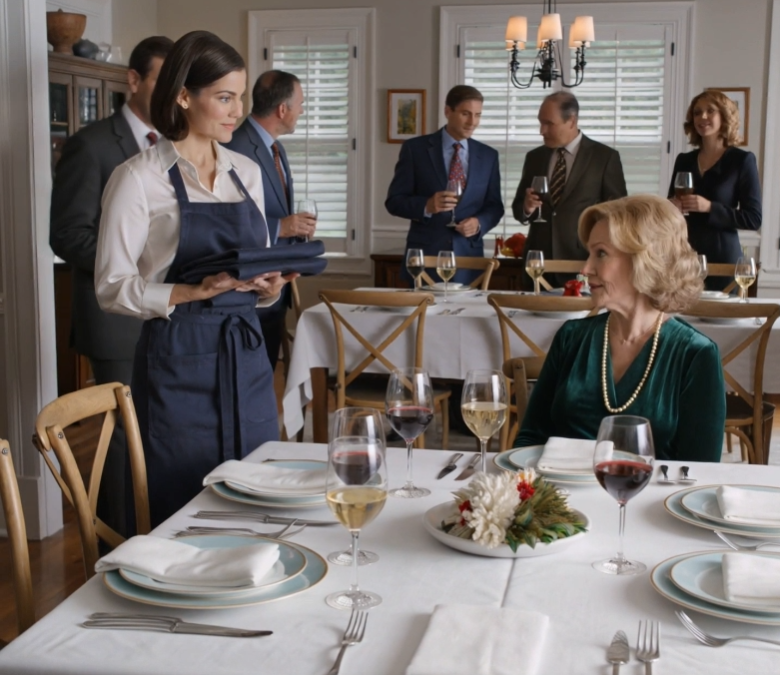
“Perfect. The help is here.”
My sister said it loud enough for the guests already taking off their coats.
And that was how we were welcomed on Christmas Eve, the first time in fifteen years my mother had let us through the door.
Forty chairs waited in the dining room, and none of them had our names. On the island sat three aprons with names taped to them: mine, my husband’s—the man she still called “the pig man”—and our fourteen-year-old son’s.
A run sheet was taped to the cabinet.
Staff entrance through the garage. Staff meal after service. Come early. Wear practical shoes.
My son had spent three weeks making her an ornament. She set it on the windowsill above the sink and handed him an apron so he could bus plates.
I was still holding a cake baked from my grandmother’s recipe.
For fifteen Decembers, her green-ink cards had said the same thing: Just the real family this year.
I did not raise my voice. I asked where we were sitting and who had written that menu. Then I folded the apron, laid it on the paper, and walked my family out the front door.
They had no idea what those two questions had opened.
Two days later, I sent my mother a box from my pantry shelf, and by Saturday, she had called nineteen times.
My name is Pamela Noi, and I am forty-two years old.
If you’re new here, take a second to like and subscribe. It helps more than you know. Drop a comment and tell me where you’re watching from and what time it is there. I read every single one.
People have asked me why I kept the cards, fifteen of them in an old cookie tin, when I could have fed every one of them to the woodstove the day it arrived.
The honest answer is that I was waiting for one of them to say something different.
The first one came in December of 2010, six months after my wedding. A heavy cream envelope, my mother’s handwriting on the front in the green felt-tip pen she has used for every birthday card, grocery list, and thank-you note I can remember.
It was addressed to Pamela Carver.
I had been Pamela Noi since June.
Inside was a printed photo card. My mother and father stood on the front steps of their house in Prospect, Kentucky. My older sister, Allison, stood beside them with her husband and their two little boys in matching red sweaters.
Under the photo, in green ink, one line:
Just the real family this year. Love, Mom.
I read it standing at the kitchen counter of the farmhouse where I still live. My husband, Bo, came in from evening chores and read it over my shoulder.
He didn’t say anything.
He set his work gloves on the counter, picked them back up, and went out to the barn.
He didn’t come back for an hour.
The next December, another card. Different photo, same ink.
Keeping it small this year. Just the real family.
The year after that: Just the real family. Again.
As if she had found the phrasing she liked and saw no reason to improve on it.
I want to be precise about what those cards were, because people hear this story and assume my family cut me off completely.
They didn’t.
That would have been simpler.
My mother still called on my birthday. Twice a year, she invited me to lunch at her country club.
“Just the girls,” she’d say.
Bo was never included. After the first year, I stopped asking.
We ate chicken salad on white china, and she asked about my work in a way that told me she hadn’t listened the last time.
Once, when I’d driven straight from the farm, she leaned across the table and lowered her voice.
“Don’t bring the smell of that place in here, sweetheart. It gets in the upholstery.”
I had showered.
I had changed clothes.
I sat there anyway and smelled my own wrist.
From 2010 on, I never once set foot inside my parents’ house. We met at the club, or not at all. And every December, a card arrived to tell me what I already knew.
I kept them in a cookie tin that had belonged to my grandmother. It was the only place in the house that felt safe enough to hold them.
In fifteen years, not one of those envelopes had my husband’s name on it.
There’s something you should know about the way I write things down, because it matters later.
My father was an insurance claims adjuster for most of his working life. On Saturday mornings when I was a girl, he’d spread his files across the kitchen table and let me sit beside him with a pencil.
He taught me to print dates clearly, every digit its own shape. And he taught me to cross my sevens, a little dash through the middle, the way they do in Europe.
“So nobody can ever misread you, Pammy.”
I have crossed my sevens every day of my life since.
My mother, in that same kitchen, would be rubbing lotion into her hands. She did it constantly. She wore gloves to garden, gloves to drive, gloves to carry in the groceries.
When I was twelve, I came home from a friend’s horse barn with dirt under my fingernails.
My mother took my hands in hers and turned them over like she was inspecting fruit at the store.
“Carver women don’t have work hands,” she said.
For most of my life, I thought that was vanity.
A date, two initials, a crossed seven. It’s a small way to sign your name.
It turned out to be enough.
Today, I’m the dietary manager at Maple Glenn Senior Living in Bardstown. I run a kitchen that feeds 120 residents three meals a day. I know every allergy, every soft diet, and every retired farmer who swears he hates pudding and then eats two.
Bo runs Noi Farm, 210 acres outside Springfield that his grandfather started in 1958. We raise Berkshire hogs on pasture, and in winter we grow squash, sweet potatoes, and greens in hoop houses.
Our son, Eli, is fourteen.
Two Decembers ago, when he was thirteen, he found the tin.
I came in from work and he was sitting at the kitchen table with all fifteen cards laid out in rows like a game of solitaire. He’d put them in order by year.
He had noticed things I’d stopped letting myself notice.
The photos got bigger every year.
Grandma’s handwriting never changed.
His father’s name was never there.
He looked up at me.
“Mom, if they’re the real family, what are we?”
I opened my mouth, and nothing useful came out.
I didn’t have an answer for him that year.
By the next Christmas, I would.
I met Bo in 2008, when I was twenty-four and working as a sous chef at a farm-to-table restaurant in Louisville. I’d gone to culinary school in the city and spent four years working my way up the line.
I was good, and I was proud of being good, and I had no patience for people who were late.
He was forty minutes late with our pork delivery on a Friday afternoon.
I met him at the back door with my arms crossed.
He was twenty-eight, mud to the ankles, carrying half a hog on one shoulder like it weighed nothing. I told him we had a full book that night and he’d just put my whole prep schedule behind.
He laid the hog on the steel table and turned it so I could see the fat cap, pale and thick, the way it’s supposed to be.
“A late pig’s better than a bad one,” he said.
Then he spent ten minutes telling me how that hog had lived, what it ate, how many acres it walked.
He wasn’t trying to sell me anything. He just assumed I’d want to know.
Before he left, I noticed he’d written the date on the side of his wooden crate in carpenter’s pencil.
He’d crossed the seven.
I still have that crate. It says NOI FARM, SPRINGFIELD, KY on the side, and it holds our onions.
Six months later, I brought him home to meet my mother.
She asked him to leave his boots in the garage.
It was Easter of 2009. My mother had set the dining table for twelve. Bo was seated at a folding card table in the corner with Allison’s little boys and a cousin’s kids.
My mother called it the overflow table, as if it were a question of space and not a decision.
Bo ate everything on his plate and thanked her twice.
Halfway through dessert, I went for more coffee and stopped in the hallway because I heard my name.
My mother and my sister were at the kitchen sink.
“Your sister brought home the pig man.”
Allison laughed.
“Pam always did like strays.”
I stood in that hallway long enough to be sure of what I’d heard.
Then I walked in, picked up the coffee pot, and my mother smiled at me as if nothing had happened.
As far as she was concerned, nothing had.
Before we left, she pulled me into the laundry room and shut the door.
“You went to culinary school,” she said quietly, “to marry the man who sells the meat.”
She never called him Bo.
Not once in sixteen years.
The only person on my side of the family who liked him from the first minute was my grandmother, Ada Carver.
Ada was my father’s mother. She was eighty-one that year, still living alone in her little house in Bardstown, and she had cooked for her church for forty years.
Funerals. Weddings. Homecomings. Every covered dish you can name.
She took one look at Bo’s hands, cracked across the knuckles from winter chores, and pulled out a chair for him.
“A man who feeds people,” she told me later, “is worth two who count money.”
She taught me things culinary school never did.
Her Kentucky jam cake, dense with blackberry jam and spice. Her bourbon glaze for ham, made with sorghum instead of brown sugar, which I have never tasted anywhere else.
She wrote everything in a cloth-covered composition book stained with sixty years of butter.
One afternoon, I asked her why my mother kept her distance.
Ada didn’t look up from the stove.
“Linda’s never forgiven me for knowing where she came from.”
I asked her what that meant.
She just handed me the wooden spoon.
Bo and I were married in June of 2010 in the field behind the farmhouse. My best friend from culinary school, Nora Kesler, catered the reception. She’d started her own small catering company the year before and insisted on doing our wedding at cost.
My father walked me down the aisle.
My mother sat in the second row in white gloves.
When the ceremony ended and people started drifting toward the tent where Nora had laid out the food, my mother picked up her purse.
“She didn’t eat barn food,” she told my father, loud enough for Bo’s aunts to hear.
My father kissed my cheek and followed her to the car.
That December, the first card came.
Bo and I spent that Christmas Eve at Ada’s house. She roasted a ham with her sorghum glaze. After supper, she went to her bedroom and came back with the composition book.
She set it in my lap.
On the inside cover, in her careful church-bulletin handwriting, she had written:
For Pamela. Feed the ones who sit down with you. Ada, Christmas 2010.
Ada died two Novembers later at eighty-four.
Her oak kitchen table came to us. It’s the table I’m sitting at now.
I’ve cooked from her book every Christmas since.
For fourteen of those Christmases, I didn’t cook them only for us.
In September of 2011, Eli was born, and I left restaurant hours behind for a steadier job at Maple Glenn. That fall, I made an arrangement with Nora.
I’m going to tell you exactly how it worked.
And I’m going to hold one thing back for now, because I held it back from almost everyone for fourteen years.
Nora had a small licensed commercial kitchen in the Germantown neighborhood of Louisville, about sixty miles from our farm. She called her business Winter Hearth Kitchen.
Starting that December, I took two vacation days every year, the twenty-second and twenty-third, and drove to Louisville to cook in her kitchen for one client.
One party.
Forty plates.
Christmas Eve.
I brought the hams from our farm, cured and smoked at the USDA plant we’d always used.
Nora handled the client. She took the order, sent the invoice, and delivered the food on Christmas Eve with two hired servers.
Her invoices listed where every ingredient came from. She did that for all her clients. People like to know which farm their dinner came from.
I never saw the client’s house.
I never set foot inside it.
Every year, when I carried the first ham in from the truck, Nora asked me the same thing.
“Same client, same menu, same ham. You sure about this, Pam?”
Every December for fourteen years, I said yes.
Catering kitchens run on labels. Every pan that leaves has a strip of masking tape on the lid: what’s inside, the date it was made, how to reheat it, the initials of the person who cooked it.
If someone gets sick, the kitchen has to know exactly where to look.
So every year, on the night of December twenty-first, I sat at Ada’s table with a roll of tape and a black marker and wrote out the labels.
Spoon bread. 12/23. Reheat 375°. PN.
When Eli turned eight, he started helping.
His handwriting was better than mine at that age, and he took the job seriously. He’d line the strips up along the edge of the table like a row of soldiers.
That first year, he held one up and frowned at it.
“Why does it matter who made it?”
“Because if something goes wrong,” I told him, “they need to know whose hands.”
He nodded like that settled it and went back to writing.
I watched him cross the seven in 375, the way I’d shown him, the way my father had shown me.
I said it like a food-safety rule.
It was also the only way I had left of signing my name.
On Christmas Eve itself, I was home. Nora and her servers handled the party, and I was back at the farm before dark.
The three of us ate ham and spoon bread at Ada’s table and opened one present each, a Noi family rule that goes back to Bo’s grandfather.
And every year, late, after Eli was asleep, my father called.
He never called on any other holiday.
Just Christmas Eve.
Just late.
He’d tell me the party had gone fine. He’d tell me who came and who didn’t.
Then he’d say the same thing, nearly word for word.
“Just packed up the leftovers. Food was the best part of the night.”
“Was it?”
“Always is.”
Then he’d say good night.
For a long time, I thought he called out of guilt, that it was his way of reminding himself he still had a second daughter.
He said the same thing every year.
It took me until I was forty-one to understand he’d been choosing his words.
In December of 2019, Nora waved me over to her desk before I’d even taken off my coat.
She had the client’s order form in her hand.
The client didn’t like email, so every October, Nora mailed a paper form, and every December it came back filled out by hand with a deposit check.
At the bottom, under Special Instructions, someone had written a line in green ink:
Please thank your chef. Whoever she is, she cooks like family.
I read it twice.
Then I went into the walk-in cooler, pulled the door shut behind me, and cried between the butter and the heavy cream until my fingers went numb.
I can’t fully explain it even now.
It was one sentence on an order form, written by someone who had no idea who she was thanking.
But I had spent nine Decembers cooking in somebody else’s name, and for one minute, the hands had been noticed.
When I came out, I asked Nora if I could keep it.
I’d already folded it into my apron pocket.
She held out her hand.
“It’s the client’s paperwork, Pam,” she said gently. “It stays in the file.”
I gave it back.
In March of last year, Nora called and asked me to drive up on a Sunday.
Her husband had taken a job in Tucson. They were selling the house. Winter Hearth would close at the end of the month.
We ate our last meal in that kitchen sitting on overturned milk crates because the tables had already been sold.
Grilled cheese on the flat top.
Two beers.
The walk-in was empty and still humming, the way a cooler hums when there is nothing left to keep cold.
“What about December?” she asked.
I had been thinking about it the whole drive up.
“Maybe fourteen is enough.”
She looked at me for a long moment.
Then she nodded, slid her key ring across the steel table, and let me take the little enamel pine tree off it, the keychain I’d given her when she opened.
It’s on my own keys now.
I drove home feeling lighter than I had in years, and I couldn’t tell if the feeling was relief or grief.
I think it was both.
Fourteen Decembers is a long time to cook in someone else’s name.
I thought I was retiring from something.
I didn’t realize I was taking something away.
In July, Nora called from Tucson. She’d been there four months.
She sounded tan, if a person can sound tan.
Then she got quiet.
“Your Christmas Eve client emailed me. She wants the recipes. The whole menu written out. It’s for some church cookbook. A fundraiser.”
I was standing in the Maple Glenn walk-in with a clipboard, counting cases of frozen green beans.
I stopped counting.
“What did you tell her?”
“She called them her family’s recipes,” Nora said. “I told her they weren’t mine to give.”
I thanked her.
I asked about the heat in Tucson.
I changed the subject, and she let me, the way she’d let me for fourteen years.
When I hung up, I stood in the cold a minute longer than I needed to.
A church cookbook.
Family recipes.
It’s hard to write down food you’ve never cooked.
At the end of October, a UPS truck came up our gravel drive and left a banker’s box on the porch.
The return address was Tucson.
On top of a stack of folders sat a yellow sticky note:
Your 14 Christmases. They’re more yours than mine.
N.
Nora had closed out her business records, and instead of shredding that one client’s file, she’d mailed it to me.
Fourteen invoices.
Fourteen order forms.
And on top, in a plastic sleeve, the very first menu I had ever written for that party in my own handwriting on Winter Hearth letterhead, December of 2011.
I slid it out.
Near the bottom of the list, it said cranbery-orange relish.
One R.
I’d been writing fast, standing at Nora’s counter, and I misspelled it. Nora typed it into her menu template exactly the way I’d written it, and neither of us ever fixed it.
It became a joke between us.
She called it our watermark.
I didn’t read any further.
I didn’t want to open fourteen years of paper on a Tuesday night with homework on the table and dishes in the sink.
I put the menu back in its sleeve, put the lid on the box, and set it on the top shelf of the pantry next to the canning jars.
I didn’t know everything that was in there.
Not yet.
Three weeks later, a Christmas card came addressed to a family my mother had never once written to.
It arrived in the middle of November, which was early for her.
A cream envelope.
Green ink.
The Noi Family.
I sat down on the porch steps to open it because my legs wanted me to.
There was no photo this time.
Just a plain card and four lines.
It’s been too long.
Christmas Eve.
Please come, all of you.
Love, Mom.
Bo came up from the hog barn and found me there.
I held the envelope out to him without a word.
He wiped his hands on his jeans before he took it, which is what he does with anything he thinks might matter.
He studied the front of that envelope for a long time.
“That’s our name,” he said.
Sixteen years.
Sixteen cards.
It was the first one I didn’t want to put in the tin.
My mother called that same week.
She never called on weeknights.
Her voice was warm.
She asked about Eli’s grades.
She asked about Bo.
She actually said his name, and it sounded strange in her mouth, like a word from a language she’d studied once and never used.
“Come early. Say three. I want time with you before everyone arrives.”
“How many people are coming?”
“Oh,” she said, “the usual.”
I didn’t ask what the usual was.
I knew there would be a party. The Carver Christmas Eve had been a party for thirty-five years.
What I didn’t know was what it looked like from the inside, with the lights on and the doors open.
I had never been invited to the usual.
Bo didn’t say much that night. He never does when he’s working something through.
Finally, while we were drying dishes, he asked, “Early for what?”
“To visit. To talk.”
He nodded slowly.
The next morning, he drove down the road and paid the neighbor’s teenage son forty dollars to do our evening feeding on Christmas Eve so we could stay as late as we wanted.
That’s how Bo hopes.
Quietly, and with a backup plan.
Eli hoped out loud.
He’d been wood-burning a project in shop class, and he scrapped it and started over. For three weeks, he stayed after school to finish a fat little Berkshire pig in a Santa hat.
The fur of the brim was burned in careful dots.
On the back, in pencil, he wrote EN.
“For Grandma’s tree,” he said, “so there’s something of ours on it.”
I decided to bring a cake.
Ada’s Kentucky jam cake from the composition book, the one she’d made for every church Christmas for forty years.
If I was going to walk into that house after fifteen years, I wanted to walk in carrying something that tasted like where I came from.
The night before, Eli sat at the counter while I turned the layers out of the pans.
“Do I get to sit at the big table?”
“I think so, bud.”
I believed it when I said it.
On the twenty-second, my phone buzzed at work.
A text from my mother.
So excited. Wear something practical and comfortable shoes. Park by the garage and use the side door. The front walk is being decorated.
I read it in the dry-storage room at Maple Glenn between shelves of canned peaches.
Then I read it again.
That night, I handed the phone to Bo.
He read it twice, the way he’d read the envelope.
Then he laid the phone face down on the table.
“Practical for what?”
I had answers ready.
My mother’s house has an old brick front walk that gets slick. She was probably having the boxwoods wrapped in lights. She’d always been particular about the front of that house.
I had one other thought, too.
I’m not proud of how quickly I put it away.
And the side door.
I held on to the side door longest of all.
Family comes in through the kitchen.
That’s what I told myself.
Everyone knows company uses the front.
Christmas Eve was cold and bright.
We left the farm a little after one-thirty, which gave us time for the seventy miles to Prospect and a few extra minutes to sit in the car if we needed them.
Eli rode in the back with the pig in a shoebox on his knees, one hand flat on the lid the whole way as if it might escape.
I held the cake.
Bo drove with the radio off.
Somewhere past Bardstown, Eli leaned forward between the seats.
“What if she doesn’t like the pig?”
“Then she’s wrong,” Bo said.
Eli grinned for the first time since breakfast.
I want to pause here for a moment because I remember exactly what those last ten miles felt like.
And I think some of you know it, too.
If you’ve ever pulled into a family driveway not knowing whether you’d be treated as a guest or as the help, tell me in the comments. I read every one.
I know that feeling in your stomach.
We pulled in just before three.
Two cars were already in the driveway.
The front walk really was being decorated. A man on a ladder was stringing garland over the door.
Bo parked by the garage the way she’d asked.
The garage door was up.
On the inside door, the one that led into the house, someone had taped a sheet of printer paper.
The letters were big and blocky in green marker.
KITCHEN CREW, THIS WAY.
I stood in front of that sign with the cake in my hands and read it the way you read a street sign in a strange city twice.
Once for the words.
And once for what they meant.
Bo’s hand touched the middle of my back.
He didn’t push.
He just let me know he was there.
We went in.
The door opened into the laundry room, the laundry room opened into my mother’s kitchen, and the kitchen opened through a wide archway into the family room.
A few people were already there taking off their coats.
Two women I half recognized from my parents’ street were holding buckets of white roses and eucalyptus. An older woman with a silver bob and a camel coat was unwinding a plaid scarf and laughing at something.
My sister stood in the middle of the kitchen in a red dress with a glass of white wine.
She turned and saw us.
She looked at Bo’s boots, at Eli’s shoebox, at the cake in my hands.
Then she lifted her voice just enough to carry through the archway.
“Perfect. The help is here.”
The two neighbors glanced at each other and became very interested in their roses.
Nobody laughed.
I noticed that even then.
The woman with the silver bob stopped unwinding her scarf.
She looked at the cake I was holding, then at me.
And she didn’t look away.
My mother came in from the dining room a moment later in a green velvet blouse and pearls.
She kissed my cheek.
She smelled like the same hand lotion she has worn my entire life.
She did not reach for the cake.
Instead, she bent toward Eli.
“Is that for me?”
He opened the shoebox and held up the pig.
She took it between two fingers and turned it over.
For a second, I thought something moved across her face.
Then she set it on the windowsill above the sink, between the dish soap and a sprig of holly.
“Let’s keep this little guy safe up here for now.”
Then she picked up one of the three aprons folded on the island.
Navy-blue canvas.
A strip of masking tape across the chest with a name in green marker.
ELI.
She shook it out and held it toward him.
“You’ll bus plates, sweetheart. Easy. You just clear the tables and bring everything back in here.”
Eli looked at me.
He took the apron because he’s a polite boy and she’s his grandmother.
And he stood there holding it against his chest like a folded flag.
My mother was already turning to Allison.
She lowered her voice, but it isn’t a big kitchen.
“Put the pig man on carving.”
Bo didn’t react.
He walked to the refrigerator, I think because he needed something to do with his hands, and opened it.
The bottom shelf held two whole hams wrapped in white butcher paper.
He lifted one out and turned it so I could read the sticker.
Noi Farm. Berkshire.
He set it down on the counter very gently, the way he sets down anything he raised.
“Pam,” he said quietly. “That’s ours.”
Somebody in my family had driven across Louisville to buy my husband’s ham for a party he’d been invited to carve.
Taped to the cabinet beside the refrigerator was a single typed page.
I recognized the format before I read a word. I write documents like it every week.
It was a run sheet.
At the top, in bold:
CREW ARRIVE — PRACTICAL SHOES.
Below that, the schedule.
Guests at 5:00. Cocktails in the family room. Dinner service at 6:30. Dessert at 8:00.
Then a section headed KITCHEN CREW.
Pamela: cook, plate.
Bo: carve, ice, trash.
Eli: bus tables, dishes.
Staff entrance: garage.
Staff meal after service: kitchen.
I did the math without meaning to.
It’s what I do all day.
Three and a half hours.
Forty plates.
Two home ovens.
And every side dish still sitting raw in grocery bags along the counter.
Nobody could do that.
Not in a strange kitchen.
Not without knowing the menu by heart.
I remember thinking it.
I remember not understanding why it bothered me so much.
I walked through to the dining room.
Five round tables.
Eight chairs each.
White linen.
A place card on every plate in careful calligraphy.
I went table by table.
My mother.
My father.
Allison and her husband.
Their older son, sixteen.
Their younger son, thirteen, his name in gold ink on a card propped against a crystal water glass.
My son was fourteen.
He had an apron.
Neighbors. Church friends. My father’s old colleagues.
Forty names.
Bo had come in behind me.
He didn’t need to walk the tables. He’s taller than I am. He could read them from the doorway.
“We’re not on it,” he said behind me.
Heels clicked on hardwood.
My mother was holding a card printed on heavy cream cardstock.
“Just make it exactly like this.”
I didn’t take the card.
Not yet.
“Mom, what is this?”
She sighed.
It was the particular sigh she has used on me since I was six years old. The one that means I’m about to make something harder than it needs to be.
“Don’t make that face. Our caterer closed this year. You cook for a living, Pamela. You’d just be sitting around anyway.”
Allison had drifted to the doorway with her wine.
“It’s family. Family pitches in.”
“You live on a farm,” my mother added. “You’re used to work.”
“Everyone has a role,” she went on. “Some people are good in a kitchen and some people are good with guests, and there’s no shame in either one.”
Then she asked why I always had to take everything so personally.
I let her finish.
I wanted to hear all of it.
Then I asked the first question.
“Where are we sitting, Mom?”
She blinked as though the question were slightly rude.
“There’s a staff meal after, in the kitchen.”
She gestured with the card.
“It’s cozier.”
She held the menu out again.
This time, I took it.
It was a beautiful card.
Thick paper with a deckled edge.
Gold foil across the top.
THE CARVER FAMILY CHRISTMAS EVE
OLD FAMILY RECIPES
Bourbon-Glazed Berkshire Ham.
Sorghum Sweet Potatoes.
Cornbread Dressing.
Spoon Bread.
Slow-Cooked Collards.
Cranbery-Orange Relish.
Kentucky Jam Cake.
One R.
I stood in my mother’s dining room and read my own spelling mistake in gold foil.
This is the part I held back.
I’ll tell you now.
The client was my mother.
It had always been my mother.
In the fall of 2011, she was recovering from back surgery and talking about canceling Christmas Eve for the first time in twenty years.
I gave my father one of Nora’s business cards.
I told him a friend of mine ran a good catering company.
I asked him not to tell Mom the card came from me because if she knew, she would never call.
She called.
For fourteen Christmas Eves, the ham on my mother’s table was raised on our farm.
The glaze was my grandmother’s.
The spoon bread.
The dressing.
The relish.
The jam cake.
Every dish was mine, cooked with my own hands in Nora’s kitchen on the twenty-second and twenty-third of December.
And every Christmas Eve, a smaller ham from the same batch sat on Ada’s table in our farmhouse.
The same meal on two tables seventy miles apart.
She ate at one.
I ate at the other.
It was the only way I had found to sit down with my mother at Christmas.
Now she had copied my menu off an old Winter Hearth card, spelling mistake and all, printed it in gold foil, and called it the Carver family’s old recipes.
I looked up from the card.
“Who wrote this menu, Mom?”
She laughed.
A short, impatient sound.
“It’s our family menu, Pamela. Honestly.”
She didn’t know.
I could see that she didn’t know.
She was asking me, out loud this time, in an apron with my name on it, to cook for her the meal I had been cooking for her in secret for fourteen years.
I set the card down on the island.
That’s when I noticed the other thing.
Next to the fruit bowl was a mock-up of a book cover printed on ordinary paper and slipped into a clear plastic sleeve.
A photograph of a candlelit Christmas table.
THE CARVER FAMILY CHRISTMAS RECIPES
FROM OUR TABLE
BY LINDA CARVER
EDITED BY ALLISON CARVER PIERCE
A ST. MATTHIAS WOMEN’S LEAGUE FUNDRAISER
Underneath, in Allison’s loopy handwriting:
300 pre-sold. Proofs due Jan. 5.
Stuck to the plastic sleeve was a square green sticky note.
My mother’s handwriting.
My name at the top.
Pam — write each one down as you go for the book. Mom.
Nora’s phone call from July came back to me all at once.
And I understood what the invitation had really been for.
Not only the party.
My mother had three hundred people waiting on recipes she didn’t have, and a daughter who could write them down between plating forty dinners and eating a staff meal by the sink.
I looked at Allison.
She was watching me from the doorway with a small, steady smile, the kind people wear while they’re waiting for a joke to land.
I didn’t understand that smile yet.
I only noticed it.
My mother wanted my hands in her kitchen and her name on my recipes.
On the same afternoon.
I picked up the apron with my name on it.
My mother’s shoulders dropped.
She thought I was putting it on.
I folded it instead.
In half, and in half again, the way we fold towels at Maple Glenn.
I laid it on top of the gold-foil menu.
Then I set Ada’s jam cake beside it on the island.
It was a gift.
I peeled the green sticky note off the plastic sleeve and put it in my coat pocket.
It was addressed to me, after all.
“Eli, get your coat, honey.”
He laid his apron on the counter, folded almost as neatly as mine.
“Pamela.”
My mother’s voice had gone thin.
“Forty people are coming.”
“I know.”
I looked at her.
“I hope it tastes the way you remember.”
We didn’t leave through the garage.
I walked my family through the family room, past the roses and the eucalyptus, past the woman with the silver bob, who was holding a bottle of wine in a gift bag.
“Aren’t you Linda’s younger girl?” she asked. “Leaving already?”
“We were never staying,” I said.
And I opened the front door.
My father was in the driveway lifting two bags of ice out of his trunk.
He stopped when he saw us.
He looked at my face.
Then at Eli’s.
Then down at the gravel.
“Pammy.”
“Merry Christmas, Dad.”
He didn’t stop us.
He stood there holding the ice while we got in the car.
Bo backed out slowly around the man on the ladder.
We were a mile down the road before anyone spoke.
It was Eli.
“I would have bused tables if it meant we could stay.”
I turned around in my seat.
He was staring out the window very hard, the way boys stare at things when they don’t want you to see their faces.
“I know, baby.”
My throat hurt.
“That’s why we left.”
Halfway home, he sat up straight and put his hand on the empty shoebox beside him.
He’d left his pig on her windowsill.
We had no dinner planned because we had planned to be fed.
Bo fried country ham and eggs.
I made biscuits because my hands needed a job.
We ate at Ada’s table with our coats still on for the first ten minutes because none of us had thought to take them off.
Nobody talked much.
Eli ate three biscuits, which I decided to take as a good sign.
Bo reached across the table and refilled my coffee.
“At least here,” he said, “everybody sits.”
Late that night, after Eli had gone up to bed, my phone lit up on the counter.
Not a call this time.
My father had never been much of a texter, and I could tell it had taken him a while.
Nobody knew what to do with the hams. Allison ran out for spiral-cut ones. Dinner was an hour late. Your mother told everyone the jam cake was hers. I’m sorry, Pammy.
I read the first three sentences once.
I read the last two until the screen went dark.
Christmas morning, we did chores first because hogs don’t know what day it is.
Then presents.
Eli got the work boots he’d been wanting.
Bo got new fencing pliers and did a poor job of pretending to be surprised.
After lunch, I went into the pantry and took down Nora’s box.
Then I took down Ada’s cookie tin.
I laid everything out on Ada’s table the way Eli had laid out the cards a year before.
Fourteen invoices from Winter Hearth Kitchen.
Every one stamped PAID with my mother’s check number written beside it.
$2,400 in 2011.
$3,600 in 2024.
Every one itemized.
Every ingredient with its source.
2011: Heritage Berkshire Ham — Noi Farm, Springfield, KY.
2012: the same.
2013: the same.
2014: Heritage Berkshire Ham — Local Family Farm.
I hadn’t known the wording had changed.
I went looking for the reason.
And I found it among the order forms.
The 2014 form, filled out in green ink, with a note in the margin I had never seen before.
I noticed last year’s invoice. I do not want anything from the Noi Farm on my table. My guests expect quality. — LC
I called Nora in Tucson.
It was early there, and she picked up on the first ring anyway.
She was quiet for a long time after I read it to her.
“I didn’t want you to see it,” she said finally. “I changed the invoice. I never changed the ham.”
Bo was standing at the sink.
He’d heard every word.
He dried his hands and came to stand behind my chair.
And he looked down at that sheet of paper for a long time without saying anything at all.
“You sure about this?”
“I’m not sending her anything she didn’t already have,” I told him. “I’m just putting it in order.”
I slid the 2014 form into a separate folder and set it on the shelf above the stove.
Not this one.
Not yet.
I used Nora’s box.
It seemed right.
Here is what I put inside.
The first menu I ever wrote for my mother’s party, December 2011, in my own handwriting, with cranberry spelled wrong.
Copies of all fourteen invoices, in order, so the first three would be the first things she saw.
One spare label from my kitchen drawer, left over from the year before:
Ada’s Jam Cake. 12/23/24. Room temp. PN.
All fifteen Christmas cards, oldest on top, still in their envelopes.
Pamela Carver.
The first one said it.
Her green sticky note:
Pam — write each one down as you go for the book. Mom.
And one more card.
The first Christmas card I had ever addressed to my mother’s house.
I wrote it at Ada’s table with the same pen I use for my labels.
To the real family,
You’ve had the real family at your table every Christmas Eve for fourteen years. You just never let her sit down.
The recipes are Ada’s.
The ham is Bo’s.
The hands were mine.
None of it is for your book.
Pamela Noi.
I read it once.
I didn’t change a word.
On Friday, the day after Christmas, I drove to the UPS Store in Bardstown and sent it Next Day Air, Saturday delivery.
The young man behind the counter asked if anything inside was fragile.
“Not anymore.”
On Saturday, a little after lunch, the tracking said DELIVERED.
My phone started ringing before I’d set it down.
I didn’t answer.
I put the phone faceup on Ada’s table and let it ring.
Then I went back to the New Year’s menu for Maple Glenn because 120 people were still going to need lunch on January first, no matter what was happening in Prospect.
The first voicemail was short.
“Pamela, call me back.”
By the sixth, her voice had changed.
“Who else has seen this?”
By the eleventh, she wasn’t asking anymore.
“The League cannot hear about this. Do you understand me?”
Allison started texting between the calls.
What did you do to her?
Then:
Do you have any idea what you’ve done to her?
Then nothing, which with Allison means she’s writing something worse.
The seventeenth voicemail was one word.
“Please.”
Bo came in from the barn around dusk and looked at the screen over my shoulder.
Nineteen missed calls.
Every one from my mother.
I had waited fifteen years for my mother to call me that many times about anything.
After the nineteenth, I picked up the phone and typed one message.
Sunday. Our kitchen. 3:00. Front door.
Three o’clock.
The same hour she’d told us to come early.
They arrived at three exactly.
My mother has never been late to anything in her life.
I watched from the kitchen window as my father’s Buick came up the gravel drive, slow, the way town people drive on gravel.
My mother was in the passenger seat.
Allison was in the back.
My mother got out first.
She stood by the car door in her camel coat and leather gloves and looked at the mud on our porch steps the way she had looked at my hands when I was twelve.
I opened the front door before she could knock.
“Come in. You don’t have to take off your boots.”
I sat them at Ada’s table.
My mother rested her hand on the edge of it, and I watched her recognize it.
She pulled her hand back.
“That was Ada’s.”
“It still is.”
I poured coffee for all three of them.
I set out cream and sugar and spoons, and I did it slowly.
I wanted to serve them.
I wanted to do it in my own kitchen because I chose to.
Bo leaned against the counter by the stove with his arms folded.
He didn’t sit.
He didn’t say a word.
And I didn’t need him to.
My mother kept her gloves on.
She’d brought everything from the box in a canvas tote, and she set it on the floor beside her chair carefully, as if it might tip over.
“I came to fix this before it gets out of hand. Ada was a Carver. You’re a Carver. They are family recipes, Pamela. So where’s the lie?”
She took a sip of coffee and set the cup down precisely in its saucer.
“Nobody needs to know where the ham came from.”
I sat down across from her.
“Why not?”
She looked at me as though I had asked why the sun comes up.
“Because people talk. Because I have spent thirty-five years building that evening, and I am not going to have it turned into a story about…”
She stopped.
Chose her words.
“…about where things came from.”
“You mean about Bo?”
“I mean about any of it.”
I reached up to the shelf above the stove and took down the folder.
I laid the 2014 order form in front of her, turned so she could read it.
Beside it, the 2013 invoice.
HERITAGE BERKSHIRE HAM
NOI FARM
SPRINGFIELD, KENTUCKY
Stamped PAID.
Her check number beside it.
Then her note.
I noticed last year’s invoice. I do not want anything from the Noi Farm on my table. My guests expect quality. — LC
Green ink.
Her initials.
My mother looked at it for a long time.
Allison leaned over to see, then sat back quickly as though the paper were hot.
“I never read the invoices,” my mother said. “Your father handles the paperwork. Nora should have said something.”
“You read that one.”
She didn’t answer.
“And Nora did do something.”
I tapped the 2014 invoice.
“Local family farm. She changed one line on your invoice. She never changed the ham.”
I took out a second order form.
December 2019.
I set it beside the first one and let her find the line herself.
Please thank your chef. Whoever she is, she cooks like family.
My mother stopped moving.
Then I leaned down and opened the canvas tote at her feet.
She didn’t try to stop me.
I took out the fifteen cards and found the one from 2019.
A photo of the whole family on a beach in Florida.
Everyone in white.
Just the real family this year. Love, Mom.
I laid the card beside the order form.
Same green pen.
Same slant to the letters.
The envelope was postmarked December ninth.
The order form was dated December tenth.
“You wrote them a day apart.”
My mother took off one glove.
I had never in my whole life seen her take off her gloves in someone else’s house.
She reached out and touched her own handwriting on the order form, the line about the chef, with one bare fingertip.
She traced it slowly, the way you’d trace a name carved in stone.
When she spoke, I almost didn’t hear her.
“I didn’t know it was you.”
“Mom,” Allison said sharply. “Stop talking.”
My mother turned her head slowly toward my sister.
“Why?”
Allison laid her hands flat on the table.
“Because none of this matters. It’s a box of old paper. Nobody at the League is going to check.”
“You told me,” my mother said, “that Nora’s girl did the cooking. In October, when I asked who could possibly make that menu if Nora wouldn’t give me the recipes. You said Nora’s girl. You said you’d arrange everything.”
Allison’s mouth tightened.
“It was her girl.”
She looked at me.
“She said it was Pam.”
Nobody moved.
“I’ve known since 2021.”
Allison’s voice had gone flat, like she had decided that if the truth was coming out anyway, she would at least be the one holding it.
“I came over early that year to help Nora’s people unload. There was a label on the bottom of the cake carrier. Ada’s Jam Cake. PN. I’ve seen Pam’s handwriting on birthday cards my whole life. I’m not stupid.”
“You knew for four years,” my mother said.
“Why do you think I gave her three and a half hours?” Allison said. “Nobody else could have done it. She already knew the menu. I bought the right hams myself.”
I remembered her smile in the doorway.
Now I understood it.
“If I’d told you,” Allison went on to our mother, “you would have canceled Christmas Eve. You would have made a scene with Nora, and there wouldn’t have been a party, and there wouldn’t have been a book. And this was my year, Mom. The luncheon is in three weeks.”
My mother looked at her older daughter like a guest she didn’t remember inviting.
I let the silence sit.
Then I stood up and took the composition book down from the shelf above the stove, where it has lived since 2012.
I set it on the table in front of my mother and opened it to the inside cover.
For Pamela. Feed the ones who sit down with you. Ada, Christmas 2010.
“That was my first Christmas without an invitation. She knew.”
I turned a few pages.
The jam cake.
The sorghum glaze.
Ada’s handwriting in blue ballpoint and mine in pencil down the margins.
Fourteen years of notes.
Double for 40.
Glaze the night before.
Nora’s oven runs hot.
“There’s no book, Mom. Not with my name in the margins and yours on the cover.”
No one said anything.
The refrigerator hummed.
Out past the window, one of the sows called for her supper, a long, low grunt.
My mother flinched at the sound.
“Three hundred people paid,” she said finally.
“Then tell three hundred people the truth or refund them. That part was always yours.”
She looked at me.
For the first time all afternoon, she looked afraid.
And I don’t think it was of me.
“Here’s what happens now,” I said. “There’s no more ham. There’s no more jam cake. There are no more Christmas Eves I cook in someone else’s name. You can see Eli when you can say our name out loud. At your own table, with us sitting at it. Not in your kitchen and not in an apron.”
My mother pulled her glove back on one finger at a time.
She stood, picked up the canvas tote, and walked to the front door without another word.
Allison followed, already on her phone.
My father didn’t get up.
“Go on, Linda. I’ll be out in a minute.”
When the front door closed, my father reached into the inside pocket of his coat and brought out a small plastic box.
An old fishing tackle box, the kind with little compartments for lures.
The hinge was cracked and taped.
I remembered it rattling around the bottom of his boat when I was a girl.
He set it on Ada’s table and opened the lid.
Inside were strips of masking tape, curled at the edges and yellowed, pressed flat into the compartments.
I picked one up.
Spoon Bread. 12/23/13. Reheat 375°. PN.
The seven was crossed.
I counted them.
Thirteen.
One for every Christmas Eve from 2012 through 2024.
“You gave me that card in 2011,” he said. “I thought Nora was doing the cooking. Then the second year, I was packing up the leftovers and I looked at the lid on the spoon bread.”
He touched one strip of tape with his finger.
“Nobody crosses a seven like you do. I taught you that.”
He was quiet for a moment.
“Every year after the guests left, I’d take one label off a pan so I’d have something of yours in the house.”
I looked at him across my grandmother’s table.
“You knew for thirteen years. And you let her send those cards.”
“Yes.”
That was all.
He didn’t give me a reason.
I think it was the most honest thing he’d ever done.
After a while, he gave me one anyway.
“If I’d said a word, she’d have stopped eating it. She’d have fired Nora. It was the only part of you she let in the house.”
He rubbed his thumb across his knuckles.
“So I kept my mouth shut and I ate every bite, knowing that’s the worst thing I’ve ever done, Pammy. And I did it thirteen times.”
He reached into his other pocket and set something else on the table.
Eli’s pig.
The Santa hat.
The careful burned dots.
The pencil initials on the back.
“Took it off the windowsill after the party. Nobody noticed.”
I couldn’t say anything.
I put my hand over the pig and left it there.
Bo had been standing by the stove this whole time.
He walked over and stood beside my father’s chair.
For a second, I didn’t know what he was going to say.
He’s had fifteen years of reasons.
“Chores start at six. You’re welcome at the table after.”
He paused.
“You’re welcome at it either way.”
My father looked up at him.
It took him a long time to nod.
He left a few minutes later.
My mother had been waiting in the Buick the whole time with the engine running, and she never once looked at the house.
I heard footsteps on the stairs.
Eli came down in his socks, saw the pig sitting on the table, and stopped at the bottom step.
“Grandpa brought my pig back.”
On January third, my mother called the president of the St. Matthias Women’s League and canceled the cookbook.
There had been, she said, a misunderstanding about the recipes.
The president was the woman with the silver bob.
She had been standing in my mother’s family room on Christmas Eve when Allison called us the help.
She had watched me walk my son out the front door.
She had eaten a spiral-cut ham an hour late and a jam cake my mother said was hers.
And she had not spent years running a church women’s league by accepting the word misunderstanding without a follow-up question.
I don’t know exactly what my mother told her.
I know that three hundred refunds went out in January.
I know Allison’s installation at the League luncheon was postponed, and in February the League elected someone else.
I didn’t tell anyone.
I never called the League.
I never posted a word.
I didn’t need to.
My mother had to explain her own menu.
And in the end, that was the whole consequence.
Allison sent me one text that month.
I hope you’re happy.
I didn’t answer.
I wasn’t happy.
I was finished.
They’re not the same thing.
In February, my father started coming out on Saturdays.
He drives the seventy miles in the Buick and arrives after the morning feeding, even though Bo told him six.
He’s sixty-nine years old, and he had never fixed a fence in his life.
He’s terrible at it.
Bo hands him the other end of the wire and says nothing about the angle.
Once, one of the young boars bowled him flat into the mud, and I watched him lie there laughing.
I could not remember ever hearing my father laugh like that.
He eats lunch with us at Ada’s table.
He says grace, which we don’t usually do.
We let him.
In April, on a Saturday when Bo and Eli were out in the far pasture, my father sat at the table with his coffee and told me about my mother.
She grew up on a tenant tobacco farm in western Kentucky.
Her family never owned the land they worked.
Every winter, she and her sisters stripped tobacco in a cold barn until their hands cracked and bled.
She was fourteen when she decided she would never have hands like that again.
She left at eighteen.
She never went back.
And she never talked about it, not even to her own daughters.
Ada knew. She had grown up two counties over.
“She didn’t hate Bo for being a farmer,” my father said. “She hated that he was what she ran from. And you ran toward it.”
I thought about her gloves.
Every pair she ever owned.
Understanding my mother didn’t make me miss her less.
It just made the missing make sense.
That same month, Eli and I made a book of our own.
It isn’t much.
A spiral-bound booklet from the coffee shop in Bardstown.
One hundred fifty copies.
Ada’s recipes, typed up by Eli, with her notes and mine.
We sell them at the Springfield Farmers Market on Saturday mornings at the same table where Bo sells pork chops.
Every dollar goes to the activities fund at Maple Glenn.
My residents want a bus trip to Churchill Downs.
At this rate, they’ll get it by fall.
Eli insisted on credits for the back page.
Recipes: Ada Carver.
Cooked by Pamela Noi.
Ham by Bo Noi.
Labels by Eli Noi.
And on page nine, under the relish, cranberry is spelled wrong on purpose.
Ask Nora.
I mailed Nora the first copy.
She called me on video from her kitchen in Tucson and held it up to the camera.
She laughed until she couldn’t.
Then she went quiet.
And so did I.
Neither of us minded.
The week before Mother’s Day, a card came in green ink.
It was addressed to the Noi family.
No photo.
Two lines.
I was wrong about the ham.
I don’t know how to say the rest yet.
Mom.
It isn’t an apology.
Not the whole one.
I read it standing at the mailbox.
Then I brought it inside and put it on the refrigerator with a magnet shaped like a pig, where anyone who walks into our kitchen can see it.
I didn’t put it in the tin.
The tin sits on the shelf above the stove now, next to Ada’s book.
It doesn’t hold cards anymore.
It holds thirteen strips of masking tape with my initials on them.
And one more.
The first label Eli ever wrote, which I found folded in the back of a drawer.
Spoon Bread. 12/23/19. Reheat 375°. EN.
His seven is crossed.
People ask me about next Christmas.
I don’t know yet.
I’ve written my mother an invitation.
It’s sitting in the tin, and I haven’t decided whether to mail it.
If I do, it will say Christmas Eve at our house.
It will say come as a guest.
And it will say front door.
Last Sunday, the seventeenth of May, the strawberries came in.
Eli spent the afternoon at Ada’s table labeling jars of jam.
Strawberry. 5/7/26. EN.
He crossed the seven without thinking about it.
My father sat across from him, snapping beans into a bowl badly.
Bo was at the sink.
The pig in the Santa hat hung in the kitchen window, where it has hung since December because none of us could think of a single reason to take it down.
I set the table for supper.
Five chairs.
There’s always one more than we need.
In this house, there’s a chair for whoever comes in the front door.
For fifteen years, my mother’s cards told me who the real family was.
She was right about one thing.
The real family was at her table every Christmas Eve.
It just took me fourteen years to bring it home.
If this story reminded you that family is the people who pull out a chair for you, share it with someone who needs to hear that and subscribe.
There’s always a seat.








