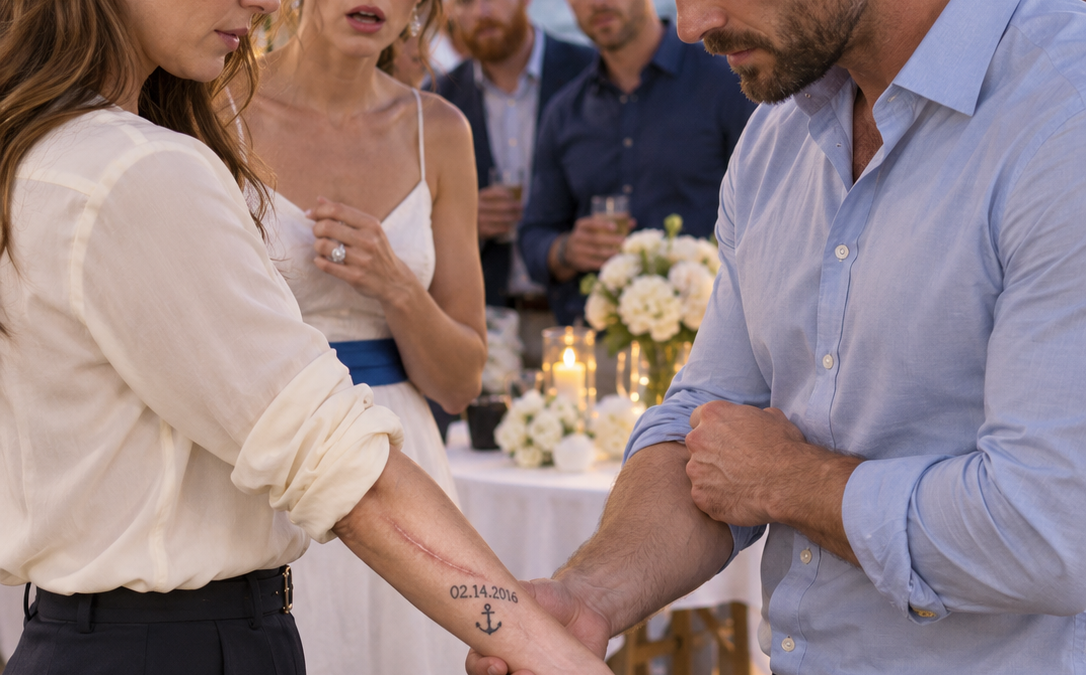
Engagement party. 60 guests. “This is my sister. The quitter,” she told her SEAL fiancé. “Washed out of the Navy in year three.” I reached to shake his hand. My sleeve slid up. He looked at my forearm. He let go of her. She laughed. “Babe?” He rolled up his sleeve and she froze.
“Okay,” I said.
“Love you,” Paige said, and hung up before I could say it back, which was also a thing she had been doing for 17 years.
I sat on the deck a while longer. The sun was going down behind the hangar line, and the water had gone the color of weak tea.
I want to tell you about my sister now. And to do that, I have to go back to a different water, a long time ago, in a marina in Hampton, Virginia, where she and I learned everything we knew.
My father, Doug Holloway, managed a marina on the Hampton River for 31 years. It was not a fancy marina. It had a fuel dock, a bait shop that also sold beer and sunscreen, a boat ramp with a crack down the middle that the city kept promising to fix, and about 200 slips full of fishing boats and old sailboats belonging to retired men who came down on Saturday mornings to drink coffee on their decks and never leave the dock.
My mother, Annette, was a secretary at the elementary school three miles inland. We lived in a two-story house with green shutters four blocks from the water, and in the summer, you could smell the river from the porch: salt and diesel and mud, the smell I still think of as home.
I was born in April of 1989. Paige came in June of 1993. I was four, and I remember the day they brought her home, a pink, furious bundle who screamed until our mother put her in my lap, at which point she stopped screaming and stared at me with enormous dark eyes as though I were the most interesting thing that had ever happened to her.
My mother says I announced to the room that she was mine. Nobody argued with me. For a long time, nobody had reason to.
I learned to swim before I could read. My father put me in the water off the end of the fuel dock when I was three, with a life jacket and a rope tied to the jacket and the other end of the rope tied to his wrist. By five, I was swimming laps along the dock pilings. By seven, I was the fastest swimmer in the summer league at the community pool.
And the summer I was seven, Paige was three, and I decided it was my job to teach her.
My mother was nervous about it. My father was not. He sat on an upturned bucket at the shallow end of the little sand beach beside the boat ramp, where the water came up gently over the mud and the minnows darted around your ankles, and he drank his coffee and watched.
Paige was terrified of the water. She would stand at the edge with her fists clenched and her lower lip shaking, and every time a wave from a passing boat came in, even a small one, she would scramble backward up the sand.
I spent the whole month of July with her in that shallow water. I held her under her arms. I held her by her hands. I let her hold on to my neck. Every single time she panicked, which was nearly every time, I said the same thing because it was the only thing I could think of to say.
“I’ve got you,” I told her. “I don’t let go.”
On the last day of July, she swam four strokes by herself from my hands to my father’s knees, with her face screwed up and her eyes closed. When she reached him, she came up sputtering and screaming with joy, and my father picked her up, dripping, and held her over his head.
She pointed at me and shouted, “Jenna didn’t let go!”
I remember that more clearly than almost anything in my life. I have tried to forget most things since then. I have never tried to forget that.
We grew up on the water after that. All of it. Crabbing off the dock with chicken necks on strings, paddling an old aluminum canoe up the river to the bridge and back.
When I was 12, a retired Navy captain who kept a 19-foot sailboat at my father’s marina started teaching me to sail. And when Paige was eight, she started crewing for me. She was small and quick and fearless by then, as if that month in the shallows had used up all her fear at once.
She would hang off the side of the boat in a wind with her hair streaming and laugh at me when I told her to be careful. We won the junior regatta on the Hampton River three summers in a row, from 2004 to 2006.
My father kept the trophies on a shelf in the bait shop next to the cash register, where every customer had to look at them.
“That one’s going to Annapolis,” he would tell the customers, pointing at me with his thumb. “Mark my words. Naval Academy. She’s going to be an officer.”
My father never served. His own father had been a Navy machinist in Korea, and he had grown up with the Navy as a kind of religion that he had never been ordained in. Living beside the water in Hampton, across from the Norfolk Naval Base, with the gray ships sliding past the mouth of the bay every week, he worshiped it from the shore.
He wanted it for me with a kind of hunger I did not understand until much later. I wanted it, too. I want to be fair to both of us. It was not only his dream. It was also mine.
Paige followed me everywhere in those years. If I joined the swim team, she joined the swim team three age groups below. If I cut my hair short for the summer, she begged our mother to cut hers.
When I got my driver’s license, she sat in the passenger seat of our mother’s old station wagon every afternoon that fall, with her feet on the dashboard, and made me drive her down to the end of the point to watch the ships come in past Fort Monroe.
She kept a list of their hull numbers in a spiral notebook. She knew which ones were destroyers and which were cruisers before I did.
“When you’re an officer,” she told me once, “I’m going to stand on this rock and wave at your ship.”
I told her she would not be able to see me from that far away. She said she would know which one it was anyway.
I applied to the United States Naval Academy in the fall of my senior year. I got in.
My father read the acceptance letter standing in the bait shop and then went out onto the fuel dock and stood there for a long time looking at the water. When he came back in, his eyes were red, and he told me it was the wind.
In July of 2007, I reported to Annapolis for Induction Day. Plebe Summer.
My whole family drove up the night before and stayed in a motel off Route 50. In the morning, in a crowd of a thousand other families outside the gates, I hugged my mother and I hugged my father. And then I turned around to hug my sister.
Paige was 14. She was wearing my old high school swim team sweatshirt, which was much too big for her, with the sleeves pulled down over her hands. She was crying so hard she could not speak. I held her for a long time.
Over her head, I could see the midshipmen in white who were waiting to take us inside and turn us into something else.
“Promise me,” Paige said into my shoulder. “Promise you’ll tell me everything. Everything that happens. Don’t leave anything out.”
“I promise.”
“Swear it.”
“I swear it, Paige.”
She let go of me first. I remember that. She was the one who let go.
I promised. It was the first promise to her I broke.
I did well at the Naval Academy. I want that on the record because for 17 years, my family has told a version of the story in which I could not handle it.
I could handle it.
I made it through Plebe Summer and plebe year. I swam on the varsity team. I sailed for the Academy in the fall regattas on the Chesapeake. I was in the top third of my class.
I wrote to Paige every Sunday night that first year on Academy stationery, long letters about the bells and the food and the upperclassmen who screamed at us in the hallways. She wrote back with stories about high school and boys and our father’s latest feud with the city about the boat ramp.
For two years, I kept my promise.
Then, in October of 2009, in the fall of my third year, the wind came up on the Severn River.
It was a Wednesday afternoon. A dozen of us were out in small two-person dinghies doing drills off the Academy seawall, and a squall line came down the river faster than anybody had forecast, gray and low and full of rain. The water went from flat to white in about four minutes.
Boats went over all around me. Most of the sailors righted them the way we had been trained. One boat a hundred yards upriver went over and stayed over, and only one head came up beside it.
Her name was Dana Whitlock. She was a second-year midshipman from Ohio, a quiet, steady girl I barely knew. Her crew had come up. She had not.
She was tangled in the mainsheet under the hull.
I do not remember deciding anything. I remember the cold of the water when I went in, and I remember swimming against the chop with my eyes stinging. And I remember going under the overturned hull into the green dark and finding her by feel, a sleeve, and then an arm, and then the line wrapped twice around her life jacket.
I remember working the line loose with fingers that would not do what I told them. I remember bringing her up into the air on the far side of the boat and holding her face out of the water while she coughed, and the safety boat coming, and someone pulling her out of my arms.
She was fine. She went on to graduate in 2012. She’s a commander now, flying jets off carriers. We exchange Christmas cards.
But something happened to me in that water that I did not have words for at the time.
I had spent two years learning to stand on bridges and give orders and plot courses and manage people from above. And under that boat, in the cold, in the dark, with a stranger’s life in my hands, I knew with a certainty I had never felt about anything that this was where I belonged.
Not above the water. In it.
I knew in the water what I had never known on the bridge.
I spent six weeks thinking about it. I talked to a lieutenant commander who had been an enlisted rescue swimmer before he became an officer. He told me that the Navy’s helicopter rescue swimmers were enlisted aircrew, that the school in Pensacola washed out more than half of every class, and that I would be giving up a commission, a degree, and every bit of status I had earned to go back to the bottom as an enlisted airman.
“Then why did you do it?” I asked him.
He smiled.
“Because there’s nothing in the world like being the one who doesn’t let go.”
In December of 2009, I resigned from the United States Naval Academy.
I called my parents to tell them. I did it on a Sunday night from a pay phone in the basement of the dormitory, which is a strange way to remember it now, but cell phones were not allowed where I was, and I did not want to wait.
My father did not say anything for so long that I thought the line had dropped. My mother cried. I told them I was going to enlist, that I was going to try for rescue swimmer, that it was the right thing for me.
My father finally spoke.
“We don’t quit in this family,” he said, and handed the phone back to my mother.
I did not call Paige.
I meant to. I told my mother I would call her the next day to tell her myself, the way I had promised. But the next day was finals, and the day after that was more finals, and I was frightened, I think, of my little sister’s voice in a way I was not frightened of my father’s.
I put it off.
By the time I called four days later, she already knew. My mother had told her at the dinner table. She did not answer my call. She did not answer my letter. She did not write to me again for a year.
I came home for Christmas that year, the last time I would come home in a midshipman’s uniform. I had a few weeks before I left Annapolis for good.
At Christmas dinner, my father carved the ham in silence. My mother talked about the weather, and my sister, who was 16, sat across the table from me with her arms folded and looked at me with an expression I had never seen on her face before.
She had my old swim sweatshirt on. I remember thinking that she must have put it on to hurt me.
“So, you just quit?” Paige said finally into the silence. “After everything, you just quit, and you didn’t even tell me.”
“Paige, I was going to—”
“You promised to tell me everything.” Her voice cracked. “You told Mom and Dad. You told everyone. I had to hear it at dinner. Like I didn’t count.”
“You count more than anyone.”
“Then you have a funny way of showing it.”
She stood up and pushed in her chair.
“Congratulations, Jenna. You’re a quitter.”
That was the first time anybody called me that. It was not the last.
By the next summer, it was a family word. My father used it as a joke at cookouts. My mother used it when she was angry and then apologized. Paige used it the most and the longest, and she never once apologized.
And after a while, I stopped expecting her to.
In February of 2010, I enlisted in the United States Navy.
Boot camp at Great Lakes, Illinois, in the dead of winter, sleeping in a barracks with 80 women, most of them three or four years younger than me, who had no idea that the quiet one at the end of the row had once worn a midshipman’s uniform. I did not tell them.
That summer, at 21, I reported to Pensacola, Florida, to Naval Aircrewman School and then to the Navy Rescue Swimmer School.
I am not going to tell you everything about that school because I teach there now, and some of it is better learned in the water than in a story. I will tell you that it is designed to find out whether you will quit. Not whether you are strong or fast or brave. Whether you will quit.
They put you in the pool in ways that make your body scream at you to get out, and they wait to see what you do.
Half my class was gone by week four. A man who had been a college swimmer quit on the second day. A former Marine quit in week three.
I did not.
My lead instructor was a senior chief named Thomas Reyes, a short, square man with a voice like gravel in a bucket who had pulled more than 60 people out of the ocean in his career.
On the last day of the school, he stood on the pool deck in front of the nine of us who were left.
“People think we teach swimming here,” he said. “We don’t. We teach one thing. We teach you not to let go.”
I got my wings.
I went to a helicopter squadron in Norfolk in 2011, flying in the back of the Navy’s gray Seahawk helicopters over the Atlantic. Search and rescue, plane guard for the carriers, pulling people out of the water.
I told my family I was in Pensacola for a while and then in Norfolk, and that I worked with the helicopters. They did not ask for more than that.
My father called it my Navy phase for the first few years, as though it were a haircut I would grow out of. When I made petty officer, he said that was nice. When I made chief years later, he said, “So, you’re a supervisor now?” and asked whether it came with a raise.
Somewhere in the second year, my mother started telling people I taught swimming down in Pensacola. And since that turned out eventually to be true, I never corrected her.
Paige and I spoke on holidays. We were polite. She went to college at Old Dominion and became a dental hygienist in Virginia Beach, and she was good at it. I sent her flowers when she passed her boards.
She would introduce me at family gatherings, cheerfully and loudly, as “my big sister, the quitter,” and people would laugh, and I would laugh, too.
I had decided by then that she was simply unkind about it, the way some people are unkind about old wounds that are not theirs.
I had decided a lot of things about my sister without asking her a single question.
The week before the engagement party in May of 2026, Paige sent me a list of rules by text message. Each rule was its own text, so my phone buzzed nine times in a row while I was standing in line at the commissary.
“The party is on the deck at the restaurant on Rudee Inlet. Sixty people.”
“Wes’s whole team is coming.”
“Please wear long sleeves.”
“No tattoos showing.”
“I mean it.”
“Don’t bring up your little Navy phase.”
“If anyone asks, you teach swimming.”
“Please just be normal.”
“Love you.”
I read the messages twice. I looked down at my right forearm, where the date had been inked across the scar for almost ten years, small and neat in black, with a tiny rescue hook beneath it.
I bought a cream blouse with long sleeves. I told myself it was for her.
The restaurant sat on pilings at the edge of Rudee Inlet in Virginia Beach, a long wooden building with a wraparound deck that hung out over the water. On the evening of Saturday, May 16, 2026, the deck was strung with white lights from post to post, and there were round tables with linen cloths and jars of white hydrangeas.
Sixty people in sundresses and pressed shirts stood around with glasses of wine while the charter boats came in under the drawbridge and the gulls worked the fish-cleaning station on the dock below.
The air smelled of salt and fried shrimp and somebody’s expensive perfume. It was a beautiful party. Paige had planned every inch of it.
I arrived at six in the cream blouse, with the long sleeves buttoned at the wrists. I had flown up from Pensacola that morning. My mother hugged me at the top of the stairs and told me I looked lovely, then glanced at my wrists to check. My father shook my hand like I was a neighbor and went back to the bar.
At the far rail, apart from the crowd, stood a group of eight or nine men who could only have been what they were. They were not especially tall. They did not look like the posters. But they stood the way men stand who have spent a long time watching doors, with their backs to the water and their eyes moving over the room.
They laughed with each other easily and quietly, and every few minutes, one of them would glance at the inlet as if he were checking on an old friend.
Wes’s team.
Paige found me in the crowd. She looked radiant. She was wearing white, of course, a short white dress with a blue sash, and her dark hair was up. She had a ring on her left hand that caught the string lights every time she moved it, which was often.
“You came,” she said, and hugged me. Then she held me at arm’s length and looked at my sleeves. “Good. Okay, come meet him. Be normal.”
She took my wrist and led me across the deck toward the rail.
I want to leave the deck for a moment now. I want to take you somewhere much colder, ten years earlier, because by the end of this scene, you will need to have been there.
At 1:40 in the morning on February 14, 2016, I was 26 years old, a second-class petty officer, and I was sitting in the open cabin door of a Navy Seahawk helicopter, 80 feet above the Atlantic Ocean, 40 miles east of the Virginia Capes.
I was wearing a wetsuit, fins, and a mask, with my safety strap clipped to the airframe and the rotor wash hammering down on twelve-foot seas that I could not see.
There had been a training exercise. A small boat full of Navy special warfare operators running without lights in a gale had rolled over in the trough of a wave. Seven men had been recovered by the other boats. One had not.
He had been in the water for nearly three hours.
The water was 41 degrees. At 41 degrees, a strong man in a wetsuit has, at best, a few hours before his body begins to shut down, and he had used up nearly all of them.
My pilot that night was a lieutenant named Rachel Odum, who could hold a helicopter steady in a hurricane. She was holding it steady now in the dark over a single tiny white strobe light that blinked and vanished and blinked again in the black water below us, appearing on the crest of each wave and disappearing in each trough.
“Swimmer’s ready,” I said into the intercom.
“Swimmer, you’re cleared,” Rachel said. “Go get him.”
I went out of the door and into the sea.
I am not going to make it sound braver than it was. It was cold, more cold than I have words for. A cold that went through the wetsuit and into my chest and squeezed the air out of me in a single gasp.
The waves picked me up and threw me down. The rotor wash flattened the spray into a stinging horizontal rain. I swam toward the strobe, losing it, finding it, losing it again, and then a wave lifted me and dropped me almost on top of him.
He was barely conscious. His face was gray-blue in the light from the helicopter. His lips were moving, but no sound was coming out.
When I grabbed his harness, he grabbed my right forearm with a strength that should not have been possible in a man that cold, and he held on.
“I’ve got you!” I shouted into his ear over the noise. “I’ve got you. I don’t let go.”
I hooked us both to the rescue hook. The hoist began to lift us. Then, ten feet up, a wave slammed us sideways, and the cable fouled on the hoist drum.
The crew chief stopped the hoist.
We dropped back into the sea, still hooked, the cable snapping taut and slack, taut and slack with every wave. The cable caught my right forearm on one of those snaps and opened it from the wrist almost to the elbow.
I did not feel it. I only saw the water around us go dark.
For 22 minutes, while the crew fought the hoist above us, I held that man’s head out of the Atlantic Ocean with my left arm and my legs and my bleeding right arm, in the dark, in twelve-foot seas, talking to him.
I talked to him about anything. I told him about my father’s marina. I told him about my little sister learning to swim. I told him over and over until it was not even words anymore, just a rhythm.
“I’ve got you. I don’t let go. I’ve got you. I don’t let go.”
At 2:04, the hoist came free.
They brought us up. In the cabin, the corpsman cut his wetsuit off and wrapped him in blankets and wrapped me in another. Then someone noticed the blood.
I never saw his face clearly. I had a mask on and a hood. And then I was being bandaged and he was being worked on, and then we were landing in Norfolk and they were rolling him away.
I never knew his name.
Rescue swimmers usually don’t. The Navy has rules about such things, and the people we pull out of the water get on with their lives, and that is the whole point.
The scar healed into a long, pale line on the inside of my right forearm.
In September of that year, I was awarded the Navy and Marine Corps Medal, which is given for heroism that does not involve combat. My mother put the letter about it in a drawer, I learned much later, without reading past the first line, because she thought it was about my pension.
A month after the ceremony, I went to a small tattoo shop in Norfolk and had the date written across the scar.
14 February 2016.
Small, neat, black, and under it a tiny rescue hook.
Now come back with me to the deck at Rudee Inlet, to the string lights and the hydrangeas, to my sister’s hand around my wrist, pulling me toward the rail where the SEALs were standing.
“Wes,” Paige called. “Babe, come meet my sister.”
One of the men turned around.
He was about my height, broad through the shoulders, with close-cut brown hair going gray at the temples, a short beard, and pale eyes that crinkled when he smiled. He was smiling now at her, as if he still could not believe his luck.
He was wearing a light-blue button-down shirt with the sleeves buttoned the same as mine. He was holding Paige’s hand in his left hand, their fingers laced, and he held out his right hand to me.
“This is my sister,” Paige said cheerfully, loudly enough for the whole rail to hear. “The quitter. Washed out of the Navy in year three.”
A couple of the men laughed politely.
Wes did not laugh. He just smiled at me kindly, the way you smile at a stranger at a party.
I reached to shake his hand.
As I reached, the button at my right wrist, which I had fastened that morning in a hotel bathroom in a hurry, slipped through its buttonhole, and the cream sleeve slid up my forearm three or four inches. The string lights fell across the inside of my arm.
He took my hand. His grip was firm and warm. He started to say something polite.
Then he looked down at my forearm.
I watched it happen.
I watched his eyes find the pale scar running toward my elbow, and then the small black numbers inked across it, and then the tiny hook.
I watched his face go still, completely still, the way water goes still in the instant before a wave breaks.
He did not let go of my hand.
He let go of hers.
His fingers slid out of Paige’s, and he dropped her hand, and his left arm fell to his side.
Paige laughed. She looked up at him, still laughing, puzzled.
“Babe?”
He did not answer her.
He was still holding my hand, and he was looking at the date on my arm, and his lips were moving. I knew the shape of what they were saying because I had heard it every night for ten years in my sleep.
“Fourteen February.”
Then, very slowly, he let go of my hand, too, and with his right hand, he began to unbutton his own left cuff.
He rolled up his sleeve, one fold, two, three.
Over the inside of his left forearm, faded a little, in plain black capital letters, ran a single line of ink.
14 FEB 2016.
And underneath it, a small, simple drawing of a strobe light.
Paige stopped laughing. She looked at his arm. She looked at mine. She looked from one to the other and back again.
I watched the color go out of my little sister’s face.
She froze with one hand still lifted halfway to her hair, and the ring on it catching the light.
The man beside Wes, a teammate with a red beard named Matt Ingram, set his drink down on the rail. Then another man did the same.
Wes looked at me. His pale eyes were wet.
“You said, ‘I don’t let go,'” he said very quietly. “You said it the whole time. I never saw your face. I’ve been looking for that voice for ten years.”
I could not say anything. I nodded.
Behind us, the party went on. Somebody laughed at the bar. A band started tuning a guitar on the far end of the deck. Sixty people went on talking about the weather.
Four of us did not.
Wes asked if I would walk down to the dock with him for ten minutes. He asked it the way you ask a stranger for directions, carefully, as if I might say no.
I said yes.
Paige did not say anything at all. She stood at the rail with her hand still half raised, staring at the place on his arm where the sleeve was rolled.
And as we went down the wooden stairs to the fish-cleaning dock, I saw Matt Ingram and two of the other men step quietly in around her. Not touching her, not saying anything, just standing close, the way you stand around someone who has had a bad fall until they’re ready to get up.
The dock smelled of fish and diesel, the smell of my childhood.
Wes leaned on a piling and looked at the water before he spoke.
“I tried to find you,” he said. “For ten years. When I got out of the hospital, I asked the command. I asked the helicopter squadron. I wrote a letter. They said the crew’s names were in the report, but the report was a training mishap investigation, and it was sealed.”
He looked down at his arm.
“Somebody finally told me off the record that it was a female rescue swimmer. That’s all. They said rescue swimmers don’t do reunions.”
“We don’t, mostly,” I said. “It’s not a rule. It’s just that most people want to forget the worst night of their life. We let them.”
“I didn’t want to forget it.”
He turned his left arm over and looked at the date.
“I got this a month after. The strobe was the only thing I could see that night besides the helicopter. And then this voice out of the dark, right in my ear. ‘I’ve got you. I don’t let go.’ I didn’t know what you looked like. I didn’t know your name. I knew you were a woman. And I knew you were bleeding because I could taste it in the water.”
He laughed a little and wiped his eyes with the heel of his hand.
“And I’m marrying your sister,” he said. “And she just introduced you to me as a quitter.”
I did not know what to say to that, so I said nothing.
“Did she know?” he asked. “Did any of them know?”
“No,” I said. “They knew I was a rescue swimmer in a general way. They didn’t know what that meant, and they didn’t know about that night. I never told them.”
“Why not?”
It was the question I had been avoiding for ten years.
I looked at the water going out under the bridge.
“Because they never asked,” I said. “And because I was angry, I think, for a long time. And because after a while, the story they told about me was easier to live next to than the one I’d have to explain.”
Wes nodded slowly. He did not tell me I was wrong. He did not tell me I was right, either.
When we went back up the stairs, Paige was gone.
I found her in the parking lot, sitting in the driver’s seat of her little white car with the door open and her feet on the gravel, her white dress bunched in her lap, her mascara running in two long gray lines down her face.
“Paige.”
“You let me say it,” she said. “In front of him. In front of his whole team. You stood there and let me call you that.”
“I didn’t know he was the one.”
“That’s not the point.”
Her voice cracked and climbed.
“You’ve let me say it for 17 years, and you smiled, and you never once told me I was wrong. You let me be the idiot. You let me be the one who looked stupid. Do you know what that’s like? To find out at your own engagement party that your fiancé’s whole life exists because of the sister you’ve been making fun of since high school?”
“No,” I said. “I don’t.”
“Go back to your party, Jenna.”
She pulled her feet into the car.
“Everybody’s going to want to meet the hero.”
She shut the door and drove out of the lot. I stood there with my right sleeve still unbuttoned and watched her taillights turn onto the bridge.
That night, in a hotel room on the oceanfront, I called Rachel Odum.
She had flown the helicopter that night in 2016. She had retired as a commander and now flew medevac in Richmond.
I told her everything.
When I finished, she was quiet for a while.
“You want the nice version or the true one?” she said.
“The true one. Always.”
“You never told them because you never forgave them for not asking,” Rachel said. “That’s fair. It’s also 17 years. At some point, not telling becomes its own kind of story, Jenna. Your sister’s been living inside the version you let her have.”
I lay awake after we hung up and listened to the Atlantic below the window. The same water.
I had spent 17 years being right. I had not checked whether that was the same as being fair.
On Sunday morning, I drove up the interstate to Hampton and sat at my parents’ kitchen table, the same table where my sister had first called me a quitter.
The news had gotten there before me. Paige had called our mother at midnight. Our mother had called our father into the kitchen.
Our father had not slept, by the look of him.
He sat across from me in his marina shirt, with his reading glasses pushed up on his forehead and his arms folded. I could see that he had decided something in the night, and that it was not what I hoped.
“Your mother says you saved that boy’s life,” he said.
“I was part of a crew that did. With a helicopter.”
“From a helicopter?”
“I was the one in the water.”
He nodded slowly.
My mother went to the drawer by the telephone and came out with an envelope that had my name on it in the Navy’s typeface. The envelope from 2016 that she had put away without reading past the first line.
She held it out to my father.
He did not take it.
“A tattoo doesn’t change that you walked out of Annapolis,” he said. “That’s what I keep coming back to. You had the whole thing. The commission, the degree, everything I never got, and you threw it away to be an enlisted swimmer. Now there’s a tattoo and a SEAL, and everybody’s crying, and I’m supposed to forget that.”
“Nobody asked you to forget anything, Dad.”
“Your sister is humiliated. In front of that man’s whole unit. She thinks you set it up.”
“I wore the sleeves,” I said. “She asked me to wear long sleeves, so I wore them.”
“Well, they didn’t stay down, did they?”
I looked at my father for a long time. He looked back. Neither of us blinked.
My mother set the envelope down on the table between us very gently, and neither of us touched it.
That afternoon, Paige called. It was the first time she had called me since March.
“Did you plan it?” she said without hello. “The sleeve. Tell me the truth. Did you undo that button on purpose?”
“No.”
“Because it looks like you did. It looks like you waited 17 years to make me look like a fool at my own engagement party.”
“Paige, I wore the sleeves for you. I bought the blouse for you. I buttoned it in a hotel bathroom with my hands shaking because I didn’t want to ruin your night. The button slipped. That’s all.”
She breathed on the other end of the line.
“He’s not talking to me,” she said finally, in a smaller voice. “Not really. He’s being polite. He says he needs to think. His friends are being nice to me in this way. That’s worse than if they were mean.”
She paused.
“He keeps looking at his arm.”
I did not say anything. There was nothing I could say that would help.
“Don’t call me for a while,” Paige said, and hung up.
I flew back to Pensacola that night.
In the third week of June, Wes called me. He said he and Paige were pausing the wedding date. Not canceling. Pausing.
He said they needed time to figure some things out and that he was not sure yet what those things were. He said it carefully, as if he were reading it off a card.
“I need you to understand something,” I said. “Please don’t make her pay for my silence. Whatever she said about me, she said it because I let her. She was 16 when I left without telling her, and I never once went back and explained. That’s mine, not hers.”
“She called you a quitter in front of my team, Jenna.”
“I know. I was there.”
I looked out the window of my office at the pool, at the lane lines lying still on the water.
“And if you’d been there the Christmas I came home, you’d have heard a 16-year-old girl who’d just found out at the dinner table that her big sister had walked out on a promise. She’s been carrying that for 17 years. I gave it to her.”
Wes was quiet for a long time.
“I’ll think about it,” he said.
After we hung up, I sat at my desk for a while. Then I opened my laptop and booked a flight to Norfolk for the first weekend in July.
I sent Paige one line, the first message I had sent her since the party.
“The fuel dock. Saturday the 4th, nine in the morning.”
She did not answer.
I learned later what those weeks were like for my sister because she told me, and I am going to tell you some of it because it is hers as much as mine.
The story went through the community around Wes’s team the way stories go through any small, tight world: quickly, quietly, and with no one admitting they had told it.
Within a week, the wives and girlfriends of the men who had stood at that rail knew that the sister Paige had called a quitter was the rescue swimmer who had pulled Wes out of the Atlantic.
Nobody was cruel to her about it.
“That was the hardest part,” she said. “They were kind.”
They brought her coffee. They invited her to things. And every one of them, sooner or later, looked at her the way you look at someone who has just learned something terrible about themselves.
She went back to work. The wedding binder sat unopened on her coffee table. Wes came over in the evenings, and they ate dinner and talked about nothing.
He did not take the ring back. He did not set a new date. He just kept rubbing the inside of his left forearm with his thumb, as though checking that the date was still there.
On that Saturday of the Fourth of July weekend, I drove down to my father’s old marina at 8:30 in the morning.
My father had retired from it four years earlier. The trophies were gone from beside the register. The fuel dock was the same, gray boards and rusted cleats and the smell of gasoline on the water.
I sat on the end of it with my feet hanging over and waited.
At nine, she was not there. At 9:15, she was not there.
At 9:25, I heard a car door close in the gravel lot behind me. Then footsteps on the boards, and then my sister sat down on the dock beside me, about three feet away, in shorts and a gray sweatshirt with the sleeves pulled down over her hands.
It was my old swim team sweatshirt, the one she had worn to Annapolis.
I had not seen it in 17 years.
We sat for a while without saying anything. A pelican came down the river and folded itself into the water and came up with a fish.
“You told Mom and Dad,” Paige said finally to the water. “You told a helicopter. You told the whole Navy. You never told me.”
“I know.”
“You promised you’d tell me everything. You swore at the gate. And then the most important thing that ever happened to you, I found out from Mom over pot roast, and you didn’t even call.”
“I called four days later.”
“Four days?” she said. “I was 16. Four days is forever when you’re 16. I thought you didn’t care. I thought you’d found somewhere better than us and you weren’t coming back. So I decided you were a quitter. It was easier than deciding you’d left me.”
I looked at her.
She was still looking at the water. Her face was wet.
I had spent 17 years deciding that my sister was cruel, petty, a girl who had found a word that hurt and kept using it because it worked.
I had never once considered that the word was not a weapon. That it was a wound. That she had been 16 years old, sitting at a dinner table, finding out that the person who had taught her to swim had gone somewhere she could not follow without even saying goodbye.
I had decided she was cruel.
She had been 16.
So I told her all of it.
I started with the squall on the Severn and Dana Whitlock under the boat. I told her about the lieutenant commander, the pay phone in the basement, and our father’s voice on the line.
I told her about boot camp in the snow and the first week at the rescue swimmer school, when I threw up in a trash can on the pool deck and got back in the water.
I told her about the night of February 14. All of it. The strobe and the cable and the 22 minutes. I told her about the medal and the tattoo shop in Norfolk and the letter Mom had put in the drawer.
It took almost two hours.
She did not interrupt me once.
When I finished, Paige stood up. She walked back along the fuel dock to the little sand beach beside the boat ramp, the same beach where she had learned to swim.
She walked straight into the water in her shorts and my old sweatshirt until it was up to her waist.
Then she turned around and looked at me.
“You used to say it,” she said. “Every time I was scared. Do you remember what you used to say?”
I stood up and walked down to the edge of the water.
“I remember,” I said.
For the first time since she was three, I watched my sister decide whether to trust me in the water.
I went in after her.
Of course I did.
I walked into the river in my jeans and my running shoes, and the water was warm and brown and smelled of mud and summer.
When I reached her, she put her arms around my neck the way she had when she was three, and she cried into my shoulder, and I held her, and neither of us said anything for a long time.
Then she laughed wetly and said, “These are my good shorts.”
And I said, “That’s my sweatshirt.”
That was the beginning.
It was only the beginning.
One morning in a river does not undo 17 years. The work of it took the rest of the summer.
The first thing she did surprised me.
Two weeks later, Wes’s team held a cookout at a teammate’s house in Virginia Beach, the kind they hold every summer with a grill made from an oil drum and a cooler full of crabs and 30 people in the backyard.
Paige asked Wes if she could say something. He told me later he did not know what she was going to say.
She stood up on the back steps with a paper plate in her hand, and the yard went quiet.
“At my engagement party,” she said, “I introduced my sister to Wes as the quitter. Some of you were there. Most of you have heard about it since.”
She took a breath.
“I called her the quitter. I was wrong. And I need you all to know that I was the one who quit on her, not the other way around. I quit asking her anything 17 years ago. That’s on me.”
She sat back down.
Matt Ingram, the red-bearded teammate who had set his drink down at the rail, walked over and handed her a beer and did not say anything.
That was all.
Wes told me that night on the phone that it was the bravest thing he had seen anybody do on dry land.
The second thing was harder, and it was mine.
I called Paige the next Sunday. I had written down what I wanted to say the way I write down a lesson plan, and I read it to her, and my voice shook anyway.
“I’m sorry I made you find out from a phone call,” I said. “I’m sorry I let you carry that word for 17 years without ever once sitting down and telling you why. I told myself you didn’t want to know. The truth is, I didn’t want to explain. I was proud. I was angry at Dad. I let you be the person I was angry at because you were the one who said it out loud. That wasn’t fair.”
There was a long silence.
“Okay,” Paige said. “Then here’s what I want. I want you to tell me something every week. Something new, even if it’s small, even if it’s boring. What you ate, who quit, what the water was like. Every week. Like the letters.”
“Like the letters,” I said.
So I did.
Every Sunday that summer, I told her something. About a candidate from Montana who had never seen the ocean. About an alligator on the base golf course.
She told me about her patients and about the wedding binder, which she had opened again, and about Wes, who had started sleeping through the night, she said, for the first time since she had known him.
In the last week of July, Wes called to tell me that they had set a new date.
September 26, at the marina in Hampton, on the lawn above the boat ramp.
He asked me if that was all right.
I told him it was not my wedding.
He said he knew that. He just wanted to ask.
My father was the last holdout.
He did not call me. He did not answer when my mother put him on the phone.
In August, I drove up from Pensacola for a weekend, and I sat on the porch with him in the evening while the cicadas went in the trees.
For an hour, he did not say anything at all.
Then, without looking at me, he held out his hand.
“Your mother says there’s a letter,” he said. “From the Navy about the medal. She says she never read it.”
My mother came out onto the porch with the envelope from the drawer. She had kept it all summer on top of the refrigerator.
She gave it to him.
He opened it and put his reading glasses on and read the citation all the way through, slowly moving his lips twice.
When he finished, he folded it and put it in his shirt pocket.
“Seventeen years,” my father said to the dark yard. “Seventeen years I’ve been saying we don’t quit in this family.”
He took off his glasses and rubbed his eyes.
“You were the only one of us who never did.”
I did not answer.
I did not need to.
In the middle of August, Paige texted me one line.
“Will you stand up with me? No sleeves.”
I said yes.
I said it so fast I misspelled it.
September came on hot and wet in Pensacola.
My newest class was in its final weeks. Nineteen candidates had started in July. Eight were left.
Their graduation was set for Friday, September 25, the day before my sister’s wedding, at ten in the morning on the pool deck, with the families in folding chairs and the wings laid out on a table under a canopy.
My flight to Norfolk left at four that afternoon.
On paper, it worked.
I had been the leading chief instructor at the school for a year by then. It was the job I had wanted since the day Senior Chief Reyes stood in front of nine of us and told us what the school was for.
I had not told my family that, either.
I told Paige that summer on a Sunday call, and she was quiet for a while and then said, “So, you’re in charge of not letting go.”
And I said, “That was more or less exactly right.”
Two weeks before the wedding, Wes called me.
“I need to ask you for something,” he said. “And I need you not to ask me why.”
“That’s a lot to ask.”
“I know. Wear something with short sleeves to the reception. That’s all. Short sleeves.”
Paige had already said yes to the dress I had picked, but he needed to know I would be okay with my arm showing.
“Wes, what are you doing?”
“Just short sleeves, Chief. Please.”
I said yes. I did not know what else to say.
Paige, when I asked her, said she had no idea what he was planning, and I believed her because Paige has never been able to keep a secret from me in her life.
Which I realized, saying it out loud, was exactly the thing I had never given her in return.
On the morning of September 25, a line of thunderstorms came up from the Gulf at seven and sat over the base like a lid.
The graduation was moved inside to the gym. The families crowded into the bleachers in wet clothes.
One of my eight graduates, a young woman from Arkansas who had nearly quit in week three, cried so hard when I pinned her wings on that she could not salute. Her father came down from the bleachers and saluted for her, and everybody laughed and cried at the same time.
I will remember that for the rest of my life.
It also put us 40 minutes behind.
By the time I got to the airport, my flight was delayed. Then it was delayed again.
The storms had moved east across the Panhandle and were sitting over Atlanta, where I was connecting.
I sat at the gate in my uniform with a garment bag over my lap and watched the departure time move.
Nine. Ten. Eleven.
At 10:40, my phone buzzed.
It was Paige.
“Where are you?”
“Atlanta delay. I’ll be there. I promise.”
There was a pause.
Then another message.
“Dad’s saving you a seat at the head table next to him. He hasn’t told me why. He’s been practicing something in the garage all week. Mom says he won’t let her listen.”
I read it three times.
My father had never practiced anything in his life.
He was a man who said what he thought when he thought it and lived with what came out.
At 11:50, they boarded us.
We sat on the runway for 40 minutes, waiting for the weather to clear.
I looked out the small window at the rain sliding sideways across the lights of the taxiway, and I thought about the strobe light blinking in the black water below the helicopter.
Appearing and disappearing. Appearing and disappearing.
And how you keep your eyes on it no matter what.
Because the moment you lose it, you have lost him.
I landed in Norfolk at one in the morning on her wedding day, with a dress in a garment bag and no idea what Wes had planned.
The wedding was at four in the afternoon on the lawn above the boat ramp at the marina where we grew up, under a white tent with the sides rolled up so the breeze could come off the river.
The storms had blown through overnight and left the sky washed clean and pale blue, and the water was flat and bright.
I stood at the front of the tent, waiting beside the place where my sister would stand, in a sleeveless dress the color of sea glass, with my right arm bare from the shoulder down, the pale scar and the small black date in plain sight of 120 guests.
Nobody stared. Or if they did, I did not notice, because I was watching Paige come up the aisle on our father’s arm.
She was beautiful. Of course she was.
But that is not what I remember.
What I remember is that halfway up the aisle, she looked over at me, and she lifted her hand from our father’s arm just slightly and held it out toward me, palm up, the way she used to hold it out at the edge of the shallow water.
And when she reached the front, before she took Wes’s hands, she took mine first and squeezed it hard once.
The ceremony was short.
Wes cried. Paige laughed at him and then cried, too.
When the chaplain pronounced them married, eight men in the third row stood up at exactly the same time, as though someone had given an order.
Paige told me later that no one had.
At the reception after dinner, Matt stood up at the head table and tapped his glass.
He said that the team had a presentation to make, and that it was not for the bride or the groom.
He looked at me.
Two of the men carried a wooden frame up to the front of the tent.
Inside it, under glass, mounted on dark blue felt, was a small, battered white strobe light, the kind attached to a life vest, scratched and faded, with a crack across the lens.
Under it, on a brass plate, was a date.
14 February 2016.
And under the date, four words.
She did not let go.
“Wes kept it,” Matt said into the microphone. “Ten years. It’s been sitting in a drawer in his house since the night he came home. He asked us to give it to you because he says it belongs to the person who followed it.”
I could not say anything.
I stood up and took the frame.
It was heavier than I expected.
The tent was very quiet.
Wes was looking at the table. Paige was holding his hand.
Then my father stood up.
He had a folded piece of paper in his hand. He unfolded it. His hands were shaking.
He was 66 years old, and he had managed a marina for 31 years, and he had never once in my whole life given a speech.
“I’ve been practicing this in the garage,” he said.
The tent laughed, and he waited for it to stop.
“I want to say something about my older daughter. For 17 years, I’ve been telling people she quit the Naval Academy. I said it at this marina. I said it at my own kitchen table. I said it to her face.”
He looked down at the paper and then put it in his pocket, as though he did not need it.
“I was wrong. My daughter didn’t quit. She went where she was needed. She spent 17 years in the water pulling people out of it, and she never once asked any of us to notice. And one of the people she pulled out is standing right there, married to my other daughter.”
He raised his glass toward me.
“To Chief Jenna Holloway, who never let go of anything in her life except a commission I wanted for myself.”
I do not remember what happened next exactly.
I remember the sound of the chairs. I remember Paige’s arms around my neck from behind. I remember my mother crying into a cocktail napkin and Wes’s whole team on their feet.
I remember looking out past the tent at the shallow water by the boat ramp, gold in the late sun, and thinking that I had learned everything I knew right there.
It is October now.
I am back on the pool deck in Pensacola, with a new class of 19 in the water and a whistle around my neck.
Last week, a postcard came in the mail from the Outer Banks, where Paige and Wes went for their honeymoon.
On the front was a lighthouse.
On the back, in my sister’s round, looping handwriting, were six words.
You’ve got me. You don’t let go.
I keep it on my desk next to the strobe light.
Sometimes the people who call us quitters are only telling us that we left them.
I hope you find out which before the party.
That’s my story.
Thank you for staying with me through all of it, from the shallow water by the boat ramp to the end of that dock.
For a long time, I thought my sister was the one who got it wrong. And she did, a little. But I was the one who stopped explaining. I was the one who let a 16-year-old carry a word for 17 years because it was easier than sitting down and telling her the truth.
We both had to walk into the water to fix it.
So I want to ask you: Is there a nickname in your family that started as a wound and turned into a joke? Have you ever found out that someone’s cruelty was really hurt wearing a disguise?
And if you could tell one person the whole story you’ve been keeping to yourself, who would it be?
Tell me in the comments. I read every one.
And if this story stayed with you, hit like and subscribe so the next one finds you.








