At my niece’s birthday party, my sister took my daughter into the back room. “We’re giving her a surprise look.” She came out sobbing. Her hair had been hacked off above her ears. My sister smirked. “Relax. She was getting too much attention.” Mom nodded. I picked up my daughter and left. By 8 a.m., Mom had called 39 times. Then someone started pounding on my front door.
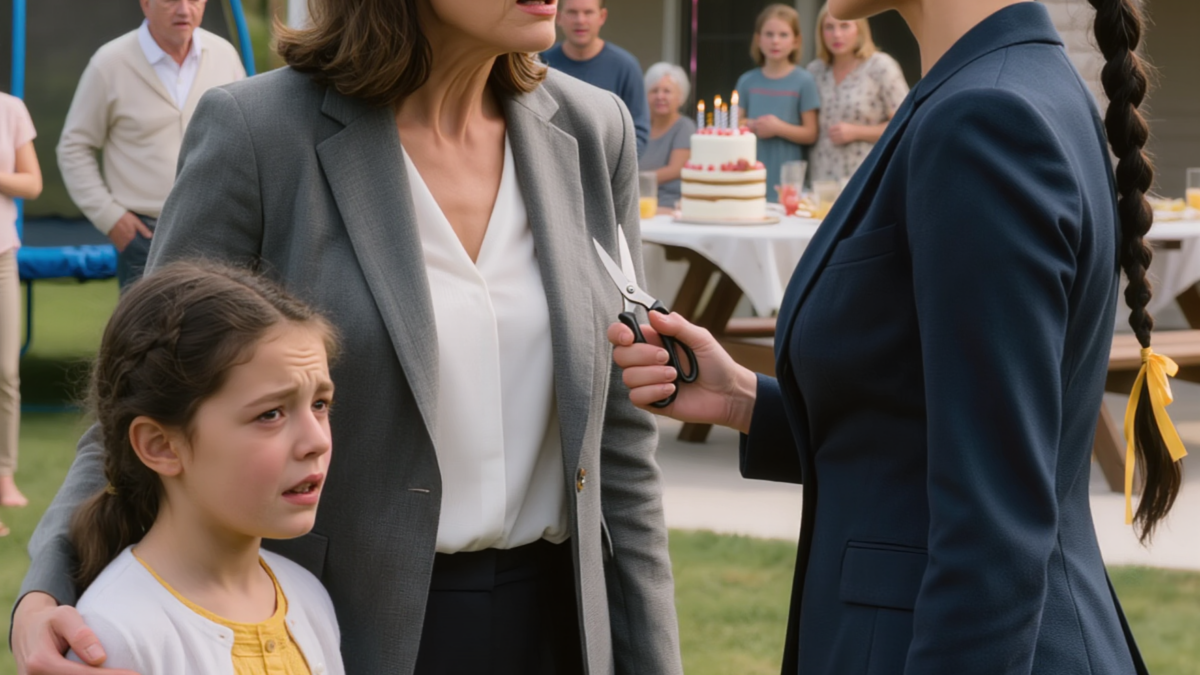
“Relax. She was getting too much attention.”
My sister Kendra said it at my niece’s tenth birthday party while guests watched from the lawn. In one hand, she was holding my nine-year-old daughter’s braid by the yellow ribbon I had tied there that morning. The shears were still in her other hand.
Eight minutes earlier, she had taken Nora into the back room, where the ring light was already on, and told her it was a surprise look. Nora trusted her.
Nora came out sobbing, her hair hacked off above her ears, and in the car she whispered that she had only said thank you. My mother nodded. My father stared at his plate. Nobody moved.
So I carried Nora out through the side gate without screaming.
By 8:00 a.m., my mother had called thirty-nine times, and not one voicemail asked about Nora. Because Kendra had posted the clip with a caption that said, “My daughter begged for it,” and 400,000 people had already watched.
What they didn’t know was that the camera had recorded more than she posted, and that for two years, this family had hidden something under a bow.
At 8:07, that secret started pounding on my front door.
My name is Ruth Robinson, and I’m thirty-six years old. If you’ve ever been the wrong daughter in your own family, this story is for you. Comment where you’re listening from and subscribe. The next part hits harder.
To understand what happened in that back room, you have to know what hair meant in my family. And you have to know about a yellow ribbon.
Every school morning for almost four years, I braided my daughter’s hair at the kitchen counter. Nora sat on the tall stool with a bowl of cereal, and I stood behind her with a wide-tooth comb and a spray bottle, working through the tangles while the coffee maker hissed.
Her hair was dark and thick, and by that spring, it reached the small of her back. She hadn’t had a real haircut since the August before kindergarten.
It wasn’t my idea.
When she was five, a stylist at the mall suggested a cute little bob, and Nora put both hands on top of her head and said no. Not rudely. Just no.
Afterward, in the car, she explained her position with the seriousness of a very small lawyer.
“I’m growing it until I decide,” she said.
“Decide what?”
“I don’t know yet. That’s why I’m growing it.”
I thought it was the best answer I had ever heard.
So it became the rule in our house. Nora’s hair belonged to Nora. She could cut it, keep it, or dye it purple when she was old enough, and nobody else got a vote. Not me, not her father, not anyone.
On special days, I tied the end of her braid with a yellow ribbon. It was frayed at the edges and a little faded, and Nora loved it because it was old.
I had owned it since I was nine.
My father gave it to me.
“Why is your hair always short, Mom?” she asked me once, holding the ribbon while I finished the braid.
I took a second too long to answer.
“It’s easier,” I said.
It was the answer I had been giving for most of my life.
In March, Nora found out a little more. We were cleaning out the hall closet, and she pulled a shoebox of old photos off the top shelf.
Near the bottom was a picture of me at nine, in a lavender dress, standing in front of a church. My hair had been cut so short and so unevenly that you could see the tops of both ears. It looked like someone had done it in the dark.
“What happened?” Nora asked.
“Lice,” I told her. “Grandma had to cut it the night before Aunt Linda’s wedding.”
It was the only version I had ever been given. I had repeated it so many times that it no longer felt like a story.
It felt like a fact.
That Sunday, Nora brought the photo to my parents’ house to show her grandpa.
My father, Gary, is a quiet man. He carried mail in Westerville for more than thirty years, and he still fixes things for half the neighborhood because he would rather use his hands than talk.
He looked at the picture for a long moment. Then he laid it face down on the kitchen table and went out to the garage.
A minute later, the grinder started. It ran much longer than anything he was working on could have needed.
My mother, Carol, picked up the photo, slid it back into its envelope, and asked Nora if she wanted lemonade.
I grew up in that house with one younger sister, Kendra. We are less than two years apart, but we were raised as if we were different species.
Kendra had the curls. She had the pageant dresses, the hot rollers on Saturday nights, the framed photos in the hallway.
I had what my mother called sensible hair—chin-length, trimmed every six weeks from the age of nine until I left home at eighteen. By then, short hair was just who I was.
“Kendra has the face for it,” Mom used to tell people. “Ruth has the sense for it.”
I was twelve before I understood that it wasn’t really a compliment to either of us.
I became the one who kept the peace. The one who drove home from college when Kendra had a crisis. The one who didn’t make things a thing.
I teach middle school art now, and our district requires teachers to log every parent contact—date, time, what was said.
After a few years, I started keeping the same kind of log for my own family in a blue spiral notebook that lives in my purse. I told myself it was just a habit.
I think part of me knew it was more than that.
Kendra grew up and turned the curls into a business.
Harper’s Bow Shop started as an Instagram page when her daughter Harper was five. By that spring, it had a storefront in Uptown Westerville and about 90,000 followers, most of whom knew Harper by her long, glossy princess curls and the bow of the day.
Harper and Nora were closer than most sisters.
Harper was a year older, and Nora followed her everywhere, but there were small things about my niece that I noticed and didn’t understand.
For two summers, she wouldn’t swim. At every pool party, she sat on the edge with a headband pressed down over her hair.
“I don’t like getting my hair wet,” she would say.
She said it like a line she had practiced.
And my mother was always the one who fixed Harper’s hair.
Always.
At the end of March, Kendra texted me about Easter lunch at Mom and Dad’s. At the bottom of the message, she had added, “Bring Nora’s hair. LOL. Tessa’s shooting.”
Easter was sunny and cold enough for jackets. My parents still live in the split-level I grew up in, with a backyard big enough for an egg hunt and a picnic table my father built the year I turned ten.
By the time we arrived, Kendra had already turned half the yard into a set.
Tessa Moore, the twenty-four-year-old photographer Kendra hired for most of her content, was crouched near the lilac bushes, shooting pastel bows arranged on a white blanket.
Kendra waved me over before I had even set down the deviled eggs.
“Guess who signed with Magnolia and Pine?” she said.
Magnolia and Pine is a chain of boutiques around Ohio. Eleven stores. The kind of place where people buy monogrammed tumblers and baby blankets that cost more than my car payment.
Kendra had signed with them in March. Her Mother’s Day bow collection would be in all eleven stores by May 4.
And on Saturday, May 9, the day before Mother’s Day, she was hosting something called Mommy and Me Bow Day at her shop. She already had the flyers printed.
“It’s huge,” she said. “They’re very careful about who they work with. They make you sign a whole kid-safety code.”
She laughed.
“I’m basically family certified.”
I asked where Scott was.
“Work thing,” Kendra said.
At exactly the same moment, my mother said, “He isn’t feeling well.”
They looked at each other.
Kendra smiled and went back to her bows.
I didn’t write anything down that day, but I remembered it.
Before the egg hunt, Kendra sat Harper on a kitchen chair in the backyard and curled her hair for the Easter photos. It took forty minutes.
Harper sat perfectly still the whole time, the way a much younger child sits in a dentist’s chair. When Kendra finished, she set a wide-brimmed straw hat on top of the curls and adjusted it twice.
Halfway through the egg hunt, a gust of wind caught the hat.
It tipped sideways.
Harper froze in the middle of the lawn and grabbed the top of her head with both hands. Her face went white, as if she had dropped something she could never pick back up.
My mother was across the yard before anyone else moved. She straightened the hat, pressed it down, and smoothed the curls around it.
“Hands down, sweetheart,” she said, not unkindly. “Pretty girls don’t touch their heads.”
Harper put her hands down.
At the picnic table, my father watched the whole thing. He opened his mouth as if he were about to say something.
Then he looked back down at his plate.
Later, while the kids counted their eggs, Kendra came up behind Nora and lifted her braid off her back, weighing it in her hand the way you would weigh a bag of flour.
“This is a lot of hair for a little girl,” she said. “You should let me give her a bob, Ruth. Short is trending.”
Nora didn’t even look up from her basket.
“I’m growing it until I decide.”
Kendra laughed.
“Kids don’t decide, Nora. Moms do.”
“In our house,” I said, “she does.”
My mother sighed from the patio.
“Ruth always did make everything a thing.”
Kendra let the braid drop.
She didn’t argue. She just kept looking at it for another second, and I didn’t like the way she looked at it.
It was the way she looked at inventory.
On the drive home, Nora was quiet for a long time.
Then she asked, “Why did Aunt Kendra look at my hair like it was hers?”
I didn’t have an answer.
I wish I’d gone looking for one.
The following Thursday, Kendra texted me about Harper’s birthday party.
“Can Nora wear something bright Saturday? Tessa’s shooting cousin content.”
There was a little pink heart at the end.
I wrote it in my notebook out of habit, along with the date. At the time, it seemed like the most normal request in the world.
My sister photographed everything.
Her Christmas tree had a content schedule.
On Friday, my mother called. She wanted me there early to help with the cake.
“You’re the artist,” she said.
It was the only time I can remember her saying that.
Nora chose her own outfit: a yellow sundress because it matched the ribbon, and a thin white cardigan because it was April in Ohio and the sun doesn’t always mean what it promises.
On Saturday morning, I braided her hair at the counter and tied the end with the yellow ribbon. She turned her head back and forth in the hallway mirror to make the braid swing.
“Harp’s going to love it,” she said.
Ben was supposed to come with us. My husband is an electrician, and that weekend he was on call.
At nine that morning, a restaurant on State Street lost half its power after a storm damaged a panel, and he kissed us both on the head and left with his tool bag.
“Save me a cupcake,” he told Nora. “The one with the most frosting.”
Kendra lives six blocks from us in a newer subdivision with sidewalks and matching mailboxes.
When we got there at two, the backyard looked like a catalog. Pink and white balloons. Paper butterflies hanging from the pergola. A bounce house humming in the corner.
The theme was bows and butterflies, which was, of course, also the name of a collection.
About twenty-five people came—parents from Harper’s class, a few neighbors, my parents, and Tessa with her camera.
Around three, I went inside for more ice and took the long way past Kendra’s home office, the one off the garage. She had converted it into what she called her content room, and it had a side door that opened straight onto the backyard.
The door to the hallway was open.
The ring light was already on.
A single chair sat in the middle of the room, and underneath it, a white sheet was spread across the floor the way they do in a barbershop.
I told myself it was a backdrop for product photos.
I told myself a lot of things that spring.
Harper found me in the kitchen and hugged me around the waist. She was wearing a pink bow the size of a dinner plate on top of her curls.
“Daddy took me for birthday pancakes this morning,” she whispered, as if it were a secret.
Kendra was two steps behind her.
“Scott had to work today,” she said brightly, and steered Harper back outside by the shoulders.
All afternoon, people kept talking about Nora’s hair.
I don’t think anyone meant anything by it. It was just there, long and dark against the yellow dress, and people noticed.
A mom from Harper’s class asked if it was natural. A neighbor asked how long it took to braid.
Nora said, “Thank you,” every time, the way I had taught her.
Then Kendra told Tessa to get a shot of the cousins together.
Harper and Nora stood side by side in front of the paper butterflies. One of Harper’s friends looked at them and said, “Nora’s hair is way longer than yours, Harper.”
The way kids say true things.
Harper’s hand went to the top of her head.
Her face went pale.
Kendra took Tessa’s camera, looked at the screen, and zoomed in. She stood there for a long time, studying the two girls side by side.
From the picnic table, my father watched her, his plate untouched in front of him.
At 3:40, my mother leaned out the back door.
“Ruthie, I need your hands in here. You’re the artist.”
The cake had been finished since that morning. It was a two-tier butterfly cake from a bakery, and it didn’t need anything from me.
But she handed me a piping bag of yellow buttercream and asked me to add a few more butterflies along the bottom.
And I did.
Because that is what I always did.
Nora stood next to me at the counter, shaking rainbow sprinkles onto a tray of cupcakes very carefully, one pinch at a time.
Kendra appeared in the kitchen doorway.
She had just fixed her lipstick.
She held out her hand to Nora.
“Come on, Nora,” she said. “We’re giving you a surprise look.”
Nora looked at me, then at her aunt.
Her face lit up.
She thought it meant glitter, bows, maybe a little makeup—the kind she was never allowed to wear.
And I said the sentence I have replayed more than any other sentence in my life.
“Nothing permanent, Kendra.”
“Relax.” My sister laughed. “It’s bows.”
Nora trusted her.
She took her aunt’s hand and went.
A minute later, my mother said she needed more napkins and stepped out into the hallway.
I kept piping yellow wings, one after another.
When she came back, her hands were empty.
I didn’t notice that until much later.
Outside, someone turned the music up. It was already loud—a pop playlist competing with the blower of the bounce house—and now it was louder.
Somewhere underneath it, I heard a high, sharp sound.
It cut off almost as soon as it started.
I remember thinking one of the kids was playing tag.
I remember deciding that was true because it was easier than the alternative.
A few minutes later, Tessa came through the kitchen fast. Her face was gray. She was clutching her camera bag against her chest with both arms.
“I have to go,” she said.
Not to me.
Not to anyone.
She walked straight through the living room and out the front door. It didn’t slam. It just closed quickly.
My mother took the candles out of the box and began pressing them into the cake.
Ten candles, evenly spaced.
Her hands were very steady.
“Let’s bring it out,” she said.
I followed her through the patio door carrying the lighter.
We were halfway across the patio when the side door of the content room opened onto the lawn.
Nora came out first.
She was sobbing so hard she couldn’t breathe. Her whole body was shaking, and her hair—her long, dark hair—was gone.
What was left had been chopped off above her ears in jagged steps, shorter on one side than the other, with a bare patch at the back where the blades had gone too close. Little pieces of it clung to her yellow dress.
Kendra came out behind her.
In one hand, she held a pair of silver shears.
In the other, she held my daughter’s braid.
She was holding it up by the yellow ribbon.
It swung a little as she walked.
The music was still playing.
Nobody on that lawn said a word.
Kendra looked at me.
She looked at the cake.
And she smirked.
“Relax,” my sister said. “She was getting too much attention.”
My mother, standing beside the birthday cake with ten unlit candles in it, nodded.
Just once.
Small and firm.
The way you nod when someone has said something reasonable.
At the picnic table, my father sat with his plate in front of him. He was staring down at it.
His face had gone white the way it had when Nora showed him that old photo, as if he had seen this exact haircut before.
Nobody moved.
Twenty-five people, and not one of them moved.
At the edge of the patio, Harper stood with one hand pressed flat on top of her head.
I set the lighter down on the patio table.
I crossed the lawn.
I didn’t look at my sister. I didn’t reach for the braid.
I knelt, and I picked up my daughter.
She was nine. Her legs hung past my knees, and her sneakers bumped against my shins with every step.
She pressed her wet face into my neck.
I carried her across the grass, through the side gate, and out to the street, and I did not say a single word because I knew that if I opened my mouth, whatever came out would be for me and not for her.
Behind us, Kendra’s voice rose over the music.
She was talking to the guests now, not to me.
“You’re being dramatic, Ruth. It’s a big-girl chop.”
The braid stayed in her hand.
I didn’t go back for it.
I buckled Nora into the back seat. My hands weren’t shaking. They were just slow, like they belonged to someone underwater.
I started the car and pulled away from the curb.
We had gone maybe one block when Nora whispered from the back seat.
“You knew.”
I pulled over and turned around in my seat.
“What did she say, baby?”
“She said it was a surprise for you.” Nora’s breath kept catching. “She said you knew. She said, ‘Sit still or it’ll be crooked.’ And then she grabbed it, Mom. From behind. I couldn’t turn around.”
Six blocks.
It’s a two-minute drive.
It was the longest drive of my life.
Halfway home, Nora reached back and touched her neck where the braid used to lie.
Then she closed her fingers around the empty air as if she could still hold it.
“Everyone kept saying nice things about my hair,” she whispered. “I only said thank you.”
I had to pull over a second time.
This is what I understood, sitting on the side of that street with the hazard lights clicking.
When my sister stood in that kitchen doorway, I hadn’t said no.
I had said nothing permanent.
I had handed her a condition instead of a boundary.
Thirty-six years of keeping the peace had taught me to negotiate with people I should have simply stopped.
At home, I ran a warm bath. Nora sat in the water with her knees pulled up, and I rinsed the loose hair off her neck and shoulders with a plastic cup, the way I used to when she was a toddler.
Short, dark pieces floated on the surface.
I scooped them out with my hand so she wouldn’t have to see them.
Ben got home around seven, still in his work boots. He took one look at Nora wrapped in a towel on the couch, and I watched his whole body change.
“I’m going over there,” he said.
“Not tonight,” I said quietly. “Tonight, she needs us here.”
He stood in the doorway for a long moment.
Then he took off his boots, sat down on the floor beside the couch, and held Nora’s foot through the blanket for an hour without saying a word.
That is my husband.
At bedtime, Nora lay on her pillow with both hands pressed flat over her ears.
Not because of noise.
Because she didn’t want to feel what was missing.
“Will it grow back?” she asked.
“It will,” I said. “And it will still be yours.”
She fell asleep like that, with her hands over her ears.
If you were ever the kid who got blamed for someone else’s cruelty, just type “me” in the comments.
You’re not the only one.
At 10:40 that night, my phone buzzed on the kitchen counter.
It was Amber Klein, one of the moms from the party.
Ruth, is Nora okay? Have you seen what Kendra posted?
I hadn’t.
I opened Instagram.
Kendra had posted a reel at 10:02. It opened with three seconds of Nora laughing near the bounce house, clipped from earlier in the afternoon.
Then the chair.
The shears.
A trending song.
The braid lifting away.
And at the very end, for less than a second before the loop, my daughter’s face crumpling.
The caption said, “She begged for a big-girl chop.”
Then a laughing emoji and a pair of scissors.
I didn’t comment.
I didn’t call her.
I took screenshots, wrote the time in my blue notebook, and put my phone on Do Not Disturb.
Every time I had refreshed the page before that, the view count had jumped.
At 11:18, the screen lit up face down on the counter.
I turned it over.
Mom calling.
I didn’t answer.
I carried the phone upstairs, set it face down on the dresser in Nora’s room, and sat in the reading chair beside her bed.
I stayed there all night.
The phone lit up again and again. The light leaked out around the edges of the case and flickered across the ceiling.
I didn’t pick it up.
I watched my daughter breathe.
A little after six, Ben came in with two cups of coffee and sat on the floor next to me with his own phone.
“Somebody downloaded it and put it on TikTok,” he said quietly. “A big parenting account stitched it. They slowed down the end.”
He turned the screen toward me.
The last second of Kendra’s reel stretched out to four, my daughter’s face coming apart in slow motion.
Underneath it were thousands of comments.
That is not a kid who begged.
Look at her shoulders.
Someone is holding her still.
Who is this woman?
Someone had already found the shop.
Someone had left a one-star review.
Then a hundred people had.
“Four hundred thousand views,” Ben said, counting the copies. “And every single one of them can see she’s not laughing.”
At 8:00, I finally turned my phone over.
Thirty-nine missed calls.
Six voicemails.
All from my mother.
I listened to them in order, standing in the hallway with Nora’s door cracked open so I could still see her bed.
The first one was short.
“Ruth, call me back.”
The second:
“Ruth, Kendra is getting threats. Actual threats. Call me.”
The third was my mother’s lecture voice, the one I have known since I was six.
“You need to get ahead of this. You know how the internet is. It was a haircut. It grows back.”
The fourth:
“Just post one sentence. Nora wanted it. That’s all, Ruth. One sentence and this all goes away.”
The fifth was mostly breathing.
And then she hung up.
The sixth was different.
Lower.
Almost a whisper.
“Please don’t make me choose.”
I stood there with the phone against my ear after the message ended.
Choose between what?
Between her daughters?
She had already chosen beside that birthday cake with one small nod.
I couldn’t imagine what choice she thought was still left.
Not one of the six messages asked how Nora was.
I was still standing in the hallway when the pounding started.
It wasn’t a knock.
It was two small fists on the front door, hard and fast, like someone who had run out of courage and was spending the last of it all at once.
It was 8:07.
I know because I looked at the phone still in my hand.
Ben came out of the kitchen. I shook my head and went down the stairs myself.
I don’t know who I expected.
My mother.
Kendra.
A reporter, maybe.
I opened the door, and it was Harper.
She was ten years and one day old.
She was red-faced and sweaty, in leggings and a sweatshirt, and her bike lay on its side in our front yard, the back wheel still turning.
She was holding a pink backpack against her chest with both arms, the same way Tessa had held her camera bag.
“Harper, honey, does your mom know you’re here?”
She shook her head.
Then she unzipped the backpack and held it open.
Inside was a hairpiece.
Long, glossy brown curls on a small mesh base with tiny clips sewn along the edges.
Underneath it, sealed in a gallon Ziploc bag, was Nora’s braid.
The yellow ribbon was still tied at the end, pressed flat against the plastic.
“I got it out of the trash in Mom’s office,” Harper said. “Last night, after everybody left.”
She held the hairpiece out to me.
“Nora can have mine. It’s my spare. Please don’t tell Mom I came.”
I didn’t understand.
“Yours?”
Harper looked at me for a long moment.
Then, slowly, she reached up and touched the top of her own head.
Right where the bow always sat.
We sat on the front step together.
Ben brought out a glass of orange juice and quietly went back inside.
Harper held it with both hands and didn’t drink.
“I pull it out,” she said finally. “My hair. I don’t mean to. I just do it when I’m worried, and then there’s a spot. There’s a lot of spots now.”
She stared into the juice.
“So I wear the clip-in. Grandma makes it so it stays.”
It had been almost two years.
Since she was eight.
Since the summer she stopped swimming.
“I asked Mom yesterday why everybody liked Nora’s hair better,” Harper said.
Her voice cracked on the last word.
“I think that’s why she did it. I think it’s my fault.”
“It’s not your fault,” I said. “Not one bit of it.”
She nodded like she wanted to believe me and couldn’t yet.
“And I heard her,” she added. “On Thursday, she wrote what to say for the video. She made me practice laughing.”
Thursday.
The day of the text about cousin content.
I asked if she wanted me to call her mom.
“Can you call my dad?” Harper said. “Not Mom.”
She finally took a sip of the orange juice.
“Dad doesn’t live with us anymore.”
Scott Puit pulled into our driveway at 8:31.
He must have left the second I called.
He is a tall, soft-spoken man who works in IT for a hospital system, and in more than a decade of family holidays, I had never seen his shirt buttoned wrong.
That morning, it was.
Harper ran to him.
He held her for a long time on our front walk.
Then he came inside, sat down at my kitchen table, and told me the truth.
He had moved out in January.
He rented a one-bedroom apartment on the south side of town, ten minutes away.
Kendra had asked him not to tell anyone until after the Magnolia and Pine launch.
Separation didn’t photograph well.
He said he had agreed because he thought he was protecting Harper.
“I’ve been taking her to a therapist since February,” Scott said. “Tuesdays and Thursdays, on my nights. Kendra doesn’t know.”
He rubbed his face with both hands.
“I asked her about it last fall. She said therapy leaves records and buyers Google brands.”
Nora had come downstairs.
She stood at the bottom of the steps in her pajamas, her new short hair sticking up in the back, looking at her cousin.
Harper held out the hairpiece again.
Nora walked across the kitchen and pushed it gently back into Harper’s hands.
“It’s yours,” she said. “You need it more than I do right now.”
Harper held it against her chest.
Neither of them said anything else.
They didn’t need to.
At the door, Scott slung the pink backpack over his own shoulder, then turned back to me.
“There’s something I need to check,” he said. “She never took my name off the store account.”
That afternoon, I took Nora to Little Shears, a kids’ salon in a strip mall with animal-shaped chairs and a fish tank by the register.
The stylist was a woman in her fifties named Deanna Hollis, with reading glasses on a beaded chain.
She took one look at Nora and didn’t ask a single question.
She just lifted her gently into a chair shaped like a fire truck.
For a while, she worked in silence, evening out the sides and shaping what was left into a pixie.
Then she ran her fingers over the back of Nora’s head and stopped.
“Can I tell you something?” she said to me quietly.
I nodded.
“These were professional shears. Sharp ones. And this”—she touched the blunt line at the nape of Nora’s neck—“is where somebody pulled the braid tight from behind and cut through it in a few hard snips.”
She met my eyes in the mirror.
“Nobody cuts like this for a kid who asked. This is someone grabbing a braid and not letting go.”
In the mirror, Nora tilted her head from side to side, looking at her own ears.
She didn’t cry.
She studied herself like a drawing she hadn’t made up her mind about.
“It looks like a pixie,” she said finally. “Like a fairy one.”
“That’s exactly what it is,” Deanna said.
On the way home, I checked Kendra’s page.
The reel was gone. She had deleted it sometime that morning, but the copies on TikTok were still there, and the comments were still coming.
On Monday night, Scott called.
He was still listed as the owner of the shop’s Shopify account. He had built the website himself when the storefront opened in 2023, and the billing was still on his credit card.
Kendra had never bothered to change it.
That afternoon, he had logged in just to look.
He had found a product draft.
A new collection.
It had been scheduled to go live at 9:00 that very morning, and someone had unscheduled it at 11:52 on Sunday, a few hours after Harper knocked on my door.
He sent me a screenshot.
The collection was called the Big Girl Chop Bow Collection.
The description read:
“Inspired by my niece’s brave Big Girl Chop. Short hair deserves bows, too.”
At the top of the page, in small gray letters, it said, “Created April 4.”
“She wrote ‘my niece’ a week before the party, Ruth,” Scott said.
His voice was very quiet.
“She knew exactly whose hair it was going to be.”
By then, I had two stories to compare.
And they didn’t match.
On Sunday night at 9:14, my mother had posted in the family group chat.
It’s called Bennett Family, with a pink heart after it, and it includes cousins in Kentucky I haven’t seen since high school.
“Nora had lice,” my mother wrote. “Kendra handled it so Ruth wouldn’t have to. Please don’t believe the internet.”
Then a pair of praying hands.
On Monday afternoon, Kendra posted an Instagram story, white letters on a pale pink background.
The video, she wrote, had been edited and posted without my approval by a contractor, and her family was healing privately.
So my sister said Nora begged.
My mother said Nora had lice.
And now, apparently, it was a contractor’s fault.
That Monday, I sent Nora to school.
I had emailed her teacher the night before so she would be ready, and Nora walked into third grade with her fairy pixie and a purple headband she had picked out herself.
At my own school, during second period, a seventh grader hung back after the bell.
“Mrs. Robinson,” she said carefully, “is that your daughter in the video?”
I told her it was a private family matter, and I thanked her for asking kindly.
Then I went into the supply closet and stood there for a minute with the door closed.
That night, I wrote the two explanations side by side in my blue notebook.
Begged.
Lice.
People who are telling the truth don’t need two versions.
And there was something about that word, lice.
It had been sitting in my chest since Sunday night.
I had heard it before, in my mother’s voice.
I just hadn’t let myself remember where.
On Tuesday, during my planning period, an email arrived in my school inbox from an address I didn’t recognize.
The subject line was just my name.
Mrs. Robinson,
My name is Tessa Moore. I filmed it. I have the whole file. I’m so sorry.
My school email is listed on the district website. Anyone can find it.
Tessa had apparently spent a full day working up the nerve.
We met on Wednesday after school in the parking lot of the public library.
She was waiting in a dented Honda, and when I got into the passenger seat, she started talking before I had even closed the door.
Kendra had hired her for $600 to shoot the party.
She had been told the haircut was a planned makeover.
“She said you were in on it,” Tessa said. “She said it was a sweet surprise reveal for you. And then Nora screamed, and I realized nobody had asked Nora anything.”
She had stopped recording and walked out.
Kendra had edited the reel herself from clips Tessa uploaded to their shared folder during the party, but the full raw file was still on Tessa’s memory card.
Since Monday, Tessa had been getting hundreds of messages.
Kendra’s followers had figured out who the contractor was.
And Kendra still hadn’t paid her invoice.
She took a small memory card out of her wallet and pressed it into my palm.
“You don’t have to watch it,” she said. “I would never ask you to watch it. But there’s a part at the beginning you need to hear.”
Not watch.
Hear.
I didn’t watch it.
I sat in my own car afterward, put in my earbuds, and played the file with my phone face down on my leg.
First, there was room noise.
Music through a wall.
The hum of the ring light.
Then Kendra’s voice, close to the camera, bright and businesslike.
“When she cries, stay on her face. Crying performs.”
I stopped the file and sat very still.
Then I made myself press play again.
A door opened somewhere off camera.
Kendra murmured something I couldn’t make out.
And then a second voice spoke from the doorway.
Calm.
Practical.
“Ruth’s got the cake. Go.”
I took out the earbuds and set them on the passenger seat.
It was my mother’s voice.
I didn’t call her.
I didn’t know what I would say that wouldn’t come out as a scream.
So, for the next two days, I did what I always do.
I went to work.
I packed lunches.
I graded seventh-grade self-portraits.
I wrote things down.
On Saturday morning, my doorbell rang at nine.
My mother’s quilting group meets at the church every Saturday from 8:30 to noon. She has never missed it.
It was my father.
He was holding a brown envelope, soft at the corners and sealed with old yellowed tape.
He stood on my porch like a man who had walked a very long way, although he had only driven across town.
“I saw what your mother wrote,” he said. “In the group. About the lice.”
He hadn’t slept.
Not for six nights, he told me.
“She used that word once before. Ruthie, I let her.”
He held out the envelope.
“I’m not letting her twice.”
We sat at my kitchen table.
Nora was in the living room building something out of Legos, and he didn’t look at her.
I think he couldn’t.
He kept his eyes on his hands.
The first thing that slid out of the envelope was a small pink slip of paper.
I recognized it before I read it.
Every kid of my generation in Ohio knows those slips.
The school nurse checked heads a few times a year, and you carried the slip home in your backpack.
Routine head check.
Ruth Bennett, Grade 4.
No lice found.
It was dated Tuesday, May 11, 1999.
Four days before my aunt Linda’s wedding.
The second thing was a photograph.
Me at the rehearsal dinner the night before the wedding.
I’m nine years old in a borrowed junior-bridesmaid dress, and my hair is in a long braid that reaches halfway down my back.
I’m laughing at something off camera.
I had never seen that picture.
I didn’t remember ever having hair that long.
“Everybody made a fuss over you that night,” my father said. “The aunts. Linda. Your grandmother. They said you looked like a little bride. Kendra was seven, and she cried and kicked under the table because she was only the flower girl.”
He swallowed.
“When we got home, your mother sat you down in the kitchen and cut it off. She said she’d found lice. She told everyone at the wedding the next day.”
“I remember the kitchen,” I said slowly.
And I did.
The cold of the scissors against my neck.
The sound they made.
All my life, I had thought I was remembering a medical emergency.
“I found that slip in your backpack a few days later,” Dad said. “I showed it to her. We fought about it for a week. I lost.”
He pressed his thumb hard against the edge of the table.
“After the wedding, I drove to the drugstore and bought you a ribbon. A yellow one. Do you remember what I told you?”
I did.
I had just never known what it meant.
“You said it was for when my hair grew back.”
“And then I let her keep it short for nine more years.”
His voice broke on the last word.
He didn’t cry.
My father doesn’t.
He just stopped talking for a while, and I let him.
When he stood to leave, he paused at the door with his hand on the knob.
“There’s more,” he said. “But it isn’t mine to tell. It’s Harper’s.”
The next day was Sunday, and Harper was at her dad’s.
That afternoon, Nora asked if she could FaceTime her, and Scott said yes.
I heard them from the hallway—mostly giggling, a long stretch of whispering.
At one point, Harper must have shown Nora her real hair because I heard Nora say, “That’s not bad. That’s just short like mine.”
And then more giggling.
After they hung up, Nora came and found me in the kitchen.
She was holding the phone against her chest with both hands.
“Harper told me a secret,” she said. “She said I could tell you, but only you.”
I put down the dish towel.
“Grandma sews the clips on Harper’s hair so they don’t show,” Nora said. “She’s done it since Harper was eight. And Grandma told her never, ever to let you see.”
She frowned, trying to get the words exactly right.
“She said you’d make it a thing.”
I sat down.
My mother had known about Harper’s pain for almost two years.
She had sewn it shut with her own hands and tucked it under a bow.
She had heard the same kitchen scissors in 1999 that I had.
And then she had stood outside that content room and sent her daughter in.
That night, after Nora was asleep, I laid everything out on my kitchen table in a row.
The photo from 1999.
The pink slip.
A printout of Scott’s screenshot.
My notebook, open to the page with begged and lice written side by side.
Tessa’s memory card.
I looked at them for a long time.
In my family, a girl’s hair had never belonged to the girl.
It belonged to whoever needed the family to look good that day.
On Thursday, Kendra finally sent me a message.
It came with a video.
She was sitting in soft light, dabbing at her eyes, saying her family had been through a hard season and that she was choosing grace.
She never said Nora’s name.
Below the video was an invitation.
Mommy and Me Bow Day.
Saturday, May 9, at the shop.
Live stream at eleven.
She wanted Harper and Nora to wear matching bows.
“Let’s give everyone a happy ending,” she wrote.
I read it with everything from that table stacked beside me.
Then I typed four words and pressed send.
I’ll be there, Kendra.
Ben didn’t understand at first.
“You have the video,” he said that night. “You have her voice. You have your mother’s voice. Post it. Let the whole world see what they did.”
“The whole world has already watched Nora cry,” I said. “I’m not going to use my daughter’s worst moment the way Kendra did.”
I closed the notebook.
“Not even to win.”
He looked at me for a long moment.
Then he nodded, and I saw something in his face I didn’t expect.
It looked like relief.
Two weeks went by.
The one-star reviews slowed down and then stopped.
The TikTok copies sank beneath newer outrage.
Kendra started posting again—bows on pastel blankets, as if nothing had happened.
My mother didn’t call.
I think she took my reply to Kendra as a truce.
I let her think so.
On May 6, Kendra posted the promotion for Mommy and Me Bow Day.
She used a photo from Harper’s party.
It was the one Tessa had taken of the cousins in front of the paper butterflies before the back room.
Nora smiling with her long braid over her shoulder.
The caption said, “Cousins reunited this Saturday.”
Tessa texted me within the hour.
She’s using Nora again. I can’t stay quiet. Can I say something only about me?
Tell your truth, I wrote back. Not Nora’s face. Not her name.
On Friday night, Tessa posted a short statement on her own page.
I filmed a haircut for a brand I worked for. I was told the child’s mother had agreed. She hadn’t. I was told to keep filming when the child cried. I’m sorry.
By morning, it had been shared more times than Kendra’s reel.
Kendra didn’t cancel.
That was when I understood that my sister truly believed a live stream could fix anything.
She believed in her own lighting more than she believed in anything I could ever write in a notebook.
On Saturday morning, Scott called.
He was going to tell Kendra he was done hiding the separation and done letting Harper be filmed.
Harper wanted to tell her mom herself.
He wanted me there.
A few minutes later, my father texted.
I’m driving your mother. She doesn’t know I’m coming for you.
Nora stayed home with Ben.
She was eating cereal on the tall stool at the counter—the same stool where I used to braid her hair.
Before I left, she looked up.
“Are you going to yell?”
“No,” I said. “I’m going to be very quiet.”
When I parked in Uptown Westerville, a banner hung across the front of the shop.
MOMMY AND ME BOW DAY.
About twenty women were already lined up on the sidewalk, most with daughters, most in matching bows.
A young employee let me in through the front and pointed me toward the back room.
It was a stockroom, really, with ribbon spools and shipping boxes lining one wall, but Kendra had set it up exactly like the content room at her house.
The ring light was already on.
A small table in front of it held a tray with two matching yellow bows, one slightly bigger than the other.
Next to the tray was a printed card with her opening line in bold letters.
WE’RE A FAMILY THAT LAUGHS TOGETHER.
My mother sat on a folding chair in the corner, sewing clips onto the last few bows for the display.
My father stood beside the door with his hands in his jacket pockets.
Kendra was in full makeup.
She looked past me at the empty doorway.
“Where’s Nora?” she said. “We go live at eleven.”
“Nora’s not coming,” I said. “Neither is her face.”
She let out a short, disbelieving laugh.
“Then why are you here?”
I didn’t answer.
I set my phone on the table next to the bows, screen down so there was nothing to see.
And I pressed play.
Room noise.
The hum of a ring light.
Then Kendra’s own voice filling the stockroom.
“When she cries, stay on her face. Crying performs.”
I stopped it.
Nobody moved.
My mother’s needle stopped halfway through a bow.
Kendra recovered first.
She always does.
“That’s out of context,” she said. “Tessa cut that together. She’s bitter. I didn’t pay her invoice.”
“You’re making it a thing again, Ruth,” my mother said quietly without looking up. “You always do this.”
Before I could answer, the back door opened and Scott walked in.
Kendra’s face changed.
“What are you doing here?”
He didn’t answer her either.
He laid a single printed page on the table beside my phone.
The product draft.
The Big Girl Chop Bow Collection.
“And at the top, in small gray letters, the date. You wrote ‘my niece’ on April 4, Kendra,” he said. “A week before you touched her.”
She looked at the page for a long time.
“It’s a product idea,” she said. “Short hair is a market. Every brand does trend collections.”
“You scheduled it for the Monday after the party,” Scott said. “You didn’t have a niece with short hair yet. You were planning to make one.”
He took a breath.
“And I’m done keeping your secrets. I moved out in January. Harper has been seeing a therapist since February. I’m not hiding either of those things anymore. Not for a launch. Not for anybody.”
Kendra turned to our mother.
It was the look she has been giving her since we were children.
The one that means fix this.
For the first time in my life, I didn’t wait to see whether she would.
I picked up my phone and played the second clip.
A door opening.
Music through a wall.
Kendra’s murmur.
And then my mother’s voice, calm and low from the doorway of that content room.
“Ruth’s got the cake. Go.”
My mother set down the bow she was sewing.
Her face didn’t crumple.
It just went very still.
“I meant go get the candles,” she said. “I was telling her to get the candles.”
It was a good answer.
It might even have worked if she hadn’t spent thirty-six years teaching me exactly how her voice sounds when she is deciding something for someone else.
That was when my father stepped away from the door.
He took the brown envelope out of his jacket, removed the pink slip, and set it on the table beside Scott’s printout.
A nurse’s slip from 1999 and a product draft from this spring, side by side under the ring light.
“There were no lice in 1999 either, Carol,” he said. “I kept the note. I kept it for twenty-seven years.”
My mother stared at the slip.
Then at him.
I don’t think anyone in our family had ever heard my father say her name in that voice.
“Gary,” she said.
But he didn’t go back to the door.
He stayed where he was.
Next to me.
There was a small rattle at the stockroom door.
Scott had asked Harper to wait in the hallway just outside.
She had heard every word.
She came in slowly, the pink backpack on both shoulders, and stopped in the middle of the room between her mother and her grandmother.
“Grandma,” Harper said.
Her voice was small but steady.
“You said Aunt Ruth would make it a thing.”
She looked at me and then back at her grandmother.
“She didn’t. She just picked Nora up and left.”
Then she turned to her mother.
“I don’t want to be in the video,” she said. “I don’t want to wear it for the camera anymore.”
Before anyone could stop her, Harper reached up and unclipped the hairpiece.
The little clips my mother had sewn came loose one by one.
She took it off and laid it on the tray, right next to the two yellow bows nobody was going to wear.
Her real hair was short and uneven, with thin places on top.
She stood there under the ring light and let us see.
Kendra moved toward her fast.
“Harper, put that back on right now. There are people outside.”
My mother caught Kendra’s wrist.
She didn’t say anything.
She just held on.
And Kendra stopped because in thirty-four years, our mother had never once held her back.
Harper was crying now, quietly.
Scott knelt and wrapped his arms around her.
My father took out his handkerchief and handed it to her without a word.
On the table, Kendra’s phone buzzed.
Then it buzzed again.
She picked it up, probably expecting a reminder about the live stream.
It wasn’t.
It was an email from Janine Hol, the head buyer at Magnolia and Pine.
Kendra read it once.
Her lips moved slightly.
Then she read it out loud in the flat, stunned voice of someone reading a language she used to speak.
“Following public statements regarding content involving a minor, we are pausing today’s co-branded event and all further orders per our vendor brand standards.”
The kid-safety code.
The one she had laughed about over Easter lunch.
Family certified.
She looked up at me.
“Who sent them anything?”
“Nobody had to,” I said. “You posted it.”
It was 10:52.
Through the door, we could hear the women on the sidewalk laughing and chatting, waiting for the shop to open.
And my sister, who had built a business on knowing exactly what to say on camera, had one last thing to say in a room with no camera at all.
“It’s hair,” Kendra said.
Her voice cracked right down the middle.
“It’s just hair. It grows back. You’re all acting like I hurt her.”
Everyone looked at me.
I hadn’t said more than a few sentences since I walked in.
“It grows back,” I said. “That was never the point. The point is, you thought it was yours to take.”
The room was completely silent.
“You don’t get to cut, film, or post my daughter ever again. Not online. Not at Thanksgiving. Not in this family. You don’t get to be alone with her. You don’t get to explain this to her. It’s done.”
Kendra opened her mouth.
Nothing came out.
My mother let go of her wrist.
She stood up, walked to the ring light, and switched it off.
Without it, the room was just a stockroom again.
Shelves.
Boxes.
A folding chair.
A tray holding a hairpiece and two yellow bows.
Then my mother walked out through the front of the shop.
Through the open door, I heard her voice, steady and polite, telling the women on the sidewalk that she was so sorry, but there had been a family emergency and Mommy and Me Bow Day was canceled.
My father walked me out the back way.
On the sidewalk in the bright May sun, he finally stopped.
“Can I come see Nora?” he asked. “Just me?”
“She’d like that,” I said. “So would I.”
If you’ve ever had to choose between keeping the peace and keeping your child safe, tell me which one you chose.
I’d like to know.
I’m not the only one who finally chose the second.
The next day was Mother’s Day.
For the first time since we moved back to Westerville, I didn’t drive my daughter to my mother’s house for brunch.
Nora made me breakfast instead, which meant toast with an alarming amount of butter.
And she gave me a card she had drawn herself.
Two girls holding hands.
Both of them had short hair colored in with brown crayon.
“That’s me and Harper,” she said. “We’re twins now.”
On Wednesday, Magnolia and Pine ended the partnership.
On Thursday, Kendra’s Instagram account went private, and then it disappeared.
By the end of the month, a sheet of paper was taped a little crooked inside the shop’s glass door.
CLOSED UNTIL FURTHER NOTICE.
Kendra sent me exactly one message.
You took everything from me.
I wrote it in my notebook with the date.
I didn’t answer.
I hadn’t taken anything.
I had just stopped holding it up.
The person whose life changed the most was the smallest one.
On the Monday after Mother’s Day, Scott and Kendra agreed that Harper would live with her dad during the week and see her mom on weekends.
Kendra agreed to family sessions with Harper’s therapist.
She agreed that Harper would never be filmed for the shop again.
Scott’s apartment is in the same school district, so Harper stayed at her school and finished fourth grade just down the hall from Nora.
“She said yes to everything,” Scott told me on the phone. “I think there was no one left to perform for.”
The next Saturday morning, my doorbell rang.
My mother had skipped her quilting group.
She was standing on my porch holding her sewing tin, the round blue one with the dented lid.
The one she has had since before I was born.
She didn’t try to come in.
“There were no lice,” she said.
She said it to the porch boards, not to me.
“Not in 1999. Not now.”
I waited.
“My mother cut mine when I was ten,” she said. “She said I was getting vain. I told myself that was love. I’ve been telling myself that for fifty years.”
She looked down at the tin in her hands.
“I don’t know how to be a different kind of mother. I don’t know if I can learn.”
I told her what I needed.
If she wanted to see Nora, it would be at my house.
Another adult would always be there.
No cameras.
No touching anyone’s hair.
And whenever Nora was ready, and not a day before, my mother would apologize to her in her own words.
My mother nodded.
It wasn’t the small, firm nod from the birthday party.
It was slower, like it cost her something.
Behind me, I heard footsteps on the stairs.
Nora had been sitting on the landing, listening to everything, the way children always do.
She came down two more steps and looked at her grandmother through the screen door.
“Grandma,” Nora said, “you can come in.”
She touched her short hair.
“But you can’t touch my hair.”
My mother set the sewing tin down on the top step and left it there.
Then she came inside and sat on my couch for an hour with both hands folded in her lap the entire time.
My father comes every Sunday now.
He doesn’t call first.
He just shows up with his toolbox and finds something in our house to fix.
And at some point in the afternoon, he and Nora end up on the back step together.
They don’t talk much.
The first Sunday, she asked him why he always fixes things.
He thought about it for a long time.
“Because for a long time,” he said, “it was easier than fixing me.”
She nodded like that made complete sense.
Maybe it does when you’re nine.
On the Friday before Memorial Day, Harper slept over.
It was the first time since the party.
The girls built a blanket fort in Nora’s room, ate their weight in popcorn, and watched a movie they had both already seen six times.
At bedtime, Harper sat on the edge of the bed for a minute.
Then she unclipped her hairpiece and set it on Nora’s desk.
Not in her backpack.
Just on the desk beside Nora’s colored pencils, where anyone could see it.
I was standing in the hallway with a stack of clean towels, and I didn’t move so they wouldn’t know I was there.
“Does it feel weird?” Harper asked in the dark. “Having it short?”
Nora thought about it for a long time.
I could almost hear her thinking.
“It feels like mine,” she said.
A little later, right before she fell asleep, Nora said, “I know what I want to do with my braid.”
The next morning, we went back to Little Shears.
Deanna was there in her beaded glasses, and she remembered us.
Nora climbed into the fire-truck chair holding the Ziploc bag in both hands.
Earlier that week, she had asked me to help her look something up, and we had found an organization that makes hairpieces for kids who lose their hair to illness.
The braid was long enough.
More than long enough.
Nora opened the bag.
Very carefully, she untied the yellow ribbon from the end of her braid.
Then she handed the braid to Deanna.
“Somebody should get to choose,” she said.
Deanna took it the way you take something that matters.
Because it did.
Then it was Harper’s turn.
She sat in the chair, took off her hairpiece by herself, and told Deanna exactly what she wanted done with her real hair.
Shorter on the sides.
A little longer on top.
She said she would still wear the clip-in, but only on the days she wanted to.
Not on the days somebody else wanted her to.
Deanna wrote that down on a sticky note and pressed it onto her mirror like it was a professional instruction.
Harper grinned at her for the rest of the cut.
On the drive home, Nora held the yellow ribbon in her lap the whole way.
Then she folded it into a small square and tucked it into the pocket of her shorts.
“It’s for somebody else now,” she said.
And she wouldn’t tell me who.
On Sunday, my father came over to fix the hinge on our garage door.
When he was done, he sat down next to me on the back step and wiped his hands on a rag.
“When’s the last time you picked your own haircut, Ruthie?” he asked.
I opened my mouth to answer.
Nothing came out.
I had kept the same appointment every six weeks for eighteen years.
Same salon.
Same length.
Chin-length.
Sensible.
I had never once walked in and asked for anything else.
It had never occurred to me that I could.
That night, I found the appointment card stuck to our refrigerator with a magnet, and I drew a line through it.
On Monday, Memorial Day, we had people over.
It was the first cookout I had ever hosted myself, in my own backyard, by my own rules.
Ben ran the grill.
My father fixed a folding chair that nobody had asked him to fix.
My mother sat at the picnic table with her hands in her lap.
And when Nora brought her a lemonade, she said thank you and didn’t reach for anything else.
Scott brought potato salad and Harper, who came through the side gate with her pink backpack on and her own short hair uncovered because that was what she chose that day.
Kendra wasn’t there.
In the middle of the afternoon, while I was in the kitchen refilling the ice, Nora came in with her hand in her pocket.
“Hold out your arm,” she said.
I did.
She pulled out the yellow ribbon, frayed and faded, and tied it around my wrist in a careful double knot.
The same way I used to tie it at the end of her braid.
“For when yours grows back,” she said.
Then she ran back outside to Harper.
My hair is still short.
But for the first time in twenty-seven years, it’s short because I haven’t decided.








