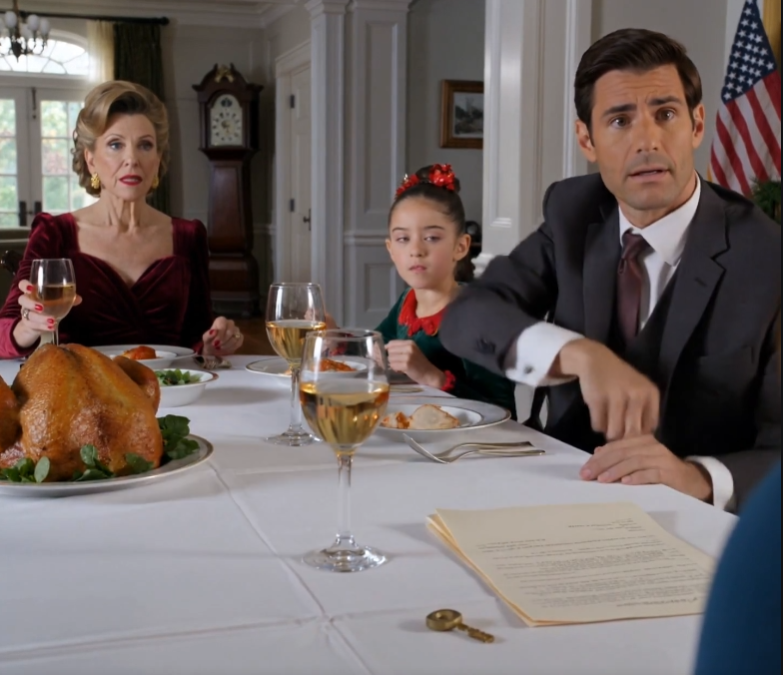
At Christmas dinner, my MIL announced, “You’re out before New Year’s.” My husband slid divorce papers across the table. I signed, then handed them a key. “You’ll need this. The new owners take possession tomorrow.” Then I looked at my husband. “Oh, and check your voicemail.”
”
Daniel’s smile disappeared, and for the first time that evening, my mother-in-law looked frightened.
My name is Claire Bennett. I was forty-two years old that Christmas, and until that evening, I had spent most of my adult life believing that patience could save almost anything. A marriage, a family, even a person who seemed determined to hurt you.
I had bought the house outside Columbus, Ohio, when I was thirty-four. It wasn’t a mansion or some extravagant property. It was a comfortable four-bedroom colonial with white trim, a wide front porch, and a maple tree in the backyard that turned a beautiful shade of gold every October.
I had saved for years to afford it. I worked in financial operations, first as an analyst and later as a senior manager. My salary wasn’t extraordinary, but I was careful with money. I drove an ordinary sedan, packed lunch for work, and spent more weekends comparing mortgage rates than shopping for clothes.
When I finally signed the closing documents, I sat in my empty living room and cried. Not because the house was beautiful, but because it was mine.
Three years later, I met Daniel at a charity fundraiser organized by a colleague. He was charming, ambitious, and funny in a way that made people lean closer when he spoke. He worked in regional sales and had a gift for making strangers feel like old friends.
When I showed him my house, he stood in the kitchen, looked out at the backyard, and said, “I could see myself raising a family here.”
At the time, I thought that was one of the sweetest things anyone had ever said to me.
We married the following year. Olivia arrived two years later, and for a while, our life was exactly what I had hoped it would be. We hosted Fourth of July cookouts. We took Olivia to the zoo. We argued about which Christmas movie to watch and whether the Browns would ever give us a winning season.
Then, slowly, things changed.
Patricia had never particularly liked me. She had wanted Daniel to marry a woman from a wealthy family, someone with influential parents and connections that might help his career. I was independent, practical, and perfectly content with an ordinary life.
Apparently, that made me inadequate.
At first, her comments were small enough to dismiss.
“Daniel always liked his shirts ironed a certain way,” she would say when she visited.
Or, “A woman with a child should probably spend less time worrying about promotions.”
If I objected, she laughed and claimed I had misunderstood her.
Daniel used to defend me. “Mom, Claire works hard. Leave her alone.”
But as his career advanced, his attitude changed. He began spending more weekends with Patricia, discussing investments and business opportunities without including me. He bought expensive suits, upgraded his car, and started talking about the kind of house he wanted to own someday.
Our house apparently no longer impressed him.
“This place is fine,” he told me one evening, standing by the kitchen island, “but it doesn’t reflect where I’m going.”
“Where are you going, Daniel?”
He gave me a tired look. “You know what I mean.”
I did. At least, I thought I did.
He wanted more money, more status, and a life that looked impressive to people who barely knew him. And Patricia encouraged every bit of it.
The final shift happened in September, when Daniel began staying late at work and taking calls outside. Whenever I asked whether something was wrong, he insisted everything was fine.
Then one evening, I walked into the living room and found Patricia sitting on our sofa with a folder in her lap. Daniel stood beside the fireplace.
“We’ve been discussing the future,” he said.
I glanced between them. “Our future?”
Patricia smiled. “Daniel deserves a fresh start, Claire. And frankly, you’ve made things very difficult for him.”
I asked what she meant. Neither answered directly.
But that night, after they left, I noticed a business card tucked beneath a magazine on the coffee table. It belonged to a divorce attorney.
Daniel had already begun planning his exit. He simply hadn’t bothered to tell me.
I didn’t confront him that night. I took a photograph of the card, placed it in a folder with our important household documents, and went to bed beside a man who was already preparing to leave me.
For three months, I watched and listened. I gathered my property records. I reviewed my finances. I spoke privately with Evelyn Brooks, a real estate attorney I had known for nearly a decade.
Evelyn didn’t promise that everything would be simple. She explained that divorce could raise complicated questions about property, marital contributions, and financial obligations, even when one spouse had purchased a house before marriage.
“Don’t act out of anger,” she told me. “Know your rights, understand your obligations, and don’t sign anything you haven’t had reviewed.”
I followed her advice.
The house sale was negotiated properly, and the closing was scheduled for late December. The buyers had financing in place and planned to move in immediately after the holidays. I arranged temporary housing for Olivia and me while I considered our next permanent home.
I didn’t sell the house to punish Daniel. I sold it because I no longer wanted my future tied to a place where my husband had quietly decided I didn’t belong.
And I wasn’t going to let him make that decision for me.
Back at the Christmas dinner table, Daniel finally pulled out his phone.
He had three missed calls from Michael Grant, the vice president of operations at his company. There was a voicemail.
Daniel pressed play.
“Daniel, this is Michael. I need you to call me immediately. The review is complete, and your employment status has changed. Effective today, your company access has been suspended. We need to discuss the findings and the next steps. Call me as soon as you receive this.”
The message ended.
Daniel stared at the screen as if it had betrayed him.
“What the hell is this?”
Patricia leaned forward. “Daniel, what does that mean?”
He didn’t answer.
I folded my napkin, placed it beside my plate, and stood.
“Thank you for dinner, Patricia.”
She looked up at me, her face suddenly pale. “Claire, sit down. We need to discuss this.”
I shook my head. “No. You made your decision. I’ve made mine.”
Then I walked toward the hallway to check on Olivia.
Behind me, I heard Daniel’s chair scrape violently against the floor.
“Claire, you knew about this, didn’t you?”
I stopped at the doorway. I turned just enough to look at him.
“I knew you had been hiding things from me, Daniel. I just didn’t know how much.”
And as I climbed the stairs to comfort my daughter, I realized that the house was only the beginning.
Daniel followed me into the hallway before I reached Olivia’s bedroom.
“Claire, I’m talking to you.”
I stopped outside her door and lowered my voice. “Not here.”
He glanced toward the staircase, then back at me. For once, the confident man who could charm an entire room seemed unable to find the right words.
“What did you do?” he demanded.
I stared at him. “Why is that your first question?”
“Because Michael just told me my employment has been terminated. You knew something was happening, didn’t you?”
“I knew you were worried about work. You told me everything was fine.”
“It was fine.”
“Then why are you shouting?”
He opened his mouth, but no answer came.
From inside the bedroom, I heard Olivia moving around. I knocked gently and opened the door.
She was sitting on her bed in her Christmas pajamas, her long brown hair falling over one shoulder. Her stuffed golden retriever rested in her lap. She had been given the toy when she was five, and although she was growing too old to carry it everywhere, she still kept it beside her when she was upset.
“Are you and Dad getting divorced?” she asked.
There was no point pretending she hadn’t heard.
“Yes, sweetheart. We’re having some serious problems, and we’re going to live separately.”
“Because Grandma doesn’t like you?”
Her question hurt more than anything Patricia had said downstairs.
I sat beside her. “Your grandmother and I don’t always agree, but this isn’t your fault, and it isn’t your job to fix anything between your father and me.”
“Are you going to make Dad leave?”
“No. We’re going to work out the arrangements with the help of our attorneys. Right now, I need you to know that you’re loved, and I’ll make sure you have a safe place to live.”
She studied my face.
“Will Christmas still be Christmas?”
I pulled her into my arms. “Yes. It might look different next year, but we’ll still have Christmas.”
She held me tightly for a few seconds before whispering, “I don’t want to lose our house.”
Neither had I once.
But sometimes the hardest part of growing up was learning that a familiar place could stop feeling like home long before you actually left it.
When I returned downstairs, Daniel was standing beside the dining table with his phone pressed against his ear. Patricia had cleared the plates without eating another bite.
“No, Michael,” Daniel said sharply. “You can’t just fire me over the phone. I’ve been with this company for eleven years.”
He listened.
“What investigation?”
Another pause.
“Those expenses were approved.”
His expression changed. I watched him grip the edge of the table.
“Michael, let me explain.”
The call ended.
Daniel lowered his phone slowly. Patricia hurried toward him.
“What did he say?”
Daniel rubbed his forehead. “They’re investigating my expense reports. They say there are charges that don’t match company policy.”
“What charges?” she asked.
He shot her a warning look. “Not now, Mom.”
But Patricia was already looking at me.
“Claire, you work with numbers. You must understand how these things happen. Sometimes accounting makes mistakes.”
I almost laughed. I had spent nearly twenty years working in financial operations. I knew the difference between an honest mistake and a pattern someone repeatedly chose to ignore.
Still, I said nothing.
Daniel turned toward me. “You’re going to help me sort this out.”
“Am I?”
“We’re married. Whatever happens to me affects you.”
“That is true,” I said, “which is why I’m going to make sure my attorney understands the situation.”
His face hardened.
“Your attorney? You’re really doing this?”
“You brought divorce papers to Christmas dinner, Daniel. What did you expect?”
He looked away for several seconds. The only sound was the grandfather clock in the hallway.
Then Patricia stepped between us.
“This is exactly what I mean. You always have to make everything about yourself. Daniel is facing a career crisis, and instead of supporting him, you’re talking about attorneys.”
I looked at her.
“Your son told me our marriage was over. He handed me divorce papers in front of our daughter, and you announced that I had to leave before New Year’s. Yet somehow, I’m the one making this difficult.”
Patricia’s lips tightened. “We were trying to handle this civilly.”
“Civilly would have been telling me the truth before Christmas dinner.”
Daniel slammed his palm against the table hard enough that I flinched before I could stop myself.
He noticed.
For a brief moment, something like shame crossed his face. Then it vanished.
“I’m not going to lose everything because of one misunderstanding,” he said.
I picked up my handbag.
“Then you should find out what actually happened.”
I left him standing beside the Christmas tree.
The following morning, I met Evelyn Brooks at her office in downtown Columbus. The streets were wet from overnight snow, and people hurried past the windows carrying coffee and shopping bags.
The city looked ordinary, almost offensively ordinary, considering how completely my life had changed in less than twelve hours.
Evelyn was waiting with two cups of coffee and a legal pad.
“Start from the beginning,” she said.
I told her about the dinner, the divorce papers, the voicemail, and Daniel’s reaction. She listened without interrupting. When I finished, she leaned back in her chair.
“First, we’re going to separate the emotional issues from the financial ones. Second, we’re going to make sure nothing you do puts you in a worse legal position.”
She reviewed the property records associated with the sale and asked about the accounts Daniel and I shared. I explained that I had purchased the house before our marriage and had maintained the original ownership documents. However, I also knew that Daniel had contributed to some household expenses over the years.
Evelyn reminded me that premarital ownership did not automatically resolve every question that might arise in a divorce. The treatment of appreciation, marital contributions, and other financial matters would depend on the facts and applicable Ohio law.
“We’ll document everything,” she said. “And you won’t sign any additional agreements without independent advice.”
Then we turned to the bank accounts.
I had noticed unusual pressure on our household budget during the previous year. Daniel had repeatedly claimed that his bonus was delayed, even though he continued spending money on expensive dinners and business travel.
I had assumed he was trying to impress his superiors. Now, I wondered whether something else was happening.
Evelyn suggested that I obtain statements for every account to which I was legally entitled to access and identify which debts were individual and which were joint.
I agreed.
Before leaving, I asked her one question.
“Could Daniel have put debt in my name without telling me?”
“It’s possible for someone to misuse another person’s information,” she replied. “But we don’t know that happened here. Let’s look at the records before we draw conclusions.”
I appreciated that about Evelyn. She never promised me a dramatic victory. She promised to help me understand the truth.
That afternoon, I returned to the temporary rental where Olivia and I were staying.
Daniel was waiting outside.
He looked exhausted. His expensive overcoat was unbuttoned, and his hair was disheveled.
“Can we talk?” he asked.
I unlocked the door but didn’t invite him inside.
“What about?”
“Work, the house, everything.”
“You’ll need to speak with your attorney about the house.”
“Claire, stop treating me like a stranger.”
I looked at him for a long moment.
“You made me a stranger when you started making plans for my life without including me.”
He lowered his eyes.
Then he said something I hadn’t expected.
“Mom thinks you should withdraw the sale.”
I almost smiled. “Your mother has an opinion about everything.”
“She says we can still fix this.”
“Who is ‘we,’ Daniel? You and your mother?”
He didn’t answer.
I stepped inside and closed the door gently.
That evening, I reviewed the financial statements Evelyn had helped me obtain.
Most of the transactions were ordinary. Mortgage payments, groceries, utilities, insurance, and the familiar expenses of raising a child. But several transfers caught my attention.
Money had been moving from our joint checking account into accounts I didn’t recognize. The amounts weren’t enormous individually, but together they represented thousands of dollars.
I printed the statements and laid them across the kitchen table.
Then I noticed several credit card charges for luxury restaurants, hotel stays, and purchases that Daniel had never mentioned.
I checked the dates.
Some matched the evenings he had claimed to be working late. Others matched weekends he had supposedly spent attending sales conferences.
My hands grew cold.
I wasn’t ready to accuse him of anything. There could be explanations I hadn’t considered, but I knew I needed answers.
I placed the statements in a folder and called Evelyn.
“I think we need to look more closely at Daniel’s finances.”
“Send me what you have,” she said. “We’ll go through it carefully.”
I was about to hang up when another call came through.
Patricia.
I almost let it go to voicemail, but something told me to answer.
“Claire,” she said, her voice unusually soft. “I think we need to talk privately.”
“About what?”
“The money Daniel owes.”
I sat very still.
“What money?”
There was a pause. Then Patricia said, “You’d better sit down, dear, because when the lawyers start digging, you’re going to wish you’d listened to us.”
The call ended before I could ask another question.
I stared at the phone in my hand.
Until that moment, I had believed Daniel’s biggest secret was the trouble at his company.
Now I wasn’t so sure.
I didn’t sleep much that night.
Patricia’s final words kept returning to me.
When the lawyers start digging, you’re going to wish you’d listened to us.
It wasn’t the threat itself that frightened me. It was the possibility that Daniel had made decisions affecting our family’s finances without telling me, and that I might not yet understand how far those decisions had gone.
At six o’clock the next morning, I made coffee, opened my laptop, and began organizing the statements I’d collected.
Outside, the rental home’s driveway was covered in a thin layer of snow. Olivia was still asleep upstairs, and the neighborhood was quiet except for a delivery truck making its rounds.
I created a spreadsheet with four columns: date, amount, account, and explanation.
By eight o’clock, I had identified eleven transfers I couldn’t account for.
The money had moved from our joint checking account into an account ending in numbers I didn’t recognize. Several transfers were followed by credit card payments or withdrawals. The amounts ranged from a few hundred dollars to nearly three thousand.
Together, they totaled more than $18,000.
I checked the dates again.
One transfer had occurred the same week Daniel told me his company had delayed his quarterly bonus. Another happened three days after he returned from a supposed business conference in Chicago.
I remembered that weekend clearly.
Olivia had been sick, and I had asked Daniel to come home early. He’d told me the conference schedule was beyond his control.
Now I wondered whether he’d even been at the conference.
I called Evelyn. She listened while I explained what I’d found.
“Don’t assume every transfer was improper,” she said. “Some could be legitimate. What matters is whether the money was used for an undisclosed purpose and whether any of those obligations affect you legally.”
“I understand.”
“And Claire, don’t contact his employer or try to access accounts that aren’t yours. We’ll work with the records you can lawfully obtain.”
“I won’t.”
After we hung up, I sent her the spreadsheet and supporting statements.
Then I sat at the kitchen table for several minutes, looking at the numbers.
Eighteen thousand dollars.
That was almost a year of Olivia’s school expenses, groceries, and medical copays. It was the emergency fund I had spent years building because I believed responsible adults prepared for difficult times.
Daniel had always praised my financial discipline.
Apparently, he had also learned to rely on it.
That afternoon, I met Daniel at a coffee shop near his former office. I chose the location because it was public, quiet, and far enough from our temporary rental that Olivia wouldn’t accidentally overhear us.
Daniel arrived fifteen minutes late.
He wore the same dark coat he’d worn the previous evening, and the skin beneath his eyes looked gray with exhaustion. He ordered black coffee and sat opposite me.
“Michael won’t even return my calls,” he said.
I waited.
“They’re treating me like I stole something. I’ve worked there for eleven years, Claire. Eleven years. I’ve brought in major accounts, trained new sales managers, and exceeded my targets.”
“What did the investigation find?”
He stared into his cup.
“Expense reporting discrepancies.”
“What does that mean?”
“It means some expenses were categorized incorrectly.”
“Accidentally?”
His jaw tightened.
“Some were. Others were complicated.”
I placed my folder on the table but didn’t open it.
“Daniel, I found transfers from our joint account that I can’t explain.”
He stopped moving.
“What transfers?”
“More than eighteen thousand dollars. Money moved into an account I don’t recognize, followed by payments and withdrawals.”
He looked toward the window for several seconds.
I thought he would deny knowing anything about it.
Instead, he rubbed his face.
“I was going to put it back.”
“Put what back?”
“The money.”
I felt something inside me grow very still.
“What did you use it for?”
He lowered his voice.
“Some business expenses. Some personal expenses. I had a lot of things happening at once.”
“Personal expenses like what?”
“Travel, meals, a few things I needed for work.”
“Eighteen thousand dollars’ worth?”
He looked at me sharply.
“You don’t understand the pressure I was under.”
“No,” I said. “I don’t understand why you thought you could take money from our joint account without telling me.”
“I wasn’t stealing from you. We’re married.”
“Being married doesn’t mean you can make financial decisions for both of us without my knowledge.”
He leaned back and looked around the coffee shop as though someone might be listening.
“My next bonus would have covered most of it. I was going to straighten everything out.”
“And if the bonus hadn’t come?”
He had no answer.
I opened the folder and showed him the dates.
“Were you using the money to cover expenses your company wouldn’t reimburse?”
He rubbed his forehead.
“Some of the expenses were legitimate. Some weren’t. I made mistakes.”
“What kind of mistakes?”
He looked at me, and for the first time, I saw fear rather than anger.
“I submitted some personal expenses as business expenses. I thought I could correct them later. Then the audit started, and everything became complicated.”
I closed the folder.
“Did you knowingly submit false expenses?”
He swallowed.
“Yes.”
The word was barely audible.
I looked out the window at the cars moving through the wet streets. People were going to work, buying groceries, and making plans for the new year. Somewhere, a family was probably arguing over what to have for dinner.
Ordinary life continued while mine seemed to split into a before and an after.
“Does your company know about the money from our joint account?” I asked.
“They know about the expense reports. They don’t know about our accounts.”
“Then we’ll let the attorneys determine what needs to be disclosed and how to address it.”
Daniel stared at me.
“Are you going to report me?”
“I’m going to tell my attorney the truth. I’m not going to lie for you, and I’m not going to make accusations I can’t support.”
He shook his head.
“You’ve changed.”
“No, Daniel. I’ve stopped pretending I don’t see what’s happening.”
When I returned to the rental, I found Olivia sitting on the living room floor with colored pencils spread around her.
She was drawing a house.
It had a red front door, four windows, and a crooked chimney with smoke curling out of it. Beside the house stood three stick figures. One was tall, one was medium-sized, and one was small.
I sat beside her.
“That’s a lovely picture.”
She looked down at it.
“I didn’t know which house to draw.”
I felt my throat tighten.
“You can draw whichever house you want, sweetheart.”
“Will Dad come to the new house?”
“I don’t know what our arrangements will look like yet, but you’ll still get to see him, and we’ll make sure you know what’s happening.”
She pressed a blue pencil against the paper.
“Grandma says you sold our house because you hate Dad.”
I closed my eyes for a moment.
“I’m sorry she said that to you.”
“Is it true?”
“No. I sold the house because I needed to make a decision about my future. Your father and I have problems that adults need to work through. None of that means you have to stop loving him.”
Olivia nodded, but she didn’t look convinced.
I put my arm around her shoulders.
“You never have to choose between your parents to make either of us happy. Do you understand?”
She leaned against me.
“I think so.”
It wasn’t a complete solution. It wasn’t even close.
But it was an honest answer, and honesty was something I could still give her.
Two days later, Evelyn called me into her office.
She had reviewed the financial records and prepared a list of questions for Daniel’s attorney.
“We have enough information to ask for a full accounting of the transfers,” she said. “But we need to be careful. We don’t yet know who owns the account, where every dollar went, or whether all the obligations are legally attributable to both of you.”
She explained that any division of marital assets and debts would depend on the facts, the applicable law, and the final divorce agreement.
I nodded.
Then she showed me another document.
It was a credit application connected to a new account Daniel had opened several months earlier.
My name appeared in the section listing household information, but I couldn’t tell from the copy whether I had been made a borrower, listed only as a spouse, or included in some other capacity.
“Did you sign this?” Evelyn asked.
“No.”
“Do you recognize the account?”
“No.”
She placed the document back on the desk.
“Then we need to verify exactly what this is. Don’t contact the lender with assumptions. We’ll request the appropriate records and determine whether your information was used without authorization.”
I stared at the paper.
The marriage had been over in everything but paperwork for months. I had accepted that.
But the possibility that Daniel had used my information to obtain credit without my knowledge was different.
If that proved true, the consequences could reach beyond the divorce.
Before I left, I called the lender’s customer service department using the official number on its website. After verifying my identity, I explained that I needed to determine whether I was legally associated with the account.
The representative couldn’t disclose everything immediately, but she opened a dispute inquiry and explained the documentation I would need to provide.
For the first time since Christmas, I felt the full weight of what might be coming.
I had spent years believing that the greatest danger in my marriage was Patricia’s cruelty or Daniel’s growing indifference.
I had been wrong.
The greatest danger was that I had trusted someone who believed trust meant he would never have to explain himself.
That evening, I received a message from Michael Grant.
He asked whether I would be willing to speak with him about certain financial records connected to Daniel’s employment investigation.
He made it clear that the company was not accusing me of wrongdoing and that I was free to consult my attorney before responding.
I forwarded the message to Evelyn. She advised me not to discuss anything until we understood exactly what the company needed and whether I possessed relevant records.
I agreed.
Then my phone rang.
It was Daniel.
“I heard you contacted the lender,” he said without greeting me.
“How did you hear that?”
“They called me because I’m listed on the account.”
I stood beside the kitchen window.
“Then you know why I need answers.”
“You’re making this much worse than it has to be.”
“Did you open an account using my information?”
A long silence followed.
Then he said, “I was going to explain everything.”
“When? After the divorce? After you got another job? After things settled down?”
I looked at Olivia’s drawing on the refrigerator. The little house with the red door seemed painfully fragile beneath the bright kitchen light.
“Daniel, you don’t get to decide when I’m allowed to know the truth about my own finances.”
He exhaled sharply.
“Mom was right about you. You always think the worst of me.”
“No,” I said quietly. “I think you should have told me the truth.”
I ended the call and sent Evelyn a brief update.
I wasn’t going to threaten Daniel. I wasn’t going to expose him on social media or turn his mistakes into entertainment for our friends.
I was going to establish the facts and protect myself and Olivia.
That was enough.
The next morning, Evelyn called again.
“Daniel’s attorney has responded,” she said. “He wants to challenge the property arrangements and argue that his contributions during the marriage give him an interest in the house.”
I sat down slowly.
“The house that was sold?”
“Yes. He may have claims he believes are valid, but that doesn’t mean he’ll succeed. We’ll review the documents and respond appropriately.”
I looked at the folder on my table, the bank statements, and the copy of the credit application.
One problem had led to another, and each answer seemed to reveal a question Daniel had hoped I would never ask.
I had prepared for a divorce. I had prepared to start over. But I hadn’t expected my husband to challenge the home I had bought before he entered my life while I was still trying to determine whether he had used my financial information without permission.
For the first time, I wondered whether the Christmas dinner had been more than a cruel announcement.
Perhaps Daniel had wanted me frightened, confused, and too ashamed to ask questions.
If that was his plan, it had failed.
I called Evelyn back.
“Let’s get everything documented,” I told her. “I want the truth on paper.”
And for the first time in months, I knew exactly what I needed to do next.
The first letter from Daniel’s attorney arrived three days after Christmas.
I was sitting at the kitchen table of our temporary rental, reviewing Olivia’s school schedule, when Evelyn called to tell me that the letter had been delivered to her office.
Daniel was challenging the way the house sale affected the divorce proceedings. His attorney argued that Daniel had contributed to the household during our marriage and that those contributions deserved consideration when the marital property was divided.
I wasn’t surprised that he wanted to protect his interests.
What hurt was the way he described our life together.
According to the letter, Daniel had made substantial financial contributions to the property, maintained the household, and supported our family throughout the marriage.
There was no mention of the years I had paid the mortgage, no mention of the savings I had used to cover unexpected expenses when his commissions fell short, and certainly no mention of the Christmas dinner when he had slid divorce papers across the table as though fourteen years of marriage were an inconvenience.
I called Evelyn.
“Can he really do this?”
“He can raise a claim,” she explained. “Whether it succeeds is another question. The original purchase records are important, but we’ll also examine mortgage payments, improvements, and any contributions made during the marriage. We need to establish the facts, not rely on assumptions.”
She reminded me that selling a house before a divorce was finalized could create complications, particularly if one spouse claimed an interest in the property.
“That’s why we’re documenting everything,” she said. “We won’t respond emotionally. We’ll respond with evidence.”
I looked through the window at the bare branches of a maple tree swaying in the winter wind.
“All right,” I said. “Let’s do it properly.”
For the first time, I understood that winning an argument and protecting my future were two entirely different things.
I didn’t need Daniel to admit that I was right.
I needed to make sure the truth could stand on its own.
Two days later, Patricia called.
She asked me to meet her at a restaurant near the shopping district where she usually spent her afternoons.
Her voice was softer than I had heard it in years.
“I think we should talk like adults,” she said. “For Olivia’s sake.”
I nearly declined, but I wanted to understand whether she was finally willing to acknowledge what had happened.
When I arrived, Patricia was seated beside the window, wearing a cream-colored sweater and a string of pearls. She had ordered tea but hadn’t touched it.
She gestured toward the chair opposite her.
“Thank you for coming.”
I sat down.
“What do you want to discuss?”
She folded her hands.
“Daniel is going through an extremely difficult time. Losing his job has been devastating. He’s worked hard for everything he has.”
“I know he’s worked hard.”
“Then you understand why he needs your support.”
I waited.
Patricia sighed.
“He needs time to find another position. If you cooperate with the lawyers and stop questioning every financial decision he made, perhaps we can reach an agreement that allows everyone to move forward.”
I studied her face.
“Are you asking me to ignore the transfers from our joint account?”
“I’m asking you not to make assumptions.”
“I’m not. I’m asking for records.”
She looked away.
“And the credit account?” I continued. “I don’t know what happened yet. That’s why my attorney is investigating it.”
Patricia stirred her tea.
“Daniel told me he was planning to repay everything.”
“Then he can explain that to the appropriate people.”
Her expression hardened.
“You make it sound as though he’s a criminal.”
“No. I’m asking him to take responsibility for his own decisions.”
She leaned closer.
“You have no idea how much pressure successful men face. Daniel had people depending on him. He had a reputation to maintain.”
I thought about all the evenings I had spent balancing our household budget while Daniel bought expensive suits and took clients to restaurants we couldn’t comfortably afford.
“What about the pressure I faced?” I asked. “What about the bills I paid, the savings I protected, and the times I kept our family afloat without telling Olivia that something was wrong?”
Patricia said nothing.
“I never asked Daniel to be perfect,” I continued. “I asked him to be honest.”
She looked at me with something approaching contempt.
“You always think you’re morally superior?”
“No, Patricia. I simply refuse to accept that someone else’s reputation is more important than my financial security.”
For a moment, she appeared genuinely startled.
Then she reached for her handbag.
“You’ll regret turning this into a fight.”
I stood.
“I’m not turning it into anything. I’m allowing the truth to be established.”
I left her sitting beside the untouched tea.
Outside, the air was cold enough to sting my cheeks. I stood on the sidewalk for a moment, watching people carry shopping bags toward their cars.
I realized that I no longer needed Patricia to understand me.
For years, I had hoped that if I worked hard enough, stayed calm enough, and gave her enough chances, she would eventually accept me as family.
But respect that had to be earned through endless self-sacrifice wasn’t respect at all.
It was permission to keep taking.
The following week, Evelyn arranged a call with Daniel’s attorney to discuss the property records and financial disclosures.
I didn’t participate in the legal arguments. Evelyn represented my interests, and Daniel had his own counsel.
I provided the documents I had collected: the original purchase records, mortgage statements, tax records, and the paperwork associated with the sale.
The attorneys also began addressing the disputed transfers and the credit account.
The process was slower than I wanted. Some records needed to be requested from financial institutions, and other questions depended on information Daniel’s attorney had yet to provide.
But at least the questions were finally being asked.
Meanwhile, Daniel’s employment situation grew worse.
Michael Grant contacted him through the company’s formal process and confirmed that the internal investigation had found violations of the company’s expense policies.
Daniel’s termination would stand.
The company required him to cooperate with the accounting review and address any amounts it determined were owed under the relevant agreements.
Daniel had always believed that strong sales figures would protect him from scrutiny. He had brought in valuable accounts, exceeded targets, and developed relationships with important clients.
But the investigation had shown that professional success did not excuse inaccurate reporting.
When he called me that evening, he sounded exhausted.
“They’re making an example of me,” he said.
“What did the review find?”
“They say I submitted personal expenses as business expenses. They say I ignored approval procedures.”
“Did you?”
He was quiet for several seconds.
“Yes.”
I closed my eyes.
“Then you need to deal with that.”
“You make it sound so simple.”
“I didn’t say it would be simple. I said you need to deal with it.”
He exhaled sharply.
“I don’t know what I’m going to do.”
For the first time, I heard genuine fear in his voice.
I felt sorry for him.
That surprised me.
I had imagined that seeing Daniel face consequences would bring me satisfaction. Instead, I felt a mixture of sadness and exhaustion.
I didn’t want him destroyed.
I wanted him to understand that he had choices and that those choices had consequences.
“Talk to your attorney,” I told him. “Get financial advice. Make a plan.”
“Is that all you have to say?”
“What else do you want me to do, Daniel?”
He didn’t answer.
We ended the call without resolving anything.
A few days later, Daniel came to the rental home to discuss Olivia’s schedule for the new year.
I let him inside because we had agreed to keep parenting arrangements civil.
He stood in the living room, looking at the boxes stacked near the wall.
“It’s strange seeing you here,” he said.
“It’s temporary.”
He nodded.
Then he noticed Olivia’s Christmas tree, a small artificial one decorated with paper snowflakes and colored lights.
“She made those at school,” I explained.
Daniel walked closer and examined a crooked paper star.
“She used to make these every year.”
“She still does.”
For a moment, neither of us spoke.
Then Daniel turned toward me.
“I never thought you’d actually leave.”
I folded my arms.
“You told me to.”
“I thought you’d argue. I thought we’d fight about it and eventually work something out.”
“You brought divorce papers to Christmas dinner.”
“I was angry.”
“So was I. But I didn’t use our daughter as an audience.”
His face tightened, and I wondered whether he would raise his voice.
Instead, he sat down.
“Mom thought it was better if we handled everything at once.”
“Your mother doesn’t get to decide how we end our marriage.”
“I know that now.”
I looked at him carefully.
“Do you?”
He rubbed his hands together.
“I don’t know. I thought I was doing what I needed to do to move forward. My career was falling apart, and I was afraid. Mom kept telling me that I needed to protect myself before everything got worse.”
“And you decided protecting yourself meant getting rid of me.”
He stared at the floor.
“When you say it like that, it sounds terrible.”
“That’s because it was terrible.”
He swallowed.
“I should have handled it differently.”
“Yes, you should have.”
He looked up, perhaps expecting me to soften the answer.
I didn’t.
An apology wasn’t a magic eraser. It was only the beginning of a conversation about accountability.
Before Daniel left, Olivia came downstairs carrying a board game.
“Dad, can you play with me for a little while?”
He looked at me, waiting.
I nodded.
“Of course,” I said. “You two can play here for the next forty minutes.”
I watched them sit on the living room floor, arguing playfully over the rules and laughing when Olivia won.
It was the first time in weeks that I had seen Daniel look relaxed.
When the game ended, he helped her put the pieces away. Then he approached me near the front door.
“I want to be better at this,” he said.
“For her?”
He nodded.
“Then be consistent. Don’t promise things you can’t deliver. Don’t put her in the middle, and don’t make her responsible for how you feel.”
He nodded slowly.
“I can do that.”
I wanted to believe him.
But I had learned that trust wasn’t rebuilt through one emotional conversation.
It was rebuilt through hundreds of ordinary decisions.
On New Year’s Eve, Evelyn called with an update.
The attorneys had exchanged additional financial records. Daniel’s side had acknowledged several disputed transactions, though the full accounting and treatment of the relevant debts remained unresolved.
The house sale and the divorce settlement still required careful legal work. No one could promise a quick resolution.
Then Evelyn mentioned something unexpected.
“Daniel’s attorney sent over a letter from his client. It’s not a legal argument. He wanted you to receive it.”
I asked her to send me a copy.
That evening, after Olivia went to bed, I opened the attachment.
Daniel had written the letter by hand.
He admitted that he had spent years confusing success with appearances. He had wanted Patricia to be proud of him, and he had wanted his colleagues to believe he was more successful than he really was.
When financial pressure began building, he hid it.
When his company started asking questions, he panicked.
And when his marriage began falling apart, he chose the easiest person to blame.
Me.
The letter ended with a sentence I read twice.
I finally understand why you sold the house before I could convince you to stay. You knew I wasn’t going to change unless losing you became real.
I sat at the kitchen table, the letter resting between my hands.
For the first time, Daniel had described his behavior without blaming his mother, his employer, or me.
But understanding what he had done was not the same as repairing it.
I folded the letter and placed it in the folder with the other documents.
Outside, fireworks began popping in the distance.
Olivia woke briefly and called down the stairs to ask whether it was midnight yet.
“Almost, sweetheart,” I called back.
Then I looked at the letter one last time.
Daniel might finally be beginning to understand what he had lost.
The question was whether he would keep learning after the immediate consequences had passed.
And I still had to decide what forgiveness would look like when the person who hurt me was also the father of my child.
By the time spring arrived in Ohio, I had learned that starting over rarely looked the way people imagined.
There was no triumphant music playing when I signed the lease on our temporary rental. No sudden feeling that every problem had disappeared.
There were bills to organize, school forms to complete, legal documents to review, and nights when I lay awake wondering how I had failed to recognize the distance growing between Daniel and me.
But there were also mornings when sunlight came through the kitchen window and Olivia sat across from me eating cereal, telling me about a friend who had embarrassed herself during a school presentation.
There were Saturday afternoons at the library, walks through the neighborhood, and dinners that didn’t end with someone criticizing the way I had cooked the chicken.
Little by little, ordinary life returned.
And I began to understand that peace didn’t always arrive as a grand victory.
Sometimes it arrived as a quiet morning when nobody made you feel small.
In March, I found a modest three-bedroom house in a quiet neighborhood on the outskirts of Columbus.
It wasn’t as large as the colonial house I had sold. The kitchen was smaller, the backyard needed work, and the garage barely accommodated my sedan.
But the mortgage fit my budget.
The school district was good, and Olivia immediately fell in love with the little window seat in the upstairs bedroom.
“Can I put my books here?” she asked during our second visit.
“Of course.”
“And my stuffed dog?”
“He can have the best spot.”
She smiled.
“Then I like this house better.”
I laughed.
But later that evening, after she had gone to bed, I stood alone in the empty living room and let myself cry.
Not because I regretted selling the old house, but because I finally understood how much energy I had spent trying to preserve a place that no longer gave me comfort.
I had once believed that if I could keep the house, the marriage, and the family traditions intact, I could keep my life intact, too.
I had been wrong.
A home was not the number of bedrooms or the size of the mortgage.
It was the feeling that you could close the front door and finally breathe.
And I was beginning to breathe again.
Daniel’s life changed more slowly.
After losing his position, he spent several months searching for another job. Some companies were reluctant to hire him while the circumstances surrounding his departure remained unresolved.
Others offered positions with lower salaries and fewer benefits.
Eventually, he accepted a regional account management role with a smaller company. The pay was considerably lower than what he had earned before, and the position required him to rebuild relationships rather than rely on the reputation he had once enjoyed.
He also began working with a financial counselor to understand his debts and establish a repayment plan.
The company’s review concluded that he had violated its expense policies. Daniel cooperated with the process and worked with his attorney to address the amounts the company determined were owed.
The matter was handled through the appropriate channels.
I didn’t celebrate his difficulties.
I didn’t call his former colleagues or tell our mutual friends every detail of what had happened.
I had no interest in turning his mistakes into a public spectacle.
For years, I had believed that revenge meant making someone feel the pain they had caused you.
Now I was beginning to understand something different.
I didn’t need Daniel to suffer forever.
I needed to stop suffering because of him.
Our divorce was finalized after months of negotiations.
The settlement addressed the division of marital assets, disputed financial obligations, and parenting arrangements.
The lawyers reviewed the property records and the financial documentation before the agreement was completed.
The outcome wasn’t perfect for either of us.
There were compromises, legal expenses, and moments when I wished the entire process could simply disappear.
But the uncertainty finally ended.
I had a clear financial plan, a home I could afford, and an arrangement that allowed Olivia to maintain a relationship with both parents.
For the first time in years, I knew what the next month of my life would look like.
That certainty was worth more to me than winning an argument.
Patricia took longer to change.
For months, she continued telling relatives that I had abandoned Daniel when he needed me most.
She described the house sale as a calculated attack and suggested that I had somehow orchestrated his employment troubles.
I heard about these comments through mutual acquaintances.
At first, I wanted to defend myself.
I drafted explanations in my head while driving to work. I imagined showing everyone the bank statements, the correspondence, and the documents that demonstrated how carefully I had handled the situation.
But every time I considered responding, I asked myself one question.
Would explaining myself to Patricia change the life I was building?
The answer was no.
So I stopped trying to convince people who had already decided what they wanted to believe.
Then, in late April, a letter arrived at my new address.
The handwriting on the envelope was unmistakable.
Patricia.
I nearly put it in a drawer unopened, but curiosity got the better of me, and I carried it to the kitchen table.
Her letter was short.
She wrote that she had spent a great deal of time thinking about Christmas.
She admitted that she had treated me unfairly and that she had allowed her expectations for Daniel to become more important than the well-being of our family.
She didn’t explain everything away.
She didn’t blame her age, her grief over her late husband, or her fear of losing her son.
She simply acknowledged that she had been wrong.
At the end, she wrote, I hope one day you can forgive me. I know I have no right to ask you to forget what happened.
I read the letter twice.
Then I placed it in a drawer.
I wasn’t ready to invite Patricia back into my life.
And I didn’t owe her immediate forgiveness just because she had finally apologized.
But I was willing to leave the door open to the possibility that people could change.
That, too, was a kind of freedom.
Daniel and I gradually learned how to communicate without turning every conversation into a battle.
At first, our calls were strictly practical.
What time would he pick Olivia up on Friday? Had she finished her science project? Could we switch weekends because of a work commitment?
We kept the conversations brief and focused on our daughter.
Over time, the hostility faded.
Daniel stopped asking me to explain my decisions. I stopped expecting every conversation to become an argument.
He began arriving on time for school events. He remembered Olivia’s appointments and helped her with homework when she stayed with him.
When he made a mistake, he acknowledged it rather than inventing an excuse.
Those changes mattered.
One afternoon after Olivia’s school concert, Daniel asked if we could talk while she was inside collecting her things.
We stood near the auditorium doors as families passed us carrying coats and flowers.
“I’ve been thinking about something,” he said.
I waited.
“I spent years believing that if I could keep everyone happy, everything would work out. My mother wanted me to succeed. My company expected results. I wanted people to think I had everything under control.”
He looked down at his hands.
“And whenever I felt like I was failing, I took it out on you.”
I didn’t interrupt.
“I made you responsible for problems I created,” he continued. “I expected you to fix things quietly because you always had before.”
He took a breath.
“I was wrong, Claire. I’m sorry.”
For a moment, I felt the old instinct to reassure him, to tell him that it was all right, that we had both made mistakes, that we could put the past behind us.
But I had learned that comforting someone wasn’t always the same as helping them grow.
So I said, “Thank you for acknowledging it.”
He nodded.
“I don’t expect you to take me back. I know that’s not what this is about.”
“No,” I said gently. “It’s about what you do from here.”
“I understand.”
We stood quietly for a moment.
Then Olivia came running toward us, holding a bouquet of flowers wrapped in blue paper.
“Did you hear me sing?” she asked.
“Every word,” Daniel said.
“I forgot one line.”
“I didn’t notice,” I told her.
She laughed.
And just like that, the conversation ended.
There was no dramatic embrace, no promise that everything would return to the way it had been.
There was simply a father, a mother, and a little girl who deserved to feel safe with both of them.
For now, that was enough.
The following Christmas, I hosted a small dinner in my new home.
I invited two close friends, prepared a turkey breast instead of an enormous whole bird, and let Olivia decorate the living room however she pleased.
She covered the tree with paper snowflakes, colorful ornaments, and the slightly crooked star she had made in elementary school.
Daniel came by that afternoon to drop off a gift.
He had asked beforehand whether he could stay for dinner, and I had agreed because Olivia wanted both of us there.
He arrived carrying a small box wrapped in silver paper.
“I wasn’t sure what to get her,” he said, “so I asked her what she wanted.”
Olivia tore the wrapping open.
Inside was a set of art supplies she had been saving for.
“Dad, these are perfect!”
She threw her arms around him.
Daniel hugged her, smiling in a way I hadn’t seen in a long time.
After she ran upstairs to put the supplies in her room, he stood beside the dining table and looked around.
“You’ve made this place beautiful,” he said.
“Thank you.”
He glanced at the tree.
“Remember the old house? You always put the lights on the porch before I could even get the boxes out of the garage.”
“I remember.”
“I used to think those things just happened. That the house looked good, Christmas felt special, and everything worked because it was supposed to.”
He paused.
“I didn’t appreciate how much of that came from you.”
I looked at him.
“I’m glad you understand that now.”
He nodded.
Then he said, “I’m sorry for what I did at Christmas. Not just the divorce papers. All of it.”
I felt the weight of those words, but I didn’t let them erase the past.
“I hope you keep becoming a better man, Daniel. I really do.”
He looked at me carefully.
“Do you think we could ever be friends again?”
I considered the question.
“I think we can become good parents together. I think we can treat each other with respect. And I think, with time, we may find a way to be comfortable around each other.”
I paused.
“But I can’t promise we’ll ever be what we were.”
He lowered his head, then nodded.
“That’s fair.”
For the first time, I believed he understood that an apology did not entitle him to a second chance.
It simply gave him the opportunity to begin making better choices.
Later that evening, after Daniel had left and Olivia was asleep, I sat alone beside the Christmas tree.
The lights reflected softly against the windows.
Outside, snow had begun to fall, covering the sidewalk and the roofs of the houses across the street.
I thought about the previous Christmas.
Patricia lifting her glass. Daniel sliding the papers across the table. The brass key resting beside his wineglass. And the look on his face when I told him that the new owners would take possession the following morning.
For a long time, I had imagined that moment as the beginning of my revenge.
But sitting in my quiet living room, I understood that it had been something else.
It had been the moment I stopped waiting for other people to give me permission to protect myself.
Selling the house had not solved every problem.
It hadn’t made the divorce painless or erased the financial uncertainty. It hadn’t transformed Daniel overnight or made Patricia suddenly kind.
What it had done was give me the opportunity to make decisions based on the life I wanted rather than the life other people expected me to accept.
I had learned to keep better financial records, to ask questions when something didn’t make sense, and to seek professional advice before signing important documents.
I had also learned that forgiveness was not the same as reconciliation, and reconciliation was not the same as returning to the past.
Sometimes forgiveness meant releasing the anger you carried.
Sometimes reconciliation meant learning to cooperate with someone you could no longer trust in the same way.
And sometimes the healthiest decision was to love someone from a distance while refusing to let them hurt you again.
I still wanted good things for Daniel.
He was Olivia’s father, and I hoped he would continue becoming a more honest and responsible man.
But his future was his responsibility.
Mine was mine.
I looked at the little paper star at the top of the tree and smiled.
I had lost a marriage, sold a house, and endured a season of uncertainty I would never willingly repeat.
Yet I had gained something I hadn’t realized I was missing.
A peaceful home, a healthier relationship with my daughter, and the confidence to trust my own judgment.
The house I had sold was gone.
But the home I was building was finally my own.
If this story has reminded you of someone who has had to start over after betrayal, I hope you’ll share it with them.
Sometimes a quiet reminder that we can rebuild our lives is exactly what someone needs to hear.
And if you’ve ever had to choose between keeping the peace and protecting your own peace, I’d love for you to reflect on that choice.
What did it teach you about love, family, and self-respect?
You don’t have to share every detail of your story. Even a few words may encourage someone who is still finding the courage to begin again.
If you enjoy stories about family, justice, forgiveness, and the strength it takes to start over, consider subscribing and joining us for another story.
Because sometimes the most powerful revenge isn’t watching someone else lose everything.
It’s discovering that even after everything you’ve lost, you can still build a life filled with dignity, love, and peace.








